WO2024247542A1 - パッチアンテナ及びアンテナ装置 - Google Patents
パッチアンテナ及びアンテナ装置 Download PDFInfo
- Publication number
- WO2024247542A1 WO2024247542A1 PCT/JP2024/015714 JP2024015714W WO2024247542A1 WO 2024247542 A1 WO2024247542 A1 WO 2024247542A1 JP 2024015714 W JP2024015714 W JP 2024015714W WO 2024247542 A1 WO2024247542 A1 WO 2024247542A1
- Authority
- WO
- WIPO (PCT)
- Prior art keywords
- ground
- patch antenna
- substrate
- plane
- resonator
- Prior art date
- Legal status (The legal status is an assumption and is not a legal conclusion. Google has not performed a legal analysis and makes no representation as to the accuracy of the status listed.)
- Ceased
Links
Images













Classifications
-
- H—ELECTRICITY
- H01—ELECTRIC ELEMENTS
- H01Q—ANTENNAS, i.e. RADIO AERIALS
- H01Q13/00—Waveguide horns or mouths; Slot antennas; Leaky-waveguide antennas; Equivalent structures causing radiation along the transmission path of a guided wave
- H01Q13/08—Radiating ends of two-conductor microwave transmission lines, e.g. of coaxial lines, of microstrip lines
-
- H—ELECTRICITY
- H01—ELECTRIC ELEMENTS
- H01Q—ANTENNAS, i.e. RADIO AERIALS
- H01Q19/00—Combinations of primary active antenna elements and units with secondary devices, e.g. with quasi-optical devices, for giving the antenna a desired directional characteristic
- H01Q19/02—Details
Definitions
- the present invention relates to a patch antenna and an antenna device.
- a patch antenna comprises an element and a ground that faces the element at a specified distance in a specified direction.
- Patent Document 1 describes an example of a patch antenna.
- the patch antenna comprises a patch conductor to which a perturbation element is added, and a ground conductor arranged in parallel to the patch conductor with a dielectric layer interposed between them.
- a slot is provided in the ground conductor at a position facing the patch conductor.
- Patent Document 2 describes an example of a patch antenna.
- the patch antenna includes a ground conductor plate, a radiating conductor element facing the ground conductor plate, and a non-powered conductor element arranged on the opposite side of the ground conductor plate from the radiating conductor element.
- One object of the present invention is to suppress the back lobe of a patch antenna. Other objects of the present invention will become apparent from the description of this specification.
- One aspect of the present invention is Elements and a ground facing the element at a predetermined distance in a predetermined direction;
- the gland has a shape having a long side and a short side, the average length of the short side of the ground is substantially equal to or less than the average length of the ground of the element generally parallel to the short side; It is a patch antenna.
- One aspect of the present invention is Elements and a ground facing the element at a predetermined distance in a predetermined direction; Equipped with At least a portion of the outer edge of the ground and at least a portion of the element overlap each other in the predetermined direction. It is a patch antenna.
- the patch antenna a base and a case forming a housing space for housing the patch antenna; Equipped with The element is fixed to the case. It is an antenna device.
- the above aspect of the present invention makes it possible to suppress the back lobe of the patch antenna.
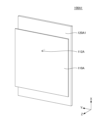
- FIG. 1 is a perspective view of a patch antenna according to embodiment 1.1.
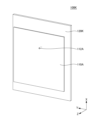
- FIG. 1 is a perspective view of a patch antenna according to a comparative example.
- 10A and 10B are diagrams for explaining an electric field distribution generated in a patch antenna according to a comparative example.
- 10A and 10B are diagrams for explaining an electric field distribution generated in a patch antenna according to a comparative example.
- FIG. 1 is a perspective view of a patch antenna according to embodiment 1.2.
- 1 is a graph showing the E-plane radiation pattern of a patch antenna according to embodiment 1.1.
- 1 is a graph showing the radiation pattern of the H-plane of a patch antenna according to embodiment 1.1.
- 13 is a graph showing the frequency characteristics of the voltage standing wave ratio (VSWR) of the patch antenna of embodiment 1.1.
- 13 is a graph showing the E-plane radiation pattern of a patch antenna according to embodiment 1.2.
- 13 is a graph showing the radiation pattern of the H-plane of the patch antenna according to embodiment 1.2.
- 13 is a graph showing the VSWR frequency characteristics of the patch antenna of embodiment 1.2.
- 11 is a graph showing an E-plane radiation pattern of a patch antenna according to a comparative example.
- FIG. 13 is a graph showing a radiation pattern of the H-plane of a patch antenna according to a comparative example.
- 11 is a graph showing VSWR frequency characteristics of a patch antenna according to a comparative example.
- FIG. 13 is a perspective view of a patch antenna according to embodiment 1.3.
- 13 is a graph showing the E-plane radiation pattern of a patch antenna according to embodiment 1.3.
- FIG. 13 is a perspective view of a patch antenna according to embodiment 1.4.
- 13 is a graph showing the E-plane radiation pattern of a patch antenna according to embodiment 1.4.
- An oblique view of a patch antenna related to embodiment 1.5 A graph showing the radiation pattern of the H plane of the patch antenna of embodiment 1.5.
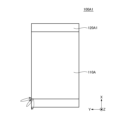
- FIG. 13 is a perspective view of a patch antenna according to variant example 1.1.
- FIG. 13 is a perspective view of a patch antenna according to variant example 1.2.
- FIG. 11 is a perspective view of a patch antenna according to a second embodiment.
- FIG. 27 is a perspective view of the opposite side of the patch antenna shown in FIG. 26.
- FIG. 29 is a perspective view of the opposite side of the patch antenna shown in FIG. 28.
- FIG. 31 is a perspective view of the opposite side of the patch antenna shown in FIG. 30.
- FIG. 13 is a graph showing the E-plane radiation patterns of a patch antenna according to embodiment 1.1, a patch antenna according to embodiment 2, a patch antenna according to embodiment 3.1, and a patch antenna according to embodiment 3.2.
- 13 is a graph showing radiation patterns of the H-plane of the patch antenna according to embodiment 1.1, the patch antenna according to embodiment 2, the patch antenna according to embodiment 3.1, and the patch antenna according to embodiment 3.2.
- 11 is a graph showing VSWR frequency characteristics of a patch antenna according to embodiment 1.1, a patch antenna according to embodiment 2, a patch antenna according to embodiment 3.1, and a patch antenna according to embodiment 3.2.
- FIG. 11 is a perspective view of an antenna device according to a fourth embodiment with the element and the case removed.
- FIG. 36 is a perspective view of the antenna device of embodiment 4 from the opposite side to FIG. 35 with the element, base and case removed.
- FIG. FIG. 11 is a partial cross-sectional view of an antenna device according to a fourth embodiment.
- 13 is an enlarged partial cross-sectional view of an antenna device according to a fourth embodiment with an element removed.
- FIG. 13A and 13B are diagrams illustrating a patch antenna according to a fifth embodiment.
- the patch antenna in the embodiment and modified examples of the present invention will be described as an antenna for linear polarization (particularly, for vertical polarization) applied to V2X (Vehicle to Everything) in the frequency band of 5850 to 5925 MHz, but is not limited thereto.
- the patch antenna may be applied to mobile communications such as LTE (Long Term Evolution) and 5G (5th generation) and telematics in these frequency bands.
- the application of the patch antenna is not limited to in-vehicle communication applications, and the patch antenna may be applied to applications such as IoT (Internet of Things), Local 5G, and wireless power transmission.
- the patch antenna may be mounted, for example, on the glass or instrument panel of the vehicle, on the spoiler, bumper, roof garnish, etc.
- patch antennas can also be installed on moving objects such as drones, vending machines, fare adjustment machines, local communication networks within factories, and other license-based communication equipment.
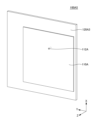
- FIG. 1 is a perspective view of a patch antenna 100A1 according to embodiment 1.1.
- the Z direction is perpendicular to element 110A, which will be described later.
- the X direction is one of the directions perpendicular to the Z direction.
- the Y direction is one of the directions perpendicular to the Z and X directions.
- the side indicated by the X-axis arrow will be referred to as the +X side
- the side opposite the side indicated by the X-axis arrow will be referred to as the -X side
- the side indicated by the Y-axis arrow will be referred to as the +Y side
- the side opposite the side indicated by the Y-axis arrow will be referred to as the -Y side
- the side indicated by the Z-axis arrow will be referred to as the +Z side
- the side opposite the side indicated by the Z-axis arrow will be referred to as the -Z side.
- the plane perpendicular to the X direction will be referred to as the YZ plane
- the plane perpendicular to the Y direction will be referred to as the ZX plane
- the direction perpendicular to the Z direction will be referred to as the XY plane.
- a white circle with a black dot pointing to the X-axis, Y-axis, or Z-axis indicates that the arrow of the axis indicated by the white circle is pointing to the front side of the paper.
- a white circle with an X pointing to the X-axis, Y-axis, or Z-axis indicates that the arrow of the axis indicated by the white circle is pointing to the back side of the paper.
- the patch antenna 100A1 includes an element 110A and a ground 120A1.
- the terms “side” of the element 110A and “outer edge” of the element 110A are synonymous, and the terms “side” of the ground 120A1 and “outer edge” of the ground 120A1 are synonymous.
- the element 110A is made of a conductor such as metal.
- the element 110A according to embodiment 1.1 is a metal plate.
- the element 110A may be a conductor pattern formed on a substrate such as a dielectric substrate, or may be formed on a resin structure by MID (Molded Interconnect Device) technology.
- the element 110A functions as a radiating element of the patch antenna 100A1.
- the element 110A has a substantially rectangular shape.
- the element 110A has a substantially square shape having a pair of sides substantially parallel to the X direction and another pair of sides substantially parallel to the Y direction.
- the shape of the element 110A is not limited to this example.
- Element 110A has a feed point 112A.
- the tip of a pin such as the core wire of a coaxial connector is electrically connected to feed point 112A.
- feed point 112A when viewed from the Z direction, is positioned offset toward the +X side with respect to the center of element 110A in the X and Y directions.
- the position of feed point 112A is not limited to the example shown in FIG. 1.
- the ground 120A1 is made of a conductor such as metal.
- the ground 120A1 in embodiment 1.1 is a metal plate.
- the ground 120A1 may be a conductor pattern formed on a substrate such as a dielectric substrate, or may be formed on a resin structure by MID (Molded Interconnect Device) technology.
- MID Molded Interconnect Device
- the ground 120A1 has a substantially rectangular shape.
- the ground 120A1 has a substantially rectangular shape having a pair of long sides substantially parallel to the X direction and a pair of short sides substantially parallel to the Y direction. That is, the ground 120A1 has a long side substantially parallel to the X direction and a short side substantially parallel to the Y direction.
- the long side of the ground 120A1 is parallel to the electric field plane of the patch antenna 100A1.
- the electric field plane of the patch antenna 100A1 is a plane parallel to the ZX plane.
- the short side of the ground 120A1 is parallel to the magnetic field plane of the patch antenna 100A1.
- the magnetic field plane of the patch antenna 100A1 is parallel to the YZ plane.
- the patch antenna 100A1 has a wave source on the short side of the ground 120A1.
- the -Z side surface of element 110A and the +Z side surface of ground 120A1 face each other at a predetermined distance in the Z direction.
- the area between the -Z side surface of element 110A and the +Z side surface of ground 120A1 is a space.
- a dielectric such as a dielectric substrate may be present between element 110A and ground 120A1.
- the average Y-direction length of the ground 120A1 is substantially equal to or less than the average Y-direction length of the element 110A. Specifically, the average Y-direction length of the ground 120A1 and the average Y-direction length of the element 110A are substantially equal.
- the average Y-direction length of the ground 120A1 is calculated by dividing the ground 120A1 into multiple figures of width t in the X-direction and calculating the average Y-direction length of each of the multiple divided figures at the limit where width t ⁇ 0.
- the average Y-direction length of the element 110A is also calculated by a similar method.
- the average Y-direction length of the ground 120A1 is the length of a pair of short sides of the ground 120A1 that are substantially parallel to the Y-direction. In embodiment 1.1, the average Y-direction length of the element 110A is the length of a pair of sides of the element 110A that are substantially parallel to the Y-direction.
- the length of A is substantially equal to or less than the length of B may include not only a state in which the length of A is equal to or less than the length of B, but also a state in which the lengths of A and B are approximately equal.
- the length of A and the length of B are approximately equal may include not only a state in which the lengths of A and B are completely equal, but also a state in which one of the lengths of A and B is larger or smaller than the other of the lengths of A and B by a specified percentage of the length of A or the length of B. The specified percentage refers to a range that a person skilled in the art would understand to be able to achieve the intended purpose by having the lengths of A and B completely equal.
- the average length of the ground 120A1 in the X direction is longer than the average length of the ground 120A1 in the Y direction.
- the average length of the ground 120A1 in the X direction is calculated by a method similar to that described in the method for calculating the average length of the ground 120A1 in the Y direction.
- the length of the ground 120A1 in the X direction is the length of a pair of long sides of the ground 120A1 that are approximately parallel to the X direction.
- the Y-direction lengths of both sides of element 110A in the X direction and the Y-direction lengths of both sides of ground 120A1 in the X direction are approximately equal.
- the geometric centers of element 110A in the X and Y directions and the geometric centers of ground 120A1 in the X and Y directions overlap each other in the Z direction.
- at least a portion of the +Y side of element 110A and at least a portion of the +Y side of ground 120A1 overlap each other in the Z direction.
- at least a portion of the -Y side of element 110A and at least a portion of the -Y side of ground 120A1 overlap each other in the Z direction.
- At least a portion of the outer edge of ground 120A1 and at least a portion of element 110A overlap each other in the Z direction.
- at least a portion of the outer edge of the ground 120A1 and at least a portion of the outer edge of the element 110A overlap each other in the Z direction.
- FIG. 2 is a perspective view of a patch antenna 100K according to a comparative example.
- the patch antenna 100K according to the comparative example is similar to the patch antenna 100A1 according to embodiment 1.1, except for the following points.
- the Y-direction length of both sides of the X-direction of the ground 120K is longer than the Y-direction length of both sides of the X-direction of the element 110A. That is, in the comparative example, the average Y-direction length of the ground 120K is greater than the average Y-direction length of the element 110A. Therefore, the +Y side of the ground 120K is shifted toward the +Y side relative to the +Y side of the element 110A. Also, the -Y side of the ground 120K is shifted toward the -Y side relative to the -Y side of the element 110A. Therefore, no part of the outer edge of the ground 120K in the comparative example overlaps with the element 110A in the Z direction.
- FIGS. 3 and 4 are diagrams for explaining the electric field distribution generated in patch antenna 100A1 according to embodiment 1.1.
- FIGS. 5 and 6 are diagrams for explaining the electric field distribution generated in patch antenna 100K according to the comparative example.
- a part of the electric field generated from the corner between the -X side side and the +Y side side of element 110A to ground 120A1 spreads toward the outside of the corner of element 110A in a direction perpendicular to the Z direction due to the fringing effect.
- a part of the electric field generated from the corner between the -X side side and the +Y side side of element 110A to ground 120K spreads toward the outside of the corner of element 110A in a direction perpendicular to the Z direction due to the fringing effect.
- FIG. 5 and 6 in the comparative example, a part of the electric field generated from the corner between the -X side side and the +Y side side of element 110A to ground 120K spreads toward the outside of the corner of element 110A in a direction perpendicular to the Z direction due to the fringing effect.
- the +Y side side of ground 120K is shifted toward the +Y side with respect to the +Y side side of element 110A.
- the +Y side side of ground 120A1 and the +Y side side of element 110A overlap each other in the Z direction. Therefore, in embodiment 1.1, the electric field generated from the above-mentioned corner of element 110A to ground 120A1 is more likely to spread toward the outside of the corner of element 110A in a direction perpendicular to the Z direction due to the fringing effect than in the comparative example.
- the gain of patch antenna 100A1 in a direction perpendicular to the Z direction can be increased more than in the comparative example, and the gain of patch antenna 100A1 in a direction parallel to the Z direction can be suppressed. Therefore, in embodiment 1.1, the back lobe of patch antenna 100A1 can be suppressed more than in the comparative example.
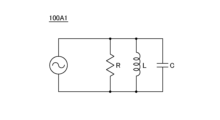
- FIG. 7 shows an equivalent circuit of patch antenna 100A1 according to embodiment 1.1.
- the element marked with R is a resistor
- the element marked with L is an inductor
- the element marked with C is a capacitor.
- the equivalent circuit of the patch antenna 100A1 according to embodiment 1.1 is an RLC parallel circuit in which a resistor, an inductor, and a capacitor are connected in parallel to an AC power source.
- the resistance in the equivalent circuit of the patch antenna 100A1 corresponds to the radiation resistance of the antenna, and the power consumed in the resistor is expressed as the power radiated from the antenna.
- the inductor and the capacitor are expressed as elements representing the frequency characteristics in the impedance of the equivalent circuit. The larger the impedance in the RLC parallel circuit, the larger the power consumed by the resistor.
- ⁇ 0 is the resonant angular frequency at which the impedance of the RLC parallel circuit is maximum
- ⁇ 1 is the angular frequency at which the impedance is (1/2) 1/2 times the maximum value on the low frequency side of the resonant angular frequency
- ⁇ 2 is the angular frequency at which the impedance is (1/2) 1/2 times the maximum value on the high frequency side of the resonant angular frequency.
- the smaller the Q factor the wider the bandwidth of the patch antenna.
- the capacitance C in the Q value of equation (1) becomes smaller as the ratio of the area of the ground perpendicular to the Z direction to the area of the element perpendicular to the Z direction becomes smaller.
- This ratio in embodiment 1.1 is smaller than that in the comparative example. Therefore, the Q value in embodiment 1.1 can be made smaller than the Q value in the comparative example. Therefore, the bandwidth of patch antenna 100A1 in embodiment 1.1 can be made wider than the bandwidth of patch antenna 100K in the comparative example.
- the capacitance C in the Q value of equation (1) becomes smaller as the distance in the Z direction between the -Z side surface of the element and the +Z side surface of the ground becomes longer. Therefore, in embodiment 1.1, the bandwidth of patch antenna 100A1 can be widened by increasing the distance in the Z direction between the -Z side surface of element 110A and the +Z side surface of ground 120A1.
- FIG. 8 is a perspective view of the patch antenna 100A2 according to embodiment 1.2.
- the patch antenna 100A2 according to embodiment 1.2 is similar to the patch antenna 100A1 according to embodiment 1.1, except for the following points.
- the Y-direction length of both sides of the X-direction of the ground 120A2 is less than the Y-direction length of both sides of the X-direction of the element 110A. Therefore, the +Y side of the ground 120A2 is shifted toward the -Y side with respect to the +Y side of the element 110A. Also, the -Y side of the ground 120A2 is shifted toward the +Y side with respect to the -Y side of the element 110A. Therefore, at least a portion of the outer edge of the ground 120A2 and at least a portion of the element 110A overlap with each other in the Z direction. In particular, in embodiment 1.2, at least a portion of the outer edge of the ground 120A2 and at least a portion of the inner side of the outer edge of the element 110A overlap with each other in the Z direction.
- the Q value in embodiment 1.2 can be made smaller than the Q value in the comparative example. Therefore, the bandwidth of patch antenna 100A2 in embodiment 1.2 can be made wider than the bandwidth of patch antenna 100K in the comparative example.
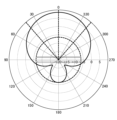
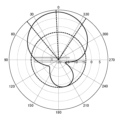
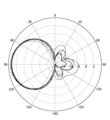
- FIG. 9 is a graph showing the radiation pattern of the E-plane of the patch antenna 100A1 according to embodiment 1.1.
- FIG. 10 is a graph showing the radiation pattern of the H-plane of the patch antenna 100A1 according to embodiment 1.1.
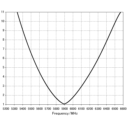
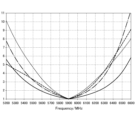
- FIG. 11 is a graph showing the frequency characteristics of the voltage standing wave ratio (VSWR) of the patch antenna 100A1 according to embodiment 1.1.
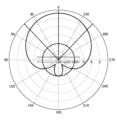
- FIG. 12 is a graph showing the radiation pattern of the E-plane of the patch antenna 100A2 according to embodiment 1.2.
- FIG. 13 is a graph showing the radiation pattern of the H-plane of the patch antenna 100A2 according to embodiment 1.2.
- FIG. 14 is a graph showing the frequency characteristics of the VSWR of the patch antenna 100A2 according to embodiment 1.2.
- FIG. 15 is a graph showing the radiation pattern of the E-plane of the patch antenna 100K according to the comparative example.
- FIG. 16 is a graph showing the radiation pattern of the H-plane of the patch antenna 100K according to the comparative example.
- FIG. 17 is a graph showing the frequency characteristics of the VSWR of the patch antenna 100K according to the comparative example.
- the E-plane is the electric field plane of the patch antenna 100A1.
- the E-plane is a plane parallel to the ZX plane.
- the numbers on the outermost periphery of the graph indicate the azimuth (unit: °).
- 0° and the 90° on the left side in the graph are the +X side and the +Z side, respectively.
- the numbers from the center of the graph to the 90° on the right side indicate the gain (unit: dBi).
- the solid line plot in the graph shows the 5900 MHz radiation pattern of the patch antenna 100A1.
- the dashed circle near -5 dBi in the graph indicates the maximum value of the gain on the -Z side of the radiation pattern.
- the dashed line extending from the center of the graph to the left near 90° indicates the direction in which the gain of the radiation pattern is maximum on the +Z side.
- the dashed line extending from the center of the graph to the left at approximately 60° and the dashed line extending from the center of the graph to the left at approximately 120° indicate the direction in which the gain of the radiation pattern on the +Z side is -3 dBi with respect to the maximum value. The same is true for the graphs in Figures 12 and 15.
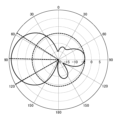
- the H plane is the magnetic field plane of the patch antenna 100A1.
- the H plane is a plane parallel to the YZ plane.
- the numbers on the outermost periphery of the graph indicate the azimuth (unit: °). 0° and 90° in the graph are the +Z side and the -Y side, respectively.
- the numbers from the center of the graph to 270° indicate the gain (unit: dBi).
- the solid line plot in the graph indicates the 5900 MHz radiation pattern of the patch antenna 100A1.
- the dashed circle near -5 dBi in the graph indicates the maximum value of the gain on the -Z side of the radiation pattern.
- the dashed line extending from the center of the graph to near 0° indicates the direction in which the gain of the radiation pattern is maximum on the +Z side.
- the dashed line extending from the center of the graph to near 45° and the dashed line extending from the center of the graph to near 315° indicate the direction in which the gain of the radiation pattern on the +Z side is -3 dBi with respect to the maximum value. The same applies to the graphs in Figures 13 and 16.
- the graph in Figure 11 will now be explained.
- the horizontal axis of the graph indicates frequency (unit: MHz).
- the vertical axis of the graph indicates VSWR. The same applies to the graphs in Figures 14 and 17.
- the back lobe of the E-plane in embodiment 1.1 and embodiment 1.2 is smaller than the back lobe of the E-plane in the comparative example. Therefore, when at least a portion of the outer edge of the ground and at least a portion of the element overlap in the Z direction, it can be said that the back lobe of the E-plane can be suppressed compared to a case where no part of the outer edge of the ground overlaps with the element in the Z direction.
- the directivity of the E-plane of patch antenna 100A1 according to embodiment 1.1 and the directivity of the E-plane of patch antenna 100A2 according to embodiment 1.2 are approximately parallel to the +Z side.
- the directivity of the E-plane of the patch antenna may vary depending on the X-directional offset between the geometric center of the element in the X and Y directions and the geometric center of the ground in the X and Y directions. Therefore, in embodiments 1.1 and 1.2, the directivity of the E-plane of the patch antenna can be made closer to the +Z side compared to the case where the geometric center of the element in the X and Y directions and the geometric center of the ground in the X and Y directions are offset from each other in the X direction.
- the back lobe of the H-plane in embodiment 1.1 and embodiment 1.2 is smaller than the back lobe of the H-plane in the comparative example. Therefore, when at least a portion of the outer edge of the ground and at least a portion of the element overlap in the Z direction, it can be said that the back lobe of the H-plane can be suppressed compared to a case where no part of the outer edge of the ground overlaps with the element in the Z direction.
- the directivity of the H plane of the patch antenna 100A1 according to embodiment 1.1 and the directivity of the H plane of the patch antenna 100A2 according to embodiment 1.2 are approximately parallel to the +Z side.
- the directivity of the H plane of the patch antenna may vary depending on the deviation in the Y direction between the geometric center of the element in the X direction and the Y direction and the geometric center of the ground in the X direction and the Y direction.
- the directivity of the H plane of the patch antenna can be made closer to the +Z side compared to the case where the geometric center of the element in the X direction and the Y direction and the geometric center of the ground in the X direction and the Y direction are offset from each other in the Y direction.
- the back lobe of the H-plane in embodiment 1.2 is smaller than the back lobe of the H-plane in embodiment 1.1. Therefore, when the average Y-direction length of the ground is less than the Y-direction length of the element, it can be said that the back lobe of the H-plane can be suppressed compared to when the average Y-direction length of the ground and the average Y-direction length of the element are approximately equal.
- the patch antennas according to embodiment 1.1, embodiment 1.2, and the comparative example are adjusted to resonate at 5900 MHz and have a VSWR of 1. Therefore, the patch antennas according to embodiment 1.1, embodiment 1.2, and the comparative example have a band centered on 5900 MHz.
- the VSWR is 3 or less from about 5680 MHz to about 6100 MHz.
- the VSWR is 3 or less from about 5650 MHz to about 6150 MHz.
- the VSWR is 3 or less from about 5720 MHz to about 6100 MHz.
- the ground has a substantially rectangular shape when viewed from the Z direction. Therefore, it is easier to shorten the average length of the ground in the Y direction compared to when the ground has a shape other than a substantially rectangular shape, such as a circle or trapezoid, when viewed in the Z direction.
- FIG. 18 is a perspective view of the patch antenna 100A3 according to embodiment 1.3.
- FIG. 19 is a graph showing the radiation pattern of the E-plane of the patch antenna 100A3 according to embodiment 1.3.
- the patch antenna 100A3 according to embodiment 1.3 is similar to the patch antenna 100A1 according to embodiment 1.1, except for the following points.
- the geometric center in the X and Y directions of element 110A and the geometric center in the X and Y directions of ground 120A3 are shifted from each other in the X direction. Specifically, when viewed from the Z direction, the geometric center in the X and Y directions of element 110A are shifted to the -X side with respect to the geometric center in the X and Y directions of ground 120A3. As shown in FIG. 19, the directivity of patch antenna 100A3 is inclined from the +Z side toward the -X side.
- the directivity of patch antenna 100A3 is inclined toward the shift direction of the geometric center in the X and Y directions of element 110A with respect to the geometric center in the X and Y directions of ground 120A3. Therefore, it can be said that the directivity of the patch antenna 100A3 can be adjusted according to the direction of deviation of the geometric center of the element 110A in the X and Y directions from the geometric center of the ground 120A3 in the X and Y directions.
- the -X side edge of element 110A and the -X side edge of ground 120A3 overlap each other in the Z direction. Therefore, when the geometric centers of element 110A in the X and Y directions and the geometric centers of ground 120A3 in the X and Y directions are offset from each other, the back lobe of patch antenna 100A3 can be suppressed compared to a case where no part of the outer edge of ground 120A3 overlaps with element 110A in the Z direction.
- FIG. 20 is a perspective view of the patch antenna 100A4 according to embodiment 1.4.
- FIG. 21 is a graph showing the radiation pattern of the E-plane of the patch antenna 100A4 according to embodiment 1.4.
- the patch antenna 100A4 according to embodiment 1.4 is similar to the patch antenna 100A1 according to embodiment 1.1, except for the following points.
- the +X side edge of element 110A and the +X side edge of ground 120A3 overlap each other in the Z direction. Therefore, when the geometric centers of element 110A in the X and Y directions and the geometric centers of ground 120A3 in the X and Y directions are offset from each other, the back lobe of patch antenna 100A4 can be suppressed compared to a case where no part of the outer edge of ground 120A3 overlaps with element 110A in the Z direction.
- FIG. 22 is a perspective view of the patch antenna 100A5 according to embodiment 1.5.
- FIG. 23 is a graph showing the radiation pattern of the H-plane of the patch antenna 100A5 according to embodiment 1.5.
- the patch antenna 100A5 according to embodiment 1.5 is similar to the patch antenna 100A1 according to embodiment 1.1, except for the following points.
- the -Y side edge of element 110A and the -Y side edge of ground 120A3 overlap each other in the Z direction. Therefore, when the geometric centers of element 110A in the X and Y directions and the geometric centers of ground 120A3 in the X and Y directions are offset from each other, the back lobe of patch antenna 100A5 can be suppressed compared to a case where no part of the outer edge of ground 120A3 overlaps with element 110A in the Z direction.
- the directivity of the patch antenna can be tilted in the direction of deviation of the geometric center of the element in the X and Y directions from the geometric center of the ground in the X and Y directions.
- the directivity of the patch antenna can also be tilted in the direction of deviation of the feed point from the position of the feed point when the directivity of the patch antenna is directed to the +Z side.
- the position of the feed point when the directivity of the patch antenna is directed to the +Z side is referred to as the reference position.
- the directivity of the patch antenna is tilted from the +Z side to the +X side, -X side, +Y side, or -Y side, respectively.
- the directivity of the patch antenna when viewed from the Z direction, if the position of the feed point is shifted from the reference position to the +X and +Y sides, -X and +Y sides, -X and -Y sides, or +X and -Y sides, the directivity of the patch antenna will tilt from the +Z side toward the +X and +Y sides, -X and +Y sides, -X and -Y sides, or +X and -Y sides, respectively.
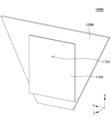
- FIG. 24 is a perspective view of a patch antenna 100M according to modification 1.1.
- the patch antenna 100M according to modification 1.1 is similar to the patch antenna 100M according to embodiment 1.1, except for the following points.
- the ground 120M has a substantially trapezoidal shape when viewed from the Z direction. That is, in variant 1.1, the ground 120M has a shape other than a square or rectangle when viewed from the Z direction. Specifically, when viewed from the Z direction, the ground 120M has an isosceles trapezoidal shape having a pair of bases that are substantially parallel to the Y direction. The length in the Y direction of the base on the -X side of the ground 120M is less than the length in the Y direction of the base on the +X side of the ground 120M.
- At least a portion of the outer edge of ground 120M and at least a portion of element 110A overlap each other in the Z direction.
- the +Y side of ground 120M and the corner between the -X side and -Y side of element 110A overlap each other in the Z direction.
- the -Y side of ground 120M and the corner between the -X side and +Y side of element 110A overlap each other in the Z direction. Therefore, the back lobe of patch antenna 100M can be suppressed compared to a case where no part of the outer edge of ground 120M overlaps with element 110A in the Z direction.
- the ratio of the area perpendicular to the Z direction of ground 120M to the area perpendicular to the Z direction of element 110A can be made smaller than when both parts of the Y direction sides of ground 120M are located outside the Y direction of both Y direction sides of element 110A when viewed from the Z direction. Therefore, in variant 1.1, the bandwidth of patch antenna 100M can be made wider than in the above-mentioned case.
- the ground 120M may have a long side that is approximately parallel to the X direction and a short side that is approximately parallel to the Y direction.
- the average Y direction length of the ground 120M may be substantially equal to or less than the average Y direction length of the element 110A.
- the back lobe of the patch antenna 100M can be suppressed as described in embodiment 1.1, compared to when the average Y direction length of the ground 120M is longer than the average Y direction length of the element 110A.
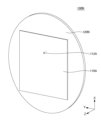
- FIG. 25 is a perspective view of a patch antenna 100N according to modification 1.2.
- the patch antenna 100N according to modification 1.2 is similar to the patch antenna 100A1 according to embodiment 1.1, except for the following points.
- the ground 120N has a substantially circular shape when viewed from the Z direction.
- the ground 120N may have a substantially elliptical shape when viewed from the Z direction.
- the outer edge of the ground 120N and at least a portion of the element 110A overlap in the Z direction.
- the +Y side outer edge of the ground 120N overlaps in the Z direction with the corner between the +X side side and the +Y side side of the element 110A and the corner between the -X side side and the +Y side side of the element 110A.
- the -Y side outer edge of the ground 120N overlaps in the Z direction with the corner between the +X side side and the -Y side side of the element 110A and the corner between the -X side side and the -Y side side of the element 110A. Therefore, the back lobe of the element 110A can be suppressed compared to a case where no part of the outer edge of the ground 120N overlaps with the element 110A in the Z direction.
- the ratio of the area perpendicular to the Z direction of ground 120N to the area perpendicular to the Z direction of element 110A can be made smaller than when any part of the outer edge of ground 120N is located outside the outer edge of element 110A in a direction perpendicular to the Z direction as viewed in the Z direction. Therefore, in variant 1.2, the bandwidth of patch antenna 100N can be made wider than in the above-mentioned case.
- the ground 120N may have a long side that is approximately parallel to the X direction and a short side that is approximately parallel to the Y direction.
- the average Y direction length of the ground 120N may be substantially equal to or less than the average Y direction length of the element 110A.
- the back lobe of the patch antenna 100N can be suppressed as described in embodiment 1.1, compared to when the average Y direction length of the ground 120N is longer than the average Y direction length of the element 110A.
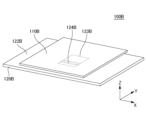
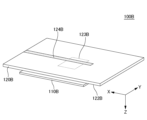
- FIG. 26 is a perspective view of a patch antenna 100B according to embodiment 2.
- FIG. 27 is a perspective view of the opposite side of the patch antenna 100B shown in FIG. 26.
- the patch antenna 100B according to embodiment 2 is similar to the patch antenna 100A1 according to embodiment 1.1, except for the following points.
- the patch antenna 100B in the second embodiment includes an element 110B and a substrate 120B.
- Substrate 120B is, for example, a dielectric substrate such as a resin substrate. As shown in Figures 26 and 27, when viewed from the Z direction, substrate 120B has a substantially quadrangular shape. Specifically, substrate 120B has a substantially rectangular shape having a pair of long sides substantially parallel to the X direction and a pair of short sides substantially parallel to the Y direction. That is, substrate 120B has a long side substantially parallel to the X direction and a short side substantially parallel to the Y direction.
- the ground conductor pattern 122B is located on the +Z side surface of the substrate 120B.
- the ground conductor pattern 122B is formed on the +Z side surface of the substrate 120B by patterning, for example.
- the ground conductor pattern 122B defines a slot 123B at approximately the center of the ground conductor pattern 122B in the X and Y directions.
- the slot 123B has an approximately rectangular shape having a pair of short sides approximately parallel to the X direction and a pair of long sides approximately parallel to the Y direction.
- the -Z side surface of the element 110B and the slot 123B face each other at a predetermined distance in the Z direction.
- the ground conductor pattern 122B covers the entire +Z side surface of the substrate 120B except for the slot 123B.
- the power feed line 124B is located on the -Z side surface of the substrate 120B.
- the power feed line 124B is formed on the -Z side surface of the substrate 120B by patterning, for example.
- the power feed line 124B is, for example, a microstrip line.
- the power feed line 124B extends approximately parallel to the X direction from the center in the Y direction of the short side on the +X side of the substrate 120B. When viewed from the Z direction, the power feed line 124B has one end that is open a predetermined distance away from the long side on the -X side of the slot 123B on the -X side.
- the slot 123B operates as a first resonator that resonates at a desired resonant frequency, i.e., a first radiating element.
- the element 110B operates as a second resonator that resonates at a resonant frequency approximately equal to the resonant frequency of the first resonator, i.e., a second radiating element.
- the ground conductor pattern 122B according to the second embodiment operates as the ground of the patch antenna 100B in the same manner as the ground 120A1 according to the first embodiment.
- the resonant frequency of the element 110B is determined mainly according to the relationship between the element 110B and the ground.
- the resonant frequency of the slot 123B may vary according to the conditions of the element 110B and the slot 123B, such as the presence or absence of the element 110B.
- the slot 123B when the element 110B resonates at a desired resonant frequency, the slot 123B can resonate at a resonant frequency approximately equal to the resonant frequency of the element 110B.
- the length in the Y direction of both sides of the X direction of the element 110B is approximately equal to the length in the Y direction of both sides of the X direction of the ground conductor pattern 122B.
- the geometric center in the X direction and the Y direction of the element 110B and the geometric center in the X direction and the Y direction of the ground conductor pattern 122B overlap each other in the Z direction. Therefore, the +Y side of the element 110B and the +Y side of the ground conductor pattern 122B overlap each other in the Z direction.
- the -Y side of the element 110B and the -Y side of the ground conductor pattern 122B overlap each other in the Z direction.
- the back lobe of the patch antenna 100B can be suppressed compared to the case where none of the parts of the outer edge of the ground conductor pattern 122B overlaps with the element 110B in the Z direction.
- the bandwidth of the patch antenna 100B can be made wider than when the Y-direction length of both sides of the ground conductor pattern 122B in the X-direction is longer than the Y-direction length of both sides of the element 110B in the X-direction.
- the element 110B according to the second embodiment is a parasitic element. Specifically, the element 110B according to the second embodiment is not electrically connected to a pin such as a core wire of a coaxial cable. In an equivalent circuit including the pin and the patch antenna, the pin may act as an inductive reactance connected in series to an RLC parallel circuit. Therefore, the inductive reactance in the equivalent circuit of the patch antenna 100B according to the second embodiment can be made smaller than the inductive reactance in the equivalent circuit of the patch antenna 100A1 according to the first embodiment by the amount corresponding to the absence of the pin. Therefore, the bandwidth of the patch antenna 100B according to the second embodiment can be made wider than the bandwidth of the patch antenna 100A1 according to the first embodiment.
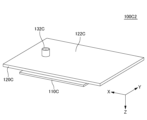
- FIG. 28 is a perspective view of the patch antenna 100C1 according to embodiment 3.1.
- FIG. 29 is a perspective view of the opposite side of the patch antenna 100C1 shown in FIG. 28.
- the patch antenna 100C1 according to embodiment 3.1 is similar to the patch antenna 100B according to embodiment 2, except for the following points.
- the patch antenna 100C1 of embodiment 3.1 includes an element 110C, a substrate 120C, and a connector 130C.
- the first ground conductor pattern 122C is located on the -Z side surface of the substrate 120C.
- the first ground conductor pattern 122C is formed on the -Z side surface of the substrate 120C by patterning, for example.
- the first ground conductor pattern 122C covers the entire -Z side surface of the first ground conductor pattern 122C.
- the second ground conductor pattern 124C is located on the +Z side surface of the substrate 120C.
- the second ground conductor pattern 124C is formed on the +Z side surface of the substrate 120C by patterning, for example.
- the second ground conductor pattern 124C defines an opening 125C at approximately the center of the second ground conductor pattern 124C in the X and Y directions.
- the opening 125C has a substantially rectangular shape having a pair of long sides substantially parallel to the X direction and a pair of short sides substantially parallel to the Y direction.
- the second ground conductor pattern 124C covers the entire +Z side surface of the substrate 120C except for the opening 125C.
- the first ground conductor pattern 122C and the second ground conductor pattern 124C are electrically connected to each other, for example, via through holes provided inside the substrate 120C.
- through holes provided inside the substrate 120C.
- multiple through holes are arranged along the outer edge of the opening 125C.
- the layout of the through holes is not limited to this example.
- an open stub 126C is located inside an opening 125C on the +Z side surface of the substrate 120C.
- the open stub 126C is formed on the +Z side surface of the substrate 120C, for example, by patterning. Therefore, the second ground conductor pattern 124C and the open stub 126C are located on approximately the same plane.
- the open stub 126C extends approximately parallel to the X direction.
- the -Z side surface of the element 110C and the +Z side surface of the open stub 126C face each other at a predetermined distance in the Z direction.
- the connector 130C according to embodiment 3.1 is a coaxial connector. As shown in FIG. 29, the connector 130C is located on the -Z side of the substrate 120C. The +Z side end of the core wire of the connector 130C and the +X side end of the open stub 126C are electrically connected to each other by a connection method such as soldering.
- the open stub 126C operates as a first resonator that resonates at a desired resonant frequency, i.e., a first radiating element.
- the element 110C operates as a second resonator that resonates at a resonant frequency substantially equal to the resonant frequency of the first resonator, i.e., a second radiating element.
- the first ground conductor pattern 122C and the second ground conductor pattern 124C according to embodiment 3.1 operate as the ground of the patch antenna 100C1 in the same manner as the ground 120A1 according to embodiment 1.1.
- the resonant frequency of the element 110C is determined mainly according to the relationship between the element 110C and the ground.
- the resonant frequency of the open stub 126C may vary according to the relationship between the element 110C and the open stub 126C, such as the presence or absence of the element 110C.
- the open stub 126C can resonate at a resonant frequency substantially equal to the resonant frequency of the element 110C when the element 110C resonates at a desired resonant frequency.
- the Y-direction length of both sides of the X-direction of the element 110C is approximately equal to the Y-direction length of both sides of the X-direction of each of the first ground conductor pattern 122C and the second ground conductor pattern 124C.
- the geometric centers of the element 110C in the X-direction and the geometric centers of the first ground conductor pattern 122C and the second ground conductor pattern 124C in the X-direction and the Y-direction overlap each other in the Z-direction. Therefore, the +Y side of the element 110C and the +Y side of each of the first ground conductor pattern 122C and the second ground conductor pattern 124C overlap each other in the Z-direction.
- the -Y side of the element 110C and the -Y side of each of the first ground conductor pattern 122C and the second ground conductor pattern 124C overlap each other in the Z-direction. Therefore, as in embodiment 1.1, the back lobe of the patch antenna 100C1 can be suppressed compared to a case where none of the outer edges of the first ground conductor pattern 122C and the second ground conductor pattern 124C overlaps with the element 110C in the Z direction.
- the bandwidth of the patch antenna 100C1 can be widened compared to a case where the Y-direction lengths of both sides in the X direction of the first ground conductor pattern 122C and the second ground conductor pattern 124C are longer than the Y-direction lengths of both sides in the X direction of the element 110C.
- the element 110C according to embodiment 3.1 is a parasitic element. Specifically, the element 110C according to embodiment 3.1 is not electrically connected to a pin such as the core wire of a coaxial cable. Therefore, similar to embodiment 2, the bandwidth of the patch antenna 100C1 according to embodiment 3.1 can be made wider than the bandwidth of the patch antenna 100A1 according to embodiment 1.1.
- FIG. 30 is a perspective view of a patch antenna 100C2 according to embodiment 3.2.
- FIG. 31 is a perspective view of the opposite side of the patch antenna 100C2 shown in FIG. 30.
- the patch antenna 100C2 according to embodiment 3.2 is similar to the patch antenna 100C1 according to embodiment 3.1, except for the following points.
- a ground conductor pattern corresponding to the second ground conductor pattern 124C in embodiment 3.1 is not located on the +Z side surface of the substrate 120C. Therefore, the +Z side surface of the substrate 120C is exposed toward the +Z side except for the area where the open stub 126C is located.
- the only conductor pattern that operates as a ground is the first ground conductor pattern 122C. Therefore, in embodiment 3.2, the ground is located on the opposite side of the open stub 126C from the side where the element 110C is located. In other words, the ground is not located on the same plane as the open stub 126C. Therefore, in embodiment 3.2, the distance in the Z direction between the element 110C and the ground can be made longer than in embodiment 3.1. Therefore, in embodiment 3.2, the electric field generated from both sides of the element 110C in the Y direction to both sides of the ground in the Y direction can be made to spread outward in the Y direction due to the fringing effect, compared to embodiment 3.1.
- the back lobe of the patch antenna 100C2 can be suppressed more than in embodiment 3.1.
- the capacitance C in the Q value of equation (1) can be made smaller than in embodiment 3.1. That is, the Q value in embodiment 3.2 can be made smaller than the Q value in embodiment 3.1. Therefore, the bandwidth of the patch antenna 100C2 according to embodiment 3.2 can be made wider than the bandwidth of the patch antenna 100C1 according to embodiment 3.1.
- FIG. 32 is a graph showing the radiation patterns of the E-plane of the patch antenna 100A1 according to embodiment 1.1, the patch antenna 100B according to embodiment 2, the patch antenna 100C1 according to embodiment 3.1, and the patch antenna 100C2 according to embodiment 3.2.
- FIG. 33 is a graph showing the radiation patterns of the H-plane of the patch antenna 100A1 according to embodiment 1.1, the patch antenna 100B according to embodiment 2, the patch antenna 100C1 according to embodiment 3.1, and the patch antenna 100C2 according to embodiment 3.2.
- FIG. 34 is a graph showing the VSWR frequency characteristics of the patch antenna 100A1 according to embodiment 1.1, the patch antenna 100B according to embodiment 2, the patch antenna 100C1 according to embodiment 3.1, and the patch antenna 100C2 according to embodiment 3.2.
- the dotted line pattern, dashed line pattern, dot-dash line pattern, and solid line pattern respectively show the radiation patterns of the E-plane of embodiment 1.1, embodiment 2, embodiment 3.1, and embodiment 3.2.
- the dotted line pattern, dashed line pattern, dot-dash line pattern, and solid line pattern respectively show the radiation patterns of the H-plane of embodiment 1.1, embodiment 2, embodiment 3.1, and embodiment 3.2.
- the dotted line pattern, dashed line pattern, dot-dash line pattern, and solid line pattern respectively show the VSWR of embodiment 1.1, embodiment 2, embodiment 3.1, and embodiment 3.2.
- the ground has long and short sides in the X and Y directions, respectively, and the average length of the ground in the Y direction and the average length of the element in the Y direction are approximately equal.
- the back lobes of the E-plane and H-plane in embodiment 2, embodiment 3.1, and embodiment 3.2 are smaller than the back lobes of the E-plane and H-plane in embodiment 1.1. Therefore, it can be said that the back lobe of the patch antenna can be suppressed more effectively when a slot or stub is provided than when the element is electrically connected to a pin such as the core wire of a coaxial cable.
- the back lobes of the E and H planes in embodiment 3.2 are smaller than those of the E and H planes in embodiment 3.1. Therefore, it can be said that the back lobe of the patch antenna can be suppressed more when the ground is located on the opposite side of the open stub from the side where the element is located than when the open stub and the ground conductor pattern are located on approximately the same plane.
- the bandwidth in embodiment 3.2 is wider than the bandwidth in embodiment 3.1. Therefore, it can be said that the bandwidth of the patch antenna can be wider when the ground is located on the opposite side of the open stub from the side where the element is located than when the open stub and the ground conductor pattern are located on approximately the same plane.
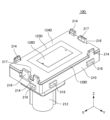
- Figure 35 is a perspective view of the antenna device 10D of embodiment 4 with the element 110D and case 220 removed.
- Figure 36 is a perspective view of the antenna device 10D of embodiment 4 with the element 110D, base 210, and case 220 removed, from the opposite side to Figure 35.
- Figure 37 is a partial cross-sectional view of the antenna device 10D of embodiment 4.
- Figure 38 is an enlarged partial cross-sectional view of the antenna device 10D of embodiment 4 with the element 110D removed.
- Figures 37 and 38 show a cross section parallel to the ZX plane at the center of the case 220 in the Y direction.
- the antenna device 10D according to the fourth embodiment includes a patch antenna 100D, a base 210, and a case 220.
- the patch antenna 100D according to the fourth embodiment includes an element 110D, a substrate 120D, and a connector 130D, similar to the patch antenna 100C1 according to the third embodiment.
- the substrate 120D according to the fourth embodiment includes a first ground conductor pattern 122D, a second ground conductor pattern 124D, and an open stub 126D, similar to the substrate 120C according to the third embodiment.
- the four sides of the substrate 120D define four first notches 120Da.
- the short sides on both sides in the X direction of the substrate 120D define a pair of second notches 120Db.
- the second ground conductor pattern 124D according to embodiment 4 defines an opening 125D in the same manner as the second ground conductor pattern 124C according to embodiment 3.1.
- a ground conductor pattern corresponding to the second ground conductor pattern 124D may not be provided.
- the back lobe of the patch antenna 100D can be suppressed more when a ground corresponding to the second ground conductor pattern 124D is not provided than when the second ground conductor pattern 124D is provided.
- the bandwidth of the patch antenna 100D can be made wider when a ground corresponding to the second ground conductor pattern 124D is not provided than when the second ground conductor pattern 124D is provided.
- the base 210 is made of resin.
- the base 210 may be made of a material other than resin.
- the base 210 when viewed from the Z direction, has a substantially rectangular shape having a pair of long sides substantially parallel to the X direction and a pair of short sides substantially parallel to the Y direction.
- the insertion portion 212 extends from the -Z side surface of the base 210 toward the -Z side. As shown in Figures 35 and 36, the insertion portion 212 is provided at a position overlapping the connector 130D in the Z direction when the board 120D is mounted on the +Z side surface of the base 210. Therefore, when the board 120D is mounted on the +Z side surface of the base 210, the connector 130D is inserted into the insertion portion 212.
- the base 210 and the insertion portion 212 are integrally formed. Therefore, the fixing of the board 120D to the base 210 and the insertion of the connector 130D into the insertion portion 212 can be performed with a single part.
- the connector 130D can be connected to a cable such as a coaxial cable. Therefore, the load caused by the connection of the connector 130D and the cable can be received by the base 210. This makes it possible to prevent stress from being applied to the connection, such as the solder joint, between the -Z side surface of the substrate 120D and the +Z side end of the connector 130D.
- positioning ribs 214 extend from the four sides of the base 210 toward the +Z side.
- a pair of positioning ribs 214 provided on both short sides of the base 210 in the X direction are positioned so as to be offset to opposite sides in the Y direction from the center of each short side of the base 210 in the Y direction.
- the positioning rib 214 provided on the short side on the +X side of the base 210 is offset to the +Y side from the center of the short side in the Y direction
- the positioning rib 214 provided on the short side on the -X side of the base 210 is offset to the -Y side from the center of the short side in the Y direction.
- the other pair of positioning ribs 214 provided on both long sides of the base 210 in the Y direction are positioned so as to be offset to opposite sides in the X direction from the center of the long sides of the base 210 in the X direction.
- the positioning rib 214 provided on the long side on the +Y side of the base 210 is offset to the -X side with respect to the center of the long side in the X direction
- the positioning rib 214 provided on the long side on the -Y side of the base 210 is offset to the +X side with respect to the center of the long side in the X direction.
- the number and arrangement of the positioning ribs 214 are not limited to the example shown in FIG. 35.
- the four positioning ribs 214 fit into the four first notches 120Da of the substrate 120D when the substrate 120D is mounted on the +Z side surface of the base 210. Therefore, the substrate 120D can be positioned by the four first notches 120Da and the four positioning ribs 214.
- the structure for positioning the substrate 120D is not limited to the first notches 120Da and the positioning ribs 214.
- a pair of protruding pieces 216 extend from both short sides of the base 210 in the X direction toward the +Z side.
- the pair of protruding pieces 216 are located at approximately the center of each short side of the base 210 in the Y direction.
- a temporary holding claw 217 extends from the end on the +Z side of each protruding piece 216 toward the substrate 120D.
- the number and arrangement of the protruding pieces 216 are not limited to this example.
- the pair of protruding pieces 216 fit into the pair of second notches 120Db of the substrate 120D when the substrate 120D is mounted on the +Z side surface of the base 210.
- both ends of the substrate 120D in the X direction are located between the +Z side surface of the base 210 and the -Z side surfaces of the pair of temporary holding claws 217. Therefore, the substrate 120D can be temporarily held by the base 210 and the temporary holding claws 217.
- the structure for temporarily holding the substrate 120D is not limited to the second notches 120Db and the protruding pieces 216.
- the base 210 has protruding portions such as a positioning rib 214 and a protruding piece 216 that extend in the Z direction toward the side where the element 110D is located.
- the base 210 can hold the board 120D by the protruding portions such as the positioning rib 214 and the protruding piece 216. Therefore, the antenna device 10D can be assembled with the board 120D held by the protruding portions such as the positioning rib 214 and the protruding piece 216. Therefore, it is possible to prevent the load during the assembly work of the antenna device 10D from being applied to the connection portion such as the solder joint between the -Z side surface of the board 120D and the +Z side end of the connector 130D.
- the case 220 includes a top plate 222 and side plates 224.
- the top plate 222 When viewed from the Z direction, the top plate 222 has a generally rectangular shape with a pair of long sides generally parallel to the X direction and a pair of short sides generally parallel to the Y direction.
- the side plates 224 extend from the entire periphery of the top plate 222 in the Z direction toward the -Z side.
- a storage space for storing the patch antenna 100D is formed between the +Z side surface of the base 210 and the -Z side surface of the top plate 222.
- approximately half of the -Z side of the side plate 224 covers the side surface around the Z direction of the base 210.
- a plurality of engagement protrusions 218 are provided on the side surface around the Z direction of the base 210.
- the engagement protrusions 218 engage with recesses provided on the inner surface of approximately half of the -Z side of the side plate 224.
- a gap that serves as a storage space is formed between the +Z side surface of the base 210 and the -Z side surface of the top plate 222.
- a pair of fins 223 extend from the -Z side surface of the top plate 222.
- the pair of fins 223 face each other approximately parallel to the X direction. Notches into which the pair of fins 223 engage are provided on both sides of the element 110D in the X direction. Therefore, the pair of fins 223 can be inserted into the notches on both sides of the element 110D in the X direction to position the element 110D relative to the case 220.
- the pair of fins 223 function as positioning ribs that position the element 110D.
- the element 110D and the case 220 may be fixed to each other by engaging the pair of fins 223 with the notches on both sides of the element 110D in the X direction.
- the element 110D and the case 220 may be further fixed to each other by other fixing methods such as double-sided tape, snap fit, heat fusion, etc., or may not be fixed to each other by other fixing methods.
- a pressing portion 225 is provided on the inner surface of approximately half of the +Z side of the side plate 224.
- the -Z side end of the pressing portion 225 and the +Z side surface of the +X side end of the board 120D are in contact with each other. Therefore, the +X side end of the board 120D is sandwiched between the pressing portion 225 and the +X side end of the base 210. Therefore, the positions of the element 110D and the board 120D can be determined by one part of the case 220. Therefore, the variation in the positions of the element 110D and the board 120D can be reduced compared to when the positions of the element 110D and the board 120D are determined by multiple parts.
- the bandwidth of the patch antenna 100D according to the fourth embodiment can be made relatively wide, similar to the bandwidth of the patch antenna 100C1 according to the third embodiment.
- the allowable variation in the position of each component of the antenna device 10D can be made relatively large. This makes it possible to eliminate the need for a relatively complicated structure or method for reducing the variation in the position of each component, such as a component structure for reducing the variation in the position of each component, the addition of other components for reducing the variation in the position of each component, or the use of a special jig to manage the variation in the position of each component.
- the structure of the antenna device 10D can be simplified and the antenna device 10D can be easily assembled, compared to the case where such a relatively complicated structure or method is used.
- FIG. 39 is a diagram showing a patch antenna 100E according to embodiment 5.
- the patch antenna 100E according to embodiment 5 is similar to the patch antenna 100A1 according to embodiment 1.1, except for the following points.
- the patch antenna 100E according to the fifth embodiment includes an element 110E and a substrate 120E.
- the element 110E is a parasitic element.
- the substrate 120E according to the fifth embodiment is a ceramic substrate. However, the substrate 120E may be a substrate other than a ceramic substrate.
- a ground conductor 122E is located on the -Z side surface of the substrate 120E.
- a radiating conductor 124E is located on the +Z side surface of the substrate 120E.
- the radiating conductor 124E operates as a resonator that resonates at a predetermined resonant frequency.
- the -Z side surface of the element 110E and the +Z side surface of the radiating conductor 124E face each other at a predetermined distance in the Z direction.
- the back lobe of the patch antenna 100E can be suppressed compared to a case where none of the Y-direction sides of the ground conductor 122E overlaps with the element 110E in the Z direction.
- the bandwidth of the patch antenna 100E can be made wider compared to a case where the Y-direction sides of the ground conductor 122E are positioned outward in the Y direction relative to the Y-direction sides of the element 110E when viewed from the Z direction.
- the length in the Y direction of the short sides on both sides in the X direction of the ground may be less than the length in the Y direction of the sides on both sides in the X direction of the element, as in the patch antenna according to embodiment 1.2.
- the ground may have a shape other than a square or a rectangle when viewed from the Z direction, as in the patch antennas according to modification 1.1 and modification 1.2.
- the geometric centers of the element in the X direction and the Y direction and the geometric centers of the ground in the X direction and the Y direction may be shifted from each other when viewed from the Z direction, as in the patch antennas according to embodiment 1.3, embodiment 1.4, and embodiment 1.5.
- a patch antenna and an antenna device having the following aspects.
- a patch antenna comprises an element and a ground facing the element at a predetermined distance in a predetermined direction, the ground having a shape having a long side and a short side, and the average length of the short side of the ground is substantially less than or equal to the average length of the element approximately parallel to the short side of the ground.
- the "predetermined direction” corresponds to the "Z direction" in the above-described embodiment and modified examples.
- the electric field generated from the element to the ground can be made to spread more easily toward the outside of the element due to the fringing effect, compared to when the average length of the short side of the ground is longer than the length of the ground of the element that is approximately parallel to the short side. Therefore, compared to the above-mentioned case, the back lobe of the patch antenna can be suppressed.
- the patch antenna comprises an element and a ground facing the element at a predetermined distance in a predetermined direction, and at least a portion of an outer edge of the ground and at least a portion of the element overlap each other in the predetermined direction.
- the "predetermined direction” corresponds to the "Z direction" in the above-described embodiment and modified examples.
- the fringing effect makes it easier for the electric field generated from the element to the ground to spread outward from the element, compared to a case where no part of the outer edge of the ground overlaps with the element in a specified direction. Therefore, compared to the above-mentioned case, the back lobe of the patch antenna can be suppressed.
- the ground has a shape having a longitudinal direction substantially parallel to a predetermined first direction, and at least the portion of the outer edge of the ground is located on a second direction side perpendicular to the first direction.
- the "first direction” corresponds to the "X direction” in the above embodiment
- the “second direction” corresponds to the "Y direction” in the above embodiment.
- the back lobe of the patch antenna can be suppressed compared to a case where no part of the outer edge of the ground overlaps with the element in a specified direction.
- the element has a substantially quadrangular shape, and the ground has a substantially rectangular shape.
- the back lobe of the patch antenna can be suppressed compared to a case where no part of the outer edge of the ground overlaps with the element in a specified direction.
- the length of a short side of the ground is equal to or less than the length of a side of the element that is substantially parallel to the short side of the ground.
- At least a portion of the long side of the ground and at least a portion of the element can be overlapped in a predetermined direction. Therefore, as in embodiment 1, the back lobe of the patch antenna can be suppressed compared to a case where no part of the outer edge of the ground overlaps with the element in the predetermined direction.
- the directivity of the patch antenna can be adjusted according to the direction of deviation of the geometric center of the element from the geometric center of the ground.
- the patch antenna further includes a first resonator facing the element, and the element is a parasitic element.
- the "first resonator” corresponds to the "slot,” “open stub,” and “radiating conductor” in the above-mentioned embodiments.
- the element is not electrically connected to a pin such as the core wire of a coaxial cable. Therefore, the inductive reactance in the equivalent circuit of the patch antenna can be reduced compared to when the element has a feed point. Therefore, the bandwidth of the patch antenna can be increased compared to when the element has a feed point.
- the first resonator and the ground are conductor patterns formed on a substrate, and at least a portion of the ground and the first resonator are located on approximately the same plane.
- the back lobe of the patch antenna can be suppressed compared to a case where no part of the outer edge of the ground overlaps with the element in a specified direction.
- the first resonator and the ground are conductor patterns formed on a substrate, and the ground is located on the opposite side of the first resonator from the side on which the element is located.
- the distance between the element and the ground can be made longer compared to when the ground and the first resonator are located on the same plane. Therefore, compared to the above-mentioned case, the electric field generated from the element to the ground can be made to spread more easily toward the outside of the element due to the fringing effect. Therefore, compared to the above-mentioned case, the back lobe of the patch antenna can be suppressed.
- the capacitance at the Q value of the patch antenna can be made smaller compared to the above-mentioned case. Therefore, compared to the above-mentioned case, the bandwidth of the patch antenna can be made wider.
- the first resonator is located between the element and the ground.
- the back lobe of the patch antenna can be suppressed, as in embodiment 1, compared to when no part of the outer edge of the ground overlaps with the element in a specified direction.
- the first resonator is an open stub.
- the element does not need to be electrically connected to a pin such as the core wire of a coaxial cable. Therefore, the inductive reactance in the equivalent circuit of the patch antenna can be made smaller compared to when the element has a feed point. Therefore, the bandwidth of the patch antenna can be made wider compared to when the element has a feed point.
- an antenna device includes the above-mentioned patch antenna, and a base and a case that form an accommodation space for accommodating the patch antenna, and the element is fixed to the case.
- a space can be secured between the element and the ground.
- the positions of the element and the ground can be determined by a single part of the case. Therefore, the variation in the positions of the element and the ground can be reduced compared to when the positions of the element and the ground are determined by multiple parts.
- the base has a protrusion extending in the predetermined direction toward the side on which the element is located.
- protrusion corresponds to the "positioning rib” and “protruding piece” in the above embodiment.
- the base can hold the ground by the convex portion. Therefore, the antenna device can be assembled with the ground held by the convex portion.
- the ground is a conductor pattern formed on a substrate, a connector is electrically connected to the substrate, and an insertion portion through which the connector is inserted is integrally formed on the base.
- the board can be fixed to the base and engaged with the connector's insertion portion with a single part. Therefore, with the board mounted on the base 210 and the connector inserted into the insertion portion, the connector can be connected to a cable such as a coaxial cable. This allows the base to bear the load caused by the connection of the connector and cable. This makes it possible to prevent stress from being applied to the connection portion, such as the solder joint between the board and connector.
- 10D Antenna device 100A1, 100A2, 100A3, 100A4, 100A5, 100B, 100C1, 100C2, 100D, 100E, 100K, 100M, 100N Patch antenna, 110A, 110B, 110C, 110D, 110E Element, 112A Feeding point, 120A1, 120A2, 120A3, 120K, 120M, 120N Ground, 120B, 120C, 120D, 120E Board, 120Da First notch, 120Db Second notch, 122B Ground conductor pad Turn, 122C, 122D first ground conductor pattern, 122E ground conductor, 123B slot, 124B power supply line, 124C, 124D second ground conductor pattern, 124E radiation conductor, 125C, 125D opening, 126C, 126D open stub, 130C, 130D connector, 210 base, 212 insertion part, 214 positioning rib, 216 protruding piece, 217 temporary retaining claw, 218 engagement protrusion, 220 case, 222 top plate
Landscapes
- Waveguide Aerials (AREA)
Priority Applications (2)
| Application Number | Priority Date | Filing Date | Title |
|---|---|---|---|
| JP2025523346A JPWO2024247542A1 (https=) | 2023-05-26 | 2024-04-22 | |
| CN202480029010.XA CN121039908A (zh) | 2023-05-26 | 2024-04-22 | 贴片天线及天线装置 |
Applications Claiming Priority (2)
| Application Number | Priority Date | Filing Date | Title |
|---|---|---|---|
| JP2023-086847 | 2023-05-26 | ||
| JP2023086847 | 2023-05-26 |
Publications (1)
| Publication Number | Publication Date |
|---|---|
| WO2024247542A1 true WO2024247542A1 (ja) | 2024-12-05 |
Family
ID=93657784
Family Applications (1)
| Application Number | Title | Priority Date | Filing Date |
|---|---|---|---|
| PCT/JP2024/015714 Ceased WO2024247542A1 (ja) | 2023-05-26 | 2024-04-22 | パッチアンテナ及びアンテナ装置 |
Country Status (3)
| Country | Link |
|---|---|
| JP (1) | JPWO2024247542A1 (https=) |
| CN (1) | CN121039908A (https=) |
| WO (1) | WO2024247542A1 (https=) |
Citations (7)
| Publication number | Priority date | Publication date | Assignee | Title |
|---|---|---|---|---|
| JP2001189615A (ja) * | 1999-10-18 | 2001-07-10 | Matsushita Electric Ind Co Ltd | 移動無線用アンテナおよび、それを用いた携帯型無線機 |
| JP2001267833A (ja) * | 2000-03-16 | 2001-09-28 | Mitsubishi Electric Corp | マイクロストリップアンテナ |
| JP2003283238A (ja) * | 2002-01-18 | 2003-10-03 | Matsushita Electric Ind Co Ltd | アンテナ装置、通信装置、およびアンテナ装置設計方法 |
| JP2004064353A (ja) * | 2002-07-26 | 2004-02-26 | Tdk Corp | アンテナ用部品、アンテナ装置、および、通信機器 |
| JP2008526100A (ja) * | 2004-12-27 | 2008-07-17 | テレフオンアクチーボラゲット エル エム エリクソン(パブル) | 三重偏波パッチアンテナ |
| JP2016052051A (ja) * | 2014-09-01 | 2016-04-11 | 東芝テック株式会社 | アンテナ装置およびrfid読取装置 |
| JP2018067882A (ja) * | 2016-10-21 | 2018-04-26 | 株式会社Soken | アンテナ装置 |
-
2024
- 2024-04-22 JP JP2025523346A patent/JPWO2024247542A1/ja active Pending
- 2024-04-22 CN CN202480029010.XA patent/CN121039908A/zh active Pending
- 2024-04-22 WO PCT/JP2024/015714 patent/WO2024247542A1/ja not_active Ceased
Patent Citations (7)
| Publication number | Priority date | Publication date | Assignee | Title |
|---|---|---|---|---|
| JP2001189615A (ja) * | 1999-10-18 | 2001-07-10 | Matsushita Electric Ind Co Ltd | 移動無線用アンテナおよび、それを用いた携帯型無線機 |
| JP2001267833A (ja) * | 2000-03-16 | 2001-09-28 | Mitsubishi Electric Corp | マイクロストリップアンテナ |
| JP2003283238A (ja) * | 2002-01-18 | 2003-10-03 | Matsushita Electric Ind Co Ltd | アンテナ装置、通信装置、およびアンテナ装置設計方法 |
| JP2004064353A (ja) * | 2002-07-26 | 2004-02-26 | Tdk Corp | アンテナ用部品、アンテナ装置、および、通信機器 |
| JP2008526100A (ja) * | 2004-12-27 | 2008-07-17 | テレフオンアクチーボラゲット エル エム エリクソン(パブル) | 三重偏波パッチアンテナ |
| JP2016052051A (ja) * | 2014-09-01 | 2016-04-11 | 東芝テック株式会社 | アンテナ装置およびrfid読取装置 |
| JP2018067882A (ja) * | 2016-10-21 | 2018-04-26 | 株式会社Soken | アンテナ装置 |
Also Published As
| Publication number | Publication date |
|---|---|
| JPWO2024247542A1 (https=) | 2024-12-05 |
| CN121039908A (zh) | 2025-11-28 |
Similar Documents
| Publication | Publication Date | Title |
|---|---|---|
| US6873291B2 (en) | Surface-mounted antenna and communications apparatus comprising same | |
| JP5540022B2 (ja) | ショートパッチアンテナ装置及びその製造方法 | |
| CN112397897B (zh) | 无线收发装置、天线单元和基站 | |
| US11862859B2 (en) | Antenna device | |
| JPH11154815A (ja) | アンテナ装置 | |
| KR102120281B1 (ko) | 무선 수신/송신 디바이스 및 기지국 | |
| WO2012160982A1 (ja) | アンテナ装置 | |
| JPH11330842A (ja) | 広帯域アンテナ | |
| CN115621730A (zh) | 天线结构及电子设备 | |
| US12218442B2 (en) | Antenna device for vehicle | |
| US12212050B2 (en) | Antenna device for vehicle | |
| WO2024247542A1 (ja) | パッチアンテナ及びアンテナ装置 | |
| WO2022202623A1 (ja) | アンテナ装置、通信装置 | |
| JP2003037423A (ja) | 表面実装型アンテナおよびそれを搭載した通信機器 | |
| CN116325351A (zh) | 车辆用天线系统 | |
| CN114667643A (zh) | 天线装置 | |
| US12212061B2 (en) | Antenna apparatus | |
| JP4473113B2 (ja) | 台形型エレメントアンテナ | |
| KR102724457B1 (ko) | 마이크로스트립 안테나, 정보 기기 | |
| WO2012053494A1 (ja) | 車載用アンテナ | |
| JP2002368528A (ja) | 表面実装型アンテナおよびそれを搭載した通信機器 | |
| CN113410617A (zh) | 基于介质谐振器的增加带宽的天线结构及电子设备 | |
| JP4242845B2 (ja) | 平面アンテナ | |
| US20110254737A1 (en) | Slotted antenna device | |
| TW202537296A (zh) | 揚聲器模組、天線模組及電子裝置 |
Legal Events
| Date | Code | Title | Description |
|---|---|---|---|
| 121 | Ep: the epo has been informed by wipo that ep was designated in this application |
Ref document number: 24815029 Country of ref document: EP Kind code of ref document: A1 |
|
| ENP | Entry into the national phase |
Ref document number: 2025523346 Country of ref document: JP Kind code of ref document: A |
|
| WWE | Wipo information: entry into national phase |
Ref document number: 2025523346 Country of ref document: JP |
|
| NENP | Non-entry into the national phase |
Ref country code: DE |