WO2024247540A1 - スピーカ装置 - Google Patents
スピーカ装置 Download PDFInfo
- Publication number
- WO2024247540A1 WO2024247540A1 PCT/JP2024/015661 JP2024015661W WO2024247540A1 WO 2024247540 A1 WO2024247540 A1 WO 2024247540A1 JP 2024015661 W JP2024015661 W JP 2024015661W WO 2024247540 A1 WO2024247540 A1 WO 2024247540A1
- Authority
- WO
- WIPO (PCT)
- Prior art keywords
- speaker
- sound
- diffusion member
- audible
- speaker device
- Prior art date
- Legal status (The legal status is an assumption and is not a legal conclusion. Google has not performed a legal analysis and makes no representation as to the accuracy of the status listed.)
- Ceased
Links
Images
Classifications
-
- H—ELECTRICITY
- H04—ELECTRIC COMMUNICATION TECHNIQUE
- H04R—LOUDSPEAKERS, MICROPHONES, GRAMOPHONE PICK-UPS OR LIKE ACOUSTIC ELECTROMECHANICAL TRANSDUCERS; ELECTRIC HEARING AIDS; PUBLIC ADDRESS SYSTEMS
- H04R1/00—Details of transducers, loudspeakers or microphones
- H04R1/20—Arrangements for obtaining desired frequency or directional characteristics
- H04R1/32—Arrangements for obtaining desired frequency or directional characteristics for obtaining desired directional characteristic only
- H04R1/34—Arrangements for obtaining desired frequency or directional characteristics for obtaining desired directional characteristic only by using a single transducer with sound reflecting, diffracting, directing or guiding means
- H04R1/345—Arrangements for obtaining desired frequency or directional characteristics for obtaining desired directional characteristic only by using a single transducer with sound reflecting, diffracting, directing or guiding means for loudspeakers
-
- H—ELECTRICITY
- H04—ELECTRIC COMMUNICATION TECHNIQUE
- H04R—LOUDSPEAKERS, MICROPHONES, GRAMOPHONE PICK-UPS OR LIKE ACOUSTIC ELECTROMECHANICAL TRANSDUCERS; ELECTRIC HEARING AIDS; PUBLIC ADDRESS SYSTEMS
- H04R1/00—Details of transducers, loudspeakers or microphones
- H04R1/20—Arrangements for obtaining desired frequency or directional characteristics
- H04R1/22—Arrangements for obtaining desired frequency or directional characteristics for obtaining desired frequency characteristic only
- H04R1/24—Structural combinations of separate transducers or of two parts of the same transducer and responsive respectively to two or more frequency ranges
-
- G—PHYSICS
- G10—MUSICAL INSTRUMENTS; ACOUSTICS
- G10K—SOUND-PRODUCING DEVICES; METHODS OR DEVICES FOR PROTECTING AGAINST, OR FOR DAMPING, NOISE OR OTHER ACOUSTIC WAVES IN GENERAL; ACOUSTICS NOT OTHERWISE PROVIDED FOR
- G10K11/00—Methods or devices for transmitting, conducting or directing sound in general; Methods or devices for protecting against, or for damping, noise or other acoustic waves in general
- G10K11/16—Methods or devices for protecting against, or for damping, noise or other acoustic waves in general
- G10K11/162—Selection of materials
-
- H—ELECTRICITY
- H04—ELECTRIC COMMUNICATION TECHNIQUE
- H04R—LOUDSPEAKERS, MICROPHONES, GRAMOPHONE PICK-UPS OR LIKE ACOUSTIC ELECTROMECHANICAL TRANSDUCERS; ELECTRIC HEARING AIDS; PUBLIC ADDRESS SYSTEMS
- H04R1/00—Details of transducers, loudspeakers or microphones
- H04R1/02—Casings; Cabinets ; Supports therefor; Mountings therein
- H04R1/023—Screens for loudspeakers
Definitions
- the present invention relates to a speaker device.
- Patent Document 1 discloses a technology for diffusing audible sounds output from speakers using an acoustic lens.
- the present invention was made in consideration of these circumstances, and aims to provide a speaker device that can diffuse inaudible sound output from a speaker and improve the directional characteristics of the inaudible sound.
- a speaker device includes a speaker that outputs audible and inaudible sounds, and a diffusion member that is provided on the sound output surface of the speaker and that diffuses the inaudible sounds output from the speaker, the diffusion member being a member that propagates the audible and inaudible sounds internally.
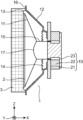
- FIG. 1 is a cross-sectional view showing a schematic configuration example of a speaker device according to this embodiment.
- the speaker device in this embodiment includes a speaker that outputs audible and inaudible sounds, and a diffusion member that is provided on the sound output surface of the speaker and that diffuses the inaudible sounds output from the speaker, the diffusion member being a member that propagates the audible and inaudible sounds within the speaker.
- the sound emission surface of the speaker refers to the part in front of the speaker from which audible and inaudible sounds are output.
- FIG. 1 is a cross-sectional view showing a speaker device 1 in this embodiment.
- the various reference characters indicate 1: speaker device, 2: speaker, 3: diffusion member, 10: field magnet portion, 11: diaphragm, 12: frame, 13: edge, 14: damper, 15: voice coil body, 16: annular portion, 17: center cap, 21: top plate, 22: magnet, and 23: yoke.
- the speaker device 1 includes a speaker 2 and a diffusion member 3 provided on the sound emitting surface (front surface) of the speaker 2.
- the diffusion member 3 may be attached directly to the speaker 2, or the speaker device 1 may include a support member (not shown) for supporting the diffusion member 3 and attaching it to the sound emitting surface of the speaker 2.
- the diffusion member 3 can be fixed to the speaker 2 by attaching it to a frame formed to surround the sound emitting surface of the speaker 2, in the same way that a well-known speaker net is attached to a speaker.
- the speaker is not particularly limited as long as it is a high-resolution speaker capable of outputting sounds in the audible range (e.g., frequencies less than about 20 kHz) and inaudible range (e.g., frequencies above about 20 kHz), and commercially available speakers can be used.
- An example of the speaker configuration will be described with reference to FIG. 1.
- the speaker 2 shown in FIG. 1 is an electroacoustic transducer that reproduces sound based on an input signal, and includes a diaphragm 11, a frame 12, an edge 13, a damper 14, a voice coil body 15, and a field magnet section 10.
- the speaker 2 may also be attached to a cabinet (not shown).
- the speaker 2 in FIG. 1 is a cone-type speaker, but the speaker in this embodiment is not limited to this, and may be a high-resolution speaker of other shapes, such as a ribbon type, a dome type, or a horn type.
- the diaphragm 11 is a member that vibrates the air and generates sound by displacing in the front-back direction (X-axis direction in the figure) from a neutral position based on an electrical signal including inaudible sound.
- the diaphragm 11 is cone-shaped (frustum-shaped), and a hole is provided in the center of the diaphragm 11.
- a voice coil body 15 is attached to the inner peripheral edge of the diaphragm 11 (the edge of the hole).
- the sound-emitting surface of the speaker 2 is a surface that passes through the outer peripheral edge of the cone-shaped diaphragm 11.
- the material of the diaphragm 11 is not particularly limited, but examples include paper, polymer resin, and metal.
- a center cap 17 is attached to cover the hole provided in the center of the diaphragm 11.
- the frame 12 is a structural member that holds the outer peripheral edge of the diaphragm 11 in a predetermined position.
- the frame 12 has an annular portion 16 that is arranged to surround the outer peripheral edge of the diaphragm 11.
- the frame 12 has a truncated cone shape whose diameter gradually decreases from the annular portion 16 toward the rear (toward the rear of the speaker 2, in the positive direction of the X-axis), and the area including the end opposite the annular portion 16 (toward the inner peripheral edge) is fixed to the field magnet portion 10.
- the edge 13 is an annular member that connects the outer peripheral edge of the diaphragm 11 to the annular portion 16 of the frame 12.
- the cross-sectional shape of the edge 13 is approximately semicircular.
- the damper 14 is a thin, annular member that is disposed between the annular portion 16 and the field magnet portion 10 in the X-axis direction and connects the frame 12 and the voice coil body 15.
- the damper 14 is disposed substantially parallel to the sound emitting surface of the speaker 2.
- the voice coil body 15 is a member having one end disposed within the magnetic gap formed in the field magnet portion 10 and the other end connected to the diaphragm 11.
- the voice coil body 15 generates a magnetic flux according to the input electrical signal, and in the speaker 2 shown in FIG. 1, the voice coil body 15 is formed with a cylindrical bobbin and a coil wound around the outer circumference of the bobbin.
- the field magnet section 10 is a member that forms a magnetic circuit for vibrating the diaphragm 11 via the voice coil body 15.
- the field magnet section 10 is disposed behind the diaphragm 11, i.e., on the opposite side of the diaphragm 11 from the sound emitting surface of the speaker 2.
- the field magnet section 10 includes a top plate 21, a magnet 22, and a yoke 23.
- the diffusion member is provided on the sound output surface (front surface) of the speaker.
- the diffusion member only needs to be provided so as to cover at least a portion of the sound output surface of the speaker from which non-audible sound can be output.
- the diffusion member 3 may be provided so as to cover the entire sound-emitting surface of the speaker 2. By providing it in this manner, the non-audible range sound can be diffused to the same extent as the audible range sound.
- the diffusion member may be provided so as to cover only a portion of the sound output surface of the speaker where non-audible sound can be output.
- the diffusion member may be provided so as to cover only the center of the diaphragm, or may be provided so as to cover only half of the portion of the sound output surface of the speaker where non-audible sound can be output.
- the diffusion member so as to cover only the right half of the portion of the sound output surface of the speaker where non-audible sound can be output (for example, the center of the diaphragm), the non-audible sound can be diffused on the right side of the speaker but not on the left side of the speaker, thereby partially creating a range in which the diffusion effect can be obtained.
- the portion from which audible sound can be output may or may not be covered by the diffusion material.
- the diffusion member is a member that propagates the audible and inaudible sounds inside. More specifically, the diffusion member has holes or gaps inside the member, and sound propagates through the air inside the member.
- the diffusion member is not particularly limited as long as it can diffuse the inaudible sounds output from the speaker.
- a diffusion member is provided on the sound emission surface of a speaker that outputs audible and inaudible sounds, and the sound pressure of 60 kHz measured at the front position (0°) of the speaker is set as the reference sound pressure. The reference sound pressure is subtracted from the sound pressure of 60 kHz measured by a microphone at an angle of 60° from the front. If the subtraction value is -16 dB or less, the diffusion member used is defined as being capable of diffusing inaudible sounds. The subtraction value is more preferably -6 dB or less, and even more preferably -4 dB or less.
- the diffusion member is preferably one that can diffuse inaudible sounds more than audible sounds.
- Specific examples include three-dimensional net structures, porous bodies, and laminated structures, and there is no particular limit to the material.
- the three-dimensional net structures include foams having a three-dimensional net skeleton without a cell membrane, and three-dimensional net structures formed from fibers.
- the porous bodies include ceramic porous bodies.
- the laminated structures include laminated structures having holes or voids, such as laminates in which punched plates (including micropores, wire mesh, etc.) are arranged at regular intervals, and laminates of mesh fabrics (plain woven fabrics).
- any material that reflects sound waves may be used, such as organic materials, inorganic materials, and metals.
- examples of foams having a three-dimensional network skeleton without cell membranes include polyurethane foams that have been treated to remove membranes, and commercially available products such as "Malt Filter” (registered trademark) manufactured by Inoac Corporation can be used.
- This polyurethane foam is not particularly limited, but it is preferable that the number of cells is 8 to 13 per 25 mm. By having the number of cells in this range, the diffusion effect of non-audible sound can be obtained more reliably.
- Examples of three-dimensional network structures formed from fibers include three-dimensional random loop joints in which multiple continuous linear bodies are twisted to form random loops and then fused together at the contact points, and nonwoven fabrics made from synthetic fibers.
- the airflow resistance value of the diffusion member is preferably in the range of 0.0020 to 0.0090 kPa ⁇ s/m. If the airflow resistance value is too small, non-audible sound may not be diffused sufficiently. On the other hand, if the airflow resistance value is too large, both audible and non-audible sound may not pass through easily, and sound may not be propagated sufficiently. Therefore, by having an airflow resistance value in the range of 0.0020 to 0.0090 kPa ⁇ s/m, non-audible sound can be diffused more reliably than audible sound, and the directional characteristics of non-audible sound can be improved more reliably.
- the airflow resistance is more preferably 0.0080 kPa ⁇ s/m or less, even more preferably 0.0060 kPa ⁇ s/m or less, and most preferably 0.0023 kPa ⁇ s/m or less.
- the airflow resistance is more preferably 0.0021 kPa ⁇ s/m or more.
- the airflow resistance refers to the airflow resistance measured using a breathability tester (e.g., Kato Tech's KES-F8 breathability tester). For example, the airflow resistance can be measured by the method described later in the Examples.
- the diffusion member may be composed of a single member, and more specifically, for example, a single member with a uniform air flow resistance value, a single member with a uniform density, etc.
- the diffusion member may also be composed of a combination of multiple different members.
- the diffusion member may include portions with partially different airflow resistance values. Even in such a case, the airflow resistance value of the diffusion member as a whole is preferably 0.0020 to 0.0090 kPa ⁇ s/m.
- the diffusion member includes portions with partially different airflow resistance values, it is preferable that the airflow resistance value of the portion close to the sound emitting surface of the speaker in the thickness direction of the diffusion member is smaller than the airflow resistance value of the portion farther from the sound emitting surface of the speaker.
- the diffusion member is configured so that the airflow resistance value is smaller the closer to the sound emitting surface of the speaker in the thickness direction.
- the diffusion member may also include portions with partially different densities. Even in such cases, the airflow resistance value of the diffusion member as a whole is preferably 0.0020 to 0.0090 kPa ⁇ s/m.
- the diffusion member includes portions with partially different densities, it is preferable that the density of the portion closer to the sound emitting surface of the speaker in the thickness direction of the diffusion member is smaller than the density of the portion farther from the sound emitting surface of the speaker. In other words, it is preferable that the diffusion member is configured so that the density is smaller the closer to the sound emitting surface of the speaker in the thickness direction. By configuring it in this way, the diffusion effect of non-audible sound can be further improved.
- the size and shape of the diffusion member are not particularly limited, and can be set appropriately depending on the size and shape of the speaker to be used. Furthermore, the hardness and thickness of the diffusion member are not particularly limited as long as they are capable of diffusing the non-audible sound output from the speaker, but it is preferable to set the thickness so that the airflow resistance value of the diffusion member is 0.0020 to 0.0090 kPa ⁇ s/m.
- the diffusion member be used to diffuse sounds with frequencies between 40 and 80 kHz. It is known that listening to non-audible sounds, particularly sounds with frequencies between 40 and 80 kHz, activates the brain and has a relaxing effect. Therefore, by diffusing sounds with frequencies between 40 and 80 kHz, it is possible to expand the listening range in which the relaxing effect can be obtained.
- the speaker device in the first aspect includes a speaker that outputs audible and inaudible sounds, and a diffusion member that is provided on the sound output surface of the speaker and diffuses the inaudible sounds output from the speaker, the diffusion member being a member that propagates the audible and inaudible sounds internally.
- the speaker device in the second aspect is the speaker device in the first aspect, in which the airflow resistance of the diffusion member is 0.0020 to 0.0090 kPa ⁇ s/m.
- the speaker device in the third aspect is the speaker device in the first or second aspect, in which the frequency of the non-audible sound is 40 to 80 kHz.
- the speaker device in the fourth aspect is the speaker device in any one of the first to third aspects, in which the diffusion member includes at least one selected from the group consisting of a three-dimensional mesh structure, a porous body, and a laminated structure.
- the speaker device in the fifth aspect is the speaker device in any one of the first to fourth aspects, in which the diffusion member is arranged to cover at least a portion of the portion of the sound output surface of the speaker from which non-audible sound is output.
- the speaker device in the sixth aspect is the speaker device in any one of the first to fifth aspects, in which the diffusion member is arranged to cover the entire sound emitting surface of the speaker.
- the seventh aspect of the speaker device is the speaker device of any one of the first to sixth aspects, in which the diffusion member includes a portion having a different airflow resistance value, and in the thickness direction of the diffusion member, the airflow resistance value of the portion close to the sound emitting surface of the speaker is smaller than the airflow resistance value of the portion far from the sound emitting surface of the speaker.
- the 60 kHz sound pressure measured at a position directly in front of the speaker (0°) that outputs the audible and inaudible sounds was used as the reference sound pressure, and the reference sound pressure was subtracted from the 60 kHz sound pressure measured by a microphone at an angle of 60° from the front. If the subtracted value was -16 dB or less, it was evaluated that the directional characteristics of the inaudible sounds in the speaker were expanded.
- Example 1 In Example 1, Sample 1 (nonwoven fabric of nylon or polyester fiber, product name: Scotch-Brite (registered trademark) rough-grained scrubbing brush, manufactured by 3M Japan Ltd.) was placed as a diffusion member on the sound-emitting surface of a speaker (product name: EAS3FP25A, manufactured by Panasonic Corporation) that outputs audible and inaudible sounds. Sample 1 was placed so as to cover the entire sound-emitting surface of the speaker.
- a speaker product name: EAS3FP25A, manufactured by Panasonic Corporation
- Example 2 In Example 2, directional characteristics were evaluated in the same manner as in Example 1, except that Sample 2 (film-removed polyester urethane foam, cell count 8/25 mm, product name: MF-8, manufactured by Inoac Corporation) was used instead of Sample 1 in Example 1. The airflow resistance value of Sample 2 was measured in the same manner as in Example 1, and the airflow resistance value of Sample 2 was 0.0020 kPa ⁇ s/m. The evaluation results are shown in Table 1.
- Example 3 In Example 3, directional characteristics were evaluated in the same manner as in Example 1, except that Sample 3 (film-removed polyester urethane foam, cell count 13/25 mm, product name: MF-13, manufactured by Inoac Corporation) was used instead of Sample 1 in Example 1. The airflow resistance value of Sample 3 was measured in the same manner as in Example 1, and the airflow resistance value of Sample 3 was 0.0085 kPa ⁇ s/m. The evaluation results are shown in Table 1.
- Comparative Example 1 As Comparative Example 1, directional characteristics were evaluated in the same manner as in Example 1, except that Sample 4 (film-removed polyester urethane foam, cell count 20/25 mm, product name: MF-20, manufactured by Inoac Corporation) was used instead of Sample 1 in Example 1. The airflow resistance value of Sample 4 was measured in the same manner as in Example 1, and the airflow resistance value of Sample 4 was 0.0141 kPa ⁇ s/m. The evaluation results are shown in Table 1.
- Comparative Example 2 As Comparative Example 2, directional characteristics were evaluated in the same manner as in Example 1, except that Sample 5 (a three-dimensional random loop joint in which polyether ester elastomer fibers are connected in three-dimensional directions while drawing many loops, product name: BreathAir (registered trademark), manufactured by Toyobo MC Co., Ltd.) was used instead of Sample 1 in Example 1.
- the airflow resistance value of Sample 5 was measured in the same manner as in Example 1, and the airflow resistance value of Sample 5 was 0.0019 kPa ⁇ s/m. The evaluation results are shown in Table 1.
- Comparative Example 3 As Comparative Example 3, directional characteristics were evaluated in the same manner as in Example 1, except that Sample 6 (nonwoven fabric of polyester fiber, product name: Travelon (registered trademark) Air Filter AF200AR, manufactured by Kanai Juyo Kogyo Co., Ltd.) was used instead of Sample 1 in Example 1. The airflow resistance value of Sample 6 was measured in the same manner as in Example 1, and the airflow resistance value of Sample 6 was 0.0550 kPa ⁇ s/m. The evaluation results are shown in Table 1.
- Comparative Example 4 As Comparative Example 4, the directional characteristics were evaluated in the same manner as in Example 1, except that Sample 1 in Example 1 was not installed. The evaluation results are shown in Table 1.
- Example 1 by using the diffusion member of the present invention, the subtraction value of the sound pressure was suppressed to -16 dB or less, and it was confirmed that the non-audible sound output from the speaker was diffused.
- Comparative Examples 1 to 3 the subtraction value of the sound pressure was greater than -16 dB, and the diffusion effect of the diffusion members used in Comparative Examples 1 to 3 on non-audible sound was low.
- Comparative Example 4 a diffusion member was not used, and therefore the diffusion effect on non-audible sound could not be obtained.
- the present invention it is possible to provide a speaker device that can diffuse non-audible sound output from a speaker and improve the directional characteristics of the non-audible sound.
Landscapes
- Health & Medical Sciences (AREA)
- Otolaryngology (AREA)
- Physics & Mathematics (AREA)
- Engineering & Computer Science (AREA)
- Acoustics & Sound (AREA)
- Signal Processing (AREA)
- Diaphragms For Electromechanical Transducers (AREA)
- Details Of Audible-Bandwidth Transducers (AREA)
Priority Applications (4)
| Application Number | Priority Date | Filing Date | Title |
|---|---|---|---|
| JP2025523345A JPWO2024247540A1 (https=) | 2023-05-26 | 2024-04-19 | |
| CN202480034630.2A CN121176034A (zh) | 2023-05-26 | 2024-04-19 | 扬声器装置 |
| EP24815027.8A EP4697748A1 (en) | 2023-05-26 | 2024-04-19 | Speaker device |
| US19/394,079 US20260082149A1 (en) | 2023-05-26 | 2025-11-19 | Speaker device |
Applications Claiming Priority (2)
| Application Number | Priority Date | Filing Date | Title |
|---|---|---|---|
| JP2023087178 | 2023-05-26 | ||
| JP2023-087178 | 2023-05-26 |
Related Child Applications (1)
| Application Number | Title | Priority Date | Filing Date |
|---|---|---|---|
| US19/394,079 Continuation US20260082149A1 (en) | 2023-05-26 | 2025-11-19 | Speaker device |
Publications (1)
| Publication Number | Publication Date |
|---|---|
| WO2024247540A1 true WO2024247540A1 (ja) | 2024-12-05 |
Family
ID=93657776
Family Applications (1)
| Application Number | Title | Priority Date | Filing Date |
|---|---|---|---|
| PCT/JP2024/015661 Ceased WO2024247540A1 (ja) | 2023-05-26 | 2024-04-19 | スピーカ装置 |
Country Status (5)
| Country | Link |
|---|---|
| US (1) | US20260082149A1 (https=) |
| EP (1) | EP4697748A1 (https=) |
| JP (1) | JPWO2024247540A1 (https=) |
| CN (1) | CN121176034A (https=) |
| WO (1) | WO2024247540A1 (https=) |
Citations (6)
| Publication number | Priority date | Publication date | Assignee | Title |
|---|---|---|---|---|
| JPS6157197A (ja) * | 1984-08-28 | 1986-03-24 | Matsushita Electric Ind Co Ltd | パラメトリツクスピ−カ |
| JPS61169099A (ja) * | 1985-01-22 | 1986-07-30 | Matsushita Electric Ind Co Ltd | 超音波送受波器 |
| JPS61264995A (ja) * | 1985-05-20 | 1986-11-22 | Matsushita Electric Ind Co Ltd | パラメトリツクスピ−カ |
| US5216209A (en) * | 1991-12-10 | 1993-06-01 | Holdaway Timothy A | Loudspeaker system and method for disbursing sounds waves |
| WO2021049136A1 (ja) | 2019-09-13 | 2021-03-18 | パナソニックIpマネジメント株式会社 | 音響レンズ及びスピーカシステム |
| JP2023087178A (ja) | 2021-12-13 | 2023-06-23 | 株式会社三共 | 遊技機 |
-
2024
- 2024-04-19 JP JP2025523345A patent/JPWO2024247540A1/ja active Pending
- 2024-04-19 WO PCT/JP2024/015661 patent/WO2024247540A1/ja not_active Ceased
- 2024-04-19 CN CN202480034630.2A patent/CN121176034A/zh active Pending
- 2024-04-19 EP EP24815027.8A patent/EP4697748A1/en active Pending
-
2025
- 2025-11-19 US US19/394,079 patent/US20260082149A1/en active Pending
Patent Citations (6)
| Publication number | Priority date | Publication date | Assignee | Title |
|---|---|---|---|---|
| JPS6157197A (ja) * | 1984-08-28 | 1986-03-24 | Matsushita Electric Ind Co Ltd | パラメトリツクスピ−カ |
| JPS61169099A (ja) * | 1985-01-22 | 1986-07-30 | Matsushita Electric Ind Co Ltd | 超音波送受波器 |
| JPS61264995A (ja) * | 1985-05-20 | 1986-11-22 | Matsushita Electric Ind Co Ltd | パラメトリツクスピ−カ |
| US5216209A (en) * | 1991-12-10 | 1993-06-01 | Holdaway Timothy A | Loudspeaker system and method for disbursing sounds waves |
| WO2021049136A1 (ja) | 2019-09-13 | 2021-03-18 | パナソニックIpマネジメント株式会社 | 音響レンズ及びスピーカシステム |
| JP2023087178A (ja) | 2021-12-13 | 2023-06-23 | 株式会社三共 | 遊技機 |
Also Published As
| Publication number | Publication date |
|---|---|
| JPWO2024247540A1 (https=) | 2024-12-05 |
| US20260082149A1 (en) | 2026-03-19 |
| CN121176034A (zh) | 2025-12-19 |
| EP4697748A1 (en) | 2026-02-18 |
Similar Documents
| Publication | Publication Date | Title |
|---|---|---|
| US11910153B2 (en) | Dipole loudspeaker for producing sound at bass frequencies | |
| EP2561131B2 (en) | Use of a textile laminar structure in acoustic components | |
| CN101816187B (zh) | 使用防水透声膜的透声部件及其制造方法 | |
| TWI705714B (zh) | 電音響變換器及音響聲阻構材 | |
| JP2018524895A (ja) | 延伸ptfe複合材を用いた振動音響カバー | |
| US10291978B2 (en) | Frame, speaker unit using the same, and headphone/earphone | |
| CN204498328U (zh) | 压电陶瓷双频低音加强耳机 | |
| WO2011049189A1 (ja) | スピーカ振動板及びスピーカ装置 | |
| CN101378604B (zh) | 音圈及扬声器 | |
| US20190058954A1 (en) | Layered speaker assembly | |
| US10743096B2 (en) | Headphones or a headset with a planar magnetic system | |
| JP5964485B1 (ja) | スピーカシステム | |
| TW200931399A (en) | Apparatus for accurate ambient noise sensing and reduction in the presence of wind | |
| WO2024247540A1 (ja) | スピーカ装置 | |
| JP7685483B2 (ja) | スピーカ、ヘッドホン | |
| JP2010034988A (ja) | スピーカ装置 | |
| EP3396975B1 (en) | Headphones | |
| JP5088377B2 (ja) | スピーカおよび音響システム | |
| US11812220B2 (en) | Omnidirectional sound source | |
| CN2641967Y (zh) | 超薄型板式扬声器 | |
| JP4538341B2 (ja) | ダイナミックマイクロホンユニット | |
| CN217721470U (zh) | 一种环形动圈式喇叭 | |
| US20240089664A1 (en) | Triangular or hexagonal angled magnet shape for planar magnetic or "isodynamic" drivers | |
| KR100724006B1 (ko) | 스피커 구조 | |
| JP2023060189A (ja) | スピーカー振動板及びヘッドフォン |
Legal Events
| Date | Code | Title | Description |
|---|---|---|---|
| 121 | Ep: the epo has been informed by wipo that ep was designated in this application |
Ref document number: 24815027 Country of ref document: EP Kind code of ref document: A1 |
|
| ENP | Entry into the national phase |
Ref document number: 2025523345 Country of ref document: JP Kind code of ref document: A |
|
| WWE | Wipo information: entry into national phase |
Ref document number: 2025523345 Country of ref document: JP |
|
| WWE | Wipo information: entry into national phase |
Ref document number: 2024815027 Country of ref document: EP |
|
| ENP | Entry into the national phase |
Ref document number: 2024815027 Country of ref document: EP Effective date: 20251113 |
|
| ENP | Entry into the national phase |
Ref document number: 2024815027 Country of ref document: EP Effective date: 20251113 |
|
| ENP | Entry into the national phase |
Ref document number: 2024815027 Country of ref document: EP Effective date: 20251113 |
|
| ENP | Entry into the national phase |
Ref document number: 2024815027 Country of ref document: EP Effective date: 20251113 |
|
| ENP | Entry into the national phase |
Ref document number: 2024815027 Country of ref document: EP Effective date: 20251113 |
|
| ENP | Entry into the national phase |
Ref document number: 2024815027 Country of ref document: EP Effective date: 20251113 |
|
| ENP | Entry into the national phase |
Ref document number: 2024815027 Country of ref document: EP Effective date: 20251113 |
|
| NENP | Non-entry into the national phase |
Ref country code: DE |
|
| ENP | Entry into the national phase |
Ref document number: 2024815027 Country of ref document: EP Effective date: 20251113 |
|
| ENP | Entry into the national phase |
Ref document number: 2024815027 Country of ref document: EP Effective date: 20251113 |
|
| WWP | Wipo information: published in national office |
Ref document number: 2024815027 Country of ref document: EP |