WO2024247493A1 - 熱伝導性組成物及びこれを用いた熱伝導性シートとその製造方法 - Google Patents
熱伝導性組成物及びこれを用いた熱伝導性シートとその製造方法 Download PDFInfo
- Publication number
- WO2024247493A1 WO2024247493A1 PCT/JP2024/014209 JP2024014209W WO2024247493A1 WO 2024247493 A1 WO2024247493 A1 WO 2024247493A1 JP 2024014209 W JP2024014209 W JP 2024014209W WO 2024247493 A1 WO2024247493 A1 WO 2024247493A1
- Authority
- WO
- WIPO (PCT)
- Prior art keywords
- thermally conductive
- component
- mass
- conductive composition
- parts
- Prior art date
- Legal status (The legal status is an assumption and is not a legal conclusion. Google has not performed a legal analysis and makes no representation as to the accuracy of the status listed.)
- Ceased
Links
Images

Classifications
-
- C—CHEMISTRY; METALLURGY
- C09—DYES; PAINTS; POLISHES; NATURAL RESINS; ADHESIVES; COMPOSITIONS NOT OTHERWISE PROVIDED FOR; APPLICATIONS OF MATERIALS NOT OTHERWISE PROVIDED FOR
- C09K—MATERIALS FOR MISCELLANEOUS APPLICATIONS, NOT PROVIDED FOR ELSEWHERE
- C09K5/00—Heat-transfer, heat-exchange or heat-storage materials, e.g. refrigerants; Materials for the production of heat or cold by chemical reactions other than by combustion
- C09K5/08—Materials not undergoing a change of physical state when used
- C09K5/14—Solid materials, e.g. powdery or granular
-
- C—CHEMISTRY; METALLURGY
- C08—ORGANIC MACROMOLECULAR COMPOUNDS; THEIR PREPARATION OR CHEMICAL WORKING-UP; COMPOSITIONS BASED THEREON
- C08J—WORKING-UP; GENERAL PROCESSES OF COMPOUNDING; AFTER-TREATMENT NOT COVERED BY SUBCLASSES C08B, C08C, C08F, C08G or C08H
- C08J5/00—Manufacture of articles or shaped materials containing macromolecular substances
- C08J5/18—Manufacture of films or sheets
-
- C—CHEMISTRY; METALLURGY
- C08—ORGANIC MACROMOLECULAR COMPOUNDS; THEIR PREPARATION OR CHEMICAL WORKING-UP; COMPOSITIONS BASED THEREON
- C08K—Use of inorganic or non-macromolecular organic substances as compounding ingredients
- C08K3/00—Use of inorganic substances as compounding ingredients
- C08K3/18—Oxygen-containing compounds, e.g. metal carbonyls
- C08K3/20—Oxides; Hydroxides
- C08K3/22—Oxides; Hydroxides of metals
-
- C—CHEMISTRY; METALLURGY
- C08—ORGANIC MACROMOLECULAR COMPOUNDS; THEIR PREPARATION OR CHEMICAL WORKING-UP; COMPOSITIONS BASED THEREON
- C08K—Use of inorganic or non-macromolecular organic substances as compounding ingredients
- C08K3/00—Use of inorganic substances as compounding ingredients
- C08K3/28—Nitrogen-containing compounds
-
- C—CHEMISTRY; METALLURGY
- C08—ORGANIC MACROMOLECULAR COMPOUNDS; THEIR PREPARATION OR CHEMICAL WORKING-UP; COMPOSITIONS BASED THEREON
- C08K—Use of inorganic or non-macromolecular organic substances as compounding ingredients
- C08K5/00—Use of organic ingredients
- C08K5/54—Silicon-containing compounds
- C08K5/541—Silicon-containing compounds containing oxygen
-
- C—CHEMISTRY; METALLURGY
- C08—ORGANIC MACROMOLECULAR COMPOUNDS; THEIR PREPARATION OR CHEMICAL WORKING-UP; COMPOSITIONS BASED THEREON
- C08K—Use of inorganic or non-macromolecular organic substances as compounding ingredients
- C08K7/00—Use of ingredients characterised by shape
-
- C—CHEMISTRY; METALLURGY
- C08—ORGANIC MACROMOLECULAR COMPOUNDS; THEIR PREPARATION OR CHEMICAL WORKING-UP; COMPOSITIONS BASED THEREON
- C08L—COMPOSITIONS OF MACROMOLECULAR COMPOUNDS
- C08L101/00—Compositions of unspecified macromolecular compounds
-
- C—CHEMISTRY; METALLURGY
- C08—ORGANIC MACROMOLECULAR COMPOUNDS; THEIR PREPARATION OR CHEMICAL WORKING-UP; COMPOSITIONS BASED THEREON
- C08L—COMPOSITIONS OF MACROMOLECULAR COMPOUNDS
- C08L83/00—Compositions of macromolecular compounds obtained by reactions forming in the main chain of the macromolecule a linkage containing silicon with or without sulfur, nitrogen, oxygen or carbon only; Compositions of derivatives of such polymers
- C08L83/04—Polysiloxanes
-
- C—CHEMISTRY; METALLURGY
- C08—ORGANIC MACROMOLECULAR COMPOUNDS; THEIR PREPARATION OR CHEMICAL WORKING-UP; COMPOSITIONS BASED THEREON
- C08G—MACROMOLECULAR COMPOUNDS OBTAINED OTHERWISE THAN BY REACTIONS ONLY INVOLVING UNSATURATED CARBON-TO-CARBON BONDS
- C08G77/00—Macromolecular compounds obtained by reactions forming a linkage containing silicon with or without sulfur, nitrogen, oxygen or carbon in the main chain of the macromolecule
- C08G77/04—Polysiloxanes
- C08G77/06—Preparatory processes
- C08G77/08—Preparatory processes characterised by the catalysts used
-
- C—CHEMISTRY; METALLURGY
- C08—ORGANIC MACROMOLECULAR COMPOUNDS; THEIR PREPARATION OR CHEMICAL WORKING-UP; COMPOSITIONS BASED THEREON
- C08G—MACROMOLECULAR COMPOUNDS OBTAINED OTHERWISE THAN BY REACTIONS ONLY INVOLVING UNSATURATED CARBON-TO-CARBON BONDS
- C08G77/00—Macromolecular compounds obtained by reactions forming a linkage containing silicon with or without sulfur, nitrogen, oxygen or carbon in the main chain of the macromolecule
- C08G77/04—Polysiloxanes
- C08G77/12—Polysiloxanes containing silicon bound to hydrogen
-
- C—CHEMISTRY; METALLURGY
- C08—ORGANIC MACROMOLECULAR COMPOUNDS; THEIR PREPARATION OR CHEMICAL WORKING-UP; COMPOSITIONS BASED THEREON
- C08G—MACROMOLECULAR COMPOUNDS OBTAINED OTHERWISE THAN BY REACTIONS ONLY INVOLVING UNSATURATED CARBON-TO-CARBON BONDS
- C08G77/00—Macromolecular compounds obtained by reactions forming a linkage containing silicon with or without sulfur, nitrogen, oxygen or carbon in the main chain of the macromolecule
- C08G77/04—Polysiloxanes
- C08G77/20—Polysiloxanes containing silicon bound to unsaturated aliphatic groups
-
- C—CHEMISTRY; METALLURGY
- C08—ORGANIC MACROMOLECULAR COMPOUNDS; THEIR PREPARATION OR CHEMICAL WORKING-UP; COMPOSITIONS BASED THEREON
- C08J—WORKING-UP; GENERAL PROCESSES OF COMPOUNDING; AFTER-TREATMENT NOT COVERED BY SUBCLASSES C08B, C08C, C08F, C08G or C08H
- C08J2383/00—Characterised by the use of macromolecular compounds obtained by reactions forming in the main chain of the macromolecule a linkage containing silicon with or without sulfur, nitrogen, oxygen, or carbon only; Derivatives of such polymers
- C08J2383/04—Polysiloxanes
- C08J2383/07—Polysiloxanes containing silicon bound to unsaturated aliphatic groups
-
- C—CHEMISTRY; METALLURGY
- C08—ORGANIC MACROMOLECULAR COMPOUNDS; THEIR PREPARATION OR CHEMICAL WORKING-UP; COMPOSITIONS BASED THEREON
- C08J—WORKING-UP; GENERAL PROCESSES OF COMPOUNDING; AFTER-TREATMENT NOT COVERED BY SUBCLASSES C08B, C08C, C08F, C08G or C08H
- C08J2483/00—Characterised by the use of macromolecular compounds obtained by reactions forming in the main chain of the macromolecule a linkage containing silicon with or without sulfur, nitrogen, oxygen, or carbon only; Derivatives of such polymers
-
- C—CHEMISTRY; METALLURGY
- C08—ORGANIC MACROMOLECULAR COMPOUNDS; THEIR PREPARATION OR CHEMICAL WORKING-UP; COMPOSITIONS BASED THEREON
- C08K—Use of inorganic or non-macromolecular organic substances as compounding ingredients
- C08K3/00—Use of inorganic substances as compounding ingredients
- C08K3/18—Oxygen-containing compounds, e.g. metal carbonyls
- C08K3/20—Oxides; Hydroxides
- C08K3/22—Oxides; Hydroxides of metals
- C08K2003/2227—Oxides; Hydroxides of metals of aluminium
-
- C—CHEMISTRY; METALLURGY
- C08—ORGANIC MACROMOLECULAR COMPOUNDS; THEIR PREPARATION OR CHEMICAL WORKING-UP; COMPOSITIONS BASED THEREON
- C08K—Use of inorganic or non-macromolecular organic substances as compounding ingredients
- C08K3/00—Use of inorganic substances as compounding ingredients
- C08K3/28—Nitrogen-containing compounds
- C08K2003/282—Binary compounds of nitrogen with aluminium
-
- C—CHEMISTRY; METALLURGY
- C08—ORGANIC MACROMOLECULAR COMPOUNDS; THEIR PREPARATION OR CHEMICAL WORKING-UP; COMPOSITIONS BASED THEREON
- C08K—Use of inorganic or non-macromolecular organic substances as compounding ingredients
- C08K2201/00—Specific properties of additives
- C08K2201/001—Conductive additives
-
- C—CHEMISTRY; METALLURGY
- C08—ORGANIC MACROMOLECULAR COMPOUNDS; THEIR PREPARATION OR CHEMICAL WORKING-UP; COMPOSITIONS BASED THEREON
- C08K—Use of inorganic or non-macromolecular organic substances as compounding ingredients
- C08K2201/00—Specific properties of additives
- C08K2201/002—Physical properties
- C08K2201/003—Additives being defined by their diameter
-
- C—CHEMISTRY; METALLURGY
- C08—ORGANIC MACROMOLECULAR COMPOUNDS; THEIR PREPARATION OR CHEMICAL WORKING-UP; COMPOSITIONS BASED THEREON
- C08K—Use of inorganic or non-macromolecular organic substances as compounding ingredients
- C08K2201/00—Specific properties of additives
- C08K2201/002—Physical properties
- C08K2201/005—Additives being defined by their particle size in general
-
- C—CHEMISTRY; METALLURGY
- C08—ORGANIC MACROMOLECULAR COMPOUNDS; THEIR PREPARATION OR CHEMICAL WORKING-UP; COMPOSITIONS BASED THEREON
- C08K—Use of inorganic or non-macromolecular organic substances as compounding ingredients
- C08K2201/00—Specific properties of additives
- C08K2201/002—Physical properties
- C08K2201/006—Additives being defined by their surface area
-
- C—CHEMISTRY; METALLURGY
- C08—ORGANIC MACROMOLECULAR COMPOUNDS; THEIR PREPARATION OR CHEMICAL WORKING-UP; COMPOSITIONS BASED THEREON
- C08K—Use of inorganic or non-macromolecular organic substances as compounding ingredients
- C08K2201/00—Specific properties of additives
- C08K2201/014—Additives containing two or more different additives of the same subgroup in C08K
Definitions
- the present invention relates to a thermally conductive composition suitable for being interposed between a heat generating portion of an electric or electronic component and a heat sink, a thermally conductive sheet using the same, and a method for producing the same.
- thermally conductive sheets are used to improve adhesion between the semiconductor and the heat sink.
- thermally conductive sheets have been proposed in Patent Documents 1 to 4, among others.
- the applicant has proposed a thermally conductive sheet with high thermal conductivity in Patent Document 5.
- thermally conductive compositions and thermally conductive sheets using them have a problem in that increasing the thermal conductivity increases the plasticity of the composition, resulting in poor moldability. This is because in order to increase the thermal conductivity, it is necessary to add a large amount of thermally conductive particles, which increases the plasticity of the composition and reduces moldability.
- the present invention provides a thermally conductive composition that has high thermal conductivity, low plasticity of the composition, and good moldability, as well as a thermally conductive sheet using the same and a method for producing the same.
- the thermally conductive composition of the present invention is a thermally conductive composition containing a matrix resin (component A) made of a thermosetting resin, a curing catalyst, and thermally conductive particles, the thermally conductive particles containing the following components B and C:
- Component B Alumina having a volume-based cumulative particle size distribution D50 (median diameter) of 0.01 ⁇ m or more and less than 1 ⁇ m is contained in an amount of 220 to 500 parts by mass per 100 parts by mass of matrix resin, and the following Component B-1 and Component B-2 are contained, B-1 component: 30 to 100% by mass of alumina having a D50 (median diameter) of 0.01 ⁇ m or more and less than 0.3 ⁇ m and a BET specific surface area of 9 m 2 /g or more, relative to 100% by mass of B component; B-2 component: 0 to 70% by mass of alumina having a D50 (median diameter) of 0.3 ⁇ m or more and less than 1 ⁇ m, based on 100% by mass
- the thermally conductive sheet of the present invention is characterized in that the thermally conductive composition is formed into a sheet.
- the thermally conductive composition is vacuum degassed, rolled, formed into a sheet, and then cured by heating to produce a thermally conductive sheet.
- the present invention can provide a thermally conductive composition having high thermal conductivity, low plasticity, and good moldability, and a thermally conductive sheet using the same.
- a thermally conductive composition having high thermal conductivity, low plasticity, and good moldability can be obtained.
- the plasticity of the thermally conductive composition after degassing before curing is preferably less than 100, and the preferred thermal conductivity is 14 W/m ⁇ K or more.
- the method for producing a thermally conductive sheet of the present invention allows for continuous sheet molding because the composition has low plasticity and good moldability.
- FIG. 1 is a schematic cross-sectional view showing a method of using a thermally conductive sheet according to one embodiment of the present invention.
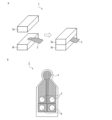
- 2A and 2B are schematic explanatory diagrams showing a method for measuring the thermal conductivity of a sample in one embodiment of the present invention.
- the present invention is a thermally conductive composition containing a matrix resin, a curing catalyst, and thermally conductive particles.
- the matrix resin is preferably a thermosetting resin such as silicone rubber, silicone gel, acrylic rubber, fluororubber, epoxy resin, phenolic resin, unsaturated polyester resin, melamine resin, acrylic resin, silicone resin, or fluororesin.
- silicone is preferred, and examples thereof include elastomer, gel, putty, and grease.
- the silicone curing system may use any method such as peroxide, addition, or condensation. Silicone is preferred because of its high heat resistance.
- it is preferred to use an addition reaction type because it is not corrosive to the surroundings, there are few by-products released outside the system, and it cures reliably to the depths.
- the thermally conductive particles are as follows, relative to 100 parts by mass of the matrix resin (component A).
- component B Alumina having a volume-based cumulative particle size distribution D50 (median diameter) of 0.01 ⁇ m or more and less than 1 ⁇ m is added in an amount of 220 to 500 parts by mass per 100 parts by mass of the matrix resin. The preferred amount is 230 to 480 parts by mass, and the more preferred amount is 240 to 440 parts by mass.
- the component B includes the following components B-1 and B-2.
- Component B-1 Alumina having a D50 (median diameter) of 0.01 ⁇ m or more and less than 0.3 ⁇ m and a BET specific surface area of 9 m 2 /g or more accounts for 30 to 100 mass% relative to 100 mass% of component B.
- the preferred D50 (median diameter) is 0.1 ⁇ m or more and less than 0.3 ⁇ m.
- the preferred BET specific surface area is 9 to 20 m 2 /g, and more preferably 10 to 18 m 2 /g.
- the BET specific surface area is measured according to the provisions of JIS R 1626-1996.
- Component B-2 Alumina having a D50 (median diameter) of 0.3 ⁇ m or more and less than 1 ⁇ m is 0 to 70 mass % relative to 100 mass % of component B.
- the preferred D50 (median diameter) is 0.3 ⁇ m or more and 1.0 ⁇ m or less.
- Component C 1900 to 2500 parts by mass of aluminum nitride having a D50 (median diameter) of 0.01 ⁇ m or more and 150 ⁇ m or less is added to 100 parts by mass of the matrix resin.
- the preferred D50 (median diameter) is 0.1 ⁇ m or more and 120 ⁇ m or less.
- the preferred amount is 1920 to 2400 parts by mass, and the more preferred amount is 1940 to 2300 parts by mass.
- component C includes the following components C-1 and C-2.
- C-1 component D50 (median diameter) is 0.01 ⁇ m or more and less than 30 ⁇ m.
- C-2 component D50 (median diameter) is 30 ⁇ m or more and 150 ⁇ m or less.
- the thermally conductive particles are made by combining multiple types of inorganic particles with different average particle sizes. In this way, the thermally conductive inorganic particles with smaller particle sizes are filled between the larger particles, allowing for a nearly close-packed state, resulting in a thermally conductive composition with high thermal conductivity, low plasticity, and good moldability.
- the ratio of the C-1 component to the C-2 component is preferably C-2 component ⁇ C-1 component, more preferably C-2 component ⁇ C-1 component, by mass ratio, thereby obtaining a thermally conductive composition having high thermal conductivity, low plasticity, and good moldability.
- the plasticity of the thermally conductive composition after vacuum degassing before curing is preferably less than 100, more preferably 10 to 99, even more preferably 20 to 99, and particularly preferably 30 to 99. This allows the thermally conductive composition to have low plasticity and good moldability.
- the thermal conductivity of the cured product of the thermally conductive composition is preferably 14 W/m ⁇ K or more, more preferably 14 to 20 W/m ⁇ K, and even more preferably 14.5 to 20 W/m ⁇ K. This provides high thermal conductivity and makes it suitable for use as a heat dissipation sheet: TIM (Thermal Interface Material).
- the SHORE 00 hardness of the cured product of the thermally conductive composition is preferably 75 or less, more preferably 10 to 75, and even more preferably 15 to 72. This provides good conformability to the heating element and heat dissipating element (heat sink).
- the matrix resin is preferably at least one selected from addition-curing silicone polymers, peroxide-curing silicone polymers, and condensation-curing silicone polymers.
- silane coupling agent coats the surface of the thermally conductive particles (surface treatment), makes it easier to fill the matrix resin (plasticizer function), and has the effect of preventing the curing catalyst from being adsorbed to the thermally conductive particles and preventing curing inhibition. This is useful for storage stability.
- the silane coupling agent is a silane compound represented by R(CH 3 ) a Si(OR') 4-a (R is an unsubstituted or substituted organic group having 1 to 20 carbon atoms, R' is an alkyl group having 1 to 4 carbon atoms, and a is 0 or 1), or a partial hydrolyzate thereof.
- alkoxysilane compounds represented by R( CH3 ) aSi (OR') 4-a
- R is an unsubstituted or substituted organic group having 1 to 20 carbon atoms
- R' is an alkyl group having 1 to 4 carbon atoms
- a is 0 or 1
- examples of alkoxysilane compounds include methyltrimethoxysilane, ethyltrimethoxysilane, propyltrimethoxysilane, butyltrimethoxysilane, pentyltrimethoxysilane, hexyltrimethoxysilane, hexyltriethoxysilane, octyltrimethoxysilane, octyltriethoxysilane, decyltrimethoxysilane, decyltriethoxysilane, dodecyltrimethoxysilane, dodecyltriethoxysilane, hex
- At least one component selected from the group consisting of alumina (aluminum oxide) as component B and aluminum nitride as component C is an irregularly pulverized particle. Irregularly pulverized particles are easy to obtain. In the following, irregularly pulverized particles will also be referred to simply as irregular.
- the thermally conductive composition of the present invention is highly versatile when molded into a thermally conductive sheet, making it suitable as a TIM.
- the thickness of the thermally conductive sheet is preferably in the range of 0.2 to 10 mm.
- the method for producing a thermally conductive sheet of the present invention involves vacuum degassing the thermally conductive composition, rolling it, forming it into a sheet, and then heat curing it to form a thermally conductive sheet.
- the thermally conductive composition compound
- Rolling can be done by roll rolling or press working, but roll rolling is preferred as it allows for continuous production.
- the dielectric breakdown voltage (JIS K6249) of the thermally conductive composition is preferably 7 to 16 kV/mm. This allows the thermally conductive sheet to have high electrical insulation properties.
- the volume resistivity (JIS K6249) of the thermally conductive composition is preferably 10 10 to 10 14 ⁇ cm, which makes it possible to obtain a thermally conductive sheet with high electrical insulation properties.
- a compound having the following composition is preferred.
- the matrix resin contains the following (A1) and (A2).
- unreacted silicone oil one example of which is dimethylpolysiloxane.
- the total amount of the base polymer component (A1), the crosslinking component (A2), the unreacted silicone oil, and the silane coupling agent is 100 parts by mass.
- B Thermally conductive particles as described above.
- C Platinum-based metal catalyst 0.01 to 1000 ppm by mass relative to the matrix resin D
- Other additives silane coupling agent, hardening retarder, colorant, etc.; any amount
- the base polymer component is an organopolysiloxane containing two or more alkenyl groups bonded to silicon atoms in one molecule, and the organopolysiloxane containing two or more alkenyl groups is the main component (base polymer component) in the silicone rubber composition of the present invention.
- This organopolysiloxane has two alkenyl groups bonded to silicon atoms in one molecule, such as vinyl groups or allyl groups, having 2 to 8 carbon atoms, especially 2 to 6 carbon atoms.
- the viscosity at 25°C is preferably 10 to 1,000,000 mPa ⁇ s, especially 100 to 100,000 mPa ⁇ s, in terms of workability, curability, etc.
- an organopolysiloxane containing two or more alkenyl groups per molecule, each of which is represented by the following general formula (Chemical Formula 1) and is bonded to a silicon atom at the molecular chain end is used.
- the side chain is a linear organopolysiloxane blocked with an alkyl group. From the viewpoints of workability, curability, etc., a viscosity of 10 to 1,000,000 mPa ⁇ s at 25°C is desirable. Note that this linear organopolysiloxane may contain a small amount of a branched structure (trifunctional siloxane unit) in the molecular chain.
- R 1 s are the same or different and are unsubstituted or substituted monovalent hydrocarbon groups having no aliphatic unsaturated bonds
- R 2 is an alkenyl group
- k is 0 or a positive integer.
- the unsubstituted or substituted monovalent hydrocarbon group having no aliphatic unsaturated bond for R 1 preferably has, for example, 1 to 10 carbon atoms, particularly 1 to 6 carbon atoms.
- alkyl groups such as methyl, ethyl, propyl, isopropyl, butyl, isobutyl, tert-butyl, pentyl, neopentyl, hexyl, cyclohexyl, octyl, nonyl, and decyl; aryl groups such as phenyl, tolyl, xylyl, and naphthyl; aralkyl groups such as benzyl, phenylethyl, and phenylpropyl; and groups in which some or all of the hydrogen atoms of these groups have been substituted with halogen atoms such as fluorine, bromine, and chlorine, or with cyano groups, for example, halogen-substituted alkyl groups such as chloromethyl, chloropropyl, bromoethyl, and trifluoropropyl; and cyanoethyl groups.
- the alkenyl group of R2 preferably has 2 to 6 carbon atoms, particularly 2 to 3 carbon atoms, and specifically includes vinyl, allyl, propenyl, isopropenyl, butenyl, isobutenyl, hexenyl, and cyclohexenyl groups, with vinyl being preferred.
- k is generally 0 or a positive integer satisfying 0 ⁇ k ⁇ 10000, preferably 5 ⁇ k ⁇ 2000, and more preferably 10 ⁇ k ⁇ 1200.
- the organopolysiloxane of component A1 may be an organopolysiloxane having at least 3, usually 3 to 30, and preferably about 3 to 20 alkenyl groups, such as vinyl groups and allyl groups, bonded to silicon atoms having 2 to 8 carbon atoms, particularly 2 to 6 carbon atoms, in one molecule.
- the molecular structure may be any of linear, cyclic, branched, and three-dimensional network molecular structures.
- a preferred organopolysiloxane is a linear organopolysiloxane whose main chain is made up of repeated diorganosiloxane units and whose molecular chain ends are blocked with triorganosiloxy groups, and whose viscosity at 25°C is 10 to 1,000,000 mPa ⁇ s, particularly 100 to 100,000 mPa ⁇ s.
- the alkenyl group may be bonded to any part of the molecule.
- it may include those bonded to silicon atoms at the ends of the molecular chain or non-ends (in the middle of the molecular chain).
- the linear organopolysiloxane has 1 to 3 alkenyl groups on each of the silicon atoms at both ends of the molecular chain represented by the following general formula (Chemical Formula 2), and if the total number of alkenyl groups bonded to the silicon atoms at the ends of the molecular chain is less than 3, it is preferable to use a linear organopolysiloxane having at least one alkenyl group bonded to a silicon atom at a non-end of the molecular chain (in the middle of the molecular chain) (for example, as a substituent in a diorganosiloxane unit), and as mentioned above, a viscosity at 25°C of 10 to 1,000,000 mPa ⁇ s at 25°C is
- R3 's are the same or different and are unsubstituted or substituted monovalent hydrocarbon groups, at least one of which is an alkenyl group
- R4 's are the same or different and are unsubstituted or substituted monovalent hydrocarbon groups that do not have an aliphatic unsaturated bond
- R5 is an alkenyl group
- l and m are 0 or positive integers.
- the monovalent hydrocarbon group of R 3 is preferably one having 1 to 10 carbon atoms, particularly 1 to 6 carbon atoms.
- alkyl groups such as methyl, ethyl, propyl, isopropyl, butyl, isobutyl, tert-butyl, pentyl, neopentyl, hexyl, cyclohexyl, octyl, nonyl, and decyl; aryl groups such as phenyl, tolyl, xylyl, and naphthyl; aralkyl groups such as benzyl, phenylethyl, and phenylpropyl; alkenyl groups such as vinyl, allyl, propenyl, isopropenyl, butenyl, hexenyl, cyclohexenyl, and octenyl; and groups in which some or all of the hydrogen atoms of these groups have been substituted with halogen atoms such as fluorine, bromine, and chlorine, or with cyano groups, such as halogen-
- the monovalent hydrocarbon group of R 4 is preferably one having 1 to 10 carbon atoms, particularly 1 to 6 carbon atoms, and may be the same as the specific examples of R 1 , but does not include alkenyl groups.
- the alkenyl group of R 5 is preferably one having 2 to 6 carbon atoms, particularly 2 to 3 carbon atoms, and may be the same as R 2 in the above formula (Chemical Formula 1), and is preferably a vinyl group.
- l and m are generally 0 or a positive integer satisfying 0 ⁇ l+m ⁇ 10000, preferably 5 ⁇ l+m ⁇ 2000, more preferably 10 ⁇ l+m ⁇ 1200, and 0 ⁇ l/(l+m) ⁇ 0.2, and preferably 0.0011 ⁇ l/(l+m) ⁇ 0.1.
- the organohydrogenpolysiloxane of component A2 of the present invention acts as a crosslinking agent, and a cured product is formed by an addition reaction (hydrosilylation) between the SiH groups in this component and the alkenyl groups in component A.
- Such organohydrogenpolysiloxane may be any one having two or more hydrogen atoms bonded to silicon atoms (i.e., SiH groups) in one molecule.
- the molecular structure of the polysiloxane may be linear, cyclic, branched, or three-dimensional network structure, but the number of silicon atoms in one molecule (i.e., the degree of polymerization) is 2 to 1000, particularly 2 to 300. A degree of this can be used.
- the position of the silicon atom to which the hydrogen atom is bonded is not particularly limited, and may be at the end of the molecular chain or at a non-end of the molecular chain (in the middle of the molecular chain).
- examples of organic groups bonded to silicon atoms other than hydrogen atoms include unsubstituted or substituted monovalent hydrocarbon groups that do not have an aliphatic unsaturated bond, similar to R1 in the general formula (Chemical Formula 1).
- organohydrogenpolysiloxane of component A2 examples include those having the following structure.
- R6 is the same or different and is an alkyl group, a phenyl group, an epoxy group, an acryloyl group, a methacryloyl group, an alkoxy group, or a hydrogen atom, and at least two of R6 are hydrogen atoms.
- L is an integer of 0 to 1,000, particularly an integer of 0 to 300, and M is an integer of 1 to 200.
- the catalyst component of component C may be a catalyst used in hydrosilylation reactions.
- a catalyst used in hydrosilylation reactions For example, platinum black, platinum chloride, chloroplatinic acid, the reaction product of chloroplatinic acid with monohydric alcohol, chloroplatinic acid with olefins, etc.
- the platinum group metal catalysts include platinum group metal catalysts such as platinum complexes with vinyl siloxanes, platinum bisacetoacetate, palladium catalysts, and rhodium catalysts.
- Two-part room temperature curing silicone polymers contain platinum group metal catalysts. Although an additional platinum group metal catalyst is used, the cure rate is controlled.
- Thermally conductive particles (component B and component C)
- the thermally conductive particles it is preferable to use three or more types of inorganic particles with different average particle sizes as the thermally conductive particles.
- the components are B-1, C-1, and C-2, and in the case of four types, the component B-2 is added to the above.
- the thermally conductive inorganic particles with smaller particle sizes are filled between the larger particles, allowing them to be packed in a state close to close packing, thereby increasing the thermal conductivity.
- composition of the present invention may contain other components than those described above, if necessary.
- heat resistance improvers such as red iron oxide, titanium oxide, and cerium oxide
- flame retardant assistants such as flame retardant assistants, and hardening retarders
- hardening retarders may be added.
- organic or inorganic pigments may be added.
- silane coupling agent may be added.
- FIG. 1 is a schematic cross-sectional view of a heat-conducting sheet according to one embodiment of the present invention incorporated into a heat dissipation structure 10.
- the heat-conducting sheet 11b dissipates heat generated by an electronic component 13 such as a semiconductor element, and is fixed to the main surface 12a of the heat spreader 12 facing the electronic component 13, and is sandwiched between the electronic component 13 and the heat spreader 2.
- the heat-conducting sheet 11a is sandwiched between the heat spreader 12 and the heat sink 15.
- the heat-conducting sheets 11a and 11b, together with the heat spreader 2, constitute a heat dissipation member that dissipates heat from the electronic component 13.
- the heat spreader 12 is formed, for example, in the shape of a rectangular plate, and has a main surface 12a facing the electronic component 13 and a side wall 12b erected along the outer periphery of the main surface 12a.
- the heat spreader 2 has a thermally conductive sheet 11b on the main surface 12a surrounded by side walls 12b, and a heat sink 15 on the other surface 12c opposite the main surface 12a via the thermally conductive sheet 11a.
- the electronic component 13 is, for example, a semiconductor element such as a BGA, and is mounted on a wiring board 14.
- thermal conductivity of the thermally conductive silicone rubber sheet was measured using a hot disk (ISO 22007-2: 2008 compliant). As shown in FIG. 2A, this thermal conductivity measuring device 1 sandwiches a polyimide film sensor 2 between two samples 3a and 3b, applies a constant power to the sensor 2, and generates a constant amount of heat, analyzing the thermal characteristics from the temperature rise of the sensor 2.
- the sensor 2 has a tip 4 with a diameter of 7 mm, and as shown in FIG. 2B, has a double spiral electrode structure, with an applied current electrode 5 and a resistance value electrode (temperature measurement electrode) 6 arranged at the bottom.
- the thermal conductivity is calculated using the following formula (Math. 1).
- ⁇ Hardness> The hardness of the thermally conductive silicone rubber sheet was measured in accordance with SHORE 00.
- the pre-vacuum plasticity is the plasticity of the compound when it is prepared.
- the post-degassing plasticity is the plasticity after the compound is prepared and then degassed for 5 minutes under a reduced pressure of -0.1 Pa.
- the post-degassing plasticity is important because the compound is molded into a sheet after being degassed.
- ⁇ BET specific surface area> The BET specific surface area of the thermally conductive particles was measured according to the standard of JIS R 1626-1996. The larger the BET specific surface area, the smaller the D50 (median diameter) of the cumulative particle size distribution based on the volume of the thermally conductive particles.
- Thermally conductive particles (component B) The thermally conductive particles used were those shown in Table 1.
- the average particle size is the D50 (median size) of the cumulative particle size distribution based on volume in particle size distribution measurement by laser diffraction light scattering method.
- An example of the measuring device is the LA-950S2 laser diffraction/scattering type particle distribution measuring device manufactured by Horiba, Ltd.
- the number before ⁇ m in the table is the average particle size of each particle.
- Thermally conductive particles (component C) The thermally conductive particles used are shown in Table 1.
- the average particle size is the D50 (median size) of the cumulative particle size distribution based on volume in particle size distribution measurement by laser diffraction light scattering method.
- An example of an instrument for this is the LA-950S2 laser diffraction/scattering particle distribution measuring instrument manufactured by Horiba, Ltd.
- the numbers before ⁇ m in the table are the average particle size of each particle.
- AlN in the table is an abbreviation for aluminum nitride.
- Platinum group metal catalyst a platinum-vinyldisiloxane complex was used.
- the two-part room temperature curing silicone polymer contains a platinum group metal catalyst.
- an additional platinum group metal catalyst was added so that the polyorganosiloxane would be sufficiently cured.
- Additive 1 Dimethylpolysiloxane (viscosity at 25° C.: 100 mm 2 /s, measured using a Brooklyn Field type rotational viscometer SP No. 2) was used as the unreacted silicone oil.
- Additive 2 Decyltrimethoxysilane was used as the silane coupling agent.
- Sheet molding The compound was sandwiched between release-treated polyethylene terephthalate (PET) films and rolled using a constant speed roll at 23°C, a roll speed of 0.5 m/min, into a sheet of thickness 2.0 mm, and then heat cured at 100°C for 15 minutes to obtain a thermally conductive silicone rubber sheet. If molding was possible under the above conditions, it was judged as "possible”, and if not, it was judged as "NG”. The above conditions and results are shown in Tables 1 and 2. Tables 1 and 2 show the amount of each component added when the total of the base polymer component (A1), the crosslinking component (A2), the unreacted silicone oil, and the silane coupling agent is 100 parts by mass.
- PTT polyethylene terephthalate
- Examples 1 to 5 had high thermal conductivity and low plasticity after degassing of the composition (plasticity before curing).
- Comparative Example 1 the absence of B-1 component caused an increase in plasticity, and the molding processability was NG.
- Comparative Example 2 the absence of B-1 component caused an increase in plasticity even though the BET specific surface area was large, and the molding processability was NG.
- Comparative Example 3 the B component was below the lower limit, so the plasticity increased and the molding processability was NG.
- the B component exceeded the upper limit, and the thermal conductivity decreased.
- Comparative Example 5 the C component was below the lower limit, and the thermal conductivity decreased.
- thermally conductive composition and thermally conductive sheet of the present invention are suitable as a thermal interface material (TIM) that is a heat dissipation sheet to be interposed between a heat generating part of an electric or electronic component and a heat sink.
- TIM thermal interface material
Landscapes
- Chemical & Material Sciences (AREA)
- Chemical Kinetics & Catalysis (AREA)
- Organic Chemistry (AREA)
- Health & Medical Sciences (AREA)
- Medicinal Chemistry (AREA)
- Polymers & Plastics (AREA)
- Engineering & Computer Science (AREA)
- Manufacturing & Machinery (AREA)
- Materials Engineering (AREA)
- Physics & Mathematics (AREA)
- Combustion & Propulsion (AREA)
- Thermal Sciences (AREA)
- Compositions Of Macromolecular Compounds (AREA)
- Manufacture Of Macromolecular Shaped Articles (AREA)
Priority Applications (4)
| Application Number | Priority Date | Filing Date | Title |
|---|---|---|---|
| US19/102,748 US20250376573A1 (en) | 2023-05-29 | 2024-04-08 | Thermally conductive composition, thermally conductive sheet obtained from same, and production method therefor |
| EP24814980.9A EP4549518B1 (en) | 2023-05-29 | 2024-04-08 | Thermally conductive composition, thermally conductive sheet using same, and production method therefor |
| CN202480003945.0A CN119855874A (zh) | 2023-05-29 | 2024-04-08 | 导热性组合物及使用其的导热性片材及其制造方法 |
| JP2024524473A JP7537050B1 (ja) | 2023-05-29 | 2024-04-08 | 熱伝導性組成物及びこれを用いた熱伝導性シートとその製造方法 |
Applications Claiming Priority (4)
| Application Number | Priority Date | Filing Date | Title |
|---|---|---|---|
| JP2023087807 | 2023-05-29 | ||
| JP2023-087807 | 2023-05-29 | ||
| JPPCT/JP2023/041437 | 2023-11-17 | ||
| JP2023041437 | 2023-11-17 |
Publications (1)
| Publication Number | Publication Date |
|---|---|
| WO2024247493A1 true WO2024247493A1 (ja) | 2024-12-05 |
Family
ID=99799616
Family Applications (1)
| Application Number | Title | Priority Date | Filing Date |
|---|---|---|---|
| PCT/JP2024/014209 Ceased WO2024247493A1 (ja) | 2023-05-29 | 2024-04-08 | 熱伝導性組成物及びこれを用いた熱伝導性シートとその製造方法 |
Country Status (6)
| Country | Link |
|---|---|
| US (1) | US20250376573A1 (cg-RX-API-DMAC7.html) |
| EP (1) | EP4549518B1 (cg-RX-API-DMAC7.html) |
| JP (1) | JP7537050B1 (cg-RX-API-DMAC7.html) |
| CN (1) | CN119855874A (cg-RX-API-DMAC7.html) |
| TW (1) | TW202506955A (cg-RX-API-DMAC7.html) |
| WO (1) | WO2024247493A1 (cg-RX-API-DMAC7.html) |
Citations (9)
| Publication number | Priority date | Publication date | Assignee | Title |
|---|---|---|---|---|
| JP2013147600A (ja) * | 2012-01-23 | 2013-08-01 | Shin-Etsu Chemical Co Ltd | 熱伝導性シリコーン組成物及びその硬化物 |
| JP2016216523A (ja) | 2015-05-14 | 2016-12-22 | デンカ株式会社 | 熱伝導性グリース用組成物、熱伝導性グリースおよび放熱部材 |
| JP2018088416A (ja) | 2012-02-29 | 2018-06-07 | サン−ゴバン プラコ | 発光パネルおよび建築物壁 |
| WO2020137086A1 (ja) * | 2018-12-25 | 2020-07-02 | 富士高分子工業株式会社 | 熱伝導組成物及びこれを用いた熱伝導性シート |
| JP2020137970A (ja) | 2019-03-01 | 2020-09-03 | ユニ・チャーム株式会社 | 吸収性物品 |
| JP2021518466A (ja) | 2018-03-22 | 2021-08-02 | モメンティブ パフォーマンス マテリアルズ インコーポレイテッドMomentive Performance Materials Inc. | シリコーンポリマーおよびそれを含む組成物 |
| JP7061736B1 (ja) | 2020-12-16 | 2022-04-28 | 富士高分子工業株式会社 | 熱伝導性シート及びその製造方法 |
| WO2022264790A1 (ja) * | 2021-06-16 | 2022-12-22 | デクセリアルズ株式会社 | 熱伝導シート及び熱伝導シートの製造方法 |
| JP7217079B1 (ja) * | 2022-01-14 | 2023-02-02 | 富士高分子工業株式会社 | 熱伝導性組成物及びこれを用いた熱伝導性シートとその製造方法 |
Family Cites Families (2)
| Publication number | Priority date | Publication date | Assignee | Title |
|---|---|---|---|---|
| KR102544366B1 (ko) * | 2015-05-22 | 2023-06-19 | 모멘티브 파포만스 마테리아루즈 쟈판 고도가이샤 | 열전도성 조성물 |
| EP3489305B1 (en) * | 2016-07-22 | 2023-10-18 | Momentive Performance Materials Japan LLC | Thermally conductive polysiloxane composition |
-
2024
- 2024-04-08 CN CN202480003945.0A patent/CN119855874A/zh active Pending
- 2024-04-08 EP EP24814980.9A patent/EP4549518B1/en active Active
- 2024-04-08 JP JP2024524473A patent/JP7537050B1/ja active Active
- 2024-04-08 WO PCT/JP2024/014209 patent/WO2024247493A1/ja not_active Ceased
- 2024-04-08 US US19/102,748 patent/US20250376573A1/en active Pending
- 2024-04-10 TW TW113113279A patent/TW202506955A/zh unknown
Patent Citations (9)
| Publication number | Priority date | Publication date | Assignee | Title |
|---|---|---|---|---|
| JP2013147600A (ja) * | 2012-01-23 | 2013-08-01 | Shin-Etsu Chemical Co Ltd | 熱伝導性シリコーン組成物及びその硬化物 |
| JP2018088416A (ja) | 2012-02-29 | 2018-06-07 | サン−ゴバン プラコ | 発光パネルおよび建築物壁 |
| JP2016216523A (ja) | 2015-05-14 | 2016-12-22 | デンカ株式会社 | 熱伝導性グリース用組成物、熱伝導性グリースおよび放熱部材 |
| JP2021518466A (ja) | 2018-03-22 | 2021-08-02 | モメンティブ パフォーマンス マテリアルズ インコーポレイテッドMomentive Performance Materials Inc. | シリコーンポリマーおよびそれを含む組成物 |
| WO2020137086A1 (ja) * | 2018-12-25 | 2020-07-02 | 富士高分子工業株式会社 | 熱伝導組成物及びこれを用いた熱伝導性シート |
| JP2020137970A (ja) | 2019-03-01 | 2020-09-03 | ユニ・チャーム株式会社 | 吸収性物品 |
| JP7061736B1 (ja) | 2020-12-16 | 2022-04-28 | 富士高分子工業株式会社 | 熱伝導性シート及びその製造方法 |
| WO2022264790A1 (ja) * | 2021-06-16 | 2022-12-22 | デクセリアルズ株式会社 | 熱伝導シート及び熱伝導シートの製造方法 |
| JP7217079B1 (ja) * | 2022-01-14 | 2023-02-02 | 富士高分子工業株式会社 | 熱伝導性組成物及びこれを用いた熱伝導性シートとその製造方法 |
Non-Patent Citations (1)
| Title |
|---|
| See also references of EP4549518A4 |
Also Published As
| Publication number | Publication date |
|---|---|
| CN119855874A (zh) | 2025-04-18 |
| EP4549518A4 (en) | 2025-12-03 |
| JP7537050B1 (ja) | 2024-08-20 |
| JPWO2024247493A1 (cg-RX-API-DMAC7.html) | 2024-12-05 |
| EP4549518A1 (en) | 2025-05-07 |
| EP4549518B1 (en) | 2026-04-29 |
| TW202506955A (zh) | 2025-02-16 |
| EP4549518C0 (en) | 2026-04-29 |
| US20250376573A1 (en) | 2025-12-11 |
Similar Documents
| Publication | Publication Date | Title |
|---|---|---|
| JP6692512B1 (ja) | 熱伝導組成物及びこれを用いた熱伝導性シート | |
| TWI698519B (zh) | 導熱性片及其製造方法 | |
| EP4324885B1 (en) | Thermally conductive composition, thermally conductive sheet obtained from same, and production method therefor | |
| CN113454165A (zh) | 导热性硅胶组合物 | |
| CN112437788A (zh) | 耐热性导热性组合物及耐热性导热性片材 | |
| JP7217079B1 (ja) | 熱伝導性組成物及びこれを用いた熱伝導性シートとその製造方法 | |
| JP7289023B1 (ja) | 熱伝導性組成物、熱伝導性グリース及び熱伝導性シート | |
| JP7537050B1 (ja) | 熱伝導性組成物及びこれを用いた熱伝導性シートとその製造方法 | |
| JP7553752B1 (ja) | 熱伝導性組成物及びこれを用いた熱伝導性シートとその製造方法 | |
| JP7503224B1 (ja) | 熱伝導性組成物及びこれを用いた熱伝導性シートとその製造方法 | |
| JP7499414B2 (ja) | 熱伝導性組成物、熱伝導性シート及びその製造方法 | |
| JP7650410B1 (ja) | 耐熱性樹脂組成物及びこれを用いた耐熱性樹脂シートとその製造方法 | |
| WO2022004086A1 (ja) | シリコーンゲル組成物及びシリコーンゲルシート | |
| JP2025167953A (ja) | 熱伝導性組成物及びこれを用いた熱伝導性シートとその製造方法 | |
| CN119731274A (zh) | 导热性组合物以及使用其的导热性片材和其制造方法 |
Legal Events
| Date | Code | Title | Description |
|---|---|---|---|
| WWE | Wipo information: entry into national phase |
Ref document number: 2024524473 Country of ref document: JP |
|
| 121 | Ep: the epo has been informed by wipo that ep was designated in this application |
Ref document number: 24814980 Country of ref document: EP Kind code of ref document: A1 |
|
| WWE | Wipo information: entry into national phase |
Ref document number: 2024814980 Country of ref document: EP |
|
| ENP | Entry into the national phase |
Ref document number: 2024814980 Country of ref document: EP Effective date: 20250131 |
|
| WWE | Wipo information: entry into national phase |
Ref document number: 202480003945.0 Country of ref document: CN |
|
| WWP | Wipo information: published in national office |
Ref document number: 202480003945.0 Country of ref document: CN |
|
| WWP | Wipo information: published in national office |
Ref document number: 2024814980 Country of ref document: EP |
|
| NENP | Non-entry into the national phase |
Ref country code: DE |
|
| WWG | Wipo information: grant in national office |
Ref document number: 2024814980 Country of ref document: EP |