WO2024247236A1 - 推定装置、推定方法およびプログラム - Google Patents
推定装置、推定方法およびプログラム Download PDFInfo
- Publication number
- WO2024247236A1 WO2024247236A1 PCT/JP2023/020546 JP2023020546W WO2024247236A1 WO 2024247236 A1 WO2024247236 A1 WO 2024247236A1 JP 2023020546 W JP2023020546 W JP 2023020546W WO 2024247236 A1 WO2024247236 A1 WO 2024247236A1
- Authority
- WO
- WIPO (PCT)
- Prior art keywords
- scale
- estimation
- unit
- region
- scale estimation
- Prior art date
- Legal status (The legal status is an assumption and is not a legal conclusion. Google has not performed a legal analysis and makes no representation as to the accuracy of the status listed.)
- Ceased
Links
Images








Classifications
-
- G—PHYSICS
- G01—MEASURING; TESTING
- G01B—MEASURING LENGTH, THICKNESS OR SIMILAR LINEAR DIMENSIONS; MEASURING ANGLES; MEASURING AREAS; MEASURING IRREGULARITIES OF SURFACES OR CONTOURS
- G01B11/00—Measuring arrangements characterised by the use of optical techniques
- G01B11/02—Measuring arrangements characterised by the use of optical techniques for measuring length, width or thickness
-
- G—PHYSICS
- G01—MEASURING; TESTING
- G01B—MEASURING LENGTH, THICKNESS OR SIMILAR LINEAR DIMENSIONS; MEASURING ANGLES; MEASURING AREAS; MEASURING IRREGULARITIES OF SURFACES OR CONTOURS
- G01B11/00—Measuring arrangements characterised by the use of optical techniques
- G01B11/28—Measuring arrangements characterised by the use of optical techniques for measuring areas
Definitions
- This disclosure relates to an estimation device, an estimation method, and a program.
- Non-Patent Document 1 describes a technology that estimates the scale from a captured image by capturing an image of the cracks in the concrete structure together with a ruler (crack scale).
- Non-Patent Document 2 describes a technology that estimates the scale from a captured image by capturing an image of the concrete structure with a marker of known size placed on the concrete structure.
- Non-Patent Documents 1 and 2 it is necessary to photograph the concrete structure with a reference object (crack scale, marker) installed. This requires time and effort to install the reference object. Furthermore, scale estimation cannot be performed on images captured without installing a reference object.
- the objective of this disclosure is to provide an estimation device, estimation method, and program that can perform scale estimation with higher accuracy in images of structures without installing a reference object.
- the estimation device disclosed herein is an estimation device that performs scale estimation in a captured image of a structure, and includes an image division unit that divides the captured image into a plurality of divided regions, an extraction unit that extracts a target region in which only concrete or asphalt is captured from the plurality of divided regions, a first scale estimation unit that performs scale estimation in the extracted target region, a second scale estimation unit that has characteristics different from those of the first scale estimation unit and performs scale estimation in the extracted target region, an estimation result determination unit that determines whether the target region is a region suitable for scale estimation or a region unsuitable for scale estimation based on the estimation results by the first scale estimation unit and the second scale estimation unit, and a scale calculation unit that calculates the scale in each of the plurality of divided regions based on the scale in the region suitable for scale estimation.
- the estimation method is an estimation method using an estimation device that performs scale estimation in a captured image of a structure, and includes the steps of: dividing the captured image into a plurality of divided regions; extracting a target region from the plurality of divided regions in which only concrete or asphalt is captured; performing a first scale estimation in the extracted target region; performing a second scale estimation in the extracted target region that has characteristics different from the first scale estimation; determining whether the target region is a region suitable for scale estimation or a region unsuitable for scale estimation based on the estimation results of the first scale estimation and the second scale estimation; and calculating the scale in each of the plurality of divided regions based on the scale in the region suitable for scale estimation.
- the program disclosed herein causes a computer to operate as the estimation device described above.
- the estimation device, estimation method, and program disclosed herein can perform scale estimation with higher accuracy in captured images of structures without the need to install a reference object.
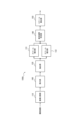
- FIG. 1 is a diagram illustrating a configuration example of an estimation device according to a first embodiment of the present disclosure.
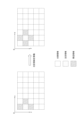
- 2 is a diagram for explaining division of a captured image by an image dividing unit shown in FIG. 1 .
- FIG. 4 is a diagram for explaining extraction of a concrete region by an extraction unit shown in FIG. 1 .
- FIG. 2 is a diagram illustrating an example of the configuration of a scale estimation unit 131 illustrated in FIG. 1 .
- 2 is a diagram illustrating an example of the configuration of a scale estimation unit 132 illustrated in FIG. 1 .
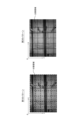
- 2 is a diagram for explaining a difference between an estimation result by a scale estimation unit 131 and an estimation result by a scale estimation unit 132 shown in FIG. 1 .
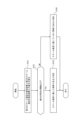
- FIG. 2 is a flowchart showing an example of an operation of the estimation device shown in FIG. 1 .
- 2 is a flowchart showing an example of an operation of an estimation result determination unit shown in FIG. 1 .
- FIG. 11 is a diagram illustrating a configuration example of an estimation device according to a second embodiment of the present disclosure. 11 is a flowchart showing an example of an operation of the removal unit shown in FIG. 10 .
- FIG. 10 is a diagram showing an example of calculation of a scale in a captured image by a scale calculation unit shown in FIG. 1 .
- FIG. 2 is a flowchart showing an example of an operation of the estimation device shown in FIG. 1 .
- 2 is a flowchart showing an example of an operation of
- FIG. 13 is a diagram illustrating a configuration example of an estimation device according to a third embodiment of the present disclosure.
- 13 is a diagram for explaining division of a captured image by an image dividing unit shown in FIG. 12 .
- FIG. 13 is a diagram for explaining extraction of a concrete region by the extraction unit shown in FIG. 12 .
- FIG. 13 is a diagram for explaining a determination by an estimation result determination unit shown in FIG. 12 .
- FIG. FIG. 13 is a diagram showing a state in which a first pattern and a second pattern are superimposed.
- 11 is a diagram for explaining selection of a scale estimation unit from a plurality of candidate scale estimation units.
- FIG. FIG. 1 is a diagram illustrating an example configuration of a computer that functions as an estimation device according to the present disclosure.
- (First embodiment) 1 is a diagram showing a configuration example of an estimation device 100 according to a first embodiment of the present disclosure.
- the estimation device 100 according to this embodiment performs scale estimation in a captured image of a structure made of concrete or asphalt.
- the structure is assumed to be a concrete structure made of asphalt.
- the estimation device 100 is assumed to estimate the number of pixels per unit length (pixel/cm) in the captured image.
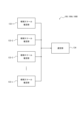
- the estimation device 100 includes an image segmentation unit 110, an extraction unit 120, a scale estimation unit 131 as a first scale estimation unit, a scale estimation unit 132 as a second scale estimation unit, an estimation result determination unit 140, and a scale calculation unit 150.
- the image segmentation unit 110 receives an image of a concrete structure.
- the image is an image of a concrete structure captured without the installation of a reference object such as a crack scale or marker.
- the image segmentation unit 110 segments the input image into a number of divided regions, as shown in FIG. 2.
- the extraction unit 120 extracts a target area in which only concrete or asphalt is photographed from among the multiple divided areas obtained by dividing the captured image.
- the structure is a concrete structure made of concrete.
- the extraction unit 120 extracts an area in which only concrete is photographed (hereinafter referred to as a concrete area) as the target area, as shown in FIG. 3.
- the extraction unit 120 extracts the concrete area from among the multiple divided areas, for example, using any image recognition technology. There are various methods for such image recognition technology, so a detailed description will be omitted.
- the scale estimation unit 131 performs scale estimation in the target area extracted by the extraction unit 120 (in this embodiment, the concrete area).
- the scale estimation unit 132 performs scale estimation in the concrete region extracted by the extraction unit 120.
- the scale estimation unit 132 has different characteristics with respect to scale estimation from the scale estimation unit 131.
- the scale estimation unit 131 and the scale estimation unit 132 can estimate the scale in the concrete region, for example, by using shadows formed by voids or unevenness on the concrete surface of the concrete region. Normally, when the shooting distance to the concrete structure is short, the shadows formed by voids or unevenness on the concrete surface become large in the captured image. Also, when the shooting distance to the concrete structure is long, the shadows formed by voids or unevenness on the concrete surface become small in the captured image.
- the scale estimation unit 131 and the scale estimation unit 132 can estimate the scale in the concrete region, for example, by using a learning model that learns a pair of a captured image with a known shooting distance and a true value of the scale in the captured image as learning data.
- the scale estimation unit 131 and the scale estimation unit 132 can estimate the scale by using, for example, shadows formed by voids or unevenness on the asphalt surface of an asphalt region in which only asphalt is captured and extracted as the target region.
- scale estimation unit 131 and scale estimation unit 132 have different features regarding scale estimation.
- Scale estimation unit 131 and scale estimation unit 132 can be constructed using, for example, ensemble learning and good product learning. Below, an example will be described in which scale estimation unit 131 is constructed using ensemble learning, and scale estimation unit 132 is constructed using good product learning. However, this is not limited to this example, and scale estimation unit 131 may be constructed using good product learning, and scale estimation unit 132 may be constructed using ensemble learning. Furthermore, scale estimation unit 131 and scale estimation unit 132 may be constructed using techniques other than ensemble learning and good product learning.
- FIG. 4A shows an example of the configuration of the scale estimation unit 131 when constructed using ensemble learning.
- the scale estimation unit 131 includes multiple weak estimators 131-1 to 131-n.
- Each of the weak estimators 131-1 to 131-n is an estimator constructed by learning a different data set (a pair of a concrete image photographed of concrete and the true value of the scale in the concrete image).
- Each of the weak estimators 131-1 to 131-n receives an image of a concrete area as input, performs scale estimation on the input image, and outputs the estimation result.
- the scale estimation unit 131 outputs one estimation result based on the estimation results of each of the weak estimators 131-1 to 131-n. For example, the scale estimation unit 131 outputs the average value or median of the estimation results of each of the weak estimators 131-1 to 131-n as the estimation result.
- FIG. 4B shows an example of the configuration of the scale estimation unit 132 when constructed using good product learning.
- the scale estimation unit 132 includes an estimator 132-1.
- the estimator 132-1 is an estimator constructed by learning only images (good product data) suitable for scale estimation, and is capable of more accurate scale estimation than the weak estimators 131-1 to 131-n described above. For example, a concrete image with a known scale is input to the multiple weak estimators 131-1 to 131-n described above, and the estimation results by each of the weak estimators 131-1 to 131-n are compared with the true value of the scale. If the number of weak estimators in which the error between the estimation result and the true value is equal to or less than a predetermined value is equal to or less than a certain number, the concrete image is determined to be good product data.
- the estimator 132-1 is constructed by learning such good product data.
- the scale estimation units 131 and 132 are selected so that for areas that are suitable for scale estimation, the difference in the estimation results is small, and for areas that are not suitable for scale estimation, the difference in the estimation results is large.
- the scale estimation units 131 and 132 having such characteristics can be selected experimentally, for example, using images that are known to be suitable for scale estimation and images that are known to be not suitable for scale estimation.
- the estimation result determination unit 140 determines, for each target region (in this embodiment, a concrete region), whether the concrete region is suitable for scale estimation or not, based on the estimation results by the scale estimation unit 131 and the scale estimation unit 132.
- the scale estimation unit 131 and the scale estimation unit 132 have the characteristic that the difference in the estimation results is small for areas suitable for scale estimation, and the difference in the estimation results is large for areas not suitable for scale estimation.
- the scale calculation unit 150 calculates the scale for each of the multiple divided regions based on the scale for the region suitable for scale estimation. Specifically, the scale calculation unit 150 calculates the scale for the divided region based on the scale for the region suitable for scale estimation surrounding the divided region. The scale calculation unit 150 performs scale estimation for the entire captured image and outputs the estimation result.
- the scale calculation unit 150 sets one of the multiple divided regions as the region of interest, as shown in FIG. 6.
- the scale calculation unit 150 calculates the scale of the region of interest based on the scale of a region determined to be suitable for scale estimation among the surrounding regions, which are divided regions adjacent to the region of interest in the four directions (up, down, left, and right). For example, if the surrounding regions include multiple regions suitable for scale estimation, the scale calculation unit 150 calculates the average value of the scales of the multiple regions suitable for scale estimation as the scale of the region of interest. After calculating the scale for one region of interest, the scale calculation unit 150 moves the region of interest, as shown in FIG. 6. The scale calculation unit 150 performs the above-mentioned scale calculation process for all divided regions.
- the scale calculation unit 150 calculates the scale of the region of interest, it determines that the region of interest is suitable for scale estimation, and calculates the scale of subsequent regions of interest. Depending on the arrangement of the regions suitable for scale estimation, there may be no regions suitable for scale estimation among the surrounding regions of the region of interest. In this case, the scale calculation unit 150 moves the region of interest without calculating the scale of the region of interest. After performing the above-mentioned scale calculation process for all divided regions, if there are still divided regions whose scale has not been calculated, the scale calculation unit 150 performs the above-mentioned scale calculation process again for all divided regions. By repeating this process, the scale calculation unit 150 can calculate the scale for all divided regions, i.e., for the entire captured image.
- FIG. 6 an example has been described in which divided regions in four directions around the region of interest are set as the surrounding region, but this is not limited to this.
- FIG. 7 in addition to the above, below, left, and right directions of the region of interest, adjacent divided regions in eight directions, namely, upper right, lower right, upper left, and lower left, may be set as the surrounding region.
- FIG. 8 is a flowchart showing an example of the operation of the estimation device 100 according to this embodiment, and is a diagram for explaining the estimation method performed by the estimation device 100.
- the image division unit 110 divides the captured image of the concrete structure into multiple divided regions (step S11).
- the extraction unit 120 extracts a target area (in this embodiment, a concrete area) in which only concrete or asphalt is photographed from among the multiple divided areas (step S12).
- the scale estimation unit 131 performs scale estimation (first scale estimation) in the extracted concrete region (step S13).
- the scale estimation unit 132 which has characteristics different from those of the scale estimation unit 131, performs scale estimation (second scale estimation) in the extracted concrete region (step S14).
- the estimation result determination unit 140 determines whether the concrete region is suitable for scale estimation or not based on the estimation results of the first scale estimation and the second scale estimation (step S15). The determination by the estimation result determination unit 140 will be described in more detail with reference to FIG. 9.
- the estimation result determination unit 140 calculates the difference between the estimation result obtained by the first scale estimation and the estimation result obtained by the second scale estimation for one concrete region (step S151).
- the estimation result determination unit 140 determines whether the calculated difference is equal to or smaller than a predetermined threshold (step S152). As described with reference to FIG. 5, the difference between the estimation result of the first scale estimation (the estimation result by the scale estimation unit 131) and the second scale estimation (the estimation result by the scale estimation unit 132) is small for an image suitable for scale estimation and is large for an image not suitable for scale estimation.
- step S152 If it is determined that the difference is equal to or less than the predetermined threshold (step S152: Yes), the estimation result determination unit 140 determines that the concrete region is suitable for scale estimation (step S153).
- step S152 determines that the concrete region is not suitable for scale estimation.
- the estimation result determination unit 140 performs the above-mentioned process for all extracted concrete regions.
- the scale calculation unit 150 calculates the scale in each of the multiple divided regions based on the scale in the region suitable for scale estimation (step S16).
- the estimation device 100 includes an image division unit 110, an extraction unit 120, a scale estimation unit 131 as a first scale estimation unit, a scale estimation unit 132 as a second scale estimation unit, an estimation result determination unit 140, and a scale calculation unit 150.
- the image division unit 110 divides a captured image of a structure into a plurality of divided regions.
- the extraction unit 120 extracts a target region in which only concrete or asphalt is captured from the plurality of divided regions.
- the scale estimation unit 131 performs scale estimation in the extracted target region.
- the scale estimation unit 132 has characteristics different from those of the scale estimation unit 131, and performs scale estimation in the extracted target region.
- the estimation result determination unit 140 determines whether the target region is suitable for scale estimation or not, based on the estimation results by the scale estimation unit 131 and the scale estimation unit 132.
- the scale calculation unit 150 calculates the scale in each of the plurality of divided regions, based on the scale in the region suitable for scale estimation.
- FIG. 10 is a diagram illustrating an example of a configuration of an estimation device 100A according to the second embodiment of the present disclosure.
- the estimation device 100A includes an image division unit 110, an extraction unit 120, a scale estimation unit 131, a scale estimation unit 132, an estimation result determination unit 140, a scale calculation unit 150, and an exclusion unit 160.
- the estimation device 100A according to this embodiment differs from the estimation device 100 according to the first embodiment in that it includes an exclusion unit 160.
- the exclusion unit 160 counts the number of pixels of a specific color (e.g., white or black) in the target region. If the number of pixels of a specific color in the target region is equal to or greater than a predetermined threshold, the exclusion unit 160 excludes the target region from the scale estimation performed by the scale estimation unit 131 and the scale estimation unit 132.
- a specific color e.g., white or black
- FIG. 11 is a flowchart showing an example of the operation of the exclusion unit 160.
- the exclusion unit 160 performs the process described with reference to FIG. 11 between the process of step S12 and the process of step S13 in FIG. 8.
- the exclusion unit 160 counts the number of pixels of a specific color in one target area (in this embodiment, the concrete area) (step S161).
- the exclusion unit 160 determines whether the counted number of pixels of a particular color is equal to or greater than a predetermined threshold (step S162).
- step S162 If it is determined that the number of pixels of a particular color counted for a concrete region is equal to or greater than a predetermined threshold (step S162: Yes), the exclusion unit 160 excludes the concrete region from the scale estimation targets (step S163).
- step S162 If it is determined that the number of pixels of a particular color counted for a concrete region is less than a predetermined threshold (step S162: No), the exclusion unit 160 determines that the concrete region is a target for scale estimation (step S164).
- the target area is excluded from the scale estimation, thereby improving the accuracy of scale estimation.
- FIG. 12 is a diagram illustrating an example of a configuration of an estimation device 100B according to a third embodiment of the present disclosure.
- the estimation device 100B includes an image division unit 110B, an extraction unit 120B, a scale estimation unit 131, a scale estimation unit 132, an estimation result determination unit 140B, a scale calculation unit 150B, and an identification unit 170.
- the estimation device 100B according to this embodiment differs from the estimation device 100 according to the first embodiment in that the image division unit 110, the extraction unit 120, the estimation result determination unit 140, and the scale calculation unit 150 are changed to an image division unit 110B, an extraction unit 120B, an estimation result determination unit 140B, and a scale calculation unit 150B, respectively, and in that an identification unit 170 is added.
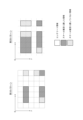
- the image division unit 110B divides the input photographed image into a plurality of divided areas using a first pattern and a second pattern different from the first pattern, as shown in FIG. 13.
- FIG. 13 shows an example in which the division size is the same for the first pattern and the second pattern, but the division position is shifted in the x and y directions by half the size of one divided area.
- the extraction unit 120B extracts a target region (in this embodiment, a concrete region) from among the multiple divided regions divided by the first pattern, as shown in FIG. 14. Also, the extraction unit 120B extracts a concrete region from among the multiple divided regions divided by the second pattern, as shown in FIG. 14.
- the scale estimation unit 131 performs scale estimation in the concrete regions extracted for each of the first pattern and the second pattern. Also, the scale estimation unit 132 performs scale estimation in the concrete regions extracted for each of the first pattern and the second pattern.
- the estimation result determination unit 140B determines whether a concrete region extracted from a plurality of divided regions divided in a first pattern is suitable for scale estimation or is not suitable for scale estimation based on the estimation results of the scale estimation unit 131 and the scale estimation unit 132.
- the estimation result determination unit 140B also determines whether a concrete region extracted from a plurality of divided regions divided in a second pattern is suitable for scale estimation or is not suitable for scale estimation based on the estimation results of the scale estimation unit 131 and the scale estimation unit 132.
- the identification unit 170 identifies an area that is included in at least one of the areas suitable for scale estimation in the first pattern and the areas suitable for scale estimation in the second pattern, among the multiple areas formed by superimposing the first pattern and the second pattern.
- the division size is the same in the first pattern and the second pattern, and the division position is shifted by half the size of one divided area in the x direction and the y direction. Therefore, by superimposing the first pattern and the second pattern, an area whose size in the x direction and the y direction is half that of the original divided area is formed.
- the identification unit 170 identifies an area that is included in at least one of the areas suitable for scale estimation in the first pattern and the areas suitable for scale estimation in the second pattern, among the areas whose size in the x direction and the y direction is half that of the original divided area.
- the scale calculation unit 150B estimates the scale in each of the multiple regions formed by superimposing the first pattern and the second pattern based on the scale in the region identified by the identification unit 170.
- the captured image can be divided into smaller regions than the original division regions, and regions suitable for scale estimation can be identified.
- the scale of the entire captured image can then be estimated based on the scale of the identified regions, thereby improving estimation accuracy.
- the first and second patterns are not limited to the above examples, and any pattern can be used. However, as in this embodiment, it is preferable to adopt a pattern in which the first and second patterns are superimposed to arrange rectangular regions in the x and y directions.
- the estimation devices 100, 100A, and 100B may include a plurality of candidate scale estimation units 133-1 to 133-n that are candidates for the scale estimation unit 131 and the scale estimation unit 132, and a selection unit 134 that selects the scale estimation unit 131 and the scale estimation unit 132 from the plurality of candidate scale estimation units 133-1 to 133-n.
- FIG. 17 only shows the configuration related to the selection of the scale estimation unit 131 and the scale estimation unit 132, and the other configurations included in the estimation devices 100, 100A, and 100B are omitted.
- Candidate scale estimation units 133-1 to 133-n each have different characteristics and perform scale estimation. Each of candidate scale estimation units 133-1 to 133-n receives an image suitable for scale estimation and an image unsuitable for scale estimation, and outputs the results of scale estimation for each. Note that images suitable for scale estimation and images unsuitable for scale estimation can be experimentally identified, for example, using an estimator other than candidate scale estimation units 133-1 to 133-n.
- the selection unit 134 selects the scale estimation unit 131 and the scale estimation unit 132 from among the multiple candidate scale estimation units 133-1 to 133-n based on the estimation results of each of the multiple candidate scale estimation units 133-1 to 133-n for the input image (an image suitable for scale estimation and an image unsuitable for scale estimation). Specifically, the selection unit 134 identifies a combination of two candidate scale estimation units 133 from among the candidate scale estimation units 133-1 to 133-n that results in a small error in the estimation result for an image suitable for scale estimation and a large error in the estimation result for an image unsuitable for scale estimation. The selection unit 134 then selects the two identified candidate scale estimation units 133 as the scale estimation unit 131 and the scale estimation unit 132.
- the candidate scale estimation unit 133 suitable for the target of scale estimation can be selected as the scale estimation unit 131 and the scale estimation unit 132.
- the above-mentioned estimation devices 100, 100A, 100B can each be realized by a computer 10 shown in FIG. 18.
- a program for causing the computer 10 to function as the estimation devices 100, 100A, 100B may also be provided.
- the program may also be stored in a storage medium or provided via a network.
- FIG. 18 is a block diagram showing a schematic configuration of a computer 10 functioning as the estimation devices 100, 100A, 100B.
- the computer 10 may be a general-purpose computer, a dedicated computer, a workstation, a PC (Personal Computer), an electronic notepad, etc.
- the program instructions may be program code, code segments, etc. for performing the required tasks.
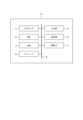
- the computer 10 has a processor 11, a ROM (Read Only Memory) 12, a RAM (Random Access Memory) 13, storage 14, an input unit 15, a display unit 16, and a communication interface (I/F) 17.
- a processor 11 is a CPU (Central Processing Unit), MPU (Micro Processing Unit), GPU (Graphics Processing Unit), DSP (Digital Signal Processor), SoC (System on a Chip), etc., and may be composed of multiple processors of the same or different types.
- the processor 11 is a control unit that controls each component and executes various calculation processes. That is, the processor 11 reads a program from the ROM 12 or the storage 14, and executes the program using the RAM 13 as a working area. The processor 11 controls each of the above components and executes various calculation processes according to the program stored in the ROM 12 or the storage 14.
- the ROM 12 or the storage 14 stores a program for operating the computer 10 as the estimation devices 100, 100A, and 100B according to the present disclosure. The program is read and executed by the processor 11 to realize each of the components of the estimation devices 100, 100A, and 100B described above.
- the program may be provided in a form stored on a non-transitory storage medium such as a CD-ROM (Compact Disk Read Only Memory), a DVD-ROM (Digital Versatile Disk Read Only Memory), or a USB (Universal Serial Bus) memory.
- the program may also be provided in a form that allows it to be downloaded from an external device via a network.
- ROM 12 stores various programs and data.
- RAM 13 temporarily stores programs or data as a working area.
- Storage 14 is composed of a HDD (Hard Disk Drive) or SSD (Solid State Drive), and stores various programs and data including the operating system.
- the input unit 15 includes a pointing device such as a mouse and a keyboard, and is used to perform various input operations.
- the display unit 16 is, for example, a liquid crystal display, and displays various information.
- the display unit 16 may adopt a touch panel system and function as the input unit 15.
- the display unit 16 is an example of the result output unit 124.
- the communication interface 17 is an interface for communicating with other devices, for example, an interface for a LAN.
- An estimation device that performs scale estimation in a captured image of a structure, comprising: A control unit is provided, The control unit is Dividing the captured image into a plurality of divided regions; Extracting a target area in which only concrete or asphalt is photographed from the plurality of divided areas; performing a first scale estimation in the extracted region of interest; performing a second scale estimation on the extracted region of interest, the second scale estimation having different characteristics than the first scale estimation; determining whether the target region is a region suitable for scale estimation or a region not suitable for scale estimation based on estimation results by the first scale estimation and the second scale estimation; An estimation device that calculates a scale in each of the plurality of divided regions based on a scale in a region suitable for the scale estimation.
- the control unit determines, for a certain target region, whether the certain target region is a region suitable for the scale estimation or a region unsuitable for the scale estimation, depending on a difference between a scale estimated by the first scale estimation and a scale estimated by the second scale estimation.
- the control unit calculates the scale of the divided region based on a scale in a region suitable for the scale estimation surrounding the divided region.
- the control unit counts the number of pixels of a specific color in the target region, and if the number of pixels of the specific color is equal to or greater than a predetermined threshold, excludes the target region from the first scale estimation and the second scale estimation.
- the control unit is Dividing the captured image into a plurality of divided regions using a first pattern and a second pattern different from the first pattern; extracting the target region from among a plurality of divided regions divided by the first pattern, and extracting the target region from each of a plurality of divided regions divided by the second pattern; performing the first scale estimation and the second scale estimation for the target regions extracted for the first pattern and the second pattern, respectively; determining whether a target area extracted from a plurality of divided areas divided in the first pattern is a region suitable for the scale estimation or a region unsuitable for the scale estimation based on results of the first scale estimation and the second scale estimation, and determining whether a target area extracted from a plurality of divided areas divided in the second pattern is a region suitable for the scale estimation or a region unsuitable for the scale estimation, identifying an area included in at least one of an area suitable for the scale estimation in the first pattern and an area suitable for the scale estimation in the second pattern from
- the estimation apparatus comprises a plurality of candidate scale estimators having different characteristics; the control unit selects a candidate scale estimation unit that performs the first scale estimation and the second scale estimation from the plurality of candidate scale estimation units based on estimation results of each of the plurality of candidate scale estimation units for the input image.
- An estimation method using an estimation device that performs scale estimation in a captured image of a structure comprising: Dividing the captured image into a plurality of divided regions; Extracting a target area in which only concrete or asphalt is photographed from the plurality of divided areas; performing a first scale estimation in the extracted region of interest; performing a second scale estimation on the extracted region of interest, the second scale estimation having different characteristics than the first scale estimation; determining whether the target region is a region suitable for scale estimation or a region not suitable for scale estimation based on estimation results by the first scale estimation and the second scale estimation; A method for estimating a scale in each of the plurality of divided regions based on a scale in the region suitable for the scale estimation.
- a non-transitory storage medium storing a program executable by a computer, the non-transitory storage medium storing the program causing the computer to operate as the estimation device according to any one of claims 1 to 6.
Landscapes
- Physics & Mathematics (AREA)
- General Physics & Mathematics (AREA)
- Image Analysis (AREA)
Priority Applications (2)
| Application Number | Priority Date | Filing Date | Title |
|---|---|---|---|
| PCT/JP2023/020546 WO2024247236A1 (ja) | 2023-06-01 | 2023-06-01 | 推定装置、推定方法およびプログラム |
| JP2025523179A JPWO2024247236A1 (https=) | 2023-06-01 | 2023-06-01 |
Applications Claiming Priority (1)
| Application Number | Priority Date | Filing Date | Title |
|---|---|---|---|
| PCT/JP2023/020546 WO2024247236A1 (ja) | 2023-06-01 | 2023-06-01 | 推定装置、推定方法およびプログラム |
Publications (1)
| Publication Number | Publication Date |
|---|---|
| WO2024247236A1 true WO2024247236A1 (ja) | 2024-12-05 |
Family
ID=93657132
Family Applications (1)
| Application Number | Title | Priority Date | Filing Date |
|---|---|---|---|
| PCT/JP2023/020546 Ceased WO2024247236A1 (ja) | 2023-06-01 | 2023-06-01 | 推定装置、推定方法およびプログラム |
Country Status (2)
| Country | Link |
|---|---|
| JP (1) | JPWO2024247236A1 (https=) |
| WO (1) | WO2024247236A1 (https=) |
Citations (4)
| Publication number | Priority date | Publication date | Assignee | Title |
|---|---|---|---|---|
| JP2014185996A (ja) * | 2013-03-25 | 2014-10-02 | Toshiba Corp | 計測装置 |
| JP2019194562A (ja) * | 2018-04-26 | 2019-11-07 | キヤノン株式会社 | 情報処理装置、情報処理方法及びプログラム |
| JP2021163190A (ja) * | 2020-03-31 | 2021-10-11 | キヤノン株式会社 | 情報処理装置、情報処理方法、およびプログラム |
| WO2023100336A1 (ja) * | 2021-12-02 | 2023-06-08 | 日本電信電話株式会社 | 学習モデル構築装置、推定装置、学習モデル構築方法、推定方法、及びプログラム |
-
2023
- 2023-06-01 JP JP2025523179A patent/JPWO2024247236A1/ja active Pending
- 2023-06-01 WO PCT/JP2023/020546 patent/WO2024247236A1/ja not_active Ceased
Patent Citations (4)
| Publication number | Priority date | Publication date | Assignee | Title |
|---|---|---|---|---|
| JP2014185996A (ja) * | 2013-03-25 | 2014-10-02 | Toshiba Corp | 計測装置 |
| JP2019194562A (ja) * | 2018-04-26 | 2019-11-07 | キヤノン株式会社 | 情報処理装置、情報処理方法及びプログラム |
| JP2021163190A (ja) * | 2020-03-31 | 2021-10-11 | キヤノン株式会社 | 情報処理装置、情報処理方法、およびプログラム |
| WO2023100336A1 (ja) * | 2021-12-02 | 2023-06-08 | 日本電信電話株式会社 | 学習モデル構築装置、推定装置、学習モデル構築方法、推定方法、及びプログラム |
Also Published As
| Publication number | Publication date |
|---|---|
| JPWO2024247236A1 (https=) | 2024-12-05 |
Similar Documents
| Publication | Publication Date | Title |
|---|---|---|
| Wang et al. | Automated estimation of reinforced precast concrete rebar positions using colored laser scan data | |
| Hoang et al. | Metaheuristic optimized edge detection for recognition of concrete wall cracks: a comparative study on the performances of roberts, prewitt, canny, and sobel algorithms | |
| US20200007855A1 (en) | Stereo Correspondence and Depth Sensors | |
| US9135710B2 (en) | Depth map stereo correspondence techniques | |
| JP2014228357A (ja) | ひび割れ検出方法 | |
| JP7188798B2 (ja) | 座標算出装置、座標算出方法、及びプログラム | |
| US20200211182A1 (en) | Image analysis device | |
| JP2018139086A (ja) | 相関追尾装置、相関追尾方法及び相関追尾プログラム | |
| US20230093034A1 (en) | Target area detection device, target area detection method, and target area detection program | |
| CN114202631A (zh) | 一种岩石二次破碎作业中岩石作业面与作业点的确定方法 | |
| WO2017221965A1 (ja) | 状態判定装置、状態判定方法、及びプログラムを記憶する記憶媒体 | |
| US11138711B2 (en) | Degradation detection device, degradation detection method, and computer-readable recording medium | |
| JP5958101B2 (ja) | 画像処理方法及び画像処理装置 | |
| CN106530273B (zh) | 高精度fpc直线线路检测与缺陷定位方法 | |
| Liu et al. | Point cloud-based crack detection and measurement in masonry buildings subjected to settlement induced by underground construction | |
| WO2024247236A1 (ja) | 推定装置、推定方法およびプログラム | |
| EP3289566A1 (en) | Method and apparatus for determining temporal behaviour of an object | |
| KR102561093B1 (ko) | 반도체 장치의 결함 검출을 위한 필터 추출 장치 및 방법과, 이를 이용한 결함 검출 시스템 | |
| JP6897448B2 (ja) | 線幅推定プログラム、装置、及び方法 | |
| JP4685711B2 (ja) | 画像処理方法及び装置及びプログラム | |
| JP7799225B2 (ja) | 画像処理装置、画像処理方法およびプログラム | |
| US20250022260A1 (en) | Learning model building device, prediction device, learning model building method, prediction method, and program | |
| KR101697648B1 (ko) | 다중 노출 카메라 영상을 이용한 자동 고속 이동 물체 검출 방법 | |
| CN114299026A (zh) | 检测方法、装置、电子设备及可读存储介质 | |
| US20250225644A1 (en) | Information processing apparatus, information processing method, and non-transitory computer-readable storage medium storing a computer program |
Legal Events
| Date | Code | Title | Description |
|---|---|---|---|
| 121 | Ep: the epo has been informed by wipo that ep was designated in this application |
Ref document number: 23939710 Country of ref document: EP Kind code of ref document: A1 |
|
| ENP | Entry into the national phase |
Ref document number: 2025523179 Country of ref document: JP Kind code of ref document: A |
|
| NENP | Non-entry into the national phase |
Ref country code: DE |