WO2024241823A1 - 光導波路デバイス、光接続構造、および光接続方法 - Google Patents
光導波路デバイス、光接続構造、および光接続方法 Download PDFInfo
- Publication number
- WO2024241823A1 WO2024241823A1 PCT/JP2024/016114 JP2024016114W WO2024241823A1 WO 2024241823 A1 WO2024241823 A1 WO 2024241823A1 JP 2024016114 W JP2024016114 W JP 2024016114W WO 2024241823 A1 WO2024241823 A1 WO 2024241823A1
- Authority
- WO
- WIPO (PCT)
- Prior art keywords
- core
- face
- optical fiber
- fiber array
- waveguide device
- Prior art date
- Legal status (The legal status is an assumption and is not a legal conclusion. Google has not performed a legal analysis and makes no representation as to the accuracy of the status listed.)
- Ceased
Links
Images






Classifications
-
- G—PHYSICS
- G02—OPTICS
- G02B—OPTICAL ELEMENTS, SYSTEMS OR APPARATUS
- G02B6/00—Light guides; Structural details of arrangements comprising light guides and other optical elements, e.g. couplings
- G02B6/10—Light guides; Structural details of arrangements comprising light guides and other optical elements, e.g. couplings of the optical waveguide type
- G02B6/12—Light guides; Structural details of arrangements comprising light guides and other optical elements, e.g. couplings of the optical waveguide type of the integrated circuit kind
- G02B6/122—Basic optical elements, e.g. light-guiding paths
-
- G—PHYSICS
- G02—OPTICS
- G02B—OPTICAL ELEMENTS, SYSTEMS OR APPARATUS
- G02B6/00—Light guides; Structural details of arrangements comprising light guides and other optical elements, e.g. couplings
- G02B6/24—Coupling light guides
- G02B6/26—Optical coupling means
- G02B6/30—Optical coupling means for use between fibre and thin-film device
Definitions
- the present disclosure relates to an optical waveguide device, an optical connection structure, and an optical connection method.
- This application claims priority based on Japanese Application No. 2023-083999, filed on May 22, 2023, and incorporates by reference all of the contents of said Japanese application.
- Patent Document 1 discloses an optical waveguide device that includes a clad and multiple cores surrounded by the clad.
- this optical waveguide device the pitch between each core inside the clad is changed along the direction of light propagation.
- Such an optical waveguide device is disposed, for example, between two fiber arrays with different core pitches, and enables these fiber arrays to be optically connected with low loss.
- An optical waveguide device comprises a cladding including a first surface and a second surface different from the first surface, at least one first core extending inside the cladding from the first surface to the second surface, and a second core formed in an area of the cladding excluding the first core and extending from the first surface through the inside of the cladding to return to the first surface.
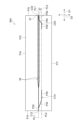
- FIG. 1 is a perspective view showing an optical connection structure according to the first embodiment.
- FIG. 2 is a perspective view showing the optical waveguide device of FIG.
- FIG. 3 is a side view showing the optical waveguide device of FIG.
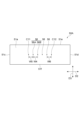
- FIG. 4a is a front view showing the optical waveguide device of FIG.
- FIG. 4b is a front view showing a first optical fiber array facing the optical waveguide device of FIG. 4a.
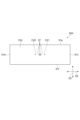
- FIG. 5a is a rear view of the optical waveguide device of FIG.
- FIG. 5b is a front view showing a second optical fiber array facing the optical waveguide device of FIG. 5a.
- FIG. 6 is a flowchart showing steps of the optical connecting method according to the first embodiment.
- FIG. 1 is a perspective view showing an optical connection structure according to the first embodiment.
- FIG. 2 is a perspective view showing the optical waveguide device of FIG.
- FIG. 3 is a side view showing the optical waveguide device of FIG.
- FIG. 4a is a front view showing the optical
- FIG. 7a is a plan view showing how the optical waveguide device and the first optical fiber array are actively aligned.
- FIG. 7b is a plan view showing active alignment of the optical waveguide device and the second optical fiber array.
- FIG. 8 is a perspective view showing an optical connection structure according to the second embodiment.
- FIG. 9 is a perspective view showing the optical waveguide device of FIG.
- FIG. 10 is a side view showing the optical waveguide device of FIG.
- FIG. 11a is a front view showing the optical waveguide device of FIG.
- FIG. 11b is a front view showing a first optical fiber array facing the optical waveguide device of FIG. 11a.
- FIG. 12a is a rear view of the optical waveguide device of FIG.
- FIG. 12b is a front view showing a second optical fiber array facing the optical waveguide device of FIG. 12a.
- an alignment operation is performed to adjust the relative positions of the three components so that the optical axes of the cores of these three components are aligned.
- alignment methods include active alignment, in which test light is actually introduced into the three components and the arrangement of the three components is adjusted while monitoring the optical coupling loss between the three components, and passive alignment, in which the arrangement of the three components is adjusted while observing markers or the like formed on the three components or their peripheral parts as marks.
- passive alignment it may be difficult to align the three components with high accuracy due to errors in the positions of marks such as markers, or errors in the detection positions of the cores during observation.
- active alignment in which the arrangement of the three components is adjusted while monitoring the test light, allows the three components to be aligned with high accuracy compared to passive alignment.
- active alignment for example, test light is input from a first fiber array, and the intensity of the test light that passes through an optical waveguide device and is output from a second fiber array is measured by a receiver such as a power meter. Three-part alignment is then performed to adjust the arrangement of the three components relative to one another so that the intensity of the test light is maximized.
- active alignment which is premised on monitoring the test light, requires adjusting the arrangement of the three components with a certain degree of precision so that the test light passes through the cores of the three components.
- This disclosure provides an optical waveguide device, an optical connection structure, and an optical connection method that allow for easier alignment of three components.
- An optical waveguide device comprises a cladding including a first surface and a second surface different from the first surface, at least one first core extending inside the cladding from the first surface to the second surface, and a second core formed in an area of the cladding excluding the first core and extending from the first surface through the inside of the cladding to return to the first surface.
- the optical waveguide device is used, for example, to optically connect two optical fiber arrays to each other.
- the first surface of the optical waveguide device faces one optical fiber array (hereinafter referred to as the "first optical fiber array”).
- the second surface of the optical waveguide device faces the other optical fiber array (hereinafter referred to as the "second optical fiber array”).
- the first core of the optical waveguide device is optically connected to the first optical fiber array on the first surface and to the second optical fiber array on the second surface. Therefore, the first core can be used as a communication core for transmitting communication light necessary for communication between these optical fiber arrays.
- the optical waveguide device has a second core that extends from the first surface through the inside of the clad to return to the first surface.
- the second core can be used as an alignment core for actively aligning the two members of the optical waveguide device and the first optical fiber array.
- Test light for actively aligning these two members is emitted from the first optical fiber array to the first surface, passes through the second core, and returns from the first surface to the first optical fiber array again. Therefore, by measuring the test light that returns to the first optical fiber array with a power meter or the like, it is possible to adjust the positioning of the two components, the optical waveguide device and the first optical fiber array, to maximize the intensity of the test light.
- the remaining second optical fiber can be aligned with the aligned optical waveguide device.
- the three components of the first optical fiber array, the optical waveguide device, and the second optical fiber array are aligned by active alignment. In this way, when the above-mentioned optical waveguide device is used, the three-way alignment for adjusting the arrangement of the three components is not performed all at once, but the two-way alignment for adjusting the arrangement of the two components is performed twice.
- the above-mentioned optical waveguide device makes it possible to align the three components more easily.
- the first core may include a core end face exposed on the first surface.
- the second core may include a first core end face and a second core end face exposed at a position on the first surface different from the core end face. In this case, it is possible to preferably realize a mode in which the test light emitted from the first optical fiber array to the first surface passes through the second core and returns to the first optical fiber array again.
- the first core end face and the second core end face may be arranged side by side with the core end face in one direction along the first surface.
- the first core end face and the second core end face may be arranged side by side on one of the two sides of the core end face in one direction.
- a second core that extends inside the cladding without intersecting with the first core can be easily formed.
- the second core may extend inside the cladding along a plane that intersects with the first surface and passes through the first core end surface and the second core end surface.
- the second core is formed on the same plane, which facilitates the work of forming the second core inside the cladding.
- the first core end face and the second core end face may be arranged on both sides of the core end face in one direction.
- the distance between the first core end face and the second core end face can be made greater than when the first core end face and the second core end face are arranged next to each other, so that the distance between the first core end face and the second core end face can be maintained large.
- the distance between the first core end face and the second core end face can be maintained large in this way, the radius of curvature of the curved portion that may be formed in the path of the second core from the first core end face to the second core end face can be maintained large compared to when the first core end face and the second core end face are arranged next to each other. This makes it possible to reduce the propagation loss of the test light introduced into the second core during alignment.
- the second core may include a first portion that intersects the first surface and extends along a plane passing through the first core end face and the second core end face, and a second portion that is formed in an area away from the plane and extends so as to intersect with the first core when viewed along the normal direction of the plane.
- the path of the second core can be changed three-dimensionally so as not to intersect with the first core inside the cladding.
- the optical waveguide device described in any one of (3) to (7) above may include a plurality of first cores.
- the core end faces of the plurality of first cores may include a first adjacent end face adjacent to one of the first core end face and the second core end face in one direction, and a second adjacent end face adjacent to the first adjacent end face in one direction.
- the distance between one of the first core end face and the second core end face and the first adjacent end face may be the same as the distance between the first adjacent end face and the first adjacent end face.
- the holder is formed with a plurality of holding portions (e.g., V-grooves) for holding the plurality of optical fibers.
- Such holding portions are usually formed to be aligned at a constant interval, assuming that the plurality of optical fibers are aligned at a constant interval.
- the plurality of first cores and the second cores can be aligned at a constant interval, so that an existing holder that holds the plurality of optical fibers aligned at a constant interval can be used accordingly. In this way, the above configuration allows existing holders to be used as is without modification, making it highly versatile.
- the mode field diameter of the second core on the first surface may be the same as the mode field diameter of the first core on the first surface.
- the multiple optical fibers of the first optical fiber array are held in a holder in a state where they are arranged corresponding to the first core and the second core.
- the holder is formed with multiple holding parts (e.g., V-grooves) for holding the multiple optical fibers.
- Such holding parts are usually formed with the same size and shape, assuming that a general-purpose optical fiber is used.
- the mode field diameter of the second core is set to be the same as the mode field diameter of the first core, assuming that a general-purpose optical fiber is optically connected to the first core and the second core. Therefore, according to the above configuration, an existing holder capable of holding a general-purpose optical fiber can be used as is, and therefore it is highly versatile.
- the optical waveguide device described in (1) to (9) above may further include a third core formed in an area of the clad excluding the first core and the second core, and extending from the second surface through the inside of the clad to return to the second surface.
- the third core can be used as an alignment core for actively aligning the two members of the optical waveguide device and the second optical fiber array. Test light for actively aligning these two members is emitted from the second optical fiber array to the second surface, passes through the third core, and returns to the second optical fiber array from the second surface.
- An optical connection structure includes an optical waveguide device according to any one of (1) to (10) above, and an optical fiber array arranged to face the first surface.
- the optical fiber array includes at least one first optical fiber optically connected to a first core on the first surface, and a pair of second optical fibers optically connected to both ends of a second core on the first surface. Since this optical connection structure includes any one of the optical waveguide devices described above, it becomes possible to more easily align the three components, as described above.
- An optical connection method includes the steps of: preparing an optical waveguide device, a first optical fiber array, and a second optical fiber array according to any one of (1) to (10) above; performing active alignment between the optical waveguide device and the first optical fiber array so that the first optical fiber array is optically connected to the optical waveguide device in a state where the first optical fiber array is arranged to face the first surface of the optical waveguide device; and performing active alignment between the optical waveguide device and the second optical fiber array so that the second optical fiber array is optically connected to the optical waveguide device after the active alignment in a state where the second optical fiber array is arranged to face the second surface of the optical waveguide device.
- alignment test light is emitted from the first alignment optical fiber of the first optical fiber array toward the first surface, the test light that passes through the second core from the first surface and is incident on the second alignment optical fiber of the first optical fiber array is measured, and the arrangement of the optical waveguide device and the first optical fiber array is adjusted so that the intensity of the test light is maximized.
- the three-component alignment for adjusting the arrangement of the three components is not performed all at once, but the two-component alignment for adjusting the arrangement of the two components is performed twice.
- the arrangement of the three components through which the test light passes can be found more easily than when the three-component alignment is performed all at once, so the difficulty of adjusting the positions of the three components when actively aligning the three components can be reduced.
- the three components can be more reliably aligned while capturing the optical axis positions of the cores of the three components, so the time required for aligning the three components can be reduced compared to when only passive alignment is performed. Therefore, according to the above optical connection method, it is possible to more easily align the three components.
- An optical waveguide device is disposed between a first optical fiber array and a second optical fiber array, and optically connects the first optical fiber array and the second optical fiber array.
- the optical waveguide device includes a cladding including a first surface facing the first optical fiber array and a second surface facing the second optical fiber array, at least one communication core extending inside the cladding from the first surface to the second surface and capable of transmitting communication light necessary for communication between the first optical fiber array and the second optical fiber array, and an alignment core formed in an area of the cladding excluding the communication core, extending from the first surface through the inside of the cladding to return to the first surface, and capable of transmitting test light for actively aligning the first optical fiber array and the optical waveguide device.
- Fig. 1 is a perspective view showing an optical connection structure 1 according to a first embodiment.
- the optical connection structure 1 includes, for example, a first optical fiber array 10, a second optical fiber array 30, and an optical waveguide device 50.
- covers 17 and 37, which will be described later, are shown by dashed lines.
- the first optical fiber array 10, the optical waveguide device 50, and the second optical fiber array 30 are arranged in this order along the first direction D1. Therefore, the optical waveguide device 50 is disposed between the first optical fiber array 10, the second optical fiber array 30, and the first direction D1.
- the optical waveguide device 50 is used to optically connect the first optical fiber array 10 and the second optical fiber array 30.
- the optical waveguide device 50 is configured to transmit communication light (i.e., optical signals) to be transmitted between the first optical fiber array 10 and the second optical fiber array 30.
- the first optical fiber array 10 includes, for example, a first optical fiber group 11 and a first holder 15 that holds the first optical fiber group 11.
- the tip of the first optical fiber group 11 extends, for example, from the MT ferrule toward the optical waveguide device 50 in a first direction D1 and faces the optical waveguide device 50 in the first direction D1.
- the first holder 15 is disposed in a position facing the optical waveguide device 50 in the first direction D1 and holds the tip of the first optical fiber group 11.
- the first holder 15 includes, for example, a base 16 that supports the tip of the first optical fiber group 11 and a lid 17 that is disposed on the base 16 so as to cover the tip of the first optical fiber group 11.
- the first optical fiber group 11 includes, for example, a plurality of general-purpose single-core fibers (hereinafter, referred to as "SCFs") 12.
- SCFs general-purpose single-core fibers
- Each SCF 12 includes, for example, a single core extending along its central axis and a cladding surrounding the single core.
- Each SCF 12 extends along a first direction D1 and is aligned in a row along a second direction D2 (an example of "one direction") that intersects with the first direction D1.
- Each SCF 12 is aligned, for example, at regular intervals along the second direction D2.
- the second optical fiber array 30 is disposed on the opposite side of the first optical fiber array 10 in the first direction D1, sandwiching the optical waveguide device 50 therebetween.
- the second optical fiber array 30 includes, for example, a second optical fiber group 31 and a second holder 35 that holds the second optical fiber group 31.
- the tip of the second optical fiber group 31 extends, for example, from the MT ferrule toward the optical waveguide device 50 in the first direction D1, and faces the optical waveguide device 50 in the first direction D1.
- the second holder 35 is disposed at a position facing the optical waveguide device 50 in the first direction D1, and holds the tip of the second optical fiber group 31.
- the second holder 35 includes, for example, a base 36 that supports the tip of the second optical fiber group 31, and a lid 37 that is disposed on the base 36 so as to cover the tip of the second optical fiber group 31.
- the second optical fiber group 31 includes, for example, a general-purpose multicore fiber (hereinafter, "MCF") 32 and a pair of general-purpose SCFs 41, 42.
- the MCF 32 includes, for example, a plurality of cores arranged at positions other than its central axis, and a cladding surrounding the plurality of cores.
- the MCF 32 extends along the first direction D1.
- the cores of the MCF 32 are aligned at regular intervals in a plane along the second direction D2 and the third direction D3.
- the third direction D3 may be a direction intersecting both the first direction D1 and the second direction D2.
- the SCFs 41, 42 extend along the first direction D1 and are aligned in a row with the MCF 32 along the second direction D2.
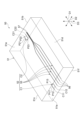
- FIG. 2 is a perspective view showing an optical waveguide device 50.
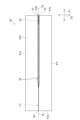
- FIG. 3 is a side view showing an optical waveguide device 50.
- the optical waveguide device 50 comprises a cladding 51 and a core group 52 formed inside the cladding 51.
- the core group 52 is shown by a solid line for convenience.
- the cladding 51 has a refractive index smaller than that of the core group 52 and surrounds the core group 52.
- the cladding 51 has, for example, a rectangular plate-like appearance.
- the cladding 51 includes, for example, a first end face 51a (an example of a "first surface") facing the first optical fiber array 10 (see FIG. 1) in the first direction D1, and a second end face 51b (an example of a "second surface") facing the second optical fiber array 30 (see FIG. 1) in the first direction D1.
- Each of the first end face 51a and the second end face 51b extends along a plane intersecting the first direction D1, and is arranged side by side along the first direction D1.
- the cladding 51 further includes a first side surface 51c, a second side surface 51d, a third side surface 51e, and a fourth side surface 51f extending in the first direction D1 between the first end surface 51a and the second end surface 51b.
- the first side surface 51c and the second side surface 51d extend along a plane intersecting the second direction D2 and are arranged side by side along the second direction D2.
- the third side surface 51e and the fourth side surface 51f extend along a plane intersecting the third direction D3 and are arranged side by side along the third direction D3.
- the core group 52 includes a plurality of communication cores 55 (an example of a "first core") for transmitting communication light between the first optical fiber array 10 and the second optical fiber array 30.
- the plurality of communication cores 55 extend inside the cladding 51 from the first end face 51a to the second end face 51b along the first direction D1, and are arranged side by side along the second direction D2.
- Each communication core 55 extends along the first direction D1 and is bent in the second direction D2 and the third direction D3.
- each communication core 55 is transformed, for example, from a state in which it is arranged in a row along the second direction at the first end face 51a to a state in which it is arranged in both the second direction D2 and the third direction D3 at the second end face 51b.
- each communication core 55 constitutes a three-dimensional optical waveguide that extends so as to change three-dimensionally in the first direction D1, the second direction D2, and the third direction D3 inside the cladding 51.
- Each communication core 55 is formed inside the cladding 51 by, for example, laser processing using a pulsed laser.
- the pulsed laser may be, for example, a titanium sapphire femtosecond laser.
- the focal point of the light pulses output from this pulsed laser is formed inside the cladding 51, the refractive index of the cladding 51 changes at the focal point.
- this focal point moves in the first direction D1, the second direction D2, and the third direction D3, a plurality of communication cores 55 that change three-dimensionally are formed inside the cladding 51.
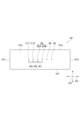
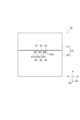
- FIG. 4a is a front view of the optical waveguide device 50.
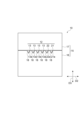
- FIG. 4b is a front view of the first optical fiber array 10.
- FIG. 5a is a rear view of the optical waveguide device 50.
- FIG. 5b is a front view of the second optical fiber array 30.
- the first core end faces 56 of the multiple communication cores 55 are exposed at the first end face 51a.
- the core end faces 56 are aligned in a row along the second direction D2 at the first end face 51a so as to correspond to the alignment of the SCFs 12 (see FIG. 4b) of the first optical fiber array 10.
- four core end faces 56 are aligned at regular intervals along the second direction D2.
- the second end faces 57 of the multiple communication cores 55 are exposed at the second end face 51b.
- the end faces 57 of each communication core 55 are arranged two-dimensionally along the second direction D2 and the third direction D3 at the second end face 51b so as to correspond to the arrangement of each core 32a (see FIG. 5b) of the MCF 32 of the second optical fiber array 30.
- four end faces 57 are arranged at regular intervals along the second direction D2 and the third direction D3.
- the core group 52 further includes a first alignment core C1 (an example of a "second core") that transmits alignment test light for actively aligning the first optical fiber array 10 and the optical waveguide device 50, and a second alignment core C2 (an example of a "third core") that transmits alignment test light for actively aligning the optical waveguide device 50 and the second optical fiber array 30.
- the first alignment core C1 and the second alignment core C2 are formed inside the cladding 51 by laser processing using a pulsed laser, for example, like each communication core 55.
- the test light used for active alignment may be an optical signal suitable for monitoring, and may be an optical signal with a different input/output direction or wavelength from the communication light guided through the communication core 55.
- the first alignment core C1 and the second alignment core C2 are formed in the area of the clad 51 excluding the multiple communication cores 55, i.e., in the area not overlapping with the multiple communication cores 55.
- the first alignment core C1 extends from the first end face 51a through the inside of the clad 51 to return to the first end face 51a.
- the second alignment core C2 extends from the second end face 51b through the inside of the clad 51 to return to the second end face 51b in the area of the clad 51 excluding the multiple communication cores 55 and the first alignment core C1, i.e., in the area not overlapping with the multiple communication cores 55 and the first alignment core C1.
- first aligning core C1 The configuration of the first aligning core C1 will be specifically described. As shown in FIG. 2, the first core end face C11 (an example of a "first core end face”) and the second core end face C12 (an example of a "second core end face") of the first aligning core C1 are both exposed at the first end face 51a.
- the first aligning core C1 is bent so as to pass from the core end face C11 through the inside of the cladding 51 to the core end face C12.
- the first aligning core C1 is, for example, U-shaped with an open end at the first end face 51a.
- the first aligning core C1 includes, for example, a pair of straight line portions P11, P12 extending from the core end faces C11, C12, respectively, in the first direction D1, and a curved portion P13 that curves inside the cladding 51, connecting the tips of the straight line portions P11, P12.
- the straight line portions P11, P12 and the curved line portion P13 are formed at the same height inside the cladding 51 when the third direction D3 is viewed as the height direction.
- the straight line portions P11, P12 and the curved line portion P13 extend along the same plane PL (see FIG. 3) along the first direction D1 and the second direction D2 inside the cladding 51.
- the plane PL may be, for example, a virtual plane that is perpendicular to the first end face 51a and passes through the optical axis of the first alignment core C1 at each of the core end faces C11, C12.
- the normal direction of the plane PL may be, for example, along the third direction D3.
- the first alignment core C1 constitutes a two-dimensional waveguide that is bent in the plane PL along the first direction D1 and the second direction D2, but not in the third direction D3.
- the core end faces C11 and C12 are aligned in a row with the core end faces 56 of the multiple communication cores 55 along the second direction D2.
- the core end faces C11 and C12 are arranged in one of the regions on both sides of the core end faces 56 of the multiple communication cores 55 in the second direction D2.
- the core end face C12 is arranged, for example, in a position adjacent to the core end face 56A (an example of a "first adjacent end face") that is located on the outermost side of the multiple core end faces 56 in the second direction D2.
- the core end face C11 is arranged, for example, on the opposite side of the core end face C12 from the core end face 56A in the second direction D2, and is aligned adjacent to the core end face C12.
- the mode field diameter of the first alignment core C1 at each of the core end faces C11 and C12 may be, for example, the same as the mode field diameter of the communication core 55 at each core end face 56.
- the mode field diameter is a value defined based on the light intensity and is an index of the core diameter.
- the multiple core end faces 56 are arranged at regular intervals along the second direction D2.
- the core end faces C11, C12 are arranged at the same intervals as the intervals between the multiple core end faces 56. Therefore, if the interval between core end face 56A of the multiple core end faces 56 and core end face 56B (an example of a "second adjacent end face") adjacent to core end face 56A is W1, the interval between core end face C12 and core end face 56A is W2, and the interval between core end face C11 and core end face C12 is W3, then the interval W2 and the interval W3 are each equal to the interval W1. In this way, the core end faces 56, core end face C11, and core end face C12 are arranged at equal intervals along the second direction D2.
- the interval W1 between the core end faces 56A and 56B may be, for example, the distance between the optical axis (i.e., the central axis) of the communication core 55 at the core end face 56A and the optical axis (i.e., the central axis) of the communication core 55 at the core end face 56B.
- the interval W2 between the core end faces C12 and 56A may be, for example, the distance between the optical axis (i.e., the central axis) of the first alignment core C1 at the core end face C12 and the optical axis (i.e., the central axis) of the communication core 55 at the core end face 56A.
- the interval W3 between the core end faces C11 and C12 may be, for example, the distance between the optical axis (i.e., the central axis) of the first alignment core C1 at the core end face C11 and the optical axis (i.e., the central axis) of the first alignment core C1 at the core end face C12.
- the multiple SCFs 12 of the first optical fiber array 10 include a pair of alignment SCFs 21, 22 (an example of a "second optical fiber") for transmitting test light for alignment, in addition to multiple communication SCFs 13 (an example of a "first optical fiber") for transmitting communication light.
- the multiple communication SCFs 13 extend along the first direction D1 and are lined up in a row along the second direction D2.
- the alignment SCFs 21, 22 extend along the first direction D1 and are lined up with the multiple communication SCFs 13 in a row along the second direction D2.
- the alignment SCFs 21, 22 are arranged, for example, in one of the regions on both sides of the multiple communication SCFs 13 in the second direction D2.
- the multiple communication SCFs 13 and the alignment SCFs 21, 22 are lined up, for example, at regular intervals along the second direction D2.
- the communication SCFs 13 and the alignment SCFs 21 and 22 are placed in the V-grooves 18 formed in the base 16 of the first holder 15.
- the V-grooves 18 extend along the first direction D1 and are arranged at regular intervals along the second direction D2 in correspondence with the arrangement of the communication SCFs 13 and the alignment SCFs 21 and 22.
- Each communication SCF 13 is arranged so that its first end face 51a faces the core end face 56 (see FIG. 4a) of each communication core 55.
- the core 13a of each communication SCF 13 is optically connected to each communication core 55 at its first end face 51a.
- Each alignment SCF 21 and 22 is arranged so that its first end face 51a faces the core end faces C11 and C12 (see FIG. 4a) of the first alignment core C1.
- Each core 21a, 22a of the alignment SCFs 21, 22 is optically connected to the first alignment core C1 at the first end face 51a.
- the aligning SCFs 21 and 22 and the first aligning core C1 are used to actively align the first optical fiber array 10 and the optical waveguide device 50.
- the aligning SCFs 21 and 22 and the first aligning core C1 constitute an optical waveguide for transmitting test light for active alignment. For example, when test light is emitted from the aligning SCF 21, the test light enters the first aligning core C1 from the core end face C11, exits from the core end face C12, and enters the aligning SCF 22.
- the first aligning core C1 has a loopback structure that returns the test light emitted from the first optical fiber array 10 to the same first optical fiber array 10.
- the arrangement of the first optical fiber array 10 and the optical waveguide device 50 is adjusted so that the intensity is maximized, thereby making it possible to actively align the first optical fiber array 10 and the optical waveguide device 50.
- both ends of the second alignment core C2 i.e., the first core end face C21 and the second core end face C22, are exposed at the second end face 51b.
- the second alignment core C2 is bent so as to pass from the core end face C21 through the inside of the cladding 51 to the core end face C22.
- the second alignment core C2 is, for example, U-shaped with an open end at the second end face 51b.
- the second alignment core C2 includes, for example, a pair of straight line portions P21, P22 extending from the core end faces C21, C22, respectively, in the first direction D1, and a curved portion P23 that curves inside the cladding 51, connecting the tips of the straight line portions P21, P22.
- the straight line portions P21, P22 and the curved line portion P23 extend along the same plane PL (see FIG. 3), similar to the first alignment core C1. Therefore, the second alignment core C2, similar to the first alignment core C1, constitutes a two-dimensional waveguide that is bent in the plane PL along the first direction D1 and the second direction D2, but not in the third direction D3.
- the core end faces C21, C22 are arranged in one of the regions on either side of the end faces 57 of the multiple communication cores 55 in the second direction D2.
- the core end face C22 is arranged in a position adjacent to the end faces 57 of the multiple communication cores 55 in the second direction D2, and the core end face C21 is arranged on the opposite side of the end faces 57 of the multiple communication cores 55 in the second direction D2, sandwiching the core end face C22.
- the mode field diameter of the second alignment core C2 at each of the core end faces C21, C22 may be the same as the mode field diameter of the communication core 55 at each end face 57, for example.
- the second optical fiber array 30 includes a pair of alignment SCFs 41, 42 (hereinafter referred to as "alignment SCFs 41, 42") for transmitting test light for alignment, in addition to a communication MCF 32 for transmitting communication light.
- the MCF 32 and the alignment SCFs 41, 42 are, for example, aligned in a row at regular intervals along the second direction D2.
- the alignment SCFs 41, 42 are, for example, arranged in one of the regions on either side of the MCF 32 in the second direction D2.
- the MCF 32 and the aligning SCFs 41, 42 are placed in a plurality of V-grooves 38 formed in the base 36 of the second holder 35.
- the V-grooves 38 extend along the first direction D1 and are arranged at regular intervals along the second direction D2 in correspondence with the arrangement of the MCF 32 and the aligning SCFs 41, 42.
- the MCF 32 is arranged so that its second end face 51b faces the end face 57 (see FIG. 5a) of each communication core 55.
- Each core 32a of the MCF 32 is optically connected to each communication core 55 at its second end face 51b.
- Each aligning SCF 41, 42 is arranged so that its second end face 51b faces the respective core end faces C21, C22 (see FIG. 5a) of the second aligning core C2.
- Each core 41a, 42a of the alignment SCFs 41, 42 is optically connected to the second alignment core C2 at the second end face 51b.
- the aligning SCFs 41 and 42 and the second aligning core C2 are used to actively align the second optical fiber array 30 and the optical waveguide device 50.
- the aligning SCFs 41 and 42 and the second aligning core C2 constitute an optical waveguide for transmitting test light for active alignment. For example, when test light is emitted from the aligning SCF 21, the test light enters the second aligning core C2 from the core end face C21, exits from the core end face C22, and enters the aligning SCF 22. In this way, the second aligning core C2 has a loopback structure that returns the test light emitted from the second optical fiber array 30 to the same second optical fiber array 30.
- the arrangement of the second optical fiber array 30 and the optical waveguide device 50 is adjusted so that the intensity is maximized, thereby making it possible to actively align the second optical fiber array 30 and the optical waveguide device 50.
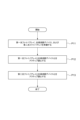
- Figure 6 is a flowchart showing the steps of the optical connection method according to this embodiment.
- the first optical fiber array 10, the optical waveguide device 50, and the second optical fiber array 30 described above are prepared (step P11).
- the first optical fiber array 10 and the optical waveguide device 50 are actively aligned (step P12).
- the first optical fiber array 10 and the optical waveguide device 50 may be passively aligned.
- identifiable grooves or markers are formed on the mounting substrate of each member, and the first optical fiber array 10 and the optical waveguide device 50 are positioned using these as markers.
- active alignment of the first optical fiber array 10 and the optical waveguide device 50 may be performed.
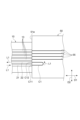
- FIG. 7a is a plan view showing how the optical waveguide device 50 and the first optical fiber array 10 are actively aligned.
- the first optical fiber array 10 is arranged to face the first end face 51a of the optical waveguide device 50, and test light L1 is emitted from the alignment SCF 21 of the first optical fiber array 10 toward the core end face C11 of the first alignment core C1.
- the test light L1 emitted from the alignment SCF 21 passes through the first alignment core C1 and is emitted from the core end face C12 toward the alignment SCF 22 of the first optical fiber array 10.
- the intensity of the test light L1 incident on the alignment SCF 22 is measured by a photoreceiver such as a power meter.
- the first optical fiber array 10 is moved relative to the optical waveguide device 50 in a plane along the second direction D2 and the third direction D3 so that the intensity of the test light L1 is maximized, i.e., so that the transmission loss between the first optical fiber array 10 and the optical waveguide device 50 is minimized.
- two-way alignment is performed to adjust the relative positions of the first optical fiber array 10 and the optical waveguide device 50, and the optical axes of the alignment SCFs 21, 22 and the first alignment core C1 are aligned. This aligns the two components, the first optical fiber array 10 and the optical waveguide device 50.
- the second optical fiber array 30 and the optical waveguide device 50 are actively aligned (step P13).
- the second optical fiber array 30 and the optical waveguide device 50 may be passively aligned.
- identifiable grooves or markers are formed on the mounting substrate of each component, and the second optical fiber array 30 and the optical waveguide device 50 are positioned using these as landmarks.
- active alignment of the second optical fiber array 30 and the optical waveguide device 50 may be performed.
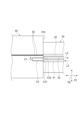
- FIG. 7b is a plan view showing the active alignment of the optical waveguide device 50 and the second optical fiber array 30.
- the second optical fiber array 30 and the optical waveguide device 50 are actively aligned, as shown in FIG. 7b, the second optical fiber array 30 is arranged to face the second end face 51b of the optical waveguide device 50, and the test light L2 is emitted from the alignment SCF 41 of the second optical fiber array 30 toward the core end face C21 of the second alignment core C2.
- the test light L2 emitted from the alignment SCF 41 passes through the second alignment core C2 and is emitted from the core end face C22 toward the alignment SCF 42 of the second optical fiber array 30.
- the intensity of the test light L2 incident on the alignment SCF 42 is measured by a photoreceiver such as a power meter.
- the second optical fiber array 30 is moved relative to the optical waveguide device 50 in a plane along the second direction D2 and the third direction D3 so that the intensity of the test light L2 is maximized, i.e., so that the transmission loss between the second optical fiber array 30 and the optical waveguide device 50 is minimized.
- two-way alignment is performed to adjust the relative positions of the second optical fiber array 30 and the optical waveguide device 50, and the optical axis of the alignment SCFs 41, 22 and the optical axis of the second alignment core C2 are aligned. This causes the two components, the second optical fiber array 30 and the optical waveguide device 50, to be aligned.
- the three components of the first optical fiber array 10, the optical waveguide device 50, and the second optical fiber array 30 are aligned by performing two-way alignment to adjust the positions of the first optical fiber array 10 and the optical waveguide device 50 while monitoring the intensity of the test light L1, and two-way alignment to adjust the positions of the first optical fiber array 10 and the optical waveguide device 50 while monitoring the intensity of the test light L2.
- an optical connection structure 1 in which the first optical fiber array 10, the optical waveguide device 50, and the second optical fiber array 30 are connected to each other can be obtained.
- the order of steps in the connection method using the optical waveguide device 50 is not limited to the method of sequentially performing steps P11 to P13 described above. For example, the order of steps may be changed as appropriate, such as performing step P12 after performing step P13.
- test light may be incident on the first optical fiber array 10, and the test light emitted from the second optical fiber array 30 may be measured after passing through the optical waveguide device 50.
- Test light may be incident on the second optical fiber array 30, and the test light emitted from the first optical fiber array 10 may be measured after passing through the optical waveguide device 50.
- three-way alignment may be performed to mutually adjust the arrangements of the three components, the first optical fiber array 10, the optical waveguide device 50, and the second optical fiber array 30.
- optical waveguide device 50 optical connection structure 1, and optical connection method according to this embodiment described above will now be explained.
- the optical waveguide device 50 includes a first alignment core C1 for transmitting test light L1 for actively aligning the two components of the optical waveguide device 50 and the first optical fiber array 10, in addition to a plurality of communication cores 55 for transmitting communication light.
- the test light L1 is emitted from the first optical fiber array 10 to the first end face 51a, passes through the first alignment core C1, and returns to the first optical fiber array 10 from the first end face 51a. If the test light L1 returned to the first optical fiber array 10 is measured with a power meter, it is possible to perform two-way alignment by adjusting the arrangement of the two components of the optical waveguide device 50 and the first optical fiber array 10 so that the intensity of the test light L1 is maximized.
- test light L2 into the two components of the optical waveguide device 50 that has been aligned with the first optical fiber array 10 and the remaining second optical fiber array 30, it is possible to perform two-way alignment for these two components as well.
- the three components, the first optical fiber array 10, the optical waveguide device 50, and the second optical fiber array 30, are actively aligned.
- the three-component alignment which adjusts the arrangement of the three components relative to one another, is not performed all at once, but rather the two-component alignment, which adjusts the arrangement of the two components relative to one another, is performed twice.
- the arrangement of the three components through which the test light passes can be found more easily than when the three-component alignment is performed all at once, so the difficulty of adjusting the positions of the three components when actively aligning the three components can be reduced.
- active alignment in this way, the three components can be more reliably aligned while capturing the optical axis positions of the cores of the three components, so the time required to align the three components can be reduced compared to when only passive alignment is performed. Therefore, according to this embodiment, it is possible to align the three components more easily.
- the core end faces C11, C12 of the first alignment core C1 may be exposed at a position different from the core end face 56 of the communication core 55.
- the core end faces C11, C12 of the first alignment core C1 may be arranged side by side with the core end face 56 in the second direction D2.
- the core end faces C11, C12 of the first alignment core C1 may be disposed on one of the two sides of the core end face 56 in the second direction D2.
- the first alignment core C1 may extend inside the cladding 51 along the plane PL.
- the first alignment core C1 is formed on the same plane PL. Therefore, when forming the first alignment core C1 inside the cladding 51, it is not necessary to move the focal point of the pulsed laser in the height direction (third direction D3) inside the cladding 51, which makes it easier to form the first alignment core C1.
- the distance W2 between the core end face C12 of the first aligning core C1 and the core end face 56A of the communication core 55 may be the same as the distance W1 between the core end face 56A of the communication core 55 and the core end face 56B of the communication core 55.
- the multiple SCFs 12 are held in the first holder 15 in a state where they are aligned corresponding to the communication core 55 and the first aligning core C1.
- the first holder 15 is formed with multiple V-grooves 18 for holding the multiple SCFs 12.
- Such V-grooves are usually formed to be aligned at a constant interval, assuming that multiple optical fibers are aligned at a constant interval.
- the multiple communication cores 55 and the first aligning core C1 can be aligned at a constant interval, so that an existing holder (first holder 15) that holds the multiple SCFs 12 aligned at a constant interval can be used. In this way, the above configuration allows existing holders to be used as is without modification, making it highly versatile.
- the mode field diameter of the first aligning core C1 at the first end surface 51a may be the same as the mode field diameter of the communication core 55 at the first end surface 51a.
- the multiple SCFs 12 are respectively held by the multiple V-grooves 18 of the first holder 15.
- Such V-grooves are usually formed with the same size and shape, assuming that a general-purpose optical fiber is used.
- the mode field diameter of the first aligning core C1 is set to be the same as the mode field diameter of the communication core 55, assuming that a general-purpose SCF 12 is optically connected to the communication core 55 and the first aligning core C1. Therefore, according to the above configuration, an existing holder (first holder 15) capable of holding a general-purpose SCF 12 can be used as is, and therefore it has excellent versatility.
- the optical waveguide device 50 may include a second alignment core C2.
- the second alignment core C2 can be used as an alignment core for actively aligning the two components of the optical waveguide device 50 and the second optical fiber array 30.
- the test light L2 for actively aligning these two components is emitted from the second optical fiber array 30 to the second end face 51b, passes through the second alignment core C2, and returns to the second optical fiber array 30 from the second end face 51b. Therefore, by measuring the test light L2 returned to the second optical fiber array 30 with a power meter or the like, it is possible to perform two-way alignment by adjusting the arrangement of the two components of the optical waveguide device 50 and the second optical fiber array 30 so that the intensity of the test light L2 is maximized.
- Fig. 8 is a perspective view showing the optical connection structure 1A.
- the optical connection structure 1A includes a first optical fiber array 10A, an optical waveguide device 50A, and a second optical fiber array 30A.
- the main difference between the optical connection structure 1A according to the second embodiment and the optical connection structure 1 according to the first embodiment is the configuration of the core group formed in the optical waveguide device. The following description will focus on the differences between the optical connection structure 1A and the optical connection structure 1.
- FIG. 9 is a perspective view showing the optical waveguide device 50A.
- FIG. 10 is a side view showing the optical waveguide device 50A.
- the core group 52A of the optical waveguide device 50A includes a first alignment core C1A and a second alignment core C2A instead of the first alignment core C1 and the second alignment core C2 of the optical waveguide device 50.
- the first alignment core C1A is formed inside the cladding 51 so as to extend from the first end face 51a across the multiple communication cores 55 and return to the first end face 51a.
- the second alignment core C2A is formed inside the cladding 51 so as to extend from the second end face 51b across the multiple communication cores 55 and return to the second end face 51b.
- the first alignment core C1A when viewed along the third direction D3, is, for example, U-shaped with an open end at the first end face 51a.
- the first alignment core C1A includes, for example, a pair of first straight portions P31, P32 (an example of a "first portion") extending in the first direction D1 from the core end faces C11, C12, respectively, a pair of second straight portions P33, P34 (an example of a "second portion”) further extending from the tips of the pair of first straight portions P31, P32, and a curved portion P35 (an example of a "second portion”) that curves and connects the tips of the pair of second straight portions P33, P34 inside the cladding 51.
- the first straight portions P31, P32 extend along the same plane PL along the first direction D1 and the second direction D2 inside the cladding 51.
- the second straight portions P33, P34 and the curved portion P35 extend in an area away from the plane PL1.
- the second straight portions P33, P34 extend in a direction bent from the tip of the first straight portions P31, P32 toward the fourth side surface 51f in the third direction D3.
- the second straight portions P33, P34 extend in a direction inclined toward both the first direction D1 and the third direction D3 when viewed along the second direction D2.
- the plane PL1 may be, for example, a virtual plane perpendicular to the first end face 51a and passing through the optical axis of the first alignment core C1A at each of the core end faces C11, C12.
- the curved portion P35 extends along a plane PL2 that is shifted from the plane PL1 toward the fourth side surface 51f in the third direction D3. As shown in FIG. 9, the curved portion P35 extends so as to intersect with multiple communication cores 55 when viewed along the third direction D3.
- the first alignment core C1A including the first straight portions P31, P32, the second straight portions P33, P34, and the curved portion P35, constitutes a three-dimensional waveguide that can be bent in the first direction D1, the second direction D2, and the third direction D3.
- FIG. 11a is a front view of the optical waveguide device 50A.
- FIG. 11b is a front view of the first optical fiber array 10A.
- the core end faces C11 and C12 are aligned in a row with the core end faces 56 of the multiple communication cores 55 along the second direction D2.
- the core end faces C11 and C12 are respectively arranged in the regions on both sides of the core end faces 56 of the multiple communication cores 55 in the second direction D2.
- the core end face C11 is arranged, for example, in a position adjacent to the core end face 56A (an example of a "first adjacent end face") that is located on the outermost side of the multiple core end faces 56 in the second direction D2.
- the core end face C12 is arranged, for example, on the opposite side of the core end face C11 across the multiple core end faces 56 in the second direction D2.
- the mode field diameter of the first alignment core C1A at each of the core end faces C11 and C12 may be, for example, the same as the mode field diameter of the communication core 55 at each of the core end faces 56.
- each core end face 56, core end face C11, and core end face C12 are arranged at equal intervals along the second direction D2.
- the alignment SCFs 21, 22 of the first optical fiber array 10A are arranged, for example, in the regions on both sides of the multiple communication SCFs 13 in the second direction D2.
- the multiple communication SCFs 13 and the alignment SCFs 21, 22 are arranged, for example, in a row at regular intervals along the second direction D2.
- Each alignment SCF 21, 22 is arranged so that the first end face 51a faces each of the core end faces C11, C12 (see FIG. 11a) of the first alignment core C1A.
- Each core 21a, 22a of the alignment SCFs 21, 22 is optically connected to the first alignment core C1A at the first end face 51a.
- the second alignment core C2A when viewed along the third direction D3, is, for example, U-shaped with an open end at the second end face 51b.
- the second alignment core C2A includes, for example, a pair of first straight line portions P41, P42 extending in the first direction D1 from the core end faces C21, C22, respectively, a pair of second straight line portions P43, P44 extending further from the tips of the pair of first straight line portions P41, P42, and a curved portion P45 that curves inside the cladding 51, connecting the tips of the pair of second straight line portions P43, P44.
- the first straight portions P41, P42 extend along the same plane PL inside the cladding 51.
- the second straight portions P43, P44 and the curved portion P45 extend in an area away from the plane PL1.
- the second straight portions P43, P44 extend in a direction bent from the tip of the first straight portions P41, P42 toward the fourth side surface 51f in the third direction D3.
- the second straight portions P43, P44 extend in a direction inclined toward both the first direction D1 and the third direction D3 when viewed along the second direction D2.
- the curved portion P45 extends along a plane PL2 that is shifted from the plane PL1 toward the fourth side surface 51f in the third direction D3. As shown in FIG. 9, the curved portion P45 extends so as to intersect with multiple communication cores 55 when viewed along the third direction D3.
- the second alignment core C2A which includes the first straight portions P41, P42, the second straight portions P43, P44, and the curved portion P45, constitutes a three-dimensional waveguide that can be bent in the first direction D1, the second direction D2, and the third direction D3.
- FIG. 12a is a rear view of the optical waveguide device 50A.
- FIG. 12b is a front view of the second optical fiber array 30A.
- the core end faces C21 and C22 of the second alignment core C2A are disposed in the regions on both sides of the end faces 57 of the multiple communication cores 55 in the second direction D2.
- the core end face C22 is disposed in a position adjacent to the end faces 57 of the multiple communication cores 55 in the second direction D2.
- the core end face C21 is disposed on the opposite side of the core end face C22 across the end faces 57 of the multiple communication cores 55 in the second direction D2.
- the mode field diameter of the second alignment core C2A at each of the core end faces C21 and C22 may be the same as the mode field diameter of the communication core 55 at each end face 57, for example.
- the alignment SCFs 41, 42 of the second optical fiber array 30A are, for example, aligned in a row at regular intervals along the second direction D2.
- the alignment SCFs 41, 42 are, for example, arranged in one of the regions on either side of the MCF 32 in the second direction D2.
- Each alignment SCF 41, 42 is arranged so as to face each core end face C21, C22 (see FIG. 12a) of the second alignment core C2A at the second end face 51b.
- Each core 41a, 42a of the alignment SCFs 41, 42 is optically connected to the second alignment core C2A at the second end face 51b.
- optical connection structure 1A similar to the optical connection structure 1, it is possible to perform two-way alignment to adjust the positions of the first optical fiber array 10A and the optical waveguide device 50A while monitoring the intensity of the test light L1, and two-way alignment to adjust the positions of the first optical fiber array 10A and the optical waveguide device 50A while monitoring the intensity of the test light L2, so that it is possible to more easily align the three components of the first optical fiber array 10A, the optical waveguide device 50A, and the second optical fiber array 30A.
- the core end faces C11 and C12 of the first alignment core C1A may be arranged in the regions on both sides of the core end face 56 in the second direction D2.
- the distance between the core end faces C11 and C12 can be made greater than when the core end faces C11 and C12 are arranged next to each other, so that the distance between the core end faces C11 and C12 can be maintained large.
- the risk of a rotational misalignment between the position of the core end face C11 where the test light L1 is incident or emitted and the position of the core end face C12 where the test light L1 is emitted or incident can be reduced. This makes it possible to more reliably align the optical waveguide device 50A and the first optical fiber array 10A.
- the radius of curvature of the curved portion P35 of the first alignment core C1A from the core end face C11 to the core end face C12 can be maintained large compared to when the core end faces C11 and C12 are arranged next to each other. This makes it possible to reduce the propagation loss of the test light L1 introduced into the first alignment core C1A during alignment.
- the curved portion P35 of the first alignment core C1A may be formed in an area away from the plane PL and extend so as to intersect with the multiple communication cores 55 when viewed along the third direction D3.
- the first alignment core C1A can be changed three-dimensionally so as not to intersect with the multiple communication cores 55 inside the cladding 51.
- the present disclosure is not limited to the above-described embodiments, and various modifications are possible within the scope of the claims.
- the number and arrangement of cores in the optical waveguide device can be modified within the scope of the claims.
- the two faces of the cladding 51 that the first optical fiber array 10 and the second optical fiber array 30 face, respectively are not limited to the first end face 51a and the second end face 51b, but may be any two faces that are different from each other, such as the first end face 51a and the first side face 51c.
- the mode field diameter of the first alignment core C1 at the first end face 51a may be set to be larger than the mode field diameter of the communication core 55 at the first end face 51a.
- the difference in these mode field diameters can be used to easily distinguish between the communication core 55 and the first alignment core C1.
- the mode field diameter of the second alignment core C2 at the second end face 51b may be set to be larger than the mode field diameter of the communication core 55 at the second end face 51b.
- the distance between the communication core 55 and the first alignment core C1 at the first end face 51a may be larger than the distance between adjacent communication cores 55 at the first end face. In this case, the difference in distance can be used to easily distinguish the communication core 55 from the first alignment core C1. As a result, it is possible to prevent the alignment test light L1 from being erroneously introduced into the communication core 55, and therefore it is possible to more reliably align the optical waveguide device 50 and the first optical fiber array 10 using the first alignment core C1.
- Optical connection structure 10 10A... First optical fiber array 11... First optical fiber group 12... SCF 13...SCF for communication (an example of the "first optical fiber") 13a, 21a, 22a, 32a, 41a, 42a... Core 15... First holder 16, 36... Base 17, 37... Cover 18, 38... V-groove 21, 22... Alignment SCF (an example of the "second optical fiber") 30, 30A... Second optical fiber array 31... Second optical fiber group 32... MCF 35...Second holder 41, 42...SCF for alignment 50, 50A... Optical waveguide device 51... Cladding 51a...
- First end surface (an example of the "first surface") 51b...Second end surface (an example of the "second surface") 51c...first side surface 51d...second side surface 51e...third side surface 51f...fourth side surface 52, 52A...core group 55...communication core (an example of a "first core") 56... Core end surface 56A... Core end surface (an example of the "first adjacent end surface”) 56B...Core end surface (an example of the "second adjacent end surface”) 57... End surface C1, C1A...
- First aligning core (an example of the "second core)
- C2A Second alignment core (an example of the "third core")
- C11...Core end surface (an example of the "first core end surface)
- C12...Core end surface (an example of the "second core end surface)
- D1 First direction
- D2 Second direction (an example of "one direction")
- D3 Third direction
- P11, P12, P21, P22 Straight line portions
- P31, P32, P41, P42 First straight line portions (an example of the “first portion”) P33, P34, P43, P44...Second straight line portion (an example of the "second portion") P13, P23...curved portions P35, P45...curved portions (examples of the "second portion”)
Landscapes
- Physics & Mathematics (AREA)
- General Physics & Mathematics (AREA)
- Optics & Photonics (AREA)
- Engineering & Computer Science (AREA)
- Microelectronics & Electronic Packaging (AREA)
- Optical Couplings Of Light Guides (AREA)
- Mechanical Coupling Of Light Guides (AREA)
Priority Applications (2)
| Application Number | Priority Date | Filing Date | Title |
|---|---|---|---|
| JP2025521901A JPWO2024241823A1 (https=) | 2023-05-22 | 2024-04-24 | |
| CN202480031290.8A CN121195191A (zh) | 2023-05-22 | 2024-04-24 | 光波导装置、光连接结构、及光连接方法 |
Applications Claiming Priority (2)
| Application Number | Priority Date | Filing Date | Title |
|---|---|---|---|
| JP2023083999 | 2023-05-22 | ||
| JP2023-083999 | 2023-05-22 |
Publications (1)
| Publication Number | Publication Date |
|---|---|
| WO2024241823A1 true WO2024241823A1 (ja) | 2024-11-28 |
Family
ID=93589077
Family Applications (1)
| Application Number | Title | Priority Date | Filing Date |
|---|---|---|---|
| PCT/JP2024/016114 Ceased WO2024241823A1 (ja) | 2023-05-22 | 2024-04-24 | 光導波路デバイス、光接続構造、および光接続方法 |
Country Status (4)
| Country | Link |
|---|---|
| JP (1) | JPWO2024241823A1 (https=) |
| CN (1) | CN121195191A (https=) |
| TW (1) | TW202516210A (https=) |
| WO (1) | WO2024241823A1 (https=) |
Citations (5)
| Publication number | Priority date | Publication date | Assignee | Title |
|---|---|---|---|---|
| JP2000162469A (ja) * | 1998-12-01 | 2000-06-16 | Sumitomo Electric Ind Ltd | 光ファイバアレイと光導波路との光結合方法及び光部品 |
| US6654523B1 (en) * | 2001-08-10 | 2003-11-25 | Lightwave Microsystems Corporation | Optical alignment guide and method for aligning an optical fiber array with an optical integrated circuit |
| JP2016024439A (ja) * | 2014-07-24 | 2016-02-08 | 日本電信電話株式会社 | 光回路部品、および光回路部品と光ファイバとの接続構造 |
| JP2019152804A (ja) * | 2018-03-05 | 2019-09-12 | 株式会社フジクラ | 光コネクタ |
| US20210011233A1 (en) * | 2019-07-12 | 2021-01-14 | Ayar Labs, Inc. | Hybrid Multi-Wavelength Source and Associated Methods |
-
2024
- 2024-04-24 JP JP2025521901A patent/JPWO2024241823A1/ja active Pending
- 2024-04-24 WO PCT/JP2024/016114 patent/WO2024241823A1/ja not_active Ceased
- 2024-04-24 CN CN202480031290.8A patent/CN121195191A/zh active Pending
- 2024-05-07 TW TW113116854A patent/TW202516210A/zh unknown
Patent Citations (5)
| Publication number | Priority date | Publication date | Assignee | Title |
|---|---|---|---|---|
| JP2000162469A (ja) * | 1998-12-01 | 2000-06-16 | Sumitomo Electric Ind Ltd | 光ファイバアレイと光導波路との光結合方法及び光部品 |
| US6654523B1 (en) * | 2001-08-10 | 2003-11-25 | Lightwave Microsystems Corporation | Optical alignment guide and method for aligning an optical fiber array with an optical integrated circuit |
| JP2016024439A (ja) * | 2014-07-24 | 2016-02-08 | 日本電信電話株式会社 | 光回路部品、および光回路部品と光ファイバとの接続構造 |
| JP2019152804A (ja) * | 2018-03-05 | 2019-09-12 | 株式会社フジクラ | 光コネクタ |
| US20210011233A1 (en) * | 2019-07-12 | 2021-01-14 | Ayar Labs, Inc. | Hybrid Multi-Wavelength Source and Associated Methods |
Also Published As
| Publication number | Publication date |
|---|---|
| JPWO2024241823A1 (https=) | 2024-11-28 |
| CN121195191A (zh) | 2025-12-23 |
| TW202516210A (zh) | 2025-04-16 |
Similar Documents
| Publication | Publication Date | Title |
|---|---|---|
| US7887243B2 (en) | Miniature mechanical transfer optical coupler | |
| EP3734338B1 (en) | Connection device, optical connector manufacturing device, connection method, and method for manufacturing optical connector | |
| KR101540485B1 (ko) | 이중-렌즈 일원 광학 수신기 조립품 | |
| US12298566B2 (en) | Optical fiber connection structure | |
| JP7010244B2 (ja) | 光接続部品及び光結合構造 | |
| US20130251307A1 (en) | Imaging interface for optical components | |
| US6031947A (en) | 1×N optical switch | |
| JP2004537065A (ja) | 拡大ビームコネクタシステム | |
| US6430337B1 (en) | Optical alignment system | |
| AU752890B2 (en) | Multiple port, fiber optic coupling device | |
| WO2020137070A1 (ja) | コネクタシステム、光接続方法及び光接続部材 | |
| CN211856985U (zh) | 一种多通道阵列光隔离器 | |
| JP2025020464A (ja) | マルチコアファイバ、及び光デバイス | |
| WO2024241823A1 (ja) | 光導波路デバイス、光接続構造、および光接続方法 | |
| EP4345518B1 (en) | Apparatus and method for low latency free-space optical communications | |
| US6704147B2 (en) | Collimator, collimator array and method of producing those member | |
| CN119395820A (zh) | 一种芯片式多芯光纤分束器 | |
| JPWO2024241823A5 (https=) | ||
| US20090067787A1 (en) | Optical System and Method of Manufacturing the Same | |
| Tekin et al. | Fibre-array optical interconnection for silicon photonics | |
| US20250028120A1 (en) | Optical system provided with attenuating area and method of producing the same | |
| CN110908040B (zh) | 一种基于反射镜的多芯光纤复用和解复用的装置及方法 | |
| WO2026047859A1 (ja) | 光コネクタ検査用コネクタおよび光コネクタ検査方法 | |
| JP2000187131A (ja) | 光導波路モジュールの製造方法 | |
| US20230273376A1 (en) | Optical connection component and connector assembly |
Legal Events
| Date | Code | Title | Description |
|---|---|---|---|
| 121 | Ep: the epo has been informed by wipo that ep was designated in this application |
Ref document number: 24810831 Country of ref document: EP Kind code of ref document: A1 |
|
| ENP | Entry into the national phase |
Ref document number: 2025521901 Country of ref document: JP Kind code of ref document: A |
|
| WWE | Wipo information: entry into national phase |
Ref document number: 2025521901 Country of ref document: JP |
|
| NENP | Non-entry into the national phase |
Ref country code: DE |