WO2024241815A1 - 判定システム、統合システム、判定方法及びプログラム - Google Patents
判定システム、統合システム、判定方法及びプログラム Download PDFInfo
- Publication number
- WO2024241815A1 WO2024241815A1 PCT/JP2024/015935 JP2024015935W WO2024241815A1 WO 2024241815 A1 WO2024241815 A1 WO 2024241815A1 JP 2024015935 W JP2024015935 W JP 2024015935W WO 2024241815 A1 WO2024241815 A1 WO 2024241815A1
- Authority
- WO
- WIPO (PCT)
- Prior art keywords
- people
- space
- determination
- unit
- state
- Prior art date
- Legal status (The legal status is an assumption and is not a legal conclusion. Google has not performed a legal analysis and makes no representation as to the accuracy of the status listed.)
- Ceased
Links
Images


Classifications
-
- G—PHYSICS
- G08—SIGNALLING
- G08B—SIGNALLING SYSTEMS, e.g. PERSONAL CALLING SYSTEMS; ORDER TELEGRAPHS; ALARM SYSTEMS
- G08B21/00—Alarms responsive to a single specified undesired or abnormal condition and not otherwise provided for
- G08B21/18—Status alarms
- G08B21/22—Status alarms responsive to presence or absence of persons
-
- G—PHYSICS
- G06—COMPUTING OR CALCULATING; COUNTING
- G06Q—INFORMATION AND COMMUNICATION TECHNOLOGY [ICT] SPECIALLY ADAPTED FOR ADMINISTRATIVE, COMMERCIAL, FINANCIAL, MANAGERIAL OR SUPERVISORY PURPOSES; SYSTEMS OR METHODS SPECIALLY ADAPTED FOR ADMINISTRATIVE, COMMERCIAL, FINANCIAL, MANAGERIAL OR SUPERVISORY PURPOSES, NOT OTHERWISE PROVIDED FOR
- G06Q10/00—Administration; Management
- G06Q10/06—Resources, workflows, human or project management; Enterprise or organisation planning; Enterprise or organisation modelling
-
- G—PHYSICS
- G06—COMPUTING OR CALCULATING; COUNTING
- G06V—IMAGE OR VIDEO RECOGNITION OR UNDERSTANDING
- G06V20/00—Scenes; Scene-specific elements
- G06V20/50—Context or environment of the image
- G06V20/52—Surveillance or monitoring of activities, e.g. for recognising suspicious objects
-
- G—PHYSICS
- G07—CHECKING-DEVICES
- G07C—TIME OR ATTENDANCE REGISTERS; REGISTERING OR INDICATING THE WORKING OF MACHINES; GENERATING RANDOM NUMBERS; VOTING OR LOTTERY APPARATUS; ARRANGEMENTS, SYSTEMS OR APPARATUS FOR CHECKING NOT PROVIDED FOR ELSEWHERE
- G07C9/00—Individual registration on entry or exit
Definitions
- the present disclosure generally relates to a determination system, an integrated system, a determination method, and a program, and more specifically to a determination system, an integrated system, a determination method, and a program that determine whether or not an abnormality has occurred in a space.
- Patent document 1 describes an information processing device that can make it easier for a user to notice the occurrence of an event.
- the information processing device of Patent Document 1 measures the number of people in each area to obtain actual measurements of the number of people, obtains environmental data that indicates environmental information in each area, calculates an estimate of the number of people in each area using a specified model from the environmental information in each area, and generates output data based on the difference between the actual measurements and the estimate in each area.
- Patent Document 1 allows the user to intuitively grasp the location of an area where more people than expected have gathered or a unit area where there are fewer people, but it cannot manage the number of people who should actually be in that area (space) or determine whether an abnormality has occurred in that space.
- the present disclosure has been made in consideration of the above-mentioned problems, and aims to provide a determination system, an integrated system, a determination method, and a program that can determine whether an abnormality has occurred regarding the number of people present in a space.
- a determination system includes an acquisition unit, an estimation unit, a detection unit, and a determination unit.
- the acquisition unit acquires schedule information indicating the time periods in a space when people are present or absent for each time period.
- the estimation unit estimates the number of people that should be present in the space as an estimated number of people based on the schedule information.
- the detection unit detects the number of people in the space as a detected number of people based on detection results from a sensor used for human detection installed in the space.
- the determination unit compares the estimated number of people with the detected number of people, and determines whether or not an abnormal state in which an abnormality has occurred in the space is occurring based on the comparison result. If the comparison result indicates that the estimated number of people and the detected number of people do not match, the determination unit determines that the state of the space is the abnormal state.
- the integrated system includes the determination system and the sensor.
- the determination method includes an acquisition step, an estimation step, a detection step, and a determination step.
- the acquisition step acquires schedule information indicating the time periods in a space when people are present or absent for each time period.
- the estimation step estimates the number of people that should be present in the space as an estimated number of people based on the schedule information.
- the detection step detects the number of people in the space as a detected number of people based on the detection results from a sensor used for human detection installed in the space.
- the determination step compares the estimated number of people with the detected number of people, and determines whether or not an abnormal state in which an abnormality has occurred in the space is occurring based on the comparison result. In the determination step, if the comparison result indicates that the estimated number of people and the detected number of people do not match, the state of the space is determined to be the abnormal state.
- a program according to one aspect of the present disclosure is a program for causing a computer system to execute the determination method.
- FIG. 1 is a system diagram of an integrated system including a determination system according to one embodiment.
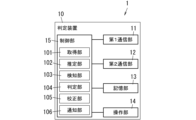
- FIG. 2 is a block diagram showing the configuration of the determination system.
- FIG. 3 is a flow chart showing the operation of the above-mentioned determination system.
- FIG. 1 (Embodiment)
- FIG. 1 a determination system 1 according to the present embodiment and an integrated system 2 including the determination system 1 will be described with reference to FIGS. 1 to 3.
- FIG. 1 a determination system 1 according to the present embodiment and an integrated system 2 including the determination system 1 will be described with reference to FIGS. 1 to 3.
- FIG. 1 a determination system 1 according to the present embodiment and an integrated system 2 including the determination system 1 will be described with reference to FIGS. 1 to 3.
- an integrated system 2 includes a determination device 10 as a determination system 1, and a sensor 20.
- the sensor 20 is an image sensor, for example an infrared array sensor.
- the sensor 20 is used to detect people in a space 5 (see FIG. 1) included in the facility.
- the sensor 20 photographs the space 5 and obtains the photographed infrared image as the detection result.
- the infrared image includes, for example, the temperature distribution of a two-dimensional area of 8 x 8 pixels.
- the sensor 20 photographs a predetermined number of times per second, for example.
- the determination device 10 is configured to be able to communicate with the sensor 20. As shown in FIG. 2, the determination device 10 includes an acquisition unit 101, an estimation unit 102, a detection unit 103, and a determination unit 104.
- the acquisition unit 101 acquires schedule information that indicates the time periods in which people are present or absent for each time period in the space 5 (see FIG. 1).
- the estimation unit 102 estimates the number of people that should be present in the space 5 based on the schedule information as the estimated number of people.
- the detection unit 103 detects the number of people (e.g., people u1 and u2) in the space 5 as the detected number of people based on the detection result from the sensor 20 that detects people in the space 5.
- the determination unit 104 compares the estimated number of people with the detected number of people, and determines whether or not an abnormal state in which an abnormality has occurred in the space 5 is occurring based on the comparison result. If the comparison result indicates that the estimated number of people and the detected number of people do not match, the determination unit 104 determines that the state of the space 5 is an abnormal state.
- the estimated number of people based on schedule information indicating the time periods when people are present or absent in space 5 is compared with the number of people detected by sensor 20, making it possible to determine whether an abnormality has occurred regarding the number of people present in space 5.
- the determination device 10 is configured to be able to communicate with the information terminal 30 via a network NT1 such as the Internet.
- the determination device 10 notifies the information terminal 30 of the determination result of the determination unit 104.
- the information terminal 30 is, for example, a smartphone, a tablet terminal, or a personal computer.
- the information terminal 30 is owned by a user of the space 5 or an administrator of the space 5.
- “facility” includes non-residential facilities such as offices, stores, business establishments, factories, buildings, schools, welfare facilities, or hospitals, as well as residential facilities such as detached houses, apartment buildings, or individual units in apartment buildings.
- Non-residential facilities also include theaters, movie theaters, public halls, amusement parks, complexes, restaurants, department stores, hotels, inns, kindergartens, libraries, museums, art galleries, underground shopping malls, stations, airports, etc.
- “facility” includes outdoor facilities such as baseball stadiums, gardens, parking lots, grounds, and parks.
- the "space” referred to in this disclosure is included in the facility.
- the space is, for example, an entire floor of the office, or a part of a floor.
- the space is a room included in the residential facility, for example, a living room and a bedroom.
- the sensor 20 is configured to be able to communicate with the determination device 10.
- the sensor 20 is configured to be able to communicate with the determination device 10 via a wired connection.
- the sensor 20 may be configured to be able to communicate with the determination device 10 wirelessly, or may be configured to be able to communicate via the network NT1.
- the sensor 20 transmits an infrared image, which is the detection result, to the determination device 10.
- the determination device 10 includes a first communication unit 11, a second communication unit 12, a storage unit 13, an operation unit 14, and a control unit 15.
- the determination device 10 has, for example, a computer system having a processor and a memory.
- the processor executes a program stored in the memory, causing the computer system to function as the control unit 15.
- the program executed by the processor is pre-recorded in the memory of the computer system here, but it may also be provided by being recorded on a recording medium such as a memory card, or it may be provided via a telecommunications line such as the Internet.
- the first communication unit 11 has a communication interface for communicating with the sensor 20.
- the first communication unit 11 communicates with the sensor 20 via wired communication.
- the second communication unit 12 has a communication interface for communicating with the information terminal 30.
- the second communication unit 12 is configured to be able to communicate with the information terminal 30 via the network NT1.
- the memory unit 13 is composed of a device selected from ROM (Read Only Memory), RAM (Random Access Memory), EEPROM (Electrically Erasable Programmable Read Only Memory), etc.
- the storage unit 13 stores schedule information indicating the time periods in which people are present or absent in the space 5.
- the schedule information includes presence/absence information that is associated with each specific time period and indicates whether or not people are present in the space 5 during that time period. When the presence/absence information indicates that people are present in the space 5, the schedule information includes the number of people present in the space 5 that is associated with the specific time period during which people are present in the space 5.
- control unit 15 has an acquisition unit 101, an estimation unit 102, a detection unit 103, a determination unit 104, a reset unit 105, and a notification unit 106.
- the acquisition unit 101 acquires schedule information indicating the time periods when people are present or absent in the space 5.
- the acquisition unit 101 acquires the schedule information from the storage unit 13 when the determination device 10 determines whether or not an abnormality has occurred in the space 5.
- the estimation unit 102 estimates the number of people who should be present in the space 5 based on the schedule information as the estimated number of people.
- the estimation unit 102 estimates the estimated number of people based on the presence/absence information for the time period including the current time, i.e., the time when the determination device 10 determines whether or not an abnormality has occurred in the space 5. For example, when the presence/absence information indicates that people are absent, the estimation unit 102 estimates the estimated number of people to be 0. When the presence/absence information indicates that people are present, the estimation unit 102 determines the number of people associated with the time period including the current time as the estimated number of people.
- the detection unit 103 detects the number of people in the space 5 as the detected number of people based on the detection results (infrared image) from the sensor 20 used for human detection installed in the space 5. That is, the detection unit 103 detects the detected number of people based on an image obtained by the sensor 20, which is an image sensor. The detection unit 103 receives an infrared image from the sensor 20 as the detection result. The detection unit 103 detects the detected number of people based on the temperature distribution of the received infrared image. The detection unit 103 may detect the detected number of people based on the temperature distribution of a single infrared image. Alternatively, the detection unit 103 may detect the detected number of people based on the temporal change in temperature distribution using multiple infrared images that are consecutive in time series.
- the determination unit 104 compares the estimated number of people with the detected number of people, and determines whether or not an abnormal state in which an abnormality has occurred in the space 5 is occurring, based on the comparison result. If the comparison result indicates that the estimated number of people and the detected number of people do not match, the determination unit 104 determines that the state of the space 5 is an abnormal state.
- the judgment unit 104 judges that the state of the space 5 is a third abnormal state. If the detected number of people and the estimated number of people are equal, the judgment unit 104 judges that the state of the space 5 is normal.
- the resetting unit 105 When the determination unit 104 determines that the state of the space 5 is the third abnormal state due to an abnormality in the sensor 20, the resetting unit 105 performs a resetting process on the process related to human detection.
- the process related to human detection is, for example, a process related to the generation of an infrared image performed by the sensor 20.
- the resetting unit 105 performs a process of restarting the process related to the generation of an infrared image performed by the sensor 20.
- the notification unit 106 When the determination unit 104 determines that the state of the space 5 is abnormal, the notification unit 106 notifies that the state of the space 5 is abnormal. When the determination unit 104 determines that the state of the space 5 is abnormal, the notification unit 106 transmits status information indicating that the state of the space 5 is abnormal to the information terminal 30 via the network NT1. Specifically, when the determination unit 104 determines that the state of the space 5 is a first abnormal state, the notification unit 106 transmits (notifies) to the information terminal 30 status information indicating that the state of the space 5 is an abnormal state due to the presence of an outsider in the space 5.
- the notification unit 106 transmits (notifies) to the information terminal 30 status information indicating that the state of the space 5 is an abnormal state due to the absence of a person who should be in the space 5.
- the notification unit 106 transmits (notifies) information indicating that the state of the sensor 20 is an abnormal state as state information to the information terminal 30.
- the notification unit 106 notifies that the state of the space 5 is normal. In other words, when the determination unit 104 determines that the state of the space 5 is not any of the first abnormal state, the second abnormal state, and the third abnormal state, the notification unit 106 notifies that the state of the space 5 is normal.
- the notification unit 106 transmits state information indicating that the state of the space 5 is normal to the information terminal 30 via the network NT1.
- the information terminal 30 is configured to be able to communicate with the determination device 10 via the network NT1.
- the information terminal 30 has, for example, a computer system having a processor and memory.
- the processor executes a program stored in the memory, causing the computer system to realize the functions of the information terminal 30.
- the program executed by the processor is pre-recorded in the memory of the computer system here, but it may also be provided by being recorded on a recording medium such as a memory card, or it may be provided via a telecommunications line such as the Internet.
- the information terminal 30 When the information terminal 30 receives the status information from the determination device 10, the information terminal 30 displays the status information on a display unit provided in the information terminal 30. Alternatively, if the status information indicates any of the first abnormal state, the second abnormal state, and the third abnormal state, the information terminal 30 may notify the user of the information terminal 30 by issuing a sound from a speaker provided in the information terminal 30.
- the determination device 10 periodically executes the following operations to determine the state of the space 5.
- the acquisition unit 101 acquires schedule information indicating the time periods when people are present or absent in the space 5 (step S1).
- the estimation unit 102 performs estimation processing (step S2).
- the estimation unit 102 estimates the number of people who should be present in the space 5 based on the schedule information acquired in step S1 as the estimated number of people. Specifically, the estimation unit 102 estimates the estimated number of people based on the presence/absence information for the time period including the current time, i.e., the time when the determination device 10 determines whether or not an abnormality has occurred in the space 5.
- the detection unit 103 receives an infrared image from the sensor 20 as the detection result (step S3).
- the detection unit 103 performs a detection process (step S4).
- the detection unit 103 detects the number of people in the space 5 as the detected number of people based on the detection result (infrared image) from the sensor 20 used for human detection installed in the space 5. Specifically, the detection unit 103 detects the detected number of people based on the temperature distribution of the received infrared image.
- the determination unit 104 compares the estimated number of people with the detected number of people and determines whether the detected number of people is greater than the estimated number of people (step S5). In other words, the determination unit 104 determines whether the state of the space 5 is the first abnormal state.
- step S5 determines whether the detected number of people is greater than the estimated number of people ("Yes" in step S5), the determination unit 104 determines whether the detected number of people is 1 or more and the estimated number of people is 0 (step S6). In other words, if the determination unit 104 determines that the state of the space 5 is the first abnormal state, the detection unit 103 further detects whether the state of the space 5 is the third abnormal state.
- step S7 the resetting unit 105 performs a resetting process. That is, if the determination unit 104 determines that the state of the space 5 is the third abnormal state, the resetting unit 105 performs a resetting process. Specifically, the resetting unit 105 performs a process of restarting the process related to the generation of an infrared image performed by the sensor 20.
- step S7 After step S7 is executed, or if the determination unit 104 determines in step S6 that the detected number of people is not 1 or more, or the estimated number of people is not 0 ("No" in step S6), the notification unit 106 performs the first notification process (step S8).
- the notification unit 106 When the notification unit 106 performs the first notification process after step S7 is executed, the notification unit 106 generates status information indicating that the state of the space 5 is an abnormal state due to the presence of an outsider in the space 5, and that the state of the space 5 is an abnormal state due to an abnormality in the sensor 20.
- the notification unit 106 transmits (notifies) the generated status information to the information terminal 30.
- the notification unit 106 When the notification unit 106 performs the first notification process after determining "No" in step S6, the notification unit 106 generates status information indicating that the state of the space 5 is an abnormal state due to the presence of an outsider in the space 5, and transmits (notifies) it to the information terminal 30.
- the determination unit 104 determines "No". This is because step S6 is based on the assumption that the number of detected people is greater than the estimated number, and it is impossible for the number of detected people to be less than one, i.e., for the number of detected people to be zero.
- the determination unit 104 determines whether the state of the space 5 is the second abnormal state.
- step S9 determines whether the detected number of people is less than the estimated number of people ("Yes" in step S9). If the determination unit 104 determines whether the estimated number of people is 1 or more and the detected number of people is 0 (step S10). In other words, if the determination unit 104 determines that the state of the space 5 is the second abnormal state, the detection unit 103 further detects whether the state of the space 5 is the third abnormal state.
- step S11 the resetting unit 105 performs a resetting process. That is, if the determination unit 104 determines that the state of the space 5 is the third abnormal state, the resetting unit 105 performs a resetting process. Specifically, the resetting unit 105 performs a process of restarting the process related to the generation of an infrared image performed by the sensor 20.
- step S11 After step S11 is executed, or if the determination unit 104 determines in step S10 that the estimated number of people is not 1 or more, or the detected number of people is not 0 ("No" in step S10), the notification unit 106 performs the second notification process (step S12).
- the notification unit 106 When the notification unit 106 performs the second notification process after step S11 is executed, the notification unit 106 generates status information indicating that the state of the space 5 is an abnormal state due to the absence of a person who should be in the space 5, and that the state of the space 5 is an abnormal state due to an abnormality in the sensor 20.
- the notification unit 106 transmits (notifies) the generated status information to the information terminal 30.
- the notification unit 106 When the notification unit 106 performs the second notification process after the determination in step S10 is "No", the notification unit 106 generates status information indicating that the state of the space 5 is an abnormal state due to the absence of a person who should be in the space 5, and transmits (notifies) the information terminal 30.
- the determination unit 104 determines "No.” This is because, in step S10, it is assumed that the detected number of people is less than the estimated number of people, and it is impossible for the estimated number to be less than 1 or more, i.e., for the estimated number to be 0.
- the notification unit 106 determines that the detected number of people is not less than the estimated number of people ("No" in step S9), the notification unit 106 performs a third notification process (step S13). In other words, if the detected number of people is equal to the estimated number of people, the notification unit 106 performs a third notification process.
- the notification unit 106 transmits (notifies) to the information terminal 30 status information indicating that the status of the space 5 is normal.
- the determination device 10 which is the determination system 1 of this embodiment, is configured to be able to communicate with the sensor 20.
- the determination device 10 includes an acquisition unit 101, an estimation unit 102, a detection unit 103, and a determination unit 104.
- the acquisition unit 101 acquires schedule information that indicates the time periods of presence and absence of people in the space 5 for each time period.
- the estimation unit 102 estimates the number of people that should be present in the space 5 as the estimated number of people based on the schedule information.
- the detection unit 103 detects the number of people (e.g., people u1 and u2) in the space 5 as the detected number of people based on the detection result from the sensor 20 that detects people in the space 5.
- the determination unit 104 compares the estimated number of people with the detected number of people, and determines whether or not an abnormal state in which an abnormality has occurred in the space 5 is occurring based on the comparison result. If the comparison result indicates that the estimated number of people and the detected number of people do not match, the determination unit 104 determines that the state of the space 5 is an abnormal state.
- the estimated number of people based on schedule information indicating the time periods when people are present or absent in space 5 is compared with the number of people detected by sensor 20, making it possible to determine whether an abnormality has occurred regarding the number of people present in space 5.
- the integrated system 2 is configured to include an image sensor as the sensor 20, but is not limited to this configuration.
- the sensor 20 may be a temperature sensor that measures the temperature distribution in the space 5.
- the sensor 20 may be a human presence sensor that detects the presence of a person in the space 5.
- the sensor 20 may be a distance sensor that measures the distance to an object.
- the present invention is not limited to this configuration.
- a plurality of sensors 20 for detecting people may be provided in the space 5.
- the detection unit 103 detects the number of people based on the detection results of the plurality of sensors 20. For example, when the detection results are infrared images, the detection unit 103 detects the number of people based on the heat distribution of each of the plurality of infrared images.
- the determination device 10 may notify the police in addition to the user of the space 5 or the administrator of the space 5.
- the determination device 10 may notify only the police.
- the determination device 10 may notify the absent person's family or the absent person's superior at work.
- the notification unit 106 is configured to notify the information terminal 30 of the state information, but is not limited to this configuration.
- the notification unit 106 may notify the operator of the determination device 10 by issuing a sound from a speaker provided in the determination device 10. Alternatively, the notification unit 106 may notify the operator of the determination device 10 by displaying a message based on the status information on a display unit provided in the determination device 10.
- the resetting unit 105 is configured to perform a process of restarting the process related to the generation of an infrared image performed by the sensor 20 as a configuration process, but is not limited to this configuration.
- the detection unit 103 may change the threshold used to identify people based on the temperature distribution image.
- the above embodiment is merely one of various embodiments of the present disclosure.
- the above embodiment can be modified in various ways depending on the design and the like as long as the object of the present disclosure can be achieved.
- the same function as the determination system 1 may be embodied in a determination method, a computer program, or a non-transitory recording medium on which a program is recorded.
- the determination method of the determination system 1 according to one aspect is executed by one or more processors (computer systems).
- the determination method includes an acquisition step, an estimation step, a detection step, and a determination step.
- the acquisition step acquires schedule information representing time periods of presence and absence of people in the space 5 for each time period.
- the estimation step estimates the number of people who should be present in the space 5 as an estimated number of people based on the schedule information.
- the detection step detects the number of people in the space 5 as a detected number of people based on the detection result from the sensor 20 used for human detection provided in the space 5.
- the determination step compares the estimated number of people with the detected number of people, and determines whether or not an abnormal state in which an abnormality has occurred in the space 5 is occurring based on the comparison result. In the determination step, if the comparison result indicates that the estimated number of people and the detected number of people do not match, the state of the space 5 is determined to be an abnormal state.
- a program according to one embodiment is a program for causing a computer system to function as the above-described determination system 1 or the determination method of the determination system 1.
- the executing entity of the determination system 1 or the determination method of the determination system 1 in the present disclosure includes a computer system.
- the computer system has a processor and a memory as hardware.
- the processor executes a program recorded in the memory of the computer system, thereby realizing the function of the determination system 1 or the determining method of the determination system 1 in the present disclosure.
- the program may be pre-recorded in the memory of the computer system, or may be provided through a telecommunications line.
- the program may also be recorded and provided in a non-transitory recording medium such as a memory card, an optical disk, or a hard disk drive that can be read by the computer system.
- the processor of the computer system is composed of one or more electronic circuits including a semiconductor integrated circuit (IC) or a large scale integrated circuit (LSI).
- the integrated circuits such as ICs or LSIs referred to here are called different names depending on the degree of integration, and include integrated circuits called system LSIs, VLSIs (Very Large Scale Integration), or ULSIs (Ultra Large Scale Integration).
- a field-programmable gate array (FPGA) that is programmed after the LSI is manufactured, or a logic device that allows reconfiguration of the connection relationships within the LSI or reconfiguration of the circuit partitions within the LSI, can also be used as a processor.
- Multiple electronic circuits may be integrated into one chip, or may be distributed across multiple chips. Multiple chips may be integrated into one device, or may be distributed across multiple devices.
- the determination system 1 it is not essential for the determination system 1 that multiple functions are concentrated in one housing, and the components of the determination system 1 may be distributed across multiple housings. Furthermore, at least some of the functions of the determination system 1 may be realized by the cloud (cloud computing) or the like.
- the detection unit 103 may be provided in the sensor 20.
- the determination system (1) of the first aspect includes an acquisition unit (101), an estimation unit (102), a detection unit (103), and a determination unit (104).
- the acquisition unit (101) acquires schedule information that indicates the time periods of presence and absence of people in the space (5) for each time period.
- the estimation unit (102) estimates the number of people that should be present in the space (5) as the estimated number of people based on the schedule information.
- the detection unit (103) detects the number of people in the space (5) as the detected number of people based on the detection result from a sensor (20) used for human detection provided in the space (5).
- the determination unit (104) compares the estimated number of people with the detected number of people, and determines whether or not an abnormal state in which an abnormality has occurred in the space (5) is occurring based on the comparison result. If the comparison result indicates that the estimated number of people and the detected number of people do not match, the determination unit (104) determines that the state of the space (5) is an abnormal state.
- the determination system (1) can determine whether an abnormality has occurred regarding the number of people present in the space (5).
- the schedule information includes presence/absence information that is associated with each predetermined time period and indicates whether or not a person is present in the space (5) during that time period.
- the presence/absence information indicates that a person is present in the space (5)
- the number of people present in the space (5) is associated with the predetermined time period during which people are present in the space (5).
- This embodiment allows for more accurate management of the number of people who should be present in the space (5).
- the determination unit (104) determines that the state of the space (5) is an abnormal state caused by the presence of an outsider in the space (5).
- the determination unit (104) determines that the state of the space (5) is an abnormal state due to the absence of people who should be present in the space (5).
- the determination unit (104) determines that the state of the space (5) is an abnormal state due to an abnormality in the sensor (20).
- abnormalities in the sensor (20) can be detected early.
- the sixth aspect of the determination system (1) is any one of the first to fifth aspects, and further includes a resetting unit (105).
- the determination unit (104) determines that the state of the space (5) is an abnormal state due to an abnormality in the sensor (20)
- the resetting unit (105) performs a reset process for the process related to human detection.
- the sensor (20) can quickly recover from an abnormal state.
- the senor (20) is an image sensor.
- the detection unit (103) detects the number of people based on the image obtained by the image sensor.
- the number of people detected can be detected based on the image obtained by the image sensor.
- a plurality of sensors (20) for detecting people are provided in the space (5).
- the detection unit (103) detects the number of people based on the detection results of the plurality of sensors (20).
- This embodiment allows for more accurate detection of the number of people.
- the ninth aspect of the determination system (1) is any of the first to eighth aspects, and further includes a notification unit (106).
- the notification unit (106) notifies that the state of the space (5) is abnormal.
- the integrated system (2) of the tenth aspect includes a determination system (1) of any one of the first to ninth aspects and a sensor (20).
- the determination method of the eleventh aspect includes an acquisition step, an estimation step, a detection step, and a determination step.
- the acquisition step acquires schedule information indicating the time periods in the space (5) when people are present or absent for each time period.
- the estimation step estimates the number of people who should be present in the space (5) based on the schedule information as an estimated number of people.
- the detection step detects the number of people in the space (5) as a detected number of people based on the detection results from a sensor (20) used for human detection installed in the space (5).
- the determination step compares the estimated number of people with the detected number of people, and determines whether or not an abnormal state in which an abnormality has occurred in the space (5) is occurring, based on the comparison result. In the determination step, if the comparison result indicates that the estimated number of people and the detected number of people do not match, the state of the space (5) is determined to be an abnormal state.
- the program of the twelfth aspect is a program for causing a computer system to execute the determination method of the eleventh aspect.
Landscapes
- Engineering & Computer Science (AREA)
- Business, Economics & Management (AREA)
- General Physics & Mathematics (AREA)
- Physics & Mathematics (AREA)
- Entrepreneurship & Innovation (AREA)
- Theoretical Computer Science (AREA)
- Strategic Management (AREA)
- Human Resources & Organizations (AREA)
- Economics (AREA)
- Game Theory and Decision Science (AREA)
- Multimedia (AREA)
- Educational Administration (AREA)
- Development Economics (AREA)
- Emergency Management (AREA)
- Marketing (AREA)
- Operations Research (AREA)
- Quality & Reliability (AREA)
- Tourism & Hospitality (AREA)
- General Business, Economics & Management (AREA)
- Alarm Systems (AREA)
Priority Applications (2)
| Application Number | Priority Date | Filing Date | Title |
|---|---|---|---|
| EP24810823.5A EP4718416A4 (en) | 2023-05-22 | 2024-04-23 | DETERMINATION SYSTEM, INTEGRATION SYSTEM, DETERMINATION METHOD, AND PROGRAM |
| JP2025521894A JPWO2024241815A1 (cg-RX-API-DMAC7.html) | 2023-05-22 | 2024-04-23 |
Applications Claiming Priority (2)
| Application Number | Priority Date | Filing Date | Title |
|---|---|---|---|
| JP2023084032 | 2023-05-22 | ||
| JP2023-084032 | 2023-05-22 |
Publications (1)
| Publication Number | Publication Date |
|---|---|
| WO2024241815A1 true WO2024241815A1 (ja) | 2024-11-28 |
Family
ID=93590031
Family Applications (1)
| Application Number | Title | Priority Date | Filing Date |
|---|---|---|---|
| PCT/JP2024/015935 Ceased WO2024241815A1 (ja) | 2023-05-22 | 2024-04-23 | 判定システム、統合システム、判定方法及びプログラム |
Country Status (3)
| Country | Link |
|---|---|
| EP (1) | EP4718416A4 (cg-RX-API-DMAC7.html) |
| JP (1) | JPWO2024241815A1 (cg-RX-API-DMAC7.html) |
| WO (1) | WO2024241815A1 (cg-RX-API-DMAC7.html) |
Citations (7)
| Publication number | Priority date | Publication date | Assignee | Title |
|---|---|---|---|---|
| JP2011180974A (ja) * | 2010-03-03 | 2011-09-15 | Mitsubishi Electric Corp | 施設管理システム |
| JP2015200639A (ja) * | 2014-03-31 | 2015-11-12 | ダイキン工業株式会社 | 温度分布データ生成システム |
| JP2016122373A (ja) | 2014-12-25 | 2016-07-07 | シャープ株式会社 | 情報処理装置、情報処理システム、端末装置、情報処理方法、及びプログラム |
| WO2019102630A1 (ja) * | 2017-11-21 | 2019-05-31 | シャープ株式会社 | 空気調和システム |
| JP2019219941A (ja) * | 2018-06-20 | 2019-12-26 | 富士ゼロックス株式会社 | 装置、管理システム及びプログラム |
| WO2020208775A1 (ja) * | 2019-04-11 | 2020-10-15 | 株式会社大正スカイビル | レンタルスペース |
| JP2020176782A (ja) * | 2019-04-19 | 2020-10-29 | 株式会社竹中工務店 | 空調システム |
Family Cites Families (3)
| Publication number | Priority date | Publication date | Assignee | Title |
|---|---|---|---|---|
| US8797159B2 (en) * | 2011-05-23 | 2014-08-05 | Crestron Electronics Inc. | Occupancy sensor with stored occupancy schedule |
| JP6380479B2 (ja) * | 2015-07-31 | 2018-08-29 | キヤノンマーケティングジャパン株式会社 | 情報処理装置、情報処理システム、制御方法、及びプログラム |
| US10448006B2 (en) * | 2016-02-11 | 2019-10-15 | Signify Holding B.V. | People sensing system |
-
2024
- 2024-04-23 JP JP2025521894A patent/JPWO2024241815A1/ja active Pending
- 2024-04-23 WO PCT/JP2024/015935 patent/WO2024241815A1/ja not_active Ceased
- 2024-04-23 EP EP24810823.5A patent/EP4718416A4/en active Pending
Patent Citations (7)
| Publication number | Priority date | Publication date | Assignee | Title |
|---|---|---|---|---|
| JP2011180974A (ja) * | 2010-03-03 | 2011-09-15 | Mitsubishi Electric Corp | 施設管理システム |
| JP2015200639A (ja) * | 2014-03-31 | 2015-11-12 | ダイキン工業株式会社 | 温度分布データ生成システム |
| JP2016122373A (ja) | 2014-12-25 | 2016-07-07 | シャープ株式会社 | 情報処理装置、情報処理システム、端末装置、情報処理方法、及びプログラム |
| WO2019102630A1 (ja) * | 2017-11-21 | 2019-05-31 | シャープ株式会社 | 空気調和システム |
| JP2019219941A (ja) * | 2018-06-20 | 2019-12-26 | 富士ゼロックス株式会社 | 装置、管理システム及びプログラム |
| WO2020208775A1 (ja) * | 2019-04-11 | 2020-10-15 | 株式会社大正スカイビル | レンタルスペース |
| JP2020176782A (ja) * | 2019-04-19 | 2020-10-29 | 株式会社竹中工務店 | 空調システム |
Non-Patent Citations (1)
| Title |
|---|
| See also references of EP4718416A4 |
Also Published As
| Publication number | Publication date |
|---|---|
| EP4718416A1 (en) | 2026-04-01 |
| EP4718416A4 (en) | 2026-07-29 |
| JPWO2024241815A1 (cg-RX-API-DMAC7.html) | 2024-11-28 |
Similar Documents
| Publication | Publication Date | Title |
|---|---|---|
| US11087888B2 (en) | Monitoring direct and indirect transmission of infections in a healthcare facility using a real-time locating system | |
| US10614627B2 (en) | Holographic technology implemented security solution | |
| US11184968B2 (en) | Occupancy sensor calibration and occupancy estimation | |
| JP2006059185A (ja) | データ管理システム及び方法 | |
| CN111368159B (zh) | 数据展示系统、方法、装置和设备 | |
| JPWO2016147789A1 (ja) | 画像監視装置及び画像監視方法 | |
| WO2018146999A1 (ja) | 座席表示装置、座席表示プログラム及び座席表示システム | |
| US20220027985A1 (en) | Information processing device, information processing system, and information processing method, and program | |
| JP7220376B2 (ja) | 通報システム、防災システム、通報方法及びプログラム | |
| JP7172376B2 (ja) | 情報提供装置、情報提供システム、情報提供方法、及びプログラム | |
| JP7595290B2 (ja) | 予兆判断システム、統合システム、予兆判断方法、及びプログラム | |
| JP2022053126A (ja) | 混雑状況推定装置、方法およびプログラム | |
| JP7591758B2 (ja) | 避難支援システム、統合システム、避難支援方法、及びプログラム | |
| JP6684730B2 (ja) | 複合個室群管理システム | |
| US12392886B2 (en) | Trajectory determination system using positional sensing to determine the movement of people or objects | |
| EP4718416A1 (en) | Determination system, integration system, determination method, and program | |
| JP7591722B2 (ja) | 植物配置支援システム、植物配置支援方法及びプログラム | |
| CN113819590B (zh) | 空调器的体温检测控制方法与空调器 | |
| JP7403095B2 (ja) | 現場管理方法及び現場管理システム | |
| JP7300629B2 (ja) | 検知装置及び現場管理システム | |
| Tanaka et al. | AkiKomi: Design and Implementation of a Mobile App System for Real-time Room Occupancy Estimation | |
| JP7742571B2 (ja) | 表示方法、プログラム及び表示システム | |
| JP2024035632A (ja) | 表示方法、プログラム、表示システム、防災連携システム及び設備連携システム | |
| JP7550362B2 (ja) | 端末監視方法、プログラム、及び端末監視システム | |
| JP7573231B2 (ja) | 防災受信機、防災システム、ネットワークシステム、情報処理方法、及びプログラム |
Legal Events
| Date | Code | Title | Description |
|---|---|---|---|
| 121 | Ep: the epo has been informed by wipo that ep was designated in this application |
Ref document number: 24810823 Country of ref document: EP Kind code of ref document: A1 |
|
| ENP | Entry into the national phase |
Ref document number: 2025521894 Country of ref document: JP Kind code of ref document: A |
|
| ENP | Entry into the national phase |
Ref document number: 2024810823 Country of ref document: EP Effective date: 20251222 |
|
| WWE | Wipo information: entry into national phase |
Ref document number: 2024810823 Country of ref document: EP |
|
| NENP | Non-entry into the national phase |
Ref country code: DE |
|
| ENP | Entry into the national phase |
Ref document number: 2024810823 Country of ref document: EP Effective date: 20251222 |
|
| ENP | Entry into the national phase |
Ref document number: 2024810823 Country of ref document: EP Effective date: 20251222 |
|
| ENP | Entry into the national phase |
Ref document number: 2024810823 Country of ref document: EP Effective date: 20251222 |
|
| ENP | Entry into the national phase |
Ref document number: 2024810823 Country of ref document: EP Effective date: 20251222 |
|
| ENP | Entry into the national phase |
Ref document number: 2024810823 Country of ref document: EP Effective date: 20251222 |
|
| ENP | Entry into the national phase |
Ref document number: 2024810823 Country of ref document: EP Effective date: 20251222 |
|
| ENP | Entry into the national phase |
Ref document number: 2024810823 Country of ref document: EP Effective date: 20251222 |
|
| WWP | Wipo information: published in national office |
Ref document number: 2024810823 Country of ref document: EP |