WO2024241659A1 - 摩擦攪拌点接合装置および方法 - Google Patents
摩擦攪拌点接合装置および方法 Download PDFInfo
- Publication number
- WO2024241659A1 WO2024241659A1 PCT/JP2024/008800 JP2024008800W WO2024241659A1 WO 2024241659 A1 WO2024241659 A1 WO 2024241659A1 JP 2024008800 W JP2024008800 W JP 2024008800W WO 2024241659 A1 WO2024241659 A1 WO 2024241659A1
- Authority
- WO
- WIPO (PCT)
- Prior art keywords
- hole
- clamp
- friction stir
- shoulder
- spot welding
- Prior art date
- Legal status (The legal status is an assumption and is not a legal conclusion. Google has not performed a legal analysis and makes no representation as to the accuracy of the status listed.)
- Ceased
Links
Images



Classifications
-
- B—PERFORMING OPERATIONS; TRANSPORTING
- B23—MACHINE TOOLS; METAL-WORKING NOT OTHERWISE PROVIDED FOR
- B23K—SOLDERING OR UNSOLDERING; WELDING; CLADDING OR PLATING BY SOLDERING OR WELDING; CUTTING BY APPLYING HEAT LOCALLY, e.g. FLAME CUTTING; WORKING BY LASER BEAM
- B23K20/00—Non-electric welding by applying impact or other pressure, with or without the application of heat, e.g. cladding or plating
- B23K20/12—Non-electric welding by applying impact or other pressure, with or without the application of heat, e.g. cladding or plating the heat being generated by friction; Friction welding
Definitions
- This disclosure relates to a friction stir spot welding device equipped with a pin, a shoulder and a clamp, and a friction stir spot welding method.
- Friction stir welding is known as a method for overlapping and joining two or more members, such as metal members and fiber-reinforced thermoplastic resin members.
- a double-action friction stir spot welding tool equipped with a pin and a shoulder with a hollow portion to accommodate the pin may be used.
- Patent Document 1 discloses a device that sprays air onto a single-action friction stir spot welding tool equipped with a pin that rotates around its axis to cool the tool.
- a clamp is placed around the outer periphery of the shoulder.
- the clamp serves to prevent the outflow of friction stir material when the pin or shoulder performs friction stirring.
- a tool structure that covers the shoulder with a clamp is essential for a double-action friction stir spot welding tool, so it is difficult to adopt a tool cooling structure such as simply blowing air directly onto the shoulder as in Patent Document 1. It is also possible to indirectly cool the shoulder by blowing air onto the clamp, but high cooling efficiency cannot be expected.
- the present disclosure aims to provide a friction stir spot welding device and method capable of efficiently cooling the shoulder of a double-action friction stir spot welding tool.
- the friction stir spot welding device includes a pin, a shoulder having a first hollow portion therein through which the pin is inserted, and a clamp having a second hollow portion therein through which the shoulder is inserted and a first hole in a peripheral wall through which a coolant flows into the second hollow portion.
- a friction stir spot welding method is a friction stir spot welding method using a tool including a pin, a shoulder having a first hollow portion therein through which the pin is inserted, and a clamp having a second hollow portion therein through which the shoulder is inserted, in which a coolant is introduced into the second hollow portion through a coolant inlet hole provided in the peripheral wall of the clamp.
- the present disclosure provides a friction stir spot welding device and method capable of efficiently cooling the shoulder of a double-action friction stir spot welding tool.
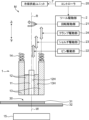
- FIG. 1 is a schematic diagram showing a configuration of a friction stir spot welding apparatus according to an embodiment of the present disclosure.
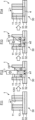
- FIG. 2 is a diagram showing an example of a joining method using a friction stir spot joining apparatus.
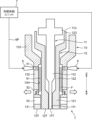
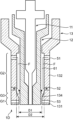
- FIG. 3A is a cross-sectional view of a friction stir spot welding tool according to the first embodiment, which is provided in the friction stir spot welding apparatus.
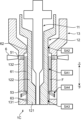
- FIG. 3B is a cross-sectional view of a friction stir spot welding tool according to a modified example of the first embodiment.
- FIG. 4A is a cross-sectional view of a friction stir spot welding tool according to a second embodiment.
- FIG. 4B is a schematic cross-sectional view showing a state in which friction stir material is discharged from a material discharge hole in the tool of the comparative example.
- FIG. 4C is a schematic cross-sectional view showing a state in which friction stir material is discharged from a material discharge hole in the tool of the second embodiment.
- FIG. 5 is a cross-sectional view showing the relationship of clearance in the tool of the second embodiment.
- FIG. 6 is a cross-sectional view of a friction stir spot welding tool according to the third embodiment.
- FIG. 7 is a cross-sectional view of a friction stir spot welding tool according to a fourth embodiment.
- FIG. 8 is a cross-sectional view of a friction stir spot welding tool according to the fifth embodiment.
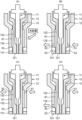
- 9A to 9D are cross-sectional views showing the manner in which cooling air was blown to the tool, which was the subject of an experiment for measuring the side surface temperature of the shoulder.
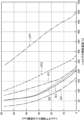
- FIG. 10 is a graph showing the results of an experiment to measure the side temperature of the shoulder.
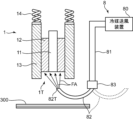
- FIG. 11 is a cross-sectional view showing an embodiment of blowing a tool tip.
- FIG. 12 is a cross-sectional view showing another embodiment for blowing a tool tip.
- the friction stir spot welding apparatus can be used to manufacture various joined bodies formed by overlapping and spot-joining two or more structural materials, such as metal or resin plates, frames, exterior materials, or columnar materials.
- the joints manufactured become components of structures such as aircraft, railway vehicles, or automobiles.
- FIG. 1 is a schematic diagram showing a configuration of a friction stir spot welding apparatus M according to an embodiment of the present disclosure.
- the friction stir spot welding apparatus M includes a tool 1 for friction stir spot welding, a tool drive unit 2 that drives the tool 1 to rotate and elevate, a coolant supply unit 7 that sends a coolant to the tool 1, and a controller 20 that controls the operation of each part of the friction stir spot welding apparatus M.
- a tool 1 for friction stir spot welding includes a tool 1 for friction stir spot welding, a tool drive unit 2 that drives the tool 1 to rotate and elevate, a coolant supply unit 7 that sends a coolant to the tool 1, and a controller 20 that controls the operation of each part of the friction stir spot welding apparatus M.
- Note that some of the drawings are indicated with directional indications of "up” and “down”, but this is for the convenience of explanation and is not intended to limit the actual direction in which the tool 1 is used.
- the tool 1 is supported by various tool fixing parts.
- the tool fixing part is the tip of an articulated robot.
- a backup 15 is arranged facing the lower end surface of the tool 1.
- At least two members to be joined are arranged between the tool 1 and the backup 15.
- Figure 1 shows an example in which an overlapping portion 30, in which a part of a first member 31 made of a flat plate and a part of a second member 32 also made of a flat plate overlap in the vertical direction, is arranged between the tool 1 and the backup 15.
- the tool 1 includes a pin 11, a shoulder 12, a clamp 13, and a spring 14.
- the pin 11 is a cylindrical member, and is arranged so that its axis extends in the vertical direction.
- the pin 11 can rotate around the axis R, and can move forward and backward in the vertical direction along the rotation axis R.
- the rotation axis R is aligned with the point joining position W at the overlapping portion 30.
- the shoulder 12 is a cylindrical member having a first hollow portion 12H therein through which the pin 11 is inserted.
- the axis of the shoulder 12 is coaxial with the axis of the pin 11, i.e., the rotation axis R.
- the shoulder 12 can rotate around the rotation axis R, and can move up and down along the rotation axis R.
- the tool 1 of this embodiment is a double-acting tool in which the pin 11 and shoulder 12 move independently in the axial direction. That is, the shoulder 12 and the pin 11 inserted in the hollow portion can move relatively in the direction of the rotation axis R while both rotating about the axis of rotation R. Specifically, the pin 11 and shoulder 12 can not only rise and fall simultaneously along the rotation axis R, but can also move independently, with one descending and the other ascending.
- the clamp 13 is a member formed in a cylindrical shape having a second hollow portion 13H inside through which the shoulder 12 is inserted.
- the axis of the clamp 13 is also coaxial with the rotation axis R.
- the clamp 13 does not rotate around its axis, but moves up and down along the rotation axis R, that is, moves forward and backward.
- the clamp 13 surrounds the periphery of the shoulder 12, and serves to prevent the outflow of friction stir material when the pin 11 or shoulder 12 performs friction stirring. In other words, the enclosure of the clamp 13 prevents the friction stir material from scattering, and allows the friction stir point joint to be finished smoothly.
- the spring 14 is attached to the upper end side of the clamp 13 and biases the clamp 13 downward toward the overlapping portion 30.
- the clamp 13 is attached to the tool fixing portion via the spring 14.
- the backup 15 has a flat surface that abuts against the underside of the overlapping portion 30 to be joined.
- the backup 15 is a backing member that supports the overlapping portion 30 when the pin 11 or shoulder 12 is pressed into the overlapping portion 30.
- the clamp 13 biased by the spring 14 presses the overlapping portion 30 against the backup 15.
- the tool driving unit 2 includes a rotation driving unit 21, a pin driving unit 22, a shoulder driving unit 23, and a clamp driving unit 24.
- the rotation driving unit 21 includes a motor, a driving gear, etc., and drives the pin 11 and the shoulder 12 to rotate around the rotation axis R.
- the pin driving unit 22 is a mechanism that moves the pin 11 back and forth along the rotation axis R.
- the pin driving unit 22 drives the pin 11 so as to press the pin 11 into the overlapping portion 30 and to retract the pin 11 from the overlapping portion 30.
- the shoulder driving unit 23 is a mechanism that moves the shoulder 12 back and forth along the rotation axis R, and presses the shoulder 12 into the overlapping portion 30 and to retract the shoulder 12 from the overlapping portion 30.
- the clamp driving unit 24 is a mechanism that moves the clamp 13 back and forth along the rotation axis R.
- the clamp driving unit 24 moves the clamp 13 toward the overlapping portion 30 and presses the overlapping portion 30 against the backup 15. At this time, the biasing force of the spring 14 acts.
- the refrigerant supply unit 7 supplies the tool 1 with a refrigerant for cooling the shoulder 12.
- the refrigerant can be a gas such as air or nitrogen gas at room temperature, or a liquid such as water or oil at room temperature.
- Specific examples of the refrigerant supply unit 7 include a device capable of generating a high-pressure air flow; for example, an axial flow blower equipped with a multi-blade fan or turbo fan, or a compressor.
- the supply of refrigerant from the refrigerant supply unit 7 can be performed either when the tool 1 is driven or not driven. If the refrigerant is supplied when the tool 1 is driven, that is, while the tool 1 is operating, the shoulder 12 can be cooled in a timely manner.
- the controller 20 is comprised of a microcomputer or the like, and controls the operation of the tool drive unit 2 and the coolant supply unit 7 by executing a predetermined control program. Specifically, the controller 20 controls the rotation drive unit 21 to cause the pin 11 and shoulder 12 to perform the required rotational operation. The controller 20 also controls the pin drive unit 22, shoulder drive unit 23, and clamp drive unit 24 to cause the pin 11, shoulder 12, and clamp 13 to perform the required forward and backward movement operation. Furthermore, the controller 20 controls the operation of the coolant supply unit 7 to control the coolant supply operation to the tool 1.
- the method of using the friction stir spot welding apparatus M can be roughly classified into a pin-first process in which the pin 11 of the tool 1 is first pressed into the overlapping portion of the welding members, and a shoulder-first process in which the shoulder 12 is first pressed into the overlapping portion of the welding members.
- the shoulder-first process will be described.
- the tool 1 may be used in the pin-first process.
- FIG. 2 shows processes P11 to P14 of the friction stir spot welding method using the shoulder-first process.
- Processes P11 to P14 show a simplified view of friction stir spot welding of the overlapping portion 30 of the first member 31 and the second member 32.
- Process P11 shows the preheating step of the overlapping portion 30. With the lower end of the tool 1 in contact with the surface of the controller 20 and the first member 31, the pin 11 and shoulder 12 are rotated around the axis at a predetermined number of rotations.
- Process P12 shows the pressing step of the shoulder 12.
- the controller 20 lowers the shoulder 12 to press it into the overlapping portion 30, while retracting the pin 11 upward. This action stirs the material in the pressing area of the shoulder 12.
- the overflow material OF that overflows from the overlapping portion 30 due to the pressing is released into the space of the first hollow portion 12H of the shoulder 12, which is created by the retraction of the pin 11 (see arrow a1). In this way, in this embodiment, the pin 11 is moved upward relative to the shoulder 12 during friction stir welding.
- Process P13 shows a backfilling process of the overflow material OF.
- the controller 20 raises and retracts the shoulder 12 while lowering the pin 11.
- the overflow material OF that has escaped to the first hollow portion 12H is backfilled into the press-fit area of the shoulder 12.
- Process P14 shows a smoothing process.
- the controller 20 rotates the pin 11 and shoulder 12 with their lower end faces returned to the height position of the surface of the first member 31, smoothing the spot joint portion. Through the above process, the stir welded portion 4 is formed.
- the shoulder 12 is pressed into the overlapping portion 30 while rotating at high speed around its axis, and in the pin-first process not shown, the pin 11 is pressed into the overlapping portion 30.
- the tool 1 becomes hot due to frictional heat, etc.
- the life of the tool 1 is shortened. It is possible to cool the hot shoulder 12 by blowing cooling air onto it, but in the double-action friction stir spot welding tool 1, the outer periphery of the shoulder 12 is surrounded by the clamp 13. If the shoulder 12 is indirectly cooled by blowing cooling air onto the clamp 13 from the outside, high cooling efficiency cannot be expected.
- a tool structure is provided that can efficiently cool the shoulder 12 of the double-action friction stir spot welding tool 1. A specific example of the tool structure is described below.
- the tool 1 includes a pin 11, a shoulder 12, and a clamp 13.
- the pin 11 is a cylindrical body whose diameter gradually decreases downward, and includes a pin tip portion 111, a pin intermediate portion 112, and a pin base portion 113.
- the pin tip portion 111 is a portion with the smallest outer diameter that forms the tip portion of the pin 11, and its tip is the lower end surface 11T of the pin 11.
- the pin intermediate portion 112 is a cylindrical portion with a larger diameter than the pin tip portion 111.
- the pin tip portion 111 and the pin intermediate portion 112 are connected by a tapered portion.
- the pin base portion 113 is located above the pin intermediate portion 112, and is a portion to which a driving force is applied to rotate the pin 11 around its axis.
- the shoulder 12 is a cylinder that houses the pin 11 and has a shoulder tip 121, a shoulder middle portion 122, and a shoulder base portion 123.
- the shoulder 12 is made of a material with excellent heat resistance, such as cemented carbide.
- the shoulder tip 121 is the portion that forms the tip portion of the shoulder 12, and its tip is the lower end surface 12T of the shoulder 12. In the shoulder-first process, the lower end surface 12T becomes the tip that is pressed into the overlapping portion 30. Therefore, the shoulder tip 121 becomes hot due to frictional heat when the tool 1 is used.
- a cylindrical tip hollow portion is formed with an inner diameter slightly larger than the outer diameter of the pin tip 111.
- the shoulder intermediate portion 122 is a portion that is connected above the shoulder tip portion 121, and has a cylindrical intermediate hollow portion inside that is connected to the tip hollow portion.
- the inner diameter of the intermediate hollow portion is slightly larger than the outer diameter of the pin intermediate portion 112.
- the shoulder base end portion 123 is a cylindrical portion that is connected above the shoulder intermediate portion 122 via a tapered portion.
- the shoulder base end portion 123 is the portion to which a driving force is applied that rotates the shoulder 12 around its axis.
- the clamp 13 is a cylinder that houses the shoulder 12, and includes a clamp tip 131, a clamp adapter 132, and a clamp base end 133.
- the clamp tip 131 is the part that forms the tip portion of the clamp 13, and its tip is the clamp lower end surface 13T.
- the clamp lower end surface 13T is pressed against the overlapping portion 30.
- the clamp tip 131 is adjacent to the shoulder tip 121, which becomes hot, and is exposed to high temperatures. For this reason, the clamp tip 131 is made of a material with excellent heat resistance, such as cemented carbide, or alloy steel such as tool steel or high-speed steel.
- the clamp adapter 132 is located above the clamp tip 131.
- the clamp adapter 132 can be made of a metal such as steel.
- the clamp tip 131 is attached to the clamp adapter 132 by screwing the inner peripheral surface of the lower end of the clamp adapter 132 to the outer peripheral surface of the upper end of the clamp tip 131.
- An annular space 61 with a relatively wide gap width is defined between the inner peripheral surface of the clamp adapter 132 and the outer peripheral surface of the shoulder intermediate portion 122.
- the annular space 61 is part of the second hollow portion 13H described above.
- the clamp base end 133 is a portion that continues above the clamp adapter 132 and is a portion to which a pressing force is applied from the spring 14.
- Three radially extending holes are opened in the peripheral wall of the clamp 13; a first hole 51, a second hole 52, and a material discharge hole 53.
- the first hole 51 is located near the upper end of the clamp adapter 132.
- the second hole 52 is located near the lower end of the clamp adapter 132. In other words, the second hole 52 is located at a different position in the axial direction of the clamp 13 from the first hole 51, and the first hole 51 is located at a higher position than the second hole 52.
- the material discharge hole 53 is located at the clamp tip 131 below the second hole 52.
- the first holes 51 are openings for allowing the refrigerant to flow into the second hollow portion 13H inside the clamp 13, and into the annular space 61 when the shoulder 12 is housed in the clamp 13.
- FIG. 3 shows an example in which two first holes 51 are opened at positions facing each other in the circumferential direction. However, it is sufficient that at least one opening for the refrigerant to flow in is opened, and the number and pitch of the first holes 51 may be set appropriately.
- a nozzle 6 for supplying refrigerant is inserted into the first hole 51.
- the nozzle 6 may be permanently installed in the first hole 51, or may be detachably attached to the first hole 51 by screwing or fitting.
- a supply pipe 6P extending from the refrigerant supply unit 7 is connected to the nozzle 6.
- Refrigerant such as room temperature air discharged from the refrigerant supply unit 7 can be supplied to the annular space 61 (second hollow portion 13H) through the supply pipe 6P and the nozzle 6. It is preferable to provide a valve device in the supply pipe 6P for switching between supplying and stopping the refrigerant.
- the second hole 52 is an opening that serves as a discharge path for the refrigerant that has flowed from the first hole 51 into the annular space 61. While FIG. 3 shows an example in which two second holes 52 are opened at positions facing each other in the circumferential direction, it is sufficient that at least one second hole 52 is provided in the peripheral wall of the clamp 13. By opening the second hole 52, it is possible to form a refrigerant flow F in the annular space 61 that flows from the first hole 51 toward the second hole 52.
- the material discharge hole 53 is an opening for escaping the friction stir material that inevitably enters the gap between the shoulder tip 121 and the clamp tip 131 to the outside. While the clamp 13 is stationary, the shoulder 12 rotates around the rotation axis R and moves up and down along the rotation axis R. For this reason, a clearance is required between the shoulder 12 and the clamp 13. As explained in process P12 of FIG. 2, when the shoulder 12 is pressed in, the pin 11 retreats upward, creating a space for the friction stir material to escape. However, not all of the friction stir material heads into this space, and some of it enters the clearance between the shoulder 12 and the clamp 13. The same is true in the backfilling process of process P13. The presence of such friction stir material in the clearance increases the sliding resistance of the shoulder 12 and affects the operation of the tool 1.
- the friction stir material that enters the clearance gradually rises above the tool 1.
- the material discharge hole 53 functions as an opening that discharges such friction stir material to the outside. The discharge of the friction stir material from the material discharge hole 53 suppresses the increase in the sliding resistance of the shoulder 12 described above.
- the shoulder 12 is pressed into the overlapping portion 30 while being rotated about its axis.
- the refrigerant is supplied from the refrigerant supply unit 7 through the supply pipe 6P to the nozzle 6 attached to the first hole 51.
- the refrigerant flows from the nozzle 6 into the annular space 61, and creates a refrigerant flow F within the annular space 61 that flows toward the second hole 52.
- the refrigerant is then discharged to the outside from the second hole 52.
- the shoulder 12 is heated by friction due to the press-in.
- the refrigerant flows into the annular space 61 from the first hole 51, direct heat exchange occurs between the refrigerant and the shoulder 12, and the shoulder 12 is cooled. Therefore, the shoulder 12 can be cooled more efficiently than in the case where the shoulder 12 is indirectly cooled by blowing cooling air against the outer periphery of the clamp 13.
- the refrigerant flow F flowing from the first hole 51 to the second hole 52 flows along the outer periphery of the shoulder 12, so that the heat exchange between the refrigerant and the shoulder 12 is promoted, and the shoulder 12 can be cooled efficiently.
- the first hole 51 which serves as the inlet of the refrigerant, is arranged on the peripheral wall of the clamp 13.
- the refrigerant is supplied from the gap between the shoulder 12 and the clamp 13 at the top of the tool 1, the refrigerant is heated in the gap before reaching the area of the annular space 61 where cooling is required, and the cooling efficiency is reduced.
- the refrigerant is supplied from the peripheral wall of the clamp 13, so the cooling efficiency is high.
- the second hole 52 for discharging the refrigerant is provided separately from the material discharge hole 53, a refrigerant flow F can be stably formed from the first hole 51 to the second hole 52. Furthermore, since the position of the second hole 52 can be freely set, there is an advantage that it is easy to design cooling according to the actual heat generation behavior of the shoulder 12 and design taking into account the strength of the clamp 13. Note that if the distance between the first hole 51 and the second hole 52 is too short, the cooling width of the shoulder 12 will be shortened and the strength of the clamp 13 will be reduced. It is desirable to set the positions of the first hole 51 and the second hole 52 taking into account factors such as cooling efficiency and strength.
- FIG. 3B is a cross-sectional view of a friction stir spot welding tool 10 according to a modified example of the first embodiment.
- the difference from the above-described friction stir spot welding tool 1 is that the member attached to the first hole 51 to supply the coolant is an adapter 60, but the rest of the configuration is the same.
- the adapter 60 has a supply hole therein through which the coolant passes, and is a member that is tightly attached to the first hole 51.
- the adapter 60 may be, for example, a one-touch pipe joint with a screw thread on the end attached to the first hole 51.
- the joint type may be a linear type, an elbow type, or the like.
- a screw groove is engraved on the inner surface of the first hole 51, and the end of the adapter 60 with the screw thread is screwed into the first hole 51.
- the supply pipe 6P is connected to the other end of the adapter 60.
- the coolant can be caused to flow from the supply pipe 6P to the annular space 61 through the adapter 60 tightly attached to the first hole 51. This suppresses leakage of the coolant from the first hole 51, and as a result, the amount of coolant supplied to the annular space 61 can be increased. This makes it possible to improve the cooling efficiency of the shoulder 12 by the coolant.
- [Second embodiment of the tool] 4A is a cross-sectional view of a friction stir spot welding tool 1A according to the second embodiment.
- the basic configuration of the tool 1A is similar to that of the tool 1 of the first embodiment, and includes a pin 11, a shoulder 12, and a clamp 13.
- the material discharge hole 53 which allows the friction stir material that has entered between the shoulder 12 and the clamp 13 to escape to the outside, is used as an opening for discharging the coolant.
- the material discharge hole 53 also serves as the second hole 52 of the tool 1 of the first embodiment. For this reason, the second hole 52 is not provided in the clamp 13 of the tool 1A.
- the refrigerant supplied from the refrigerant supply unit 7 flows into the annular space 61 through the nozzle 6 and the first hole 51.
- the refrigerant flow F produced by the flowed-in refrigerant exchanges heat with the outer peripheral surface of the shoulder 12, cooling the shoulder 12. This operation is the same as in the first embodiment.
- the discharge path for the refrigerant flow F is the material discharge hole 53.
- the refrigerant flowed into the annular space 61 is discharged to the outside from the material discharge hole 53.
- the material discharge hole 53 is usually not completely blocked by the friction stirring material, so it can be used as a refrigerant discharge hole.
- the material discharge hole 53 is used as a coolant discharge hole, so there is no need to drill a new coolant discharge hole in the clamp 13.
- the friction stir material comes into contact with the coolant. This has the advantage that the friction stir material can be cooled to form a coagulated mass before being discharged from the material discharge hole 53. This advantage will be explained further with reference to Figures 4B and 4C.
- FIG. 4B is a schematic cross-sectional view showing the discharge of friction stir material from material discharge hole 53 in a comparative example tool that does not have a coolant inflow path, i.e., first hole 51.
- the friction stir material that enters the clearance heads toward material discharge hole 53 while still at a high temperature, and is discharged to the outside from material discharge hole 53 in the form of fine pieces MA.
- problems may occur in which scattered fine pieces MA adhere to the surface of the workpiece to be joined, causing uneven painting, or the fine pieces MA become airborne, worsening the work environment.
- FIG. 4C is a schematic cross-sectional view showing the discharge of friction stir material from the material discharge hole 53 in the tool 1A of the second embodiment.
- a coolant flow F is generated that flows through the annular space 61, cools the shoulder 12, and is discharged from the material discharge hole 53.
- the friction stir material discharged from the material discharge hole 53 is cooled by contact with the coolant flow F.
- the shoulder 12 is also cooled by the coolant flow F, so the friction stir material is also cooled when it rises in the clearance between the shoulder 12 and the clamp 13. Due to these cooling effects, the friction stir material discharged from the material discharge hole 53 becomes agglomerates MB in the form of continuous lumps, rather than small pieces MA that are separated from each other. Therefore, in the tool 1A, the friction stir material does not scatter as in the comparative example.
- the agglomerates MB can be easily removed with a spatula or the like, making post-processing easy.
- the tool 1A of the second embodiment also focuses on the clearance between the inner peripheral wall of the clamp 13 and the outer peripheral wall of the shoulder 12. This point will be explained with reference to Figure 5.
- annular space 61 in which the refrigerant flow F is expected to flow.
- the clearance of this annular space 61 in other words, the width in the radial direction, is defined as C1.
- An upper annular space 62 is formed between the clamp 13 and the shoulder 12 on the side farther from the clamp lower end surface 13T than the first hole 51, that is, above the first hole 51.
- a lower annular space 63 is formed between the clamp tip portion 131 and the shoulder tip portion 121 closer to the clamp lower end surface 13T than the material discharge hole 53, that is, below the second hole 52.
- the clearance of the upper annular space 62 is defined as C2
- the clearance of the lower annular space 63 is defined as C3.
- the relationship between the clearances C1, C2, and C3 is set so as to satisfy the relationship of the following formula (1).
- the annular space 61 between the first hole 51 and the material discharge hole 53, which serves as a passage for the refrigerant flow F, has a wide clearance
- C1>C2 it is possible to make it difficult for the refrigerant supplied from the first hole 51 to flow upward through the upper annular space 62, making it easier to form the refrigerant flow F in the annular space 61.
- C1>C3 it is possible to make it difficult for the refrigerant to flow out through the lower annular space 63 to the tip surface side of the tool 1, making it easier to form the refrigerant flow F that flows exclusively from the material discharge hole 53.
- the relationship between the clearances C1, C2, and C3 in the above formula (1) makes it easier for the refrigerant to preferentially flow between the first hole 51 and the material discharge hole 53 serving as the second hole. Therefore, in the annular space 61, heat exchange can be efficiently performed between the refrigerant flow F and the shoulder 12.
- [Third embodiment of the tool] 6 is a cross-sectional view of a friction stir spot welding tool 1B according to the third embodiment.
- the configuration of the tool 1B is similar to that of the tool 1A of the second embodiment, and includes a pin 11, a shoulder 12, and a clamp 13 having a first hole 51 for coolant inflow and a material discharge hole 53 that also serves as a coolant discharge hole.
- the tool 1B of the third embodiment focuses on the thermal conductivity of the material constituting the shoulder 12 and the clamp 13.
- the clamp 13 of the tool 1B has a region in the peripheral wall that defines the annular space 61, which is a passage for the refrigerant between the first hole 51 and the material discharge hole 53 (second hole), and has a thermal conductivity lower than that of the shoulder 12.
- the peripheral wall that defines the annular space 61 is the clamp adapter 132, and the first hole 51 and the material discharge hole 53 are also provided in the clamp adapter 132. Therefore, a material having a thermal conductivity lower than that of the material of the shoulder 12 is selected as the material of the clamp adapter 132.
- the material of the shoulder 12 is a cemented carbide, which is a sintered mixture of tungsten carbide and cobalt
- the material of the clamp adapter 132 is steel or ceramic
- the clamp tip 131 attached to the lower end of the clamp adapter 132 is the area facing the shoulder tip 121 that performs friction stirring, and therefore receives the same amount of heat as the shoulder tip 121.
- the clamp lower end surface 13T which is the end surface of the clamp tip 131, is pressed against the overlapping portion 30, so it needs to have a corresponding strength. Therefore, it is desirable for the clamp tip 131 to be made of the same cemented carbide material as the shoulder 12. If the clamp tip 131 is made of cemented carbide and the clamp adapter 132 is made of steel, the clamp adapter 132 will be made of a material with a lower thermal conductivity than the clamp tip 131.
- the temperature relationship during use of the tool 1B made of the above-mentioned constituent materials is as follows: If the ambient temperature of the overlapping portion 30 into which the tool 1B is pressed is Ta, the temperature of the shoulder tip 121 is Ts, the temperature of the clamp tip 131 is Tc1, the temperature of the clamp adapter 132 is Tc2, the temperature of the coolant supplied from the coolant supply unit 7 is Tb1, and the temperature of the coolant flow F flowing through the annular space 61 is Tb2, the temperature relationship is expressed by the following formula (2). Ts>Tc1>Tc2>Ta>Tb2 ⁇ Tb1...(2) This results in the following relationship.
- the tool 1B of the third embodiment makes it possible to make it difficult for the air heat around the friction stir spot welding device M and the heat of other parts of the clamp 13 to be transferred to the coolant flow F flowing through the annular space 61. That is, since the clamp adapter 132 is made of a material with low thermal conductivity, the peripheral wall between the first hole 51 and the material discharge hole 53 acts as an insulator, and the transfer of heat to the coolant flow F is suppressed. Even if the clamp tip 131 becomes hot, the heat is difficult to transfer to the clamp adapter 132, and as a result, the coolant flow F is difficult to heat by friction stirring heat. Therefore, the relationship Tb2 ⁇ Tb1 in the above formula (2) can be maintained. That is, most of the cold energy of the coolant supplied from the coolant supply unit 7 can be used for heat exchange with the shoulder 12, and the shoulder 12 can be cooled efficiently.
- the clamp adapter 132 was made of a material with low thermal conductivity, but at least a portion of the peripheral wall between the first hole 51 and the material discharge hole 53 (second hole) may be made of a material with a thermal conductivity lower than that of the shoulder 12, that is, a material that exhibits insulating properties.
- a ring-shaped member with insulating properties may be attached to the lower end of a conventionally used clamp adapter, and the clamp tip may be attached to the lower end of the ring-shaped member.
- the openings corresponding to the first and second holes through which the refrigerant flows may be opened in the ring-shaped member or at a position that sandwiches the ring-shaped member.
- [Fourth embodiment of the tool] 7 is a cross-sectional view of a friction stir spot welding tool 1C according to the fourth embodiment.
- the configuration of the tool 1C is similar to that of the tool 1A of the second embodiment, and includes a pin 11, a shoulder 12, and a clamp 13 having a first hole 51 for coolant inflow and a material discharge hole 53 that also serves as a coolant discharge hole.
- the tool 1C of the fourth embodiment focuses on the cross-sectional area of the space between the clamp 13 and the shoulder 12.
- the cross-sectional area between the first hole 51 and the material discharge hole 53 as the second hole is defined as SA1.
- SA1 the cross-sectional area of the annular space 61 through which the coolant flow F is expected to flow.
- SA2 The cross-sectional area of the upper annular space 62 above the first hole 51
- SA3 the cross-sectional area of the lower annular space 63 below the material discharge hole 53
- the opening area of the material discharge hole 53 as the second hole, which is the outlet of the coolant flow F, is defined as SA4.
- the relationship between the cross-sectional areas SA1, SA2, SA3 and the opening area SA4 is set to satisfy the relationship of the following formula (3).
- the annular space 61 between the first hole 51 and the material discharge hole 53, which serves as the passage for the coolant flow F, and the material discharge hole 53, which serves as the outlet for the coolant flow F have a relatively large cross-sectional area.
- the upper annular space 62 and the lower annular space 63 which sandwich the annular space 61 and the material discharge hole 53 from above and below, have a relatively small cross-sectional area.
- the cross-sectional areas SA1, SA2, SA3 and the opening area SA4 are related as in formula (3) above, so that the refrigerant can preferentially flow between the first hole 51 and the material discharge hole 53 serving as the second hole, as in the second embodiment. Therefore, the refrigerant flow F can be efficiently exchanged with the shoulder 12 in the annular space 61.
- [Fifth embodiment] 8 is a cross-sectional view of a friction stir spot welding tool 1D according to the fifth embodiment.
- the tool 1D includes a pin 11, a shoulder 12, and a clamp 13 having a first hole 51 for coolant inflow, a second hole 52 for coolant discharge, and a material discharge hole 53.
- the clamp 13 of the fifth embodiment includes a tapered surface 134 between the inner surface of the clamp tip 131 and the inner surface of the clamp adapter 132.
- the tapered surface 134 is an inner surface whose inner diameter gradually decreases toward the tool tip.
- the material discharge hole 53 is an opening that discharges to the outside the friction stir material that has entered the clearance between the shoulder 12 and the clamp 13. During the discharge, it is desirable for the friction stir material to pass through the material discharge hole 53 in the form of a fluid agglomerate. In other words, it is desirable for the friction stir material that has entered the clearance to be discharged from the material discharge hole 53 without solidifying. To prevent the solidification, it is desirable for the material to not be cooled too much by the refrigerant flowing through the annular space 61.
- the fifth embodiment takes this into consideration.
- the peripheral wall of the clamp 13 in the fifth embodiment includes a first region G1, a second region G2, and an intermediate region G3.
- the first region E1 corresponds to the clamp tip portion 131 constituting the tip of the clamp 13.
- the inner diameter of the first region G1 is a predetermined first length D1.
- the first length D1 is slightly larger than the outer diameter of the shoulder 12.
- the second region G2 is located above the first region E1 and is an area that generally corresponds to the clamp adapter 132.
- the inner diameter of the second region G2 is a second length D2 that is longer than the first length D1.
- the second length D2 is set to a length that can define an annular space 61 between the shoulder 12 and the intermediate region G3, through which sufficient refrigerant can flow.
- the intermediate region G3 is located between the first region G1 and the second region G2.
- the inner surface of the intermediate region G3 is a tapered surface 134 that fills the diameter difference between the first length D1 and the second length D2.
- the first hole 51 and the second hole 52 are located in the second region G2.
- the material discharge hole 53 is located in the first region G1.
- the second hole 52 which is the discharge hole for the refrigerant flow F
- the material discharge hole 53 there is a tapered surface 134 that gradually narrows the gap between the outer peripheral surface of the shoulder 12 and the inner peripheral surface of the clamp 13.
- the refrigerant flow F has difficulty moving toward the material discharge hole 53, and is discharged exclusively from the second hole 52.
- the refrigerant flow F that once passed through the second hole 52 is also likely to be guided by the tapered surface 134 and become a reverse flow toward the second hole 52. Therefore, the friction stir material present near the entrance of the material discharge hole 53 is unlikely to be cooled excessively by the refrigerant flow F, and solidification is suppressed. This allows the friction stir material to be discharged from the material discharge hole 53 in the form of a fluid mass.
- FIG. 9(A) shows the blowing state of a comparative example.
- the clamp 13 does not have a first hole 51 for introducing a refrigerant, and the cooling air is blown onto the outer peripheral surface of the clamp 13, indirectly cooling the shoulder 12.
- FIGS. 9(B) to 9(D) show blowing states corresponding to the embodiments of the present disclosure, in which the shoulder 12 is directly cooled by the cooling air.
- FIG. 9(B) shows an example in which the first hole 51 for the inflow of the cooling air and the second hole 52 for the exhaust of the cooling air are arranged to face each other at a position directly above the two material exhaust holes 53.
- FIG. 9(C) shows an example in which the first hole 51 and the second hole 52 are arranged to face each other at a position above the clamp 13.
- FIG. 9(D) shows an example in which the cooling air is introduced from one first hole 51 located above the clamp 13 and exhausted from one second hole 52 located below.
- Figure 10 is a graph showing the analysis results of the side temperature of the shoulder 12.
- the vertical axis of the graph shows the height distance from the lower end surface 12T of the shoulder ( Figure 3A).
- Graph CP1 in Figure 9 shows the side temperature of the shoulder 12 when no cooling air is blown onto the tool 1.
- the side temperature near the tip 121 of the shoulder rises to nearly 500°C. If the tool 1 is used with the shoulder 12 in such a high-temperature state, the life of the tool 1 is likely to be shortened.
- Graph CP2 shows the side temperature when the shoulder 12 is indirectly cooled, as shown in Figure 9 (A). Although the side temperature of the shoulder 12 is lower than that of graph CP1 without cooling, it is still high, exceeding 250°C, near the tip 121 of the shoulder.
- Graph E1 shows the side temperature of the shoulder 12 when cooling air is blown directly as shown in FIG. 9(B). Compared to graph CP2 of the comparative example, graph E1 shows that the cooling effect is improved by about 50°C or more near the shoulder tip 121.
- Graph E2 shows the side temperature of the shoulder 12 when cooling air is blown directly as shown in FIG. 9(C), and graph E3 shows the side temperature of the shoulder 12 when cooling air is blown directly as shown in FIG. 9(D).
- Graphs E1 to E3 are graphs calculated assuming the use of a friction stir spot welding tool 1 having the nozzle 6 shown in FIG. 3A.
- graph E4 is a graph calculated assuming the use of a friction stir spot welding tool 10 having the adapter 60 shown in FIG. 3B and the direct blowing of cooling air as shown in FIG. 9(D).
- graphs E2 and E3 have improved cooling effects.
- graph E3 in the embodiment of FIG. 8(D), where cooling air is introduced into the annular space 61 from the first hole 51 above the clamp 13 and discharged from the second hole located below, was confirmed to have an excellent cooling effect on the shoulder 12.
- graph E4 in which an adapter 60 that can be tightly attached to the first hole 51 is used, was confirmed to have the best cooling effect on the shoulder 12.
- FIG. 11 is a cross-sectional view showing an embodiment in which the tool tip 1T is blown.
- the tool tip 1T of the tool 1 is a part that directly contacts the workpiece 300. Therefore, when the tool 1 is driven, the tool tip 1T becomes hot. Excessive heating can promote damage and deterioration of the tool tip 1T.
- foreign matter is likely to adhere to the tool tip 1T.
- the foreign matter is, for example, material scraps of the workpiece 300, oils and material scraps leaking from between the tool elements between the pin 11 and the shoulder 12 or between the shoulder 12 and the clamp 13. If the foreign matter of the tool tip 1T gets mixed into the friction stir spot welded portion, it can reduce the strength of the welded portion.
- FIG. 11 shows an embodiment equipped with equipment for blowing the tool tip 1T to solve these problems.
- the tool 1 in FIG. 11 is provided with a tool tip blow unit 8 that blows a refrigerant flow FA to the tool tip 1T.
- the tool tip blow unit 8 includes a refrigerant blower 80, an air supply pipe 81, a nozzle 82, and a swivel joint 83.
- the refrigerant blower 80 is a supply source of the refrigerant flow FA to be blown.
- the refrigerant blower 80 includes a compressor or a blower that pressurizes the refrigerant.
- the refrigerant may be air.
- the air supply pipe 81 sends the refrigerant to the nozzle 82.
- the nozzle 82 has a tip opening 82T that blows out the refrigerant flow FA.
- the nozzle 82 has a U-shape, and the tip opening 82T can face the tool tip 1T from below.
- the swivel joint 83 rotatably connects the nozzle 82 to
- the tool tip 1T is cooled by the coolant flow FA sprayed from the tip opening 82T of the nozzle 82. This prevents the tool tip 1T from excessively increasing in temperature.
- the coolant flow FA blows away any foreign matter adhering to the tool tip 1T.
- the coolant flow FA also blows between the pin 11 and the shoulder 12, and between the shoulder 12 and the clamp 13, helping to clean the gap between these tool elements.
- the nozzle 82 rotates around the swivel joint 83 and retreats from below the tool tip 1T. Instead of retracting the nozzle 82 with the swivel joint 83, it is also possible to move the entire tool tip blow unit 8, or move the air supply pipe 81 to advance and retreat the nozzle 82.
- FIG. 12 is a cross-sectional view showing another embodiment for blowing the tool tip 1T.
- a coolant flow FA is blown directly from a nozzle 82 to the tool tip 1T.
- FIG. 12 an example is shown in which the coolant flow FA is blown indirectly to the tool tip 1T via the workpiece 300.
- the tool 1 in FIG. 12 is provided with a tool tip blow unit 8A that blows the coolant flow FA to the workpiece 300.
- the tool tip blow unit 8A includes the same refrigerant blower 80 and air supply pipe 81 as in the previous example, and an indirect nozzle 84 that sprays the refrigerant flow FA onto the workpiece 300.
- the indirect nozzle 84 is fixedly attached to the lower end of the air supply pipe 81.
- the indirect nozzle 84 has a tip opening 84T that sprays the refrigerant flow FA at a predetermined cross angle with respect to the surface of the workpiece 300.
- the indirect nozzle 84 is located outside the advance/retract area of the tool 1 and does not interfere with the tool 1.
- the refrigerant flow FA sprayed from the tip opening 84T first hits the workpiece 300.
- the refrigerant flow FA is then reflected by the surface of the workpiece 300 and hits the tool tip 1T. Therefore, the tool tip 1T is cooled and cleaned.
- the friction stir spot welding device includes a pin, a shoulder having a first hollow portion therein through which the pin is inserted, and a clamp having a second hollow portion therein through which the shoulder is inserted and a first hole in the peripheral wall through which a coolant flows into the second hollow portion.
- the peripheral wall of the clamp is provided with a first hole, so that the refrigerant can flow from the first hole into the second hollow portion and directly exchange heat between the refrigerant and the shoulder. Therefore, the shoulder can be cooled more efficiently than when the shoulder is cooled indirectly from the outer periphery of the clamp.
- the friction stir spot welding device is the device of the first aspect, further comprising a nozzle attached to the first hole, and the coolant is supplied to the second hollow portion through the nozzle.
- the nozzle is used as a refrigerant supply port, making it easy to supply the refrigerant to the second hollow portion.
- the friction stir spot welding device is the device according to the first aspect, further comprising an adapter with a supply hole that is tightly attached to the first hole, and the coolant is supplied to the second hollow portion through the adapter.
- the third aspect it is possible to suppress leakage of refrigerant from the first hole and increase the amount of refrigerant supplied to the second hollow portion.
- the friction stir spot welding device is the device according to the first to third aspects, in which the clamp is arranged at a position different from the first hole, and further includes a second hole in the peripheral wall that serves as a discharge path for the coolant that has flowed into the second hollow portion.
- a refrigerant flow is formed in the second hollow portion from the first hole to the second hole. This promotes heat exchange between the refrigerant and the shoulder, allowing the shoulder to be cooled efficiently.
- the friction stir spot welding device is the device of the fourth aspect, in which the first hole is positioned higher than the second hole when the tip of the clamp is the lower end.
- the present inventors have confirmed through experiments that the cooling efficiency of the shoulder is further improved by arranging the first hole, which serves as the inlet hole for the refrigerant, on the upper side and the second hole, which serves as the outlet hole, on the lower side, as in the fifth embodiment.
- the friction stir spot welding device of the sixth aspect is the device of the fourth aspect, in which the second hole is a material discharge hole that allows the friction stir material that has entered between the shoulder and the clamp to escape to the outside.
- friction stir material can unavoidably get between the shoulder and the clamp, and the clamp may be provided with a material discharge hole to allow the friction stir material to escape.
- the material discharge hole is used as a coolant discharge hole, so there is no need to drill a new discharge hole in the clamp.
- the coolant comes into contact with the friction stir material that has gotten between the shoulder and the clamp, so the friction stir material can be cooled and discharged as an agglomerate.
- the seventh aspect of the friction stir spot welding device is the fourth aspect of the device, in which the clamp has a material discharge hole that allows friction stir material that has entered between the shoulder and the clamp to escape to the outside, in addition to the first and second holes.
- the friction stirring material that has entered between the shoulder and the clamp can be discharged from the material discharge hole.
- a second hole is provided in addition to the material discharge hole, a stable coolant flow can be formed from the first hole to the second hole.
- the friction stir spot welding device of the eighth aspect is the device of the seventh aspect, in which the peripheral wall of the clamp includes a first region that constitutes the tip of the clamp and has an inner diameter of a predetermined first length, a second region located above the first region and having an inner diameter of a second length longer than the first length, and an intermediate region located between the first and second regions and filling the diameter difference between the first and second lengths, the first hole and the second hole are located in the second region of the peripheral wall, and the material discharge hole is located in the first region.
- the gap between the outer peripheral surface of the shoulder and the inner peripheral surface of the clamp gradually narrows between the second hole, which is the discharge hole for the refrigerant flow, and the material discharge hole. This makes it difficult for the refrigerant flow to flow toward the material discharge hole, and the refrigerant flow is discharged exclusively from the second hole. Therefore, the friction stir material discharged from the material discharge hole is difficult to be cooled by the refrigerant flow, and solidification is suppressed. This allows the friction stir material to be discharged from the material discharge hole in the form of a fluid mass.
- the friction stir spot welding device is the device according to the fourth to eighth aspects, in which the clamp has a region in the peripheral wall that defines the coolant passage at least between the first hole and the second hole, the region having a lower thermal conductivity than the thermal conductivity of the shoulder.
- a region with low thermal conductivity is provided on the peripheral wall between the first and second holes of the clamp. This makes it difficult for the heat of the air around the friction stir spot welding device and the heat of other parts of the clamp to be transmitted to the coolant flowing from the first hole to the second hole. This allows for a configuration in which most of the cold energy of the coolant can be used for heat exchange with the shoulder.
- the friction stir spot welding device is the device according to the fourth to ninth aspects, in which the clamp includes a clamp tip portion constituting the tip of the clamp and a clamp adapter to which the clamp tip portion is attached, the first hole and the second hole are provided in the clamp adapter, and the clamp adapter is made of a material having a lower thermal conductivity than the clamp tip portion.
- the clamp tip receives heat equivalent to that of the shoulder performing friction stirring. According to the tenth aspect, the heat received by the clamp tip is less likely to be transmitted to the clamp adapter, and as a result, the refrigerant can be prevented from being heated by friction stirring heat.
- the friction stir spot welding apparatus is the apparatus according to any one of the fourth to tenth aspects, wherein, with respect to the clearance between the inner peripheral wall of the clamp and the outer peripheral wall of the shoulder, the clearance between the first hole and the second hole is C1, the clearance on the side away from the tip of the clamp from the first hole is C2, and the clearance on the tip side from the second hole is C3, C1>C2, C1>C3 Satisfy the relationship.
- the refrigerant is more likely to preferentially flow between the first hole and the second hole.
- clearance C1 is set wider than clearances C2 and C3, the refrigerant is less likely to escape above the first hole and below the second hole. Therefore, efficient heat exchange can be achieved between the refrigerant and the shoulder between the first hole and the second hole.
- the friction stir spot welding apparatus is the apparatus of any one of the fourth to tenth aspects, in which, with respect to the cross-sectional area of the space between the inner peripheral wall of the clamp and the outer peripheral wall of the shoulder in a direction perpendicular to the central axis of the clamp, the cross-sectional area between the first hole and the second hole is SA1, the cross-sectional area on the side away from the tip of the clamp from the first hole is SA2, the cross-sectional area on the tip side from the second hole is SA3, and the opening area of the second hole is SA4, SA1>SA2, SA1>SA3, SA4>SA2, SA4>SA3 Satisfy the relationship.
- the refrigerant is more likely to preferentially flow between the first hole and the second hole.
- the friction stir spot welding device is the device according to the first to twelfth aspects, further comprising a refrigerant supply unit that supplies a refrigerant to the first hole.
- the refrigerant can be stably supplied from the refrigerant supply unit to the second hollow portion.
- the friction stir spot welding method according to the fourteenth aspect is a friction stir spot welding method using a tool including a pin, a shoulder having a first hollow portion therein through which the pin is inserted, and a clamp having a second hollow portion therein through which the shoulder is inserted, and a coolant is introduced into the second hollow portion through a coolant inlet hole provided in the peripheral wall of the clamp.
- the refrigerant when the tool is in operation, the refrigerant can be caused to flow into the second hollow portion through the refrigerant inlet hole, and heat can be directly exchanged between the refrigerant and the shoulder. Therefore, the tool can be operated while efficiently cooling the shoulder.
- the friction stir spot welding method according to the fifteenth aspect is the friction stir spot welding method according to the fourteenth aspect, in which the coolant flows in when the tool is driven. According to the fifteenth aspect, the shoulder can be cooled in a timely manner when the tool is driven.
Landscapes
- Engineering & Computer Science (AREA)
- Mechanical Engineering (AREA)
- Pressure Welding/Diffusion-Bonding (AREA)
Priority Applications (1)
| Application Number | Priority Date | Filing Date | Title |
|---|---|---|---|
| JP2025521808A JPWO2024241659A1 (https=) | 2023-05-24 | 2024-03-07 |
Applications Claiming Priority (2)
| Application Number | Priority Date | Filing Date | Title |
|---|---|---|---|
| JP2023085254 | 2023-05-24 | ||
| JP2023-085254 | 2023-05-24 |
Publications (1)
| Publication Number | Publication Date |
|---|---|
| WO2024241659A1 true WO2024241659A1 (ja) | 2024-11-28 |
Family
ID=93589293
Family Applications (1)
| Application Number | Title | Priority Date | Filing Date |
|---|---|---|---|
| PCT/JP2024/008800 Ceased WO2024241659A1 (ja) | 2023-05-24 | 2024-03-07 | 摩擦攪拌点接合装置および方法 |
Country Status (2)
| Country | Link |
|---|---|
| JP (1) | JPWO2024241659A1 (https=) |
| WO (1) | WO2024241659A1 (https=) |
Cited By (1)
| Publication number | Priority date | Publication date | Assignee | Title |
|---|---|---|---|---|
| US20250144741A1 (en) * | 2023-03-22 | 2025-05-08 | Institute For The Development And Quality, Macau | Solid-phase molding processing method |
Citations (5)
| Publication number | Priority date | Publication date | Assignee | Title |
|---|---|---|---|---|
| JPH1052770A (ja) * | 1996-05-31 | 1998-02-24 | Boeing Co:The | 摩擦スター溶接方法および工具 |
| WO2005105360A1 (ja) * | 2004-04-30 | 2005-11-10 | Tokyu Car Corporation | 金属材の接合方法 |
| WO2012026800A1 (en) * | 2010-08-24 | 2012-03-01 | Universiti Sains Malaysia | A method for spot welding and an apparatus to perform the method |
| WO2019186658A1 (ja) * | 2018-03-26 | 2019-10-03 | ヤマザキマザック株式会社 | 摩擦攪拌接合用工具及び摩擦攪拌接合装置 |
| US20220048131A1 (en) * | 2020-08-14 | 2022-02-17 | Lincoln Global, Inc. | Refill friction stir spot welding tool and end effector |
-
2024
- 2024-03-07 JP JP2025521808A patent/JPWO2024241659A1/ja active Pending
- 2024-03-07 WO PCT/JP2024/008800 patent/WO2024241659A1/ja not_active Ceased
Patent Citations (5)
| Publication number | Priority date | Publication date | Assignee | Title |
|---|---|---|---|---|
| JPH1052770A (ja) * | 1996-05-31 | 1998-02-24 | Boeing Co:The | 摩擦スター溶接方法および工具 |
| WO2005105360A1 (ja) * | 2004-04-30 | 2005-11-10 | Tokyu Car Corporation | 金属材の接合方法 |
| WO2012026800A1 (en) * | 2010-08-24 | 2012-03-01 | Universiti Sains Malaysia | A method for spot welding and an apparatus to perform the method |
| WO2019186658A1 (ja) * | 2018-03-26 | 2019-10-03 | ヤマザキマザック株式会社 | 摩擦攪拌接合用工具及び摩擦攪拌接合装置 |
| US20220048131A1 (en) * | 2020-08-14 | 2022-02-17 | Lincoln Global, Inc. | Refill friction stir spot welding tool and end effector |
Cited By (1)
| Publication number | Priority date | Publication date | Assignee | Title |
|---|---|---|---|---|
| US20250144741A1 (en) * | 2023-03-22 | 2025-05-08 | Institute For The Development And Quality, Macau | Solid-phase molding processing method |
Also Published As
| Publication number | Publication date |
|---|---|
| JPWO2024241659A1 (https=) | 2024-11-28 |
Similar Documents
| Publication | Publication Date | Title |
|---|---|---|
| WO2024241659A1 (ja) | 摩擦攪拌点接合装置および方法 | |
| CN112122768B (zh) | 一种静止轴肩搅拌摩擦焊焊具、焊接装置及焊接系统 | |
| CN1084654C (zh) | 同步冷却的摩擦搅动焊接 | |
| KR101142509B1 (ko) | 마찰 교반 접합 장치 | |
| CN109070263B (zh) | 摩擦搅拌接合装置 | |
| WO2020238282A1 (zh) | 外冷织构车刀部件及纳米流体微量润滑与微织构刀具耦合的车削工艺系统 | |
| US20090159643A1 (en) | Method for joining tube plates and tubes as well as friction tool to carry out the method | |
| KR101148275B1 (ko) | 마찰교반용접에 사용하기 위한 연장 가능한 맨드릴 | |
| CN211464865U (zh) | 纳米流体微量润滑智能工作系统 | |
| EP2514551B1 (en) | Machine tool head for friction stir welding with a floating shoulder | |
| CN117381130A (zh) | 一种搅拌摩擦工具冷却方法 | |
| CN112719273A (zh) | 基于半固态浆料的表面预处理及修复辊压一体装置 | |
| EP3069812B1 (en) | Apparatus for friction stir welding with a shoulder comprising first and second through holes | |
| CN117862976B (zh) | 一种具有轧辊生产用温度自调式打磨装置 | |
| CN117620470A (zh) | 一种板材激光切割装置 | |
| CN213469954U (zh) | 一种静止轴肩搅拌摩擦焊焊具、焊接装置及焊接系统 | |
| CN109702498B (zh) | 一种基于高压水射流技术的焊接强化装置 | |
| JP3463671B2 (ja) | 摩擦撹拌を用いた接合方法及び装置 | |
| CN120461008A (zh) | 一种机器人自动焊接装置 | |
| CN119115203A (zh) | 一种激光焊接设备及其焊接方法 | |
| KR100707673B1 (ko) | 배관의 균일한 피막두께를 유지할 수 있는 용사장치 | |
| JP4671523B2 (ja) | 摩擦撹拌を用いた加工管理方法及び加工管理装置 | |
| KR102241722B1 (ko) | 발포 패드 원료 도포 건, 발포 패드 원료 도포 장치, 및 발포 패드 원료 도포 방법 | |
| CN220093366U (zh) | 一种摩擦焊接工具 | |
| CN118875492A (zh) | 一种蜂窝夹套成型焊接装置 |
Legal Events
| Date | Code | Title | Description |
|---|---|---|---|
| 121 | Ep: the epo has been informed by wipo that ep was designated in this application |
Ref document number: 24810667 Country of ref document: EP Kind code of ref document: A1 |
|
| ENP | Entry into the national phase |
Ref document number: 2025521808 Country of ref document: JP Kind code of ref document: A |
|
| WWE | Wipo information: entry into national phase |
Ref document number: 2025521808 Country of ref document: JP |
|
| NENP | Non-entry into the national phase |
Ref country code: DE |