WO2024232355A1 - コネクタ - Google Patents
コネクタ Download PDFInfo
- Publication number
- WO2024232355A1 WO2024232355A1 PCT/JP2024/016948 JP2024016948W WO2024232355A1 WO 2024232355 A1 WO2024232355 A1 WO 2024232355A1 JP 2024016948 W JP2024016948 W JP 2024016948W WO 2024232355 A1 WO2024232355 A1 WO 2024232355A1
- Authority
- WO
- WIPO (PCT)
- Prior art keywords
- housing
- groove
- cam
- cam pin
- groove portion
- Prior art date
- Legal status (The legal status is an assumption and is not a legal conclusion. Google has not performed a legal analysis and makes no representation as to the accuracy of the status listed.)
- Ceased
Links
Images





Classifications
-
- H—ELECTRICITY
- H01—ELECTRIC ELEMENTS
- H01R—ELECTRICALLY-CONDUCTIVE CONNECTIONS; STRUCTURAL ASSOCIATIONS OF A PLURALITY OF MUTUALLY-INSULATED ELECTRICAL CONNECTING ELEMENTS; COUPLING DEVICES; CURRENT COLLECTORS
- H01R13/00—Details of coupling devices of the kinds covered by groups H01R12/70 or H01R24/00 - H01R33/00
- H01R13/62—Means for facilitating engagement or disengagement of coupling parts or for holding them in engagement
- H01R13/629—Additional means for facilitating engagement or disengagement of coupling parts, e.g. aligning or guiding means, levers, gas pressure electrical locking indicators, manufacturing tolerances
Definitions
- This disclosure relates to connectors.
- the connector disclosed in Patent Document 1 comprises a first housing and a second housing that can be fitted together, and a lever that is rotatably supported on the first housing.
- the lever is set to rotate in one direction during the fitting process of the first housing and the second housing, and rotate in the opposite direction during the disengagement process of the first housing and the second housing.
- the lever has a cam groove that receives a cam pin of the second housing. With the cam pin engaged with the disengagement cam surface of the cam groove, the lever rotates in the other direction, applying a disengagement force to the first housing and the second housing.
- first and second housings are assembled into a large module, and the rotation direction of the lever is set to the opposite side for removal and for insertion as described above, it can be difficult to operate and make it difficult to remove the first and second housings.
- the present disclosure therefore aims to provide a connector that allows the first housing and the second housing to be easily separated.
- the connector disclosed herein comprises a first housing and a second housing that can be fitted together, and a lever that is rotatably supported on the first housing, the second housing having a housing cam pin, the lever having a cam groove that receives the housing cam pin, and the cam groove is formed with an engagement groove portion in which the housing cam pin is disposed during the fitting process of the first housing and the second housing, and a removal groove portion in which the housing cam pin is disposed during the removal process of the first housing and the second housing, which are aligned in one direction in which the lever rotates.
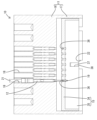
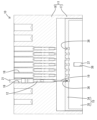
- FIG. 1 is a cross-sectional view of a connector according to a first embodiment.
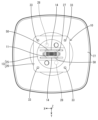
- FIG. 2 is a plan view of the connector of the first embodiment.
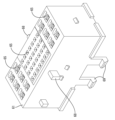
- FIG. 3 is a perspective view of a second housing in the connector of the first embodiment.
- FIG. 4 is a perspective view of a second holder in the connector of the first embodiment.
- FIG. 5 is an exploded perspective view of the movable support portion in the connector of the first embodiment.
- FIG. 6 is a perspective view of a first housing in the connector of the first embodiment.
- FIG. 7 is a perspective view of a first holder in the connector of the first embodiment.
- FIG. 8 is a perspective view of a moving plate in the connector of the first embodiment.
- FIG. 9 is a perspective view of a lever in the connector of the first embodiment.
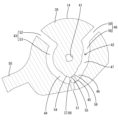
- FIG. 10 is a cross-sectional view showing a state in which the plate cam pin enters the assembly groove portion of the cam groove of the lever in the connector of the first embodiment.
- FIG. 11 is a cross-sectional view showing a state in which a plate cam pin is disposed in an inspection groove portion of a cam groove of a lever in the connector of the first embodiment.
- FIG. 12 is a cross-sectional view showing a state in which a plate cam pin is disposed in a protective groove portion of a cam groove of a lever in the connector of the first embodiment.
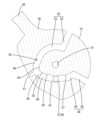
- FIG. 13 is a cross-sectional view showing a state in which a cam pin is disposed in a floating groove portion of a cam groove of a lever in the connector of the first embodiment.
- FIG. 14 is a cross-sectional view showing a state in which the cam pin is removed from the removal groove portion of the cam groove of the lever in the connector of the first embodiment.
- FIG. 15 is a cross-sectional view showing a state in which the tip of the tab protrudes from the plate body toward the opening of the hood portion when the plate cam pin is placed in the inspection groove in the connector of the first embodiment.
- FIG. 16 is a cross-sectional view showing a state in which the tip of the tab is protected by the plate body when the plate cam pin is disposed in the protective groove in the connector of the first embodiment.
- FIG. 17 is a cross-sectional view showing a state in which the first housing and the second housing are arranged in a mated state and the first terminal fittings and the second terminal fittings are electrically connected in the connector of the first embodiment.
- the connector of the present disclosure comprises: (1) A housing includes a first housing and a second housing that can be fitted together with each other, and a lever that is rotatably supported on the first housing, wherein the second housing has a housing cam pin, and the lever has a cam groove that receives the housing cam pin, and the cam groove forms an engagement groove portion in which the housing cam pin is positioned during the fitting process of the first housing and the second housing, and a removal groove portion in which the housing cam pin is positioned during the removal process of the first housing and the second housing, which are aligned in one direction in which the lever rotates.
- the lever continues to rotate in one direction from the fitting process to the removal process, so that the first housing and the second housing can be easily removed. Also, since the fitting groove does not need to have a track through which the cam pin passes during removal, the fitting groove can be easily provided.
- the removal groove portion is formed in succession with a removal cam groove portion that presses the housing cam pin to apply a removal force to the first housing and the second housing, and an extraction groove portion from which the housing cam pin is removed.
- the lever rotates with the housing cam pin engaged with the removal cam groove, thereby allowing the first and second housings to transition from a fitted state to a separated state. Furthermore, the housing cam pin can smoothly come out of the cam groove through the removal groove.
- the second housing is supported so as to be capable of floating relative to a support surface in a direction along the support surface and in a direction away from the support surface, and that the cam groove has a floating groove portion between the mating groove portion and the removal groove portion in the one direction, which allows the second housing to float.
- the housing cam pin By disposing the housing cam pin in the floating groove, both the floating state of the second housing and the mated state of the first and second housings can be realized. Also, the first and second housings can smoothly transition from the mated state to the disengaged state. Furthermore, since the floating groove does not need to have a track through which the housing cam pin passes during disengagement, the floating groove can be easily provided.
- the first housing can be lowered from above to be mated with the second housing, and that the lever is configured to automatically rotate while the housing cam pin is positioned in the mating groove portion. Since the worker does not need to rotate the lever during the process of fitting the first housing and the second housing, the workload can be reduced.
- the removal cam groove portion has a removal cam surface that presses the housing cam pin formed on an upper groove surface. Since the removal cam surface can press the housing cam pin downward, the second housing can be smoothly removed downward from the first housing.
- the lever has an operating portion that protrudes upward beyond the first housing while the housing cam pin is positioned in the removal groove portion.
- the connectors 10, 60 according to the first embodiment of the present disclosure exemplify a module that is disposed between an upper portion 100 (such as a body) and a lower portion 600 (such as a chassis) of a vehicle, and provides electrical connection between the upper portion 100 and the lower portion 600.
- the connectors include a first connector 10 disposed in the upper portion 100 and a second connector 60 disposed in the lower portion 600.
- the first connector 10 comprises a first housing 11, a first terminal fitting 12, a first holder 13, a lever 14, and a moving plate 15.
- the second connector 60 comprises a second housing 61, a second terminal fitting 62, a second holder 63, and a movable support portion 64.
- the first housing 11 and the second housing 61 can be fitted together.
- the front, right, and top are represented by the characters X, Y, and Z, respectively.
- the second housing 61 is made of synthetic resin and has a square block shape as shown in FIG. 3.
- the second housing 61 has a plurality of second cavities 65.
- the second terminal fittings 62 are made of conductive metal and are housed in the second cavities 65 as shown in FIG. 17.
- the second terminal fittings 62 are female terminals having cylindrical connecting portions 66 and are connected to the ends of electric wires 67.
- the second housing 61 has a pair of housing cam pins 68 protruding from the left and right end faces.
- Each housing cam pin 68 has a plate shape extending in the vertical direction and is disposed in a cam groove 42 of the lever 14, which will be described later.
- the second housing 61 also has a plurality of second locking portions 69 protruding downward and capable of being engaged with the second holder 63.
- the second holder 63 is made of synthetic resin and has a disk shape as a whole, as shown in FIG. 4.
- the second holder 63 has a second mounting hole 71 that penetrates in the vertical direction in the center.
- the second mounting hole 71 has an inner shape that corresponds to the outer shape of the second housing 61.
- the second housing 61 is inserted into the second mounting hole 71 and held therein.
- the second holder 63 has a pair of positioning holes 72 on both radial sides of the second mounting hole 71.
- Each positioning hole 72 has a circular cross section, penetrates a boss portion 73 that protrudes upward from the second holder 63, and penetrates the entire second holder 63 in the vertical direction.
- the second holder 63 has a curved surface portion 74 that has an arc-shaped cross section and bulges out all around the circumference in the lower half of the outer circumferential surface.
- the movable support part 64 supports the second holder 63 in a state in which it can move three-dimensionally. As shown in FIG. 1, the movable support part 64 has a support receiving part 75 that receives the second holder 63, a restricting part 76 that restricts the movable range of the support receiving part 75, and a seal member 77 that maintains a liquid-tight seal between the movable support part 64 and the second holder 63.
- the support receiving portion 75 has a cylindrical body receiving portion 78 that slidably supports the curved surface portion 74 of the second holder 63, and a plate portion 79 that is rectangular in plan view and protrudes radially outward from the lower end of the body receiving portion 78.
- the restricting portion 76 has a cover portion 81 that covers the plate portion 79 from above.
- the cover portion 81 is recessed in the underside of the restricting portion 76.
- the plate portion 79 comes into contact with the cover portion 81, thereby restricting the upward displacement of the support receiving portion 75.
- the support receiving portion 75 can move in the surface direction of the cover portion 81 (a direction perpendicular to the up-down direction).
- the seal member 77 is made of rubber such as silicone rubber, and is configured as, for example, a grommet. As shown in FIG. 1, the seal member 77 has an outer peripheral end 82 that tightly surrounds the outer periphery of the regulating portion 76, and an inner peripheral end 83 that tightly contacts the outer peripheral surface of the second holder 63 over the entire circumference. The seal member 77 extends upward from the outer peripheral end 82 to the inner peripheral end 83 while reducing in diameter.
- the seal member 77 is fixed to, for example, a support surface 601 in the lower portion 600 of the vehicle.
- the second holder 63 and the second housing 61 are capable of floating relative to the support surface 601 in the planar direction of the support surface 601 and in the vertical direction via the seal member 77.
- the first housing 11 is made of synthetic resin and has a terminal accommodating portion 16 in the shape of a square block and a square tubular hood portion 17 protruding downward from the terminal accommodating portion 16, as shown in Fig. 6.
- the terminal accommodating portion 16 has a plurality of first cavities 18.
- the first terminal fittings 12 are made of conductive metal and are accommodated in the first cavities 18, as shown in Fig. 15.
- the first terminal fittings 12 are male terminals and have tabs 19 protruding downward, which are connected to the ends of the electric wires 21. As shown in Fig. 17, when the first housing 11 and the second housing 61 are fitted together, the tabs 19 of the first terminal fittings 12 are inserted into the connecting portions 66 of the second terminal fittings 62 and connected.
- the hood portion 17 has through recesses 22 on both the left and right side walls.
- the through recesses 22 extend in the vertical direction and open to the opening edge at the lower end of the hood portion 17.
- Cam pins 37, 68 which will be described later, are passed through the through recesses 22.
- the hood portion 17 has a shaft portion 23 protruding above the through recesses 22 on the outer surfaces of both the left and right side walls.
- the first housing 11 has first locking portions 24 on the outer surfaces of both the front and rear side walls that can be engaged with the first holder 13.
- the first holder 13 is made of synthetic resin, and has a first mounting portion 25 having a circular outer shape and a flange portion 26 that projects radially outward from the lower end of the first mounting portion 25, as shown in FIG. 7.
- the first mounting portion 25 has a first mounting hole 27 that penetrates in the vertical direction.
- the first housing 11 is inserted into the first mounting hole 27 together with a pair of levers 14 supported by the first housing 11.
- the first locking portion 24 is engaged with the inner surface of the first mounting hole 27, so that the first housing 11 is held in the first mounting portion 25.
- each lever 14 is rotatably arranged in the first mounting hole 27 with a portion of it protruding upward from the first mounting hole 27.
- the first mounting portion 25 has a pair of positioning pins 28 on both radial sides of the first mounting hole 27.
- Each positioning pin 28 is rod-shaped with a circular cross section and protrudes downward from the first mounting portion 25.
- the tip of each positioning pin 28 is a tapered guide portion 29 that narrows in diameter toward the lower end.
- each positioning pin 28 is inserted into each positioning hole 72.
- the guide portion 29 of each positioning pin 28 comes into contact with the inner surface of each positioning hole 72, thereby adjusting the misalignment of the fitting axes of the first housing 11 and the second housing 61.
- the flange portion 26 has an annular ring mounting groove 31 on the underside.
- a rubber seal ring 32 is fitted in the ring mounting groove 31.
- the flange portion 26 has fixing holes 33 at positions closer to the four corners and outside the ring mounting groove 31.
- the first connector 10 is fixed to the upper part 100 of the vehicle by inserting a fixing member such as a bolt (not shown) into the fixing hole 33.
- the seal ring 32 is compressed between the upper part 100 and the flange 26 to maintain a liquid-tight seal.
- the moving plate 15 is made of synthetic resin and is arranged inside the hood portion 17 so as to be movable in the vertical direction, as shown in Figs. 15-17.
- the moving plate 15 has a rectangular plate-shaped plate body 34 and a square cylindrical peripheral wall 35 that protrudes downward from the outer end of the plate body 34.
- the plate body 34 has a number of terminal insertion holes 36 that penetrate in the plate thickness direction (vertical direction). The tip of the tab 19 of the first terminal fitting 12 penetrates each terminal insertion hole 36 in a positioned state, as shown in Fig. 15.
- the peripheral wall 35 has a pair of plate cam pins 37 protruding from the outer surfaces of the left and right side walls.
- Each plate cam pin 37 is cylindrical overall and faces the lower end of the left and right side walls.
- a mating recess 38 with a rectangular cross section is recessed into the lower surface of each plate body 34.
- the mating recess 38 also opens into the inner surface of the side wall of the peripheral wall 35.
- the lever 14 is made of synthetic resin and is rotatably supported by the shaft portion 23. As shown in FIG. 9, the lever 14 has a plate-shaped cam plate portion 39.
- the cam plate portion 39 has a bearing portion 41 that receives the shaft portion 23.
- the bearing portion 41 is formed to penetrate the center of the cam plate portion 39.
- the lever 14 is rotatable in one direction, for example, a clockwise direction (see the arrow direction in FIG. 11), around the shaft portion 23 that is fitted into the bearing portion 41.
- the levers 14 are individually supported by the shaft portions 23 on both the left and right sides of the first housing 11, and two levers 14 are provided in one first connector 10.
- the two levers 14 are configured to be the same shape and size as each other. When the first connector 10 is viewed from above, the two levers 14 can be rotated in opposite directions to each other (see FIGS. 1 and 2).
- the cam plate portion 39 has a cam groove 42 on the inner surface facing the side wall of the hood portion 17.
- the cam groove 42 is recessed into the inner surface of the cam plate portion 39 as shown in FIG. 9.
- the cam groove 42 has a main groove 49 that extends continuously in one direction around the bearing portion 41 on the inner surface of the cam plate portion 39 in the order of an assembly groove portion 43, an inspection groove portion 44, a protection groove portion 45, a fitting groove portion 46, a floating groove portion 47, and a removal groove portion 48.
- the cam groove 42 has a branch groove portion 51 that intersects and continues to the protection groove portion 45.
- the groove width of the main groove 49 is constant or nearly constant in one direction (extension direction) and is larger than the groove width of the branch groove portion 51.
- the groove width of the main groove 49 corresponds to the outer diameter dimension of the plate cam pin 37.
- the groove width of the branch groove portion 51 corresponds to the thickness of the housing cam pin 68.
- the housing cam pin 68 is inserted into the branch groove
- the branch groove portion 51 extends linearly in the radial direction. One end of the branch groove portion 51 opens to the outer peripheral surface of the cam plate portion 39. The other end of the branch groove portion 51 opens to the location where the protective groove portion 45 connects to the fitting groove portion 46. The depth of the branch groove portion 51 in the plate thickness direction is shallower than the depth of the main groove 49 in the plate thickness direction. The other end of the branch groove portion 51 connects to the main groove 49 in a stepped manner.
- the assembly groove 43 has an introduction groove 52 that extends linearly in the radial direction. One end of the introduction groove 52 opens to the outer circumferential surface of the cam plate 39.
- the assembly groove 43 has a connecting groove 53 that is connected to the other end of the introduction groove 52.
- the connecting groove 53 is formed along a concentric arc centered on the bearing 41.
- the connecting groove 53 is formed to the same depth in the plate thickness direction as the inspection groove 44, the protection groove 45, the fitting groove 46, the floating groove 47, and the removal groove 48.
- the other end of the introduction groove 52 is shallower in the plate thickness direction than the connecting groove 53 and is connected to the connecting groove 53 in a stepped manner.
- the plate cam pin 37 is introduced from the introduction groove 52 toward the connecting groove 53, as shown in FIG. 10.
- the inspection groove 44 has one end connected to the other end of the connecting groove 53 and extends to the side where the protective groove 45 is located.
- the inspection groove 44 has an inspection cam surface 54 on the groove surface on the side closer to the bearing 41, which increases the distance from the bearing 41 as it approaches the protective groove 45.
- the protective groove 45 has one end connected to the other end of the inspection groove 44 via a V-shaped intersection, and extends to the side where the fitting groove 46 is located.
- the protective groove 45 has a protective cam surface 55 on the groove surface on the side closer to the bearing 41, which reduces the distance from the bearing 41 as it approaches the fitting groove 46.
- the mating groove 46 has one end connected to the other end of the protective groove 45 and extends to the side where the floating groove 47 is located.
- the groove surface of the mating groove 46 is continuous with the groove surface of the protective groove 45 without any steps.
- the mating groove 46 has a mating cam surface 56 on the groove surface closer to the bearing 41, which reduces the distance from the bearing 41 as it approaches the floating groove 47.
- the floating groove 47 has one end connected to the other end of the fitting groove 46 and extends to the side where the removal groove 48 is located.
- the floating groove 47 is formed along a concentric arc centered on the bearing 41.
- the release groove 48 has a release cam groove 58, one end of which is connected to the other end of the floating groove 47 and extends in one direction in a curved manner, and a removal groove 59, which is connected to the other end of the release cam groove 58 and extends in a straight line around the outer circumferential surface of the cam plate 39.
- the removal cam groove portion 58 has a removal cam surface 57 on the groove surface closer to the bearing portion 41, which increases the distance from the bearing portion 41 as it approaches the removal groove portion 59.
- the removal cam surface 57 comes into contact with the cam pins 37, 68.
- the removal cam surface 57 presses against the cam pins 37, 68, causing the second housing 61 to be removed from the first housing 11.
- the cam pins 37, 68 come out downward from the removal groove portion 59, as shown in FIG. 14.
- the cam plate portion 39 has an operating portion 50 protruding from the side opposite the bearing portion 41 across the assembly groove portion 43.
- the operating portion 50 is in the form of a protruding piece that protrudes along the surface direction of the cam plate portion 39, and is formed in a size that allows the operator to operate it.
- the lever 14 is rotated in the other direction opposite to the one direction (counterclockwise in the illustrated example).
- the plate cam pin 37 is placed in the inspection groove 44 and pressed by the inspection cam surface 54, the plate body 34 moves upward from the protection position inside the hood portion 17 to the inspection position.
- the tip of the tab 19 of the first terminal fitting 12 protrudes downward from the plate body 34 (towards the opening of the hood portion 17).
- an inspection tool such as a probe pin is inserted into the inside of the hood portion 17 from below, and the inspection tool is able to come into contact with the tip of the tab 19, thereby performing a continuity inspection.
- the lever 14 is rotated in one direction and the plate body 34 is again placed in the protection position.
- the plate cam pin 37 is placed in the protective groove portion 45 and the mating recess 38 is placed facing the branch groove portion 51.
- the outer diameter dimension of the plate cam pin 37 is larger than the groove width of the branch groove portion 51.
- the amount of protrusion of the plate cam pin 37 into the cam groove 42 is larger than the depth of the branch groove portion 51. For this reason, the plate cam pin 37 will not mistakenly enter the branch groove portion 51.
- the upper part 100 is lowered relative to the lower part 600 of the vehicle, and the upper part 100 and the lower part 600 are held at a fixed distance from each other.
- the positioning pin 28 is inserted into the positioning hole 72 by the guide part 29 in a positioned state, and the first connector 10 arranged on the upper part 100 and the second connector 60 arranged on the lower part 600 are axially aligned.
- the second housing 61 of the second connector 60 enters the inside of the hood part 17, the housing cam pin 68 fits into the fitting recess 38 via the through recess 22, and the housing cam pin 68 and the plate cam pin 37 form an integrated cam pin 37, 68.
- the second housing 61 moves toward the rear of the hood portion 17.
- the moving plate 15 is also pressed by the second housing 61 and moves toward the rear of the hood portion 17 together with the second housing 61.
- the cam pins 37, 68 move along the mating cam surface 56 of the mating groove portion 46, and the lever 14 rotates in one direction. In other words, the lever 14 rotates automatically without the need to operate the operating portion 50, and the operating portion 50 is automatically displaced in one direction (upward).
- the second housing 61 is in a movable state relative to the support surface 601 of the lower portion 600 via the movable support portion 64.
- the second housing 61 can be in a floating state in which it moves upward from the support surface 601 while accompanying the elastic deformation of the seal member 77 within the regulating range of the regulating portion 76.
- the cam pins 37, 68 can contact the groove surface of the floating groove portion 47.
- the groove surface of the floating groove portion 47 is not a cam surface that can press the cam pins 37, 68 in the direction of attracting and separating the first housing 11 and the second housing 61. Therefore, when the cam pins 37, 68 are arranged on the groove surface of the floating groove portion 47, the mating state of the first housing 11 and the second housing 61 can be maintained while the floating of the second housing 61 is permitted.
- the first housing 11 When separating the first housing 11 and the second housing 61, the first housing 11 is unlocked from the first holder 13, and the lever 14 is rotated in one direction while grasping the operating part 50. In other words, a rotational force in one direction is applied to the lever 14 from the operating part 50.
- the operating part 50 protrudes independently from the surrounding area and above the first housing 11. This allows the operator to easily grasp the operating part 50.
- the detachment cam surface 57 presses the cam pins 37, 68, and the first housing 11 and the second housing 61 gradually move from the engaged state to the detached state. Specifically, the detachment cam surface 57 presses the cam pins 37, 68 downward, and the second housing 61 moves downward away from the first housing 11, and the floating state can be eliminated.
- the cam pins 37, 68 move from the other end of the detachment groove 48 to one end of the removal groove 59, the first housing 11 and the second housing 61 are detached, and the conductive state of the first terminal metal 12 and the second terminal metal 62 is released.
- the plate body 34 of the moving plate 15 returns to the protective position by the cam action of the detachment cam surface 57, and the tab 19 of the first terminal metal 12 is restored to a state in which it can be protected.
- first housing 11 and the second housing 61 are pulled apart from each other.
- the cam pins 37, 68 pass through the removal groove portion 59 and exit downward from the cam groove 42. This causes the first housing 11 and the second housing 61 to be completely pulled apart.
- the removal groove 48 successively forms a removal cam groove 58 that applies a removal force to the first housing 11 and the second housing 61 by pressing the cam pins 37, 68, including the housing cam pin 68, and a removal groove 59 from which the cam pins 37, 68 are removed. Therefore, by continuing to rotate the lever 14 in one direction, the cam pins 37, 68 can smoothly come out of the cam groove 42 via the removal groove 48.
- both the floating state of the second housing 61 and the mated state of the first housing 11 and the second housing 61 can be realized.
- the first housing 11 and the second housing 61 can smoothly transition from the mated state to the disengaged state.
- the floating groove 47 can be easily provided.
- the first housing 11 can be fitted into the second housing 61 by lowering from above, and the lever 14 is set to rotate automatically while the cam pins 37, 68 are positioned in the fitting groove portion 46. Therefore, during the fitting process of the first housing 11 and the second housing 61, the worker does not need to rotate the lever 14, which reduces the workload.
- the detachment cam surface 57 is formed on the upper groove surface of the detachment cam groove portion 58, the cam pins 37, 68 are pressed downward by the detachment cam surface 57, and the second housing 61 can be smoothly detached downward from the first housing 11.
- the operating part 50 which protrudes above the first housing 11, is operated, providing excellent operability.
- the plate cam pin 37 when the plate cam pin 37 is placed in the inspection groove 44, the plate body 34 reaches the inspection position, and the continuity of the first terminal metal fitting 12 can be inspected.
- the lever 14 rotates, the plate cam pin 37 moves from the protection groove 45 to the fitting groove 46, the first housing 11 and the second housing 61 are fitted, and the plate body 34 can reach the fitting position.
- the assembly groove 43, the inspection groove 44, the protection groove 45, and the fitting groove 46 are formed in succession, so that the plate cam pin 37 does not enter the assembly groove 43 when moving from the protection groove 45 to the fitting groove 46. Therefore, the plate cam pin 37 can move smoothly from the protection groove 45 to the fitting groove 46.
- the tab 19 is properly protected by the plate body 34 in the protection position.
- the plate cam pin 37 can be prevented from entering the branch groove portion 51 when the plate cam pin 37 moves from the protection groove portion 45 to the fitting groove portion 46.
- the cam pins 37, 68 which are the combination of the housing cam pin 68 and the plate cam pin 37, are arranged in the cam groove 42.
- the housing cam pin and the plate cam pin may simply be arranged side by side in the cam groove.
- a configuration in which only the housing cam pin is arranged in the cam groove may be used.
- the housing cam pin may be configured to come into contact with the release cam surface and be pressed by the release cam surface.
- the pair of levers 14 are supported separately from each other on the first housing 11.
- the first housing may be configured to support one lever having a pair of cam plate portions connected by a connecting portion.
- the first housing may be configured to support a lever consisting of only one cam plate portion.
- the cam groove 42 has the floating groove portion 47 between the fitting groove portion 46 and the removal groove portion 48.
- the cam groove does not have a floating groove portion, and the fitting groove portion and the removal groove portion may be formed continuously in this order.
Landscapes
- Details Of Connecting Devices For Male And Female Coupling (AREA)
Priority Applications (1)
| Application Number | Priority Date | Filing Date | Title |
|---|---|---|---|
| CN202480030115.7A CN121175886A (zh) | 2023-05-09 | 2024-05-07 | 连接器 |
Applications Claiming Priority (2)
| Application Number | Priority Date | Filing Date | Title |
|---|---|---|---|
| JP2023077249A JP2024162068A (ja) | 2023-05-09 | 2023-05-09 | コネクタ |
| JP2023-077249 | 2023-05-09 |
Publications (1)
| Publication Number | Publication Date |
|---|---|
| WO2024232355A1 true WO2024232355A1 (ja) | 2024-11-14 |
Family
ID=93430044
Family Applications (1)
| Application Number | Title | Priority Date | Filing Date |
|---|---|---|---|
| PCT/JP2024/016948 Ceased WO2024232355A1 (ja) | 2023-05-09 | 2024-05-07 | コネクタ |
Country Status (3)
| Country | Link |
|---|---|
| JP (1) | JP2024162068A (https=) |
| CN (1) | CN121175886A (https=) |
| WO (1) | WO2024232355A1 (https=) |
Citations (4)
| Publication number | Priority date | Publication date | Assignee | Title |
|---|---|---|---|---|
| JPH06333637A (ja) * | 1993-05-19 | 1994-12-02 | Yazaki Corp | レバー式コネクタ |
| JP2013054946A (ja) * | 2011-09-05 | 2013-03-21 | Auto Network Gijutsu Kenkyusho:Kk | 電気接続装置 |
| JP2014002864A (ja) * | 2012-06-15 | 2014-01-09 | Yazaki Corp | レバー式コネクタ |
| JP2019216065A (ja) * | 2018-06-14 | 2019-12-19 | 矢崎総業株式会社 | レバー式コネクタ |
-
2023
- 2023-05-09 JP JP2023077249A patent/JP2024162068A/ja active Pending
-
2024
- 2024-05-07 CN CN202480030115.7A patent/CN121175886A/zh active Pending
- 2024-05-07 WO PCT/JP2024/016948 patent/WO2024232355A1/ja not_active Ceased
Patent Citations (4)
| Publication number | Priority date | Publication date | Assignee | Title |
|---|---|---|---|---|
| JPH06333637A (ja) * | 1993-05-19 | 1994-12-02 | Yazaki Corp | レバー式コネクタ |
| JP2013054946A (ja) * | 2011-09-05 | 2013-03-21 | Auto Network Gijutsu Kenkyusho:Kk | 電気接続装置 |
| JP2014002864A (ja) * | 2012-06-15 | 2014-01-09 | Yazaki Corp | レバー式コネクタ |
| JP2019216065A (ja) * | 2018-06-14 | 2019-12-19 | 矢崎総業株式会社 | レバー式コネクタ |
Also Published As
| Publication number | Publication date |
|---|---|
| JP2024162068A (ja) | 2024-11-21 |
| CN121175886A (zh) | 2025-12-19 |
Similar Documents
| Publication | Publication Date | Title |
|---|---|---|
| JP5644657B2 (ja) | 車載用電気機器のシールカバー | |
| TWI387167B (zh) | L型同軸連接器 | |
| US7753690B2 (en) | L-shaped coaxial connector and the manufacturing method | |
| JP3562405B2 (ja) | レバー式コネクタ | |
| EP1557914B1 (en) | Coaxial Cable Connector | |
| EP2276122B1 (en) | Lever-type connector | |
| EP4075604A1 (en) | Connector and holding structure of electric wire with terminal | |
| US20150318639A1 (en) | Lever-type connector | |
| CN112018546B (zh) | 插座连接器及连接器组合 | |
| EP2597730A1 (en) | Waterproof connector and waterproof connector mounting structure and mounting method | |
| GB2425408A (en) | Connector assembly with lever to facilitate engagement and disengagement | |
| CN114665326A (zh) | 第一连接器、第二连接器以及连接器组合 | |
| EP4075606B1 (en) | Connector and holding structure of electric wire with terminal | |
| CN119447912A (zh) | 具有浮动配合接口的电连接器组件 | |
| CN115336116B (zh) | 连接器单元、线束以及连接器嵌合结构 | |
| WO2024232355A1 (ja) | コネクタ | |
| WO2024232354A1 (ja) | コネクタ | |
| JP7144480B2 (ja) | コネクタユニットおよびワイヤハーネス | |
| WO2020036152A1 (ja) | レバー式コネクタ | |
| US20240258743A1 (en) | Connector assembly | |
| EP4648232B1 (en) | Connector | |
| JP7406243B2 (ja) | 端子台 | |
| US20250023305A1 (en) | Coaxial plug connection for electrical connection of electrical or electronic components having an axial plug | |
| JP7161462B2 (ja) | 電気コネクタ | |
| US20250320942A1 (en) | Connection assembly having an installation connection device and a fit-on connection device |
Legal Events
| Date | Code | Title | Description |
|---|---|---|---|
| 121 | Ep: the epo has been informed by wipo that ep was designated in this application |
Ref document number: 24803466 Country of ref document: EP Kind code of ref document: A1 |
|
| NENP | Non-entry into the national phase |
Ref country code: DE |