WO2024232181A1 - 感放射線性組成物、レジストパターン形成方法及び重合体 - Google Patents
感放射線性組成物、レジストパターン形成方法及び重合体 Download PDFInfo
- Publication number
- WO2024232181A1 WO2024232181A1 PCT/JP2024/012734 JP2024012734W WO2024232181A1 WO 2024232181 A1 WO2024232181 A1 WO 2024232181A1 JP 2024012734 W JP2024012734 W JP 2024012734W WO 2024232181 A1 WO2024232181 A1 WO 2024232181A1
- Authority
- WO
- WIPO (PCT)
- Prior art keywords
- group
- structural unit
- radiation
- polymer
- bonded
- Prior art date
- Legal status (The legal status is an assumption and is not a legal conclusion. Google has not performed a legal analysis and makes no representation as to the accuracy of the status listed.)
- Ceased
Links
Classifications
-
- C—CHEMISTRY; METALLURGY
- C08—ORGANIC MACROMOLECULAR COMPOUNDS; THEIR PREPARATION OR CHEMICAL WORKING-UP; COMPOSITIONS BASED THEREON
- C08F—MACROMOLECULAR COMPOUNDS OBTAINED BY REACTIONS ONLY INVOLVING CARBON-TO-CARBON UNSATURATED BONDS
- C08F212/00—Copolymers of compounds having one or more unsaturated aliphatic radicals, each having only one carbon-to-carbon double bond, and at least one being terminated by an aromatic carbocyclic ring
- C08F212/02—Monomers containing only one unsaturated aliphatic radical
- C08F212/04—Monomers containing only one unsaturated aliphatic radical containing one ring
- C08F212/14—Monomers containing only one unsaturated aliphatic radical containing one ring substituted by heteroatoms or groups containing heteroatoms
-
- C—CHEMISTRY; METALLURGY
- C08—ORGANIC MACROMOLECULAR COMPOUNDS; THEIR PREPARATION OR CHEMICAL WORKING-UP; COMPOSITIONS BASED THEREON
- C08F—MACROMOLECULAR COMPOUNDS OBTAINED BY REACTIONS ONLY INVOLVING CARBON-TO-CARBON UNSATURATED BONDS
- C08F220/00—Copolymers of compounds having one or more unsaturated aliphatic radicals, each having only one carbon-to-carbon double bond, and only one being terminated by only one carboxyl radical or a salt, anhydride ester, amide, imide or nitrile thereof
- C08F220/02—Monocarboxylic acids having less than ten carbon atoms; Derivatives thereof
- C08F220/10—Esters
- C08F220/26—Esters containing oxygen in addition to the carboxy oxygen
- C08F220/30—Esters containing oxygen in addition to the carboxy oxygen containing aromatic rings in the alcohol moiety
-
- G—PHYSICS
- G03—PHOTOGRAPHY; CINEMATOGRAPHY; ANALOGOUS TECHNIQUES USING WAVES OTHER THAN OPTICAL WAVES; ELECTROGRAPHY; HOLOGRAPHY
- G03F—PHOTOMECHANICAL PRODUCTION OF TEXTURED OR PATTERNED SURFACES, e.g. FOR PRINTING, FOR PROCESSING OF SEMICONDUCTOR DEVICES; MATERIALS THEREFOR; ORIGINALS THEREFOR; APPARATUS SPECIALLY ADAPTED THEREFOR
- G03F7/00—Photomechanical, e.g. photolithographic, production of textured or patterned surfaces, e.g. printing surfaces; Materials therefor, e.g. comprising photoresists; Apparatus specially adapted therefor
- G03F7/004—Photosensitive materials
-
- G—PHYSICS
- G03—PHOTOGRAPHY; CINEMATOGRAPHY; ANALOGOUS TECHNIQUES USING WAVES OTHER THAN OPTICAL WAVES; ELECTROGRAPHY; HOLOGRAPHY
- G03F—PHOTOMECHANICAL PRODUCTION OF TEXTURED OR PATTERNED SURFACES, e.g. FOR PRINTING, FOR PROCESSING OF SEMICONDUCTOR DEVICES; MATERIALS THEREFOR; ORIGINALS THEREFOR; APPARATUS SPECIALLY ADAPTED THEREFOR
- G03F7/00—Photomechanical, e.g. photolithographic, production of textured or patterned surfaces, e.g. printing surfaces; Materials therefor, e.g. comprising photoresists; Apparatus specially adapted therefor
- G03F7/004—Photosensitive materials
- G03F7/039—Macromolecular compounds which are photodegradable, e.g. positive electron resists
-
- G—PHYSICS
- G03—PHOTOGRAPHY; CINEMATOGRAPHY; ANALOGOUS TECHNIQUES USING WAVES OTHER THAN OPTICAL WAVES; ELECTROGRAPHY; HOLOGRAPHY
- G03F—PHOTOMECHANICAL PRODUCTION OF TEXTURED OR PATTERNED SURFACES, e.g. FOR PRINTING, FOR PROCESSING OF SEMICONDUCTOR DEVICES; MATERIALS THEREFOR; ORIGINALS THEREFOR; APPARATUS SPECIALLY ADAPTED THEREFOR
- G03F7/00—Photomechanical, e.g. photolithographic, production of textured or patterned surfaces, e.g. printing surfaces; Materials therefor, e.g. comprising photoresists; Apparatus specially adapted therefor
- G03F7/004—Photosensitive materials
- G03F7/039—Macromolecular compounds which are photodegradable, e.g. positive electron resists
- G03F7/0392—Macromolecular compounds which are photodegradable, e.g. positive electron resists the macromolecular compound being present in a chemically amplified positive photoresist composition
-
- G—PHYSICS
- G03—PHOTOGRAPHY; CINEMATOGRAPHY; ANALOGOUS TECHNIQUES USING WAVES OTHER THAN OPTICAL WAVES; ELECTROGRAPHY; HOLOGRAPHY
- G03F—PHOTOMECHANICAL PRODUCTION OF TEXTURED OR PATTERNED SURFACES, e.g. FOR PRINTING, FOR PROCESSING OF SEMICONDUCTOR DEVICES; MATERIALS THEREFOR; ORIGINALS THEREFOR; APPARATUS SPECIALLY ADAPTED THEREFOR
- G03F7/00—Photomechanical, e.g. photolithographic, production of textured or patterned surfaces, e.g. printing surfaces; Materials therefor, e.g. comprising photoresists; Apparatus specially adapted therefor
- G03F7/20—Exposure; Apparatus therefor
-
- H—ELECTRICITY
- H10—SEMICONDUCTOR DEVICES; ELECTRIC SOLID-STATE DEVICES NOT OTHERWISE PROVIDED FOR
- H10P—GENERIC PROCESSES OR APPARATUS FOR THE MANUFACTURE OR TREATMENT OF DEVICES COVERED BY CLASS H10
- H10P76/00—Manufacture or treatment of masks on semiconductor bodies, e.g. by lithography or photolithography
- H10P76/20—Manufacture or treatment of masks on semiconductor bodies, e.g. by lithography or photolithography of masks comprising organic materials
Definitions
- a radiation-sensitive composition is irradiated with far ultraviolet light (such as an ArF excimer laser), extreme ultraviolet light (EUV), electron beams, etc. to generate acid in the exposed areas, and a chemical reaction involving this acid creates a difference in the dissolution rate in the developer between the exposed and unexposed areas, forming a resist pattern on the substrate.
- far ultraviolet light such as an ArF excimer laser
- EUV extreme ultraviolet light
- electron beams etc.
- Patent Document 1 discloses that a resist composition contains a salt consisting of a sulfonate anion having a benzene ring to which a halogen atom such as an iodine atom is bonded, and a cation.
- resist patterns become finer, slight differences in process conditions such as exposure conditions and development conditions are more likely to affect the shape of the resist pattern and the occurrence of defects. Therefore, radiation-sensitive compositions used in forming resist patterns are required to have a wide margin of error that can absorb slight differences in process conditions, i.e., a wide range of process conditions (hereinafter also referred to as the "process window") that can form a pattern without bridge defects or collapse during the resist pattern formation process.
- process window a wide range of process conditions
- the present disclosure has been made in consideration of the above problems, and its purpose is to provide a radiation-sensitive composition that has high sensitivity yet good lithography performance, a wide process window, and suppresses the occurrence of development defects, and a method for forming a resist pattern using the radiation-sensitive composition.
- the present disclosure provides a radiation-sensitive composition that contains a polymer (A) that contains a structural unit (U1) having an acid-dissociable group and has a carboxy group, and a radiation-sensitive acid generator (B) (excluding the polymer (A)), in which one or more compounds selected from the group consisting of the polymer (A) and the radiation-sensitive acid generator (B) have an iodine group, the polymer (A) contains a structural unit (U2) that has a carboxy group, and the carboxy group in the structural unit (U2) is bonded to a carbon atom that constitutes the main chain of the polymer (A), the structural unit (U2) has a chain structure and a carboxy group is bonded to the chain structure, or the structural unit (U2) has an aromatic ring that is bonded to a carbon atom that constitutes the main chain of the polymer (A), and a carboxy group is bonded to the aromatic ring.
- a radiation-sensitive composition comprising a polymer (A) which includes a structural unit (U1) having an acid dissociable group and has a carboxy group, and a radiation-sensitive acid generator (B) (excluding the polymer (A)), wherein one or more compounds selected from the group consisting of the polymer (A) and the radiation-sensitive acid generator (B) have an iodine group, the polymer (A) includes a structural unit (U2) having a carboxy group, and which satisfies at least one of the following requirements (a) and (b): Requirement (a): The structural unit (U1) has an iodine group. Requirement (b): the polymer (A) further contains a structural unit (U3) different from the structural unit (U1) and the structural unit (U2), and the structural unit (U3) has an iodine group.
- a radiation-sensitive composition comprising a polymer (A) that contains a structural unit (U1) having an acid-dissociable group and has a carboxy group, and a radiation-sensitive acid generator (B) (excluding the polymer (A)), in which one or more compounds selected from the group consisting of the polymer (A) and the radiation-sensitive acid generator (B) have an iodine group, the radiation-sensitive acid generator (B) contains an onium salt compound composed of an organic anion and a cation, and one or both of the organic anion and the cation of the onium salt compound have a structure in which an iodine group is bonded to an aromatic ring.
- the present disclosure provides a method for forming a resist pattern, comprising the steps of forming a resist film on a substrate using the radiation-sensitive composition, exposing the resist film to light, and developing the exposed resist film.
- a polymer including a structural unit represented by the following formula (2A) and a structural unit having an acid-dissociable group:
- R 1 , R 2 and R 3 are each independently a hydrogen atom, a fluorine atom, a methyl group or a trifluoromethyl group.
- Y 2 is a halogen atom or a monovalent hydrocarbon group having 1 to 10 carbon atoms.
- r is an integer of 1 or more.
- s is an integer of 0 or more.
- m is an integer of 1 or more.
- t is 0 or 1, provided that 2 ⁇ (r+s+m) ⁇ (2 ⁇ t+5) is satisfied.
- the radiation-sensitive composition of the present disclosure can provide a radiation-sensitive composition that is highly sensitive yet has good lithography performance, a wide process window, and suppresses the occurrence of development defects. Furthermore, the resist pattern forming method of the present disclosure uses the radiation-sensitive composition of the present disclosure, and thus can form a resist pattern with a good shape with a small amount of exposure light. Furthermore, the resist pattern forming method of the present disclosure can suppress the occurrence of development defects, has a wide process window, and is excellent in productivity.
- a “structural unit” refers to a unit that mainly constitutes the main chain structure, and is a unit that is contained in at least two units in the main chain structure.
- the radiation-sensitive composition of the present disclosure includes a polymer (hereinafter referred to as “polymer (A”)) that includes a structural unit (U1) having an acid-dissociable group and has a carboxy group.
- the composition further contains, as an optional component, a polymer (A) and a radiation-sensitive acid generator (B).
- the composition may contain one or more different compounds. Unless otherwise specified, each component may be used alone or in combination of two or more.
- hydrocarbon group includes linear hydrocarbon groups, alicyclic hydrocarbon groups, and aromatic hydrocarbon groups.
- linear hydrocarbon group refers to linear and branched hydrocarbon groups that do not contain a cyclic structure and are composed only of a linear structure. However, the linear hydrocarbon group may be saturated or unsaturated.
- alicyclic hydrocarbon group refers to a hydrocarbon group that contains only an alicyclic hydrocarbon structure as a ring structure and does not contain an aromatic ring structure. However, the alicyclic hydrocarbon group does not have to be composed only of an alicyclic hydrocarbon structure and includes those that have a linear structure as part of it.
- aromatic hydrocarbon group refers to a hydrocarbon group that contains an aromatic ring structure as a ring structure. However, the aromatic hydrocarbon group does not have to be composed only of an aromatic ring structure and may contain a linear structure or an alicyclic hydrocarbon structure as part of it.
- aromatic ring group refers to an n-valent group obtained by removing n hydrogen atoms (where n is an integer of 1 or more) from the ring portion of a substituted or unsubstituted aromatic ring.
- Alicyclic group refers to an n-valent group formed by removing n hydrogen atoms (where n is an integer of 1 or more) from the ring portion of a substituted or unsubstituted aliphatic ring.
- Organic group refers to an atomic group formed by removing any hydrogen atom from a compound containing carbon (i.e., an organic compound).
- Aromaatic ring is intended to include aromatic hydrocarbon rings and aromatic heterocycles.
- substituted or unsubstituted p-valent hydrocarbon group (where p is an integer of 1 or more) includes p-valent hydrocarbon groups (i.e., unsubstituted p-valent hydrocarbon groups) and groups in which p hydrogen atoms have been removed from the hydrocarbon structural portion of a substituted hydrocarbon group.
- fluoroalkyl groups are “substituted monovalent hydrocarbon groups” and fluoroalkanediyl groups are “substituted divalent hydrocarbon groups.” The same applies to other groups to which "substituted or unsubstituted” is added.
- (Meth)acrylate is a term that includes “acrylate” and “methacrylate.”
- One or more compounds selected from the group consisting of a polymer (A) and a radiation-sensitive acid generator (B) contained in the present composition have an iodine group ("*-I", where "*" represents a bond).
- the present composition includes the following first, second and third aspects. ⁇ First aspect> The polymer (A) contains a structural unit (U2) having a carboxy group.
- the carboxy group in the structural unit (U2) is bonded to a carbon atom constituting the main chain of the polymer (A), the structural unit (U2) has a chain structure and a carboxy group is bonded to the chain structure, or the structural unit (U2) has an aromatic ring bonded to a carbon atom constituting the main chain of the polymer (A) and a carboxy group is bonded to the aromatic ring.
- the polymer (A) contains a structural unit (U2) having a carboxy group, and further satisfies at least one of the following requirements (a) and (b): Requirement (a):
- the structural unit (U1) has an iodine group.
- the polymer (A) further contains a structural unit (U3) different from the structural unit (U1) and the structural unit (U2), and the structural unit (U3) has an iodine group.
- the radiation-sensitive acid generator (B) contains an onium salt compound composed of an organic anion and a cation, and one or both of the organic anion and the cation of the onium salt compound have a structure in which an iodine group is bonded to an aromatic ring.
- the polymer (A) contains a structural unit (U1) having an acid dissociable group.
- the acid dissociable group is a group that replaces a hydrogen atom of an acid group such as a carboxy group or a hydroxyl group, and is a group that dissociates under the action of an acid.
- the acid dissociable group in the structural unit (U1) is dissociated by the acid generated by exposure of the composition to light to generate an acid group, and the solubility of the polymer (A) in the developer changes. This can impart good lithography performance to the composition.
- the polymer (A) may have a carboxy group at the polymer terminal or at the polymer side chain.
- the polymer (A) may also have a carboxy group at both the polymer terminal and the polymer side chain. From the viewpoint of fully obtaining the effect of improving various properties of the radiation-sensitive composition, such as the lithography performance, the expansion of the process window, and the suppression of development defects, by introducing a carboxy group into the polymer (A), it is preferable that the polymer (A) contains a structural unit having a carboxy group (hereinafter also referred to as "structural unit (U2)").
- the "main chain” of a polymer refers to the "trunk” portion of the polymer that is made up of the longest chain of atoms. It is permissible for this "trunk” portion to contain a ring structure.
- the “side chain” of a polymer refers to the portion that branches off from the “trunk” of the polymer.
- the polymer (A) may further contain a structural unit (hereinafter also referred to as "structural unit (U3)") different from the structural unit (U1) and the structural unit (U2).
- the structural unit (U3) may be any unit that does not fall into either the structural unit (U1) or the structural unit (U2).
- Examples of the structural unit (U3) include a structural unit having a hydroxyl group bonded to an aromatic ring (hereinafter also referred to as “structural unit (U3-1)”); a structural unit having an onium salt structure (hereinafter also referred to as “structural unit (U3-2)”); a structural unit having a lactone structure, a cyclic carbonate structure, a sultone structure, or a ring structure combining two or more of these (hereinafter also referred to as “structural unit (U3-3)”); a structural unit having an alcoholic hydroxyl group (hereinafter also referred to as “structural unit (U3-4)”); and the like.
- the radiation-sensitive acid generator (B) is a compound that generates an acid upon exposure to light.
- the radiation-sensitive acid generator (B) preferably has an onium salt structure consisting of a radiation-sensitive cation and an organic anion.
- the radiation-sensitive acid generator (B) may be a low molecular weight compound consisting of a radiation-sensitive cation and an organic anion, or may be a polymer containing a structural unit having an onium salt structure.
- the molecular weight of the radiation-sensitive acid generator (B) is preferably 1,000 or less, more preferably 800 or less, and even more preferably 600 or less.
- the radiation-sensitive acid generator (B) is a compound different from the polymer (A) and does not contain the structural unit (U1). That is, among the polymers containing a structural unit having an onium salt structure, the polymer containing the structural unit (U1) is classified as the polymer (A), and the polymer not containing the structural unit (U1) is classified as the radiation-sensitive acid generator (B).
- the radiation-sensitive acid generator (B) When the radiation-sensitive acid generator (B) has an onium salt structure consisting of a radiation-sensitive cation and an organic anion, the radiation-sensitive acid generator (B) liberates an organic anion by decomposing the radiation-sensitive cation due to the action of radiation. This liberated anion bonds with hydrogen extracted from a component contained in the composition (e.g., the radiation-sensitive acid generator itself or a solvent), generating an acid derived from the organic anion.
- “radiation” includes electron beams (visible light, ultraviolet light, far ultraviolet light, extreme ultraviolet light (EUV), etc.) and electromagnetic waves (X-rays, gamma rays, etc.).
- the radiation-sensitive acid generator (B) may be a radiation-sensitive acid generator or an acid diffusion controller.
- the composition may contain only one of a radiation-sensitive acid generator and an acid diffusion controller as the radiation-sensitive acid generator (B), or may contain both a radiation-sensitive acid generator and an acid diffusion controller.
- a radiation-sensitive acid generator is a compound that generates a strong acid that induces dissociation of an acid-dissociable group under normal conditions upon exposure.
- the "normal conditions” referred to here refer to conditions in which post-exposure baking (PEB) is performed at 110°C for 60 seconds.
- the "acid diffusion controller” is a component that can suppress chemical reactions caused by acid in unexposed areas by suppressing the diffusion of acid generated in the resist film upon exposure of the composition within the resist film.
- an acid diffusion controller in the composition, the lithography performance (LWR performance and CDU performance) of the composition can be further improved.
- changes in the line width of the resist pattern caused by fluctuations in the delay time from exposure to development processing can be suppressed, and a radiation-sensitive composition with excellent process stability can be obtained.
- the acid diffusion control agent a compound having an onium salt structure that generates an acid with a lower acidity than the acid generated by the radiation-sensitive acid generator (hereinafter also referred to as a "photodegradable base”) is preferably used.
- the level of acidity can be evaluated by the acid dissociation constant (pKa).
- the acid dissociation constant of the acid generated by the acid diffusion control agent is usually -3 or more, preferably -1 ⁇ pKa ⁇ 7, and more preferably 0 ⁇ pKa ⁇ 5.
- the acid generated by the acid diffusion control agent is typically a weak acid that does not induce dissociation of the acid dissociable group under the above-mentioned normal conditions.
- the present composition preferably contains a radiation-sensitive acid generator (B) together with the polymer (A), so that the acid generated upon irradiation with radiation causes the acid-dissociable group to be eliminated to generate an acid group, thereby changing the solubility of the polymer (A) in the developer.
- the polymer (A) may contain a structural unit that functions as a radiation-sensitive acid generator (more specifically, a structural unit that generates a strong acid upon irradiation with radiation), and may contain a radiation-sensitive acid generator as the radiation-sensitive acid generator (B).
- the present composition contains a structural unit in the polymer (A) that functions as an acid diffusion controller (more specifically, a structural unit that generates a weak acid upon irradiation with radiation) or contains an acid diffusion controller as the radiation-sensitive acid generator (B).
- the radiation-sensitive acid generator corresponds to the "first radiation-sensitive acid generator”
- the acid diffusion controller corresponds to the "second radiation-sensitive acid generator” that generates an acid with a weaker acidity than the first radiation-sensitive acid generator.
- the number of iodine groups in one molecule of one or more compounds having an iodine group selected from the group consisting of a polymer (A) and a radiation-sensitive acid generator (B) may be one or more.
- the iodine group-containing compound preferably has two or more iodine groups in one molecule.
- the polymer preferably contains a structural unit having an iodine group, and it is more preferable that a monomer that gives a structural unit having an iodine group has two or more iodine groups in one molecule.
- the bonding position of the iodine group in the iodine group-containing compound is not particularly limited.
- the iodine group-containing compound preferably has an aromatic ring and has a structure in which the iodine group is bonded to the aromatic ring.
- the number of iodine groups bonded to the aromatic ring in the iodine group-containing compound is, for example, 1 to 5.
- the number of iodine groups bonded to the aromatic ring in the iodine group-containing compound is preferably two or more.
- the two or more iodine groups may be bonded to the same aromatic ring in the iodine group-containing compound or may be bonded to different aromatic rings.
- the aromatic ring to which the iodine group is bonded is preferably a benzene ring or a naphthalene ring, and more preferably a benzene ring.
- the embodiment in which one or more compounds selected from the group consisting of the polymer (A) and the radiation-sensitive acid generator (B) have an iodine group is not particularly limited.
- only one of the polymer (A) and the radiation-sensitive acid generator (B) may have an iodine group, or both the polymer (A) and the radiation-sensitive acid generator (B) may have an iodine group.
- the polymer (A) may contain a polymer that includes the structural unit (U1) and has an iodine group and a carboxy group (hereinafter also referred to as "iodine group-containing polymer (A1)").
- the polymer (A) may further contain a polymer that includes the structural unit (U1), has a carboxy group, and does not have an iodine group.
- the radiation-sensitive acid generator (B) may also contain a compound having an onium salt structure with an iodine group (hereinafter also referred to as "iodine group-containing acid generator (B1)").
- the radiation-sensitive acid generator (B) may further contain a compound having an onium salt structure without an iodine group.
- the polymer (A) contained in the present composition may contain an iodine group-containing polymer (A1), and the radiation-sensitive acid generator (B) may contain an iodine group-containing acid generator (B1).
- the iodine group-containing polymer (A1) preferably contains a structural unit having an iodine group, from the viewpoint of fully obtaining the effect of improving the sensitivity of the composition and the effect of improving the lithography performance.
- any structural unit among the structural units constituting the iodine group-containing polymer (A1) may have an iodine group, and two or more structural units may have an iodine group.
- the structural unit (U1) when the iodine group-containing polymer (A1) contains a structural unit (U1) and a structural unit (U2), the structural unit (U1) may have an iodine group, and the structural unit (U2) may have an iodine group.
- the structural unit (U1) and the structural unit (U2) in the iodine group-containing polymer (A1) may have an iodine group. That is, when the iodine group-containing polymer (A1) contains the structural unit (U1) and the structural unit (U2), the iodine group-containing polymer (A1) may be such that at least one selected from the group consisting of the structural unit (U1) and the structural unit (U2) has an iodine group.
- the structural unit (U3) in the iodine group-containing polymer (A1) may have an iodine group.
- the structural unit (U3) has an iodine group
- any of the structural units (U3) in the iodine group-containing polymer (A1) may have an iodine group.
- at least one structural unit selected from the group consisting of the structural unit (U3-1), the structural unit (U3-2), the structural unit (U3-3) and the structural unit (U3-4) may have an iodine group.
- the structural unit (U3) in the iodine group-containing polymer (A1) has an iodine group (i.e., when the requirement (b) is satisfied), from the viewpoint of sufficiently increasing the sensitivity of the present composition, it is preferable that at least one structural unit selected from the group consisting of the structural unit (U3-1) and the structural unit (U3-2) has an iodine group.
- the iodine group-containing polymer (A1) preferably has at least one iodine group selected from the group consisting of structural units (U1), (U2), (U3-1) and (U3-2), more preferably has at least one iodine group selected from the group consisting of structural units (U1) and (U3-2), and even more preferably contains a structural unit (U1) having an iodine group (i.e., satisfies requirement (a)).
- the iodine group-containing acid generator (B1) may be a radiation-sensitive acid generator or an acid diffusion controller.
- the composition may contain a radiation-sensitive acid generator and an acid diffusion controller as the iodine group-containing acid generator (B1).
- the iodine group-containing acid generator (B1) may be a low molecular weight compound (typically an onium salt consisting of a radiation-sensitive cation and an organic anion) or a polymer containing a structural unit having an onium salt structure.
- the composition may contain one or both of a radiation-sensitive acid generator and an acid diffusion controller as a low molecular weight compound classified as an iodine group-containing acid generator (B1), and may contain one or both of a radiation-sensitive acid generator and an acid diffusion controller as a polymer classified as an iodine group-containing acid generator (B1).
- a radiation-sensitive acid generator and an acid diffusion controller as a low molecular weight compound classified as an iodine group-containing acid generator (B1)
- the iodine group-containing acid generator (B1) is a low molecular weight compound, its molecular weight is preferably 1,000 or less, more preferably 800 or less, and even more preferably 600 or less.
- the iodine-containing acid generator (B1) may have an iodine group in either or both of the cation portion and the organic anion portion that constitute the onium salt structure. That is, the iodine-containing acid generator (B1) may have an iodine group in either the cation portion that constitutes the onium salt structure, the organic anion portion that constitutes the onium salt structure, or both the cation portion and the organic anion portion that constitutes the onium salt structure.
- the iodine-containing acid generator (B1) When the cationic moiety in the iodine-containing acid generator (B1) has an aromatic ring to which an iodine group is bonded, the sensitivity of the composition can be further improved, and a radiation-sensitive composition with superior lithography performance can be obtained, which is preferable.
- the iodine-containing acid generator (B1) is a low molecular weight compound, the number of iodine groups per molecule of the iodine-containing acid generator (B1) may be 1 or more, and 1 to 8 is more preferable.
- the iodine-containing acid generator (B1) When the iodine-containing acid generator (B1) is a polymer, the number of iodine groups per molecule of the monomer that gives the structural unit having an onium salt structure may be 1 or more, and 1 to 8 is more preferable.
- Specific embodiments of the present composition containing an iodine group-containing compound include the following [1] to [7] and combinations of two or more of these.
- the present composition contains an iodine group-containing polymer (A1), the iodine group-containing polymer (A1) contains a structural unit (U3), and the structural unit (U3) has an iodine group.
- the present composition contains an iodine group-containing acid generator (B1), and the iodine group-containing acid generator (B1) contains a low molecular weight compound as a radiation-sensitive acid generator.
- the present composition contains an iodine group-containing acid generator (B1), and the iodine group-containing acid generator (B1) contains a polymer as a radiation-sensitive acid generator.
- composition contains an iodine group-containing acid generator (B1), and the iodine group-containing acid generator (B1) contains a low molecular weight compound as an acid diffusion controller.
- present composition contains an iodine group-containing acid generator (B1), and the iodine group-containing acid generator (B1) contains a polymer as an acid diffusion controller.
- [1] and [3] to [6] are preferred in that they have higher sensitivity, improved lithography performance, wider process window, and greater defect suppression effects.
- the iodine group-containing polymer (A1) preferably contains structural units having iodine groups in an amount of 2 mol% or more, more preferably 5 mol% or more, and even more preferably 10 mol% or more, based on the total structural units constituting the iodine group-containing polymer (A1).
- the content of structural units having iodine groups is preferably 90 mol% or less, more preferably 75 mol% or less, and even more preferably 65 mol% or less, based on the total structural units constituting the iodine group-containing polymer (A1).
- composition contains a polymer as the iodine group-containing acid generator (B1)
- content of the structural unit having an iodine group contained in the polymer is the same as that described for the iodine group-containing polymer (A1).
- the present composition can improve the lithography performance while increasing the sensitivity of the radiation-sensitive composition and further suppress the occurrence of development defects is unclear, but the following is thought to be the case.
- iodine-containing compounds have high sensitivity to radiation, they tend to be highly hydrophobic due to the presence of iodine atoms. Therefore, when an iodine-containing compound is added to a radiation-sensitive composition, it is expected that the sensitivity can be increased, but the solubility in the developer is reduced, and development defects are likely to occur.
- the structural unit (U1) is preferably a group that generates a carboxyl group or a hydroxyl group by elimination of an acid dissociable group by an acid generated in the present composition upon exposure to light.
- Examples of the structural unit (U1) include a structural unit represented by the following formula (i-1) (hereinafter also referred to as “structural unit (I-1)”), a structural unit represented by the following formula (i-2) (hereinafter also referred to as “structural unit (I-2)”), and a structural unit represented by the following formula (i-3) (hereinafter also referred to as "structural unit (I-3)”).
- R 12 is a hydrogen atom, a fluorine atom, a methyl group, or a trifluoromethyl group.
- R 13 is a hydrogen atom or a substituted or unsubstituted monovalent hydrocarbon group having 1 to 20 carbon atoms.
- R 14 and R 15 are each independently a substituted or unsubstituted monovalent hydrocarbon group or aromatic heterocyclic group having 1 to 20 carbon atoms, or R 14 and R 15 taken together represent an alicyclic hydrocarbon structure having 3 to 20 carbon atoms together with the carbon atoms to which R 14 and R 15 are bonded.
- R 13 is a hydrogen atom
- R 14 and R 15 are each independently a substituted or unsubstituted monovalent unsaturated hydrocarbon group, a substituted or unsubstituted aromatic heterocyclic group, or R 14 and R 15 taken together represent an unsaturated alicyclic hydrocarbon structure having 3 to 20 carbon atoms together with the carbon atoms to which R 14 and R 15 are bonded.
- R 16 is a hydrogen atom, a fluorine atom, a methyl group or a trifluoromethyl group.
- L 3 is a single bond, -O-, -CO-, * 2 -COO- or * 2 -CONH-. "* 2 " represents a bond to the main chain.
- R 17 , R 18 and R 19 are each independently a hydrogen atom, a substituted or unsubstituted monovalent hydrocarbon group having 1 to 20 carbon atoms, or a substituted or unsubstituted monovalent oxyhydrocarbon group having 1 to 20 carbon atoms.
- R 35 is a monovalent substituent.
- g1 is an integer of 0 to 4.
- R 31 is a hydrogen atom, a fluorine atom, a methyl group, or a trifluoromethyl group.
- L 4 is a single bond, -O-, -CO-, * 3 -COO-, or * 3 -CONH-. "* 3 " represents a bond to the main chain.
- R 32 is a hydrogen atom, a substituted or unsubstituted monovalent hydrocarbon group having 1 to 20 carbon atoms, or a substituted or unsubstituted monovalent oxyhydrocarbon group having 1 to 20 carbon atoms.
- R 33 and R 34 are each independently a hydrogen atom, a substituted or unsubstituted monovalent hydrocarbon group having 1 to 20 carbon atoms, or a substituted or unsubstituted monovalent oxyhydrocarbon group having 1 to 20 carbon atoms, or R 33 and R 34 taken together represent an alicyclic hydrocarbon structure having 3 to 20 carbon atoms formed together with the carbon atom to which R 33 and R 34 are bonded.
- R 36 is a monovalent substituent.
- g2 is an integer from 0 to 4.
- R 12 is preferably a hydrogen atom or a methyl group, more preferably a methyl group, from the viewpoint of copolymerizability of the monomer that gives the structural unit (I-1).
- R 16 is preferably a hydrogen atom, from the viewpoint of copolymerizability of the monomer that gives the structural unit (I-2).
- R 31 in the above formula (i-3) is preferably a hydrogen atom or a methyl group.
- L 3 in the above formula (i-2) or L 4 in the above formula (i-3) is preferably a single bond, -COO- or -CONH-.
- Examples of the monovalent hydrocarbon group having 1 to 20 carbon atoms represented by R 13 to R 15 , R 17 to R 19 or R 32 to R 34 include a monovalent chain hydrocarbon group having 1 to 20 carbon atoms, a monovalent alicyclic hydrocarbon group having 3 to 20 carbon atoms, and a monovalent aromatic hydrocarbon group having 6 to 20 carbon atoms.
- Examples of the monovalent chain hydrocarbon group having 1 to 20 carbon atoms include alkyl groups such as methyl, ethyl, n-propyl, i-propyl, n-butyl, and t-butyl; alkenyl groups such as ethenyl, propenyl, and butenyl; and alkynyl groups such as ethynyl, propynyl, and butynyl.
- the monovalent chain hydrocarbon group having 1 to 20 carbon atoms represented by R 13 to R 15 , R 17 to R 19 , or R 32 to R 34 is preferably an alkyl group, more preferably an alkyl group having 1 to 4 carbon atoms.
- Examples of monovalent alicyclic hydrocarbon groups having 3 to 20 carbon atoms include monovalent monocyclic alicyclic saturated hydrocarbon groups such as cyclopentyl, cyclohexyl, methylcyclopentyl, ethylcyclopentyl, methylcyclohexyl, and ethylcyclohexyl groups; monovalent monocyclic unsaturated hydrocarbon groups such as cyclopentenyl, cyclohexenyl, methylcyclopentenyl, and methylcyclohexenyl groups; monovalent polycyclic alicyclic saturated hydrocarbon groups such as norbornyl, adamantyl, and tricyclodecyl groups; and monovalent polycyclic unsaturated alicyclic hydrocarbon groups such as norbornenyl, tricyclodecenyl, and indanyl groups.
- monovalent monocyclic alicyclic saturated hydrocarbon groups such as cyclopentyl, cyclohexyl, methylcyclopen
- Examples of monovalent aromatic hydrocarbon groups having 6 to 20 carbon atoms include aryl groups such as phenyl, tolyl, xylyl, mesityl, naphthyl, methylnaphthyl, anthryl, methylanthryl, and indenyl; and aralkyl groups such as benzyl, phenethyl, naphthylmethyl, and anthrylmethyl.
- Examples of the monovalent unsaturated hydrocarbon group represented by R 13 or R 14 include the above-mentioned monocyclic or polycyclic alicyclic unsaturated hydrocarbon group and aromatic hydrocarbon group.
- Examples of the monovalent aromatic heterocyclic group include a furyl group and a thienyl group.
- Examples of the alicyclic hydrocarbon structure having 3 to 20 carbon atoms formed by combining R 14 and R 15 together with the carbon atoms to which R 14 and R 15 are bonded, and the alicyclic hydrocarbon structure having 3 to 20 carbon atoms formed by combining R 33 and R 34 together with the carbon atoms to which R 33 and R 34 are bonded include monocyclic saturated alicyclic hydrocarbon structures such as a cyclopropane structure, cyclobutane structure, cyclopentane structure, cyclohexane structure, cycloheptane structure, and cyclooctane structure; monocyclic unsaturated alicyclic hydrocarbon structures such as cyclopentene and cyclohexene; and polycyclic alicyclic hydrocarbon structures such as a norbornane structure, adamantane structure, tricyclodecane structure, and tetracyclododecane structure.
- monocyclic saturated alicyclic hydrocarbon structures such as a
- Examples of the monovalent oxyhydrocarbon group having 1 to 20 carbon atoms represented by R 17 to R 19 or R 32 to R 34 include groups containing an oxygen atom at the bond-side terminal of the above-mentioned examples of the monovalent hydrocarbon group having 1 to 20 carbon atoms represented by R 13 to R 15 , R 17 to R 19 , and R 32 to R 34.
- the monovalent oxyhydrocarbon group represented by R 17 to R 19 or R 32 to R 34 is preferably an alkoxy group, a cycloalkoxy group, or a cycloalkylalkoxy group.
- substituents include a halogen atom (a fluorine atom, a chlorine atom, a bromine atom, an iodine atom, etc.), a hydroxyl group, an alkoxy group having 1 to 3 carbon atoms, etc.
- halogen atom a fluorine atom, a chlorine atom, a bromine atom, an iodine atom, etc.
- hydroxyl group an alkoxy group having 1 to 3 carbon atoms, etc.
- Examples of the monovalent substituent represented by R 35 or R 36 include an alkyl group having 1 to 3 carbon atoms, an alkoxy group having 1 to 3 carbon atoms, a halogen atom (e.g., a fluorine atom, a chlorine atom, a bromine atom, an iodine atom), a hydroxyl group, etc.
- g1 and g2 are preferably 0 to 2, and more preferably 0 or 1.
- structural unit (I-1) include structural units represented by the following formulas: (In the formula, R 12 is a hydrogen atom, a fluorine atom, a methyl group, or a trifluoromethyl group.)
- structural unit (I-2) include structural units represented by the following formulas: (In the formula, R 16 is a hydrogen atom, a fluorine atom, a methyl group, or a trifluoromethyl group.)
- structural unit (I-3) include structural units represented by the following formulas: (In the formula, R 31 is a hydrogen atom, a fluorine atom, a methyl group, or a trifluoromethyl group.)
- the content of the structural unit (U1) in the polymer (A) is preferably 20 mol% or more, more preferably 25 mol% or more, and even more preferably 30 mol% or more, based on all structural units constituting the polymer (A).
- the content of the structural unit (U1) is preferably 80 mol% or less, more preferably 75 mol% or less, and even more preferably 70 mol% or less, based on all structural units constituting the polymer (A).
- the polymer (A) may contain a structural unit having an acid dissociable group and a hydroxyl group bonded to an aromatic ring.
- a structural unit having an acid dissociable group and a hydroxyl group bonded to an aromatic ring is classified as a structural unit (U1).
- the sensitivity of the composition can be further increased and the process window can be further widened, which is preferable.
- the structural unit (U2) has a carboxy group.
- Specific examples of the structural unit (U2) include a structural unit represented by the following formula (1).
- R 1 and R 2 are each independently a hydrogen atom, a fluorine atom, a methyl group, or a trifluoromethyl group.
- X 1 is a single bond, * 1 -COO-, * 1 -CONH-, or a divalent aromatic ring group.
- "* 1 " represents a bond to the main chain.
- a 1 is a single bond or a (r+1)-valent aromatic ring group
- R 3 is a hydrogen atom, a fluorine atom, a methyl group, or a trifluoromethyl group
- a 1 and R 3 taken together represent a ring structure formed together with the carbon atom on the main chain side to which A 1 is bonded and the carbon atom to which R 3 is bonded.
- a R1 is a substituted or unsubstituted (r+1)-valent hydrocarbon group, or a substituted or unsubstituted hydrocarbon group in which a methylene group is replaced with -O-, -S-, -CO-, -COO-, -NH-, or -CONH-, and R3 is a hydrogen atom, a fluorine atom, a methyl group, or a trifluoromethyl group.
- r is an integer of 1 or more.
- R 1 and R 2 are preferably a hydrogen atom or a methyl group from the viewpoint of copolymerizability of the monomer that gives the structural unit (U2).
- X 1 is a divalent aromatic ring group
- examples of the divalent aromatic ring group include groups in which two hydrogen atoms have been removed from a benzene ring or a naphthalene ring.
- examples of the aromatic ring group include groups in which (r+1) hydrogen atoms have been removed from a benzene ring or a naphthalene ring.
- substituents include an alkyl group having 1 to 3 carbon atoms, an alkoxy group having 1 to 3 carbon atoms, a hydroxyl group, a halogen atom (e.g., a fluorine atom, a chlorine atom, a bromine atom, an iodine atom), and the like.
- substituents include an alkyl group having 1 to 3 carbon atoms, an alkoxy group having 1 to 3 carbon atoms, a hydroxyl group, a halogen atom (e.g., a fluorine atom, a chlorine atom, a bromine atom, an iodine atom), and the like.
- examples of the ring structure include a ring structure derived from a cycloolefin (e.g., norbornene, tetracyclododecene, etc.), a ring structure derived from acenaphthylene, and a ring structure derived from indene.
- a cycloolefin e.g., norbornene, tetracyclododecene, etc.
- a ring structure derived from acenaphthylene e.g., norbornene, tetracyclododecene, etc.
- hydrocarbon group examples include a (r+1)-valent chain hydrocarbon group having 1 to 20 carbon atoms, a (r+1)-valent alicyclic hydrocarbon group having 3 to 20 carbon atoms, and a (r+1)-valent aromatic hydrocarbon group having 6 to 20 carbon atoms.
- specific examples of these include groups in which r hydrogen atoms have been further removed from the groups exemplified as the monovalent hydrocarbon groups having 1 to 20 carbon atoms of R 13 to R 15 , R 17 to R 19, and R 32 to R 34 above.
- a 1 may be a (r+1)-valent group in which a methylene group in a substituted or unsubstituted hydrocarbon group is replaced with -O-, -S-, -CO-, -COO-, -NH- or -CONH-.
- a 1 preferably contains -O-, -S-, -CO-, -COO-, -NH- or -CONH- between carbon-carbon bonds in the substituted or unsubstituted chain hydrocarbon group.
- chain hydrocarbon group examples include groups in which r hydrogen atoms have been further removed from the groups exemplified as the monovalent chain hydrocarbon groups having 1 to 20 carbon atoms for R 13 to R 15 , R 17 to R 19 and R 32 to R 34 above.
- r is, for example, an integer from 1 to 5. From the viewpoint of increasing the difference in dissolution rate in a developer between exposed and unexposed areas and improving the pattern shape of the resist film, r is preferably 1 to 3, and more preferably 1 or 2.
- the carboxy group in the structural unit (U2) may be bonded to a carbon atom constituting the main chain of the polymer (A) or may be bonded to a chain structure in the side chain portion.
- the structural unit (U2) may have an aromatic ring, and the carboxy group may be bonded to the aromatic ring.
- Further specific examples of the structural unit represented by the above formula (1) include structural units represented by the following formula (1-1), formula (1-2) or formula (1-3).
- R 1 and R 2 are each independently a hydrogen atom, a fluorine atom, a methyl group, or a trifluoromethyl group.
- X 2 is a single bond, * 4 -COO-, or * 4 -CONH-.
- a 2 is a (r+1)-valent aromatic ring group.
- R 3 is a hydrogen atom, a fluorine atom, a methyl group, or a trifluoromethyl group.
- r is an integer of 1 or more.
- R 1 and R 2 are each independently a hydrogen atom, a fluorine atom, a methyl group, or a trifluoromethyl group.
- X 3 is a single bond, * 5 -COO-, * 5 -CONH-, or a divalent aromatic ring group.
- "* 5 " represents a bond to the main chain. When X 3 is a single bond, A 3 is a single bond.
- a 3 is a substituted or unsubstituted (r+1)-valent chain hydrocarbon group, or a substituted or unsubstituted chain hydrocarbon group in which a methylene group is replaced with -O-, -S-, -CO-, -COO-, -NH-, or -CONH-, and a (r+1)-valent group.
- the carboxy group in formula (1-2) is bonded to the chain hydrocarbon group in A 3 .
- R3 is a hydrogen atom, a fluorine atom, a methyl group or a trifluoromethyl group, and r is an integer of 1 or more.
- r is an integer of 1 or more.
- Y3 is a hydroxyl group, a halogen atom, a monovalent hydrocarbon group having 1 to 10 carbon atoms, or a monovalent oxyhydrocarbon group having 1 to 10 carbon atoms.
- k is an integer from 0 to (6-r).
- the carboxy group in the structural unit (U2) is bonded to an aromatic ring. Also, from the viewpoint of LWR, it is preferable that the carboxy group in the structural unit (U2) is bonded to a carbon atom constituting the main chain of the polymer or to a chain structure.
- the structural unit (U2) is preferably represented by the following formula (1a).
- R 1 , R 2 , X 1 and r are each defined as in formula (1).
- X 1 is a single bond
- a 1a is a single bond or a (r+1)-valent aromatic ring group
- R 3 is a hydrogen atom, a fluorine atom, a methyl group or a trifluoromethyl group
- a 1a and R 3 taken together represent a ring structure constituted with the carbon atom on the main chain side to which A 1a is bonded and the carbon atom to which R 3 is bonded.
- a 1a is a substituted or unsubstituted (r+1)-valent hydrocarbon group, or a (r+1)-valent group in which a methylene group in a substituted or unsubstituted hydrocarbon group is replaced with -O-, -S-, -CO-, -COO-, -NH- or -CONH-, and has a chain structure to which a carboxy group is bonded, and R 3 is a hydrogen atom, a fluorine atom, a methyl group or a trifluoromethyl group.
- the structural unit (U2) When the carboxy group in the structural unit (U2) is bonded to an aromatic ring, it is preferable that the structural unit (U2) has an aromatic ring bonded to a carbon atom in the main chain and has a partial structure in which a carboxy group is bonded to the aromatic ring.
- Preferred examples of the structural unit (U2) when the carboxy group in the structural unit (U2) is bonded to an aromatic ring include a structural unit represented by the following formula (1-1a) and a structural unit represented by the following formula (1-3). Among these, a structural unit represented by the following formula (2) is preferable.
- X 2a is a single bond.
- R 1 , R 2 , R 3 , A 2 , Y 3 , r and k are each as defined in the above formulas (1-1) and (1-3), respectively.
- R 1 , R 2 and R 3 are each defined as in formula (1-1).
- Y 1 is a hydroxyl group, a halogen atom, a monovalent hydrocarbon group having 1 to 10 carbon atoms or a monovalent oxyhydrocarbon group having 1 to 10 carbon atoms.
- r is an integer of 1 or more.
- u is an integer of 0 or more.
- t is 0 or 1, provided that 1 ⁇ (r+u) ⁇ (2 ⁇ t+5) is satisfied.
- Y1 when Y1 is a halogen atom, examples of the halogen atom include a fluorine atom, a chlorine atom, a bromine atom, and an iodine atom.
- Y1 when Y1 is a monovalent hydrocarbon group having 1 to 10 carbon atoms, the hydrocarbon group is preferably a chain hydrocarbon group, and more preferably an alkyl group.
- the explanation of the above formula (1) applies to R1 , R2 , R3 , and r.
- the polymer (A) may contain a structural unit having a carboxy group and a hydroxyl group bonded to an aromatic ring.
- the structural unit having a carboxy group and a hydroxyl group bonded to an aromatic ring is classified as a structural unit (U2).
- a preferred specific example of the structural unit having a carboxy group and a hydroxyl group bonded to an aromatic ring is the structural unit represented by the following formula (2A).
- R 1 , R 2 and R 3 are each independently a hydrogen atom, a fluorine atom, a methyl group or a trifluoromethyl group.
- Y 2 is a halogen atom, a monovalent hydrocarbon group having 1 to 10 carbon atoms or a monovalent oxyhydrocarbon group having 1 to 10 carbon atoms.
- r is an integer of 1 or more.
- s is an integer of 0 or more.
- m is an integer of 1 or more.
- t is 0 or 1, provided that 2 ⁇ (r+s+m) ⁇ (2 ⁇ t+5) is satisfied.
- m is preferably 1 to 3, and more preferably 1 or 2.
- s is preferably 0 to 2, and more preferably 0 or 1.
- the explanation for the above formula (1) applies to R 1 , R 2 , R 3 and r.
- R 40 is a hydrogen atom, a fluorine atom, a methyl group, or a trifluoromethyl group.
- the bonding positions and the positional relationship of the carboxy group and the iodine group bonded to the same aromatic ring in the structural unit (U2) are not particularly limited.
- the iodine group bonded to the same aromatic ring as the carboxy group may be bonded to a carbon adjacent to the carbon to which the carboxy group is bonded, or may be bonded to a carbon further adjacent to the carbon to which the carboxy group is bonded.
- the aromatic ring to which the carboxy group and the iodine group are bonded is a benzene ring
- the position of the iodine group bonded to the aromatic ring may be any of the ortho, meta, and para positions relative to the carboxy group.
- it is preferable that the iodine group bonded to the same aromatic ring as the carboxy group is bonded to a carbon other than the carbon adjacent to the carbon to which the carboxy group is bonded, and it is more preferable that the iodine group is bonded to a carbon further adjacent to the carbon to which the carboxy group is bonded.
- the content of structural unit (U2) in polymer (A) is preferably 1 mol % or more, more preferably 2 mol % or more, and even more preferably 5 mol % or more, based on all structural units constituting polymer (A).
- the content of structural unit (U2) is preferably 30 mol % or less, more preferably 25 mol % or less, based on all structural units constituting polymer (A).
- the structural unit (U3-1) is a structural unit having an aromatic ring and a hydroxyl group bonded to the aromatic ring (excluding those corresponding to the structural unit (U1) and the structural unit (U2)).
- the polymer (A) having a hydroxyl group bonded to an aromatic ring is preferable in that the lithography performance such as LWR performance and CDU (critical dimension uniformity) performance of the present composition can be further improved, and the effect of suppressing dissolution of unexposed areas into a developer can be highly suppressed, and development defects can be sufficiently reduced.
- a polymer having a hydroxyl group bonded to an aromatic ring can be preferably applied in pattern formation using exposure to radiation having a wavelength of 50 nm or less, such as an electron beam or EUV.
- Examples of the aromatic ring to which the hydroxyl group is bonded include a benzene ring, a naphthalene ring, an anthracene ring, and a phenanthrene ring. Of these, a benzene ring or a naphthalene ring is preferred, and a benzene ring is more preferred.
- the number of hydroxyl groups bonded to the aromatic ring is preferably 1 to 3, and more preferably 1 or 2.
- the position of the hydroxyl group in the benzene ring may be any of the ortho, meta, and para positions relative to other groups.
- the aromatic ring to which the hydroxyl group is bonded may further have a substituent bonded thereto that is different from any of the hydroxyl group, carboxyl group, and group having an acid-dissociable group.
- substituents include alkyl groups having 1 to 5 carbon atoms, alkoxy groups having 1 to 5 carbon atoms, and halogen atoms (e.g., fluorine atoms, chlorine atoms, bromine atoms, and iodine atoms).
- the structural unit (U3-1) include a structural unit represented by the following formula (iii).
- R 11 is a hydrogen atom, a fluoro group, a methyl group, or a trifluoromethyl group.
- L 2 is a single bond, -O-, -CO-, * 6 -COO-, or * 6 -CONH-.
- “* 6 " represents a bond to the main chain.
- Y 4 is a monovalent group having a hydroxyl group bonded to an aromatic ring. However, Y 4 does not have a carboxy group, a group having an acid-dissociable group, or both.
- R 11 is preferably a hydrogen atom or a methyl group from the viewpoint of copolymerizability of the monomer that gives the structural unit (U3-1).
- L 2 is preferably a single bond or * 6 -COO-, and is more preferably a single bond in that the sensitivity of the present composition can be further increased.
- Y 4 is preferably a group in which one hydrogen atom has been removed from the ring portion of an aromatic ring to which a hydroxyl group is bonded (i.e., a monovalent aromatic ring group substituted with a hydroxyl group).
- the aromatic ring in Y 4 may further have a substituent different from a hydroxyl group. Specific examples of the substituent are as described above.
- R 11 is a hydrogen atom, a fluoro group, a methyl group, or a trifluoromethyl group.
- the content of the structural unit (U3-1) is preferably 5 mol% or more, more preferably 10 mol% or more, even more preferably 15 mol% or more, and even more preferably 20 mol% or more, based on all the structural units constituting the polymer (A).
- the content of the structural unit (U3-1) is preferably 80 mol% or less, more preferably 75 mol% or less, and even more preferably 70 mol% or less, based on all the structural units constituting the polymer (A).
- the present composition may contain a polymer containing the structural unit (U3-1) in addition to the polymer containing the structural unit (U1). From the viewpoint of obtaining a radiation-sensitive composition having excellent lithography performance (LWR performance, CDU performance, etc.) and development defect suppression properties, the present composition preferably contains, as the polymer (A), a polymer having the structural unit (U1) and the structural unit (U3-1) in the same molecule.
- the structural unit (U3-2) is a structural unit having an onium salt structure (excluding those corresponding to the structural unit (U1), the structural unit (U2) and the structural unit (U3-1)).
- the structural unit (U3-2) may have a partial structure in which an iodine group is bonded to an aromatic ring (preferably a benzene ring).
- the number of iodine groups bonded to the aromatic ring is, for example, 1 to 5.
- the structural unit (U3-2) has an iodine group
- the iodine group may be contained in the radiation-sensitive onium cation moiety constituting the onium salt structure, in the organic anion moiety, or in both of them.
- the structural unit (U3-2) is typically a structural unit derived from an onium salt compound having a group that participates in polymerization. By including such a structural unit in the polymer (A), the lithography performance can be further improved.
- the structural unit (U3-2) include a structural unit represented by the following formula (iv-1), a structural unit represented by the following formula (iv-2), and a structural unit represented by the following formula (iv-3).
- R 20 is a hydrogen atom, a fluorine atom, a methyl group, or a trifluoromethyl group.
- L 5 is -O-, *-COO-, or a divalent aromatic ring group.
- "*" represents a bond to the main chain.
- R 23 is a substituted or unsubstituted alkanediyl group having 1 to 6 carbon atoms, a substituted or unsubstituted alkenediyl group having 2 to 6 carbon atoms, or a substituted or unsubstituted arylene group having 6 to 12 carbon atoms.
- R 21 and R 22 are each independently a substituted or unsubstituted alkyl group having 1 to 12 carbon atoms, a substituted or unsubstituted alkenyl group having 2 to 12 carbon atoms, or a substituted or unsubstituted aryl group having 6 to 20 carbon atoms.
- J - is a monovalent organic anion.
- R 20 is a hydrogen atom, a fluorine atom, a methyl group, or a trifluoromethyl group.
- L 6 is -O-, *-COO-, or a divalent aromatic ring group.
- "*" represents a bond to the main chain.
- R 26 is a single bond or a divalent organic group having 1 to 40 carbon atoms.
- R 24 and R 25 are each independently a hydrogen atom, a fluorine atom, an alkyl group having 1 to 10 carbon atoms, or a fluoroalkyl group having 1 to 10 carbon atoms.
- Y + is a monovalent radiation-sensitive cation.
- R 20 is a hydrogen atom, a fluorine atom, a methyl group, or a trifluoromethyl group.
- L 7 is -O-, *-COO-, or a divalent aromatic ring group. "*" represents a bond to the main chain.
- R 27 is a divalent organic group having 1 to 40 carbon atoms.
- Y + is a monovalent radiation-sensitive cation.
- examples of the substituent include a fluorine atom, a chlorine atom, a bromine atom, an iodine atom, an alkoxy group, a cycloalkyloxy group, an ester group, an alkylsulfonyl group, a cycloalkylsulfonyl group, a hydroxyl group, a cyano group, a nitro group, an acetyl group, a fluoroacetyl group, an alkoxycarbonyl group, an alkoxycarbonyloxy group, and an oxo group.
- the divalent organic group represented by R 26 or R 27 may be a group having a chain structure (hereinafter also referred to as a "chain organic group”), or may be a group having a cyclic structure (hereinafter also referred to as a "cyclic organic group").
- examples of the chain organic group include linear or branched saturated hydrocarbon groups having 1 to 40 carbon atoms, linear or branched unsaturated hydrocarbon groups having 1 to 40 carbon atoms, monovalent groups having 2 to 40 carbon atoms having a (thio)ether group or an ester group between the carbon-carbon bonds of the linear or branched hydrocarbon group, and monovalent groups having 1 to 40 carbon atoms in which any hydrogen atom in the monovalent group or linear or branched hydrocarbon group has been substituted.
- examples of the cyclic structure contained in R 26 or R 27 include an alicyclic hydrocarbon structure having 3 to 20 carbon atoms, an aliphatic heterocyclic structure having 3 to 20 carbon atoms, and an aromatic ring structure having 6 to 20 carbon atoms. These cyclic structures may have a substituent.
- Examples of alicyclic hydrocarbon structures having 3 to 20 carbon atoms include alicyclic monocyclic hydrocarbon structures having 3 to 20 carbon atoms and alicyclic polycyclic hydrocarbon structures having 6 to 20 carbon atoms.
- the alicyclic monocyclic hydrocarbon structures having 3 to 20 carbon atoms and the alicyclic polycyclic hydrocarbon structures having 6 to 20 carbon atoms may be either saturated or unsaturated.
- the alicyclic polycyclic structures may be any of bridged structures, condensed ring structures, and spiro ring structures.
- Examples of the rings contained in the alicyclic monocyclic hydrocarbon structure include cyclopentane, cyclohexane, cycloheptane, cyclooctane, cyclopentene, cyclohexene, cycloheptene, cyclooctene, cyclodecene, etc.
- the alicyclic polycyclic hydrocarbon structure is preferably a bridged alicyclic saturated hydrocarbon structure or a condensed alicyclic saturated hydrocarbon structure, such as a bicyclo[2.2.1]heptane structure, a bicyclo[2.2.2]octane structure, a tricyclo[3.3.1.1 3,7 ]decane structure, a steroid structure, etc.
- Examples of the aliphatic heterocyclic structure having 3 to 20 carbon atoms include a cyclic ether structure, a lactone structure, a cyclic acetal structure, a cyclic carbonate structure, and a sultone structure.
- the aliphatic heterocyclic structure may be either a monocyclic structure or a polycyclic structure.
- the polycyclic structure may be either a bridged structure, a condensed ring structure, or a spiro ring structure.
- the aliphatic heterocyclic structure having 3 to 20 carbon atoms represented by R 26 or R 27 may be a combination of two or more of a bridged structure, a condensed ring structure, and a spiro ring structure.
- the two or more rings constituting the spiro ring structure may be only aliphatic heterocyclic rings, or may be a combination of an aliphatic heterocyclic ring and an alicyclic hydrocarbon ring.
- Examples of the ring contained in the aromatic ring structure having 6 to 20 carbon atoms include a benzene ring, a naphthalene ring, an anthracene ring, an indene ring, and a fluorene ring.
- R 26 or R 27 is a divalent cyclic organic group, R 26 or R 27 may have a chain structure in addition to the cyclic structure.
- the radiation-sensitive cation (Y + ) in the above formulae (iv-2) and (iv-3) preferably has a triarylsulfonium cationic structure or a diaryliodonium cationic structure.
- the radiation-sensitive cation (Y + ) has a triarylsulfonium cationic structure or a diaryliodonium cationic structure, and that an iodo group, a fluoro group, or a fluoroalkyl group is bonded to an aromatic ring (i.e., an aromatic ring bonded to S + or I + ) in the triarylsulfonium cationic structure or diaryliodonium cationic structure.
- the fluoroalkyl group is preferably a trifluoromethyl group.
- Examples of the organic anion (J ⁇ ) in the above formula (iv-1) include a sulfonate anion, an imide anion, a methyl anion, and a carboxylate anion.
- the organic anion (J ⁇ ) is preferably a sulfonate anion, an imide anion, or a carboxylate anion.
- the organic anion (J ⁇ ) preferably has a structure in which an iodine group is bonded to an aromatic ring.
- one or more of L 5 , R 21 , R 22 , R 23 and J ⁇ in the above formula (iv-1) have an iodine group.
- one or more of L 6 , R 26 and Y + in the above formula (iv-2) have an iodine group
- one or more of L 7 , R 27 and Y + in the above formula (iv-3) have an iodine group.
- R 20 is a hydrogen atom, a fluorine atom, a methyl group or a trifluoromethyl group.
- Y + is a monovalent radiation-sensitive cation.
- J ⁇ is a monovalent organic anion.
- the content of structural unit (U3-2) is preferably 1 mol % or more, and more preferably 3 mol % or more, based on all structural units constituting polymer (A). Furthermore, the content of structural unit (U3-2) is preferably 30 mol % or less, and more preferably 20 mol % or less, based on all structural units constituting polymer (A). By setting the content of structural unit (U3-2) within the above range, the lithography performance of this composition can be further improved.
- the structural unit (U3-3) is a structural unit having a lactone structure, a cyclic carbonate structure or a sultone structure, or a ring structure that is a combination of two or more of these (however, excluding those corresponding to the structural unit (U1), the structural unit (U2), the structural unit (U3-1), and the structural unit (U3-2)).
- R L1 is a hydrogen atom, a fluorine atom, a methyl group, or a trifluoromethyl group.
- the content of structural unit (U3-3) is preferably 1 mol% or more, and more preferably 3 mol% or more, based on all structural units constituting polymer (A).
- the content of structural unit (U3-3) is preferably 30 mol% or less, and more preferably 20 mol% or less, and even more preferably 15 mol% or less, based on all structural units constituting polymer (A).
- the structural unit (U3-4) may further have a structural unit having an alcoholic hydroxyl group (excluding those corresponding to the structural unit (U1), the structural unit (U2), the structural unit (U3-1), the structural unit (U3-2) and the structural unit (U3-3)).
- an "alcoholic hydroxyl group” refers to a group having a structure in which a hydroxyl group is directly bonded to an aliphatic hydrocarbon group.
- the aliphatic hydrocarbon group may be a chain hydrocarbon group or an alicyclic hydrocarbon group.
- the structural unit (U3-4) is preferably a structural unit derived from an unsaturated monomer having an alcoholic hydroxyl group.
- the structure of the unsaturated monomer that gives the structural unit (U3-4) is not particularly limited.
- Specific examples of the structural unit (U3-4) include structural units represented by the following formula: (In the formula, R A is a hydrogen atom, a fluorine atom, a methyl group, or a trifluoromethyl group.)
- the content of structural unit (U3-4) is preferably 1 mol % or more, and more preferably 3 mol % or more, based on all structural units constituting polymer (A). Also, the content of structural unit (U3-4) is preferably 30 mol % or less, and more preferably 20 mol % or less, based on all structural units constituting polymer (A).
- the structural unit (U3) includes, in addition to the structural units (U3-1) to (U3-4), structural units containing a cyano group, a nitro group, or a sulfonamide group (specifically, a structural unit derived from 2-cyanomethyladamantan-2-yl (meth)acrylate, etc.), structural units containing a non-acid-dissociable hydrocarbon group (specifically, a structural unit derived from substituted or unsubstituted styrene (e.g., a styrene unit, an iodostyrene unit, etc.), a structural unit derived from vinylnaphthalene, a structural unit derived from n-pentyl (meth)acrylate, etc.), a structural unit having a fluorine atom and different from the structural units (U3-1) to (U3-4), etc.
- the content ratio of these structural units can be appropriately set according to each structural unit within a range that does not imp
- the content of the polymer (A) is preferably 50% by mass or more, more preferably 70% by mass or more, and even more preferably 85% by mass or more, based on the total amount of solids contained in the composition.
- the content of the polymer (A) is preferably 99% by mass or less, more preferably 98% by mass or less, and even more preferably 95% by mass or less, based on the total amount of solids contained in the composition.
- the polymer (A) preferably constitutes the base resin of the present composition.
- the term "base resin” refers to a polymer component that accounts for 50% by mass or more of the total amount of solids contained in the composition.
- the polymer (A) constituting the base resin may be one type or two or more types.
- the total content of the two or more types of polymers is 50% by mass or more, based on the total amount of solids contained in the composition.
- the weight average molecular weight (Mw) of polymer (A) in terms of polystyrene by gel permeation chromatography (GPC) is preferably 1,000 or more, more preferably 2,000 or more, even more preferably 3,000 or more, and even more preferably 4,000 or more.
- Mw is preferably 50,000 or less, more preferably 30,000 or less, even more preferably 20,000 or less, and even more preferably 15,000 or less.
- the ratio (Mw/Mn) of Mw to the number average molecular weight (Mn) of the polymer (A) calculated as polystyrene by GPC is preferably 5.0 or less, more preferably 3.0 or less, and even more preferably 2.0 or less.
- Mw/Mn is usually 1.0 or more, and preferably 1.1 or more.
- the polymer (A) can be synthesized, for example, by polymerizing the monomers that give each structural unit in an appropriate solvent using a known radical polymerization initiator.
- radical polymerization initiators include azo radical initiators (e.g., azobisisobutyronitrile (AIBN), 2,2'-azobis(4-methoxy-2,4-dimethylvaleronitrile), etc.), peroxide radical initiators (e.g., benzoyl peroxide, etc.).
- a compound having a carboxy group can be used as the polymerization initiator to polymerize monomers including a monomer that gives the structural unit (U1), thereby obtaining a polymer having a carboxy group at the polymerization terminal as the polymer (A).
- Solvents used in the polymerization include linear alkanes, cycloalkanes, aromatic hydrocarbons, halogenated hydrocarbons, saturated carboxylic acid esters, ketones, ethers, and alcohols.
- the reaction temperature in the polymerization is preferably 40 to 150°C, and more preferably 50 to 120°C.
- the reaction time is preferably 1 to 48 hours, and more preferably 2 to 24 hours.
- the radiation-sensitive acid generator (B) is a compound that generates an acid upon exposure to light.
- the present composition may contain a radiation-sensitive acid generator as the radiation-sensitive acid generator (B), or may contain an acid diffusion controller as the radiation-sensitive acid generator (B).
- the radiation-sensitive acid generator (B) When a low molecular weight compound is used as the radiation-sensitive acid generator (B), a compound that generates a sulfonic acid, a carboxylic acid, or a sulfonamide in the composition upon exposure to light can be preferably used as the radiation-sensitive acid generator (B). Among these, a compound that generates a sulfonic acid or a carboxylic acid in the composition can be more preferably used.
- the radiation-sensitive acid generator (B) preferably contains at least one selected from the group consisting of an onium salt represented by the following formula (3) and an onium salt represented by the following formula (4). (In formula (3) and formula (4), Y11 and Y12 are monovalent organic groups having 1 to 40 carbon atoms. X + is a monovalent radiation-sensitive cation.)
- the monovalent organic group represented by Y 11 or Y 12 preferably has an aromatic ring structure, and more preferably has a structure in which an iodo group is bonded to an aromatic ring.
- the organic anion has an iodine group
- at least one selected from the group consisting of onium salts represented by the following formula (3A) and onium salts represented by the following formula (4A) can be preferably used as the radiation-sensitive acid generator (B).
- the onium salt represented by the following formula (3A) can be preferably used as the radiation-sensitive acid generator
- the onium salt represented by the following formula (4A) can be preferably used as the photodegradable base.
- W 1 is a monovalent aromatic ring group having 5 to 40 carbon atoms and an iodine group.
- L 11 is a single bond or an (n1+1)-valent organic group.
- n1 is an integer of 1 or more.
- R f1 is a (n1+1)-valent fluorinated hydrocarbon group when L 11 is a single bond, and is a divalent fluorinated hydrocarbon group when L 11 is an (n1+1)-valent organic group.
- X + is a monovalent radiation-sensitive cation.
- W2 is a monovalent aromatic ring group having 5 to 40 carbon atoms and an iodine group.
- n2 is an integer of 1 or greater.
- Rc1 is a single bond or a divalent organic group when n2 is 1, and is an (n2+1)-valent organic group when n2 is 2 or greater.
- X + is a monovalent radiation-sensitive cation.
- the monovalent aromatic ring group represented by W 1 or W 2 is preferably a group in which one hydrogen atom is removed from the ring portion of an aromatic ring having a substituent.
- the aromatic ring include a benzene ring, a naphthalene ring, an anthracene ring, an indene ring, and a fluorene ring, among which a benzene ring or a naphthalene ring is preferred, and a benzene ring is more preferred.
- the substituent substituting the hydrogen atom of the aromatic ring includes an iodine group.
- the aromatic ring in W 1 or W 2 may further have a substituent other than an iodine group together with the iodine group.
- substituents include a fluoro group, a bromo group, a chloro group, and a hydroxyl group.
- the divalent fluorinated hydrocarbon group represented by R f1 is preferably a linear or branched fluorinated saturated hydrocarbon group.
- the fluorinated saturated hydrocarbon group preferably has a structure in which any hydrogen atom in a linear alkanediyl group (preferably having 1 to 5 carbon atoms, more preferably having 1 to 3 carbon atoms) is substituted with a fluoroalkyl group (preferably a trifluoromethyl group) or a fluoro group.
- the divalent fluorinated hydrocarbon group represented by R f1 is preferably a group in which a fluoroalkyl group (preferably a trifluoromethyl group) or a fluoro group is bonded to a carbon atom to which a sulfonate anion (—SO 3 ⁇ ) is bonded.
- R f1 is a (n1+1)-valent fluorinated hydrocarbon group
- examples of the group include the above-mentioned divalent fluorinated hydrocarbon groups in which (n1-1) hydrogen atoms have been removed.
- n1 is preferably 1 to 5, more preferably 1 to 3, and further preferably 1 or 2.
- the divalent linking group represented by L11 is preferably -O-, -CO-, -COO-, -OCO-, -O-CO-O-, -S-, -SO 2 -, -CONH-, -NHCO-, or a divalent group in which any methylene group in an alkanediyl group having 2 to 10 carbon atoms is replaced by -O-, -CO-, -COO-, -OCO-, -O-CO-O-, -S-, -SO 2 -, -CONH- or -NHCO-.
- Examples of the divalent organic group represented by R c1 include a substituted or unsubstituted alkanediyl group having 1 to 20 carbon atoms, and a divalent group in which any methylene group in the alkanediyl group is replaced with -O-, -CO-, -COO-, -OCO-, -O-CO-O-, -S-, -SO 2 -, -CONH- or -NHCO-.
- Examples of the substituent include a fluorine atom and a hydroxyl group.
- the number of carbon atoms in the divalent organic group represented by R c1 is preferably 1 to 10.
- R c1 is an (n2+1)-valent organic group
- examples of the group include the above-mentioned divalent organic groups from which (n2-1) hydrogen atoms have been removed.
- n2 is preferably 1 to 5, more preferably 1 to 3, and further preferably 1 or 2.
- the cation of the radiation-sensitive acid generator (B) preferably has a sulfonium cation structure or an iodonium cation structure from the viewpoint of increasing the sensitivity of the composition and from the viewpoint of forming a resist film with excellent lithography performance.
- X + in the above formula (3), (3A), (4) or (4A) The same applies to X + in the above formula (3), (3A), (4) or (4A).
- the cation of the radiation-sensitive acid generator (B) and X + in the above formula (3), (3A), (4) or (4A) preferably have an aromatic ring bonded to a sulfonium cation or an iodonium cation, and at least one group selected from the group consisting of a fluoroalkyl group, a fluoro group (excluding the fluoro group in the fluoroalkyl group) and an iodine group is bonded to the aromatic ring.
- the cation contained in the radiation-sensitive acid generator (B) preferably has a triarylsulfonium cation structure or a diaryliodonium cation structure, specifically, a cation represented by the following formula (3B) or a cation represented by the following formula (4B) is preferred.
- a cation represented by the following formula (3B) or a cation represented by the following formula (4B) is preferred.
- R 1a , R 2a , and R 3a are each independently an iodo group, a fluoro group, or a fluoroalkyl group.
- R 4a and R 5a are each independently a monovalent substituent different from an iodo group, a fluoro group, and a fluoroalkyl group, or R 4a and R 5a taken together represent a single bond or a divalent group connecting rings to which they are bonded.
- R 6a is a monovalent substituent different from an iodo group, a fluoro group, and a fluoroalkyl group.
- a1, a2, and a3 are each independently an integer of 0 to 5.
- a4, a5, and a6 are each independently an integer of 0 to 3.
- r is 0 or 1.
- R 7a and R 8a are each independently an iodo group, a fluoro group, or a fluoroalkyl group.
- R 9a and R 10a are each independently a monovalent substituent different from an iodo group, a fluoro group, or a fluoroalkyl group.
- a7 and a8 are each independently an integer of 0 to 5.
- a9 and a10 are each independently an integer of 0 to 3. However, a7+a9 ⁇ 5 and a8+a10 ⁇ 5 are satisfied.
- R 1a , R 2a , R 3a , R 7a and R 8a are preferably an iodo group, a fluoro group, a trifluoromethyl group, a 2,2,2-trifluoroethyl group or a perfluoroethyl group, and more preferably an iodo group, a fluoro group or a trifluoromethyl group.
- a1, a2 and a3 satisfy "a1+a2+a3 ⁇ 1”
- a7 and a8 satisfy "a7+a8 ⁇ 1".
- the sensitivity of the present composition can be further improved, and a radiation-sensitive composition having excellent lithography performance can be obtained.
- examples of the monovalent substituent represented by R 4a , R 5a , R 6a , R 9a , and R 10a include a chloro group, a bromo group, a substituted or unsubstituted alkyl group (excluding a fluoroalkyl group), a substituted or unsubstituted alkoxy group, a substituted or unsubstituted cycloalkyl group, a substituted or unsubstituted cycloalkyloxy group, an ester group, an alkylsulfonyl group, a cycloalkylsulfonyl group, a hydroxyl group, a carboxy group, a cyano group, and a nitro group.
- radiation-sensitive cation examples include cations represented by the following formulae, but are not limited to these.
- the onium salt used as the radiation-sensitive acid generator include compounds represented by the following structural formulas, however, the radiation-sensitive acid generator is not limited to the following compounds.
- the onium salt used as the photodegradable base include compounds represented by the following structural formulas, etc.
- the photodegradable base is not limited to the following compounds.
- a polymer in preparing the present composition, can also be used as the radiation-sensitive acid generator (B).
- the polymer as the radiation-sensitive acid generator (B) preferably contains the structural unit (U3-2).
- the polymer as the radiation-sensitive acid generator (B) may contain, in addition to the structural unit (U3-2), a structural unit other than the structural unit (U2) among the structural units that may be contained in the polymer (A). The content ratio of each structural unit can be applied to the explanation of the polymer (A).
- the content of the radiation-sensitive acid generator (B) in the composition is preferably 2 parts by mass or more, more preferably 5 parts by mass or more, and even more preferably 10 parts by mass or more, per 100 parts by mass of the polymer (A) contained in the composition.
- the content of the radiation-sensitive acid generator (B) is preferably 100 parts by mass or less, more preferably 80 parts by mass or less, and even more preferably 60 parts by mass or less, per 100 parts by mass of the polymer (A).
- the content ratio of the radiation-sensitive acid generator (B) when the present composition contains a radiation-sensitive acid generator as the radiation-sensitive acid generator (B), the content ratio of the radiation-sensitive acid generator is preferably 2 parts by mass or more, more preferably 5 parts by mass or more, and even more preferably 10 parts by mass or more, per 100 parts by mass of the polymer (A) contained in the present composition.
- the content ratio of the radiation-sensitive acid generator is preferably 40 parts by mass or less, more preferably 30 parts by mass or less, and even more preferably 20 parts by mass or less, per 100 parts by mass of the polymer (A).
- the content of the photodegradable base in the composition is preferably 1 part by mass or more, more preferably 3 parts by mass or more, and even more preferably 5 parts by mass or more, per 100 parts by mass of the polymer (A) contained in the composition.
- the content of the photodegradable base is preferably 30 parts by mass or less, more preferably 25 parts by mass or less, and even more preferably 20 parts by mass or less, per 100 parts by mass of the polymer (A).
- the content of the photodegradable base is preferably 1 molar part or more, more preferably 2 molar parts or more, and even more preferably 5 molar parts or more, relative to 100 molar parts of the total amount of the radiation-sensitive acid generators contained in the present composition.
- the content of the photodegradable base is preferably 50 molar parts or less, more preferably 40 molar parts or less, and even more preferably 30 molar parts or less, relative to 100 molar parts of the total amount of the radiation-sensitive acid generators contained in the present composition.
- the solvent (D) is not particularly limited as long as it is a solvent capable of dissolving or dispersing the components to be blended in the composition.
- an organic solvent can be preferably used as the solvent (D).
- Specific examples of the solvent (D) include alcohols, ethers, ketones, amides, esters, and hydrocarbons.
- alcohols examples include aliphatic monoalcohols having 1 to 18 carbon atoms, such as 4-methyl-2-pentanol and n-hexanol; alicyclic monoalcohols having 3 to 18 carbon atoms, such as cyclohexanol; polyhydric alcohols having 2 to 18 carbon atoms, such as 1,2-propylene glycol; and partial ethers of polyhydric alcohols having 3 to 19 carbon atoms, such as propylene glycol monomethyl ether.
- ethers examples include dialkyl ethers, such as diethyl ether, dipropyl ether, dibutyl ether, dipentyl ether, diisoamyl ether, dihexyl ether, and diheptyl ether; cyclic ethers, such as tetrahydrofuran and tetrahydropyran; and aromatic ring-containing ethers, such as diphenyl ether and anisole.
- dialkyl ethers such as diethyl ether, dipropyl ether, dibutyl ether, dipentyl ether, diisoamyl ether, dihexyl ether, and diheptyl ether
- cyclic ethers such as tetrahydrofuran and tetrahydropyran
- aromatic ring-containing ethers such as diphenyl ether and anisole.
- Ketones include chain ketones such as acetone, methyl ethyl ketone, methyl n-propyl ketone, methyl n-butyl ketone, diethyl ketone, methyl iso-butyl ketone, 2-heptanone, ethyl n-butyl ketone, methyl n-hexyl ketone, di-iso-butyl ketone, and trimethylnonanone; cyclic ketones such as cyclopentanone, cyclohexanone, cycloheptanone, cyclooctanone, and methylcyclohexanone; 2,4-pentanedione, acetonylacetone, acetophenone, and diacetone alcohol.
- chain ketones such as acetone, methyl ethyl ketone, methyl n-propyl ketone, methyl n-butyl ketone, diethyl ket
- Amides include cyclic amides such as N,N'-dimethylimidazolidinone and N-methylpyrrolidone; and chain amides such as N-methylformamide, N,N-dimethylformamide, N,N-diethylformamide, acetamide, N-methylacetamide, N,N-dimethylacetamide, and N-methylpropionamide.
- Esters include monocarboxylic acid esters such as n-butyl acetate, ethyl lactate, and methyl 2-hydroxyisobutyrate; polyhydric alcohol carboxylates such as propylene glycol diacetate; polyhydric alcohol partial ether carboxylates such as propylene glycol monomethyl ether acetate; polycarboxylic acid diesters such as diethyl oxalate; carbonates such as dimethyl carbonate and diethyl carbonate; and cyclic esters such as gamma-butyrolactone.
- Hydrocarbons include aliphatic hydrocarbons with 5 to 12 carbon atoms such as n-pentane and n-hexane; and aromatic hydrocarbons with 6 to 16 carbon atoms such as toluene and xylene.
- the solvent (D) preferably contains at least one selected from the group consisting of esters and ketones, and more preferably contains at least one selected from the group consisting of polyhydric alcohol partial ether carboxylates and cyclic ketones.
- One or more types of solvent (D) can be used.
- the high fluorine content polymer (F) (hereinafter, also simply referred to as "polymer (F)”) is a polymer having a higher mass content of fluorine atoms than the polymer (A).
- the polymer (F) is contained in the present composition, for example, as a water repellent additive.
- the fluorine atom content of the polymer (F) is not particularly limited as long as it is larger than that of the polymer (A).
- the fluorine atom content of the polymer (F) is preferably 1% by mass or more, more preferably 4% by mass or more, and particularly preferably 7% by mass or more.
- the fluorine atom content of the polymer (F) is preferably 60% by mass or less, more preferably 40% by mass or less.
- the fluorine atom content (mass%) of the polymer can be calculated from the structure of the polymer determined by 13C -NMR spectrum measurement or the like.
- the content of polymer (F) in the composition is preferably 0.05 parts by mass or more, more preferably 0.1 parts by mass or more, and even more preferably 0.5 parts by mass or more, per 100 parts by mass of polymer (A).
- the content of polymer (F) is preferably 10 parts by mass or less, more preferably 5 parts by mass or less, and even more preferably 3 parts by mass or less, per 100 parts by mass of polymer (A).
- the composition may contain only one type of polymer (F), or may contain two or more types.
- composition may further contain components other than the above-mentioned polymer (A), radiation-sensitive acid generator (B), solvent (D), and high fluorine content polymer [F] (hereinafter also referred to as "other optional components").
- nitrogen-containing compounds e.g., alkylamines, aromatic amines, polyamines, nitrogen-containing heterocyclic compounds (e.g., N-(undecane-1-ylcarbonyloxyethyl)morpholine, etc.), nitrogen-containing compounds having an acid dissociable group (e.g., N-(t-butoxycarbonyl)di-n-octylamine, N-t-butoxycarbonyl-4-hydroxypiperidine, etc.)), surfactants, alicyclic skeleton-containing compounds (e.g., 1-adamantanecarboxylic acid, 2-adamantanone, t-butyl deoxycholate, etc.), sensitizers, uneven distribution promoters, etc.
- nitrogen-containing compounds e.g., alkylamines, aromatic amines, polyamines, nitrogen-containing heterocyclic compounds (e.g., N-(undecane-1-ylcarbonyloxyethyl)morpholine
- the composition can be produced, for example, by mixing the polymer (A) and the radiation-sensitive acid generator (B) and, if necessary, the solvent (D) and other components in a desired ratio, and filtering the resulting mixture, preferably using a filter (e.g., a filter with a pore size of about 0.2 ⁇ m).
- the solid content concentration of the composition is preferably 0.1% by mass or more, more preferably 0.5% by mass or more, and even more preferably 1% by mass or more.
- the solid content concentration of the composition is preferably 50% by mass or less, more preferably 20% by mass or less, and even more preferably 5% by mass or less.
- the composition thus obtained can be used as a positive pattern-forming composition that forms a pattern using an alkaline developer, or as a negative pattern-forming composition that uses a developer containing an organic solvent.
- the method for forming a resist pattern in the present disclosure includes a step of applying the present composition to one side of a substrate (hereinafter also referred to as a "coating step"), a step of exposing the resist film obtained by the coating step (hereinafter also referred to as an "exposure step”), and a step of developing the resist film exposed by the exposure step (hereinafter also referred to as a "development step”).
- Examples of patterns formed by the method for forming a resist pattern in the present disclosure include a line and space pattern and a hole pattern.
- the resist film is formed using the present composition, so that a resist pattern having good sensitivity, good lithography performance, and few development defects can be formed. Each step will be described below.
- the composition is coated on one side of the substrate to form a resist film on the substrate.
- the substrate on which the resist film is formed may be a conventionally known one, such as a silicon wafer, a silicon dioxide wafer, or a wafer coated with aluminum.
- an organic or inorganic anti-reflective film such as that disclosed in JP-B-6-12452 or JP-A-59-93448, may be formed on the substrate and used.
- Examples of the coating method of the composition include rotary coating (spin coating), casting coating, and roll coating. After coating, soft baking (SB, also called pre-baking) may be performed to volatilize the solvent in the coating.
- the SB temperature is preferably 60° C.
- the SB temperature is preferably 140° C. or lower, more preferably 120° C. or lower.
- the SB time is preferably 5 seconds or longer, more preferably 10 seconds or longer.
- the SB time is preferably 600 seconds or less, and more preferably 300 seconds or less.
- the average thickness of the resist film formed is preferably 10 to 1,000 nm, and more preferably 20 to 500 nm.
- the resist film obtained by the coating step is exposed to light.
- This exposure is carried out by irradiating the resist film with radiation through a photomask, or in some cases through an immersion medium such as water.
- radiation include electromagnetic waves such as visible light, ultraviolet light, far ultraviolet light, extreme ultraviolet light (EUV), X-rays, and gamma rays; charged particle beams such as electron beams and alpha rays, etc., depending on the line width of the target pattern.
- the radiation irradiated to the resist film formed using the present composition is preferably far ultraviolet light, EUV, or electron beams, more preferably ArF excimer laser light (wavelength 193 nm), KrF excimer laser light (wavelength 248 nm), EUV, or electron beams, even more preferably ArF excimer laser light, EUV, or electron beams, even more preferably EUV or electron beams, and particularly preferably EUV.
- PEB post-exposure bake
- the PEB temperature is preferably 50°C or higher, and more preferably 80°C or higher.
- the PEB temperature is preferably 180°C or lower, and more preferably 130°C or lower.
- the PEB time is preferably 5 seconds or longer, and more preferably 10 seconds or longer.
- the PEB time is preferably 600 seconds or less, and more preferably 300 seconds or less.
- the exposed resist film is developed. This allows a desired resist pattern to be formed.
- the resist film is generally washed with a rinse liquid such as water or alcohol, and then dried.
- the development method in the development step may be alkaline development or organic solvent development.
- examples of the developer used for development include an alkaline aqueous solution in which at least one of the following alkaline compounds is dissolved: sodium hydroxide, potassium hydroxide, sodium carbonate, sodium silicate, sodium metasilicate, aqueous ammonia, ethylamine, n-propylamine, diethylamine, di-n-propylamine, triethylamine, methyldiethylamine, ethyldimethylamine, triethanolamine, tetramethylammonium hydroxide (TMAH), pyrrole, piperidine, choline, 1,8-diazabicyclo-[5.4.0]-7-undecene, 1,5-diazabicyclo-[4.3.0]-5-nonene, etc.
- TMAH tetramethylammonium hydroxide
- examples of the developer include one or more of organic solvents such as hydrocarbons, ethers, esters, ketones, and alcohols, and solvents containing the above organic solvents.
- Development methods include, for example, a method in which the substrate is immersed in a tank filled with developer for a certain period of time (dip method), a method in which developer is piled up on the substrate surface by surface tension and left to stand for a certain period of time (paddle method), a method in which developer is sprayed onto the substrate surface (spray method), and a method in which developer is continuously dispensed while scanning a developer dispense nozzle at a constant speed onto a substrate rotating at a constant speed (dynamic dispense method).
- dip method a method in which the substrate is immersed in a tank filled with developer for a certain period of time
- paddle method a method in which developer is piled up on the substrate surface by surface tension and left to stand for a certain period of time
- spray method a method in which developer is sprayed onto the substrate surface
- dynamic dispense method a method in which developer is continuously dispensed while scanning a developer dispense nozzle at a constant speed onto a substrate rotating at
- polymer comprising a structural unit represented by formula (2A) and a structural unit having an acid-dissociable group.
- the polymer is suitable as a polymer component (particularly a base resin) of a radiation-sensitive composition used for forming a resist pattern.
- Weight average molecular weight (Mw), number average molecular weight (Mn) and dispersity (Mw/Mn) of polymer The weight average molecular weight (Mw) and number average molecular weight (Mn) of the polymer were measured by gel permeation chromatography (GPC) using Tosoh GPC columns (G2000HXL: 2 columns, G3000HXL: 1 column, G4000HXL: 1 column) under the analysis conditions of flow rate: 1.0 mL/min, elution solvent: tetrahydrofuran, column temperature: 40° C., and monodisperse polystyrene as a standard. The dispersity (Mw/Mn) was calculated from the measurement results of Mw and Mn.
- Polymerization initiator The structures of the polymerization initiators used in the synthesis of each polymer are shown below.
- the polymerization solution was cooled to room temperature.
- the cooled polymerization solution was poured into hexane (500 parts by mass relative to the polymerization solution), and the precipitated white powder was filtered off.
- the filtered white powder was washed twice with 100 parts by mass of hexane relative to the polymerization solution, and then redissolved in 1-methoxy-2-propanol (300 parts by mass).
- methanol 500 parts by mass
- triethylamine 50 parts by mass
- ultrapure water 10 parts by mass
- the reaction was completed, the remaining solvent was distilled off, and the obtained solid was dissolved in acetone (100 parts by mass).
- the resin was solidified by dropping into 500 parts by mass of water, and the obtained solid was separated by filtration.
- the resultant was dried at 50° C. for 12 hours to obtain a white powdery polymer (A-1a).
- the Mw of the polymer (A-1a) was 5,600, and the Mw/Mn was 1.4.
- Synthesis Example 38 Synthesis of Polymer (A-1b)
- Compound (Z-1), compound (M-12), and compound (M-31) were dissolved in 2-butanone (200 parts by mass relative to the total monomer amount) so that the molar ratio was 10/30/60.
- Compound (S-1) was added as a polymerization initiator in an amount of 6 mol% relative to the total monomers to prepare a monomer solution.
- 2-butanone 100 parts by mass was placed in an empty reaction vessel and heated to 80°C while stirring. Next, the monomer solution prepared above was dropped into this reaction vessel over 3 hours. Then, the reaction vessel was heated at 80°C for another 3 hours. After the polymerization reaction was completed, the polymerization solution was cooled to room temperature.
- Bp-1 to Bp-16 Compounds represented by the following formulas (Bp-1) to (Bp-16)
- Bq-1 to Bq-15 Compounds represented by the following formulas (Bq-1) to (Bq-15)
- Example 1 100 parts by mass of polymer (A-1a), 20 parts by mass of compound (Bp-1), 20 mol % of compound (Bq-1) relative to compound (Bp-1), 4,800 parts by mass of solvent (E-1), and 2,000 parts by mass of solvent (E-2) were blended and mixed. Next, the resulting mixture was filtered through a membrane filter having a pore size of 0.20 ⁇ m to prepare radiation-sensitive composition (R-1).
- Examples 2 to 116 and Comparative Examples 1 to 13 Radiation-sensitive compositions (R-2) to (R-116) and (CR-1) to (CR-13) were prepared in the same manner as in Example 1, except that the types and amounts of each component were used as shown in Tables 4 to 8.
- the amount of the acid diffusion controller represents the ratio (mol %) to the total amount of the monomer providing the structural unit (U3-2) contained in 100 parts by mass of the polymer and the amount of the radiation-sensitive acid generator (i.e., the total amount of the acid generator components).
- PEB post-exposure baking
- the exposure dose required to form a 34 nm line and space pattern was defined as the optimum exposure dose (Eop), and this optimum exposure dose was defined as the sensitivity (mJ/cm 2 ). A smaller value of the sensitivity indicates a higher sensitivity.
- a pattern was formed by changing the exposure dose from low to high using a mask that forms 32 nm line and space (1L/1S). In general, connections between patterns are observed on the low exposure side, while defects such as pattern collapse are observed on the high exposure side. The difference between the upper and lower limits of the resist dimensions where these defects are not observed was defined as the "CD (Critical Dimension) margin.” It is considered that the larger the CD margin value, the wider the process window.
- the resist film was exposed to an optimal exposure dose and developed to form a 32 nm line and space pattern.
- the number of defects on this wafer was measured using a defect inspection device (KLA-Tencor's "KLA2810").
- the observed defects were classified into defects determined to be originating from the resist film and foreign matter derived from the external environment.
- the number of development defects was judged as "A" (very good) when the number of defects determined to be originating from the resist film was less than 40, "B" (good) when the number was 40 to 60, and "C” (bad) when the number was more than 60.
- the radiation-sensitive resin compositions of Examples 1 to 116 all had a good balance of sensitivity, LWR performance, process window, and development defect suppression properties compared to the radiation-sensitive resin compositions of Comparative Examples 1 to 13.
- the radiation-sensitive composition and resist pattern forming method disclosed herein can improve sensitivity, lithography performance, process window, and suppression of development defects in a well-balanced manner. Therefore, the radiation-sensitive composition and resist pattern forming method disclosed herein can be suitably used for forming fine resist patterns in the lithography process of various electronic devices such as semiconductor devices and liquid crystal devices.
Landscapes
- Chemical & Material Sciences (AREA)
- Physics & Mathematics (AREA)
- General Physics & Mathematics (AREA)
- Health & Medical Sciences (AREA)
- Chemical Kinetics & Catalysis (AREA)
- Medicinal Chemistry (AREA)
- Polymers & Plastics (AREA)
- Organic Chemistry (AREA)
- Spectroscopy & Molecular Physics (AREA)
- Materials For Photolithography (AREA)
Abstract
Description
本出願は、2023年5月9日に出願された日本特許出願番号2023-77504号に基づく優先権を主張し、その全体が参照により本明細書に組み込まれる。
本開示は、感放射線性組成物、レジストパターン形成方法及び重合体に関する。
要件(a):前記構造単位(U1)中にヨード基を有する。
要件(b):前記重合体(A)が、前記構造単位(U1)及び前記構造単位(U2)とは異なる構造単位(U3)を更に含み、前記構造単位(U3)中にヨード基を有する。
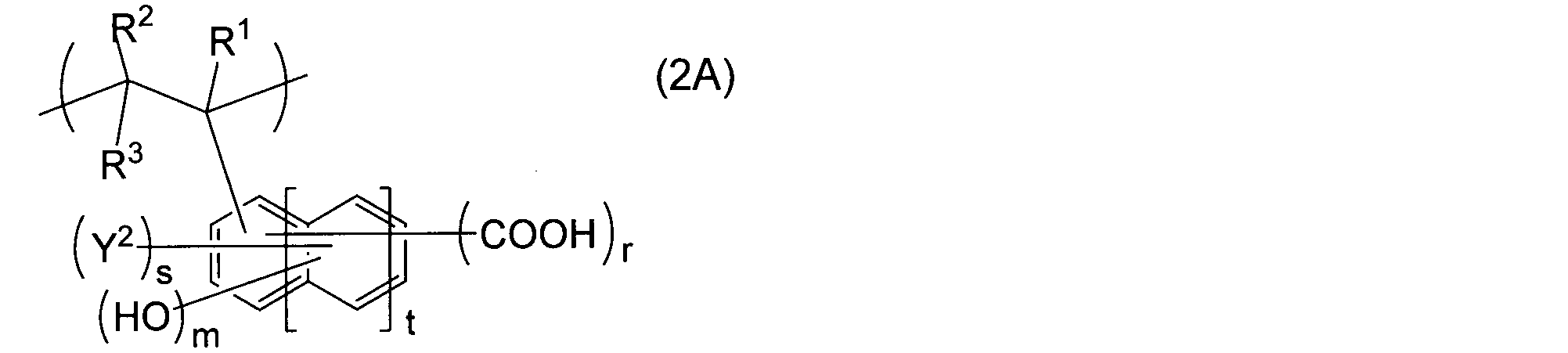
本開示の感放射線性組成物(以下、「本組成物」ともいう)は、酸解離性基を有する構造単位(U1)を含み、かつカルボキシ基を有する重合体(以下、「重合体(A)」ともいう)と、感放射線性酸発生体(B)とを含有する。また、本組成物は、任意成分として更に、重合体(A)及び感放射線性酸発生体(B)とは異なる化合物を1種又は2種以上含有していてもよい。なお、各成分については特に言及しない限り、1種を単独で用いてもよく、2種以上を組み合わせて用いてもよい。
<第1の態様>
重合体(A)は、カルボキシ基を有する構造単位(U2)を含む。さらに、構造単位(U2)中のカルボキシ基が重合体(A)の主鎖を構成する炭素原子に結合しているか、構造単位(U2)が鎖状構造を有し当該鎖状構造にカルボキシ基が結合しているか、又は、構造単位(U2)が重合体(A)の主鎖を構成する炭素原子に結合する芳香環を有し当該芳香環にカルボキシ基が結合している。
<第2の態様>
重合体(A)は、カルボキシ基を有する構造単位(U2)を含む。さらに、下記の要件(a)及び要件(b)の少なくとも一方を満たす。
要件(a):構造単位(U1)中にヨード基を有する。
要件(b):重合体(A)が、構造単位(U1)及び構造単位(U2)とは異なる構造単位(U3)を更に含み、構造単位(U3)中にヨード基を有する。
<第3の態様>
感放射線性酸発生体(B)は、有機アニオンとカチオンとからなるオニウム塩化合物を含み、オニウム塩化合物が有する有機アニオン及びカチオンのうち一方又は両方が、芳香環にヨード基が結合した構造を有する。
重合体(A)は、酸解離性基を有する構造単位(U1)を含む。酸解離性基は、カルボキシ基、水酸基等の酸基が有する水素原子を置換する基であって、酸の作用により解離する基である。重合体(A)が構造単位(U1)を含むことにより、本組成物に対する露光により発生した酸によって、構造単位(U1)中の酸解離性基が解離して酸基を生じ、重合体(A)の現像液への溶解性が変化する。これにより、本組成物に良好なリソグラフィー性能を付与することができる。
感放射線性酸発生体(B)は、露光により酸を発生する化合物である。感放射線性酸発生体(B)は、感放射線性カチオンと有機アニオンとからなるオニウム塩構造を有することが好ましい。感放射線性酸発生体(B)は、感放射線性カチオンと有機アニオンとにより構成される低分子化合物であってもよく、オニウム塩構造を有する構造単位を含む重合体であってもよい。感放射線性酸発生体(B)が低分子化合物である場合、感放射線性酸発生体(B)の分子量は、1,000以下が好ましく、800以下がより好ましく、600以下が更に好ましい。なお、感放射線性酸発生体(B)は、重合体(A)とは異なる化合物であり、構造単位(U1)を含まない。すなわち、オニウム塩構造を有する構造単位を含む重合体のうち、構造単位(U1)を含む重合体は重合体(A)に分類され、構造単位(U1)を含まない重合体は感放射線性酸発生体(B)に分類される。
重合体(A)及び感放射線性酸発生体(B)よりなる群から選択される1種以上であってヨード基を有する化合物(以下、「ヨード基含有化合物」ともいう)が1分子内に有するヨード基の数は、1個以上であればよい。本組成物の高感度化を十分に図る観点からすると、ヨード基含有化合物は、ヨード基を1分子内に2個以上有することが好ましい。ヨード基含有化合物が重合体である場合、当該重合体はヨード基を有する構造単位を含むことが好ましく、ヨード基を有する構造単位を与える単量体が1分子内に2個以上のヨード基を有することがより好ましい。
[1] 本組成物がヨード基含有重合体(A1)を含み、かつヨード基含有重合体(A1)中の構造単位(U1)がヨード基を有する態様。
[2] 本組成物がヨード基含有重合体(A1)を含み、ヨード基含有重合体(A1)が構造単位(U2)を含み、かつ構造単位(U2)がヨード基を有する態様。
[3] 本組成物がヨード基含有重合体(A1)を含み、ヨード基含有重合体(A1)が構造単位(U3)を含み、かつ構造単位(U3)がヨード基を有する態様。
[4] 本組成物がヨード基含有酸発生体(B1)を含み、かつヨード基含有酸発生体(B1)が感放射線性酸発生剤としての低分子化合物を含む態様。
[5] 本組成物がヨード基含有酸発生体(B1)を含み、かつヨード基含有酸発生体(B1)が感放射線性酸発生剤としての重合体を含む態様。
[6] 本組成物がヨード基含有酸発生体(B1)を含み、かつヨード基含有酸発生体(B1)が酸拡散制御剤としての低分子化合物を含む態様。
[7] 本組成物がヨード基含有酸発生体(B1)を含み、かつヨード基含有酸発生体(B1)が酸拡散制御剤としての重合体を含む態様。
・構造単位(U1)
構造単位(U1)は、露光により本組成物中に発生した酸によって酸解離性基が脱離してカルボキシ基又は水酸基を生じさせる基であることが好ましい。構造単位(U1)としては、例えば、下記式(i-1)で表される構造単位(以下、「構造単位(I-1)」ともいう)、下記式(i-2)で表される構造単位(以下、「構造単位(I-2)」ともいう)、及び下記式(i-3)で表される構造単位(以下、「構造単位(I-3)」ともいう)が挙げられる。
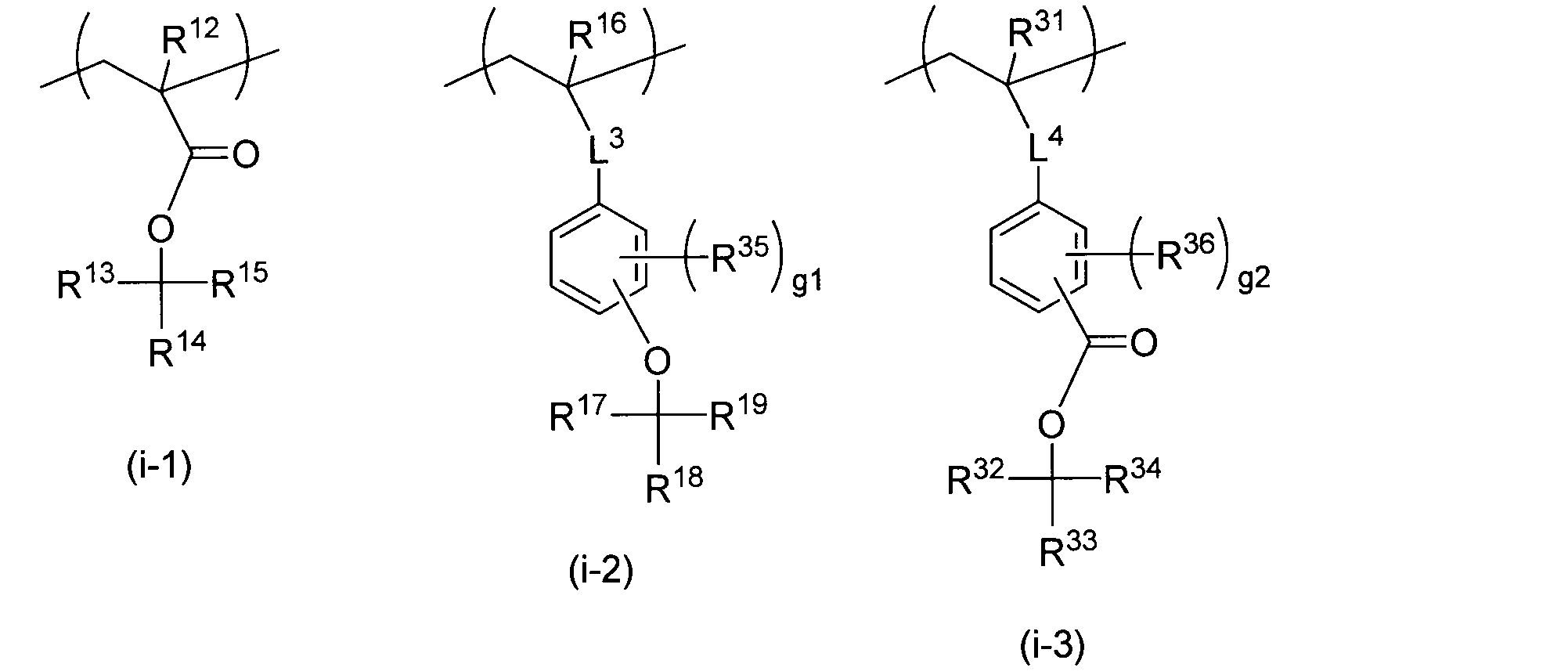
式(i-2)中、R16は、水素原子、フッ素原子、メチル基又はトリフルオロメチル基である。L3は、単結合、-O-、-CO-、*2-COO-又は*2-CONH-である。「*2」は主鎖との結合手を表す。R17、R18及びR19は、互いに独立して、水素原子、炭素数1~20の置換若しくは無置換の1価の炭化水素基、又は炭素数1~20の置換若しくは無置換の1価のオキシ炭化水素基である。R35は1価の置換基である。g1は0~4の整数である。
式(i-3)中、R31は、水素原子、フッ素原子、メチル基又はトリフルオロメチル基である。L4は、単結合、-O-、-CO-、*3-COO-又は*3-CONH-である。「*3」は主鎖との結合手を表す。R32は、水素原子、炭素数1~20の置換若しくは無置換の1価の炭化水素基、又は炭素数1~20の置換若しくは無置換の1価のオキシ炭化水素基である。R33及びR34は、互いに独立して、水素原子、炭素数1~20の置換若しくは無置換の1価の炭化水素基、又は炭素数1~20の置換若しくは無置換の1価のオキシ炭化水素基であるか、又は、R33及びR34が互いに合わせられR33及びR34が結合する炭素原子と共に構成される炭素数3~20の脂環式炭化水素構造を表す。R36は1価の置換基である。g2は0~4の整数である。)
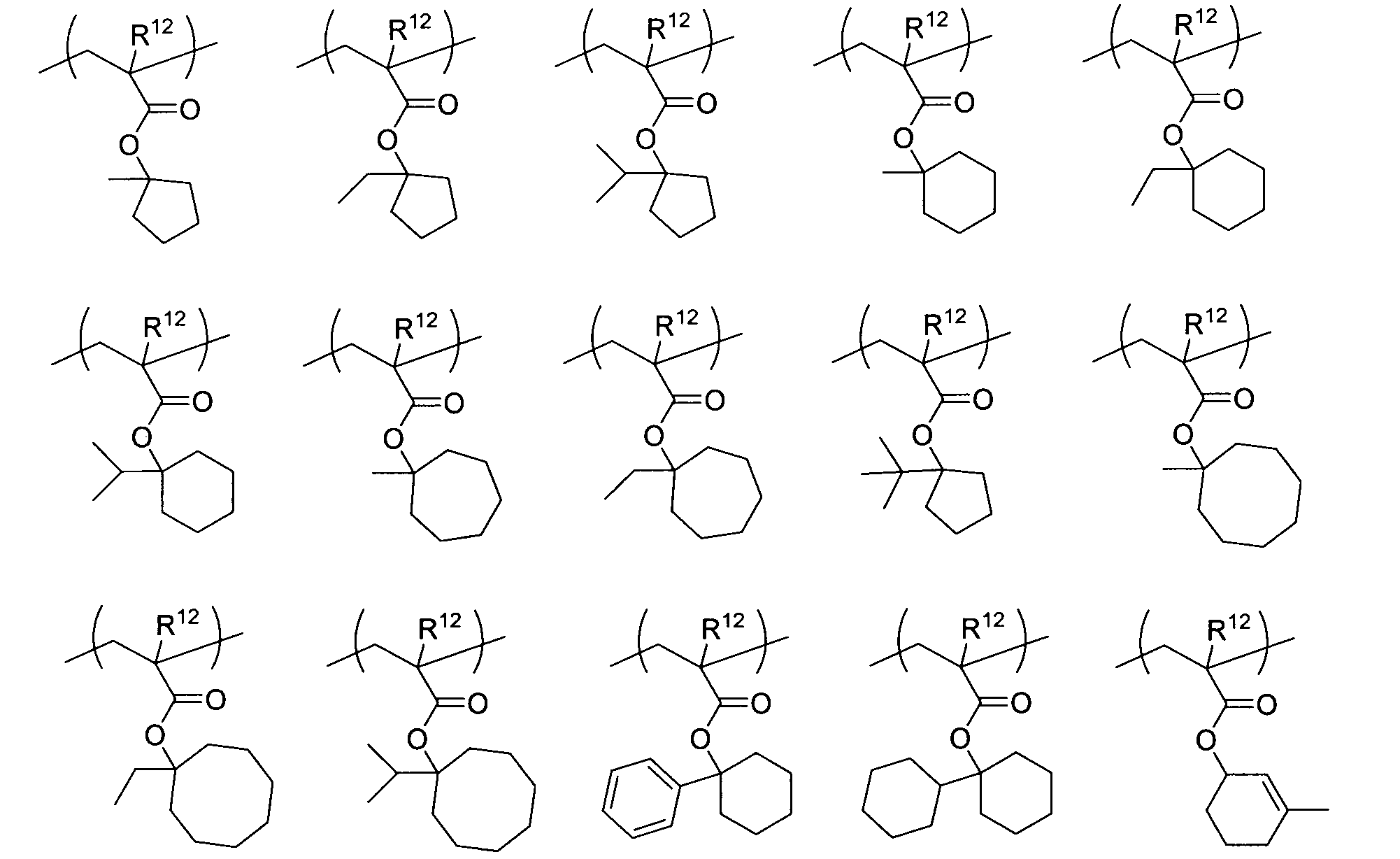
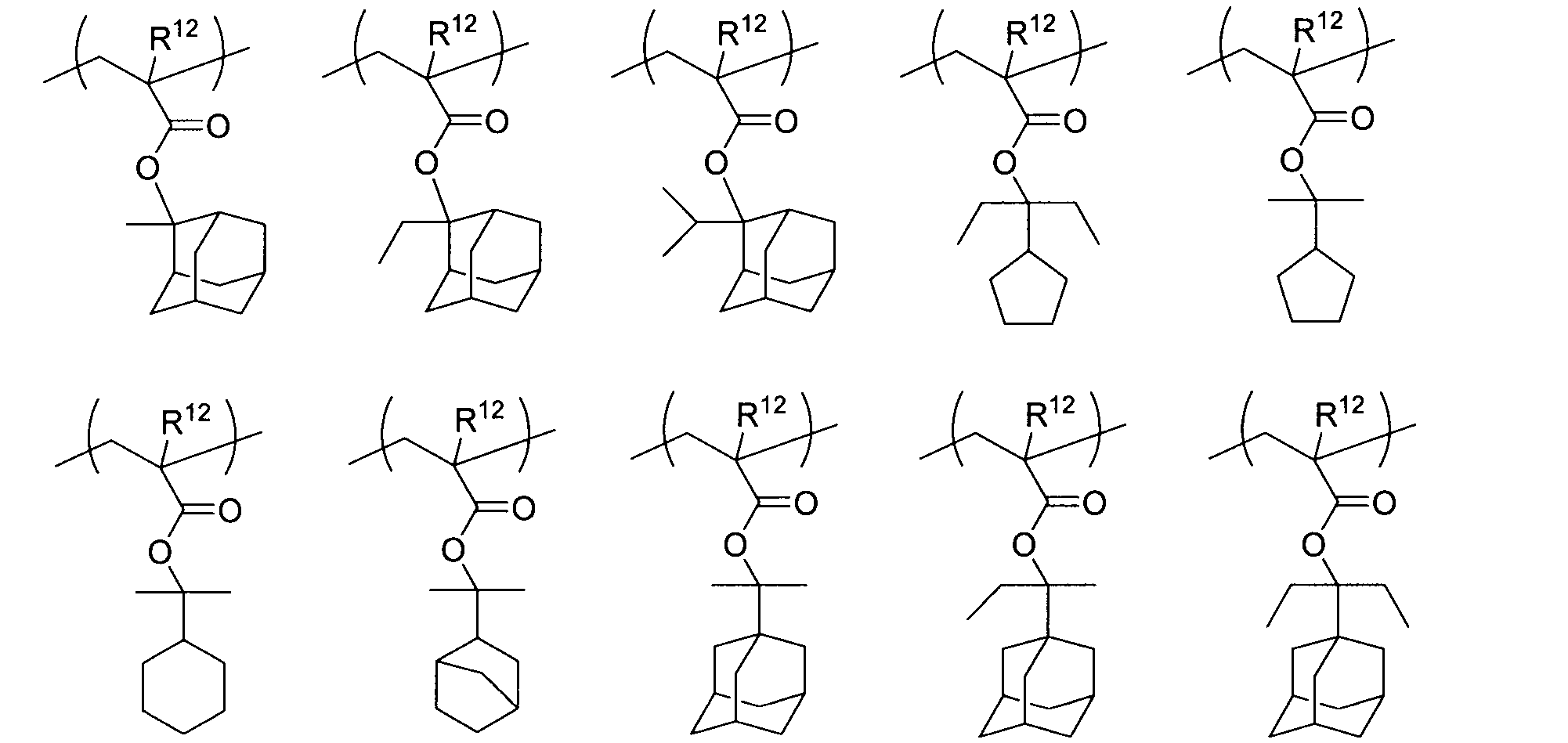
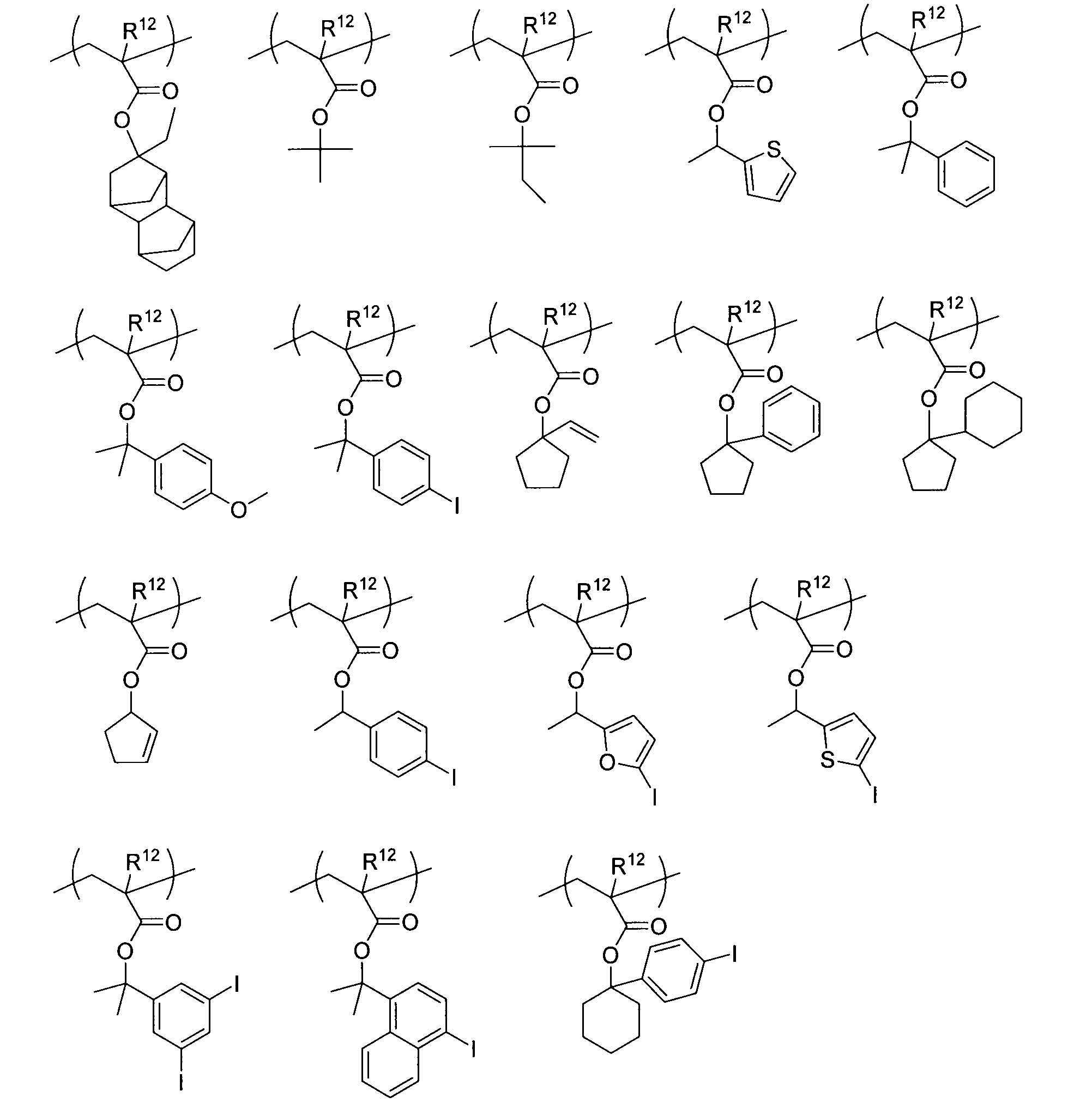
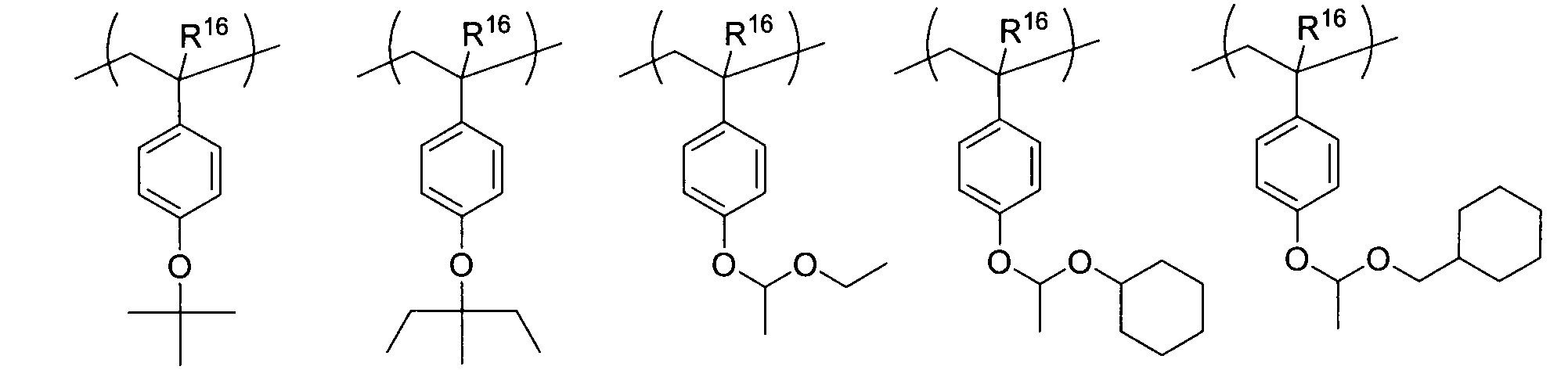
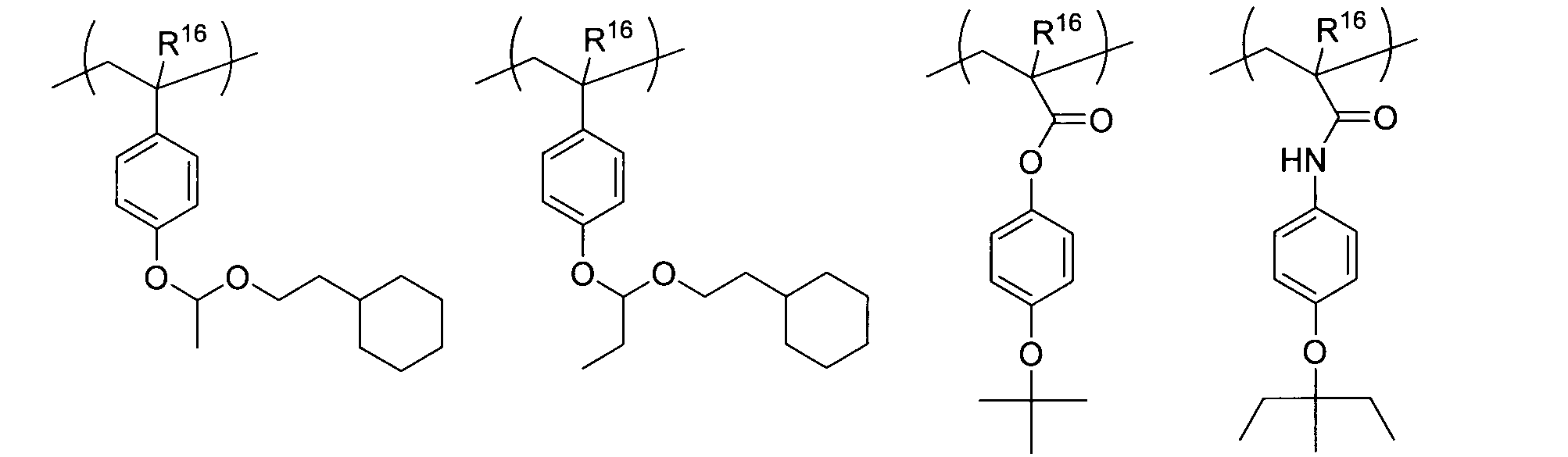
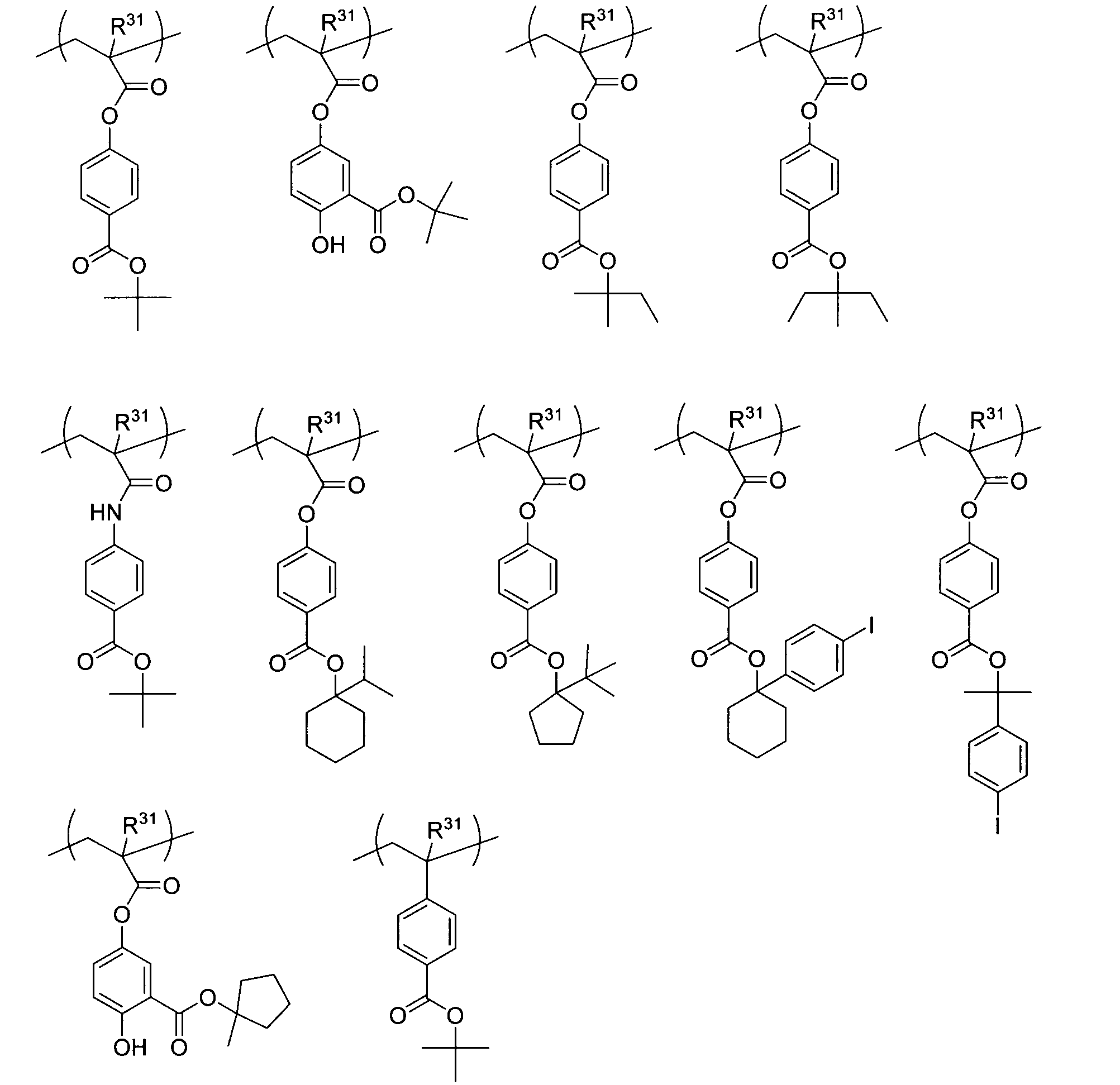
構造単位(U2)は、カルボキシ基を有する。構造単位(U2)の具体例としては、下記式(1)で表される構造単位が挙げられる。

X1が2価の芳香環基である場合、当該2価の芳香環基としては、ベンゼン環又はナフタレン環から2個の水素原子を取り除いた基が挙げられる。X1が単結合であって、A1が(r+1)価の芳香環基である場合、当該芳香環基としては、ベンゼン環又はナフタレン環から(r+1)個の水素原子を取り除いた基が挙げられる。X1又はA1が置換基を有する場合、置換基としては、炭素数1~3のアルキル基、炭素数1~3のアルコキシ基、水酸基、ハロゲン原子(例えばフッ素原子、塩素原子、臭素原子、ヨウ素原子)等が挙げられる。
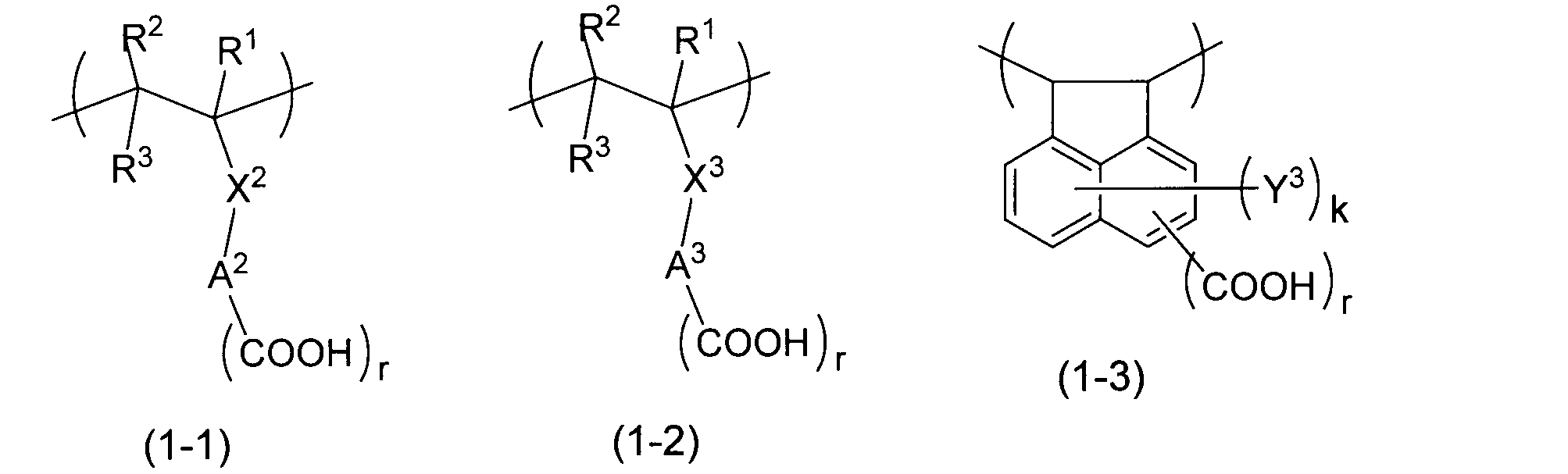
式(1-2)中、R1及びR2は、互いに独立して、水素原子、フッ素原子、メチル基又はトリフルオロメチル基である。X3は、単結合、*5-COO-、*5-CONH-、又は2価の芳香環基である。「*5」は主鎖との結合手を表す。X3が単結合の場合、A3は単結合である。X3が*5-COO-、*5-CONH-又は2価の芳香環基の場合、A3は、置換若しくは無置換の(r+1)価の鎖状炭化水素基であるか、又は置換若しくは無置換の鎖状炭化水素基におけるメチレン基が-O-、-S-、-CO-、-COO-、-NH-若しくは-CONH-で置き換えられた(r+1)価の基である。ただし、式(1-2)中のカルボキシ基は、A3中の鎖状炭化水素基に結合している。R3は、水素原子、フッ素原子、メチル基又はトリフルオロメチル基である。rは1以上の整数である。
式(1-3)中、rは1以上の整数である。Y3は、水酸基、ハロゲン原子、炭素数1~10の1価の炭化水素基又は炭素数1~10の1価のオキシ炭化水素基である。kは0~(6-r)の整数である。)


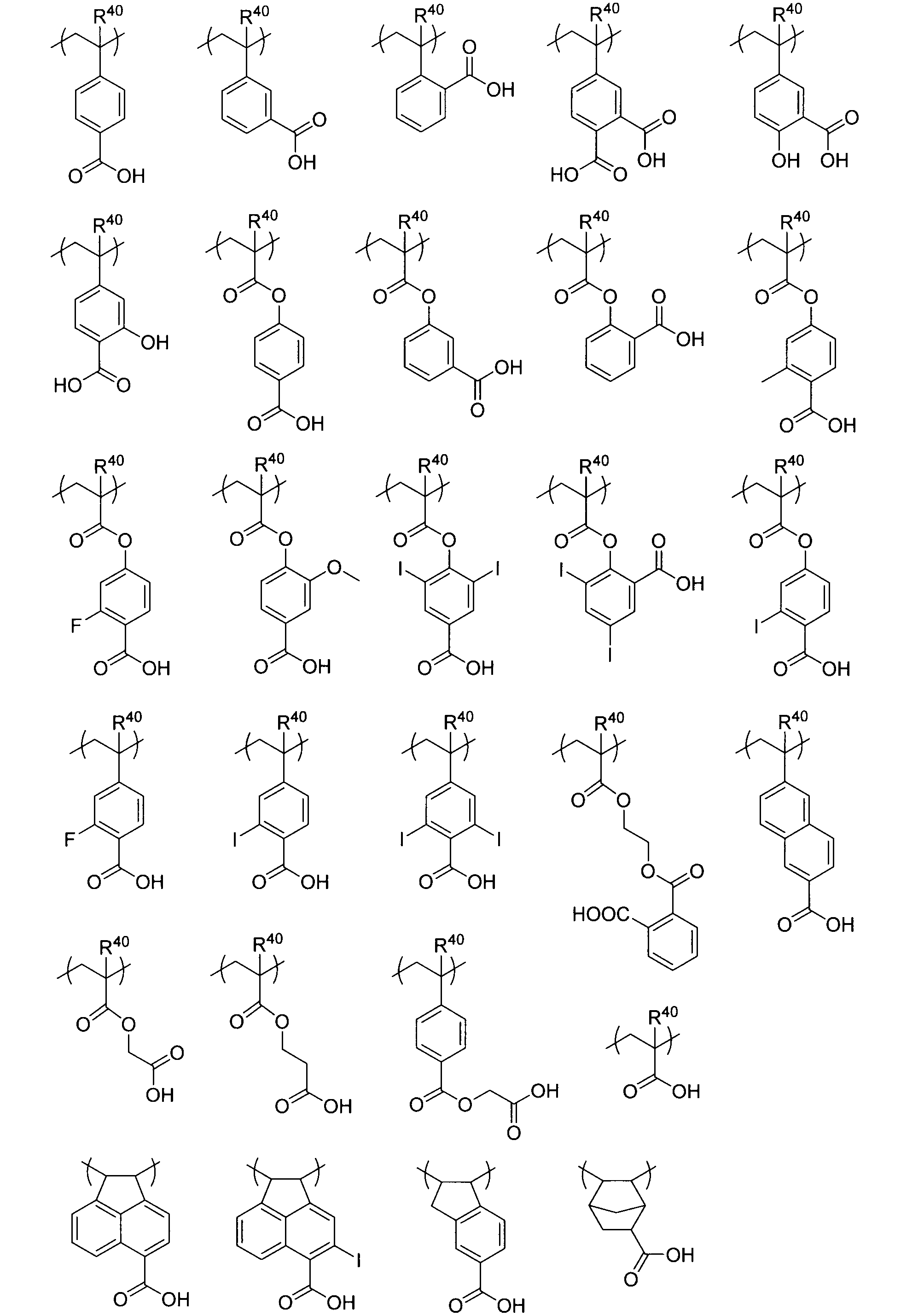
構造単位(U3-1)は、芳香環と当該芳香環に結合する水酸基とを有する構造単位(ただし、構造単位(U1)及び構造単位(U2)に該当するものを除く。)である。重合体(A)が芳香環に結合する水酸基を有することにより、本組成物のLWR性能及びCDU(Critical Dimension Uniformity)性能等のリソグラフィー性能をより向上できる点、並びに、未露光部の現像液への溶け出し抑制の効果が高く、現像欠陥を十分に低減できる点で好適である。特に、電子線やEUVといった、波長50nm以下の放射線による露光を用いるパターン形成において、芳香環に結合する水酸基を有する重合体を好ましく適用することができる。

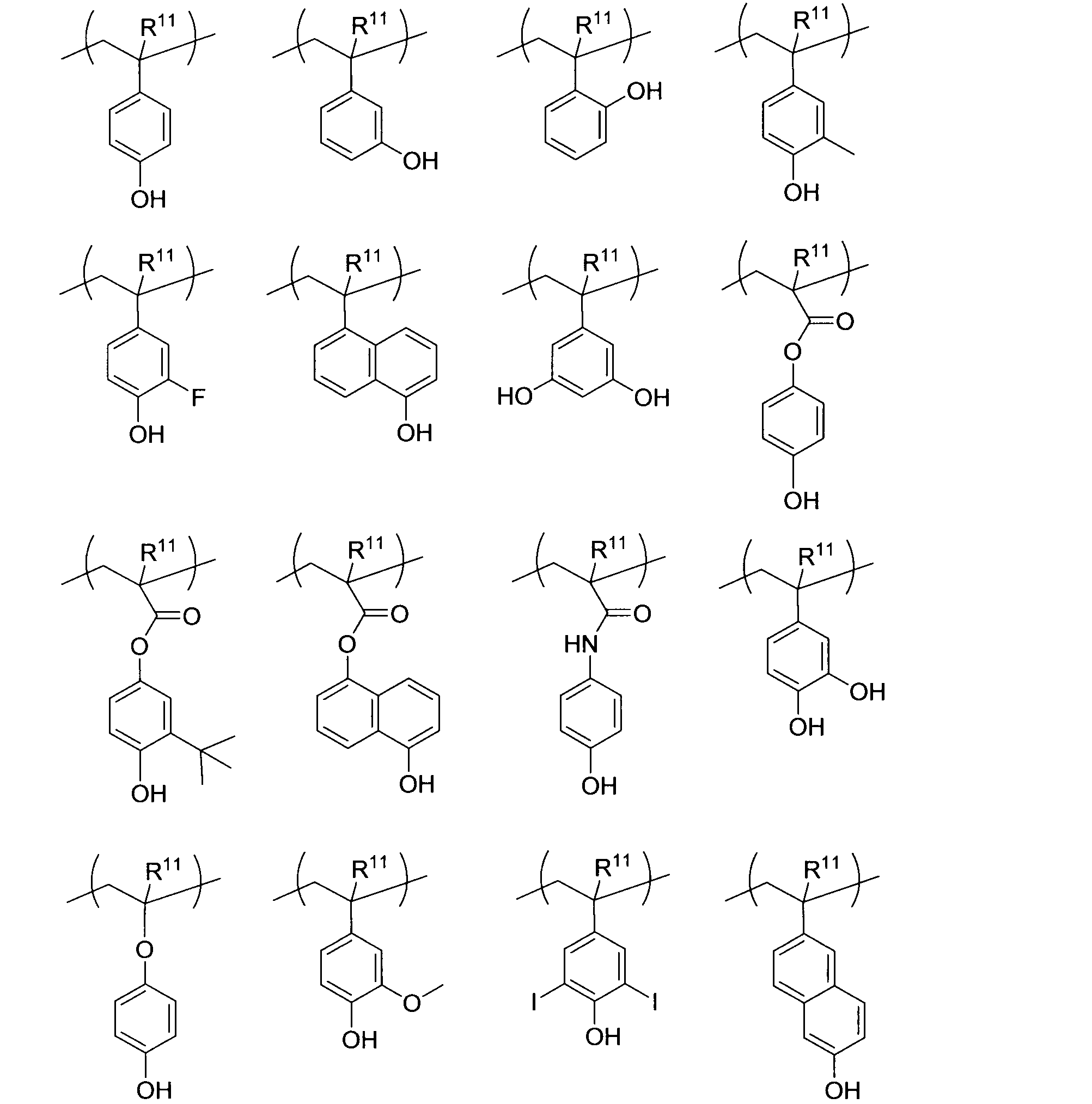
構造単位(U3-2)はオニウム塩構造を有する構造単位(ただし、構造単位(U1)、構造単位(U2)及び構造単位(U3-1)に該当するものを除く。)である。重合体(A)が構造単位(U3-2)を含むことにより、酸拡散に伴う解像度の低下を抑制することが可能である。本組成物の感度を更に高めるために、構造単位(U3-2)は、ヨード基が芳香環(好ましくはベンゼン環)に結合した部分構造を有していてもよい。各構造単位(U3-2)において、芳香環に結合するヨード基の数は、例えば1~5個である。構造単位(U3-2)がヨード基を有する場合、ヨード基は、オニウム塩構造を構成する感放射線性オニウムカチオン部分が有していてもよく、有機アニオン部分が有していてもよく、これらの両方が有していてもよい。
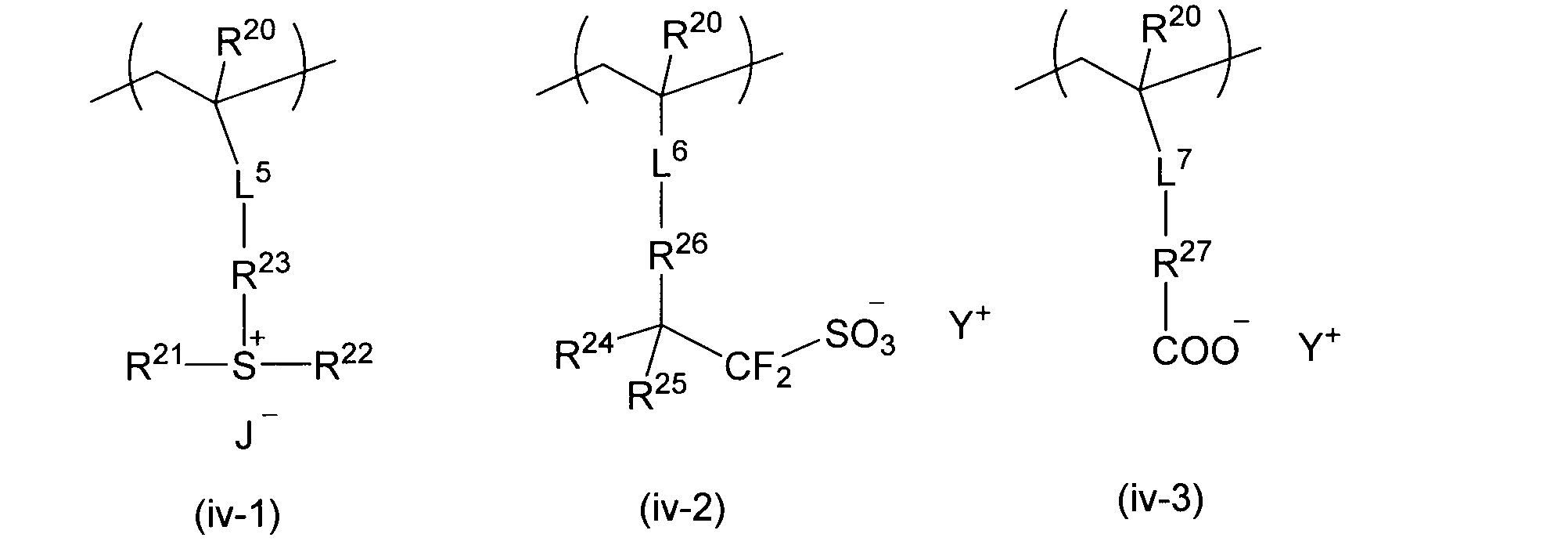
式(iv-2)中、R20は、水素原子、フッ素原子、メチル基又はトリフルオロメチル基である。L6は、-O-、*-COO-又は2価の芳香環基である。「*」は主鎖との結合手を表す。R26は単結合又は炭素数1~40の2価の有機基である。R24及びR25は、互いに独立して、水素原子、フッ素原子、炭素数1~10のアルキル基、又は炭素数1~10のフルオロアルキル基である。Y+は1価の感放射線性カチオンである。
式(iv-3)中、R20は、水素原子、フッ素原子、メチル基又はトリフルオロメチル基である。L7は、-O-、*-COO-又は2価の芳香環基である。「*」は主鎖との結合手を表す。R27は炭素数1~40の2価の有機基である。Y+は1価の感放射線性カチオンである。)
なお、R26又はR27が2価の環状有機基である場合、R26又はR27は環状構造と共に鎖状構造を有していてもよい。

構造単位(U3-3)は、ラクトン構造、環状カーボネート構造若しくはスルトン構造、又はこれらのうちの2種以上を組み合わせた環構造を有する構造単位(ただし、構造単位(U1)、構造単位(U2)、構造単位(U3-1)及び構造単位(U3-2)に該当するものを除く。)である。


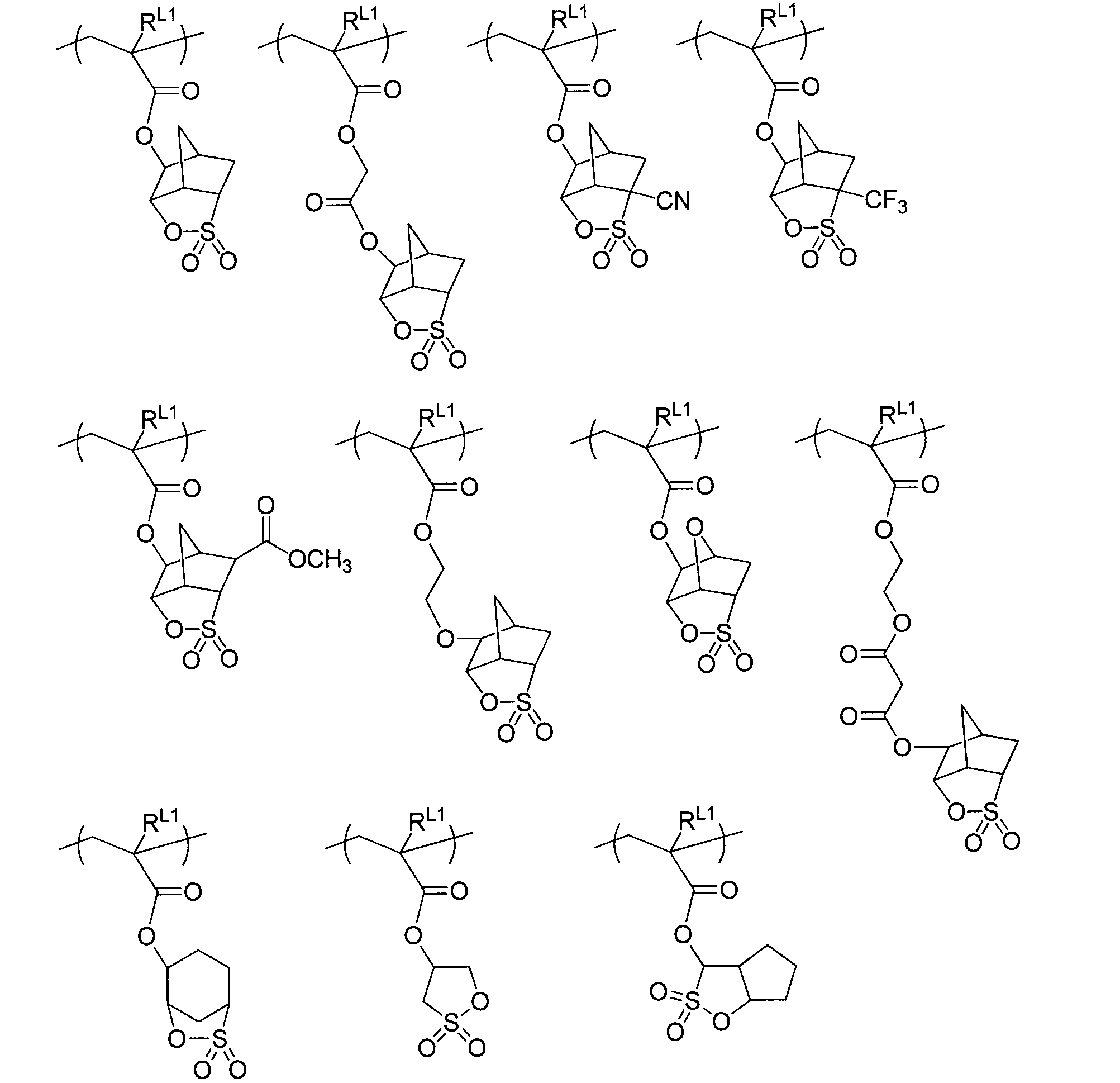
構造単位(U3-4)は、アルコール性水酸基を有する構造単位(ただし、構造単位(U1)、構造単位(U2)、構造単位(U3-1)、構造単位(U3-2)及び構造単位(U3-3)に該当するものを除く。)を更に有していてもよい。ここで、本明細書において「アルコール性水酸基」とは、脂肪族炭化水素基に水酸基が直接結合した構造を有する基である。当該脂肪族炭化水素基は、鎖状炭化水素基でもよく、脂環式炭化水素基でもよい。

感放射線性酸発生体(B)は、露光により酸を発生する化合物である。上述したとおり、本組成物は、感放射線性酸発生体(B)として感放射線性酸発生剤を含有していてもよく、感放射線性酸発生体(B)として酸拡散制御剤を含有していてもよい。
感放射線性酸発生体(B)として低分子化合物を用いる場合、感放射線性酸発生体(B)としては、露光によりスルホン酸、カルボン酸又はスルホンアミドを組成物中に発生させる化合物を好ましく使用できる。これらの中でも、スルホン酸又はカルボン酸を組成物中に発生させる化合物をより好ましく使用できる。具体的には、感放射線性酸発生体(B)は、下記式(3)で表されるオニウム塩及び下記式(4)で表されるオニウム塩よりなる群から選択される少なくとも1種を含むことが好ましい。


Rf1が(n1+1)価のフッ素化炭化水素基である場合、上述した2価のフッ素化炭化水素基から(n1-1)個の水素原子を取り除いた基が挙げられる。
n1は、1~5が好ましく、1~3がより好ましく、1又は2が更に好ましい。
Rc1が(n2+1)価の有機基である場合、上述した2価の有機基から(n2-1)個の水素原子を取り除いた基が挙げられる。
n2は、1~5が好ましく、1~3がより好ましく、1又は2が更に好ましい。
感放射線性酸発生体(B)が有するカチオンは、本組成物の高感度化を図る観点及びリソグラフィー性能により優れたレジスト膜を形成する観点から、スルホニウムカチオン構造又はヨードニウムカチオン構造を有することが好ましい。また、上記式(3)、(3A)、式(4)又は式(4A)中のX+についても同様である。感放射線性酸発生体(B)が有するカチオン及び上記式(3)、(3A)、式(4)又は式(4A)中のX+は、中でも、スルホニウムカチオン又はヨードニウムカチオンに結合する芳香環を有し、当該芳香環に、フルオロアルキル基、フルオロ基(ただし、フルオロアルキル基中のフルオロ基を除く。)及びヨード基よりなる群から選択される少なくとも1種の基が結合していることが好ましい。
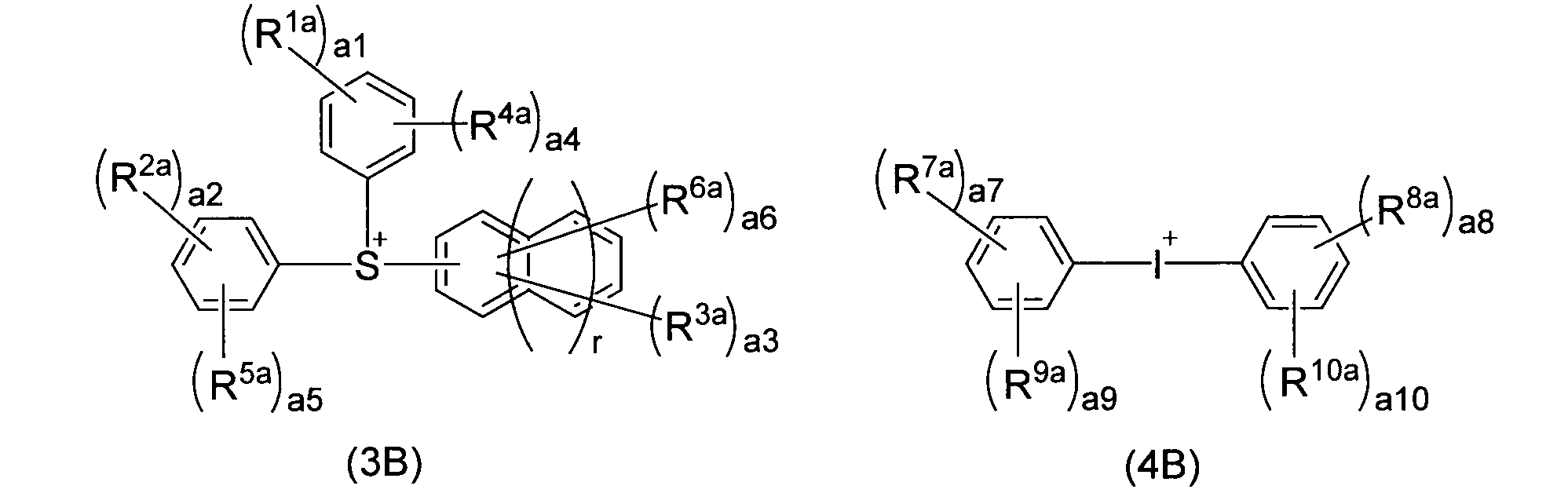
式(4B)中、R7a及びR8aは、互いに独立して、ヨード基、フルオロ基又はフルオロアルキル基である。R9a及びR10aは、互いに独立して、ヨード基、フルオロ基及びフルオロアルキル基とは異なる1価の置換基である。a7及びa8は、互いに独立して0~5の整数である。a9及びa10は、互いに独立して0~3の整数である。ただし、a7+a9≦5及びa8+a10≦5を満たす。)

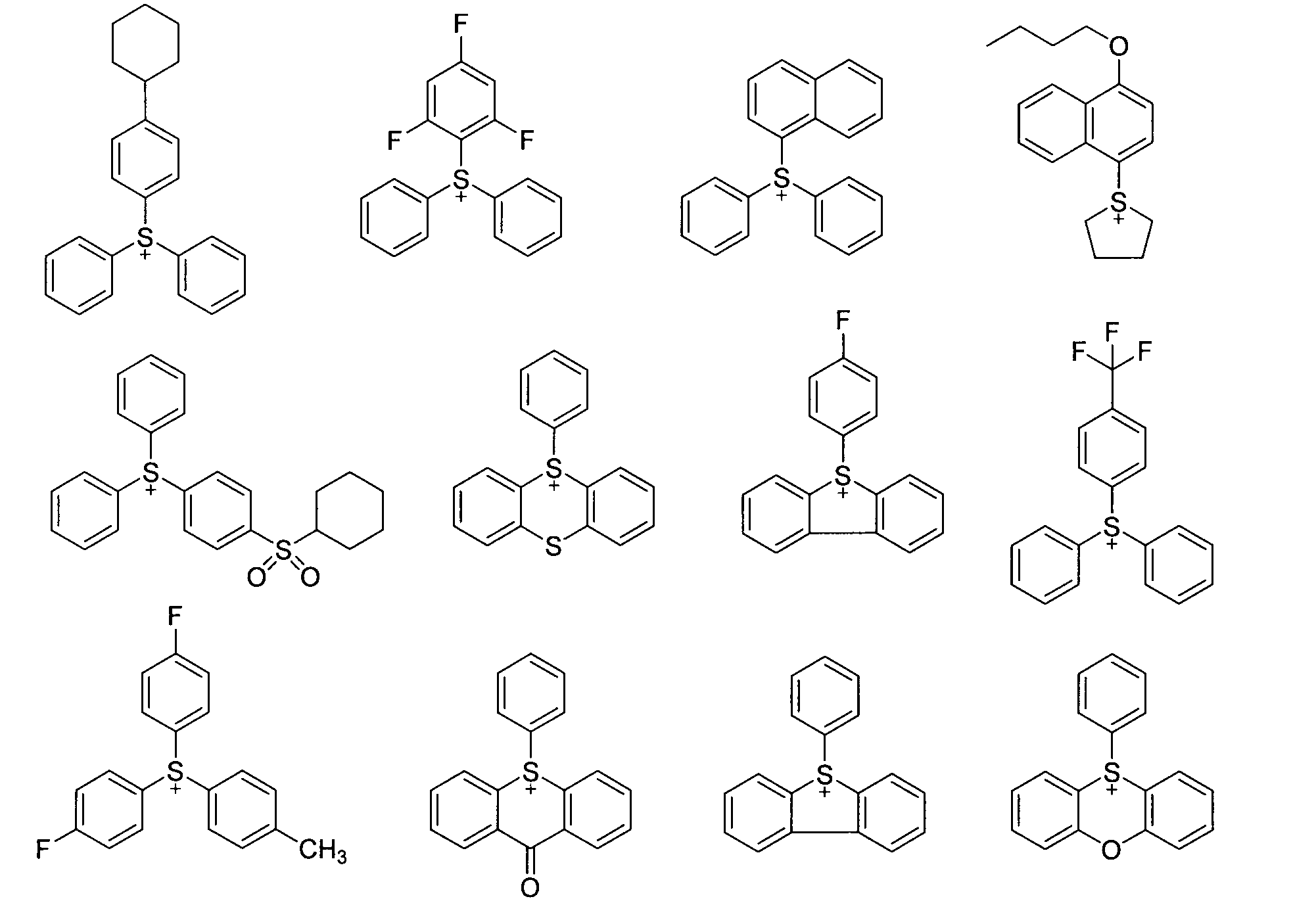

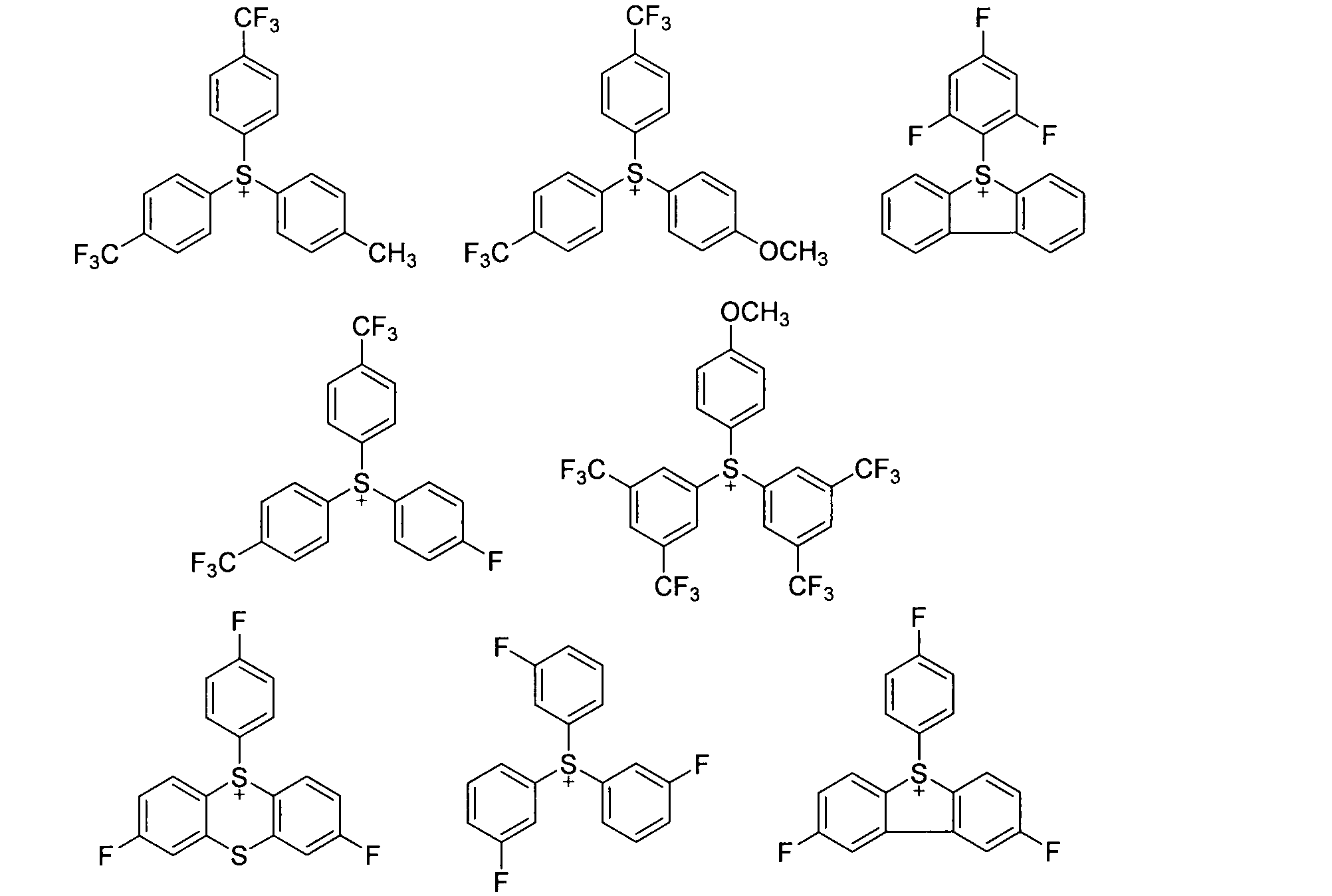


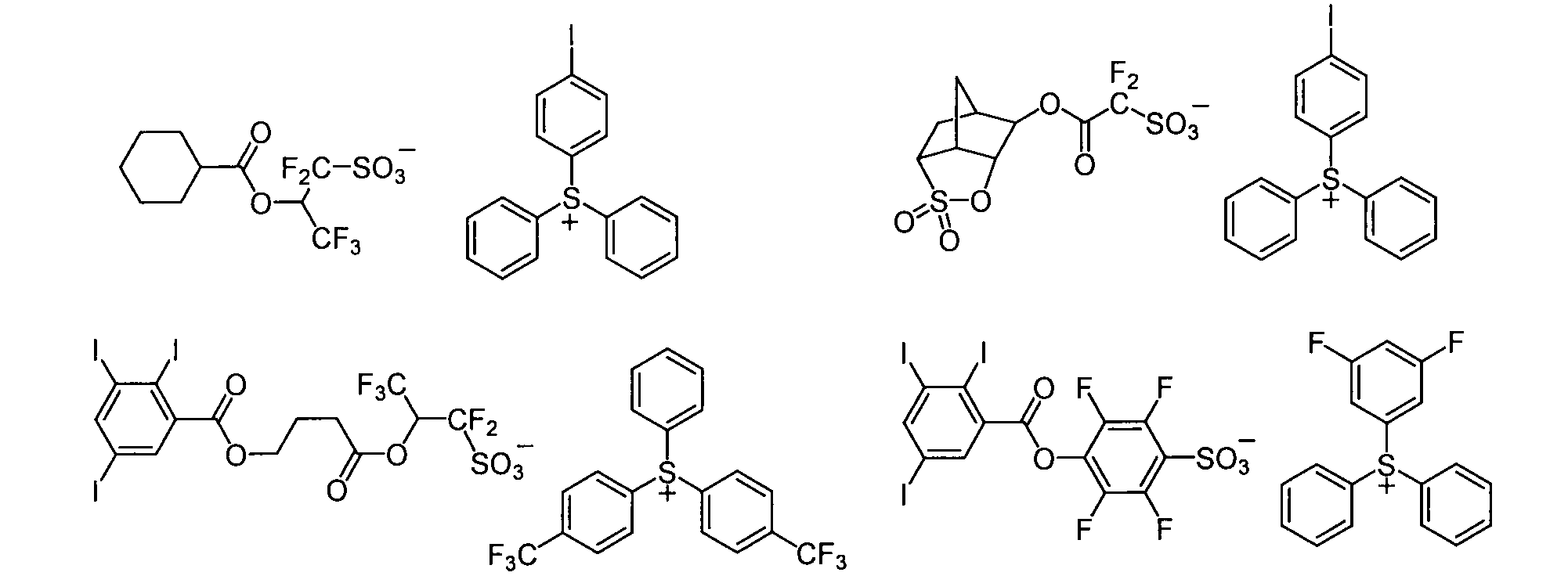
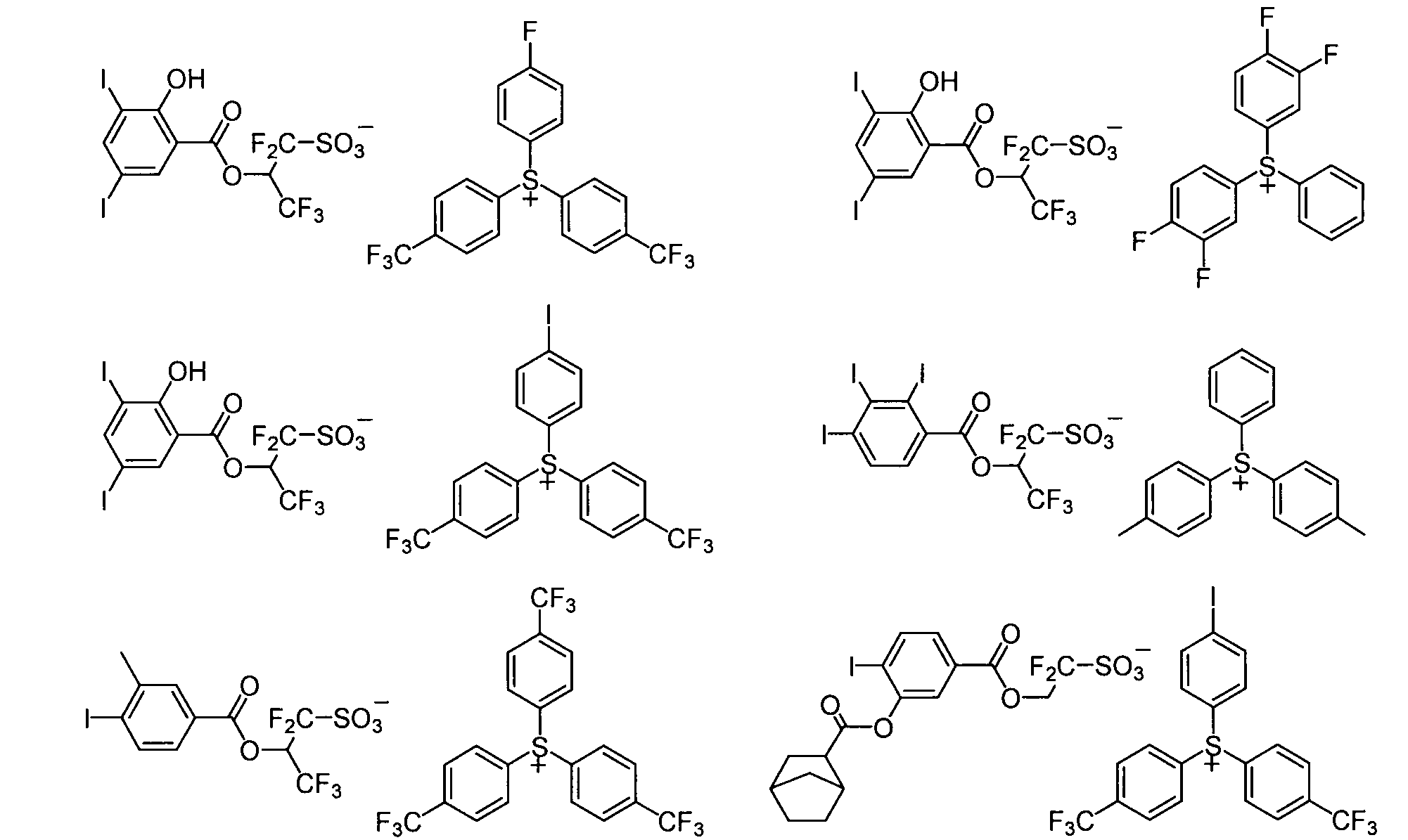
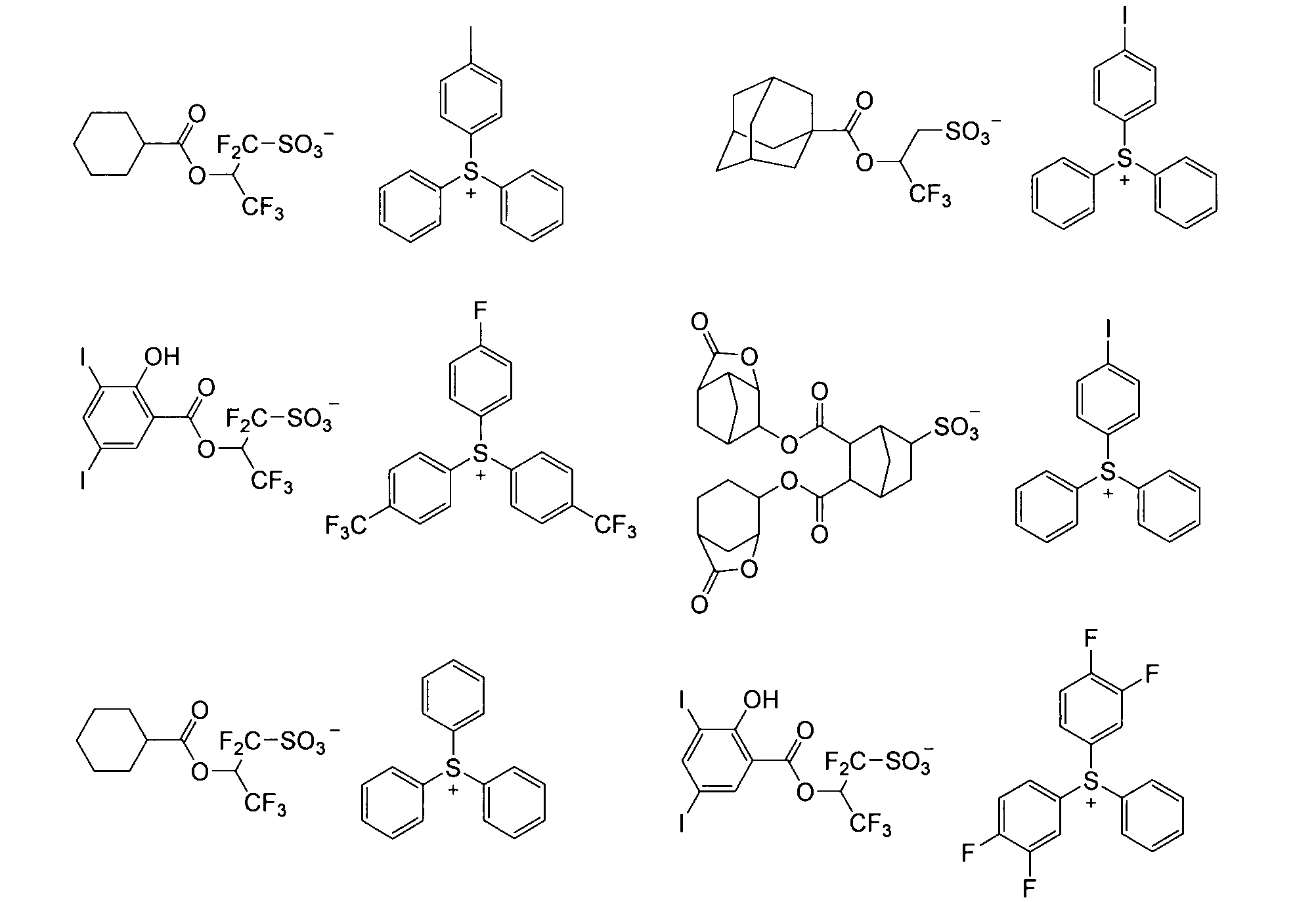


本組成物の調製に際しては、感放射線性酸発生体(B)として重合体を用いることもできる。感放射線性酸発生体(B)としての重合体は、構造単位(U3-2)を含むことが好ましい。また、感放射線性酸発生体(B)としての重合体は、構造単位(U3-2)と共に、重合体(A)が含んでいてもよい構造単位として示したもののうち、構造単位(U2)以外の構造単位を含んでいてもよい。各構造単位の含有割合については、重合体(A)の説明を適用することができる。
溶媒(D)は、本組成物に配合される成分を溶解又は分散可能な溶媒であれば特に限定されない。溶媒(D)としては、有機溶媒を好ましく用いることができる。溶媒(D)の具体例としては、アルコール類、エーテル類、ケトン類、アミド類、エステル類、炭化水素類等が挙げられる。
高フッ素含有量重合体(F)(以下、単に「重合体(F)」ともいう)は、重合体(A)よりもフッ素原子の質量含有率が大きい重合体である。重合体(F)は、例えば撥水性添加剤として本組成物に含有される。
本組成物は、上記の重合体(A)、感放射線性酸発生体(B)、溶媒(D)及び[F]高フッ素含有量重合体とは異なる成分(以下、「その他の任意成分」ともいう)を更に含有していてもよい。その他の任意成分としては、窒素含有化合物(例えば、アルキルアミン、芳香族アミン、ポリアミン、含窒素複素環化合物(N-(ウンデカン-1-イルカルボニルオキシエチル)モルホリン等)、酸解離性基を有する含窒素化合物(N-(t-ブトキシカルボニル)ジ-n-オクチルアミン、N-t-ブトキシカルボニル-4-ヒドロキシピペリジン等))、界面活性剤、脂環式骨格含有化合物(例えば、1-アダマンタンカルボン酸、2-アダマンタノン、デオキシコール酸t-ブチル等)、増感剤、偏在化促進剤等が挙げられる。
本組成物は、例えば、重合体(A)及び感放射線性酸発生体(B)のほか、必要に応じて溶媒(D)等の成分を所望の割合で混合し、得られた混合物を、好ましくはフィルター(例えば、孔径0.2μm程度のフィルター)等を用いてろ過することにより製造することができる。本組成物の固形分濃度は、0.1質量%以上が好ましく、0.5質量%以上がより好ましく、1質量%以上が更に好ましい。また、本組成物の固形分濃度は、50質量%以下が好ましく、20質量%以下がより好ましく、5質量%以下が更に好ましい。本組成物の固形分濃度を上記範囲とすることにより、塗布性を良好にでき、レジストパターンの形状を良好にできる点で好適である。
本開示におけるレジストパターン形成方法は、基板の一方の面に本組成物を塗工する工程(以下、「塗工工程」ともいう)と、塗工工程により得られるレジスト膜を露光する工程(以下、「露光工程」ともいう)と、露光工程により露光されたレジスト膜を現像する工程(以下、「現像工程」ともいう)とを含む。本開示のレジストパターン形成方法により形成されるパターンとしては、例えば、ラインアンドスペースパターン、ホールパターン等が挙げられる。本開示のレジストパターン形成方法では本組成物を用いてレジスト膜を形成していることから、感度が良好であり、リソグラフィー性能が良好であり、かつ現像欠陥の少ないレジストパターンを形成することができる。以下、各工程について説明する。
塗工工程では、基板の一方の面に本組成物を塗工することにより基板上にレジスト膜を形成する。レジスト膜を形成する基板としては従来公知のものを使用でき、例えば、シリコンウエハ、二酸化シリコン、アルミニウムで被覆されたウエハ等が挙げられる。また、例えば、特公平6-12452号公報や特開昭59-93448号公報等に開示されている有機系又は無機系の反射防止膜を基板上に形成して使用してもよい。本組成物の塗工方法としては、例えば、回転塗工(スピンコーティング)、流延塗工、ロール塗工等が挙げられる。塗工後には、塗膜中の溶媒を揮発させるためにソフトベーク(SB、プレベークとも称される。)を行ってもよい。SBの温度は、60℃以上が好ましく、80℃以上がより好ましい。また、SBの温度は、140℃以下が好ましく、120℃以下がより好ましい。SBの時間は、5秒以上が好ましく、10秒以上がより好ましい。また、SBの時間は、600秒以下が好ましく、300秒以下がより好ましい。形成されるレジスト膜の平均厚さは、10~1,000nmが好ましく、20~500nmがより好ましい。
露光工程では、上記塗工工程により得られるレジスト膜を露光する。この露光は、フォトマスクを介して、場合によっては水等の液浸媒体を介して、レジスト膜に対して放射線を照射することにより行う。放射線としては、目的とするパターンの線幅に応じて、例えば可視光線、紫外線、遠紫外線、極端紫外線(EUV)、X線、γ線等の電磁波;電子線、α線等の荷電粒子線、等が挙げられる。これらのうち、本組成物を用いて形成されたレジスト膜に対し照射する放射線は、遠紫外線、EUV又は電子線が好ましく、ArFエキシマレーザー光(波長193nm)、KrFエキシマレーザー光(波長248nm)、EUV又は電子線がより好ましく、ArFエキシマレーザー光、EUV又は電子線が更に好ましく、EUV又は電子線がより更に好ましく、EUVが特に好ましい。
現像工程では、上記露光されたレジスト膜を現像する。これにより、所望のレジストパターンを形成することができる。現像後は、水又はアルコール等のリンス液で洗浄し、乾燥することが一般的である。現像工程における現像方法は、アルカリ現像であってもよく、有機溶媒現像であってもよい。
本開示によれば、上記式(2A)で表される構造単位と、酸解離性基を有する構造単位とを含む重合体が提供される。当該重合体は、レジストパターン形成に用いられる感放射線性組成物の重合体成分(特にベース樹脂)として好適である。
重合体の重量平均分子量(Mw)及び数平均分子量(Mn)は、東ソー製GPCカラム(G2000HXL:2本、G3000HXL:1本、G4000HXL:1本)を用い、流量:1.0mL/分、溶出溶媒:テトラヒドロフラン、カラム温度:40℃の分析条件で、単分散ポリスチレンを標準とするゲルパーミエーションクロマトグラフィ(GPC)により測定した。また、分散度(Mw/Mn)は、Mw及びMnの測定結果より算出した。
(単量体)
各重合体の合成に用いた単量体の構造式を以下に示す。なお、以下の合成例においては特に断りのない限り、「質量部」は、使用した単量体の合計質量を100質量部とした場合の値を意味する。「モル%」は、使用した単量体の合計モル数を100モル%とした場合の値を意味する。なお、本開示は下記構造単位に限定されるものでない。

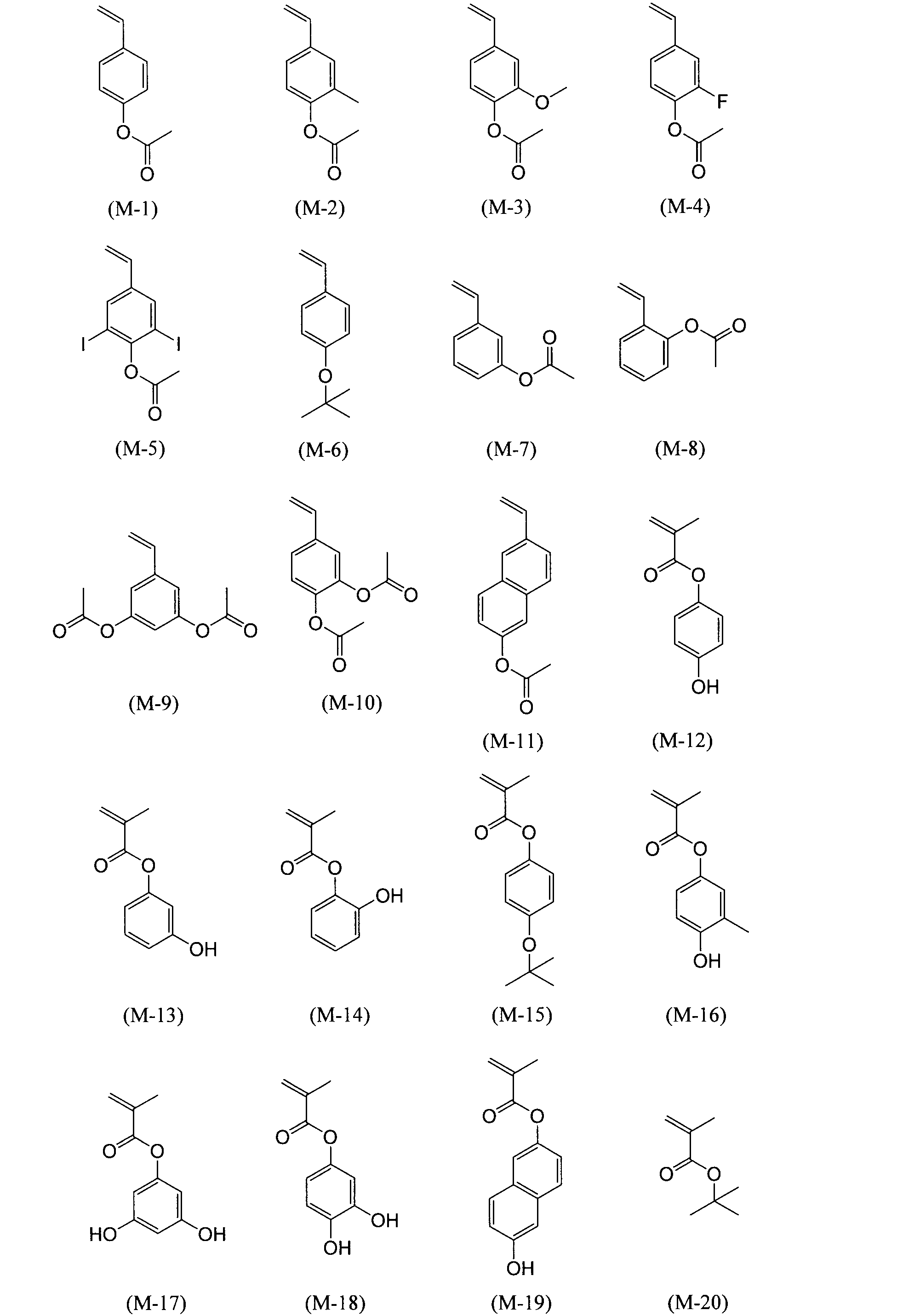

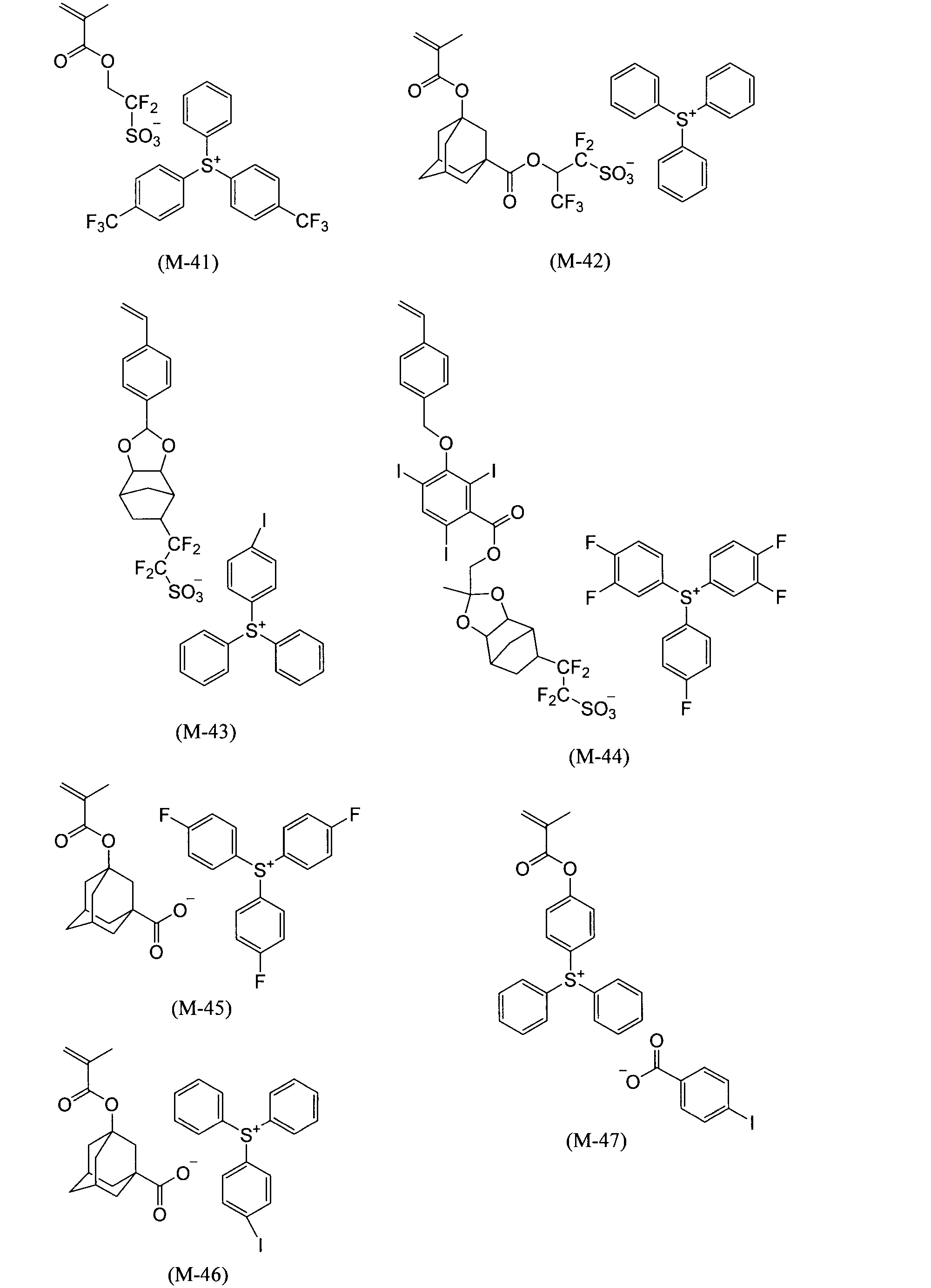
各重合体の合成に用いた重合開始剤の構造を以下に示す。
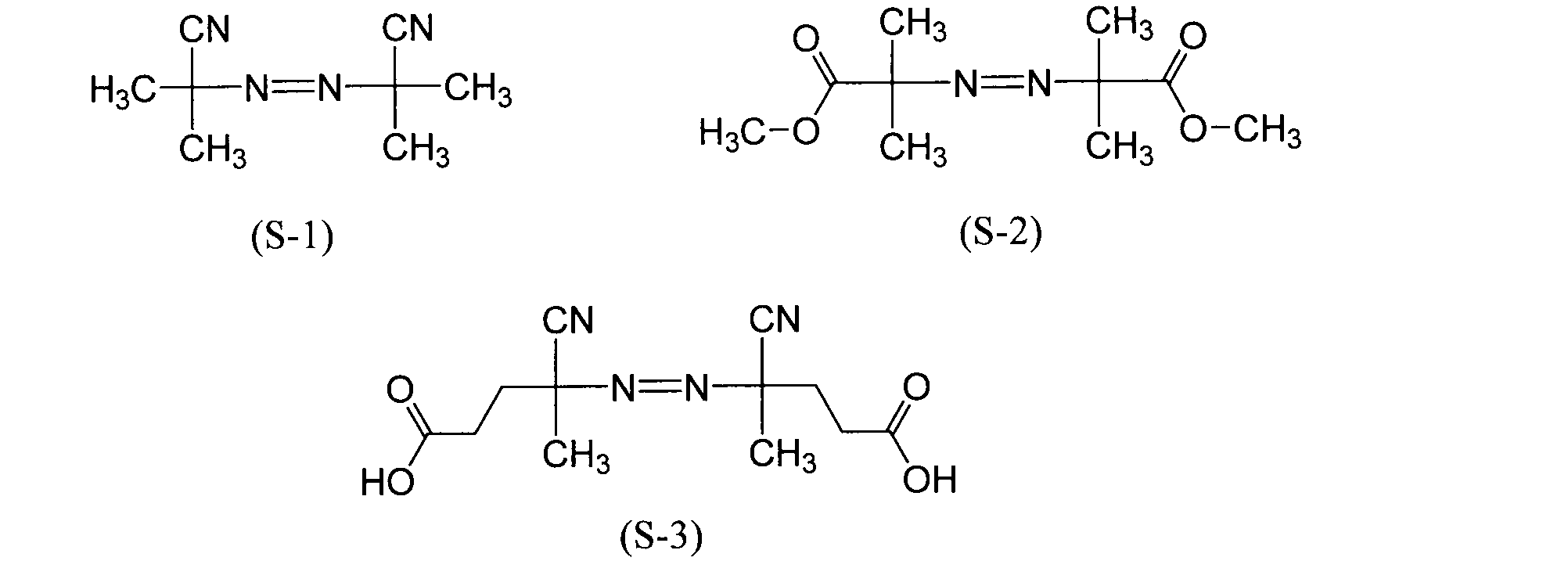
化合物(Z-2)、化合物(M-1)、化合物(M-31)をモル比率が5/35/60となるようメタノール(全モノマー量に対して200質量部)に溶解した。次に、重合開始剤として化合物(S-1)を全モノマーに対して6モル%添加し、単量体溶液を調製した。一方、空の反応容器に1-メトキシ-2-プロパノール(全モノマー量に対して100質量部)を加え、撹拌しながら85℃に加熱した。次に、この反応容器に、上記で調製した単量体溶液を3時間かけて滴下し、その後、更に3時間、85℃で加熱した。重合反応終了後、重合溶液を室温に冷却した。
冷却した重合溶液をヘキサン(重合溶液に対して500質量部)中に投入し、析出した白色粉末をろ別した。ろ別した白色粉末を重合溶液に対して100質量部のヘキサンで2回洗浄した後、1-メトキシ-2-プロパノール(300質量部)に再度溶解した。次に、メタノール(500質量部)、トリエチルアミン(50質量部)、超純水(10質量部)を加え、撹拌しながら70℃で6時間加水分解反応を実施した。
反応終了後、残溶媒を留去し、得られた固体をアセトン(100質量部)に溶解させた。500質量部の水中に滴下して樹脂を凝固させ、得られた固体をろ別した。50℃で12時間乾燥させて、白色粉末状の重合体(A-1a)を得た。重合体(A-1a)のMwは5600、Mw/Mnは1.4であった。
単量体及び重合開始剤の種類及び量を表1~表3に記載のとおり変更した以外は、合成例1と同様に操作して、重合体(A-2a)~(A-61a)を得た。得られた各重合体のMw、Mw/Mnを表1~表3に併せて示す。
化合物(Z-1)、化合物(M-12)、化合物(M-31)をモル比率が10/30/60となるよう2-ブタノン(全モノマー量に対して200質量部)に溶解した。重合開始剤として化合物(S-1)を全モノマーに対して6モル%添加し、単量体溶液を調製した。一方、空の反応容器に2-ブタノン(100質量部)を入れ、撹拌しながら80℃に加熱した。次に、この反応容器に、上記で調製した単量体溶液を3時間かけて滴下した。その後、更に3時間、80℃で加熱した。重合反応終了後、重合溶液を室温に冷却した。得られた重合溶液にアセトニトリル(100質量部)及びヘキサン(600質量部)を加えて撹拌した。下層を回収後、溶媒を除去することで重合体(A-1b)を得た。重合体(A-1b)のMwは5900、Mw/Mnは1.5であった。
単量体及び重合開始剤の種類及び量を表2、表3に記載のとおり変更した以外は、合成例38と同様に操作して、重合体(A-2b)~(A-27b)を得た。得られた各重合体のMw、Mw/Mnを表2、表3に併せて示す。


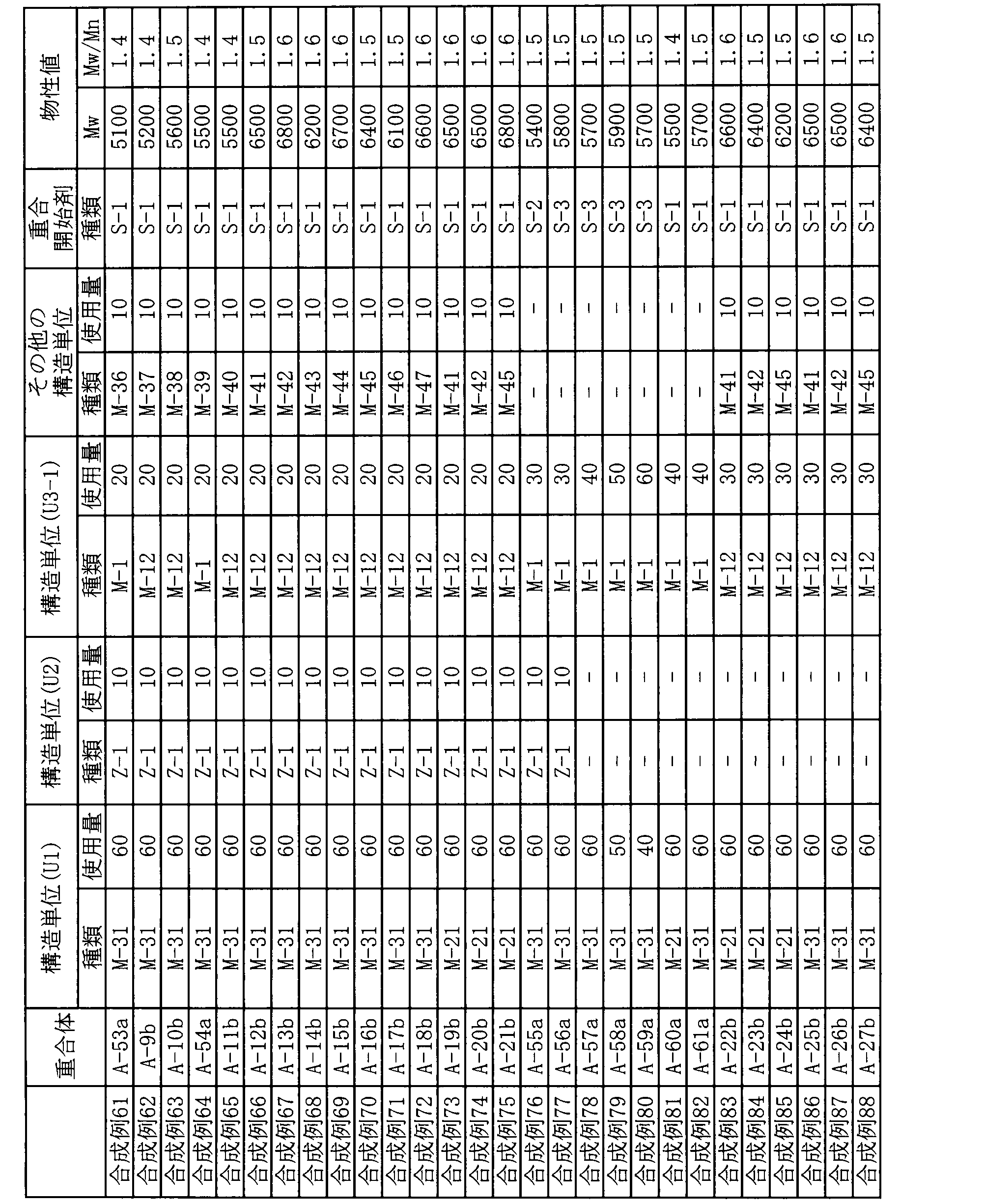
感放射線性組成物の調製に用いた感放射線酸発生剤、酸拡散制御剤及び溶媒を以下に示す。
Bp-1~Bp-16:下記式(Bp-1)~(Bp-16)で表される化合物
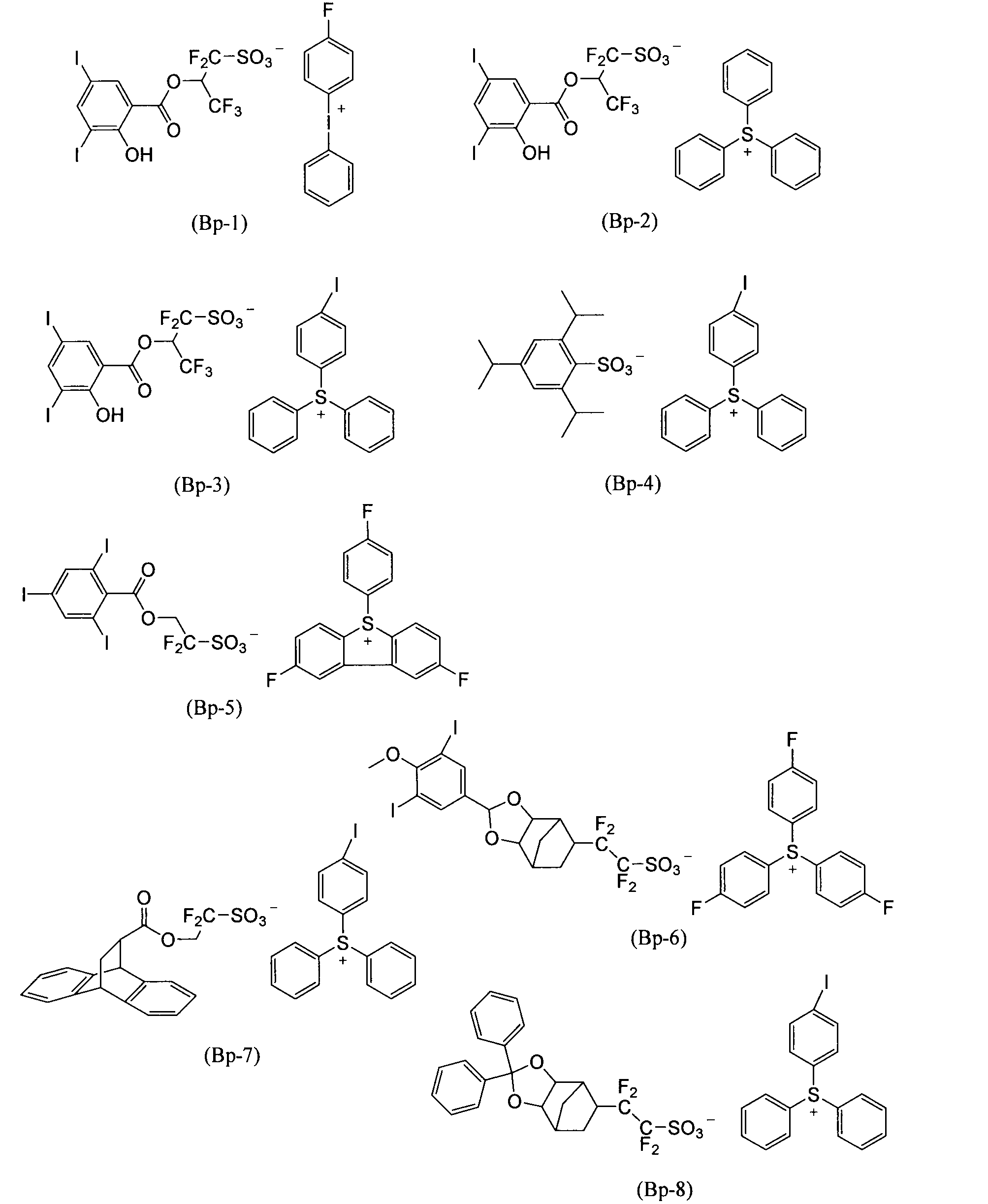

Bq-1~Bq-15:下記式(Bq-1)~(Bq-15)で表される化合物
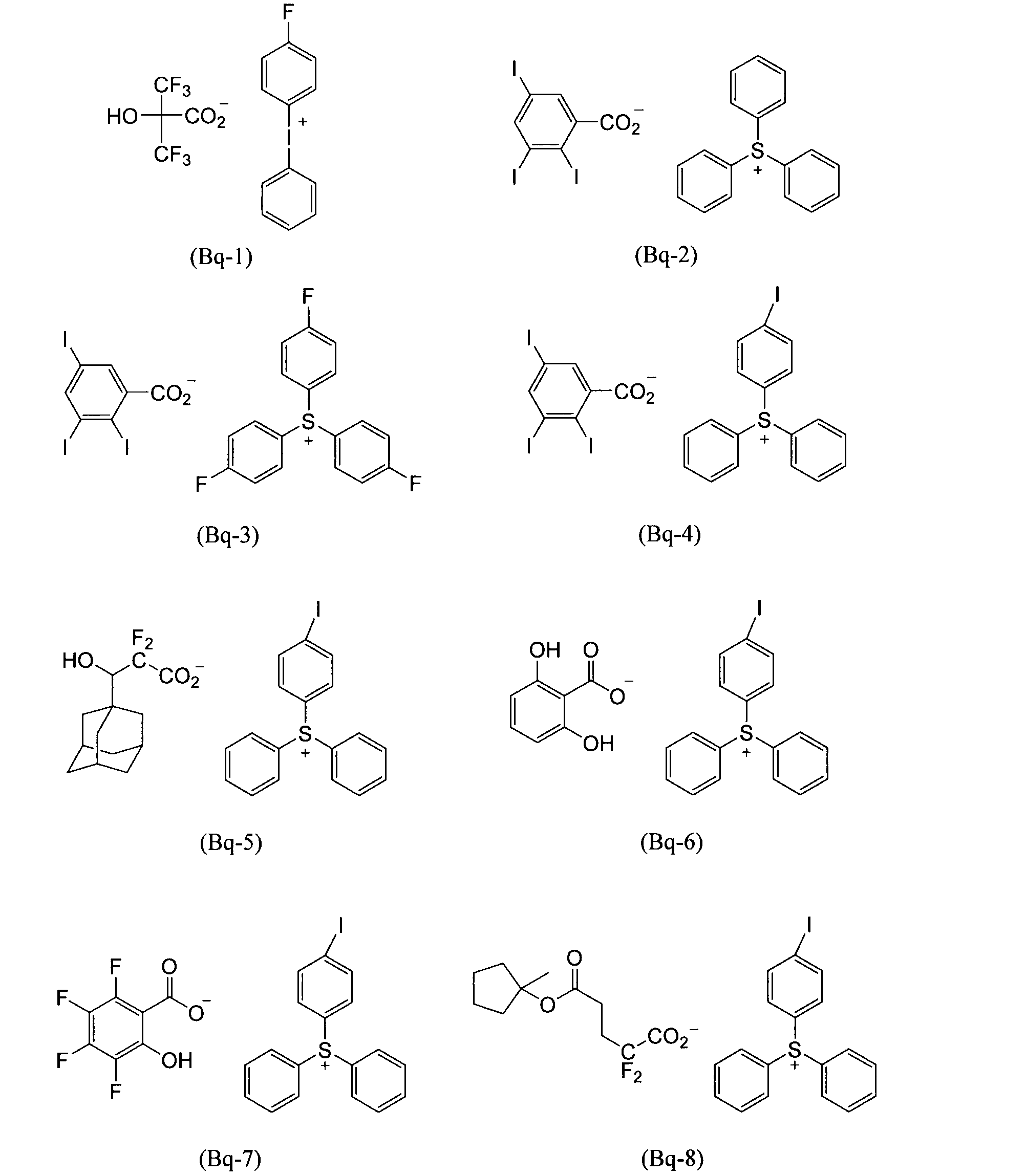

E-1:酢酸プロピレングリコールモノメチルエーテル
E-2:プロピレングリコール1-モノメチルエーテル
E-3:2-ヒドロキシイソ酪酸メチル
重合体(A-1a)100質量部、化合物(Bp-1)20質量部、化合物(Bq-1)を化合物(Bp-1)に対して20モル%、溶媒(E-1)4,800質量部、及び溶媒(E-2)2,000質量部を配合して混合した。次に、得られた混合液を孔径0.20μmのメンブランフィルターでろ過することにより、感放射線性組成物(R-1)を調製した。
表4~表8に示す種類及び配合量の各成分を用いた以外は、実施例1と同様に操作して、感放射線性組成物(R-2)~(R-116)及び(CR-1)~(CR-13)をそれぞれ調製した。なお、表4~表8中、酸拡散制御剤の量は、重合体100質量部に含まれる構造単位(U3-2)を与える単量体の量と、感放射線性酸発生剤の量の合計(すなわち、酸発生剤成分の合計量)に対する比率(モル%)を表す。
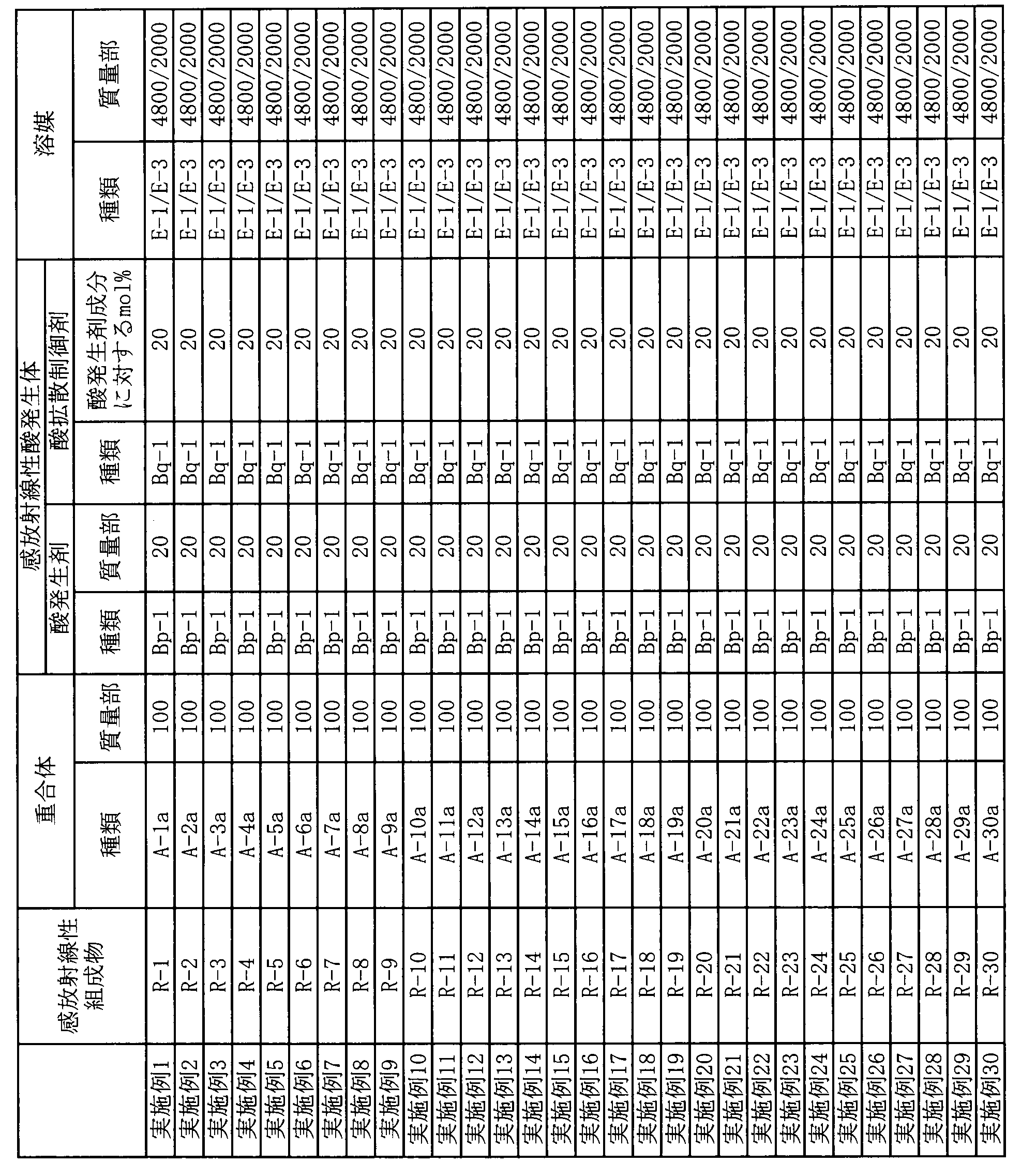
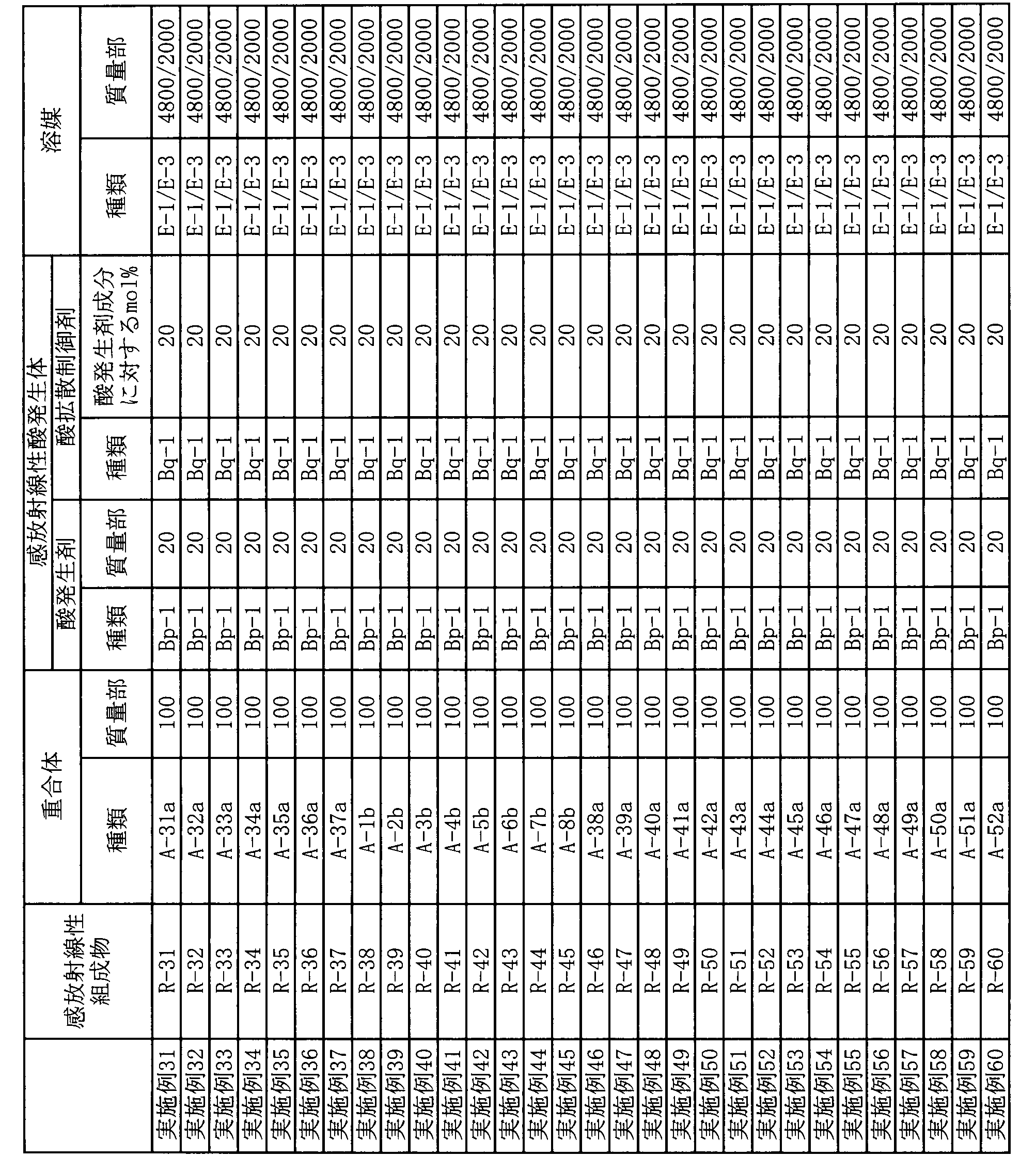


膜厚20nmの下層膜(AL412(Brewer Science社製))が形成された12インチのシリコンウエハ表面に、スピンコーター(CLEAN TRACK ACT12、東京エレクトロン社製)を使用して、上記で調製した各感放射線性組成物を塗布した。130℃で60秒間ソフトベーク(SB)を行った後、23℃で30秒間冷却し、膜厚50nmのレジスト膜を形成した。次に、このレジスト膜に、EUV露光機(型式「NXE3300」、ASML社製、NA=0.33、照明条件:Conventional s=0.89、マスクimecDEFECT32FFR02)を用いてEUV光を照射した。次いで、110℃で60秒間ポストエクスポージャーベーク(PEB)を行った後、2.38wt%のTMAH水溶液を用い、23℃で30秒間現像して、ポジ型の34nmラインアンドスペースパターンを形成した。
上記で形成したレジストパターンについて、下記方法に従って測定することにより、各感放射線性組成物のLWR性能及び現像欠陥数を評価した。なお、レジストパターンの測長には走査型電子顕微鏡(日立ハイテクノロジーズ社の「CG-4100」)を用いた。評価結果を表9~表12に示す。
上記のレジストパターンの形成において、34nmラインアンドスペースパターンを形成する露光量を最適露光量(Eop)とし、この最適露光量を感度(mJ/cm2)とした。感度は、値が小さいほど高感度であることを示す。
上記走査型電子顕微鏡を用いてレジストパターンを上部から観察した。線幅を任意のポイントで計50点測定し、その測定値の分布から3シグマ値を求め、これをLWR性能とした。LWR性能は、値が小さいほど良好であることを示す。
32nmラインアンドスペース(1L/1S)を形成するマスクを用いて、低露光量から高露光量まで露光量を変えてパターンを形成した。一般的に、低露光量側ではパターン間の繋がりが見られ、高露光量側ではパターン倒れ等の欠陥が見られる。これらの欠陥が見られないレジスト寸法の上限値と下限値の差を「CD(Critical Dimension)マージン」とした。CDマージンの値が大きいほどプロセスウィンドウが広いと考えられる。
最適露光量にてレジスト膜を露光、現像して32nmラインアンドスペースパターンを形成した。このウエハ上の欠陥数を、欠陥検査装置(KLA-Tencor社の「KLA2810」)を用いて測定した。また、観察された欠陥を、レジスト膜由来と判断される欠陥と、外部環境由来の異物とに分類した。現像欠陥数は、レジスト膜由来と判断される欠陥の数が40個未満の場合を「A」(極めて良好)、40個以上60個以下の場合を「B」(良好)、60個を超える場合を「C」(不良)と判定した。


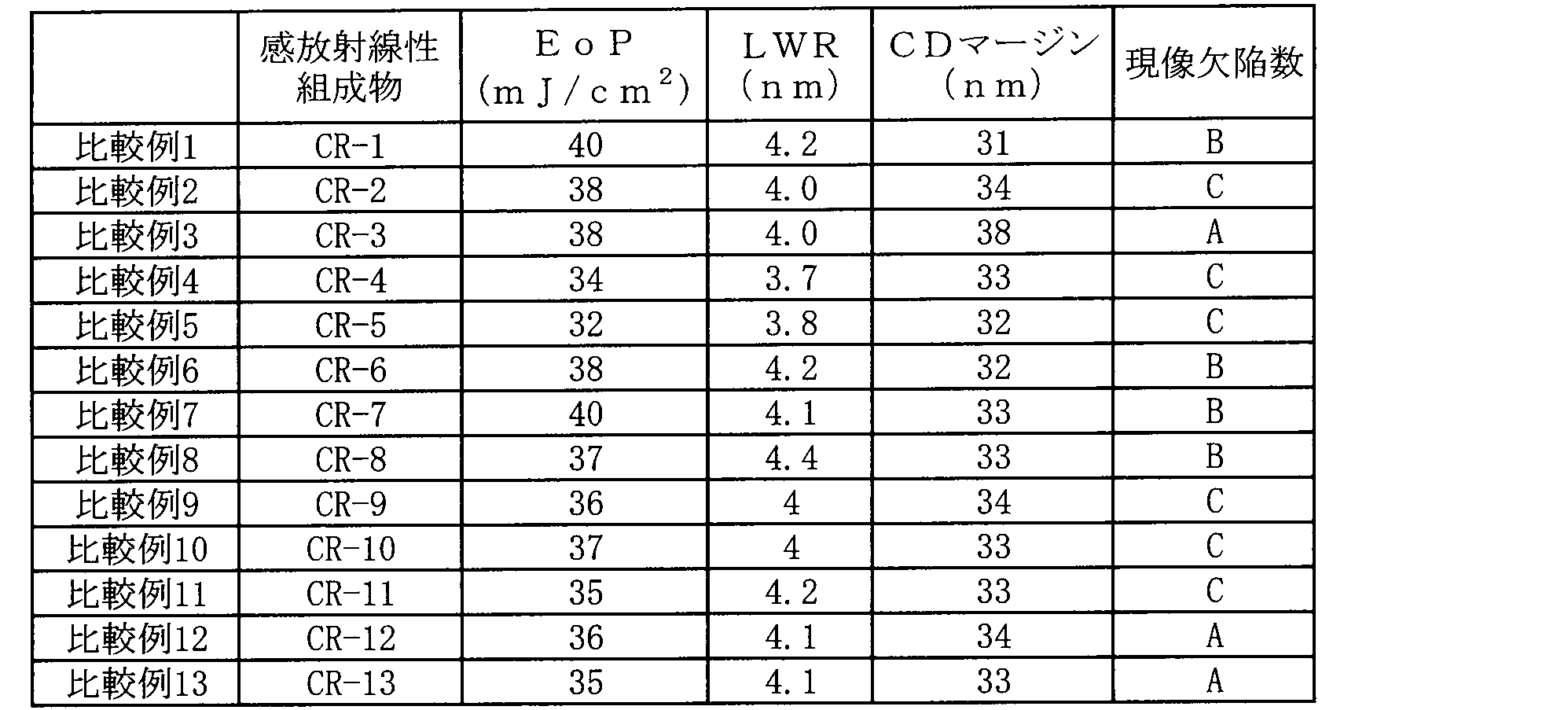
Claims (18)
- 酸解離性基を有する構造単位(U1)を含み、かつカルボキシ基を有する重合体(A)と、
感放射線性酸発生体(B)(ただし、前記重合体(A)を除く。)と、
を含有し、
前記重合体(A)及び前記感放射線性酸発生体(B)よりなる群から選択される1種以上の化合物がヨード基を有し、
前記重合体(A)が、カルボキシ基を有する構造単位(U2)を含み、
前記構造単位(U2)中のカルボキシ基が前記重合体(A)の主鎖を構成する炭素原子に結合しているか、前記構造単位(U2)が鎖状構造を有し当該鎖状構造にカルボキシ基が結合しているか、又は、前記構造単位(U2)が前記重合体(A)の主鎖を構成する炭素原子に結合する芳香環を有し当該芳香環にカルボキシ基が結合している、感放射線性組成物。 - 前記構造単位(U2)が下記式(1a)で表される、請求項1に記載の感放射線性組成物。

- 前記構造単位(U2)が下記式(1-1a)、式(1-2)又は式(1-3)で表される、請求項2に記載の感放射線性組成物。
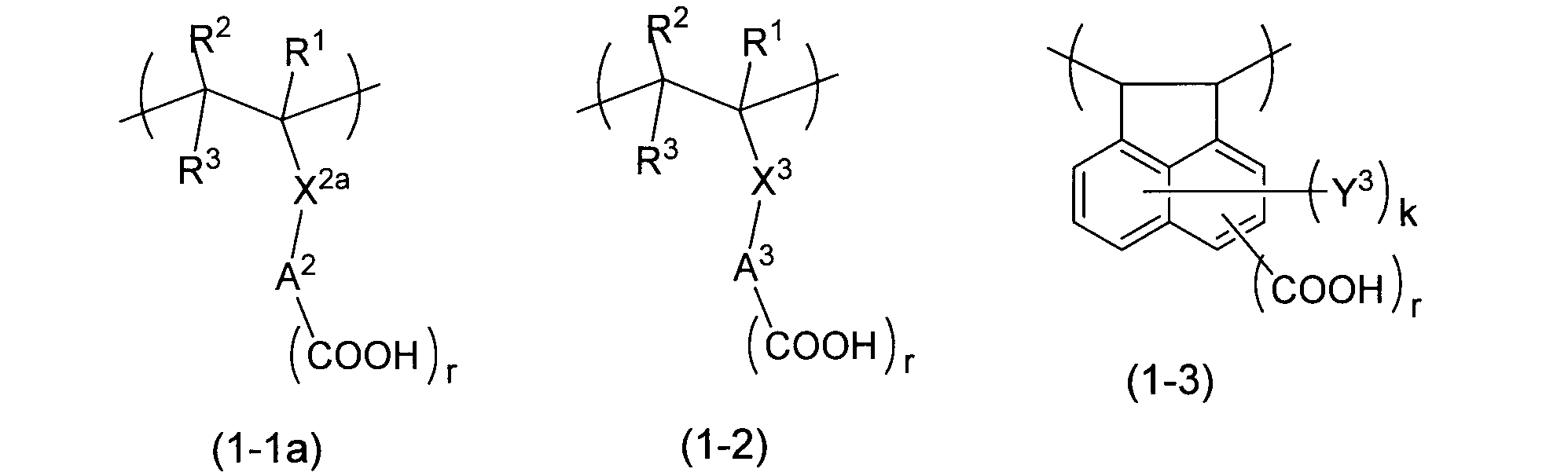
式(1-2)中、R1及びR2は、互いに独立して、水素原子、フッ素原子、メチル基又はトリフルオロメチル基である。X3は、単結合、*5-COO-、*5-CONH-、又は2価の芳香環基である。「*5」は主鎖との結合手を表す。X3が単結合の場合、A3は単結合である。X3が*5-COO-、*5-CONH-又は2価の芳香環基の場合、A3は、置換若しくは無置換の(r+1)価の鎖状炭化水素基であるか、又は置換若しくは無置換の鎖状炭化水素基におけるメチレン基が-O-、-S-、-CO-、-COO-、-NH-若しくは-CONH-で置き換えられた(r+1)価の基である。ただし、式(1-2)中のカルボキシ基は、A3中の鎖状炭化水素基に結合している。R3は、水素原子、フッ素原子、メチル基又はトリフルオロメチル基である。rは1以上の整数である。
式(1-3)中、rは1以上の整数である。Y3は、水酸基、ハロゲン原子、炭素数1~10の1価の炭化水素基又は炭素数1~10の1価のオキシ炭化水素基である。kは0~(6-r)の整数である。) - 上記式(1-1)で表される構造単位が下記式(2)で表される、請求項1に記載の感放射線性組成物。
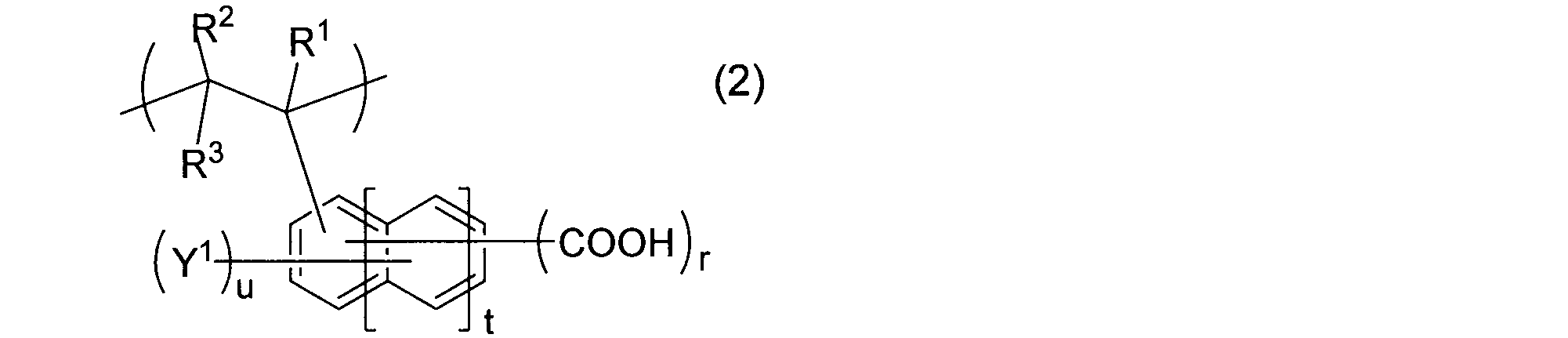
- 酸解離性基を有する構造単位(U1)を含み、かつカルボキシ基を有する重合体(A)と、
感放射線性酸発生体(B)(ただし、前記重合体(A)を除く。)と、
を含有し、
前記重合体(A)及び前記感放射線性酸発生体(B)よりなる群から選択される1種以上の化合物がヨード基を有し、
前記重合体(A)が、カルボキシ基を有する構造単位(U2)を含み、
下記の要件(a)及び要件(b)の少なくとも一方を満たす、感放射線性組成物。
要件(a):前記構造単位(U1)中にヨード基を有する。
要件(b):前記重合体(A)が、前記構造単位(U1)及び前記構造単位(U2)とは異なる構造単位(U3)を更に含み、前記構造単位(U3)中にヨード基を有する。 - 酸解離性基を有する構造単位(U1)を含み、かつカルボキシ基を有する重合体(A)と、
感放射線性酸発生体(B)(ただし、前記重合体(A)を除く。)、
と、
を含有し、
前記重合体(A)及び前記感放射線性酸発生体(B)よりなる群から選択される1種以上の化合物がヨード基を有し、
前記感放射線性酸発生体(B)が、有機アニオンとカチオンとからなるオニウム塩化合物を含み、
前記オニウム塩化合物が有する有機アニオン及びカチオンのうち一方又は両方が、芳香環にヨード基が結合した構造を有する、感放射線性組成物。 - 前記重合体(A)は、カルボキシ基を有する構造単位(U2)を含む、請求項6に記載の感放射線性組成物。
- 前記構造単位(U2)が下記式(1)で表される、請求項5又は7に記載の感放射線性組成物。

- 前記構造単位(U2)は、主鎖中の炭素原子に結合する芳香環を有し、当該芳香環にカルボキシ基が結合した部分構造を有する、請求項5又は7に記載の感放射線性組成物。
- 前記構造単位(U2)が下記式(2)で表される、請求項9に記載の感放射線性組成物。

- 前記構造単位(U2)中のカルボキシ基が、前記重合体(A)の主鎖を構成する炭素原子に結合しているか、又は鎖状構造に結合している、請求項5又は7に記載の感放射線性組成物。
- 前記構造単位(U1)及び前記構造単位(U2)よりなる群から選択される少なくとも1種の構造単位中にヨード基を有する、請求項1又は7に記載の感放射線性組成物。
- 前記重合体(A)は、前記構造単位(U1)及び前記構造単位(U2)とは異なる構造単位(U3)を更に含み、
前記構造単位(U3)中にヨード基を有する、請求項1又は7に記載の感放射線性組成物。 - 前記感放射線性酸発生体(B)は、第1の感放射線性酸発生体と、露光により前記第1の感放射線性酸発生体よりも酸性度が低い酸を発生する第2の感放射線性酸発生体とを含み、
前記第1の感放射線性酸発生体及び第2の感放射線性酸発生体よりなる群から選択される少なくとも1種の化合物がヨード基を有する、請求項1、5又は6に記載の感放射線性組成物。 - 前記感放射線性酸発生体(B)は、有機アニオンとカチオンとからなるオニウム塩化合物を含み、
前記オニウム塩化合物が有する有機アニオン及びカチオンのうち一方又は両方が、芳香環にヨード基が結合した構造を有する、請求項1又は5に記載の感放射線性組成物。 - 前記重合体(A)は、芳香環と当該芳香環に結合した水酸基とを有する構造単位を更に含む、請求項1、5又は6に記載の感放射線性組成物。
- 請求項1、5又は6に記載の感放射線性組成物を用いて、基板上にレジスト膜を形成する工程と、
前記レジスト膜を露光する工程と、
露光された前記レジスト膜を現像する工程と、
を含む、レジストパターン形成方法。 - 下記式(2A)で表される構造単位と、酸解離性基を有する構造単位とを含む、重合体。

Priority Applications (2)
| Application Number | Priority Date | Filing Date | Title |
|---|---|---|---|
| JP2025519339A JPWO2024232181A1 (ja) | 2023-05-09 | 2024-03-28 | |
| KR1020257036895A KR20260006578A (ko) | 2023-05-09 | 2024-03-28 | 감방사선성 조성물, 레지스트 패턴 형성 방법 및 중합체 |
Applications Claiming Priority (2)
| Application Number | Priority Date | Filing Date | Title |
|---|---|---|---|
| JP2023-077504 | 2023-05-09 | ||
| JP2023077504 | 2023-05-09 |
Publications (1)
| Publication Number | Publication Date |
|---|---|
| WO2024232181A1 true WO2024232181A1 (ja) | 2024-11-14 |
Family
ID=93431553
Family Applications (1)
| Application Number | Title | Priority Date | Filing Date |
|---|---|---|---|
| PCT/JP2024/012734 Ceased WO2024232181A1 (ja) | 2023-05-09 | 2024-03-28 | 感放射線性組成物、レジストパターン形成方法及び重合体 |
Country Status (4)
| Country | Link |
|---|---|
| JP (1) | JPWO2024232181A1 (ja) |
| KR (1) | KR20260006578A (ja) |
| TW (1) | TW202444772A (ja) |
| WO (1) | WO2024232181A1 (ja) |
Cited By (2)
| Publication number | Priority date | Publication date | Assignee | Title |
|---|---|---|---|---|
| WO2025084342A1 (ja) * | 2023-10-20 | 2025-04-24 | 三菱瓦斯化学株式会社 | ヨウ素含有(メタ)アクリレート化合物、ヨウ素含有(メタ)アクリレート(共)重合体、リソグラフィー用組成物、レジスト組成物、下層膜形成用組成物、及びヨウ素含有(メタ)アクリレート化合物の製造方法 |
| CN119916641A (zh) * | 2025-01-15 | 2025-05-02 | 上海玟昕科技有限公司 | 一种负性光刻胶组合物及其制备方法与应用 |
Citations (3)
| Publication number | Priority date | Publication date | Assignee | Title |
|---|---|---|---|---|
| WO2020255964A1 (ja) * | 2019-06-21 | 2020-12-24 | 富士フイルム株式会社 | 感活性光線性又は感放射線性樹脂組成物、レジスト膜、パターン形成方法、電子デバイスの製造方法 |
| WO2021251055A1 (ja) * | 2020-06-10 | 2021-12-16 | 富士フイルム株式会社 | 感活性光線性又は感放射線性樹脂組成物、レジスト膜、パターン形成方法、電子デバイスの製造方法 |
| JP2022115072A (ja) * | 2021-01-27 | 2022-08-08 | 信越化学工業株式会社 | ポジ型レジスト材料及びパターン形成方法 |
Family Cites Families (1)
| Publication number | Priority date | Publication date | Assignee | Title |
|---|---|---|---|---|
| JP2023036004A (ja) | 2021-09-01 | 2023-03-13 | 住友化学株式会社 | 塩、酸発生剤、レジスト組成物及びレジストパターンの製造方法 |
-
2024
- 2024-03-28 JP JP2025519339A patent/JPWO2024232181A1/ja active Pending
- 2024-03-28 WO PCT/JP2024/012734 patent/WO2024232181A1/ja not_active Ceased
- 2024-03-28 KR KR1020257036895A patent/KR20260006578A/ko active Pending
- 2024-04-17 TW TW113114240A patent/TW202444772A/zh unknown
Patent Citations (3)
| Publication number | Priority date | Publication date | Assignee | Title |
|---|---|---|---|---|
| WO2020255964A1 (ja) * | 2019-06-21 | 2020-12-24 | 富士フイルム株式会社 | 感活性光線性又は感放射線性樹脂組成物、レジスト膜、パターン形成方法、電子デバイスの製造方法 |
| WO2021251055A1 (ja) * | 2020-06-10 | 2021-12-16 | 富士フイルム株式会社 | 感活性光線性又は感放射線性樹脂組成物、レジスト膜、パターン形成方法、電子デバイスの製造方法 |
| JP2022115072A (ja) * | 2021-01-27 | 2022-08-08 | 信越化学工業株式会社 | ポジ型レジスト材料及びパターン形成方法 |
Cited By (2)
| Publication number | Priority date | Publication date | Assignee | Title |
|---|---|---|---|---|
| WO2025084342A1 (ja) * | 2023-10-20 | 2025-04-24 | 三菱瓦斯化学株式会社 | ヨウ素含有(メタ)アクリレート化合物、ヨウ素含有(メタ)アクリレート(共)重合体、リソグラフィー用組成物、レジスト組成物、下層膜形成用組成物、及びヨウ素含有(メタ)アクリレート化合物の製造方法 |
| CN119916641A (zh) * | 2025-01-15 | 2025-05-02 | 上海玟昕科技有限公司 | 一种负性光刻胶组合物及其制备方法与应用 |
Also Published As
| Publication number | Publication date |
|---|---|
| KR20260006578A (ko) | 2026-01-13 |
| TW202444772A (zh) | 2024-11-16 |
| JPWO2024232181A1 (ja) | 2024-11-14 |
Similar Documents
| Publication | Publication Date | Title |
|---|---|---|
| JP6959538B2 (ja) | 感放射線性樹脂組成物及びレジストパターン形成方法 | |
| TWI886124B (zh) | 感放射線性樹脂組成物、抗蝕劑圖案形成方法及化合物 | |
| JP2020008842A (ja) | 感放射線性樹脂組成物、レジストパターン形成方法及び重合体組成物 | |
| WO2024057701A1 (ja) | 感放射線性組成物、レジストパターン形成方法、感放射線性酸発生体及び重合体 | |
| JP7396360B2 (ja) | 感放射線性樹脂組成物、レジストパターン形成方法及び感放射線性酸発生剤 | |
| JP6705303B2 (ja) | 感放射線性樹脂組成物及びレジストパターン形成方法 | |
| WO2023119910A1 (ja) | 感放射線性組成物、レジストパターン形成方法、酸発生体及び化合物 | |
| KR20260006578A (ko) | 감방사선성 조성물, 레지스트 패턴 형성 방법 및 중합체 | |
| WO2024203352A1 (ja) | 感放射線性組成物、レジストパターン形成方法及び感放射線性酸発生体 | |
| WO2024127808A1 (ja) | 感放射線性組成物及びレジストパターン形成方法 | |
| JP2025185106A (ja) | オニウム塩化合物 | |
| WO2024190386A1 (ja) | 感放射線性組成物、レジストパターン形成方法、重合体及び化合物 | |
| WO2021215163A1 (ja) | 感放射線性樹脂組成物及びレジストパターン形成方法 | |
| WO2021153124A1 (ja) | 感放射線性樹脂組成物、レジストパターン形成方法及び感放射線性酸発生剤 | |
| US20210318613A9 (en) | Radiation-sensitive resin composition and resist pattern-forming method | |
| JP7751258B2 (ja) | 感放射線性樹脂組成物及びパターン形成方法 | |
| JP7459636B2 (ja) | 感放射線性樹脂組成物及びレジストパターン形成方法 | |
| WO2025249330A1 (ja) | 感放射線性組成物及びレジストパターン形成方法 | |
| WO2025037476A1 (ja) | 感放射線性組成物、レジストパターン形成方法及び重合体 | |
| WO2025142242A1 (ja) | 感放射線性組成物、レジストパターン形成方法、重合体及び化合物 | |
| WO2025032972A1 (ja) | 感放射線性組成物、レジストパターン形成方法及び重合体 | |
| WO2025253952A1 (ja) | 感放射線性組成物及びレジストパターン形成方法 | |
| WO2025197401A1 (ja) | 感放射線性組成物及びレジストパターン形成方法 | |
| WO2025239227A1 (ja) | 感放射線性組成物及びレジストパターン形成方法 | |
| WO2026053667A1 (ja) | 感放射線性組成物、レジストパターン形成方法、重合体及び化合物 |
Legal Events
| Date | Code | Title | Description |
|---|---|---|---|
| 121 | Ep: the epo has been informed by wipo that ep was designated in this application |
Ref document number: 24803296 Country of ref document: EP Kind code of ref document: A1 |
|
| ENP | Entry into the national phase |
Ref document number: 2025519339 Country of ref document: JP Kind code of ref document: A |
|
| WWE | Wipo information: entry into national phase |
Ref document number: 2025519339 Country of ref document: JP |
|
| NENP | Non-entry into the national phase |
Ref country code: DE |
|
| 122 | Ep: pct application non-entry in european phase |
Ref document number: 24803296 Country of ref document: EP Kind code of ref document: A1 |