WO2024232173A1 - 玩具部品及び玩具 - Google Patents
玩具部品及び玩具 Download PDFInfo
- Publication number
- WO2024232173A1 WO2024232173A1 PCT/JP2024/011813 JP2024011813W WO2024232173A1 WO 2024232173 A1 WO2024232173 A1 WO 2024232173A1 JP 2024011813 W JP2024011813 W JP 2024011813W WO 2024232173 A1 WO2024232173 A1 WO 2024232173A1
- Authority
- WO
- WIPO (PCT)
- Prior art keywords
- toy
- subpart
- size
- parts
- opening
- Prior art date
- Legal status (The legal status is an assumption and is not a legal conclusion. Google has not performed a legal analysis and makes no representation as to the accuracy of the status listed.)
- Ceased
Links
Images





Classifications
-
- A—HUMAN NECESSITIES
- A63—SPORTS; GAMES; AMUSEMENTS
- A63H—TOYS, e.g. TOPS, DOLLS, HOOPS OR BUILDING BLOCKS
- A63H3/00—Dolls
-
- A—HUMAN NECESSITIES
- A63—SPORTS; GAMES; AMUSEMENTS
- A63H—TOYS, e.g. TOPS, DOLLS, HOOPS OR BUILDING BLOCKS
- A63H3/00—Dolls
- A63H3/36—Details; Accessories
- A63H3/46—Connections for limbs
Definitions
- the present invention relates to toy parts and toys.
- Assembly toys are assembled by combining multiple parts.
- Patent Document 1 describes a plastic model in which each part is assembled by combining two plastic parts, one on the front and one on the back.
- the plastic parts have projections and recesses, which are combined to join the parts together.
- the present invention provides toy parts and toys that allow the combination of parts to be changed depending on the type of toy.
- One aspect of the present invention is, for example, a toy component for an assembly toy, comprising a first part, a second part, and a third part configured to be connectable to the first part and the second part, the first part and the second part having the same configuration of a first portion that connects to the third part, and configured to differ from each other in some configurations of the parts, and the first part and the second part are configured to be used in a reconfigurable manner with the third part depending on the type of the toy.
- Another aspect of the present invention is an assembly toy that includes, for example, the toy parts described above.
- the present invention provides toy parts and toys that allow the combination of parts to be changed depending on the type of toy.
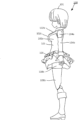
- FIG. 2 is a diagram showing an example of an external front view of a toy object according to an embodiment.
- FIG. 2 is a diagram showing an example of an exterior side surface of a toy object according to an embodiment.
- FIG. 1 is a diagram showing an example of the external front appearance of a plurality of toy objects of different sizes according to an embodiment.
- 11A to 11C are diagrams showing examples of the structure of a portion of a leg of a toy object of different size according to an embodiment.
- 4A to 4C are diagrams for explaining the structure of parts that configure the leg portion shown in FIG. 3 according to one embodiment.
- 11A to 11C are diagrams illustrating examples of chest structures of toy bodies of different sizes according to an embodiment.
- FIGS. 11A to 11C are diagrams showing examples of cross-sectional structures of the chests of toy bodies of different sizes according to an embodiment.
- FIG. 13 is a diagram showing an example of a mark indicating a size that is attached to a toy part of a toy body according to one embodiment.
- the up, down, left and right directions on the paper surface will be used in the description in the text as the up, down, left and right directions of the parts (or components) in this embodiment.
- the present invention uses ABS (acrylonitrile-butadiene-styrene) resin, SBC (styrene-butadiene copolymer), and other molding materials as examples, but is not limited to these, and does not exclude the use of other materials (thermoplastic resins such as polyethylene, thermosetting resins, soft resins, metals, etc.).
- Figure 1A shows the exterior front of the toy body 100.
- Figure 1B shows the exterior side of the toy body 100. Note that the up/down, left/right, and front/back arrows indicate the orientation of the toy body in the figure, and this also applies to the other figures.
- the toy body 100 can be constructed by combining multiple parts.
- the appearance of the toy body 100 may be, for example, a doll type or an animal type.
- the toy body 100 comprises a head 101, a chest 102, a right arm 103, a left arm 104, an abdomen 105, a waist 106, a right leg 107, and a left leg 108.
- the toy body 100 is a movable toy body such as a movable figure, and each part can be moved within a limited range caused by its relationship with other members.
- the head 101 is connected to the chest 102 by a spherical connecting member (hereinafter also referred to as a ball joint).
- the chest 102 can be separated into a bust section 102a, a clavicle section 102b, and a costume section 102c, and the right arm section 103 and the left arm section 104 are further connected by a spherical connecting member.
- the right arm section 103 is composed of a right shoulder section 103a and a right arm main body section 103b
- the left arm section 104 is composed of a left shoulder section 104a and a left arm main body section 104b.
- an abdomen 105 is connected to the lower part of the chest 102. The detailed configurations of the chest 102 and the arms 103 and 104 will be described later.
- a waist section 106 is connected to the abdomen 105.
- a right leg section 107 and a left leg section 108 are connected to the waist section 106, and are covered with decorative parts such as a skirt.
- the right leg 107 is composed of a right hip joint 107a and a right leg body 107b
- the left leg 108 is composed of a left hip joint 108a and a left leg body 108b.
- the upper body including the head 101, chest 102, right arm 103, and left arm 104 will be referred to as the upper body.
- the lower body including the waist 106, right leg 107, and left leg 108 will be referred to as the lower body.
- the upper body and lower body are connected via the abdomen 105.
- the chest 102, abdomen 105, and waist 106 will also be collectively referred to as the torso.
- the structure of the legs and hip joints will be mainly described as the movable structure according to this embodiment. However, this is not intended to limit the present invention, and the movable structure described below can be applied not only to the legs and hip joints, but also to other joints such as shoulder joints and chest joints that connect the arms.
- size includes the height (or overall length) and other physical characteristics (bust, waist, hips, etc.) of the character represented by the toy body 100.
- the sizes of the toy body 100 are classified into four types, S, M, L, and LL, according to height.
- S, M, L, and LL the sizes of the toy body 100 are classified into four types, S, M, L, and LL, according to height.
- S, M, L, and LL the sizes of the toy body 100 are classified into four types, S, M, L, and LL, according to height.
- S, M, L, and LL the sizes of the toy body 100
- the size of a toy body this refers to the height size.
- the chest 102 refers to the bust size.
- characters may have the same height but different physical characteristics.
- a toy body 100 with a height of S can have a bust size of S, M, or L. Even if the height and physical characteristics are the same, the type of character represented by the toy body 100 can be different by changing the face or hairstyle.
- Figure 2(a) shows an example of the appearance of a small-sized toy body 100S.
- Figure 2(b) shows an example of the appearance of a medium-sized toy body 100M.
- Figure 2(c) shows an example of the appearance of a large-sized toy body 100L.
- Figure 2(d) shows an example of the appearance of an extra-large-sized toy body 100LL.
- an example is described in which the smaller the stature, the smaller the physical features, but the height and the physical features do not necessarily need to match.
- These different sized toy bodies 100S to 100LL can be constructed by combining common parts and size-specific parts regardless of size.
- the common parts can be, for example, the right arm body part 103b, the left arm body part 104b, the right leg body part 107b, and the left leg body part 108b.
- the abdomen 105 and waist part 106 can also be common, but in FIG. 2 they are common between toy bodies 100S and 100M, and between toy bodies 100L and 100LL, respectively.
- the user can change the size of the toy body 100, for example, from 100S to 100L, or change the style of the toy body 100 while keeping the size of the toy body the same (for example, change the bust size from S to M or L).
- the head and face can of course be made unique parts to identify the character, but the right hip joint 107a and left hip joint 108a can be made unique for each size.
- toy body 100S has right hip joint 107as and left hip joint 108as
- toy body 100M has right hip joint 107am and left hip joint 108am
- toy body 100L has right hip joint 107al and left hip joint 108al
- toy body 100LL has right hip joint 107all and left hip joint 108all.
- These hip joints have the same basic structure except that their length (height) differs for each size. In this way, by changing the length of the hip joints, the height of each toy body 100 can be changed. Also, since the hip joints can be hidden by clothing, the viewer does not feel uncomfortable even if the legs are of different lengths.
- the right shoulder 103as and the left shoulder 104as are used in common for the toy bodies 100S and 100M, and the right shoulder 103al and the left shoulder 104al are used in common for the toy bodies 100L and 100LL.
- the right shoulder 103a and the left shoulder 104a each include a shoulder joint and are the parts that connect to the chest 102.
- the right shoulder 103a also accounts for part of the length of the right arm 103, and when the length of the right shoulder 103a increases, the length of the right arm 103 increases when combined with the length of the right arm main body 103b, which is used in common.
- the length of the right arm would be noticeable in the LL-sized toy body 100LL, which could cause a sense of discomfort.
- the same is true for the left arm 104. If the arms are too long like this, it can feel unnatural and can give the impression of being unbalanced as a doll body, so the length is made standardized to a certain extent.
- the arms are standardized for S, M, L, and LL sizes, but they can also be standardized for all sizes from S to LL.
- the toy bodies 100S and 100M share the same bust portion 102as and clavicle portion 102bs, while the toy bodies 100L and 100LL share the same bust portion 102al and clavicle portion 102bl, but the bust portion 102a and clavicle portion 102b may be prepared for each size.
- the costume portion 102c is omitted in FIG. 2, but it may be prepared for each type of toy body 100, including the configuration of the costume portion.
- the configuration of the costume portion 102c may also have a common design, or may have a different design for each character.
- bust portion 102a, clavicle portion 102b, and costume portion 102c are connected to form the chest portion 102, matching the sizes can be used to avoid any visual discomfort.
- the connection surfaces between the bust portion and clavicle portion do not connect well, creating a visual discomfort.
- Fig. 3(a) is a diagram showing an example of the appearance of the leg 107 of the toy body 100S.
- Fig. 3(b) is a diagram showing an example of the appearance of the right leg 107 of the toy body 100M.
- the right leg body 107b is common to the toy bodies 100S and 100M.
- Fig. 3 only the part above the knee of the leg 107b is shown, and the part below the knee is omitted, but the part below the knee is also common.
- the heights of the right hip joint parts 107as and 107am are different.
- the user can see that the right hip joint parts 107as and 107a m, the configuration of the legs 107 of the toy body can be changed.
- FIG. 3 shows the configuration of the legs 107 for toy bodies 100S and 100M, but the same is true for toy bodies 100L and 100LL.
- this embodiment uses parts specific to the size of toy body 100 (or parts that differ for each size) and common parts regardless of size, so even if the parts are specific, the connection parts with the common parts are made in the same shape.
- right hip joints 107as and 107am have different heights (or lengths)
- the connection parts with right leg body part 107b are configured in the same way
- the joining part with connection part 301 is also configured in the same way.
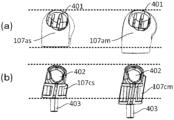
- FIG. 4(a) shows a comparison between the right hip joint portion 107as and the right hip joint portion 107am.
- the dotted line when the top of the right hip joint portion 107as is aligned with the top of the right hip joint portion 107am, it can be seen that the right hip joint portion 107am extends more downward than the right hip joint portion 107as.
- the configuration of the opening 401 provided in the right hip joint portion 107as and the right hip joint portion 107am is the same, including the size of the opening and the internal structure.
- FIG. 4(b) shows an example of the appearance of subparts 107cs and 107cm arranged inside hip joints 107as and 107am.
- Subparts 107cs and 107cm each have an opening 402 and a protrusion 403, and opening 402 and protrusion 403 each have a common size and shape.
- subparts 107cs and 107cm have different lengths corresponding to the heights of hip joints 107as and 107am. As shown by the dotted line, when the top of subpart 107cs is aligned with the top of subpart 107cm, it can be seen that subpart 107cm extends more downward than subpart 107cs.
- protrusion 403 are common. This is to make a common connection to right leg body 107b. Additionally, hip joints 107as and 107am have openings at their bottoms, and when sub-parts 107cs and 107cm are inserted through these openings, opening 402 is positioned at the opening of opening 401, and protrusion 403 protrudes from the bottom opening. In this way, even in toy parts specific to a size, there are common parts and unique parts, and compatibility with other toy parts of different sizes is maintained when connecting to other parts.
- FIG. 5A(a) is a diagram showing an example of the appearance of the chest 102s of the toy bodies 100S and 100M.
- Fig. 5A(b) is a diagram showing an example of the appearance of the chest 102l of the toy bodies 100L and 100LL. The user can change the configuration of the toy body's chest 102 to either the chest 102s or the chest 102l by replacing parts.
- Fig. 5B(a) is an A-A cross-sectional view of the chest 102 shown in Fig. 5A(a).
- Fig. 5B(b) is a B-B cross-sectional view of the chest 102 shown in Fig. 5A(b).
- the chest 102 is configured to include a bust portion 102a, a clavicle portion 102b, and a costume portion 102c according to the bust size.
- the chest 102 may also include other components that constitute the skeleton.
- FIG. 5A shows a combination of a bust portion 102as, a clavicle portion 102bs, and a costume portion 102cs, and a combination of a bust portion 102al, a clavicle portion 102bl, and a costume portion 102cl.
- the parts where these parts connect are configured to have a depth (or width, thickness, fullness, etc.) specific to the bust size, so when the parts are swapped, the connection surface is not continuous, which creates a visual sense of incongruity, so it is desirable to configure the chest 102 by combining parts of each size.
- the chest 102 is configured to have different depths, widths, or fullness of the parts.
- the depth (or width) d1, d2 of the bust portion 102as and 102al differ to reflect the size of the bust of the toy body 100.
- the depth d2 of the bust portion 102al which has a larger bust size, is greater than the depth d1 of the bust portion 102as.
- the clavicle portion 102b located above the bust portion 102a also has a larger bulge near the connection surface with the bust portion 102a in 102bl than in 102bs.
- the clavicle portion 102bl has a gentle slope near the connection surface with the bust portion 102al, with the end protruding to the outside of the toy body 100, whereas the clavicle portion 102bs has a steeper slope near the connection surface with the bust portion 102as, with the end located further inside the toy body 100.
- costume part 102c is fuller than costume part 102cs at the boundary between bust part 102a and clavicle part 102b. This is also evident from the fact that, of costume parts 102cs and 102cl shown in cross section in FIG. 5B, 102cl is located on the outer front side of toy body 100.
- chest part 102 has a connection part 501 for connecting to abdomen 105, and the configuration of connection part 501 is the same regardless of size.
- Figure 6 shows an example of a label that indicates which size each individual part corresponds to.
- the part size could be indicated on the part's runner, but once the part is removed from the runner it becomes difficult to determine the size individually, so each part is given a label to identify its size. By checking the label when changing parts, the user can easily determine which size a part corresponds to.
- Figures 6(a) and (b) are views showing the appearance of subparts 107cs and 107cm shown in Figure 4(b) from different angles.
- Figure 6(a) shows subpart 107cs, which is marked with a triangular mark 601.
- Figure 6(b) shows subpart 107cm, which is marked with a circular mark 602. That is, a triangle indicates S size, and a circle indicates M size. Alternatively, a square may indicate L size, and a star may indicate LL size.
- Figure 6(c) shows an example of adding a marker indicating the size of a cylindrical part, where a round marker 603 has been added. This shows that this part is a medium-sized part.
- Figures 6(d) to (f) show the same costume parts, but the number of lines shown in the mold is different.
- Marker 604 in Figure 6(d) has one line
- mark 605 in Figure 6(e) has two lines
- mark 606 in Figure 6(f) has three lines.
- one line can be small size
- two lines can be medium size
- three lines can be large size.
- four lines can also be large size.
- sizes can be indicated using the rock, paper, scissors symbols or animals. Or they can be symbols such as a unicycle, bicycle, tricycle, or quadruple wheel vehicle. Sizes can also be indicated using the alphabet (A, B, C), Arabic numerals (1, 2, 3), Roman numerals (I, II, III), or Greek letters ( ⁇ , ⁇ , ⁇ , etc.). Size labels can also be placed on the inside of the parts.
- the user can easily change the size and style of the toy body. For example, by replacing the right hip joint 107a, the length of the leg 107 can be easily changed, and as a result, the size of the toy body can be changed. Also, by replacing the parts that make up the chest 102, the bust size can be changed from S to M or L. Also, for example, by selling size-specific parts as a set, the user can enjoy changing the size and style of the toy body without having to purchase the entire doll toy, thereby improving playability.
- size-specific parts are created with common connection parts with parts of the same size, so even if the user replaces size-specific parts, the size can be changed naturally without creating discontinuous surfaces in the appearance of the toy.
- a toy part for an assembly-type toy comprising a first part, a second part, and a third part configured to be connectable to the first part and the second part, the first part and the second part have the same configuration of a first portion that connects to the third part, and are configured to differ from each other in a configuration of a part, and the first part and the second part are configured to be used by being recombined with the third part depending on the type of the toy.
- the toy part according to (1) in which the type of the toy is at least one of the height and physical characteristics of the toy.
- the mark is provided on a part surface that is not exposed to the outside when the first part and the second part are connected to other parts.
Landscapes
- Toys (AREA)
Abstract
【課題】パーツの組合せは固定的であり、玩具の種別に応じてパーツの組合せを変更することができない。【解決手段】組み立て式の玩具の玩具部品であって、第1のパーツと、第2のパーツと、前記第1のパーツ及び前記第2のパーツと接続可能に構成された第3のパーツとを備え、前記第1のパーツと前記第2のパーツとは、前記第3のパーツと接続する第1の部分の構成が同一であり、かつ、パーツの一部の構成において互いに異なるように構成され、前記第1のパーツと前記第2のパーツとは、前記玩具の種別に応じて前記第3のパーツに対して組み換えて使用されるよう構成されている。
Description
本発明は、玩具部品及び玩具に関する。
組立て玩具(例えば、人形型の組立玩具)は、複数のパーツを組み合わせることで組み立てられる。例えば、特許文献1では、プラスチック製のパーツが表裏2個で1組となって各部位が組み立てられるプラスチックモデルが記載されている。当該プラスチック製のパーツに凹凸が形成されており、これを組み合わせることでパーツが結合される。
しかし、従来技術では、パーツの組合せは固定的であり、玩具の種別に応じてパーツの組合せを変更することができない。
本発明は、玩具の種別に応じてパーツの組合せを変更することを可能とする玩具部品及び玩具を提供する。
本発明の一つは、例えば組み立て式の玩具の玩具部品であって、第1のパーツと、第2のパーツと、前記第1のパーツ及び前記第2のパーツと接続可能に構成された第3のパーツとを備え、前記第1のパーツと前記第2のパーツとは、前記第3のパーツと接続する第1の部分の構成が同一であり、かつ、パーツの一部の構成において互いに異なるように構成され、前記第1のパーツと前記第2のパーツとは、前記玩具の種別に応じて前記第3のパーツに対して組み換えて使用されるよう構成されている。
本発明の他の一つは、例えば上述の玩具部品を含む組み立て式の玩具である。
本発明によれば、玩具の種別に応じてパーツの組合せを変更することを可能とする玩具部品及び玩具を提供することができる。
以下、添付図面を参照して実施形態を詳しく説明する。尚、以下の実施形態は特許請求の範囲に係る発明を限定するものではなく、また実施形態で説明されている特徴の組み合わせの全てが発明に必須のものとは限らない。実施形態で説明されている複数の特徴うち二つ以上の特徴が任意に組み合わされてもよい。また、同一若しくは同様の構成には同一の参照番号を付し、重複した説明は省略する。
また、各図において、紙面における上下左右方向を、本実施形態における部品(またはパーツ)の上下左右方向として、本文中の説明の際に用いることとする。なお本発明は、以下に説明する実施形態おいて成形材料としてABS(アクリロニトリル (Acrylonitrile)・ブタジエン (Butadiene)・スチレン (Styrene))樹脂及び、SBC(スチレン(styrene)・ブタジエン(butadiene)共重合体(copolymer)、スチレン系特殊透明樹脂)等を例示するがこれに限定されず、他の材質(ポリエチレン等の熱可塑性樹脂、熱硬化性樹脂、軟質樹脂、金属等)の利用を排除するものではない。
<玩具体の外観> まず、図1A及び図1Bを参照して、本実施形態に係る玩具体100の外観構成の一例について説明する。図1Aは玩具体100の外観正面を示す。図1Bは玩具体100の外観側面を示す。なお、上下、左右、前後の矢印については図における玩具体の向きを示し、他の図面についても同様である。
玩具体100は、複数のパーツを組み合わせて構成することができる。また、玩具体100の外観は、例えば、人形型でも動物型でもよい。玩具体100は、頭部101、胸部102、右腕部103、左腕部104、腹部105、腰部106、及び右脚部107、左脚部108を備える。玩具体100は、可動フィギアなどの可動式の玩具体であり、各パーツは他の部材との関係で生じる制限領域の範囲内で可動させることができる。頭部101は胸部102に球形状の連結部材によって連結される(以下では、ボールジョイントとも称する。)。
胸部102は、バスト部102a、鎖骨部102b及び衣装部102cに分離することができ、さらに右腕部103及び左腕部104が球形状の連結部材で連結される。右腕部103は、右肩部103aと右腕本体部103bとで構成され、左腕部104は、左肩部104aと左腕本体部104bとで構成される。また、胸部102の下部において腹部105が連結される。胸部102、腕部103、104の詳細な構成については後述する。腹部105には腰部106が連結される。腰部106には右脚部107及び左脚部108が連結され、スカート等の装飾部パーツで覆われる。右脚部107は、右股関節部107aと右脚本体部107bとで構成され、左脚部108は、左股関節部108aと左脚本体部108bとで構成される。
以下では、頭部101、胸部102、及び右腕部103、左腕部104を含む上半身を上体部と称する。また、腰部106、右脚部107、左脚部108を含む下半身を下体部と称する。上体部及び下体部は腹部105を介して連結される。また、胸部102、腹部105、及び腰部106をまとめて胴体部とも称する。以下では、本実施形態に係る可動構造として、主に脚部及び股関節の構造について説明する。しかしながら、本発明を限定する意図はなく、以下で説明する可動構造は、脚部や股関節に限らず、他の関節部、例えば腕部を連結する肩関節や胸関節などの関節部に適用することも可能である。
<サイズの異なる玩具体の外観> 次に、図2を参照して、本実施形態に係るサイズの異なる玩具体100の外観の違いを説明する。本実施形態において、サイズには、玩具体100が表すキャラクタの身長(或いは全長)やその他の身体的特徴(バスト、ウエスト、ヒップ等)が含まれる。図2では、玩具体100のサイズを、身長の大きさに応じてS、M、L、LLの四種類に分類することとする。以下、玩具体のサイズといった場合には、この身長のサイズを指しているものである。一方、身体的特徴についてサイズといった場合には、例えば胸部102であればバストサイズのことを指しているものとする。
なお、本実施形態においては同じ身長でも身体的特徴が異なっていてもよい。例えば、身長がSサイズの玩具体100について、バストサイズをS、M、Lのいずれかとすることができる。また、身長及び身体的特徴が同じであっても、顔や髪型が異ならせることで玩具体100が示すキャラクタの種別を異ならせることができる。
図2(a)は小サイズの玩具体100Sの外観の一例を示す。図2(b)は中サイズの玩具体100Mの外観の一例を示す。図2(c)は大サイズの玩具体100Lの外観の一例を示す。図2(d)は特大サイズの玩具体100LLの外観の一例を示す。図2の例では、身長が小さいほど、身体的特徴も小さい例で説明するが、身長の大きさと身体的特徴の大きさは必ずしも一致していなくてよい。
これらのサイズの異なる玩具体100Sから100LLは、サイズに関わらず共通のパーツとサイズ固有のパーツとを組み合わせることにより構成することができる。共通のパーツは、例えば、右腕本体部103b、左腕本体部104b、右脚本体部107b、左脚本体部108bとすることができる。また、腹部105、腰部106を共通とすることもできるが、図2では、玩具体100S、100Mの間、100L、100LLの間でそれぞれ共通としている。ユーザはサイズ固有のパーツを入れ替えることで、玩具体100のサイズを例えば100Sから100Lに変更したり、玩具体のサイズを維持したままで、玩具体100のスタイルを変更したりする(例えば、バストサイズをSからM或いはLに変更する)ことができる。
頭部や顔についてはキャラクタの識別のために当然に固有のパーツとすることができるが、右股関節部107a、左股関節部108aは、各サイズについて固有とすることができる。よって、玩具体100Sは、右股関節部107as、左股関節部108as、玩具体100Mは右股関節部107am、左股関節部108am、玩具体100Lは右股関節部107al、左股関節部108al、玩具体100LLは右股関節部107all、左股関節部108allを有する。これらの股関節部はサイズ毎に長さ(高さ)が異なる以外は基本的な構成は共通である。このようにして股関節部の長さを変えることによりそれぞれの玩具体100の身長を変えることができる。また、股関節部は衣装により隠すことができるので、脚の長さが違っても見るものに違和感を感じさせることが無い。
また、図2では、玩具体100Sと100Mとについて、共通の右肩部103as、左肩部104asを使用し、玩具体100Lと100LLとについては、共通の右肩部103al、左肩部104alを使用している。右肩部103a、左肩部104aは、それぞれ肩関節部を含み、胸部102との接続を行う部位である。また、右肩部103aは右腕部103の長さの一部を担っており、右肩部103aの長さが長くなると、共通で用いられる右腕本体部103bの長さとの合計で、右腕部103の長さが長くなる。よって、右肩部103aをサイズごとに用意すると、LLサイズの玩具体100LLでは右腕の長さが目立ってしまい、違和感を感じさせることにもなりかねない。左腕部104についても同様である。このように腕の長さが伸び過ぎると違和感が生じ、また人形体としてアンバランスな印象を与えるおそれがあるため、長さについてはある程度共通化させることとしている。図2では、S、Mサイズ、L、LLサイズでそれぞれ共通としたがSからLLサイズまでで全て共通としてもよい。
また、玩具体100Sと100Mとについて、共通のバスト部102as、鎖骨部102bsを使用し、玩具体100Lと100LLとについては、共通のバスト部102al、鎖骨部102blを使用しているが、バスト部102aと鎖骨部102bについては、サイズ毎に用意してもよい。図2では衣装部102cを省略しているが、衣装部の構成を含めて玩具体100の種類ごとに用意してもよい。また、衣装部102cの構成はデザイン共通としてもよいし、キャラクタごとに異なるデザインとしてもよい。
更に、バスト部102a、鎖骨部102b及び衣装部102cは連結されて胸部102を構成しているので、サイズを合わせることで視覚的な違和感を感じさないようにすることができる。例えば、バスト部102asと鎖骨部102blとを組み合わせた場合、或いは、バスト部102alと鎖骨部102bsを組み合わせた場合、バスト部と鎖骨部との接続面が上手くつながらないため視覚的な違和感が発生する。このような事態を防止するため、バスト部、鎖骨部及び衣装部は同じサイズで組み合わせることが望ましい。
<脚部の構成例> 次に図3を参照して、本実施形態に係る玩具体100の脚部107のサイズの違いについて説明する。図3(a)は、玩具体100Sの脚部107の外観の一例を示す図である。図3(b)は、玩具体100Mの右脚部107の外観の一例を示す図である。玩具体100Sと100Mとで、右脚本体部107bは共通である。但し、図3では、脚部107bを膝上のみを示し、膝下を省略しているが膝下も共通である。一方、右股関節部107asと107amとでは、高さが異なっていることが分かる。ユーザは右股関節部107asと107a
mとを交換することにより、玩具体の脚部107の構成を変更することができる。
mとを交換することにより、玩具体の脚部107の構成を変更することができる。
このように玩具体100のサイズに応じて股関節部の高さを変えることにより脚部107の長さが変わり、その結果として玩具体100の身長が変わる。股関節部107aは接続部301と結合しているが、当該接続部301は玩具体100のサイズに関わらず共通である。図3は玩具体100Sと100Mについて脚部107の構成を示したが玩具体100Lと100LLについても同様である。
このように、本実施形態では玩具体100のサイズに固有のパーツ(或いは、サイズ毎に異なるパーツ)と、サイズに関わらず共通のパーツとを用いるため、固有のパーツであっても、共通のパーツとの接続部は同一の形態で作成されている。図3では、右股関節部107asと107amとは高さ(或いは長さ)が異なるものの、右脚本体部107bとの接続部分は同様に構成されており、また、接続部301との結合部分も同様に構成されている。
次に、図4を参照して、図3に示した右股関節部107aの内部構造について説明する。図4(a)は、右股関節部107asと右股関節部107amとの比較を示している。点線で示している通り、右股関節部107asの頂部と右股関節部107amの頂部とを一致させると、右股関節部107asよりも右股関節部107amの方が下方向に伸びていることが分かる。但し、右股関節部107as及び右股関節部107amに設けられた開口部401の構成は、開口の大きさ及び内部の構造を含め共通である。
次に図4(b)は、股関節部107asと107amの内部に配置されるサブパーツ107csと107cmの外観の一例を示す。サブパーツ107cs、107cmは、それぞれ開口402と突起部403とを有しており、開口402と突起部403はそれぞれ共通の大きさ及び形状を有する。但し、サブパーツ107csと107cmとは、股関節部107asと107amの高さに対応して、長さが異なっている。点線で示している通り、サブパーツ107csの頂部とサブパーツ107cmの頂部とを一致させると、サブパーツ107csよりもサブパーツ107cmの方が下方向に伸びていることが分かる。このとき突起部403の長さ及び形状は共通である。これは、右脚本体部107bとの接続を共通に行うためである。また、股関節部107asと107amには底部に開口が設けられており、当該底部開口からサブパーツ107cs、107cmをそれぞれ挿入すると、開口402が開口部401の開口に位置し、底部開口から突起部403が突出する。このように、サイズに固有の玩具部品においても、共通部分と固有部分とが存在しており、他のパーツとの接続においてはサイズ違いの他の玩具部品との互換性が保たれている。
<胸部の構成例> 次に、図5A及び図5Bを参照して、本実施形態に係る玩具体100の胸部102の構造及びサイズの違いによるパーツ構成の違いついて説明する。図5A(a)は、玩具体100S、100Mの胸部102sの外観の一例を示す図である。図5A(b)は、玩具体100L、100LLの胸部102lの外観の一例を示す図である。ユーザはパーツを交換することにより、玩具体の胸部102の構成を胸部102sと胸部102lとのいずれかに変更することができる。なお、玩具体100Sと100M、玩具体100Lと100LLとで、胸部102の構成を共通としているが、玩具体100のサイズに応じて異ならせてもよい。図5B(a)は、図5A(a)に示した胸部102のA-A断面図である。図5B(b)は、図5A(b)に示した胸部102のB-B断面図である。
本実施形態において、胸部102は、バストのサイズに応じたバスト部102a、鎖骨部102b、衣装部102cを含むように構成される。胸部102はその他、骨格を構成する部材を含むことができる。図5Aでは、バスト部102as、鎖骨部102bs、衣装部102csの組合せと、バスト部102alと、鎖骨部102bl、衣装部102clとの組み合わせを示している。これらのパーツが接続する部分は、バストサイズに固有の奥行(或いは、幅、厚み、膨らみ等)を有するように構成されているため、パーツを入れ替えた場合には接続面が連続せず、視覚的な違和感を生じさせるので、サイズ毎の組み合わせにより胸部102を構成することが望ましい。また、上述の脚部107においてはパーツの長さ或いは高さが違っていたが、胸部102の構成においては、パーツの奥行や幅或いは膨らみが異なるように構成されている。
例えば、図5Bに示すように、バスト部102asと102alとでは、玩具体100のバストの大きさを反映するようにパーツの奥行(或いは幅)d1、d2の値が異なっている。ここでは、バストサイズがより大きいバスト部102alの奥行d2の方がバスト部102asの奥行d1よりも大きい。それに伴い、バスト部102aの上側に位置する鎖骨部102bも、鎖骨部102bsよりも、102blの方が、バスト部102aとの接続面付近の膨らみが大きくなっている。具体的には、鎖骨部102blではバスト部102alの接続面付近において傾きがなだらかになって、端部が玩具体100の外側に突出しているのに対し、鎖骨部102bsではバスト部102asの接続面付近において傾きがより急になっており、端部が玩具体100のより内側に位置している。これはバストのサイズを反映したものである。また、衣装部102cについても、バスト部102aと鎖骨部102bとの境において、衣装部102csよりも102clの方がふくらみが大きくなっている。このことは、図5Bにおいて断面で示す衣装部102csと102clのうち、102clの方が玩具体100の正面外側に位置していることからも明らかである。なお、胸部102は、腹部105と接続するための接続部501を有しており、接続部501の構成は、サイズに関わらず共通である。
<パーツサイズの識別> 次に、図6を参照して、パーツサイズの識別方法について説明する。図6は、個々のパーツがどのサイズに対応しているかを示す標識の例を示している。例えばパーツのランナーにパーツサイズを示すこともできるが、ランナーから取り外してしまった後はサイズを単体で判別することが困難になるため、個々のパーツにサイズを識別するための標識を付与している。ユーザはパーツを変更する際に当該標識を確認することでパーツがどのサイズに対応しているかを容易に判断可能となる。
図6(a)、(b)は、図4(b)に示したサブパーツ107cs、107cmの外観を別の角度から示した図である。図6(a)はサブパーツ107csを示しており、ここには三角形の標識601が付与されている。また、図6(b)はサブパーツ107cmを示しており、ここには丸形の標識602が付与されている。即ち、三角形はSサイズを示し、丸形はMサイズを示す。その他、四角形はLサイズ、星形はLLサイズを示すこととしてもよい。
図6(c)は、筒状のパーツについてサイズを示す標識を付与する例を示しており、ここでは丸形の標識603が付与されている。よって、このパーツはMサイズようのパーツであることが分かる。
続く図6(d)から(f)は、同じ衣装パーツを示しているが、モールドで示される線の本数が異なっている。図6(d)の標識604は1本、図6(e)の標識605は2本、図6(f)の標識606は3本である。このようにして本数を変えることにより、どのサイズの衣装パーツであるかを示すことができる。ここでは、1本をSサイズ、2本をMサイズ、3本をLサイズとすることができる。図6では、示していないが4本をLLサイズとしてもよい。
サイズの表記については、上述の方法以外にもジャンケンのグー、チョキ、パーの図柄や、動物を用いてもよい。或いは、1輪車、2輪車、3輪車、4輪車のような図柄であってもよい。また、アルファベット(A、B、C)、アラビア数字(1、2、3)、ローマ数字(I、II、III)、ギリシア文字(α、β、γ等)で表してもよい。また、サイズを示す標識はパーツの内側に配置することができる。
なお、標識の組合せは、異なるパーツについて共通に利用することもできる。或いは、パーツの部位に応じて肩関節は幾何学的形状(例えば、三角形、丸形、四角形等)、股関節はアラビア数字、といった具合で異ならせてもよい。
上述のように、玩具体を構成するパーツ(玩具部品)を共通部分とサイズ固有の部分とに分けることで、ユーザは玩具体のサイズやスタイルを簡易に変更することが可能となる。例えば、右股関節部107aを入れ替えることにより脚部107の長さを容易に変更することが可能となり、その結果として玩具体のサイズを変更することができる。また、胸部102を構成するパーツを交換することにより、バストサイズをSからM或いはLに変更することができる。また、例えば、サイズ固有のパーツをセット販売することにより、人形玩具全体を購入しなくとも、ユーザは玩具体のサイズやスタイルを変更して楽しむことができるので、遊戯性を向上させることができる。
また、サイズ固有のパーツは、サイズ共通のパーツとの接続部分が共通に作成されているので、ユーザがサイズ固有のパーツを入れ替えた場合であっても、玩具体の外見において不連続な面が発生することなく、自然に大きさを変えることができる。
<実施形態のまとめ> 上記実施形態は以下の玩具部品、玩具を少なくとも開示する。(1) 組み立て式の玩具の玩具部品であって、 第1のパーツと、第2のパーツと、 前記第1のパーツ及び前記第2のパーツと接続可能に構成された第3のパーツとを備え、 前記第1のパーツと前記第2のパーツとは、前記第3のパーツと接続する第1の部分の構成が同一であり、かつ、パーツの一部の構成において互いに異なるように構成され、 前記第1のパーツと前記第2のパーツとは、前記玩具の種別に応じて前記第3のパーツに対して組み換えて使用されるように構成された、玩具部品。(2) 前記玩具の種別は、前記玩具の身長と身体的特徴とのうち少なくともいずれかである、(1)に記載の玩具部品。(3) 前記パーツの一部の構成は、パーツの長さ、高さ、厚さ、奥行、幅のうち少なくともいずれかである、(1)または(2)に記載の玩具部品。(4) 前記第1のパーツを前記第3のパーツと接続させた場合の前記玩具の全長が、前記第2のパーツを前記第3のパーツと接続させた場合の前記玩具の全長よりも短くなる、(1)から(3)のいずれか1つに記載の玩具部品。(5) 前記第1のパーツは第1のサブパーツを内部に含み、 前記第2のパーツは第2のサブパーツを内部に含み、 前記第1の部分は、前記第1のサブパーツ及び前記第2のサブパーツにおける突起部として構成され、 前記突起部は、前記第1のサブパーツ及び前記第2のサブパーツについてサイズ及び長さが同一に構成されている、(1)から(4)のいずれか1つに記載の玩具部品。(6) 前記第1のサブパーツ及び前記第2のサブパーツの長さは、それぞれ前記第1のパーツ及び前記第2のパーツの長さに対応する、(5)に記載の玩具部品。(7) 前記第1のパーツ及び前記第2のパーツの表面は、前記第3のパーツと接続された際に前記第3のパーツの表面と連続するように構成されている、(1)から(6)のいずれか1つに記載の玩具部品。(8) 前記第1のパーツ及び前記第2のパーツの前記第1の部分とは異なる第2の部分で、前記第1のパーツ及び前記第2のパーツと接続可能に構成され、前記第3のパーツとは異なる第4のパーツを更に備え、 前記第1のパーツと前記第2のパーツとは、前記第2の部分の構成が同一である、(1)から(7)のいずれか1つに記載の玩具部品。(9) 前記第2の部分は、前記第1のパーツ及び前記第2のパーツにおける開口部として構成され、 前記開口部は、前記第1のパーツ及び前記第
2のパーツについて開口の大きさ、及び、開口内部の構造が同一である、(8)に記載の玩具部品。(10) 前記第1のパーツは第1のサブパーツを内部に含み、 前記第2のパーツは第2のサブパーツを内部に含み、 前記第1のサブパーツ及び前記第2のサブパーツは開口を有し、 前記第1のサブパーツ及び前記第2のサブパーツは、前記開口の大きさが同一に構成されており、 前記第1のサブパーツは第1のパーツの内部において、前記開口が前記開口部から視認できる位置に配置され、前記第2のサブパーツは第2のパーツの内部において、前記開口が前記開口部から視認できる位置に配置される、(9)に記載の玩具部品。(11) 前記第1のパーツは、第3のサブパーツと第4のサブパーツとを含み、 前記第2のパーツは、第5のサブパーツと第6のサブパーツとを含み、 前記第3のサブパーツと前記第4のサブパーツとで構成される部位の幅または奥行は、前記第5のサブパーツと前記第6のサブパーツとで構成される部位の幅又は奥行よりも小さい、(1)から(10)のいずれか1つに記載の玩具部品。(12) 前記第1のパーツ及び前記第2のパーツは、パーツサイズを識別するための異なる標識をそれぞれ有する、(1)から(11)のいずれか1つに記載の玩具部品。(13) 前記標識は、前記第1のパーツ及び前記第2のパーツが他のパーツと接続された場合に外部に露出しないパーツ表面に付与されている、(12)に記載の玩具部品。(14) 前記標識は、複数のサイズを個別に示すための複数の図形、模様、文字、又は、数字の組合せを含む、(12)または(13)に記載の玩具部品。(15) (1)から(14)のいずれか1つに記載の玩具部品を含む組み立て式の玩具。
2のパーツについて開口の大きさ、及び、開口内部の構造が同一である、(8)に記載の玩具部品。(10) 前記第1のパーツは第1のサブパーツを内部に含み、 前記第2のパーツは第2のサブパーツを内部に含み、 前記第1のサブパーツ及び前記第2のサブパーツは開口を有し、 前記第1のサブパーツ及び前記第2のサブパーツは、前記開口の大きさが同一に構成されており、 前記第1のサブパーツは第1のパーツの内部において、前記開口が前記開口部から視認できる位置に配置され、前記第2のサブパーツは第2のパーツの内部において、前記開口が前記開口部から視認できる位置に配置される、(9)に記載の玩具部品。(11) 前記第1のパーツは、第3のサブパーツと第4のサブパーツとを含み、 前記第2のパーツは、第5のサブパーツと第6のサブパーツとを含み、 前記第3のサブパーツと前記第4のサブパーツとで構成される部位の幅または奥行は、前記第5のサブパーツと前記第6のサブパーツとで構成される部位の幅又は奥行よりも小さい、(1)から(10)のいずれか1つに記載の玩具部品。(12) 前記第1のパーツ及び前記第2のパーツは、パーツサイズを識別するための異なる標識をそれぞれ有する、(1)から(11)のいずれか1つに記載の玩具部品。(13) 前記標識は、前記第1のパーツ及び前記第2のパーツが他のパーツと接続された場合に外部に露出しないパーツ表面に付与されている、(12)に記載の玩具部品。(14) 前記標識は、複数のサイズを個別に示すための複数の図形、模様、文字、又は、数字の組合せを含む、(12)または(13)に記載の玩具部品。(15) (1)から(14)のいずれか1つに記載の玩具部品を含む組み立て式の玩具。
発明は上記の実施形態に制限されるものではなく、発明の要旨の範囲内で、種々の変形・変更が可能である。
Claims (15)
- 組み立て式の玩具の玩具部品であって、 第1のパーツと、第2のパーツと、 前記第1のパーツ及び前記第2のパーツと接続可能に構成された第3のパーツとを備え、 前記第1のパーツと前記第2のパーツとは、前記第3のパーツと接続する第1の部分の構成が同一であり、かつ、パーツの一部の構成において互いに異なるように構成され、 前記第1のパーツと前記第2のパーツとは、前記玩具の種別に応じて前記第3のパーツに対して組み換えて使用されるように構成された、玩具部品。
- 前記玩具の種別は、前記玩具の身長と身体的特徴とのうち少なくともいずれかである、請求項1に記載の玩具部品。
- 前記パーツの一部の構成は、パーツの長さ、高さ、厚さ、奥行、幅のうち少なくともいずれかである、請求項1に記載の玩具部品。
- 前記第1のパーツを前記第3のパーツと接続させた場合の前記玩具の全長が、前記第2のパーツを前記第3のパーツと接続させた場合の前記玩具の全長よりも短くなる、請求項1に記載の玩具部品。
- 前記第1のパーツは第1のサブパーツを内部に含み、 前記第2のパーツは第2のサブパーツを内部に含み、 前記第1の部分は、前記第1のサブパーツ及び前記第2のサブパーツにおける突起部として構成され、 前記突起部は、前記第1のサブパーツ及び前記第2のサブパーツについてサイズ及び長さが同一に構成されている、請求項1に記載の玩具部品。
- 前記第1のサブパーツ及び前記第2のサブパーツの長さは、それぞれ前記第1のパーツ及び前記第2のパーツの長さに対応する、請求項5に記載の玩具部品。
- 前記第1のパーツ及び前記第2のパーツの表面は、前記第3のパーツと接続された際に前記第3のパーツの表面と連続するように構成されている、請求項1に記載の玩具部品。
- 前記第1のパーツ及び前記第2のパーツの前記第1の部分とは異なる第2の部分で、前記第1のパーツ及び前記第2のパーツと接続可能に構成され、前記第3のパーツとは異なる第4のパーツを更に備え、 前記第1のパーツと前記第2のパーツとは、前記第2の部分の構成が同一である、請求項1に記載の玩具部品。
- 前記第2の部分は、前記第1のパーツ及び前記第2のパーツにおける開口部として構成され、 前記開口部は、前記第1のパーツ及び前記第2のパーツについて開口の大きさ、及び、開口内部の構造が同一である、請求項8に記載の玩具部品。
- 前記第1のパーツは第1のサブパーツを内部に含み、 前記第2のパーツは第2のサブパーツを内部に含み、 前記第1のサブパーツ及び前記第2のサブパーツは開口を有し、 前記第1のサブパーツ及び前記第2のサブパーツは、前記開口の大きさが同一に構成されており、 前記第1のサブパーツは第1のパーツの内部において、前記開口が前記開口部から視認できる位置に配置され、前記第2のサブパーツは第2のパーツの内部において、前記開口が前記開口部から視認できる位置に配置される、請求項9に記載の玩具部品。
- 前記第1のパーツは、第3のサブパーツと第4のサブパーツとを含み、 前記第2のパーツは、第5のサブパーツと第6のサブパーツとを含み、 前記第3のサブパーツと前記第4のサブパーツとで構成される部位の幅または奥行は、前記第5のサブパーツと前記第6のサブパーツとで構成される部位の幅又は奥行よりも小さい、請求項1に記載の玩具部品。
- 前記第1のパーツ及び前記第2のパーツは、パーツサイズを識別するための異なる標識をそれぞれ有する、請求項1に記載の玩具部品。
- 前記標識は、前記第1のパーツ及び前記第2のパーツが他のパーツと接続された場合に外部に露出しないパーツ表面に付与されている、請求項12に記載の玩具部品。
- 前記標識は、複数のサイズを個別に示すための複数の図形、模様、文字、又は、数字の組合せを含む、請求項12に記載の玩具部品。
- 請求項1から14のいずれか1項に記載の玩具部品を含む組み立て式の玩具。
Applications Claiming Priority (2)
| Application Number | Priority Date | Filing Date | Title |
|---|---|---|---|
| JP2023-077349 | 2023-05-09 | ||
| JP2023077349A JP7394248B1 (ja) | 2023-05-09 | 2023-05-09 | 玩具部品及び玩具 |
Publications (1)
| Publication Number | Publication Date |
|---|---|
| WO2024232173A1 true WO2024232173A1 (ja) | 2024-11-14 |
Family
ID=89023228
Family Applications (1)
| Application Number | Title | Priority Date | Filing Date |
|---|---|---|---|
| PCT/JP2024/011813 Ceased WO2024232173A1 (ja) | 2023-05-09 | 2024-03-26 | 玩具部品及び玩具 |
Country Status (3)
| Country | Link |
|---|---|
| JP (2) | JP7394248B1 (ja) |
| CN (1) | CN117695679A (ja) |
| WO (1) | WO2024232173A1 (ja) |
Families Citing this family (2)
| Publication number | Priority date | Publication date | Assignee | Title |
|---|---|---|---|---|
| JP7676630B1 (ja) | 2024-05-31 | 2025-05-14 | 株式会社バンダイ | 模型玩具、及び模型部品 |
| JP7796927B1 (ja) * | 2025-04-28 | 2026-01-09 | 株式会社バンダイ | 模型素体、模型部品、及び模型素体の製造方法 |
Citations (3)
| Publication number | Priority date | Publication date | Assignee | Title |
|---|---|---|---|---|
| JPH0541470U (ja) * | 1991-11-18 | 1993-06-08 | 昌子 安藤 | デイスプレー用人形 |
| JPH0718789U (ja) * | 1993-09-16 | 1995-04-04 | 哲彦 吉田 | 背丈伸縮人形 |
| JP2001269255A (ja) * | 2000-03-27 | 2001-10-02 | Shirai:Kk | マネキン |
-
2023
- 2023-05-09 JP JP2023077349A patent/JP7394248B1/ja active Active
- 2023-11-27 JP JP2023200108A patent/JP2024162978A/ja active Pending
- 2023-12-25 CN CN202311789527.2A patent/CN117695679A/zh active Pending
-
2024
- 2024-03-26 WO PCT/JP2024/011813 patent/WO2024232173A1/ja not_active Ceased
Patent Citations (3)
| Publication number | Priority date | Publication date | Assignee | Title |
|---|---|---|---|---|
| JPH0541470U (ja) * | 1991-11-18 | 1993-06-08 | 昌子 安藤 | デイスプレー用人形 |
| JPH0718789U (ja) * | 1993-09-16 | 1995-04-04 | 哲彦 吉田 | 背丈伸縮人形 |
| JP2001269255A (ja) * | 2000-03-27 | 2001-10-02 | Shirai:Kk | マネキン |
Non-Patent Citations (1)
| Title |
|---|
| OBITSU BODY11: "Obtaining the [OBITSU BODY11 Height Adjustment Kit]!)", OBITSU OBITSU11 HEIGHT ADJUSTMENT KIT (WHITEY), OBITSU OBITSU11, JP, 27 August 2018 (2018-08-27), JP, pages 1 - 15, XP093235877, Retrieved from the Internet <URL:https://tofu56.info/2018/08/27/3753/> * |
Also Published As
| Publication number | Publication date |
|---|---|
| CN117695679A (zh) | 2024-03-15 |
| JP2024162978A (ja) | 2024-11-21 |
| JP7394248B1 (ja) | 2023-12-07 |
| JP2024162120A (ja) | 2024-11-21 |
Similar Documents
| Publication | Publication Date | Title |
|---|---|---|
| US6626732B1 (en) | Character toy | |
| WO2024232173A1 (ja) | 玩具部品及び玩具 | |
| CA3026917C (en) | Reversible toy | |
| JP7693934B2 (ja) | 玩具部品及び人形玩具 | |
| USD1039642S1 (en) | Roundabout for children's playgrounds | |
| CN105148526B (zh) | 塑料模型成套组件 | |
| JP7734626B2 (ja) | パーツ供給体 | |
| KR100383683B1 (ko) | 종이를 이용한 완구 | |
| JP2017200573A (ja) | 組立式模型玩具とそのパーツ | |
| KR200192186Y1 (ko) | 종이를 이용한 완구 | |
| KR200303341Y1 (ko) | 조립식 인형 | |
| JP7227295B2 (ja) | 人形型玩具、及び模型の服飾部材 | |
| KR20160029424A (ko) | 종이 완구 | |
| JP6734045B2 (ja) | プラスチックモデルキット | |
| JPH08168577A (ja) | 組立式筒ブロック玩具 | |
| US1150792A (en) | Cut-out doll. | |
| JP7162968B2 (ja) | 組立玩具 | |
| JP2004305275A (ja) | パズル型フィギュア | |
| ES2396774B1 (es) | Procedimiento para la fabricación de figuras u objetos con articulaciones invisibles. | |
| JP2004097266A (ja) | マスク組み立て用シート | |
| KR102196476B1 (ko) | 이미지 연출을 위한 교체식 장식패널 | |
| JPH0137661Y2 (ja) | ||
| WO1988005680A1 (en) | Toy set of elements for forming patterns or pictures | |
| ITFI20010079U1 (it) | Giocattolo tridimensionale realizzato con parti collegabili liberamente | |
| CZ17168U1 (cs) | Dutá figurína ve tvaru sněhuláka |
Legal Events
| Date | Code | Title | Description |
|---|---|---|---|
| 121 | Ep: the epo has been informed by wipo that ep was designated in this application |
Ref document number: 24803288 Country of ref document: EP Kind code of ref document: A1 |
|
| NENP | Non-entry into the national phase |
Ref country code: DE |