WO2024225342A1 - アルミニウム-ダイヤモンド複合体、及びアルミニウム-ダイヤモンド複合体の製造方法、並びに半導体パッケージ - Google Patents
アルミニウム-ダイヤモンド複合体、及びアルミニウム-ダイヤモンド複合体の製造方法、並びに半導体パッケージ Download PDFInfo
- Publication number
- WO2024225342A1 WO2024225342A1 PCT/JP2024/016149 JP2024016149W WO2024225342A1 WO 2024225342 A1 WO2024225342 A1 WO 2024225342A1 JP 2024016149 W JP2024016149 W JP 2024016149W WO 2024225342 A1 WO2024225342 A1 WO 2024225342A1
- Authority
- WO
- WIPO (PCT)
- Prior art keywords
- aluminum
- diamond
- composite
- particles
- region
- Prior art date
- Legal status (The legal status is an assumption and is not a legal conclusion. Google has not performed a legal analysis and makes no representation as to the accuracy of the status listed.)
- Ceased
Links
Images



Classifications
-
- B—PERFORMING OPERATIONS; TRANSPORTING
- B32—LAYERED PRODUCTS
- B32B—LAYERED PRODUCTS, i.e. PRODUCTS BUILT-UP OF STRATA OF FLAT OR NON-FLAT, e.g. CELLULAR OR HONEYCOMB, FORM
- B32B15/00—Layered products comprising a layer of metal
- B32B15/01—Layered products comprising a layer of metal all layers being exclusively metallic
- B32B15/016—Layered products comprising a layer of metal all layers being exclusively metallic all layers being formed of aluminium or aluminium alloys
-
- C—CHEMISTRY; METALLURGY
- C22—METALLURGY; FERROUS OR NON-FERROUS ALLOYS; TREATMENT OF ALLOYS OR NON-FERROUS METALS
- C22C—ALLOYS
- C22C1/00—Making non-ferrous alloys
- C22C1/10—Alloys containing non-metals
-
- C—CHEMISTRY; METALLURGY
- C22—METALLURGY; FERROUS OR NON-FERROUS ALLOYS; TREATMENT OF ALLOYS OR NON-FERROUS METALS
- C22C—ALLOYS
- C22C1/00—Making non-ferrous alloys
- C22C1/10—Alloys containing non-metals
- C22C1/1084—Alloys containing non-metals by mechanical alloying (blending, milling)
-
- C—CHEMISTRY; METALLURGY
- C22—METALLURGY; FERROUS OR NON-FERROUS ALLOYS; TREATMENT OF ALLOYS OR NON-FERROUS METALS
- C22C—ALLOYS
- C22C21/00—Alloys based on aluminium
-
- C—CHEMISTRY; METALLURGY
- C22—METALLURGY; FERROUS OR NON-FERROUS ALLOYS; TREATMENT OF ALLOYS OR NON-FERROUS METALS
- C22C—ALLOYS
- C22C26/00—Alloys containing diamond or cubic or wurtzitic boron nitride, fullerenes or carbon nanotubes
-
- H—ELECTRICITY
- H10—SEMICONDUCTOR DEVICES; ELECTRIC SOLID-STATE DEVICES NOT OTHERWISE PROVIDED FOR
- H10W—GENERIC PACKAGES, INTERCONNECTIONS, CONNECTORS OR OTHER CONSTRUCTIONAL DETAILS OF DEVICES COVERED BY CLASS H10
- H10W40/00—Arrangements for thermal protection or thermal control
- H10W40/20—Arrangements for cooling
-
- H—ELECTRICITY
- H10—SEMICONDUCTOR DEVICES; ELECTRIC SOLID-STATE DEVICES NOT OTHERWISE PROVIDED FOR
- H10W—GENERIC PACKAGES, INTERCONNECTIONS, CONNECTORS OR OTHER CONSTRUCTIONAL DETAILS OF DEVICES COVERED BY CLASS H10
- H10W40/00—Arrangements for thermal protection or thermal control
- H10W40/20—Arrangements for cooling
- H10W40/25—Arrangements for cooling characterised by their materials
- H10W40/254—Diamond
-
- H—ELECTRICITY
- H10—SEMICONDUCTOR DEVICES; ELECTRIC SOLID-STATE DEVICES NOT OTHERWISE PROVIDED FOR
- H10W—GENERIC PACKAGES, INTERCONNECTIONS, CONNECTORS OR OTHER CONSTRUCTIONAL DETAILS OF DEVICES COVERED BY CLASS H10
- H10W40/00—Arrangements for thermal protection or thermal control
- H10W40/20—Arrangements for cooling
- H10W40/25—Arrangements for cooling characterised by their materials
- H10W40/258—Metallic materials
-
- C—CHEMISTRY; METALLURGY
- C22—METALLURGY; FERROUS OR NON-FERROUS ALLOYS; TREATMENT OF ALLOYS OR NON-FERROUS METALS
- C22C—ALLOYS
- C22C21/00—Alloys based on aluminium
- C22C21/02—Alloys based on aluminium with silicon as the next major constituent
-
- C—CHEMISTRY; METALLURGY
- C22—METALLURGY; FERROUS OR NON-FERROUS ALLOYS; TREATMENT OF ALLOYS OR NON-FERROUS METALS
- C22C—ALLOYS
- C22C21/00—Alloys based on aluminium
- C22C21/06—Alloys based on aluminium with magnesium as the next major constituent
-
- C—CHEMISTRY; METALLURGY
- C22—METALLURGY; FERROUS OR NON-FERROUS ALLOYS; TREATMENT OF ALLOYS OR NON-FERROUS METALS
- C22C—ALLOYS
- C22C21/00—Alloys based on aluminium
- C22C21/12—Alloys based on aluminium with copper as the next major constituent
Definitions
- the present disclosure relates to an aluminum-diamond composite, a method for producing an aluminum-diamond composite, and a semiconductor package.
- Aluminum-diamond composites are materials made by combining diamond, which has high thermal conductivity, with aluminum, which has a high coefficient of thermal expansion, and are used in a variety of materials such as heat sinks.
- Patent Document 1 discloses an aluminum-diamond composite heat dissipation part.
- Patent Document 2 discloses a semiconductor package that uses such a composite.
- Aluminum-diamond composites are formed by dispersing diamond particles in an aluminum phase. Therefore, it is believed that the thermal conductivity of the composite can be improved by adjusting the size, number, and distribution of diamond particles in the aluminum phase.
- the present disclosure provides an aluminum-diamond composite having sufficiently high thermal conductivity, and a method for producing the same.
- the present disclosure provides a semiconductor package that has excellent heat dissipation properties by including such an aluminum-diamond composite.
- One aspect of the present disclosure provides the following aluminum-diamond composite:
- An aluminum-diamond composite having a laminated structure including a composite layer containing an aluminum phase and a plurality of diamond particles having different sizes, and a pair of aluminum layers sandwiching the composite layer, In a cut surface obtained by cutting along the lamination direction,
- the plurality of diamond particles include coarse particles having an area of 2000 ⁇ m2 or more and fine particles having an area of less than 2000 ⁇ m2 ;
- An aluminum-diamond composite wherein the average value ⁇ of the ratio of the total area of the coarse particles to the total area of the plurality of diamond particles in a region extending 200 ⁇ m from the boundary line between the pair of aluminum layers and the composite layer toward the inside of the composite layer is 65 to 80%.
- the aluminum-diamond composite of [1] above has an average area ratio ⁇ of 65-80% of the total area of the coarse and fine diamond particles in a given region of the cut surface.
- Such an aluminum-diamond composite has high thermal conductivity because the diamond particles, which have high thermal conductivity, are densely dispersed in the aluminum phase.
- the aluminum-diamond composite of [1] above may be any one of [2] to [4] below.
- the region includes a first region that is a region extending from a boundary between one of the pair of aluminum layers and the composite layer to 200 ⁇ m toward the inside of the composite layer, and a second region that is a region extending from a boundary between the other of the aluminum layers and the composite layer to 200 ⁇ m toward the inside of the composite layer,
- the region includes a first region that is a region extending from a boundary between one of the pair of aluminum layers and the composite layer to 200 ⁇ m toward the inside of the composite layer, and a second region that is a region extending from a boundary between the other of the aluminum layers and the composite layer to 200 ⁇ m toward the inside of the composite layer,
- the aluminum-diamond composite according to any one of [1] to [3], wherein the absolute value of the difference between the average value ⁇ 1 of the ratio of the total area of the coarse particles to the total area of the plurality of diamond particles in the first region and the average value ⁇ 2 of the ratio of the total area of the coarse particles to the total area of the plurality of diamond particles in the second region is 6.0% or less.
- the aluminum-diamond composite of [2] above has an average particle number ratio ⁇ of the number of coarse particles to the number of diamond particles in the region of the cut surface of 2.0% or less. Such an aluminum-diamond composite has an even higher thermal conductivity.
- the absolute value of the difference between the average particle number ratio ⁇ 1 in the first region and the average particle number ratio ⁇ 2 in the second region is 0.6% or less.
- Such an aluminum-diamond composite has a higher thermal conductivity because the variation in the distribution of coarse particles is sufficiently reduced.
- the absolute value of the difference between the average area ratio ⁇ 1 in the first region and the average area ratio ⁇ 2 in the second region is 6.0% or less.
- Such an aluminum-diamond composite has a higher thermal conductivity because the variation in the distribution of coarse particles is sufficiently reduced.
- One aspect of the present disclosure provides the following method for producing an aluminum-diamond composite.
- the manufacturing method of the aluminum-diamond composite described above in [5] includes a mixing step in which coarse and fine diamond particles are mixed using a V-type mixer.
- the coarse and fine diamond particles are mixed with high uniformity, so that an aluminum-diamond composite having high thermal conductivity can be obtained.
- the aluminum-diamond composite of [5] above may be any one of [6] to [8] below.
- the plurality of diamond particles include the coarse particles having an area of 2000 ⁇ m2 or more and the fine particles having an area of less than 2000 ⁇ m2 ;
- the average area ratio ⁇ of the coarse particles to the total area of the coarse and fine diamond particles in the region of the cut surface of the aluminum-diamond composite is 65 to 80%.
- diamond particles with high thermal conductivity are densely dispersed in the aluminum phase, so that an aluminum-diamond composite with high thermal conductivity can be obtained.
- the method for producing an aluminum-diamond composite described above in [7] includes rotating the V-type mixer at a rotation speed of 15 to 50 rpm for 5 to 30 minutes in the mixing step. This method for producing an aluminum-diamond composite allows the diamond particles to be mixed with higher uniformity, resulting in an aluminum-diamond composite with higher thermal conductivity.
- the ratio of the volume of the plurality of diamond particles to the total volume of the V-type mixer is 10 to 50%.
- the diamond particles can be mixed with higher uniformity, resulting in an aluminum-diamond composite with higher thermal conductivity.
- One aspect of the present disclosure provides the following semiconductor package:
- a semiconductor package comprising a heat dissipation member containing the aluminum-diamond composite described in any one of [1] to [4] above, or an aluminum-diamond composite obtained by the manufacturing method described in any one of [5] to [8] above, and a semiconductor element bonded to the heat dissipation member.
- the semiconductor package of [9] above is provided with a heat dissipation member that contains the aluminum-diamond composite. Therefore, the semiconductor package has high thermal conductivity.
- the present disclosure can provide an aluminum-diamond composite having sufficiently high thermal conductivity, and a method for producing the same.
- the present disclosure can provide a semiconductor package that has excellent heat dissipation properties by including such an aluminum-diamond composite.
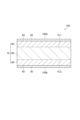
- FIG. 2 is a diagram showing an example of a cross section of an aluminum-diamond composite in the layering direction.
- FIG. 2 is an enlarged view of a part of the boundary between the first aluminum layer and the first region in a cross section of the aluminum-diamond composite in the lamination direction.
- FIG. 2 is a diagram showing an example of a block forming step in a method for producing an aluminum-diamond composite.
- FIG. 2 is a diagram showing an example of a heating step in a method for producing an aluminum-diamond composite.
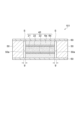
- FIG. 1 is a diagram showing an example of a semiconductor package using a heat dissipation member containing an aluminum-diamond composite.
- 1 is a SEM photograph of a cut surface of aluminum-diamond composite No. 1 in Example 1.
- 1 is a SEM photograph of a cut surface of aluminum-diamond composite No. 2 in Example 1.
- 1 is a SEM photograph of a cut surface of aluminum-diamond composite No. 3 in Example 1.
- 1 is a SEM photograph of a cut surface of aluminum-diamond composite No. 4 in Example 1.
- FIG. 1 shows a cross section obtained by cutting an aluminum-diamond composite according to one embodiment along the lamination direction.
- the aluminum-diamond composite 100 comprises a first aluminum layer 20, a composite layer 10, and a second aluminum layer 30, in that order.
- the shape of the aluminum-diamond composite 100 is not particularly limited as long as it is plate-like.
- the thickness of the aluminum-diamond composite 100 may be 1.0 to 3.0 mm, or 1.2 to 2.5 mm.
- the composite layer 10 includes an aluminum phase and a plurality of diamond particles of different sizes.
- the diamond particles may be natural diamond, artificial diamond, or a mixture of the two.
- the composite layer 10 includes coarse particles with a large particle diameter and fine particles with a small particle diameter.
- the average particle diameter of the coarse particles may be 100 to 250 ⁇ m or 140 to 210 ⁇ m.
- the average particle diameter of the fine particles may be 5 to 30 ⁇ m or 10 to 25 ⁇ m.
- the diamond particles may be of high purity or may contain a binder such as silica.
- the average particle diameters of the diamond particles, coarse particles, and fine particles can be measured using a laser diffraction scattering particle size distribution measuring device in accordance with the description of ISO 13320:2009.
- the "LS-13 320" (device name) manufactured by Beckman Coulter can be used as the laser diffraction scattering particle size distribution measuring device.
- the volume-based particle size distribution (cumulative distribution) shown with the horizontal axis being the logarithmic scale particle size [ ⁇ m] and the vertical axis being the frequency [volume %]
- D50 the average particle size
- Diamond particles having a ⁇ -type silicon carbide layer formed on the surface can be used as the diamond particles.
- Such diamond particles can suppress the generation of metal carbides with low thermal conductivity (e.g., aluminum carbide (Al 4 C 3 )), and can improve the thermal conductivity of the aluminum-diamond composite 100.
- the thickness of the composite layer 10 may be 0.5 to 2.5 mm, 0.8 to 2.2 mm, or 1.0 to 1.8 mm.
- the mass ratio of the coarse particles to the total mass of the diamond particles in the composite layer 10 may be 60 mass% or more, 70 mass% or more, or 90 mass% or less.
- the mass ratio of the coarse particles may be, for example, 60 to 90 mass%, or 70 to 90 mass%.
- the mass ratio of the fine particles to the total mass of the diamond particles may be 40 mass% or less, 30 mass% or less, or 10 mass% or more.
- the mass ratio of the fine particles may be, for example, 10 to 30 mass%, or 10 to 40 mass%.
- the aluminum phase only needs to contain aluminum as the main component, and may contain metals other than aluminum.
- metals other than aluminum include silicon, magnesium, and copper. By containing such metals, the aluminum phase can be sufficiently infiltrated into the voids in the diamond particles, resulting in a denser composite layer 10.
- the aluminum-diamond composite 100 has a first aluminum layer 20 and a second aluminum layer 30 sandwiching the composite layer 10. By having such aluminum layers, the main surfaces 100a, 100b of the aluminum-diamond composite 100 can be made smooth, improving plating properties.
- the thickness of the first aluminum layer 20 and the second aluminum layer 30 may be 10 to 100 ⁇ m, or 20 to 80 ⁇ m. By having the thickness of the first aluminum layer 20 and the second aluminum layer 30 within this range, it is possible to increase the thermal conductivity of the aluminum-diamond composite 100 while improving the plating properties of the surface.
- the lower limit of the aluminum content in the first aluminum layer 20 and the second aluminum layer 30 may be, for example, 80 mass%, 82 mass%, 84 mass%, or 86 mass%.
- the upper limit of the aluminum content may be, for example, 100 mass%, 98 mass%, 96 mass%, 94 mass%, 92 mass%, or 90 mass%.
- the aluminum-diamond composite 100 may have plating layers on the main surfaces 100a, 100b.
- the plating layers may have a nickel plating layer and a gold plating layer in this order from the aluminum-diamond composite 100 side.
- the average thickness of the nickel plating layer may be 0.5 to 6.5 ⁇ m
- the average thickness of the gold plating layer may be 0.5 ⁇ m or more.
- a general plating method can be used to form the plating layer.
- plating methods include electrolytic plating and electroless plating.
- a pretreatment may be performed in which at least a portion of the main surfaces 100a, 100b of the aluminum-diamond composite 100 is replaced with zinc or the like. By performing such a pretreatment, the adhesion of the plating layer can be further improved.
- an amorphous nickel alloy plating film having a thickness of 0.5 to 6.5 ⁇ m may be formed on the surface of the nickel plating layer.
- the means for forming the amorphous nickel alloy plating may be an electroless plating method.
- the amorphous nickel alloy plating may be an alloy plating containing nickel and phosphorus (P) in an amount of, for example, 5 to 15 mass%.
- the nickel alloy plating layer may be, for example, 0.5 to 2 ⁇ m thick.
- the thickness of the gold plating layer may be, for example, 0.01 ⁇ m or more. From the viewpoint of reducing costs, the thickness of the gold plating layer may be, for example, 4.0 ⁇ m or less.
- the composite layer 10 is divided into three band-shaped regions by a first virtual line VL1 extending parallel to the main surface 100a and a second virtual line VL2 extending parallel to the main surface 100b.
- the three band-shaped regions are arranged in the order of the first region 80, the central region 85, and the second region 90 from the first aluminum layer 20 toward the second aluminum layer 30.
- the first virtual line VL1 is drawn at a position 200 ⁇ m toward the inside of the composite layer 10 from the first boundary line 82 between the first aluminum layer 20 and the composite layer 10.
- the second virtual line VL2 is drawn at a position 200 ⁇ m toward the inside of the composite layer 10 from the second boundary line 92 between the second aluminum layer 30 and the composite layer 10.
- the first region 80 defined by the first boundary line 82 and the first virtual line VL1 is a band-shaped region extending from the first boundary line 82 between the first aluminum layer 20 and the composite layer 10 to 200 ⁇ m toward the inside of the composite layer 10.
- the second region 90 defined by the second boundary line 92 and the second virtual line VL2 is a band-shaped region extending from the second boundary line 92 between the second aluminum layer 30 and the composite layer 10 to 200 ⁇ m toward the inside of the composite layer 10.
- the central region 85 is a band-shaped region defined by the first virtual line VL1 and the second virtual line VL2. That is, the central region 85 is located between the first region 80 and the second region 90.
- the thickness of the composite layer 10 may be 400 ⁇ m or more.
- the thickness of the composite layer 10 (length in the stacking direction) may be 1000 ⁇ m or more, or 3000 ⁇ m or more.
- the cut surface of the aluminum-diamond composite 100 can be obtained by cutting along the stacking direction (direction perpendicular to the main surfaces 100a, 100b) of the first aluminum layer 20, composite layer 10, and second aluminum layer 30.
- the cutting may be performed by water jet processing, laser processing, or the like, or may be performed manually by an operator. There are no particular limitations on the cutting position, and it may be anywhere that includes the first aluminum layer 20, composite layer 10, and second aluminum layer 30. However, it is preferable to observe four or more cut surfaces in order to obtain the average values ⁇ and ⁇ described below.
- the cut surface of the aluminum-diamond composite 100 is obtained by processing using a cross-section polisher (manufactured by JEOL Ltd.). By observing such a cut surface using a scanning electron microscope (SEM), the average values of ⁇ , ⁇ , etc. can be obtained.
- the magnification of the SEM may be 50 to 100 times, or 60 to 90 times.
- the first boundary line 82 is a tangent line parallel to the main surface 100a that is in contact with the outer edge A of the diamond particle 84 that is closest to the first aluminum layer 20 among the diamond particles 84 dispersed in the aluminum phase 86 of the composite layer 10.
- the first boundary line 82 may be in contact with the outer edges of the multiple diamond particles 84 as long as it is parallel to the main surface 100a.
- the second boundary line 92 is also a tangent line parallel to the main surface 100b that is in contact with the outer edge of the diamond particle 84 that is closest to the second aluminum layer 30 among the diamond particles 84 in the composite layer 10, similar to the first boundary line 82.
- the first boundary line 82 and the second boundary line 92 may be drawn by image analysis or may be drawn visually on the SEM photograph.
- the area and number of coarse particles and fine particles are measured, and the average value ⁇ and the average value ⁇ are obtained by the following procedure.
- the area and number of diamond particles in the cut surface can be obtained by image analysis. For image analysis, for example, "ImageJ" can be used.
- image analysis for example, "ImageJ" can be used.
- the ratio of the total area of the coarse particles to the total area of the plurality of diamond particles 84 in the first region 80 and the second region 90 is determined.
- the average value ⁇ (weighted average) of the ratio for the four or more cut surfaces is 65 to 80%.
- the average value ⁇ may be 70 to 78%, or 72 to 77%. With such an average value ⁇ , the diamond coarse particles are sufficiently densely dispersed in the aluminum phase, and the thermal conductivity of the aluminum-diamond composite 100 can be sufficiently high.
- the absolute value of the difference between the average value ⁇ 1 in the first region 80 and the average value ⁇ 2 in the second region 90 may be 6.0% or less, 2.5% or less, or 0.5% or less. If the absolute value of the difference between the average value ⁇ 1 in the first region 80 and the average value ⁇ 2 in the second region 90 is within the above range, the diamond particles are dispersed with sufficiently high uniformity throughout the composite layer 10, so that the thermal conductivity of the aluminum-diamond composite 100 can be further improved. In addition, the absolute value of the difference between the above average values ⁇ 1 and ⁇ 2 may be 0% or more.
- the average value ⁇ (weighted average) of the ratios for the four or more cut surfaces may be 2.0% or less, or may be 1.5% or less. With such an average value ⁇ , fine particles are dispersed between the coarse diamond particles, improving the density and further improving the thermal conductivity of the aluminum-diamond composite 100.
- the average value ⁇ may also be 1.0% or more.
- the absolute value of the difference between the average value ⁇ 1 in the first region 80 and the average value ⁇ 2 in the second region 90 may be 0.6% or less, or may be 0.3% or less. If the absolute value of the difference between the average value ⁇ 1 in the first region 80 and the average value ⁇ 2 in the second region 90 is within the above range, the diamond particles are dispersed with high uniformity throughout the composite layer 10, and the thermal conductivity of the aluminum-diamond composite 100 can be further improved. In addition, the absolute value of the difference between the average values ⁇ 1 and ⁇ 2 may be 0% or more.
- the aluminum-diamond composite 100 has excellent thermal conductivity because the aluminum phase is densely packed with diamond particles.
- the thermal conductivity of the aluminum-diamond composite 100 at 25°C may be 500 W/(m ⁇ K) or more, or 550 W/(m ⁇ K) or more.
- the thermal conductivity at 25°C may be 650 W/(m ⁇ K) or less, or 600 W/(m ⁇ K) or less.
- the thermal conductivity can be measured by a laser flash method.
- an "LF/TCM-8510B" product name, manufactured by Rigaku Denki Co., Ltd.
- the method for producing an aluminum-diamond composite includes a mixing step in which coarse and fine diamond particles are mixed using a V-type mixer to obtain a mixture, and a heating step in which the resulting mixture is heated while sandwiched between aluminum foil.
- the diamond coarse particles and fine particles used as raw materials can be as described above.
- the coarse particles and fine particles are fed into a V-type mixer.
- the average value ⁇ can be set to 65 to 80%.
- the average value ⁇ can be set to 2.0% or less.
- the mass ratio of the coarse particles to the total mass of the diamond particles fed may be 60 mass% or more, 70 mass% or more, or 90 mass% or less.
- the numerical range of the mass ratio of the coarse particles to the total mass of the diamond particles fed may be, for example, 60 to 90 mass%, or 70 to 90 mass%.
- the mass ratio of the fine particles to the total mass of the diamond particles may be 40 mass% or less, 30 mass% or less, or 10 mass% or more.
- the numerical range of the mass ratio of the fine particles to the total mass of the diamond particles may be, for example, 10 to 30 mass%, or 10 to 40 mass%.
- a mixture with a mass ratio of coarse particles to fine particles within the above range can contain coarse particles and fine particles with sufficiently high uniformity, thereby increasing the thermal conductivity of the aluminum-diamond composite.
- the total volume of the V-type mixer may be, for example, 0.1 to 5.0 m 3 or 0.5 to 3.0 m 3.
- the V-type mixer may be, for example, "V-10" (product name, manufactured by Tokuju Machine Works, Ltd.).
- the volume ratio of the diamond particles introduced to the total volume of the V-type mixer may be 10 to 50%, 15 to 40%, or 20 to 40%.
- the rotation speed of the V-type mixer may be 15 to 50 rpm, or may be 20 to 40 rpm.
- the rotation time of the V-type mixer may be 5 to 30 minutes, or may be 10 to 20 minutes.
- a block formation step may be included to obtain a structure 101 including a laminated structure 40 in which a first release plate 6a, an aluminum layer 22, a diamond particle mixture layer 21, an aluminum layer 22, and a second release plate 6b are laminated in this order within a space surrounded by two metal plates 60 and a porous material 50 as shown in Figures 3 and 4.
- the openings in the porous material 50 are through holes that penetrate in the vertical direction.
- the openings are not limited to through holes, and may be, for example, recesses having an opening on one of the main surfaces of the porous material 50.
- multiple openings may be provided in one porous material 50, and the positions at which the openings are formed may also be adjusted as appropriate.
- the openings are through holes, but if the openings are recesses, one of the metal plates 60 in FIG. 3 and FIG. 4 may be interpreted as being integral with the porous material 50 and made of the same material.
- the block formation process is a process in which a gap S is provided inside an opening of the porous material 50, which is a frame material that is placed between two metal plates 60 and serves as a mold for the aluminum-diamond composite 100, and a laminated structure 40 is provided so as to be away from the inner peripheral surface 50a of the opening of the porous material 50.
- the method of providing the laminated structure 40 inside the opening of the porous material 50 is not particularly limited.
- the porous material 50 may be placed on the metal plate 60, and then each layer that constitutes the laminated structure 40 may be sequentially laminated, or a separately formed laminated structure 40 may be inserted inside the opening of the porous material 50.
- the method of providing the gap S (distance g) between the inner peripheral surface 50a of the opening of the porous material 50 and the outer peripheral surface of the laminated structure 40 may be, for example, a method in which a spacer of a predetermined thickness that can be removed later is provided so as to be in contact with the inner peripheral surface 50a of the opening, and the laminated structure 40 is formed or inserted inside the spacer (the space on the opposite side to the porous material 50 side), and then the spacer is removed.
- FIG. 3 and FIG. 4 show an example in which one laminate structure 40 is provided, multiple laminate structures 40 may be laminated along the thickness direction of the porous material 50 inside the opening of the porous material 50.
- the distance g between the inner circumferential surface 50a of the opening of the porous material 50 and the outer circumferential surface of the laminated structure 40 can be adjusted according to the thickness of the metal layer to be formed on the side of the desired aluminum-diamond composite 100.
- the distance g between the inner circumferential surface 50a of the opening of the porous material 50 and the outer circumferential surface of the laminated structure 40 may be, for example, 0.05 to 3.50 mm, 0.05 to 2.50 mm, or 0.05 to 1.00 mm.
- Examples of the metal plate 60 include an iron plate and a stainless steel plate.
- the porous material 50 may have heat resistance that allows a molten metal containing aluminum to be pressed into or penetrated into it in the heating step described below.
- the porous material 50 may be, for example, a porous sintered body made of graphite or boron nitride (e.g., an isotropic graphite mold material, etc.), or a porous body made of alumina fibers.
- the shape of the opening of the porous material 50 can be adjusted according to the desired shape of the aluminum-diamond composite 100. In the manufacturing method of this embodiment, the shape of the aluminum-diamond composite 100 can be changed by adjusting the shape of the opening of the porous material 50. This allows for greater freedom in design than conventional methods using laser processing or other methods for molding.
- the laminated structure 40 formed in the block formation process includes, in this order, a first release plate 6a, an aluminum layer 22, a mixture layer 21, an aluminum layer 22, and a second release plate 6b.
- the mixture layer 21 may be a mixture of diamond particles obtained in the above-mentioned mixing process.
- the mixture layer 21 may be composed of, for example, only diamond particles, or may contain other components.
- the other components may be, for example, a binder such as silica.
- the content of the other components may be, for example, 0.5 to 3.0 mass% based on the total amount of the mixture layer 21.
- the aluminum layer 22 may include inorganic fibers, such as alumina fibers and glass fibers.
- the aluminum layer 22 may be, for example, aluminum foil and aluminum alloy foil.
- the thickness of the aluminum layer 22 may be, for example, 0.01 mm or more, 0.02 mm or more, or 0.03 mm or more.
- the thickness of the aluminum layer 22 may be, for example, 0.20 mm or less, 0.15 mm or less, 0.10 mm or less, 0.08 mm or less, or 0.06 mm or less.
- the above thickness can be adjusted within the above range, and may be, for example, 0.01 to 0.20 mm, or 0.02 to 0.15 mm.
- the thickness of the aluminum layer 22 can be measured with a micrometer and is the arithmetic average value of values measured at five points in the plane. Note that the pair of aluminum layers 22 sandwiching the mixture layer 21 may have different thicknesses or may have the same thickness.
- the first release plate 6a and the second release plate 6b can be plates having a dense structure so that sufficient pressure can be applied when the aluminum-containing metal melt is pressed into the mixture layer 21 and impregnated in the heating process described below.
- the first release plate 6a and the second release plate 6b can be, for example, a stainless steel plate or a ceramic plate.
- the main surfaces of the first release plate 6a and the second release plate 6b on the mixture layer 21 side may be coated with a release agent or may be subjected to a release treatment. Examples of such release agents include graphite, boron nitride, and alumina.
- the first release plate 6a and the second release plate 6b can be, for example, a release plate on which a coating layer of alumina sol or the like is formed on the main surface on the mixture layer 21 side and then a release agent is further attached.
- a release plate By using such a release plate, more stable release can be performed, and the main surface of the resulting aluminum-diamond composite 100 can be made smoother.
- the heating step can be performed by impregnating the above-mentioned structure 101 with a molten metal containing aluminum.
- the temperature of the molten metal may be 600 to 1500°C, or may be 700 to 1300°C.
- the molten metal is supplied to the inside and surface of the mixture layer 21 through the porous material 50.
- an aluminum-diamond composite 100 (FIG. 1) having a composite layer 10 containing aluminum and diamond, a first aluminum layer 20, and a second aluminum layer 30 is formed in the structure 102.
- a metal layer 24 can be formed on the side surface of the aluminum-diamond composite 100. The method for forming the aluminum-diamond composite 100 will be specifically described below.
- a molten metal containing aluminum may penetrate into the interior of the aluminum layer 22 or onto the main surface of the aluminum layer 22 facing the mixture layer 21, forming the first aluminum layer 20 and the second aluminum layer 30.
- the aluminum layer 22 itself constitutes a metal-containing layer, and the molten metal containing aluminum penetrates onto the main surface of the aluminum layer 22 facing the mixture layer 21, thereby firmly bonding the composite layer 10 to the first aluminum layer 20 and the second aluminum layer 30.
- the method of supplying the molten metal containing aluminum may be, for example, the so-called high-pressure forging method, in which the molten metal is impregnated into the target object under high pressure. From the viewpoint of obtaining an aluminum-diamond composite 100 with superior thermal conductivity, it is preferable to use the molten metal forging method.
- the heating step is performed, for example, by immersing the structure 101 obtained in the block formation step in a container filled with the molten material and applying pressure to the molten material.
- the aluminum-containing metal melt may contain, for example, other metals in addition to aluminum.
- other metals include silicon, magnesium, and copper.
- the other metals preferably contain at least one of silicon and magnesium.
- the content of the other metals may be 2 to 20 mass%, 2 to 15 mass%, or 5 to 15 mass%, based on the total mass of the molten material.
- the lower limit of the heating temperature in the preheating may be, for example, 520°C or more, or 540°C or more.
- the upper limit of the heating temperature may be, for example, 750°C or less, or 700°C or less.
- the heating temperature may be adjusted within the above range, and can be, for example, 520 to 750°C, or 540 to 700°C.
- the pressure when the molten material is impregnated into the mixture layer 21 may be, for example, 20 MPa or more, 30 MPa or more, 40 MPa or more, or 50 MPa or more.
- the pressure when the molten material is impregnated into the mixture layer 21 may be, for example, 150 MPa or less, 100 MPa or less, or 80 MPa or less.
- the pressure when the molten material is impregnated into the mixture layer 21 may be adjusted within the above range, and may be, for example, 20 to 150 MPa.
- the metal plate 60, the porous material 50, the first release plate 6a, and the second release plate 6b can be removed from the structure 102 to extract the aluminum-diamond composite 100 as shown in FIG. 1.
- the aluminum-diamond composite 100 may be cut out from the structure 102 by water jet processing, laser processing, or the like.
- a surface treatment may be performed.
- the surface treatment may be performed by a processing method employed in ordinary metal processing, for example, polishing, surface grinding, or the like.
- the obtained aluminum-diamond composite 100 may be subjected to an annealing process.
- a heat treatment is performed at a relatively low temperature after the heating process to reduce distortions that may exist in the composite layer 10, the first aluminum layer 20, the second aluminum layer 30, the metal layer 24, etc.
- the heating temperature in the annealing process may be, for example, 400 to 550°C, or 400 to 500°C.
- the heating time in the annealing process may be, for example, 10 minutes or more, or 20 minutes or more, and may be 24 hours or less, or 12 hours or less.
- Figure 5 shows an example of a semiconductor package using a heat dissipation member containing an aluminum-diamond composite 100.
- the semiconductor package in Figure 5 can be obtained by bonding a semiconductor element 8 to a heat dissipation member 2, bonding an insulating member 1 and a lid member 5 to each other so as to surround the semiconductor element 8, and bonding the insulating member 1 to the heat dissipation member 2.
- the semiconductor package is connected to an external terminal (not disclosed) via a conductor 6.
- the heat dissipation member 2 and the semiconductor element 8 are bonded via a bonding material 7.
- the lower surface of the heat dissipation member 2 and the insulating member 1 are bonded via a bonding material 3.
- the upper surface of the insulating member 1 and the lid member 5 are bonded via a bonding material 4.
- alumina, aluminum nitride, silicon nitride, beryllium oxide, etc. can be used for the insulating member 1.
- an aluminum-diamond composite 100 with high thermal conductivity in the heat dissipation member 2 of such a semiconductor package By including an aluminum-diamond composite 100 with high thermal conductivity in the heat dissipation member 2 of such a semiconductor package, a semiconductor package with further improved heat dissipation can be obtained.
- the aluminum-diamond composite 100 may have a metal layer on the side of the composite layer 10.
- Example 1 Commercially available high-purity diamond powder A (average particle size: 180 ⁇ m, manufactured by Saint-Gobain Co., Ltd.) and high-purity diamond powder B (average particle size: 20 ⁇ m, manufactured by Saint-Gobain Co., Ltd.) were charged into a V-type mixer (product name: V-10, manufactured by Tokuju Co., Ltd.) so that the mass ratio of A:B was 7:3. The volume ratio of diamond particles to the internal volume of the V-type mixer was 17%. The V-type mixer was rotated at a rotation speed of 25 rpm for 10 minutes to mix the diamond powder, and a mixture of diamond powders A and B was obtained.
- a release plate was produced by coating alumina sol on the surface of a stainless steel plate (SUS430 material) with a length x width x thickness of 40 mm x 40 mm x 2 mm and baking it at 350 ° C for 30 minutes.
- An isotropic graphite jig with a porosity of 20% was prepared, with an external dimension of 60 mm x 60 mm x 8 mm in length x width x thickness and a through hole of 40 mm x 40 mm x 8 mm in the center.
- the isotropic graphite jig was placed on a 12 mm thick iron plate with bolt holes at the four corners so that the opening of the through hole was facing upward.
- a release plate and pure aluminum foil manufactured by UACJ Corporation with a thickness of 30 ⁇ m were inserted into the through hole from above, in that order, and the pure aluminum foil was laminated on the release plate inside the through hole.
- the above-mentioned diamond powder mixture was further filled on top of this pure aluminum foil to a thickness of 1.24 mm to form a mixture layer, and pure aluminum foil and a release plate were laminated on top of the mixture layer in that order to form a laminated structure inside the through hole.
- the obtained block was preheated to a temperature of 650°C in an electric furnace, and then placed in a preheated press mold with an inner diameter of 300 mm.
- a molten aluminum alloy containing 12% by mass of silicon and 1% by mass of magnesium at a temperature of 800°C was poured into the press mold, and pressure was applied at a pressure of 100 MPa for 20 minutes. This resulted in impregnating the mixture layer with the aluminum alloy to obtain a composite layer containing the aluminum alloy and diamond powders A and B.
- the block on which the composite layer was formed was cooled to room temperature, and then cut along the shape of the release plate with a wet band saw, and the stainless steel plate was peeled off to obtain cut pieces.
- the cut pieces were heated at a temperature of 400°C for 3 hours to perform an annealing treatment. Then, the surface of the aluminum layer in the cut pieces was polished with #600 abrasive paper, and then buffed. In this way, a laminate having a first aluminum layer, a composite layer, and a second aluminum layer in this order was obtained.
- the main surfaces of the first aluminum layer and the second aluminum layer were pretreated with a Zn catalyst.
- Ni electric plating, electroless Ni-P plating, and Au electric plating were sequentially performed on the pretreated surfaces of the first aluminum layer and the second aluminum layer to form a plating layer 6 ⁇ m thick (Ni: 2.0 ⁇ m + Ni-P: 2.0 ⁇ m + Au: 2.0 ⁇ m) on the surface of the aluminum-diamond composite.
- Example 2 The aluminum-diamond composites of Examples 2 and 3 were obtained in the same manner as in Example 1.
- Comparative Example 1 An aluminum-diamond composite of Comparative Example 1 was obtained in the same manner as in Examples 1 to 3, except that the diamond mixture was obtained by manually stirring the mixture for 5 minutes by an operator instead of using a V-type mixer.
- Comparative Example 2 instead of filling the through-holes of the isotropic graphite jig with a mixture of diamond powders, diamond powder A was placed in the through-holes, and then diamond powder B was placed from above in a mass ratio of 7:3 to fill the through-holes with diamond powders. Otherwise, the aluminum-diamond composite of Comparative Example 2 was obtained by the same procedure as in Examples 1 to 3.
- a composite layer of the aluminum-diamond composite was present so as to be sandwiched between the first aluminum layer and the second aluminum layer.
- coarse particles and fine particles of diamond particles were dispersed in the aluminum phase.
- the first region was determined as the area from the first boundary line between the first aluminum layer and the composite layer in the obtained SEM image to the area 200 ⁇ m into the composite layer.
- the first boundary line is a tangent line that contacts the outer edge A of the diamond particle 84 located closest to the first aluminum layer 20 as shown in FIG. 2 and is drawn parallel to the main surface of the first aluminum layer 20.
- the second region was determined as the area from the second boundary line between the second aluminum layer and the composite layer to the area 200 ⁇ m into the composite layer.
- the second boundary line is a tangent line that passes through the outer edge of the diamond particle located closest to the second aluminum layer and is drawn parallel to the main surface of the second aluminum layer.
- Image analysis was performed on the first and second regions of each cut surface using ImageJ. Diamond particles with an area of 2000 ⁇ m2 or more were defined as coarse particles, and diamond particles with an area of less than 2000 ⁇ m2 were defined as fine particles. The areas and particle numbers of the coarse particles and fine particles were measured in each of the first and second regions. The results are shown in Tables 1 and 3.
- Tables 1 and 2 show the total area of diamond particles in each region, the ratio of the total area of coarse particles to that total area, the average value of that ratio for the first region and the second region ( ⁇ 1, ⁇ 2), the average value ⁇ of that ratio for both the first region and the second region combined, and the absolute value of the difference between the average value ⁇ 1 for the first region and the average value ⁇ 2 for the second region.
- Tables 3 and 4 show the number of diamond particles in each cut surface (total X), the ratio of the number of coarse particles to the total X, the average value of the ratio for the first and second regions ( ⁇ 1, ⁇ 2), the average value ⁇ of the ratio for both the first and second regions combined, and the absolute value of the difference between the average value ⁇ 1 for the first region and the average value ⁇ 2 for the second region. Note that in Tables 1 to 4, among Nos. 1 to 4 of one embodiment, those with the same No. show the results for the first and second regions on the same cut surface.
- the aluminum-diamond composites using the diamond powder mixtures of Examples 1 to 3 had higher thermal conductivity than Comparative Example 1 and Comparative Example 2. Also, as shown in Table 2, when comparing the average value ⁇ of the area ratio of the coarse particles in the first and second regions in each aluminum-diamond composite, it was 73.7% to 77.9% in Examples 1 to 3. On the other hand, the average value ⁇ of Comparative Example 1 was high at 80.7%, and the average value ⁇ of Comparative Example 2 was low at 48.8%. Furthermore, as shown in Table 4, in Examples 1 to 3, the average value ⁇ of the ratio of the number of coarse particles to the total number of diamond particles calculated for each region was 2.0% or less in all cases. In this way, it was confirmed that the aluminum-diamond composites of Examples 1 to 3 have diamond particles with high thermal conductivity dispersed appropriately within the aluminum phase.
- an aluminum-diamond composite having a sufficiently high thermal conductivity, and a method for producing the same. Furthermore, by including such an aluminum-diamond composite, it is possible to provide a semiconductor package with excellent heat dissipation properties.
- 100...aluminum-diamond composite 100a, 100b...main surface, 20...first aluminum layer, 30...second aluminum layer, 10...composite layer, 80...first region, 85...central region, 90...second region, 82...first boundary line, 92...second boundary line, VL1...first virtual line, VL2...second virtual line, 84...diamond particles, 86...aluminum phase, A...outer edge, 21...mixture layer, 22...aluminum layer, 40...laminated structure, 50...porous material, 60...metal plate, 50a...inner surface, S...gap, g...distance, 24...metal layer, 101, 102...structure, 1...insulating member, 2...heat dissipation member, 3, 4, 7...bonding material, 5...lid material, 6...conductor, 6a...first release plate, 6b...second release plate, 8...semiconductor element.
Landscapes
- Chemical & Material Sciences (AREA)
- Engineering & Computer Science (AREA)
- Materials Engineering (AREA)
- Mechanical Engineering (AREA)
- Metallurgy (AREA)
- Organic Chemistry (AREA)
- Cooling Or The Like Of Semiconductors Or Solid State Devices (AREA)
- Carbon And Carbon Compounds (AREA)
Priority Applications (3)
| Application Number | Priority Date | Filing Date | Title |
|---|---|---|---|
| EP24797088.2A EP4704150A1 (en) | 2023-04-28 | 2024-04-24 | Aluminum-diamond composite, method for producing aluminum-diamond composite, and semiconductor package |
| JP2025516861A JPWO2024225342A1 (https=) | 2023-04-28 | 2024-04-24 | |
| CN202480028130.8A CN121100405A (zh) | 2023-04-28 | 2024-04-24 | 铝-金刚石复合体、铝-金刚石复合体的制造方法、以及半导体封装体 |
Applications Claiming Priority (2)
| Application Number | Priority Date | Filing Date | Title |
|---|---|---|---|
| JP2023075161 | 2023-04-28 | ||
| JP2023-075161 | 2023-04-28 |
Publications (1)
| Publication Number | Publication Date |
|---|---|
| WO2024225342A1 true WO2024225342A1 (ja) | 2024-10-31 |
Family
ID=93256559
Family Applications (1)
| Application Number | Title | Priority Date | Filing Date |
|---|---|---|---|
| PCT/JP2024/016149 Ceased WO2024225342A1 (ja) | 2023-04-28 | 2024-04-24 | アルミニウム-ダイヤモンド複合体、及びアルミニウム-ダイヤモンド複合体の製造方法、並びに半導体パッケージ |
Country Status (4)
| Country | Link |
|---|---|
| EP (1) | EP4704150A1 (https=) |
| JP (1) | JPWO2024225342A1 (https=) |
| CN (1) | CN121100405A (https=) |
| WO (1) | WO2024225342A1 (https=) |
Citations (5)
| Publication number | Priority date | Publication date | Assignee | Title |
|---|---|---|---|---|
| WO2013015158A1 (ja) * | 2011-07-28 | 2013-01-31 | 電気化学工業株式会社 | 半導体素子用放熱部品 |
| JP2014107468A (ja) | 2012-11-29 | 2014-06-09 | Denki Kagaku Kogyo Kk | アルミニウム−ダイヤモンド系複合体放熱部品 |
| WO2015182576A1 (ja) | 2014-05-27 | 2015-12-03 | 電気化学工業株式会社 | 半導体パッケージ及びその製造方法 |
| JP2022002266A (ja) * | 2020-06-22 | 2022-01-06 | ウシオ電機株式会社 | 半導体発光装置 |
| WO2023013500A1 (ja) * | 2021-08-06 | 2023-02-09 | デンカ株式会社 | 放熱部材および電子装置 |
-
2024
- 2024-04-24 WO PCT/JP2024/016149 patent/WO2024225342A1/ja not_active Ceased
- 2024-04-24 JP JP2025516861A patent/JPWO2024225342A1/ja active Pending
- 2024-04-24 CN CN202480028130.8A patent/CN121100405A/zh active Pending
- 2024-04-24 EP EP24797088.2A patent/EP4704150A1/en active Pending
Patent Citations (5)
| Publication number | Priority date | Publication date | Assignee | Title |
|---|---|---|---|---|
| WO2013015158A1 (ja) * | 2011-07-28 | 2013-01-31 | 電気化学工業株式会社 | 半導体素子用放熱部品 |
| JP2014107468A (ja) | 2012-11-29 | 2014-06-09 | Denki Kagaku Kogyo Kk | アルミニウム−ダイヤモンド系複合体放熱部品 |
| WO2015182576A1 (ja) | 2014-05-27 | 2015-12-03 | 電気化学工業株式会社 | 半導体パッケージ及びその製造方法 |
| JP2022002266A (ja) * | 2020-06-22 | 2022-01-06 | ウシオ電機株式会社 | 半導体発光装置 |
| WO2023013500A1 (ja) * | 2021-08-06 | 2023-02-09 | デンカ株式会社 | 放熱部材および電子装置 |
Non-Patent Citations (1)
| Title |
|---|
| See also references of EP4704150A1 |
Also Published As
| Publication number | Publication date |
|---|---|
| EP4704150A1 (en) | 2026-03-04 |
| CN121100405A (zh) | 2025-12-09 |
| JPWO2024225342A1 (https=) | 2024-10-31 |
Similar Documents
| Publication | Publication Date | Title |
|---|---|---|
| JP5496888B2 (ja) | アルミニウム−ダイヤモンド系複合体の製造方法 | |
| TWI452143B (zh) | 鋁-金剛石系複合體及其製造方法 | |
| JP5988977B2 (ja) | 半導体素子用放熱部品 | |
| JP5759152B2 (ja) | アルミニウム−ダイヤモンド系複合体及びその製造方法 | |
| KR102324373B1 (ko) | 방열판 및 그 제조 방법 | |
| JPWO2017158993A1 (ja) | アルミニウム−ダイヤモンド系複合体及び放熱部品 | |
| TWI357788B (https=) | ||
| WO2017065139A1 (ja) | アルミニウム-ダイヤモンド系複合体及びその製造方法 | |
| TWI682026B (zh) | 鋁-金剛石系複合體及使用其之散熱零件 | |
| JP5755895B2 (ja) | アルミニウム−ダイヤモンド系複合体及びその製造方法 | |
| JP2012158783A (ja) | アルミニウム−ダイヤモンド系複合体及びその製造方法 | |
| JP6105262B2 (ja) | アルミニウム−ダイヤモンド系複合体放熱部品 | |
| US12084390B2 (en) | Molded article and method for producing same | |
| WO2024225342A1 (ja) | アルミニウム-ダイヤモンド複合体、及びアルミニウム-ダイヤモンド複合体の製造方法、並びに半導体パッケージ | |
| WO2024225345A1 (ja) | アルミニウム-ダイヤモンド複合体、及びアルミニウム-ダイヤモンド複合体の製造方法、並びに半導体パッケージ | |
| JP7665021B2 (ja) | アルミニウム-ダイヤモンド系複合体の製造方法 | |
| WO2024181224A1 (ja) | セラミックス板、包装体、セラミックス板の製造方法、モジュールおよび電気・電子製品 |
Legal Events
| Date | Code | Title | Description |
|---|---|---|---|
| 121 | Ep: the epo has been informed by wipo that ep was designated in this application |
Ref document number: 24797088 Country of ref document: EP Kind code of ref document: A1 |
|
| ENP | Entry into the national phase |
Ref document number: 2025516861 Country of ref document: JP Kind code of ref document: A |
|
| WWE | Wipo information: entry into national phase |
Ref document number: 2025516861 Country of ref document: JP |
|
| WWE | Wipo information: entry into national phase |
Ref document number: CN2024800281308 Country of ref document: CN |
|
| WWE | Wipo information: entry into national phase |
Ref document number: 2024797088 Country of ref document: EP |
|
| NENP | Non-entry into the national phase |
Ref country code: DE |
|
| ENP | Entry into the national phase |
Ref document number: 2024797088 Country of ref document: EP Effective date: 20251128 |
|
| ENP | Entry into the national phase |
Ref document number: 2024797088 Country of ref document: EP Effective date: 20251128 |
|
| ENP | Entry into the national phase |
Ref document number: 2024797088 Country of ref document: EP Effective date: 20251128 |
|
| ENP | Entry into the national phase |
Ref document number: 2024797088 Country of ref document: EP Effective date: 20251128 |
|
| ENP | Entry into the national phase |
Ref document number: 2024797088 Country of ref document: EP Effective date: 20251128 |
|
| ENP | Entry into the national phase |
Ref document number: 2024797088 Country of ref document: EP Effective date: 20251128 |
|
| ENP | Entry into the national phase |
Ref document number: 2024797088 Country of ref document: EP Effective date: 20251128 |
|
| ENP | Entry into the national phase |
Ref document number: 2024797088 Country of ref document: EP Effective date: 20251128 |
|
| ENP | Entry into the national phase |
Ref document number: 2024797088 Country of ref document: EP Effective date: 20251128 |
|
| WWP | Wipo information: published in national office |
Ref document number: 2024797088 Country of ref document: EP |