WO2024224575A1 - 心身状態を評価するためのテスト方法 - Google Patents
心身状態を評価するためのテスト方法 Download PDFInfo
- Publication number
- WO2024224575A1 WO2024224575A1 PCT/JP2023/016750 JP2023016750W WO2024224575A1 WO 2024224575 A1 WO2024224575 A1 WO 2024224575A1 JP 2023016750 W JP2023016750 W JP 2023016750W WO 2024224575 A1 WO2024224575 A1 WO 2024224575A1
- Authority
- WO
- WIPO (PCT)
- Prior art keywords
- subject
- application
- thumb
- test
- touch panel
- Prior art date
- Legal status (The legal status is an assumption and is not a legal conclusion. Google has not performed a legal analysis and makes no representation as to the accuracy of the status listed.)
- Ceased
Links
Images




Classifications
-
- A—HUMAN NECESSITIES
- A61—MEDICAL OR VETERINARY SCIENCE; HYGIENE
- A61B—DIAGNOSIS; SURGERY; IDENTIFICATION
- A61B5/00—Measuring for diagnostic purposes; Identification of persons
- A61B5/16—Devices for psychotechnics; Testing reaction times ; Devices for evaluating the psychological state
-
- A—HUMAN NECESSITIES
- A61—MEDICAL OR VETERINARY SCIENCE; HYGIENE
- A61B—DIAGNOSIS; SURGERY; IDENTIFICATION
- A61B5/00—Measuring for diagnostic purposes; Identification of persons
- A61B5/103—Measuring devices for testing the shape, pattern, colour, size or movement of the body or parts thereof, for diagnostic purposes
- A61B5/11—Measuring movement of the entire body or parts thereof, e.g. head or hand tremor or mobility of a limb
- A61B5/1121—Determining geometric values, e.g. centre of rotation or angular range of movement
- A61B5/1122—Determining geometric values, e.g. centre of rotation or angular range of movement of movement trajectories
-
- A—HUMAN NECESSITIES
- A61—MEDICAL OR VETERINARY SCIENCE; HYGIENE
- A61B—DIAGNOSIS; SURGERY; IDENTIFICATION
- A61B5/00—Measuring for diagnostic purposes; Identification of persons
- A61B5/103—Measuring devices for testing the shape, pattern, colour, size or movement of the body or parts thereof, for diagnostic purposes
- A61B5/11—Measuring movement of the entire body or parts thereof, e.g. head or hand tremor or mobility of a limb
-
- A—HUMAN NECESSITIES
- A61—MEDICAL OR VETERINARY SCIENCE; HYGIENE
- A61B—DIAGNOSIS; SURGERY; IDENTIFICATION
- A61B5/00—Measuring for diagnostic purposes; Identification of persons
- A61B5/22—Ergometry; Measuring muscular strength or the force of a muscular blow
- A61B5/224—Measuring muscular strength
- A61B5/225—Measuring muscular strength of the fingers, e.g. by monitoring hand-grip force
-
- A—HUMAN NECESSITIES
- A61—MEDICAL OR VETERINARY SCIENCE; HYGIENE
- A61B—DIAGNOSIS; SURGERY; IDENTIFICATION
- A61B5/00—Measuring for diagnostic purposes; Identification of persons
- A61B5/68—Arrangements of detecting, measuring or recording means, e.g. sensors, in relation to patient
- A61B5/6887—Arrangements of detecting, measuring or recording means, e.g. sensors, in relation to patient mounted on external non-worn devices, e.g. non-medical devices
- A61B5/6898—Portable consumer electronic devices, e.g. music players, telephones, tablet computers
-
- A—HUMAN NECESSITIES
- A61—MEDICAL OR VETERINARY SCIENCE; HYGIENE
- A61B—DIAGNOSIS; SURGERY; IDENTIFICATION
- A61B5/00—Measuring for diagnostic purposes; Identification of persons
Definitions
- the present invention relates to a method for testing the mental and physical state of a test subject. More specifically, the present invention relates to a testing method that can determine the mental and physical state of a test subject from the mobility of the test subject's fingers.
- the O-ring test is a method for assessing the health condition of a subject based on the amount of pressure applied between the thumb and index finger (known as finger pressure), and is used particularly in clinical practice in traditional Chinese medicine.
- the O-ring test has a long history, and various proposals have been made regarding the O-ring. Note that the "finger pressure" referred to here is different from the pressure applied to acupressure points or the strength of kneading used in massage treatments.
- Non-Patent Document 1 describes the practicality of the O-ring test and methods for improving its practicality.
- a method for performing the O-ring test with high accuracy using simple equipment is also proposed.
- Patent Documents 2, 3, 4, 5, and 6 describe testing equipment that allows a test subject to perform the O-ring test alone.
- Patent Document 7 describes a method for converting the results of the O-ring test into more objective numerical values and utilizing them by combining the O-ring test with a saliva test.
- O-ring tests and their advanced versions have traditionally required dedicated testing equipment. Although the individual testing devices have become smaller and simpler, they are not convenient to use at home or in the workplace or to carry around.
- the results of the O-Ring test reflect not only the subject's physical health, but also their stress and self-esteem. Therefore, the O-Ring test can evaluate both the subject's physical and psychological state, and unlike evaluations based on sensor data such as blood pressure, pulse, body temperature, and blood oxygen concentration, it is possible to estimate the subject's life satisfaction and overall physical and mental quality.
- an individual would be able to perform O-ring testing whenever and wherever they wanted without the need for special testing equipment.
- the inventor therefore sought a test method that would allow the test subject to perform the O-ring test by himself without using special testing equipment.
- the present invention is a method for determining the mental and physical state of a test subject from measurements corresponding to the range of motion and pressure of the test subject's thumb.
- the present invention is also an application for measuring the range of motion and pressure of the test subject's thumb and determining the mental and physical state of the test subject.
- the term "mental and physical state" is used in a broad sense to include mental and physical states that reflect, for example, preferences for food and hobbies, subconsciousness, desires, motivation, and other tendencies and intensities. That is, the present invention is as follows.
- a test method comprising the steps of: (1) executing a test command for a mobile terminal and an application; Step 1: The application (2) starts the operation to be tested. Step 2: The subject (3) responds to the questions and/or invitation messages (21), and then slides the pad (32) of the thumb (31) of the subject's (3) dominant hand over the surface of the touch panel (11), where the touch panel (11) has both a display function and a sensor function. Step 3: The application (2) measures the dimension (41) of the contact trace (4) between the pad (32) of the thumb (31) that appeared in step 2 and the touch panel (11).
- step 2 an application (2) outputs questions and/or invitation messages (21) to which a response from a test subject (3) is to be sought;
- the testing method of invention 1 further comprises carrying out the following step 4 after step 3.
- step 3 an application (2) outputs questions and/or invitation messages (21) to which a response from a test subject (3) is to be sought;
- the testing method of invention 1 further comprises carrying out the following steps 4 and 5 after step 3.
- Step 4 The application (2) compares the dimensions (41) with pre-set reference values (40) to generate response data (5) of the subject (3) to the questions and/or invitation messages (21).
- Step 5 The application (2) judges the mental and physical state (7) of the test subject (3) based on performance data (6) calculated from one or more pieces of answer data (5) obtained by executing steps 1 to 4 one or more times.
- the length (411) of the contact path (4) is measured;
- the application (2) compares the length (411) with a preset reference length (4110) to generate response data (5) of the subject (3) to the question and/or invitation message (21).
- the testing method of invention 1 wherein the length (411) corresponds to the total length of the contact locus (4).
- Invention 6) The testing method of invention 1, wherein the length (411) corresponds to the shortest distance between both ends of the contact locus (4).
- step 3 the rotation angle (412) of the thumb (30) is measured from the contact path (4);
- step 4 the application (2) compares the turning angle (412) with a preset reference turning angle (4140) to generate response data (5) of the subject (3) to the question and/or invitation message (21).
- step 2 the subject (3) responds to the questions and/or invitation messages (21), and then slides the pad (32) of the thumb (31) of the subject's (3) dominant hand over the surface of the touch panel (11) to drum-roll the scale displayed on the touch panel (11);
- step 3 the scale movement (413) caused by the drum roll in step 2 is measured as the dimension (41);
- step 4 the application (2) compares the scale movement (413) with a preset reference scale movement (4150) to generate response data (5) of the subject (3) to the questions and/or invitation messages (21).
- the present invention is a method for diagnosing the mental and physical condition of a subject with simple operations, anytime, anywhere, and actively, sometimes as entertainment. Such a test method and application of the present invention have not been found in the conventional O-ring test related fields, and are therefore epoch-making.
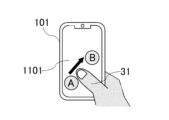
- FIG. 1 shows a state in which a subject (3) holds a mobile terminal (1) according to the present invention.
- the thumb (31) of the subject (3) touches the mobile terminal (1) in the present invention.
- An example of a contact trajectory (4) according to the present invention. 1 is a display example of a smartphone (101) used in the present invention.
- a test subject (3) slides his thumb (31) using the present invention.
- a test subject (3) slides his thumb (31) using the present invention.
- a test subject (3) slides his thumb (31) using the present invention.
- a test subject (3) slides his thumb (31) using the present invention.
- a test subject (3) slides his thumb (31) using the present invention.
- a test subject (3) slides his thumb (31) using the present invention.
- a test subject (3) slides his thumb (31) using the present invention.
- a test subject (3) slides his thumb (31) using the present invention.
- Test Method (100) The test method (100) of the present invention is executed by a mobile terminal (1) and an application (2).
- the steps necessarily executed in the test method (100) are steps 1, 2, and 3 described below.
- the test method (100) preferably includes steps 1, 2, and 3 described below.
- the test method (100) further preferably includes steps 1, 2, 3, and 4 or steps 1, 2, 3, 4, and 5 described below.
- the application (2) used in the present invention refers to a program or program set that executes the test method (100) of the present invention, and there are no limitations on where it is installed. Both so-called web applications and mobile applications fall under the category of application (2).
- the pressure and mobility of the thumb (31) of the test subject (3) are measured from the data acquired by the mobile terminal (1), and the mental and physical state of the test subject (3) is judged from the measurement results.
- the mobile terminal (1) has a touch panel (11) that combines display and sensor functions.
- a smartphone or tablet that is convenient for the subject (3) to carry is preferred.
- the touch panel (11) any type of display screen that is commonly used as the display unit of a smartphone or tablet and that is operated by the user by touching it with a finger or a pen-type input device can be used without limitation.
- the data acquired by the mobile terminal (1) is specifically the trajectory of movement of the contact point between the thumb (31) and the touch panel (11) of the mobile terminal (1) during the response action of the subject (3).
- the application (2) calculates the dimensions of the contact trajectory (4) from the data of the contact trajectory (4). If the shape dimensions are larger (longer) than a reference value, the application (2) judges that the pressure and mobility of the thumb (31) are high and the mental and physical condition is good. If the shape dimensions are smaller (shorter) than the reference value, the application (2) judges that the pressure and mobility of the thumb (31) are low and the mental and physical condition is not good.
- the application (2) may operate in a state where it is downloaded to the mobile terminal (1), or may operate while being stored in a medium such as a cloud on the Internet and communicating with the mobile terminal (1) connected to the Internet.
- the test subject (3) When performing a test according to the test method of the present invention, the test subject (3) actually holds the mobile terminal (1) prior to step 1.
- the test subject (3) holds the mobile terminal (1) in a state in which he/she can rotate the thumb (31) of his/her dominant hand around the base of the thumb (31) and can also touch the pad (32) of the thumb (31) to the surface of the touch panel (11) during the rotation.
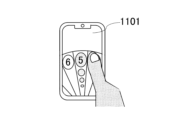
- Figures 1 and 2 show the case where the subject (3) is right-handed. Figures 1 and 2 are schematic diagrams and some details are exaggerated or omitted. Part of the subject's (3) hand is omitted.
- Figure 1 shows the relative positions of the display screen (1101) of the smartphone (101) and the thumb (31). The direction in which the thumb (31) rotates is indicated by an arrow.
- Figure 2 shows the relative positions of the smartphone (101), the display screen (1101), and the pad (32) of the thumb (31).
- Step 1 is a step in which a start operation in the test method (100) is performed.
- the application (2) outputs a question and/or an invitation message (21) to the test subject (3) on the touch panel (11) of the mobile terminal (1).
- the output is not limited as long as it is in a form that the test subject (3) can recognize.
- the message (21) is output as text or an image on the touch panel (11) of the mobile terminal (1) or as a voice addressed to the test subject (3).
- the application (2) may provide a practice phase in which the subject (3) responds to messages (21) prior to or in parallel with step 1.
- the messages (21) are preferably questions that allow the subject (3) to have either a "yes" (I think so) or a "no" (I don't think so) feeling, and to clearly determine and distinguish their intentions.
- Such messages (21) preferably guide the subject (3) so that a relatively long contact trajectory (4) appears in step 3 described below if there are no problems with the subject's physical and mental state.
- the messages (21) preferably guide the subject (3) so that a relatively long contact trajectory (4) appears in step 3 described below if the content of the messages (21) is positive for the subject's physical and mental state.
- the message (21) may be a question that the test subject (3) asks himself or herself, or a message that inspires or comforts the test subject (3).
- it may be a message that encourages the test subject (3) to ask himself questions, such as "Today is your lucky day as an Aries! Cheer on yourself before you go to work! or "Have your feelings toward your favorite character changed? Ask yourself first thing this morning.”
- the application (2) can customize the questions and/or invitation messages (21) according to the conditions input by the test subject (3).
- the application (2) can display the basic form of the message (21): "How much your pet wants to see you” on the mobile terminal (1) (touch panel (11)), and provide the test subject (3) with a customized message (21) based on the input information "Tama-chan the cat” by the test subject (3): "Your pet ***-chan is waiting for you at home. Slide your finger to imagine how happy ***-chan will be when she greets you at the front door!.
- the message (21) may be a question asked or answered by the test subject (3), a display on the touch panel (11), or a voice received by the test subject (3) from the mobile terminal (1).
- step 1 when the message (21) "Can you put force into your fingertips?" is output, the test subject (3) places his/her thumb (31) on the circle designated as the starting point on the touch panel (11). Next, the message (21) "Slide your thumb from the starting circle to the goal position with minimal force” is displayed. In step 2 described below, the test subject (3) slides the pad (32) of the thumb (31) of the hand holding the touch panel (11) from the starting circle to the goal circle.
- a text or voice message such as "Focus your attention on ***-chan and slide your thumb immediately after asking your question” may be displayed or output on the mobile device (1) as a message (21).
- a message encouraging the test subject (3) to respond can be displayed on the touch panel (11).
- a message can be text such as "Move your thumb in the direction of the arrow while imagining the answer to this question” or "Start answering with your finger! that can be displayed on the touch panel (11).
- Pictures or photographs can be displayed instead of or in addition to such messages.
- Such messages can also be output as audio messages using the audio function of the mobile terminal (1).
- the application (2) may also output a question and/or invitation message (21) after detecting that the thumb (31) of the test subject (3) has touched the touch panel (11).
- the test subject (3) receives the question and/or invitation message (21) while pressing the pad (32) of his/her thumb (31) against the touch panel (11), and proceeds to step 3 described below. That is, the test subject (3) responds to the question and/or invitation message (21), and then starts a rotational movement of the thumb (31), which had been stationary up until then.
- the subject (3) responds to the questions and/or invitation messages (21), and then slides the pad (32) of the thumb (31) of the subject's (3) dominant hand over the surface of the touch panel (11).
- the touch panel (11) has both a display function and a sensor function.
- the pad (32) of the thumb (31) starts moving while in contact with the surface of the touch panel (11), and after moving a certain distance, it stops on the touch panel (11) or leaves the surface of the touch panel (11).
- the entire contact points between the pad (32) of the thumb (31) and the touch panel (11) detected by the mobile terminal (1) in step 2 are called the contact trajectory (4).
- step 2 the subject (3) slides the thumb (31) of the hand holding the mobile terminal (1) over the touch panel (11), so the range of movement of the thumb (31) is limited.
- the main types of movement of the pad (32) of the thumb (31) in step 2 are expected to be as follows:
- a fan-shaped arc is drawn with its center near the base of the thumb (31) or near the wrist.
- the pad (32) of the thumb (31) either comes to rest on the surface of the touch panel (11) and an end point appears, or it continues its rotational motion and leaves the surface of the touch panel (11).
- the pad (32) of the thumb (31) moves in a straight line and/or a curved line that is not a sector shape.
- the pad (32) of the thumb (31) either stops on the surface of the touch panel (11) and an end point appears, or continues to move and leaves the surface of the touch panel (11).
- the position of the "start” and “goal” displayed on the touch panel (11) changes.
- the test subject (3) rotates the thumb (31) placed at the start (A) around the base and slides the pad (32) of the thumb (31) to the goal (B).
- a contact trajectory (4) resembling part of a circular arc is obtained.
- the subject (3) moves his/her thumb (31) in a flicking motion upwards starting from the base.
- the contact trajectory (4) generally becomes a straight line extending up and down near the start (A).
- this straight line either ends away from the start (A), or changes shape to a curve near the goal (B) before reaching the end point.
- the application (2) can display a scale (1103) connecting the start (A) and goal (B) as shown in FIG. 7 in order to guide the movements of the subject (3).
- the touch panel (11) can display various things in addition to scales to encourage the subject (3) to perform the sliding movement of the thumb (31). For example, it is possible to color-code the display area according to the distance from the starting point, or to display multiple target points with scales of 0, 1, 2, 3, etc. according to the extent of the distance traveled.
- step 2 when the test subject (3) slides his/her thumb (31) while feeling highly positive emotion toward the question and/or invitation message (21), the degree of contact between the thumb (32) and the touch panel (11) increases. Therefore, whether the contact trajectory (4) is curved or linear, the entire contact trajectory (4) becomes longer, or the shortest distance between both ends of the contact trajectory (4) becomes longer.
- the application (2) can display a message on the touch panel (11) prompting the subject to make a selection using a text set of "Did you finish sliding?", "Yes - Next", and "No - Redo". In this case, if "Yes - Next” is selected (if the subject (3) inputs the selected data into the mobile terminal (1) by touching the screen), the application (2) ends step 2.
- step 2 the application (2) can output a message to the test subject (3) according to the movement state of the thumb (31) during the period from the start to the end of the rotation of the thumb (31). For example, to help the blind test subject (3) with the operation, it is possible to output different sounds or generate vibrations depending on the movement state of the thumb (31).
- step 2 when the pad (32) of the thumb (31) of the subject's (3) dominant hand is slid across the surface of the touch panel (11), a so-called drum roll method can also be used.
- the "drum roll,” also known as the picker method, is a method often used when selecting one item from a number of options displayed on a smartphone. For example, it is used to select and input dates, times, ages, place names, etc. Just as one rolls a roll with printed text on its surface to reveal the desired text, the user scrolls the initial display in two directions (up and down, for example) to change to the desired input item. On smartphones, drum roll applications often generate sound effects as the display changes, helping the user imagine the roll rolling. The distance between the initial display and the desired display (the amount of rotation of the roll) corresponds to the speed of the scroll.
- the application (2) prompts the test subject (3) to advance (rotate) the scale initially displayed on the touch panel (11) in response to the question and/or invitation message (21).
- the displayed scale is displayed to advance in one direction (e.g., upward on the touch panel (11).
- the test subject (3) slides the pad (32) of the thumb (31) of his/her dominant hand over the surface of the touch panel (11) to drum roll the scale displayed on the touch panel (11).
- drum roll techniques can be used in step 2, from basic to ordinary applications.
- the drum roll method is used in step 2 of the present invention, the more vigorously the pad (32) of the thumb (31) is slid, the greater the change in the scale.
- step 3 the application (2) measures the dimension (41) of the contact trace (4) between the pad (32) of the thumb (31) that appeared in step 2 and the touch panel (11).
- the contact trace (4) is based on position information detected by a method effective for the touch panel.
- the detection method used here may be any of the projected capacitive method, which is widely used in smartphones and tablets, as well as the surface capacitive method, the low-hardness film method, the infrared method, and the like.
- the dimension (41) does not directly depend on the speed at which the pad (32) of the thumb (31) moves across the surface of the touch panel (11), but depends on the distribution of positions detected as "contact (touched)" by each method. Therefore, even if there is a period when the pad (32) of the thumb (31) stops moving while moving across the surface of the touch panel (11), the contact trace (4) is detected.
- the detected contact trajectory (4) is displayed on the touch panel (11) as a line that changes from moment to moment in step 2, it can be displayed as a trajectory in the X and Y directions by utilizing the swipe detection method of a smartphone.
- the application (2) can display a message on the touch panel (11) urging the subject (3) to slide his/her finger again. In this case, the test returns to step 1 or step 2 and continues.
- the process ends.
- the measurement result of the dimension (41) can also be registered in a database controlled by the application (2).
- the measured dimension (41) is not limited as long as it is a characteristic value that reflects the pressure and/or range of motion of the thumb (31).
- the measured dimension (41) is actually a calculated value calculated using a calculation method that introduces an appropriate statistical method to the two-dimensional coordinates of points belonging to the contact trajectory (4).
- the length (411) of the contact trajectory (4) can be measured as the dimension (41).
- the length (411) may be the total length of the line that is the contact locus (4).
- the application (2) calculates the total length (as an approximation) based on the two-dimensional coordinates of the points that make up the contact locus (4) and an appropriate statistical calculation method.
- the contact locus (4) can be approximated to a portion of a circular arc based on the coordinates of the start and end points of the thumb (31) with the base at the center, and the length of the portion of the circular arc can be calculated as the total length of the contact locus (4).
- the length (411) may also be the shortest distance between both ends of the contact locus (4), i.e., the start point and the end point (the length of a straight line connecting the start point and the end point).
- the application (2) calculates the shortest distance based on the two-dimensional coordinates of the start and end points of the contact locus (4).
- Figure 4 shows La (total length) and Ls (distance between the start and end points) as the length (411).
- the rotation angle (412) of the thumb (30) can be measured from the contact trajectory (4) as a feature representing the dimension (41).
- the thumb (31) slides on the touch panel (11) while rotating around the base of the thumb (31), so the contact trajectory (4) usually approximates the circumference of a sector. Therefore, the angle of the approximate sector can be calculated as the rotation angle (412) from the coordinates of the contact points belonging to the contact trajectory (4).
- Figure 4 shows a schematic diagram of how the rotation angle (412) is calculated as an angle ⁇ for the contact trajectory (4).
- step 3 the scale movement (413) before and after the drum roll in step 2 is measured as the dimension (41).
- the entire movement trajectory of the thumb (31) is not sensed and detected as the contact trajectory (4), but the scale movement (413) reflecting the sliding speed and pressure of the thumb (31) at the drum roll point is regarded as the contact trajectory (4). This is based on the hypothesis that if the sliding speed and pressure of the thumb (31) at the drum roll point are large, the contact trajectory (4) generated as a result of continuing the sliding motion will also be long.
- the strength of the sliding movement of the thumb will increase, or the pad (32) of the thumb (31) will vigorously drum-roll the scale, and the length (411), rotation angle (412), and scale movement (413) measured as the dimension (41) will all be large values.
- step 4 the application (2) compares the dimensions (41) with preset reference values (40) to generate answer data (5) of the subject (3) to the questions and/or invitation messages (21).
- the answer data (5) is generated according to the following rules:
- test subject (3) is determined to have affirmed the question and/or invitation message (21) (answered "yes").
- the application (2) can display the answer content on the touch panel (11) based on the generated answer data (5). For example, when positive answer data (5) is generated, the text "Your answer is 'YES'" can be displayed on the display screen (1101) of the smartphone (101). Also, when negative answer data (5) is generated, the text "Your answer is 'NO'" can be displayed on the display screen (1101) of the smartphone (101).
- step 5 the application (2) judges the mental and physical state (7) of the test subject (3) based on performance data (6) calculated from one or more pieces of answer data (5) obtained by executing steps 1 to 4 one or more times.
- the application (2) can display the judgment result on the touch panel (11). For example, when the subject (3) responds to one question and/or invitation message (21), if positive answer data (5) is generated, the message: “You look energetic today. Keep it up!” can be displayed, and if negative answer data (5) is generated, the message: "You may be tired today. Would you like to take a rest?" can be displayed.
- the application (2) can compare the performance data (6) of the test subject (3) with a preset reference value (61) to determine whether the mental and physical condition (7) is "good” or "not good.” The determination is usually made according to the following rules.
- the physical and mental condition (7) is determined to be good.
- the mental and physical condition (7) is determined to be poor.
- the application (2) can store each question and/or invitation message (21), each contact trajectory (4), and each response data (5) in a database.
- the database may be a so-called local part on the mobile terminal (1) or a part provided in a cloud on the Internet.
- the test history of these test subjects (3) can be linked to information such as the age and sex of the test subjects (3), the test date and time, the location of the mobile terminal (1) at the time of the test, weather information, and the like, and saved as a test history data set.
- the test history can be updated each time the test history is accumulated and each time the information of the test subject (3) is changed.
- the application (2) can redisplay on the touch panel (11) the past contact trajectory (4) and the assessment results of the mental and physical state (7) in response to the request information input by the subject (3) to the mobile terminal (1).
- the application (2) can detect changes in the assessment results of the mental and physical state (7) of the subject (3) and display a message informing the user of the change on the mobile terminal (1). In this case, for example, it can display text messages such as "Your mental and physical state is improving. Keep it up! or "You seem to have become fatigued over the past week,” or output a voice reading these texts.
- test method of the present invention allows users to observe and self-assess their physical and mental state in a game-like manner.
- steps 1 to 5 it is possible to add, without any restrictions, well-known functions provided to individual users in interfaces for playing games or viewing images using mobile terminal devices, such as menu selection, requests to clear or replay the screen, information input, so-called "favorite saving,” etc.
- FIG. 3 shows a schematic example (401) of the contact trajectory (4) to be measured in step 3 of the present invention.
- FIG. 3 shows the case where the subject (3) is right-handed. In FIG. 3, some details are exaggerated and omitted.
- the contact trajectory (401) is theoretically a line consisting of a collection of contact points between the pad (32) of the thumb (31) and the display screen (1101) of the smartphone (101) that appears while the subject (3) slides the thumb (31) in a flicking motion in the longitudinal direction of the display screen (1101). In reality, it is a line drawing display output by the application (2) in response to a finger swipe on the display screen (1101).
- FIG. 4 shows another example (402) of the contact trajectory (4).
- the start point C and the end point D of the contact trajectory (402) are emphasized in FIG. 4.
- FIG. 4 shows the case where the subject (3) is right-handed.
- the dotted line is a straight line connecting the start point C and the end point D of the contact trajectory (402), and is an auxiliary line related to the fan shape that approximates the contact trajectory (402).
- the application (2) obtains the following numerical values for the dimensions (41) of the contact area (402) and uses them as features representing the shape dimensions (4102) of the contact area (402).
- La the total length of the contact locus (402).
- ⁇ Ls The shortest distance between the start point C and the end point D.
- the application (2) judges the mental and physical state of the test subject (3) based on the results of comparing each of the feature quantities La, Ls, ⁇ , and T with a preset threshold value.
- Example 3 In Example 3, the subject (3) tests the same invitation message (21) generated by the application (2) at one-week intervals.
- FIG. 5 shows the application (2) displaying the past three mental and physical state judgment results (73, 74, 75) on the smartphone (101). It may be possible to display four or more results.
- the judgment results (73, 74, 75) are obtained by comparing the feature amount acquired in relation to each contact trajectory (403, 404, 405, not shown) with a threshold value, and the mental and physical level is judged based on a certain rule and displayed with a mark. The more face marks there are, the better the mental and physical state is.
- the judgment result (73) was obtained on ****/****/1.
- the judgment result (74) was obtained on ****/****/8.
- the judgment result (75) was obtained on ****/****/15.
- the application (2) can display the following text as a message (1102) on the smartphone (101): "You're gaining confidence. Let's keep this state of mind.”
- Example 4 is an example in which the drum roll method is used in steps 2 and 3.
- FIG. 8 shows the start of the drum roll in step 2 of the first test. Some details are exaggerated or omitted in FIG. 8.
- the thumb (31) of the test subject (3) is in contact with the scale mark "0", which is the starting point.
- the display screen (1101) also displays the scale mark "1" in contact with the scale mark "0".
- the thumb (31) starts to slide in the direction of the arrow (vertical direction as seen by the test subject (3)).
- the drum roll of the scale starts.
- Example 5 is an example in which the drum roll display of Example 4 is modified to a fan shape.
- Figure 10 shows how the drum roll starts.
- the thumb (31) starts to slide in the direction of the arrow.
- the scale drum roll starts.
- the display screen (1101) stabilizes in the state shown in Figure 11.
- "5" is measured as the scale movement (413).
- a test that replaces the O-ring test can be easily performed by anyone, anytime, anywhere.
- the test method of the present invention does not require anyone other than the test subject. Therefore, the test subject can take the test in a relaxed, stress-free and enjoyable manner.
- the present invention can be said to be a method for performing the O-ring test in a game-like manner. Therefore, the present invention provides an attractive service material for the health promotion industry.
Landscapes
- Health & Medical Sciences (AREA)
- Life Sciences & Earth Sciences (AREA)
- Engineering & Computer Science (AREA)
- Physics & Mathematics (AREA)
- Public Health (AREA)
- Surgery (AREA)
- Biophysics (AREA)
- Biomedical Technology (AREA)
- Heart & Thoracic Surgery (AREA)
- Medical Informatics (AREA)
- Molecular Biology (AREA)
- Pathology (AREA)
- Animal Behavior & Ethology (AREA)
- General Health & Medical Sciences (AREA)
- Veterinary Medicine (AREA)
- Oral & Maxillofacial Surgery (AREA)
- Dentistry (AREA)
- Physiology (AREA)
- Geometry (AREA)
- Multimedia (AREA)
- Physical Education & Sports Medicine (AREA)
- Child & Adolescent Psychology (AREA)
- Developmental Disabilities (AREA)
- Educational Technology (AREA)
- Hospice & Palliative Care (AREA)
- Psychiatry (AREA)
- Psychology (AREA)
- Social Psychology (AREA)
- Professional, Industrial, Or Sporting Protective Garments (AREA)
- Investigating Strength Of Materials By Application Of Mechanical Stress (AREA)
- Measurement Of The Respiration, Hearing Ability, Form, And Blood Characteristics Of Living Organisms (AREA)
Priority Applications (4)
| Application Number | Priority Date | Filing Date | Title |
|---|---|---|---|
| AU2023446360A AU2023446360A1 (en) | 2023-04-27 | 2023-04-27 | Test method for evaluating mind/body condition |
| PCT/JP2023/016750 WO2024224575A1 (ja) | 2023-04-27 | 2023-04-27 | 心身状態を評価するためのテスト方法 |
| JP2025516429A JPWO2024224575A1 (https=) | 2023-04-27 | 2023-04-27 | |
| GB2517698.3A GB2644257A (en) | 2023-04-27 | 2023-04-27 | Test method for evaluating mind/body condition |
Applications Claiming Priority (1)
| Application Number | Priority Date | Filing Date | Title |
|---|---|---|---|
| PCT/JP2023/016750 WO2024224575A1 (ja) | 2023-04-27 | 2023-04-27 | 心身状態を評価するためのテスト方法 |
Publications (1)
| Publication Number | Publication Date |
|---|---|
| WO2024224575A1 true WO2024224575A1 (ja) | 2024-10-31 |
Family
ID=93255767
Family Applications (1)
| Application Number | Title | Priority Date | Filing Date |
|---|---|---|---|
| PCT/JP2023/016750 Ceased WO2024224575A1 (ja) | 2023-04-27 | 2023-04-27 | 心身状態を評価するためのテスト方法 |
Country Status (4)
| Country | Link |
|---|---|
| JP (1) | JPWO2024224575A1 (https=) |
| AU (1) | AU2023446360A1 (https=) |
| GB (1) | GB2644257A (https=) |
| WO (1) | WO2024224575A1 (https=) |
Citations (3)
| Publication number | Priority date | Publication date | Assignee | Title |
|---|---|---|---|---|
| JP2019079342A (ja) * | 2017-10-25 | 2019-05-23 | 富士通株式会社 | 状態判定方法、状態判定プログラム及び状態判定装置 |
| JP2020113217A (ja) * | 2019-01-16 | 2020-07-27 | 株式会社SR factory | 感情判定端末、感情判定プログラム、及び感情判定方法 |
| WO2020246198A1 (ja) * | 2019-06-06 | 2020-12-10 | 株式会社ワコム | 操作者状態判断システム |
-
2023
- 2023-04-27 JP JP2025516429A patent/JPWO2024224575A1/ja active Pending
- 2023-04-27 WO PCT/JP2023/016750 patent/WO2024224575A1/ja not_active Ceased
- 2023-04-27 AU AU2023446360A patent/AU2023446360A1/en active Pending
- 2023-04-27 GB GB2517698.3A patent/GB2644257A/en active Pending
Patent Citations (3)
| Publication number | Priority date | Publication date | Assignee | Title |
|---|---|---|---|---|
| JP2019079342A (ja) * | 2017-10-25 | 2019-05-23 | 富士通株式会社 | 状態判定方法、状態判定プログラム及び状態判定装置 |
| JP2020113217A (ja) * | 2019-01-16 | 2020-07-27 | 株式会社SR factory | 感情判定端末、感情判定プログラム、及び感情判定方法 |
| WO2020246198A1 (ja) * | 2019-06-06 | 2020-12-10 | 株式会社ワコム | 操作者状態判断システム |
Also Published As
| Publication number | Publication date |
|---|---|
| AU2023446360A1 (en) | 2025-11-06 |
| JPWO2024224575A1 (https=) | 2024-10-31 |
| GB2644257A (en) | 2026-03-25 |
Similar Documents
| Publication | Publication Date | Title |
|---|---|---|
| CN104423591B (zh) | 用于光谱图的视觉处理以生成触觉效果的系统和方法 | |
| CN112433603A (zh) | 呼吸序列用户界面 | |
| KR20180110012A (ko) | 센서 지원 우울증 검출 | |
| Mihajlov et al. | Intuitive learnability of touch gestures for technology-naïve older adults | |
| TW201506834A (zh) | 問卷系統、問卷回答裝置、問卷回答方法、及問卷回答程式 | |
| JPWO2011158965A1 (ja) | 感性評価システム、感性評価方法、およびプログラム | |
| Park et al. | Investigating the affective quality of interactivity by motion feedback in mobile touchscreen user interfaces | |
| Carreira et al. | Evaluation of in-air hand gestures interaction for older people | |
| JPWO2018116703A1 (ja) | 表示制御装置、表示制御方法及びコンピュータプログラム | |
| CN114051621B (zh) | 空间提案系统和空间提案方法 | |
| JP6488064B2 (ja) | 人の心理を定量的に測定する心理量測定装置と測定方法 | |
| Bakke et al. | Design aspects of vaginal applicators that influence acceptance among target users | |
| WO2024224575A1 (ja) | 心身状態を評価するためのテスト方法 | |
| US20200209972A1 (en) | Device, system and method for tactile sensation recognition | |
| US20170084191A1 (en) | A Method for Controlling an Individualized Video Data Output on a Display Device and System | |
| JP2007050162A (ja) | 生体情報計測システム及び携帯用電子機器 | |
| JP7813265B2 (ja) | 情報提示方法および情報提示装置 | |
| Lee et al. | Design exploration for the" squeezable" interaction | |
| US20240006034A1 (en) | Systems and methods of utilizing emotion dyads to determine an individuals emotion state | |
| JP7355909B1 (ja) | 心身状態評価のための方法、プログラム、及びデバイス | |
| KR100401912B1 (ko) | 감성평가시스템 | |
| JP2025071412A (ja) | 予測装置、予測方法、予測装置用プログラム、および、予測システム | |
| JP2019036326A (ja) | 電子機器 | |
| JP2019168864A (ja) | 販売促進システム | |
| Feng | Dwell-free input methods for people with motor impairments |
Legal Events
| Date | Code | Title | Description |
|---|---|---|---|
| 121 | Ep: the epo has been informed by wipo that ep was designated in this application |
Ref document number: 23935353 Country of ref document: EP Kind code of ref document: A1 |
|
| ENP | Entry into the national phase |
Ref document number: 2025516429 Country of ref document: JP Kind code of ref document: A |
|
| WWE | Wipo information: entry into national phase |
Ref document number: AU2023446360 Country of ref document: AU Ref document number: 2025516429 Country of ref document: JP |
|
| ENP | Entry into the national phase |
Ref document number: 202517698 Country of ref document: GB Kind code of ref document: A Free format text: PCT FILING DATE = 20230427 |
|
| WWE | Wipo information: entry into national phase |
Ref document number: 2517698.3 Country of ref document: GB |
|
| ENP | Entry into the national phase |
Ref document number: 2023446360 Country of ref document: AU Date of ref document: 20230427 Kind code of ref document: A |
|
| NENP | Non-entry into the national phase |
Ref country code: DE |
|
| WWP | Wipo information: published in national office |
Ref document number: 2517698.3 Country of ref document: GB |