WO2024219501A1 - Mincleリガンドとしての糖脂質誘導体 - Google Patents
Mincleリガンドとしての糖脂質誘導体 Download PDFInfo
- Publication number
- WO2024219501A1 WO2024219501A1 PCT/JP2024/015647 JP2024015647W WO2024219501A1 WO 2024219501 A1 WO2024219501 A1 WO 2024219501A1 JP 2024015647 W JP2024015647 W JP 2024015647W WO 2024219501 A1 WO2024219501 A1 WO 2024219501A1
- Authority
- WO
- WIPO (PCT)
- Prior art keywords
- group
- salt
- glycolipid derivative
- ring
- hydrogen atom
- Prior art date
- Legal status (The legal status is an assumption and is not a legal conclusion. Google has not performed a legal analysis and makes no representation as to the accuracy of the status listed.)
- Ceased
Links
Images

Classifications
-
- A—HUMAN NECESSITIES
- A61—MEDICAL OR VETERINARY SCIENCE; HYGIENE
- A61P—SPECIFIC THERAPEUTIC ACTIVITY OF CHEMICAL COMPOUNDS OR MEDICINAL PREPARATIONS
- A61P31/00—Antiinfectives, i.e. antibiotics, antiseptics, chemotherapeutics
- A61P31/04—Antibacterial agents
-
- A—HUMAN NECESSITIES
- A61—MEDICAL OR VETERINARY SCIENCE; HYGIENE
- A61K—PREPARATIONS FOR MEDICAL, DENTAL OR TOILETRY PURPOSES
- A61K31/00—Medicinal preparations containing organic active ingredients
- A61K31/70—Carbohydrates; Sugars; Derivatives thereof
- A61K31/7028—Compounds having saccharide radicals attached to non-saccharide compounds by glycosidic linkages
- A61K31/7034—Compounds having saccharide radicals attached to non-saccharide compounds by glycosidic linkages attached to a carbocyclic compound, e.g. phloridzin
-
- A—HUMAN NECESSITIES
- A61—MEDICAL OR VETERINARY SCIENCE; HYGIENE
- A61K—PREPARATIONS FOR MEDICAL, DENTAL OR TOILETRY PURPOSES
- A61K39/00—Medicinal preparations containing antigens or antibodies
- A61K39/39—Medicinal preparations containing antigens or antibodies characterised by the immunostimulating additives, e.g. chemical adjuvants
-
- A—HUMAN NECESSITIES
- A61—MEDICAL OR VETERINARY SCIENCE; HYGIENE
- A61P—SPECIFIC THERAPEUTIC ACTIVITY OF CHEMICAL COMPOUNDS OR MEDICINAL PREPARATIONS
- A61P31/00—Antiinfectives, i.e. antibiotics, antiseptics, chemotherapeutics
- A61P31/12—Antivirals
-
- A—HUMAN NECESSITIES
- A61—MEDICAL OR VETERINARY SCIENCE; HYGIENE
- A61P—SPECIFIC THERAPEUTIC ACTIVITY OF CHEMICAL COMPOUNDS OR MEDICINAL PREPARATIONS
- A61P35/00—Antineoplastic agents
-
- A—HUMAN NECESSITIES
- A61—MEDICAL OR VETERINARY SCIENCE; HYGIENE
- A61P—SPECIFIC THERAPEUTIC ACTIVITY OF CHEMICAL COMPOUNDS OR MEDICINAL PREPARATIONS
- A61P37/00—Drugs for immunological or allergic disorders
- A61P37/02—Immunomodulators
- A61P37/04—Immunostimulants
-
- A—HUMAN NECESSITIES
- A61—MEDICAL OR VETERINARY SCIENCE; HYGIENE
- A61P—SPECIFIC THERAPEUTIC ACTIVITY OF CHEMICAL COMPOUNDS OR MEDICINAL PREPARATIONS
- A61P43/00—Drugs for specific purposes, not provided for in groups A61P1/00-A61P41/00
-
- C—CHEMISTRY; METALLURGY
- C07—ORGANIC CHEMISTRY
- C07H—SUGARS; DERIVATIVES THEREOF; NUCLEOSIDES; NUCLEOTIDES; NUCLEIC ACIDS
- C07H15/00—Compounds containing hydrocarbon or substituted hydrocarbon radicals directly attached to hetero atoms of saccharide radicals
- C07H15/20—Carbocyclic rings
- C07H15/203—Monocyclic carbocyclic rings other than cyclohexane rings; Bicyclic carbocyclic ring systems
Definitions
- the present invention relates to glycolipid derivatives that are ligands for the macrophage-inducible C-type lectin receptor, which plays an important role in immune responses, and are useful in the pharmaceutical field.
- PRRs pattern recognition receptors
- Mincle macrophage-inducible C-type lectin receptor
- Non-Patent Document 2 Non-Patent Document 2
- the present invention aims to provide a new compound (Mincle ligand) that efficiently activates Mincle in order to solve the above problems.
- the present inventors have focused on the fact that immune responses against mycobacteria are initiated by pattern recognition receptors (PRRs) sensing lipids in the cell wall of mycobacteria, and have investigated the involvement of lipids constituting the cell wall of Mycobacterium leprae, the causative bacterium of Hansen's disease, in immune responses (Non-Patent Document 3), and have found for the first time that phenolic glycolipid-III (PGL-III), the function of which was previously unknown, is a useful Mincle ligand. Based on this new finding, the present inventors have further pursued intensive studies and have completed the present invention. In this application, the following are disclosed as specific examples of the embodiment of the present invention. However, the present invention is not limited to these.
- R 1 and R 2 represents a hydroxyl group or a C 1-6 alkoxy group, and the other represents a hydrogen atom;
- R3 represents a hydrogen atom, a hydroxyl group, or a C1-6 alkoxy group;
- PGL-I, PGL-II and PGL-III represented by the following formula (Rx and Ry of each compound are as shown in Table 1) are excluded from the glycolipid derivative (I).
- R 4 and R 5 are the same as those in the glycolipid derivative (I) described in [1] above,
- One of R 4 and R 5 is a hydroxyl group or a C 1-6 alkoxy group, and the other is a hydrogen atom;
- One of R 6 and R 7 is a hydroxyl group or a C 1-6 alkoxy group, and the other is a hydrogen atom;
- one of R 8 and R 9 is a group represented by the formula: CH 2 -Ra (wherein Ra represents a hydrogen atom, a hydroxyl group, or a C 1-6 alkoxy group), and the other represents a hydrogen atom;
- one of R 10 and R 11 is a hydroxyl group or a C 1-6 alkoxy group, and the other is a hydrogen atom;
- one of R 12 and R 13 is a group represented by the formula: CH 2 -Ra (wherein Ra represents a hydrogen atom, a hydroxyl group, or a C 1-6 alkoxy group), and the
- R 4 or R 5 is a C 1-6 alkoxy group, and the other is a hydrogen atom
- One of R 6 and R 7 is a C 1-6 alkoxy group, and the other is a hydrogen atom
- one of R 8 and R 9 is a group represented by the formula: CH 2 -Ra (wherein Ra is a hydrogen atom), and the other is a hydrogen atom
- the glycolipid derivative (I) or a salt thereof according to any one of the above [6] to [10].
- R 4 is a hydrogen atom and R 5 is a C 1-6 alkoxy group
- R 6 is a hydrogen atom and R 7 is a C 1-6 alkoxy group
- R 8 is a hydrogen atom
- R 9 is a group represented by the formula: CH 2 -Ra (wherein Ra is a hydrogen atom); The glycolipid derivative (I) or a salt thereof according to any one of the above [6] to [11].
- R 10 or R 11 is a C 1-6 alkoxy group, and the other is a hydrogen atom; one of R 12 and R 13 is a group represented by the formula: CH 2 -Ra (wherein Ra is a hydrogen atom), and the other is a hydrogen atom; one of R 14 and R 15 is a hydroxyl group, and the other is a hydrogen atom;
- the glycolipid derivative (I) or a salt thereof according to any one of the above [6] to [12].
- R 10 is a hydrogen atom
- R 11 is a C 1-6 alkoxy group
- R 12 is a hydrogen atom
- R 13 is a group represented by the formula: CH 2 -Ra (wherein Ra is a hydrogen atom);
- R 14 is a hydroxyl group and
- R 15 is a hydrogen atom;
- [15] The glycolipid derivative (I) or a salt thereof according to any one of the above-mentioned [1] to [14], wherein L is a phenylene group.
- glycolipid derivative (I) or a salt thereof according to any one of the above-mentioned [1] to [15], wherein the hydrocarbon group in the optionally substituted C3-40 hydrocarbon group in R L is a C6-40 hydrocarbon group (preferably a C6-35 hydrocarbon group, more preferably a C6-35 alkyl group).
- the substituent in the optionally substituted C 3-40 hydrocarbon group is 1) a hydroxyl group, 2) an oxo group, 3) an optionally substituted C 3-40 hydrocarbon group (preferably a C 3-40 hydrocarbon group optionally substituted by 1 to 5 identical or different substituents selected from a hydroxyl group, an oxo group, and a C 1-6 alkoxy group); 4) a C alkoxy group, 5) an optionally substituted C 3-40 hydrocarbon-carbonyloxy group (preferably a C 6-40 hydrocarbon-carbonyloxy group optionally substituted by 1 to 5 identical or different substituents selected from a hydroxyl group, an oxo group, and a C 1-6 alkoxy group); 6) a group containing an epitope sequence; 7) an amino group or an acylamino group (preferably an amino group or an optionally substituted C 3-40 hydrocarbon-carbonylamino group); 8) a thiol group, and 9) a hal
- a pharmaceutical composition comprising, as an active ingredient, a glycolipid derivative (I') represented by the following formula (II): or a salt thereof.
- PGL-I and PGL-II represented by the following formula (Rx and Ry of each compound are as shown in Table 2) are excluded from the glycolipid derivative (I').
- composition according to any one of the above-mentioned [18] to [26], which is a PGL-III compound represented by the following formula (I):
- a method for preventing and/or treating cancer, bacterial infections, viral infections, and/or allergic diseases comprising administering an effective amount of the glycolipid derivative (I') defined in [18] above or a salt thereof to a mammal in need thereof.
- a method for immunostimulation which comprises administering an effective amount of the glycolipid derivative (I') defined in [18] above or a salt thereof to a mammal in need thereof.
- glycolipid derivative (I') or a salt thereof defined in the above [18] for use in the prevention and/or treatment of cancer, bacterial infections, viral infections, and/or allergic diseases.
- the glycolipid derivative (I') or a salt thereof defined in the above [18] for use in immunostimulation.
- the present invention provides, as an embodiment thereof, glycolipid derivatives having Mincle activation activity, as well as uses of the glycolipid derivatives, including their use as vaccine adjuvants.
- 1 shows the evaluation results of the Mincle ligand activity of glycolipid derivatives in Test Example 1.
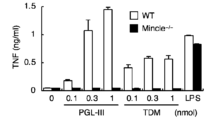
- 1 shows the evaluation results of macrophage activation by glycolipid derivatives in Test Example 2.
- 1 shows the results of crystal structure analysis (electron density map) of the Mincle-glycolipid derivative complex in Test Example 3.
- 1 shows the results of crystal structure analysis of the Mincle-glycolipid derivative complex in Test Example 3 (schematic diagram of binding mode).
- 1 shows the results of evaluation of the effect of glycolipid derivatives on enhancing antigen-specific IgG production in Test Example 4(1).
- 1 shows the results of evaluation of the effect of glycolipid derivatives on body weight in Test Example 4(2).
- 1 shows the results of evaluation of the effect of glycolipid derivatives on enhancing cellular immunity in Test Example 5.
- R 1 and R 2 represents a hydroxyl group or a C 1-6 alkoxy group, and the other represents a hydrogen atom;
- R3 represents a hydrogen atom, a hydroxyl group, or a C1-6 alkoxy group;
- glycolipid derivative (I) represents a single bond (however, the configuration is unspecified), ring S2 and ring S3 each independently represent an optionally substituted pyranose or an optionally substituted deoxypyranose; L represents a C 6-14 arylene group, and R L represents an optionally substituted C 3-40 hydrocarbon group.
- the glycolipid derivative (I) is represented by the following formula (I): or a salt thereof. (However, the above PGL-I, PGL-II and PGL-III are excluded from the above glycolipid derivative (I)). is provided.
- C ab indicates that the number of carbon atoms constituting the group is a to b (eg, 1 to 6)
- the expression “optionally substituted” indicates that the substituted object may be substituted at a substitutable position.
- examples of the "halogen atom” include fluorine, chlorine, bromine and iodine.
- C 1-6 alkyl (group) examples include methyl, ethyl, propyl, isopropyl, butyl, isobutyl, sec-butyl, tert-butyl, pentyl, isopentyl, neopentyl, 1-ethylpropyl, hexyl, isohexyl, 1,1-dimethylbutyl, 2,2-dimethylbutyl, 3,3-dimethylbutyl, and 2-ethylbutyl.
- examples of the "C 1-6 alkoxy (group)" include methoxy, ethoxy, propoxy, isopropoxy, butoxy, isobutoxy, sec-butoxy, tert-butoxy, pentyloxy and hexyloxy.
- pyranose refers to an aldohexose (six-carbon sugar) that is a carbohydrate that forms a six-membered ring with five carbons and one oxygen at the vertices, and examples thereof include allopyranose, altropyranose, glucopyranose, mannopyranose, gropyranose, idopyranose, galactopyranose, and talopyranose.
- D-form or the L-form of the "pyranose” can be used.
- the "pyranose” used may be either natural or non-natural.
- the "pyranose” may have a hydrogen atom of a hydroxyl group substituted therein, and suitable substituents include C 1-6 alkyl groups (e.g., methyl, ethyl, propyl, isopropyl, butyl, isobutyl, sec-butyl, tert-butyl, pentyl, isopentyl, neopentyl, 1-ethylpropyl, hexyl, isohexyl, 1,1-dimethylbutyl, 2,2-dimethylbutyl, 3,3-dimethylbutyl, 2-ethylbutyl, etc.).
- the number of substituted hydroxyl groups is preferably 1 to 3.
- deoxypyranose refers to a pyranose having a structure in which one or more of the hydroxyl groups of the above-mentioned “pyranose (aldohexose)" are replaced with hydrogen atoms, and examples thereof include 2- (or 3- or 4- or 5- or 6-) deoxyallopyranose, 2- (or 3- or 4- or 5- or 6-) deoxyaltropyranose, 2- (or 3- or 4- or 5- or 6-) deoxyglucopyranose, 2- (or 3- or 4- or 5- or 6-) deoxymannopyranose, 2- (or 3- or 4- or 5- or 6-) deoxygulopyranose, 2- (or 3- or 4- or 5- or 6-) deoxyidopyranose, 2- (or 3- or 4- or 5- or 6-) deoxygalactopyranose, and 2- (or 3- or 4- or 5- or 6-) deoxytalopyranose.
- Suitable examples include, but are not limited to, 2- (or 3- or 4- or 5- or 6-) deoxyglucopyranose and 2- (or 3- or 4- or 5- or 6-) deoxymannopyranose, more suitable examples include 6-deoxypyranose, and even more suitable examples include 6-deoxyglucopyranose and 6-deoxymannopyranose (rhamnopyranose).
- the "deoxypyranose” may have a hydrogen atom of a hydroxyl group substituted therein, and suitable substituents include C 1-6 alkyl groups (e.g., methyl, ethyl, propyl, isopropyl, butyl, isobutyl, sec-butyl, tert-butyl, pentyl, isopentyl, neopentyl, 1-ethylpropyl, hexyl, isohexyl, 1,1-dimethylbutyl, 2,2-dimethylbutyl, 3,3-dimethylbutyl, 2-ethylbutyl, etc.).
- the number of substituted hydroxyl groups is preferably 1 to 3.
- C 3-40 hydrocarbon group refers to a saturated or unsaturated, linear or branched hydrocarbon group having 3 to 40 carbon atoms, and specific examples thereof include propyl, butyl, isobutyl, sec-butyl, tert-butyl, pentyl, isopentyl, neopentyl, 1-ethylpropyl, hexyl, isohexyl, 1,1-dimethylbutyl, 2,2-dimethylbutyl, 3,3-dimethylbutyl, 2-ethylbutyl, 2-hexenyl, 1-hexynyl, heptyl, 1-methylhexyl, 6-heptynyl, octyl, 2-methylheptyl, 2-octen-7-ynyl, nonyl, 3-methyloctyl, decyl, 4-methylnonyl, undecyl, and 5-methyldecyl.
- C 3-40 hydrocarbon group may have 1 to 5 ring structure moieties (for example, C 3-6 cycloalkane moieties (e.g., cyclopropane, cyclobutane, cyclopentane, cyclohexane) etc.) in the molecule.
- ring structure moieties for example, C 3-6 cycloalkane moieties (e.g., cyclopropane, cyclobutane, cyclopentane, cyclohexane) etc.
- examples include groups represented by the following formulas.
- the "C 3-40 hydrocarbon group” is preferably a hydrocarbon group having 6 or more carbon atoms, more preferably a hydrocarbon group having 6 to 35 carbon atoms. More specific examples include saturated or unsaturated hydrocarbon groups having 6 to 10, 11 to 15, 16 to 20, 21 to 25, 26 to 30, or 30 to 35 carbon atoms. Furthermore, a hydrocarbon group having 1 to 5 unsaturated bonds in the molecule, which may have 1 to 5 ring structure moieties in the molecule, or a saturated hydrocarbon group (alkyl group) is preferred.
- Examples of the substituent that may be substituted on the "C 3-40 hydrocarbon group” include: 1) a hydroxyl group, 2) an oxo group, 3) an optionally substituted C3-40 hydrocarbon group, 4) a C alkoxy group, 5) an optionally substituted C 3-40 hydrocarbon-carbonyloxy group, 6) a group containing an epitope sequence; 7) an amino group or an acylamino group (preferably an amino group or an optionally substituted C 3-40 hydrocarbon-carbonylamino group); 8) a thiol group, and 9) a halogen atom.
- substituents are 1) a hydroxyl group, 2) a C 1-6 alkoxy group, and 3) an optionally substituted C 3-40 hydrocarbon-carbonyloxy group;
- substituents include:
- C 3-40 hydrocarbon portion in the above “optionally substituted C 3-40 hydrocarbon group”, “optionally substituted C 3-40 hydrocarbon-carbonyloxy group” and “optionally substituted C 3-40 hydrocarbon-carbonylamino group”, reference can be made to what is explained above for the "C 3-40 hydrocarbon group”, and examples of the substituent include a hydroxyl group, an oxo group, a C 1-6 alkoxy group , etc.
- the "group containing an epitope sequence” includes a group containing an epitope sequence determined according to a target antigen (e.g., a peptide group containing an epitope sequence), but may also be the epitope sequence itself.
- Epitope sequences include T cell epitopes and B cell epitopes.
- Those skilled in the art can select the "group containing an epitope sequence” according to the purpose and link it to a "C 3-40 hydrocarbon group” as appropriate, with reference to methods known in the art (e.g., C.C. Hanna et al., Chem. Commun., 2022, 58, 6890-6893).
- glycolipid derivative (I) is described.
- Ring S2 and ring S3 are as defined above, but ring S2 and ring S3 may be any sugar independently selected from an optionally substituted pyranose and an optionally substituted deoxypyranose.
- ring S2 and ring S3 may each be an optionally substituted pyranose, or each may be an optionally substituted deoxypyranose, or one of ring S2 and ring S3 may be an optionally substituted pyranose, and the other may be an optionally substituted deoxypyranose.
- ring S2 the sugar represented by ring S2
- ring S3 the sugar represented by ring S3
- ring S2 may both be D-form or both may be L-form.
- Either ring S2 or ring S3 may be D-form, and the other may be L-form.
- a person skilled in the art would be able to practice the present invention by appropriately selecting ring S2 and ring S3, and preferred specific examples include the following combinations (but are not limited to these).
- Ring S2 and ring S3 are each independently an optionally substituted pyranose or an optionally substituted deoxypyranose.
- Ring S2 and ring S3 are each independently a pyranose optionally substituted by a C1-6 alkyl group (preferably glucopyranose or mannopyranose) or a deoxypyranose optionally substituted by a C1-6 alkyl group (preferably 6-deoxyglucopyranose or 6-deoxymannopyranose (rhamnopyranose)).
- Ring S2 and ring S3 are each independently a deoxypyranose optionally substituted with 1 to 3 C 1-6 alkyl groups.
- Ring S2 and ring S3 are each independently a deoxymannopyranose optionally substituted with 1 to 3 C 1-6 alkyl groups.
- Ring S2 and ring S3 are each independently 6-deoxymannopyranose (rhamnopyranose) optionally substituted by 1 to 3 C 1-6 alkyl groups. Between ring S1 and ring S2, and between ring S2 and ring S3
- glycosidic bond linking two sugars indicates the glycosidic bond linking two sugars.
- the type of glycosidic bond linking the terminal sugar represented by ring S1 (hereinafter also simply referred to as "ring S1") and the sugar represented by ring S2 is not particularly limited, and may be any of a 1,2 glycosidic bond, a 1,3 glycosidic bond, a 1,4 glycosidic bond, and a 1,6 glycosidic bond as viewed from ring S1, but is preferably a 1,4 glycosidic bond.
- the configuration ( ⁇ - or ⁇ -configuration) of each sugar in the glycosidic bond is not particularly limited, but the ⁇ -configuration is preferable in ring S1, and either the ⁇ - or ⁇ -configuration is acceptable in ring S2.
- the type of glycosidic bond connecting ring S2 and ring S3 is not particularly limited, and may be any of a 1,2 glycosidic bond, a 1,3 glycosidic bond, a 1,4 glycosidic bond, and a 1,6 glycosidic bond as viewed from ring S2, but is preferably a 1,2 glycosidic bond or a 1,4 glycosidic bond, and more preferably a 1,2 glycosidic bond.
- the configuration ( ⁇ - or ⁇ -configuration) of each sugar in the glycosidic bond is not particularly limited, but the ⁇ -configuration is preferable in ring S2, and either the ⁇ -configuration or the ⁇ -configuration is acceptable in ring S3.
- One of the preferred bonding modes of the above-mentioned rings S1, S2 and S3 is the structure shown in formula (Ia) described in [6] of the [Means for solving the problems] section, but the bonding mode shown in the structure of formula (Ib) below is more preferred.
- the bonding mode shown in the structure of formula (Ib) below is more preferred.
- preferred embodiments of each group in the structure of formula (Ib) please refer to the embodiments described in [8] to [17] for the derivatives of formula (Ia).
- R 1 and R 2 are as defined above, but it is preferable that one of them is a hydroxyl group and the other is a hydrogen atom, and it is more preferable that R 1 is a hydroxyl group and R 2 is a hydrogen atom.
- R3 is as defined above, but is preferably a hydroxyl group or a C1-6 alkoxy group, more preferably a C1-6 alkoxy group, and particularly preferably a methoxy group.
- R 4 and R 5 are as defined above, but it is preferable that one of them is a C 1-6 alkoxy group and the other is a hydrogen atom, and it is more preferable that R 4 is a hydrogen atom and R 5 is a C 1-6 alkoxy group.
- R 6 and R 7 are as defined above, but it is preferable that one of them is a C 1-6 alkoxy group and the other is a hydrogen atom, and it is more preferable that R 6 is a hydrogen atom and R 7 is a C 1-6 alkoxy group.
- R 8 and R 9 are as defined above, but it is preferable that one of them is a group represented by the formula CH 2 -Ra (wherein Ra is a hydrogen atom) and the other is a hydrogen atom, and it is more preferable that R 8 is a hydrogen atom and R 9 is a group represented by the formula CH 2 -Ra (wherein Ra is a hydrogen atom).
- R 10 and R 11 are as defined above, but it is preferable that one of them is a C 1-6 alkoxy group and the other is a hydrogen atom, and it is more preferable that R 10 is a hydrogen atom and R 11 is a C 1-6 alkoxy group.
- R 12 and R 13 are as defined above, but it is preferable that one of them is a group represented by the formula CH 2 -Ra (wherein Ra is a hydrogen atom) and the other is a hydrogen atom, and it is more preferable that R 12 is a hydrogen atom and R 13 is a group represented by the formula CH 2 -Ra (wherein Ra is a hydrogen atom).
- R 14 and R 15 are as defined above, but it is preferable that one of them is a hydroxyl group and the other is a hydrogen atom, and it is more preferable that R 14 is a hydroxyl group and R 15 is a hydrogen atom.
- L is as defined above, but is preferably a phenylene group, and more preferably a 1,4-phenylene group.
- R L is as defined above, but is preferably an optionally substituted C 6-40 hydrocarbon group, More preferably, a C6-40 hydrocarbon group which may be substituted by 1 to 5 identical or different substituents selected from: 1) a hydroxyl group, 2) an oxo group, 3) an optionally substituted C3-40 hydrocarbon group, 4) a C1-6 alkoxy group, 5) an optionally substituted C3-40 hydrocarbon-carbonyloxy group, 6) a group containing an epitope sequence, 7) an amino group or an optionally substituted C3-40 hydrocarbon-carbonylamino group, 8) a thiol group, and 9) a halogen atom; More preferably, 1) a hydroxyl group, 2) an oxo group, 3) a C 3-40 hydrocarbon group which may be substituted by 1 to 5 identical or different substituents selected from a hydroxyl group, an oxo group, and a C 1-6 alkoxy group, 4) a C 1-6 alkoxy group
- the C6-40 hydrocarbon group and the C6-40 alkyl group are more preferably a C6-35 hydrocarbon group and a C6-35 alkyl group, respectively.
- the C6-40 hydrocarbon group and the C6-40 alkyl group may each have 1 to 5 ring structure moieties in the molecule.
- the glycolipid derivative (I) can be used in either the free form or the form of a salt thereof (preferably a medicamentously acceptable salt thereof).
- a person skilled in the art can carry out the present invention by appropriately selecting either form, taking into account the characteristics of the individual glycolipid derivative (I) used.
- Examples of pharma- ceutically acceptable salts include salts with inorganic acids such as hydrochloride, hydrobromide, sulfate, phosphate, etc.; salts with organic acids such as acetate, fumarate, oxalate, citrate, methanesulfonate, benzenesulfonate, tosylate, maleate, etc.; salts with bases such as alkali metal salts such as sodium salt, potassium salt, etc., and alkaline earth metal salts such as calcium salt; salts with amino acids such as glycine salt, lysine salt, arginine salt, ornithine salt, glutamate, aspartate, etc.
- inorganic acids such as hydrochloride, hydrobromide, sulfate, phosphate, etc.
- salts with organic acids such as acetate, fumarate, oxalate, citrate, methanesulfonate, benzenesulfonate, tos
- glycolipid derivative (I) or a salt thereof of the present invention has been described above in detail. Based on the results of "Analysis of the crystal structure of Mincle-ligand complex" described in Test Example 3 below, guidelines for specifically designing the glycolipid derivative (I) will be described. From the structural analysis, it is understood that in glycolipid derivative (I), each of the sugar chain portion (oligosaccharide portion consisting of ring S1-ring S2-ring S3) and the lipid portion ( RL portion) interacts with Mincle, inducing efficient polymerization of Mincle. When observed in more detail, as can be seen from FIG.
- each of the three sugars does not bind along the surface of Mincle, but only the sugar represented by S1 at the terminal (S1 sugar) binds to Mincle, and the sugars represented by S2 and S3 (S2 sugar, S3 sugar) do not bind to Mincle and are arranged at an angle close to perpendicular to the surface of Mincle. Therefore, it is understood that there is a relatively large degree of freedom in the selection of S2 sugar and S3 sugar when designing glycolipid derivative (I), while it is preferable to design so that S2 sugar and S3 sugar are arranged as described above (for example, the linkage mode of S1 sugar and S2 sugar is ⁇ ). On the other hand, when observing the lipid portion (R L portion), as can be seen from Fig.
- glycolipid derivative (I) a hydrocarbon chain of an appropriate chain length is arranged protruding from the periphery of Mincle, not along the surface of Mincle bound via sugar, and the hydrocarbon chain is bound to the hydrophobic groove of Mincle. Therefore, when designing glycolipid derivative (I), it is understood that it is preferable to design the lipid portion (R L portion) so as to satisfy such a binding mode (for example, to have a carbon number of about 6 or more). Those skilled in the art can refer to the above guidelines to design, produce and use the desired glycolipid derivative (I).
- glycolipid derivative (I) of the present invention The method for producing the glycolipid derivative (I) or a salt thereof will be described below.
- the glycolipid derivative (I) or a salt thereof can be produced, for example, by the synthesis scheme shown below.
- R L ' represents an optionally substituted C 3-38 hydrocarbon group
- X represents a halogen atom (e.g., a fluorine atom, a chlorine atom, a bromine atom, an iodine atom)
- the glycolipid derivative (I) or a salt thereof can be produced by subjecting a starting compound (II) or a salt thereof (hereinafter also referred to as "compound (II)”) and a starting compound (III) or a salt thereof (hereinafter also referred to as "compound (III)”) to a Sonogashira cross-coupling reaction, and then subjecting the resulting compound or a salt thereof to a hydrogenation reaction, according to the above synthesis scheme.
- glycolipid derivative (I) For the salts of the respective raw material compounds, reference can be made to those exemplified for the glycolipid derivative (I).
- Each reaction in the above synthesis scheme can be appropriately carried out by those skilled in the art by referring to the specific methods described in the Production Examples and Examples below, or methods known in the art.
- compound (II) can be appropriately produced by a person skilled in the art starting from a known compound by selecting a sugar represented by ring S3 and a sugar represented by ring S2 to determine the structure of the sugar moiety of the desired glycolipid derivative, and then referring to the specific methods described in the Production Examples and Examples below or methods known in the art.
- glycolipid derivative (I) or a salt thereof can also be produced by subjecting compound (III) to a Sonogashira cross-coupling reaction, followed by esterification with a carboxylic acid compound corresponding to the "optionally substituted C 3-40 hydrocarbon-carbonyloxy group", and then subjecting the resultant to a hydrogenation reaction.
- This synthesis reaction can also be appropriately carried out by a person skilled in the art starting from a known compound with reference to the specific methods described in the Production Examples and Examples below, or methods known in the art.
- a pharmaceutical composition comprising, as an active ingredient, a glycolipid derivative (I') or a salt thereof represented by the following formula (1'): (However, the above PGL-I and PGL-II are excluded from the above glycolipid derivative (I')). is provided.
- the glycolipid derivative (I') is a compound common to the glycolipid derivative (I) except that PGL-IIIs are included within its scope.
- glycolipid derivative (I) for example, the embodiment of "glycolipid derivative (I) or a salt thereof" described in [1] to [17] in the above [Means for solving the problem]).
- glycolipid derivative (I) is included in glycolipid derivative (I')
- the usefulness of glycolipid derivative (I') or a salt thereof described in detail below also applies to glycolipid derivative (I) or a salt thereof.
- the salt of the glycolipid derivative (I') reference can be made to those exemplified for the glycolipid derivative (I).
- glycolipid derivative (I) or (I') (hereinafter collectively referred to as glycolipid derivative (I')) or a salt thereof is useful as a medicine for prevention and/or treatment of diseases, containing itself as an active ingredient.
- the glycolipid derivative (I') or a salt thereof is a Mincle ligand and can activate the action of Mincle. Through this activation of Micle, the activity of the natural immune system is induced, and for example, an infection defense action against a pathogen parasitic in a cell is exerted.
- the glycolipid derivative (I') or a salt thereof activates bone marrow-derived macrophages through the activation of Mincle, and exerts an action of enhancing TNF (tumor necrosis factor) production, and is therefore useful as an anticancer agent (cancer prevention and/or treatment agent).
- the target cancer is not particularly limited, and examples thereof include cancer [e.g., colon cancer, lung cancer, mesothelioma, pancreatic cancer, pharyngeal cancer, laryngeal cancer, esophageal cancer, gastric cancer, duodenal cancer, small intestine cancer, breast cancer, ovarian cancer, testicular tumor, prostate cancer, thyroid cancer, kidney cancer, uterine cancer, etc.].
- glycolipid derivative (I') or a salt thereof also has the effect of enhancing the production of IFN- ⁇ through the activation of Mincle, and is therefore also useful as a preventive and/or therapeutic agent for bacterial infections, viral infections, and/or allergic diseases.
- prevention includes prevention of the onset of a disease (all pathologies or symptoms, or one or more pathologies or symptoms), and delay of the onset of the disease.
- Prophylactically effective amount refers to a dose of the glycolipid derivative (I') or a salt thereof sufficient to achieve such a purpose.
- Treatment includes cure of a disease (all pathologies or symptoms, or one or more pathologies or symptoms), amelioration of the disease, and inhibition of progression of the severity of the disease.
- pharmaceuticalally effective amount refers to a dose of the glycolipid derivative (I') or a salt thereof sufficient to achieve such a purpose.
- glycolipid derivative (I') or a salt thereof can be used either alone or in the form of a pharmaceutical composition containing the glycolipid derivative (I') or a salt thereof as an active ingredient together with a pharma- ceutical acceptable carrier (hereinafter also referred to as "the pharmaceutical").
- a pharmaceutical composition containing the glycolipid derivative (I') or a salt thereof as an active ingredient together with a pharma- ceutical acceptable carrier (hereinafter also referred to as "the pharmaceutical").
- compositions include tablets (including sugar-coated tablets, film-coated tablets, sublingual tablets, orally disintegrating tablets, buccal tablets, etc.), pills, powders, granules, capsules (including soft capsules and microcapsules), troches, syrups, liquids, emulsions, suspensions, controlled-release preparations (e.g., immediate-release preparations, sustained-release preparations, sustained-release microcapsules), aerosols, films (e.g., orally disintegrating films, oral mucosa patch films), injections (e.g., subcutaneous injections, intravenous injections (e.g., bolus), intramuscular injections, intraperitoneal injections), drip infusions, transdermal preparations, ointments, lotions, patches, suppositories (e.g., rectal suppositories, vaginal suppositories), pellets, nasal preparations, pulmonary preparations (inhalants), and eye drops.
- tablets including sugar-co
- pharmaceutical acceptable carrier various carriers commonly used in the field of pharmaceutical formulation technology can be used.
- specific examples of the "pharmaceutical acceptable carrier” that can be used in solid preparations include excipients (e.g., lactose, sucrose, D-mannitol, starch, corn starch, crystalline cellulose, light anhydrous silicic acid, etc.), lubricants (e.g., magnesium stearate, talc, colloidal silica, etc.), binders (e.g., crystalline cellulose, sucrose, D-mannitol, dextrin, hydroxypropyl cellulose, hydroxypropylmethylcellulose, polyvinylpyrrolidone, starch, sucrose, gelatin, methylcellulose, sodium carboxymethylcellulose, etc.), and disintegrants (e.g., starch, carboxymethylcellulose, calcium carboxymethylcellulose, sodium carboxymethylstarch, L-hydroxypropylcellulose, etc.).
- excipients e.g., lactose
- solvents e.g., water for injection, isotonic saline, alcohol, propylene glycol, macrogol, sesame oil, etc.
- solubilizing agents e.g., polyethylene glycol, propylene glycol, D-mannitol, benzyl benzoate, ethanol, triethanolamine, sodium carbonate, sodium citrate, etc.
- suspending agents e.g., surfactants such as stearyl triethanolamine, sodium lauryl sulfate, lauryl aminopropionic acid, lecithin, benzalkonium chloride, glycerin monostearate, etc.
- hydrophilic polymers such as polyvinyl alcohol, polyvinylpyrrolidone, sodium carboxymethylcellulose, methylcellulose, hydroxymethylcellulose, hydroxypropylcellulose, etc.
- isotonic agents e.g., glucose, D-sorbitol, sodium chloride, glycerin, D-mannitol, etc.
- formulation additives such as preservatives (e.g., paraoxybenzoic acid esters, chlorobutanol, benzyl alcohol, sorbic acid, etc.), antioxidants (e.g., sulfites, ascorbic acid, ⁇ -tocopherol, etc.), colorants, sweeteners, etc. may be further added.
- the above pharmaceutical composition may be prepared by adding the glycolipid derivative (I') or a salt thereof in an amount of usually 0.01 to 99% (w/w), preferably 0.1 to 85% (w/w), based on the total amount of the preparation, depending on the dosage form, administration method, carrier, etc.
- the pharmaceutical composition may be prepared by a method commonly used in the field of formulation technology depending on the form.
- the pharmaceutical composition of the present invention may be formed into a controlled release preparation, such as an immediate release preparation or sustained release preparation, containing an active ingredient.
- the glycolipid derivative (I') or its salt is expected to have low toxicity and few side effects, and has excellent properties as a pharmaceutical. Therefore, the pharmaceutical can be safely administered to any animal having an immune system, for example, mammals (e.g., humans, monkeys, dogs, cows, horses, etc.) (especially humans).
- mammals e.g., humans, monkeys, dogs, cows, horses, etc.
- the glycolipid derivative (I') or a salt thereof may be administered orally or parenterally (e.g., intravenously, by drip infusion, intramuscularly, subcutaneously, intraorgan, intranasally, intradermally, transdermally, by eye drop, intracerebral, intrarectal, intravaginal, intraperitoneal administration, and administration to a lesion) alone or as a pharmaceutical composition.
- parenterally e.g., intravenously, by drip infusion, intramuscularly, subcutaneously, intraorgan, intranasally, intradermally, transdermally, by eye drop, intracerebral, intrarectal, intravaginal, intraperitoneal administration, and administration to a lesion
- the dosage of the glycolipid derivative (I') or a salt thereof varies depending on the subject, the route of administration, and the age and symptoms of the subject, but is not particularly limited.
- the dosage is 0.1 to 1000 mg, preferably 0.1 to 500 mg, and more preferably 1 to 300 mg, per oral administration of the active ingredient glycolipid derivative (I') or a salt thereof.
- the dosage can be administered in 1 to 3 divided doses per day.
- When administered in the form of a sustained release preparation it is also possible to administer every other day or at intervals of more than that, so as to correspond to the dosage.
- the glycolipid derivative (I') or its salt has an immunostimulating effect and can be used as an adjuvant.
- adjuvant is a general term for a substance that can increase antibody production and enhance immune responses by combining with an antigen.
- the glycolipid derivative (I') or a salt thereof of the present invention is used as an adjuvant.
- its dosage form may be, for example, an aqueous or non-aqueous (e.g., oil-based, etc.) solution, suspension, emulsion, etc.
- glycolipid derivative (I') or a salt thereof can be prepared by mixing the glycolipid derivative (I') or a salt thereof with a medicamentously acceptable carrier (e.g., solvent, suspending agent, etc.) and by a method such as hand shaking, mechanical shaking, ultrasonic dispersion, dispersion using a homomixer, self-emulsification, membrane emulsification, D-phase emulsification method, vacuum emulsification method, ultra-high pressure emulsification method, etc. (hereinafter, also referred to as "this adjuvant").
- a medicamentously acceptable carrier e.g., solvent, suspending agent, etc.
- the present adjuvant may be used in combination with other adjuvants, such as adjuvants used in the art, for example, Freund's incomplete adjuvant, Freund's complete adjuvant, microparticles (e.g., uric acid crystals, silica, aluminum hydroxide gel, polystyrene, asbestos, titanium dioxide, black nickel oxide, etc.), lipopolysaccharides (LPS), etc.
- adjuvants used in the art, for example, Freund's incomplete adjuvant, Freund's complete adjuvant, microparticles (e.g., uric acid crystals, silica, aluminum hydroxide gel, polystyrene, asbestos, titanium dioxide, black nickel oxide, etc.), lipopolysaccharides (LPS), etc.
- adjuvants used in the art, for example, Freund's incomplete adjuvant, Freund's complete adjuvant, microparticles (e.g., uric acid crystals, silica, aluminum hydroxide gel,
- the present invention also provides a vaccine comprising the glycolipid derivative (I') of the present invention or a salt thereof and an antigen (hereinafter also referred to as "the present vaccine”).
- the antigen is not particularly limited as long as it is a substance capable of inducing an immune response, and examples thereof include (1) allergens (e.g., pollen allergens, food allergens, house dust allergens, etc.), (2) pathogen antigens (e.g., (i) pathogenic virus antigens (e.g., virus antigens such as human immunodeficiency virus, hepatitis virus, influenza virus, etc.), (ii) pathogenic microbial antigens (e.g., pathogenic bacteria (e.g., Streptococcus pneumoniae, Clostridium tetanus, Corynebacterium diphtheriae, Bordetella pertussis, Vibrio cholerae, Salmonella enterica, Salmonella typhi, Chlamydia
- pathogenic yeasts e.g., Aspergillus, Candida, etc.
- pathogenic protozoan antigens e.g., antigens expressed in malaria, Schistosoma, etc.
- self-antigens in the body e.g., amyloid ⁇ and prions in neurological diseases such as Alzheimer's disease and Creutzfeldt-Jakob disease; ApoB100 in cardiovascular diseases such as arteriosclerosis and hypertension
- tumor antigens e.g., antigens of solid tumors including epithelial and non-epithelial tumors, antigens of tumors in hematopoietic tissues, etc.
- the vaccine may be administered by a route selected from the group consisting of oral, intramuscular, transdermal, intradermal, subcutaneous, intraperitoneal, intratracheal, nasal, intraocular, intravaginal, rectal, intravenous, small intestinal and inhalation administration, with subcutaneous or nasal administration being particularly preferred.
- the content of the antigen in the present vaccine may be an effective amount for functioning as a vaccine, and such amount can be determined by a person skilled in the art without undue experimentation, for example, based on tests using laboratory animals, etc. Specifically, the content of the antigen in the present vaccine is usually 1 to 100 ⁇ g.
- the content of the glycolipid derivative (I') of the present invention or a salt thereof in the present vaccine is not particularly limited and may be appropriately adjusted depending on, for example, the type of antigen, the subject of administration, the administration form and the administration route, but is, for example, 2 ⁇ g to 1000 mg, usually 2 ⁇ g to 500 mg, preferably 2 ⁇ g to 20 mg, and more preferably 20 ⁇ g to 200 ⁇ g in the case of oral, intramuscular, transdermal, intradermal, subcutaneous or intraperitoneal administration.
- the present vaccine may contain a medicament acceptable carrier in addition to the glycolipid derivative (I') or a salt thereof and an antigen.
- the medicament acceptable carrier that the present vaccine may contain include the same as those exemplified as the medicament acceptable carrier that the present medicine may contain.
- the present vaccine may further contain other adjuvants. Examples of such other adjuvants include those exemplified as adjuvants that can be used in combination with the present adjuvant.
- Examples of dosage forms of the present vaccine include the same as those exemplified as dosage forms of the present medicament.
- the vaccine can be produced by a method commonly used in the field of formulation technology, such as the method described in the 16th Edition of the Japanese Pharmacopoeia, etc. For example, it can be prepared by mixing the drug and the desired antigen, and emulsifying or dispersing as necessary, or by adding the drug to a vaccine containing the desired antigen, and emulsifying or dispersing as necessary.
- the vaccine may be administered in a single dose or multiple consecutive doses.
- the administration period is not particularly limited and may be appropriately set depending on, for example, the type of antigen, the subject to be administered, the administration form, and the administration route, but is usually in the range of 1 to 150 days, and can also be appropriately administered for 1 to 120 days, 1 to 60 days, 1 to 30 days, etc., as necessary.
- allergies, infectious diseases, cancer, and the like can be prevented and/or treated.
- Ph is a phenyl group
- Me is a methyl group
- PMB is a 4-methoxybenzyl group
- Bn is a benzyl group
- Cbz is a benzyloxycarbonyl group.
- the compounds represented by the formula (I) are compounds 15 to 17 produced in Production Examples C to E, respectively.
- the structural formulae of the produced PGL-I compound (Example 1), PGL-II compound (Example 2), and PGL-III compound (Example 3) are shown below.
- the ligand activity of HD-276 was evaluated on a 96-well plate using NFAT-GFP reporter cells expressing bovine Mincle, which were prepared according to a method described in a literature (Yamasaki, S. et al., Nat Immunol 9, 1179-88 (2008)). The evaluation results are shown in FIG. 1 (right). The dose of the test compound (horizontal axis) is 0.03 to 3 (nmol) from left to right. This evaluation revealed that the PGL-III compound has superior Mincle ligand activity to TDM. HD-276 was also confirmed to have Mincle ligand activity in a similar evaluation. Furthermore, neither the PGL-I compound nor the PGL-II compound was found to have ligand activity in a similar evaluation. From the above facts, it is understood that the hydroxyl group at the 3-position of the terminal sugar represented by ring S1 of the glycolipid derivative (I') of the present invention is an essential structure for exerting Mincle ligand activity.
- the evaluation results are shown in FIG. 2.
- the doses of the test compounds were as shown in FIG. 2.
- LPS 0.1 ⁇ g/ml was used as a positive control. This evaluation revealed that the PGL-III compound activates macrophages through activation of Mincle and enhances TNF production in a dose-dependent manner, and furthermore, that this effect is superior to that of TDM.
- Test Example 3 Analysis of the Crystal Structure of Mincle-Ligand Complex
- a crystal structure analysis was performed using a complex of Mincle and a PGL-III analog (HD-276). The results of the analysis are shown in Figures 3 and 4.
- Figure 3 shows an electron density map of the complex.
- Figure 4 shows a schematic diagram of the binding mode between Mincle and a PGL-III analog. From this structural analysis, it was assumed that in the glycolipid derivative (I') of the present invention, the glycan portion (the oligosaccharide portion consisting of ring S1-ring S2-ring S3) and the lipid portion (the R L portion) each interact with Mincle, inducing efficient polymerization of Mincle.
- the glycolipid derivative (I') of the present invention the glycan portion (the oligosaccharide portion consisting of ring S1-ring S2-ring S3) and the lipid portion (the R L portion) each interact with Mincle, inducing efficient polymerization of Mincle.
- Test Example 4 Evaluation of Immunostimulatory Action (1) Study of Effect of Enhancing Antigen-Specific IgG Production
- the adjuvant activity of the test compounds (PGL-III compound and TDB) was evaluated using the amount of IgG antibody produced when ovalbumin (OVA) was administered to C57BL/6 mice as a model antigen.
- mice serum was collected over time after immunization, and the amount of OVA-specific IgG antibody produced was evaluated and quantified by ELISA using a standard curve drawn using serum collected from OVA/Alum-immunized mice (*p ⁇ 0.05, **p ⁇ 0.01, ***p ⁇ 0.005).
- the evaluation results are shown in FIG. 5.
- This evaluation revealed that the OVA + PGL-III compound administration group showed significantly enhanced IgG antibody production compared to the OVA alone administration group, and furthermore, the degree of enhancement was greater than that of the OVA + TDB administration group. This fact clearly indicates that the PGL-III compound has an excellent immunostimulating effect and is excellent as an adjuvant.
- the present invention relates to embodiments of glycolipid derivatives, which are ligands for Mincle, which plays an important role in immune responses, and are useful in the pharmaceutical field.
Landscapes
- Health & Medical Sciences (AREA)
- Life Sciences & Earth Sciences (AREA)
- Chemical & Material Sciences (AREA)
- General Health & Medical Sciences (AREA)
- Medicinal Chemistry (AREA)
- Pharmacology & Pharmacy (AREA)
- Organic Chemistry (AREA)
- Animal Behavior & Ethology (AREA)
- Public Health (AREA)
- Veterinary Medicine (AREA)
- General Chemical & Material Sciences (AREA)
- Chemical Kinetics & Catalysis (AREA)
- Nuclear Medicine, Radiotherapy & Molecular Imaging (AREA)
- Immunology (AREA)
- Engineering & Computer Science (AREA)
- Bioinformatics & Cheminformatics (AREA)
- Molecular Biology (AREA)
- Epidemiology (AREA)
- Communicable Diseases (AREA)
- Oncology (AREA)
- Biochemistry (AREA)
- Biotechnology (AREA)
- Genetics & Genomics (AREA)
- Mycology (AREA)
- Microbiology (AREA)
- Virology (AREA)
- Pharmaceuticals Containing Other Organic And Inorganic Compounds (AREA)
- Saccharide Compounds (AREA)
Priority Applications (3)
| Application Number | Priority Date | Filing Date | Title |
|---|---|---|---|
| JP2025515313A JPWO2024219501A1 (https=) | 2023-04-20 | 2024-04-19 | |
| CN202480026591.1A CN121079308A (zh) | 2023-04-20 | 2024-04-19 | 作为Mincle配体的糖脂质衍生物 |
| EP24792772.6A EP4700036A1 (en) | 2023-04-20 | 2024-04-19 | Glycolipid derivative as mincle ligand |
Applications Claiming Priority (2)
| Application Number | Priority Date | Filing Date | Title |
|---|---|---|---|
| JP2023-069661 | 2023-04-20 | ||
| JP2023069661 | 2023-04-20 |
Publications (1)
| Publication Number | Publication Date |
|---|---|
| WO2024219501A1 true WO2024219501A1 (ja) | 2024-10-24 |
Family
ID=93152578
Family Applications (1)
| Application Number | Title | Priority Date | Filing Date |
|---|---|---|---|
| PCT/JP2024/015647 Ceased WO2024219501A1 (ja) | 2023-04-20 | 2024-04-19 | Mincleリガンドとしての糖脂質誘導体 |
Country Status (4)
| Country | Link |
|---|---|
| EP (1) | EP4700036A1 (https=) |
| JP (1) | JPWO2024219501A1 (https=) |
| CN (1) | CN121079308A (https=) |
| WO (1) | WO2024219501A1 (https=) |
Citations (3)
| Publication number | Priority date | Publication date | Assignee | Title |
|---|---|---|---|---|
| JP2021501791A (ja) * | 2017-11-02 | 2021-01-21 | ヴィクトリア リンク リミテッド | ブラルテミシン類似体 |
| WO2023277051A1 (ja) * | 2021-06-30 | 2023-01-05 | 国立大学法人大阪大学 | 免疫賦活剤 |
| JP2023069661A (ja) | 2021-11-08 | 2023-05-18 | 三甲株式会社 | 分別容器 |
-
2024
- 2024-04-19 JP JP2025515313A patent/JPWO2024219501A1/ja active Pending
- 2024-04-19 WO PCT/JP2024/015647 patent/WO2024219501A1/ja not_active Ceased
- 2024-04-19 EP EP24792772.6A patent/EP4700036A1/en active Pending
- 2024-04-19 CN CN202480026591.1A patent/CN121079308A/zh active Pending
Patent Citations (3)
| Publication number | Priority date | Publication date | Assignee | Title |
|---|---|---|---|---|
| JP2021501791A (ja) * | 2017-11-02 | 2021-01-21 | ヴィクトリア リンク リミテッド | ブラルテミシン類似体 |
| WO2023277051A1 (ja) * | 2021-06-30 | 2023-01-05 | 国立大学法人大阪大学 | 免疫賦活剤 |
| JP2023069661A (ja) | 2021-11-08 | 2023-05-18 | 三甲株式会社 | 分別容器 |
Non-Patent Citations (17)
| Title |
|---|
| ANGEWANDTE CHEMIE INTERNATIONAL EDITION, vol. 124, no. 47, 2012, pages 11774 - 11777 |
| ARBUES ET AL., FRONT. CELL. INFECT. MICROBIOL, vol. 4, 2014, pages 173 |
| BRAGANZA ET AL., FRONT. IMMUNOL, vol. 8, 2018, pages 1940 |
| C.C. HANNA ET AL., CHEM. COMMUN., vol. 58, 2022, pages 6890 - 6893 |
| CHEM BIO CHEM, vol. 22, no. 8, 2021, pages 1487 - 1493 |
| CHEM. COMMUN., no. 5, 2007, pages 489 - 491 |
| HUNTER SHIRLEY W, BRENNANS PATRICK J: "Further specific extracellular phenolic glycolipid antigens and a related diacylphthiocerol from Mycobacterium leprae", JOURNAL OF BIOLOGICAL CHEMISTRY, vol. 258, no. 12, 25 June 1983 (1983-06-25), pages 7556 - 7562, XP093223636, DOI: 10.1016/S0021-9258(18)32214-2 * |
| ISHIKAWA, T. ET AL., CELL HOST MICROBE, vol. 13, 2013, pages 477 - 488 |
| JARDINE IAN., SCANLAN GALE., MCNEIL MICHAEL., BRENNAN PATRICK J.: "Plasma desorption mass spectrometric analysis of mycobacterial glycolipids", ANALYTICAL CHEMISTRY, AMERICAN CHEMICAL SOCIETY, US, vol. 61, no. 5, 1 March 1989 (1989-03-01), US , pages 416 - 422, XP093223676, ISSN: 0003-2700, DOI: 10.1021/ac00180a008 * |
| KIYOTAKE, R. ET AL., J BIOL CHEM, vol. 290, 2015, pages 25322 - 25332 |
| KLINGEL TIZIAN; HADAMJETZ MARTINA; FISCHER ANJA; WEFERS DANIEL: "Glucosylation of flavonoids and flavonoid glycosides by mutant dextransucrase from Lactobacillus reuteri TMW 1.106", CARBOHYDRATE RESEARCH, PERGAMON, GB, vol. 483, 10 July 2019 (2019-07-10), GB , XP085769978, ISSN: 0008-6215, DOI: 10.1016/j.carres.2019.107741 * |
| RIVIÈRE M., FOURNIÉ J. J., VERCELLONE A., PUZO G.: "Particular matrix for fast atom bombardment mass spectrometric analysis of phenolic glycolipid antigens isolated from pathogen mycobacteria", BIOLOGICAL MASS SPECTROSCOPY, WILEY AND SONS, CHICHESTER, GB, vol. 16, no. 1-12, 1 October 1988 (1988-10-01), GB , pages 275 - 278, XP093223637, ISSN: 1052-9306, DOI: 10.1002/bms.1200160153 * |
| SCHOENEN ET AL., J. IMMUNOL., vol. 184, 2010, pages 2756 |
| See also references of EP4700036A1 |
| YAMASAKI, S. ET AL., NAT IMMUNOL, vol. 9, 2008, pages 1179 - 88 |
| YAMASAKI, S. ET AL., PROC NATL ACAD SCI USA, vol. 106, 2009, pages 1897 - 1902 |
| ZHENG RUIXIANG BLAKE, JÉGOUZO SABINE A. F., JOE MAJU, BAI YU, TRAN HUU-ANH, SHEN KE, SAUPE JÖRN, XIA LI, AHMED MD. FAIAZ, LIU YU-H: "Insights into Interactions of Mycobacteria with the Host Innate Immune System from a Novel Array of Synthetic Mycobacterial Glycans", ACS CHEMICAL BIOLOGY, AMERICAN CHEMICAL SOCIETY, vol. 12, no. 12, 15 December 2017 (2017-12-15), pages 2990 - 3002, XP093223635, ISSN: 1554-8929, DOI: 10.1021/acschembio.7b00797 * |
Also Published As
| Publication number | Publication date |
|---|---|
| CN121079308A (zh) | 2025-12-05 |
| JPWO2024219501A1 (https=) | 2024-10-24 |
| EP4700036A1 (en) | 2026-02-25 |
Similar Documents
| Publication | Publication Date | Title |
|---|---|---|
| ES2654382T3 (es) | Método para la preparación de glucoesfingolípidos | |
| US7129219B2 (en) | Immunoeffector compounds | |
| US7491707B1 (en) | Synthetic lipid-a-analogs and uses thereof | |
| KR101675657B1 (ko) | 탄수화물-당지질 컨쥬게이트 백신 | |
| US20230139366A1 (en) | Brartemicin analogues | |
| KR102480429B1 (ko) | 스트렙토코커스 뉴모니에 혈청형 8에 대한 백신 | |
| AU2002253909B2 (en) | New immunoeffector compounds | |
| WO2024219501A1 (ja) | Mincleリガンドとしての糖脂質誘導体 | |
| JP2019504017A (ja) | ストレプトコッカス ニューモニアエ(Streptococcus pneumoniae)血清型2に対する合成ワクチン | |
| HK40129352A (zh) | 作为mincle配体的糖脂质衍生物 | |
| WO2026054009A1 (ja) | Mincle受容体およびDectin-2受容体のデュアル活性化剤 | |
| TWI595878B (zh) | 製備鞘糖脂之方法及其用途 | |
| JPWO2018155051A1 (ja) | リピドa | |
| WO2025154737A1 (ja) | 糖脂質誘導体を有効成分とするt細胞活性化剤 | |
| Wu | Modulators of Toll-like Receptors-4 and-2 | |
| Seeberger et al. | Synthetic vaccines against Streptococcus pneumoniae |
Legal Events
| Date | Code | Title | Description |
|---|---|---|---|
| 121 | Ep: the epo has been informed by wipo that ep was designated in this application |
Ref document number: 24792772 Country of ref document: EP Kind code of ref document: A1 |
|
| ENP | Entry into the national phase |
Ref document number: 2025515313 Country of ref document: JP Kind code of ref document: A |
|
| WWE | Wipo information: entry into national phase |
Ref document number: 2025515313 Country of ref document: JP |
|
| WWE | Wipo information: entry into national phase |
Ref document number: 2024792772 Country of ref document: EP |
|
| NENP | Non-entry into the national phase |
Ref country code: DE |
|
| ENP | Entry into the national phase |
Ref document number: 2024792772 Country of ref document: EP Effective date: 20251120 |
|
| ENP | Entry into the national phase |
Ref document number: 2024792772 Country of ref document: EP Effective date: 20251120 |
|
| ENP | Entry into the national phase |
Ref document number: 2024792772 Country of ref document: EP Effective date: 20251120 |
|
| ENP | Entry into the national phase |
Ref document number: 2024792772 Country of ref document: EP Effective date: 20251120 |
|
| ENP | Entry into the national phase |
Ref document number: 2024792772 Country of ref document: EP Effective date: 20251120 |
|
| ENP | Entry into the national phase |
Ref document number: 2024792772 Country of ref document: EP Effective date: 20251120 |
|
| ENP | Entry into the national phase |
Ref document number: 2024792772 Country of ref document: EP Effective date: 20251120 |
|
| ENP | Entry into the national phase |
Ref document number: 2024792772 Country of ref document: EP Effective date: 20251120 |
|
| ENP | Entry into the national phase |
Ref document number: 2024792772 Country of ref document: EP Effective date: 20251120 |
|
| WWP | Wipo information: published in national office |
Ref document number: 2024792772 Country of ref document: EP |