WO2024219379A1 - ガラス - Google Patents
ガラス Download PDFInfo
- Publication number
- WO2024219379A1 WO2024219379A1 PCT/JP2024/015078 JP2024015078W WO2024219379A1 WO 2024219379 A1 WO2024219379 A1 WO 2024219379A1 JP 2024015078 W JP2024015078 W JP 2024015078W WO 2024219379 A1 WO2024219379 A1 WO 2024219379A1
- Authority
- WO
- WIPO (PCT)
- Prior art keywords
- glass
- less
- content
- mgo
- thermal expansion
- Prior art date
- Legal status (The legal status is an assumption and is not a legal conclusion. Google has not performed a legal analysis and makes no representation as to the accuracy of the status listed.)
- Ceased
Links
Images

Classifications
-
- H—ELECTRICITY
- H10—SEMICONDUCTOR DEVICES; ELECTRIC SOLID-STATE DEVICES NOT OTHERWISE PROVIDED FOR
- H10W—GENERIC PACKAGES, INTERCONNECTIONS, CONNECTORS OR OTHER CONSTRUCTIONAL DETAILS OF DEVICES COVERED BY CLASS H10
- H10W70/00—Package substrates; Interposers; Redistribution layers [RDL]
- H10W70/60—Insulating or insulated package substrates; Interposers; Redistribution layers
- H10W70/67—Insulating or insulated package substrates; Interposers; Redistribution layers characterised by their insulating layers or insulating parts
- H10W70/69—Insulating materials thereof
- H10W70/692—Ceramics or glasses
-
- C—CHEMISTRY; METALLURGY
- C03—GLASS; MINERAL OR SLAG WOOL
- C03C—CHEMICAL COMPOSITION OF GLASSES, GLAZES OR VITREOUS ENAMELS; SURFACE TREATMENT OF GLASS; SURFACE TREATMENT OF FIBRES OR FILAMENTS MADE FROM GLASS, MINERALS OR SLAGS; JOINING GLASS TO GLASS OR OTHER MATERIALS
- C03C3/00—Glass compositions
- C03C3/04—Glass compositions containing silica
- C03C3/076—Glass compositions containing silica with 40% to 90% silica, by weight
- C03C3/089—Glass compositions containing silica with 40% to 90% silica, by weight containing boron
-
- C—CHEMISTRY; METALLURGY
- C03—GLASS; MINERAL OR SLAG WOOL
- C03C—CHEMICAL COMPOSITION OF GLASSES, GLAZES OR VITREOUS ENAMELS; SURFACE TREATMENT OF GLASS; SURFACE TREATMENT OF FIBRES OR FILAMENTS MADE FROM GLASS, MINERALS OR SLAGS; JOINING GLASS TO GLASS OR OTHER MATERIALS
- C03C3/00—Glass compositions
- C03C3/04—Glass compositions containing silica
- C03C3/076—Glass compositions containing silica with 40% to 90% silica, by weight
- C03C3/089—Glass compositions containing silica with 40% to 90% silica, by weight containing boron
- C03C3/091—Glass compositions containing silica with 40% to 90% silica, by weight containing boron containing aluminium
-
- C—CHEMISTRY; METALLURGY
- C03—GLASS; MINERAL OR SLAG WOOL
- C03C—CHEMICAL COMPOSITION OF GLASSES, GLAZES OR VITREOUS ENAMELS; SURFACE TREATMENT OF GLASS; SURFACE TREATMENT OF FIBRES OR FILAMENTS MADE FROM GLASS, MINERALS OR SLAGS; JOINING GLASS TO GLASS OR OTHER MATERIALS
- C03C3/00—Glass compositions
- C03C3/04—Glass compositions containing silica
- C03C3/076—Glass compositions containing silica with 40% to 90% silica, by weight
- C03C3/089—Glass compositions containing silica with 40% to 90% silica, by weight containing boron
- C03C3/091—Glass compositions containing silica with 40% to 90% silica, by weight containing boron containing aluminium
- C03C3/093—Glass compositions containing silica with 40% to 90% silica, by weight containing boron containing aluminium containing zinc or zirconium
-
- C—CHEMISTRY; METALLURGY
- C03—GLASS; MINERAL OR SLAG WOOL
- C03C—CHEMICAL COMPOSITION OF GLASSES, GLAZES OR VITREOUS ENAMELS; SURFACE TREATMENT OF GLASS; SURFACE TREATMENT OF FIBRES OR FILAMENTS MADE FROM GLASS, MINERALS OR SLAGS; JOINING GLASS TO GLASS OR OTHER MATERIALS
- C03C3/00—Glass compositions
- C03C3/04—Glass compositions containing silica
- C03C3/076—Glass compositions containing silica with 40% to 90% silica, by weight
- C03C3/095—Glass compositions containing silica with 40% to 90% silica, by weight containing rare earths
-
- H—ELECTRICITY
- H10—SEMICONDUCTOR DEVICES; ELECTRIC SOLID-STATE DEVICES NOT OTHERWISE PROVIDED FOR
- H10W—GENERIC PACKAGES, INTERCONNECTIONS, CONNECTORS OR OTHER CONSTRUCTIONAL DETAILS OF DEVICES COVERED BY CLASS H10
- H10W99/00—Subject matter not provided for in other groups of this subclass
Definitions
- the present invention relates to glass.
- Patent Document 1 describes a supporting glass substrate with a high Young's modulus to suppress deflection. Also, the coefficient of thermal expansion may be reduced to suppress deflection due to temperature changes.
- the objective of the present invention is to provide glass that is easy to manufacture.
- the glass according to the present disclosure satisfies the following formulas (1) and (2) when the liquidus temperature is T L (° C.), the Young's modulus is E (GPa), and the linear thermal expansion coefficient is ⁇ (ppm/° C.).
- the present invention makes manufacturing easier.
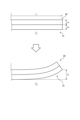
- FIG. 1 is a schematic diagram of the glass according to this embodiment.
- FIG. 2 is a schematic diagram for explaining the deflection evaluation.
- FIG. 1 is a schematic diagram of the glass according to the present embodiment.
- the glass 10 according to the present embodiment is used as a glass substrate for manufacturing a semiconductor package, and more specifically, is a supporting glass substrate for manufacturing FOWLP and the like.
- the use of the glass 10 is not limited to the manufacture of FOWLP and the like, and is arbitrary, and may be a glass substrate used to support a member, or may be used for purposes other than supporting a member.
- FOWLP and the like include fan out wafer level package (FOWLP) and fan out panel level package (FOPLP).
- FOWLP fan out wafer level package
- FOPLP fan out panel level package
- the liquidus temperature of glass 10 is T L (° C.), the Young's modulus of glass 10 is E (GPa), and the linear thermal expansion coefficient of glass 10 is ⁇ (ppm/° C.).
- T L the liquidus temperature
- E Young's modulus
- ⁇ the linear thermal expansion coefficient of glass 10
- the liquidus temperature T L can be evaluated by placing glass particles that pass through a sieve with a mesh width of 4.0 mm but do not pass through a sieve with a mesh width of 2.3 mm on a platinum dish, and then holding the dish in an electric furnace set at a predetermined temperature for 1 hour to measure the temperature at which crystals precipitate.
- the left side of formula (1) (13.1 ⁇ E+9 ⁇ T L ) is preferably 17 or greater, more preferably 33 or greater, still more preferably 42 or greater, still more preferably 63 or greater, still more preferably 92 or greater, and still more preferably 117 or greater.
- the left side of formula (2) (1923-156 ⁇ -T L ) is preferably 12 or greater, more preferably 22 or greater, still more preferably 42 or greater, still more preferably 62 or greater, still more preferably 72 or greater, and still more preferably 102 or greater.
- Young's modulus E can be measured by the ultrasonic pulse method specified in JIS R 1602:1995 "Test method for elastic modulus of fine ceramics.”
- the bulk density of the sample is measured by the Archimedes method, and the longitudinal wave velocity and shear wave velocity are measured using an ultrasonic thickness gauge 38DL PLUS manufactured by Olympus Corporation, to obtain the Young's modulus value.
- the linear thermal expansion coefficient ⁇ is the average thermal expansion coefficient in the range of 50°C to 200°C, and is a value measured in accordance with DIN-51045-1 as a standard for thermal expansion measurement.
- a NETZSCH thermal expansion meter (DIL 402 Expedis Supreme) is used as the measuring device to measure in the range of 30°C to 300°C, and the average thermal expansion coefficient in the range of 50°C to 200°C may be used as the linear thermal expansion coefficient.
- the liquidus temperature T L of the glass 10 is preferably 1300° C. or less, more preferably 800° C. or more and 1290° C. or less, more preferably 825° C. or more and 1280° C. or less, more preferably 850° C. or more and 1270° C. or less, more preferably 875° C. or more and 1260° C. or less, more preferably 900° C. or more and 1250° C. or less, more preferably 925° C. or more and 1240° C. or less, more preferably 950° C. or more and 1230° C. or less, more preferably 975° C. or more and 1220° C. or less, more preferably 1000° C. or more and 1210° C. or less, and even more preferably 1200° C. or less.
- the liquidus temperature T L of the glass 10 is preferably 1300° C. or less, more preferably 800° C. or more and 1290° C. or less, more preferably 825° C. or more
- the Young's modulus E of the glass 10 is preferably 80 GPa or more, more preferably 85 GPa to 180 GPa, more preferably 88 GPa to 170 GPa, more preferably 90 GPa to 160 GPa, more preferably 93 GPa to 150 GPa, more preferably 95 GPa to 145 GPa, more preferably 97 GPa to 140 GPa, more preferably 98 GPa to 135 GPa, and even more preferably 99 GPa to 130 GPa.
- the Young's modulus E of the glass 10 is preferably 80 GPa or more, more preferably 85 GPa to 180 GPa, more preferably 88 GPa to 170 GPa, more preferably 90 GPa to 160 GPa, more preferably 93 GPa to 150 GPa, more preferably 95 GPa to 145 GPa, more preferably 97 GPa to 140 GPa, more preferably 98 GPa to 135 GPa
- the linear thermal expansion coefficient ⁇ of the glass 10 is preferably 4.5 ppm/° C. or less, more preferably 2.0 ppm/° C. or more and 4.3 ppm/° C. or less, more preferably 2.1 ppm/° C. or more and 4.1 ppm/° C. or less, more preferably 2.2 ppm/° C. or more and 4 ppm/° C. or less, more preferably 2.3 ppm/° C. or more and 3.9 ppm/° C. or less, more preferably 2.4 ppm/° C. or more and 3.8 ppm/° C. or less, more preferably 2.5 ppm/° C. or more and 3.75 ppm/° C.
- the linear thermal expansion coefficient ⁇ of the glass 10 may be in the following range:
- the linear thermal expansion coefficient ⁇ of the glass 10 is preferably 5.0 ppm/°C or less, more preferably 3.6 ppm/°C or more and 4.9 ppm/°C or less, more preferably 3.7 ppm/°C or more and 4.8 ppm/°C or less, more preferably 3.8 ppm/°C or more and 4.7 ppm/°C or less, more preferably 3.85 ppm/°C or more and 4.65 ppm/°C or less, more preferably 3.9 ppm/°C or more and 4.6 ppm/°C or less, more preferably 3.95 ppm/°C or more and 4.55 ppm/°C or less, more preferably 4 ppm/°C or more and 4.5 ppm/°C or less, more preferably 4.1 ppm/°C or more and 4.45 ppm/°C or less, and even more preferably 4.2 ppm
- the Young's modulus parameter Y of glass 10 calculated from the composition is preferably 0.8 or more, more preferably 0.85 to 1.8, more preferably 0.88 to 1.7, more preferably 0.9 to 1.6, more preferably 0.93 to 1.5, more preferably 0.95 to 1.45, more preferably 0.97 to 1.4, more preferably 0.98 to 1.35, and even more preferably 0.99 to 1.3.
- the Young's modulus parameter Y is calculated from the following equation (3).
- the content of oxide RxOy (R is an element constituting the oxide, and x and y are any integers) contained in glass 10 in mol% notation based on oxide is represented as [ RxOy ].
- the content here refers to the ratio of the content of oxide RxOy to the entire glass 10 in mol% notation based on oxide. That is, for example, [ SiO2 ] in formula ( 3 ) refers to the ratio of the content of SiO2 to the entire glass 10 in mol% notation based on oxide.
- glass 10 does not have to contain all of the oxides shown in formula (3). In formula (3), the content of oxides not contained in glass 10 is treated as 0.
- glass 10 may contain components other than the oxides shown in formula (3).
- the liquidus parameter L of glass 10 calculated from the composition is preferably 10.5 or less, more preferably 6.4 to 10.4, more preferably 7.2 to 10.3, more preferably 7.6 to 10.2, more preferably 7.7 to 10.1, more preferably 7.8 to 10, more preferably 7.9 to 9.9, and even more preferably 8 to 9.8.
- the liquid phase parameter L is calculated from the following equation (4).
- Glass 10 does not have to contain all of the oxides shown in formula (4).
- the content of oxides not contained in glass 10 is treated as 0.
- glass 10 may contain components other than the oxides shown in formula (4).
- the thermal expansion parameter C of glass 10 calculated from the composition is preferably 0.9 or less, more preferably 0.4 to 0.86, more preferably 0.42 to 0.82, more preferably 0.44 to 0.8, more preferably 0.46 to 0.79, more preferably 0.48 to 0.78, more preferably 0.5 to 0.77, more preferably 0.52 to 0.76, more preferably 0.54 to 0.75, and even more preferably 0.56 to 0.74.
- the thermal expansion parameter C is preferably 0.9 or less, more preferably 0.4 to 0.86, more preferably 0.42 to 0.82, more preferably 0.44 to 0.8, more preferably 0.46 to 0.79, more preferably 0.48 to 0.78, more preferably 0.5 to 0.77, more preferably 0.52 to 0.76, more preferably 0.54 to 0.75, and even more preferably 0.56 to 0.74.
- the thermal expansion parameter C of glass 10 may be in the following range:
- the thermal expansion parameter C of glass 10 is preferably 1.0 or less, more preferably 0.72 to 0.98, more preferably 0.74 to 0.96, more preferably 0.76 to 0.94, more preferably 0.77 to 0.93, more preferably 0.78 to 0.92, more preferably 0.79 to 0.91, more preferably 0.8 to 0.9, more preferably 0.82 to 0.89, and even more preferably 0.84 to 0.88.
- the thermal expansion parameter C is calculated from the following formula (5).
- Glass 10 does not have to contain all of the oxides shown in formula (5).
- the content of oxides not contained in glass 10 is treated as 0, and the same applies hereafter.
- glass 10 may contain components other than the oxides shown in formula (5).
- the glass 10 may have any composition as long as the liquidus temperature T L satisfies the above range.
- the glass 10 preferably contains SiO 2 (the content of SiO 2 is higher than 0 mol%).
- SiO 2 is a component that reduces the linear thermal expansion coefficient and controls the magnitude of the Young's modulus.
- the content of SiO 2 is preferably 65% or less.
- the content of SiO 2 in the glass 10 is preferably 40% or more and 65% or less, preferably 44% or more and 64% or less, preferably 44% or more and 62% or less, preferably 46% or more and 60% or less, preferably 49% or more and 58% or less, preferably 50% or more and 57% or less, preferably 51% or more and 56% or less, preferably 52% or more and 55% or less, and more preferably 52.5% or more and 54% or less, in terms of oxide-based mol% display.
- the glass 10 preferably contains at least one of Al 2 O 3 and rare earth oxide.
- the rare earth oxide here may be one type of rare earth oxide or multiple types of rare earth oxide.
- the glass 10 contains Al 2 O 3 and rare earth oxide, and the Young's modulus is increased by containing Al 2 O 3 and rare earth oxide.
- the glass 10 has a total content of Al 2 O 3 and rare earth oxide (Al 2 O 3 + rare earth oxide) of 0% or more and 20% or less, more preferably 5% or more and 18% or less, more preferably 9% or more and 17.5% or less, more preferably 10% or more and 17% or less, more preferably 10.5% or more and 16.5% or less, more preferably 11% or more and 16% or less, more preferably 11.5% or more and 15.5% or less, and more preferably 12% or more and 15% or less, expressed in mole percent based on oxide.
- Al 2 O 3 + rare earth oxide rare earth oxide
- the total content of Al 2 O 3 and rare earth oxides refers to the ratio of the total value of the content of Al 2 O 3 and the content of rare earth oxides to the entire glass 10. Furthermore, the glass 10 is not limited to containing both Al 2 O 3 and rare earth oxides. For example, when no rare earth oxide is contained, the total content of Al 2 O 3 and rare earth oxides refers to the content of Al 2 O 3 , and when no Al 2 O 3 is contained, the total content of rare earth oxides refers to the content of rare earth oxides. When multiple types of rare earth oxides are contained, the content of rare earth oxides refers to the total content of those rare earth oxides.
- Al2O3 Al 2 O 3 has the effect of increasing the Young's modulus, suppressing deflection, and suppressing phase separation of glass, but if the content of Al 2 O 3 is less than 5%, these effects are unlikely to be achieved. In addition, by making the content of Al 2 O 3 20% or less, it is possible to suppress the liquidus temperature from increasing.
- the content of Al 2 O 3 in the glass 10 is preferably 5% or more and 20% or less, more preferably 7% or more and 19% or less, more preferably 8% or more and 18.5% or less, more preferably 9% or more and 18% or less, more preferably 9.5% or more and 17.5% or less, more preferably 10% or more and 17% or less, more preferably 10.5% or more and 16.5% or less, more preferably 11% or more and 16% or less, more preferably 11.5% or more and 15.5% or less, and more preferably 12% or more and 15% or less, expressed in mole % based on oxide.
- B2O3 has the effect of suppressing devitrification due to crystallization of glass, facilitating production, and controlling Young's modulus. Therefore, glass 10 may not contain B 2 O 3 (content of B 2 O 3 is 0 mol%), but may contain B 2 O 3. In terms of oxide-based mol%, the content of B 2 O 3 is preferably 0.01% to 15%, preferably 1% to 13%, preferably 3% to 12%, preferably 5% to 11%, preferably 6% to 10%, preferably 6.5% to 9.5%, and more preferably 7% to 9%. The content of B 2 O 3 in this range can facilitate production while suppressing deflection.
- the glass 10 may not contain MgO (the content of MgO is 0 mol%), but may contain MgO.
- the glass 10 has an MgO content of 1% or more and 30% or less, more preferably 5% or more and 29.5% or less, more preferably 9% or more and 29% or less, more preferably 10% or more and 28.5% or less, more preferably 11% or more and 28% or less, more preferably 12% or more and 27.5% or less, more preferably 13% or more and 27% or less, more preferably 14% or more and 26.5% or less, more preferably 15% or more and 26% or less, more preferably 16% or more and 25.5% or less, more preferably 17% or more and 25% or less, more preferably 18% or more and 24.5% or less, more preferably 19% or more and 24% or less, more preferably 19.5% or more and 23.5% or less, and more preferably 20% or more and 23% or less.
- the MgO content in this range makes it easy to manufacture while suppressing warping.
- CaO CaO has the characteristic of increasing the specific elastic modulus next to MgO among oxides of group 2 elements and not excessively decreasing the linear thermal expansion coefficient, and further has the characteristic of being less likely to increase the liquidus temperature than MgO. Therefore, the glass 10 may not contain CaO (the CaO content is 0 mol%), but may contain CaO. By reducing the CaO content to 5% or less, the linear thermal expansion coefficient can be prevented from increasing and the liquidus temperature can be controlled low.
- the CaO content of the glass 10 is preferably 0.01% or more and 5% or less, more preferably 0.1% or more and 3% or less, more preferably 0.15% or more and 2% or less, more preferably 0.2% or more and 1.3% or less, more preferably 0.25% or more and 1% or less, and more preferably 0.3% or more and 0.5% or less, expressed in mol% on an oxide basis.
- the glass 10 may not contain SrO (the content of SrO is 0 mol%), but may contain SrO. By making the content of SrO 5% or less, the linear thermal expansion coefficient is suppressed from increasing, and the liquidus temperature can be controlled to be low.
- the content of SrO in the glass 10 is preferably 0.01% or more and 5% or less, more preferably 0.1% or more and 3% or less, more preferably 0.15% or more and 2% or less, more preferably 0.2% or more and 1.3% or less, more preferably 0.25% or more and 1% or less, and more preferably 0.3% or more and 0.5% or less, expressed in mol% on an oxide basis.
- the BaO content of the glass 10 is preferably 0.01% or more and 5% or less, more preferably 0.1% or more and 3% or less, more preferably 0.15% or more and 2% or less, more preferably 0.2% or more and 1.3% or less, more preferably 0.25% or more and 1% or less, and more preferably 0.3% or more and 0.5% or less, expressed in mol% on an oxide basis.
- Li2O Li 2 O has the effect of improving the solubility without decreasing the linear thermal expansion coefficient among alkali metal oxides. Therefore, the glass 10 may not contain Li 2 O (Li 2 O content is 0 mol%), but may contain Li 2 O. By making the Li 2 O content 5% or less, the Young's modulus can be increased and the linear thermal expansion coefficient can be suppressed from increasing.
- the Li 2 O content of the glass 10 is preferably 0.01% or more and 5% or less, more preferably 0.1% or more and 4% or less, more preferably 0.15% or more and 3% or less, more preferably 0.2% or more and 2 % or less, more preferably 0.25% or more and 1.5% or less, and more preferably 0.3% or more and 1% or less, expressed in mol% on an oxide basis.
- the glass 10 may not contain Na 2 O (Na 2 O content is 0 mol%), but may contain Na 2 O.
- Na 2 O content is 0 mol%
- the Young's modulus can be increased and the linear thermal expansion coefficient can be suppressed from increasing.
- the Na 2 O content of the glass 10 is preferably 0.01% or more and 5% or less, more preferably 0.1% or more and 4% or less, more preferably 0.15 % or more and 3% or less, more preferably 0.2% or more and 2% or less, more preferably 0.25% or more and 1.5% or less, and more preferably 0.3% or more and 1% or less, expressed in mol% on an oxide basis.
- the glass 10 may not contain K 2 O (K 2 O content is 0 mol%), but may contain K 2 O. By making the K 2 O content 5% or less, the Young's modulus can be increased and the linear thermal expansion coefficient can be suppressed from increasing.
- the K 2 O content of the glass 10 is preferably 0.01% or more and 5% or less, more preferably 0.1% or more and 4% or less, more preferably 0.15% or more and 3% or less, more preferably 0.2% or more and 2% or less, more preferably 0.25% or more and 1.5% or less, and more preferably 0.3% or more and 1% or less, expressed in mol% on an oxide basis.
- ZnO ZnO has the effect of improving the melting property of glass and increasing Young's modulus. Therefore, glass 10 may not contain ZnO (ZnO content is 0 mol%), but may contain ZnO. By making the ZnO content 10% or less, the linear thermal expansion coefficient is suppressed from increasing, and the liquidus temperature can be controlled.
- the ZnO content is preferably 0.01% or more and 10% or less, more preferably 0.1% or more and 8% or less, more preferably 0.2% or more and 7% or less, more preferably 0.4% or more and 6% or less, more preferably 0.6% or more and 5% or less, more preferably 0.8% or more and 4% or less, and more preferably 1% or more and 3% or less, expressed in mole % based on oxide.
- P2O5 has the effect of improving the melting property of glass and lowering the linear thermal expansion coefficient. Therefore, the glass 10 may not contain P 2 O 5 (the content of P 2 O 5 is 0 mol%), but may contain P 2 O 5. By making the content of P 2 O 5 5% or less, the Young's modulus can be increased without deteriorating the chemical resistance, and the linear thermal expansion coefficient can be suppressed from increasing.
- the content of P 2 O 5 in the glass 10 is preferably 0.01% or more and 5% or less, more preferably 0.1% or more and 4% or less, more preferably 0.15% or more and 3% or less, more preferably 0.2% or more and 2% or less, more preferably 0.25% or more and 1.5% or less, and more preferably 0.3% or more and 1% or less, expressed in mol% based on oxide.
- the glass 10 may not contain ZrO2 ( ZrO2 content is 0 mol%), but may contain ZrO2 .
- the liquidus temperature can be controlled by making the ZrO2 content 10% or less.
- the ZrO2 content of the glass 10 is preferably 0.01% or more and 10% or less, more preferably 0.2% or more and 7% or less, more preferably 0.5% or more and 4% or less, more preferably 0.7% or more and 4% or less, and more preferably 1% or more and 2% or less, expressed in mol% on an oxide basis.
- TiO2 TiO 2
- the liquidus temperature can be controlled by making the TiO 2 content 10% or less.
- the glass 10 preferably has a TiO 2 content of 0.01% or more and 10% or less, more preferably 0.2% or more and 7% or less, more preferably 0.5% or more and 4% or less, more preferably 0.7% or more and 4% or less, and more preferably 1% or more and 2% or less, in terms of oxide-based mol%.
- the TiO 2 content in this range can facilitate manufacturing while suppressing deflection.
- glass 10 may not contain Y 2 O 3 (Y 2 O 3 content is 0 mol%), but may contain Y 2 O 3.
- the Y 2 O 3 content of glass 10 is preferably 0.1% or more and 7% or less, more preferably 0.3% or more and 5% or less, more preferably 0.5% or more and 3% or less, more preferably 0.8% or more and 2.5% or less, and more preferably 1% or more and 2% or less, expressed in mol% on an oxide basis.
- Gd2O3 has the effect of improving the melting property of glass and increasing Young's modulus. Therefore, Gd 2 O 3 may not be contained (Gd 2 O 3 content is 0 mol%), but Gd 2 O 3 may be contained.
- the linear thermal expansion coefficient can be controlled by making the Gd 2 O 3 content 7% or less.
- the glass 10 preferably has a Gd 2 O 3 content of 0.1% or more and 7% or less, more preferably 0.3% or more and 5% or less, more preferably 0.5% or more and 3% or less, more preferably 0.8% or more and 2.5% or less, and more preferably 1% or more and 2% or less, in terms of oxide-based mol%.
- La2O3 La 2 O 3 has the effect of improving the melting property of glass and increasing the Young's modulus. Therefore, the glass 10 may not contain La 2 O 3 (the content of La 2 O 3 is 0 mol%), but may contain La 2 O 3.
- the linear thermal expansion coefficient can be controlled by making the content of La 2 O 3 7% or less.
- the content of La 2 O 3 in the glass 10 is preferably 0.1% or more and 7% or less, more preferably 0.3% or more and 5% or less, more preferably 0.5% or more and 3% or less, more preferably 0.8% or more and 2.5% or less, and more preferably 1% or more and 2% or less, in terms of mol% based on oxide.
- the content of La 2 O 3 in this range can facilitate manufacturing while suppressing warping.
- WO 3 has the effect of improving the melting property of glass and increasing Young's modulus. Therefore, glass 10 may not contain WO 3 (content of WO 3 is 0 mol%), but may contain WO 3. By making the content of WO 3 7% or less, it is possible to suppress the increase of the linear thermal expansion coefficient and control the liquidus temperature.
- the content of WO 3 is preferably 0.1% or more and 7% or less, more preferably 0.3% or more and 5% or less, more preferably 0.5% or more and 3% or less, more preferably 0.8% or more and 2.5% or less, and more preferably 1% or more and 2% or less, in terms of mol% based on oxide. By making the content of WO 3 within this range, it is possible to easily manufacture while suppressing warping.
- the glass 10 may not contain Ta 2 O 5 (the content of Ta 2 O 5 is 0 mol%), but may contain Ta 2 O 5.
- the liquidus temperature can be controlled by making the content of Ta 2 O 5 10% or less.
- the content of Ta 2 O 5 in the glass 10 is preferably 0.1% or more and 10% or less, more preferably 0.5% or more and 5% or less, more preferably 1% or more and 4% or less, more preferably 1.5% or more and 3.5% or less, and more preferably 2% or more and 3% or less, in terms of mol% based on oxide.
- the content of Ta 2 O 5 in this range can facilitate manufacturing while suppressing warping.
- MnO MnO has the effect of increasing the Young's modulus. However, MnO may increase the liquidus temperature, and even a small amount of MnO will cause the glass to be colored dark brown to black. Therefore, it is preferable that the glass 10 does not contain MnO.
- the content of MnO in the glass 10 is preferably 0.1% or less, more preferably 0.001% or more and 0.05% or less, and even more preferably 0.005% or more and 0.01% or less, expressed in mole percent based on oxide. By having the content of MnO in this range, it is possible to suppress a decrease in light transmittance.
- PbO PbO has the effect of increasing the Young's modulus, but is an oxide that places a high burden on the environment. For this reason, it is preferable that glass 10 does not contain PbO.
- the PbO content of glass 10 is preferably 0.1% or less, more preferably 0.05% or less, and even more preferably 0.01% or less, expressed in mole percent based on oxide. By keeping the PbO content within this range, the environmental burden can be suppressed.
- the glass 10 does not contain Fe2O3 .
- the content of Fe2O3 in the glass 10 is preferably 0.1% or less, more preferably 0.001% or more and 0.05% or less, and even more preferably 0.005% or more and 0.01% or less. Such a low content of Fe2O3 can suppress a decrease in light transmittance.
- the Fe 2 O 3 content in terms of exclusive proportion refers to the ratio of the mass of Fe 2 O 3 contained in the glass 10 to the total mass of all components of the glass 10 excluding Fe 2 O 3 , on an oxide basis.
- Glass 10 has a total content of Y 2 O 3 , Gd 2 O 3 , La 2 O 3 , Nd 2 O 3 , Ta 2 O 5 , and Nb 2 O 5 (Y 2 O 3 + Gd 2 O 3 + La 2 O 3 + Nd 2 O 3 + Ta 2 O 5 + Nb 2 O 5 ) is preferably 0.5% or more, more preferably 1% or more and 10% or less, When the total content of these components is in this range, warping can be suppressed and manufacturing can be facilitated.
- the glass 10 does not need to contain all of the above components, and may contain only some of the components.
- the glass 10 may be acceptable even if it does not contain any of the above components. That is, for example, when Y 2 O 3 is not contained, (Y 2 O 3 ) in (Y 2 O 3 + Gd 2 O 3 + Ta 2 O 5 + La 2 O 3 + Nd 2 O 3 + Nb 2 O 5 ) may be expressed as follows : The same applies if it is treated as zero and no other components are included.
- Glass 10 has a ratio of the total content of Al 2 O 3 and MgO to the total content of SiO 2, Al 2 O 3 , B 2 O 3, and MgO, expressed in mole percent on an oxide basis, (Al 2 The ratio of (SiO 2 +Al 2 O 3 +B 2 O 3 +MgO)/(SiO 2 +Al 2 O 3 +B 2 O 3 + MgO )) is preferably 0.1 or more and 1 or less, more preferably 0.2 or more and 0.8 or less, and more preferably 0.
- the total content of these components is preferably 28 or more and 0.5 or less, more preferably 0.3 or more and 0.4 or less, and even more preferably 0.32 or more and 0.38 or less.
- the glass 10 is not limited to containing all of SiO 2 , Al 2 O 3 , B 2 O 3, and MgO. That is, for example, when Al 2 O 3 is not contained, (Al 2 O 3 +MgO ), and (Al 2 O 3 ) in (SiO 2 +Al 2 O 3 +B 2 O 3 +MgO) is treated as zero, and the same applies when no other components are contained.
- Glass 10 has a ratio of the MgO content ((MgO)/( ⁇ RO)) to the total content of alkaline earth metal oxides ( ⁇ RO), expressed in mole percent on an oxide basis, of 0.5 to 1. It is preferable that the ratio is 0.7 or more and 0.98 or less, more preferable that the ratio is 0.8 or more and 0.97 or less, and most preferable that the ratio is 0.83 or more and 0.96 or less. When the total content of these components is within this range, the linear thermal expansion coefficient can be reduced and deflection can be suppressed.
- the glass 10 is not limited to containing alkaline earth metal oxides such as MgO.
- MgO in (MgO/ ⁇ RO) is treated as zero, and alkaline earth metal oxides other than MgO are treated as zero.
- the content of alkaline earth metal oxides other than MgO in (MgO/ ⁇ RO) is treated as zero.
- the number N of oxides contained in glass 10 that has a content of 0.5% or more is preferably 5 or more, more preferably 7 or more, more preferably 8 or more, more preferably 9 or more, and more preferably 10 or more. Such a high number N can lower the liquidus temperature and facilitate production.
- glass 10 does not include a sintered body.
- glass 10 is preferably a glass that is not a sintered body.
- a sintered body here refers to a member in which a plurality of particles are heated at a temperature lower than the melting point to bond the particles together.
- a sintered body has a relatively high porosity because it contains pores, but glass 10 has a low porosity, usually 0%, because it is not a sintered body. However, it is acceptable for glass 10 to contain unavoidable small pores.
- the porosity here refers to the so-called true porosity, which refers to the sum of the volumes of pores (voids) that are connected to the outside and pores (voids) that are not connected to the outside, divided by the total volume (apparent volume).
- the porosity can be measured, for example, according to JIS R 1634:1998 "Method of measuring density and open porosity of sintered fine ceramics".
- the glass used for glass 10 is preferably amorphous glass, i.e., an amorphous solid.
- This glass may also be crystallized glass that contains crystals on the surface or inside, but amorphous glass is preferred from the viewpoint of density.
- ceramics those made by sintering have low transmittance and high density, so it is preferable not to use them.
- the glass 10 is a plate-shaped glass substrate including a surface 12 which is a main surface on one side, and a surface 14 which is a main surface on the opposite side to the surface 12.
- the surface 14 may be parallel to the surface 12, for example.
- the glass 10 may be a circular disk shape when viewed in a plan view, i.e., when viewed from a direction perpendicular to the surface 12, but is not limited to a disk shape and may be any shape, for example, a polygonal plate such as a rectangle.
- the above shapes also include those having a notch or an orientation flat (orientation flat) provided on the outer periphery.
- thickness D of glass 10, i.e., the length between surface 12 and surface 14, is preferably 0.1 mm or more and 5.0 mm or less, more preferably 0.1 mm or more and 2.0 mm or less, and even more preferably 0.1 mm or more and 0.5 mm or more.
- thickness D 0.1 mm or more glass 10 can be prevented from becoming too thin, and damage due to bending or impact can be prevented.
- thickness D 2.0 mm or less the glass can be prevented from becoming too heavy, and by making thickness D 0.5 mm or less, the glass can be further prevented from becoming too heavy.
- the glass transition temperature of the glass 10 is preferably 600° C. or more and 850° C. or less, more preferably 650° C. or more and 800° C. or less, more preferably 700° C. or more and 790° C. or less, more preferably 705° C. or more and 780° C. or less, more preferably 710° C. or more and 770° C. or less, more preferably 715° C. or more and 760° C. or less, and even more preferably 720° C. or more and 750° C. or less.
- the glass transition temperature can be measured according to the method specified in JIS R3103-3:2001 “Viscosity and viscosity fixed points of glass—Part 3: Method for measuring transition temperature by thermal expansion method”.
- the density of the glass 10 is preferably 2.45 g/cm3 or more and 3.0 g/cm3 or less , more preferably 2.55 g/cm3 or more and 2.95 g/cm3 or less , more preferably 2.6 g/cm3 or more and 2.9 g/cm3 or less , still more preferably 2.65 g/cm3 or more and 2.85 g/cm3 or less , and even more preferably 2.7 g/cm3 or more and 2.8 g/cm3 or less .
- the liquidus viscosity log ⁇ L (dPa ⁇ s) of the glass 10 is preferably 2 or more and 7 or less, more preferably 2.2 or more and 6.5 or less, more preferably 2.4 or more and 6 or less, more preferably 2.6 or more and 5.5 or less, more preferably 2.8 or more and 5 or less, more preferably 2.9 or more and 4.5 or less, and more preferably 3 or more and 4 or less.
- the liquidus viscosity refers to the viscosity of the glass 10 at the liquidus temperature. Such a relatively high liquidus temperature makes it easy to manufacture. If the liquidus temperature is too high, it becomes difficult to mold the glass.
- the liquidus viscosity can be obtained by measuring a temperature-viscosity curve by an inner cylinder rotation method or the like and calculating the viscosity at the liquidus temperature.
- the fracture toughness value K IC of glass 10 is preferably 0.5 MPa ⁇ m 0.5 or more and 2 MPa ⁇ m 0.5 or less, more preferably 0.7 MPa ⁇ m 0.5 or more and 1.5 MPa ⁇ m 0.5 or less, more preferably 0.8 MPa ⁇ m 0.5 or more and 1.4 MPa ⁇ m 0.5 or less, and even more preferably 0.9 MPa ⁇ m 0.5 or more and 1.3 MPa ⁇ m 0.5 or less.
- the fracture toughness value K IC is in this range, breakage of glass 10 can be suppressed. If the fracture toughness value K IC is too high, cutting and grinding of the glass becomes difficult.
- the fracture toughness value K IC can be measured using a pre-crack introduction fracture test method (SEPB method: Single-Edge-Precracked-Beam method) as defined in, for example, JIS R1607:2015 "Room temperature fracture toughness test method for fine ceramics”.
- SEPB method Single-Edge-Precracked-Beam method
- the internal transmittance of glass 10 having a thickness D of 0.7 mm for light (ultraviolet rays) with a wavelength of 308 nm is preferably 30% or more, more preferably 35% or more, even more preferably 40% or more, even more preferably 45% or more, even more preferably 50% or more, even more preferably 55% or more, and even more preferably 60% or more.
- ultraviolet rays can be appropriately transmitted.
- the internal transmittance of the glass 10 having a thickness D of 0.7 mm for light (infrared radiation) having a wavelength of 1064 nm is preferably 80% or more, more preferably 85% or more, and even more preferably 90% or more.
- the transmittance for light having a wavelength of 1064 nm is in this range, infrared radiation can be appropriately transmitted.
- the transmittance can be measured by measuring a spectral transmittance curve using a spectrophotometer or the like.
- the melting temperature T2 of the glass 10 is preferably 1000° C. or higher and 1550° C. or lower, more preferably 1100° C. or higher and 1500° C. or lower, still more preferably 1150° C. or higher and 1450° C. or lower, and is preferably 1200° C. or higher. It is more preferable that the melting temperature T2 is 1400° C. or lower.
- the melting temperature T2 refers to the temperature at which the viscosity ⁇ is 10 2 dPa ⁇ s. Such a relatively low melting temperature T2 makes it easy to melt. .
- the working temperature T3 of the glass 10 is preferably 1000° C. or more and 1400° C.
- the working temperature T3 refers to the temperature at which the viscosity ⁇ is 10 3 dPa ⁇ s. Such a relatively low working temperature T3 makes it easy to mold.
- the forming temperature T4 of the glass 10 is preferably 900° C. or higher and 1250° C. or lower, more preferably 950° C. or higher and 1200° C. or lower, and even more preferably 1000° C. or higher and 1150° C. or lower.
- the molding temperature T4 refers to the temperature at which the viscosity ⁇ is 10 4 dPa ⁇ s. Such a relatively low molding temperature T4 makes molding easy.
- the melting temperature T 2 , the working temperature T 3 and the molding temperature T 4 can be measured by an inner cylinder rotation method or the like.
- Glass 10 may be manufactured by any method, but for example, it is manufactured by the following method. First, raw materials such as silica sand and soda ash, which are the raw materials for the compounds contained in glass 10, are heated to a predetermined temperature (for example, 1500° C. to 1600° C.) and melted. Then, the molten raw materials (glass) are clarified and then a forming step is performed in which the glass is formed into a plate shape. The formed glass has the composition range of glass 10 described above on an oxide basis. Then, glass 10 is manufactured by subjecting the glass formed in the forming step to an annealing step. The manufacturing method of the glass 10 is not limited to the above and may be any method.
- the annealing step is not essential.
- various methods can be adopted as the forming step in manufacturing the glass 10, and examples of the method include a melt casting method, a downdraw method (e.g., an overflow downdraw method, a slot-down method, a redraw method, etc.), a float method, a roll-out method, and a press method.
- FOWLP manufacturing multiple semiconductor chips are bonded onto glass 10, and the semiconductor chips are covered with a sealant to form an element substrate. Then, the glass 10 and the element substrate are separated, and the side of the element substrate opposite the semiconductor chips is bonded, for example, to another piece of glass 10. Then, wiring, solder bumps, etc. are formed on the semiconductor chips, and the element substrate and glass 10 are separated again. The element substrate is then cut into individual semiconductor chips to obtain a semiconductor device.
- glass 10 according to the first aspect of the present disclosure satisfies the above-mentioned formulas (1) and (2).
- formulas (1) and (2) the liquidus temperature is low and manufacturing can be facilitated.
- glass having a high Young's modulus and a low thermal expansion coefficient to suppress deflection may be particularly prone to crystallization and difficult to manufacture.
- formulas (1) and (2) are satisfied, the liquidus temperature is suppressed from becoming high and manufacturing can be facilitated.
- Glass 10 according to a second aspect of the present disclosure is glass 10 according to the first aspect, and comprises, in mol % on an oxide basis: SiO2 : 40% to 65%, B 2 O 3 : 0.01% to 15%, Al 2 O 3 + rare earth oxides: 0% to 20%, (Y2O3+Gd2O3+Ta2O5+La2O3 + Nd2O3 + Nb2O5 ) : 0.5 % or more ; This makes it possible to increase the Young's modulus, decrease the linear thermal expansion coefficient, and decrease the liquidus temperature, thereby making it possible to easily manufacture the material while suppressing deflection.
- Glass 10 according to a third aspect of the present disclosure is glass 10 according to the second aspect, and comprises, in mol % on an oxide basis: SiO 2 :44% to 64%, B 2 O 3 : 1% to 13%, Al 2 O 3 : 5% to 20%, (Y2O3+Gd2O3+Ta2O5+La2O3 + Nd2O3 + Nb2O5 ) : 1 % or more and 10% or less ,
- Glass 10 according to a fourth aspect of the present disclosure is glass 10 according to any one of the first to third aspects, and comprises, in mol % on an oxide basis: 0.1 ⁇ (Al 2 O 3 +MgO)/(SiO 2 +Al 2 O 3 +B 2 O 3 +MgO) ⁇ 1, 0.5 ⁇ (MgO)/ ⁇ RO) ⁇ 1, 0% ⁇ Al 2 O 3 + rare earth oxides ⁇ 20%, This makes it possible to increase the Young's modulus, decrease the linear thermal expansion coefficient, and decrease the liquidus temperature, thereby making it possible to easily manufacture the material while suppressing deflection.
- Glass 10 according to the fifth aspect of the present disclosure is glass 10 according to any one of the first to fourth aspects, and preferably has a Young's modulus parameter Y calculated by formula (3) of 0.8 or more, a liquidus parameter L calculated by formula (4) of 10.5 or less, and a thermal expansion parameter C calculated by formula (5) of 0.9 or less. This makes it possible to increase the Young's modulus, decrease the linear thermal expansion coefficient, and decrease the liquidus temperature, thereby facilitating manufacture while suppressing deflection.
- the glass 10 according to the seventh aspect of the present disclosure is the glass 10 according to the sixth aspect, and is preferably used in the manufacture of at least one of a fan-out wafer level package and a fan-out panel level package.
- the glass 10 is suitable for these applications.
- Tables 1 to 41 show the characteristics of the glass of each example. Note that the embodiment may be modified as long as the effects of the invention are achieved.
- Example 1 glass was produced with the composition shown in Table 1.
- a raw plate with a diameter of 320 mm and a thickness of 6 mm was produced using a fusion casting method.
- a plurality of plates with a diameter of 300 mm and a thickness of 3 mm were cut out from the center of the raw plate. Both sides of these plates were polished using cerium oxide as an abrasive to obtain glass with a thickness of 0.7 mm.
- the Young's modulus E was measured for the glass of Example 1.
- the Young's modulus was measured by the ultrasonic pulse method specified in JIS R 1602:1995 "Testing method for elastic modulus of fine ceramics.”
- the bulk density of the sample was measured by the Archimedes method, and the longitudinal wave velocity and shear wave velocity were measured using an ultrasonic thickness gauge 38DL PLUS manufactured by Olympus Corporation to obtain the Young's modulus value.
- the linear thermal expansion coefficient ⁇ (ppm/°C) was measured for the glass of Example 1.
- a thermal expansion meter (DIL 402 Expedis Supreme) manufactured by NETZSCH was used as the measuring device to measure in the range of 30°C to 300°C, and the average thermal expansion coefficient in the range of 50°C to 200°C was taken as the linear thermal expansion coefficient ⁇ .
- the liquidus temperature T L (° C.) was measured for the glass of Example 1.
- the liquidus temperature T L was measured by placing glass particles that passed through a sieve with a mesh width of 4.0 mm but did not pass through a sieve with a mesh width of 2.3 mm on a platinum dish, and then holding the glass particles in an electric furnace set at a predetermined temperature for 1 hour to measure the temperature at which crystals precipitated.
- the values of the left sides of the above formulas (1) and (2) were calculated.
- the Young's modulus parameter Y was calculated using equation (3) above.
- the thermal expansion parameter C was calculated using the above-mentioned formula (5).
- the liquidus parameter L was calculated using the above-mentioned equation (4).
- the glass transition temperature (° C.) was measured for the glass of Example 1.
- the glass transition temperature was measured by obtaining an expansion curve until the glass softened using a thermal expansion measuring device.
- the density (g/cm 3 ) was measured for the glass of Example 1.
- the density was measured by the Archimedes method.
- the liquidus viscosity was measured for the glass of Example 1.
- the liquidus viscosity was measured by measuring a temperature-viscosity curve by an inner cylinder rotation method and calculating the viscosity at the liquidus temperature.
- the fracture toughness value K IC (MPa ⁇ m 0.5 ) was measured for the glass of Example 1.
- the fracture toughness value K IC was measured using a pre-crack introduction fracture test method (SEPB method: Single-Edge-Precracked-Beam method) as specified in JIS R1607:2015 "Room temperature fracture toughness test method for fine ceramics.”
- SEPB method Single-Edge-Precracked-Beam method
- the transmittance for light having a wavelength of 308 nm and the transmittance for light having a wavelength of 1064 nm were measured for the glass of Example 1.
- the transmittance was measured by measuring a spectral transmittance curve using an ultraviolet-visible spectrophotometer (manufactured by Hitachi High-Tech Corporation (UH4150 type)).
- the melting temperature T2 , working temperature T3 , and forming temperature T4 were measured for the glass of Example 1.
- the melting temperature T2 , working temperature T3 , and forming temperature T4 were measured by an inner cylinder rotation method. The measurement results and calculation results are shown in Table 1.
- Example 2 to 682 glasses were produced in the same manner as in Example 1, except that the glass compositions were those shown in Tables 1 to 41. The measurement results and calculation results for each Example are shown in Tables 1 to 41.
- FIG. 2 is a schematic diagram for explaining the deflection evaluation.
- the amount of warpage ⁇ is defined as the amount of displacement in either the vertical direction of the end of the glass 10, with the center of the second surface 14 as the height reference, when the semiconductor substrate is molded with resin and bonded to the first surface 12 side of the glass 10 processed into the shape of FIG. 1, as shown in FIG. 2, and cooled from a high temperature of 200°C to a low temperature of 20°C.
- the amount of warpage ⁇ is calculated by the following formula (6).
- L is the length of the glass 10 in the warping direction (horizontal direction in FIG. 2)
- ⁇ 1 is the linear thermal expansion coefficient of the resin substrate 20
- ⁇ 2 is the linear thermal expansion coefficient of the glass 10
- T 2 is the temperature after cooling (here, 20° C.)
- T 1 is the temperature before cooling (here, 200° C.).
- m is a 1 /a 2
- h is a 1 +a 2
- n is E 1 /E 2.
- a 1 is the thickness of the resin substrate 20
- a 2 is the thickness of the glass 10
- E 1 is the Young's modulus of the resin substrate 20
- E 2 is the Young's modulus of the glass 10.
- the resin substrate 20 to be bonded to the glass 10 was assumed to have a thickness of 0.3 mm and a Young's modulus of 31.5 GPa, taking into consideration the mounting of semiconductors.
- the linear thermal expansion coefficient was assumed to be 4.0 ppm/°C, and the warpage ⁇ was calculated when the thickness of the glass 10 was 0.7 mm and the length L was 300 mm.
- the absolute value of the calculated warpage ⁇ was 0.8 mm or less, and x was given to the glass 10 if it was 0.8 mm or more.
- manufacturability refers to the ease of manufacturing, and the liquidus temperature was rated as ⁇ for less than 1280°C, ⁇ for less than 1260°C, and x for the liquidus temperature of 1280°C or more.
- a deflection evaluation in a high density process was also performed.
- the resin substrate 20 to be bonded to the glass 10 was assumed to have a thickness of 0.3 mm and a Young's modulus of 31.5 GPa, taking into consideration the high density mounting of silicon.
- the linear thermal expansion coefficient was assumed to be 3.2 ppm/°C.
- an absolute value of the calculated amount of warpage ⁇ of less than 1.08 mm was indicated as ⁇ , and an absolute value of 1.08 mm or more was indicated as ⁇ .
- Example 1 to 675 which are working examples in which the liquidus temperature T L satisfies the above formula (1) and formula (2)
- the deflection judgment and manufacturability judgment are ⁇ to ⁇ , and it is understood that they can be easily manufactured while suppressing deflection.
- Examples 676 to 682 which are comparative examples
- the liquidus temperature T L does not satisfy at least one of the above formula (1) and formula (2), so at least one of the manufacturability judgment and the deflection judgment is ⁇ , and it is understood that they cannot be easily manufactured.
Landscapes
- Chemical & Material Sciences (AREA)
- Engineering & Computer Science (AREA)
- Life Sciences & Earth Sciences (AREA)
- Chemical Kinetics & Catalysis (AREA)
- General Chemical & Material Sciences (AREA)
- Geochemistry & Mineralogy (AREA)
- Materials Engineering (AREA)
- Organic Chemistry (AREA)
- Glass Compositions (AREA)
- Ceramic Engineering (AREA)
Priority Applications (4)
| Application Number | Priority Date | Filing Date | Title |
|---|---|---|---|
| KR1020257033070A KR20250173497A (ko) | 2023-04-17 | 2024-04-16 | 유리 |
| CN202480024751.9A CN120957953A (zh) | 2023-04-17 | 2024-04-16 | 玻璃 |
| JP2025515233A JPWO2024219379A1 (https=) | 2023-04-17 | 2024-04-16 | |
| US19/355,333 US20260035288A1 (en) | 2023-04-17 | 2025-10-10 | Glass |
Applications Claiming Priority (2)
| Application Number | Priority Date | Filing Date | Title |
|---|---|---|---|
| JP2023-067481 | 2023-04-17 | ||
| JP2023067481 | 2023-04-17 |
Related Child Applications (1)
| Application Number | Title | Priority Date | Filing Date |
|---|---|---|---|
| US19/355,333 Continuation US20260035288A1 (en) | 2023-04-17 | 2025-10-10 | Glass |
Publications (1)
| Publication Number | Publication Date |
|---|---|
| WO2024219379A1 true WO2024219379A1 (ja) | 2024-10-24 |
Family
ID=93152487
Family Applications (1)
| Application Number | Title | Priority Date | Filing Date |
|---|---|---|---|
| PCT/JP2024/015078 Ceased WO2024219379A1 (ja) | 2023-04-17 | 2024-04-16 | ガラス |
Country Status (6)
| Country | Link |
|---|---|
| US (1) | US20260035288A1 (https=) |
| JP (1) | JPWO2024219379A1 (https=) |
| KR (1) | KR20250173497A (https=) |
| CN (1) | CN120957953A (https=) |
| TW (1) | TW202442603A (https=) |
| WO (1) | WO2024219379A1 (https=) |
Citations (5)
| Publication number | Priority date | Publication date | Assignee | Title |
|---|---|---|---|---|
| WO2019021672A1 (ja) * | 2017-07-26 | 2019-01-31 | 日本電気硝子株式会社 | 支持ガラス基板及びこれを用いた積層基板 |
| JP2021508666A (ja) * | 2017-12-13 | 2021-03-11 | 東旭科技集団有限公司Tunghsu Technology Group Co., Ltd. | ガラス用組成物、アルミノ珪酸塩ガラス、及びその調製方法と応用 |
| WO2021241312A1 (ja) * | 2020-05-28 | 2021-12-02 | 日本電気硝子株式会社 | 支持ガラス基板及びこれを用いた積層基板 |
| WO2022186393A1 (ja) * | 2021-03-05 | 2022-09-09 | Hoya株式会社 | 磁気記録媒体基板用または磁気記録再生装置用ガラススペーサ用のガラス、磁気記録媒体基板、磁気記録媒体、磁気記録再生装置用ガラススペーサおよび磁気記録再生装置 |
| WO2023026770A1 (ja) * | 2021-08-24 | 2023-03-02 | 日本電気硝子株式会社 | 支持ガラス基板、積層体、積層体の製造方法及び半導体パッケージの製造方法 |
Family Cites Families (1)
| Publication number | Priority date | Publication date | Assignee | Title |
|---|---|---|---|---|
| KR102809471B1 (ko) | 2019-07-29 | 2025-05-19 | 에이지씨 가부시키가이샤 | 지지 유리 기판 |
-
2024
- 2024-04-16 WO PCT/JP2024/015078 patent/WO2024219379A1/ja not_active Ceased
- 2024-04-16 KR KR1020257033070A patent/KR20250173497A/ko active Pending
- 2024-04-16 JP JP2025515233A patent/JPWO2024219379A1/ja active Pending
- 2024-04-16 CN CN202480024751.9A patent/CN120957953A/zh active Pending
- 2024-04-17 TW TW113114275A patent/TW202442603A/zh unknown
-
2025
- 2025-10-10 US US19/355,333 patent/US20260035288A1/en active Pending
Patent Citations (5)
| Publication number | Priority date | Publication date | Assignee | Title |
|---|---|---|---|---|
| WO2019021672A1 (ja) * | 2017-07-26 | 2019-01-31 | 日本電気硝子株式会社 | 支持ガラス基板及びこれを用いた積層基板 |
| JP2021508666A (ja) * | 2017-12-13 | 2021-03-11 | 東旭科技集団有限公司Tunghsu Technology Group Co., Ltd. | ガラス用組成物、アルミノ珪酸塩ガラス、及びその調製方法と応用 |
| WO2021241312A1 (ja) * | 2020-05-28 | 2021-12-02 | 日本電気硝子株式会社 | 支持ガラス基板及びこれを用いた積層基板 |
| WO2022186393A1 (ja) * | 2021-03-05 | 2022-09-09 | Hoya株式会社 | 磁気記録媒体基板用または磁気記録再生装置用ガラススペーサ用のガラス、磁気記録媒体基板、磁気記録媒体、磁気記録再生装置用ガラススペーサおよび磁気記録再生装置 |
| WO2023026770A1 (ja) * | 2021-08-24 | 2023-03-02 | 日本電気硝子株式会社 | 支持ガラス基板、積層体、積層体の製造方法及び半導体パッケージの製造方法 |
Also Published As
| Publication number | Publication date |
|---|---|
| JPWO2024219379A1 (https=) | 2024-10-24 |
| KR20250173497A (ko) | 2025-12-10 |
| TW202442603A (zh) | 2024-11-01 |
| CN120957953A (zh) | 2025-11-14 |
| US20260035288A1 (en) | 2026-02-05 |
Similar Documents
| Publication | Publication Date | Title |
|---|---|---|
| JP2025124861A (ja) | 高周波デバイス用ガラス基板と高周波デバイス用回路基板 | |
| CN102448901B (zh) | 无碱玻璃 | |
| JP2025085692A (ja) | 結晶化ガラス、化学強化ガラスおよび半導体支持基板 | |
| JP7722421B2 (ja) | 高周波デバイス用ガラス基板、液晶アンテナ及び高周波デバイス | |
| US12122712B2 (en) | High index low density glass | |
| US20200172426A1 (en) | High index glasses | |
| WO2022168895A1 (ja) | 結晶化ガラスおよび化学強化ガラス | |
| JP7540440B2 (ja) | 積層部材 | |
| WO2024219379A1 (ja) | ガラス | |
| WO2024219375A1 (ja) | ガラス | |
| WO2024219377A1 (ja) | ガラス | |
| WO2025079640A1 (ja) | ガラス | |
| WO2025018213A1 (ja) | ガラス | |
| WO2025079639A1 (ja) | ガラス | |
| WO2015199035A1 (ja) | 放射線遮蔽ガラス及びそれを用いた合わせガラス | |
| CN118786099A (zh) | 玻璃 | |
| JP2025110747A (ja) | ガラス | |
| JP2026053968A (ja) | ガラス | |
| JP2026053967A (ja) | ガラス | |
| TW202428532A (zh) | 玻璃 | |
| JP2023160152A (ja) | ガラス | |
| JP2023031228A (ja) | ガラス | |
| TW202608682A (zh) | 積層構件 |
Legal Events
| Date | Code | Title | Description |
|---|---|---|---|
| 121 | Ep: the epo has been informed by wipo that ep was designated in this application |
Ref document number: 24792653 Country of ref document: EP Kind code of ref document: A1 |
|
| WWE | Wipo information: entry into national phase |
Ref document number: 2025515233 Country of ref document: JP |
|
| ENP | Entry into the national phase |
Ref document number: 1020257033070 Country of ref document: KR Free format text: ST27 STATUS EVENT CODE: A-0-1-A10-A15-NAP-PA0105 (AS PROVIDED BY THE NATIONAL OFFICE) |
|
| WWE | Wipo information: entry into national phase |
Ref document number: KR1020257033070 Country of ref document: KR |
|
| NENP | Non-entry into the national phase |
Ref country code: DE |
|
| 122 | Ep: pct application non-entry in european phase |
Ref document number: 24792653 Country of ref document: EP Kind code of ref document: A1 |