WO2024219027A1 - ハイドロゲル、及びハイドロゲルを形成するための組成物 - Google Patents
ハイドロゲル、及びハイドロゲルを形成するための組成物 Download PDFInfo
- Publication number
- WO2024219027A1 WO2024219027A1 PCT/JP2024/000752 JP2024000752W WO2024219027A1 WO 2024219027 A1 WO2024219027 A1 WO 2024219027A1 JP 2024000752 W JP2024000752 W JP 2024000752W WO 2024219027 A1 WO2024219027 A1 WO 2024219027A1
- Authority
- WO
- WIPO (PCT)
- Prior art keywords
- hydrogel
- functionalized
- polyethylene glycol
- rada
- aldehyde
- Prior art date
- Legal status (The legal status is an assumption and is not a legal conclusion. Google has not performed a legal analysis and makes no representation as to the accuracy of the status listed.)
- Ceased
Links
Images




Classifications
-
- C—CHEMISTRY; METALLURGY
- C08—ORGANIC MACROMOLECULAR COMPOUNDS; THEIR PREPARATION OR CHEMICAL WORKING-UP; COMPOSITIONS BASED THEREON
- C08G—MACROMOLECULAR COMPOUNDS OBTAINED OTHERWISE THAN BY REACTIONS ONLY INVOLVING UNSATURATED CARBON-TO-CARBON BONDS
- C08G81/00—Macromolecular compounds obtained by interreacting polymers in the absence of monomers, e.g. block polymers
-
- C—CHEMISTRY; METALLURGY
- C08—ORGANIC MACROMOLECULAR COMPOUNDS; THEIR PREPARATION OR CHEMICAL WORKING-UP; COMPOSITIONS BASED THEREON
- C08L—COMPOSITIONS OF MACROMOLECULAR COMPOUNDS
- C08L87/00—Compositions of unspecified macromolecular compounds, obtained otherwise than by polymerisation reactions only involving unsaturated carbon-to-carbon bonds
-
- C—CHEMISTRY; METALLURGY
- C08—ORGANIC MACROMOLECULAR COMPOUNDS; THEIR PREPARATION OR CHEMICAL WORKING-UP; COMPOSITIONS BASED THEREON
- C08L—COMPOSITIONS OF MACROMOLECULAR COMPOUNDS
- C08L89/00—Compositions of proteins; Compositions of derivatives thereof
-
- C—CHEMISTRY; METALLURGY
- C07—ORGANIC CHEMISTRY
- C07K—PEPTIDES
- C07K2/00—Peptides of undefined number of amino acids; Derivatives thereof
Definitions
- the present invention relates to a hydrogel and a composition for forming a hydrogel.
- hydrogels that contain polymer networks made of biopolymers and biocompatible polymer materials have been attracting attention for use as scaffolding materials for cell culture, etc.
- hydrogels As for such hydrogels, the present inventors have proposed a hydrogel formed from a self-assembling peptide, chitosan, and polyethylene glycol having an aldehyde end (see Non-Patent Documents 1 and 2). Such hydrogels can be synthesized in one pot or in situ, and are useful for various applications such as cell culture.
- the mesh polymer in which chitosan and polyethylene glycol having an aldehyde end, which constitutes the hydrogel described in Non-Patent Documents 1 and 2, are cross-linked with a Schiff base has the problem that it is prone to decomposition over time.
- the present invention has been made in consideration of the above problems, and aims to provide a hydrogel that is stable over a long period of time under cell culture conditions, and a composition for forming the hydrogel.
- the present invention is as follows.
- the hydrophilic polymer is a polymer that exhibits a water content of 50% by mass or more and 99% by mass or less, in terms of the mass ratio of water, when the hydrophilic polymer is allowed to swell in equilibrium with the addition of water.
- the hydrogel described in (1) has an interpenetrating polymer network structure in which a self-assembling peptide and a network polymer interpenetrate each other.
- composition according to (7) which is a three-liquid composition consisting of a first liquid containing a self-assembling peptide, a second liquid containing an aldehyde-functionalized or hydrazide-functionalized hydrophilic polymer, and a third liquid containing an aldehyde-functionalized or hydrazide-functionalized polyethylene glycol.
- the present invention provides a hydrogel that is stable over a long period of time under cell culture conditions, and a composition for forming the hydrogel.
- FIG. 1 shows the 1 H NMR spectrum of aldehyde-functionalized polyethylene glycol (CHO-PEG).
- FIG. 1 shows the time course of degradation rate of hydrogels formed from a network polymer obtained by condensing hydrazide-functionalized hyaluronic acid (HA S -CHD, HA S -AHD, HA L -CHD, HA L -AHD) or carboxymethylchitosan (CMCH) with an aldehyde-functionalized polyethylene glycol (CHO-PEG).
- HA S -CHD hydrazide-functionalized hyaluronic acid
- CMCH carboxymethylchitosan
- FIG. 1 shows the time course of swelling ratio of hydrogels formed from network polymers of hydrazide-functionalized hyaluronic acid (HAs - CHD, HAs - AHD, HAl - CHD, HAl - AHD) or carboxymethylchitosan (CMCH) condensed with aldehyde-functionalized polyethylene glycol (CHO-PEG).
- HAs - CHD hydrazide-functionalized hyaluronic acid
- HAs - AHD HAs - AHD
- HAl - CHD HAl - CHD
- HAl - AHD carboxymethylchitosan
- FIG. 1 shows a hydrogel formed from a network polymer obtained by condensing hydrazide-functionalized hyaluronic acid (HA S -CHD) and aldehyde-functionalized polyethylene glycol (CHO-PEG), a hydrogel having an interpenetrating polymer network formed from the network polymer and RADA16, and the dichroic spectroscopy (CD) spectrum of RADA16.
- HA S -CHD hydrazide-functionalized hyaluronic acid
- CHO-PEG aldehyde-functionalized polyethylene glycol
- FIG. 1 shows the shear rate dependence of stress for a hydrogel formed from a network polymer obtained by condensing hydrazide-functionalized hyaluronic acid (HA 20-50 -AHD) with aldehyde-functionalized polyethylene glycol (CHO-PEG), and a hydrogel having an interpenetrating polymer network formed from the network polymer and RADA16.
- HA 20-50 -AHD hydrazide-functionalized hyaluronic acid
- CHO-PEG aldehyde-functionalized polyethylene glycol
- FIG. 1 shows the shear rate dependence of viscosity of a hydrogel formed by a network polymer obtained by condensing hydrazide-functionalized hyaluronic acid (HA 20-50 -AHD) with aldehyde-functionalized polyethylene glycol (CHO-PEG), and a hydrogel having an interpenetrating polymer network formed by the network polymer and RADA16.
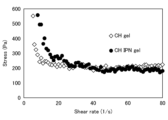
- FIG. 1 shows the shear rate dependence of stress for a hydrogel formed from a network polymer obtained by condensing carboxymethylchitosan (CMCH) with aldehyde-functionalized polyethylene glycol (CHO-PEG), and a hydrogel having an interpenetrating polymer network formed from the network polymer and RADA16.
- CMCH carboxymethylchitosan
- CHO-PEG aldehyde-functionalized polyethylene glycol
- FIG. 1 shows the shear rate dependence of viscosity of a hydrogel formed from a network polymer obtained by condensing carboxymethylchitosan (CMCH) with aldehyde-functionalized polyethylene glycol (CHO-PEG), and a hydrogel having an interpenetrating polymer network formed from the network polymer and RADA16.
- CMCH carboxymethylchitosan
- CHO-PEG aldehyde-functionalized polyethylene glycol
- FIG. 1 shows the cell viability when cells are cultured using a hydrogel formed from a network polymer obtained by condensing hydrazide-functionalized hyaluronic acid (HA 20-50 -AHD) or carboxymethylchitosan (CMCH) with an aldehyde-functionalized polyethylene glycol (CHO-PEG), or a hydrogel having an interpenetrating polymer network structure formed from the network polymer and RADA16.
- FIG. 13 is a graph showing the cell survival rate in the case where the cells were cultured after injection of a hydrogel containing cells, and in the case where the cells were cultured without injection of a hydrogel containing cells.
- the hydrogel contains a self-assembling peptide and a network polymer.
- the network polymer has a hydrophilic polymer block derived from a hydrophilic polymer and a polyethylene glycol block derived from polyethylene glycol.
- the hydrophilic polymer is a polymer that exhibits a water content of 50% by mass or more and 99% by mass or less as the mass ratio of water when equilibrium swelling is achieved by adding water.
- the hydrogel contains a self-assembling peptide.
- the self-assembling peptide functions as a scaffold for cell culture together with a mesh-like polymer described later.
- the self-assembling peptide self-assembles through hydrophobic interactions and hydrogen bonds, and is physically cross-linked into a mesh-like structure.
- the self-assembling peptide and the mesh-like polymer described below interpenetrate with linear independence (orthogonal reaction).
- Such a structure in which two types of mesh-like polymers interpenetrate is called an interpenetrating polymer network structure (IPN structure).
- IPN structure interpenetrating polymer network structure
- the extracellular matrix which has a three-dimensional structure in which molecular chains of various biopolymers are intricately entangled, plays a major role in the regeneration and maintenance of cells.
- a hydrogel is obtained that has a three-dimensional structure similar to the extracellular matrix in the living body and can be used as a pseudo-extracellular matrix.
- Self-organization is a phenomenon in which small molecules autonomously assemble through intermolecular interactions and other factors to form three-dimensional structures. For example, collagen, elastin, amyloid, etc., organize under certain conditions in the presence of water to form fibrous one-dimensional structures. When the fibrous one-dimensional structures further intertwine, a gel with a three-dimensional structure is formed.
- a "self-assembling peptide” is a peptide that can undergo sol-gel transition, losing fluidity from a sol state to a gel state under specific conditions such as temperature, pressure, pH, and ion concentration.
- collagen and the peptides described below that are composed of peptide units containing three types of amino acid residues, namely arginine residues, alanine residues, and aspartic acid residues, are examples of self-assembling peptides.
- the "sol state” refers to a liquid state in which colloidal particles are dispersed in a dispersion medium and have fluidity. In general, a gel that has been fluidized by heating it is in a sol state. "Solation” refers to a change from a gel state to a sol state.
- a "colloid” is a state in which minute particles formed by aggregation of molecules or ions are dispersed in a medium. The minute particles that form a colloid are called “colloid particles.”
- the “gel state” refers to a state in which colloidal particles self-organize in a dispersion medium and lose fluidity. In general, a gel state is a state in which a sol loses fluidity by cooling it. "Gellation” refers to the change from a sol state to a gel state.
- the "sol-gel transition” is a reversible phase transition phenomenon between a sol and a gel. The sol-gel transition generally depends on temperature under isobaric conditions.
- a self-assembling peptide can be composed of a polypeptide in which multiple peptide units are linked to each other through peptide bonds.
- a "peptide unit” is a constituent unit of a self-assembling peptide in the present invention.
- a peptide unit is composed of an oligopeptide in which at least three types of amino acid residues are bonded together by four bonds.
- the peptide units that make up the self-assembling peptide preferably contain three types of amino acid residues: arginine residues (Arg, R), alanine residues (Ala, A), and aspartic acid residues (Asp, D).
- the peptide units constituting the self-assembling peptide may further contain residues of hydrophobic amino acids other than alanine.
- hydrophobic amino acids other than alanine include glycine (Gly, G), proline (Pro, P), valine (Val, V), leucine (Leu, L), isoleucine (Ile, I), methionine (Met, M), cysteine (Cis, C), phenylalanine (Phe, F), tyrosine (Tyr, Y), and tryptophan (Trp, W).
- glycine and proline are preferred.
- the above amino acids other than glycine may be in either the D- or L-form.
- the peptide units constituting the self-assembling peptide are preferably units consisting of four amino acid residues essentially including arginine, alanine, and aspartic acid residues. Examples of such peptide units include RADA, RXDA, and RADX. X is a glycine or proline residue.
- a preferred self-assembling peptide is, for example, a peptide in which m RADAs are linked to n RXDAs or RADXs.
- m is an integer between 3 and 6.
- n is 1 or 2.
- m and n satisfy the relationship 2n ⁇ m.
- the combination is preferably 3/1, 4/1, 5/1, 6/1, 5/2, or 6/2.
- the peptide units can be linked in any order.
- the C-terminal peptide unit is RXDA or RADX, or the N-terminal peptide unit is RXDA.
- a peptide in which RADA is repeated p times is also preferred.
- p is an integer between 3 and 8.
- self-assembling peptides include peptides having the following amino acid sequences:
- X is a glycine residue or a proline residue:
- the two or more Xs may be the same amino acid residue or different amino acid residues.
- RXDA-(RADA) 4 (SEQ ID NO: 1) (RADA) 5 (SEQ ID NO: 2) (RADA) 6 (SEQ ID NO: 3) RXDA-(RADA) 3 (SEQ ID NO: 4) (RADA) 3 -RXDA (SEQ ID NO:5) (RADA) 3 -RADX (SEQ ID NO: 6) RXDA-(RADA) 4 (SEQ ID NO:7) (RADA) 4 -RXDA (SEQ ID NO: 8) (RADA) 4 -RADX (SEQ ID NO: 9) RXDA-(RADA) 5 (SEQ ID NO: 10) (RADA) 5 -RXDA (SEQ ID NO: 11) (RADA) 5 -RADX (SEQ ID NO: 12) RXDA-(RADA) 6 (SEQ ID NO: 13) (RADA) 6 -RXDA (SEQ ID NO: 14) (RADA) 6 -RADX (SEQ ID NO: 15) (RXDA) 2
- (RADA) 4 is preferred.
- (RADA) 4 is also referred to as RADA16.
- the self-assembling peptides can be synthesized by known peptide synthesis methods.
- the peptide synthesis method may be a chemical method or a genetic engineering method.
- the synthesis method of the self-assembling peptides is described in various documents (Ishida et. al., Chem. Eur. J. 2019, 25, 13523-13530; Peptide Synthesis and Self-Assembly, A. Aggeli et. al., Chapter First Online: 25 October 2011, Peptide-Based Materials, pp27-69; Developments in p eptide and amide synthesis, Fernando Albericio, Current Opinion in Chemical Biology, Volume 8, Issue 3, June 2004, Page 211-221; Peptide synthesis: Chemical or enzymatic, Electron. J. Biotechnol. , 2007; 10:279-314; etc.).
- the hydrogel may contain one type of self-assembling peptide, or may contain a combination of two or more types of self-assembling peptides.
- the content of the self-assembling peptide in the hydrogel is not particularly limited as long as the desired effect is not impaired.
- the content of the self-assembling peptide in the hydrogel is preferably 0.1% by mass or more and 3.0% by mass or less, and more preferably 0.2% by mass or more and 1.0% by mass or less, relative to the total mass of the hydrogel.
- the content of the self-assembling peptide is within the above range, the formation of a ⁇ -sheet structure as a self-assembling structure is remarkable, the self-repairing property of the hydrogel is good, and cell death is unlikely to occur when cells and the hydrogel are injected while applying a shear force.
- the network polymer is a network polymer having hydrophilic polymer blocks derived from a hydrophilic polymer and polyethylene glycol blocks derived from polyethylene glycol.
- the above hydrazone bond is formed by the reaction between an aldehyde group and a carboxylic acid hydrazide group.
- the reaction that forms the hydrazone bond is a reversible reaction. Therefore, in a hydrogel containing a network polymer, even if the crosslinking portion containing the hydrazone bond in the network polymer is cleaved, the hydrazone bond will naturally be reformed. This allows the hydrogel to exhibit self-repairing properties.
- Angiogenesis is one of the fundamental properties of biological tissues, known as self-repair. For this reason, dynamic self-repairing hydrogels with reversible crosslinks are expected to be a material that provides an attractive environment for angiogenesis.
- a hydrogel with self-repairing properties When a hydrogel with self-repairing properties is used for cell culture, the hydrogel can stably exist for a long period of time under culture conditions while repeatedly being destroyed and repaired, and cell migration and nutrient transport within the hydrogel are promoted. Furthermore, a hydrogel with an IPN structure containing a reversible bond-containing mesh polymer exhibits rapid recovery rheological properties that self-repair mechanical strength through sol-gel transition. As a result, a hydrogel with an IPN structure containing the above-mentioned mesh polymer and self-assembling peptide becomes an injectable gel.
- the network polymer is preferably a reaction product of a hydrazide-functionalized hydrophilic polymer and an aldehyde-functionalized polyethylene glycol, or a reaction product of an aldehyde-functionalized hydrophilic polymer and a hydrazide-functionalized polyethylene glycol. More preferably, the network polymer is a reaction product of a hydrazide-functionalized hydrophilic polymer and an aldehyde-functionalized polyethylene glycol.
- a network polymer may be obtained by reacting a hydrazide-functionalized hydrophilic polymer and an aldehyde-functionalized hydrophilic polymer with an aldehyde-functionalized polyethylene glycol.
- a network polymer may be obtained by reacting a hydrazide-functionalized hydrophilic polymer and an aldehyde-functionalized hydrophilic polymer with a hydrazide-functionalized polyethylene glycol.
- a network polymer may be obtained by reacting a hydrazide-functionalized hydrophilic polymer and an aldehyde-functionalized hydrophilic polymer with an aldehyde-functionalized polyethylene glycol and a hydrazide-functionalized polyethylene glycol.
- a network polymer may be obtained by reacting a hydrazide-functionalized hydrophilic polymer with an aldehyde-functionalized polyethylene glycol and a hydrazide-functionalized polyethylene glycol.
- a network polymer may be obtained by reacting an aldehyde-functionalized hydrophilic polymer with an aldehyde-functionalized polyethylene glycol and a hydrazide-functionalized polyethylene glycol.
- the reaction conditions for forming a network polymer from a hydrazide- or aldehyde-functionalized hydrophilic polymer and a hydrazide- or aldehyde-functionalized polyethylene glycol are not particularly limited.
- the network polymer is produced by mixing a hydrazide- or aldehyde-functionalized hydrophilic polymer with a hydrazide- or aldehyde-functionalized polyethylene glycol at a temperature near room temperature, for example, about 0°C to 40°C.
- the self-assembling peptides self-assemble through hydrophobic interactions and hydrogen bonds, and are physically cross-linked into a mesh-like structure.
- a hydrogel is obtained that contains the self-assembling peptides and the mesh-like polymers in a mutually interpenetrating state.
- Hydrazide functionalization is a modification in which a carboxylic acid hydrazide group (-CO-NH-NH 2 ) is introduced.
- Aldehyde functionalization is a modification in which an aldehyde group (-CHO) is introduced.
- the aldehyde-functionalized polyethylene glycol is a polyethylene glycol derivative having an aldehyde group at both ends of a linear molecular chain.
- the hydrazide-functionalized polyethylene glycol is a polyethylene glycol derivative having a carboxylic acid hydrazide group at both ends of a linear molecular chain.
- the aldehyde-functionalized polyethylene glycol and the hydrazide-functionalized polyethylene glycol have reactive functional groups at both ends of a linear molecular chain. Therefore, in order to form a network polymer, it is necessary that the hydrazide-functionalized hydrophilic polymer has three or more carboxylic acid hydrazide groups in one molecular chain, or that the aldehyde-functionalized hydrophilic polymer has three or more aldehyde groups in one molecular chain.
- the network polymer may contain other blocks other than the hydrophilic polymer block and the polyethylene glycol block, so long as the desired effect is not impaired.
- examples of other blocks include blocks derived from hydrazide- or aldehyde-functionalized peptides; blocks derived from hydrazide- or aldehyde-functionalized polysaccharides that do not fall under the definition of hydrophilic polymers described below; blocks derived from hydrazide- or aldehyde-functionalized silicone resins; blocks derived from hydrazide- or aldehyde-functionalized fluororesins; blocks derived from hydrazide- or aldehyde-functionalized polyester resins; blocks derived from hydrazide- or aldehyde-functionalized polyamide resins; and the like.
- the other blocks are not limited to the above blocks.
- the ratio of other blocks in the network polymer is preferably 20% by mass or less, more preferably 10% by mass or less, and even more preferably 5% by mass or less, based on the mass of the network polymer. It is most preferable that the network polymer does not contain other blocks.
- hydrophilic polymer block and polyethylene glycol block are explained below.
- the hydrophilic polymer block is a block derived from a hydrophilic polymer. More specifically, the hydrophilic polymer block is a block derived from a hydrazide- or aldehyde-functionalized hydrophilic polymer.
- the network polymer may contain different hydrophilic polymer blocks derived from two or more hydrophilic polymers.
- a hydrophilic polymer is a polymer that exhibits a water content of 50% by mass or more and 99% by mass or less as the mass ratio of water when swollen to equilibrium by adding water.
- the equilibrium swelling ratio is calculated from the dry mass Md of the gel and the weight Mw of the gel swollen to equilibrium based on the following formula.
- Mw is the mass of the gel swollen to equilibrium when the gel is swollen to equilibrium in water at 25°C.
- Moisture content (mass%) (Mw - Md) / Mw x 100
- hydrophilic polymer block in the mesh polymer promotes the self-assembly of the self-assembling peptide.
- formation of a ⁇ -sheet structure by the self-assembling peptide is promoted.
- the molecular weight of the hydrophilic polymer block is preferably 100,000 or more and 1,600,000 or less, more preferably 100,000 or more and 700,000 or less, and even more preferably 200,000 or more and 500,000 or less, in terms of weight average molecular weight.
- hydrophilic polymers can be used as the polymer exhibiting the above water content.
- Some examples of polymers exhibiting the above water content include partially saponified polyvinyl alkanoates, polysaccharides containing uronic acid units, gelatin, collagen, fibroin, etc. These hydrophilic polymers are aldehyde- or hydrazide-functionalized according to known methods and used to form a network polymer.
- the partially saponified polyvinyl alkanoate As for the partially saponified polyvinyl alkanoate, the partially saponified polyvinyl acetate is preferred in terms of ease of availability and the above-mentioned water content.
- the water content of the partially saponified polyvinyl alkanoate can be adjusted by adjusting the degree of saponification or the molecular weight of polyvinyl alcohol.
- a partially saponified polyvinyl alkanoate has an alcoholic hydroxyl group.
- an aldehyde group can be introduced into a partially saponified polyvinyl alkanoate by reacting the alcoholic hydroxyl group with a carboxylic acid having an aldehyde group to esterify it, or by etherifying the alcoholic hydroxyl group using a compound having an aldehyde group and a halogen atom by a method such as Williamson's ether synthesis.
- the above method is one example of a method for introducing an aldehyde group into a partially saponified polyvinyl alkanoate.
- the method for introducing an aldehyde group into a partially saponified polyvinyl alkanoate is not limited to the above method.
- Carboxy groups can be introduced into the partially saponified polyvinyl alkanoate by reacting the alcoholic hydroxyl group with a dicarboxylic anhydride, or by condensing and esterifying the alcoholic hydroxyl group with a dicarboxylic acid.
- a dicarboxylic anhydride for example, anhydrides of chain aliphatic dicarboxylic acids such as succinic anhydride, glutaric anhydride, adipic anhydride, and maleic anhydride can be used.
- chain aliphatic dicarboxylic acids such as malonic acid, succinic acid, glutaric acid, adipic acid, maleic acid, and fumaric acid can be used.
- Hydrazide groups can be introduced into the partially saponified polyvinyl alkanoate by reacting the carboxyl groups introduced into the partially saponified polyvinyl alkanoate with a dihydrazide compound.
- a dihydrazide compound chain aliphatic dicarboxylic acid dihydrazides such as carbohydrazide, malonic acid dihydrazide, succinic acid dihydrazide, glutaric acid dihydrazide, adipic acid dihydrazide, maleic acid dihydrazide, and fumaric acid dihydrazide can be used.
- the uronic acid unit has a carboxy group. Since the carboxy group is highly reactive, a hydrazide group or an aldehyde group can be introduced into the uronic acid unit by various reactions. With respect to the polysaccharide containing the uronic acid unit, the type of uronic acid and the content of the uronic acid unit are not particularly limited as long as the polysaccharide exhibits the above-mentioned predetermined water content. Specific examples of the uronic acid include glucuronic acid, iduronic acid, and galacturonic acid. The uronic acid may be in the D-form or the L-form. As the uronic acid described above, D-glucuronic acid and L-iduronic acid are preferable.
- the above polysaccharides may contain units derived from other monosaccharides in addition to the uronic acid units.
- specific examples of other monosaccharides include D-glucose, D-galactose, D-mannose, xylose, L-fucose, D-glucosamine, D-acetylglucosamine, D-galactosamine, D-acetylgalactosamine, etc.
- so-called amino acids such as D-glucosamine, D-acetylglucosamine, D-galactosamine, D-acetylgalactosamine, etc. or their derivatives are preferred in terms of the ease of obtaining the above polysaccharides.
- glycosaminoglycans are preferred as the polysaccharides.
- glycosaminoglycans include hyaluronic acid, chondroitin sulfate, dermatan sulfate, heparan sulfate, and heparin.
- hyaluronic acid is preferred because of its low inflammation-inducing properties and high affinity with fibroblasts, which is expected to increase collagen production.
- hyaluronic acid is likely to promote the formation of a ⁇ -sheet structure by self-assembling peptides.
- the method of hydrazide-functionalizing or aldehyde-functionalizing a polysaccharide containing uronic acid units is not particularly limited. Hydrazide-functionalizing a polysaccharide containing uronic acid units can be carried out, for example, by reacting the polysaccharide with a dihydrazide compound. According to this reaction, a carboxy group in the uronic acid unit of the polysaccharide and a hydrazide group are condensed, and a group represented by -CO-NH- NH2 is introduced at the end of the side chain of the polysaccharide.
- a chain aliphatic dicarboxylic acid dihydrazide such as carbohydrazide, malonic acid dihydrazide, succinic acid dihydrazide, glutaric acid dihydrazide, adipic acid dihydrazide, maleic acid dihydrazide, and fumaric acid dihydrazide can be used.
- One method for functionalizing a polysaccharide containing uronic acid units with an aldehyde is to react the polysaccharide with a periodate.
- the bond represented by -C(OH)H-C(OH)H- in the uronic acid unit is oxidatively cleaved to generate two aldehyde groups.
- the periodate for example, an alkali metal periodate such as sodium periodate or potassium periodate can be used.
- the amount of carboxylic acid hydrazide groups or aldehyde groups in the hydrazide- or aldehyde-functionalized hydrophilic polymer is not particularly limited as long as the desired effect is not impaired.
- the amount of carboxylic acid hydrazide groups or aldehyde groups in the hydrazide- or aldehyde-functionalized hydrophilic polymer is preferably 20 to 200, more preferably 40 to 100, as the average number per molecule of the hydrophilic polymer.
- the ratio of the mass W HP of the hydrophilic polymer block to the mass W PEG of the polyethylene glycol block, W HP :W PEG is preferably from 20:80 to 80:20, more preferably from 30:70 to 70:30, even more preferably from 40:60 to 60:40, and particularly preferably from 45:55 to 55:45.
- the polyethylene glycol block is a block derived from polyethylene glycol. More specifically, the polyethylene glycol block is a block derived from hydrazide- or aldehyde-functionalized polyethylene glycol.
- the network polymer may contain different polyethylene glycol blocks derived from two or more polyethylene glycols of different molecular weights.
- the molecular weight of the polyethylene glycol block is preferably 2,000 or more and 40,000 or less, and more preferably 2,000 or more and 10,000 or less, in terms of number average molecular weight.
- a method for functionalizing polyethylene glycol with an aldehyde there can be mentioned a method of condensing the terminal hydroxyl group of polyethylene glycol with a carboxylic acid having an aldehyde group to form an ester.
- carboxylic acids having an aldehyde group include terephthalaldehyde acid (4-formylbenzoic acid) and 3-formylbenzoic acid.
- polyethylene glycol can be functionalized with aldehydes by introducing carboxyl groups to both ends of polyethylene glycol and then reducing the carboxyl groups to aldehyde groups by a known method.
- carboxyl groups can be introduced to both ends of polyethylene glycol by reacting the terminal hydroxyl groups of polyethylene glycol with a dicarboxylic acid anhydride, or by condensing the terminal hydroxyl groups with a dicarboxylic acid to form an ester.
- the dicarboxylic acid anhydride for example, anhydrides of chain aliphatic dicarboxylic acids such as succinic anhydride, glutaric anhydride, adipic anhydride, and maleic anhydride can be used.
- chain aliphatic dicarboxylic acids such as malonic acid, succinic acid, glutaric acid, adipic acid, maleic acid, and fumaric acid can be used.
- a method for functionalizing polyethylene glycol with hydrazide is to react the carboxyl groups introduced at both ends of polyethylene glycol with a dihydrazide compound.
- a dihydrazide compound aliphatic chain dicarboxylic acid dihydrazides such as carbohydrazide, malonic acid dihydrazide, succinic acid dihydrazide, glutaric acid dihydrazide, adipic acid dihydrazide, maleic acid dihydrazide, and fumaric acid dihydrazide can be used.
- hydrogels described above can be used for a variety of purposes, including as scaffolding materials for cell culture, as well as materials for artificial cartilage, artificial muscle, artificial skin, wound healing agents, and carriers for drug delivery systems.
- composition for forming hydrogel A composition for forming a hydrogel is used to form the hydrogel described above, the composition comprising the self-assembling peptide, an aldehyde- or hydrazide-functionalized hydrophilic polymer to provide a hydrophilic polymer block, and an aldehyde- or hydrazide-functionalized polyethylene glycol to provide a polyethylene glycol block, each of which is described above.
- the self-assembling peptide, the aldehyde- or hydrazide-functionalized hydrophilic polymer that provides the hydrophilic polymer block, and the aldehyde- or hydrazide-functionalized polyethylene glycol that provides the polyethylene glycol block are usually dissolved.
- Solvents contained in the composition include water; saline; cell culture medium; cell culture medium containing serum; etc.
- the composition may be a multi-liquid composition consisting of two or more liquids.
- the liquids contained in the multi-liquid composition are mixed when forming the hydrogel.
- each of the liquids constituting the multi-liquid composition has good stability over time
- a three-liquid composition consisting of a first liquid containing a self-assembling peptide, a second liquid containing an aldehyde-functionalized or hydrazide-functionalized hydrophilic polymer, and a third liquid containing an aldehyde-functionalized or hydrazide-functionalized polyethylene glycol is preferred as the multi-liquid composition.
- the concentration of the self-assembling peptide in the composition is not particularly limited, but is preferably from 0.01% to 3% by mass, more preferably from 0.05% to 1% by mass, and even more preferably from 0.1% to 1% by mass.
- concentration of the aldehyde- or hydrazide-functionalized hydrophilic polymer that gives the hydrophilic polymer block, and the concentration of the aldehyde- or hydrazide-functionalized polyethylene glycol that gives the polyethylene glycol block in the composition are not particularly limited, but are preferably 0.01% by mass or more and 20% by mass or less, and more preferably 0.05% by mass or more and 10% by mass or less.
- the preferred ranges of the concentration of the self-assembling peptide in the first part, the preferred ranges of the concentration of the aldehyde- or hydrazide-functionalized hydrophilic polymer in the second part, and the preferred ranges of the concentration of the aldehyde- or hydrazide-functionalized polyethylene glycol in the third part are the same as the preferred ranges described above.
- Synthesis Example 1 CHO-PEG was synthesized by condensation reaction of formylbenzoic acid (terephthalaldehyde acid) with both terminal hydroxyl groups of polyethylene glycol having a number average molecular weight of 1986.
- the reaction formula is shown below.
- the product was confirmed to be CHO-PEG by 1 H NMR spectrum.
- the 1 H NMR spectrum of the product is shown in FIG. 1. From the 1 H NMR spectrum of the product (CHO-PEG) shown in FIG. 1, the introduction rate of aldehyde groups into both ends of polyethylene glycol was obtained. Specifically, the integral value of the protons corresponding to the alkyl chain of polyethylene glycol was set to 174, and the introduction rate of aldehyde groups into both ends of polyethylene glycol was obtained based on the peak of protons b in FIG. 1, which corresponds to the bonding parts of the functional groups (p-formylphenylcarbonyloxy groups) at both ends. As a result, the introduction rate of aldehyde groups into both ends of polyethylene glycol was 99%.
- Synthesis Example 4 200 mg (0.500 mmol) of sodium hyaluronate (HA S , weight average molecular weight: 500,000 to 700,000, manufactured by Kikkoman Biochemifa Corporation) was added to sodium hyaluronate (HA L ).
- the amount of 1-(3-dimethylaminopropyl-3-ethylcarbodiimide hydrochloride (EDC, manufactured by Tokyo Chemical Industry Co., Ltd.) was changed from 397.1 mg (2.07 mmol) to 397.9 mg (2.08 mmol) in the same manner as in Synthesis Example 2, and 222.5 mg of the product (HA L -CHD) was obtained (yield 81.3%).
- the hydrazide conversion rate of the side chain carboxyl group of hyaluronic acid calculated from 1 H NMR was 60%.
- Synthesis Example 5 200 mg (0.500 mmol) of sodium hyaluronate (HA S , weight average molecular weight: 500,000 to 700,000, manufactured by Kikkoman Biochemifa Corporation) was added to sodium hyaluronate (HA L ).
- HA S sodium hyaluronate
- HA L weight average molecular weight: 500,000 to 700,000, manufactured by Kikkoman Biochemifa Corporation
- CMCH solution, a HAs - CHD solution, a HAs -AHD solution, a HAl - CHD solution, and a HAl -AHD solution were prepared using phosphate buffered saline (1x PBS).
- a CHO-PEG solution having a concentration of 3.0% by mass was prepared using phosphate buffered saline (1x PBS).
- CMCH solution 200 ⁇ L of CMCH solution, HA S -CHD solution, HA S -AHD solution, HA L -CHD solution, or HA L -AHD solution was mixed with 100 ⁇ L of CHO-PEG solution in a 1.5 mL tube. The solution in the tube was left to stand for 18 hours to form a hydrogel. 1 mL of 1 ⁇ PBS was added onto the hydrogel in each tube, and the hydrogel was allowed to swell at room temperature for 24 hours.
- the time when the hydrogel was swollen was used as the starting point, and the decomposition rate and swelling rate were measured after 1 day, 6 days, 12 days, 18 days, and 24 days according to the following method. During the 24-day test, the supernatant in the tube was removed once every two days, and 1 mL of 1x PBS was added to the tube.
- the hydrogel was washed twice with 1 mL of 1x PBS. After the washing, the supernatant in the tube was removed, and the weight W swell of the swollen hydrogel in the tube was measured. After measuring W swell , the hydrogel was freeze-dried for 18 hours, and the weight W d of the dried hydrogel was measured. The mass of the raw material of the hydrogel added to the tube was W 0 , and the weight of the salt of 1x PBS contained in the gel was 9 mg/mL, and the decomposition rate and swelling rate were calculated based on the following formula.
- a HA.sub.S -CHD solution, a HA.sub.S -AHD solution, a HA.sub.L- CHD solution, and a HA.sub.L-AHD solution were prepared using phosphate buffered saline (1.times.PBS).
- a CHO -PEG solution having a concentration of 3.0% by mass was prepared using phosphate buffered saline (1.times.PBS).
- a solution of hydrazide-functionalized hyaluronic acid and a solution of aldehyde-functionalized polyethylene glycol were mixed on the stage of a rheometer so that the masses of the hydrazide-functionalized hyaluronic acid and the aldehyde-functionalized polyethylene glycol were the same. Then, the change in the storage modulus G' and the change in the loss modulus G" over time were measured under the following measurement conditions.
- the gel point (seconds) was measured, which is the time when the storage modulus G' exceeded the loss modulus G".
- the measurement results of the gel point are shown in Table 1.
- gelation occurred immediately after mixing the hydrazide-functionalized hyaluronic acid and the aldehyde-functionalized polyethylene glycol, so the gel point could not be measured.
- Table 1 shows that in a hydrazide-functionalized hydrophilic polymer (hydrazide-functionalized hyaluronic acid), the longer the side chain length containing a carboxylic acid hydrazide group, the longer the gelation time.
- a hydrazide-functionalized hydrophilic polymer with a long side chain length containing a carboxylic acid hydrazide group a mixed solution containing the hydrogel raw materials can be injected in liquid form into the area where a hydrogel is to be formed.
- liquid containing the hydrogel raw materials does not gel easily, for example, when forming a hydrogel in situ at a location in a living body where specific cells are to be grown, it is easy to inject the liquid containing the hydrogel raw materials into the living body by injection.
- a hydrogel was formed according to the following method using the hydrazide-functionalized hyaluronic acid (HA S -CHD) obtained in Synthesis Example 2, the aldehyde-functionalized polyethylene glycol (CHO-PEG) obtained in Synthesis Example 1, and RADA16 as a self-assembling peptide.
- the circular dichroism (CD) spectrum of the formed hydrogel was measured.
- a 2% by mass HA S -CHD solution was prepared using phosphate buffered saline (1 ⁇ PBS).
- a 4% by mass CHO-PEG solution was prepared using phosphate buffered saline (2 ⁇ PBS).
- a 1% by mass RADA16 solution was prepared using phosphate buffered saline (1 ⁇ PBS).
- the above three solutions were mixed and the concentrations were adjusted so that the concentration of HA S -CHD in the mixed solution was 1.5% by mass, the concentration of CHO-PEG was 1% by mass, and the concentration of RADA16 in the mixed solution was 0.25% by mass, to form a hydrogel (HA S -CHD/CHO-PEG/RADA16).
- the circular dichroism (CD) spectrum of the formed hydrogel was measured in the wavelength range of 190 to 300 nm using a circular dichroism spectrometer (J-820 model, manufactured by JASCO Corporation).
- CD circular dichroism
- the obtained circular dichroism (CD) spectra are shown in Figure 4.
- the spectrum of "(1) RADA16 solution” is the CD spectrum of RADA16.
- the spectrum of "(2) HAs -CHD/CHO-PEG” is the CD spectrum of a hydrogel formed using HAs - CHD and CHO-PEG.
- the spectrum of "(3) HAs - CHD/CHO-PEG/RADA16” is the CD spectrum of a hydrogel formed using HAs - CHD, CHO-PEG, and RADA16.
- the spectrum of the difference between the CD spectrum of (3) above and the CD spectrum of (2) above is shown in Figure 4 as "(4) Difference between (3) and (2)".
- the spectrum (4) is the difference spectrum between the CD spectrum (3) above and the CD spectrum (2) above, and therefore the spectrum (4) can be said to be the spectrum of RADA16 in a hydrogel (mesh polymer) formed using HA S -CHD and CHO-PEG.
- a peak corresponding to a ⁇ -sheet structure appears in the vicinity of 220 to 230 nm wavelength in the CD spectrum.
- the spectrum of (4) can be said to be the spectrum of RADA16 in a hydrogel (network polymer) formed using HA s -CHD and CHO-PEG. From the above, it is considered that the formation of ⁇ -sheet of RADA16 has progressed in the hydrogel (HA s -CHD/CHO-PEG/RADA16) formed using HA s -CHD and CHO-PEG.
- phosphate buffered saline (1xPBS) was used to prepare a HA S -CHD solution, a HA S -AHD solution, a HA L -CHD solution, and a HA L -AHD solution, each having a concentration of 2% by mass.
- Phosphate buffered saline (1xPBS) was used to prepare a CMCH solution having a concentration of 4% by mass.
- Phosphate buffered saline (1xPBS) was used to prepare a CHO-PEG solution having a concentration of 8% by mass.
- a RADA16 solution having a concentration of 2.5% by mass was also prepared.
- the transparent semicircular hydrogel and the blue semicircular hydrogel were placed in 1x PBS while being in contact with each other to form a circle, and the disk-shaped hydrogel was left at room temperature for 18 hours. After 18 hours, the disk-shaped hydrogel was pulled up with tweezers, and the adhesion state between the transparent semicircular hydrogel and the blue semicircular hydrogel was confirmed, and the self-repairing property was evaluated according to the following evaluation criteria.
- the evaluation results are shown in Table 2.
- -Evaluation criteria- Good The transparent semicircular hydrogel and the blue semicircular hydrogel were firmly adhered to each other.
- Poor The transparent semicircular hydrogel and the blue semicircular hydrogel are weakly or not adhered to each other.
- Table 2 shows that hydrogels with an IPN structure consisting of a network polymer formed by condensing hydrazide-functionalized hyaluronic acid and aldehyde-functionalized polyethylene glycol, and a self-assembling peptide, exhibit good self-healing properties.
- hydrogels consisting of a self-assembling peptide and a mesh polymer formed by condensation of carboxymethylchitosan and aldehyde-functionalized polyethylene glycol also showed self-repairing properties.
- the mesh polymer formed by condensation of carboxymethylchitosan and aldehyde-functionalized polyethylene glycol easily decomposes over time. For this reason, hydrogels consisting of a self-assembling peptide and a mesh polymer formed by condensation of carboxymethylchitosan and aldehyde-functionalized polyethylene glycol cannot maintain self-repairing properties for a long period of time.
- HA 20-50 -AHD solution and CMCH solution were prepared using phosphate buffered saline (1xPBS).
- a CHO-PEG solution with a concentration of 4% by mass was prepared using phosphate buffered saline (2xPBS).
- a RADA16 solution (PuraStat, manufactured by 3D Matrix Co., Ltd.) with a concentration of 2.5% by mass was prepared, sonicated for 30 minutes, and then stirred with a vortex mixer.
- hydrogel with an IPN structure consisting of a network polymer condensed from hydrazide-functionalized hyaluronic acid and aldehyde-functionalized polyethylene glycol, and a self-assembling peptide, showed strong shear-thinning properties.
- HA 20-50 -AHD, CMCH, and CHO-PEG were sterilized by irradiation with ultraviolet light for 20 minutes.
- HA 20-50 -AHD solution and CMCH solution were prepared using phosphate buffered saline (1xPBS).
- a CHO-PEG solution having a concentration of 4% by mass was prepared using phosphate buffered saline (2xPBS).
- a RADA16 solution PuraStat, manufactured by Three-D Matrix Co., Ltd.
- concentration of 2.5% by mass was prepared, sonicated for 30 minutes, and then stirred with a vortex mixer.
- MTT reagent solution was prepared using phosphate buffered saline (1xPBS), and 1 M hydrochloric acid was diluted with 2-propanol to 0.04 mM to prepare an MTT extraction reagent.
- Subconfluent HepG2 cells that had been cultured in advance in an incubator (37°C, 5% CO 2 ) were detached by trypsin treatment, centrifuged (1500 rpm, 5 minutes), and the supernatant was removed.
- 1 mL of DMEM was added, trypan blue staining was performed, and the number of live cells was counted using a hemocytometer.
- 4 mL of DMEM was added, centrifuged, and the supernatant was removed.
- HA 20-50 -AHD solution or CMCH solution was added to the cells, and they were suspended to 2.0 x 10 7 cells/mL.
- the HA 20-50 -AHD solution or CMCH solution in which the cells were suspended, the CHO-PEG solution, the RADA16 solution, and ultrapure water were added to a 1.5 mL tube and mixed to obtain the compositions shown in Tables 5 and 6.
- the tube was then placed in an incubator (37°C, 5% CO 2 ) for 30 minutes to form a hydrogel.
- HA 20-50 -AHD, CMCH, and CHO-PEG were sterilized by irradiation with ultraviolet light for 30 minutes. Then, phosphate buffered saline (1xPBS) was used to prepare HA 20-50 -AHD solution and CMCH solution, each with a concentration of 2% by mass. Phosphate buffered saline (2xPBS) was used to prepare a CHO-PEG solution with a concentration of 4% by mass.
- a RADA16 solution PuraStat, manufactured by 3D Matrix Co., Ltd.
- concentration of 2.5% by mass was prepared, sonicated for 30 minutes, and then stirred with a vortex mixer.
- Subconfluent HepG2 cells that had been cultured in advance in an incubator (37°C, 5% CO 2 ) were detached by trypsin treatment, centrifuged (1500 rpm, 5 minutes), and the supernatant was removed.
- 1 mL of DMEM was added, trypan blue staining was performed, and the number of live cells was measured using a hemocytometer.
- 4 mL of DMEM was added, centrifuged, and the supernatant was removed.
- HA 20-50 -AHD solution or CMCH solution was added to the cells, and they were suspended to 1.0 x 10 7 cells/mL.
- the HA 20-50 -AHD solution or CMCH solution in which the cells were suspended, the CHO-PEG solution, the RADA16 solution, and ultrapure water were added to a tube with a capacity of 1.5 mL to obtain the composition described in Tables 7 and 8, and mixed, and immediately aspirated with a 5 mL syringe and left to stand for 30 minutes to form 400 ⁇ L of hydrogel in the syringe.
- an 18G injection needle was attached to the tip of the syringe, and the hydrogel was injected into a 24-well plate at 200 ⁇ L/well.
- the HA 20-50 -AHD solution or CMCH solution in which the cells were suspended the CHO-PEG solution, the RADA16 solution, and ultrapure water were added to a tube with a capacity of 1.5 mL to obtain the composition described in Tables 7 and 8, and immediately transferred to a 24-well plate and left to stand for 30 minutes to form a hydrogel.
Landscapes
- Chemical & Material Sciences (AREA)
- Health & Medical Sciences (AREA)
- Chemical Kinetics & Catalysis (AREA)
- Medicinal Chemistry (AREA)
- Polymers & Plastics (AREA)
- Organic Chemistry (AREA)
- Peptides Or Proteins (AREA)
Priority Applications (1)
| Application Number | Priority Date | Filing Date | Title |
|---|---|---|---|
| JP2025515050A JPWO2024219027A1 (https=) | 2023-04-21 | 2024-01-15 |
Applications Claiming Priority (2)
| Application Number | Priority Date | Filing Date | Title |
|---|---|---|---|
| JP2023070135 | 2023-04-21 | ||
| JP2023-070135 | 2023-04-21 |
Publications (1)
| Publication Number | Publication Date |
|---|---|
| WO2024219027A1 true WO2024219027A1 (ja) | 2024-10-24 |
Family
ID=93152334
Family Applications (1)
| Application Number | Title | Priority Date | Filing Date |
|---|---|---|---|
| PCT/JP2024/000752 Ceased WO2024219027A1 (ja) | 2023-04-21 | 2024-01-15 | ハイドロゲル、及びハイドロゲルを形成するための組成物 |
Country Status (2)
| Country | Link |
|---|---|
| JP (1) | JPWO2024219027A1 (https=) |
| WO (1) | WO2024219027A1 (https=) |
Cited By (1)
| Publication number | Priority date | Publication date | Assignee | Title |
|---|---|---|---|---|
| CN120000835A (zh) * | 2025-04-21 | 2025-05-16 | 南京东万生物技术有限公司 | 透明质酸敷料及其在治疗皮炎中的应用 |
Citations (5)
| Publication number | Priority date | Publication date | Assignee | Title |
|---|---|---|---|---|
| JP2007535607A (ja) * | 2004-04-30 | 2007-12-06 | アドヴァンスド カーディオヴァスキュラー システムズ, インコーポレイテッド | ヒアルロン酸系コポリマー |
| JP2009507110A (ja) * | 2005-09-09 | 2009-02-19 | オタワ ヘルス リサーチ インスティテュート | 相互侵入ネットワーク、およびそれに関連する方法および組成物 |
| JP2015502829A (ja) * | 2011-12-22 | 2015-01-29 | オステムインプラント カンパニー リミテッド | 体内分解速度調節が可能な水和ゲル及びその製造方法 |
| WO2022165416A1 (en) * | 2021-02-01 | 2022-08-04 | The Regents Of The University Of Colorado, A Body Corporate | Compositions and methods for making and using hybrid network hydrogels |
| JP2023508448A (ja) * | 2019-12-26 | 2023-03-02 | アラーガン、インコーポレイテッド | 物理混合ha-コラーゲン皮膚充填剤 |
-
2024
- 2024-01-15 WO PCT/JP2024/000752 patent/WO2024219027A1/ja not_active Ceased
- 2024-01-15 JP JP2025515050A patent/JPWO2024219027A1/ja active Pending
Patent Citations (5)
| Publication number | Priority date | Publication date | Assignee | Title |
|---|---|---|---|---|
| JP2007535607A (ja) * | 2004-04-30 | 2007-12-06 | アドヴァンスド カーディオヴァスキュラー システムズ, インコーポレイテッド | ヒアルロン酸系コポリマー |
| JP2009507110A (ja) * | 2005-09-09 | 2009-02-19 | オタワ ヘルス リサーチ インスティテュート | 相互侵入ネットワーク、およびそれに関連する方法および組成物 |
| JP2015502829A (ja) * | 2011-12-22 | 2015-01-29 | オステムインプラント カンパニー リミテッド | 体内分解速度調節が可能な水和ゲル及びその製造方法 |
| JP2023508448A (ja) * | 2019-12-26 | 2023-03-02 | アラーガン、インコーポレイテッド | 物理混合ha-コラーゲン皮膚充填剤 |
| WO2022165416A1 (en) * | 2021-02-01 | 2022-08-04 | The Regents Of The University Of Colorado, A Body Corporate | Compositions and methods for making and using hybrid network hydrogels |
Non-Patent Citations (2)
| Title |
|---|
| ABBASI AVAL NEGAR; EMADI RAHMATOLLAH; VALIANI ALI; KHARAZIHA MAHSHID; FINNE-WISTRAND ANNA: "An aligned fibrous and thermosensitive hyaluronic acid-puramatrix interpenetrating polymer network hydrogel with mechanical properties adjusted for neural tissue", JOURNAL OF MATERIAL SCIENCE, KLUWER ACADEMIC PUBLISHERS, DORDRECHT, vol. 57, no. 4, 1 January 2022 (2022-01-01), Dordrecht , pages 2883 - 2896, XP037672993, ISSN: 0022-2461, DOI: 10.1007/s10853-021-06733-0 * |
| ISHIKAWA S., IIJIMA K., MATSUKUMA D., IIJIMA M., OSAWA S., OTSUKA H.: "An interpenetrating polymer network hydrogel with biodegradability through controlling self-assembling peptide behavior with hydrolyzable cross-linking networks", MATERIALS TODAY ADVANCES, vol. 9, 1 March 2021 (2021-03-01), pages 100131, XP093222544, ISSN: 2590-0498, DOI: 10.1016/j.mtadv.2021.100131 * |
Cited By (2)
| Publication number | Priority date | Publication date | Assignee | Title |
|---|---|---|---|---|
| CN120000835A (zh) * | 2025-04-21 | 2025-05-16 | 南京东万生物技术有限公司 | 透明质酸敷料及其在治疗皮炎中的应用 |
| CN120000835B (zh) * | 2025-04-21 | 2025-07-11 | 南京东万生物技术有限公司 | 透明质酸敷料及其在治疗皮炎中的应用 |
Also Published As
| Publication number | Publication date |
|---|---|
| JPWO2024219027A1 (https=) | 2024-10-24 |
Similar Documents
| Publication | Publication Date | Title |
|---|---|---|
| US20240100221A1 (en) | Preparation and/or formulation of proteins cross-linked with polysaccharides | |
| JP7414687B2 (ja) | ヒアルロン酸/コラーゲン系真皮充填剤組成物およびそれを作製するための方法 | |
| Chang et al. | Amphiphilic hydrogels for biomedical applications | |
| Eslahi et al. | Hybrid cross-linked hydrogels based on fibrous protein/block copolymers and layered silicate nanoparticles: Tunable thermosensitivity, biodegradability and mechanical durability | |
| CN108310460A (zh) | 可注射高强度温敏性改性甲壳素基水凝胶及其制备方法和应用 | |
| CN110498936A (zh) | 一种透明质酸钠/海藻酸钠注射型复合水凝胶的制备方法 | |
| WO2009006780A1 (en) | A method for the formation of a rapid-gelling biocompatible hydrogel and the preparation of a spraying agent | |
| CN106188609A (zh) | 一种l‑赖氨酸改性透明质酸衍生物水凝胶及其制备方法 | |
| Federico et al. | Supramolecular hydrogel networks formed by molecular recognition of collagen and a peptide grafted to hyaluronic acid | |
| WO2024219027A1 (ja) | ハイドロゲル、及びハイドロゲルを形成するための組成物 | |
| Mondal et al. | Multibiofunctional self-healing adhesive injectable nanocomposite polysaccharide hydrogel | |
| Tong et al. | In situ forming and reversibly cross-linkable hydrogels based on copolypept (o) ides and polysaccharides | |
| Sundaram et al. | Recombinant hyaluronic acid-incorporated self-healing injectable hydrogels for cartilage tissue engineering: a case study on effects of molecular weight | |
| Ye et al. | Injectable and self-healable hydrogel composed of oxidized hyaluronic acid and aminated gelatin with excellent cellular compatibility | |
| Feng et al. | Preparation and evaluation of chitosan/salicylaldehyde/collagen peptide Schiff base hydrogels for wound healing | |
| KR102795186B1 (ko) | 초임계 이산화탄소 공정 기반 생체 적합성이 증진된 탈세포 기질 제조 방법 | |
| US20250270389A1 (en) | Stretchable self-healing hydrogel | |
| Ruso et al. | Application of natural, semi-synthetic, and synthetic biopolymers used in drug delivery systems design | |
| Gholamali et al. | Exploring the Progress of Hyaluronic Acid Hydrogels: Synthesis, Characteristics, and Wide-Ranging Applications. Materials 2024, 17, 2439 | |
| Hackelbusch et al. | Polymeric supramolecular hydrogels as materials for medicine | |
| Rusu et al. | Cellulose-based hydrogels: design, structure-related properties, and medical | |
| CN120983344A (zh) | 制备复合可注射凝胶的方法、复合可注射凝胶及其用途 | |
| HK40078732A (en) | Preparation and/or formulation of proteins cross-linked with polysaccharides | |
| HK40009300A (en) | Preparation and/or formulation of proteins cross-linked with polysaccharides | |
| HK40009300B (en) | Preparation and/or formulation of proteins cross-linked with polysaccharides |
Legal Events
| Date | Code | Title | Description |
|---|---|---|---|
| 121 | Ep: the epo has been informed by wipo that ep was designated in this application |
Ref document number: 24792303 Country of ref document: EP Kind code of ref document: A1 |
|
| ENP | Entry into the national phase |
Ref document number: 2025515050 Country of ref document: JP Kind code of ref document: A |
|
| WWE | Wipo information: entry into national phase |
Ref document number: 2025515050 Country of ref document: JP |
|
| NENP | Non-entry into the national phase |
Ref country code: DE |
|
| 122 | Ep: pct application non-entry in european phase |
Ref document number: 24792303 Country of ref document: EP Kind code of ref document: A1 |