WO2024209899A1 - 半導体装置および車両 - Google Patents
半導体装置および車両 Download PDFInfo
- Publication number
- WO2024209899A1 WO2024209899A1 PCT/JP2024/009763 JP2024009763W WO2024209899A1 WO 2024209899 A1 WO2024209899 A1 WO 2024209899A1 JP 2024009763 W JP2024009763 W JP 2024009763W WO 2024209899 A1 WO2024209899 A1 WO 2024209899A1
- Authority
- WO
- WIPO (PCT)
- Prior art keywords
- lead
- conductive member
- semiconductor device
- electrode
- thickness direction
- Prior art date
- Legal status (The legal status is an assumption and is not a legal conclusion. Google has not performed a legal analysis and makes no representation as to the accuracy of the status listed.)
- Ceased
Links
Images




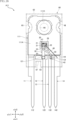
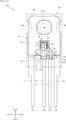


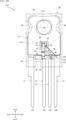
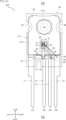





Classifications
-
- H—ELECTRICITY
- H10—SEMICONDUCTOR DEVICES; ELECTRIC SOLID-STATE DEVICES NOT OTHERWISE PROVIDED FOR
- H10W—GENERIC PACKAGES, INTERCONNECTIONS, CONNECTORS OR OTHER CONSTRUCTIONAL DETAILS OF DEVICES COVERED BY CLASS H10
- H10W72/00—Interconnections or connectors in packages
-
- H—ELECTRICITY
- H10—SEMICONDUCTOR DEVICES; ELECTRIC SOLID-STATE DEVICES NOT OTHERWISE PROVIDED FOR
- H10W—GENERIC PACKAGES, INTERCONNECTIONS, CONNECTORS OR OTHER CONSTRUCTIONAL DETAILS OF DEVICES COVERED BY CLASS H10
- H10W72/00—Interconnections or connectors in packages
- H10W72/071—Connecting or disconnecting
-
- H—ELECTRICITY
- H10—SEMICONDUCTOR DEVICES; ELECTRIC SOLID-STATE DEVICES NOT OTHERWISE PROVIDED FOR
- H10W—GENERIC PACKAGES, INTERCONNECTIONS, CONNECTORS OR OTHER CONSTRUCTIONAL DETAILS OF DEVICES COVERED BY CLASS H10
- H10W90/00—Package configurations
Definitions
- This disclosure relates to a semiconductor device and a vehicle equipped with the semiconductor device.
- Patent Document 1 discloses an example of a conventional semiconductor device.
- the semiconductor device disclosed in this document comprises a number of leads, a semiconductor element, and a number of conductive members.
- the number of conductive members include a metal clip and a wire.
- the metal clip is joined to an electrode formed on the upper surface of the semiconductor element and to a lead.
- the wire is joined to an electrode formed on the upper surface of the semiconductor element and to another lead. In such a semiconductor device, it is required to pass a larger current.
- An object of the present disclosure is to provide a semiconductor device that is an improvement over conventional devices.
- an object of the present disclosure is to provide a semiconductor device that is suitable for passing a large current.
- the semiconductor device provided by the first aspect of the present disclosure comprises a first lead having a base, a semiconductor element mounted on one side in a thickness direction of the base and having a first electrode arranged on one side in the thickness direction, a second lead arranged at a distance from the base in a first direction perpendicular to the thickness direction, a third lead arranged at a distance from the base and the second lead, a first conductive member electrically connected to the first electrode and the second lead, and a second conductive member electrically connected to the first conductive member and the third lead.
- the vehicle provided by the second aspect of the present disclosure is equipped with a power conversion device that includes a semiconductor device according to the first aspect of the present disclosure.
- the above configuration provides a semiconductor device with a structure that is favorable for passing large currents.
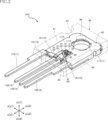
- FIG. 1 is a perspective view showing a semiconductor device according to a first embodiment of the present disclosure.
- FIG. 2 is a partial perspective view showing the semiconductor device according to the first embodiment of the present disclosure.
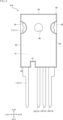
- FIG. 3 is a plan view showing the semiconductor device according to the first embodiment of the present disclosure.
- FIG. 4 is a partial plan view showing the semiconductor device according to the first embodiment of the present disclosure.
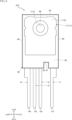
- FIG. 5 is a bottom view showing the semiconductor device according to the first embodiment of the present disclosure.
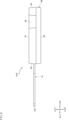
- FIG. 6 is a side view showing the semiconductor device according to the first embodiment of the present disclosure.
- FIG. 7 is a front view showing the semiconductor device according to the first embodiment of the present disclosure.
- FIG. 8 is a cross-sectional view taken along line VIII-VIII in FIG. FIG.
- FIG. 9 is a cross-sectional view taken along line IX-IX in FIG.
- FIG. 10 is a cross-sectional view taken along line XX in FIG.
- FIG. 11 is a cross-sectional view taken along line XI-XI in FIG.
- FIG. 12 is a cross-sectional view taken along line XII-XII in FIG.
- FIG. 13 is a partially enlarged view of a part of FIG.
- FIG. 14 is a partially enlarged view of a part of FIG.
- FIG. 15 is a schematic diagram of a vehicle including the semiconductor device according to the first embodiment of the present disclosure.
- FIG. 16 is a partial plan view showing a semiconductor device according to a first modification of the first embodiment.
- FIG. 16 is a partial plan view showing a semiconductor device according to a first modification of the first embodiment.
- FIG. 17 is a partial plan view showing a semiconductor device according to a second modification of the first embodiment.
- FIG. 18 is a partial plan view showing a semiconductor device according to a third modification of the first embodiment.
- FIG. 19 is a partial plan view showing a semiconductor device according to a fourth modification of the first embodiment.
- FIG. 20 is a partial plan view showing a semiconductor device according to a fifth modification of the first embodiment.
- FIG. 21 is a partial plan view showing a semiconductor device according to a sixth modification of the first embodiment.
- FIG. 22 is a partially enlarged cross-sectional view showing a semiconductor device according to a sixth modification of the first embodiment, and shows a cross section similar to that of FIG.
- FIG. 23 is a partial plan view showing a semiconductor device according to a second embodiment of the present disclosure.
- FIG. 23 is a partial plan view showing a semiconductor device according to a second embodiment of the present disclosure.
- FIG. 24 is a partial plan view showing a semiconductor device according to a third embodiment of the present disclosure.
- FIG. 25 is a cross-sectional view taken along line XXV-XXV in FIG.
- FIG. 26 is a partial plan view showing a semiconductor device according to a fourth embodiment of the present disclosure.
- FIG. 27 is a cross-sectional view taken along line XXVII-XXVII in FIG.
- FIG. 28 is a partial perspective view showing a semiconductor device according to a fifth embodiment of the present disclosure.
- FIG. 29 is a partial plan view showing a semiconductor device according to a fifth embodiment of the present disclosure.
- FIG. 30 is a cross-sectional view taken along line XXX-XXX in FIG.
- FIG. 31 is a partial plan view showing a semiconductor device according to a first modification of the fifth embodiment.
- an object A is formed on an object B" and “an object A is formed on an object B” include “an object A is formed directly on an object B” and “an object A is formed on an object B with another object interposed between the object A and the object B” unless otherwise specified.
- an object A is disposed on an object B” and “an object A is disposed on an object B” include “an object A is disposed directly on an object B” and “an object A is disposed on an object B with another object interposed between the object A and the object B" unless otherwise specified.
- an object A is located on an object B includes “an object A is located on an object B in contact with an object B” and “an object A is located on an object B with another object interposed between the object A and the object B” unless otherwise specified.
- an object A overlaps an object B when viewed in a certain direction includes “an object A overlaps the entire object B” and “an object A overlaps a part of an object B.”
- a surface A faces in direction B is not limited to the case where the angle of surface A with respect to direction B is 90°, but also includes the case where surface A is tilted with respect to direction B.
- First embodiment: 1 to 14 show a semiconductor device according to a first embodiment of the present disclosure.
- the application of the A10 of this embodiment is not limited in any way, and the semiconductor device A10 is used in electronic devices equipped with a power conversion circuit, such as a DC-DC converter.
- the semiconductor device A10 includes a first lead 11, a second lead 12, a third lead 13, a fourth lead 14, a semiconductor element 20, a first conductive member 30, a second conductive member 40, a third conductive member 50, and a sealing resin 60.
- FIG. 1 is a perspective view showing the semiconductor device A10.
- FIG. 2 is a partial perspective view showing the semiconductor device A10.
- FIG. 3 is a plan view showing the semiconductor device A10.
- FIG. 4 is a partial plan view showing the semiconductor device A10.
- the outer shape of the sealing resin 60 is shown by an imaginary line (two-dot chain line).
- FIG. 5 is a bottom view showing the semiconductor device A10.
- FIG. 6 is a side view showing the semiconductor device A10.
- FIG. 7 is a front view showing the semiconductor device A10.
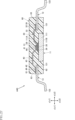
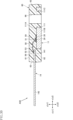
- FIG. 8 is a cross-sectional view taken along line VIII-VIII in FIG. 4.
- FIG. 9 is a cross-sectional view taken along line IX-IX in FIG. 4.
- FIG. 10 is a cross-sectional view taken along line X-X in FIG. 4.
- FIG. 11 is a cross-sectional view taken along line XI-XI in FIG. 4.
- FIG. 12 is a cross-sectional view taken along line XII-XII in FIG. 4.
- FIG. 13 is a partial enlarged view of a part of FIG. 9.
- FIG. 14 is a partial enlarged view of a part of FIG. 11.
- the thickness direction of semiconductor device A10 (the up-down direction in FIG. 1) will be referred to as the "thickness direction z.”
- One direction that is orthogonal to thickness direction z will be referred to as the "first direction x.”
- a direction that is orthogonal to both thickness direction z and first direction x will be referred to as the "second direction y.”
- the first lead 11 has a base 111 and a terminal portion 112.
- the first lead 11 is a conductive member on which the semiconductor element 20 is mounted and which forms part of the conductive path between the semiconductor element 20 and a wiring board (not shown) on which the semiconductor device A10 is mounted, etc.
- the first lead 11 includes, for example, copper (Cu) or a copper alloy.
- the first lead 11 may have a surface metal layer (not shown).
- the surface metal layer includes, for example, Ag (silver), Ni (nickel), etc.
- the base 111 has a first main surface 111A, a first back surface 111B, and a through hole 111C.
- the first main surface 111A faces the z1 side in the thickness direction z.
- the first back surface 111B faces the z2 side in the z direction.
- the through hole 111C penetrates the base 111 in the thickness direction z.
- the shape of the through hole 111C is not limited in any way, and in the illustrated example, it is circular when viewed in the thickness direction z.
- the terminal portion 112 is connected to the base portion 111 and includes a portion extending toward the x1 side in the first direction x.
- the base portion 111 and the terminal portion 112 are electrically conductive to each other.
- a portion of the terminal portion 112 is covered with the sealing resin 60.
- the portion of the terminal portion 112 covered with the sealing resin 60 is bent when viewed in the second direction y.
- the surface of the portion of the terminal portion 112 exposed from the sealing resin 60 may be plated with, for example, tin (Sn).
- the second lead 12 is separated from the first lead 11 and is disposed on the y2 side of the second direction y with respect to the terminal portion 112 of the first lead 11.
- the second lead 12 is disposed on the x1 side of the first direction x with respect to the base portion 111 of the first lead 11.
- the second lead 12 is electrically connected to the semiconductor element 20 via the first conductive member 30.
- the second lead 12 has a pad portion 121 and a terminal portion 122.
- the pad portion 121 is covered with a sealing resin 60.
- the pad portion 121 may be plated with, for example, silver (Ag) or tin (Sn).
- the terminal portion 122 is connected to the pad portion 121.
- a portion of the terminal portion 122 is covered with the sealing resin 60, and another portion is exposed from the sealing resin 60.
- the terminal portion 122 extends in the first direction x, for example, parallel to the terminal portion 112.
- the surface of the terminal portion 122 may be plated with, for example, tin (Sn).
- the third lead 13 is separated from the first lead 11 and the second lead 12 and is disposed at a distance from the second lead 12 on the y2 side in the second direction y.
- the third lead 13 is adjacent to the second lead 12 in the second direction y.
- the third lead 13 is disposed at a distance from the base 111 on the x1 side in the first direction x.
- the third lead 13 is electrically connected to the semiconductor element 20 via the second conductive member 40 and the first conductive member 30.
- the third lead 13 has a pad portion 131 and a terminal portion 132.
- the pad portion 131 is covered with a sealing resin 60.
- the pad portion 131 may be plated with, for example, silver (Ag) or tin (Sn).
- the terminal portion 132 is connected to the pad portion 131. A portion of the terminal portion 132 is covered with the sealing resin 60, and another portion is exposed from the sealing resin 60. Terminal portion 132 extends in the first direction x, for example, parallel to terminal portion 112 and terminal portion 122.
- the surface of terminal portion 132 may be plated with, for example, tin (Sn).
- the fourth lead 14 is separated from the first lead 11, the second lead 12 and the third lead 13, and is disposed at a distance from the third lead 13 on the y2 side in the second direction y.
- the fourth lead 14 is located on the opposite side of the second lead 12 from the third lead 13 in the second direction y.
- the fourth lead 14 is disposed at a distance from the base 111 on the x1 side in the first direction x.
- the fourth lead 14 is electrically connected to the semiconductor element 20 via the third conductive member 50.
- the fourth lead 14 has a pad portion 141 and a terminal portion 142.
- the pad portion 141 is covered with a sealing resin 60.
- the pad portion 141 may be plated with, for example, silver (Ag) or tin (Sn).
- the terminal portion 142 is connected to the pad portion 141. A portion of the terminal portion 142 is covered with the sealing resin 60, and another portion is exposed from the sealing resin 60. Terminal portion 142 extends in the first direction x, for example, parallel to terminal portion 112, terminal portion 122, and terminal portion 132.
- the surface of terminal portion 142 may be plated with, for example, tin (Sn).
- the semiconductor element 20 is mounted on the first main surface 111A of the base 111, as shown in Figures 2, 4, and 9 to 14.
- the specific configuration of the semiconductor element 20 is not limited in any way, and in this embodiment, the semiconductor element 20 is a switching element, for example, a MOSFET (Metal-Oxide-Semiconductor Field-Effect Transistor) of n-channel type and vertical structure.
- the semiconductor element 20 is not limited to a MOSFET.
- the semiconductor element 20 may be other transistors such as an IGBT (Insulated Gate Bipolar Transistor).
- the semiconductor element 20 may be an LSI (Large Scale Integration) or a diode.
- the semiconductor element 20 is rectangular when viewed in the thickness direction z.
- the semiconductor element 20 is disposed in the center of the base 111 in the second direction y.
- the semiconductor element 20 has a semiconductor layer 25, a first electrode 21, a second electrode 22, and a third electrode 23.
- the thickness of the semiconductor element 20 (dimension in the thickness direction z) is, for example, 100 ⁇ m or more and 1000 ⁇ m or less.
- the semiconductor layer 25 includes a compound semiconductor substrate.
- the main material of the compound semiconductor substrate is silicon carbide (SiC).
- silicon (Si) may be used as the main material of the compound semiconductor substrate.
- the first electrode 21 is disposed on the z1 side of the semiconductor layer 25 in the thickness direction z. A current corresponding to the power converted by the semiconductor element 20 flows through the first electrode 21.
- the first electrode 21 is a source electrode.
- the second electrode 22 is disposed in a portion of the semiconductor layer 25 on the z1 side in the thickness direction z.
- the second electrode 22 is located away from the first electrode 21.
- a voltage is applied to the second electrode 22 to drive the semiconductor element 20.
- the second electrode 22 is a gate electrode.
- the area of the second electrode 22 is smaller than the area of the first electrode 21.
- the second electrode 22 is disposed near a corner of the semiconductor element 20 on the x1 side in the first direction x and on the y2 side in the second direction y, when viewed in the thickness direction z.
- the third electrode 23 is disposed on the portion of the semiconductor layer 25 on the z2 side in the thickness direction z.
- the third electrode 23 faces the first main surface 111A of the base 111 of the first lead 11.
- a current corresponding to the power before being converted by the semiconductor element 20 flows through the third electrode 23.
- the third electrode 23 is a drain electrode.
- the third electrode 23 is conductively joined to the first main surface 111A via a joining layer 29.
- the joining layer 29 is made of a conductive material, such as solder or Ag (silver) paste.
- the first lead 11 is electrically connected to the third electrode 23 of the semiconductor element 20.
- the terminal portion 112 is the drain terminal of the semiconductor device A10.
- the second lead 12 is electrically connected to the first electrode 21 of the semiconductor element 20.
- the terminal portion 122 is the source terminal of the semiconductor device A10.
- the third lead 13 is electrically connected to the first electrode 21 of the semiconductor element 20.
- the terminal portion 132 is the source sense terminal of the semiconductor device A10.
- the fourth lead 14 is electrically connected to the second electrode 22 of the semiconductor element 20.
- the terminal portion 142 is the gate terminal of the semiconductor device A10.
- the first conductive member 30 is conductively joined to the first electrode 21 of the semiconductor element 20 and the pad portion 121 of the second lead 12.
- the first conductive member 30 is made of, for example, a metal plate material.
- the constituent material of the first conductive member 30 includes, for example, Cu (copper).
- the first conductive member 30 is a metal plate material that is appropriately bent.
- the first conductive member 30 is a fixed-length Cu clip (metal clip).
- the first conductive member 30 extends with the first direction x as its longitudinal direction.
- the first conductive member 30 has a first portion 31, a second portion 32, and a first intermediate portion 33.
- the first portion 31 is joined to the first electrode 21 via a joining layer 39, and is a portion that electrically joins the first conductive member 30 to the first electrode 21.
- the joining layer 39 is made of a conductive material, such as solder or Ag (silver) paste.
- the first portion 31 is located at the end of the first conductive member 30 on the x2 side in the first direction x.
- the second portion 32 is joined to the pad portion 121 of the second lead 12 via a joining layer 39, and is a portion that electrically joins the first conductive member 30 to the second lead 12.
- the joining layer 39 is made of a conductive material, such as solder or Ag (silver) paste.
- the second portion 32 is located at the end of the first conductive member 30 on the x1 side in the first direction x.
- the first intermediate portion 33 is located between the first portion 31 and the second portion 32 when viewed in the thickness direction z.
- the first intermediate portion 33 is connected to both the first portion 31 and the second portion 32.
- the portions of the first intermediate portion 33 that are connected to the first portion 31 and the second portion 32 are bent when viewed in the second direction y.
- the portions of the first intermediate portion 33 other than the bent portions are along the xy plane and are located on the z1 side in the thickness direction z of the first portion 31 and the second portion 32.
- the second conductive member 40 is conductively joined to the first conductive member 30 and the third lead 13.
- the second conductive member 40 is made of, for example, a metal plate material.
- the constituent material of the second conductive member 40 includes, for example, Cu (copper).
- the second conductive member 40 is a metal plate material that is appropriately bent.
- the second conductive member 40 has a third portion 41, a fourth portion 42 and a second intermediate portion 43.
- the third portion 41 is joined to the first portion 31 of the first conductive member 30 via a joining layer 49.
- the joining layer 49 is made of a conductive material, such as solder or Ag (silver) paste.
- the third portion 41 is electrically connected to the first electrode 21 of the semiconductor element 20 via the first conductive member 30 (first portion 31).
- the third portion 41 is located at the end of the second conductive member 40 on the x2 side in the first direction x.
- the fourth portion 42 is joined to the pad portion 131 of the third lead 13 via a joining layer 49, and is a portion that electrically connects the second conductive member 40 to the third lead 13.
- the joining layer 49 is made of a conductive material, such as solder or Ag (silver) paste.
- the fourth portion 42 is located at the end of the second conductive member 40 on the x1 side in the first direction x.
- the second intermediate portion 43 is located between the third portion 41 and the fourth portion 42 when viewed in the thickness direction z.
- the second intermediate portion 43 is connected to both the third portion 41 and the fourth portion 42.
- the portions of the second intermediate portion 43 that are connected to the third portion 41 and the fourth portion 42 are bent when viewed in the second direction y.
- the portions of the second intermediate portion 43 other than the bent portions are along the xy plane and are located on the z1 side of the thickness direction z relative to the third portion 41 and the fourth portion 42.
- the portions of the second intermediate portion 43 other than the bent portions are located on the y2 side of the second direction y as they move toward the x1 side of the first direction x, and extend in a direction intersecting both the first direction x and the second direction y.
- the cross-sectional area of the current path of the second conductive member 40 is smaller than the cross-sectional area of the current path of the first conductive member 30.
- the third conductive member 50 is conductively joined to the second electrode 22 of the semiconductor element 20 and the pad portion 141 of the fourth lead 14.
- the third conductive member 50 is a bonding wire.
- the specific configuration of the third conductive member 50 is not limited in any way, and includes configurations in which the cross-sectional shape is circular, elliptical, flattened rectangular, etc. In the illustrated example, the third conductive member 50 has a circular cross-sectional shape.
- the third conductive member 50 is joined by wedge bonding, for example.
- the material of the third conductive member 50 is not limited in any way, and includes, for example, Cu (copper), Al (aluminum), etc.
- the bonding of the semiconductor element 20 to the base 111 via the bonding layer 29, the bonding of the first conductive member 30 to the first electrode 21 and the second lead 12 (pad portion 121) via the bonding layer 39, and the bonding of the second conductive member 40 to the first conductive member 30 (first portion 31) and the third lead 13 (pad portion 131) via the bonding layer 49 are performed all at once, for example, by a solder reflow process. Then, after the first conductive member 30 and the second conductive member 40 are bonded, the third conductive member 50 is bonded.
- the sealing resin 60 covers the semiconductor element 20, the first conductive member 30, the second conductive member 40, the third conductive member 50, and parts of the first lead 11, the second lead 12, the third lead 13, and the fourth lead 14.
- the sealing resin 60 has electrical insulation properties.
- the sealing resin 60 is made of a material that contains, for example, black epoxy resin.
- the sealing resin 60 has a resin main surface 61, a resin back surface 62, a pair of first resin side surfaces 63, a pair of second resin side surfaces 64, a pair of openings 65, a mounting hole 66, and a recess 67.
- the resin main surface 61 faces the z1 side in the thickness direction z.
- the resin back surface 62 faces the z2 side in the thickness direction z.
- the first back surface 111B of the base 111 is exposed from the resin back surface 62.
- the first back surface 111B and the resin back surface 62 are flush with each other.
- the pair of first resin side surfaces 63 are positioned apart from each other in the first direction x.
- the pair of first resin side surfaces 63 are connected to the resin main surface 61 and the resin back surface 62.
- the terminal portion 112 of the first lead 11, the terminal portion 122 of the second lead 12, the terminal portion 132 of the third lead 13, and the terminal portion 142 of the fourth lead 14 protrude from the first resin side surface 63 facing the x1 side of the first direction x.
- the pair of second resin side surfaces 64 are spaced apart from each other in the second direction y.
- the pair of second resin side surfaces 64 are connected to the resin main surface 61 and the resin back surface 62.
- the pair of openings 65 are positioned apart from each other in the second direction y. Each of the pair of openings 65 is recessed inwardly into the sealing resin 60 from the resin main surface 61 and one of the pair of second resin side surfaces 64. A portion of the first main surface 111A of the base 111 of the first lead 11 is exposed from the pair of openings 65.
- the mounting hole 66 penetrates the sealing resin 60 from the resin main surface 61 to the resin back surface 62 in the thickness direction z.
- the mounting hole 66 is contained within the through hole 111C of the base 111 of the first lead 11.
- the inner surface of the base 111 that defines the through hole 111C is covered by the sealing resin 60.
- the maximum dimension of the mounting hole 66 is smaller than the dimension of the through hole 111C.
- the recess 67 is located between the terminal portion 112 and the terminal portion 122 in the second direction y.
- the recess 67 is recessed from the first resin side surface 63 located on the x1 side in the first direction x to the x2 side in the first direction x.
- FIG. 15 is a schematic diagram of a vehicle B1 equipped with the semiconductor device A10.
- the vehicle B1 is, for example, an electric vehicle (EV).
- EV electric vehicle
- vehicle B1 is equipped with a drive system 84 including an AC-DC converter 81, a power receiving device 82, and a storage battery 83.
- Semiconductor device A10 constitutes a part of the AC-DC converter 81.
- the AC-DC converter 81 converts the AC power into high-voltage DC power.
- the AC-DC converter 81 supplies the high-voltage DC power to the storage battery 83.
- the power receiving device 82 supplies power to the storage battery 83 through a non-contact charging system, and is supplied with power by electromagnetic induction from a non-contact charger (not shown) installed in a parking lot or the like.
- the power stored in the storage battery 83 is supplied to a drive system 84 consisting of an inverter, an AC motor, and a transmission.
- the drive system 84 drives vehicle B1.
- the AC-DC converter 81 is an example of a "power conversion device”.
- the second lead 12 is disposed away from the base 111 on which the semiconductor element 20 is mounted on the x1 side in the first direction x.
- the third lead 13 is disposed away from the base 111 and the second lead 12.
- the first conductive member 30 is conductively joined to the first electrode 21 of the semiconductor element 20 and the second lead 12.
- the second conductive member 40 is conductively joined to the first conductive member 30 and the third lead 13.
- the second conductive member 40 is conductive to the first electrode 21 via the first conductive member 30.
- the first conductive member 30 has a first portion 31, a second portion 32, and a first intermediate portion 33.
- the first portion 31 is conductively joined to the first electrode 21 of the semiconductor element 20, and the second conductive member 40 is conductively joined to this first portion 31.
- the portion of the second conductive member 40 joined to the first conductive member 30 is close to the first electrode 21. This makes it possible to suppress deterioration in the characteristics of the second conductive member 40 that is conductive to the terminal portion 132 (third lead 13), which is the source sense terminal.
- the first conductive member 30 and the second conductive member 40 are each made of a metal plate material. With this configuration, the joining of the first conductive member 30 to the first electrode 21 and the second lead 12 (pad portion 121) and the joining of the second conductive member 40 to the first conductive member 30 (first portion 31) and the third lead 13 (pad portion 131) can be performed in one step, for example, by a solder reflow process. This makes it possible to efficiently manufacture the semiconductor device A10.
- the third lead 13 is arranged at a distance from the second lead 12 in a second direction y perpendicular to both the thickness direction z and the first direction x.
- the third lead 13 is arranged adjacent to 12 in the second direction y.
- the direction in which the first conductive member 30 extends (the first direction x in the illustrated example) and the direction in which the second conductive member 40 extends are relatively close. This allows the first conductive member 30 and the second conductive member 40 to be efficiently arranged with respect to the second lead 12 and the third lead 13, which are adjacent to each other in the second direction y.
- FIGS. 16 to 31 show modified examples and other embodiments of the present disclosure.
- elements that are the same as or similar to those in the above embodiment are given the same reference numerals as in the above embodiment, and duplicated explanations will be omitted.
- the configurations of each part in each modified example and each embodiment can be combined with each other as appropriate to the extent that no technical contradictions arise.
- Fig. 16 shows a first modified example of the semiconductor device A10.
- Fig. 16 is a partial plan view showing a semiconductor device A11 according to the first modified example.
- the outline of the sealing resin 60 is shown by an imaginary line (two-dot chain line).
- the semiconductor device A11 of this modified example differs from the semiconductor device A10 in the configuration of the first conductive member 30.
- the first portion 31 of the first conductive member 30 is L-shaped when viewed in the thickness direction z. When viewed in the thickness direction z, the area of this first portion 31 is larger than the area of the first portion 31 in the semiconductor device A10 shown in FIG. 4.
- the first portion 31 is also provided on the x2 side of the first direction x of the second electrode 22 when viewed in the thickness direction z, and overlaps with most of the first electrode 21 when viewed in the thickness direction z.
- the first conductive member 30 is conductively joined to the first electrode 21 of the semiconductor element 20 and the second lead 12.
- the second conductive member 40 is conductively joined to the first conductive member 30 and the third lead 13.
- the second conductive member 40 is conductive to the first electrode 21 via the first conductive member 30.
- the semiconductor device A11 has the same effects as the semiconductor device A10 of the above embodiment.
- Fig. 17 shows a second modified example of the semiconductor device A10.
- Fig. 17 is a partial plan view showing a semiconductor device A12 according to the second modified example.
- the outline of the sealing resin 60 is shown by an imaginary line (two-dot chain line).
- the configurations of the semiconductor element 20 and the first conductive member 30 are different from those of the semiconductor device A10.
- the arrangement of the second electrode 22 in the semiconductor element 20 is different from that of the semiconductor device A10.
- the second electrode 22 is arranged on the y2 side of the second direction y in the thickness direction z, and is arranged in the center in the first direction x.
- the first portion 31 of the first conductive member 30 is U-shaped in the thickness direction z.
- the first portion 31 is also provided on both sides of the second electrode 22 in the first direction x in the thickness direction z, and overlaps with most of the first electrode 21 in the thickness direction z.
- the first conductive member 30 is conductively joined to the first electrode 21 of the semiconductor element 20 and the second lead 12.
- the second conductive member 40 is conductively joined to the first conductive member 30 and the third lead 13.
- the second conductive member 40 is conductive to the first electrode 21 via the first conductive member 30.
- the semiconductor device A12 has the same effects as the semiconductor device A10 of the above embodiment.
- Fig. 18 shows a third modified example of the semiconductor device A10.
- Fig. 18 is a partial plan view showing a semiconductor device A13 according to the third modified example.
- the outline of the sealing resin 60 is shown by an imaginary line (two-dot chain line).
- the arrangement of the semiconductor element 20 and the configuration of the first conductive member 30 are different from those of the semiconductor device A10.
- the semiconductor element 20 is mounted on the y2 side of the base 111 in the second direction y.
- the first conductive member 30 is L-shaped when viewed in the thickness direction z.
- the first portion 31 of the first conductive member 30 is bent when viewed in the thickness direction z, and is shaped such that a portion extending in the first direction x and a portion extending in the second direction y are connected.
- the first portion 31 is connected to the end of the first intermediate portion 33 on the y2 side in the second direction y, and the second portion 32 is connected to the end of the first intermediate portion 33 on the x1 side in the first direction x.
- the first conductive member 30 is conductively joined to the first electrode 21 of the semiconductor element 20 and the second lead 12.
- the second conductive member 40 is conductively joined to the first conductive member 30 and the third lead 13.
- the second conductive member 40 is conductively connected to the first electrode 21 via the first conductive member 30.
- the semiconductor device A13 achieves the same effects as the semiconductor device A10 within the same range of configuration as the semiconductor device A10 of the above embodiment.
- Fig. 19 shows a fourth modified example of the semiconductor device A10.
- Fig. 19 is a partial plan view showing a semiconductor device A14 according to the fourth modified example.
- the outline of the sealing resin 60 is shown by an imaginary line (two-dot chain line).
- the arrangement of the third lead 13 and the fourth lead 14 is different from that of the semiconductor device A10.
- the third lead 13 and the fourth lead 14 are arranged in a swapped position compared to the semiconductor device A10.
- the third lead 13 is located on the y2 side of the first lead 11, the second lead 12, and the fourth lead 14 in the second direction y.
- the fourth lead 14 is arranged between the second lead 12 and the fourth lead 14 in the second direction y, and is adjacent to both the second lead 12 and the third lead 13.
- the second conductive member 40 joined to the third lead 13 and the third conductive member 50 joined to the fourth lead 14 cross each other when viewed in the thickness direction z.
- the third conductive member 50 straddles the second intermediate portion 43 of the second conductive member 40 when viewed in the thickness direction z.
- the first conductive member 30 is conductively joined to the first electrode 21 of the semiconductor element 20 and the second lead 12.
- the second conductive member 40 is conductively joined to the first conductive member 30 and the third lead 13.
- the second conductive member 40 is conductive to the first electrode 21 via the first conductive member 30.
- the semiconductor device A14 achieves the same effects as the semiconductor device A10 within the same range of configuration as the semiconductor device A10 of the above embodiment.
- Fig. 20 shows a fifth modified example of the semiconductor device A10.
- Fig. 20 is a partial plan view showing a semiconductor device A15 according to the fifth modified example.
- the outline of the sealing resin 60 is shown by an imaginary line (two-dot chain line).
- the semiconductor device A15 of this modified example differs from the semiconductor device A10 in the portion where the second conductive member 40 is joined to the first conductive member 30.
- the second conductive member 40 (third portion 41) is conductively joined to the first intermediate portion 33 of the first conductive member 30.
- the second conductive member 40 is conductively connected to the first electrode 21 of the semiconductor element 20 via the first conductive member 30 (first intermediate portion 33 and first portion 31).
- the semiconductor device A15 achieves the same effects as the semiconductor device A10 within the same range of configuration as the semiconductor device A10 of the above embodiment.
- FIG. 21 and 22 show a sixth modified example of the semiconductor device A10.
- Fig. 21 is a partial plan view showing a semiconductor device A16 according to the sixth modified example.
- Fig. 22 is a partially enlarged cross-sectional view showing the semiconductor device A16, and shows a cross-section similar to that of Fig. 13.
- the outline of the sealing resin 60 is shown by an imaginary line (two-dot chain line).
- the semiconductor device A16 of this modified example differs from the semiconductor device A10 in the configuration of the first portion 31 of the first conductive member 30.
- the first portion 31 has a first surface 311 and a first recess 312.
- the first surface 311 faces the z1 side in the thickness direction z.
- the first recess 312 is recessed from the first surface 311 toward the z2 side in the thickness direction z.
- At least a portion of the third portion 41 of the second conductive member 40 is disposed in the first recess 312.
- the first conductive member 30 is conductively joined to the first electrode 21 of the semiconductor element 20 and the second lead 12.
- the second conductive member 40 is conductively joined to the first conductive member 30 and the third lead 13.
- the second conductive member 40 is conductive to the first electrode 21 via the first conductive member 30 (first portion 31).
- At least a part of the third portion 41 is disposed in the first recess 312 of the first portion 31.
- the semiconductor device A16 has the same effects as the semiconductor device A10 of the above embodiment.
- Fig. 23 shows a semiconductor device according to a second embodiment of the present disclosure.
- Fig. 23 is a partial plan view showing a semiconductor device A20 according to this embodiment.
- the outline of the sealing resin 60 is shown by an imaginary line (two-dot chain line).
- the semiconductor device A20 of this embodiment differs from the semiconductor device A10 in the sizes of the semiconductor element 20, the first conductive member 30, and the second conductive member 40.
- the size of the semiconductor element 20 and the first conductive member 30 as viewed in the thickness direction z is significantly larger than that of the semiconductor device A10.
- the size of the second conductive member 40 as viewed in the thickness direction z is also larger than that of the semiconductor device A10.
- the second electrode 22 is disposed near the corner on the x1 side of the first direction x and the y2 side of the second direction y as viewed in the thickness direction z.
- the first conductive member 30 is conductively joined to the first electrode 21 of the semiconductor element 20 and the second lead 12.
- the second conductive member 40 is conductively joined to the first conductive member 30 and the third lead 13.
- the second conductive member 40 is conductive to the first electrode 21 via the first conductive member 30.
- the semiconductor device A20 has the same effects as the semiconductor device A10 of the above embodiment.
- FIG. 24 and 25 show a semiconductor device according to a third embodiment of the present disclosure.
- FIG. 24 is a partial plan view showing a semiconductor device A30 according to this embodiment.
- FIG. 25 is a cross-sectional view taken along line XXV-XXV in FIG. 24.
- the outline of the sealing resin 60 is shown by an imaginary line (two-dot chain line).
- the specific configurations of the first lead 11, the second lead 12, the third lead 13, and the fourth lead 14 are different from those of the semiconductor device A10, and accordingly, other elements are also appropriately changed.
- the terminal portion 112 is connected to the base portion 111 and is disposed on the x2 side of the base portion 111 in the first direction x.
- the terminal portion 112 is elongated in the second direction y.
- the terminal portion 112 is electrically connected to the third electrode 23 (drain electrode) of the semiconductor element 20 via the base portion 111 and the bonding layer 29.
- the terminal portion 112 is the drain terminal of the semiconductor device A30.
- the second lead 12 is separated from the first lead 11 and is arranged on the x1 side of the base 111 of the first lead 11 in the first direction x.
- the second lead 12 is electrically connected to the semiconductor element 20 via the first conductive member 30.
- the second lead 12 has a pad portion 121 and multiple (five in the illustrated example) terminal portions 122.
- the pad portion 121 is elongated in the second direction y and is arranged from the center in the second direction to the y2 side in the second direction y as viewed in the thickness direction z.
- the multiple terminal portions 122 are arranged at intervals from each other in the second direction y and each is connected to the pad portion 121.
- each terminal portion 122 exposed from the sealing resin 60 is appropriately bent as viewed in the second direction y.
- the pad portion 121 (second lead 12) is electrically connected to the first electrode 21 (source electrode) of the semiconductor element 20 via the first conductive member 30 and the bonding layer 39.
- the multiple terminal portions 122 are source terminals of the semiconductor device A30.
- the third lead 13 is spaced apart from the first lead 11 and the second lead 12, and is spaced apart from the second lead 12 on the y1 side in the second direction y.
- the third lead 13 is adjacent to the second lead 12 in the second direction y.
- the third lead 13 is spaced apart from the base 111 on the x1 side in the first direction x.
- the third lead 13 is electrically connected to the first electrode 21 (source electrode) of the semiconductor element 20 via the second conductive member 40 and the first conductive member 30.
- the terminal portion 132 is a source sense terminal of the semiconductor device A30.
- the fourth lead 14 is spaced apart from the first lead 11, the second lead 12 and the third lead 13, and is spaced apart from the third lead 13 on the y1 side in the second direction y.
- the fourth lead 14 is located on the opposite side of the third lead 13 from the second lead 12 in the second direction y.
- the fourth lead 14 is spaced apart from the base 111 on the x1 side in the first direction x.
- the fourth lead 14 is electrically connected to the second electrode 22 of the semiconductor element 20 via the third conductive member 50.
- the terminal portion 142 is a gate terminal of the semiconductor device A30.
- the first conductive member 30 is conductively joined to the first electrode 21 of the semiconductor element 20 and the pad portion 121 of the second lead 12.
- the first conductive member 30 is made of, for example, a metal plate material.
- the constituent material of the first conductive member 30 includes, for example, Cu (copper).
- the first conductive member 30 is a metal plate material that is appropriately bent.
- the first conductive member 30 is a fixed-length Cu clip (metal clip).
- the first conductive member 30 extends with the first direction x as its longitudinal direction.
- the first conductive member 30 has a first portion 31, a second portion 32, and a first intermediate portion 33.
- the first portion 31 is joined to the first electrode 21 via a bonding layer 39, and is a portion that conductively bonds the first conductive member 30 to the first electrode 21.
- the bonding layer 39 is, for example, solder, Ag (silver) paste, etc.
- the first portion 31 is located at the end of the first conductive member 30 on the x2 side in the first direction x.
- the second portion 32 is joined to the pad portion 121 of the second lead 12 via the bonding layer 39, and is a portion that conductively bonds the first conductive member 30 to the second lead 12.
- the bonding layer 39 is, for example, solder, Ag (silver) paste, etc.
- the second portion 32 is located at the end of the first conductive member 30 on the x1 side in the first direction x.
- the first intermediate portion 33 is located between the first portion 31 and the second portion 32 when viewed in the thickness direction z.
- the first intermediate portion 33 is connected to both the first portion 31 and the second portion 32.
- the portions of the first intermediate portion 33 that are connected to the first portion 31 and the second portion 32 are bent when viewed in the second direction y.
- the portions of the first intermediate portion 33 other than the bent portions are along the xy plane and are located on the z1 side of the first portion 31 and the second portion 32 in the thickness direction z.
- the second conductive member 40 is conductively joined to the first conductive member 30 and the third lead 13.
- the second conductive member 40 is made of, for example, a metal plate material.
- the constituent material of the second conductive member 40 includes, for example, Cu (copper).
- the second conductive member 40 is a metal plate material that is appropriately bent. In this embodiment, the second conductive member 40 has a third portion 41, a fourth portion 42, and a second intermediate portion 43.
- the third portion 41 is joined to the first portion 31 of the first conductive member 30 via a joining layer 49.
- the joining layer 49 is made of a conductive material, such as solder or Ag (silver) paste.
- the third portion 41 is electrically connected to the first electrode 21 of the semiconductor element 20 via the first conductive member 30 (first portion 31).
- the third portion 41 is located at the end of the second conductive member 40 on the x2 side in the first direction x.
- the fourth portion 42 is joined to the pad portion 131 of the third lead 13 via a joining layer 49, and is a portion that electrically connects the second conductive member 40 to the third lead 13.
- the joining layer 49 is made of a conductive material, such as solder or Ag (silver) paste.
- the fourth portion 42 is located at the end of the second conductive member 40 on the x1 side in the first direction x.
- the second intermediate portion 43 is located between the third portion 41 and the fourth portion 42 when viewed in the thickness direction z.
- the second intermediate portion 43 is connected to both the third portion 41 and the fourth portion 42.
- the portions of the second intermediate portion 43 that are connected to the first portion 31 and the second portion 32 are bent when viewed in the second direction y.
- the portions of the second intermediate portion 43 other than the bent portions are along the xy plane and are located on the z1 side of the thickness direction z relative to the first portion 31 and the second portion 32.
- the portions of the second intermediate portion 43 other than the bent portions are located on the y1 side of the second direction y as they move toward the x1 side of the first direction x, and extend in a direction intersecting both the first direction x and the second direction y.
- the third conductive member 50 is conductively joined to the second electrode 22 (gate electrode) of the semiconductor element 20 and the pad portion 141 of the fourth lead 14.
- the second electrode 22 is disposed near a corner on the x2 side in the first direction x and the y1 side in the second direction y of the semiconductor element 20 as viewed in the thickness direction z.
- the third conductive member 50 is a bonding wire.
- the specific configuration of the third conductive member 50 is not limited in any way, and includes configurations in which the cross-sectional shape is circular, elliptical, flattened rectangular, etc. In the illustrated example, the third conductive member 50 has a circular cross-sectional shape.
- the third conductive member 50 is joined, for example, by wedge bonding.
- the material of the third conductive member 50 is not limited in any way, and includes, for example, Cu (copper), Al (aluminum), etc.
- the bonding of the semiconductor element 20 to the base 111 via the bonding layer 29, the bonding of the first conductive member 30 to the first electrode 21 and the second lead 12 (pad portion 121) via the bonding layer 39, and the bonding of the second conductive member 40 to the first conductive member 30 (first portion 31) and the third lead 13 (pad portion 131) via the bonding layer 49 are performed all at once, for example, by a solder reflow process. Then, after the first conductive member 30 and the second conductive member 40 are bonded, the third conductive member 50 is bonded.
- the sealing resin 60 has a resin main surface 61, a resin back surface 62, a pair of first resin side surfaces 63, and a pair of second resin side surfaces 64.
- Each of the multiple terminal portions 122 of the second lead 12, the terminal portion 132 of the third lead 13, and the terminal portion 142 of the fourth lead 14 protrude from the first resin side surface 63 facing the x1 side of the first direction x.
- the terminal portion 112 of the first lead 11 protrudes from the first resin side surface 63 facing the x2 side of the first direction x.
- the second lead 12 is disposed away from the base 111 on which the semiconductor element 20 is mounted on the x1 side in the first direction x.
- the third lead 13 is disposed away from the base 111 and the second lead 12.
- the first conductive member 30 is conductively joined to the first electrode 21 of the semiconductor element 20 and the second lead 12.
- the second conductive member 40 is conductively joined to the first conductive member 30 and the third lead 13.
- the second conductive member 40 is conductively connected to the first electrode 21 via the first conductive member 30.
- the first conductive member 30 has a first portion 31, a second portion 32, and a first intermediate portion 33.
- the first portion 31 is conductively joined to the first electrode 21 of the semiconductor element 20, and the second conductive member 40 is conductively joined to this first portion 31.
- the portion of the second conductive member 40 joined to the first conductive member 30 is close to the first electrode 21. This makes it possible to suppress deterioration in the characteristics of the second conductive member 40 that is conductive to the terminal portion 132 (third lead 13), which is the source sense terminal.
- the third lead 13 is arranged at a distance from the second lead 12 in a second direction y perpendicular to both the thickness direction z and the first direction x.
- the third lead 13 is arranged adjacent to 12 in the second direction y.
- the direction in which the first conductive member 30 extends (the first direction x in the illustrated example) and the direction in which the second conductive member 40 extends are relatively close. This allows the first conductive member 30 and the second conductive member 40 to be efficiently arranged with respect to the second lead 12 and the third lead 13, which are adjacent to each other in the second direction y.
- FIG. 26 and 27 show a semiconductor device according to a fourth embodiment of the present disclosure.
- FIG. 26 is a partial plan view showing a semiconductor device A40 according to this embodiment.
- FIG. 27 is a cross-sectional view taken along line XXVII-XXVII in FIG. 26.
- the outline of the sealing resin 60 is shown by an imaginary line (two-dot chain line).
- the arrangement of the second lead 12 is different from that of the semiconductor device A10, and accordingly, other elements are also appropriately changed.
- the second lead 12 is disposed at a distance from the base 111 of the first lead 11 on the x2 side in the first direction x.
- the third lead 13 is disposed at a distance from the base 111 on the x1 side in the first direction x.
- the third lead 13 is disposed on the opposite side of the base 111 from the second lead 12 in the first direction x.
- the terminal portion 112 of the first lead 11, the terminal portion 132 of the third lead 13, and the terminal portion 142 of the fourth lead 14 protrude from the first resin side surface 63 of the sealing resin 60 facing the x1 side in the first direction x.
- the terminal portion 122 of the second lead 12 protrudes from the first resin side surface 63 of the sealing resin 60 facing the x2 side in the first direction x.
- the portions of the terminal portion 112, the terminal portion 122, the terminal portion 132, and the terminal portion 142 exposed from the sealing resin 60 are appropriately bent when viewed in the second direction y.
- the first conductive member 30 extends with the first direction x as its longitudinal direction.
- the first conductive member 30 has a first portion 31, a second portion 32, and a first intermediate portion 33.
- the first portion 31 is located at the end of the first conductive member 30 on the x1 side in the first direction x.
- the second portion 32 is located at the end of the first conductive member 30 on the x2 side in the first direction x.
- the second conductive member 40 has a third portion 41, a fourth portion 42, and a second intermediate portion 43.
- the third portion 41 is conductively joined to the first portion 31 of the first conductive member 30 via a joining layer 49.
- the third portion 41 is located at the end of the second conductive member 40 on the x2 side in the first direction x.
- the fourth portion 42 is located at the end of the second conductive member 40 on the x1 side in the first direction x.
- the second lead 12 is disposed away from the base 111 on which the semiconductor element 20 is mounted on the x2 side of the first direction x.
- the third lead 13 is disposed away from the base 111 and the second lead 12.
- the first conductive member 30 is conductively joined to the first electrode 21 of the semiconductor element 20 and the second lead 12.
- the second conductive member 40 is conductively joined to the first conductive member 30 and the third lead 13.
- the second conductive member 40 is conductive to the first electrode 21 via the first conductive member 30.
- FIG. 28 is a partial perspective view showing a semiconductor device A50 according to this embodiment.
- FIG. 29 is a partial plan view showing the semiconductor device A50.
- FIG. 30 is a cross-sectional view taken along line XXX-XXX in FIG. 29.
- the outline of the sealing resin 60 is shown by an imaginary line (two-dot chain line).
- the configuration of the third conductive member 50 is different from that of the semiconductor device A10.
- the third conductive member 50 is made of, for example, a metal plate material.
- the constituent material of the third conductive member 50 includes, for example, Cu (copper).
- the third conductive member 50 is a metal plate material that is appropriately bent.
- the third conductive member 50 has a fifth portion 51, a sixth portion 52, and a third intermediate portion 53.
- the fifth portion 51 is bonded to the second electrode 22 of the semiconductor element 20 via a bonding layer 59.
- the bonding layer 59 is made of a conductive material, such as solder or Ag (silver) paste.
- the fifth portion 51 is located at the end of the third conductive member 50 on the x2 side in the first direction x.
- the sixth portion 52 is bonded to the pad portion 141 of the fourth lead 14 via a bonding layer 59.
- the bonding layer 59 is made of a conductive material, such as solder or Ag (silver) paste.
- the sixth portion 52 is located at the end of the third conductive member 50 on the x1 side in the first direction x.
- the third intermediate portion 53 is located between the fifth portion 51 and the sixth portion 52 when viewed in the thickness direction z.
- the third intermediate portion 53 is connected to both the fifth portion 51 and the sixth portion 52.
- the portions of the third intermediate portion 53 that are connected to the fifth portion 51 and the sixth portion 52 are bent when viewed in the second direction y.
- the portions of the third intermediate portion 53 other than the bent portions are along the xy plane and are located on the z1 side of the thickness direction z relative to the fifth portion 51 and the sixth portion 52.
- the portions of the third intermediate portion 53 other than the bent portions are located on the y2 side of the second direction y as they move toward the x1 side of the first direction x, and extend in a direction intersecting both the first direction x and the second direction y.
- the first conductive member 30 is conductively joined to the first electrode 21 of the semiconductor element 20 and the second lead 12.
- the second conductive member 40 is conductively joined to the first conductive member 30 and the third lead 13.
- the second conductive member 40 is conductive to the first electrode 21 via the first conductive member 30.
- the third conductive member 50 is made of a metal plate material. This means that it is not necessary to provide a space for bonding a wire to the second electrode 22 using a bonding tool. This is suitable for making the size of the first conductive member 30 larger.
- the first conductive member 30, the second conductive member 40, and the third conductive member 50 are each made of a metal plate material. With this configuration, the joining of the first conductive member 30 to the first electrode 21 and the second lead 12 (pad portion 121), the joining of the second conductive member 40 to the first conductive member 30 (first portion 31) and the third lead 13 (pad portion 131), and the joining of the third conductive member 50 to the second electrode 22 and the fourth lead 14 (pad portion 131) can be performed all at once, for example, by solder reflow processing. In the semiconductor device A50, wire bonding is not required. This makes it possible to efficiently manufacture the semiconductor device A50. In addition, the semiconductor device A50 has the same effects as the semiconductor device A10 of the above embodiment.
- Fig. 31 shows a first modified example of the third conductive member 50.
- Fig. 31 is a partial plan view showing a semiconductor device A51 according to a first modified example of the fifth embodiment.
- the outline of the sealing resin 60 is shown by an imaginary line (two-dot chain line).
- the arrangement of the third lead 13 and the fourth lead 14 is different from that of the semiconductor device A50.
- the third lead 13 and the fourth lead 14 are arranged in a swapped position compared to the semiconductor device A50.
- the third lead 13 is located on the y2 side of the first lead 11, the second lead 12, and the fourth lead 14 in the second direction y.
- the fourth lead 14 is arranged between the second lead 12 and the fourth lead 14 in the second direction y, and is adjacent to both the second lead 12 and the third lead 13.
- the second conductive member 40 joined to the third lead 13 and the third conductive member 50 joined to the fourth lead 14 cross each other in the thickness direction z.
- the second intermediate portion 43 of the second conductive member 40 straddles the third intermediate portion 53 of the third conductive member 50 in the thickness direction z.
- the first conductive member 30 is conductively joined to the first electrode 21 of the semiconductor element 20 and the second lead 12.
- the second conductive member 40 is conductively joined to the first conductive member 30 and the third lead 13.
- the second conductive member 40 is conductive to the first electrode 21 via the first conductive member 30.
- the semiconductor device A51 has the same effects as the semiconductor device A50 of the above embodiment.
- the semiconductor device according to the present disclosure is not limited to the above-mentioned embodiment.
- the specific configuration of each part of the semiconductor device according to the present disclosure can be freely designed in various ways.
- the first conductive member 30 and the second conductive member 40 are bonded by a solder reflow process, but the present disclosure is not limited to this.
- the first conductive member 30 and the second conductive member 40 may be bonded in advance by a bonding method such as ultrasonic bonding, metal sintering bonding, or solid-state diffusion bonding, and the bonded first conductive member 30 and second conductive member 40 may then be conductively bonded to the semiconductor element 20, the second lead 12, and the third lead 13.
- Appendix 1 a first lead having a base; a semiconductor element mounted on one side in a thickness direction of the base and having a first electrode disposed on the one side in the thickness direction; a second lead disposed apart from the base in a first direction perpendicular to the thickness direction; a third lead disposed spaced apart from the base and the second lead; a first conductive member conductively joined to the first electrode and the second lead; a second conductive member conductively joined to the first conductive member and the third lead.
- Appendix 3. 3. The semiconductor device according to claim 2, wherein the second conductive member is conductively joined to the first portion.
- 4. The semiconductor device according to claim 1, wherein a cross-sectional area of the current path of the second conductive member is smaller than a cross-sectional area of the current path of the first conductive member. Appendix 5. 5.
- the second conductive member has a third portion joined to the first conductive member, a fourth portion joined to the third lead, and a second intermediate portion located between the third portion and the fourth portion when viewed in the thickness direction and connected to both the third portion and the fourth portion.
- the first conductive member has a first surface facing one side in the thickness direction and a first recess recessed from the first surface to the other side in the thickness direction, 6.
- Appendix 7. 7.
- the semiconductor device according to claim 1, wherein the first conductive member extends with the first direction as a longitudinal direction.
- the semiconductor device wherein the third lead is arranged at a distance from the second lead in a second direction perpendicular to both the thickness direction and the first direction.
- Appendix 9. The semiconductor device according to claim 8, wherein the third lead is arranged adjacent to the second lead in the second direction.
- the third lead is arranged on an opposite side of the base from the second lead in the first direction.
- Appendix 11. a fourth lead disposed on one side of the base in the first direction; and a third conductive member.
- the semiconductor element has a second electrode disposed on one side in the thickness direction; the fourth lead is disposed apart from the third lead in a second direction perpendicular to both the thickness direction and the first direction, 10.
- the semiconductor element is a switching element having a drain electrode, a source electrode, and a gate electrode; the first electrode is the source electrode, the second electrode is the gate electrode, 13.
- Appendix 17. 17 The semiconductor device according to claim 2, wherein the second conductive member is conductively joined to the first intermediate portion.
- a vehicle comprising a power conversion device including the semiconductor device according to claim 16.
Landscapes
- Lead Frames For Integrated Circuits (AREA)
Priority Applications (1)
| Application Number | Priority Date | Filing Date | Title |
|---|---|---|---|
| JP2025512465A JPWO2024209899A1 (https=) | 2023-04-05 | 2024-03-13 |
Applications Claiming Priority (2)
| Application Number | Priority Date | Filing Date | Title |
|---|---|---|---|
| JP2023061579 | 2023-04-05 | ||
| JP2023-061579 | 2023-04-05 |
Publications (1)
| Publication Number | Publication Date |
|---|---|
| WO2024209899A1 true WO2024209899A1 (ja) | 2024-10-10 |
Family
ID=92972030
Family Applications (1)
| Application Number | Title | Priority Date | Filing Date |
|---|---|---|---|
| PCT/JP2024/009763 Ceased WO2024209899A1 (ja) | 2023-04-05 | 2024-03-13 | 半導体装置および車両 |
Country Status (2)
| Country | Link |
|---|---|
| JP (1) | JPWO2024209899A1 (https=) |
| WO (1) | WO2024209899A1 (https=) |
Citations (3)
| Publication number | Priority date | Publication date | Assignee | Title |
|---|---|---|---|---|
| JP2017050441A (ja) * | 2015-09-03 | 2017-03-09 | ローム株式会社 | 半導体装置 |
| JP2020136331A (ja) * | 2019-02-14 | 2020-08-31 | 株式会社日産アーク | 半導体装置及びその製造方法 |
| WO2022030244A1 (ja) * | 2020-08-05 | 2022-02-10 | ローム株式会社 | 半導体装置 |
-
2024
- 2024-03-13 WO PCT/JP2024/009763 patent/WO2024209899A1/ja not_active Ceased
- 2024-03-13 JP JP2025512465A patent/JPWO2024209899A1/ja active Pending
Patent Citations (3)
| Publication number | Priority date | Publication date | Assignee | Title |
|---|---|---|---|---|
| JP2017050441A (ja) * | 2015-09-03 | 2017-03-09 | ローム株式会社 | 半導体装置 |
| JP2020136331A (ja) * | 2019-02-14 | 2020-08-31 | 株式会社日産アーク | 半導体装置及びその製造方法 |
| WO2022030244A1 (ja) * | 2020-08-05 | 2022-02-10 | ローム株式会社 | 半導体装置 |
Also Published As
| Publication number | Publication date |
|---|---|
| JPWO2024209899A1 (https=) | 2024-10-10 |
Similar Documents
| Publication | Publication Date | Title |
|---|---|---|
| US11670572B2 (en) | Semiconductor device | |
| JP7199214B2 (ja) | 半導体装置および電力変換装置 | |
| JP2017174951A (ja) | 半導体装置 | |
| US11996344B2 (en) | Semiconductor device | |
| WO2019235146A1 (ja) | 半導体モジュール | |
| KR20160085672A (ko) | 초음파 용접을 이용한 반도체 패키지 및 제조 방법 | |
| WO2024209899A1 (ja) | 半導体装置および車両 | |
| WO2024190426A1 (ja) | 半導体装置および車両 | |
| US20240030080A1 (en) | Semiconductor device | |
| JP7835681B2 (ja) | 半導体装置 | |
| US20260082945A1 (en) | Semiconductor device and vehicle | |
| CN113508461B (zh) | 半导体装置 | |
| WO2024219218A1 (ja) | 半導体装置および車両 | |
| US20150221588A1 (en) | Surface Mountable Power Components | |
| JP2023013642A (ja) | 半導体装置 | |
| US20240282681A1 (en) | Semiconductor device, and semiconductor device mounting body | |
| US20260090403A1 (en) | Semiconductor device and vehicle | |
| WO2024247688A1 (ja) | 半導体装置および車両 | |
| WO2026094683A1 (ja) | 半導体装置 | |
| EP4369394A1 (en) | Power semiconductor package and method for fabricating the same | |
| US20240312896A1 (en) | Semiconductor device | |
| US20250279339A1 (en) | Semiconductor device and external connection main terminal | |
| WO2024225036A1 (ja) | 半導体装置および車両 | |
| WO2024128062A1 (ja) | 半導体装置 | |
| WO2025158862A1 (ja) | 半導体装置および車両 |
Legal Events
| Date | Code | Title | Description |
|---|---|---|---|
| 121 | Ep: the epo has been informed by wipo that ep was designated in this application |
Ref document number: 24784694 Country of ref document: EP Kind code of ref document: A1 |
|
| ENP | Entry into the national phase |
Ref document number: 2025512465 Country of ref document: JP Kind code of ref document: A |
|
| WWE | Wipo information: entry into national phase |
Ref document number: 2025512465 Country of ref document: JP |
|
| NENP | Non-entry into the national phase |
Ref country code: DE |
|
| 122 | Ep: pct application non-entry in european phase |
Ref document number: 24784694 Country of ref document: EP Kind code of ref document: A1 |