WO2024204487A1 - コーティング用硬化性組成物、及び、その硬化物 - Google Patents
コーティング用硬化性組成物、及び、その硬化物 Download PDFInfo
- Publication number
- WO2024204487A1 WO2024204487A1 PCT/JP2024/012547 JP2024012547W WO2024204487A1 WO 2024204487 A1 WO2024204487 A1 WO 2024204487A1 JP 2024012547 W JP2024012547 W JP 2024012547W WO 2024204487 A1 WO2024204487 A1 WO 2024204487A1
- Authority
- WO
- WIPO (PCT)
- Prior art keywords
- meth
- curable composition
- acrylate
- urethane
- compound
- Prior art date
- Legal status (The legal status is an assumption and is not a legal conclusion. Google has not performed a legal analysis and makes no representation as to the accuracy of the status listed.)
- Ceased
Links
Images




Classifications
-
- C—CHEMISTRY; METALLURGY
- C09—DYES; PAINTS; POLISHES; NATURAL RESINS; ADHESIVES; COMPOSITIONS NOT OTHERWISE PROVIDED FOR; APPLICATIONS OF MATERIALS NOT OTHERWISE PROVIDED FOR
- C09D—COATING COMPOSITIONS, e.g. PAINTS, VARNISHES OR LACQUERS; FILLING PASTES; CHEMICAL PAINT OR INK REMOVERS; INKS; CORRECTING FLUIDS; WOODSTAINS; PASTES OR SOLIDS FOR COLOURING OR PRINTING; USE OF MATERIALS THEREFOR
- C09D4/00—Coating compositions, e.g. paints, varnishes or lacquers, based on organic non-macromolecular compounds having at least one polymerisable carbon-to-carbon unsaturated bond ; Coating compositions, based on monomers of macromolecular compounds of groups C09D183/00 - C09D183/16
- C09D4/06—Organic non-macromolecular compounds having at least one polymerisable carbon-to-carbon unsaturated bond in combination with a macromolecular compound other than an unsaturated polymer of groups C09D159/00 - C09D187/00
-
- C—CHEMISTRY; METALLURGY
- C08—ORGANIC MACROMOLECULAR COMPOUNDS; THEIR PREPARATION OR CHEMICAL WORKING-UP; COMPOSITIONS BASED THEREON
- C08F—MACROMOLECULAR COMPOUNDS OBTAINED BY REACTIONS ONLY INVOLVING CARBON-TO-CARBON UNSATURATED BONDS
- C08F220/00—Copolymers of compounds having one or more unsaturated aliphatic radicals, each having only one carbon-to-carbon double bond, and only one being terminated by only one carboxyl radical or a salt, anhydride ester, amide, imide or nitrile thereof
- C08F220/02—Monocarboxylic acids having less than ten carbon atoms; Derivatives thereof
- C08F220/10—Esters
- C08F220/12—Esters of monohydric alcohols or phenols
- C08F220/16—Esters of monohydric alcohols or phenols of phenols or of alcohols containing two or more carbon atoms
- C08F220/18—Esters of monohydric alcohols or phenols of phenols or of alcohols containing two or more carbon atoms with acrylic or methacrylic acids
- C08F220/1808—C8-(meth)acrylate, e.g. isooctyl (meth)acrylate or 2-ethylhexyl (meth)acrylate
-
- C—CHEMISTRY; METALLURGY
- C08—ORGANIC MACROMOLECULAR COMPOUNDS; THEIR PREPARATION OR CHEMICAL WORKING-UP; COMPOSITIONS BASED THEREON
- C08F—MACROMOLECULAR COMPOUNDS OBTAINED BY REACTIONS ONLY INVOLVING CARBON-TO-CARBON UNSATURATED BONDS
- C08F220/00—Copolymers of compounds having one or more unsaturated aliphatic radicals, each having only one carbon-to-carbon double bond, and only one being terminated by only one carboxyl radical or a salt, anhydride ester, amide, imide or nitrile thereof
- C08F220/02—Monocarboxylic acids having less than ten carbon atoms; Derivatives thereof
- C08F220/10—Esters
- C08F220/12—Esters of monohydric alcohols or phenols
- C08F220/16—Esters of monohydric alcohols or phenols of phenols or of alcohols containing two or more carbon atoms
- C08F220/18—Esters of monohydric alcohols or phenols of phenols or of alcohols containing two or more carbon atoms with acrylic or methacrylic acids
- C08F220/1811—C10or C11-(Meth)acrylate, e.g. isodecyl (meth)acrylate, isobornyl (meth)acrylate or 2-naphthyl (meth)acrylate
-
- C—CHEMISTRY; METALLURGY
- C08—ORGANIC MACROMOLECULAR COMPOUNDS; THEIR PREPARATION OR CHEMICAL WORKING-UP; COMPOSITIONS BASED THEREON
- C08F—MACROMOLECULAR COMPOUNDS OBTAINED BY REACTIONS ONLY INVOLVING CARBON-TO-CARBON UNSATURATED BONDS
- C08F290/00—Macromolecular compounds obtained by polymerising monomers on to polymers modified by introduction of aliphatic unsaturated end or side groups
- C08F290/02—Macromolecular compounds obtained by polymerising monomers on to polymers modified by introduction of aliphatic unsaturated end or side groups on to polymers modified by introduction of unsaturated end groups
- C08F290/06—Polymers provided for in subclass C08G
-
- C—CHEMISTRY; METALLURGY
- C08—ORGANIC MACROMOLECULAR COMPOUNDS; THEIR PREPARATION OR CHEMICAL WORKING-UP; COMPOSITIONS BASED THEREON
- C08F—MACROMOLECULAR COMPOUNDS OBTAINED BY REACTIONS ONLY INVOLVING CARBON-TO-CARBON UNSATURATED BONDS
- C08F290/00—Macromolecular compounds obtained by polymerising monomers on to polymers modified by introduction of aliphatic unsaturated end or side groups
- C08F290/02—Macromolecular compounds obtained by polymerising monomers on to polymers modified by introduction of aliphatic unsaturated end or side groups on to polymers modified by introduction of unsaturated end groups
- C08F290/06—Polymers provided for in subclass C08G
- C08F290/067—Polyurethanes; Polyureas
-
- C—CHEMISTRY; METALLURGY
- C09—DYES; PAINTS; POLISHES; NATURAL RESINS; ADHESIVES; COMPOSITIONS NOT OTHERWISE PROVIDED FOR; APPLICATIONS OF MATERIALS NOT OTHERWISE PROVIDED FOR
- C09D—COATING COMPOSITIONS, e.g. PAINTS, VARNISHES OR LACQUERS; FILLING PASTES; CHEMICAL PAINT OR INK REMOVERS; INKS; CORRECTING FLUIDS; WOODSTAINS; PASTES OR SOLIDS FOR COLOURING OR PRINTING; USE OF MATERIALS THEREFOR
- C09D175/00—Coating compositions based on polyureas or polyurethanes; Coating compositions based on derivatives of such polymers
- C09D175/04—Polyurethanes
- C09D175/14—Polyurethanes having carbon-to-carbon unsaturated bonds
-
- C—CHEMISTRY; METALLURGY
- C09—DYES; PAINTS; POLISHES; NATURAL RESINS; ADHESIVES; COMPOSITIONS NOT OTHERWISE PROVIDED FOR; APPLICATIONS OF MATERIALS NOT OTHERWISE PROVIDED FOR
- C09D—COATING COMPOSITIONS, e.g. PAINTS, VARNISHES OR LACQUERS; FILLING PASTES; CHEMICAL PAINT OR INK REMOVERS; INKS; CORRECTING FLUIDS; WOODSTAINS; PASTES OR SOLIDS FOR COLOURING OR PRINTING; USE OF MATERIALS THEREFOR
- C09D175/00—Coating compositions based on polyureas or polyurethanes; Coating compositions based on derivatives of such polymers
- C09D175/04—Polyurethanes
- C09D175/14—Polyurethanes having carbon-to-carbon unsaturated bonds
- C09D175/16—Polyurethanes having carbon-to-carbon unsaturated bonds having terminal carbon-to-carbon unsaturated bonds
-
- C—CHEMISTRY; METALLURGY
- C09—DYES; PAINTS; POLISHES; NATURAL RESINS; ADHESIVES; COMPOSITIONS NOT OTHERWISE PROVIDED FOR; APPLICATIONS OF MATERIALS NOT OTHERWISE PROVIDED FOR
- C09D—COATING COMPOSITIONS, e.g. PAINTS, VARNISHES OR LACQUERS; FILLING PASTES; CHEMICAL PAINT OR INK REMOVERS; INKS; CORRECTING FLUIDS; WOODSTAINS; PASTES OR SOLIDS FOR COLOURING OR PRINTING; USE OF MATERIALS THEREFOR
- C09D4/00—Coating compositions, e.g. paints, varnishes or lacquers, based on organic non-macromolecular compounds having at least one polymerisable carbon-to-carbon unsaturated bond ; Coating compositions, based on monomers of macromolecular compounds of groups C09D183/00 - C09D183/16
-
- C—CHEMISTRY; METALLURGY
- C09—DYES; PAINTS; POLISHES; NATURAL RESINS; ADHESIVES; COMPOSITIONS NOT OTHERWISE PROVIDED FOR; APPLICATIONS OF MATERIALS NOT OTHERWISE PROVIDED FOR
- C09D—COATING COMPOSITIONS, e.g. PAINTS, VARNISHES OR LACQUERS; FILLING PASTES; CHEMICAL PAINT OR INK REMOVERS; INKS; CORRECTING FLUIDS; WOODSTAINS; PASTES OR SOLIDS FOR COLOURING OR PRINTING; USE OF MATERIALS THEREFOR
- C09D7/00—Features of coating compositions, not provided for in group C09D5/00; Processes for incorporating ingredients in coating compositions
- C09D7/40—Additives
- C09D7/60—Additives non-macromolecular
- C09D7/63—Additives non-macromolecular organic
Definitions
- the present invention relates to a curable composition for coating and its cured product.
- curable compositions that are cured by irradiation with light are known.
- a curable composition that is cured even under anaerobic conditions is known.
- examples of curable compositions that can be cured by irradiation with light and under anaerobic conditions include a curable composition whose anaerobic curability is improved by irradiation with active energy rays, and which contains a compound having a (meth)acryloyl group, saccharin, an organic peroxide, and a photoacid generator (see, for example, Patent Document 1).
- the curable composition described in Patent Document 1 is used to provide a cured product after curing for use as, for example, an adhesive.
- the curable composition described in Patent Literature 1 is in a state in which its curability under anaerobic conditions is accelerated when irradiated with active energy rays, and the time until curing is completed can be shortened by subsequently curing under anaerobic conditions.
- the curable composition described in Patent Literature 1 has good storage stability before irradiation with active energy rays, and can exhibit good anaerobic curability after irradiation.
- the curable composition described in Patent Document 1 for purposes other than as an adhesive, for example. If the curable composition described in Patent Document 1 is used as a coating material, the cured product is required to have good electrical insulation properties after curing.
- curable compositions such as those described in Patent Document 1 become cured products having good electrical insulation in the areas irradiated with active energy rays, but do not necessarily impart good electrical insulation to non-irradiated areas because the curing is insufficient in the non-irradiated areas.
- good electrical insulation is not necessarily exhibited in both the irradiated areas that have been cured by irradiation with active energy rays and the non-irradiated areas that have not been irradiated.
- a curable composition has been proposed in which an isocyanate compound is further added to the curable composition.
- Such a curable composition is also called a moisture-curable photocurable composition because the non-irradiated portion as described above is cured by moisture.
- the (meth)acryloyl group-containing compound that should be polymerized by irradiation with active energy rays remains unreacted, and the curable composition is in a semi-cured state, so that the cured product does not necessarily have sufficient electrical insulation.
- an object of the present invention is to provide a curable composition for coating that can cure not only an irradiated portion irradiated with active energy rays but also a non-irradiated portion under anaerobic conditions, and that can give a cured product having good electrical insulation properties in both the irradiated and non-irradiated portions.
- Another object of the present invention is to provide a cured product of the above-mentioned curable composition for coating.
- the curable composition for coating according to the present invention comprises:
- the composition contains a urethane (meth)acrylate resin, a (meth)acrylic acid alkyl ester, a photopolymerization initiator, an organic peroxide, and an amine compound.
- the cured product of the present invention is a cured product of the above-mentioned coating curable composition and is attached to the object to be coated.
- FIG. 1 is a schematic diagram showing examples of a urethane (meth)acrylate resin and an alkyl (meth)acrylate ester contained in the curable composition.
- FIG. 2A is a schematic diagram showing an example of a site where a curing reaction due to ultraviolet light and a curing reaction in an anaerobic state proceed after a curable composition is applied to the surface of an IC package.
- FIG. 2B is a schematic diagram showing an example of a site where a curing reaction due to ultraviolet light and a curing reaction in an anaerobic condition progress after a curable composition is applied to the surface of a chip component.
- FIG. 1 is a schematic diagram showing examples of a urethane (meth)acrylate resin and an alkyl (meth)acrylate ester contained in the curable composition.
- FIG. 2A is a schematic diagram showing an example of a site where a curing reaction due to ultraviolet light and a curing reaction in an anaerobic state proceed after
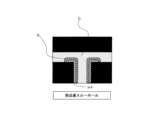
- FIG. 2C is a schematic diagram showing an example in which a curing reaction proceeds under anaerobic conditions at a site where the curable composition has entered a through-hole on the back of the component.
- FIG. 2D is a schematic diagram showing an example of a site where a curing reaction by ultraviolet light and a curing reaction in an anaerobic condition progress after the curable composition is applied to the surface of the BGA array.
- FIG. 3 is a schematic diagram showing a method of an insulation resistance evaluation test.
- the curable composition according to the present invention is primarily used to coat (cover) components of electronic circuits or electric circuits. Thereafter, for example, the curable composition is cured and used to cover the above-mentioned components with a cured coating.
- the curable composition of the present embodiment is The composition contains a urethane (meth)acrylate resin, a (meth)acrylic acid alkyl ester, a photopolymerization initiator, an organic peroxide, and an amine compound.
- the curable composition of the present embodiment can be cured not only by irradiation with active energy rays but also under anaerobic conditions, and the cured product of the curable composition can have good electrical insulation properties both in the cured portion cured by the above-mentioned irradiation and in the cured portion that is the non-irradiated portion cured under anaerobic conditions.
- This allows, for example, the back side of a component on a mounting board that cannot be irradiated with active energy rays, or a through-hole portion that is structurally in an anaerobic state, to have sufficient electrical insulation.
- an anaerobic state Even in a portion that is not irradiated with active energy rays and is structurally in an anaerobic state, sufficient electrical insulation can be exhibited by exposing the portion to an anaerobic state.
- the change to an anaerobic state can be achieved, for example, by using an oxygen scavenger during packaging, replacing the surrounding environment with nitrogen gas, or reducing the oxygen gas concentration in the surrounding environment by vacuum treatment.
- the urethane (meth)acrylate resin contained in the curable composition of the present embodiment is not particularly limited as long as it is a polymer compound having a (meth)acryloyl group and a urethane bond in the molecule.
- the urethane (meth)acrylate resin a commercially available product may be used.
- the term "(meth)acrylate” includes both "acrylate” and “methacrylate”. The same is true for "(meth)acrylic”.
- the urethane (meth)acrylate resin contained in the curable composition of this embodiment is, for example, a urethane reaction product of a difunctional or higher isocyanate compound, a diol compound, a hydroxyl group-containing (meth)acrylate, and an aliphatic monol.
- the isocyanate compound is preferably a trifunctional or higher isocyanate compound.
- the isocyanate compound for obtaining the urethane reaction product is not particularly limited as long as it has two or more isocyanate groups (-NCO) in the molecule.
- the isocyanate compound is preferably a compound having three or more isocyanate groups (-NCO) in the molecule, since this allows more hydrophobic groups to be introduced into the molecule of the urethane reaction product.
- the isocyanate compound examples include aromatic polyisocyanate compounds, alicyclic polyisocyanate compounds, and aliphatic polyisocyanate compounds. These isocyanate compounds may have 2, 3, or 4 isocyanate groups in the molecule. As the isocyanate compound, an isocyanate compound that does not contain a benzene ring and does not contain an unsaturated bond is preferable in that the weather resistance of the cured product after curing is improved. These isocyanate compounds may be used alone or in combination of two or more.
- isocyanate compounds include isocyanurates, adducts, and biurets of aliphatic diisocyanates having a total of 6 to 10 carbon atoms.
- the above isocyanate compounds have, for example, three or four isocyanate groups in the molecule. It is preferable that the above isocyanate compounds have neither a benzene ring structure (aromatic ring structure) nor a saturated cycloalkyl structure (a saturated structure in which the ring is composed only of carbon atoms) in the molecule.
- the isocyanurate as the above-mentioned isocyanate compound is, for example, the trimer of the above-mentioned hexamethylene diisocyanate (HMDI), and has three isocyanate groups in the molecule.
- HMDI hexamethylene diisocyanate
- the adduct as the above-mentioned isocyanate compound is, for example, a reaction product between trimethylolpropane and an aliphatic diisocyanate having a total of 6 to 10 carbon atoms (such as the above-mentioned HMDI).
- an adduct has three isocyanate groups in the molecule.
- an adduct obtained by reacting hexamethylene diisocyanate (HMDI) with trimethylolpropane, or an isocyanurate (trimer) of hexamethylene diisocyanate (HMDI) is preferred, since it does not contain a benzene ring and therefore has good weather resistance after curing, and also has good solubility in a diluent when the diluent is coexisted in the urethane reaction.
- the tri- or higher functional isocyanate compound is an isocyanurate (trifunctional) of an aliphatic diisocyanate having a total of 6 to 10 carbon atoms, and more preferably, an isocyanurate (trifunctional) of an aliphatic diisocyanate having a total of 8 carbon atoms.
- the diol compound for obtaining the urethane reaction product may be a branched polyolefin diol, an aliphatic polycarbonate diol, or an aliphatic polyether diol.
- the polyolefin portion in the branched polyolefin diol may have, for example, an unsaturated double bond in the side chain of the branched chain structure.
- the cured product of the curable composition may have better insulation properties.
- the side chain of the branched chain structure is a saturated hydrocarbon, the cured product of the curable composition may have better heat resistance.
- the aliphatic portion (hydrocarbon portion in which carbon atoms are successively bonded) in the aliphatic polycarbonate diol may have 4 or more and 12 or less carbon atoms.
- branched polyolefin diols examples include 1,2-polybutadiene diol and hydrogenated 1,2-polybutadiene diol.
- Examples of the aliphatic polycarbonate diol include aliphatic polycarbonate diols in which the hydrocarbon portion in which carbon atoms are successively bonded is a straight-chain hydrocarbon.
- Examples of the aliphatic polyether diol include polyethylene glycol, polypropylene glycol, and polybutylene glycol.
- the hydroxyl group-containing (meth)acrylate for obtaining the above urethane reaction product has one hydroxyl group and one (meth)acryloyl group in the molecule.
- the hydroxyl group-containing (meth)acrylate is an alkyl ester compound of (meth)acrylic acid, and one hydroxyl group is bonded to any carbon of the alkyl portion.
- the number of carbon atoms in the alkyl portion is preferably 1 to 4.
- the (meth)acryloyl group of the hydroxyl group-containing (meth)acrylate can initiate a polymerization reaction when irradiated with active energy rays.
- the (meth)acryloyl group of the hydroxyl group-containing (meth)acrylate can initiate a polymerization reaction when placed in an anaerobic environment in the presence of an organic peroxide and an amine compound.
- hydroxyl group-containing (meth)acrylates examples include 2-hydroxyethyl (meth)acrylate, 2-hydroxypropyl (meth)acrylate, 3-hydroxypropyl (meth)acrylate, 2-hydroxybutyl (meth)acrylate, and 4-hydroxybutyl (meth)acrylate.
- the hydroxyl group-containing (meth)acrylate is preferably 2-hydroxyethyl (meth)acrylate, since it has better polymerizability when irradiated with active energy rays.
- the aliphatic monol that can be used to obtain the above urethane reaction product is a monohydric alcohol having a total carbon number in the molecule of from 6 to 18.
- the aliphatic monol is a compound having from 6 to 18 carbons in the molecule and having one hydroxyl group.
- the hydrocarbons in the molecules of the aliphatic monol are preferably saturated hydrocarbons. Furthermore, such hydrocarbons are preferably linear.
- the hydroxyl group of the aliphatic monol is preferably bonded to the end of the linear hydrocarbon.
- examples of aliphatic monools include 1-hexanol, 1-heptanol, 1-octanol, 1-nonanol, 1-decanol, 1-undecanol, and 1-dodecanol.
- the curable composition of the present embodiment includes various urethane reaction products.
- the molecular structure of the urethane reaction product is not necessarily limited to one. Therefore, it is not practical to specify the molecular structure of all the compounds contained in the curable composition of the present embodiment. In other words, it is not practical to directly specify the structure or properties of all the compounds contained in the curable composition of the present embodiment.
- the molecular structure of the compound before the urethanization reaction is specified and the product of the urethanization reaction can be fully predicted, it is fully possible to predict the molecular structure of the urethanization reaction product.
- the above urethane reaction product is represented by the general formula in Figure 1.
- the above urethane reaction product usually has a molecular weight of about the same as an oligomer.
- the (meth)acrylic acid alkyl ester contained in the curable composition of the present embodiment is an alkyl ester compound of (meth)acrylic acid.
- the (meth)acrylic acid alkyl ester include monofunctional (meth)acrylic acid alkyl esters having one (meth)acryloyl group in the molecule.
- the (meth)acrylic acid alkyl ester is a compound that can undergo a polymerization reaction when irradiated with active energy rays.
- the (meth)acrylic acid alkyl ester is a compound that can undergo a polymerization reaction when placed in an anaerobic environment in the presence of an organic peroxide and an amine compound.
- Examples of the monofunctional (meth)acrylic acid alkyl ester include (meth)acrylic acid alkyl esters having a cyclic hydrocarbon structure in the molecule, and (meth)acrylic acid alkyl esters having a chain hydrocarbon structure in the molecule.
- the cyclic hydrocarbon structure is preferably a saturated hydrocarbon.
- the (meth)acrylic acid alkyl ester preferably has 8 to 15 carbon atoms in the molecule.
- the (meth)acrylic acid alkyl ester preferably does not contain a benzene ring, an ether bond (-CH 2 -O-CH 2 -), an -OH group, or a -COOH group as a polar group in the molecule.
- the cyclic hydrocarbon structure may be a saturated hydrocarbon structure having 4 to 8 carbon atoms without containing a heteroatom.
- the (meth)acrylic acid alkyl ester may be monocyclic, bicyclic, or polycyclic.
- the bicyclic or polycyclic cyclic hydrocarbon structure may share two or more carbon atoms.
- at least one cyclic hydrocarbon structure may be a saturated hydrocarbon structure, for example, all cyclic hydrocarbon structures may be saturated hydrocarbon structures.
- a methyl group or an ethyl group may further be bonded to the carbon of the saturated cyclic hydrocarbon structure.
- examples of (meth)acrylic acid alkyl esters having a cyclic hydrocarbon structure in the molecule include isobornyl (meth)acrylate, dicyclopentadieneoxyethyl (meth)acrylate, dicyclopentanyl (meth)acrylate, dicyclopentenyloxyethyl (meth)acrylate, and adamantyl (meth)acrylate.
- the curable composition contains the (meth)acrylic acid alkyl ester having a cyclic hydrocarbon structure in the molecule, the curable composition can provide a cured product having more sufficient moisture resistance and more sufficient electrical insulation.
- the chain hydrocarbon structure may be a linear hydrocarbon structure or a branched chain hydrocarbon structure.
- the number of carbon atoms in the chain hydrocarbon structure may be 6 or more and 18 or less.
- the chain hydrocarbon structure is preferably a saturated chain hydrocarbon structure.
- the above-mentioned (meth)acrylic acid alkyl ester having a chain hydrocarbon structure in the molecule preferably does not contain any of a benzene ring, an ether bond (-CH 2 -O-CH 2 -), an -OH group, a -COOH group, etc.
- the chain hydrocarbon structure is preferably a saturated chain hydrocarbon structure containing no atoms other than C and H and composed of 6 to 18 carbon atoms.
- the chain hydrocarbon structure may be a straight chain or a branched chain, in other words, the chain hydrocarbon structure may be a straight chain or a branched chain.
- a (meth)acrylic acid alkyl ester having a chain hydrocarbon structure in the molecule a (meth)acrylic acid alkyl ester having a saturated branched chain hydrocarbon structure is preferred in that the flexibility of the cured product after the curable composition is cured can be increased. This makes it possible to obtain a more uniform cured product coating without being significantly affected by the substrate supporting the cured product, the thickness of the cured product, or the curing reaction conditions.
- (meth)acrylic acid alkyl esters having a saturated linear hydrocarbon structure in the molecule include n-hexyl (meth)acrylate, n-heptyl (meth)acrylate, n-octyl (meth)acrylate, n-nonyl (meth)acrylate, n-decyl (meth)acrylate, tridecyl (meth)acrylate, lauryl (meth)acrylate, and myristyl (meth)acrylate.
- the hydrocarbon structure of the (meth)acrylic acid alkyl ester having a saturated branched hydrocarbon structure in the molecule may be a saturated branched alkyl structure, and may be an iso structure, a sec structure, a neo structure, or a tert structure.
- examples of (meth)acrylic acid alkyl esters having a saturated branched hydrocarbon structure in the molecule include isoheptyl (meth)acrylate, isooctyl (meth)acrylate, isononyl (meth)acrylate, isodecyl (meth)acrylate, and 2-ethylhexyl (meth)acrylate.
- the above-mentioned monofunctional (meth)acrylic acid alkyl esters may be used alone or in combination of two or more.
- the curable composition of the present embodiment preferably contains, as monofunctional (meth)acrylic acid alkyl esters, both of the above-mentioned (meth)acrylic acid alkyl ester having a cyclic hydrocarbon structure in its molecule (hereinafter may be referred to as a (meth)acrylic acid cyclic alkyl ester) and the above-mentioned (meth)acrylic acid alkyl ester having a chain hydrocarbon structure having 6 or more carbon atoms in its molecule (hereinafter may be referred to as a (meth)acrylic acid chain alkyl ester).
- the mass ratio ( ⁇ / ⁇ ) of the (meth)acrylic acid cyclic alkyl ester ( ⁇ ) to the (meth)acrylic acid chain alkyl ester ( ⁇ ) may be within a predetermined numerical range.
- the mass ratio ( ⁇ / ⁇ ) By increasing the mass ratio ( ⁇ / ⁇ ), the electrical insulation of the cured product can be improved.
- the mass ratio ( ⁇ / ⁇ ) By decreasing the mass ratio ( ⁇ / ⁇ ), the flexibility of the cured product can be improved.
- the photopolymerization initiator contained in the curable composition of the present embodiment is not particularly limited as long as it is a compound that generates radicals by irradiation with active energy rays (ultraviolet rays, etc.).
- the photopolymerization initiator include acetophenone-based polymerization initiators, acylphosphine oxide-based polymerization initiators, o-acyloxime-based polymerization initiators, benzophenone-based polymerization initiators, thioxanthone-based polymerization initiators, and acylphosphine oxide-based polymerization initiators.
- acyl-based photopolymerization initiators containing camphorquinone, or hydrogen abstraction-type photopolymerization initiators such as benzophenone-based polymerization initiators or thioxanthone-based polymerization initiators are preferred.
- the photopolymerization initiator commercially available products can be used.
- the organic peroxide contained in the curable composition of the present embodiment is not particularly limited, and a general organic peroxide is used.
- the organic peroxide is a compound that can generate radicals, and therefore has the effect of promoting the reaction when the curable composition is cured under anaerobic conditions. That is, the organic peroxide is a compound that can promote the progress of each polymerization reaction of the hydroxyl group-containing (meth)acrylate residue in the urethane (meth)acrylate resin and the (meth)acrylic acid alkyl ester.
- organic peroxide an organic peroxide with a 10-hour half-life temperature of 100°C or higher is preferred. This has the advantage of further improving the storage stability of the curable composition.
- organic peroxides include p-menthane hydroperoxide, diisopropylbenzene hydroperoxide, 1,1,3,3-tetramethylbutyl hydroperoxide, cumene hydroperoxide, and t-butyl hydroperoxide.
- the amine compound contained in the curable composition of the present embodiment is not particularly limited, and a general amine compound may be used.
- the amine compound has the effect of promoting the reaction when the curable composition is cured under anaerobic conditions. Furthermore, the amine compound has the effect of promoting the curing reaction of the curable composition by irradiation with active energy rays, particularly for a specific photopolymerization initiator (the above-mentioned hydrogen abstraction type).
- the above amine compounds include, for example, secondary amines or tertiary amines having a specific molecular structure.
- the above amine compounds include, for example, amine compounds having an aromatic ring structure, or amine compounds having a heterocyclic structure.
- the above amine compounds preferably include at least one of a tertiary amine compound having an aromatic ring and a secondary amine compound having a heterocyclic structure.
- the above amine compound more preferably contains dimethylaminobenzoic acid ester or 1,2,3,4-tetrahydroquinoline.
- the mass ratio of the (meth)acrylic acid alkyl ester to the above-mentioned urethane (meth)acrylate resin is preferably 1.0 or more and 5.0 or less. This allows the curable composition to reach the inside of the microstructure as described above, and also allows the cured product to have good flexibility.
- the mass ratio of the organic peroxide to the total amount of the urethane (meth)acrylate resin and the (meth)acrylic acid alkyl ester is preferably 0.005 or more and 0.030 or less.
- the curable composition can be cured more sufficiently.
- the electrical insulation of the cured product can be more reliably ensured.
- the mass ratio of the amine compound to the total amount of the urethane (meth)acrylate resin and the (meth)acrylic acid alkyl ester is preferably 0.005 or more and 0.030 or less.
- the curable composition can be cured more sufficiently, and the electrical insulation of the cured product can be further improved.
- the electrical insulation of the cured product can be more reliably ensured.
- the curable composition of the present embodiment can contain a urethanization reaction catalyst.
- a metal catalyst such as an organotin catalyst such as dibutyltin dilaurate or stannous octoate, or an acetylacetonate complex catalyst can be used.
- the curable composition of the present embodiment may contain, as necessary, a photosensitizer, a reducing agent that contributes to a curing reaction under anaerobic conditions, a polymerization inhibitor, an antioxidant, a dye (fluorescent dye), a pigment, and the like.
- reducing agents include saccharin, metal soaps for paints such as manganese octylate or cobalt octylate which act as auxiliary agents, and organic compounds having ⁇ -hydrogen and unsaturated double bonds (e.g., unsaturated fatty acids and butadiene rubber oligomers).
- the saccharin content is preferably less than 1% by mass (including 0%), and it is more preferable that the curable composition does not contain saccharin.
- the electrical insulation of the cured product can be improved.
- saccharin is a type of sulfonimide
- a lower saccharin content in the cured product is preferable for the following reasons.
- a low saccharin content can suppress the generation of strongly acidic compounds due to hydrolysis of saccharin under high temperature and humidity, for example.
- the generation of corrosive sulfur compounds such as hydrogen sulfide and sulfur dioxide gas due to thermal decomposition of saccharin in a high temperature environment can be suppressed.
- the method for producing the curable composition of the present embodiment includes the steps of:
- the method includes a step of mixing a urethane (meth)acrylate resin, a (meth)acrylic acid alkyl ester, a photopolymerization initiator, an organic peroxide, and an amine compound.
- the method for producing the curable composition of this embodiment may include, for example, a step of synthesizing the above-mentioned urethane (meth)acrylate resin.
- a commercially available product may be used as the above-mentioned urethane (meth)acrylate resin.
- a method for producing the curable composition of the present embodiment includes the steps of: a synthesis step of synthesizing the urethane (meth)acrylate resin; The method includes at least a mixing step of mixing the synthesized urethane (meth)acrylate resin, an alkyl (meth)acrylate ester, a photopolymerization initiator, an organic peroxide, and an amine compound.
- a urethane reaction product is obtained by carrying out a urethane reaction between at least a trifunctional or higher isocyanate compound, a diol compound, and a hydroxyl group-containing (meth)acrylate. Furthermore, the urethane reaction may be carried out in the presence of an aliphatic monool.
- the compounds to be subjected to the urethane reaction are as described above.
- the air in the reaction vessel is usually replaced with nitrogen before the urethane reaction is carried out to prevent unintended reactions caused by moisture (water).
- the urethane reaction is carried out by maintaining a temperature of 50 to 90°C for 0.5 to 3 hours.
- the amounts (charge amounts) of the trifunctional or higher isocyanate compound (a1), the diol compound (a2), the hydroxyl group-containing (meth)acrylate (a3), and the aliphatic monool (a4) used as needed are preferably as follows:
- the urethane reaction it is preferable to carry out the urethane reaction so that the total amount of hydroxy groups (-OH) in the diol compound (a2), the hydroxy group-containing (meth)acrylate (a3), and the aliphatic monol (a4) used as needed is 0.95 mol or more and 1.00 mol or less per mol of isocyanate groups in the tri- or higher functional isocyanate compound (a1).
- the molar ratio of the hydroxyl group of the aliphatic monol (a4) to 1 mole of the isocyanate compound (a1), where n is the number of isocyanate groups in the molecule of the isocyanate compound (a1) having three or more functionalities, is preferably from (n-2) x 0.8 to (n-2) x 1.2.
- the above-mentioned molar ratio is calculated using an arithmetic average value.
- the number of hydroxyl groups (-OH) in the hydroxyl group-containing (meth)acrylate (a3) is 0.5 to 2.0 moles per mole of hydroxyl group (-OH) in the diol compound (a2). This has the advantage that the cured product can have both good electrical insulation and good flexibility.
- the amount of hydroxyl groups (-OH) in the aliphatic monol (a4) is 0.8 moles or more and 1.2 moles or less per mole of hydroxyl groups (-OH) in the diol compound (a2). This has the advantage of improving the flexibility of the cured product.
- the number of moles of the trifunctional isocyanate compound (a1) is greater than the number of moles of the diol compound (a2), and the ratio of the number of moles of the hydroxyl groups in the hydroxyl group-containing (meth)acrylate (a3) to the difference in the number of moles is 2.0 or more and 4.0 or less.
- a urethanization reaction may be carried out in one step in the presence of a tri- or higher functional isocyanate compound (a1), a diol compound (a2), a hydroxyl group-containing (meth)acrylate (a3), and the like.
- the synthesis step is preferably carried out in two stages, that is, a urethanization reaction is carried out in the presence of a tri- or higher functional isocyanate compound (a1) and a diol compound (a2), and then a urethanization reaction is further carried out with a hydroxyl group-containing (meth)acrylate (a3), etc. This makes it possible to more reliably produce a main chain structure formed by the reaction of a tri- or higher functional isocyanate compound with a diol compound.
- the above-mentioned (meth)acrylic acid alkyl ester, photopolymerization initiator, organic peroxide, and amine compound are further added.
- photosensitizers In the mixing process, photosensitizers, polymerization inhibitors, antioxidants, dyes such as fluorescent dyes, pigments, etc. may be further added as necessary.
- the curable composition of the present embodiment can be cured by irradiation with active energy rays such as ultraviolet rays, and can be used as a cured product.
- the curable composition of the present embodiment can be cured by exposure to an anaerobic environment, and can be used as a cured product.
- the curable composition may be applied to the portion to be covered, and then the composition may be cured by irradiating it with light such as ultraviolet light to form a cured coating film.
- a curing reaction may be allowed to proceed under anaerobic conditions.
- the curing reaction of the curable composition may be allowed to proceed by eliminating the influence of oxygen gas using an oxygen scavenger, nitrogen replacement treatment, vacuum treatment, or the like.
- the curable composition of the present embodiment may be cured by both a curing reaction caused by light and a curing reaction in an anaerobic environment, or may be cured by either one of the curing reactions.
- the active energy rays irradiated to promote the curing reaction include, for example, ultraviolet light or infrared light, radiation, electron beams, etc.
- the light to be irradiated is preferably ultraviolet light.
- the light source may be a high-pressure mercury lamp, a metal halide lamp, a xenon lamp, a chemical lamp, an LED lamp, or the like.
- the irradiation intensity may be, for example, 100 W/ cm2 or more and 10,000 mW/ cm2 or less.
- the temperature for promoting the curing reaction in an anaerobic state is preferably 20 to 40°C, and the oxygen concentration is preferably less than 5 mg/L.
- Specific locations that become anaerobic include, for example, the gap between the IC package or mounted components and the printed circuit board, the through-holes in the printed circuit board, the internal electrodes of chip components, locations that are covered with a cured product cured by exposure to light and are not sufficiently exposed to light, or the backside of the lead parts of the IC package.
- the object to be coated with the curable composition includes a metal in part. More specifically, at least a part of the surface of the object to be coated with the curable composition may be formed of a metal. This further promotes the curing of the curable composition.
- the metal is not particularly limited, but examples thereof include copper, silver, iron, titanium, nickel, manganese, cobalt, tin, and lead.
- the metal may include a plurality of the above types of metals. If a metal is present on the surface to be coated, the curing of the curable composition will proceed relatively quickly when the surface is in an anaerobic state. Even in areas away from the metal, the curing reaction will eventually proceed and a cured product will be formed. The resulting cured product is not liquid, so it will not leak unintentionally when subjected to pressure.
- the object to be coated with the curable composition is mainly a component of an electric circuit or an electronic circuit.
- the object to be coated examples include a substrate, a mounted component, a connection between a mounted component and a substrate, and a connection between substrates.
- the objects to be coated include wiring and terminals on mounting boards or mounted components used in precision instruments, wiring and terminals on mounting boards installed in automobiles, bicycles, trains, aircraft, ships, etc., wiring and terminals on mounting boards used in mobile devices (mobile phones, digital cameras, digital video cameras, etc.), wiring and terminals of boards used in outdoor equipment (water heaters, air conditioner outdoor units, etc.), and wiring and terminals on mounting boards used in wet equipment such as washing machines, warm-water cleaning toilet seats, dishwashers, etc.
- the curing reaction of the above-mentioned curable composition proceeds in the part (indicated by U) irradiated with active energy rays (such as ultraviolet rays).
- active energy rays such as ultraviolet rays
- the curing reaction of the above-mentioned curable composition proceeds under anaerobic conditions, particularly in the part (indicated by K) close to the metal (indicated by m1).
- the curing reaction also proceeds and solidifies in the part (indicated by G) that is not reached by the active energy rays and is far from the metal.
- the curable composition when the above-mentioned curable composition is applied to a part of the surface of a chip component having ceramics (s), a protective film (h), an internal electrode (m2), an external electrode (m3), and a solder (m4), the curable composition proceeds with the curing reaction triggered by the irradiation in the part (indicated by U) irradiated with active energy rays (such as ultraviolet rays). In the part that can become anaerobic even without the active energy rays, the curable composition proceeds with the curing reaction under anaerobic conditions, particularly in the part (indicated by K) close to the metal (indicated by m2, m3, m4).
- active energy rays such as ultraviolet rays
- the curing reaction also proceeds and solidifies in the part (indicated by G) away from the metal where the active energy rays do not reach.
- the curing reaction of the curable composition proceeds under anaerobic conditions, particularly in a portion (indicated by K) close to the metal (indicated by m4).
- the curing reaction also proceeds and solidifies in a portion (indicated by G) away from the metal.
- the curing reaction of the above-mentioned curable composition proceeds in response to irradiation of active energy rays (such as ultraviolet rays) in the part (indicated by U).
- active energy rays such as ultraviolet rays
- the curing reaction proceeds and the composition solidifies.
- the curable composition, the cured product, and the method for producing the curable composition of the present embodiment are as exemplified above, but the present invention is not limited to the above-exemplified curable compositions. That is, various forms used in general curable compositions and the like can be adopted as long as they do not impair the effects of the present invention.
- a curable composition for coating comprising a urethane (meth)acrylate resin, a (meth)acrylic acid alkyl ester, a photopolymerization initiator, an organic peroxide, and an amine compound.
- the urethane (meth)acrylate resin is a urethane reaction product of at least a tri- or higher functional isocyanate compound, a diol compound, and a hydroxyl group-containing (meth)acrylate.
- the diol compound includes at least one of a branched polyolefin diol and an aliphatic polycarbonate diol.
- the urethane (meth)acrylate resin is a urethane reaction product of at least the isocyanate compound, the diol compound, the hydroxyl group-containing (meth)acrylate, and an aliphatic monol.
- a method for producing a curable composition for coating comprising the step of mixing a urethane (meth)acrylate resin, an alkyl (meth)acrylate ester, a photopolymerization initiator, an organic peroxide, and an amine compound.
- a urethane (meth)acrylate resin was synthesized as follows, and then (B) an alkyl (meth)acrylate ester, (C) a photopolymerization initiator, (D) an organic peroxide, (E) an amine compound, etc. were mixed to produce a curable composition.
- Trifunctional or higher isocyanate compound Isocyanurate derivative of hexamethylene diisocyanate (HMDI)
- HMDI hexamethylene diisocyanate
- Diol compound Aliphatic polycarbonate diol (Product name: "ETERNACOLL PH-50" manufactured by UBE) Hydroxyl value: 224 [KOHmg/g] ⁇ Branched polyolefin diol (polybutadiene diol) (Product name: "G-1000” manufactured by Nippon Soda) Hydroxyl value: 76 [KOHmg/g] (a3) Hydroxy group-containing (meth)acrylate, 2-hydroxyethyl acrylate (HEA, commercially available product, containing 300 ppm MEHQ) (a4) Aliphatic monool 1-octanol (Oc-OH) 1-d
- Photopolymerization initiator 4-benzoyl-4'-methyldiphenyl sulfide (BMS) (Product name: Omnirad BMS, manufactured by IGM RESINS) Benzophenone-based (hydrogen abstraction type) polymerization initiator, 2,4-diethylthioxanthone (DETX) (Product name: "KAYACURE DETX-S” manufactured by Nippon Kayaku Co., Ltd.) Thioxanthone-based (hydrogen abstraction type) polymerization initiator, ( ⁇ )-camphorquinone (CQN) Bis(2,4,6-trimethylbenzoyl)phenylphosphine oxide (BTPO) (product name "Omnirad 819" manufactured by IGM RESINS) Acylphosphine oxide polymerization initiator 2,4,6-trimethylbenzoyl-diphenylphosphine oxide (TPO) (Product name: "Omnirad
- composition of Synthesis Example 1 is such that the average value of n in Figure 1 is 2.
- compositions of Synthesis Examples 2 to 4 are such that the average value of n in Figure 1 is 1.
- the mixing step was carried out by adding and mixing the above-mentioned raw materials (B) to (F) to the composition after each synthesis step in the blending amounts shown in Tables 2 to 6.
- Tables 2 and 3 show blending compositions mainly for investigating the effect of each of the above-mentioned components (D) to (F) on curing under anaerobic conditions.
- the amount of each of the urethane (meth)acrylate resins (A-1) to (A-4) is based on the total amount of each raw material used when synthesizing the respective urethane (meth)acrylate resins.
- the curable compositions produced in the test examples, examples, and comparative examples were evaluated as described below.
- the electrical insulation resistance of the cured products (cured films) produced by curing each of the curable compositions produced was measured.
- a JIS II type comb-shaped substrate (copper thickness 35 ⁇ m, rectangular shape) was prepared, the back surface of which was covered with a polyimide film adhesive tape (Nitto Denko No. 360UL, tape thickness m 0.06).
- Two sheets of polyester tape (Nitto Denko N-300, tape thickness 0.10) cut to a width of 3 mm were attached to the surface along the three sides (three sides excluding the one side on which the terminals were arranged) of this comb-shaped substrate.
- Such a tape is for preventing the composition from flowing off and for allowing the composition to be cured at a predetermined thickness (for spacer).
- each curable composition was applied to one side of the comb-shaped substrate (copper thickness 35 ⁇ m) to a thickness of 200 ⁇ m.
- Two such samples were prepared. Thereafter, one of the samples was irradiated with ultraviolet light from a 500 W metal halide lamp so that the integrated light amount was a light intensity of 3000 mJ/cm 2 (light-irradiated cured sample). The other sample was left to stand under the anaerobic conditions described below and cured in an anaerobic state.
- a glass epoxy substrate (one side entirely covered with the polyimide film adhesive tape) was prepared so as to be able to block ultraviolet rays.
- the coated portion of each sample (the surface coated with each curable composition) was placed opposite the glass epoxy substrate on which the adhesive tape was not attached, and the curable composition of each sample was placed in an anaerobic state.
- the comb-shaped substrate and the glass epoxy substrate were sandwiched between two binder clips so that the substrate was subjected to a compressive force in the thickness direction. In this way, the anaerobic state was continued for 30 days, and a curing process was performed in an anaerobic state (anaerobic cured sample).
- Evaluation 1-1 Anaerobic cured sample/substrate internal insulation resistance value [ ⁇ ] (after 4 hours)
- Evaluation 1-2 Anaerobic cured sample/substrate internal insulation resistance value [ ⁇ ] (after 7 days)
- Evaluation 1-3 Anaerobic cured sample/substrate internal insulation resistance value [ ⁇ ] (after 1 month)
- Evaluation 1-a Anaerobic cured sample/curing property of part away from copper wiring (after 1 month) (The part surrounded by the dashed line in the schematic diagram at the bottom of FIG.
- Evaluation 2 Surface insulation resistance value of cured sample/substrate exposed to light [ ⁇ ]
- Evaluation 3 Stability over time of the curable composition (liquid) 50 g of the curable composition was placed in a 250 mL light-shielding plastic bottle and left at room temperature. The number of days until solidification was examined.
- ⁇ Glass transition temperature (Tg)> The glass transition points of the cured products were measured for the UV-irradiated portions in Examples 1 and 5 to 7. The results are shown in Table 4. The glass transition points were measured using a dynamic viscoelasticity measuring device in a tensile mode, with a vibration frequency of 1 Hz and a temperature rise rate of 5° C./min, and by reading the maximum value of tan ⁇ .
- ⁇ Storage modulus> The storage modulus of the cured products at 25° C. was measured for the UV-irradiated areas in Examples 1 and 5 to 7. The results are shown in Table 4. The storage modulus was measured using a dynamic viscoelasticity measuring device in a tensile mode, at a temperature rise rate of 5° C./min and a vibration frequency of 1 Hz.
- the cured products of the curable compositions of Examples 1 and 5 to 7 had appropriate flexibility.
- Conventional curable compositions for adhesive applications have relatively hard cured products after curing, so if they are used for electrical insulation applications in the electrical and electronic fields and are repeatedly exposed to high and low temperatures, the cured products may crack due to stress caused by repeated expansion and contraction. For example, wiring containing the cured product may break, or the cured product itself may crack. Therefore, if a conventional curable composition for adhesive applications is simply applied to electrical insulation applications, it is expected that the reliability of the product will be impaired in terms of insulation reliability.
- the curable composition of the present invention (composition for curing) is used, for example, by being applied to circuit components constituting electronic circuits, electric circuits, etc., in order to cover at least a portion of the surface of the object to be coated with a cured product. It is then cured by exposure to light or under anaerobic conditions, and the cured product adheres to the object to be coated and is suitable for use.
- the curable composition of the present invention is suitable for use, for example, as a curable composition for insulating coatings.
Landscapes
- Chemical & Material Sciences (AREA)
- Organic Chemistry (AREA)
- Life Sciences & Earth Sciences (AREA)
- Engineering & Computer Science (AREA)
- Materials Engineering (AREA)
- Wood Science & Technology (AREA)
- Health & Medical Sciences (AREA)
- Chemical Kinetics & Catalysis (AREA)
- Medicinal Chemistry (AREA)
- Polymers & Plastics (AREA)
- Macromonomer-Based Addition Polymer (AREA)
Priority Applications (3)
| Application Number | Priority Date | Filing Date | Title |
|---|---|---|---|
| JP2025511109A JPWO2024204487A1 (https=) | 2023-03-30 | 2024-03-28 | |
| KR1020257034974A KR20250169219A (ko) | 2023-03-30 | 2024-03-28 | 코팅용 경화성 조성물, 및 그의 경화물 |
| CN202480021303.3A CN120858151A (zh) | 2023-03-30 | 2024-03-28 | 涂布用固化性组合物及其固化物 |
Applications Claiming Priority (2)
| Application Number | Priority Date | Filing Date | Title |
|---|---|---|---|
| JP2023055571 | 2023-03-30 | ||
| JP2023-055571 | 2023-03-30 |
Publications (1)
| Publication Number | Publication Date |
|---|---|
| WO2024204487A1 true WO2024204487A1 (ja) | 2024-10-03 |
Family
ID=92905804
Family Applications (1)
| Application Number | Title | Priority Date | Filing Date |
|---|---|---|---|
| PCT/JP2024/012547 Ceased WO2024204487A1 (ja) | 2023-03-30 | 2024-03-28 | コーティング用硬化性組成物、及び、その硬化物 |
Country Status (4)
| Country | Link |
|---|---|
| JP (1) | JPWO2024204487A1 (https=) |
| KR (1) | KR20250169219A (https=) |
| CN (1) | CN120858151A (https=) |
| WO (1) | WO2024204487A1 (https=) |
Citations (4)
| Publication number | Priority date | Publication date | Assignee | Title |
|---|---|---|---|---|
| JP2003137953A (ja) * | 2001-11-02 | 2003-05-14 | Daicel Ucb Co Ltd | ウレタン(メタ)アクリレート及びそれを含む活性エネルギー線硬化型ウレタン(メタ)アクリレート組成物 |
| JP2005133050A (ja) * | 2003-10-29 | 2005-05-26 | Hitachi Kasei Polymer Co Ltd | 活性エネルギー線硬化型樹脂組成物 |
| JP2011514393A (ja) * | 2008-01-28 | 2011-05-06 | ビーエーエスエフ ソシエタス・ヨーロピア | ラジカル硬化性配合物のレドックス硬化のための光潜在性アミジン塩基 |
| JP2017057251A (ja) * | 2015-09-15 | 2017-03-23 | 株式会社昭和インク工業所 | ウレタン(メタ)アクリレートの製造方法 |
Family Cites Families (1)
| Publication number | Priority date | Publication date | Assignee | Title |
|---|---|---|---|---|
| JP6902198B2 (ja) | 2016-06-01 | 2021-07-14 | 株式会社スリーボンド | 嫌気硬化性組成物 |
-
2024
- 2024-03-28 WO PCT/JP2024/012547 patent/WO2024204487A1/ja not_active Ceased
- 2024-03-28 KR KR1020257034974A patent/KR20250169219A/ko active Pending
- 2024-03-28 CN CN202480021303.3A patent/CN120858151A/zh active Pending
- 2024-03-28 JP JP2025511109A patent/JPWO2024204487A1/ja active Pending
Patent Citations (4)
| Publication number | Priority date | Publication date | Assignee | Title |
|---|---|---|---|---|
| JP2003137953A (ja) * | 2001-11-02 | 2003-05-14 | Daicel Ucb Co Ltd | ウレタン(メタ)アクリレート及びそれを含む活性エネルギー線硬化型ウレタン(メタ)アクリレート組成物 |
| JP2005133050A (ja) * | 2003-10-29 | 2005-05-26 | Hitachi Kasei Polymer Co Ltd | 活性エネルギー線硬化型樹脂組成物 |
| JP2011514393A (ja) * | 2008-01-28 | 2011-05-06 | ビーエーエスエフ ソシエタス・ヨーロピア | ラジカル硬化性配合物のレドックス硬化のための光潜在性アミジン塩基 |
| JP2017057251A (ja) * | 2015-09-15 | 2017-03-23 | 株式会社昭和インク工業所 | ウレタン(メタ)アクリレートの製造方法 |
Also Published As
| Publication number | Publication date |
|---|---|
| KR20250169219A (ko) | 2025-12-02 |
| JPWO2024204487A1 (https=) | 2024-10-03 |
| CN120858151A (zh) | 2025-10-28 |
Similar Documents
| Publication | Publication Date | Title |
|---|---|---|
| KR100910184B1 (ko) | (메타)아크릴 변성 우레탄 폴리머의 합성방법, 그 합성물 및 그 합성물을 이용한 자외선 경화형 방습 접착제 조성물 | |
| WO2012090298A1 (ja) | 光硬化性樹脂組成物、保護コーティング剤、硬化膜、並びに液晶ディスプレイモジュール及びその製造法 | |
| JP7375299B2 (ja) | 硬化性イミド樹脂、硬化性樹脂組成物、硬化性イミド樹脂の製造方法、硬化性樹脂組成物の製造方法、硬化物、及び硬化物の製造方法 | |
| WO2024204487A1 (ja) | コーティング用硬化性組成物、及び、その硬化物 | |
| JP5530091B2 (ja) | 電子材料用樹脂組成物 | |
| US7851124B2 (en) | Composition for forming wiring protective film and uses thereof | |
| JP2017114977A (ja) | 光硬化性樹脂組成物及び防湿絶縁塗料 | |
| WO2019193966A1 (ja) | 硬化性組成物、液晶用シール剤、液晶パネル、及び液晶パネルの製造方法 | |
| JP2025179914A (ja) | 回路保護用硬化性組成物、その硬化物、及び、制御部品 | |
| US20040247908A1 (en) | Composition for forming wiring protective film and uses thereof | |
| WO2022138184A1 (ja) | 活性エネルギー線硬化性樹脂組成物、硬化物、絶縁材料及びレジスト部材 | |
| KR102935375B1 (ko) | 경화성 조성물 | |
| JPH0152902B2 (https=) | ||
| US20220073672A1 (en) | Curable compound, curable composition, and method for producing curable composition | |
| KR102795546B1 (ko) | 경화성 조성물 | |
| EP3025778B1 (en) | Reaction accelerator and method of producing urethane compound, thiourethane compound, amide compound or urea compound using same | |
| KR102908744B1 (ko) | 경화성 화합물, 경화성 조성물, 및 경화성 조성물의 제조 방법 | |
| TWI893168B (zh) | 硬化性化合物、硬化性組成物、及硬化性組成物的製造方法 | |
| WO2025126839A1 (ja) | 樹脂組成物、接着剤、封止材、硬化物、半導体装置及び電子部品 | |
| JPH0242371B2 (https=) | ||
| WO2020145328A1 (ja) | 硬化性組成物 | |
| CN114058321A (zh) | 显示器用封装剂 | |
| JP2024116994A (ja) | 酸基及び重合性不飽和基含有樹脂、硬化性樹脂組成物、ソルダーレジスト用樹脂材料、硬化物、絶縁材料及びレジスト部材 | |
| CN120020193A (zh) | 液晶滴注法用液晶密封剂和使用该液晶密封剂的液晶显示面板 |
Legal Events
| Date | Code | Title | Description |
|---|---|---|---|
| 121 | Ep: the epo has been informed by wipo that ep was designated in this application |
Ref document number: 24780588 Country of ref document: EP Kind code of ref document: A1 |
|
| ENP | Entry into the national phase |
Ref document number: 2025511109 Country of ref document: JP Kind code of ref document: A |
|
| WWE | Wipo information: entry into national phase |
Ref document number: 2025511109 Country of ref document: JP |
|
| WWE | Wipo information: entry into national phase |
Ref document number: 202480021303.3 Country of ref document: CN |
|
| ENP | Entry into the national phase |
Ref document number: 1020257034974 Country of ref document: KR Free format text: ST27 STATUS EVENT CODE: A-0-1-A10-A15-NAP-PA0105 (AS PROVIDED BY THE NATIONAL OFFICE) |
|
| WWE | Wipo information: entry into national phase |
Ref document number: KR1020257034974 Country of ref document: KR |
|
| WWP | Wipo information: published in national office |
Ref document number: 202480021303.3 Country of ref document: CN |
|
| NENP | Non-entry into the national phase |
Ref country code: DE |
|
| 122 | Ep: pct application non-entry in european phase |
Ref document number: 24780588 Country of ref document: EP Kind code of ref document: A1 |