WO2024204409A1 - グルテン改質剤、穀粉生地 - Google Patents
グルテン改質剤、穀粉生地 Download PDFInfo
- Publication number
- WO2024204409A1 WO2024204409A1 PCT/JP2024/012373 JP2024012373W WO2024204409A1 WO 2024204409 A1 WO2024204409 A1 WO 2024204409A1 JP 2024012373 W JP2024012373 W JP 2024012373W WO 2024204409 A1 WO2024204409 A1 WO 2024204409A1
- Authority
- WO
- WIPO (PCT)
- Prior art keywords
- gluten
- flour
- bread
- modifier
- lutein
- Prior art date
- Legal status (The legal status is an assumption and is not a legal conclusion. Google has not performed a legal analysis and makes no representation as to the accuracy of the status listed.)
- Ceased
Links
Classifications
-
- A—HUMAN NECESSITIES
- A21—BAKING; EDIBLE DOUGHS
- A21D—TREATMENT OF FLOUR OR DOUGH FOR BAKING, e.g. BY ADDITION OF MATERIALS; BAKING; BAKERY PRODUCTS
- A21D10/00—Batters, dough or mixtures before baking
-
- A—HUMAN NECESSITIES
- A21—BAKING; EDIBLE DOUGHS
- A21D—TREATMENT OF FLOUR OR DOUGH FOR BAKING, e.g. BY ADDITION OF MATERIALS; BAKING; BAKERY PRODUCTS
- A21D13/00—Finished or partly finished bakery products
-
- A—HUMAN NECESSITIES
- A21—BAKING; EDIBLE DOUGHS
- A21D—TREATMENT OF FLOUR OR DOUGH FOR BAKING, e.g. BY ADDITION OF MATERIALS; BAKING; BAKERY PRODUCTS
- A21D13/00—Finished or partly finished bakery products
- A21D13/80—Pastry not otherwise provided for elsewhere, e.g. cakes, biscuits or cookies
-
- A—HUMAN NECESSITIES
- A21—BAKING; EDIBLE DOUGHS
- A21D—TREATMENT OF FLOUR OR DOUGH FOR BAKING, e.g. BY ADDITION OF MATERIALS; BAKING; BAKERY PRODUCTS
- A21D2/00—Treatment of flour or dough by adding materials thereto before or during baking
- A21D2/08—Treatment of flour or dough by adding materials thereto before or during baking by adding organic substances
- A21D2/14—Organic oxygen compounds
-
- A—HUMAN NECESSITIES
- A21—BAKING; EDIBLE DOUGHS
- A21D—TREATMENT OF FLOUR OR DOUGH FOR BAKING, e.g. BY ADDITION OF MATERIALS; BAKING; BAKERY PRODUCTS
- A21D2/00—Treatment of flour or dough by adding materials thereto before or during baking
- A21D2/08—Treatment of flour or dough by adding materials thereto before or during baking by adding organic substances
- A21D2/14—Organic oxygen compounds
- A21D2/18—Carbohydrates
- A21D2/181—Sugars or sugar alcohols
-
- A—HUMAN NECESSITIES
- A21—BAKING; EDIBLE DOUGHS
- A21D—TREATMENT OF FLOUR OR DOUGH FOR BAKING, e.g. BY ADDITION OF MATERIALS; BAKING; BAKERY PRODUCTS
- A21D2/00—Treatment of flour or dough by adding materials thereto before or during baking
- A21D2/08—Treatment of flour or dough by adding materials thereto before or during baking by adding organic substances
- A21D2/24—Organic nitrogen compounds
- A21D2/26—Proteins
-
- A—HUMAN NECESSITIES
- A21—BAKING; EDIBLE DOUGHS
- A21D—TREATMENT OF FLOUR OR DOUGH FOR BAKING, e.g. BY ADDITION OF MATERIALS; BAKING; BAKERY PRODUCTS
- A21D2/00—Treatment of flour or dough by adding materials thereto before or during baking
- A21D2/08—Treatment of flour or dough by adding materials thereto before or during baking by adding organic substances
- A21D2/36—Vegetable material
-
- A—HUMAN NECESSITIES
- A23—FOODS OR FOODSTUFFS; TREATMENT THEREOF, NOT COVERED BY OTHER CLASSES
- A23G—COCOA; COCOA PRODUCTS, e.g. CHOCOLATE; SUBSTITUTES FOR COCOA OR COCOA PRODUCTS; CONFECTIONERY; CHEWING GUM; ICE-CREAM; PREPARATION THEREOF
- A23G3/00—Sweetmeats; Confectionery; Marzipan; Coated or filled products
- A23G3/34—Sweetmeats, confectionery or marzipan; Processes for the preparation thereof
- A23G3/36—Sweetmeats, confectionery or marzipan; Processes for the preparation thereof characterised by the composition containing organic or inorganic compounds
-
- A—HUMAN NECESSITIES
- A23—FOODS OR FOODSTUFFS; TREATMENT THEREOF, NOT COVERED BY OTHER CLASSES
- A23G—COCOA; COCOA PRODUCTS, e.g. CHOCOLATE; SUBSTITUTES FOR COCOA OR COCOA PRODUCTS; CONFECTIONERY; CHEWING GUM; ICE-CREAM; PREPARATION THEREOF
- A23G3/00—Sweetmeats; Confectionery; Marzipan; Coated or filled products
- A23G3/34—Sweetmeats, confectionery or marzipan; Processes for the preparation thereof
- A23G3/36—Sweetmeats, confectionery or marzipan; Processes for the preparation thereof characterised by the composition containing organic or inorganic compounds
- A23G3/44—Sweetmeats, confectionery or marzipan; Processes for the preparation thereof characterised by the composition containing organic or inorganic compounds containing peptides or proteins
-
- A—HUMAN NECESSITIES
- A23—FOODS OR FOODSTUFFS; TREATMENT THEREOF, NOT COVERED BY OTHER CLASSES
- A23G—COCOA; COCOA PRODUCTS, e.g. CHOCOLATE; SUBSTITUTES FOR COCOA OR COCOA PRODUCTS; CONFECTIONERY; CHEWING GUM; ICE-CREAM; PREPARATION THEREOF
- A23G3/00—Sweetmeats; Confectionery; Marzipan; Coated or filled products
- A23G3/34—Sweetmeats, confectionery or marzipan; Processes for the preparation thereof
- A23G3/36—Sweetmeats, confectionery or marzipan; Processes for the preparation thereof characterised by the composition containing organic or inorganic compounds
- A23G3/48—Sweetmeats, confectionery or marzipan; Processes for the preparation thereof characterised by the composition containing organic or inorganic compounds containing plants or parts thereof, e.g. fruits, seeds, extracts
Definitions
- the present invention relates to a gluten modifier that can be incorporated into gluten-containing flour dough to modify the gluten and improve the extensibility and elasticity of the flour dough.
- Foods produced by heating flour dough are obtained through a common manufacturing process in which wheat flour or other flour is mixed with water and other ingredients.
- the gluten contained in flour dough is formed by the binding of two types of proteins, gliadin and glutenin, during the mixing process.
- Gluten formation affects the physical properties of flour dough, and insufficient gluten formation reduces the extensibility and elasticity of the flour dough, resulting in a decrease in the quality of foods obtained by heating the flour dough. For this reason, flour dough with excellent extensibility and elasticity is desired by modifying the gluten.
- Patent Document 1 a bread-making oil-and-fat composition in which monoglyceride and diacetyl tartaric acid monoglyceride are blended with oils and fats has been proposed.
- the Japanese are a nation whose staple food is rice, and rice that has a chewy texture and allows you to enjoy the original taste of rice is considered to be good.
- rice that has a chewy texture and allows you to enjoy the original taste of flour.
- Bread has a fermented smell because it is made by fermenting flour with yeast and then baking it. The fermented smell can be considered the flavor of the bread itself, but it can also make it difficult to detect the original flavor of the flour.
- the starch and proteins contained in the flour have a large effect on the texture of the bread.
- the starch By increasing the amount of water added during bread production, the starch is alpha-converted by heating, resulting in a chewy texture, but the starch particles also bond more strongly, resulting in a denser bread and less crisp. Furthermore, the proteins contained in the grain flour bind together to form gluten during the mixing process during bread production, and if gluten formation is promoted by intensifying the mixing, a chewy bread is obtained, but the bread is difficult to bite through and less crisp. Conversely, if gluten formation is suppressed, a bread with a crisp texture that is easy to bite through is obtained, but the texture is not elastic and the chewiness is reduced.
- Patent Document 2 proposes an emulsified oil composition for bread making containing dextrin having a DE of 2 to 9 in the water phase, and describes a method for obtaining bread with a chewy texture and good flavor without using an emulsifier.
- Patent Document 4 an oil and fat composition containing diglycerol mono-fatty acid ester, monoglycerol mono-fatty acid ester, and propylene glycol mono-fatty acid ester is used.
- cakes produced by adding and mixing whipped eggs and flour and heating include sponge cakes, snack cakes, butter cakes, chiffon cakes, and roll cakes.
- Cakes that are moist, melt in the mouth, and have improved volume are preferred.
- the baking temperature is set low to retain moisture inside the cake, but this reduces the volume of the cake and makes it sticky and difficult to melt in the mouth.
- the volume and melt in the mouth can be improved, but the moistness decreases and the texture becomes dry.
- Patent Document 5 As a method for imparting a moist texture to cakes, a water-in-oil type emulsion composition for kneading, which contains fresh cream in a specific oil and fat, has been proposed (Patent Document 5). As a method for obtaining a butter cake that melts easily in the mouth and has increased volume, a fat and oil composition for butter cake containing maltose-producing ⁇ -amylase, hemicellulase and phospholipase has been proposed (Patent Document 6).
- Patent Document 1 describes that the extensibility of the flour dough is improved by the action of an emulsifier such as diacetyl tartaric acid monoglyceride, the effect is not sufficient, and the elasticity improvement effect is also not sufficient.
- an emulsifier such as diacetyl tartaric acid monoglyceride
- Patent Document 2 produces bread with a chewy texture, but the bread is not crisp and does not have the original flavor of the flour.
- Patent Document 3 also produces bread with a chewy texture that prevents flavor deterioration caused by emulsifiers, but the bread is not crisp and does not have the original flavor of the flour, and the method of Patent Document 4 improves the crispness and ease of eating of the bread, but does not produce the desired chewy texture, and does not have the effect of improving the flavor of the bread.
- Patent Document 5 produces cakes with a moist texture, but the effects of improving melt-in-the-mouth texture and volume are insufficient and unsatisfactory.
- Patent Document 6 improves melt-in-the-mouth texture, but does not have the effect of improving moistness.
- the first object of the present invention is to provide a gluten modifier that can be incorporated into gluten-containing flour dough to modify the gluten and improve the elasticity and extensibility of the flour dough.
- the second object of the present invention is to provide a gluten modifier for bread making that contains lutein and that can produce bread with a good flavor that is chewy, crisp, and has the original flavor of grain flour.
- the third object of the present invention is to provide a gluten modifier for confectionery that can stably produce cakes that are moist, melt in the mouth, and have increased volume.
- the inventors discovered that the carotenoid lutein modifies gluten in gluten-containing flour dough, improving the extensibility and elasticity of the flour dough.
- the inventors also discovered that the carotenoid lutein modifies gluten in gluten-containing cereal flour dough, resulting in bread that is chewy, crisp, and has an improved original flour flavor.
- the inventors also discovered that the carotenoid lutein modifies gluten in gluten-containing cereal flour dough, enabling the stable production of cakes that are moist, melt in the mouth, and have increased volume.
- the present invention relates to the following [1] to [7].
- a gluten modifier comprising lutein.
- the gluten modifier according to [1] characterized in that it contains fats and/or liquid sugar.
- the gluten modifier according to [1] or [2] characterized in that it is used for bread making (hereinafter also referred to as "gluten modifier for bread making”).
- the gluten modifier according to [1] or [2] characterized in that it is for use in confectionery (hereinafter also referred to as "gluten modifier for confectionery”).
- a flour dough comprising gluten and the gluten modifier according to [1] or [2], and characterized in that the lutein content is 0.2 to 20 parts by mass per 1,000,000 parts by mass of the gluten.
- the present invention provides a gluten modifier that can be added to flour dough containing gluten to modify the gluten and improve the elasticity and extensibility of the flour dough.
- the present invention also provides a gluten modifier for bread making that contains lutein and that, when added to gluten-containing cereal flour dough, modifies the gluten to produce bread with improved chewiness, crispness, and flavor.
- chewiness refers to a small amount of stress reduction when bread is continuously compressed at a certain strain rate for a certain period of time
- good crispness refers to a small stress value required to break the bread. Both the chewiness and crispness can be felt as textures when the bread is eaten.
- the gluten modifier for confectionery of the present invention when it is added to a cereal flour dough containing gluten, the lutein modifies the gluten. This makes it possible to provide a gluten modifier for confectionery that can stably produce cakes that are moist, melt in the mouth, and have increased volume.
- the gluten modifier of the present invention is characterized by containing lutein, and when added to flour dough containing gluten, it modifies the gluten and improves the elasticity and extensibility of the flour dough.
- the gluten modifier for bread making of the present invention is characterized by containing lutein, and when added to gluten-containing cereal flour dough for bread making, it modifies the gluten, resulting in bread that is chewy, crisp, and has improved flavor.
- bread making means producing bread by baking cereal flour dough containing cereal flour, yeast, and water, and bread making means the ingredients that are added when making bread.
- the gluten modifier for confectionery of the present invention is characterized by containing lutein, and by blending it with gluten-containing cereal flour dough for confectionery, the lutein modifies the gluten, allowing cakes to be steadily produced that are moist, melt in the mouth, and have increased volume.
- confectionery refers to the production of cakes by baking a cereal flour dough containing whole eggs or egg whites and cereal flour and having a dough density of 0.25 to 0.9 g/ml
- confectionery refers to the raw materials blended when producing cakes.
- the gluten modifier, bread-making gluten modifier, and confectionery-making gluten modifier of the present invention will be described in detail below.
- Lutein is a type of carotenoid pigment, and is known to be a beneficial component for protecting the eyes against light by absorbing high-energy light entering the eye and removing active oxygen generated by light through localization in the macula of the retina in the living body.
- the gluten modifier in the present invention contains at least one of free lutein and esterified lutein. By blending and mixing lutein with gluten-containing flour dough, lutein binds to the gluten to modify the gluten, thereby improving the extensibility and elasticity of the flour dough. It has not been known that lutein, which is a pigment, has such a gluten modifying effect, and the present invention has discovered a new effect that cannot be expected from conventional techniques.
- lutein when added to bread flour dough containing gluten, it binds to the gluten by mixing, modifying the gluten and improving the extensibility and elasticity of the bread flour dough, resulting in bread that is chewy and crisp. It is also presumed that by modifying the gluten, a uniform air bubble film is formed in the inner phase of the bread, which makes it easier for saliva to mix with the bread when chewed, resulting in bread with an improved flavor in which the original flavor of the flour can be felt. It was not previously known that lutein, a pigment, had such an effect on bread, and the present invention has discovered a new effect that could not have been expected from conventional technology.
- lutein when added to and mixed with gluten-containing confectionery flour dough, it binds to the gluten, and the binding of oil-soluble lutein improves the water retention of gluten, improving the moistness of cakes and inhibiting the formation of covalent bonds in gluten, improving the melt-in-the-mouth quality and volume of cakes. Even if excessive stirring is performed to uniformly disperse the flour, the viscosity of the confectionery flour dough is unlikely to increase due to lutein's effect of inhibiting the formation of covalent bonds in gluten, and there is no adverse effect on the melt-in-the-mouth quality or volume, making it possible to stably produce cakes of consistent quality regardless of the skill of the workers. It was not previously known that lutein, a pigment, has such an effect on cakes, and the present invention has discovered a new effect that could not be expected from conventional technology.
- Lutein can be derived from plants such as kale, parsley, spinach, komatsuna, broccoli, lettuce, and pumpkin skin, or from animals such as chicken eggs, but plant-derived lutein is preferred from the standpoint of lutein content and flavor.
- the gluten modifier, gluten modifier for bread making, and gluten modifier for confectionery of the present invention can be extracted from food materials containing lutein in a manner that does not cause lutein loss, and processed into a paste, dried powder, etc., but is preferably in the form of oil or fat, W/O, O/W, or powder so that it can be uniformly dispersed in gluten-containing cereal flour dough.
- lutein since lutein is oil-soluble, it can be preferably used in a state dissolved in oil or fat.
- the dried powder of the animal or vegetable product can be filtered to obtain a product in which lutein is dissolved in edible oil or fat.
- the moisture content is preferably 10% by mass or less.
- the particle size of the dry powder (D10% particle size, D90% particle size) is preferably 5 ⁇ m or more and 250 ⁇ m or less, which are equivalent to the particle size of the flour, so that the lutein in the dry powder can easily act on the gluten formed in the flour dough.
- the dry powder containing lutein can be used as it is or mixed with wheat starch or the like and diluted to a predetermined concentration to form the gluten modifier, gluten modifier for bread making, and gluten modifier for confectionery of the present invention.
- the method for uniformly dispersing the dry powder containing lutein in liquid sugar there is no particular limitation on the method for uniformly dispersing the dry powder containing lutein in liquid sugar, but for example, a method using a propeller stirrer can be used.
- a propeller stirrer When a propeller stirrer is used, the dry powder containing lutein is added little by little to the liquid sugar heated to 15 to 60°C while stirring it with the propeller stirrer, and the gluten modifier for confectionery of the present invention can be obtained by stirring it for 10 to 30 minutes at a rotation speed of 300 to 700 rpm.
- “D10% particle size" is defined as the particle size at which the cumulative particle frequency percentage on the smaller side is 10% (or 90%) when the particle size distribution of the measurement target is measured on a volume basis.
- the D90% and D10% particle sizes of the dry powder were measured using a laser diffraction particle size distribution analyzer SALD-2100 (manufactured by Shimadzu Corporation) under the condition of a refractive index parameter of 1.60-0.10i.
- the gluten modifiers, gluten modifiers for bread making, and gluten modifiers for confectionery may be lutein that has been processed into a water-soluble form by blending lutein with an emulsifier, polysaccharides, protein, dextrin, etc. and drying to form a powder, and lutein that has been processed into a water-soluble form can be preferably used in a state mixed with liquid sugar, etc.
- an emulsifier may be blended with liquid sugar, etc. to emulsify the oil-soluble lutein and use it as a gluten modifier, gluten modifiers for bread making, and gluten modifiers for confectionery.
- Liquid sugar is liquid sugar or powdered sugar in a solution state.
- monosaccharides such as glucose, manthose, sucrose, lactose, trehalose, maltotriose, tetraose, sorbitol, xylitol, erythritol, and maltitol, disaccharides, trisaccharides, tetrasaccharides, pentasaccharides, and hexasaccharides, starch hydrolysates, and sugar alcohols obtained by reducing these, or liquid mixtures thereof, such as starch syrup, reduced starch syrup, and sugar-mixed glucose-fructose liquid sugar, can also be used.
- monosaccharides such as glucose, manthose, sucrose, lactose, trehalose, maltotriose, tetraose, sorbitol, xylitol, erythritol, and maltitol
- disaccharides trisaccharides, tetrasaccharides, penta
- the viscosity of the liquid sugar used in the present invention is preferably 0.1 to 10,000 mPa ⁇ s or less under 20°C conditions using a B-type viscometer. If the viscosity of the liquid sugar exceeds 10,000 mPa ⁇ s, the dispersibility of the gluten modifier, gluten modifier for bread making, and gluten modifier for confectionery of the present invention in flour dough decreases, and as a result, the dispersibility of lutein in flour dough also decreases, so that the effect of shortening the working time cannot be fully exhibited.
- the liquid sugar content in the gluten modifier, bread gluten modifier, and confectionery gluten modifier of the present invention is appropriately adjusted depending on the content of the raw material containing lutein.
- the lower limit is 20% by mass or more, 30% by mass or more, 40% by mass or more, 50% by mass or more, 60% by mass or more, 70% by mass or more, 80% by mass or more, 90% by mass or more, or 95% by mass or more.
- the average particle size of the lutein-containing oil dispersed in the liquid sugar is preferably 0.01 ⁇ m or more and 1000 ⁇ m or less. More preferably, it is 0.05 ⁇ m or more and 500 ⁇ m or less, and most preferably, it is 0.1 ⁇ m or more and 100 ⁇ m or less. Within this range, the dispersibility of lutein in flour dough is improved, and the effects of the present invention can be more effectively achieved.
- the lutein-containing oil only needs to be dispersed in the liquid sugar, and the dispersion method is not particularly limited, but for example, a propeller mixer or a high-pressure homogenizer can be used.
- a propeller agitator When a propeller agitator is used, the gluten modifier, gluten modifier for bread making, and gluten modifier for confectionery of the present invention can be obtained by gradually adding lutein-containing oil heated to 15 to 60°C to liquid sugar heated to 15 to 60°C while stirring the liquid sugar with a propeller agitator, and stirring for 10 to 30 minutes at a stirring speed of 300 to 700 rpm.
- the gluten modifier, gluten modifier for bread making, and gluten modifier for confectionery of the present invention can be obtained by gradually adding lutein-containing oil heated to 15 to 60°C to liquid sugar heated to 15 to 60°C while stirring the liquid sugar with a propeller agitator, and stirring for 10 to 15 minutes at a stirring speed of 300 to 700 rpm, and then homogenizing the liquid sugar with a high-pressure homogenizer at a pressure of 10 to 30 MPa.
- the average particle size when lutein-containing oil was dispersed in liquid sugar was measured using a laser diffraction/scattering particle size distribution analyzer LA-950 (manufactured by Horiba, Ltd.).
- the viscosity of the gluten modifier measured at 20°C using a B-type viscometer is preferably 0.1 to 10,000 mPa ⁇ s or less, more preferably 100 to 8000 mPa ⁇ s, and even more preferably 500 to 6000 mPa ⁇ s. If the viscosity is within this range, the gluten modifier, gluten modifier for bread making, and gluten modifier for confectionery can be sufficiently dispersed in the flour dough.
- the lutein content in the gluten modifier of the present invention is preferably 0.2 ppm by mass to 400 ppm by mass.
- the lower limit is more preferably 1 ppm by mass or more, and particularly preferably 2 ppm by mass or more.
- the upper limit is more preferably 300 ppm by mass or less, and particularly preferably 200 ppm by mass or less. If the lutein content is within this range, it can be mixed with the gluten in the flour dough in an appropriate amount, and the effects of the present invention can be more effectively achieved.
- the lutein content in the gluten modifier for bread making of the present invention is preferably 2 ppm by mass to 200 ppm by mass.
- the lower limit is more preferably 5 ppm by mass or more, and particularly preferably 10 ppm by mass or more.
- the upper limit is more preferably 150 ppm by mass or less, and particularly preferably 100 ppm by mass or less. If the lutein content is within this range, an appropriate mixing ratio with gluten in the grain flour dough for bread making can be achieved, and the effects of the present invention can be more effectively exhibited.
- the lutein content in the gluten modifier for confectionery of the present invention is preferably 1.5 ppm by mass to 150 ppm by mass.
- the lower limit is more preferably 3 ppm by mass or more, and particularly preferably 5 ppm by mass or more.
- the upper limit is more preferably 130 ppm by mass or less, and particularly preferably 100 ppm by mass or less. If the lutein content is within this range, it can be mixed with the gluten in the grain flour dough for confectionery in an appropriate amount, and the effects of the present invention can be more effectively achieved.
- the gluten modifier used to be incorporated into the gluten-containing flour dough of the present invention is preferably incorporated so that, for example, 0.2 to 20.0 parts by mass of lutein per 1,000,000 parts by mass of gluten. More preferably, it is 0.5 to 15.0 parts by mass, and most preferably, it is 1.5 to 10.0 parts by mass. If it is 0.2 parts by mass or more, the gluten modifying effect of lutein can be fully exerted. Also, if it is 20.0 parts by mass or less, the extensibility and elasticity of the flour dough can be improved in a balanced manner, and the effect of the present invention can be fully exerted.
- the gluten modifier for bread making of the present invention is incorporated into the grain flour dough for bread making, it is preferable to mix it so that 0.2 to 20.0 parts by mass of lutein is mixed per 1,000,000 parts by mass of gluten in the grain flour dough for bread making. More preferably, it is 0.5 to 15.0 parts by mass, and most preferably, it is 1.5 to 10.0 parts by mass. Within this range, the gluten modifying effect of lutein can be fully exerted, and bread with excellent chewiness, crispness, and flavor can be obtained.
- the gluten modifier for confectionery of the present invention is incorporated into the confectionery flour dough, it is preferable to incorporate 0.2 to 20.0 parts by mass of lutein per 1,000,000 parts by mass of gluten in the confectionery flour dough. More preferably, it is 0.5 to 20.0 parts by mass, and most preferably, it is 1.5 to 15.0 parts by mass. Within this range, the gluten modifying effect of lutein can be fully exerted, and cakes with excellent moistness and melt-in-the-mouth texture can be stably produced.
- raw material for lutein As a raw material for lutein, commercially available products include, for example, "Lyc-O-Lutein 20% in Safflower Oil” (imported and sold by Sunbright Co., Ltd.). Raw materials containing lutein may also be used in the form of a paste or dried powder, or commercially available paste or powder products may be used.
- kale powder manufactured by Kodama Foods Co., Ltd.
- parsley powder manufactured by Kodama Foods Co., Ltd.
- komatsuna fine powder manufactured by Mikasa Sangyo Co., Ltd.
- CS parsley Y42 manufactured by S&B Foods Co., Ltd.
- the lutein content in this invention was measured in accordance with the Japanese Agricultural Standards (JAS) 0008:2019.
- the gluten modifier, bread-making gluten modifier, and confectionery gluten modifier of the present invention can contain other ingredients, such as emulsifiers such as polyglycerol fatty acid esters, sucrose fatty acid esters, glycerol fatty acid esters, glycerol organic acid fatty acid esters, sorbitan fatty acid esters, propylene glycol fatty acid esters, and lecithin, processed starches such as phosphate cross-linked starch, water-soluble hemicellulose, gum arabic, carrageenan, karaya gum, xanthan gum, guar gum, tragacanth gum, pectin, and roasted bean gum, thickening stabilizers such as egg proteins such as whole eggs, egg whites, and egg yolks, milk proteins such as whey protein and sodium caseinate, vegetable proteins such as soybean protein and wheat protein, and animal proteins such as gelatin, as well as other ingredients necessary for dispersing lutein, as long as the effects of the present invention are not impaired.
- the flour dough, bread flour dough, and confectionery flour dough of the present invention will be described in detail below.
- the flour dough of the present invention refers to a dough containing gluten.
- gluten may be formed in the flour dough by mixing gluten-forming flour with a liquid containing moisture such as water or eggs, or a preformed gluten raw material may be used.
- a mixture of one or more of wheat flour, buckwheat flour, rye flour, barley flour, rice flour, corn flour, oat flour, wheat starch, corn starch, glutinous corn starch, potato starch, sweet potato starch, tapioca starch, rice starch, sago starch, kudzu starch, etc. may be used.
- the gluten modifier of the present invention improves the extensibility and elasticity of the flour dough by modifying gluten, the flour dough needs to contain gluten-forming flour such as wheat flour, but it may also be mixed with non-gluten-forming flour such as rice flour.
- the gluten content in the flour dough of the present invention is preferably 0.5 to 100 parts by mass, more preferably 1 to 100 parts by mass, and most preferably 1.5 to 100 parts by mass, per 100 parts by mass of flour in the flour dough.
- the gluten content in the present invention was measured as dry gluten in accordance with ISO 21415-2 (2015) and ISO 21415-4 (2006).
- the flour dough of the present invention further contains a gluten modifier.
- the gluten modifier may be added in any manner, but can be obtained, for example, by mixing gluten and/or gluten-forming flour, water, and a gluten modifier, and kneading thoroughly with a mixer or the like.
- the order in which gluten and/or gluten-forming flour, water, and a gluten modifier are mixed does not matter.
- the content of the gluten modifier in the flour dough of the present invention is preferably 0.1 to 10 parts by mass per 100 parts by mass of flour.
- the lower limit is more preferably 0.5 parts by mass or more.
- the upper limit is more preferably 5 parts by mass or less, and most preferably 3 parts by mass or less.
- the flour dough of the present invention can contain any of the following ingredients: yeast, yeast food, emulsifiers, fats and oils, water, processed starch, dairy products, salt, sugars, seasonings (monosodium glutamate and nucleic acids), preservatives, vitamins, fortifying agents such as calcium, proteins, amino acids, chemical leavening agents, flavors, dried fruits such as raisins, etc., as long as the effects of the present invention are not impaired.
- the bread flour dough of the present invention is a dough containing gluten, flour, yeast, water, and the gluten modifier of the present invention, and is to be baked to make bread.
- the gluten in the bread flour dough of the present invention may be formed from the components contained in the flour by mixing flour with a liquid containing moisture such as water or eggs, or may be directly mixed with gluten.
- As the flour raw material for example, a mixture of one or more of wheat flour, buckwheat flour, rye flour, barley flour, rice flour, corn flour, oat flour, wheat starch, corn starch, glutinous corn starch, potato starch, sweet potato starch, tapioca starch, rice starch, sago starch, kudzu starch, etc.
- the flour dough for bread making must contain flour that forms gluten, such as wheat flour, but it is also possible to mix in flour that does not form gluten, such as rice flour.
- the gluten content in the flour dough for bread of the present invention is preferably 0.5 to 15 parts by mass, more preferably 1.0 to 13 parts by mass, and most preferably 1.5 to 11 parts by mass, per 100 parts by mass of flour in the flour dough for bread.
- the gluten modifier for bread making of the present invention may be added to the cereal flour dough for bread making in any manner, but for example, it can be obtained by mixing gluten and/or gluten-forming cereal flour, water, and the gluten modifier for bread making and kneading thoroughly in a mixer or the like.
- the order in which gluten and/or gluten-forming cereal flour, water, and the gluten modifier for bread making are mixed does not matter.
- the content of the gluten modifier for bread making in the flour dough for bread making of the present invention is preferably 0.1 to 10 parts by mass per 100 parts by mass of flour.
- the lower limit is more preferably 0.5 parts by mass or more.
- the upper limit is more preferably 5 parts by mass or less, and most preferably 3 parts by mass or less.
- the preferred blending amount of the gluten modifier for bread making in the flour dough for bread making containing gluten is as described above.
- the flour dough for bread making of the present invention can be used in any bread making method, such as the straight method, sponge method, no-time method, etc., as long as the dough can be heated. It can also be used in any process, such as when the dough is made and then goes through a freezing and refrigeration process, or when it is baked and then frozen.
- Breads obtained by baking the grain flour dough for bread making of the present invention include breads stuffed with fillings, and examples of such breads include white bread, meal bread, specialty bread, cooked bread, and sweet bread.
- Specific examples of meal bread include French bread, variety bread, and rolls (table roll, bun, and butter roll).
- Cooked bread includes sandwiches, hot dogs, and hamburgers, while sweet bread includes jam bread, bean paste bread, cream bread, raisin bread, and melon bread.
- the flour dough for bread of the present invention can contain any of the other ingredients commonly used in bread making, such as yeast food, emulsifiers, fats and oils, water, modified starch, dairy products, salt, sugars, seasonings (monosodium glutamate and nucleic acids), preservatives, fortifiers such as vitamins and calcium, proteins, amino acids, chemical leavening agents, flavors, and dried fruits such as raisins, as long as the effects of the present invention are not impaired.
- yeast food emulsifiers, fats and oils
- water modified starch
- dairy products salt
- sugars seasonings (monosodium glutamate and nucleic acids)
- preservatives fortifiers
- fortifiers such as vitamins and calcium, proteins, amino acids, chemical leavening agents, flavors, and dried fruits such as raisins, as long as the effects of the present invention are not impaired.
- the confectionery flour dough of the present invention is a dough containing foamed whole egg or egg white, gluten, cereal flour, and the confectionery gluten modifier of the present invention, and is baked to produce cakes.
- the confectionery flour dough of the present invention may be produced by mixing already foamed whole egg or egg white with cereal flour, or may be produced by foaming whole egg or egg white while mixing unfoamed whole egg or egg white with cereal flour and other ingredients as in the all-in-mix method.
- the gluten in the confectionery flour dough of the present invention may be formed from the components contained in the cereal flour by mixing cereal flour with a liquid containing water, milk, etc., or may be directly mixed with gluten formed therein.
- the cereal flour raw material for example, a mixture of one or more of wheat flour, buckwheat flour, rye flour, barley flour, rice flour, corn flour, oat flour, wheat starch, corn starch, glutinous corn starch, potato starch, sweet potato starch, tapioca starch, rice starch, sago starch, kudzu starch, etc. can be used.
- the gluten modifier for confectionery of the present invention modifies gluten and enables the stable production of cakes that are moist, melt in the mouth, and have increased volume
- the flour dough for confectionery must contain flour that forms gluten, such as wheat flour, but it is also possible to mix in flour that does not form gluten, such as rice flour.
- the gluten content in the confectionery flour dough of the present invention is preferably 0.5 to 15 parts by mass, more preferably 1.0 to 13 parts by mass, and most preferably 1.5 to 11 parts by mass, per 100 parts by mass of the flour in the confectionery flour dough.
- the confectionery gluten modifier of the present invention may be added to confectionery flour dough in any manner, for example, the confectionery gluten modifier may be mixed with eggs when the eggs are whipped in a mixer, or the confectionery gluten modifier may be mixed with gluten and/or gluten-forming flour and added. From the viewpoint that the lutein contained in the confectionery gluten modifier acts on gluten, it is preferable to add the confectionery gluten modifier to the confectionery flour dough simultaneously with or before the gluten and/or gluten-forming flour.
- the content of the confectionery gluten modifier in the confectionery flour dough of the present invention is preferably 0.1 to 10 parts by mass per 100 parts by mass of flour.
- the lower limit is more preferably 0.5 parts by mass or more.
- the upper limit is more preferably 5 parts by mass or less, and most preferably 3 parts by mass or less.
- the confectionery gluten modifier can be excellently mixed uniformly with the flour, and by making the content 10 parts by mass or less, cakes can be produced with good workability.
- the preferred blending amount of the confectionery gluten modifier in the confectionery flour dough containing gluten is as described above.
- the confectionery flour dough of the present invention can be used in any confectionery method, including the joint mixing method, separate mixing method, all-in-mix method, sugar batter method, and flower batter method. It can also be used in any process, such as when the confectionery flour dough is prepared and then subjected to freezing and refrigeration processes, or when it is baked and then frozen.
- Cakes that can be obtained by baking the confectionery flour dough of the present invention include sponge cake, roll cake, snack cake, butter cake, fruit cake, pound cake, madeleine, financier, chiffon cake, bouillon, baumkuchen, macaroon, dorayaki, castella, etc.
- the flour dough for confectionery of the present invention can contain any of the following ingredients as long as they do not impair the effects of the present invention: emulsifiers, oils and fats, processed starch, dairy products, salt, sugars, seasonings (such as monosodium glutamate and nucleic acids), preservatives, fortifying agents such as vitamins and calcium, proteins, amino acids, chemical leavening agents, flavors, dried fruits such as raisins, etc.
- Example 1-1 was produced by the following method based on the blending composition shown in Table 1. That is, lutein-containing oil (product name: Lyc-O-Lutein 20% in Safflower Oil, imported and sold by Sunbright Co., Ltd., lutein content 20 g/100 g) was used, and 100 g of lutein-containing oil and 9900 g of rapeseed oil were mixed and stirred to obtain a 100-fold diluted product of lutein-containing oil (lutein content 2000 mass ppm).
- lutein-containing oil product name: Lyc-O-Lutein 20% in Safflower Oil, imported and sold by Sunbright Co., Ltd., lutein content 20 g/100 g
- 100 g of lutein-containing oil and 9900 g of rapeseed oil were mixed and stirred to obtain a 100-fold diluted product of lutein-containing oil (lutein content 2000 mass ppm).
- gluten modifiers were produced according to the blending compositions shown in Table 1 for Examples 1-2, 1-3, and Comparative Example 1-1.
- Examples 2-1 to 2-5 Comparative Example 2-1
- Commercially available parsley and lettuce were purchased, powdered, and used as gluten modifiers. 100 g each of parsley and lettuce were prepared and dried in a vacuum freeze dryer (AdVantage PLUS) until the moisture content was 1% or less. After that, they were crushed in a high-speed cutter mixer to obtain dried powders of parsley and lettuce. The lutein content of each was measured, and found to be 900 ppm by mass in the parsley dried powder and 180 ppm by mass in the lettuce dried powder.
- Example 2-1 The lutein content of commercially available kale powder (manufactured by Kodama Foods Co., Ltd.) was also measured, and found to be 2,800 ppm by mass in the kale powder.
- Example 2-1 was produced according to the composition shown in Table 2. That is, 3 g of parsley dry powder and 97 g of wheat starch were uniformly dispersed to obtain a gluten modifier (lutein content: 27 ppm by mass).
- gluten modifiers were produced based on the blending compositions shown in Table 1 by the above method.
- Examples 1-1 to 1-3, 2-1 to 2-5, and Comparative Examples 1-1 and 2-1 were evaluated for extensibility and elasticity of flour dough by the following method. That is, 1000 g of wheat gluten (manufactured by NIPPN Co., Ltd., product name: powdered wheat protein, gluten content 100% by mass), 100 g of gluten modifier, and 1000 g of water were added to a mixer bowl manufactured by Kanto Mixing Machinery Co., Ltd., and the flour dough was produced after stirring for 3 minutes at low speed and 6 minutes at medium-low speed with a dough hook.
- the obtained flour dough was divided into 150 g portions and rounded into balls with a Brabender Extensograph E (manufactured by Parker Corporation), and the maximum height from the bottom of the spherical flour dough was measured and used for elasticity evaluation. When rounded, if the elasticity is good, the flour dough will maintain its spherical shape without sagging and the maximum height will be high. The maximum height as an actual measurement value was 43 mm in Comparative Example 1-1 and 44 mm in Comparative Example 1-2.
- the maximum height of Comparative Example 1-1 or Comparative Example 2-1 was set to 100, and a maximum height of 105 or more was rated as "5", a maximum height of 102 or more but less than 105 was rated as "4", a maximum height of 98 or more but less than 102 was rated as "3", a maximum height of 95 or more but less than 98 was rated as "2”, and a maximum height of less than 95 was rated as "1". Only “5" and "4" were considered to pass the elasticity of the flour dough.
- the flour dough that had been rounded into a ball was stretched into a rod shape with a length of 10 cm, and after leaving it to stand for 5 minutes, one end was fixed and the other end was grabbed 1 cm from the end, and a tensile test was performed at a speed of 1 cm/10 seconds.
- the extensibility was evaluated by the length of the flour dough when it broke. The better the extensibility, the longer the length of the flour dough.
- the actual measured extensibility was 14.5 cm in Comparative Example 1-1 and 13.2 cm in Comparative Example 1-2.
- the length of the flour dough of Comparative Example 1-1 or Comparative Example 2-1 was set to 100, and the flour dough length of 105 or more was rated as "5", 102 or more and less than 105 was rated as "4", 98 or more and less than 102 was rated as "3", 95 or more and less than 98 was rated as "2", and less than 95 was rated as "1". Only “5" and "4" were considered to pass the extensibility of the flour dough.
- Example 1-1 10g of the gluten modifier of Example 1-1 was added, and the mixture was stirred with a dough hook at low speed for 3 minutes and at medium-low speed for 6 minutes, after which a flour dough was produced.
- the obtained flour dough was divided into 150g portions, and the extensibility and elasticity were evaluated using a Brabender Extensograph E (manufactured by Parker Corporation Co., Ltd.).
- the flour dough was made into a spherical shape using a rounder, and the spherical dough was rolled into a roll using a dough roller. The dough was then left to rest for 40 minutes at 20°C in a dedicated holder, and then the dough was pulled and measured using a stretching device.
- the length of the base of the curve on the horizontal axis of the obtained graph (the length the dough was stretched) was taken as the extensibility, and the longer the length of the base, the better the extensibility.
- the maximum value on the vertical axis of the obtained graph is taken as elasticity, and a larger maximum value on the vertical axis indicates better elasticity.
- the extensibility measured was 142 mm in Comparative Example 1-1 and 138 mm in Comparative Example 1-2.
- the elasticity was 450 BU in Comparative Example 1-1 and 480 BU in Comparative Example 1-2.
- the extensibility of Comparative Example 1-1 or Comparative Example 2-1 was set to 100, and the extensibility was evaluated as "5" when it was 105 or more, "4" when it was 102 or more and less than 105, "3" when it was 98 or more and less than 102, "2” when it was 95 or more and less than 98, and "1" when it was less than 95. Only “5" and "4" were considered to be acceptable.
- the elasticity of Comparative Example 1-1 or Comparative Example 2-1 was set to 100, and elasticity of 105 or more was evaluated as "5", elasticity of 102 or more and less than 105 was evaluated as "4", elasticity of 98 or more and less than 102 was evaluated as "3", elasticity of 95 or more and less than 98 was evaluated as "2”, and elasticity of less than 95 was evaluated as "1". Only "5" and "4" were evaluated as passing.
- Tables 1 and 2 show that the gluten modifier improves the extensibility and elasticity of gluten-containing flour dough.
- Example 4-1 to 4-5 Comparative Example 4-1
- Table 4 the gluten modifiers of Examples 4-1 to 4-5 and Comparative Example 4-1 were produced by the method described in Example 2-1.
- noodle flour dough and Chinese noodles were produced by the following method, and the dough properties (extensibility) of the noodle flour dough and the texture (stickiness, elasticity) of the Chinese noodles were evaluated.
- Flour dough for noodles was produced by the following method: Specifically, 1 kg of wheat flour (trade name: Tokuhiryu, manufactured by Nisshin Flour Milling Co., Ltd.), 10 g of salt, 10 g of kansui (water), 10 g of gluten modifier, and 350 g of water were kneaded for 12 minutes in a horizontal pin mixer for noodles (VM-1, manufactured by Sodek Corporation) while pulling a vacuum of 90 kPa to obtain flour dough for noodles.
- the gluten content in the noodle flour dough was 10.1 g per 100 g of wheat flour.
- the flour dough for noodles was rolled and cut using a roll-type noodle machine (cutting blade: No. 20) to produce raw noodles (Chinese noodles) with a noodle strand thickness of 1.5 mm.
- 100 g of the resulting raw noodles were boiled in 2 L of boiling water for 2.5 minutes, then placed in 300 ml of hot water at 70°C and eaten (hot Chinese noodles).
- boiled noodles were immersed in ice water for 1 minute, tightened, and then eaten (chilled Chinese noodles).
- the dough properties (stretchability) of the flour dough for noodles and the texture (elasticity, stickiness) of the Chinese noodles were evaluated using the following methods.
- the stickiness of the hot Chinese noodles and the chilled Chinese noodles was evaluated by a sensory evaluation by 10 panelists when they ate them.
- the stickiness of the Chinese noodles when the gluten modifier of Comparative Example 3-1 or Comparative Example 4-1 was used as the standard, and the stickiness was evaluated as follows: (5) the stickiness is felt to be strong, (4) the stickiness is felt to be slightly strong, (3) the stickiness is felt to be the same, (2) the stickiness is felt to be slightly weak, and (1) the stickiness is felt to be clearly weak.
- the average value of the sensory evaluation by the 10 panelists was rounded off to the first decimal place to obtain a score, and a score of 4 or more was considered to be a pass.
- Example 5-1 [Production of gluten modifier containing liquid sugar] (Examples 5-1 to 5-3, Comparative Example 5-1)
- the gluten modifier of Example 5-1 was produced by the following method based on the blending composition shown in Table 5.
- Example 5-1 1998.6 g of liquid sugar (product name: Amameal, manufactured by Mitsubishi Corporation Foodtech Co., Ltd.) and 1.4 g of lutein (product name: Water-soluble Lutein 3.5, manufactured by Kyowa Hakko Bio Co., Ltd.) were mixed and stirred to obtain a gluten modifier (lutein content: 24.5 ppm by mass).
- gluten modifiers were produced according to the blending compositions shown in Table 5 for Examples 5-2, 5-3, and Comparative Example 5-1.
- flour dough was produced using the following method, and the dough properties (extensibility, elasticity) of the flour dough were evaluated.
- wheat gluten flour dough (gluten content 100% by mass): stretchability and elasticity evaluation)
- the extensibility and elasticity of the flour dough were evaluated by the following method. 1000 g of wheat gluten (manufactured by NIPPN Co., Ltd., product name: powdered wheat protein, gluten content 100% by mass), 100 g of gluten modifier, and 1000 g of water were added to a mixer bowl manufactured by Kanto Mixing Machinery Co., Ltd., and stirred with a dough hook at low speed for 3 minutes and at medium-low speed for 6 minutes to produce flour dough.
- the resulting flour dough was divided into 150 g portions and rounded into spheres using a Brabender Extensograph E (manufactured by Parker Corporation), and the maximum height of the spherical flour dough from the bottom was measured and used for elasticity evaluation. When rounded, if the elasticity is good, the flour dough will maintain its spherical shape without sagging and the maximum height will be high. The maximum height as an actual measurement value was 42 mm in Comparative Example 5-1.
- the maximum height of Comparative Example 5-1 was set to 100, and a maximum height of 105 or more was rated as "5", a maximum height of 102 or more but less than 105 was rated as "4", a maximum height of 98 or more but less than 102 was rated as "3", a maximum height of 95 or more but less than 98 was rated as "2”, and a maximum height of less than 95 was rated as "1". Only “5" and "4" were considered to pass the elasticity of the flour dough.
- the flour dough that had been rounded into a ball was stretched into a rod shape with a length of 10 cm, and after leaving it to stand for 5 minutes, one end was fixed and the other end was grabbed 1 cm from the end, and a tensile test was performed at a speed of 1 cm/10 seconds.
- the extensibility was evaluated based on the length of the flour dough when it broke. The better the extensibility, the longer the length of the flour dough.
- the actual measured extensibility was 13.8 cm in Comparative Example 5-1.
- the length of the flour dough in Comparative Example 5-1 was set to 100, and flour dough lengths of 105 or more were rated as "5", 102 or more and less than 105 as “4", 98 or more and less than 102 as “3", 95 or more and less than 98 as “2", and less than 95 as “1". Only “5" and "4" were considered to pass the extensibility of the flour dough.
- Example 5-1 10g of the gluten modifier of Example 5-1 was put in, and the mixture was stirred with a dough hook at low speed for 3 minutes and at medium-low speed for 6 minutes, after which a flour dough was produced.
- the obtained flour dough was divided into 150g portions, and the extensibility and elasticity were evaluated using a Brabender Extensograph E (manufactured by Parker Corporation Co., Ltd.).
- the flour dough was made into a spherical shape using a rounder, and the spherical dough was rolled into a roll shape using a dough roller.
- the dough was then left to rest for 40 minutes at 20°C in a dedicated holder, and then the dough was pulled and measured using a stretching device.
- the length of the base of the curve on the horizontal axis of the obtained graph (the length the dough was stretched) was taken as the extensibility, and the longer the length of the base, the better the extensibility.
- the maximum value on the vertical axis of the obtained graph is taken as elasticity, and a larger maximum value on the vertical axis indicates better elasticity.
- the extensibility measured was 146 mm in Comparative Example 5-1, and the elasticity measured was 440 BU in Comparative Example 5-1.
- the extensibility of Comparative Example 5-1 was set to 100, and extensibility of 105 or more was evaluated as "5", that of 102 or more and less than 105 was evaluated as "4", that of 98 or more and less than 102 was evaluated as "3", that of 95 or more and less than 98 was evaluated as "2”, and that of less than 95 was evaluated as "1". Only "5" and "4" were evaluated as passing.
- the elasticity of Comparative Example 5-1 was set to 100, and elasticity of 105 or more was evaluated as "5", elasticity of 102 or more and less than 105 was evaluated as "4", elasticity of 98 or more and less than 102 was evaluated as "3", elasticity of 95 or more and less than 98 was evaluated as “2”, and elasticity of less than 95 was evaluated as “1”. Only “5" and "4" were evaluated as passing.
- Example 6-1 was produced by the following method based on the blending composition shown in Table 6. That is, lutein-containing oil (product name: Lyc-O-Lutein 20% in Safflower Oil, imported and sold by Sunbright Co., Ltd., lutein content 20 g/100 g) was used, and 100 g of lutein-containing oil and 9900 g of rapeseed oil were mixed and stirred to obtain a 100-fold diluted product of lutein-containing oil (lutein content 2000 mass ppm).
- lutein-containing oil product name: Lyc-O-Lutein 20% in Safflower Oil, imported and sold by Sunbright Co., Ltd., lutein content 20 g/100 g
- 100 g of lutein-containing oil and 9900 g of rapeseed oil were mixed and stirred to obtain a 100-fold diluted product of lutein-containing oil (lutein content 2000 mass ppm).
- gluten modifiers for bread making were produced according to the blending compositions shown in Table 6 for Examples 6-2, 6-3, and Comparative Example 6-1.
- Examples 7-1 to 7-5, Comparative Example 7-1) Parsley and lettuce were purchased commercially, powdered, and used as gluten modifiers for bread making. 100 g each of parsley and lettuce were prepared and dried in a vacuum freeze dryer (AdVantage PLUS) until the moisture content was 1% or less. The resulting powders were then pulverized in a high-speed cutter mixer and sieved through a 50-mesh sieve to obtain dried powders of parsley and lettuce.
- the lutein content, D90%, and D10% particle size of the parsley dried powder were 900 ppm by mass, D90% particle size 150 ⁇ m, D10% particle size 50 ⁇ m, and lettuce dried powder were 180 ppm by mass, D90% particle size 240 ⁇ m, D10% particle size 80 ⁇ m.
- the lutein content of commercially available dried kale powder (product name "Domestic Kale Powder", manufactured by Kodama Foods Co., Ltd.) was also measured, and was found to be 2,800 ppm by mass, D90% particle size 50 ⁇ m, D10% particle size 10 ⁇ m. Using these dry powders, Example 7-1 was produced according to the blending composition shown in Table 7.
- gluten modifiers for bread making were produced by the above method based on the blending compositions shown in Table 7.
- the D90% and D10% particle sizes of the dry powders were measured using a laser diffraction particle size distribution analyzer SALD-2100 (manufactured by Shimadzu Corporation) under the condition of a refractive index parameter of 1.60-0.10i.
- a bread flour dough was produced according to the composition shown in Table 8. Specifically, 1 kg of wheat flour (manufactured by Nippon Co., Ltd., product name: Eagle), 30 g of yeast (manufactured by Oriental Yeast Co., Ltd., product name: Oriental Yeast), 1 g of yeast food (manufactured by Oriental Yeast Co., Ltd., product name: Oriental C Oriental Food), 250 g of white sugar, 12 g of salt, 30 g of skim milk powder, 60 g of whole eggs, and 550 g of water were put into a mixer bowl manufactured by Kanto Mixing Machinery Co., Ltd., and stirred with a dough hook at low speed for 2 minutes and at medium-low speed for 5 minutes, after which 10 g of bread gluten modifier and 70 g of shortening were added and mixed at low speed for 3 minutes and at medium-low speed for 3 minutes to obtain a bread flour dough.
- the gluten content in the bread dough was 10.2 g per 100 g of
- a bread roll was produced according to the process shown in Table 8. That is, the bread flour dough was left on the floor for 30 minutes, then divided into 60 g portions, rested for 30 minutes, molded into bread rolls using a molder manufactured by Oshikiri Co., Ltd., proofed for 60 minutes at a temperature of 38°C and humidity of 85%, and baked in an oven at 205°C for 9 minutes to produce bread rolls. After production, the bread was allowed to cool naturally to room temperature, sealed in a plastic bag, and stored at room temperature. The bread was then used the next day to evaluate the chewiness, crispness, and flavor.
- the relative value of the stress drop was rated as “1” if it was 110 or more, “2” if it was less than 110 and 105 or more, “3” if it was less than 105 and 95 or more, “4" if it was less than 95 and 90 or more, and "5" if it was less than 90. Only “5" and "4" were considered to be acceptable.
- the bread roll was cut into a 3 cm width from the center just before the measurement to prepare a sample.
- the breaking measurement was performed using a rheometer manufactured by Yamaden Co., Ltd., and the maximum stress [N] required to push the bread from above with a cutter blade at a speed of 5 mm/sec was measured and used as an index of crispness.
- the maximum stress value [N] of the bread when the gluten modifier for bread making of Comparative Example 6-1 or Comparative Example 7-1 was used was evaluated as a relative value when the maximum stress value [N] of the bread when the gluten modifier for bread making of Comparative Example 6-1 or Comparative Example 7-1 was used was set at 100.
- the stress value of the bread when the gluten modifier for bread making of Comparative Example 6-1 was used was 12.4, and the stress value of the bread when the gluten modifier for bread making of Comparative Example 7-1 was 13.6.
- the maximum stress value was rated as "1” if it was 108 or more, "2” if it was less than 108 and 102 or more, "3” if it was 96 or more and less than 102, "4" if it was 90 or more and less than 96, and "5" if it was less than 90. Only "5" and "4" were considered to be acceptable.
- the flavor of the bread roll was evaluated by a sensory evaluation by 10 panelists.
- the flavor of the flour of the bread roll when the gluten modifier for bread making of Comparative Example 6-1 or Comparative Example 7-1 was used was used as the standard, and the flour flavor was evaluated as being strong (5), slightly strong (4), equal (3), slightly weak (2), or clearly weak (1).
- the average value of the sensory evaluation by the 10 panelists was used as the flavor score, and a score of 4 or more was considered to be acceptable.
- Example 8-1 was produced by the following method based on the blending composition shown in Table 9. That is, using lutein-containing oil (product name: Lyc-O-Lutein 20% in Safflower Oil, imported and sold by Sunbright Co., Ltd., lutein content 20 g/100 g), 100 g of the lutein-containing oil and 9,900 g of rapeseed oil were heated to 45° C.
- lutein-containing oil product name: Lyc-O-Lutein 20% in Safflower Oil, imported and sold by Sunbright Co., Ltd., lutein content 20 g/100 g
- 100 g of the lutein-containing oil and 9,900 g of rapeseed oil were heated to 45° C.
- Example 9-1 to 9-6 Comparative Example 9-1
- Parsley and lettuce were purchased commercially, powdered, and used as gluten modifiers for bread making. 100 g each of parsley and lettuce were prepared and dried in a vacuum freeze dryer (AdVantage PLUS). The resulting powders were then pulverized in a high-speed cutter mixer and sieved through a 50-mesh sieve to obtain dried powders of parsley and lettuce.
- the lutein content, D90%, and D10% particle size of the parsley dried powder were 900 ppm by mass, D90% particle size 150 ⁇ m, D10% particle size 50 ⁇ m, and lettuce dried powder were 180 ppm by mass, D90% particle size 240 ⁇ m, D10% particle size 80 ⁇ m.
- the lutein content of commercially available dried kale powder (product name "Domestic Kale Powder", manufactured by Kodama Foods Co., Ltd.) was also measured, and was found to be 2,800 ppm by mass, D90% particle size 50 ⁇ m, D10% particle size 10 ⁇ m. Using these dry powders, Example 9-1 was produced according to the blending composition shown in Table 10.
- a flour dough for bread was produced according to the composition shown in Table 11. Specifically, 700 g of wheat flour (manufactured by Nippun Co., Ltd., product name: Eagle), 30 g of yeast (manufactured by Oriental Yeast Co., Ltd., product name: Oriental Yeast), 1 g of yeast food (manufactured by Oriental Yeast Co., Ltd., product name: Oriental C Oriental Food), 30 g of white sugar, and 400 g of water were placed in a mixer bowl manufactured by Kanto Mixing Machinery Co., Ltd., and stirred with a dough hook at low speed for 2 minutes and at medium-low speed for 2 minutes to produce a sponge, which was then fermented for 2 hours.
- the dough starter 300 g of wheat flour, 120 g of white sugar, 12 g of salt, 30 g of skimmed milk powder, 60 g of whole eggs, 230 g of water, and 10 g of gluten modifier for bread making were placed in a mixer bowl and mixed with a dough hook at low speed for 2 minutes and at medium-low speed for 5 minutes. Then, 70 g of shortening was added and mixed at low speed for 3 minutes and at medium-low speed for 3 minutes to obtain flour dough for bread making.
- the gluten content in the bread flour dough was 10.2 g per 100 g of wheat flour.
- the above mixing time is the optimal mixing time in the present invention, and by producing bread flour dough at the above mixing time, gluten bonds and the bread flour dough is extensible and elastic.
- the mixing time is shorter than the above mixing time, the gluten bonds are insufficient, and the bread flour dough is elastic but lacks extensibility.
- the mixing time is longer than the above mixing time, the gluten is stretched more than necessary and broken, resulting in a bread flour dough that is extensible but lacks elasticity.
- a bread roll was produced according to the process shown in Table 11. That is, the bread flour dough was left on the floor for 30 minutes, then divided into 60g portions, rested for 30 minutes, molded into bread rolls using a molder manufactured by Oshikiri Co., Ltd., proofed for 60 minutes at a temperature of 38°C and humidity of 85%, and baked in an oven at 205°C for 9 minutes to produce bread rolls. After production, the bread was naturally cooled to room temperature, sealed in a plastic bag and stored at room temperature, and the next day, it was used to evaluate the chewiness, crispness, and flavor. The evaluation methods for each are described below. The specific evaluation method for shortening the work time is described below.
- ⁇ Evaluation criteria> If the relative value of the maximum stress is 108 or more, it is set to "1". If the number is greater than or equal to 102 and less than 108, enter “2.” If the number is 96 or more but less than 102, enter “3.” If it is 90 or more but less than 96, it is "4". If it is less than 90, it is "5" Only the evaluation criteria of "5" and "4" were considered to be acceptable.
- the flavor of the bread roll was evaluated by a sensory evaluation by 10 panelists.
- the flavor of the flour of the bread roll when the bread gluten modifier of Comparative Example 8-1 or Comparative Example 9-1 was used was used as the standard, and the bread roll was scored according to the following evaluation criteria.
- the average value of the sensory evaluation by 10 panelists was rounded off to the first decimal place to obtain a score, and a score of (4) or higher was considered to be a pass.
- the bread roll produced with the composition shown in Table 11 is called bread roll A.
- bread roll B the mixing time of the main kneading process with the composition shown in Table 11 was shortened. That is, after stirring at low speed for 2 minutes and at medium-low speed for 4 minutes, shortening was added and mixed at low speed for 3 minutes and at medium-low speed for 2 minutes to produce bread flour dough, and bread roll B was obtained.
- the specific volumes (volume A, volume B) of 10 pieces of the obtained bread roll A and bread roll B were measured using "3D Laser volume measurement selnac win VM2100" (manufactured by Astec).
- the work time reduction was evaluated by calculating the change in volume before and after the reduction in the mixing time as a relative value when the specific volume (volume A) of the bread roll A produced using the gluten modifier for bread making of Comparative Examples 8-1 and 9-1 was set to 100 using the following [Equation 2]. If the mixing time is short, the gluten bond is insufficient, resulting in a bread flour dough that is elastic but lacks extensibility, which makes it difficult for the dough to expand when baked, and reduces the volume of the bread. On the other hand, if the mixing time is optimal, the gluten bond is formed, resulting in a bread flour dough that is extensible and elastic, and a voluminous bread can be obtained.
- a dough that has a small change in volume before and after shortening the mixing time that is, a bread flour dough that is extensible and elastic even when the mixing time is shortened, and a voluminous bread can be obtained, was evaluated as being able to shorten the working time.
- Amount of change Volume B / Volume A x 100 ⁇ Evaluation criteria> If the volume change is 95 or more, it is set to "5". If it is 90 or more but less than 95, it is "4". If it is 85 or more but less than 90, it is "3" If it is 80 or more but less than 85, enter “2” If it is less than 80, enter "1" Only the evaluation criteria of "5" and "4" were considered to be acceptable.
- Example 10-1 was produced by the following method based on the blending composition shown in Table 12. That is, lutein-containing oil (product name: Lyc-O-Lutein 20% in Safflower Oil, imported and sold by Sunbright Co., Ltd., lutein content 20g/100g) was used, and 100g of lutein-containing oil and 9900g of rapeseed oil were mixed and stirred to obtain a 100-fold diluted product of lutein-containing oil (lutein content 2000 mass ppm).
- lutein-containing oil product name: Lyc-O-Lutein 20% in Safflower Oil, imported and sold by Sunbright Co., Ltd., lutein content 20g/100g
- 100g of lutein-containing oil and 9900g of rapeseed oil were mixed and stirred to obtain a 100-fold diluted product of lutein-containing oil (lutein content 2000 mass ppm).
- Examples 11-1 to 11-5, Comparative Example 11-1 Commercially available parsley and lettuce were powdered and used as a gluten modifier for confectionery as a raw material for lutein. 100 g each of parsley and lettuce were prepared and dried in a vacuum freeze dryer (AdVantage PLUS) until the moisture content was 1% or less. Then, they were crushed in a high-speed cutter mixer and sieved through a 50-mesh sieve to obtain dried powders of parsley and lettuce.
- AdVantage PLUS vacuum freeze dryer
- the lutein content, D90%, and D10% particle size of each were parsley dried powder (900 ppm by mass, D90% particle size 150 ⁇ m, D10% particle size 50 ⁇ m) and lettuce dried powder (180 ppm by mass, D90% particle size 240 ⁇ m, D10% particle size 80 ⁇ m).
- the results were 2,800 mass ppm, D90% particle size 50 ⁇ m, D10% particle size 10 ⁇ m.
- Example 11-1 was produced according to the composition shown in Table 13.
- confectionery gluten modifiers were produced by the above method based on the blending compositions shown in Table 13.
- the D90% and D10% particle sizes of the dry powders were measured using a laser diffraction particle size distribution analyzer SALD-2100 (manufactured by Shimadzu Corporation) under the condition of a refractive index parameter of 1.60-0.10i.
- confectionery flour doughs and cakes were produced by the following method, and the moistness, melt-in-the-mouth texture, volume, and quality stability were evaluated.
- a confectionery flour dough was produced according to the composition shown in Table 14. Specifically, 200g of whole eggs, 100g of white sugar, and 1g of gluten modifier for confectionery were mixed with a whipper at low speed for 1 minute, high speed for 5 minutes, and medium speed for 3 minutes to foam the whole eggs. Then, 100g of sieved wheat flour (manufactured by Nippon Flour Mills Co., Ltd.: product name: Violet) and 1g of BP (manufactured by Oriental Yeast Co., Ltd.: product name: Baking Powder FS) were added and mixed at low speed for 1 minute, and 30g of rapeseed oil was added and mixed at low speed for 1 minute to obtain a confectionery flour dough. The specific gravity of this confectionery flour dough was 0.55g/ml. The gluten content in the confectionery flour dough was 7.3 g per 100 g of wheat flour.
- the baked surface of the sponge cake (top, side, bottom) was cut off to a width of 2 cm, and the center of the sponge cake was taken out. The center of the sponge cake was further cut into a square with a side of 2 cm to obtain a cubic sponge cake with a side of 2 cm.
- the moistness when eating them was evaluated by a sensory evaluation by 10 panelists.
- the moistness refers to a state in which the saliva in the mouth is not taken away by the cake when eating the cake.
- the sponge cakes using the gluten modifier for confectionery of Comparative Example 10-1 or Comparative Example 11-1 were used as the standard, and the sponge cakes were evaluated as very moist (5), slightly moist (4), equal (3), slightly dry (2), and dry (1).
- the most common score in the sensory evaluation by the 10 panelists was taken as the moistness score, and 4 or more was taken as a pass. In addition, when the scores were the same, the lower one was taken as the moistness score.
- the specific volume of each of the sponge cakes was measured for 10 pieces, and the average specific volume was used as the volume index.
- the specific volume of the sponge cake was measured using a "3D Laser volume measurement selnac win VM2100" (manufactured by Astec).
- the relative value was based on the specific volume of the sponge cake when the gluten modifier for confectionery of Comparative Example 10-1 or Comparative Example 11-1 was used as 100.
- the specific volume was 4.8 cc/g when the confectionery gluten modifier of Comparative Example 10-1 was used, and the specific volume was 4.7 cc/g when the confectionery gluten modifier of Comparative Example 11-1 was used.
- the relative value of the specific volume was evaluated as (5) if it was 110 or more, (4) if it was 105 or more and less than 110, (3) if it was 100 or more and less than 105, (2) if it was 95 or more and less than 100, and (1) if it was less than 95, with a value of 4 or more being considered a pass.
- the confectionery flour dough was prepared by a prescribed method, and then stirred at medium speed for an additional 30 seconds.
- the resulting sponge cake was evaluated for its melt-in-the-mouth texture and volume.
- - Evaluation of melting in the mouth Evaluation was performed by a sensory evaluation by 10 panelists in the same manner as the above-mentioned melting in the mouth evaluation method.
- the sponge cakes of each Example and Comparative Example which were made with flour dough obtained by using each gluten modifier for confectionery and a prescribed method, were used as a standard, and the sponge cakes made with flour dough obtained by stirring at medium speed for 30 seconds were each cut into a cube with a side length of 2 cm and eaten.
- the sponge cakes were evaluated as slightly melting in the mouth (4) or the same, slightly melting in the mouth (3), melting in the mouth (2), and very melting in the mouth (1).
- the most common score in the sensory evaluation by the 10 panelists was taken as the score for quality stability (melting in the mouth), and a score of 3 or more was considered to be a pass.
- the lower score was taken as the score for quality stability (melting in the mouth).
- the average specific volume of 10 sponge cakes of each Example and Comparative Example produced with flour dough obtained by a prescribed method using each gluten modifier for confectionery was used as the standard, and the average specific volume of 10 sponge cakes produced with flour dough obtained by stirring at medium speed for 30 seconds was compared and evaluated.
- the average specific volume of the standard sponge cake was taken as 100, the relative value of the average specific volume was evaluated as (4) for 99 or more, (3) for 97 or more and less than 99, (2) for 95 or more and less than 97, and (1) for less than 95, and the quality stability (volume) score was evaluated as 3 or more as passing.
- Example 12-1 was produced by the following method based on the blending composition shown in Table 15. That is, using lutein-containing oil (product name: Lyc-O-Lutein 20% in Safflower Oil, imported and sold by Sunbright Co., Ltd., lutein content 20 g/100 g), 100 g of the lutein-containing oil and 9,900 g of rapeseed oil were heated to 45° C. while stirring with a propeller stirrer (stirring speed 350 rpm), and stirred for 10 minutes to obtain a 100-fold diluted product of the lutein-containing oil (lutein content 2,000 ppm by mass).
- lutein-containing oil product name: Lyc-O-Lutein 20% in Safflower Oil, imported and sold by Sunbright Co., Ltd., lutein content 20 g/100 g
- 100 g of the lutein-containing oil and 9,900 g of rapeseed oil were heated to 45° C. while stirring with a propeller stirrer (sti
- Examples 13-1 to 13-6, Comparative Example 13-1) Commercially available parsley and lettuce were powdered and used as a gluten modifier for confectionery as a raw material for lutein. 100 g each of parsley and lettuce were prepared and dried in a vacuum freeze dryer (AdVantage PLUS) until the moisture content was 1% or less. Then, they were crushed in a high-speed cutter mixer and sieved through a 50-mesh sieve to obtain dried powders of parsley and lettuce.
- AdVantage PLUS vacuum freeze dryer
- the lutein content, D90%, and D10% particle size of each were parsley dried powder (900 ppm by mass, D90% particle size 150 ⁇ m, D10% particle size 50 ⁇ m) and lettuce dried powder (180 ppm by mass, D90% particle size 240 ⁇ m, D10% particle size 80 ⁇ m).
- the results were 2,800 mass ppm, D90% particle size 50 ⁇ m, D10% particle size 10 ⁇ m.
- Example 13-1 was produced according to the blending composition shown in Table 16.
- Confectionery flour dough and cakes were produced using the gluten modifiers of Examples 12-1 to 12-5, 13-1 to 13-6, and Comparative Examples 12-1 and 13-1 by the following methods.
- a confectionery flour dough was produced according to the composition shown in Table 17. Specifically, 120g of whole eggs, 100g of white sugar, and 1g of a confectionery gluten modifier or a confectionery fat preparation were mixed with a whipper at low speed for 1 minute, high speed for 5 minutes, and medium speed for 3 minutes to foam the whole eggs.
- the baked surface of the pound cake (top, side, bottom) was cut off to a width of 2 cm, and the center of the pound cake was taken out. The center of the taken out pound cake was further cut into a square with a side length of 2 cm to obtain a cubic pound cake with a side length of 2 cm.
- the moistness when eating them was evaluated by sensory evaluation by 10 panelists.
- the moistness refers to a state in which the saliva in the mouth is not taken away by the cake when eating the cake.
- the pound cakes using the gluten modifier for confectionery of Comparative Example 12-1 or Comparative Example 13-1 were used as the standard, and the pound cakes were evaluated as very moist (5), slightly moist (4), the same (3), slightly dry (2), and dry (1).
- the most common score in the sensory evaluation by the 10 panelists was taken as the moistness score, and 4 or more was taken as a pass. In addition, when the scores were the same, the lower one was taken as the moistness score.
- the specific volume of each of the pound cakes was measured for 10 pieces, and the average specific volume was used as an index of volume.
- the specific volume of the pound cake was measured using a "3D Laser volume measurement selnac win VM2100" (manufactured by Astec).
- the relative value was based on the specific volume of the pound cake when the gluten modifier for confectionery of Comparative Example 12-1 or Comparative Example 13-1 was used as 100.
- the specific volume was 4.8 cc/g when the confectionery gluten modifier of Comparative Example 12-1 was used, and the specific volume was 4.7 cc/g when the confectionery modifier of Comparative Example 13-1 was used.
- the relative value of the specific volume was evaluated as (5) if it was 110 or more, (4) if it was 105 or more and less than 110, (3) if it was 100 or more and less than 105, (2) if it was 95 or more and less than 100, and (1) if it was less than 95, with a value of 4 or more being considered a pass.
- the pound cakes of each Example and Comparative Example which were made with flour dough obtained by a specified method using each gluten modifier for confectionery, were used as a standard, and the melting in the mouth of the pound cakes made with flour dough stirred at medium speed for 30 seconds longer than the specified method was compared and evaluated.
- the melting in the mouth of the pound cakes was evaluated as good (5), slightly good or equal (4), slightly poor (3), poor (2), and very poor (1) compared to the standard pound cake.
- the most common score in the sensory evaluation by the 10 panelists was taken as the melting in the mouth score, and a score of 4 or more was considered to be a pass. In addition, when the scores were the same, the lower score was taken as the melting in the mouth score.
- volume evaluation The average specific volume of the pound cake was evaluated in the same manner as the volume evaluation method described above.
- the pound cakes of each Example and Comparative Example which were made with flour dough obtained by a specified method using each gluten modifier for confectionery, were used as a standard, and the average specific volume of 10 pound cakes made with flour dough stirred at medium speed for 30 seconds longer than the specified method was compared and evaluated.
- the average specific volume of the standard pound cake was set to 100
- the relative value of the average specific volume was evaluated as (5) for 110 or more, (4) for 105 or more and less than 110, (3) for 100 or more and less than 105, (2) for 95 or more and less than 100, and (1) for less than 95.
- the quality stability (volume) score was evaluated as 4 or more as passing.
Landscapes
- Life Sciences & Earth Sciences (AREA)
- Engineering & Computer Science (AREA)
- Food Science & Technology (AREA)
- Chemical & Material Sciences (AREA)
- Inorganic Chemistry (AREA)
- Polymers & Plastics (AREA)
- Proteomics, Peptides & Aminoacids (AREA)
- Botany (AREA)
- Health & Medical Sciences (AREA)
- Molecular Biology (AREA)
- Bakery Products And Manufacturing Methods Therefor (AREA)
- Noodles (AREA)
Abstract
Description
パンは、穀粉をイーストにて発酵後焼成したものであるため、パンには発酵臭がある。発酵臭は、それ自体をパンの風味ととらえることもあるが、穀粉本来の風味を感じにくくする原因にもなっている。
またパンは、穀粉を原料とするため穀粉に含まれる澱粉およびタンパク質がパンの食感に大きく影響を与える。パン製造時に水の配合量を多くすることで加熱によって澱粉がα化し、もっちりとした食感が得られるが、澱粉同士の結着が強くなり、内相の詰まったパンとなり歯切れが低下する。またパン製造時のミキシングにより穀粉に含まれるタンパク質が結合しグルテンを形成するが、ミキシングを強くすることでグルテン形成を促進した場合、もっちりとした食感のパンが得られるが、パンはかみ切りにくく歯切れが低下してしまう。反対にグルテン形成を抑制すると、かみ切りやすい歯切れのよい食感のパンが得られるが、弾力のない食感となりもっちり感が低下する。
パンをもっちりとした食感にする方法としては、酸性水中油型乳化油脂組成物を含有する湯種生地が提案されており、もっちりとした食感のパンが得られる方法が記載されている(特許文献2)。また特許文献3ではDEが2~9であるデキストリンを水相中に含有する製パン用乳化油脂組成物が提案されており、乳化剤を使用することなく、もっちり感と風味が良好なパンが得られる方法が記載されている。
一方でパンの歯切れを向上したパンを製造する方法として、ジグリセリンモノ脂肪酸エステル、モノグリセリンモノ脂肪酸エステル、プロピレングルコールモノ脂肪酸エステルを含有する油脂組成物を使用する方法が提案されている(特許文献4)。
したがって、しっとり感と口溶けが良く、更にボリュームが向上したケーキ類を安定して製造することが望まれている。
ケーキ類にしっとり感を付与する方法として、特定の油脂に生クリームを含有する練り込み用油中水型乳化組成物が提案されている(特許文献5)。
口溶けが良好でボリュームの向上したバターケーキを得る方法として、マルトース生成α-アミラーゼ、ヘミセルラーゼおよびホスホリパーゼを含有するバターケーキ用油脂組成物が提案されている(特許文献6)。
[1]ルテインを含有することを特徴とする、グルテン改質剤。
[2]油脂及び/又は液糖を含有することを特徴とする、[1]に記載のグルテン改質剤。
[3]製パン用であることを特徴とする、[1]又は[2]に記載のグルテン改質剤(以下、「製パン用グルテン改質剤」とも称す。)。
[4]製菓用であることを特徴とする、[1]又は[2]に記載のグルテン改質剤(以下、「製菓用グルテン改質剤」とも称す。)。
[5]グルテン、及び、[1]又は[2]に記載のグルテン改質剤を含み、ルテインの含有量が、前記グルテン1000000質量部に対して0.2~20質量部であることを特徴とする、穀粉生地。
[6]製パン用であることを特徴とする、[5]に記載の穀粉生地(以下、「製パン用穀粉生地」とも称す。)。
[7]製菓用であることを特徴とする、[5]に記載の穀粉生地(以下、「製菓用穀粉生地」とも称す。)。
ルテインはカロチノイド系色素の1種類であり、生体内で網膜の黄斑部に局在することで、目に進入するエネルギーの高い光を吸収し、光によって生じる活性酸素を除去することで光に対する目の保護に有益な成分として知られている。本発明におけるグルテン改質剤は、フリー体のルテイン又はエステル体のルテインのうち少なくとも1種を含むものである。ルテインは、グルテンを含有する穀粉生地に配合し、混合することで、グルテンにルテインが結合してグルテンを改質し、穀粉生地の伸展性と弾力性を向上させることができる。色素であるルテインに、このようなグルテンの改質効果があることはこれまで知られておらず、本発明は従来技術からは想定できない新たな効果を見出したものである。
本発明の穀粉生地とは、グルテンを含有する生地を指す。例えば、グルテンを形成する穀粉に水、卵などの水分を含む液体を混ぜ合わせて、穀粉生地中でグルテンを形成してもよいし、事前に形成されたグルテン原料を使用してもよい。穀粉としては、小麦粉、そば粉、ライ麦粉、大麦粉、米粉、トウモロコシ粉、オーツ粉末、小麦澱粉、トウモロコシ澱粉、モチ種トウモロコシ澱粉、馬鈴薯澱粉、さつまいも澱粉、タピオカ澱粉、米澱粉、さご澱粉、くず澱粉等を1種類以上混合したものを用いることができる。本発明のグルテン改質剤がグルテンの改質による穀粉生地の伸展性および弾力性を向上するという観点から、穀粉生地には、小麦粉などのグルテンを形成する穀粉を穀粉生地に含む必要があるが、グルテンを形成しない米粉などの穀粉を混合して用いても良い。
本発明の穀粉生地は、穀粉の他にイースト、イーストフード、乳化剤、油脂類、水、加工澱粉、乳製品、食塩、糖類、調味料(グルタミン酸ソーダ類や核酸類)、保存料、ビタミン、カルシウム等の強化剤、蛋白質、アミノ酸、化学膨張剤、フレーバー、レーズン等の乾燥果実等を本願発明の効果を損なわない範囲で任意に用いることができる。
本発明の製パン用穀粉生地とは、グルテン、穀粉、イースト、水、及び、本発明の製パン用グルテン改質剤を含有し、焼成してパンとするための生地である。本発明の製パン用穀粉生地中のグルテンは、穀粉に水、卵などの水分を含む液体を混ぜ合わせて、穀粉に含まれる成分から形成したものであっても、グルテンとして形成されているものを直接配合してもよい。穀粉原料としては、例えば、小麦粉、そば粉、ライ麦粉、大麦粉、米粉、トウモロコシ粉、オーツ粉末、小麦澱粉、トウモロコシ澱粉、モチ種トウモロコシ澱粉、馬鈴薯澱粉、さつまいも澱粉、タピオカ澱粉、米澱粉、さご澱粉、くず澱粉等を1種類以上混合したものを用いることができる。本発明の製パン用グルテン改質剤がグルテンの改質による製パン用穀粉生地の伸展性および弾力性を向上し、もっちり感、歯切れ、風味に優れたパンを得ることができるという観点から、製パン用穀粉生地には、小麦粉などのグルテンを形成する穀粉を穀粉生地に含む必要があるが、グルテンを形成しない米粉などの穀粉を混合して用いても良い。
本発明の製菓用穀粉生地とは、起泡させた全卵もしくは卵白、グルテン、穀粉及び、本発明の製菓用グルテン改質剤を含有し、焼成してケーキ類とするための生地である。本発明の製菓用穀粉生地は、すでに起泡させた全卵もしくは卵白を穀粉と混ぜ合わせて製造してもよいし、オールインミックス法のように起泡していない全卵もしくは卵白と穀粉やその他原料と混ぜ合わせながら全卵もしくは卵白を起泡させて製造してもよい。本発明の製菓用穀粉生地中のグルテンは、穀粉に水、牛乳などの水分を含む液体を混ぜ合わせて、穀粉に含まれる成分から形成したものであっても、グルテンとして形成されているものを直接配合してもよい。穀粉原料としては、例えば、小麦粉、そば粉、ライ麦粉、大麦粉、米粉、トウモロコシ粉、オーツ粉末、小麦澱粉、トウモロコシ澱粉、モチ種トウモロコシ澱粉、馬鈴薯澱粉、さつまいも澱粉、タピオカ澱粉、米澱粉、さご澱粉、くず澱粉等を1種類以上混合したものを用いることができる。本発明の製菓用グルテン改質剤がグルテンを改質し、しっとり感と口溶けが良く、更にボリュームが向上したケーキ類を安定して製造することができるという観点から、製菓用穀粉生地には、小麦粉などのグルテンを形成する穀粉を穀粉生地に含む必要があるが、グルテンを形成しない米粉などの穀粉を混合して用いても良い。
(実施例1-1~1-3、比較例1-1)
表1に示す配合組成をベースに以下の方法により実施例1-1を製造した。すなわちルテイン含有オイル(製品名:Lyc-O-Lutein 20% in Safflower Oil、サンブライト株式会社輸入・販売、ルテイン含有量20g/100g)を用い、ルテイン含有オイル100g、菜種油9900gを混合、攪拌しルテイン含有オイル100倍希釈品(ルテイン含有量2000質量ppm)を得た。さらに、ルテイン含有オイル100倍希釈品125g、菜種油9875gを混合、攪拌して、グルテン改質剤(ルテイン含有量25質量ppm)を得た。
同様に、実施例1-2、1-3、比較例1-1についても表1に示す配合組成にてグルテン改質剤を製造した。
市販されているパセリおよびレタスを購入し、粉末化しグルテン改質剤に用いた。パセリ、レタスをそれぞれ100g用意し、真空凍結乾燥機(AdVantagePLUSにて水分が1%以下となるまで乾燥させた。その後、高速カッターミキサーにて粉砕をし、パセリおよびレタスの乾燥パウダーを得た。それぞれのルテイン含有量を測定したところ、パセリ乾燥パウダー(900質量ppm)、レタス乾燥パウダー(180質量ppm)であった。また市販されているケールパウダー(こだま食品株式会社製)も同様にルテイン含有量を測定したところ、ケールパウダー(2800質量ppm)であった。
これら乾燥粉末パウダーを使用し、表2に示す配合組成にて実施例2―1を製造した。すなわちパセリ乾燥パウダー3gと小麦でんぷん97gを均一分散させグルテン改質剤(ルテイン含有量27質量ppm)を得た。
同様に実施例2-2~2-5、比較例2-1についても表1に示す配合組成をベースにグルテン改質剤を上記方法で製造した。

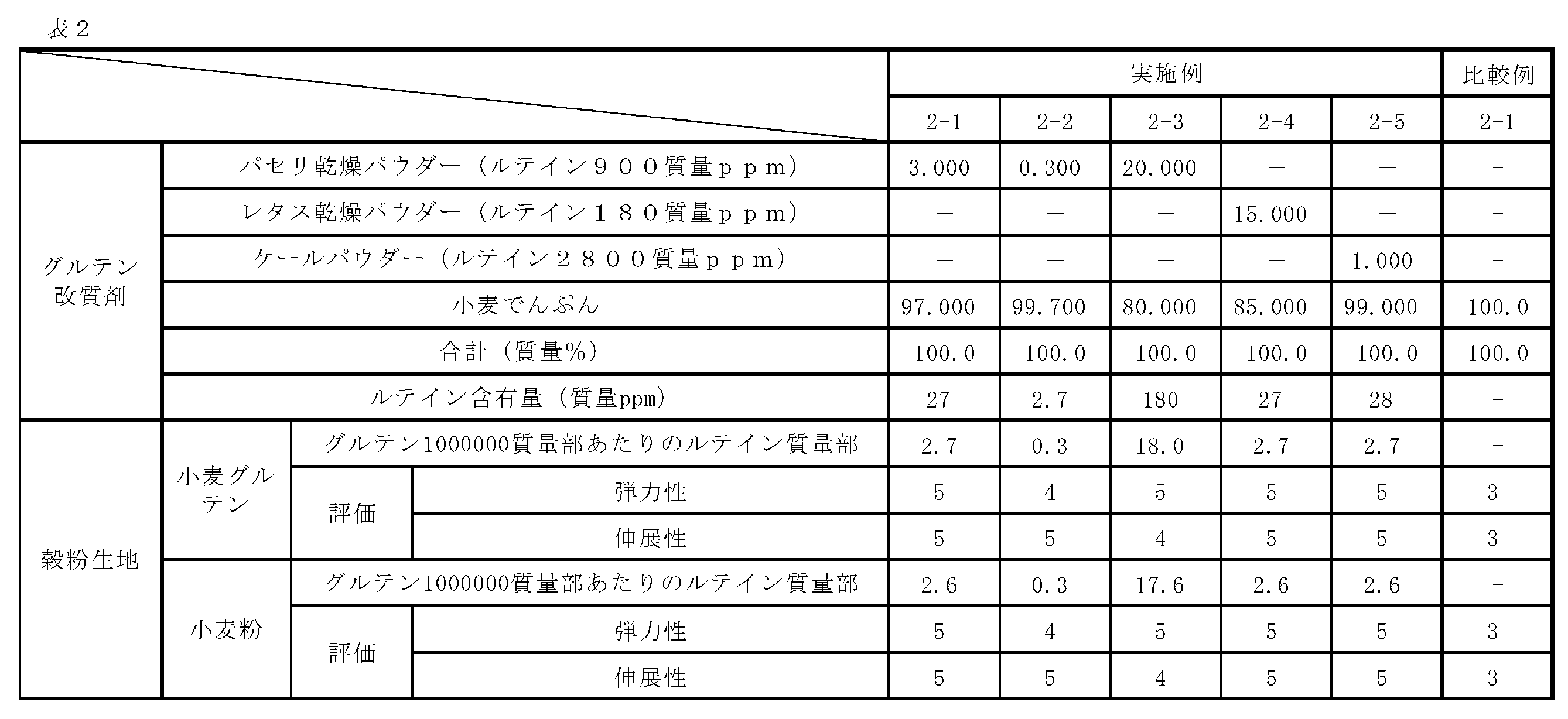
実施例1-1~1-3、2-1~2-5、比較例1-1、2-1のグルテン改質剤について以下の方法で穀粉生地の伸展性、弾力性を評価した。すなわち、関東混合機工業(株)製ミキサーボウルに小麦グルテン(株式会社ニップン社製、商品名:粉末状小麦たんぱく グルテン含有量100質量%)1000g、グルテン改質剤100g、水1000gを投入し、ドゥフックにて低速3分間、中低速6分間攪拌後、穀粉生地を製造した。得られた穀粉生地を150gづつ分割し、ブラベンダーエキステンソグラフE(株式会社パーカーコーポレーション社製)のラウンダーにて球状にし、球状となった穀粉生地の底部からの最大高を測定し、弾力性評価に用いた。球状にした際、弾力性が良好であれば穀粉生地がダレることなく球状を維持し、最大高は高くなる。
実測値として最大高は比較例1-1で43mm、比較例1-2で44mmであった。
評価においては、比較例1-1もしくは比較例2-1の最大高をそれぞれ100とし、最大高が105以上の場合を「5」、102以上、105未満の場合を「4」、98以上、102未満の場合を「3」、95以上、98未満の場合を「2」、95未満の場合を「1」として評価した。「5」、「4」のみ穀粉生地の弾力性を合格とした。
次にラウンダーにて球状となった穀粉生地を10センチの長さとなるよう棒状に伸ばし、5分間静置したのち、片方の端を固定し、もう片方を端から1センチのところをつかみ、1cm/10秒の速さで引っ張り試験を実施した。穀粉生地が切れた際の穀粉生地の長さで伸展性を評価した。伸展性が良好なほど穀粉生地の長さが長くなる。
実測値として伸展性は比較例1-1で14.5cm、比較例1-2で13.2cmであった。
評価においては、比較例1-1もしくは比較例2-1の穀粉生地の長さをそれぞれ100とし、穀粉生地の長さが105以上の場合を「5」、102以上、105未満の場合を「4」、98以上、102未満の場合を「3」、95以上、98未満の場合を「2」、95未満の場合を「1」として評価した。「5」、「4」のみ穀粉生地の伸展性を合格とした。
実施例1-1~1-3、2-1~2-5、比較例1-1、2-1のグルテン改質剤については以下の方法で穀粉生地の伸展性、弾力性を評価した。
関東混合機工業(株)製ミキサーボウルに小麦粉(日本製粉株式会社製、製品名:イーグル)1000g、塩15g、水700gを投入し、ドゥフックにて低速3分間、中低速6分間攪拌した。このときのグルテン含有量は10.2質量%であった。さらに実施例1-1のグルテン改質剤10gを投入し、ドゥフックにて低速3分間、中低速6分間攪拌後、穀粉生地を製造した。得られた穀粉生地を150gづつ分割し、ブラベンダーエキステンソグラフE(株式会社パーカーコーポレーション社製)にて伸展性と弾力性を評価した。穀粉生地をラウンダーにて球状にし、球状の生地をロール状にする生地ローラーにてロール状にした。その後専用ホルダーにて20℃で40分間ねかせ、その後ストレッチング装置で生地を引っ張り測定した。得られたグラフの横軸のカーブ底辺の長さ(生地が伸びた長さ)を伸展性とし、底辺の長さが長いほど伸展性に優れていることを示す。また、得られたグラフの縦軸の最大値を弾力性とし、縦軸の最大値が大きいほど弾力性に優れていることを示す。
実測値として伸展性は比較例1-1で142mm、比較例1-2で138mmであった。弾力性は比較例1-1で450BU、比較例1-2で480BUであった。
比較例1-1もしくは比較例2-1の伸展性をそれぞれ100とし、伸展性が105以上の場合を「5」、102以上、105未満の場合を「4」、98以上、102未満の場合を「3」、95以上、98未満の場合を「2」、95未満の場合を「1」として評価した。「5」、「4」のみ合格とした。
比較例1-1もしくは比較例2-1の弾力性をそれぞれ100とし、弾力性が105以上の場合を「5」、102以上、105未満の場合を「4」、98以上、102未満の場合を「3」、95以上、98未満の場合を「2」、95未満の場合を「1」として評価した。「5」、「4」のみ合格とした。
表1、表2より、グルテン改質剤によって、グルテン含有穀粉生地の伸展性、弾力性が向上することが分かる。
(実施例3-1~3-3、比較例3-1)
表3に示す配合組成をベースに実施例1-1の記載の方法により実施例3-1~3-3、比較例3-1のグルテン改質剤を製造した。
表4に示す配合組成をベースに実施例2-1の記載の方法により実施例4-1~4-5、比較例4-1のグルテン改質剤を製造した。
次の方法により麺用穀粉生地を製造した。具体的には、小麦粉(日清製粉株式会社製、商品名:特飛龍)1kg、食塩10g、かん水10g、グルテン改質剤10g、水350gを麺用横型ピンミキサー(株式会社ソデック製、VM-1)で真空を90kPaで引きながら12分間混錬し麺用穀粉生地を得た。
なお、麺用穀粉生地中のグルテン含量は、小麦粉100gあたり10.1gであった。
麺用穀粉生地をロール式製麺機にて圧延してから切り出し(切り刃:角20番)、麺線の厚みが1.5mmの生麺(中華麺)を製造した。得られた生麺100gを沸騰水2L中で2分半茹で、70℃のお湯300mlに入れて喫食した(ホット中華麺)。また同様に茹でた麺を氷水に1分間浸し、締めた後に喫食した(冷やし中華麺)。以下の方法にて麺用穀粉生地の生地物性(伸展性)および中華麺の食感(弾力、粘り)を評価した。
麺用穀粉生地をロール式製麺機にて1.5mmの厚さへ圧延した際に伸展性が低下した麺用穀粉生地では麺帯表面が滑らかではなく、ひび割れや凹凸(おうとつ)といった荒れが生じる。そこで、比較例3-1もしくは比較例4-1のグルテン改質剤を使用した場合の麺用穀粉生地の麺帯表面の荒れを麺用穀粉生地の生地物性(伸展性)の基準とし、荒れが明らかに少ない(5)、荒れが少ない(4)、同等(3)、荒れが多い(2)、荒れが明らかに多い(1)として評価した。これを伸展性の評点とし、4以上を合格とした。
ホット中華麺および冷やし中華麺を食した際に弾力をパネラー10人にて官能評価にて評価した。比較例3-1もしくは比較例4-1のグルテン改質剤を使用した場合の中華麺の弾力を基準とし、弾力がしっかりと感じる(5)、弾力がやや強く感じる(4)、同等(3)、弾力がやや弱く感じる(2)、弾力が明らかに弱く感じる(1)として評価した。パネラー10人の官能評価の平均値を小数点第一位で四捨五入した点を評点とし、4以上を合格とした。
ホット中華麺および冷やし中華麺を食した際に粘りをパネラー10人にて官能評価にて評価した。比較例3-1もしくは比較例4-1のグルテン改質剤を使用した場合の中華麺の粘りを基準とし、粘りがしっかりと感じる(5)、粘りがやや強く感じる(4)、同等(3)、粘りがやや弱く感じる(2)、粘りが明らかに弱く感じる(1)として評価した。パネラー10人の官能評価の平均値を小数点第一位で四捨五入した点を評点とし、4以上を合格とした。
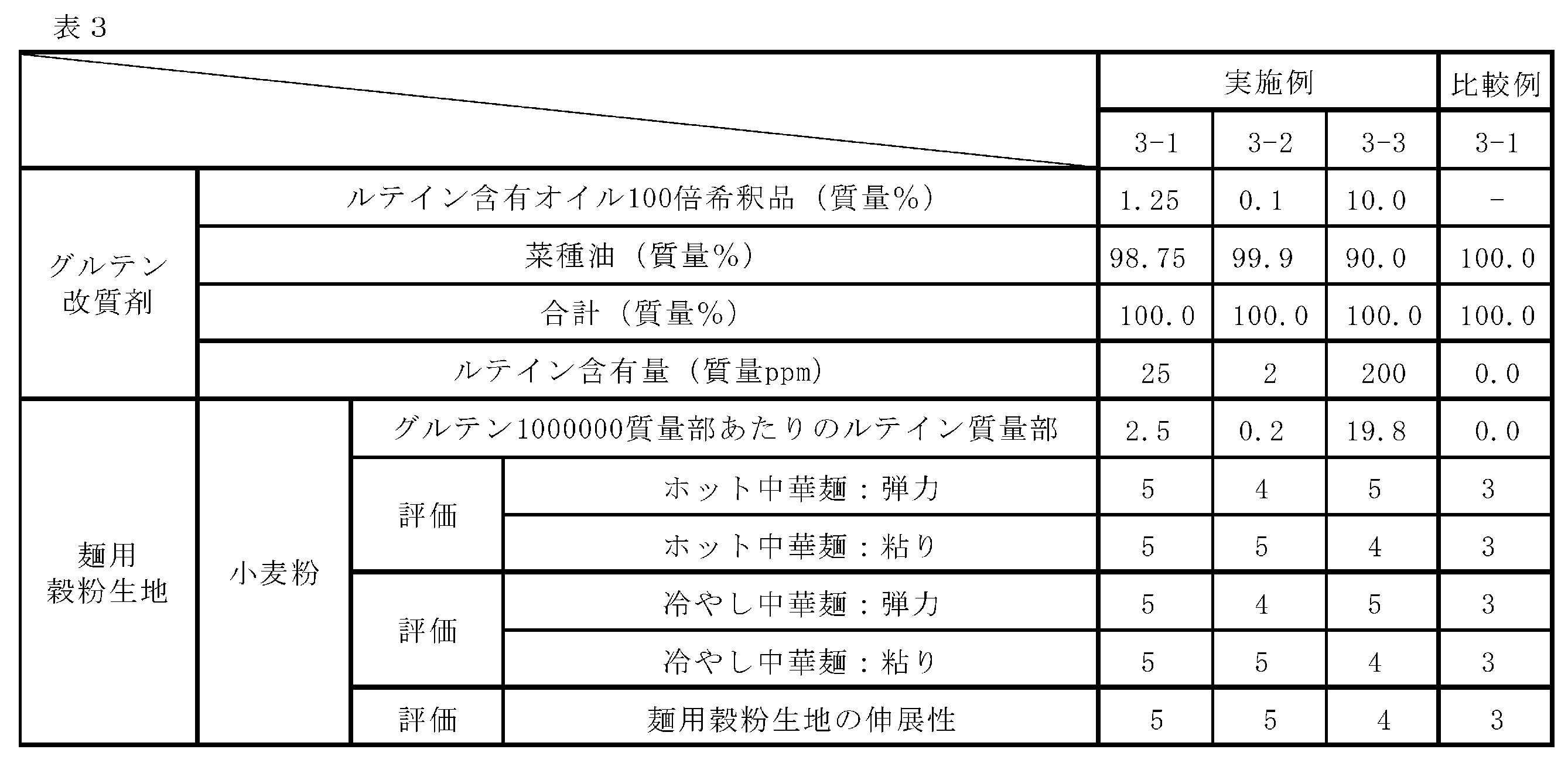
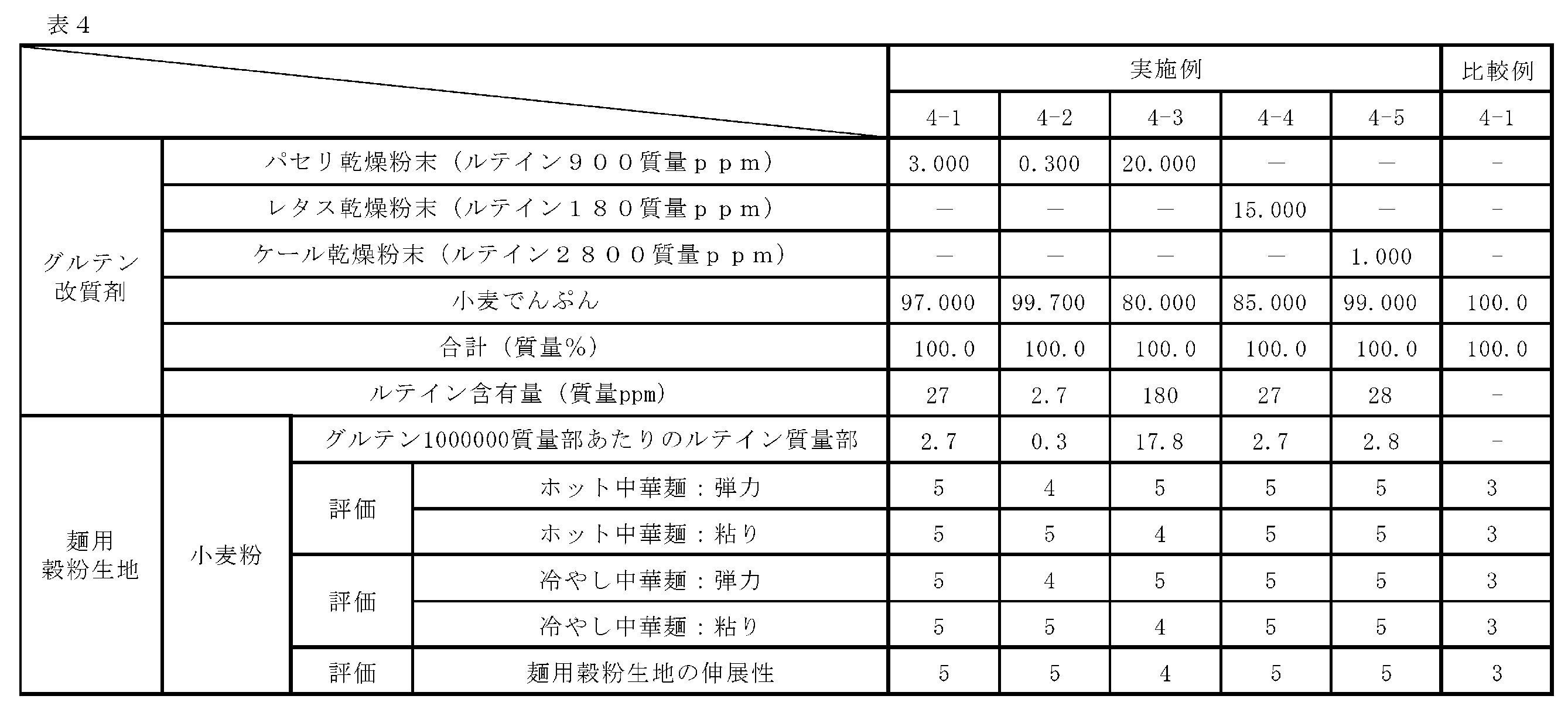
(実施例5-1~5-3、比較例5-1)
表5に示す配合組成をベースに以下の方法により実施例5-1のグルテン改質剤を製造した。実施例5-1では、液糖(三菱商事フードテック(株)製、製品名:アマミール)1998.6g、ルテイン(協和発酵バイオ(株)製、製品名:水溶性ルテイン3.5)1.4gを混合、攪拌して、グルテン改質剤(ルテイン含有量24.5質量ppm)を得た。
同様に、実施例5-2、5-3、比較例5-1についても表5に示す配合組成にてグルテン改質剤を製造した。
実施例5-1~5-3、比較例5-1のグルテン改質剤については以下の方法で穀粉生地の伸展性、弾力性を評価した。
関東混合機工業(株)製ミキサーボウルに小麦グルテン(株式会社ニップン社製、商品名:粉末状小麦たんぱく グルテン含有量100質量%)1000g、グルテン改質剤100g、水1000gを投入し、ドゥフックにて低速3分間、中低速6分間攪拌後、穀粉生地を製造した。得られた穀粉生地を150gづつ分割し、ブラベンダーエキステンソグラフE(株式会社パーカーコーポレーション社製)のラウンダーにて球状にし、球状となった穀粉生地の底部からの最大高を測定し、弾力性評価に用いた。球状にした際、弾力性が良好であれば穀粉生地がダレることなく球状を維持し、最大高は高くなる。
実測値として最大高は比較例5-1で42mmであった。
評価においては、比較例5-1の最大高をそれぞれ100とし、最大高が105以上の場合を「5」、102以上、105未満の場合を「4」、98以上、102未満の場合を「3」、95以上、98未満の場合を「2」、95未満の場合を「1」として評価した。「5」、「4」のみ穀粉生地の弾力性を合格とした。
次にラウンダーにて球状となった穀粉生地を10センチの長さとなるよう棒状に伸ばし、5分間静置したのち、片方の端を固定し、もう片方を端から1センチのところをつかみ、1cm/10秒の速さで引っ張り試験を実施した。穀粉生地が切れた際の穀粉生地の長さで伸展性を評価した。伸展性が良好なほど穀粉生地の長さが長くなる。
実測値として伸展性は比較例5-1で13.8cmであった。
評価においては、比較例5-1の穀粉生地の長さをそれぞれ100とし、穀粉生地の長さが105以上の場合を「5」、102以上、105未満の場合を「4」、98以上、102未満の場合を「3」、95以上、98未満の場合を「2」、95未満の場合を「1」として評価した。「5」、「4」のみ穀粉生地の伸展性を合格とした。
実施例5-1~5-3、比較例5-1のグルテン改質剤については以下の方法で穀粉生地の伸展性、弾力性を評価した。
関東混合機工業(株)製ミキサーボウルに小麦粉(日本製粉株式会社製、製品名:イーグル)1000g、塩15g、水700gを投入し、ドゥフックにて低速3分間、中低速6分間攪拌した。このときのグルテン含有量は10.2質量%であった。さらに実施例5-1のグルテン改質剤10gを投入し、ドゥフックにて低速3分間、中低速6分間攪拌後、穀粉生地を製造した。得られた穀粉生地を150gづつ分割し、ブラベンダーエキステンソグラフE(株式会社パーカーコーポレーション社製)にて伸展性と弾力性を評価した。穀粉生地をラウンダーにて球状にし、球状の生地をロール状にする生地ローラーにてロール状にした。その後専用ホルダーにて20℃で40分間ねかせ、その後ストレッチング装置で生地を引っ張り測定した。得られたグラフの横軸のカーブ底辺の長さ(生地が伸びた長さ)を伸展性とし、底辺の長さが長いほど伸展性に優れていることを示す。また、得られたグラフの縦軸の最大値を弾力性とし、縦軸の最大値が大きいほど弾力性に優れていることを示す。
実測値として伸展性は比較例5-1で146mmであった。弾力性は比較例5-1で440BUであった。
比較例5-1の伸展性を100とし、伸展性が105以上の場合を「5」、102以上、105未満の場合を「4」、98以上、102未満の場合を「3」、95以上、98未満の場合を「2」、95未満の場合を「1」として評価した。「5」、「4」のみ合格とした。
比較例5-1の弾力性を100とし、弾力性が105以上の場合を「5」、102以上、105未満の場合を「4」、98以上、102未満の場合を「3」、95以上、98未満の場合を「2」、95未満の場合を「1」として評価した。「5」、「4」のみ合格とした。

表5より、液糖を配合したグルテン改質剤においても、グルテン含有穀粉生地の伸展性、弾力性が向上することが分かる。
(実施例6-1~6-3、比較例6-1)
表6に示す配合組成をベースに以下の方法により実施例6-1を製造した。すなわちルテイン含有オイル(製品名:Lyc-O-Lutein 20% in Safflower Oil、サンブライト株式会社輸入・販売、ルテイン含有量20g/100g)を用い、ルテイン含有オイル100g、菜種油9900gを混合、攪拌しルテイン含有オイル100倍希釈品(ルテイン含有量2000質量ppm)を得た。さらに、ルテイン含有オイル100倍希釈品125g、菜種油9875gを混合、攪拌して、製パン用グルテン改質剤(ルテイン含有量25質量ppm)を得た。
同様に、実施例6-2、6-3、比較例6-1についても表6に示す配合組成にて製パン用グルテン改質剤を製造した。
市販されているパセリおよびレタスを購入し、粉末化し製パン用グルテン改質剤に用いた。パセリ、レタスをそれぞれ100g用意し、真空凍結乾燥機(AdVantagePLUSにて水分が1%以下となるまで乾燥させた。その後、高速カッターミキサーにて粉砕をし、50メッシュの篩にてふるいがけをして、パセリおよびレタスの乾燥粉末を得た。それぞれのルテイン含有量、D90%、D10%粒径は、パセリ乾燥粉末(900質量ppm、D90%粒径150μm、D10%粒径50μm)、レタス乾燥粉末(180質量ppm、D90%粒径240μm、D10%粒径80μm)であった。また市販されているケール乾燥粉末(製品名「国産ケールパウダー」、こだま食品株式会社製)もルテイン含有量を測定したところ、ケール乾燥粉末(2800質量ppm、D90%粒径50μm、D10%粒径10μm)であった。
これら乾燥粉末を使用し、表7に示す配合組成にて実施例7-1を製造した。すなわちパセリ乾燥粉末3gと小麦でんぷん97gを均一分散させ製パン用グルテン改質剤(ルテイン含有量27質量ppm)を得た。
同様に実施例7-2~7-5、比較例7-1についても表7に示す配合組成をベースに製パン用グルテン改質剤を上記方法で製造した。なお、乾燥粉末のD90%およびD10%粒径は、レーザー回折式粒度分布測定装置SALD-2100(株式会社島津製作所製)を用いて屈折率パラメーター1.60-0.10iの条件にて測定した。
表8に示す配合により製パン用穀粉生地を製造した。具体的には、小麦粉(株式会社ニップン社製、商品名:イーグル)1kg、イースト(オリエンタル酵母工業株式会社製、商品名:オリエンタルイースト)30g、イーストフード(オリエンタル酵母工業株式会社製、商品名:オリエンタルCオリエンタルフード)1g、上白糖250g、食塩12g、脱脂粉乳30g、全卵60g、水550gを関東混合機工業(株)製ミキサーボウルに投入し、ドゥフックにて低速2分間、中低速5分間攪拌後、製パン用グルテン改質剤10g、ショートニング70gを投入し、低速3分間、中低速3分間混合し製パン用穀粉生地を得た。
なお製パン用穀粉生地中のグルテン含量は、小麦粉100gあたり10.2gであった。
表8に示す工程によりコッペパンを製造した。すなわち製パン用穀粉生地を30分間フロアタイムをとったのち、60gに分割し、30分間のベンチタイムをとり、(株)オシキリ製モルダーにてコッペパン型に成型し、温度38℃、湿度85%にて60分間ホイロをとり、205℃のオーブンにて9分間焼成しコッペパンを製造した。製造後、室温まで自然放冷し、ビニール袋に密閉し室温で保管し、翌日、もっちり感、歯切れ、風味の評価に用いた。
評価においては、測定する直前にコッペパンを中心から3cm幅にカットしサンプルとした。株式会社山電製レオメーターで応力緩和測定を行い、直径3cmの円盤型プランジャーにてパンのカットした側面を1mm/secで6mm、2分間圧縮変形させた。2分間の圧縮変形後の応力低下量を以下の[式1]により算出した。
[式1]
応力低下量=100-(6mm圧縮した際の2分後の応力値/6mm圧縮した際の初期の応力値)×100
比較例6-1もしくは比較例7-1の製パン用グルテン改質剤を使用した場合の応力低下量を100とした際の相対値で評価した。なお、比較例6-1の製パン用グルテン改質剤を使用したパンの応力低下量は15、比較例7-1のパンの応力低下量は12であった。
応力低下量の相対値が110以上の場合を「1」、110未満、105以上の場合を「2」、105未満、95以上の場合を「3」、95未満、90以上の場合を「4」、90未満の場合を「5」として評価した。「5」、「4」のみ、合格とした。
評価においては、測定する直前にコッペパンを中心から3cm幅にカットしてサンプルとした。株式会社山電製レオメーターで破断測定を行い、カッター刃にてパンを上部から5mm/秒の速度で押し切る際に必要な最大応力[N]を測定し、歯切れの指標とした。比較例6-1もしくは比較例7-1の製パン用グルテン改質剤を使用した場合のパンの最大応力値[N]をそれぞれ100とした際の相対値で評価した。なお、比較例6-1の製パン用グルテン改質剤を使用したパンの応力値は12.4、比較例7-1のパンの応力値は13.6であった。
最大応力値が108以上の場合を「1」、108未満、102以上の場合を「2」、96以上、102未満の場合を「3」、90以上、96未満の場合を「4」、90未満の場合を「5」として評価した。「5」、「4」のみ、合格とした。
コッペパンを食した際の風味を、10人のパネラーの官能評価にて評価した。比較例6-1もしくは比較例7-1の製パン用グルテン改質剤を使用した場合のコッペパンの穀粉の風味を基準とし、穀粉の風味が強く感じる(5)、穀粉の風味がやや強く感じる(4)、同等(3)、穀粉の風味がやや弱く感じる(2)、穀粉の風味が明らかに弱く感じる(1)として評価した。パネラー10人の官能評価の平均値を風味の評点とし、4以上を合格とした。
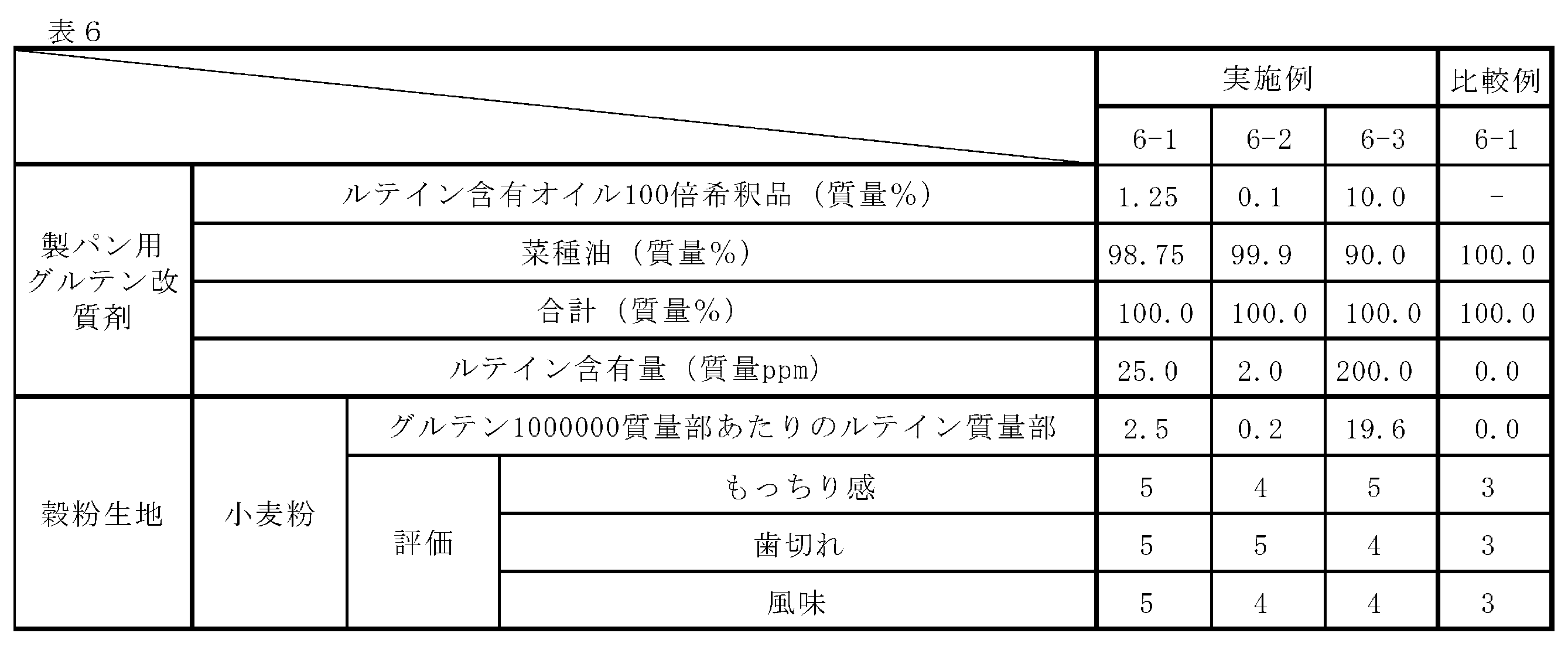
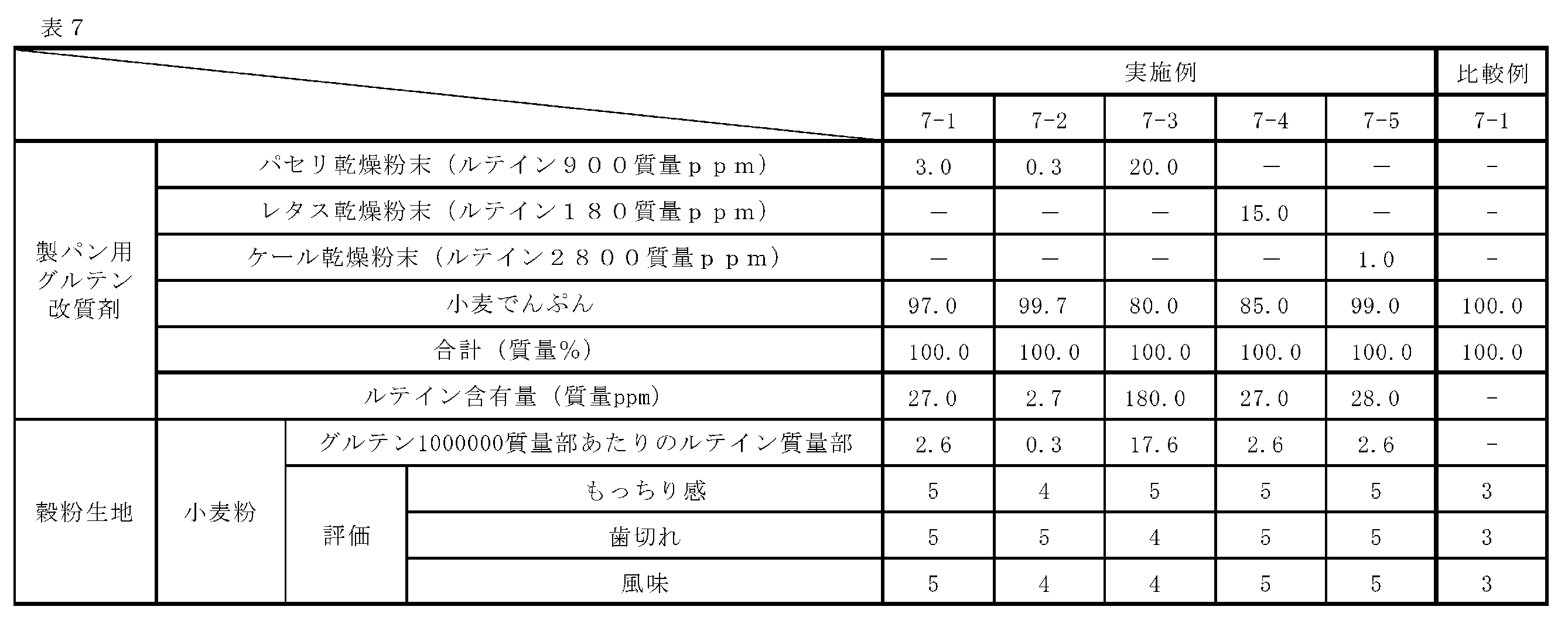

表6、表7より、製パン用グルテン改質剤によって、パンのもっちり感、歯切れ、風味が向上することが分かる。
(実施例8-1~8-4、比較例8-1)
表9に示す配合組成をベースに以下の方法により実施例8-1を製造した。すなわちルテイン含有オイル(製品名:Lyc-O-Lutein 20% in Safflower Oil、サンブライト株式会社輸入・販売、ルテイン含有量20g/100g)を用い、ルテイン含有オイル100gおよび菜種油9900gをプロペラ攪拌機(攪拌速度350rpm)にて攪拌しながら45℃まで加温し、10分間攪拌することでルテイン含有オイル100倍希釈品(ルテイン含有量2000質量ppm)を得た。次に、液糖(RCS-50)9875gをプロペラ攪拌機(攪拌速度350rpm)にて攪拌しながら45℃まで加温し、そこに45℃に加温したルテイン含有オイル100倍希釈品125gを少しずつ加え、30分間攪拌を行い、製パン用グルテン改質剤(ルテイン含有量25質量ppm)を得た。
同様に、実施例8-2~8-4、比較例8-1についても表9に示す配合組成をベースに製パン用グルテン改質剤を上記方法で製造した。
市販されているパセリおよびレタスを購入し、粉末化し製パン用グルテン改質剤に用いた。パセリ、レタスをそれぞれ100g用意し、真空凍結乾燥機(AdVantagePLUSにて乾燥させた。その後、高速カッターミキサーにて粉砕をし、50メッシュの篩にてふるいがけをして、パセリおよびレタスの乾燥粉末を得た。それぞれのルテイン含有量、D90%、D10%粒径は、パセリ乾燥粉末(900質量ppm、D90%粒径150μm、D10%粒径50μm)、レタス乾燥粉末(180質量ppm、D90%粒径240μm、D10%粒径80μm)であった。また市販されているケール乾燥粉末(製品名「国産ケールパウダー」、こだま食品株式会社製)もルテイン含有量を測定したところ、ケール乾燥粉末(2800質量ppm、D90%粒径50μm、D10%粒径10μm)であった。
これら乾燥粉末を使用し、表10に示す配合組成にて実施例9-1を製造した。すなわち液糖(RCS-50)97gをプロペラ攪拌機(攪拌速度350rpm)にて攪拌しながら45℃まで加温し、そこにルテインを含有する乾燥粉末を少しずつ加え、30分間攪拌を行い、製パン用グルテン改質剤(ルテイン含有量27質量ppm)を得た。
同様に実施例9-2~9-6、比較例9-1についても表10に示す配合組成をベースに製パン用グルテン改質剤を上記方法で製造した。
表11に示す配合により製パン用穀粉生地を製造した。具体的には、小麦粉(株式会社ニップン社製、商品名:イーグル)700g、イースト(オリエンタル酵母工業株式会社製、商品名:オリエンタルイースト)30g、イーストフード(オリエンタル酵母工業株式会社製、商品名:オリエンタルCオリエンタルフード)1g、上白糖30g、水400gを関東混合機工業(株)製ミキサーボウルに投入し、ドゥフックにて低速2分間、中低速2分間攪拌して中種を製造し、2時間醗酵させた。中種、小麦粉300g、上白糖120g、食塩12g、脱脂粉乳30g、全卵60g、水230g、製パン用グルテン改質剤10gをミキサーボウルに投入し、ドゥフックにて低速2分間、中低速5分間攪拌後、ショートニング70gを投入し、低速3分間、中低速3分間混合し製パン用穀粉生地を得た。
なお、製パン用穀粉生地中のグルテン含量は、小麦粉100gあたり10.2gであった。
上記のミキシング時間は、本発明における最適なミキシング時間であり、上記のミキシング時間で製パン用穀粉生地を製造することによってグルテンが繋がり伸展性と弾力性のある製パン用穀粉生地となる。ミキシング時間が上記のミキシング時間より短い場合、グルテンの繋がりが不十分となり、弾力性はあるが伸展性に欠ける製パン用穀粉生地が得られる。一方で、上記のミキシング時間より長い場合、グルテンが必要以上に引き伸ばされ、切れてしまい、伸展性はあるが弾力性を失った製パン用穀粉生地となってしまう。
表11に示す工程によりコッペパンを製造した。すなわち製パン用穀粉生地を30分間フロアタイムをとったのち、60gに分割し、30分間のベンチタイムをとり、(株)オシキリ製モルダーにてコッペパン型に成型し、温度38℃、湿度85%にて60分間ホイロをとり、205℃のオーブンにて9分間焼成しコッペパンを製造した。製造後、室温まで自然放冷し、ビニール袋に密閉し室温で保管し、翌日、もっちり感、歯切れ、風味の評価に用いた。それぞれの評価方法は、下記に記す。作業時間短縮については、下記に具体的な評価方法を記す。
コッペパンの中心から3cm幅にカットしたものをサンプルとし、株式会社山電製レオメーターにて応力緩和測定を行った。直径3cmの円盤型プランジャーでパンのカットした側面を1mm/secで6mm、2分間圧縮変形させ、2分間の圧縮変形後の応力低下量を以下の[式1]により算出した。
[式1]
応力低下量=100-(6mm圧縮した際の2分後の応力値/6mm圧縮した際の初期の応力値)×100
比較例8-1もしくは比較例9-1の製パン用グルテン改質剤を使用した場合の応力低下量を100とした際の相対値で評価した。なお、比較例8-1および9-1の製パン用グルテン改質剤を使用したパンの応力低下量は、いずれも14であった。応力低下量の相対値は、以下の評価基準で採点し、もっちり感の評価とした。
<評価基準>
応力低下量の相対値が
110以上の場合を「1」
110未満、105以上の場合を「2」
105未満、95以上の場合を「3」
95未満、90以上の場合を「4」
90未満の場合を「5」
として評価した。評価基準の「5」、「4」のみを合格とした。
コッペパンの中心から3cm幅にカットしたものをサンプルとし、株式会社山電製レオメーターで破断測定を行った。カッター刃にてパンを上部から5mm/秒の速度で押し切る際に必要な最大応力[N]を測定し、歯切れの指標とした。
比較例8-1もしくは比較例9-1の製パン用グルテン改質剤を使用した場合のパンの最大応力値[N]をそれぞれ100とした際の相対値で評価した。なお、比較例8-1および9-1の製パン用改質剤を使用したパンの応力値はいずれも12.8であった。最大応力値の相対値は、以下の評価基準で採点し、歯切れの評価とした。
<評価基準>
最大応力値の相対値が
108以上の場合を「1」
102以上、108未満の場合を「2」
96以上、102未満の場合を「3」
90以上、96未満の場合を「4」
90未満の場合を「5」
として評価した。評価基準の「5」、「4」のみを合格とした。
コッペパンを食した際の風味を、10人のパネラーの官能評価にて評価した。比較例8-1もしくは比較例9-1の製パン用グルテン改質剤を使用した場合のコッペパンの穀粉の風味を基準とし、以下の評価基準で採点した。
<評価基準>
穀粉の風味を強く感じる(5)
穀粉の風味をやや強く感じる(4)
同等(3)
穀粉の風味をやや弱く感じる(2)
穀粉の風味を明らかに弱く感じる(1)
として評価した。パネラー10人の官能評価の平均値を小数点第一位で四捨五入した点を評点とし、(4)以上を合格とした。
表11に示す配合にて製造したコッペパンをコッペパンAとする。コッペパンBでは表11に示す配合の本捏工程のミキシング時間を短縮した。すなわち、低速2分間、中低速4分間攪拌後、ショートニングを投入し、低速3分間、中低速2分間混合し製パン用穀粉生地を製造し、コッペパンBを得た。得られたコッペパンA、コッペパンB各10個の比容積(ボリュームA、ボリュームB)を「3D Laser volume measurement selnac win VM2100」(Astec社製)を用いて測定した。そして、比較例8-1、9-1の製パン用グルテン改質剤を使用して製造したコッペパンAの比容積(ボリュームA)を100とした際の相対値でミキシング時間の短縮前後でのボリュームの変化量を以下の[式2]により算出することで作業時間短縮の評価を行った。
ミキシング時間が短い場合、グルテンの繋がりは不十分で弾力性はあるが伸展性に欠ける製パン用穀粉生地となり、焼成時に窯伸びしにくく、パンのボリュームは低下する。一方で、ミキシング時間が最適である場合、グルテンが繋がり伸展性と弾力性のある製パン用穀粉生地となり、ボリュームのあるパンが得られる。ミキシング時間の短縮前後でのボリュームの変化量が小さい、すなわち、ミキシング時間を短縮しても伸展性と弾力性のある製パン用穀粉生地が得られ、ボリュームのあるパンが得られるものを作業時間の短縮が可能であると評価した。
[式2]
変化量=ボリュームB/ボリュームA×100
<評価基準>
ボリュームの変化量が
95以上の場合を「5」
90以上、95未満の場合を「4」
85以上、90未満の場合を「3」
80以上、85未満の場合を「2」
80未満の場合を「1」
として評価した。評価基準の「5」、「4」のみを合格とした。
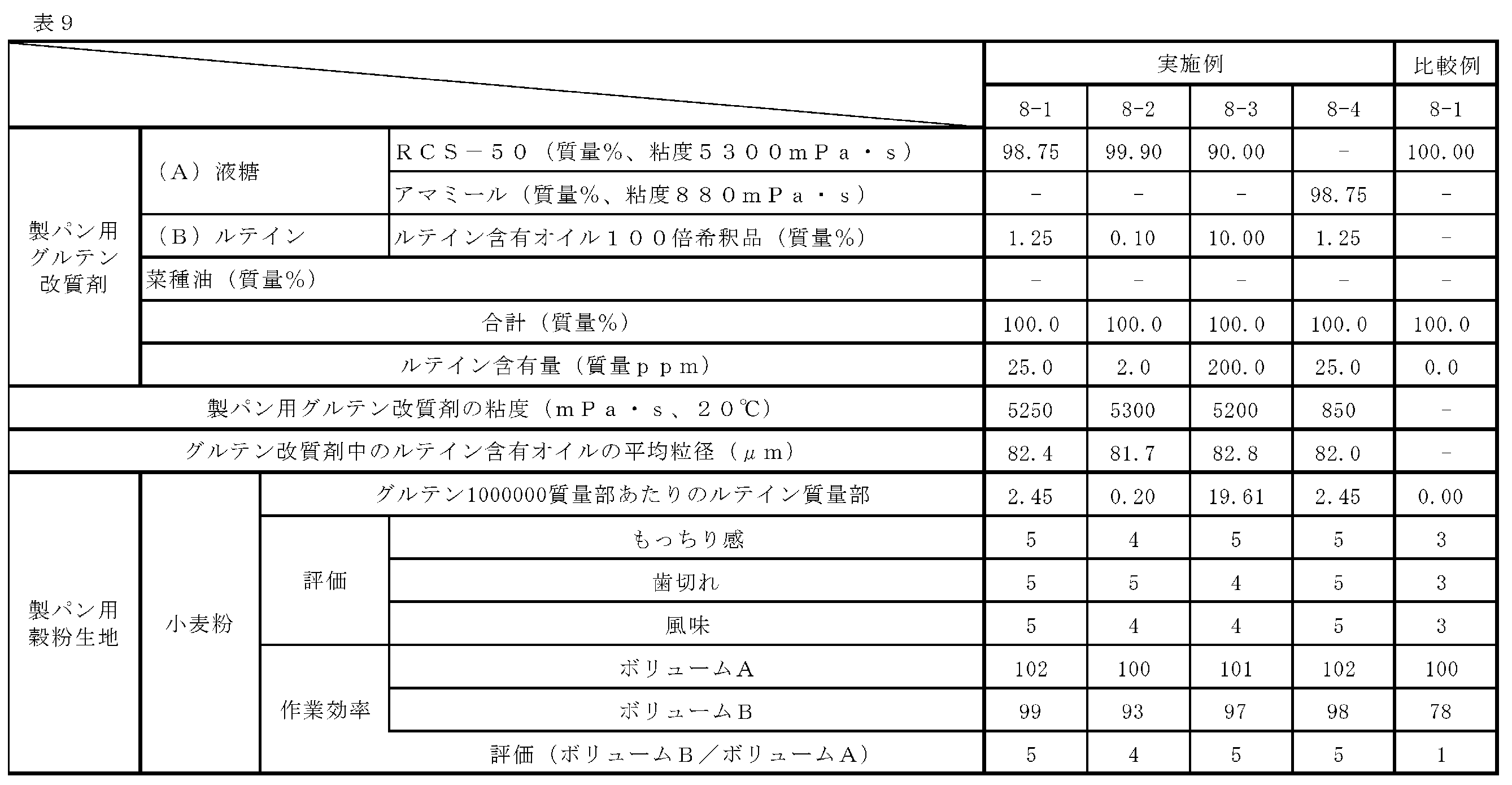


表9、10の実施例8-1~8-4、9-1~9-6では、もっちり感、歯切れ、風味、作業時間短縮は合格となり、製パン用グルテン改質剤によって、ルテインの穀粉生地への分散性を向上させることで、パン製造時の作業時間を短縮し、パンのもっちり感と歯切れ、穀粉本来の風味が向上することが分かる。
また、表9、10の比較例8-1、9-1では、ルテインによる効果が得られず、もっちり感、歯切れ、穀粉本来の風味が向上したパンを得ることはできず、作業時間を短縮することもできないことが分かる。
(実施例10-1~10-3、比較例10-1)
表12に示す配合組成をベースに以下の方法により実施例10-1を製造した。すなわちルテイン含有オイル(製品名:Lyc-O-Lutein 20% in Safflower Oil、サンブライト株式会社輸入・販売、ルテイン含有量20g/100g)を用い、ルテイン含有オイル100g、菜種油9900gを混合、攪拌しルテイン含有オイル100倍希釈品(ルテイン含有量2000質量ppm)を得た。さらに、ルテイン含有オイル100倍希釈品90g、菜種油9910gを混合、攪拌して、製菓用グルテン改質剤(ルテイン含有量18質量ppm)を得た。
同様に、実施例10-2、10-3、比較例10-1についても表12に示す配合組成にて製菓用グルテン改質剤を製造した。
市販されているパセリおよびレタスを粉末化し、ルテインの原料として製菓用グルテン改質剤に用いた。パセリ、レタスをそれぞれ100g用意し、真空凍結乾燥機(AdVantagePLUS)にて水分が1%以下となるまで乾燥させた。その後、高速カッターミキサーにて粉砕をし、50メッシュの篩にてふるいがけをして、パセリおよびレタスの乾燥粉末を得た。それぞれのルテイン含有量、D90%、D10%粒径は、パセリ乾燥粉末(900質量ppm、D90%粒径150μm、D10%粒径50μm)、レタス乾燥粉末(180質量ppm、D90%粒径240μm、D10%粒径80μm)であった。また市販されているケール乾燥粉末(製品名「国産ケールパウダー」、こだま食品株式会社製)もルテイン含有量および粒径を測定したところ、ケール乾燥粉末(2800質量ppm、D90%粒径50μm、D10%粒径10μm)であった。
これら乾燥粉末を使用し、表13に示す配合組成にて実施例11-1を製造した。すなわちパセリ乾燥粉末2gと小麦でんぷん98gを均一分散させ製菓用グルテン改質剤(ルテイン含有量18質量ppm)を得た。
同様に実施例11-2~11-5、比較例11-1についても表13に示す配合組成をベースに製菓用グルテン改質剤を上記方法で製造した。なお、乾燥粉末のD90%およびD10%粒径は、レーザー回折式粒度分布測定装置SALD―2100(株式会社島津製作所製)を用いて屈折率パラメーター1.60-0.10iの条件にて測定した。
表14に示す配合により製菓用穀粉生地を製造した。具体的には、全卵200g、上白糖100g、製菓用グルテン改質剤1gをホイッパーで低速1分間、高速5分間、中速3分間攪拌し全卵を起泡させた。その後、篩った小麦粉(日本製粉(株)製:商品名:バイオレット)100gとBP(オリエンタル酵母工業(株)製:商品名:ベーキングパウダーFS)1gを加え低速1分間攪拌し、菜種油30gを加え低速1分間攪拌して製菓用穀粉生地を得た。この製菓用穀粉生地は生地比重0.55g/mlであった。
なお、製菓用穀粉生地中のグルテン含有量は、小麦粉100gあたり7.3gであった。
製菓用穀粉生地を6寸デコ台に350g流し込み、上火170℃、下火150℃のオーブンにて35分間焼成した。その後オーブンから取り出し、開放系にて静置し室温になるまで2時間放冷した。その後デコ台から出してビニール袋に入れ密封し、20℃にて保存した。焼成翌日にしっとり感、口溶け、ボリューム評価に使用した。
スポンジケーキの焼成表面部(上面、側面、底面)を2センチメートルの幅で切り捨て、スポンジケーキの中心部を取り出した。さらに取り出したスポンジケーキの中心部を1辺2センチの正方形にカットすることで、1辺2センチの立方体型のスポンジケーキを得た。それらを食した際のしっとり感を、10人のパネラーの官能評価にて評価した。本発明におけるしっとり感とは、ケーキ類を摂食した際、口の唾液がケーキ類に奪われない状態をいう。比較例10-1もしくは比較例11-1の製菓用グルテン改質剤を使用した場合のスポンジケーキを基準とし、非常にしっとり感がある(5)、少ししっとり感がある(4)、同等(3)、少しパサつく(2)、パサつく(1)として評価した。パネラー10人の官能評価のもっとも多かった評点をしっとり感の評点とし、4以上を合格とした。なお、評点が同一の場合、低い方をしっとり感の評点とした。
しっとり感の評価方法と同様に、1辺2センチの立方体型のスポンジケーキを用意し、それらを食した際の口溶けを、10人のパネラーの官能評価にて評価した。本発明における口溶けとは、ケーキ類を摂食した際、口の中でさらっとケーキ類がほぐれる状態をいう。比較例10-1もしくは比較例11-1の製菓用グルテン改質剤を使用した場合のスポンジケーキを基準とし、非常に口溶けがよい(5)、少し口溶けがよい(4)、同等(3)、少し口溶けが悪い(2)、非常に口溶けが悪い(1)として評価した。パネラー10人の官能評価のもっとも多かった評点を口溶けの評点とし、4以上を合格とした。なお、評点が同一の場合、低い方を口溶けの評点とした。
スポンジケーキの比容積を各10個測定し、その平均比容積をボリュームの指標とした。スポンジケーキの比容積は「3D Laser volume measurement selnac win VM2100」(Astec社製)を用いて測定した。比較例10-1もしくは比較例11-1の製菓用グルテン改質剤を使用した場合のスポンジケーキの比容積を100とした場合の相対値を基準とした。
なお、比較例10-1の製菓用グルテン改質剤を使用した場合の比容積は4.8cc/g、比較例11-1の製菓用グルテン改質剤を使用した場合の比容積は4.7cc/g、であった。
比容積の相対値が110以上の場合を(5)、105以上、110未満の場合を(4)、100以上、105未満の場合を(3)、95以上、100未満を(2)、95未満を(1)として評価し4以上を合格とした。
製菓用穀粉生地を所定方法で製造したのち、さらに中速で30秒攪拌した場合のスポンジケーキの口溶けおよびボリュームを評価に用いた。
・口溶け評価
上記口溶け評価方法と同様にしてパネラー10人による官能評価にて評価した。各製菓用グルテン改質剤を使用し、所定方法で得た穀粉生地で製造した各実施例、比較例のスポンジケーキを基準とし、さらに中速で30秒攪拌して得た穀粉生地で製造したスポンジケーキにつき、それぞれ1辺2センチの立方体型にして摂食した場合の口溶けを比較評価した。基準とするスポンジケーキに対して、少し口溶けがよいか同等(4)、少し口溶けが悪い(3)、口溶けが悪い(2)、非常に口溶けが悪い(1)として評価した。パネラー10人の官能評価のもっとも多かった評点を品質安定性(口溶け)の評点とし、3以上を合格とした。なお、評点が同一の場合、低い方を品質安定性(口溶け)の評点とした。
・ボリューム評価
上記ボリューム評価方法と同様にしてスポンジケーキの平均比容積にて評価した。各製菓用グルテン改質剤を使用し、所定方法で得た穀粉生地で製造した各実施例、比較例のスポンジケーキ10個の平均比容積を基準とし、さらに中速で30秒攪拌して得た穀粉生地で製造したスポンジケーキ10個の平均比容積のボリュームを比較評価した。基準とするスポンジケーキの平均比容積を100としたときの、平均比容積の相対値が99以上の場合を(4)、97以上、99未満の場合を(3)、95以上、97未満の場合を(2)、95未満を(1)として評価し、品質安定性(ボリューム)の評点とし3以上を合格とした。

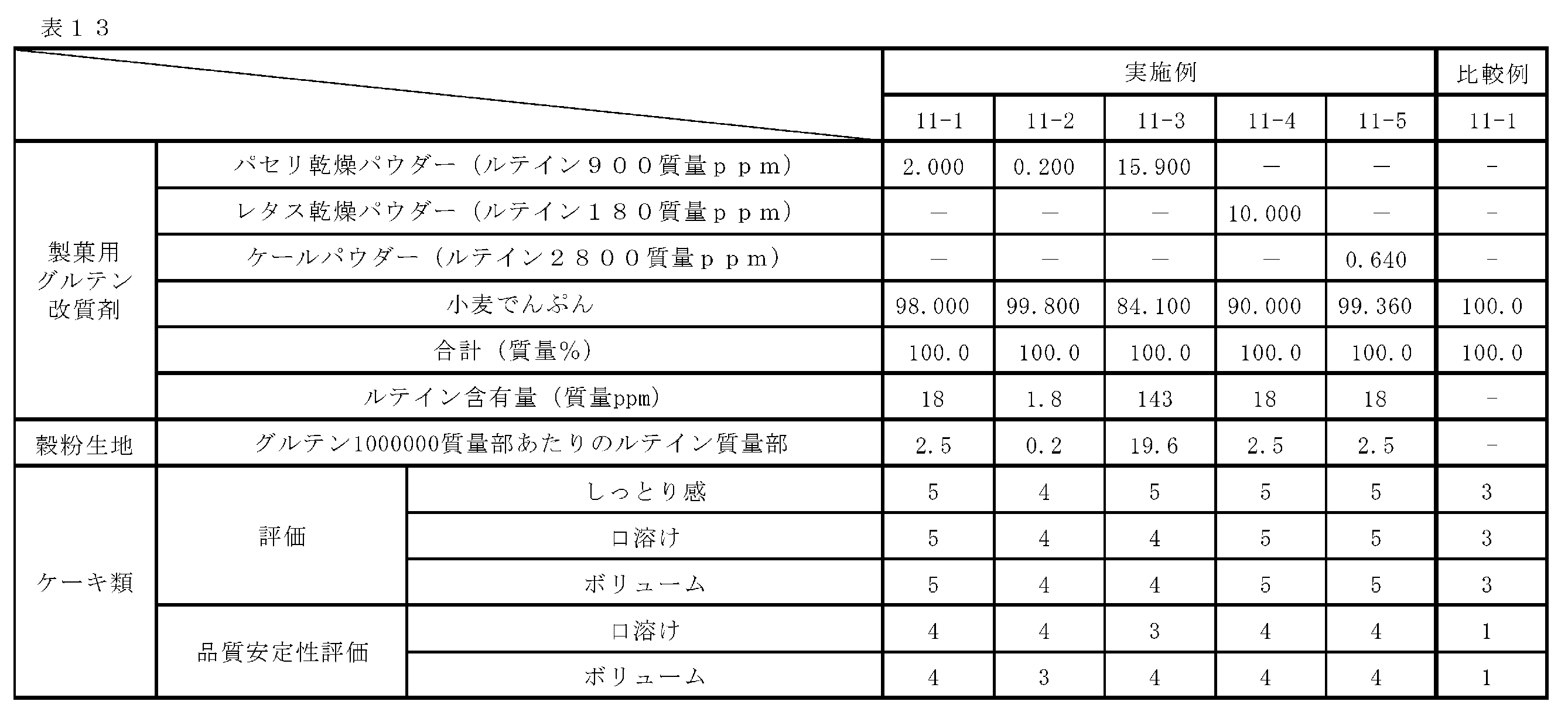

表12、表13より、製菓用グルテン改質剤によって、ケーキ類のしっとり感、口溶け、ボリュームが向上することが分かる。
(実施例12-1~12-5、比較例12-1)
表15に示す配合組成をベースに以下の方法により実施例12-1を製造した。すなわちルテイン含有オイル(製品名:Lyc-O-Lutein 20% in Safflower Oil、サンブライト株式会社輸入・販売、ルテイン含有量20g/100g)を用い、ルテイン含有オイル100g、菜種油9900gをプロペラ攪拌機(攪拌速度350rpm)にて攪拌しながら45℃まで加温し、10分間攪拌することでルテイン含有オイル100倍希釈品(ルテイン含有量2000質量ppm)を得た。次に、液糖(RCS-50)9900gとポリグリセリン脂肪酸エステル10gをプロペラ攪拌機(攪拌速度350rpm)にて攪拌しながら45℃まで加温し、そこに45℃に加温したルテイン含有オイル100倍希釈品90gを少しずつ加え、30分間攪拌を行い、製菓用グルテン改質剤(ルテイン含有量18質量ppm)を得た。
同様に、実施例12-2~12-5、比較例12-1についても表15に示す配合組成をベースに製菓用グルテン改質剤を上記方法で製造した。
市販されているパセリおよびレタスを粉末化し、ルテインの原料として製菓用グルテン改質剤に用いた。パセリ、レタスをそれぞれ100g用意し、真空凍結乾燥機(AdVantagePLUS)にて水分が1%以下となるまで乾燥させた。その後、高速カッターミキサーにて粉砕をし、50メッシュの篩にてふるいがけをして、パセリおよびレタスの乾燥粉末を得た。それぞれのルテイン含有量、D90%、D10%粒径は、パセリ乾燥粉末(900質量ppm、D90%粒径150μm、D10%粒径50μm)、レタス乾燥粉末(180質量ppm、D90%粒径240μm、D10%粒径80μm)であった。また市販されているケール乾燥粉末(製品名「国産ケールパウダー」、こだま食品株式会社製)もルテイン含有量および粒径を測定したところ、ケール乾燥粉末(2800質量ppm、D90%粒径50μm、D10%粒径10μm)であった。
これら乾燥粉末を使用し、表16に示す配合組成にて実施例13-1を製造した。すなわち、液糖(RCS-50)98gをプロペラ攪拌機にて350rpmで攪拌しながら45℃まで加温し、そこにパセリ乾燥粉末2gを少しずつ加え、30分間攪拌を行い、製菓用グルテン改質剤(ルテイン含有量18質量ppm)を得た。
同様に実施例13-2~13-6、比較例13-1についても表16に示す配合組成をベースに製菓用グルテン改質剤を上記方法で製造した。
表17に示す配合により製菓用穀粉生地を製造した。具体的には、全卵120g、上白糖100g、製菓用グルテン改質剤または製菓用油脂製剤1gをホイッパーで低速1分間、高速5分間、中速3分間攪拌し全卵を起泡させた。その後、篩った小麦粉(日本製粉(株)製:商品名:バイオレット)100gとBP(オリエンタル酵母工業(株)製:商品名:ベーキングパウダーFS)1gを加え低速1分間攪拌した後、湯煎で溶解したバターを100g加えて低速で1分間攪拌して製菓用穀粉生地を得た。この製菓用穀粉生地は生地比重0.70g/mlであった。
なお、製菓用穀粉生地中のグルテン含有量は、小麦粉100gあたり7.3gであった。
製菓用穀粉生地を幅7cm×長さ13.5cm×深さ6cmの型に250g流し込み、上火165℃、下火150℃のオーブンにて40分間焼成した。その後オーブンから取り出し、型からはずし時間室温で放冷した後、ビニール袋に入れ密封し、20℃にて保存した。焼成翌日にしっとり感、口溶け、ボリューム、内相評価に使用した。それぞれの評価方法は、下記に記す。
パウンドケーキの焼成表面部(上面、側面、底面)を2センチメートルの幅で切り捨て、パウンドケーキの中心部を取り出した。さらに取り出したパウンドケーキの中心部を1辺2センチの正方形にカットすることで、1辺2センチの立方体型のパウンドケーキを得た。それらを食した際のしっとり感を、10人のパネラーの官能評価にて評価した。本発明におけるしっとり感とは、ケーキ類を摂食した際、口の唾液がケーキ類に奪われない状態をいう。比較例12-1もしくは比較例13-1の製菓用グルテン改質剤を使用した場合のパウンドケーキを基準とし、非常にしっとり感がある(5)、少ししっとり感がある(4)、同等(3)、少しパサつく(2)、パサつく(1)として評価した。パネラー10人の官能評価のもっとも多かった評点をしっとり感の評点とし、4以上を合格とした。なお、評点が同一の場合、低い方をしっとり感の評点とした。
しっとり感の評価方法と同様に、1辺2センチの立方体型のパウンドケーキを用意し、それらを食した際の口溶けを、10人のパネラーの官能評価にて評価した。本発明における口溶けとは、ケーキ類を摂食した際、口の中でさらっとケーキ類がほぐれる状態をいう。比較例12-1もしくは比較例13-1の製菓用液糖を使用した場合のパウンドケーキを基準とし、非常に口溶けがよい(5)、少し口溶けがよい(4)、同等(3)、少し口溶けが悪い(2)、非常に口溶けが悪い(1)として評価した。パネラー10人の官能評価のもっとも多かった評点を口溶けの評点とし、4以上を合格とした。なお、評点が同一の場合、低い方を口溶けの評点とした。
パウンドケーキの比容積を各10個測定し、その平均比容積をボリュームの指標とした。パウンドケーキの比容積は「3D Laser volume measurement selnac win VM2100」(Astec社製)を用いて測定した。比較例12-1もしくは比較例13-1の製菓用グルテン改質剤を使用した場合のパウンドケーキの比容積を100とした場合の相対値を基準とした。
なお、比較例12-1の製菓用グルテン改質剤を使用した場合の比容積は4.8cc/g、比較例13-1の製菓用改質剤を使用した場合の比容積は4.7cc/g、であった。
比容積の相対値が110以上の場合を(5)、105以上、110未満の場合を(4)、100以上、105未満の場合を(3)、95以上、100未満を(2)、95未満を(1)として評価し4以上を合格とした。
パウンドケーキを厚さ20mmにスライスし、内相(キメの状態)を以下の評価基準で採点した。評価が4以上を合格とした。
<評価基準>
5:キメが非常に均一で、内相が整っている。
4:多少大きなキメも混在するが均一で、内相が整っている。
3:大小様々なキメがありやや不均一で、内相が粗い。
2:大小様々なキメがありかなり不均一で、内相が粗い。
1:大小様々なキメがありかなり不均一で、内相に芯が生じている。
製菓用穀粉生地は、最適な攪拌状態のときに、焼成後に良好な品質のケーキ類とすることができる。そのため最適な攪拌状態となる時間範囲が広いほうが、特定の攪拌時間で常に同等品質を工業的に得ることが可能となり、品質安定性が優れるといえる。
そこで品質安定性の評価は、所定方法で製造した製菓用穀粉生地と、所定方法よりも中速で30秒長く攪拌した製菓用穀粉生地それぞれ焼成したのち、それぞれの焼成後の品質(口溶け、ボリューム)で、品質安定性について評価した。
・口溶け評価
上記口溶け評価方法と同様にしてパネラー10人による官能評価にて評価した。各製菓用グルテン改質剤を使用し、所定方法で得た穀粉生地で製造した各実施例、比較例のパウンドケーキを基準とし、所定方法よりも中速で30秒長く攪拌した穀粉生地で製造したパウンドケーキにつき、それぞれ1辺2センチの立方体型にして摂食した場合の口溶けを比較評価した。基準とするパウンドケーキに対して、口溶けがよい(5)、少し口溶けがよいか同等(4)、少し口溶けが悪い(3)、口溶けが悪い(2)、非常に口溶けが悪い(1)として評価した。パネラー10人の官能評価のもっとも多かった評点を口溶けの評点とし、4以上を合格とした。なお、評点が同一の場合、低い方を口溶けの評点とした。
・ボリューム評価
上記ボリューム評価方法と同様にしてパウンドケーキの平均比容積にて評価した。各製菓用グルテン改質剤を使用し、所定方法で得た穀粉生地で製造した各実施例、比較例のパウンドケーキを基準とし、所定方法よりも中速で30秒長く攪拌した穀粉生地で製造したパウンドケーキ、それぞれにつき10個の平均比容積のボリュームを比較評価した。基準とするパウンドケーキの平均比容積を100としたときの、平均比容積の相対値が110以上の場合を(5)、105以上、110未満の場合を(4)、100以上、105未満の場合を(3)、95以上、100未満を(2)、95未満を(1)として評価し、品質安定性(ボリューム)の評点とし4以上を合格とした。
・内相評価方法
上記内相評価方法と同様にしてパウンドケーキを厚さ20mmにスライスし、内相(キメの状態)を以下の評価基準で採点した。評価が4以上を合格とした。
<評価基準>
5:キメが非常に均一で、内相が整っている。
4:多少大きなキメも混在するがやや均一で、内相が整っている。
3:大小様々なキメがありやや不均一で、内相が荒れている。
2:大小様々なキメがありかなり不均一で、内相が荒れている。
1:大小様々なキメがありかなり不均一で、内相に芯が生じている。


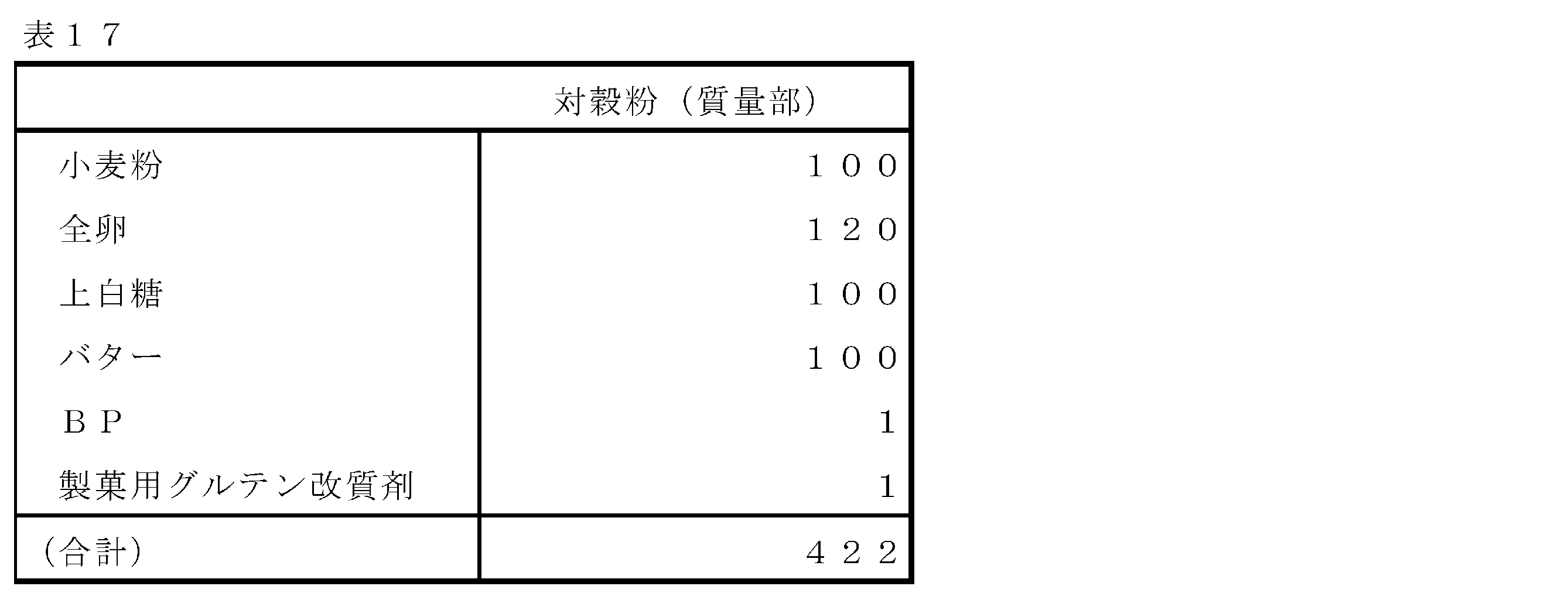
表15、表16の実施例の結果より、ルテインを含有した製菓用グルテン改質剤を使用することで、しっとり感と口溶けが良く、更にボリュームや内相に優れたケーキ類を安定して製造することができることが分かる。
一方、表15、16の比較例の結果より、ルテインを含有した製菓用グルテン改質剤を使用しない場合、本発明の効果を得ることができない。
Claims (7)
- ルテインを含有することを特徴とする、グルテン改質剤。
- 油脂及び/又は液糖を含有することを特徴とする、請求項1に記載のグルテン改質剤。
- 製パン用であることを特徴とする、請求項1又は2に記載のグルテン改質剤。
- 製菓用であることを特徴とする、請求項1又は2に記載のグルテン改質剤。
- グルテン、及び、請求項1又は2に記載のグルテン改質剤を含み、
ルテインの含有量が、前記グルテン1000000質量部に対して0.2~20質量部であることを特徴とする、穀粉生地。 - 製パン用であることを特徴とする、請求項5に記載の穀粉生地。
- 製菓用であることを特徴とする、請求項5に記載の穀粉生地。
Priority Applications (2)
| Application Number | Priority Date | Filing Date | Title |
|---|---|---|---|
| CN202480013137.2A CN120659540A (zh) | 2023-03-31 | 2024-03-27 | 麸质改性剂、谷粉面团 |
| KR1020257031672A KR20250169329A (ko) | 2023-03-31 | 2024-03-27 | 글루텐 개질제, 곡분 생지 |
Applications Claiming Priority (6)
| Application Number | Priority Date | Filing Date | Title |
|---|---|---|---|
| JP2023-058250 | 2023-03-31 | ||
| JP2023058250 | 2023-03-31 | ||
| JP2023-091981 | 2023-06-02 | ||
| JP2023091981A JP2024173510A (ja) | 2023-06-02 | 2023-06-02 | 製パン用改質剤 |
| JP2023-124500 | 2023-07-31 | ||
| JP2023124500A JP2025020875A (ja) | 2023-07-31 | 2023-07-31 | 製菓用改質剤 |
Publications (1)
| Publication Number | Publication Date |
|---|---|
| WO2024204409A1 true WO2024204409A1 (ja) | 2024-10-03 |
Family
ID=92905587
Family Applications (1)
| Application Number | Title | Priority Date | Filing Date |
|---|---|---|---|
| PCT/JP2024/012373 Ceased WO2024204409A1 (ja) | 2023-03-31 | 2024-03-27 | グルテン改質剤、穀粉生地 |
Country Status (4)
| Country | Link |
|---|---|
| KR (1) | KR20250169329A (ja) |
| CN (1) | CN120659540A (ja) |
| TW (1) | TW202444254A (ja) |
| WO (1) | WO2024204409A1 (ja) |
Citations (4)
| Publication number | Priority date | Publication date | Assignee | Title |
|---|---|---|---|---|
| US20040052916A1 (en) * | 2002-09-16 | 2004-03-18 | Ree Sook Hee | Bread utilizing vegetables for their nutritional value and method for making |
| WO2006111779A1 (en) * | 2005-04-22 | 2006-10-26 | Komuves Geza | Bakery products prepared with vegetable flakes and premixes for the preparation thereof |
| JP2017143747A (ja) * | 2016-02-15 | 2017-08-24 | 奥野製薬工業株式会社 | パン類品質改良剤およびそれを用いたパン類の製造方法 |
| CN111955513A (zh) * | 2020-09-07 | 2020-11-20 | 辽宁眼宝生物科技股份有限公司 | 叶黄素酯蛋糕及其制作方法 |
Family Cites Families (6)
| Publication number | Priority date | Publication date | Assignee | Title |
|---|---|---|---|---|
| JPH05219886A (ja) | 1992-02-14 | 1993-08-31 | Asahi Denka Kogyo Kk | 製パン練込油脂組成物 |
| JP4924897B2 (ja) | 2007-08-10 | 2012-04-25 | 日油株式会社 | 製パン用油脂組成物及び該組成物を使用して製造されたパン |
| JP2009201468A (ja) | 2008-02-29 | 2009-09-10 | Adeka Corp | ベーカリー製品用湯種生地、及び該湯種生地を用いたベーカリー製品 |
| JP5886006B2 (ja) | 2011-11-16 | 2016-03-16 | 株式会社Adeka | 製パン練り込み用乳化油脂組成物 |
| JP7559331B2 (ja) | 2020-03-10 | 2024-10-02 | 不二製油株式会社 | 練り込み用油中水型乳化組成物 |
| JP2022152863A (ja) | 2021-03-29 | 2022-10-12 | 日油株式会社 | バターケーキ用油脂組成物、バターケーキ生地、バターケーキ生地の製造方法、バターケーキ |
-
2024
- 2024-03-27 WO PCT/JP2024/012373 patent/WO2024204409A1/ja not_active Ceased
- 2024-03-27 TW TW113111399A patent/TW202444254A/zh unknown
- 2024-03-27 KR KR1020257031672A patent/KR20250169329A/ko active Pending
- 2024-03-27 CN CN202480013137.2A patent/CN120659540A/zh active Pending
Patent Citations (4)
| Publication number | Priority date | Publication date | Assignee | Title |
|---|---|---|---|---|
| US20040052916A1 (en) * | 2002-09-16 | 2004-03-18 | Ree Sook Hee | Bread utilizing vegetables for their nutritional value and method for making |
| WO2006111779A1 (en) * | 2005-04-22 | 2006-10-26 | Komuves Geza | Bakery products prepared with vegetable flakes and premixes for the preparation thereof |
| JP2017143747A (ja) * | 2016-02-15 | 2017-08-24 | 奥野製薬工業株式会社 | パン類品質改良剤およびそれを用いたパン類の製造方法 |
| CN111955513A (zh) * | 2020-09-07 | 2020-11-20 | 辽宁眼宝生物科技股份有限公司 | 叶黄素酯蛋糕及其制作方法 |
Non-Patent Citations (3)
| Title |
|---|
| ALOTAIBI HAJER NAIF, ANDERSON ALFRED K., SIDHU JIWAN S.: "Influence of lutein content of marigold flowers on functional properties of baked pan bread", ANNALS OF AGRICULTURAL SCIENCE, UNIVERSITY OF AIN SHAMS, FACULTY OF AGRICULTURE, EG, vol. 66, no. 2, 1 December 2021 (2021-12-01), EG , pages 162 - 168, XP093218687, ISSN: 0570-1783, DOI: 10.1016/j.aoas.2021.12.002 * |
| DZIKI DARIUSZ, HASSOON WALEED H., BIERNACKA BEATA, GAWLIK-DZIKI URSZULA: "Dried and Powdered Leaves of Parsley as a Functional Additive to Wheat Bread", APPLIED SCIENCES, MDPI SWITZERLAND, vol. 12, no. 15, pages 7930, XP093218688, ISSN: 2076-3417, DOI: 10.3390/app12157930 * |
| KWON HYUKJIN, LEE DONG‐UN, LEE SUYONG: "Lutein fortification of wheat bread with marigold powder: impact on rheology, water dynamics, and structure", JOURNAL OF THE SCIENCE OF FOOD AND AGRICULTURE, WILEY & SONS, CHICHESTER., GB, vol. 103, no. 11, 30 August 2023 (2023-08-30), GB , pages 5462 - 5471, XP093218689, ISSN: 0022-5142, DOI: 10.1002/jsfa.12621 * |
Also Published As
| Publication number | Publication date |
|---|---|
| TW202444254A (zh) | 2024-11-16 |
| CN120659540A (zh) | 2025-09-16 |
| KR20250169329A (ko) | 2025-12-02 |
Similar Documents
| Publication | Publication Date | Title |
|---|---|---|
| JP7634171B2 (ja) | 製パン用油脂組成物、製パン用穀粉生地、製パン用穀粉生地の製造方法 | |
| EP1916910A2 (en) | Batter-like compositions containing setting agent and methods of preparing and using same | |
| US20070009643A1 (en) | Monoglyceride and emulsifier compositions and processes of producing the same | |
| WO2004110160A1 (ja) | ベーカリー製品用油脂組成物及びベーカリー製品 | |
| US20080138484A1 (en) | Starchy Food Material or Starchy Food | |
| KR101435643B1 (ko) | 난백분말을 이용한 거품형 케이크용 프리믹스 조성물, 및 이를 이용하여 제조된 거품형 케이크 및 그 제조방법 | |
| WO2018222117A1 (en) | Cooking compositions comprising a chemical leavening agent substitute | |
| JP4211217B2 (ja) | 食用油脂代替物 | |
| JP2003199536A (ja) | 起泡組成物の製造方法および焼成菓子の製造方法 | |
| WO2010107021A1 (ja) | ビスケット生地の製造方法及びビスケット | |
| TWI665966B (zh) | 油脂組成物、添加有該油脂組成物之小麥膨化食品、及該油脂組成物的製造方法 | |
| JP3669303B2 (ja) | ベーカリー製品の製造方法 | |
| JP4507195B2 (ja) | ケーキ生地用乳化油脂 | |
| WO2024204409A1 (ja) | グルテン改質剤、穀粉生地 | |
| CN109820012A (zh) | 一种面包专用复合乳化油及其制备方法和面包的制作方法 | |
| TWI878441B (zh) | 烘焙食品用麵糊之製造方法 | |
| JP2020162442A (ja) | 製パン用水中油型乳化油脂組成物 | |
| JP6316604B2 (ja) | ベーカリー製品の製造方法 | |
| JP2881655B2 (ja) | 空洞を有するパン類の製造法 | |
| JP2025150025A (ja) | 製菓用グルテン改質剤 | |
| JP7615551B2 (ja) | 冷凍ペストリー生地練り込み用油脂組成物、冷凍ペストリー生地 | |
| JP4278956B2 (ja) | 多層状膨化食品の製造方法及び多層状膨化食品 | |
| JP2025149998A (ja) | 製パン用グルテン改質剤 | |
| JP7427416B2 (ja) | ケーキ類生地及びケーキ類の製造方法 | |
| JP7531271B2 (ja) | ケーキ生地用気泡安定剤、ケーキ生地及びケーキの製造方法、並びに菓子類の製造方法 |
Legal Events
| Date | Code | Title | Description |
|---|---|---|---|
| 121 | Ep: the epo has been informed by wipo that ep was designated in this application |
Ref document number: 24780511 Country of ref document: EP Kind code of ref document: A1 |
|
| WWE | Wipo information: entry into national phase |
Ref document number: 202480013137.2 Country of ref document: CN |
|
| WWP | Wipo information: published in national office |
Ref document number: 202480013137.2 Country of ref document: CN |
|
| ENP | Entry into the national phase |
Ref document number: 1020257031672 Country of ref document: KR Free format text: ST27 STATUS EVENT CODE: A-0-1-A10-A15-NAP-PA0105 (AS PROVIDED BY THE NATIONAL OFFICE) |
|
| WWE | Wipo information: entry into national phase |
Ref document number: KR1020257031672 Country of ref document: KR |
|
| NENP | Non-entry into the national phase |
Ref country code: DE |
|
| 122 | Ep: pct application non-entry in european phase |
Ref document number: 24780511 Country of ref document: EP Kind code of ref document: A1 |