WO2024203869A1 - リチウムイオン電池 - Google Patents
リチウムイオン電池 Download PDFInfo
- Publication number
- WO2024203869A1 WO2024203869A1 PCT/JP2024/011333 JP2024011333W WO2024203869A1 WO 2024203869 A1 WO2024203869 A1 WO 2024203869A1 JP 2024011333 W JP2024011333 W JP 2024011333W WO 2024203869 A1 WO2024203869 A1 WO 2024203869A1
- Authority
- WO
- WIPO (PCT)
- Prior art keywords
- negative electrode
- separator
- positive electrode
- layer
- ion battery
- Prior art date
- Legal status (The legal status is an assumption and is not a legal conclusion. Google has not performed a legal analysis and makes no representation as to the accuracy of the status listed.)
- Ceased
Links
Images




Classifications
-
- H—ELECTRICITY
- H01—ELECTRIC ELEMENTS
- H01M—PROCESSES OR MEANS, e.g. BATTERIES, FOR THE DIRECT CONVERSION OF CHEMICAL ENERGY INTO ELECTRICAL ENERGY
- H01M10/00—Secondary cells; Manufacture thereof
- H01M10/05—Accumulators with non-aqueous electrolyte
- H01M10/052—Li-accumulators
- H01M10/0525—Rocking-chair batteries, i.e. batteries with lithium insertion or intercalation in both electrodes; Lithium-ion batteries
-
- H—ELECTRICITY
- H01—ELECTRIC ELEMENTS
- H01M—PROCESSES OR MEANS, e.g. BATTERIES, FOR THE DIRECT CONVERSION OF CHEMICAL ENERGY INTO ELECTRICAL ENERGY
- H01M10/00—Secondary cells; Manufacture thereof
- H01M10/05—Accumulators with non-aqueous electrolyte
- H01M10/056—Accumulators with non-aqueous electrolyte characterised by the materials used as electrolytes, e.g. mixed inorganic/organic electrolytes
- H01M10/0564—Accumulators with non-aqueous electrolyte characterised by the materials used as electrolytes, e.g. mixed inorganic/organic electrolytes the electrolyte being constituted of organic materials only
- H01M10/0566—Liquid materials
-
- H—ELECTRICITY
- H01—ELECTRIC ELEMENTS
- H01M—PROCESSES OR MEANS, e.g. BATTERIES, FOR THE DIRECT CONVERSION OF CHEMICAL ENERGY INTO ELECTRICAL ENERGY
- H01M10/00—Secondary cells; Manufacture thereof
- H01M10/05—Accumulators with non-aqueous electrolyte
- H01M10/058—Construction or manufacture
- H01M10/0585—Construction or manufacture of accumulators having only flat construction elements, i.e. flat positive electrodes, flat negative electrodes and flat separators
-
- H—ELECTRICITY
- H01—ELECTRIC ELEMENTS
- H01M—PROCESSES OR MEANS, e.g. BATTERIES, FOR THE DIRECT CONVERSION OF CHEMICAL ENERGY INTO ELECTRICAL ENERGY
- H01M4/00—Electrodes
- H01M4/02—Electrodes composed of, or comprising, active material
- H01M4/13—Electrodes for accumulators with non-aqueous electrolyte, e.g. for lithium-accumulators; Processes of manufacture thereof
- H01M4/131—Electrodes based on mixed oxides or hydroxides, or on mixtures of oxides or hydroxides, e.g. LiCoOx
-
- H—ELECTRICITY
- H01—ELECTRIC ELEMENTS
- H01M—PROCESSES OR MEANS, e.g. BATTERIES, FOR THE DIRECT CONVERSION OF CHEMICAL ENERGY INTO ELECTRICAL ENERGY
- H01M4/00—Electrodes
- H01M4/02—Electrodes composed of, or comprising, active material
- H01M4/64—Carriers or collectors
- H01M4/66—Selection of materials
-
- H—ELECTRICITY
- H01—ELECTRIC ELEMENTS
- H01M—PROCESSES OR MEANS, e.g. BATTERIES, FOR THE DIRECT CONVERSION OF CHEMICAL ENERGY INTO ELECTRICAL ENERGY
- H01M50/00—Constructional details or processes of manufacture of the non-active parts of electrochemical cells other than fuel cells, e.g. hybrid cells
- H01M50/40—Separators; Membranes; Diaphragms; Spacing elements inside cells
- H01M50/409—Separators, membranes or diaphragms characterised by the material
- H01M50/431—Inorganic material
- H01M50/434—Ceramics
-
- H—ELECTRICITY
- H01—ELECTRIC ELEMENTS
- H01M—PROCESSES OR MEANS, e.g. BATTERIES, FOR THE DIRECT CONVERSION OF CHEMICAL ENERGY INTO ELECTRICAL ENERGY
- H01M50/00—Constructional details or processes of manufacture of the non-active parts of electrochemical cells other than fuel cells, e.g. hybrid cells
- H01M50/40—Separators; Membranes; Diaphragms; Spacing elements inside cells
- H01M50/46—Separators, membranes or diaphragms characterised by their combination with electrodes
-
- H—ELECTRICITY
- H01—ELECTRIC ELEMENTS
- H01M—PROCESSES OR MEANS, e.g. BATTERIES, FOR THE DIRECT CONVERSION OF CHEMICAL ENERGY INTO ELECTRICAL ENERGY
- H01M50/00—Constructional details or processes of manufacture of the non-active parts of electrochemical cells other than fuel cells, e.g. hybrid cells
- H01M50/40—Separators; Membranes; Diaphragms; Spacing elements inside cells
- H01M50/489—Separators, membranes, diaphragms or spacing elements inside the cells, characterised by their physical properties, e.g. swelling degree, hydrophilicity or shut down properties
-
- Y—GENERAL TAGGING OF NEW TECHNOLOGICAL DEVELOPMENTS; GENERAL TAGGING OF CROSS-SECTIONAL TECHNOLOGIES SPANNING OVER SEVERAL SECTIONS OF THE IPC; TECHNICAL SUBJECTS COVERED BY FORMER USPC CROSS-REFERENCE ART COLLECTIONS [XRACs] AND DIGESTS
- Y02—TECHNOLOGIES OR APPLICATIONS FOR MITIGATION OR ADAPTATION AGAINST CLIMATE CHANGE
- Y02E—REDUCTION OF GREENHOUSE GAS [GHG] EMISSIONS, RELATED TO ENERGY GENERATION, TRANSMISSION OR DISTRIBUTION
- Y02E60/00—Enabling technologies; Technologies with a potential or indirect contribution to GHG emissions mitigation
- Y02E60/10—Energy storage using batteries
Definitions
- a lithium ion battery is known that has a positive electrode layer made of a sintered body of lithium composite oxide, a negative electrode layer made of a sintered body containing titanium, and a ceramic separator disposed between the positive electrode layer and the negative electrode layer.
- Patent Document 1 discloses a lithium ion battery that is made of an integrated sintered plate in which the positive electrode layer, ceramic separator, and negative electrode layer are bonded together, and that is impregnated with an electrolyte.
- the lithium ion battery disclosed in Patent Document 1 has a ceramic separator made of MgO and glass as the separator.
- Patent Document 2 discloses an all-solid-state battery having a laminate in which multiple positive electrode layers and multiple negative electrode layers are alternately stacked with solid electrolyte layers interposed therebetween.
- Patent Document 2 JP 2021-027044 A
- a laminate is disclosed in which lithium vanadium phosphate is used as the positive electrode active material layer and the negative electrode active material layer, and lithium aluminum titanium phosphate is used as the solid electrolyte layer. It also discloses that copper and lithium vanadium phosphate are used as the positive electrode current collector layer and the negative electrode current collector layer.
- one of the objectives of the invention disclosed herein is to provide a highly reliable lithium-ion battery whose charging characteristics do not deteriorate, especially when placed in a high-temperature environment.
- a lithium ion battery includes a plurality of positive electrode layers, a plurality of negative electrode layers, and a separator disposed between the positive electrode layers and the negative electrode layers.
- the lithium ion battery includes an electrode including an integrated sintered body in which the positive electrode layers, the negative electrode layers, and the separator are sintered together, an electrolyte impregnated in the electrode, and an exterior body in which the electrode and the electrolyte are housed.
- a negative electrode current collector layer is provided in contact with the negative electrode layer.
- the negative electrode current collector layer includes Ag.
- the separator includes LiAlO2 . The content of LiAlO2 in the separator is 50 volume % or more.
- the above lithium-ion battery provides a highly reliable lithium-ion battery whose charging characteristics do not deteriorate even when placed in a high-temperature environment.
- FIG. 1 is a schematic cross-sectional view showing a lithium ion battery according to the present disclosure.
- FIG. 2 is a schematic cross-sectional perspective view showing a laminated portion included in a lithium ion battery according to the present disclosure.
- FIG. 3 is a schematic perspective view showing a sintered body included in a lithium ion battery according to the present disclosure.
- FIG. 4 is a schematic perspective view showing a sintered body included in a lithium ion battery according to the present disclosure.
- FIG. 5 is a schematic diagram showing a part of a process for producing a sintered body included in a lithium ion battery according to the present disclosure.
- FIG. 1 is a schematic cross-sectional view showing a lithium ion battery according to the present disclosure.
- FIG. 2 is a schematic cross-sectional perspective view showing a laminated portion included in a lithium ion battery according to the present disclosure.
- FIG. 3 is a schematic perspective view showing a sintered body included in a lithium i
- FIG. 6 is a schematic diagram showing a part of a process for producing a sintered body included in a lithium ion battery according to the present disclosure.
- FIG. 7 is a schematic diagram showing a part of a process for producing a sintered body included in a lithium ion battery according to the present disclosure.
- FIG. 8 is a schematic perspective view showing the appearance of a lithium-ion battery according to the present disclosure.
- a lithium ion battery according to the present disclosure includes a plurality of positive electrode layers, a plurality of negative electrode layers, and a separator disposed between the positive electrode layers and the negative electrode layers.
- the lithium ion battery includes an electrode including an integrated sintered body in which the plurality of positive electrode layers, the plurality of negative electrode layers, and the separator are sintered together, an electrolyte impregnated in the electrode, and an exterior body in which the electrode and the electrolyte are accommodated.
- a negative electrode current collector layer is provided in contact with the negative electrode layer.
- the negative electrode current collector layer includes Ag.
- the separator includes LiAlO2 . The content ratio of LiAlO2 in the separator is 50 volume % or more.
- lithium ion batteries are known that include a laminate that includes multiple positive electrode layers and multiple negative electrode layers, with multiple cells configured within one electrode (for example, Patent Document 2).
- Patent Document 2 discloses that a material with excellent electrical conductivity can be used for the positive electrode current collector layer and the negative electrode current collector layer, and that, for example, silver, palladium, gold, platinum, aluminum, copper, and nickel can be used.
- the negative electrode current collector in lithium ion batteries is exclusively made of copper.
- the electrode for a lithium ion battery according to the present disclosure uses a separator with a new configuration. By using such an electrode, a highly reliable lithium ion battery can be provided in which the charging characteristics do not deteriorate even when placed in a high-temperature environment.
- the separator may contain LiAlO 2 and a metal oxide other than LiAlO 2.
- the separator has this configuration, the effects of the present disclosure can be reliably obtained.
- the positive electrode layer may be made of a lithium composite oxide sintered body
- the negative electrode layer may be made of a titanium-containing sintered body. Electrodes in which the positive electrode layer and the negative electrode layer are integral sintered bodies having these configurations are well known, and can be used to construct a high-capacity, highly durable lithium ion battery. By combining this with the aforementioned negative electrode current collector and separator, a lithium ion battery with high capacity and whose charging characteristics do not deteriorate even at high temperatures can be obtained.
- the thickness of the negative electrode current collector layer may be 0.1 ⁇ m or more and 60 ⁇ m or less.
- the thickness of the separator may be 1 ⁇ m or more and 50 ⁇ m or less.
- FIG. 1 is a schematic cross-sectional view showing the structure of a lithium ion battery 10 according to an embodiment of the present disclosure.
- FIG. 2 is a schematic cross-sectional perspective view showing a laminated portion 1 in a sintered body 9 included in the lithium ion battery 10.
- FIG. 3 is a schematic perspective view showing a sintered body 9 included in the lithium ion battery 10. In this specification, the direction along the X-axis shown in FIGS.
- the width direction of the laminated portion 1 to the sintered body 9 is referred to as the width direction of the laminated portion 1 to the sintered body 9, the direction along the Y-axis is referred to as the depth direction of the laminated portion 1 to the sintered body 9, and the direction along the Z-axis is referred to as the stacking direction or thickness direction of the laminated portion 1 to the sintered body 9.
- the surface of the top layer in the stacking direction of the laminated portion 1 is referred to as the top surface
- the surface of the bottom layer in the stacking direction is referred to as the bottom surface
- the surfaces on which all the stacked layers are exposed are referred to as the front and back surfaces.
- the front and back surfaces are parallel to the XZ plane.
- the surfaces on which the stacked structure is exposed which extend between the front and back surfaces and extend along the depth direction are referred to as side surfaces.
- the side surface is a surface parallel to the YZ plane.
- Surfaces other than the top and bottom surfaces, that is, the front and back surfaces in addition to the side surfaces, may also be referred to as side surfaces.
- the top surface, bottom surface, side surface, etc. are relative names used for convenience of explanation in this specification, and it is natural that the arrangement direction and use direction of the lithium ion battery are not limited to these directions.
- the lithium-ion battery 10 has an electrode 5 housed inside an exterior body 24.
- the electrode 5 includes a sintered body 9, and a positive electrode current collector 14 and a negative electrode current collector 18 attached to both side surfaces of the sintered body 9, respectively.
- the sintered body 9 includes a laminated portion 1 and an insulating portion 51 as an insulating ceramic portion extending to the periphery of the laminated portion 1.
- the laminated portion 1 is formed by laminating a plurality of positive electrode layers 12, a plurality of negative electrode layers 16, and a separator 20.
- the laminated portion 1 and the insulating portion 51 as a whole constitute the sintered body 9, which is a single integrated sintered body.
- the positive electrode layers 12 and the negative electrode layers 16 are alternately stacked in the lamination direction (Z-axis direction).
- a separator 20 is interposed between the positive electrode layers 12 and the negative electrode layers 16.
- the separator 20 separates the positive electrode layers 12 and the negative electrode layers 16 from each other.
- the positive electrode layers 12 are made of a sintered body containing, for example, lithium cobalt oxide.
- the negative electrode layers 16 are made of a sintered body containing, for example, titanium.
- the separator 20 is made of ceramic.
- the electrode 5 of the lithium ion battery 10 includes a positive electrode collector 14 arranged in contact with the sintered body 9 from the side to the bottom of the sintered body 9.
- the lithium ion battery 10 also includes a negative electrode collector 18 arranged in contact with the sintered body 9 from the side to the top of the sintered body 9.
- the positive electrode collector 14 and the negative electrode collector 18 may be metal foils such as aluminum foils.
- the positive electrode collector 14 may be made of LiCoO 2 , which is a positive electrode active material constituting the positive electrode layer 12, or may be made of LiCoO 2.
- the negative electrode collector 18 may be made of copper foil, silver foil, or silver.
- a carbon layer (not shown) is preferably provided between the positive electrode collector 14 and the negative electrode collector 18 and the sintered body 9.
- the carbon layer is preferably made of conductive carbon.
- the carbon layer can be formed, for example, by applying a conductive carbon paste to the surface of a metal foil used as a collector.
- the exterior body 24 has an enclosed space formed inside.
- the electrodes 5 and electrolyte 22 are contained in this enclosed space.
- the lithium-ion battery 10 has the electrolyte 22 sealed inside the exterior body 24.
- the positive electrode layer 12, the negative electrode layer 16, and the separator 20 are impregnated with the electrolyte 22.
- the exterior body 24 may be appropriately selected depending on the type of the lithium ion battery 10.
- the exterior body 24 typically includes a positive electrode can 24a, a negative electrode can 24b, and a gasket 24c, and the positive electrode can 24a and the negative electrode can 24b are crimped via the gasket 24c to form a sealed space.
- the positive electrode can 24a and the negative electrode can 24b may be made of a metal such as stainless steel, but are not limited to these.
- the gasket 24c may be an annular member made of an insulating resin such as polypropylene, polytetrafluoroethylene, PFA resin, or the like, but are not particularly limited to these.
- the lithium ion battery 10 shown in FIG. 1 is in the form of a coin-type battery
- the form of the lithium ion battery according to the present disclosure is not limited to a coin-type battery.
- the exterior body is preferably a resin substrate, and the electrodes and electrolyte are embedded in the resin substrate.
- the electrodes may be sandwiched between a pair of resin films.
- the pair of resin films may be bonded together with an adhesive.
- the pair of resin films may be heat-sealed to each other by a heat press.
- a separator made of a solid electrolyte may be used as the separator, and may not contain an electrolyte.
- FIG. 2 is a schematic cross-sectional perspective view showing a laminated portion 1 as a component of an electrode included in a lithium ion battery according to the present disclosure.
- the laminated portion 1 is a laminated body in which a large number of layers are laminated.
- FIG. 2 shows the laminated portion 1 having a rectangular parallelepiped shape, but the shape of the laminated portion 1 is not limited thereto. It is also preferable that a part of the periphery is formed in an arc shape according to a desired electrode shape, etc.
- the rectangular parallelepiped shape has a rectangular parallelepiped shape whose outer shape is defined by a width W, a depth D, and a thickness T. Note that the rectangular parallelepiped shape does not only mean a rectangular parallelepiped in a mathematically accurate sense, but also includes a three-dimensional structure having a shape similar to a rectangular parallelepiped for design and manufacturing reasons.
- separator 20 is exposed on the upper and lower surfaces of laminate 1. That is, the top and bottom layers of laminate 1 are both layers of separator 20.
- positive electrode layer 12 and negative electrode layer 16 that face each other via separator 20 form one cell.
- Five cells are formed in laminate 1 in FIG. 2.
- the number of cells in the laminate included in the lithium ion battery according to the present disclosure is not limited as long as the effect of the invention is maintained, but may be, for example, a laminate including 3 to 200 cells.
- a plurality of positive electrode layers 12 and a plurality of negative electrode layers 16 are alternately laminated.
- the positive electrode layers 12 and the negative electrode layers 16 constituting the laminate 1 are each in the shape of a quadrilateral plate.
- the widths of the positive electrode layers 12 and the negative electrode layers 16 are both smaller than the width W of the laminate 1. In other words, the positive electrode layers 12 and the negative electrode layers 16 do not exist over the entire width W of the laminate 1.
- the positive electrode layers 12 and the negative electrode layers 16 are arranged at positions offset from each other in the width direction, and each of the positive electrode layers 12 and the negative electrode layers 16 is exposed only on one of the first side surface s1 and the second side surface s2 that face each other in the laminate 1.
- each of the multiple positive electrode layers 12 is exposed on the first side surface s1 of the laminate 1, but not on the second side surface s2.
- the positive electrode layer 12 extends in the width direction from the side surface s1 to the middle of the width direction of the laminate 1, and the inner end surface 12e is the end in the width direction.
- Each of the multiple negative electrode layers 16 is exposed on the second side surface s2 of the laminate 1, but not on the first side surface s1.
- the negative electrode layer 16 extends in the width direction from the side surface s2 to the middle of the width direction of the laminate 1, with the inner end surface 16e being the end in the width direction.
- the negative electrode layer 16 has a negative electrode collector layer 19 on one of its main surfaces or inside in the thickness direction, which contacts the negative electrode layer 16.
- the negative electrode collector layer 19 may be provided inside the negative electrode layer 16 in the thickness direction.
- the negative electrode collector layer 19 may also be formed so as to be exposed on one of the main surfaces of the negative electrode layer 16.
- the negative electrode collector layer 19 is made of a material with excellent electrical conductivity.
- a separator 20 is interposed between the positive electrode layer 12 and the negative electrode layer 16.
- the separator 20 includes a first region 21, a second region 22, and a third region 23.
- the first region 21 extends across the entire width W in the width direction of the laminated portion 1, and is interposed between the positive electrode layer 12 and the negative electrode layer 16 in the thickness direction of the laminated portion 1.
- the second region 22 is a region that is at the same position as the positive electrode layer 12 in the thickness direction, is aligned with the positive electrode layer 12 in the width direction (X-axis direction), and extends between the inner end surface 12e of the positive electrode layer 12 and the side surface s2.
- the second region 22 functions as an insulating layer that insulates between the positive electrode layer 12 and the side surface s2.
- the third region 23 is at the same position as the negative electrode layer 16 in the thickness direction, is aligned with the negative electrode layer 16 in the width direction (X-axis direction), and is a region that extends between the inner end surface 16e of the negative electrode layer 16 and the side surface s1.
- the third region 23 functions as an insulating layer that provides insulation between the negative electrode layer 16 and the side surface s1.
- the first region 21, the second region 22, and the third region 23 are continuous without any boundaries.
- the first region 21, the second region 22, and the third region 23 are regions that are partitioned for the sake of convenience of explanation, and in an actual electrode, it is preferable that the first region 21, the second region 22, and the third region 23 are an integral structure that is continuous throughout.
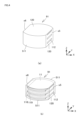
- Fig. 3 is a schematic perspective view showing a sintered body 9 included in the lithium ion battery according to the present disclosure.
- Fig. 3(a) shows the external appearance
- Fig. 3(b) is a schematic view showing the configuration of layers included in the sintered body 9, including the inside.
- the sintered body 9 includes the laminated portion 1 described above and an insulating layer 51 added in contact with the laminated portion 1.
- the first side surface s1 of the periphery of the laminated portion 1 exposes the positive electrode layer 12 and the separator 20, and the negative electrode layer 16 is not exposed.
- the second side surface s2 of the periphery of the laminated portion 1 exposes the negative electrode layer 16 and the separator 20, and the positive electrode layer 12 is not exposed.
- the first side surface s1 and the second side surface s2 of the laminated portion 1 are exposed and form the surface of the sintered body 9.
- a laminated structure including a positive electrode layer, a negative electrode layer, and a separator appears on the third side surface s3 and the fourth side surface s4 of the periphery of the laminated portion 1.
- the third side surface s3 and the fourth side surface s4 of the laminated portion 1 are covered with an insulating layer 51 as an insulating ceramic portion. That is, the third side surface s3 and the fourth side surface s4 of the laminated portion 1 are not exposed to the outside because they are covered with the insulating layer 51 in the sintered body 9.
- the periphery of the laminated portion 1 means the surface of the laminated portion 1 located on the outer periphery, excluding the upper and lower surfaces in the lamination direction.
- the insulating layer 51 is preferably provided so as to cover both the third side s3 and the fourth side s4 of the laminate 1, but may be provided so as to cover either the third side s3 or the fourth side s4. Also, it is preferable that the insulating layer 51 covers the entire surfaces of the third side s3 and the fourth side s4, but may be provided so as to cover only a portion of them.
- the insulating layer 51 extends over at least a portion of the lamination direction of the third side s3 and the fourth side s4 so as to cover at least a portion of the layers constituting the laminate. Also, the insulating layer 51 is not a required component, and the sintered body 9 may be composed of only the laminate 1.
- the sintered body 9 has a rectangular parallelepiped (square) shape, but the external shape of the sintered body is not limited to this.
- it may be a cylinder (round) with sides, or a polygonal prism shape.
- the insulating layer 51 may cover only a portion of the third side surface s3 and the fourth side surface s4, rather than covering the entire surfaces of the third side surface s3 and the fourth side surface s4.
- the sintered body included in the lithium ion battery according to the present disclosure may be round, in addition to a square shape like the sintered body 9.
- Figures 4(a) and 4(b) show a sintered body 91 having a shape in which a part of a cylinder has been cut off.
- Figure 4(a) shows the appearance
- Figure 4(b) is a schematic diagram showing the configuration of the layers included in the sintered body 91, including the inside. This shape is called "round”.
- the sintered body 91 has a different shape from the sintered body 9, but has the same laminated structure as the sintered body 9.
- the sintered body 91 includes a laminated section 11 and an insulating layer 511 arranged to cover the arc-shaped side surface of the laminated section 11.
- the laminated section 11 has the same configuration as the laminated section 1, except for the difference in the external shape.
- the sintered body 91 has a shape in which a part of a cylinder has been cut off parallel to the tangent line, forming two opposing side surfaces s5 and s6.
- the end surface of the separator 120 and the end surface of the positive electrode layer 112 are exposed on the side surface s5.
- the negative electrode layer 116 is not exposed on side surface s5.
- the end surface of the separator 120 and the end surface of the negative electrode layer 116 are exposed on side surface s6, which is the surface opposite side surface s5.
- the positive electrode layer 112 is not exposed on side surface s6.
- the positive electrode layer is composed of a sintered body containing lithium cobalt oxide.
- the positive electrode layer may be free of binders or conductive additives.
- Specific examples of lithium cobalt oxide include LiCoO 2 (hereinafter, sometimes abbreviated as LCO).
- LCO LiCoO 2
- the positive electrode layer is preferably an oriented positive electrode layer containing a plurality of primary particles composed of lithium cobalt oxide, the plurality of primary particles being oriented at an average orientation angle of more than 0° and less than or equal to 30° with respect to the layer surface of the positive electrode layer. Examples of the structure, composition, and method of identifying such an oriented positive electrode layer include those disclosed in Patent Document 1 (International Publication No. WO 2019/221144).
- the lithium cobalt oxide constituting the primary particles in the positive electrode layer may be Li x NiCoO 2 (lithium nickel cobalt oxide), Li x CoNiMnO 2 (lithium cobalt nickel manganese oxide), Li x CoMnO 2 (lithium cobalt manganese oxide), etc.
- other lithium composite oxides may be included together with the lithium cobalt oxide.
- the lithium composite oxide include oxides represented by Li x MO 2 (wherein 0.05 ⁇ x ⁇ 1.10, M is at least one transition metal, and M typically includes one or more of Co, Ni, and Mn).
- the transition metal element among the elements constituting the positive electrode layer is Co.
- the positive electrode layer is made of a sintered body containing Li x NiCoO 2 (lithium nickel cobalt oxide)
- the transition metal elements among the elements constituting the positive electrode layer are Ni and Co.
- the positive electrode layer is made of a sintered body containing Li x CoNiMnO 2 (lithium cobalt nickel manganese oxide)
- the transition metal elements among the elements constituting the positive electrode layer are Ni, Co and Mn. The same is true for positive electrodes other than lithium cobalt oxide.
- the transition metal element among the elements constituting the positive electrode layer is Fe.
- the transition metal element constituting the positive electrode layer may be a transition metal element such as V (vanadium).
- the average particle size of the multiple primary particles that make up the positive electrode layer is preferably 5 ⁇ m or more.
- the average particle size of the primary particles used to calculate the average orientation angle is preferably 5 ⁇ m or more, more preferably 7 ⁇ m or more, and even more preferably 12 ⁇ m or more.
- the positive electrode layer may contain pores.
- the electrolyte can penetrate into the sintered body when the sintered body is incorporated into a battery as a positive electrode layer, thereby improving the lithium ion conductivity.
- the porosity of the positive electrode layer is preferably 20 to 60%, more preferably 25 to 55%, and even more preferably 30 to 50%.
- the porosity of the sintered body can be measured according to a known method.
- the average pore diameter of the positive electrode layer is preferably 0.1 to 10.0 ⁇ m, more preferably 0.2 to 5.0 ⁇ m, and even more preferably 0.25 to 3.0 ⁇ m. Within the above range, localized stress concentration in large pores is suppressed, making it easier to release stress uniformly within the sintered body. In addition, the pores can more effectively improve lithium ion conductivity by allowing the electrolyte to penetrate inside.
- the thickness of the positive electrode layer in the laminated portion is not particularly limited, but is preferably, for example, 1 to 200 ⁇ m, more preferably 2 to 150 ⁇ m, and even more preferably 5 to 100 ⁇ m. Within this range, electronic resistance is suppressed, and the resistance to the movement of Li ions contained in the electrolyte is also suppressed, making it possible to reduce battery resistance.
- the separator is composed of a ceramic microporous film.
- the separator contains LiAlO 2 (lithium aluminate), and is preferably made of LiAlO 2.
- the separator is a sintered body of LiAlO 2. Conventionally, LiAlO 2 has not been expected to be used as a separator in a multilayer laminated ceramic electrode.
- the content of LiAlO 2 in the separator may be 50% by volume or more, more preferably 70% by volume or more, and even more preferably 100% by volume. That is, the separator is preferably made of LiAlO 2 (lithium aluminate).
- the separator may contain other metal oxides in addition to LiAlO 2. Specifically, the other metal oxides may include one or more selected from the group consisting of MgO, Li 2 ZrO 3 , ZrO 2 , Al 2 O 3 , Li 3 AlO 4 and LiAl 5 O 8.
- the separator may also include nitrides and carbides that are ceramic materials, specifically, for example, SiC, Si 3 N 4 , AlN, etc.
- the thickness of the separator in the laminated portion is not particularly limited, but is preferably, for example, 1 to 50 ⁇ m, and more preferably 2 to 30 ⁇ m.
- the thickness of the separator here refers to the thickness of the region that separates the positive electrode layer and the negative electrode layer in the lamination direction (first region 21 shown in Figure 2).
- the second region 22 and third region 23 of the separator 20 can be made to be the same thickness as the positive electrode layer and the negative electrode layer, respectively.
- the porosity of the separator is not particularly limited, but can be, for example, about 30 to 70%, and is preferably about 40 to 60%.
- the negative electrode layer is, for example, composed of a plate-shaped sintered body containing a titanium-containing composition.
- the negative electrode layer may be one that does not contain a binder or a conductive additive.
- the titanium-containing sintered body preferably contains lithium titanate Li 4 Ti 5 O 12 (hereinafter, LTO) or niobium titanium composite oxide Nb 2 TiO 7 , and more preferably contains LTO.
- LTO lithium titanate Li 4 Ti 5 O 12
- Nb 2 TiO 7 niobium titanium composite oxide
- LTO is not limited to a spinel structure.
- a part of LTO may be replaced with other elements. Examples of other elements include Nb, Ta, W, Al, Mg, etc.
- the LTO sintered body can be produced, for example, according to the method described in JP 2015-185337 A.
- the transition metal element of the negative electrode layer is Ti.
- the transition metal elements of the negative electrode layer are Nb and Ti.
- the negative electrode layer has a structure in which a large number of primary particles are bonded together. These primary particles are preferably composed of LTO or Nb 2 TiO 7.
- the negative electrode layer is composed of an integral sintered body together with the positive electrode layer and the separator 20.
- the thickness of the negative electrode layer is not particularly limited, but is preferably 1 to 200 ⁇ m, more preferably 2 to 150 ⁇ m, and even more preferably 5 to 100 ⁇ m.
- the primary particle size which is the average particle size of the multiple primary particles that make up the negative electrode layer, is preferably 1.2 ⁇ m or less, more preferably 0.02 to 1.2 ⁇ m, and even more preferably 0.05 to 0.7 ⁇ m.
- the negative electrode layer preferably contains pores. By containing pores, particularly open pores, when the negative electrode layer is incorporated into a battery, the electrolyte can penetrate into the inside, thereby improving the lithium ion conductivity.
- the porosity of the negative electrode layer is preferably 20 to 60%, more preferably 30 to 55%, and even more preferably 35 to 50%.
- the average pore diameter of the negative electrode layer is preferably 0.08 to 5.0 ⁇ m, more preferably 0.1 to 3.0 ⁇ m, and even more preferably 0.12 to 1.5 ⁇ m.
- the negative electrode collector layer can be made of a material having excellent electrical conductivity.
- the negative electrode collector layer contains Ag (silver).
- the negative electrode collector layer may further contain one or more selected from the group consisting of Au (gold), Pt (platinum), Pd (palladium), Al (aluminum), Cu (copper) and Ni (nickel).
- the content ratio of Ag in the negative electrode collector layer may be 30% or more, more preferably 50% or more, and even more preferably 100%. That is, the negative electrode collector layer 19 is preferably a layer made of Ag.
- the thickness of the negative electrode current collector layer is not particularly limited, but is preferably 0.1 to 60 ⁇ m, and more preferably 0.5 to 30 ⁇ m. It is also believed that when the relationship between the thickness of the negative electrode current collector layer and the thickness of the separator is within a certain range, the diffusion of Ag contained in the negative electrode current collector layer can be effectively suppressed.
- the ratio of the thickness of the negative electrode current collector layer (A) to the thickness of the separator (B) preferably satisfies 0.1 ⁇ B/A ⁇ 50, and more preferably 0.15 ⁇ B/A ⁇ 30.
- the insulating layer included in the sintered body covers the periphery of the laminated part, particularly the side surface other than the part where the internal electrode layer is drawn out.
- the insulating layer is composed of insulating ceramic. Specifically, the same ceramic as that used as the separator can be used.
- the insulating ceramic part contains LiAlO 2 and is preferably composed of LiAlO 2.
- the thickness w2 of the insulating layer is not particularly limited, but is preferably 100 ⁇ m to 1000 ⁇ m, for example, and more preferably 200 ⁇ m to 500 ⁇ m.
- the insulating layer and the separator when the insulating layer and the separator are composed of the same composition, the insulating layer and the separator may be integrated during the sintering process, and the insulating layer and the separator may be an integrated region without a boundary in the sintered body.
- the lithium ion battery includes an electrolyte.
- the electrolyte is not particularly limited, and any electrolyte known as an electrolyte for lithium ion batteries can be used.
- the solvent one or a combination of two or more selected from ethylene carbonate (EC), methyl ethyl carbonate (MEC), diethyl carbonate (DEC), ethyl methyl carbonate (EMC), propylene carbonate (PC) and ⁇ -butyrolactone (GBL) can be used.
- a lithium salt compound such as lithium hexafluorophosphate (LiPF 6 ) or lithium borofluoride (LiBF 4 ) can be used.
- the electrolyte 22 may further include at least one selected from vinylene carbonate (VC), fluoroethylene carbonate (FEC), vinyl ethylene carbonate (VEC), and lithium difluoro(oxalato)borate (LiDFOB) as an additive.
- the concentration of the electrolyte in the electrolytic solution is preferably 0.5 to 4.0 mol/L, more preferably 0.6 to 3.0 mol/L, even more preferably 0.7 to 2.5 mol/L, and particularly preferably 0.8 to 2.0 mol/L.
- a solid electrolyte or a polymer electrolyte can be used as the electrolyte.
- the electrolyte is impregnated at least inside the pores of the separator.
- the impregnation method examples include a method in which the electrolyte is melted and allowed to penetrate into the pores of the separator, and a method in which a compressed powder of the electrolyte is pressed against the separator.
- FIG. 5 is a schematic diagram showing a process for preparing, stacking and pressing each sheet for constituting a laminate, among the steps for producing a sintered body.
- the positive electrode green sheet 112, the negative electrode green sheet 116, and the separator green sheet 120 which are materials for forming the laminate, are prepared separately. Typically, a slurry containing the raw materials for each layer is first prepared, and then the prepared slurry is formed into a sheet on a resin film, thereby preparing the green sheets.
- the negative electrode green sheet 116 may have a collector layer 119 formed on one of its main surfaces.
- each sheet is cut to a predetermined width and stacked in order to form a predetermined layer structure. Note that the layer structure is simply shown in the example of FIG. 5, but a unit U including the negative electrode green sheet 116, the separator green sheet 120, the positive electrode green sheet 112, and the separator green sheet 120 may be repeatedly stacked to form a multi-layer laminate.
- each green sheet when stacking, each green sheet may be used alone in the thickness direction, or two or more of the same type of sheets may be stacked continuously in the thickness direction.
- two negative electrode green sheets 116 having a current collector layer 119 on one side may be stacked.
- the stacked sheets are integrated at the sintering stage, so that the sintered body becomes a single layer.
- the positive electrode green sheet 112 and the negative electrode green sheet 116 are arranged to be shifted from each other in the width direction (X-axis direction). By arranging them in this manner, it is possible to obtain a configuration in which, of the pair of side surfaces in the laminate 1 ( Figure 2), the positive electrode layer 12 is exposed on one side surface and the negative electrode layer 16 is not exposed, and the negative electrode layer 16 is exposed on the other side surface and the positive electrode layer 12 is not exposed.
- the green sheet laminate 101 is pressurized to bond the layers together.
- the green sheets included in the green sheet laminate 101 can be bonded together by pressing. It is preferable to press the green sheet laminate 101 in the thickness direction (Z-axis direction).
- the pressing method can be, for example, cold isostatic pressing (CIP), hot isostatic pressing (WIP), hydrostatic pressing, or the like, and is not particularly limited. Pressing may be performed while heating.
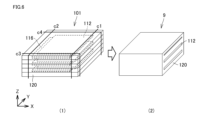
- FIG. 6 shows a part of the process for manufacturing a rectangular sintered body in which each layer is formed into a quadrilateral and the entire body is a rectangular parallelepiped.
- the cutting points c1 to c4 are indicated by thick lines. Referring to FIG. 6(1), first, both side surfaces of the green sheet laminate 101 are cut at the cutting points c1 and c2 so as to obtain a predetermined width.
- the cutting point c1 is a position where the positive electrode green sheet 112 is cut but the negative electrode green sheet 116 is not cut.
- the cutting point c2 is a position where the negative electrode green sheet 116 is cut but the positive electrode green sheet 112 is not cut.
- the cutting points c3 and c4 are positions where only the separator green sheet 120 is cut but the positive electrode green sheet 112 and the negative electrode green sheet 116 are not cut.
- degreasing and firing are performed to obtain an integrated sintered body 9 ( Figure 6 (2)) having an insulating ceramic portion on the periphery of the laminate. Degreasing and firing can be performed under known conditions and methods.
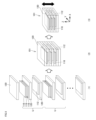
- Figure 7 shows a green sheet laminate 911 for obtaining a round sintered body.
- the green sheet laminate 911 is obtained by cutting out the positive electrode green sheet 112, the negative electrode green sheet 116, and the separator green sheet 120 into a circular shape using a punch or the like.
- Figure 7 (1) is a schematic diagram showing the internal laminate structure of the green sheet laminate 911.
- the positive electrode green sheet 112, the negative electrode green sheet 116, and the separator green sheet 120 constituting the respective layers of the green sheet laminate 911 can be the same as the various green sheets constituting the green sheet laminate 101, except for their different shapes.
- the stacking order can also be the same as that of the green sheet laminate 101.
- the positive electrode green sheet 112 and the negative electrode green sheet 116 included in the green sheet laminate 911 each have a shape in which a part of a circle has been cut away parallel to the tangent.
- the positive electrode green sheet 112 and the negative electrode green sheet 116 are alternately stacked with circular separator green sheets 120 in between.
- the positive electrode green sheet 112 and the negative electrode green sheet 116 are also arranged so that the cut areas are located on opposite sides of each other.
- the separator green sheet 120 covers the entire periphery of the stacked portion.
- the green sheet laminate 911 is cut.
- the cut points c8 and c9 are indicated by thick lines.
- the cut point c8 is a position where the negative electrode green sheet 116 does not overlap with the negative electrode green sheet 116 and where the positive electrode green sheet 112 is cut.
- the cut point c8 is parallel to the cut portion of the negative electrode green sheet 116.
- the cut point c9 is a position where the negative electrode green sheet 116 is cut and where the positive electrode green sheet 112 does not overlap with the positive electrode green sheet 112. In addition, the cut point c9 is parallel to the cut portion of the positive electrode green sheet 112.
- a side s6 (FIG. 7(2)) is obtained in which the negative electrode green sheet 116 and the separator green sheet 120 are exposed on the cross section, and the positive electrode green sheet 112 is not exposed.
- degreasing and sintering are performed, and an integrated sintered body 91 is obtained in which an insulating ceramic portion is formed on the periphery of the laminate.
- collectors are attached to both sides of the sintered body.
- a positive electrode collector 14 is attached to the first side s1 of the sintered body 9, and a negative electrode collector 18 is attached to the second side s2.
- a conductive material such as aluminum foil, can be used for the positive electrode collector 14 and the negative electrode collector 18.
- the positive electrode collector 14 is attached so as to cover the entire first side s1, and can be configured to extend to the lower surface of the sintered body 9.
- the negative electrode collector 18 is attached so as to cover the entire second side s2, and can be configured to extend to the upper surface of the sintered body 9.
- the sintered body 9 and the positive electrode collector 14, and the sintered body 9 and the negative electrode collector 18 can be bonded together using a conductive adhesive.
- a conductive carbon paste can be used as the conductive adhesive.
- the thickness of the conductive adhesive layer is not particularly limited as long as it exerts its effect as an adhesive layer and does not interfere with the effects of the invention, but it can be, for example, about 1 to 500 ⁇ m.
- the electrodes obtained by the above manufacturing method can be placed inside an exterior body according to known methods and conditions, and an electrolyte can be sealed in to obtain a lithium-ion battery.
- Samples 1 to 7 are examples of the lithium ion battery according to the present disclosure.
- Samples 8 and 9 are comparative examples that are outside the scope of the lithium ion battery according to the present disclosure.
- Example 1 A lithium ion battery was fabricated according to the methods described in 1 to 8 below.
- Laminates Green sheets for each layer constituting the sintered body were prepared under the conditions and methods of (1) to (3).
- the viscosity of the slurry was measured using a Brookfield LVT viscometer. The doctor blade method was used to form the slurry on a PET film.
- LCO green sheet positive electrode green sheet
- Co3O4 powder manufactured by Seido Chemical Industry Co., Ltd.
- Li2CO3 powder manufactured by Honjo Chemical Co., Ltd.
- the obtained powder was pulverized in a pot mill so that the volumetric D50 was 0.4 ⁇ m to obtain a powder consisting of LCO plate-like particles.
- 10 parts by weight of a binder polyvinyl butyral: product number BM-2, manufactured by Sekisui Chemical Co., Ltd.
- 2 parts by weight of a plasticizer DOP: Di (2-ethylhexyl) phthalate, manufactured by Kurogane Kasei Co., Ltd.
- a dispersant product name: Rheodol SP-O30, manufactured by Kao Corporation
- LTO green sheet negative electrode green sheet
- LTO powder volume standard D 50 particle size 0.6 ⁇ m, manufactured by Ishihara Sangyo Kaisha, Ltd.
- binder polyvinyl butyral: product number BM-2, manufactured by Sekisui Chemical Co., Ltd.
- plasticizer DOP: Di (2-ethylhexyl) phthalate, manufactured by Kurogane Kasei Co., Ltd.
- dispersant product name: Rheodol SP-O30, manufactured by Kao Corporation
- the obtained negative electrode raw material mixture was stirred and degassed under reduced pressure, and the viscosity was adjusted to 4000 cP to prepare an LTO slurry.
- the prepared slurry was formed into a sheet on a PET film to form an LTO green sheet.
- the thickness of the negative electrode layer after firing was adjusted to 10 ⁇ m.
- LiAlO 2 powder volume standard D 50 particle size 1.5 ⁇ m
- 20 parts by weight of a binder polyvinyl butyral: product number BM-2, manufactured by Sekisui Chemical Co., Ltd.
- 4 parts by weight of a plasticizer DOP: Di (2-ethylhexyl) phthalate, manufactured by Kurogane Kasei Co., Ltd.
- a dispersant product name: Rheodol SP-O30, manufactured by Kao Corporation
- the obtained raw material mixture was stirred under reduced pressure to degas and the viscosity was adjusted to 4000 cP to prepare a slurry.
- the prepared slurry was formed into a sheet on a PET film to form a separator green sheet.
- the thickness of the separator located between the positive electrode layer and the negative electrode layer was set to 25 ⁇ m after firing.
- the thickness of the separator (insulating layer) adjacent to the positive electrode layer was set to be the same as that of the positive electrode layer after firing, and the thickness of the separator (insulating layer) adjacent to the negative electrode layer was set to be the same as that of the negative electrode layer and the current collector layer after firing.
- the green sheets obtained in 1. were cut to be laminated. That is, the positive electrode green sheet and the negative electrode green sheet were each punched with a round puncher having a diameter of 15.5 mm to obtain circular green sheets. Furthermore, each circular green sheet was cut linearly at a position 2 mm from one point on the end face toward the center in parallel to the tangent at that point.
- the cut laminate was heated from room temperature to 600° C. and degreased for 5 hours, then heated to 800° C. and held at that temperature for 10 minutes to be fired, and then cooled.
- An aluminum foil serving as a positive electrode current collector was placed on the surface where the positive electrode and separator were exposed, with a conductive carbon paste interposed therebetween, and an aluminum foil serving as a negative electrode current collector was placed on the surface where the negative electrode and separator were exposed, with a conductive carbon paste interposed therebetween.
- conductive carbon paste A binder (CMC: MAC350HC, manufactured by Nippon Paper Industries Co., Ltd.) was weighed out to 1.2 wt% in pure water and dissolved by stirring to obtain a 1.2 wt% CMC solution.
- a carbon dispersion product number: BPW-229, manufactured by Nippon Graphite Co., Ltd.
- a dispersant solution product number LB-300, manufactured by Showa Denko K.K.
- the carbon dispersion, the dispersant solution, and the 1.2 wt% CMC solution were weighed out to 0.22:0.29:1, and mixed with a rotary mixer to prepare a conductive carbon paste.
- the conductive carbon paste obtained in 5. was screen printed on the aluminum foil as a positive electrode current collector.
- the positive electrode exposed surface of the laminated integral sintered body obtained in 4. was placed so as to be bonded within the undried printing pattern (the area where the conductive carbon paste was applied), and was lightly pressed with a finger, and then vacuum dried at 50 ° C for 60 minutes. In this way, the positive electrode exposed surface of the laminated integral sintered body and the positive electrode current collector were bonded via a conductive carbon adhesive layer.
- the thickness of the conductive carbon adhesive layer was 30 ⁇ m.
- LiPF6 LiPF6 was dissolved to a concentration of 1.5 mol/L in an organic solvent in which propylene carbonate (PC) and ⁇ -butyrolactone (GBL) were mixed in a volume ratio of 1:3.
- PC propylene carbonate
- GBL ⁇ -butyrolactone
- Example 2 A lithium ion battery was produced in the same manner as in Sample 1, except that a separator containing LiAlO 2 and MgO was used. ⁇ Preparation of separator green sheet and insulating layer green sheet containing LiAlO2 and MgO Li2CO3 powder (manufactured by Honjo Chemical Co., Ltd.) and Al2O3 (manufactured by Sumitomo Chemical Co., Ltd., product name: AKP-20) were mixed so that the molar ratio of Li/Al was 1.00, and then heat-treated at 900°C for 5 hours to obtain LiAlO2 powder.
- Magnesium carbonate powder (manufactured by Konoshima Chemical Co., Ltd.) was heat-treated at 900°C for 5 hours to obtain MgO powder.
- the obtained LiAlO2 powder and MgO powder were mixed in a volume ratio of 50 VOL%:50 VOL%.
- Example 3 A lithium ion battery was fabricated in the same manner as in Sample 1, except that a separator containing LiAlO2 and Li2ZrO3 was used. ⁇ Preparation of separator green sheet and insulating layer green sheet containing LiAlO 2 and Li 2 ZrO 3 Li 2 CO 3 powder (manufactured by Honjo Chemical Co., Ltd.) and Al 2 O 3 (manufactured by Sumitomo Chemical Co., Ltd., product name: AKP-20) were mixed so that the molar ratio of Li/Al was 1.00, and then heat-treated at 900 ° C for 5 hours to obtain LiAlO 2 powder.
- Li 2 CO 3 powder manufactured by Honjo Chemical Co., Ltd.
- ZrO 2 manufactured by Tosoh Corporation, product name: TZ-0
- the obtained LiAlO 2 powder and Li 2 ZrO 3 powder were mixed in a volume ratio of 50 VOL%: 50 VOL%.
- Example 4 A lithium ion battery was produced in the same manner as in Sample 1, except that a separator containing LiAlO2 and ZrO2 was used. Preparation of separator green sheet and insulating layer green sheet containing LiAlO2 and ZrO2 Li2CO3 powder (manufactured by Honjo Chemical Co., Ltd.) and Al2O3 (manufactured by Sumitomo Chemical Co., Ltd., product name: AKP-20) were mixed so that the molar ratio of Li/Al was 1.00, and then heat-treated at 900°C for 5 hours to obtain LiAlO2 powder.
- the obtained LiAlO2 powder was mixed with ZrO2 (manufactured by Tosoh Corporation, product name: TZ-0) powder in a volume ratio of 90 VOL%:10 VOL%.
- the obtained raw material mixture was stirred under reduced pressure to degas and the viscosity was adjusted to 4000 cP to prepare
- Example 5 A lithium ion battery was fabricated in the same manner as in Sample 1, except that a separator containing LiAlO2 and Al2O3 was used. Preparation of separator green sheet and insulating layer green sheet containing LiAlO2 and Al2O3 Li2CO3 powder (manufactured by Honjo Chemical Co., Ltd.) and Al2O3 (manufactured by Sumitomo Chemical Co., Ltd., product name: AKP-20) were mixed so that the molar ratio of Li/Al was 1.00, and then heat-treated at 900°C for 5 hours to obtain LiAlO2 powder.
- the obtained LiAlO2 powder and Al2O3 powder (manufactured by Sumitomo Chemical Co., Ltd., product name: AKP-20) were mixed in a volume ratio of 90 VOL%:10 VOL%.
- the obtained raw material mixture was stirred under reduced pressure to degas and the viscosity was adjusted to 4
- Example 6 A lithium ion battery was fabricated in the same manner as in Sample 1, except that a separator containing LiAlO2 and Li3AlO4 was used. ⁇ Preparation of separator green sheet and insulating layer green sheet containing LiAlO2 and Li3AlO4 Li2CO3 powder (manufactured by Honjo Chemical Co., Ltd.) and Al2O3 (manufactured by Sumitomo Chemical Co., Ltd., product name: AKP-20) were mixed so that the molar ratio of Li/Al was 1.00, and then heat-treated at 900 ° C for 5 hours to obtain LiAlO2 powder.
- Li2CO3 powder (manufactured by Honjo Chemical Co., Ltd.) and Al2O3 powder (manufactured by Sumitomo Chemical Co., Ltd., product name: AKP-20) were mixed so that the molar ratio of Li/Al was 3.00, and then heat-treated at 900 ° C for 5 hours to obtain Li3AlO4 powder.
- the obtained LiAlO2 powder and Li3AlO4 powder were mixed in a volume ratio of 80 VOL%: 20 VOL%.
- Example 7 A lithium ion battery was fabricated in the same manner as in Sample 1, except that a separator containing LiAlO2 and LiAl5O8 was used. ⁇ Preparation of separator green sheet and insulating layer green sheet containing LiAlO 2 and LiAl 5 O 8 Li 2 CO 3 powder (manufactured by Honjo Chemical Co., Ltd.) and Al 2 O 3 (manufactured by Sumitomo Chemical Co., Ltd., product name: AKP-20) were mixed so that the molar ratio of Li/Al was 1.00, and then heat-treated at 900 ° C for 5 hours to obtain LiAlO 2 powder.
- Li 2 CO 3 powder (manufactured by Honjo Chemical Co., Ltd.) and Al 2 O 3 (manufactured by Sumitomo Chemical Co., Ltd., product name: AKP-20) were mixed so that the molar ratio of Li/Al was 0.20, and then heat-treated at 900 ° C for 5 hours to obtain LiAl 5 O 8 powder.
- the obtained LiAlO 2 powder and LiAl 5 O 8 powder were mixed in a volume ratio of 80 VOL%: 20 VOL%.
- Example 8 A lithium ion battery was fabricated in the same manner as in Sample 1, except that a separator containing MgO and glass frit was used. Preparation of separator green sheet and insulating layer green sheet containing MgO and glass frit Magnesium carbonate powder (manufactured by Konoshima Chemical Co., Ltd.) was heat-treated at 900°C for 5 hours to obtain MgO powder. The obtained MgO powder and glass frit (manufactured by Nippon Frit Co., Ltd., CK0199) were mixed in a weight ratio of 7:3.
- a dispersant product name: Rheodol SP-O30, manufactured by Kao Corporation
- the obtained raw material mixture was stirred under reduced pressure to degas the mixture and adjusted to a viscosity of 4000 cP to prepare a slurry.
- the prepared slurry was formed into a sheet on a PET film to form a separator green sheet.
- Example 9 A lithium ion battery was fabricated in the same manner as in Sample 1, except that a separator containing LiAlO 2 and MgO was used. ⁇ Preparation of separator green sheet and insulating layer green sheet containing LiAlO2 and MgO Li2CO3 powder (manufactured by Honjo Chemical Co., Ltd.) and Al2O3 (manufactured by Sumitomo Chemical Co., Ltd., product name: AKP-20) were mixed so that the molar ratio of Li/Al was 1.00, and then heat-treated at 900°C for 5 hours to obtain LiAlO2 powder.
- Magnesium carbonate powder (manufactured by Konoshima Chemical Co., Ltd.) was heat-treated at 900°C for 5 hours to obtain MgO powder.
- the obtained LiAlO2 powder and MgO powder were mixed in a volume ratio of 30 VOL%:70 VOL%.
- the lithium ion batteries of Samples 1 to 7 were all evaluated as "passed” in the high-temperature charge/discharge evaluation.
- the lithium ion batteries of Samples 1 to 7 use Ag as the negative electrode current collector layer and contain 50% or more by volume of LiAlO 2 as the separator. It was confirmed that the lithium ion battery using Ag as the negative electrode current collector layer and a sintered body containing lithium aluminate as the separator can reliably charge and discharge even when placed in a high-temperature environment.
- the lithium ion battery of Sample 8 which uses Ag as the negative electrode current collector layer and includes a conventional ceramic separator containing MgO and glass as the separator, had insufficient results in the high-temperature charge/discharge evaluation.
- the lithium ion battery of Sample 9 in which the ratio of LiAlO 2 in the separator was 30% by volume, had insufficient results in the high-temperature charge/discharge evaluation. It was thought that a micro-short circuit or short circuit occurred inside the electrode at high temperatures.
Landscapes
- Chemical & Material Sciences (AREA)
- General Chemical & Material Sciences (AREA)
- Chemical Kinetics & Catalysis (AREA)
- Electrochemistry (AREA)
- Engineering & Computer Science (AREA)
- Manufacturing & Machinery (AREA)
- Materials Engineering (AREA)
- Inorganic Chemistry (AREA)
- Ceramic Engineering (AREA)
- Physics & Mathematics (AREA)
- Condensed Matter Physics & Semiconductors (AREA)
- General Physics & Mathematics (AREA)
- Secondary Cells (AREA)
- Battery Electrode And Active Subsutance (AREA)
Priority Applications (1)
| Application Number | Priority Date | Filing Date | Title |
|---|---|---|---|
| JP2025510729A JPWO2024203869A1 (https=) | 2023-03-31 | 2024-03-22 |
Applications Claiming Priority (2)
| Application Number | Priority Date | Filing Date | Title |
|---|---|---|---|
| JP2023058368 | 2023-03-31 | ||
| JP2023-058368 | 2023-03-31 |
Publications (1)
| Publication Number | Publication Date |
|---|---|
| WO2024203869A1 true WO2024203869A1 (ja) | 2024-10-03 |
Family
ID=92905093
Family Applications (1)
| Application Number | Title | Priority Date | Filing Date |
|---|---|---|---|
| PCT/JP2024/011333 Ceased WO2024203869A1 (ja) | 2023-03-31 | 2024-03-22 | リチウムイオン電池 |
Country Status (2)
| Country | Link |
|---|---|
| JP (1) | JPWO2024203869A1 (https=) |
| WO (1) | WO2024203869A1 (https=) |
Citations (3)
| Publication number | Priority date | Publication date | Assignee | Title |
|---|---|---|---|---|
| CN110858661A (zh) * | 2018-08-24 | 2020-03-03 | 比亚迪股份有限公司 | 锂离子电池的正极组件及其制备方法、全固态锂电池 |
| WO2021214946A1 (ja) * | 2020-04-23 | 2021-10-28 | 日本碍子株式会社 | リチウムイオン二次電池及びその製造方法 |
| WO2022044409A1 (ja) * | 2020-08-26 | 2022-03-03 | 日本碍子株式会社 | リチウムイオン二次電池 |
-
2024
- 2024-03-22 WO PCT/JP2024/011333 patent/WO2024203869A1/ja not_active Ceased
- 2024-03-22 JP JP2025510729A patent/JPWO2024203869A1/ja active Pending
Patent Citations (3)
| Publication number | Priority date | Publication date | Assignee | Title |
|---|---|---|---|---|
| CN110858661A (zh) * | 2018-08-24 | 2020-03-03 | 比亚迪股份有限公司 | 锂离子电池的正极组件及其制备方法、全固态锂电池 |
| WO2021214946A1 (ja) * | 2020-04-23 | 2021-10-28 | 日本碍子株式会社 | リチウムイオン二次電池及びその製造方法 |
| WO2022044409A1 (ja) * | 2020-08-26 | 2022-03-03 | 日本碍子株式会社 | リチウムイオン二次電池 |
Also Published As
| Publication number | Publication date |
|---|---|
| JPWO2024203869A1 (https=) | 2024-10-03 |
Similar Documents
| Publication | Publication Date | Title |
|---|---|---|
| JP7189163B2 (ja) | リチウム二次電池 | |
| JP7280379B2 (ja) | リチウム二次電池及びその充電状態の測定方法 | |
| US12046711B2 (en) | Lithium secondary battery | |
| US12469886B2 (en) | Lithium secondary battery | |
| WO2019221146A1 (ja) | リチウム二次電池 | |
| JP7742301B2 (ja) | リチウム二次電池 | |
| JP7104148B2 (ja) | リチウム二次電池 | |
| WO2019221144A1 (ja) | リチウム二次電池 | |
| WO2024203869A1 (ja) | リチウムイオン電池 | |
| US12261294B2 (en) | Lithium secondary battery | |
| WO2024203868A1 (ja) | リチウムイオン電池のための電極およびリチウムイオン電池 | |
| WO2019221143A1 (ja) | リチウム二次電池 | |
| JP7751651B2 (ja) | リチウム二次電池 | |
| CN112889163B (zh) | 纽扣型锂二次电池 | |
| JP7710541B2 (ja) | リチウム二次電池 | |
| US20240387878A1 (en) | Lithium secondary battery | |
| WO2024203506A1 (ja) | リチウムイオン電池 | |
| US20240291042A1 (en) | Lithium secondary battery | |
| JP2026021871A (ja) | リチウムイオン電池の正極材料、電極およびリチウムイオン電池 |
Legal Events
| Date | Code | Title | Description |
|---|---|---|---|
| 121 | Ep: the epo has been informed by wipo that ep was designated in this application |
Ref document number: 24779987 Country of ref document: EP Kind code of ref document: A1 |
|
| WWE | Wipo information: entry into national phase |
Ref document number: 2025510729 Country of ref document: JP |
|
| NENP | Non-entry into the national phase |
Ref country code: DE |
|
| 122 | Ep: pct application non-entry in european phase |
Ref document number: 24779987 Country of ref document: EP Kind code of ref document: A1 |