WO2024203592A1 - 円筒形電池及び円筒形電池の製造方法 - Google Patents
円筒形電池及び円筒形電池の製造方法 Download PDFInfo
- Publication number
- WO2024203592A1 WO2024203592A1 PCT/JP2024/010696 JP2024010696W WO2024203592A1 WO 2024203592 A1 WO2024203592 A1 WO 2024203592A1 JP 2024010696 W JP2024010696 W JP 2024010696W WO 2024203592 A1 WO2024203592 A1 WO 2024203592A1
- Authority
- WO
- WIPO (PCT)
- Prior art keywords
- gasket
- axial direction
- tip
- cylindrical battery
- bent
- Prior art date
- Legal status (The legal status is an assumption and is not a legal conclusion. Google has not performed a legal analysis and makes no representation as to the accuracy of the status listed.)
- Ceased
Links
Images



Classifications
-
- H—ELECTRICITY
- H01—ELECTRIC ELEMENTS
- H01M—PROCESSES OR MEANS, e.g. BATTERIES, FOR THE DIRECT CONVERSION OF CHEMICAL ENERGY INTO ELECTRICAL ENERGY
- H01M50/00—Constructional details or processes of manufacture of the non-active parts of electrochemical cells other than fuel cells, e.g. hybrid cells
- H01M50/10—Primary casings; Jackets or wrappings
- H01M50/102—Primary casings; Jackets or wrappings characterised by their shape or physical structure
- H01M50/107—Primary casings; Jackets or wrappings characterised by their shape or physical structure having curved cross-section, e.g. round or elliptic
-
- H—ELECTRICITY
- H01—ELECTRIC ELEMENTS
- H01M—PROCESSES OR MEANS, e.g. BATTERIES, FOR THE DIRECT CONVERSION OF CHEMICAL ENERGY INTO ELECTRICAL ENERGY
- H01M10/00—Secondary cells; Manufacture thereof
- H01M10/04—Construction or manufacture in general
- H01M10/0422—Cells or battery with cylindrical casing
-
- H—ELECTRICITY
- H01—ELECTRIC ELEMENTS
- H01M—PROCESSES OR MEANS, e.g. BATTERIES, FOR THE DIRECT CONVERSION OF CHEMICAL ENERGY INTO ELECTRICAL ENERGY
- H01M50/00—Constructional details or processes of manufacture of the non-active parts of electrochemical cells other than fuel cells, e.g. hybrid cells
- H01M50/10—Primary casings; Jackets or wrappings
- H01M50/147—Lids or covers
- H01M50/148—Lids or covers characterised by their shape
- H01M50/1535—Lids or covers characterised by their shape adapted for specific cells, e.g. electrochemical cells operating at high temperature
-
- H—ELECTRICITY
- H01—ELECTRIC ELEMENTS
- H01M—PROCESSES OR MEANS, e.g. BATTERIES, FOR THE DIRECT CONVERSION OF CHEMICAL ENERGY INTO ELECTRICAL ENERGY
- H01M50/00—Constructional details or processes of manufacture of the non-active parts of electrochemical cells other than fuel cells, e.g. hybrid cells
- H01M50/10—Primary casings; Jackets or wrappings
- H01M50/147—Lids or covers
- H01M50/166—Lids or covers characterised by the methods of assembling casings with lids
- H01M50/167—Lids or covers characterised by the methods of assembling casings with lids by crimping
-
- H—ELECTRICITY
- H01—ELECTRIC ELEMENTS
- H01M—PROCESSES OR MEANS, e.g. BATTERIES, FOR THE DIRECT CONVERSION OF CHEMICAL ENERGY INTO ELECTRICAL ENERGY
- H01M50/00—Constructional details or processes of manufacture of the non-active parts of electrochemical cells other than fuel cells, e.g. hybrid cells
- H01M50/10—Primary casings; Jackets or wrappings
- H01M50/183—Sealing members
- H01M50/184—Sealing members characterised by their shape or structure
-
- H—ELECTRICITY
- H01—ELECTRIC ELEMENTS
- H01M—PROCESSES OR MEANS, e.g. BATTERIES, FOR THE DIRECT CONVERSION OF CHEMICAL ENERGY INTO ELECTRICAL ENERGY
- H01M50/00—Constructional details or processes of manufacture of the non-active parts of electrochemical cells other than fuel cells, e.g. hybrid cells
- H01M50/10—Primary casings; Jackets or wrappings
- H01M50/183—Sealing members
- H01M50/186—Sealing members characterised by the disposition of the sealing members
-
- Y—GENERAL TAGGING OF NEW TECHNOLOGICAL DEVELOPMENTS; GENERAL TAGGING OF CROSS-SECTIONAL TECHNOLOGIES SPANNING OVER SEVERAL SECTIONS OF THE IPC; TECHNICAL SUBJECTS COVERED BY FORMER USPC CROSS-REFERENCE ART COLLECTIONS [XRACs] AND DIGESTS
- Y02—TECHNOLOGIES OR APPLICATIONS FOR MITIGATION OR ADAPTATION AGAINST CLIMATE CHANGE
- Y02E—REDUCTION OF GREENHOUSE GAS [GHG] EMISSIONS, RELATED TO ENERGY GENERATION, TRANSMISSION OR DISTRIBUTION
- Y02E60/00—Enabling technologies; Technologies with a potential or indirect contribution to GHG emissions mitigation
- Y02E60/10—Energy storage using batteries
-
- Y—GENERAL TAGGING OF NEW TECHNOLOGICAL DEVELOPMENTS; GENERAL TAGGING OF CROSS-SECTIONAL TECHNOLOGIES SPANNING OVER SEVERAL SECTIONS OF THE IPC; TECHNICAL SUBJECTS COVERED BY FORMER USPC CROSS-REFERENCE ART COLLECTIONS [XRACs] AND DIGESTS
- Y02—TECHNOLOGIES OR APPLICATIONS FOR MITIGATION OR ADAPTATION AGAINST CLIMATE CHANGE
- Y02P—CLIMATE CHANGE MITIGATION TECHNOLOGIES IN THE PRODUCTION OR PROCESSING OF GOODS
- Y02P70/00—Climate change mitigation technologies in the production process for final industrial or consumer products
- Y02P70/50—Manufacturing or production processes characterised by the final manufactured product
Definitions
- This disclosure relates to cylindrical batteries and methods for manufacturing cylindrical batteries.
- Patent Document 1 describes a cylindrical battery in which a cap (sealing body) is crimped and fixed to the opening of the outer can via a gasket.
- the objective of this disclosure is to provide a cylindrical battery and a method for manufacturing a cylindrical battery that can reduce stress concentration at the corners of the outer can when the gasket is compressed by the tip of the outer can.
- the cylindrical battery according to the present disclosure is a cylindrical battery comprising an electrode assembly in which a positive electrode and a negative electrode are wound with a separator interposed therebetween, a bottomed cylindrical outer can containing the electrode assembly, and a sealing body that is crimped and fixed to the opening of the outer can via a gasket, the outer can including a tip bent portion that is bent so as to extend radially inward at the opening adjacent to the gasket, and a tip tubular portion that extends in the axial direction, and the gasket has a discontinuous portion that can be separated in the axial direction at an opposing portion that faces the radially inward side of the tip tubular portion.
- the manufacturing method of the cylindrical battery according to the present disclosure is a manufacturing method of a cylindrical battery including an electrode assembly in which a positive electrode and a negative electrode are wound with a separator therebetween, a bottomed cylindrical outer can containing the electrode assembly, and a sealing body that is crimped and fixed to the opening of the outer can via a gasket, in which a gasket is disposed adjacent to the inside of the opening of the outer can, and the tip of the outer can is bent radially inward by 90 degrees or more from a state in which it extends in the axial direction, to form a bent tip portion and a tubular tip portion that is located on the bottom side of the bent tip portion and extends in the axial direction, and the gasket is axially compressed via the bent tip portion from a state in which the gasket is separated in the axial direction via a gap at an opposing portion that faces the radially inward side of the tubular tip portion.
- the cylindrical battery and manufacturing method for the cylindrical battery disclosed herein can reduce stress concentration at the corners of the outer can when the gasket is compressed by the tip of the outer can.
- FIG. 2 is an axial cross-sectional view of a cylindrical battery according to one embodiment of the present disclosure.
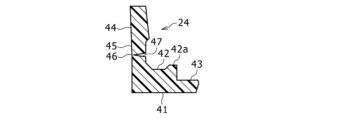
- 2 is an enlarged cross-sectional view of a portion in the circumferential direction of the gasket before it is installed in the cylindrical battery of FIG. 1 .
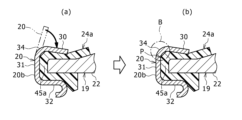
- FIG. 2 is an enlarged cross-sectional view corresponding to part A in FIG. 1 , showing a method of folding the front end of the outer can and further compressing the gasket in the axial direction after assembling the gasket into the outer can of the cylindrical battery in FIG. 1 .
- FIG. 2 is an enlarged cross-sectional view corresponding to part A in FIG.
- FIG. 4 is a view corresponding to FIG. 3 in a cylindrical battery according to another embodiment of the present invention.
- the cylindrical battery according to the present disclosure may be a primary battery or a secondary battery. It may also be a battery using an aqueous electrolyte or a battery using a non-aqueous electrolyte.
- a non-aqueous electrolyte secondary battery (lithium ion battery) using a non-aqueous electrolyte is exemplified as the cylindrical battery 10, which is one embodiment, but the cylindrical battery according to the present disclosure is not limited to this, and the electrolyte may also be an aqueous electrolyte.
- the cylindrical battery 10 includes an electrode body 14, a non-aqueous electrolyte, a bottomed cylindrical exterior can 20 that contains the electrode body 14 and the electrolyte, and a sealing body 19 that closes the opening of the exterior can 20.
- the electrode body 14 includes a positive electrode 11, a negative electrode 12, and a separator 13 interposed between the positive electrode 11 and the negative electrode 12, and has a wound structure in which the positive electrode 11 and the negative electrode 12 are wound with the separator 13 interposed therebetween.
- the exterior can 20 is a bottomed cylindrical container, and has a bottom 20a and a cylindrical portion 20b.
- the non-aqueous electrolyte includes, for example, a non-aqueous solvent and an electrolyte salt dissolved in the non-aqueous solvent.
- the non-aqueous solvent may be an ester, an ether, a nitrile, an amide, or a mixed solvent of two or more of these.
- the non-aqueous solvent may contain a halogen-substituted body in which at least a part of the hydrogen of these solvents is replaced with a halogen atom such as fluorine.
- the non-aqueous electrolyte is not limited to a liquid electrolyte, and may be a solid electrolyte using a gel polymer or the like.
- the electrolyte salt may be a lithium salt such as LiPF6 .
- the electrode body 14 has a long positive electrode 11, a long negative electrode 12, and two long separators 13.
- the electrode body 14 also has, as electrode leads, a positive electrode lead 17 joined to the positive electrode 11 and a negative electrode lead 18 joined to the negative electrode 12.
- the negative electrode 12 is formed with dimensions slightly larger than the positive electrode 11 to suppress lithium precipitation.
- the two separators 13 are formed with dimensions at least slightly larger than the positive electrode 11, and are arranged, for example, to sandwich the positive electrode 11.
- the positive electrode 11 has a positive electrode core and a positive electrode mixture layer provided on both sides of the positive electrode core.
- the positive electrode core can be a foil of a metal such as aluminum or an aluminum alloy that is stable in the potential range of the positive electrode 11, or a film with the metal disposed on the surface.
- the positive electrode mixture layer contains a positive electrode active material, a conductive agent such as acetylene black, and a binder such as polyvinylidene fluoride (PVDF).
- PVDF polyvinylidene fluoride
- the positive electrode 11 can be produced by applying a positive electrode mixture slurry containing a positive electrode active material, a conductive agent, and a binder, etc., onto the positive electrode core, drying the coating, and then compressing it to form a positive electrode mixture layer on both sides of the positive electrode core.
- a lithium transition metal composite oxide is used as the positive electrode active material.
- Metal elements contained in the lithium transition metal composite oxide include Ni, Co, Mn, Al, B, Mg, Ti, V, Cr, Fe, Cu, Zn, Ga, Sr, Zr, Nb, In, Sn, Ta, W, etc.
- An example of a suitable lithium transition metal composite oxide is a lithium metal composite oxide containing at least one of Ni, Co, and Mn. Specific examples include a composite oxide containing Ni, Co, and Mn, and a composite oxide containing Ni, Co, and Al.
- the negative electrode 12 has a negative electrode core and a negative electrode mixture layer provided on both sides of the negative electrode core.
- a foil of a metal such as copper or a copper alloy that is stable in the potential range of the negative electrode 12, or a film with such a metal disposed on the surface layer, can be used.
- the negative electrode mixture layer contains a negative electrode active material and a binder such as styrene butadiene rubber (SBR).
- SBR styrene butadiene rubber
- the negative electrode 12 can be produced by applying a negative electrode mixture slurry containing a negative electrode active material and a binder, etc., onto the negative electrode core, drying the coating, and then compressing it to form a negative electrode mixture layer on both sides of the negative electrode core.
- the negative electrode active material may be, for example, natural graphite such as flake graphite, lump graphite, or earthy graphite, or artificial graphite such as lump artificial graphite or graphitized mesophase carbon microbeads.
- the negative electrode active material may be, for example, a metal that alloys with lithium such as Si or Sn, an alloy containing the metal, or a compound containing the metal, which may be used in combination with graphite.
- a suitable example of the active material is a Si-containing material in which Si fine particles are dispersed in a SiO2 phase, a silicate phase such as lithium silicate, or an amorphous carbon phase.
- Insulating plates 15 and 16 are arranged above and below the electrode body 14.
- the positive electrode lead 17 attached to the positive electrode 11 extends through the through hole of the insulating plate 15 toward the sealing body 19
- the negative electrode lead 18 attached to the negative electrode 12 extends through the outside of the insulating plate 16 toward the bottom 20a of the outer can 20.
- the positive electrode lead 17 is connected to the inner surface of the sealing body 19 facing inward by welding or the like, and the sealing body 19 serves as the positive electrode terminal.
- the negative electrode lead 18 is connected to the inner surface of the bottom 20a of the outer can 20 by welding or the like, and the outer can 20 serves as the negative electrode terminal.
- a gasket 24 is provided between the exterior can 20 and the sealing body 19, ensuring the sealing of the battery interior and the insulation of the exterior can 20 and the sealing body 19.
- the tubular portion 20b includes a tip bent portion 30 that is bent so as to extend radially inward over the entire circumference, and a tip tubular portion 31 that is provided on the bottom 20a side in the axial direction from the tip bent portion 30 and extends in the axial direction.
- the tubular portion 20b also includes an annular grooved portion 32 that is provided on the bottom 20a side in the axial direction from the tip tubular portion 31.
- the grooved portion 32 is a portion of the exterior can 20 that protrudes radially inward over the entire circumference at the bottom 20a side portion of the tip tubular portion 31 of the tubular portion 20b.
- the grooved portion 32 is formed by, for example, recessing a part of the tubular portion 20b radially inward by spinning or the like.
- the bent tip portion 30 is formed when the upper end of the tubular portion 20b is bent radially inward and crimped to the peripheral edge portion 33 of the sealing body 19, and extends radially inward.
- the sealing body 19 is clamped by the bent tip portion 30 and the grooved portion 32 via the gasket 24 by this crimping, and is fixed to the outer can 20.
- the sealing body 19 is a disk-shaped member equipped with a current interruption mechanism.
- the sealing body 19 has a structure in which, from the electrode body 14 side, an internal terminal plate 21, an insulating plate 23, and a rupture plate 22 are stacked.
- the internal terminal plate 21 has a thin-walled portion in the center that is thinner than the outer annular portion to which the positive electrode lead 17 is connected.
- the insulating plate 23 is a disk-shaped member made of insulating material with an opening 23a in the center.
- the rupture plate 22 is disposed opposite the internal terminal plate 21 with the insulating plate 23 in between.
- the center of the rupture plate 22 is connected to the thin-walled portion in the center of the internal terminal plate 21 by welding or the like through the opening 23a of the insulating plate 23.
- the rupture plate 22 has an easily breakable portion 22a in the radial middle portion.
- the easily breakable portion 22a is formed by a ring-shaped thin portion 22b formed in a radial portion of the rupture plate 22.
- the easily breakable portion 22a is formed by forming an annular groove 22c in a radial portion of the inner surface (lower surface in Figure 1) of the rupture plate 22.
- the groove for forming the easily breakable portion 22a may be formed in the outer surface (upper surface in Figure 1) of the rupture plate 22.
- the valve portion 22d is formed by a portion of the rupture plate 22 that is radially inward from the easily breakable portion 22a.
- the sealing body 19 is fixed by crimping to the outer can 20 via a gasket 24, radially outside the easily breakable portion 22a.
- the pressure inside the battery acts on the groove 22c of the rupture plate 22 through the vent holes formed in the internal terminal plate 21 and the insulating plate 23.
- the internal terminal plate 21, to which the positive electrode lead 17 is connected is electrically connected to the rupture plate 22, forming a current path from the electrode body 14 to the rupture plate 22. If an abnormality occurs in the battery and the internal pressure rises, the internal terminal plate 21 breaks, the thin-walled portion of the internal terminal plate 21 is separated from its outer annular portion, and the valve portion 22d deforms so that it becomes convex toward the outside of the battery. This interrupts the current path. If the internal pressure of the battery rises further, the easily breakable portion 22a breaks as described above, forming a gas exhaust port.
- the structure of the sealing body 19 is not limited to the structure shown in FIG. 1.
- the sealing body 19 may be composed of only a rupture plate.
- the sealing body 19 may have a laminated structure including two rupture plates, and may have a convex sealing body cap that covers the rupture plate.
- FIG. 2 is a cross-sectional view of the gasket 24 before the battery is assembled.
- the gasket 24 is made of resin and is generally formed in an L-shaped cross section and generally annular.
- the gasket 24 includes an annular plate portion 41 and a generally cylindrical tube portion 44 standing from the outer periphery of the plate portion 41.
- the plate portion 41 has an annular main plate portion 42 and an annular thin-walled portion 43 that extends radially inward from the bottom 20a side (lower side) of the inner periphery of the main plate portion 42 and is thinner than the main plate portion.
- the thin-walled portion 43 constitutes a covering portion 55 (see FIG. 1) that covers the radially inner end of the grooved portion 32 in the cylindrical battery 10.
- the thin-walled portion 43 constitutes the covering portion 55, reliably preventing a short circuit between the outer can 20 and the sealing body 19.
- a circular protrusion 42a protrudes from the upper surface on the inner periphery of the main plate portion 42.
- the protrusion 42a is pressed against the underside of the rupture plate 22, and the thin-walled portion 43 is deformed downward. At that time, the thin-walled portion 43 can cover the radially inward tip of the grooved portion 32.
- an easily breakable portion 46 is formed in the facing portion 45 of the tubular portion 44 of the gasket 24 that faces the radially inward side of the tip tubular portion 31 of the outer can 20.
- the easily breakable portion 46 is a thin-walled portion that is provided by forming a notch 47 along the entire circumference of the inner peripheral surface of the facing portion 45, and has a smaller radial thickness than other portions.
- the notch 47 has a generally V-shaped cross section or a generally linear cross section extending radially.
- the easily breakable portion 46 makes it easier to break the gasket 24 so as to separate it into two parts, upper and lower, when the gasket 24 is placed inside the opening of the outer can 20 and the tip of the outer can 20 is bent radially inward as described below.
- the resin that constitutes the gasket 24 may be any material that can be deformed during crimping, and there is no limit to the type.
- the resin that constitutes the gasket 24 may also be a material that can be produced by injection molding. Examples of resins that can be used to constitute the gasket 24 include polypropylene (PP), polybutylene terephthalate (PBT), and perfluoroalkoxyalkane (PFA).
- PP polypropylene
- PBT polybutylene terephthalate
- PFA perfluoroalkoxyalkane
- the outer can 20 is produced, for example, in the following procedure. First, a part of the cylindrical portion 20b of the outer can 20 is spun to make a recess radially inward, forming a grooved portion 32. Next, the sealing body 19 and the gasket 24 are placed on the grooved portion 32 so that the gasket 24 is positioned between the outer can 20 and the sealing body 19.
- the gasket 24 is inserted inside the portion on the forward side, and after the gasket 24 is placed on the grooved portion 32, the forward end of the cylindrical portion 20b is bent slightly radially inward from its axially extending state. In this state, the gasket 24 is placed adjacent to the inside of the opening of the outer can 20.
- the tip of the tubular portion 20b of the outer can 20 is bent radially inward at an angle of 90 degrees or slightly greater than 90 degrees. This forms the tip bent portion 30 and the tip tubular portion 31, which is located axially closer to the bottom portion 20a than the tip bent portion 30 and extends axially.
- the outside of the easily breakable portion 46 of the gasket 24 is stretched by the tip of the outer can 20, generating tensile stress in the easily breakable portion 46, which breaks it. This causes the gasket 24 to separate axially via the gap G1.
- the gasket 24 is compressed in the axial direction with the peripheral portion 33 of the rupture plate 22 sandwiched inside through the tip bent portion 30 and the upper portion of the grooved portion 32.
- the gasket 24 is compressed in the axial direction so as to be sandwiched between the tip bent portion 30 and the grooved portion 32.
- the gap existing between the separated portions of the gasket 24 becomes smaller. Therefore, the gasket 24 is sandwiched in the axial direction between the tip bent portion 30 and the grooved portion 32.
- the tip bent portion 30 is further bent downward and crimped to the peripheral portion 33 of the rupture plate 22, thereby producing the cylindrical battery 10.
- the bending of the tip of the tube portion 20b and the compression of the gasket 24 can be performed by machining.
- the gasket 24 is disposed adjacent to the inside of the opening including the tip bend portion 30 and the tip tube portion 31. At this time, a discontinuous portion 48 that can be separated in the axial direction is formed in the facing portion 45 of the gasket 24 that faces the radially inner side of the tip tube portion 31 of the outer can 20.
- the gasket 24 has axially facing opposing surfaces that are in contact with each other only partially in the discontinuous portion 48, and gaps G2, G3 are formed between the opposing surfaces. Each gap G2, G3 is a notched space formed around the entire circumference of the gasket 24 along the circumferential direction.
- the gap may be formed only at one of the radially outer end portion and the radially inner end portion.
- the axially facing opposing surfaces in the discontinuous portion 48 may be in contact with each other over the entire range. In this case, no gap is formed between the opposing surfaces, but the gasket 24 can maintain a state in which it can be separated into an upper portion and a lower portion at the discontinuous portion 48, so that the discontinuous portion 48 can relieve the stress inside the gasket 24 and reduce stress concentration at the corners of the exterior can 20.
- the formation of the above-mentioned gap at the discontinuous portion 48 significantly exerts the above-mentioned effect.
- the opposing surfaces at the discontinuous portion 48 may be completely separated from each other.
- curved portions S1, S2 with arc-shaped cross sections are formed on one or both of the opposing surfaces of the discontinuous portion 48 of the gasket 24.
- the opposing portion 45 of the gasket 24 has a discontinuous portion 48 formed therein that is separable in the axial direction.
- the gasket 24 is compressed in the axial direction via the bent tip portion 30 while being separable in the axial direction. This reduces the stress applied from the gasket 24 to the corners of the outer can 20 when the gasket 24 is compressed by the tip of the outer can 20 when the tip of the outer can 20 is crimped to the peripheral portion 33 of the sealing body 19. This reduces stress concentration at the corners of the outer can 20, thereby suppressing damage to the corners.
- the formation of a gap between the opposing surfaces of the discontinuous portion 48 significantly enhances the above-mentioned effects.
- the facing portion 45 of the gasket 24 where the gaps G2 and G3 are formed is a portion where tensile stress is likely to occur in the gasket 24 due to bending of the tip of the exterior can 20. Therefore, by providing the easily breakable portion 46 in the facing portion 45, the easily breakable portion 46 is likely to break due to tensile stress. It is more preferable to provide the easily breakable portion 46 in the portion of the facing portion 45 of the gasket 24 that faces the outer peripheral surface of the sealing body 19.
- At least one of the opposing surfaces of the gasket 24 that are separated in the axial direction by the gaps G2 and G3 has curved surface portions S1 and S2 with an arc-shaped cross section. This makes it easier to form the gaps G2 and G3 in the discontinuous portion 48 of the gasket 24.
- an easily breakable portion 46 is formed in the gasket 24 at the opposing portion 45 opposing the tip tube portion 31. Then, when the tip of the outer casing 20 is bent, the easily breakable portion 46 breaks, and the gasket 24 is compressed in the axial direction via the tip bent portion 30 from a state in which the gasket 24 is separated in the axial direction via the gap G1. As a result, the gasket 24 can be handled as a single, inseparable part before being assembled into the battery, thereby improving manufacturing workability.
- Figure 4 is an enlarged cross-sectional view corresponding to part A in Figure 1, showing that after the gasket 24a is assembled into the outer can 20 of a cylindrical battery of the comparative example, the front end of the outer can 20 is bent, and the gasket 24a is further compressed in the axial direction, the outer can 20 is damaged when used under harsh conditions.
- the gasket 24a does not have a discontinuous portion that can be separated in the axial direction via a gap in the opposing portion 45a of the gasket 24a that faces the radially inner side of the front tube portion 31 of the outer can 20.
- the front end of the outer can 20 is bent and crimped to the sealing body 19 via the gasket 24a.
- a notch 47 is formed in the inner peripheral surface of the facing portion 45 of the gasket 24, thereby providing an easily breakable portion 46 in the facing portion 45.
- a notch having a generally V-shaped cross section or the like may be formed in the outer peripheral surface of the facing portion of the gasket, thereby providing an easily breakable portion in the facing portion.
- FIG. 5 is a view corresponding to FIG. 3, showing a cylindrical battery according to another embodiment.
- the gasket 24b does not have a breakable portion before being assembled into the cylindrical battery. Instead, the gasket 24b is completely separated into two parts, an upper part 60 and a lower part 61, before being assembled into the cylindrical battery.
- the lower part 61 has a shape in which the plate part 41 and the base end of the tube part 44 are integrally formed in the gasket 24 shown in FIG. 2.
- the upper part 60 has a shape similar to that of the gasket 24 shown in FIG. 2, excluding the base end of the tube part 44 and the plate part 41.
- the tip of the outer can 20 is bent radially inward by 90 degrees or more to form the bent tip portion 30.
- the bent portion of the tip of the outer can 20 can deform the upper portion 60 so as to push it radially inward, forming a gap G1 between the upper portion 60 and the lower portion 1.
- the tip of the outer can 20 can be bent radially inward while lifting the upper portion 60 upward to form the gap G1.
- the bent tip portion 30 and the grooved portion 32 compress the gasket 24b in the axial direction via the rupture plate 22.
- a discontinuous portion 48b that can be separated in the axial direction can be formed in gasket 24b at opposing portion 45b that faces the radially inner side of tip tubular portion 31 of outer can 20.
- the discontinuous portion 48b relieves the stress in gasket 24b, thereby reducing the stress applied from gasket 24b to corner portion 34 of outer can 20. This reduces stress concentration at corner portion 34.
- other configurations and functions are the same as those in FIGS. 1 to 3.
Landscapes
- Chemical & Material Sciences (AREA)
- Chemical Kinetics & Catalysis (AREA)
- Electrochemistry (AREA)
- General Chemical & Material Sciences (AREA)
- Engineering & Computer Science (AREA)
- Manufacturing & Machinery (AREA)
- Sealing Battery Cases Or Jackets (AREA)
Priority Applications (3)
| Application Number | Priority Date | Filing Date | Title |
|---|---|---|---|
| CN202480020504.1A CN120836108A (zh) | 2023-03-29 | 2024-03-19 | 圆筒形电池以及圆筒形电池的制造方法 |
| EP24779717.8A EP4693641A1 (en) | 2023-03-29 | 2024-03-19 | Cylindrical battery and method for manufacturing cylindrical battery |
| JP2025510571A JPWO2024203592A1 (https=) | 2023-03-29 | 2024-03-19 |
Applications Claiming Priority (2)
| Application Number | Priority Date | Filing Date | Title |
|---|---|---|---|
| JP2023-053430 | 2023-03-29 | ||
| JP2023053430 | 2023-03-29 |
Publications (1)
| Publication Number | Publication Date |
|---|---|
| WO2024203592A1 true WO2024203592A1 (ja) | 2024-10-03 |
Family
ID=92904840
Family Applications (1)
| Application Number | Title | Priority Date | Filing Date |
|---|---|---|---|
| PCT/JP2024/010696 Ceased WO2024203592A1 (ja) | 2023-03-29 | 2024-03-19 | 円筒形電池及び円筒形電池の製造方法 |
Country Status (4)
| Country | Link |
|---|---|
| EP (1) | EP4693641A1 (https=) |
| JP (1) | JPWO2024203592A1 (https=) |
| CN (1) | CN120836108A (https=) |
| WO (1) | WO2024203592A1 (https=) |
Citations (6)
| Publication number | Priority date | Publication date | Assignee | Title |
|---|---|---|---|---|
| JPS54167329U (https=) * | 1978-05-17 | 1979-11-26 | ||
| JPH11307067A (ja) | 1998-04-20 | 1999-11-05 | Sony Corp | 電解液密封用シール部材およびリチウムイオン二次電池 |
| JP2014110316A (ja) * | 2012-11-30 | 2014-06-12 | Fdk Tottori Co Ltd | 非水電解液素子 |
| JP2017224426A (ja) * | 2016-06-14 | 2017-12-21 | 三洋電機株式会社 | 円筒形電池 |
| CN214672781U (zh) * | 2021-04-27 | 2021-11-09 | 宁波超霸能源有限公司 | 圆柱型锂电池的封口结构及圆柱型锂电池 |
| JP2023027511A (ja) * | 2021-08-17 | 2023-03-02 | トヨタ自動車株式会社 | 二次電池 |
-
2024
- 2024-03-19 EP EP24779717.8A patent/EP4693641A1/en active Pending
- 2024-03-19 CN CN202480020504.1A patent/CN120836108A/zh active Pending
- 2024-03-19 WO PCT/JP2024/010696 patent/WO2024203592A1/ja not_active Ceased
- 2024-03-19 JP JP2025510571A patent/JPWO2024203592A1/ja active Pending
Patent Citations (6)
| Publication number | Priority date | Publication date | Assignee | Title |
|---|---|---|---|---|
| JPS54167329U (https=) * | 1978-05-17 | 1979-11-26 | ||
| JPH11307067A (ja) | 1998-04-20 | 1999-11-05 | Sony Corp | 電解液密封用シール部材およびリチウムイオン二次電池 |
| JP2014110316A (ja) * | 2012-11-30 | 2014-06-12 | Fdk Tottori Co Ltd | 非水電解液素子 |
| JP2017224426A (ja) * | 2016-06-14 | 2017-12-21 | 三洋電機株式会社 | 円筒形電池 |
| CN214672781U (zh) * | 2021-04-27 | 2021-11-09 | 宁波超霸能源有限公司 | 圆柱型锂电池的封口结构及圆柱型锂电池 |
| JP2023027511A (ja) * | 2021-08-17 | 2023-03-02 | トヨタ自動車株式会社 | 二次電池 |
Non-Patent Citations (1)
| Title |
|---|
| See also references of EP4693641A1 |
Also Published As
| Publication number | Publication date |
|---|---|
| JPWO2024203592A1 (https=) | 2024-10-03 |
| EP4693641A1 (en) | 2026-02-11 |
| CN120836108A (zh) | 2025-10-24 |
Similar Documents
| Publication | Publication Date | Title |
|---|---|---|
| JP7379380B2 (ja) | 密閉電池 | |
| JP7422680B2 (ja) | ガスケット、及び円筒形電池 | |
| JP7669293B2 (ja) | 密閉電池 | |
| CN113767510A (zh) | 圆筒形电池 | |
| WO2023100768A1 (ja) | 蓄電装置 | |
| WO2021200440A1 (ja) | 円筒形電池 | |
| JP7749537B2 (ja) | 円筒形電池 | |
| US20240039096A1 (en) | Gasket and cylindrical battery | |
| WO2023167010A1 (ja) | 円筒形電池 | |
| JP7664220B2 (ja) | 密閉電池 | |
| EP4080648B1 (en) | Cylindrical battery | |
| WO2022196623A1 (ja) | 封口板およびそれを用いた蓄電装置 | |
| JP7531402B2 (ja) | 円筒形電池 | |
| JP7833661B2 (ja) | 蓄電装置および蓄電装置の製造方法 | |
| WO2024203592A1 (ja) | 円筒形電池及び円筒形電池の製造方法 | |
| WO2023189790A1 (ja) | 円筒形電池 | |
| WO2024185394A1 (ja) | ガスケット、円筒形電池、及び円筒形電池の製造方法 | |
| WO2024161974A1 (ja) | 円筒形電池 | |
| JP7833662B2 (ja) | 蓄電装置および蓄電装置の製造方法 | |
| WO2024161945A1 (ja) | 円筒形電池 | |
| WO2025094682A1 (ja) | 密閉型電池 | |
| WO2025094752A1 (ja) | 円筒形二次電池 | |
| WO2025028054A1 (ja) | 円筒形電池 | |
| WO2024161920A1 (ja) | 円筒形電池 | |
| WO2024161967A1 (ja) | 円筒形電池 |
Legal Events
| Date | Code | Title | Description |
|---|---|---|---|
| 121 | Ep: the epo has been informed by wipo that ep was designated in this application |
Ref document number: 24779717 Country of ref document: EP Kind code of ref document: A1 |
|
| ENP | Entry into the national phase |
Ref document number: 2025510571 Country of ref document: JP Kind code of ref document: A |
|
| WWE | Wipo information: entry into national phase |
Ref document number: 2025510571 Country of ref document: JP |
|
| WWE | Wipo information: entry into national phase |
Ref document number: 202517088709 Country of ref document: IN |
|
| WWE | Wipo information: entry into national phase |
Ref document number: 202480020504.1 Country of ref document: CN |
|
| WWP | Wipo information: published in national office |
Ref document number: 202480020504.1 Country of ref document: CN |
|
| WWE | Wipo information: entry into national phase |
Ref document number: 2024779717 Country of ref document: EP |
|
| NENP | Non-entry into the national phase |
Ref country code: DE |
|
| ENP | Entry into the national phase |
Ref document number: 2024779717 Country of ref document: EP Effective date: 20251029 |
|
| ENP | Entry into the national phase |
Ref document number: 2024779717 Country of ref document: EP Effective date: 20251029 |
|
| ENP | Entry into the national phase |
Ref document number: 2024779717 Country of ref document: EP Effective date: 20251029 |
|
| ENP | Entry into the national phase |
Ref document number: 2024779717 Country of ref document: EP Effective date: 20251029 |
|
| ENP | Entry into the national phase |
Ref document number: 2024779717 Country of ref document: EP Effective date: 20251029 |
|
| ENP | Entry into the national phase |
Ref document number: 2024779717 Country of ref document: EP Effective date: 20251029 |
|
| WWP | Wipo information: published in national office |
Ref document number: 202517088709 Country of ref document: IN |
|
| ENP | Entry into the national phase |
Ref document number: 2024779717 Country of ref document: EP Effective date: 20251029 |
|
| ENP | Entry into the national phase |
Ref document number: 2024779717 Country of ref document: EP Effective date: 20251029 |
|
| WWP | Wipo information: published in national office |
Ref document number: 2024779717 Country of ref document: EP |