WO2024203231A1 - 粘着剤および粘着剤の製造方法 - Google Patents
粘着剤および粘着剤の製造方法 Download PDFInfo
- Publication number
- WO2024203231A1 WO2024203231A1 PCT/JP2024/009356 JP2024009356W WO2024203231A1 WO 2024203231 A1 WO2024203231 A1 WO 2024203231A1 JP 2024009356 W JP2024009356 W JP 2024009356W WO 2024203231 A1 WO2024203231 A1 WO 2024203231A1
- Authority
- WO
- WIPO (PCT)
- Prior art keywords
- polyester
- sensitive adhesive
- pressure
- weight
- acid
- Prior art date
- Legal status (The legal status is an assumption and is not a legal conclusion. Google has not performed a legal analysis and makes no representation as to the accuracy of the status listed.)
- Ceased
Links
Images

Classifications
-
- C—CHEMISTRY; METALLURGY
- C09—DYES; PAINTS; POLISHES; NATURAL RESINS; ADHESIVES; COMPOSITIONS NOT OTHERWISE PROVIDED FOR; APPLICATIONS OF MATERIALS NOT OTHERWISE PROVIDED FOR
- C09J—ADHESIVES; NON-MECHANICAL ASPECTS OF ADHESIVE PROCESSES IN GENERAL; ADHESIVE PROCESSES NOT PROVIDED FOR ELSEWHERE; USE OF MATERIALS AS ADHESIVES
- C09J167/00—Adhesives based on polyesters obtained by reactions forming a carboxylic ester link in the main chain; Adhesives based on derivatives of such polymers
-
- C—CHEMISTRY; METALLURGY
- C08—ORGANIC MACROMOLECULAR COMPOUNDS; THEIR PREPARATION OR CHEMICAL WORKING-UP; COMPOSITIONS BASED THEREON
- C08K—Use of inorganic or non-macromolecular organic substances as compounding ingredients
- C08K3/00—Use of inorganic substances as compounding ingredients
- C08K3/34—Silicon-containing compounds
- C08K3/36—Silica
-
- C—CHEMISTRY; METALLURGY
- C09—DYES; PAINTS; POLISHES; NATURAL RESINS; ADHESIVES; COMPOSITIONS NOT OTHERWISE PROVIDED FOR; APPLICATIONS OF MATERIALS NOT OTHERWISE PROVIDED FOR
- C09J—ADHESIVES; NON-MECHANICAL ASPECTS OF ADHESIVE PROCESSES IN GENERAL; ADHESIVE PROCESSES NOT PROVIDED FOR ELSEWHERE; USE OF MATERIALS AS ADHESIVES
- C09J11/00—Features of adhesives not provided for in group C09J9/00, e.g. additives
- C09J11/02—Non-macromolecular additives
- C09J11/04—Non-macromolecular additives inorganic
-
- C—CHEMISTRY; METALLURGY
- C09—DYES; PAINTS; POLISHES; NATURAL RESINS; ADHESIVES; COMPOSITIONS NOT OTHERWISE PROVIDED FOR; APPLICATIONS OF MATERIALS NOT OTHERWISE PROVIDED FOR
- C09J—ADHESIVES; NON-MECHANICAL ASPECTS OF ADHESIVE PROCESSES IN GENERAL; ADHESIVE PROCESSES NOT PROVIDED FOR ELSEWHERE; USE OF MATERIALS AS ADHESIVES
- C09J7/00—Adhesives in the form of films or foils
- C09J7/30—Adhesives in the form of films or foils characterised by the adhesive composition
- C09J7/38—Pressure-sensitive adhesives [PSA]
Definitions
- the present invention relates to an adhesive and a method for producing the adhesive.
- Adhesives have been used in various technical fields for a long time. In addition to acrylic adhesives, polyester adhesives are also being considered for use as such adhesives from the perspective of optimizing adhesive strength, etc.
- One way to reduce the environmental impact is to reduce the amount of solvent used.
- the molecular weight of the base polymer e.g., polyester resin
- the low molecular weight of the base polymer may cause the coatability to deteriorate.
- the present invention was made to solve the above-mentioned problems in the past, and its purpose is to provide a polyester-based adhesive that can contribute to reducing the environmental load and has excellent coatability.
- a polyester-based pressure-sensitive adhesive comprises a polyester-based resin, a crosslinking agent, and inorganic particles, and the weight-average molecular weight of the polyester-based resin is 0.2 ⁇ 10 4 to 2.0 ⁇ 10 4 .
- the polyester-based pressure-sensitive adhesive according to the above item [1] may be substantially free of an organic solvent.
- the inorganic particles may have a specific surface area of 60 m 2 /g to 380 m 2 /g.
- the inorganic particles may be silica particles.
- the polyester-based resin may be a bio-polyester-based resin.
- the polyester-based pressure-sensitive adhesive according to any one of [1] to [5] above may further contain a crosslinking catalyst.
- the content of the crosslinking agent may be 3 parts by weight or more per 100 parts by weight of the polyester-based resin.
- a pressure-sensitive adhesive sheet according to one embodiment of the present invention comprises a substrate and a pressure-sensitive adhesive layer disposed on at least one side of the substrate, the pressure-sensitive adhesive layer comprising the polyester-based pressure-sensitive adhesive.
- a method for producing a polyester-based pressure-sensitive adhesive according to one embodiment of the present invention includes mixing a polyester-based resin, inorganic particles, and a crosslinking agent to prepare a mixture, the mixture being substantially free of an organic solvent.
- the present invention provides a polyester-based adhesive that can contribute to reducing the environmental impact and has excellent coatability.
- FIG. 1(a) and 1(b) are schematic cross-sectional views of a pressure-sensitive adhesive sheet according to one embodiment of the present invention.
- polyester-based pressure-sensitive adhesive includes a polyester-based resin having a weight-average molecular weight of 0.2 ⁇ 10 4 to 2.0 ⁇ 10 4 , a crosslinking agent, and inorganic particles.
- the present invention by adding inorganic particles, it is possible to provide a polyester-based adhesive that has excellent coatability while using a polyester-based resin with a low molecular weight.
- a polyester-based resin with a low molecular weight By using a polyester-based resin with a low molecular weight, the amount of organic solvent added can be reduced, resulting in a polyester-based adhesive with a low environmental impact.
- the polyester-based adhesive is substantially free of organic solvents.
- a polyester-based adhesive with a low environmental impact can be provided.
- the concept of "substantially free of organic solvents" (hereinafter sometimes referred to as “solvent-free") can also include aspects in which a small amount of organic solvent is contained that is unavoidably present in the raw materials or unintentionally mixed in during production.
- the amount of unintentionally contained organic solvent is preferably 3 parts by weight or less per 100 parts by weight of the polyester-based adhesive, preferably 1 part by weight or less, more preferably 0.5 parts by weight or less, and particularly preferably 0.1 parts by weight or less.
- the viscosity of the polyester-based adhesive at 25°C is preferably 2 Pa ⁇ s to 80 Pa ⁇ s, more preferably 4 Pa ⁇ s to 60 Pa ⁇ s, and even more preferably 5 Pa ⁇ s to 50 Pa ⁇ s. Within this range, a polyester-based adhesive with excellent coatability can be obtained.
- viscosity refers to the viscosity at a shear rate of 0.1 to 1000 (1/s) measured using a rheometer.
- the ratio (viscosity b/viscosity a) of the viscosity b of the polyester adhesive at 25°C and a shear rate of 1 (1/S) to the viscosity a of the polyester adhesive at 25°C and a shear rate of 100 (1/S) is preferably 1.8 or more, more preferably 1.9 or more, and even more preferably 2 or more. If it is within this range, a polyester adhesive with excellent coatability can be obtained.
- the polyester resin is obtained by reacting a polycarboxylic acid component with a polyhydric alcohol component.
- the polycarboxylic acid component includes one or more compounds selected from polycarboxylic acids having two or more carboxyl groups in one molecule and their derivatives.
- the polyhydric alcohol component includes one or more compounds selected from polyhydric alcohols having two or more hydroxyl groups in one molecule.
- the polyester resin is a biopolyester resin.
- a biopolyester resin refers to a polyester resin in which at least one of the polyvalent carboxylic acid component and the polyhydric alcohol component is derived from a plant.
- polyvalent carboxylic acid examples include aliphatic or alicyclic dibasic acids. Specific examples include adipic acid, azelaic acid, dimer acid, sebacic acid, 1,4-cyclohexanedicarboxylic acid, 1,3-cyclohexanedicarboxylic acid, 1,2-cyclohexanedicarboxylic acid, 4-methyl-1,2-cyclohexanedicarboxylic acid, dodecenylsuccinic anhydride, fumaric acid, succinic acid, dodecanedioic acid, hexahydrophthalic anhydride, tetrahydrophthalic anhydride, maleic acid, maleic anhydride, itaconic acid, and citraconic acid.
- adipic acid azelaic acid, dimer acid, sebacic acid
- 1,4-cyclohexanedicarboxylic acid 1,3-cyclohexanedicarboxylic acid
- Aromatic dibasic acids may also be used. Specific examples of aromatic dibasic acids include terephthalic acid, isophthalic acid, orthophthalic acid, 1,5-naphthalenedicarboxylic acid, 2,6-naphthalenedicarboxylic acid, 4,4'-diphenyldicarboxylic acid, 2,2'-diphenyldicarboxylic acid, and 4,4'-diphenyletherdicarboxylic acid.
- Examples of the polyvalent carboxylic acid derivatives that can be used include anhydrides and alkyl esters of the carboxylic acids (e.g., monoesters, diesters, etc., preferably monoalcohols having 1 to 3 carbon atoms).
- a polycarboxylic acid derived from a plant is used.
- polycarboxylic acids derived from a plant include dimer acid, sebacic acid, succinic acid, and glutaric acid.
- dimer acid refers to a dicarboxylic acid having a structure in which an unsaturated fatty acid is dimerized.
- a dicarboxylic acid having 36 carbon atoms and a structure in which an unsaturated fatty acid having 18 carbon atoms (oleic acid, linoleic acid, linolenic acid, etc.) is dimerized is a typical example of the dimer acid.
- the content of the plant-derived polycarboxylic acid relative to the total polycarboxylic acids in the polycarboxylic acid component is preferably 10 mol% or more, preferably 50 mol% or more, more preferably 75 mol% or more, even more preferably 90 mol% or more, and most preferably 100 mol%.
- polyhydric alcohol examples include aliphatic or alicyclic diols. Specific examples include ethylene glycol, 1,2-propylene glycol, 1,3-propanediol, 2-methyl-1,3-propanediol, 1,2-butanediol, 1,3-butanediol, 1,4-butanediol, 1,5-pentanediol, 1,6-hexanediol, 3-methyl-1,5-pentanediol, neopentyl glycol, diethylene glycol, dipropylene glycol, 2,2,4-trimethyl-1,5-pentanediol, 2-ethyl-2-butylpropanediol, 1,9-nonanediol, 2-methyloctanediol, and 1,10-decanediol.
- a polyhydric alcohol derived from a plant is used.
- examples of polyhydric alcohol derived from a plant include dimer diol, 1,3-propanediol, 1,4-butanediol, ethylene glycol, and polyoxytetramethylene glycol.
- dimer diol refers to a diol having a structure in which the carboxyl group in a dicarboxylic acid formed by dimerization of an unsaturated fatty acid is converted to a hydroxyl group (hydrogenated).
- a diol having 36 carbon atoms which corresponds to a dimer of an unsaturated fatty acid having 18 carbon atoms (oleic acid, linoleic acid, linolenic acid, etc.), is a typical example included in the above dimer diol.
- the content of the plant-derived polyhydric alcohol is preferably 50 mol% or more, more preferably 75 mol% or more, even more preferably 90 mol% or more, and most preferably 100 mol% based on the total polyhydric alcohol in the polyhydric alcohol component.
- the polyester resin can be obtained by polycondensation of a polycarboxylic acid component and a polyhydric alcohol component. More specifically, the polyester resin can be produced (synthesized) by proceeding with a condensation reaction between a carboxyl group of the polycarboxylic acid component and a hydroxyl group of the polyhydric alcohol component while removing water (condensed water) produced by the condensation reaction from the reaction system.
- Methods for removing the condensed water from the reaction system include a method of blowing an inert gas into the reaction system and removing the condensed water together with the inert gas from the reaction system, and a method of distilling off the condensed water from the reaction system under reduced pressure (reduced pressure method).
- the reduced pressure method can be preferably used because it is suitable for improving productivity by making it easy to shorten the polymerization time.
- the reaction conditions such as the reaction temperature when carrying out the condensation reaction and the degree of vacuum (pressure in the reaction system) when a vacuum method is adopted, can be any appropriate condition.
- the reaction temperature is, for example, 180°C to 260°C, and preferably 200°C to 220°C.
- the degree of vacuum is, for example, 10 kPa or less, preferably 0.1 kPa to 10 kPa, and more preferably 0.1 kPa to 4 kPa.
- any suitable polymerization catalyst may be used in the condensation reaction.
- the polymerization catalyst include titanium-based catalysts such as tetraisopropyl titanate and tetrabutyl titanate, antimony-based catalysts such as antimony trioxide, germanium-based catalysts such as germanium dioxide, and catalysts such as zinc acetate, manganese acetate, and dibutyltin oxide. These catalysts may be used alone or in combination of two or more. Among these, antimony trioxide, tetrabutyl titanate, germanium dioxide, and zinc acetate are preferably used.
- the amount of the polymerization catalyst may be any appropriate amount.
- the amount of the catalyst is preferably 0.001 mol% to 5 mol%, more preferably 0.01 mol% to 3 mol%, and even more preferably 0.1 mol% to 2 mol%, based on the total amount of the polyvalent carboxylic acid component and the polyhydric alcohol component.
- the polyester resin can be synthesized without using an organic solvent.
- the content of the polyester resin is preferably 60 parts by weight or more, more preferably 70 parts by weight or more, and even more preferably 80 parts by weight or more, per 100 parts by weight of the polyester adhesive.
- the weight average molecular weight of the polyester resin is 0.2 ⁇ 10 4 to 2.0 ⁇ 10 4.
- a polyester adhesive that can exhibit appropriate adhesive strength without containing a solvent can be preferably prepared.
- the weight average molecular weight of the polyester resin is preferably 0.25 ⁇ 10 4 to 1.5 ⁇ 10 4 , more preferably 0.3 ⁇ 10 4 to 1.0 ⁇ 10 4. In this range, the above-mentioned effect is remarkable.
- the weight average molecular weight refers to a value measured by gel permeation chromatography (GPC) in terms of polystyrene.
- the polyester-based pressure-sensitive adhesive contains a crosslinking agent.
- an isocyanate-based crosslinking agent and/or an epoxy-based crosslinking agent is used as the crosslinking agent.
- the content of the crosslinking agent is 3 parts by weight or more relative to 100 parts by weight of the polyester-based resin.
- the above-mentioned isocyanate-based crosslinking agents are compounds having an isocyanate group, and specific examples thereof include lower aliphatic polyisocyanates such as butylene diisocyanate and hexamethylene diisocyanate; alicyclic isocyanates such as cyclopentylene diisocyanate, cyclohexylene diisocyanate and isophorone diisocyanate; aromatic isocyanates such as 2,4-tolylene diisocyanate, 4,4'-diphenylmethane diisocyanate and xylylene diisocyanate; isocyanate adducts such as trimethylolpropane/tolylene diisocyanate trimer adduct (manufactured by Nippon Polyurethane Industry Co., Ltd., product name "Coronate L”), trimethylolpropane/hexamethylene diisocyanate trimer adduct (manufactured by Nippon Polyure
- the content of the isocyanate-based crosslinking agent can be set to any appropriate amount depending on the desired adhesive strength, and is preferably 3 to 30 parts by weight, and more preferably 10 to 20 parts by weight, per 100 parts by weight of the polyester-based resin.
- the above epoxy crosslinking agent is a compound having an epoxy group, and specific examples thereof include N,N,N',N'-tetraglycidyl-m-xylylenediamine, diglycidylaniline, 1,3-bis(N,N-glycidylaminomethyl)cyclohexane (manufactured by Mitsubishi Gas Chemical Company, product name "Tetrad C”), 1,6-hexanediol diglycidyl ether (manufactured by Kyoeisha Chemical Company, product name "Epolight 1600"), neopentyl glycol diglycidyl ether (manufactured by Kyoeisha Chemical Company, product name "Epolight 1500NP”), ethylene glycol diglycidyl ether (manufactured by Kyoeisha Chemical Company, product name "Epolight 40E”), propylene glycol diglycidyl ether (manufactured by Kyoeisha Chemical Company, product name "Epol
- Suitable epoxy resins include glycidyl ether (manufactured by Nippon Oil & Fats Corporation, trade name "Epiol P-200”), sorbitol polyglycidyl ether (manufactured by Nagase ChemteX Corporation, trade name "Denacol EX-611"), glycerol polyglycidyl ether (manufactured by Nagase ChemteX Corporation, trade name "Denacol EX-314”), pentaerythritol polyglycidyl ether, polyglycerol polyglycidyl ether (manufactured by Nagase ChemteX Corporation, trade name "Denacol EX-512”), sorbitan polyglycidyl ether, trimethylolpropane polyglycidyl ether, adipic acid diglycidyl ester, o-phthalic acid diglycidyl ester, trigly
- the content of the epoxy-based crosslinking agent can be set to any appropriate amount depending on the desired adhesive strength, and is typically 0.01 to 10 parts by weight, and more preferably 3 to 5 parts by weight, per 100 parts by weight of the polyester-based resin.
- the polyester-based pressure-sensitive adhesive contains inorganic particles.
- the inorganic particles may be inorganic particles that can impart thixotropy to the polyester-based pressure-sensitive adhesive.
- a polyester-based pressure-sensitive adhesive having excellent coatability can be obtained by adding inorganic particles while using a polyester-based resin having a small molecular weight. More specifically, when a low-molecular-weight polyester-based resin is used to prepare the adhesive without a solvent, coating defects such as so-called cissing may occur when the adhesive is applied to a substrate (such as a release liner). In the present invention, however, such coating defects can be prevented by adding inorganic particles.
- any suitable particles may be used as the inorganic particles as long as the effects of the present invention are obtained.
- the inorganic particles include silica, titanium dioxide, bentonite, zinc oxide, talc, kaolin, mica, vermiculite, magnesium carbonate, calcium carbonate, aluminum silicate, barium silicate, calcium silicate, magnesium silicate, strontium silicate, metal tungstate, magnesium, zeolite, barium sulfate, calcined calcium sulfate, calcium phosphate, fluorapatite, hydroxyapatite, and metal soap.
- Composite particles obtained by coating particles with metal oxides or the like, and modified particles whose particle surfaces are treated with compounds or the like may also be used.
- silica particles are preferably used, and fumed silica is more preferably used.
- the effects of the present invention become more pronounced when fumed silica is used. It is also advantageous in that the coagulation properties can be easily controlled and the system can be stabilized.
- the inorganic particles are particles that have been subjected to a hydrophobizing treatment.
- components used for hydrophobizing include halogenated organosilicon such as methyltrichlorosilane; alkoxysilanes such as dimethyldialkoxysilane; silazane, low molecular weight methylpolysiloxane, and the like. Any appropriate method can be used as the hydrophobizing method.
- the content of the inorganic particles is preferably 1 to 30 parts by weight, more preferably 3 to 20 parts by weight, and even more preferably 3 to 10 parts by weight, per 100 parts by weight of polyester resin. If the content is within this range, a polyester adhesive that prevents coating defects can be obtained.
- the average primary particle size of the inorganic particles may be any suitable particle size as long as the effects of the present invention are obtained.
- the specific surface area of the inorganic particles is preferably 60 m 2 /g to 380 m 2 /g, more preferably 80 m 2 /g to 350 m 2 /g, and even more preferably 100 m 2 /g to 300 m 2 /g. Within such a range, the thixotropy can be favorably controlled to obtain a polyester-based pressure-sensitive adhesive that prevents coating defects.
- the specific surface area can be measured by specific surface area analysis (BET method).
- the polyester-based adhesive may further contain any suitable additive as necessary.
- additives include tackifiers, plasticizers (e.g., trimellitic acid ester-based plasticizers, pyromellitic acid ester-based plasticizers, etc.), pigments, dyes, fillers, antioxidants, conductive materials, antistatic agents, UV absorbers, light stabilizers, release regulators, softeners, surfactants, flame retardants, antioxidants, etc.
- the polyester-based adhesive may further contain other resins such as acrylic resins, natural rubber resins, synthetic rubber resins, and silicone resins.
- the polyester-based adhesive contains a crosslinking catalyst.
- the crosslinking catalyst include metal complex compounds such as aluminum triacetylacetonate, iron triacetylacetonate, manganese tetraacetylacetonate, nickel tetraacetylacetonate, chromium hexaacetylacetonate, titanium tetraacetylacetonate, and cobalt tetraacetylacetonate; metal alkoxides such as aluminum ethoxide, aluminum propoxide, aluminum butoxide, titanium ethoxide, titanium propoxide, and titanium butoxide; metal salt compounds such as sodium acetate, tin octylate, lead octylate, cobalt octylate, zinc octylate, calcium octylate, lead naphthenate, cobalt naphthenate, dibutyltin dioctate, dibutyltin d
- Examples of such compounds include acidic compounds such as toluenesulfonic acid, trichloroacetic acid, phosphoric acid, monoalkyl phosphoric acid, dialkyl phosphoric acid, phosphoric acid ester of ⁇ -hydroxyethyl (meth)acrylate, monoalkyl phosphorous acid, and dialkyl phosphorous acid; acids such as p-toluenesulfonic acid, phthalic anhydride, benzoic acid, benzenesulfonic acid, dodecylbenzenesulfonic acid, formic acid, acetic acid, itaconic acid, oxalic acid, and maleic acid, as well as their ammonium salts, lower amine salts, and polyvalent metal salts; organic metal compounds such as sodium hydroxide, lithium chloride, diethylzinc, and tetra(n-butoxy)titanium; and amines such as dicyclohexylamine, triethylamine,
- the content of the crosslinking catalyst is preferably 0.01 to 1 part by weight, more preferably 0.05 to 0.8 parts by weight, and even more preferably 0.08 to 0.5 parts by weight, per 100 parts by weight of the polyester resin. If the content is within this range, a polyester adhesive that prevents coating defects can be obtained.
- the polyester-based adhesive contains a surfactant.
- a surfactant By adding a surfactant, the surface tension of the polyester-based adhesive can be adjusted to a desired value, resulting in a polyester-based adhesive with excellent coatability.
- the method for producing a polyester-based pressure-sensitive adhesive according to an embodiment of the present invention includes mixing a polyester-based resin, inorganic particles, and a crosslinking agent to prepare a mixture, and the mixture is characterized in that it does not substantially contain an organic solvent.
- the polyester resin used in the above production method is the polyester resin described in the above section A.
- the polyester resin may have a weight average molecular weight of 0.2 ⁇ 10 4 to 2.0 ⁇ 10 4 , and instead of such a polyester resin, a polyester resin having a molecular weight outside this range may be used as long as the effects of the present invention are obtained.
- the inorganic particles and crosslinking agent used are those described in Section A above.
- the mixture may further contain an additive (e.g., a crosslinking catalyst) described in Section A above.
- Any suitable method may be used to prepare the mixture.
- Mixing may be performed in stages, such as by mixing the polyester resin with the inorganic particles and then adding the crosslinking agent.
- a pressure-sensitive adhesive sheet in one embodiment, includes a pressure-sensitive adhesive layer formed from the polyester-based pressure-sensitive adhesive.
- Figure 1 is a schematic cross-sectional view of a pressure-sensitive adhesive sheet according to one embodiment of the present invention.
- the pressure-sensitive adhesive sheet 100 may be composed of only a pressure-sensitive adhesive layer 10 as shown in Figure 1(a), or may be composed of a substrate 20 and a pressure-sensitive adhesive layer 10 disposed on at least one side of the substrate 20 as shown in Figure 1(b).
- the thickness of the adhesive sheet is preferably 3 ⁇ m to 300 ⁇ m, more preferably 5 ⁇ m to 150 ⁇ m, and even more preferably 10 ⁇ m to 100 ⁇ m.
- the adhesive strength at 23°C when the adhesive layer of the adhesive sheet is attached to a SUS304 plate is not particularly limited and can be adjusted to an appropriate range depending on the purpose and use.
- the adhesive strength may be, for example, 0.5 N/20 mm or more, or 0.8 N/20 mm or more.
- An adhesive sheet exhibiting an adhesive strength of a predetermined value or more can adhere well to an adherend.
- the adhesive strength is preferably 1.0 N/20 mm or more, more preferably 1.5 N/20 mm or more, even more preferably 2.0 N/20 mm or more, may be 2.5 N/20 mm or more, may be 3.0 N/20 mm or more, may be 3.5 N/20 mm or more, 4.0 N/20 mm or more, or may be 4.5 N/20 mm or more.
- the upper limit of the adhesive strength is not particularly limited, and may be, for example, less than 30 N/20 mm, and from the viewpoint of making it easier to balance with other properties, may be 25 N/20 mm or less, 20 N/20 mm or less, or 15 N/20 mm or less.
- the adhesive strength refers to the adhesive strength measured by a method conforming to JIS Z 0237:2009 (lamination conditions: 1 round trip with a 2 kg roller, peel speed (tensile speed): 300 mm/min, peel angle 180°).
- the substrate may be made of any suitable material.
- various sheet-like materials such as paper, cloth, nonwoven fabric, metal foil, plastic laminates thereof, and laminates of plastics can be used in addition to plastic films and plastic sheets.
- plastic films and plastic sheets are most preferable from the viewpoint of handling and cost.
- the material of the plastic film can be selected as necessary from the viewpoint of strength, heat resistance, and the like.
- olefin-based resins having ⁇ -olefins as monomer components such as polyethylene (PE), polypropylene (PP), ethylene-propylene copolymer, and ethylene-vinyl acetate copolymer (EVA); polyesters such as polyethylene terephthalate (PET), polyethylene naphthalate (PEN), and polybutylene terephthalate (PBT); polyvinyl chloride (PVC); polyphenylene sulfide (PPS); amide-based resins such as polyamide (nylon) and fully aromatic polyamide (aramid); polyether ether ketone (PEEK), polyimide, polyetherimide, polystyrene, and acrylic resins can be mentioned.
- PE polyethylene
- PP polypropylene
- EVA ethylene-vinyl acetate copolymer
- PET polyethylene terephthalate
- PEN polyethylene naphthalate
- PBT polybutylene terephthalate
- PVC
- the plastic film may be any of an unstretched film, a uniaxially oriented film, and a biaxially oriented film. These films may be laminated films consisting of two or more film layers, or, from the viewpoint of handling, a film containing a lubricant such as inert particles may be appropriately added.
- the substrate can function as a release liner.
- the thickness of the substrate is preferably 200 ⁇ m or less, more preferably 1 ⁇ m to 200 ⁇ m, even more preferably 5 ⁇ m to 200 ⁇ m, particularly preferably 10 ⁇ m to 200 ⁇ m, particularly preferably 20 ⁇ m to 200 ⁇ m, and most preferably 30 ⁇ m to 200 ⁇ m.
- the substrate may be surface-treated.
- surface treatments include corona treatment, chromate treatment, ozone exposure, flame exposure, high-voltage shock exposure, ionizing radiation treatment, and coating with a primer.
- the pressure-sensitive adhesive layer can be formed by applying the polyester-based pressure-sensitive adhesive to a substrate and curing the applied layer. That is, the pressure-sensitive adhesive layer can be a cured product of the polyester-based pressure-sensitive adhesive.
- the curing treatment is typically a crosslinking treatment.
- the curing treatment can be a curing treatment by heating or a curing treatment by active energy rays (e.g., ultraviolet rays).
- the curing conditions can be any appropriate conditions depending on the composition of the polyester-based pressure-sensitive adhesive.
- the gel fraction of the above-mentioned adhesive layer is preferably 50% to 95%, more preferably 60% to 90%, and even more preferably 70% to 80%. If it is within such a range, it is possible to obtain an adhesive layer that has excellent coating properties and adhesion. The method for measuring the gel fraction will be described later.
- the glass transition temperature (Tg) of the adhesive layer is preferably -100°C to 0°C, more preferably -70°C to -10°C, and even more preferably -60°C to -20°C. Within such ranges, an adhesive layer with excellent coatability and adhesive properties can be obtained.
- the Tg can typically be determined as the temperature corresponding to the peak top of the loss modulus G" in dynamic viscoelasticity measurement performed at a frequency of 1 Hz. The specific measurement method will be described later.
- the thickness of the adhesive layer is preferably 5 ⁇ m to 200 ⁇ m, and more preferably 10 ⁇ m to 100 ⁇ m.
- the pressure-sensitive adhesive sheet can be produced by any suitable method, such as a method of directly coating a substrate with a pressure-sensitive adhesive, or a method of coating a substrate with a pressure-sensitive adhesive to form a coating layer and then transferring the coating layer to the substrate.
- polyester adhesive examples include coating methods using a die coater, comma coater, gravure coater, etc.
- Viscosity The viscosity of the polyester-based pressure-sensitive adhesive was measured under the following conditions. Measurement device: HAAKE rheometer Cone plate: diameter 35 mm, 1°, made of titanium Shear rate: 0.1 to 1000 1/s Temperature: 25°C Gap: 0.025um
- Adhesive strength A sheet piece having a length of 100 mm and a width of 20 mm was cut out from the adhesive sheets obtained in the Examples and Comparative Examples. Next, the PET film having been subjected to a release treatment on one side of the adhesive sheet was peeled off, and the exposed adhesive surface was attached (backed) with a PET film (product name "Lumirror S10#25", manufactured by Toray Industries, Inc.). Next, the PET film having been subjected to a release treatment on the other side was peeled off, and the sheet was pressed onto a SUS304 plate as a test plate under the pressing conditions of a 2 kg roller and one round trip, and left in an atmosphere of 23°C and 50% RH for 72 hours.
- a PET film product name "Lumirror S10#25", manufactured by Toray Industries, Inc.
- the adhesive sheet (adhesive layer/PET film) was peeled off from the test plate in accordance with JIS Z0237 under conditions of an atmosphere of 23°C and 50% RH, a tensile speed of 300 mm/min, and a peel angle of 180°, and the adhesive strength (N/20 mm) was measured.
- the pressure-sensitive adhesive layer was wrapped in a tetrafluoroethylene sheet and tied with a kite string (referred to as a "sample"), which was placed in a 50 ml container filled with toluene and allowed to stand for 7 days at 23° C. Thereafter, the sample (after toluene treatment) was taken out of the container and transferred to an aluminum cup, and dried in a dryer at 130° C. for 2 hours to remove the toluene, after which the weight was measured and this weight was defined as the post-immersion weight (X).
- the total light transmittance and haze in the visible light region of the test piece were measured using a haze meter (device name "HSP-150Vis", manufactured by Murakami Color Research Institute Co., Ltd.) under an environment of 23 ⁇ 1 ° C and 52 ⁇ 1% RH. Three samples were prepared for each specimen, and the averages of the measured values of the three samples were taken as the total light transmittance and haze in the visible light region.
- Production Example 1 Production of Polyester Resin
- a reaction system equipped with a stirrer, a thermometer, and an outflow cooler 1 mol of bis-2-hydroxyethyl terephthalate (manufactured by TCI) as a dicarboxylic acid component, 1.4 mol of dimer diol (product name "Pripol 2033", molecular weight 534, manufactured by Croda Japan) as a diol component, 0.4 mol of polyol (product name "BioPTMG650", molecular weight 650), and 0.025 wt % of tetrabutyl titanate as a catalyst were charged, and the pressure was reduced to 3 kPa. Condensation polymerization was carried out at 210° C.
- polyester resin A had a weight average molecular weight Mw of 4,400 and a viscosity of 10 Pa ⁇ s.
- the amounts of the dicarboxylic acid component and the diol component used were such that the hydroxyl groups contained in the diol component were 1.8 mol per 1.0 mol of the carboxyl groups contained in the dicarboxylic acid component.
- Example 1 To 100 parts by weight of polyester resin A, 5 parts by weight of inorganic particles (silicon oxide particles, Nippon Aerosil Co., Ltd., product name "Aerosil #200", specific surface area: 175-225 m2 /g) were added and dispersed using a homodisper to obtain a varnish.
- inorganic particles silicon oxide particles, Nippon Aerosil Co., Ltd., product name "Aerosil #200", specific surface area: 175-225 m2 /g
- a polyester-based adhesive was obtained by blending 12 parts by weight of diisocyanate (product name "Duranate D101", Asahi Kasei) as a crosslinking agent, 8 parts by weight of polyisocyanate (product name "Coronate HX", Tosoh) and 0.1 parts by weight of titanium tetraacetylacetonate (product name "Orgatics TC-401", Matsumoto Fine Chemical) as a catalyst per 100 parts by weight of this varnish.
- This polyester-based adhesive was applied to the release-treated surface of a substrate (a polyethylene terephthalate (PET) film subjected to a release treatment) so that the thickness after drying would be 20 ⁇ m, and the coating was heated at 130° C. for 1 minute and then left in an atmosphere at 50° C. for 3 days to obtain an adhesive sheet.
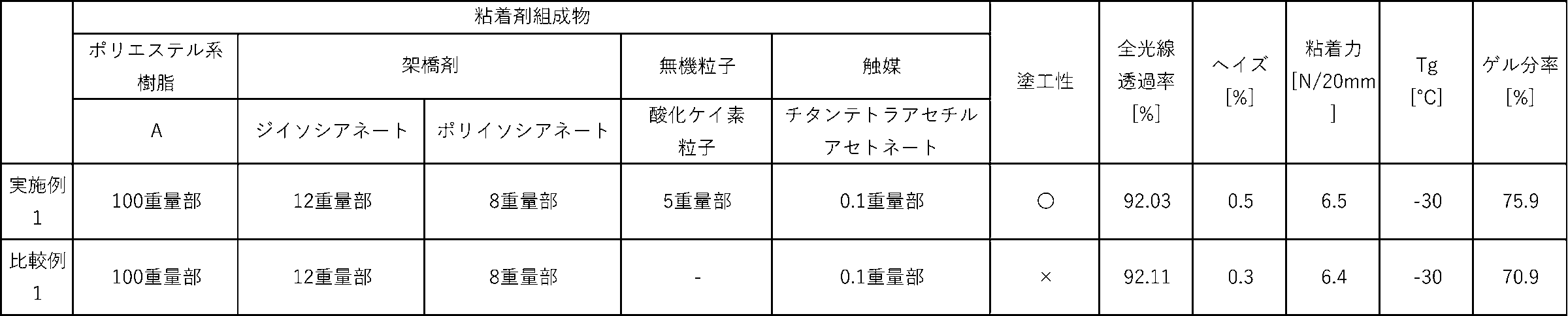
- the obtained adhesive sheet was subjected to the above evaluation. The results are shown in Table 1.
- a polyester-based adhesive was obtained by blending 100 parts by weight of polyester resin A with 12 parts by weight of diisocyanate (product name "Duranate D101", manufactured by Asahi Kasei) as a crosslinking agent, 8 parts by weight of polyisocyanate (product name "Coronate HX", manufactured by Tosoh) and 0.1 parts by weight of titanium tetraacetylacetonate as a catalyst.
- This polyester-based adhesive was applied to the release-treated surface of a substrate (a polyethylene terephthalate (PET) film subjected to a release treatment) so that the thickness after drying would be 20 ⁇ m, and the coating was heated at 130° C. for 1 minute and then left in an atmosphere at 50° C. for 3 days to obtain an adhesive sheet.
- the obtained adhesive sheet was subjected to the above evaluation. The results are shown in Table 1.
- the polyester-based adhesive of the present invention containing inorganic particles (Example 1) has better coatability than the polyester-based adhesive not containing inorganic particles (Comparative Example 1).
Landscapes
- Chemical & Material Sciences (AREA)
- Organic Chemistry (AREA)
- Chemical Kinetics & Catalysis (AREA)
- Inorganic Chemistry (AREA)
- Health & Medical Sciences (AREA)
- Medicinal Chemistry (AREA)
- Polymers & Plastics (AREA)
- Adhesives Or Adhesive Processes (AREA)
Abstract
Description
[2]上記[1]に記載のポリエステル系粘着剤は、有機溶媒を実質的に含有していなくてもよい。
[3]上記[1]または[2]に記載のポリエステル系粘着剤において、上記無機粒子の比表面積が、60m2/g~380m2/gであってもよい。
[4]上記[1]から[3]のいずれかに記載のポリエステル系粘着剤において、上記無機粒子が、シリカ粒子であってもよい。
[5]上記[1]から[4]のいずれかに記載のポリエステル系粘着剤において、上記ポリエステル系樹脂が、バイオポリエステル系樹脂であってもよい。
[6]上記[1]から[5]のいずれかに記載のポリエステル系粘着剤は、架橋触媒をさらに含んでいてもよい。
[7]上記[1]から[6]のいずれかに記載のポリエステル系粘着剤において、架橋剤の含有割合が、ポリエステル系樹脂100重量部に対して、3重量部以上であってもよい。
[8]本発明の1つの実施形態による粘着シートは、基材と基材の少なくとも片側に配置された粘着剤層とを備え、該粘着剤層が上記ポリエステル系粘着剤を含む。
[9]本発明の1つの実施形態によるポリエステル系粘着剤の製造方法は、ポリエステル系樹脂と、無機粒子と、架橋剤とを混合して混合物を調製することを含み、当該混合物が有機溶媒を実質的に含まない。
本発明の実施形態によるポリエステル系粘着剤は、重量平均分子量が0.2×10⁴~2.0×10⁴であるポリエステル系樹脂と、架橋剤と、無機粒子とを含む。
代表的には、ポリエステル系樹脂は、多価カルボン酸成分と、多価アルコール成分との反応により得られる。多価カルボン酸成分は、一分子中に二個以上のカルボキシル基を有する多価カルボン酸およびその誘導体から選択される一種または二種以上の化合物を含む。また、多価アルコール成分は、一分子中に二個以上の水酸基を有する多価アルコールから選択される一種または二種以上の化合物を含む。
上記のとおり、ポリエステル系粘着剤は、架橋剤を含む。1つの実施形態においては、架橋剤としては、イソシアネート系架橋剤および/またはエポキシ系架橋剤が用いられる。1つの実施形態において、架橋剤の含有割合は、ポリエステル系樹脂100重量部に対して、3重量部以上である。
上記のとおり、ポリエステル系粘着剤は、無機粒子を含む。当該無機粒子は、ポリエステル系粘着剤にチクソ性を付与し得る無機粒子であり得る。本発明の実施形態においては、分子量が小さいポリエステル系樹脂を用いながらも、無機粒子を添加することにより、塗工性に優れるポリエステル系粘着剤を得ることができる。より詳細には、無溶剤で調製すべく、低分子量ポリエステル系樹脂を用いると、基材(はく離ライナー等)に塗工する際に、いわゆるハジキ等の塗工不良が発生することがあるが、本発明においては、無機粒子を添加することにより、このような塗工不良を防止することができる。
上記ポリエステル系粘着剤は、必要に応じて、任意の適切な、添加剤をさらに含み得る。添加剤としては、例えば、粘着付与剤、可塑剤(例えば、トリメリット酸エステル系可塑剤、ピロメリット酸エステル系可塑剤等)、顔料、染料、充填剤、老化防止剤、導電材、帯電防止剤、紫外線吸収剤、光安定剤、剥離調整剤、軟化剤、界面活性剤、難燃剤、酸化防止剤等が挙げられる。また、アクリル系樹脂、天然ゴム系樹脂、合成ゴム系樹脂、シリコーン系樹脂等のその他の樹脂をさらに含んでいてもよい。
本発明の実施形態によるポリエステル系粘着剤の製造方法は、ポリエステル系樹脂と、無機粒子と、架橋剤とを混合して混合物を調製することを含み、当該混合物が有機溶媒を実質的に含まないことを特徴とする。
1つの実施形態においては、上記ポリエステル系粘着剤から形成された粘着剤層を備える粘着シートが提供される。図1は、本発明の1つの実施形態による粘着シートの概略断面図である。上記粘着シート100は、図1(a)に示すように、粘着剤層10のみから構成されていてもよく、図1(b)に示すように、基材20と基材20の少なくとも片側に配置された粘着剤層10とから構成されていてもよい。
上記基材は、任意の適切な材料から構成され得る。基材は、例えば、プラスチックフィルム、プラスチックシートの他、紙、布、不織布、金属箔、あるいはそれらのプラスチックラミネート体、プラスチック同士の積層体など、様々なシート状物を用いることが可能である。中でも、取り扱い性やコストの観点から、プラスチックフィルムやプラスチックシート(以下、プラスチックフィルムという)が最も好ましい。プラスチックフィルムの素材としては、強度、耐熱性などの観点から、必要に応じて選択できる。例えば、ポリエチレン(PE)、ポリプロピレン(PP)、エチレン-プロピレン共重合体、エチレン-酢酸ビニル共重合体(EVA)等のα-オレフィンをモノマー成分とするオレフィン系樹脂;ポリエチレンテレフタレート(PET)、ポリエチレンナフタレート(PEN)、ポリブチレンテレフタレート(PBT)等のポリエステル;ポリ塩化ビニル(PVC);ポリフェニレンスルフィド(PPS);ポリアミド(ナイロン)、全芳香族ポリアミド(アラミド)等のアミド系樹脂;ポリエーテルエーテルケトン(PEEK)、ポリイミド、ポリエーテルイミド、ポリスチレン、アクリル樹脂などが挙げられる。これらの素材は単独で又は2種以上組み合わせて使用することができる。また、プラスチックフィルムとしては、未延伸フィルム、1軸配向フィルム、2軸配向フィルムのいずれを用いてもよい。また、これらのフィルムは2層以上のフィルム層からなる積層フィルムでもよいし、取り扱い性の観点から、適宜、不活性粒子などの滑剤を添加したフィルムを用いてもよい。
1つの実施形態においては、上記粘着剤層は、上記ポリエステル系粘着剤を基材に塗布し、塗布層を硬化処理することにより形成され得る。すなわち、上記粘着剤層は上記ポリエステル系粘着剤の硬化物であり得る。硬化処理は、代表的には、架橋処理である。上記硬化処理は、加熱による硬化処理であっても、活性エネルギー線(例えば、紫外線)による硬化処理であってもよい。硬化条件としては、ポリエステル系粘着剤の組成に応じて、任意の適切な条件とされ得る。
上記粘着シートは、任意の適切な方法により製造することができる。粘着シートの製造方法としては、例えば、基材上に直接、粘着剤を塗工する方法、または任意の適切な基体上に粘着剤を塗工して形成された塗工層を基材に転写する方法等が挙げられる。
試料(ポリエステル系樹脂)を0.2wt%のテトラヒドロフラン(THF)溶液に調製し、室温で20時間放置した。その後、0.45μmメンブレンフィルターにてろ過し、ろ液についてGPC測定を行った。
分析装置:Waters製、Alliance
カラム:東ソー製、G7000HXL + GMHXL + GMHXL
カラム温度:40℃
溶離液:THF
流速:0.8mL/min
注入量:100uL
検出器:示差屈折計(RI)
標準試料:Agilent製、ポリスチレン(PS)
ポリエステル系粘着剤の粘度を、下記の条件にて測定した。
測定装置:HAAKE製レオメーター
コーンプレート:直径35mm、1°、チタン製
せん断速度:0.1~1000 1/s
温度:25℃
ギャップ:0.025um
実施例および比較例で得られた粘着シートから、長さ100mm、幅20mmのシート片を切り出した。次いで、粘着シートの一方の剥離処理を施したPETフィルムを剥離し、露出した粘着面をPETフィルム(商品名「ルミラーS10#25」、東レ株式会社製)を貼付(裏打ち)した。次に、他方の剥離処理を施したPETフィルムを剥離して、試験板としてSUS304板に、2kgローラー、1往復の圧着条件で圧着し、23℃、50%RHの雰囲気下で72時間放置した。その後、引張試験機(装置名「EZ Test/Ez-S」、株式会社島津製作所製)を用い、JIS Z0237に準拠して、23℃、50%RHの雰囲気下、引張速度300mm/分、剥離角度180°の条件で、試験板から粘着シート(粘着剤層/PETフィルム)を引きはがし、粘着力(N/20mm)を測定した。
実施例および比較例で得られた粘着剤層を積層して打ち抜き、厚さ1mm×直径8mmの円盤状の試験片を作製した。この試験片を、せん断試験用のパラレルプレートで挟み込み、動的粘弾性測定装置(装置名「ARES-G2」、TA Instruments社製)を用いて、下記に記載する測定条件で貯蔵弾性率G’および損失弾性率G’’を測定した。貯蔵弾性率と損失弾性率の比(G’’/G’)=Tanδのピーク値を粘着剤層のTgとして読み取った。
・測定:せん断モード
・温度範囲:-50℃~150℃
・昇温速度:5℃/min
・周波数:1Hz
実施例および比較例で得られた粘着剤層を約0.1g採取し、平均孔径0.2umの多孔質テトラフルオロエチレンシート(商品名「NTF1122」、日東電工株式会社製)に包んだ後、凧糸で縛り、その際の重量を測定し、該重量を浸漬前重量(Z)とした。なお、該浸漬前重量は、粘着剤層(上記で採取した粘着剤層)と、テトラフルオロエチレンシートと、凧糸の総重量である。また、テトラフルオロエチレンシートと凧糸との合計重量も測定しておき、該重量を包袋重量(Y)とした。
次に、粘着剤層をテトラフルオロエチレンシートで包み凧糸で縛ったもの(「サンプル」と称する)を、トルエンで満たした50ml容器に入れ、23℃にて7日間静置した。その後、容器からサンプル(トルエン処理後)を取り出してアルミニウム製カップに移し、130℃で2時間、乾燥機中で乾燥してトルエンを除去した後、重量を測定し、該重量を浸漬後重量(X)とした。
そして、下記の式からゲル分率を算出した。
ゲル分率[%(重量%)]=(X-Y)/(Z-Y)×100
実施例および比較例で得られた粘着シートから一方の剥離処理を施したPETフィルムを剥離して、露出した粘着面をスライドガラス(商品名「白研磨 No.1」(厚さ0.8~1.0mm、全光線透過率92%、ヘイズ0.2%、b*0.15)、松浪硝子工業株式会社製)に貼り合わせ、オートクレーブ処理(50℃,0.5MPa,15分)を行った。処理後、他方の剥離処理を施したPETフィルムを剥離して、[粘着シート(粘着剤層)/スライドガラス]の層構成を有する試験片を作製した。上記試験片の可視光領域における全光線透過率およびヘイズを、ヘイズメーター(装置名「HSP-150Vis」、株式会社村上色彩研究所製)を用いて23±1℃、52±1%RHの環境下において測定した。各検体で3サンプル作製し、それらの3サンプルの測定値の平均を可視光領域における全光線透過率およびヘイズとした。
実施例および比較例で得られた粘着シートの外観を目視で確認し、塗工性を評価した。
〇:ハジキなし
△:ハジキ数個あり
×:ハジキ全面にあり
攪拌機、温度計、流出用冷却機を装備した反応系内に、ジカルボン酸成分としてビス-2-ヒドロキシエチルテレフタレート(TCI製)1mol、ジオール成分としてダイマージオール(商品名「プリポール2033」、分子量534、クローダジャパン社製)1.4mol、ポリオール(商品名「BioPTMG650」、分子量650)0.4mol、触媒としてテトラブチルチタネート0.025wt%を仕込み、3kPaに減圧し、210℃で4時間縮合重合を行い、ポリエステル樹脂Aを得た。
このポリエステル樹脂Aは、重量平均分子量Mwが4,400、粘度が10Pa・sであった。なお、上記のジカルボン酸成分とジオール成分との使用量は、ジカルボン酸成分に含まれるカルボキシル基1.0モルに対して、ジオール成分に含まれる水酸基が1.8モルとなる割合であった。
ポリエステル樹脂A100重量部に、無機粒子(酸化ケイ素粒子、日本アエロジル社製、商品名「アエロジル#200」、比表面積:175~225m2/g)5重量部加え、ホモディスパーを用いて分散し、ワニスを得た。このワニス100重量部に対し、架橋剤としてジイソシアネート(商品名「デュラネートD101」、旭化成製)12重量部、ポリイソシアネート(商品名「コロネートHX」、東ソー製)8重量部、触媒としてチタンテトラアセチルアセトネート(商品名「オルガチックスTC-401」、マツモトファインケミカル製)0.1重量部を配合したポリエステル系粘着剤を得た。
このポリエステル系粘着剤を、基材(剥離処理を施したポリエチレンテレフタレート(PET)フィルム)の剥離処理面に、乾燥後の厚さが20μmとなるように塗布し、130℃で1分加熱後、50℃の雰囲気に3日間放置して、粘着シートを得た。得られた粘着シートを上記評価に供した。結果を表1に示す。
ポリエステル樹脂A100重量部に対し、架橋剤としてジイソシアネート(商品名「デュラネートD101」、旭化成製)12重量部、ポリイソシアネート(商品名「コロネートHX」、東ソー製)8重量部、触媒としてチタンテトラアセチルアセトネート0.1重量部を配合したポリエステル系粘着剤を得た。
このポリエステル系粘着剤を、基材(剥離処理を施したポリエチレンテレフタレート(PET)フィルム)の剥離処理面に、乾燥後の厚さが20μmとなるように塗布し、130℃で1分加熱後、50℃の雰囲気に3日間放置して、粘着シートを得た。得られた粘着シートを上記評価に供した。結果を表1に示す。
20 基材
100 粘着シート
Claims (9)
- ポリエステル系樹脂と、架橋剤と、無機粒子とを含み、
該ポリエステル系樹脂の重量平均分子量が0.2×10⁴~2.0×10⁴である、
ポリエステル系粘着剤。 - 有機溶媒を実質的に含有しない、請求項1に記載のポリエステル系粘着剤。
- 前記無機粒子の比表面積が、60m2/g~380m2/gである、請求項1に記載のポリエステル系粘着剤。
- 前記無機粒子が、シリカ粒子である、請求項1に記載のポリエステル系粘着剤。
- 前記ポリエステル系樹脂が、バイオポリエステル系樹脂である、請求項1に記載のポリエステル系粘着剤。
- 架橋触媒をさらに含む、請求項1に記載のポリエステル系粘着剤。
- 前記架橋剤の含有割合が、ポリエステル系樹脂100重量部に対して、3重量部以上である、請求項1に記載のポリエステル系粘着剤。
- 基材と基材の少なくとも片側に配置された粘着剤層とを備え、
該粘着剤層が請求項1に記載のポリエステル系粘着剤を含む、
粘着シート。 - ポリエステル系樹脂と、無機粒子と、架橋剤とを混合して混合物を調製することを含み、
当該混合物が有機溶媒を実質的に含まない、
ポリエステル系粘着剤の製造方法。
Priority Applications (3)
| Application Number | Priority Date | Filing Date | Title |
|---|---|---|---|
| KR1020257031988A KR20250166133A (ko) | 2023-03-31 | 2024-03-11 | 점착제 및 점착제의 제조 방법 |
| JP2025510235A JPWO2024203231A1 (ja) | 2023-03-31 | 2024-03-11 | |
| CN202480007221.3A CN120569450A (zh) | 2023-03-31 | 2024-03-11 | 粘合剂及粘合剂的制造方法 |
Applications Claiming Priority (2)
| Application Number | Priority Date | Filing Date | Title |
|---|---|---|---|
| JP2023059060 | 2023-03-31 | ||
| JP2023-059060 | 2023-03-31 |
Publications (1)
| Publication Number | Publication Date |
|---|---|
| WO2024203231A1 true WO2024203231A1 (ja) | 2024-10-03 |
Family
ID=92904302
Family Applications (1)
| Application Number | Title | Priority Date | Filing Date |
|---|---|---|---|
| PCT/JP2024/009356 Ceased WO2024203231A1 (ja) | 2023-03-31 | 2024-03-11 | 粘着剤および粘着剤の製造方法 |
Country Status (5)
| Country | Link |
|---|---|
| JP (1) | JPWO2024203231A1 (ja) |
| KR (1) | KR20250166133A (ja) |
| CN (1) | CN120569450A (ja) |
| TW (1) | TW202503005A (ja) |
| WO (1) | WO2024203231A1 (ja) |
Citations (5)
| Publication number | Priority date | Publication date | Assignee | Title |
|---|---|---|---|---|
| JP2003238930A (ja) * | 2002-02-18 | 2003-08-27 | Toyobo Co Ltd | 粘接着剤用樹脂組成物及びこれを用いた積層体 |
| WO2011081163A1 (ja) * | 2009-12-28 | 2011-07-07 | 日東電工株式会社 | ポリエステル系粘着剤組成物 |
| JP2014169420A (ja) * | 2013-03-05 | 2014-09-18 | Nitto Denko Corp | 両面粘着テープ |
| JP2020056006A (ja) * | 2018-09-26 | 2020-04-09 | 三菱ケミカル株式会社 | ポリエステル系粘着剤組成物、ポリエステル系粘着剤及び粘着シート |
| JP2023024126A (ja) * | 2021-08-06 | 2023-02-16 | 三菱ケミカル株式会社 | ポリエステル系樹脂組成物、粘着剤組成物、粘着剤、粘着シートおよび積層体、並びにポリエステル系樹脂(a)およびその製法 |
-
2024
- 2024-03-11 WO PCT/JP2024/009356 patent/WO2024203231A1/ja not_active Ceased
- 2024-03-11 JP JP2025510235A patent/JPWO2024203231A1/ja active Pending
- 2024-03-11 KR KR1020257031988A patent/KR20250166133A/ko active Pending
- 2024-03-11 CN CN202480007221.3A patent/CN120569450A/zh active Pending
- 2024-03-22 TW TW113110685A patent/TW202503005A/zh unknown
Patent Citations (5)
| Publication number | Priority date | Publication date | Assignee | Title |
|---|---|---|---|---|
| JP2003238930A (ja) * | 2002-02-18 | 2003-08-27 | Toyobo Co Ltd | 粘接着剤用樹脂組成物及びこれを用いた積層体 |
| WO2011081163A1 (ja) * | 2009-12-28 | 2011-07-07 | 日東電工株式会社 | ポリエステル系粘着剤組成物 |
| JP2014169420A (ja) * | 2013-03-05 | 2014-09-18 | Nitto Denko Corp | 両面粘着テープ |
| JP2020056006A (ja) * | 2018-09-26 | 2020-04-09 | 三菱ケミカル株式会社 | ポリエステル系粘着剤組成物、ポリエステル系粘着剤及び粘着シート |
| JP2023024126A (ja) * | 2021-08-06 | 2023-02-16 | 三菱ケミカル株式会社 | ポリエステル系樹脂組成物、粘着剤組成物、粘着剤、粘着シートおよび積層体、並びにポリエステル系樹脂(a)およびその製法 |
Also Published As
| Publication number | Publication date |
|---|---|
| TW202503005A (zh) | 2025-01-16 |
| CN120569450A (zh) | 2025-08-29 |
| KR20250166133A (ko) | 2025-11-27 |
| JPWO2024203231A1 (ja) | 2024-10-03 |
Similar Documents
| Publication | Publication Date | Title |
|---|---|---|
| JP6343463B2 (ja) | 両面粘着テープ | |
| CN102597151B (zh) | 粘合剂组合物 | |
| CN105745297B (zh) | 阻气性粘接剂用树脂组合物及粘接剂 | |
| JP6515809B2 (ja) | ポリエステル樹脂組成物および接着剤組成物 | |
| EP2508581B1 (en) | Adhesive sheet | |
| TW201323557A (zh) | 接著劑組成物、疊層體及聚酯多元醇 | |
| WO2014136765A1 (ja) | 粘着剤層、粘着テープ、及び、両面粘着テープ | |
| JP2019059892A (ja) | 粘接着剤層、粘接着シートおよび樹脂組成物 | |
| JP7443763B2 (ja) | 接着剤組成物、及び積層体 | |
| JP2021134354A (ja) | ポリエステル系粘着剤組成物、ポリエステル系粘着剤および粘着シート | |
| WO2024204421A1 (ja) | 粘着シートおよび粘着剤組成物 | |
| JP2023022367A (ja) | 無溶剤型接着剤、積層体及び包装体 | |
| JP2024083272A (ja) | 着色粘着テープ及び着色粘着テープの製造方法 | |
| WO2024203232A1 (ja) | 粘着剤、粘着剤の製造方法および粘着シート | |
| JP2018193537A (ja) | ポリエステル系粘着剤とその粘着シート | |
| JP2012216619A (ja) | 表面保護用シート | |
| JP2012214585A (ja) | エネルギー線硬化型粘着剤用のアンカーコート剤組成物、コートフィルム、及び半導体ウエハ加工用粘着シート | |
| WO2019017366A1 (ja) | 接着剤組成物 | |
| TW202442838A (zh) | 黏著片材之製造方法 | |
| JP2019023277A (ja) | ポリエステル系粘着剤とその粘着シート | |
| JP5627280B2 (ja) | ポリエステルシートの製造方法 | |
| TW202503005A (zh) | 黏著劑及黏著劑之製造方法 | |
| JP7855908B2 (ja) | 粘着剤組成物、粘着剤、粘着剤層、粘着シート、積層体および接着剤組成物 | |
| JP7115649B2 (ja) | 粘着テープ | |
| JP7211537B2 (ja) | 粘着テープ |
Legal Events
| Date | Code | Title | Description |
|---|---|---|---|
| 121 | Ep: the epo has been informed by wipo that ep was designated in this application |
Ref document number: 24779361 Country of ref document: EP Kind code of ref document: A1 |
|
| WWE | Wipo information: entry into national phase |
Ref document number: 2025510235 Country of ref document: JP |
|
| WWE | Wipo information: entry into national phase |
Ref document number: 202480007221.3 Country of ref document: CN |
|
| WWP | Wipo information: published in national office |
Ref document number: 202480007221.3 Country of ref document: CN |
|
| ENP | Entry into the national phase |
Ref document number: 1020257031988 Country of ref document: KR Free format text: ST27 STATUS EVENT CODE: A-0-1-A10-A15-NAP-PA0105 (AS PROVIDED BY THE NATIONAL OFFICE) |
|
| WWE | Wipo information: entry into national phase |
Ref document number: KR1020257031988 Country of ref document: KR |
|
| NENP | Non-entry into the national phase |
Ref country code: DE |
|
| 122 | Ep: pct application non-entry in european phase |
Ref document number: 24779361 Country of ref document: EP Kind code of ref document: A1 |