WO2024203200A1 - 化合物、着色樹脂組成物、着色硬化性樹脂組成物、カラーフィルタ、表示装置、及び固体撮像素子 - Google Patents
化合物、着色樹脂組成物、着色硬化性樹脂組成物、カラーフィルタ、表示装置、及び固体撮像素子 Download PDFInfo
- Publication number
- WO2024203200A1 WO2024203200A1 PCT/JP2024/009257 JP2024009257W WO2024203200A1 WO 2024203200 A1 WO2024203200 A1 WO 2024203200A1 JP 2024009257 W JP2024009257 W JP 2024009257W WO 2024203200 A1 WO2024203200 A1 WO 2024203200A1
- Authority
- WO
- WIPO (PCT)
- Prior art keywords
- colored
- resin composition
- meth
- group
- acrylate
- Prior art date
- Legal status (The legal status is an assumption and is not a legal conclusion. Google has not performed a legal analysis and makes no representation as to the accuracy of the status listed.)
- Ceased
Links
Classifications
-
- C—CHEMISTRY; METALLURGY
- C07—ORGANIC CHEMISTRY
- C07D—HETEROCYCLIC COMPOUNDS
- C07D311/00—Heterocyclic compounds containing six-membered rings having one oxygen atom as the only hetero atom, condensed with other rings
- C07D311/02—Heterocyclic compounds containing six-membered rings having one oxygen atom as the only hetero atom, condensed with other rings ortho- or peri-condensed with carbocyclic rings or ring systems
- C07D311/78—Ring systems having three or more relevant rings
- C07D311/80—Dibenzopyrans; Hydrogenated dibenzopyrans
- C07D311/82—Xanthenes
-
- C—CHEMISTRY; METALLURGY
- C08—ORGANIC MACROMOLECULAR COMPOUNDS; THEIR PREPARATION OR CHEMICAL WORKING-UP; COMPOSITIONS BASED THEREON
- C08L—COMPOSITIONS OF MACROMOLECULAR COMPOUNDS
- C08L101/00—Compositions of unspecified macromolecular compounds
-
- C—CHEMISTRY; METALLURGY
- C09—DYES; PAINTS; POLISHES; NATURAL RESINS; ADHESIVES; COMPOSITIONS NOT OTHERWISE PROVIDED FOR; APPLICATIONS OF MATERIALS NOT OTHERWISE PROVIDED FOR
- C09B—ORGANIC DYES OR CLOSELY-RELATED COMPOUNDS FOR PRODUCING DYES, e.g. PIGMENTS; MORDANTS; LAKES
- C09B11/00—Diaryl- or thriarylmethane dyes
- C09B11/28—Pyronines ; Xanthon, thioxanthon, selenoxanthan, telluroxanthon dyes
-
- C—CHEMISTRY; METALLURGY
- C09—DYES; PAINTS; POLISHES; NATURAL RESINS; ADHESIVES; COMPOSITIONS NOT OTHERWISE PROVIDED FOR; APPLICATIONS OF MATERIALS NOT OTHERWISE PROVIDED FOR
- C09B—ORGANIC DYES OR CLOSELY-RELATED COMPOUNDS FOR PRODUCING DYES, e.g. PIGMENTS; MORDANTS; LAKES
- C09B67/00—Influencing the physical, e.g. the dyeing or printing properties of dyestuffs without chemical reactions, e.g. by treating with solvents grinding or grinding assistants, coating of pigments or dyes; Process features in the making of dyestuff preparations; Dyestuff preparations of a special physical nature, e.g. tablets, films
- C09B67/006—Preparation of organic pigments
-
- G—PHYSICS
- G02—OPTICS
- G02B—OPTICAL ELEMENTS, SYSTEMS OR APPARATUS
- G02B5/00—Optical elements other than lenses
- G02B5/20—Filters
-
- G—PHYSICS
- G03—PHOTOGRAPHY; CINEMATOGRAPHY; ANALOGOUS TECHNIQUES USING WAVES OTHER THAN OPTICAL WAVES; ELECTROGRAPHY; HOLOGRAPHY
- G03F—PHOTOMECHANICAL PRODUCTION OF TEXTURED OR PATTERNED SURFACES, e.g. FOR PRINTING, FOR PROCESSING OF SEMICONDUCTOR DEVICES; MATERIALS THEREFOR; ORIGINALS THEREFOR; APPARATUS SPECIALLY ADAPTED THEREFOR
- G03F7/00—Photomechanical, e.g. photolithographic, production of textured or patterned surfaces, e.g. printing surfaces; Materials therefor, e.g. comprising photoresists; Apparatus specially adapted therefor
- G03F7/0005—Production of optical devices or components in so far as characterised by the lithographic processes or materials used therefor
- G03F7/0007—Filters, e.g. additive colour filters; Components for display devices
-
- G—PHYSICS
- G03—PHOTOGRAPHY; CINEMATOGRAPHY; ANALOGOUS TECHNIQUES USING WAVES OTHER THAN OPTICAL WAVES; ELECTROGRAPHY; HOLOGRAPHY
- G03F—PHOTOMECHANICAL PRODUCTION OF TEXTURED OR PATTERNED SURFACES, e.g. FOR PRINTING, FOR PROCESSING OF SEMICONDUCTOR DEVICES; MATERIALS THEREFOR; ORIGINALS THEREFOR; APPARATUS SPECIALLY ADAPTED THEREFOR
- G03F7/00—Photomechanical, e.g. photolithographic, production of textured or patterned surfaces, e.g. printing surfaces; Materials therefor, e.g. comprising photoresists; Apparatus specially adapted therefor
- G03F7/004—Photosensitive materials
- G03F7/09—Photosensitive materials characterised by structural details, e.g. supports, auxiliary layers
- G03F7/105—Photosensitive materials characterised by structural details, e.g. supports, auxiliary layers having substances, e.g. indicators, for forming visible images
Definitions
- the present invention relates to a compound, a colored resin composition, a colored curable resin composition, a color filter, a display device, and a solid-state imaging device.
- Color filters used in displays such as liquid crystal displays, electroluminescent displays, and plasma displays; and solid-state imaging devices such as CCD and CMOS sensors, are manufactured from colored (curable) resin compositions.
- Known examples of such compositions include compositions that contain colorants, resins, etc. (for example, Patent Document 1).
- Color filters used in display devices, solid-state imaging devices, etc. are required to have sufficient light resistance from the viewpoint of the usage environment.
- conventional color filters do not necessarily have sufficient light resistance, and there is room for improvement.
- the main object of the present invention is to provide a compound useful for forming a color filter having excellent light resistance, and to provide a colored curable resin composition capable of forming a color filter having excellent light resistance.
- the present invention provides a compound according to [1], a colored resin composition according to [2], a colored curable resin composition according to [3], a color filter according to [4], a display device according to [5], and a solid-state imaging device according to [6].
- R 1 represents a monovalent hydrocarbon group having 21 to 40 carbon atoms.
- R3 represents a monovalent hydrocarbon group having 6 to 40 carbon atoms.
- R2 and R4 each independently represent a hydrogen atom or a monovalent saturated hydrocarbon group having 1 to 6 carbon atoms.
- R5 represents -OH , -SO3- , -SO3H , -SO3 - Z + , -CO2H , -CO2 - Z + , -CO2R8 , -SO3R8 , or -SO2NR9R10 .
- R 6 and R 7 each independently represent a hydrogen atom or a monovalent saturated hydrocarbon group having 1 to 6 carbon atoms.
- m represents an integer of 0 to 5. When m is 2 or more, multiple R 5s may be the same or different.
- a represents an integer of 0 or 1.
- X represents a halogen atom.
- Z + represents N + ( R11 ) 4 , Na + , or K + , and the four R11 's may be the same or different.
- R 8 represents a monovalent saturated hydrocarbon group having 1 to 20 carbon atoms, and a hydrogen atom contained in the saturated hydrocarbon group may be substituted with a halogen atom.
- R 9 and R 10 each independently represent a hydrogen atom or a monovalent saturated hydrocarbon group having 1 to 20 carbon atoms which may have a substituent, and -CH 2 - contained in the saturated hydrocarbon group may be substituted with -O-, -CO-, -NH- or -NR 8 -.
- R 9 and R 10 may be bonded to each other to form a 3- to 10-membered heterocycle together with the adjacent nitrogen atom.
- R 11 represents a hydrogen atom, a monovalent saturated hydrocarbon group having 1 to 20 carbon atoms, or an aralkyl group having 7 to 10 carbon atoms.
- [2] Contains a colorant and a resin, The colored resin composition, wherein the colorant comprises a compound represented by formula (I) according to [1].
- a composition comprising a colorant, a resin, a polymerizable compound, and a polymerization initiator, The colored curable resin composition, wherein the colorant contains a compound represented by formula (I) according to [1].
- [5] A display device comprising the color filter according to [4].
- [6] A solid-state imaging device comprising the color filter according to [4].
- the present invention provides a compound useful for forming a color filter having excellent light resistance.
- the present invention also provides a colored curable resin composition capable of forming a color filter having excellent light resistance.
- the present invention also provides a colored resin composition useful for preparing a colored curable resin composition.
- the present invention provides a color filter formed from such a colored curable resin composition, as well as a display device and a solid-state imaging device including the color filter.
- a numerical range indicated using “ ⁇ ” indicates a range that includes the numerical values before and after " ⁇ " as the minimum and maximum values, respectively.
- the upper or lower limit value described in one numerical range may be replaced with the upper or lower limit value of another numerical range described in stages.
- the upper or lower limit value of that numerical range may be replaced with a value shown in an example.
- (meth)acrylate means acrylate or the corresponding methacrylate.
- (meth)acrylic acid, (meth)acryloyl, and (meth)acrylic acid esters are similar expressions such as (meth)acrylic acid, (meth)acryloyl, and (meth)acrylic acid esters.
- the materials exemplified below may be used alone or in combination of two or more types within the range that meets the conditions.
- the content of each component means the total amount of those multiple substances unless otherwise specified.
- the compound of the present embodiment is a compound represented by formula (I) (hereinafter, may be referred to as "compound (I)"). Note that compound (I) may have isomers such as tautomers, and these isomers are also included in the scope of the present invention.
- R 1 represents a monovalent hydrocarbon group having 21 to 40 carbon atoms.
- R3 represents a monovalent hydrocarbon group having 6 to 40 carbon atoms.
- R2 and R4 each independently represent a hydrogen atom or a monovalent saturated hydrocarbon group having 1 to 6 carbon atoms.
- R5 represents -OH , -SO3- , -SO3H , -SO3 - Z + , -CO2H , -CO2 - Z + , -CO2R8 , -SO3R8 , or -SO2NR9R10 .
- R 6 and R 7 each independently represent a hydrogen atom or a monovalent saturated hydrocarbon group having 1 to 6 carbon atoms.
- m represents an integer of 0 to 5.
- R 5s When m is 2 or more, multiple R 5s may be the same or different.
- a represents an integer of 0 or 1.
- X represents a halogen atom.
- Z + represents N + ( R11 ) 4 , Na + , or K + , and the four R11 's may be the same or different.
- R 8 represents a monovalent saturated hydrocarbon group having 1 to 20 carbon atoms, and a hydrogen atom contained in the saturated hydrocarbon group may be substituted with a halogen atom.
- R 9 and R 10 each independently represent a hydrogen atom or a monovalent saturated hydrocarbon group having 1 to 20 carbon atoms which may have a substituent, and -CH 2 - contained in the saturated hydrocarbon group may be substituted with -O-, -CO-, -NH- or -NR 8 -.
- R 9 and R 10 may be bonded to each other to form a 3- to 10-membered heterocycle together with the adjacent nitrogen atom.
- R 11 represents a hydrogen atom, a monovalent saturated hydrocarbon group having 1 to 20 carbon atoms, or an aralkyl group having 7 to 10 carbon atoms.
- the monovalent hydrocarbon group having 6 to 40 carbon atoms in R3 is preferably a monovalent aromatic hydrocarbon group having 6 to 40 carbon atoms which may have a substituent.
- the number of carbon atoms in the monovalent aromatic hydrocarbon group is 6 to 40, including the number of carbon atoms in the substituent.
- Examples of the monovalent aromatic hydrocarbon group in R 3 include monocyclic aromatic hydrocarbons (e.g., benzene) or polycyclic aromatic hydrocarbons (e.g., bicyclic aromatic hydrocarbons such as naphthalene, indene, naphthoquinone, indenone, and tetralone; tricyclic aromatic hydrocarbons such as anthracene, phenanthrene, dihydrophenanthrene, fluorene, anthraquinone, phenanthoquinone, and fluorenone; tetracyclic aromatic hydrocarbons such as benzoanthracene, benzophenanthrene, benzofluorene, pyrene, and fluoranthene; pentcyclic aromatic hydrocarbons such as dibenzanthracene, dibenzophenanthrene, dibenzofluorene, indenofluorene, perylene, and benzofluoranthene; and hexacyclic aromatic hydrocarbons such
- the monovalent aromatic hydrocarbon group examples include groups in which one hydrogen atom directly bonded to a carbon atom constituting a ring has been removed from an aromatic hydrocarbon (non-condensed polycyclic aromatic hydrocarbon) in which a plurality of such aromatic hydrocarbons are bonded.
- the non-condensed polycyclic aromatic hydrocarbon examples include biphenyl, terphenyl (o-terphenyl, m-terphenyl, p-terphenyl), and phenylterphenyl.
- Examples of the substituent that the monovalent aromatic hydrocarbon group may have include a halogen atom, -OH, -OR 8 , -SO 3 - , -SO 3 H, -SO 3 - Z + , -CO 2 H, -CO 2 R 8 , -SR 8 , -SO 2 R 8 , -SO 3 R 8 , -SO 2 NR 9 R 10 , and -Si(OR 12 )(OR 13 )(OR 14 ).
- R 12 , R 13 , and R 14 each independently represent a monovalent saturated hydrocarbon group having 1 to 4 carbon atoms, and a hydrogen atom contained in the saturated hydrocarbon group may be substituted with a halogen atom.
- the aromatic hydrocarbon of the monovalent aromatic hydrocarbon group in R 3 is preferably an aromatic hydrocarbon having one to six benzene rings, more preferably an aromatic hydrocarbon having two to five benzene rings, and even more preferably an aromatic hydrocarbon having two to four benzene rings.
- the aromatic hydrocarbon having two to four benzene rings may be, for example, biphenyl, terphenyl, or phenylterphenyl.
- the number of fused benzene rings is the number of benzene rings. For example, naphthalene in which two benzene rings are fused is counted as having two benzene rings.
- the number of bonded benzene rings is the number of benzene rings.
- biphenyl in which two benzene rings are bonded is counted as having two benzene rings.
- R3 is preferably a group in which one hydrogen atom directly bonded to a carbon atom constituting a ring has been removed from at least one aromatic hydrocarbon selected from the group consisting of benzene, biphenyl, terphenyl, and phenylterphenyl, and more preferably a group in which one hydrogen atom directly bonded to a carbon atom constituting a ring has been removed from at least one aromatic hydrocarbon selected from the group consisting of biphenyl, terphenyl, and phenylterphenyl.
- the monovalent hydrocarbon group having 21 to 40 carbon atoms in R1 is preferably a monovalent aromatic hydrocarbon group having 21 to 40 carbon atoms which may have a substituent.
- the number of carbon atoms in the monovalent aromatic hydrocarbon group is 21 to 40, including the number of carbon atoms in the substituent.
- Examples of the monovalent aromatic hydrocarbon group for R 1 include those having 21 to 40 carbon atoms among the groups exemplified as the monovalent aromatic hydrocarbon group for R 3 .
- the aromatic hydrocarbon of the monovalent aromatic hydrocarbon group in R1 is preferably an aromatic hydrocarbon having 4 to 6 benzene rings, more preferably an aromatic hydrocarbon having 4 or 5 benzene rings, and even more preferably an aromatic hydrocarbon having 4 benzene rings.
- An aromatic hydrocarbon having 4 benzene rings may be, for example, phenyl terphenyl.
- R 1 is preferably a group in which one hydrogen atom directly bonded to a carbon atom constituting the ring has been removed from phenylterphenyl.
- Examples of the monovalent saturated hydrocarbon group having 1 to 6 carbon atoms for R2 and R4 include linear alkyl groups such as a methyl group, an ethyl group, a propyl group, a pentyl group, and a hexyl group; branched alkyl groups such as an isopropyl group, an isobutyl group, an isopentyl group, and a neopentyl group; and cyclic alkyl groups such as a cyclopropyl group, a cyclopentyl group, and a cyclohexyl group.
- Examples of the monovalent saturated hydrocarbon group having 1 to 20 carbon atoms for R 8 to R 11 include linear alkyl groups such as methyl, ethyl, propyl, butyl, pentyl, hexyl, heptyl, octyl, nonyl, decyl, dodecyl, hexadecyl, and icosyl groups; branched alkyl groups such as isopropyl, isobutyl, isopentyl, neopentyl, and 2-ethylhexyl groups; and cyclic alkyl groups such as cyclopropyl, cyclopentyl, cyclohexyl, cycloheptyl, cyclooctyl, and tricyclodecyl groups.
- linear alkyl groups such as methyl, ethyl, propyl, butyl, pentyl, hexyl, heptyl, o
- the monovalent saturated hydrocarbon group having 1 to 20 carbon atoms in R 9 and R 10 may have a substituent.
- substituents include a hydroxy group and a halogen atom.
- Examples of the monovalent saturated hydrocarbon group having 1 to 4 carbon atoms for R 12 to R 14 include linear alkyl groups such as a methyl group, an ethyl group, a propyl group, and a butyl group; branched alkyl groups such as an isopropyl group and an isobutyl group; and cyclic alkyl groups such as a cyclopropyl group.
- Z + is N + ( R11 ) 4 , Na + , or K + , and is preferably N + ( R11 ) 4 .
- N + ( R11 ) 4 it is preferable that at least two are monovalent saturated hydrocarbon groups having 5 to 20 carbon atoms.
- the total carbon number of the four R11 is preferably 20 to 80, and more preferably 20 to 60.
- Examples of --OR 8 include a methoxy group, an ethoxy group, a propoxy group, a butoxy group, a pentyloxy group, a hexyloxy group, a heptyloxy group, an octyloxy group, a 2-ethylhexyloxy group, and an icosyloxy group.
- Examples of --CO 2 R 8 include a methoxycarbonyl group, an ethoxycarbonyl group, a propoxycarbonyl group, a tert-butoxycarbonyl group, a hexyloxycarbonyl group, and an icosyloxycarbonyl group.
- Examples of --SR 8 include a methylsulfanyl group, an ethylsulfanyl group, a butylsulfanyl group, a hexylsulfanyl group, a decylsulfanyl group, and an icosylsulfanyl group.
- Examples of --SO 2 R 8 include a methylsulfonyl group, an ethylsulfonyl group, a butylsulfonyl group, a hexylsulfonyl group, a decylsulfonyl group, and an icosylsulfonyl group.
- Examples of --SO 3 R 8 include a methoxysulfonyl group, an ethoxysulfonyl group, a propoxysulfonyl group, a tert-butoxysulfonyl group, a hexyloxysulfonyl group, and an icosyloxysulfonyl group.
- Examples of —SO 2 NR 9 R 10 include a sulfamoyl group; an N-methylsulfamoyl group, an N-ethylsulfamoyl group, an N-isopropylsulfamoyl group, an N-butylsulfamoyl group, an N-pentylsulfamoyl group, an N-(1-ethylpropyl)sulfamoyl group, an N-(1,1-dimethylpropyl)sulfamoyl group, an N-(2-methylbutyl)sulfamoyl group, an N-cyclopentylsulfamoyl group, an N-hexylsulfamoyl group, an N-(3,3-dimethylbutyl)sulfamoyl group, an N-(1- N-1 substituted sulfamoyl groups such as N-(methylhexyl)sul
- Examples of —Si(OR 12 )(OR 13 )(OR 14 ) include a trimethoxysilyl group and a triethoxysilyl group.
- R 5 is preferably —CO 2 H, —CO 2 ⁇ Z + , —CO 2 R 8 , —SO 3 ⁇ , —SO 3 ⁇ Z + , —SO 3 H or SO 2 NHR 9 , more preferably SO 3 ⁇ , —SO 3 ⁇ Z + , —SO 3 H or SO 2 NHR 9 .
- n represents an integer from 0 to 5, preferably 1 to 4, more preferably 1 or 2, and even more preferably 1.
- Examples of the monovalent saturated hydrocarbon group having 1 to 6 carbon atoms in R6 and R7 include the same as the monovalent saturated hydrocarbon group having 1 to 6 carbon atoms in R2 and R4 .
- the alkyl group having 1 to 6 carbon atoms in R6 and R7 may be, for example, an alkyl group having 1 or 2 carbon atoms.
- R6 and R7 are preferably hydrogen atoms.
- Examples of the aralkyl group having 7 to 10 carbon atoms for R 11 include a benzyl group, a phenylethyl group, and a phenylbutyl group.
- a is an integer of 0 or 1, preferably 0.
- halogen atom in X examples include a chlorine atom, a fluorine atom, a bromine atom, an iodine atom, etc.
- X - means a halide ion.
- Examples of compound (I) include compounds represented by formulas (I-1) to (I-8).
- Ph represents a phenyl group.
- Compound (I) can be obtained, for example, by the following procedure. First, a compound represented by formula (I-A) is reacted with a compound represented by formula (I-B) in an organic solvent to obtain a compound represented by formula (I-C). Next, the obtained compound represented by formula (I-C) is reacted with a compound represented by formula (I-D) in an organic solvent to obtain compound (I).
- the colored resin composition of the present embodiment contains a colorant (hereinafter, sometimes referred to as "colorant (A)”) and a resin (hereinafter, sometimes referred to as “resin (B)”).
- the colored resin composition of the present embodiment may contain a solvent (hereinafter, sometimes referred to as “solvent (C)”), other components, and the like.
- the colorant (A) contains a compound represented by the above formula (I) (hereinafter, may be referred to as "colorant (A1)").
- the content of colorant (A1) is preferably 10 to 100 mass%, more preferably 30 to 100 mass%, further preferably 50 to 100 mass%, and particularly preferably 70 to 100 mass%, based on the total amount of colorant (A). In one embodiment, the content of colorant (A1) may be 100 mass%, based on the total amount of colorant (A). When colorant (A1) is used as a blue coloring in the colored resin composition, the content of colorant (A1) may be 10 to 45 mass% or 20 to 35 mass%, based on the total amount of colorant (A).
- the colorant (A) may further contain a colorant (hereinafter sometimes referred to as "colorant (A2)”) that is different from the colorant (A1).
- colorant (A2) a colorant that is different from the colorant (A1).
- colorants (A2) include dyes and pigments.
- Dyes include, for example, compounds classified as having a hue other than pigments in the Color Index (published by The Society of Dyers and Colourists), and known dyes listed in Dyeing Notes (Shikisensha Co., Ltd.).
- Xanthene dyes are dyes that contain compounds having a xanthene skeleton in the molecule (excluding compounds represented by the above formula (I)).
- xanthene dyes include C.I. Acid Red 51 (hereinafter, the description "C.I. Acid Red” will be omitted and only the number will be used. Other similar expressions may also be described by only the number.), 52, 87, 92, 94, 289, 388; C.I. Acid Violet 9, 30, 102; C.I. Basic Red 1 (Rhodamine 6G), 2, 3, 4, 8, 10, 11; C.I. Basic Violet 10 (Rhodamine B), 11; C.I. Solvent Red 218; C.I. Mordant Red 27; C.I.
- Examples include Reactive Red 36 (Rose Bengal B); Sulforhodamine G; the xanthene dyes described in JP-A-2010-32999; and the xanthene dyes described in Japanese Patent No. 4492760.
- Xanthene dyes that are soluble in organic solvents are preferred.
- xanthene dyes e.g., "Chugai AminoL Fast Pink R-H/C” manufactured by Chugai Chemical Industry Co., Ltd., and “Rhodamin 6G” manufactured by Taoka Chemical Industry Co., Ltd.
- Xanthene dyes can also be synthesized using commercially available xanthene dyes as starting materials with reference to JP-A-2010-32999.
- Dyes other than xanthene dyes may include azo dyes, cyanine dyes, triphenylmethane dyes, thiazole dyes, oxazine dyes, phthalocyanine dyes, quinophthalone dyes, anthraquinone dyes, naphthoquinone dyes, quinoneimine dyes, methine dyes, azomethine dyes, squarylium dyes, acridine dyes, styryl dyes, coumarin dyes, quinoline dyes, and nitro dyes.
- dyes other than xanthene dyes known dyes may be used.
- dyes other than xanthene dyes include C.I. Solvent Yellow 4 (hereinafter, the description of C.I. Solvent Yellow will be omitted and only the number will be used. Other similar expressions may also be described only by the number.), 14, 15, 23, 24, 38, 62, 63, 68, 82, 94, 98, 99, 117, 162, 163, 167, 189; C.I. Solvent Red 45, 49, 111, 125, 130, 143, 145, 146, 150, 151, 155, 168, 169, 172, 175, 181, 207, 222, 227, 230, 245, 247; C.I.
- Acid dyes such as C.I. Acid Green 1, 3, 5, 6, 7, 8, 9, 11, 13, 14, 15, 16, 22, 25, 27, 28, 41, 50, 50:1, 58, 63, 65, 80, 104, 105, 106, 109, C.I. Direct Yellow 2, 33, 34, 35, 38, 39, 43, 47, 50, 54, 58, 68, 69, 70, 71, 86, 93, 94, 95, 98, 102, 108, 109, 129, 136, 138, 141; C.I.
- Direct dyes such as C.I. Direct Green 25, 27, 31, 32, 34, 37, 63, 65, 66, 67, 68, 69, 72, 77, 79, 82, C.I. Disperse Yellow 51, 54, 76; C.I. Disperse Violet 26, 27; C.I. Disperse dyes such as C.I. Disperse Blue 1, 14, 56, 60, etc. C.I. Basic Blue 1, 3, 5, 7, 9, 19, 21, 22, 24, 25, 26, 28, 29, 40, 41, 45, 47, 54, 58, 59, 60, 64, 65, 66, 67, 68, 81, 83, 88, 89; C.I. Basic Violet 2; C.I. Basic Red 1, 9, 10; C.I.
- Basic dyes such as C.I. Basic Green 1, C.I. Reactive Yellow 2, 76, 116; C.I. Reactive Orange 16; C.I. Reactive dyes such as C.I. Reactive Red 36, C.I. Mordant Yellow 5, 8, 10, 16, 20, 26, 30, 31, 33, 42, 43, 45, 56, 61, 62, 65; C.I. Mordant Red 1, 2, 3, 4, 9, 11, 12, 14, 17, 18, 19, 22, 23, 24, 25, 26, 29, 30, 32, 33, 36, 37, 38, 39, 41, 42, 43, 45, 46, 48, 52, 53, 56, 62, 63, 71, 74, 76, 78, 85, 86, 88, 90, 94, 95; C.I.
- pigments include those classified as pigments in the Color Index (published by The Society of Dyers and Colourists). Examples of such pigments include the following:
- Green pigments C.I. Pigment Green 7, 36, 58, 59, 62, 63, etc.
- Orange pigments C.I. Pigment Orange 13, 31, 34, 36, 38, 40, 42, 43, 51, 55, 59, 61, 64, 65, 71, 73, etc.
- Red pigments C.I. C.I.
- These pigments may be one type or multiple types for each color, or a combination of pigments of each color may be used.
- the colorant (A2) is preferably a combination of one or more pigments, more preferably two or more pigments, and even more preferably two or more pigments selected from the group consisting of orange pigments, purple pigments, blue pigments, and red pigments.
- the pigment may be subjected to, as necessary, rosin treatment; surface treatment using a pigment derivative into which an acidic or basic group has been introduced; grafting treatment to the pigment surface using a polymer compound; atomization treatment using sulfuric acid atomization method or the like; washing treatment using an organic solvent, water, or the like to remove impurities; removal treatment of ionic impurities using ion exchange method or the like.
- the particle size of the pigment is preferably approximately uniform.
- Pigment dispersants include silicone-based, fluorine-based, ester-based, cationic, anionic, nonionic, amphoteric, polyester-based, polyamine-based, and acrylic surfactants.
- surfactants include polyoxyethylene alkyl ethers, polyoxyethylene alkyl phenyl ethers, polyethylene glycol diesters, sorbitan fatty acid esters, fatty acid modified polyesters, tertiary amine modified polyurethanes, and polyethyleneimines.
- surfactants include, for example, KP (Shin-Etsu Chemical Co., Ltd.), FLOWRENE (Kyoeisha Chemical Co., Ltd.), Solsperse (Zeneca Corporation), EFKA (BASF Japan Ltd.), AJISPER (registered trademark) (Ajinomoto Fine-Techno Co., Ltd.), and Disperbyk (BYK-Chemie).
- the amount used is preferably 10 to 200 parts by weight, more preferably 15 to 180 parts by weight, and even more preferably 20 to 160 parts by weight, per 100 parts by weight of pigment. If the amount of pigment dispersant used is within the above range, a pigment dispersion in a more uniformly dispersed state tends to be obtained when two or more types of pigments are used.
- the content of colorant (A2) is preferably 0 to 90 mass%, more preferably 0 to 70 mass%, even more preferably 0 to 50 mass%, and particularly preferably 0 to 30 mass%, based on the total amount of colorant (A).
- the content of colorant (A2) may be, in one embodiment, 55 to 90 mass% or 65 to 80 mass%, based on the total amount of colorant (A).
- the content of colorant (A) is 1% by mass or more based on the total amount of solids in the colored resin composition.
- the content of colorant (A) is preferably 3% by mass or more, more preferably 5% by mass or more, even more preferably 7% by mass or more, and preferably 50% by mass or less, more preferably 40% by mass or less, even more preferably 30% by mass or less based on the total amount of solids in the colored resin composition.
- the “total amount of solids in the colored resin composition” means the total amount of components excluding the solvent from the colored resin composition.
- the total amount of solids in the colored resin composition and the content of each component relative to the total amount can be measured by known analytical means such as liquid chromatography and gas chromatography.
- the colored resin composition of the present embodiment contains a resin (B).
- the resin (B) is preferably an alkali-soluble resin.
- Examples of the alkali-soluble resin include the following resins [K1] to [K6].
- Resin [K1] a copolymer having a structural unit derived from at least one type (a) (hereinafter, sometimes referred to as "(a)”) selected from the group consisting of unsaturated carboxylic acids and unsaturated carboxylic anhydrides, and a structural unit derived from a monomer (b) (hereinafter, sometimes referred to as "(b)”) having a cyclic ether structure and an ethylenically unsaturated bond having 2 to 4 carbon atoms;
- Resin [K2] a copolymer having a structural unit derived from (a), a structural unit derived from (b), and a monomer (c) (however different from (a) and (b)) copolymerizable with (a) (hereinafter, sometimes referred to as "(c)”).
- (a) include unsaturated monocarboxylic acids such as acrylic acid, methacrylic acid, crotonic acid, o-, m-, and p-vinylbenzoic acid; Unsaturated dicarboxylic acids such as maleic acid, fumaric acid, citraconic acid, mesaconic acid, itaconic acid, 3-vinylphthalic acid, 4-vinylphthalic acid, 3,4,5,6-tetrahydrophthalic acid, 1,2,3,6-tetrahydrophthalic acid, dimethyltetrahydrophthalic acid, and 1,4-cyclohexenedicarboxylic acid; Bicyclounsaturated compounds containing a carboxy group, such as methyl-5-norbornene-2,3-dicarboxylic acid, 5-carboxybicyclo[2.2.1]hept-2-ene, 5,6-dicarboxybicyclo[2.2.1]hept-2-ene, 5-carboxy-5-methylbicyclo[2.2.1]h
- (a) is preferably acrylic acid, methacrylic acid, or maleic anhydride in terms of copolymerization reactivity and the solubility of the resulting resin in an alkaline aqueous solution.
- (b) may be, for example, a polymerizable compound having a cyclic ether structure having 2 to 4 carbon atoms (e.g., at least one selected from the group consisting of an oxirane ring, an oxetane ring, and a tetrahydrofuran ring) and an ethylenically unsaturated bond.
- (b) is preferably a monomer having a cyclic ether having 2 to 4 carbon atoms and a (meth)acryloyloxy group.
- Examples of (b) include a monomer (b1) having an oxiranyl group and an ethylenically unsaturated bond (hereinafter sometimes referred to as "(b1)”), a monomer (b2) having an oxetanyl group and an ethylenically unsaturated bond (hereinafter sometimes referred to as "(b2)”), and a monomer (b3) having a tetrahydrofuryl group and an ethylenically unsaturated bond (hereinafter sometimes referred to as "(b3)”), etc.
- a monomer (b1) having an oxiranyl group and an ethylenically unsaturated bond hereinafter sometimes referred to as "(b1)
- a monomer (b2) having an oxetanyl group and an ethylenically unsaturated bond hereinafter sometimes referred to as "(b2)
- Examples of (b1) include monomer (b1-1) (hereinafter, sometimes referred to as "(b1-1)”) having a structure in which a linear or branched aliphatic unsaturated hydrocarbon has been epoxidized, and monomer (b1-2) (hereinafter, sometimes referred to as "(b1-2)”) having a structure in which an alicyclic unsaturated hydrocarbon has been epoxidized.
- (b1-1) includes glycidyl (meth)acrylate, ⁇ -methyl glycidyl (meth)acrylate, ⁇ -ethyl glycidyl (meth)acrylate, glycidyl vinyl ether, o-vinylbenzyl glycidyl ether, m-vinylbenzyl glycidyl ether, p-vinylbenzyl glycidyl ether, ⁇ -methyl-o-vinylbenzyl glycidyl ether, ⁇ -methyl-m-vinylbenzyl glycidyl ether, ⁇ -methyl-p-vinylbenzyl glycidyl ether, 2,3-bis(glycidyl Examples include 2,4-bis(glycidyloxymethyl)styrene, 2,5-bis(glycidyloxymethyl)styrene, 2,6-bis(glycidyloxymethyl)styrene
- Examples of (b1-2) include vinylcyclohexene monoxide, 1,2-epoxy-4-vinylcyclohexane (e.g., Celloxide 2000 (manufactured by Daicel Corporation)), 3,4-epoxycyclohexylmethyl (meth)acrylate (e.g., Cyclomer A400 (manufactured by Daicel Corporation)), 3,4-epoxycyclohexylmethyl (meth)acrylate (e.g., Cyclomer M100 (manufactured by Daicel Corporation)), 3,4-epoxytricyclo[5.2.1.0 2,6 ]decyl (meth)acrylate (3,4-epoxytricyclo[5.2.1.0 2,6 ]decan-8-yl (meth)acrylate, 3,4-epoxytricyclo[5.2.1.0 2,6 ]decan-9-yl (meth)acrylate, etc.), 3,4-epoxytricyclo[5.2.1.0 2,6 ]decy
- (b2) is more preferably a monomer having an oxetanyl group and a (meth)acryloyloxy group.
- Examples of (b2) include 3-methyl-3-methacryloyloxymethyloxetane, 3-methyl-3-acryloyloxymethyloxetane, 3-ethyl-3-methacryloyloxymethyloxetane, 3-ethyl-3-acryloyloxymethyloxetane, 3-methyl-3-methacryloyloxyethyloxetane, 3-methyl-3-acryloyloxyethyloxetane, 3-ethyl-3-methacryloyloxyethyloxetane, 3-ethyl-3-methacryloyloxyethyloxetane, 3-ethyl-3-acryloyloxyethyloxetane, and the like.
- (b3) is more preferably a monomer having a tetrahydrofuryl group and a (meth)acryloyloxy group.
- examples of (b3) include tetrahydrofurfuryl acrylate (e.g., Viscoat V#150 (manufactured by Osaka Organic Chemical Industry Co., Ltd.)), tetrahydrofurfuryl methacrylate, etc.
- (b) is preferably (b1) in that it can further increase the reliability of the light resistance, heat resistance, chemical resistance, etc. of the resulting color filter. Furthermore, (b) is more preferably (b1-2) in that the colored resin composition and the colored curable resin composition have excellent storage stability.
- Examples of (c) include methyl (meth)acrylate, ethyl (meth)acrylate, n-butyl (meth)acrylate, sec-butyl (meth)acrylate, tert-butyl (meth)acrylate, 2-ethylhexyl (meth)acrylate, dodecyl (meth)acrylate, lauryl (meth)acrylate, stearyl (meth)acrylate, cyclopentyl (meth)acrylate, cyclohexyl (meth)acrylate, 2-methylcyclohexyl (meth)acrylate, tricyclo[5.2.1.0 2,6 ] decan-8-yl (meth)acrylate (commonly known in the art as "dicyclopentanyl (meth)acrylate” and sometimes referred to as “tricyclodecyl (meth)acrylate”).
- (meth)acrylic acid esters such as decene-8-yl (meth)acrylate (commonly known in the art as "dicyclopentenyl (meth)acrylate"), dicyclopentanyloxyethyl (meth)acrylate, isobornyl (meth)acrylate, adamantyl (meth)acrylate, allyl (meth)acrylate, propargyl (meth)acrylate, phenyl (meth)acrylate, naphthyl (meth)acrylate, and benzyl (meth)acrylate; Hydroxy group-containing (meth)acrylic acid esters such as 2-hydroxyethyl (meth)acrylate and 2-hydroxypropyl (meth)acrylate; dicarboxylic acid diesters such as diethyl maleate, diethyl fumarate, and diethyl itaconate; Bicyclo[2.2.1]hept-2-ene, 5-methylbicyclo[2.2.1]hept-2-
- (c) is preferably styrene, vinyltoluene, N-phenylmaleimide, N-cyclohexylmaleimide, N-benzylmaleimide, or bicyclo[2.2.1]hept-2-ene.
- the ratio of the structural units derived from each of them to all the structural units constituting the resin [K1] is as follows: Structural units derived from (a): 2 to 60 mol% Structural units derived from (b): 40 to 98 mol% It is preferred that Structural units derived from (a): 10 to 50 mol % Structural units derived from (b): 50 to 90 mol% It is more preferable that:
- the colored resin composition and colored curable resin composition tend to have excellent storage stability, developability when forming a colored pattern, and solvent resistance of the resulting color filter.
- Resin [K1] can be produced, for example, by referring to the method described in the literature "Experimental Methods for Polymer Synthesis” (written by Otsu Takayuki, published by Kagaku Dojin Co., Ltd., 1st edition, 1st printing, published March 1, 1972) and the references cited in said literature.
- polymerization initiator and solvent used here are not particularly limited, and any of those commonly used in the field can be used.
- polymerization initiators include azo compounds (2,2'-azobisisobutyronitrile, 2,2'-azobis(2,4-dimethylvaleronitrile), etc.) and organic peroxides (benzoyl peroxide, etc.).
- the solvent may be any solvent that dissolves each monomer, and for example, the solvents exemplified below as solvent (E) can be used.
- the copolymer obtained may be used as it is in the form of a solution after the reaction, or may be a concentrated or diluted solution.
- the copolymer obtained may also be used after being extracted as a solid (powder) by a method such as reprecipitation.
- a solvent (E) described below as a solvent during this polymerization the solution after the reaction can be used to prepare the colored resin composition and the colored curable resin composition, and therefore the manufacturing process of the colored resin composition and the colored curable resin composition of this embodiment can be simplified.
- the ratio of the structural units derived from each of them to all the structural units constituting the resin [K2] is as follows: Structural units derived from (a): 2 to 45 mol% Structural units derived from (b): 2 to 95 mol% Structural units derived from (c): 1 to 65 mol% It is preferred that Structural units derived from (a): 5 to 40 mol% Structural units derived from (b): 5 to 80 mol% Structural units derived from (c): 5 to 60 mol% It is more preferable that:
- the colored resin composition and colored curable resin composition tend to have excellent storage stability, developability when forming a colored pattern, and the resulting color filter tends to have excellent solvent resistance, light resistance, heat resistance, and mechanical strength.
- Resin [K2] can be produced, for example, in the same manner as described above for producing resin [K1].
- the ratio of the structural units derived from each of them to all the structural units constituting the resin [K3] is as follows: Structural units derived from (a): 2 to 60 mol% Structural units derived from (c): 40 to 98 mol% It is preferred that Structural units derived from (a): 10 to 50 mol % Structural units derived from (c): 50 to 90 mol% It is more preferable that:
- Resin [K3] can be produced, for example, in the same manner as described above for producing resin [K1].
- Resin [K4] can be produced by obtaining a copolymer of (a) and (c) and then adding the cyclic ether having 2 to 4 carbon atoms contained in (b) to the carboxylic acid and/or carboxylic anhydride contained in (a).
- a copolymer of (a) and (c) is produced in the same manner as described for the production method of resin [K1].
- the ratio of the structural units derived from each is the same as the ratio exemplified for resin [K3].
- the carboxylic acid and/or carboxylic anhydride derived from (a) in the copolymer is reacted with the cyclic ether having 2 to 4 carbon atoms contained in (b).
- the atmosphere in the flask is replaced with air instead of nitrogen, and (b), a reaction catalyst for the carboxylic acid or carboxylic anhydride with the cyclic ether (e.g., tris(dimethylaminomethyl)phenol, etc.) and a polymerization inhibitor (e.g., hydroquinone, etc.) are placed in the flask, and the reaction is carried out, for example, at 60 to 130°C for 1 to 10 hours to produce the resin [K4].
- a reaction catalyst for the carboxylic acid or carboxylic anhydride with the cyclic ether e.g., tris(dimethylaminomethyl)phenol, etc.
- a polymerization inhibitor e.g., hydroquinone, etc.
- the amount of (b) used is preferably 5 to 80 moles, more preferably 10 to 75 moles, per 100 moles of (a). This range tends to improve the balance of the storage stability of the colored resin composition and the colored curable resin composition, the developability when forming a pattern, and the solvent resistance, light resistance, heat resistance, mechanical strength, and sensitivity of the resulting pattern. Since the reactivity of cyclic ethers is high and unreacted (b) is unlikely to remain, (b) used in resin [K4] is preferably (b1), more preferably (b1-1).
- the amount of the reaction catalyst used is preferably 0.001 to 5 parts by mass per 100 parts by mass of the total of (a), (b), and (c).
- the amount of the polymerization inhibitor used is preferably 0.001 to 5 parts by mass per 100 parts by mass of the total of (a), (b), and (c).
- reaction conditions such as the charging method, reaction temperature, and time, can be adjusted as appropriate, taking into consideration the manufacturing equipment, the amount of heat generated by polymerization, etc.
- resin [K5] is produced by the same method as in the production of resin [K1] described above, to obtain a copolymer of (b) and (c).
- the resulting copolymer may be used as a solution after the reaction as is, or a concentrated or diluted solution may be used.
- the resulting copolymer may also be extracted as a solid (powder) by a method such as reprecipitation and used.
- the ratios of the structural units derived from (b) and (c) to the total number of moles of all structural units constituting the copolymer are, respectively, Structural units derived from (b): 5 to 95 mol% Structural units derived from (c): 5 to 95 mol% It is preferred that Structural units derived from (b): 10 to 90 mol% Structural units derived from (c): 10 to 90 mol% It is more preferable that:
- resin [K5] can be obtained by reacting the cyclic ether derived from (b) contained in the copolymer of (b) and (c) with the carboxylic acid or carboxylic anhydride contained in (a).
- the amount of (a) used to react with the above copolymer is preferably 5 to 80 moles per 100 moles of (b). Because the reactivity of cyclic ethers is high and unreacted (b) is unlikely to remain, the (b) used in resin [K5] is preferably (b1), and more preferably (b1-1).
- the ratio of the structural units derived from each of them to all the structural units constituting the resin [K5'] is as follows: Structural units derived from (a) (without (b) added): 0 to 30 mol % Structural units obtained by adding (b) to a structural unit derived from (a): 5 to 95 mol% Structural units derived from (c): 5 to 95 mol% It is preferred that Structural units derived from (a) (without (b) added): 0 to 10 mol % Structural units obtained by adding (b) to a structural unit derived from (a): 15 to 90 mol% Structural units derived from (c): 10 to 85 mol% It is more preferable that Structural units derived from (a) (without (b) added): 0 to 5 mol % Structural units obtained by adding (b) to a structural unit derived from (a): 20 to 80 mol% Struct
- the total of the structural units derived from (a) (without (b) added), the structural units derived from (a) with (b) added, and the structural units derived from (c) is, for example, 90 mol% or more, preferably 95 mol% or more, more preferably 98 mol% or more, and particularly preferably 100 mol% of all the structural units constituting the resin [K5'].
- a structural unit derived from an unsaturated monocarboxylic acid such as (meth)acrylic acid is preferred.
- a structural unit in which (b) is added to a structural unit derived from (a) a structural unit in which a monomer (b1-1) having a structure in which a linear or branched aliphatic unsaturated hydrocarbon is epoxidized is added to a structural unit derived from an unsaturated monocarboxylic acid such as (meth)acrylic acid is preferred.
- one or more types selected from (meth)acrylic acid esters having a linear or branched aliphatic saturated hydrocarbon group and (meth)acrylic acid esters having a cyclic saturated hydrocarbon group are preferred, and two or more types are more preferred.
- Resin [K5'] may be produced by referring to the production method of resin [K4] described above, and the amount of (b) used may be more than 80 moles and not more than 100 moles per 100 moles of (a).
- Resin [K6] is a resin obtained by further reacting resin [K5] with a carboxylic acid anhydride.
- the hydroxyl group generated by the reaction of a cyclic ether with a carboxylic acid or a carboxylic acid anhydride is reacted with the carboxylic acid anhydride.
- Carboxylic acid anhydrides include maleic anhydride, citraconic anhydride, itaconic anhydride, 3-vinylphthalic anhydride, 4-vinylphthalic anhydride, 3,4,5,6-tetrahydrophthalic anhydride, 1,2,3,6-tetrahydrophthalic anhydride, dimethyltetrahydrophthalic anhydride, 5,6-dicarboxybicyclo[2.2.1]hept-2-ene anhydride, etc.
- the amount of carboxylic acid anhydride used is preferably 0.5 to 1 mole per mole of (a).
- the resin (B) include resins [K1] such as 3,4-epoxycyclohexylmethyl (meth)acrylate/(meth)acrylic acid copolymer, 3,4-epoxytricyclo[5.2.1.0 2,6 ] decyl acrylate/(meth)acrylic acid copolymer, glycidyl (meth)acrylate/benzyl (meth)acrylate/(meth)acrylic acid copolymer, glycidyl (meth)acrylate/styrene/(meth)acrylic acid copolymer, 3,4-epoxytricyclo[5.2.1.0 2,6 ] decyl acrylate/(meth)acrylic acid/benzyl (meth)acrylate, 3,4-epoxytricyclo[5.2.1.0 2,6 ] decyl acrylate/(meth)acrylic acid/N-cyclohexylmaleimide copolymer, 3,4-epoxytricyclo[5.2
- Resin (B) is preferably a copolymer containing at least a structural unit derived from at least one selected from the group consisting of unsaturated carboxylic acids and unsaturated carboxylic anhydrides, and a structural unit having a cyclic ether structure having 2 to 4 carbon atoms and an ethylenically unsaturated bond, more preferably resin [K1] or resin [K2], and even more preferably resin [K2].
- the weight average molecular weight of resin (B) in terms of polystyrene is preferably 3,000 to 100,000, more preferably 5,000 to 50,000, and even more preferably 5,000 to 30,000.
- the weight average molecular weight is within the above range, the hardness of the color filter is improved, the residual film rate is high, the solubility of the unexposed parts in the developer is good, and the resolution of the colored pattern tends to be improved.
- the dispersity of resin (B) [weight average molecular weight (Mw)/number average molecular weight (Mn)] is preferably 1.1 to 6, more preferably 1.2 to 4.
- the acid value of resin (B) is preferably 10 to 170 mg-KOH/g, more preferably 20 to 150 mg-KOH/g, and even more preferably 30 to 135 mg-KOH/g, calculated as solid content.
- the acid value is a value measured as the amount (mg) of potassium hydroxide required to neutralize 1 g of resin (B), and can be determined, for example, by titration with an aqueous potassium hydroxide solution.
- the content of resin (B) is preferably 0.1 to 40 mass%, more preferably 1 to 30 mass%, and even more preferably 2 to 20 mass%, based on the total amount of solids in the colored resin composition.
- the content of resin (B) is within the above range, a colored pattern can be formed, and the resolution and remaining film rate of the colored pattern tend to be improved.
- the solvent (C) is not particularly limited, and a solvent normally used in the relevant field can be used. Examples thereof include ester solvents (solvents containing -COO- and not containing -O- in the molecule), ether solvents (solvents containing -O- and not containing -COO- in the molecule), ether ester solvents (solvents containing -COO- and -O- in the molecule), ketone solvents (solvents containing -CO- and not containing -COO- in the molecule), alcohol solvents (solvents containing OH in the molecule and not containing -O-, -CO-, and -COO-), aromatic hydrocarbon solvents, amide solvents, dimethyl sulfoxide, and the like.
- Ester solvents include methyl lactate, ethyl lactate, butyl lactate, methyl 2-hydroxyisobutanoate, ethyl acetate, n-butyl acetate, isobutyl acetate, pentyl formate, isopentyl acetate, butyl propionate, isopropyl butyrate, ethyl butyrate, butyl butyrate, methyl pyruvate, ethyl pyruvate, propyl pyruvate, methyl acetoacetate, ethyl acetoacetate, cyclohexanol acetate, and gamma-butyrolactone.
- Ether solvents include ethylene glycol monomethyl ether, ethylene glycol monoethyl ether, ethylene glycol monopropyl ether, ethylene glycol monobutyl ether, diethylene glycol monomethyl ether, diethylene glycol monoethyl ether, diethylene glycol monobutyl ether, propylene glycol monomethyl ether, propylene glycol monoethyl ether, propylene glycol monopropyl ether, propylene glycol monobutyl ether, 3-methoxy-1-butanol, 3-methoxy-3-methylbutanol, tetrahydrofuran, tetrahydropyran, 1,4-dioxane, diethylene glycol dimethyl ether, diethylene glycol diethyl ether, diethylene glycol methyl ethyl ether, diethylene glycol dipropyl ether, diethylene glycol dibutyl ether, anisole, phenetole, and methylanisole.
- Ether ester solvents include methyl methoxyacetate, ethyl methoxyacetate, butyl methoxyacetate, methyl ethoxyacetate, ethyl ethoxyacetate, methyl 3-methoxypropionate, ethyl 3-methoxypropionate, methyl 3-ethoxypropionate, ethyl 3-ethoxypropionate, methyl 2-methoxypropionate, ethyl 2-methoxypropionate, propyl 2-methoxypropionate, methyl 2-ethoxypropionate, ethyl 2-ethoxypropionate, methyl 2-methoxy-2-methylpropionate, methyl 2-ethoxypropionate, ethyl 2-ethoxypropionate, methyl 2-methoxy-2-methylpropionate, methyl 2-ethoxypropionate, methyl 2-ethoxypropionate, methyl 2-methoxy-2-methylpropionate, methyl 2-ethoxypropionate, Examples include
- Ketone solvents include 4-hydroxy-4-methyl-2-pentanone, acetone, 2-butanone, 2-heptanone, 3-heptanone, 4-heptanone, 4-methyl-2-pentanone, cyclopentanone, cyclohexanone, and isophorone.
- Alcohol solvents include methanol, ethanol, propanol, butanol, hexanol, cyclohexanol, ethylene glycol, propylene glycol, and glycerin.
- Aromatic hydrocarbon solvents include benzene, toluene, xylene, and mesitylene.
- Amide solvents include N,N-dimethylformamide, N,N-dimethylacetamide, and N-methylpyrrolidone.
- the solvent (C) is preferably at least one selected from the group consisting of ether ester solvents and ether solvents, and more preferably propylene glycol monomethyl ether acetate or diethylene glycol ethyl methyl ether.
- the content of the solvent (C) is preferably 70 to 95% by mass, more preferably 75 to 92% by mass, based on the total amount of the colored resin composition.
- the content of the solid content of the colored resin composition is preferably 5 to 30% by mass, more preferably 8 to 25% by mass, based on the total amount of the colored resin composition.
- the content of the ether ester solvent is preferably 10 to 100 mass %, more preferably 15 to 90 mass %, and even more preferably 17 to 80 mass %, based on the total amount of solvent.
- the content of the ether solvent is preferably 20 to 90 mass %, more preferably 30 to 85 mass %, and even more preferably 40 to 80 mass %, based on the total amount of the solvent.
- the colored resin composition of the present embodiment may contain additives known in the art, such as dispersants, ultraviolet absorbers, fillers, other polymer compounds, adhesion promoters, antioxidants, light stabilizers, and chain transfer agents, as necessary.
- the colored resin composition of this embodiment can be prepared, for example, by mixing the colorant (A), resin (B), and solvent (C), as well as other components used as necessary. After mixing the components, the colored resin composition is preferably filtered through a filter with a pore size of about 0.01 to 10 ⁇ m.
- the colored resin composition of this embodiment is suitable for use in preparing a colored curable resin composition.
- the colored curable resin composition of the present embodiment includes a colorant (A), a resin (B), a polymerizable compound (hereinafter, may be referred to as “polymerizable compound (D)”), and a polymerization initiator (hereinafter,
- the colored curable resin composition of the present embodiment contains a solvent (C), a leveling agent (hereinafter, sometimes referred to as a "leveling agent (F)"). ), and may contain other ingredients.
- the colorant (A), resin (B), solvent (C), and other components in the colored curable resin composition are the same as the colorant (A), resin (B), solvent (C), and other components in the colored resin composition. Therefore, redundant explanations will be omitted here.
- the content of the colorant (A) is 0.1 mass% or more based on the total amount of solids in the colored curable resin composition.
- the content of the colorant (A) is preferably 1 mass% or more, more preferably 2 mass% or more, even more preferably 3 mass% or more, and preferably 40 mass% or less, more preferably 30 mass% or less, even more preferably 20 mass% or less based on the total amount of solids in the colored curable resin composition.
- the total amount of solids in the colored curable resin composition means the total amount of components excluding the solvent from the colored curable resin composition.
- the total amount of solids in the colored curable resin composition and the content of each component relative to the total amount can be measured by known analytical means such as liquid chromatography and gas chromatography.
- the content of resin (B) is preferably 1 to 40 mass%, more preferably 3 to 30 mass%, and even more preferably 5 to 20 mass%, based on the total amount of solids in the colored curable resin composition.
- the content of resin (B) is within the above range, a colored pattern can be formed, and the resolution and remaining film rate of the colored pattern tend to be improved.
- the content of the solvent (C) is preferably 70 to 95 mass %, more preferably 75 to 92 mass %, based on the total amount of the colored curable resin composition.
- the content of the solid content of the colored curable resin composition is preferably 5 to 30 mass %, more preferably 8 to 25 mass %, based on the total amount of the colored curable resin composition.
- the colored curable resin composition of the present embodiment contains a polymerizable compound (D) and a polymerization initiator (E).
- the polymerizable compound (D) reacts with active radicals and/or amines generated from the polymerization initiator (E).
- the polymerizable compound (D) is, for example, a compound having a polymerizable ethylenically unsaturated bond.
- the polymerizable compound (D) is preferably a (meth) It is an acrylic ester compound.
- the polymerizable compound (D) is preferably a polymerizable compound having three or more ethylenically unsaturated bonds.
- examples of such polymerizable compounds include trimethylolpropane tri(meth)acrylate, pentaerythritol poly(meth)acrylates (e.g., pentaerythritol tri(meth)acrylate, pentaerythritol tetra(meth)acrylate), dipentaerythritol poly(meth)acrylates (e.g., dipentaerythritol penta(meth)acrylate, dipentaerythritol hexa(meth)acrylate), tripentaerythritol poly(meth)acrylates (e.g., tripentaerythritol octa(meth)acrylate, tripentaerythritol hexa(meth)acrylate), tripentaerythritol tri
- pentaerythritol hepta(meth)acrylate pentaerythritol hepta(meth)acrylate
- tetrapentaerythritol poly(meth)acrylate e.g., tetrapentaerythritol deca(meth)acrylate, tetrapentaerythritol nona(meth)acrylate
- tris(2-(meth)acryloyloxyethyl)isocyanurate ethylene oxide modified pentaerythritol poly(meth)acrylate (e.g., ethylene oxide modified pentaerythritol tri(meth)acrylate, ethylene oxide modified pentaerythritol tetra(meth)acrylate), ethylene oxide modified dipentaerythritol poly(meth)acrylate, meth)acrylates (e.g., ethylene oxide-modified dipentaerythritol penta(me
- the polymerizable compound (D) is preferably trimethylolpropane tri(meth)acrylate, dipentaerythritol poly(meth)acrylate (a mixture of dipentaerythritol penta(meth)acrylate and dipentaerythritol hexa(meth)acrylate), or ethylene oxide-modified dipentaerythritol poly(meth)acrylate (a mixture of ethylene oxide-modified dipentaerythritol penta(meth)acrylate and ethylene oxide-modified dipentaerythritol hexa(meth)acrylate).
- the molecular weight or weight average molecular weight of the polymerizable compound (D) is preferably 150 to 2900, more preferably 250 to 1500.
- the content of the polymerizable compound (D) is preferably 1 to 50 mass %, more preferably 2 to 40 mass %, and even more preferably 3 to 30 mass %, based on the total amount of solids in the colored curable resin composition.
- the content of the polymerizable compound (D) is within the above range, the residual film rate during colored pattern formation and the chemical resistance of the color filter tend to improve.
- the polymerization initiator (E) is not particularly limited as long as it is a compound that can generate active radicals, acids, etc. by the action of light or heat and initiate polymerization, and any known polymerization initiator can be used.
- Examples of polymerization initiators that generate active radicals include O-acyloxime compounds, alkylphenone compounds, triazine compounds, acylphosphine oxide compounds, and biimidazole compounds.
- O-acyloxime compounds are compounds having a partial structure represented by formula (e1). Hereinafter, * represents a bond.
- O-acyloxime compounds include N-benzoyloxy-1-(4-phenylsulfanylphenyl)butan-1-one-2-imine, N-benzoyloxy-1-(4-phenylsulfanylphenyl)octan-1-one-2-imine, N-benzoyloxy-1-(4-phenylsulfanylphenyl)-3-cyclopentylpropan-1-one-2-imine, N-acetoxy-1-[9-ethyl-6-(2-methylbenzoyl)-9H-carbazol-3-yl]ethane-1-imine, N-acetoxy-1-[9-ethyl-6- ⁇ 2-methyl-4-(3,3-dimethyl)phenyl ⁇ ethane-1-imine, N-acetoxy-1-[9-ethyl-6-(2-methylbenzoyl)-9H-carbazol-3-yl]-3-cyclopentylpropan-1-imine, N-
- O-acyloxime compound commercially available products such as Irgacure (registered trademark, hereinafter the same) OXE01 (N-benzoyloxy-1-(4-phenylsulfanylphenyl)octan-1-one-2-imine), Irgacure OXE02 (N-acetoxy-1-[9-ethyl-6-(2-methylbenzoyl)-9H-carbazol-3-yl]ethane-1-imine) (all manufactured by BASF), and N-1919 (manufactured by ADEKA Corporation) may be used.
- Irgacure registered trademark, hereinafter the same
- OXE01 N-benzoyloxy-1-(4-phenylsulfanylphenyl)octan-1-one-2-imine
- Irgacure OXE02 N-acetoxy-1-[9-ethyl-6-(2-methylbenzoyl)-9H-carbazol-3-y
- O-acyloxime compounds include N-acetyloxy-1-(4-phenylsulfanylphenyl)-3-cyclohexylpropan-1-one-2-imine, N-benzoyloxy-1-(4-phenylsulfanylphenyl)butan-1-one-2-imine, N-benzoyloxy-1-(4-phenylsulfanylphenyl)octan-1-one-2-imine, N-acetoxy-1-[9-ethyl-6-(2-methylbenzoyl)-9H-carbazol-3-yl]ethane-1-imine, and N-benzoyloxy-1- At least one selected from the group consisting of (4-phenylsulfanylphenyl)-3-cyclopentylpropan-1-one-2-imine is preferred, and N-acetyloxy-1-(4-phenylsulfanylphenyl)-3-cyclohexylpropan-1
- the alkylphenone compound is a compound having a partial structure represented by formula (e2) or a partial structure represented by formula (e3).
- the benzene ring may have a substituent.
- Examples of compounds having a partial structure represented by formula (e2) include 2-methyl-2-morpholino-1-(4-methylsulfanylphenyl)propan-1-one, 2-dimethylamino-1-(4-morpholinophenyl)-2-benzylbutan-1-one, and 2-(dimethylamino)-2-[(4-methylphenyl)methyl]-1-[4-(4-morpholinyl)phenyl]butan-1-one.
- Commercially available products such as Irgacure 369, 907, and 379 (all manufactured by BASF) may also be used as compounds having a partial structure represented by formula (e2).
- Examples of compounds having the partial structure represented by formula (e3) include 2-hydroxy-2-methyl-1-phenylpropan-1-one, 2-hydroxy-2-methyl-1-[4-(2-hydroxyethoxy)phenyl]propan-1-one, 1-hydroxycyclohexyl phenyl ketone, oligomers of 2-hydroxy-2-methyl-1-(4-isopropenylphenyl)propan-1-one, ⁇ , ⁇ -diethoxyacetophenone, and benzyl dimethyl ketal.
- the alkylphenone compound is preferably a compound having a partial structure represented by formula (e2).
- triazine compounds examples include 2,4-bis(trichloromethyl)-6-(4-methoxyphenyl)-1,3,5-triazine, 2,4-bis(trichloromethyl)-6-(4-methoxynaphthyl)-1,3,5-triazine, 2,4-bis(trichloromethyl)-6-piperonyl-1,3,5-triazine, 2,4-bis(trichloromethyl)-6-(4-methoxystyryl)-1,3,5-triazine, and 2,4-bis(trichloromethyl)-6-[ 2-(5-methylfuran-2-yl)ethenyl]-1,3,5-triazine, 2,4-bis(trichloromethyl)-6-[2-(furan-2-yl)ethenyl]-1,3,5-triazine, 2,4-bis(trichloromethyl)-6-[2-(furan-2-yl)ethenyl]-1,3,5
- acylphosphine oxide compounds examples include 2,4,6-trimethylbenzoyldiphenylphosphine oxide.
- Commercially available products such as Irgacure 819 (manufactured by BASF) may also be used as acylphosphine oxide compounds.
- biimidazole compounds include 2,2'-bis(2-chlorophenyl)-4,4',5,5'-tetraphenylbiimidazole, 2,2'-bis(2,3-dichlorophenyl)-4,4',5,5'-tetraphenylbiimidazole (see, for example, JP-A-6-75372 and JP-A-6-75373), 2,2'-bis(2-chlorophenyl)-4,4',5,5'-tetra(alkoxyphenyl)biimidazole, 2,2'-bis(2-chlorophenyl)-4,4',5,5'-tetra(alkoxyphenyl)biimidazole, 2,2'-bis(2-chlorophenyl)-4,4',5,5'-tetra(dialkoxyphenyl)biimidazole, 2,2'-bis(2-chlorophenyl)-4,4',5,5'-tetra
- polymerization initiator (E) examples include benzoin compounds such as benzoin, benzoin methyl ether, benzoin ethyl ether, benzoin isopropyl ether, and benzoin isobutyl ether; benzophenone compounds such as benzophenone, o-benzoyl methyl benzoate, 4-phenylbenzophenone, 4-benzoyl-4'-methyldiphenyl sulfide, 3,3',4,4'-tetra(tert-butylperoxycarbonyl)benzophenone, and 2,4,6-trimethylbenzophenone; quinone compounds such as 9,10-phenanthrenequinone, 2-ethylanthraquinone, and camphorquinone; 10-butyl-2-chloroacridone, benzyl, methyl phenylglyoxylate, and titanocene compounds. These are preferably used in combination with the polymerization initiator aid (E1) (particularly amine), and
- polymerization initiators that generate acid include onium salts such as 4-hydroxyphenyldimethylsulfonium p-toluenesulfonate, 4-hydroxyphenyldimethylsulfonium hexafluoroantimonate, 4-acetoxyphenyldimethylsulfonium p-toluenesulfonate, 4-acetoxyphenylmethylbenzylsulfonium hexafluoroantimonate, triphenylsulfonium p-toluenesulfonate, triphenylsulfonium hexafluoroantimonate, diphenyliodonium p-toluenesulfonate, and diphenyliodonium hexafluoroantimonate, as well as nitrobenzyl tosylates and benzoin tosylates.
- onium salts such as 4-hydroxyphenyldimethylsulfonium p-
- the polymerization initiator (E) is preferably a polymerization initiator containing at least one selected from the group consisting of O-acyloxime compounds, alkylphenone compounds, triazine compounds, acylphosphine oxide compounds, and biimidazole compounds, and is more preferably a polymerization initiator containing an O-acyloxime compound.
- the content of the polymerization initiator (E) is preferably 0.1 to 30 parts by mass, and more preferably 1 to 20 parts by mass, per 100 parts by mass of the total amount of the resin (B) and the polymerizable compound (D). If the content of the polymerization initiator (E) is within the above range, the sensitivity tends to be increased and the exposure time tends to be shortened, so that improvement in productivity of the color filter can be expected.
- the polymerization initiation aid (E1) is a compound or sensitizer used to promote polymerization of a polymerizable compound.
- the colored curable resin composition contains the polymerization initiation aid (E1), it is usually used in combination with the polymerization initiator (E).
- Examples of the polymerization initiator aid (E1) include amine compounds, alkoxyanthracene compounds, thioxanthone compounds, carboxylic acid compounds, etc.
- Amine compounds include triethanolamine, methyldiethanolamine, triisopropanolamine, methyl 4-dimethylaminobenzoate, ethyl 4-dimethylaminobenzoate, isoamyl 4-dimethylaminobenzoate, 2-dimethylaminoethyl benzoate, 2-ethylhexyl 4-dimethylaminobenzoate, N,N-dimethyl-p-toluidine, 4,4'-bis(dimethylamino)benzophenone (commonly known as Michler's ketone), 4,4'-bis(diethylamino)benzophenone, 4,4'-bis(ethylmethylamino)benzophenone, and the like.
- the amine compound As the amine compound, commercially available products such as EAB-F (manufactured by Hodogaya Chemical Co., Ltd.) may be used. Of these, the amine compound is preferably 4,4'-bis(diethylamino)benzophenone.
- Alkoxyanthracene compounds include 9,10-dimethoxyanthracene, 2-ethyl-9,10-dimethoxyanthracene, 9,10-diethoxyanthracene, 2-ethyl-9,10-diethoxyanthracene, 9,10-dibutoxyanthracene, 2-ethyl-9,10-dibutoxyanthracene, etc.
- Thioxanthone compounds include 2-isopropylthioxanthone, 4-isopropylthioxanthone, 2,4-diethylthioxanthone, 2,4-dichlorothioxanthone, 1-chloro-4-propoxythioxanthone, etc.
- Carboxylic acid compounds include phenylsulfanylacetic acid, methylphenylsulfanylacetic acid, ethylphenylsulfanylacetic acid, methylethylphenylsulfanylacetic acid, dimethylphenylsulfanylacetic acid, methoxyphenylsulfanylacetic acid, dimethoxyphenylsulfanylacetic acid, chlorophenylsulfanylacetic acid, dichlorophenylsulfanylacetic acid, N-phenylglycine, phenoxyacetic acid, naphthylthioacetic acid, N-naphthylglycine, naphthoxyacetic acid, etc.
- the content is preferably 0.1 to 30 parts by mass, and more preferably 1 to 20 parts by mass, per 100 parts by mass of the total amount of the resin (B) and the polymerizable compound (D).
- the amount of the polymerization initiation aid (E1) is within this range, a colored pattern can be formed with even higher sensitivity, and the productivity of the color filter tends to improve.
- Leveling Agent (F) examples include silicone surfactants, fluorine surfactants, silicone surfactants having fluorine atoms, etc. These may have a polymerizable group in the side chain.
- silicone surfactants include surfactants having a siloxane bond in the molecule.
- Specific examples include Toray Silicone DC3PA, SH7PA, DC11PA, SH21PA, SH28PA, SH29PA, SH30PA, and SH8400 (product names, manufactured by Toray Dow Corning Co., Ltd.), KP321, KP322, KP323, KP324, KP326, KP340, and KP341 (manufactured by Shin-Etsu Chemical Co., Ltd.), TSF400, TSF401, TSF410, TSF4300, TSF4440, TSF4445, TSF4446, TSF4452, and TSF4460 (manufactured by Momentive Performance Materials Japan, LLC).
- Fluorosurfactants include surfactants having a fluorocarbon chain in the molecule. Specific examples include Fluorad (registered trademark) FC430 and FC431 (manufactured by Sumitomo 3M Limited), Megafac (registered trademark) F142D, F171, F172, F173, F177, F183, F554, R30, and RS-718-K (manufactured by DIC Corporation), F-top (registered trademark) EF301, EF303, EF351, and EF352 (manufactured by Mitsubishi Materials Electronic Chemicals Co., Ltd.), Surflon (registered trademark) S381, S382, SC101, and SC105 (manufactured by AGC Corporation (formerly Asahi Glass Co., Ltd.)), and E5844 (manufactured by Daikin Fine Chemicals Research Institute, Ltd.).
- Fluorad registered trademark
- FC430 and FC431 manufactured by Sumitomo 3M Limited
- Megafac registered
- silicone surfactants containing fluorine atoms include surfactants that have siloxane bonds and fluorocarbon chains in the molecule. Specific examples include Megafac (registered trademark) R08, BL20, F475, F477, and F443 (manufactured by DIC Corporation).
- the content of the leveling agent (F) is preferably 0.001 to 0.2 mass%, more preferably 0.002 to 0.1 mass%, and even more preferably 0.01 to 0.05 mass%, based on the total amount of the colored curable resin composition.
- the content of the leveling agent (F) is within the above range, the flatness of the color filter can be improved.
- the colored curable resin composition of this embodiment can be prepared, for example, by mixing the colorant (A), resin (B), solvent (C), polymerizable compound (D), polymerization initiator (E), and, if necessary, the polymerization initiator aid (E1), leveling agent (F), and other components. After mixing the components, the colored curable resin composition is preferably filtered through a filter having a pore size of about 0.01 to 10 ⁇ m. Alternatively, the above colored resin composition may be prepared in advance and used to prepare the colored curable resin composition.
- the colored curable resin composition of this embodiment is suitable for use in forming color filters.
- Examples of methods for producing a colored pattern from the colored curable resin composition of the present embodiment include photolithography, inkjet, and printing.
- the method for producing a colored pattern is preferably photolithography.
- the photolithography method is a method in which a colored curable resin composition is applied to a substrate, dried to form a colored coating film, and the colored coating film is exposed through a photomask and developed.
- a colored cured coating film which is a cured product of the colored coating film, can be formed by not using a photomask during exposure and/or not developing.
- the colored cured coating film can also be formed by heating the colored coating film without applying the photolithography method or the like.
- the colored pattern (pattern colored cured coating film) or colored cured coating film thus formed is the color filter of the present embodiment.
- the thickness of the color filter to be produced is not particularly limited and can be adjusted as appropriate depending on the purpose and application.
- the thickness of the color filter may be, for example, 0.1 to 30 ⁇ m, preferably 0.1 to 20 ⁇ m, and more preferably 0.5 to 6 ⁇ m.
- substrates include glass plates such as quartz glass, borosilicate glass, alumina silicate glass, and soda lime glass with a silica-coated surface; resin plates such as polycarbonate, polymethylmethacrylate, and polyethylene terephthalate; silicon substrates; and substrates having thin films of aluminum, silver, silver/copper/palladium alloys, etc. formed on the substrates.
- resin plates such as polycarbonate, polymethylmethacrylate, and polyethylene terephthalate
- silicon substrates such as silicon substrates
- other color filters colored patterns or colored cured coatings
- resin films may be formed on these substrates.
- each color pixel by photolithography can be carried out using known or conventional equipment, conditions, etc.
- the formation of each color pixel by photolithography can be produced, for example, as follows.
- the colored curable resin composition is applied onto a substrate, and then the composition is dried by heating (pre-baking) and/or drying under reduced pressure to remove volatile components such as solvents, resulting in a smooth colored coating film.
- Application methods include spin coating, slit coating, and slit and spin coating.
- the temperature is preferably 30 to 120°C, more preferably 50 to 110°C.
- the heating time is preferably 10 seconds to 60 minutes, more preferably 30 seconds to 30 minutes.
- drying under reduced pressure it is preferably performed under a pressure of 50 to 150 Pa at a temperature range of 20 to 25°C.
- the thickness of the colored coating film is not particularly limited and can be selected appropriately depending on the thickness of the desired color filter.
- the colored coating film is then exposed through a photomask to form the desired colored pattern.
- the pattern formed by the photomask is not particularly limited, and a pattern appropriate for the intended use can be used.
- the light source used for exposure is preferably a light source that generates light with a wavelength of 250 to 450 nm.
- the light source used for exposure may be, for example, one that cuts out light less than 350 nm using a filter that cuts out this wavelength range, or one that selectively extracts light around 436 nm, 408 nm, and 365 nm using a bandpass filter that extracts these wavelength ranges.
- Specific examples of light sources used for exposure include mercury lamps, light-emitting diodes, metal halide lamps, and halogen lamps.
- an exposure device such as a mask aligner or stepper, as this allows for uniform irradiation of the entire exposure surface with parallel light and allows for accurate alignment of the photomask with the substrate on which the colored coating is formed.
- the colored coating film after exposure (i.e., the colored cured coating film) is developed by contacting it with a developer, thereby forming a colored pattern on the substrate.
- a developer examples include aqueous solutions (aqueous developers) containing alkaline compounds such as potassium hydroxide, sodium bicarbonate, sodium carbonate, and tetramethylammonium hydroxide.
- alkaline compounds such as potassium hydroxide, sodium bicarbonate, sodium carbonate, and tetramethylammonium hydroxide.
- concentration of the alkaline compound in these aqueous developers is preferably 0.01 to 10% by mass, more preferably 0.03 to 5% by mass.
- the developer may further contain a surfactant.
- Development methods include the puddle method, dipping method, spray method, etc. During development, the substrate may be tilted at any angle. After development, it is preferable to wash the resulting colored pattern with water.
- the post-baking temperature is preferably 150 to 250°C, more preferably 160 to 235°C.
- the post-baking time is preferably 1 to 120 minutes, more preferably 10 to 60 minutes.
- the colored cured coating film which is the cured product of the colored coating film, can also be formed, for example, by forming a colored coating film from a resin composition and then heating the colored coating film without exposing it to light.
- the heating conditions can be, for example, the same as those for post-baking.
- the display device of the present embodiment includes a color filter which is a colored pattern, a colored cured coating film, etc.
- the solid-state imaging device of the present embodiment includes a color filter which is a colored pattern, a colored cured coating film, etc.
- the colored curable resin composition of this embodiment can be used to produce, for example, a color filter.
- the color filter is useful as a film for use in displays such as liquid crystal displays, electroluminescent displays, and plasma displays; and solid-state imaging devices such as CCD and CMOS sensors.
- room temperature means 18-24°C.
- the polystyrene-equivalent weight average molecular weight (Mw) and number average molecular weight (Mn) of the resin were measured by GPC under the following conditions.
- Apparatus HLC-8120GPC (manufactured by Tosoh Corporation) Column: TSK-GELG2000HXL Column temperature: 40°C Solvent: tetrahydrofuran Flow rate: 1.0 mL/min Solids concentration of analytical sample: 0.001 to 0.01% by mass Injection volume: 50 ⁇ L Detector: RI
- Calibration standard material TSK STANDARD POLYSTYRENE F-40, F-4, F-288, A-2500, A-500 (manufactured by Tosoh Corporation)
- the ratio of the weight average molecular weight and number average molecular weight (Mw/Mn) calculated in terms of polystyrene obtained above was taken as the degree of dispersion.
- Example 1-1) ⁇ Synthesis of Compound Represented by Formula (I-1) (Colorant A-1)> 1.00 parts of the compound represented by formula (1), 3.17 parts of 2,4,6-triphenylaniline (manufactured by Sigma-Aldrich Co., Ltd.), 0.67 parts of zinc chloride (manufactured by Wako Pure Chemical Industries, Ltd.), and 6.00 parts of sulfolane (manufactured by Tokyo Chemical Industry Co., Ltd.) were mixed at room temperature, heated to 250°C, and stirred for 7 hours.
- 2,4,6-triphenylaniline manufactured by Sigma-Aldrich Co., Ltd.
- zinc chloride manufactured by Wako Pure Chemical Industries, Ltd.
- 6.00 parts of sulfolane manufactured by Tokyo Chemical Industry Co., Ltd.
- copolymer (resin B-1) solution with a copolymer solid content of 35.1%.
- the weight average molecular weight Mw of the copolymer (resin B-1) was 9.2 ⁇ 10 3 , the dispersity was 2.08, and the acid value calculated as solid content was 77 mg-KOH/g.
- the copolymer produced had the following structural units.
- t-butylperoxy-2-ethylhexanoate (polymerization initiator) was added to a monomer mixture consisting of 92.4 parts of 2-ethylhexyl acrylate, 184.9 parts of glycidyl methacrylate, and 12.3 parts of dicyclopentanyl methacrylate, and the mixture was dropped into the flask from the dropping funnel over 2 hours. After the dropwise addition, the mixture was stirred for another 30 minutes at 120° C. to carry out a copolymerization reaction, and an addition copolymer was synthesized.
- Example 2-1 ⁇ Preparation of Colored Resin Composition 1> 80.0 parts of the compound represented by formula (I-1) (colorant A-1), 29.1 parts of a dispersant (BYK, BYKLPN-6919) (solid content equivalent), 29.1 parts of the resin B-1 obtained in Synthesis Example 1 (solid content equivalent), 861.8 parts of propylene glycol monomethyl ether acetate, and 1500 parts of 0.2 mm zirconia beads were mixed, and the resulting mixture was shaken for 1 hour using a paint conditioner (LAU). Thereafter, the zirconia beads were removed by filtration to obtain a colored resin composition 1.
- a dispersant BYK, BYKLPN-6919
- Example 2-2 Preparation of Colored Resin Composition 2> A colored resin composition 2 was obtained in the same manner as in Example 2-1, except that 80.0 parts of the compound represented by formula (I-1) (colorant A-1) was replaced with 80.0 parts of the compound represented by formula (I-6) (colorant A-3).
- Colored curable resin composition 1 was obtained by mixing the following components.
- Other components dispersant (BYK, BYKLPN-6919) 11.8 parts (solid content equivalent)
- a colorimeter (OLYMPUS CO., LTD., OSP-SP-200) was used to measure the absorbance at the maximum absorption wavelength of the colored cured coating film 1 before and after light irradiation, and the absorbance maintenance rate was calculated.
- the absorbance maintenance rate is a numerical value calculated from the following formula, and the higher the absorbance maintenance rate, the better the light resistance.
- the light resistance of the colored cured coating film is good, it can be said that a color filter made from the same colored curable resin composition also has excellent light resistance.
- the maximum transmittance change before and after light irradiation was measured using the colored cured coating film 1 before light irradiation and the colored cured coating film 1 after light irradiation.
- the smaller the maximum transmittance change before and after light irradiation of the cured coating film the more excellent the light resistance. If the light resistance of the colored cured coating film is good, it can be said that a color filter made from the same colored curable resin composition also has excellent light resistance. The results are shown in Table 1.
- Example 3-2 Preparation and Evaluation of Colored Cured Coating Film 2> A colored curable resin composition 2 was prepared in the same manner as in Example 3-1, except that 407.1 parts of the colored resin composition 1 in Example 2-1 was changed to 407.1 parts of the colored resin composition 2 in Example 2-2. Subsequently, a colored cured coating film 2 was prepared from the colored curable resin composition 2 in the same manner as in Example 3-1, and a light resistance test was performed. The results are shown in Table 1.
- Example 3-1 ⁇ Preparation and Evaluation of Colored Cured Coating Film 3> A colored curable resin composition 3 was prepared in the same manner as in Example 3-1, except that 407.1 parts of the colored resin composition 1 in Example 2-1 was changed to 407.1 parts of the colored resin composition 3 in Comparative Example 2-1. Subsequently, a colored cured coating film 3 was prepared from the colored curable resin composition 3 in the same manner as in Example 3-1, and a light resistance test was performed. The results are shown in Table 1. Note that, for the colored cured coating film 3, the results of the light resistance test-1 were not good, so the light resistance test-2 was not performed.
- the colored cured coating films of Examples 3-1 and 3-2 which contain a specific colorant (compound (I)), showed a higher absorbance retention rate and a smaller change in maximum transmittance before and after light irradiation than the colored cured coating film of Comparative Example 3-1, which does not contain a specific colorant.
Landscapes
- Chemical & Material Sciences (AREA)
- Organic Chemistry (AREA)
- Physics & Mathematics (AREA)
- General Physics & Mathematics (AREA)
- Chemical Kinetics & Catalysis (AREA)
- Engineering & Computer Science (AREA)
- Architecture (AREA)
- Structural Engineering (AREA)
- Polymers & Plastics (AREA)
- Medicinal Chemistry (AREA)
- Optics & Photonics (AREA)
- Health & Medical Sciences (AREA)
- Optical Filters (AREA)
- Compositions Of Macromolecular Compounds (AREA)
Abstract
Description
[1]式(I)で表される化合物。

R1は、炭素数21~40の1価の炭化水素基を表す。
R3は、炭素数6~40の1価の炭化水素基を表す。
R2及びR4は、互いに独立に、水素原子又は炭素数1~6の1価の飽和炭化水素基を表す。
R5は、-OH、-SO3 -、-SO3H、-SO3 -Z+、-CO2H、-CO2 -Z+、-CO2R8、-SO3R8、又は-SO2NR9R10を表す。
R6及びR7は、互いに独立に、水素原子又は炭素数1~6の1価の飽和炭化水素基を表す。
mは、0~5の整数を表す。mが2以上のとき、複数のR5は同一であっても異なっていてもよい。
aは、0又は1の整数を表す。
Xは、ハロゲン原子を表す。
Z+は、N+(R11)4、Na+、又はK+を表し、4つのR11は同一であっても異なっていてもよい。
R8は、炭素数1~20の1価の飽和炭化水素基を表し、該飽和炭化水素基に含まれる水素原子は、ハロゲン原子で置換されていてもよい。
R9及びR10は、互いに独立に、水素原子又は置換基を有していてもよい炭素数1~20の1価の飽和炭化水素基を表し、該飽和炭化水素基に含まれる-CH2-は、-O-、-CO-、-NH-、又は-NR8-で置換されていてもよい。R9及びR10は、互いに結合して隣接する窒素原子とともに3~10員環の複素環を形成していてもよい。
R11は、水素原子、炭素数1~20の1価の飽和炭化水素基、又は炭素数7~10のアラルキル基を表す。]
[2]着色剤及び樹脂を含有し、
前記着色剤が、[1]に記載の式(I)で表される化合物を含む、着色樹脂組成物。
[3]着色剤、樹脂、重合性化合物、及び重合開始剤を含有し、
前記着色剤が、[1]に記載の式(I)で表される化合物を含む、着色硬化性樹脂組成物。
[4][3]に記載の着色硬化性樹脂組成物により形成される、カラーフィルタ。
[5][4]に記載のカラーフィルタを含む、表示装置。
[6][4]に記載のカラーフィルタを含む、固体撮像素子。
本実施形態の化合物は、式(I)で表される化合物(以下、「化合物(I)」という場合がある。)である。なお、化合物(I)は、互変異性体等の異性体が存在し得るが、これらの異性体も本発明の範囲に包含される。
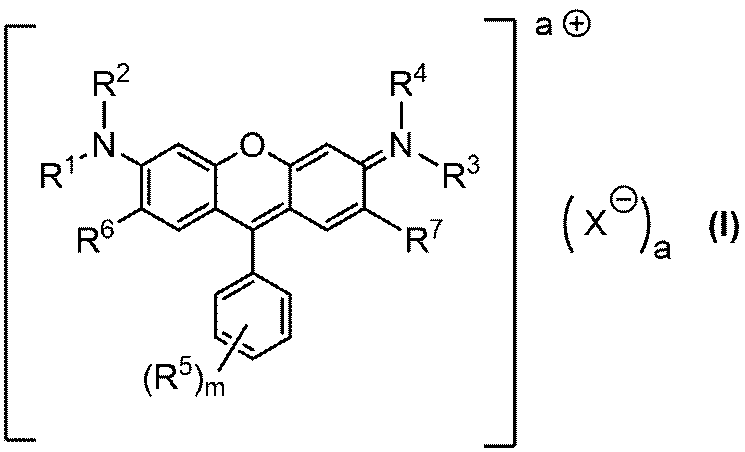
R1は、炭素数21~40の1価の炭化水素基を表す。
R3は、炭素数6~40の1価の炭化水素基を表す。
R2及びR4は、互いに独立に、水素原子又は炭素数1~6の1価の飽和炭化水素基を表す。
R5は、-OH、-SO3 -、-SO3H、-SO3 -Z+、-CO2H、-CO2 -Z+、-CO2R8、-SO3R8、又は-SO2NR9R10を表す。
R6及びR7は、互いに独立に、水素原子又は炭素数1~6の1価の飽和炭化水素基を表す。
mは、0~5の整数を表す。mが2以上のとき、複数のR5は同一であっても異なっていてもよい。
aは、0又は1の整数を表す。
Xは、ハロゲン原子を表す。
Z+は、N+(R11)4、Na+、又はK+を表し、4つのR11は同一であっても異なっていてもよい。
R8は、炭素数1~20の1価の飽和炭化水素基を表し、該飽和炭化水素基に含まれる水素原子は、ハロゲン原子で置換されていてもよい。
R9及びR10は、互いに独立に、水素原子又は置換基を有していてもよい炭素数1~20の1価の飽和炭化水素基を表し、該飽和炭化水素基に含まれる-CH2-は、-O-、-CO-、-NH-、又は-NR8-で置換されていてもよい。R9及びR10は、互いに結合して隣接する窒素原子とともに3~10員環の複素環を形成していてもよい。
R11は、水素原子、炭素数1~20の1価の飽和炭化水素基、又は炭素数7~10のアラルキル基を表す。
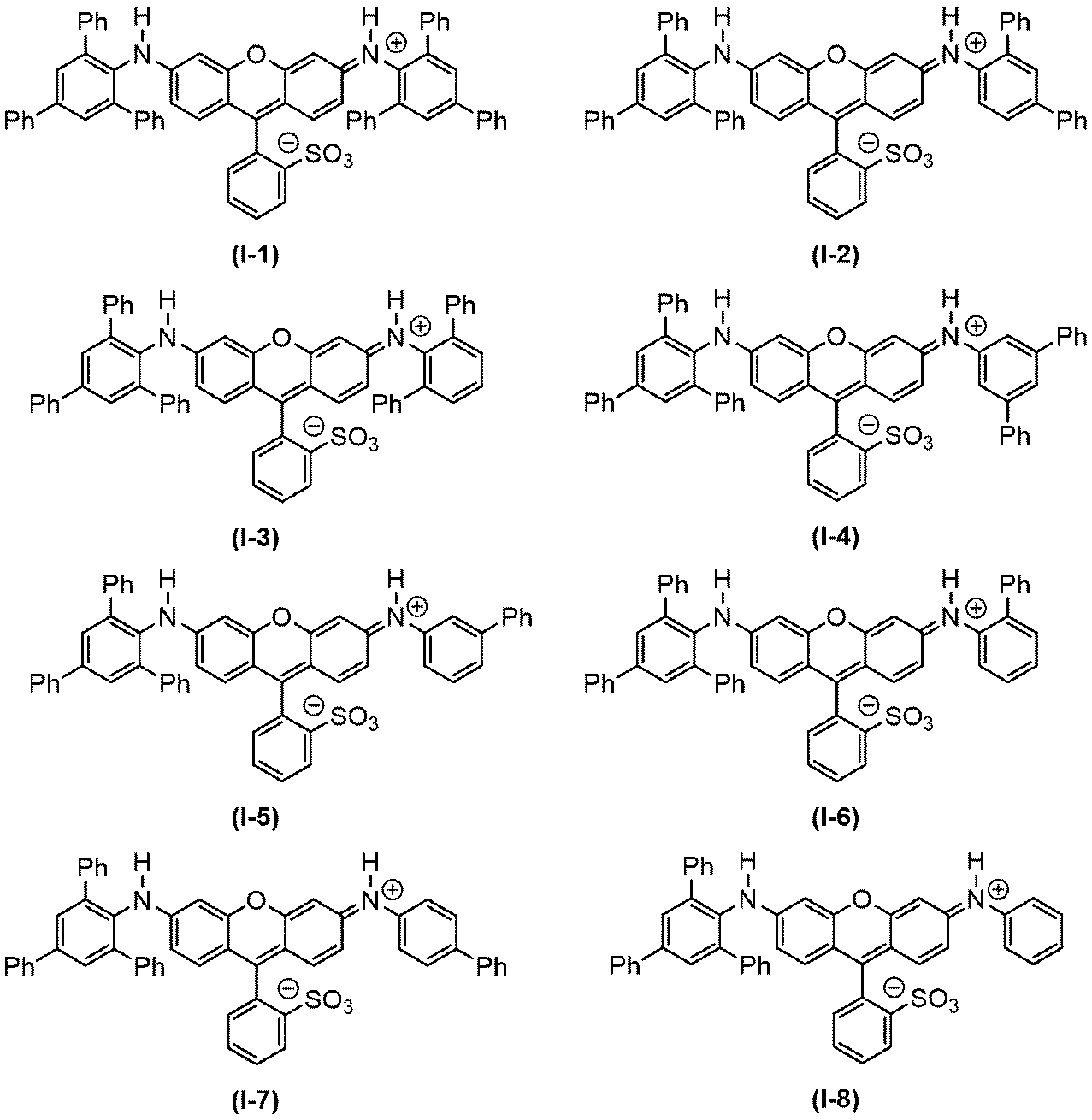
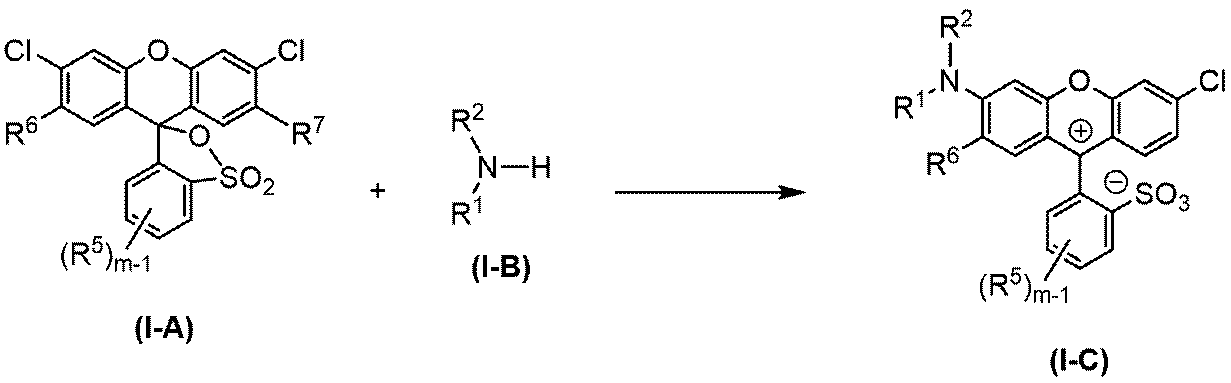
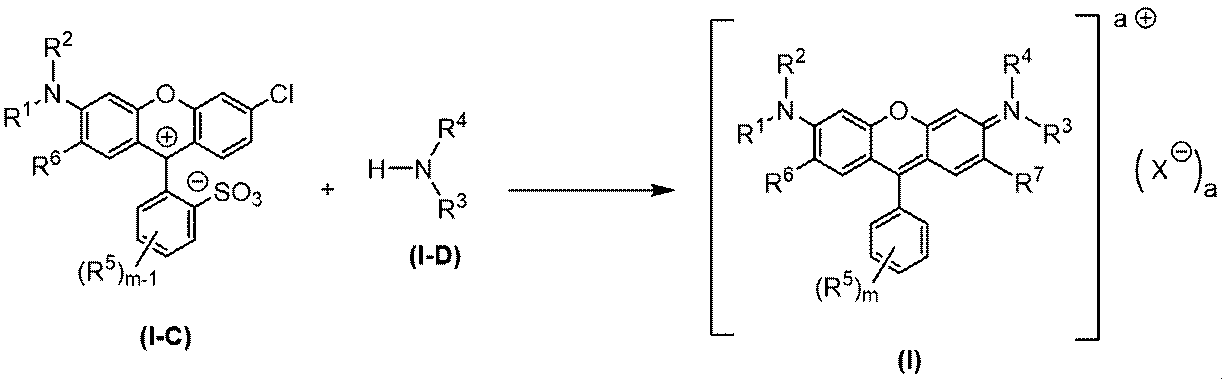
本実施形態の着色樹脂組成物は、着色剤(以下、「着色剤(A)」という場合がある。)及び樹脂(以下、「樹脂(B)」という場合がある。)を含有する。本実施形態の着色樹脂組成物は、溶剤(以下、「溶剤(C)」という場合がある。)、その他の成分等を含有していてもよい。
着色剤(A)は、上記の式(I)で表される化合物(以下、「着色剤(A1)」という場合がある。)を含む。
C.I.ソルベントレッド45、49、111、125、130、143、145、146、150、151、155、168、169、172、175、181、207、222、227、230、245、247;
C.I.ソルベントオレンジ2、7、11、15、26、56、77、86;
C.I.ソルベントバイオレット11、13、14、26、31、36、37、38、45、47、48、51、59、60;
C.I.ソルベントブルー4、5、14、18、35、36、37、45、58、59、59:1、63、67、68、69、70、78、79、83、90、94、97、98、100、101、102、104、105、111、112、122、128、132、136、139;
C.I.ソルベントグリーン1、3、4、5、7、28、29、32、33、34、35等のC.I.ソルベント染料、
C.I.アシッドイエロー1、3、7、9、11、17、23、25、29、34、36、38、40、42、54、65、72、73、76、79、98、99、111、112、113、114、116、119、123、128、134、135、138、139、140、144、150、155、157、160、161、163、168、169、172、177、178、179、184、190、193、196、197、199、202、203、204、205、207、212、214、220、221、228、230、232、235、238、240、242、243、251;
C.I.アシッドレッド1、4、8、14、17、18、26、27、29、31、33、34、35、37、40、42、44、50、57、66、73、76、80、88、91、95、97、98、103、106、111、114、129、133、134、138、143、145、150、151、155、158、160、172、176、182、183、195、198、206、211、215、216、217、227、228、249、252、257、258、260、261、266、268、270、274、277、280、281、308、312、315、316、339、341、345、346、349、382、383、394、401、412、417、418、422、426;
C.I.アシッドオレンジ6、7、8、10、12、26、50、51、52、56、62、63、64、74、75、94、95、107、108、169、173;
C.I.アシッドバイオレット6B、7、15、16、17、19、21、23、24、25、34、38、49、72;
C.I.アシッドブルー1、3、5、7、9、11、13、15、17、18、22、23、24、25、26、27、29、34、38、40、41、42、43、45、48、51、54、59、60、62、70、72、74、75、78、80、82、83、86、87、88、90、90:1、91、92、93、93:1、96、99、100、102、103、104、108、109、110、112、113、117、119、120、123、126、127、129、130、131、138、140、142、143、147、150、151、154、158、161、166、167、168、170、171、175、182、183、184、187、192、199、203、204、205、210、213、229、234、236、242、243、256、259、267、269、278、280、285、290、296、315、324:1、335、340;
C.I.アシッドグリーン1、3、5、6、7、8、9、11、13、14、15、16、22、25、27、28、41、50、50:1、58、63、65、80、104、105、106、109等のC.I.アシッド染料、
C.I.ダイレクトイエロー2、33、34、35、38、39、43、47、50、54、58、68、69、70、71、86、93、94、95、98、102、108、109、129、136、138、141;
C.I.ダイレクトレッド79、82、83、84、91、92、96、97、98、99、105、106、107、172、173、176、177、179、181、182、184、204、207、211、213、218、220、221、222、232、233、234、241、243、246、250;
C.I.ダイレクトオレンジ26、34、39、41、46、50、52、56、57、61、64、65、68、70、96、97、106、107;
C.I.ダイレクトバイオレット47、52、54、59、60、65、66、79、80、81、82、84、89、90、93、95、96、103、104;
C.I.ダイレクトブルー1、2、3、6、8、15、22、25、28、29、40、41、42、47、52、55、57、71、76、77、78、80、81、84、85、86、90、93、94、95、97、98、99、100、101、106、107、108、109、113、114、115、117、119、120、137、149、150、153、155、156、158、159、160、161、162、163、164、165、166、167、168、170、171、172、173、188、189、190、192、193、194、195、196、198、199、200、201、202、203、207、209、210、212、213、214、222、225、226、228、229、236、237、238、242、243、244、245、246、247、248、249、250、251、252、256、257、259、260、268、274、275、293;
C.I.ダイレクトグリーン25、27、31、32、34、37、63、65、66、67、68、69、72、77、79、82等のC.I.ダイレクト染料、
C.I.ディスパースイエロー51、54,76;
C.I.ディスパースバイオレット26、27;
C.I.ディスパースブルー1、14、56、60等のC.I.ディスパース染料、
C.I.ベーシックブルー1、3、5、7、9、19、21、22、24、25、26、28、29、40、41、45、47、54、58、59、60、64、65、66、67、68、81、83、88、89;
C.I.ベーシックバイオレット2;
C.I.ベーシックレッド1、9、10;
C.I.ベーシックグリーン1等のC.I.ベーシック染料、
C.I.リアクティブイエロー2、76、116;
C.I.リアクティブオレンジ16;
C.I.リアクティブレッド36等のC.I.リアクティブ染料、
C.I.モーダントイエロー5、8、10、16、20、26、30、31、33、42、43、45、56、61、62、65;
C.I.モーダントレッド1、2、3、4、9、11、12、14、17、18、19、22、23、24、25、26、29、30、32、33、36、37、38、39、41、42、43、45、46、48、52、53、56、62、63、71、74、76、78、85、86、88、90、94、95;
C.I.モーダントオレンジ3、4、5、8、12、13、14、20、21、23、24、28、29、32、34、35、36、37、42、43、47、48;
C.I.モーダントバイオレット1、1:1、2、3、4、5、6、7、8、10、11、14、15、16、17、18、19、21、22、23、24、27、28、30、31、32、33、36、37、39、40、41、44、45、47、48、49、53、58;
C.I.モーダントブルー1、2、3、7、8、9、12、13、15、16、19、20、21、22、23、24、26、30、31、32、39、40、41、43、44、48、49、53、61、74、77、83、84;
C.I.モーダントグリーン1、3、4、5、10、13、15、19、21、23、26、29、31、33、34、35、41、43、53等のC.I.モーダント染料、
C.I.バットグリーン1等のC.I.バット染料などが挙げられる。
黄色顔料:C.I.ピグメントイエロー1、3、12、13、14、15、16、17、20、24、31、53、83、86、93、94、109、110、117、125、128、129、137、138、139、147、148、150、153、154、166、173、185、194、214、231、233等
オレンジ色顔料:C.I.ピグメントオレンジ13、31、34、36、38、40、42、43、51、55、59、61、64、65、71、73等
赤色顔料:C.I.ピグメントレッド9、97、105、122、123、144、149、166、168、176、177、180、192、209、215、216、224、242、254、255、264、265、269、272等
青色顔料:C.I.ピグメントブルー15、15:3、15:4、15:6、16、60等
紫色顔料:C.I.ピグメントバイオレット1、19、23、29、32、36、38等
黒色顔料:C.I.ピグメントブラック1、7、31、32等
本実施形態の着色樹脂組成物は、樹脂(B)を含有する。樹脂(B)は、アルカリ可溶性樹脂であることが好ましい。アルカリ可溶性樹脂としては、以下の樹脂[K1]~[K6]等が挙げられる。
・樹脂[K2]:(a)に由来する構造単位と、(b)に由来する構造単位と、(a)と共重合可能な単量体(c)(ただし、(a)及び(b)とは異なる。)(以下、「(c)」という場合がある。)に由来する構造単位とを有する共重合体
・樹脂[K3]:(a)に由来する構造単位と(c)に由来する構造単位とを有する共重合体
・樹脂[K4]:(a)に由来する構造単位に(b)を付加させた構造単位と、(c)に由来する構造単位とを有する共重合体
・樹脂[K5]:(b)に由来する構造単位に(a)を付加させた構造単位と、(c)に由来する構造単位とを有する共重合体
・樹脂[K5’];(a)に由来する構造単位に(b)を付加させた構造単位と(c)に由来する構造単位とを有する共重合体;
・樹脂[K6]:(b)に由来する構造単位に(a)を付加させ、カルボン酸無水物をさらに付加させた構造単位と、(c)に由来する構造単位とを有する共重合体
マレイン酸、フマル酸、シトラコン酸、メサコン酸、イタコン酸、3-ビニルフタル酸、4-ビニルフタル酸、3,4,5,6-テトラヒドロフタル酸、1,2,3,6-テトラヒドロフタル酸、ジメチルテトラヒドロフタル酸、1,4-シクロヘキセンジカルボン酸等の不飽和ジカルボン酸類;
メチル-5-ノルボルネン-2,3-ジカルボン酸、5-カルボキシビシクロ[2.2.1]ヘプト-2-エン、5,6-ジカルボキシビシクロ[2.2.1]ヘプト-2-エン、5-カルボキシ-5-メチルビシクロ[2.2.1]ヘプト-2-エン、5-カルボキシ-5-エチルビシクロ[2.2.1]ヘプト-2-エン、5-カルボキシ-6-メチルビシクロ[2.2.1]ヘプト-2-エン、5-カルボキシ-6-エチルビシクロ[2.2.1]ヘプト-2-エン等のカルボキシ基を含有するビシクロ不飽和化合物類;
無水マレイン酸、シトラコン酸無水物、イタコン酸無水物、3-ビニルフタル酸無水物、4-ビニルフタル酸無水物、3,4,5,6-テトラヒドロフタル酸無水物、1,2,3,6-テトラヒドロフタル酸無水物、ジメチルテトラヒドロフタル酸無水物、5,6-ジカルボキシビシクロ[2.2.1]ヘプト-2-エン無水物等の不飽和ジカルボン酸無水物類;
コハク酸モノ[2-(メタ)アクリロイルオキシエチル]、フタル酸モノ[2-(メタ)アクリロイルオキシエチル]等の2価以上の多価カルボン酸の不飽和モノ[(メタ)アクリロイルオキシアルキル]エステル類;
α-(ヒドロキシメチル)アクリル酸等の、同一分子中にヒドロキシ基及びカルボキシ基を含有する不飽和アクリレート類等が挙げられる。
2-ヒドロキシエチル(メタ)アクリレート、2-ヒドロキシプロピル(メタ)アクリレート等のヒドロキシ基含有(メタ)アクリル酸エステル類;
マレイン酸ジエチル、フマル酸ジエチル、イタコン酸ジエチル等のジカルボン酸ジエステル;
ビシクロ[2.2.1]ヘプト-2-エン、5-メチルビシクロ[2.2.1]ヘプト-2-エン、5-エチルビシクロ[2.2.1]ヘプト-2-エン、5-ヒドロキシビシクロ[2.2.1]ヘプト-2-エン、5-ヒドロキシメチルビシクロ[2.2.1]ヘプト-2-エン、5-(2’-ヒドロキシエチル)ビシクロ[2.2.1]ヘプト-2-エン、5-メトキシビシクロ[2.2.1]ヘプト-2-エン、5-エトキシビシクロ[2.2.1]ヘプト-2-エン、5,6-ジヒドロキシビシクロ[2.2.1]ヘプト-2-エン、5,6-ジ(ヒドロキシメチル)ビシクロ[2.2.1]ヘプト-2-エン、5,6-ジ(2’-ヒドロキシエチル)ビシクロ[2.2.1]ヘプト-2-エン、5,6-ジメトキシビシクロ[2.2.1]ヘプト-2-エン、5,6-ジエトキシビシクロ[2.2.1]ヘプト-2-エン、5-ヒドロキシ-5-メチルビシクロ[2.2.1]ヘプト-2-エン、5-ヒドロキシ-5-エチルビシクロ[2.2.1]ヘプト-2-エン、5-ヒドロキシメチル-5-メチルビシクロ[2.2.1]ヘプト-2-エン、5-tert-ブトキシカルボニルビシクロ[2.2.1]ヘプト-2-エン、5-シクロヘキシルオキシカルボニルビシクロ[2.2.1]ヘプト-2-エン、5-フェノキシカルボニルビシクロ[2.2.1]ヘプト-2-エン、5,6-ビス(tert-ブトキシカルボニル)ビシクロ[2.2.1]ヘプト-2-エン、5,6-ビス(シクロヘキシルオキシカルボニル)ビシクロ[2.2.1]ヘプト-2-エン等のビシクロ不飽和化合物類;
N-フェニルマレイミド、N-シクロヘキシルマレイミド、N-ベンジルマレイミド、N-スクシンイミジル-3-マレイミドベンゾエート、N-スクシンイミジル-4-マレイミドブチレート、N-スクシンイミジル-6-マレイミドカプロエート、N-スクシンイミジル-3-マレイミドプロピオネート、N-(9-アクリジニル)マレイミド等のジカルボニルイミド誘導体類;
スチレン、α-メチルスチレン、m-メチルスチレン、p-メチルスチレン、ビニルトルエン、p-メトキシスチレン、アクリロニトリル、メタクリロニトリル、塩化ビニル、塩化ビニリデン、アクリルアミド、メタクリルアミド、酢酸ビニル、1,3-ブタジエン、イソプレン、2,3-ジメチル-1,3-ブタジエン等が挙げられる。
(a)に由来する構造単位;2~60モル%
(b)に由来する構造単位;40~98モル%
であることが好ましく、
(a)に由来する構造単位;10~50モル%
(b)に由来する構造単位;50~90モル%
であることがより好ましい。
(a)に由来する構造単位;2~45モル%
(b)に由来する構造単位;2~95モル%
(c)に由来する構造単位;1~65モル%
であることが好ましく、
(a)に由来する構造単位;5~40モル%
(b)に由来する構造単位;5~80モル%
(c)に由来する構造単位;5~60モル%
であることがより好ましい。
(a)に由来する構造単位;2~60モル%
(c)に由来する構造単位;40~98モル%
であることが好ましく、
(a)に由来する構造単位;10~50モル%
(c)に由来する構造単位;50~90モル%
であることがより好ましい。
(b)に由来する構造単位;5~95モル%
(c)に由来する構造単位;5~95モル%
であることが好ましく、
(b)に由来する構造単位;10~90モル%
(c)に由来する構造単位;10~90モル%
であることがより好ましい。
(a)に由来する構造単位((b)は付加していない);0~30モル%
(a)に由来する構造単位に(b)を付加させた構造単位;5~95モル%
(c)に由来する構造単位;5~95モル%
であることが好ましく、
(a)に由来する構造単位((b)は付加していない);0~10モル%
(a)に由来する構造単位に(b)を付加させた構造単位;15~90モル%
(c)に由来する構造単位;10~85モル%
であることがより好ましく、
(a)に由来する構造単位((b)は付加していない);0~5モル%
(a)に由来する構造単位に(b)を付加させた構造単位;20~80モル%
(c)に由来する構造単位;20~80モル%
であることがよりさらに好ましい。
溶剤(C)は、特に限定されず、当該分野で通常使用される溶剤を用いることができる。例えば、エステル溶剤(分子内に-COO-を含み、-O-を含まない溶剤)、エーテル溶剤(分子内に-O-を含み、-COO-を含まない溶剤)、エーテルエステル溶剤(分子内に-COO-と-O-とを含む溶剤)、ケトン溶剤(分子内に-CO-を含み、-COO-を含まない溶剤)、アルコール溶剤(分子内にOHを含み、-O-、-CO-、及び-COO-を含まない溶剤)、芳香族炭化水素溶剤、アミド溶剤、ジメチルスルホキシド等が挙げられる。
本実施形態の着色樹脂組成物は、必要に応じて、分散剤、紫外線吸収剤、充填剤、他の高分子化合物、密着促進剤、酸化防止剤、光安定剤、連鎖移動剤等、当該技術分野で公知の添加剤を含有していてもよい。
本実施形態の着色硬化性樹脂組成物は、着色剤(A)、樹脂(B)、重合性化合物(以下、「重合性化合物(D)」という場合がある。)、及び重合開始剤(以下、「重合開始剤(E)」という場合がある。)を含有する。本実施形態の着色硬化性樹脂組成物は、溶剤(C)、レベリング剤(以下、「レベリング剤(F)」という場合がある。)、その他の成分等を含有していてもよい。
本実施形態の着色硬化性樹脂組成物は、重合性化合物(D)及び重合開始剤(E)を含有する。重合性化合物(D)は、重合開始剤(E)から発生した活性ラジカル及び/又は酸によって重合し得る化合物である。重合性化合物(D)としては、例えば、重合性のエチレン性不飽和結合を有する化合物等が挙げられる。重合性化合物(D)は、好ましくは(メタ)アクリル酸エステル化合物である。
重合開始剤(E)は、光又は熱の作用により活性ラジカル、酸等を発生し、重合を開始し得る化合物であれば特に限定されることなく、公知の重合開始剤を用いることができる。活性ラジカルを発生する重合開始剤としては、例えば、O-アシルオキシム化合物、アルキルフェノン化合物、トリアジン化合物、アシルホスフィンオキサイド化合物、ビイミダゾール化合物が挙げられる。
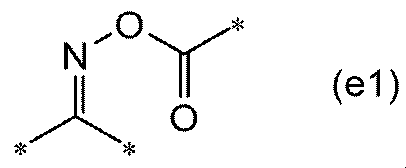
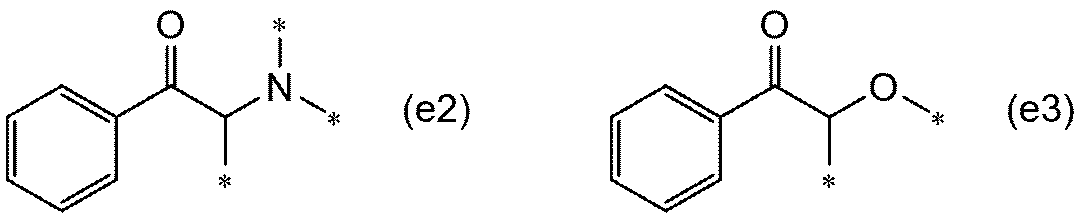
重合開始助剤(E1)は、重合性化合物の重合を促進するために用いられる化合物又は増感剤である。着色硬化性樹脂組成物が重合開始助剤(E1)を含有する場合、通常、重合開始剤(E)と組み合わせて用いられる。
レベリング剤(F)としては、シリコーン系界面活性剤、フッ素系界面活性剤、フッ素原子を有するシリコーン系界面活性剤等が挙げられる。これらは、側鎖に重合性基を有していてもよい。
本実施形態の着色硬化性樹脂組成物から着色パターンを製造する方法としては、フォトリソグラフ法、インクジェット法、印刷法等が挙げられる。これらの中でも、着色パターンを製造する方法は、フォトリソグラフ法であることが好ましい。フォトリソグラフ法は、着色硬化性樹脂組成物を基板に塗布し、乾燥させて着色塗膜を形成し、フォトマスクを介して該着色塗膜を露光して、現像する方法である。フォトリソグラフ法において、露光の際にフォトマスクを用いないこと、及び/又は、現像しないことにより、着色塗膜の硬化物である着色硬化塗膜を形成することができる。なお、着色硬化塗膜は、フォトリソグラフ法等を適用しないで、着色塗膜に対して加熱を行うことによっても形成することができる。このようにして形成された、着色パターン(パターン着色硬化塗膜)又は着色硬化塗膜が本実施形態のカラーフィルタである。
本実施形態の表示装置は、着色パターン、着色硬化塗膜等であるカラーフィルタを含む。本実施形態の固体撮像素子は、着色パターン、着色硬化塗膜等であるカラーフィルタを含む。
装置:HLC-8120GPC(東ソー(株)製)
カラム:TSK-GELG2000HXL
カラム温度:40℃
溶剤:テトラヒドロフラン
流速:1.0mL/分
分析試料の固形分濃度:0.001~0.01質量%
注入量:50μL
検出器:RI
校正用標準物質:TSK STANDARD POLYSTYRENE F-40、F-4、F-288、A-2500、A-500(東ソー(株)製)
<式(I-1)で表される化合物(着色剤A-1)の合成>
式(1)で表される化合物1.00部、2,4,6-トリフェニルアニリン(シグマアルドリッチ(株)製)3.17部、塩化亜鉛(和光純薬工業(株)製)0.67部、及びスルホラン(東京化成工業(株)製)6.00部を室温で混合し、250℃に昇温して7時間撹拌した。反応液を室温まで冷却後、1規定塩酸12部を加え、得られた析出物を吸引濾過の残渣として取得し、トルエン24.0部、DMF12.0部、及び酢酸エチル12.0部で順次洗浄後乾燥し、式(I-1)で表される化合物(着色剤A-1)1.67部を得た。収率は69%であった。

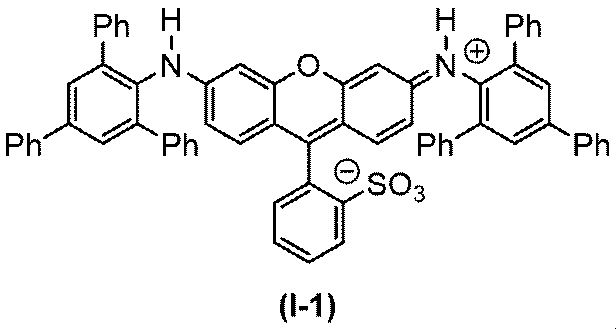
(質量分析)イオン化モード=ESI+:m/z=[M+H]+ 975.2
Exact Mass:974.3
<式(I-5)で表される化合物(着色剤A-2)の合成>
式(1)で表される化合物3.00部、2,4,6-トリフェニルアニリン(シグマアルドリッチ(株)製)4.76部、及びスルホラン(東京化成工業(株)製)18.0部を室温で混合し、120℃に昇温して4時間撹拌した。反応液を室温まで冷却後、1規定塩酸36.0部を投入し、得られた析出物を吸引濾過の残渣として取得し、さらにトルエン30.0部で洗浄した。得られた残渣を乾燥し、式(2)で表される化合物5.10部を得た。収率は>99%であった。
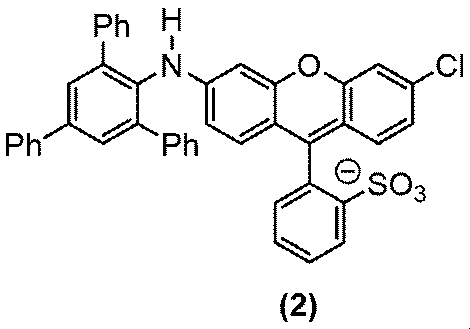

(質量分析)イオン化モード=ESI+:m/z=[M+H]+ 823.2
Exact Mass:822.3
<式(I-6)で表される化合物(着色剤A-3)の合成>
3-アミノビフェニルを2-アミノビフェニルに変更した以外は、実施例1-2と同様にして、式(I-6)で表される化合物(着色剤A-3)を得た。収率は72.7%であった。
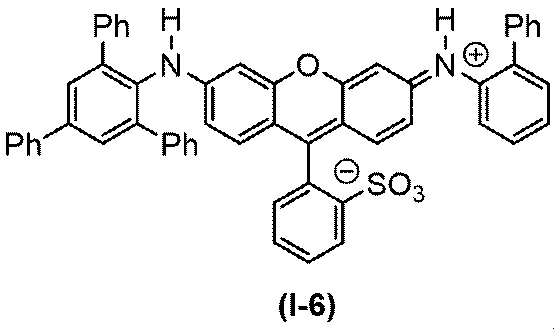
(質量分析)イオン化モード=ESI+:m/z=[M+H]+ 823.2
Exact Mass:822.3
<式(3)で表される化合物(着色剤a-1)の合成>
特開2021-162854号公報の記載に従って、式(3)で表される化合物(着色剤a-1)を合成した。

<樹脂B-1の合成>
還流冷却器、滴下ロート、及び撹拌機を備えたフラスコ内に窒素を適量流して窒素雰囲気とし、プロピレングリコールモノメチルエーテルアセテート280部を入れ、撹拌しながら80℃まで加熱した。次いで、該フラスコ内に、アクリル酸38部、3,4-エポキシトリシクロ[5.2.1.02,6]デカン-8-イルアクリレート及び3,4-エポキシトリシクロ[5.2.1.02,6]デカン-9-イルアクリレートの混合物(含有率は1:1)289部をプロピレングリコールモノメチルエーテルアセテート125部に溶解した溶液を、滴下ポンプを用いて約5時間かけて滴下した。一方、重合開始剤2,2’-アゾビス(2,4-ジメチルバレロニトリル)33部をプロピレングリコールモノメチルエーテルアセテート235部に溶解した溶液を別の滴下ポンプを用いて約6時間かけてフラスコ内に滴下した。滴下終了後、4時間同温度で保持した後、室温まで冷却して、共重合体固形分35.1%の共重合体(樹脂B-1)溶液を得た。生成した共重合体(樹脂B-1)の重量平均分子量Mwは9.2×10³、分散度2.08、固形分換算の酸価は77mg-KOH/gであった。生成した共重合体は下記構造単位を有する。

<樹脂B-2の合成>
撹拌装置、滴下ロート、コンデンサー、温度計、及びガス導入管を備えたフラスコにプロピレングリコールモノメチルエーテルアセテート(PGMEA)276.8部を加え、窒素置換しながら撹拌し120℃に昇温した。次いで、2-エチルヘキシルアクリレート92.4部、グリシジルメタクリレート184.9部、及びジシクロペンタニルメタクリレート12.3部からなる単量体混合物に、35.3部のt-ブチルパーオキシ-2-エチルヘキサノエート(重合開始剤)を添加し、これを滴下ロートから2時間にわたってフラスコ中に滴下した。滴下終了後、120℃でさらに30分撹拌して共重合反応を行い、付加共重合体を合成した。その後、フラスコ内を空気に置換し、アクリル酸93.7部、トリフェニルホスフィン(触媒)1.5部、及びメトキノン(重合禁止剤)0.8部を付加共重合体溶液中に投入し、110℃で10時間にわたって反応を続け、グリシジルメタクリレート由来のエポキシ基とアクリル酸との反応によりエポキシ基を開裂させるとともに、付加共重合体の側鎖に重合性不飽和結合を導入した。次いで、反応系に無水コハク酸24.2部を加え、110℃で1時間にわたって反応を続け、エポキシ基の開裂により生じたヒドロキシ基と無水コハク酸とを反応させて側鎖にカルボキシル基を導入し、共重合体(樹脂B-2)を得た。最後に反応溶液に、PGMEA383.3部を加え、固形分40質量%の共重合体(樹脂B-2)溶液を得た。生成した共重合体のポリスチレン換算の重量平均分子量は6.3×103、固形分換算の酸価は34mg-KOH/gであった。
<着色樹脂組成物1の調製>
式(I-1)で表される化合物(着色剤A-1)80.0部、分散剤(BYK社製、BYKLPN-6919)(固形分換算)29.1部、合成例1で得られた樹脂B-1(固形分換算)29.1部、プロピレングリコールモノメチルエーテルアセテート861.8部、及び0.2mmのジルコニアビーズ1500部を混合し、ペイントコンディショナー(LAU社製)を使用して、得られた混合物を1時間振盪した。その後、ジルコニアビーズを濾過により除去して着色樹脂組成物1を得た。
<着色樹脂組成物2の調製>
式(I-1)で表される化合物(着色剤A-1)80.0部を式(I-6)で表される化合物(着色剤A-3)80.0部に変更した以外は、実施例2-1と同様にして、着色樹脂組成物2を得た。
<着色樹脂組成物3の調製>
式(I-1)で表される化合物(着色剤A-1)80.0部を式(3)で表される化合物(着色剤a-1)80.0部に変更した以外は、実施例2-1と同様にして、着色樹脂組成物3を得た。
<着色硬化塗膜1の作製及び評価>
(1)着色硬化性樹脂組成物1の調製
下記の成分を混合することにより、着色硬化性樹脂組成物1を得た。
・実施例2-1の着色樹脂組成物1:407.1部
(着色剤(A):式(I-1)で表される化合物(着色剤A-1)32.6部
樹脂(B):樹脂(B-1)11.8部(固形分換算)
溶剤(E):プロピレングリコールモノメチルエーテルアセテート350.8部
その他の成分:分散剤(BYK社製、BYKLPN-6919)11.8部(固形分換算))
・樹脂(B):合成例2で得られた樹脂(B-2)51.8部(固形分換算)
・溶剤(C):プロピレングリコールモノメチルエーテルアセテート484.2部
・重合性化合物(D):ジペンタエリスリトールポリアクリレート(新中村化学工業(株)製、商品名A-9550)42.5部(固形分換算)
・重合開始剤(E):N-アセチルオキシ-1-(4-フェニルスルファニルフェニル)-3-シクロヘキシルプロパン-1-オン-2-イミン(常州強力電子新材料社製、商品名TR-PBG327)9.0部
・レベリング剤(F):ポリエーテル変性シリコーンオイル(東レダウコーニング(株)製、商品名トーレシリコーンSH8400)0.1部
得られた着色硬化性樹脂組成物1を、5cm角のガラス基板(コーニング社製、イーグル2000)上にスピンコート法で塗布し、着色塗膜1を得た。その後、着色塗膜1に対して、100℃で2分間プリベークを行い、オーブン中、230℃で5分間ポストベークを行うことによって着色硬化塗膜1を得た。
得られた着色硬化塗膜1(光照射前の着色硬化塗膜1)上に紫外線カットフィルタ(ホヤ社製、COLORED OPTICAL GLASS L38、380nm以下の光をカットするフィルタ)を配置し、大気中、耐光性試験機(東洋精機社製、SUNTEST CPS+)にてキセノンランプ光を67時間照射し、光照射後の着色硬化塗膜1を得た。測色機(オリンパス(株)製、OSP-SP-200)製)を用いて、光照射前後の着色硬化塗膜1の極大吸収波長における吸光度を測定し、吸光度維持率を算出した。ここで、吸光度維持率とは、下記式から算出される数値であり、吸光度維持率が高いほど、耐光性に優れることを意味する。また、着色硬化塗膜の耐光性が良好であれば、同じ着色硬化性樹脂組成物から作製されるカラーフィルタも、耐光性に優れるといえる。結果を表1に示す。
吸光度維持率(%)=(光照射後の着色硬化塗膜の極大吸収波長における吸光度)/(光照射前の着色硬化塗膜の極大吸収波長における吸光度)×100
上記の光照射前の着色硬化塗膜1及び光照射後の着色硬化塗膜1を用いて、光照射前後の最大透過率変化を測定した。こで、光照射前後の最大透過率変化とは、300~1400nmにおいて、各波長の光照射前後の透過率変化(光照射前後の透過率変化(%)=光照射前の透過率(%)-光照射後の透過率(%))のうち最大のものを意味する。硬化塗膜の光照射前後の最大透過率変化が小さいほど、耐光性に優れることを意味する。着色硬化塗膜の耐光性が良好であれば、同じ着色硬化性樹脂組成物から作製されるカラーフィルタも、耐光性に優れるといえる。結果を表1に示す。
<着色硬化塗膜2の作製及び評価>
実施例2-1の着色樹脂組成物1 407.1部を実施例2-2の着色樹脂組成物2 407.1部に変更した以外は、実施例3-1と同様にして、着色硬化性樹脂組成物2を調製した。続いて、実施例3-1と同様にして、着色硬化性樹脂組成物2から着色硬化塗膜2を作製し、耐光性試験を行った。結果を表1に示す。
<着色硬化塗膜3の作製及び評価>
実施例2-1の着色樹脂組成物1 407.1部を比較例2-1の着色樹脂組成物3 407.1部に変更した以外は、実施例3-1と同様にして、着色硬化性樹脂組成物3を調製した。続いて、実施例3-1と同様にして、着色硬化性樹脂組成物3から着色硬化塗膜3を作製し、耐光性試験を行った。結果を表1に示す。なお、着色硬化塗膜3については、耐光性試験-1の結果が良好でなかったため、耐光性試験-2は行わなかった。

Claims (6)
- 式(I)で表される化合物。
[式(I)中、
R1は、炭素数21~40の1価の炭化水素基を表す。
R3は、炭素数6~40の1価の炭化水素基を表す。
R2及びR4は、互いに独立に、水素原子又は炭素数1~6の1価の飽和炭化水素基を表す。
R5は、-OH、-SO3 -、-SO3H、-SO3 -Z+、-CO2H、-CO2 -Z+、-CO2R8、-SO3R8、又は-SO2NR9R10を表す。
R6及びR7は、互いに独立に、水素原子又は炭素数1~6の1価の飽和炭化水素基を表す。
mは、0~5の整数を表す。mが2以上のとき、複数のR5は同一であっても異なっていてもよい。
aは、0又は1の整数を表す。
Xは、ハロゲン原子を表す。
Z+は、N+(R11)4、Na+、又はK+を表し、4つのR11は同一であっても異なっていてもよい。
R8は、炭素数1~20の1価の飽和炭化水素基を表し、該飽和炭化水素基に含まれる水素原子は、ハロゲン原子で置換されていてもよい。
R9及びR10は、互いに独立に、水素原子又は置換基を有していてもよい炭素数1~20の1価の飽和炭化水素基を表し、該飽和炭化水素基に含まれる-CH2-は、-O-、-CO-、-NH-、又は-NR8-で置換されていてもよい。R9及びR10は、互いに結合して隣接する窒素原子とともに3~10員環の複素環を形成していてもよい。
R11は、水素原子、炭素数1~20の1価の飽和炭化水素基、又は炭素数7~10のアラルキル基を表す。] - 着色剤及び樹脂を含有し、
前記着色剤が、請求項1に記載の式(I)で表される化合物を含む、着色樹脂組成物。 - 着色剤、樹脂、重合性化合物、及び重合開始剤を含有し、
前記着色剤が、請求項1に記載の式(I)で表される化合物を含む、着色硬化性樹脂組成物。 - 請求項3に記載の着色硬化性樹脂組成物により形成される、カラーフィルタ。
- 請求項4に記載のカラーフィルタを含む、表示装置。
- 請求項4に記載のカラーフィルタを含む、固体撮像素子。
Priority Applications (2)
| Application Number | Priority Date | Filing Date | Title |
|---|---|---|---|
| KR1020257035764A KR20250171315A (ko) | 2023-03-30 | 2024-03-11 | 화합물, 착색 수지 조성물, 착색 경화성 수지 조성물, 컬러 필터, 표시 장치 및 고체 촬상 소자 |
| CN202480021963.1A CN120882811A (zh) | 2023-03-30 | 2024-03-11 | 化合物、着色树脂组合物、着色固化性树脂组合物、滤色器、显示装置及固体摄像器件 |
Applications Claiming Priority (2)
| Application Number | Priority Date | Filing Date | Title |
|---|---|---|---|
| JP2023-055203 | 2023-03-30 | ||
| JP2023055203 | 2023-03-30 |
Publications (1)
| Publication Number | Publication Date |
|---|---|
| WO2024203200A1 true WO2024203200A1 (ja) | 2024-10-03 |
Family
ID=92904295
Family Applications (1)
| Application Number | Title | Priority Date | Filing Date |
|---|---|---|---|
| PCT/JP2024/009257 Ceased WO2024203200A1 (ja) | 2023-03-30 | 2024-03-11 | 化合物、着色樹脂組成物、着色硬化性樹脂組成物、カラーフィルタ、表示装置、及び固体撮像素子 |
Country Status (5)
| Country | Link |
|---|---|
| JP (1) | JP2024144197A (ja) |
| KR (1) | KR20250171315A (ja) |
| CN (1) | CN120882811A (ja) |
| TW (1) | TW202500554A (ja) |
| WO (1) | WO2024203200A1 (ja) |
Citations (5)
| Publication number | Priority date | Publication date | Assignee | Title |
|---|---|---|---|---|
| KR20190098374A (ko) * | 2018-02-14 | 2019-08-22 | 동우 화인켐 주식회사 | 청색 감광성 수지 조성물, 이를 이용하여 제조된 컬러필터 및 화상표시장치 |
| JP2021067817A (ja) * | 2019-10-24 | 2021-04-30 | 東洋インキScホールディングス株式会社 | カラーフィルタ用着色組成物及びカラーフィルタ |
| JP2021107525A (ja) * | 2019-12-27 | 2021-07-29 | 東友ファインケム株式会社Dongwoo Fine−Chem Co., Ltd. | 化合物 |
| JP2021128201A (ja) * | 2020-02-12 | 2021-09-02 | 東洋インキScホールディングス株式会社 | カラーフィルタ用着色組成物及びカラーフィルタ |
| JP2021162854A (ja) * | 2020-03-31 | 2021-10-11 | 住友化学株式会社 | ネガ型レジスト組成物 |
-
2024
- 2024-03-07 JP JP2024035255A patent/JP2024144197A/ja active Pending
- 2024-03-11 CN CN202480021963.1A patent/CN120882811A/zh active Pending
- 2024-03-11 KR KR1020257035764A patent/KR20250171315A/ko active Pending
- 2024-03-11 WO PCT/JP2024/009257 patent/WO2024203200A1/ja not_active Ceased
- 2024-03-18 TW TW113109962A patent/TW202500554A/zh unknown
Patent Citations (5)
| Publication number | Priority date | Publication date | Assignee | Title |
|---|---|---|---|---|
| KR20190098374A (ko) * | 2018-02-14 | 2019-08-22 | 동우 화인켐 주식회사 | 청색 감광성 수지 조성물, 이를 이용하여 제조된 컬러필터 및 화상표시장치 |
| JP2021067817A (ja) * | 2019-10-24 | 2021-04-30 | 東洋インキScホールディングス株式会社 | カラーフィルタ用着色組成物及びカラーフィルタ |
| JP2021107525A (ja) * | 2019-12-27 | 2021-07-29 | 東友ファインケム株式会社Dongwoo Fine−Chem Co., Ltd. | 化合物 |
| JP2021128201A (ja) * | 2020-02-12 | 2021-09-02 | 東洋インキScホールディングス株式会社 | カラーフィルタ用着色組成物及びカラーフィルタ |
| JP2021162854A (ja) * | 2020-03-31 | 2021-10-11 | 住友化学株式会社 | ネガ型レジスト組成物 |
Also Published As
| Publication number | Publication date |
|---|---|
| CN120882811A (zh) | 2025-10-31 |
| JP2024144197A (ja) | 2024-10-11 |
| KR20250171315A (ko) | 2025-12-08 |
| TW202500554A (zh) | 2025-01-01 |
Similar Documents
| Publication | Publication Date | Title |
|---|---|---|
| JP6028326B2 (ja) | 着色硬化性樹脂組成物 | |
| JP6713517B2 (ja) | 赤色着色硬化性樹脂組成物 | |
| JP6098113B2 (ja) | 着色感光性樹脂組成物 | |
| CN102681346B (zh) | 着色感光性树脂组合物 | |
| JP6019596B2 (ja) | 着色感光性樹脂組成物 | |
| TW202244194A (zh) | 紅色著色組合物 | |
| CN102914943B (zh) | 着色固化性树脂组合物 | |
| WO2023243353A1 (ja) | 着色樹脂組成物、光学フィルタ及び固体撮像素子 | |
| TWI570507B (zh) | 著色感光性樹脂組合物 | |
| JP5978583B2 (ja) | 着色感光性樹脂組成物 | |
| WO2022172781A1 (ja) | 硬化性組成物 | |
| JP2026014120A (ja) | 着色硬化性樹脂組成物、カラーフィルタ、表示装置、及び固体撮像素子 | |
| JP6047885B2 (ja) | 着色感光性樹脂組成物 | |
| CN109212899B (zh) | 着色固化性树脂组合物、滤色器及显示装置 | |
| CN108459467A (zh) | 红色着色组合物 | |
| CN114253074A (zh) | 着色固化性树脂组合物、滤色器和显示装置 | |
| CN114303095A (zh) | 着色树脂组合物 | |
| JP2024144197A (ja) | 化合物、着色樹脂組成物、着色硬化性樹脂組成物、カラーフィルタ、表示装置、及び固体撮像素子 | |
| JP7594962B2 (ja) | 赤色着色組成物 | |
| JP2024144198A (ja) | 化合物、着色樹脂組成物、着色硬化性樹脂組成物、カラーフィルタ、表示装置、及び固体撮像素子 | |
| JP2024111713A (ja) | 着色硬化性樹脂組成物、光学フィルタ及び固体撮像素子 | |
| WO2024070371A1 (ja) | 組成物、光学フィルタ、及び固体撮像素子 | |
| JP2026017517A (ja) | 着色硬化性樹脂組成物、カラーフィルタ、及び表示装置 | |
| JP2025054198A (ja) | 着色硬化性樹脂組成物、カラーフィルタ、表示装置、及び固体撮像素子 | |
| JP2026014119A (ja) | 着色硬化性樹脂組成物、カラーフィルタ、表示装置、及び固体撮像素子 |
Legal Events
| Date | Code | Title | Description |
|---|---|---|---|
| 121 | Ep: the epo has been informed by wipo that ep was designated in this application |
Ref document number: 24779331 Country of ref document: EP Kind code of ref document: A1 |
|
| WWE | Wipo information: entry into national phase |
Ref document number: 202480021963.1 Country of ref document: CN |
|
| ENP | Entry into the national phase |
Ref document number: 1020257035764 Country of ref document: KR Free format text: ST27 STATUS EVENT CODE: A-0-1-A10-A15-NAP-PA0105 (AS PROVIDED BY THE NATIONAL OFFICE) |
|
| WWE | Wipo information: entry into national phase |
Ref document number: KR1020257035764 Country of ref document: KR |
|
| NENP | Non-entry into the national phase |
Ref country code: DE |
|
| WWP | Wipo information: published in national office |
Ref document number: 202480021963.1 Country of ref document: CN |
|
| 122 | Ep: pct application non-entry in european phase |
Ref document number: 24779331 Country of ref document: EP Kind code of ref document: A1 |