WO2024202558A1 - 情報処理方法、情報処理装置及びプログラム - Google Patents
情報処理方法、情報処理装置及びプログラム Download PDFInfo
- Publication number
- WO2024202558A1 WO2024202558A1 PCT/JP2024/004027 JP2024004027W WO2024202558A1 WO 2024202558 A1 WO2024202558 A1 WO 2024202558A1 JP 2024004027 W JP2024004027 W JP 2024004027W WO 2024202558 A1 WO2024202558 A1 WO 2024202558A1
- Authority
- WO
- WIPO (PCT)
- Prior art keywords
- sound
- factor
- user
- value
- sound content
- Prior art date
- Legal status (The legal status is an assumption and is not a legal conclusion. Google has not performed a legal analysis and makes no representation as to the accuracy of the status listed.)
- Ceased
Links
Images












Classifications
-
- G—PHYSICS
- G06—COMPUTING OR CALCULATING; COUNTING
- G06F—ELECTRIC DIGITAL DATA PROCESSING
- G06F3/00—Input arrangements for transferring data to be processed into a form capable of being handled by the computer; Output arrangements for transferring data from processing unit to output unit, e.g. interface arrangements
- G06F3/01—Input arrangements or combined input and output arrangements for interaction between user and computer
- G06F3/011—Arrangements for interaction with the human body, e.g. for user immersion in virtual reality
-
- G—PHYSICS
- G06—COMPUTING OR CALCULATING; COUNTING
- G06F—ELECTRIC DIGITAL DATA PROCESSING
- G06F3/00—Input arrangements for transferring data to be processed into a form capable of being handled by the computer; Output arrangements for transferring data from processing unit to output unit, e.g. interface arrangements
- G06F3/01—Input arrangements or combined input and output arrangements for interaction between user and computer
-
- G—PHYSICS
- G06—COMPUTING OR CALCULATING; COUNTING
- G06F—ELECTRIC DIGITAL DATA PROCESSING
- G06F3/00—Input arrangements for transferring data to be processed into a form capable of being handled by the computer; Output arrangements for transferring data from processing unit to output unit, e.g. interface arrangements
- G06F3/16—Sound input; Sound output
- G06F3/165—Management of the audio stream, e.g. setting of volume, audio stream path
-
- G—PHYSICS
- G06—COMPUTING OR CALCULATING; COUNTING
- G06Q—INFORMATION AND COMMUNICATION TECHNOLOGY [ICT] SPECIALLY ADAPTED FOR ADMINISTRATIVE, COMMERCIAL, FINANCIAL, MANAGERIAL OR SUPERVISORY PURPOSES; SYSTEMS OR METHODS SPECIALLY ADAPTED FOR ADMINISTRATIVE, COMMERCIAL, FINANCIAL, MANAGERIAL OR SUPERVISORY PURPOSES, NOT OTHERWISE PROVIDED FOR
- G06Q10/00—Administration; Management
- G06Q10/10—Office automation; Time management
-
- G—PHYSICS
- G06—COMPUTING OR CALCULATING; COUNTING
- G06F—ELECTRIC DIGITAL DATA PROCESSING
- G06F2203/00—Indexing scheme relating to G06F3/00 - G06F3/048
- G06F2203/01—Indexing scheme relating to G06F3/01
- G06F2203/011—Emotion or mood input determined on the basis of sensed human body parameters such as pulse, heart rate or beat, temperature of skin, facial expressions, iris, voice pitch, brain activity patterns
Definitions
- This disclosure relates to technology that creates a space according to the user's condition.
- Non-Patent Document 1 discloses that the frequency with which a user's level of alertness drops can be reduced by providing the user with an airflow that corresponds to the user's level of alertness.
- Non-Patent Document 1 merely discloses controlling the airflow given to the user depending on the user's level of alertness, and this does not allow for the creation of an environment in the space in which the user is present, where the user is surrounded by sounds that correspond to the user's state (hereinafter referred to as the sound environment).
- the purpose of this disclosure is to provide technology that creates a sound environment in the space in which the user is present that corresponds to the user's state.
- the information processing method is an information processing method in a computer, which obtains factor values for a plurality of sound contents, obtains a user state that is a state of the user related to the factors, selects sound content having a factor value corresponding to the user state from the plurality of sound contents, and plays the selected sound content in a space in which the user is present.
- FIG. 1 is a diagram illustrating an example of an experiment environment.
- FIG. 2 is a diagram showing an example of a plurality of sound environment conditions.
- FIG. 1 is a diagram showing features of multiple sound contents.
- FIG. 4 is a diagram showing frequency characteristics of each type of sound content shown in FIG. 3.
- FIG. 4 is a diagram showing time-series changes in amplitude when the various types of sound content shown in FIG. 3 are reproduced in stereo.
- FIG. 1 is a diagram showing evaluation items and evaluation words for each sound environment.
- FIG. 1 is a diagram showing the evaluation scale for each evaluation item.
- FIG. 1 is a diagram showing the relationship between evaluation items, factor loadings, and factors.
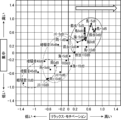
- FIG. 13 is a diagram showing an example of the results of factor analysis and cluster analysis of the evaluation results.
- FIG. 1 is a diagram illustrating an example of an experiment environment.
- FIG. 2 is a diagram showing an example of a plurality of sound environment conditions.
- FIG. 1 is a diagram showing features of multiple
- FIG. 13 is a diagram showing an example of the results of factor analysis and cluster analysis of the evaluation results.
- 1 is a block diagram showing a configuration of an information processing system according to an embodiment of the present disclosure.
- 4 is a flowchart showing a process of the information processing device.
- FIG. 11 is a diagram illustrating an example of a first selection table. A diagram showing the relationship between the values of a first factor and the values of a second factor for a plurality of sound contents.
- FIG. 11 is a diagram illustrating an example of a second selection table. A diagram showing the relationship between the values of a first factor and the values of a second factor for a plurality of sound contents.
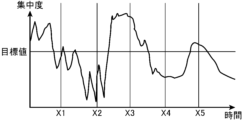
- FIG. 11 is a diagram illustrating an example of a time series change in a user's relaxation level.
- FIG. 11 is a diagram illustrating an example of a time series change in a user's concentration level.
- FIG. 13 is a diagram illustrating an example of another experiment environment.
- FIG. 13 is a diagram showing an example of the results of factor analysis and cluster analysis of other evaluation results.
- FIG. 13 is a diagram showing an example of the results of factor analysis and cluster analysis of other evaluation results.
- FIG. 11 is a diagram illustrating an example of a third selection table. A diagram showing the relationship between the values of a first factor and the values of a second factor for a plurality of sound contents.
- FIG. 13 is a diagram illustrating an example of a fourth selection table.
- FIG. 13 is a diagram showing an example of a screen related to the process shown in FIG. 12 .
- Figure 1 shows an example of the experimental environment. Specifically, this experiment was conducted over two days in an anechoic chamber 50.
- the subjects were 16 office workers (8 men and 8 women) in their 20s to 50s.
- a desk was placed in the center of the anechoic chamber 50 to allow the subjects to fill out a questionnaire using a tablet terminal.
- Speakers 31 were placed 2 m to the left and 2 m to the right of the subjects, reproducing sound content that represents a base sound that serves as background noise.
- two speakers 31 and one speaker 32 that reproduces sound content that represents natural sounds to be added to the base sound were placed 2 m in front of the subjects.
- FIG. 2 shows an example of multiple sound environment conditions. Sound content representing bass sounds was played on four speakers 31, and sound content representing natural sounds was played on speaker 32 so that the sound environment inside anechoic chamber 50 would satisfy each of the 24 sound environment conditions shown in FIG. 2. Note that multiple sound environment conditions were applied randomly, taking into consideration the order effect.
- the sound environment condition No. "1" in FIG. 2 "Base sound: office noise 40 dB, natural sound: birds chirping -5 dB” indicates that the base sound is 40 dB office noise, and the natural sound is birds chirping with a differential volume (S/N ratio for the sound pressure level of the base sound) of -5 dB compared to the base sound.
- the differential volume of the natural sound compared to the base sound will be abbreviated to simply volume.
- the sound environment condition "base sound: office noise 35 dB" for No. "21" in Figure 2 indicates that the base sound is office noise of 35 dB and there is no natural sound.
- the sound environment that satisfies this sound environment condition was realized by playing sound content indicating 35 dB office noise on the speaker 31.
- Fig. 3 shows the characteristics of multiple sound contents.
- 24 sound contents were used, including six types of sound (birds, bell crickets, river, rain, ocean, background noise) and four volume levels (-5 dB, 0 dB, +5 dB, +10 dB) shown in Fig. 3.
- the volume levels shown in Fig. 3 indicate the differential volume (S/N ratio) relative to a background noise of 40 dB.
- FIG. 4 is a diagram showing the frequency characteristics of each type of sound content shown in FIG. 3.
- FIG. 4 shows graphs G41 to G45 showing the frequency characteristics of five types of sound content representing natural sounds shown in FIG. 3: "birds,” “bell crickets,” “river,” “rain,” and “sea,” as well as graph G46 showing the frequency characteristics of one type of sound content, "background noise,” representing the base sound shown in FIG. 3.
- the horizontal axis of graphs G41 to G46 shows frequency (Hz), and the vertical axis shows relative sound pressure (dB).
- Fig. 5 is a diagram showing the time series change in amplitude when each type of sound content shown in Fig. 3 is played in stereo.
- Fig. 5 shows graphs G51 to G55 which show the time series change in amplitude when five types of sound content representing natural sounds, "birds,” “bell crickets,” “river,” “rain,” and “sea,” are played in stereo, and graph G56 which shows the time series change in amplitude when one type of sound content, "background noise,” representing a bass sound, is played in stereo.
- the horizontal axis of graphs G51 to G56 shows time, and the vertical axis shows amplitude.
- sound content of the type "bird” is sound content whose sound source is a non-stationary sound that includes bird chirps in the frequency band of 1 KHz or higher, as shown in graph G41 in FIG. 4 and graph G51 in FIG. 5.
- the "river” sound content is sound content whose sound source is a steady sound that includes the babbling sound of a river in a wide band.
- sound content of the "river” type with four different volume levels, "-5 dB”, “0 dB”, “+5 dB”, and "+10 dB”, was used.
- Sound content of the type "background noise” is sound content whose sound source is a stationary sound that includes office conversation sounds in a wide band, as shown in graph G46 in Figure 4 and graph G56 in Figure 5.
- sound content of the type "background noise” with four different volume levels “-5 dB", “0 dB”, “+5 dB”, and “+10 dB” was used.
- Figure 6 shows the evaluation items and evaluation words for each sound environment.
- the evaluation words shown in Figure 6 are the standard terms used by the Architectural Institute of Japan for psychological evaluation in offices.
- Figure 7 shows the evaluation scale for each evaluation item. In the questionnaire, subjects were asked to evaluate the 13 evaluation items shown in Figure 6 for 24 sound environments that satisfied each of the 24 sound environment conditions, using the 7-point evaluation scale shown in Figure 7.
- the rating scales shown in Figure 7 were normalized. Specifically, the rating scale “neither agree nor disagree” in Figure 7 was set to “0”, the positive rating scale “somewhat” was set to “+1”, the positive rating scale “-” was set to “+2”, the positive rating scale “very much” was set to “+3”, the negative rating scale “somewhat” was set to "-1”, the negative rating scale “-” was set to “-2”, and the negative rating scale "very much” was set to "-3”.
- Factor loadings were calculated using maximum likelihood and promax rotation. Goodness-of-fit tests were performed using chi-square values. As a result, the significance level was below 5%. Factor scores were calculated using the Bartlett method.
- Figure 8 shows the relationship between evaluation items, factor loadings, and factors.
- the factor with high factor loadings for the five evaluation items related to the worker's relaxation level - "relaxation,” “motivation,” “fatigue resistance,” “ideas,” and “comfort” - was named “relaxation motivation.”
- the subject's relaxation level is the degree to which the subject is relaxed.
- the factor with high factor loadings for the three evaluation items related to the subject's concentration level - "sense of interference,” “quietness,” and “concentration” - was named “concentration.”
- the subject's concentration level is the degree to which the subject is concentrated.
- the factor with high factor loadings for the two evaluation items related to the desirability of the space 5 in which the subject is present was named “desirable space.”
- Figures 9 and 10 show examples of the results of factor analysis and cluster analysis of the evaluation results.
- Figure 9 shows the results of the evaluation results for each sound environment, organized with the factor score for the "relaxation/motivation” factor on the horizontal axis and the factor score for the "concentration” factor on the vertical axis, and further classified into three groups by cluster analysis.
- circles (dots) are drawn at the coordinates corresponding to the factor scores of the factors “relaxation/motivation” and “concentration” in the evaluation results for each sound environment.
- type and volume of sound content indicating the natural sounds played to create each sound environment for example, "rain -5 dB" are drawn in association with the circles (dots).
- the three groups classified by cluster analysis are shown by solid, dashed, and dotted ellipses, respectively.
- the factor score for the "Relaxation Motivation" factor in the evaluation results for each sound environment can be said to be the degree of influence that the sound content played to form each sound environment has on the user's level of relaxation, which is a state related to the user's factor "Relaxation Motivation.”
- the factor score for the "Concentration” factor in the evaluation results for each sound environment can be said to be the degree of influence that the sound content played to form each sound environment has on the user's level of concentration, which is a state related to the user's factor "Concentration.”
- Figure 10 like Figure 9, organizes the evaluation results for each sound environment with the factor score for the "Relaxation/Motivation” factor on the horizontal axis and the factor score for the "Preferred Space” factor (other factors) on the vertical axis, and further shows the results of classifying the results into three groups using cluster analysis.
- the inventors therefore conducted intensive research into a technology for forming a sound environment in the space in which the user exists that corresponds to the state of each of the user's factors, using the factor scores of each factor in the evaluation results of the sound environment formed when playing back each of a plurality of sound contents, based on the above findings.
- the factor scores of the factors in the evaluation results of the sound environment formed when playing back sound contents will be abbreviated as the factor values for the sound contents.
- An information processing method is an information processing method in a computer, which obtains factor values for a plurality of sound contents, obtains a user state that is a state of the user related to the factors, selects sound content having a factor value corresponding to the user state from the plurality of sound contents, and plays the selected sound content in a space in which the user is present.
- the plurality of sound contents may include a predetermined sound content, and in the selection, if the user state has not reached a target state, any one of the sound contents having a higher factor value than the predetermined sound content may be selected.
- the selection may further include selecting any one of the sound contents having a lower factor value than the predetermined sound content when the user state exceeds the target state.
- this configuration can suppress the state related to the user's factors more than when the specified sound content is played, and bring the state closer to the target state.
- background noise in the space may be acquired, and in the selection, the background noise in the space may be set as the predetermined sound content.
- the acquisition of the user state, the selection, and the playback may be repeated each time a predetermined time elapses, and in the selection, the sound content being played in the space may be set as the predetermined sound content.
- this configuration if the user state is not the target state, each time a specified time has passed, a piece of sound content with a factor value higher or lower than the sound content being played in the space in which the user is present is selected and played. Therefore, this configuration can gradually improve or suppress the state related to the user's factors, bringing the user closer to the target state.
- the plurality of sound contents may include a plurality of types of sound content, and each type of sound content may include sound content of one or more volumes.
- sound content can be selected from multiple types of sound content and one or more volume levels in the space in which the user is present, according to the user's state, and played back.
- This configuration therefore makes it possible to flexibly create a sound environment suited to the state related to the user's factors.
- each of the one or more volume levels may be expressed as a differential volume relative to the volume of background noise in the space.
- a relaxation level indicating the degree to which the user is relaxed is acquired as the user state
- the target state is a state in which the relaxation level is a predetermined value
- the value of the factor may be a value indicating the degree of influence that each sound content has on the relaxation level.
- this configuration can improve the user's degree of relaxation and bring them closer to the target state than when the predetermined sound content is played.
- a concentration level indicating the degree to which the user is concentrated is acquired as the user state
- the target state is a state in which the concentration level is a predetermined value
- the value of the factor may be a value indicating the degree of influence that each sound content has on the concentration level.
- this configuration can improve the user's level of concentration and bring them closer to the target state than when the predetermined sound content is played.
- the selection may include obtaining a list of the plurality of sound contents whose factor values are equal to or greater than a reference value, sorting the sound contents in order of the magnitude of the factor values, and selecting the sound content that is sorted before or after the specified sound content in the list.
- sound content to be played in the space where the user is present can be limited to those with factor values equal to or greater than a reference value, and can be efficiently selected according to the order in the list.
- values of other factors for the plurality of sound contents may be further obtained, and in the selection, the list may be obtained in which the value of the factor of the sound content having the highest value of the other factor among the plurality of sound contents is set as the reference value.
- sound content to be played in the space where the user is present can be limited to sound content whose factor values are equal to or greater than the factor values of sound content with the highest factor values, and can be efficiently selected according to the order in the list.
- the value of the other factor may be a value indicating the degree of influence that each sound content has on the desirability of the space.
- sound content to be played in the space in which the user is present can be limited to sound content whose factor value is equal to or greater than the factor value of the sound content that has the greatest influence on the desirability of the space, and can be efficiently selected according to the order in the list.
- an adjustment value of the factor which is the value of the factor for the plurality of sound contents when a predetermined facility is provided in the space, may be obtained, and in the selection, when the predetermined facility is provided in the space, a sound content having an adjustment value of the factor according to the user state may be selected from the plurality of sound contents.
- this configuration can create a sound environment suited to the state related to the user's factors in a space where the specific equipment is installed.
- the specified facility may be a plantation.
- this configuration can create a sound environment suitable for the state related to the user's factors in the space in which plants are present.
- the selection may shorten the predetermined time as the difference between the user state and the target state increases.
- the greater the difference between the user state and the target state the shorter the specified time period. Therefore, in this configuration, the greater the difference between the user state and the target state, the more frequently the state related to the user's factors is gradually improved or suppressed, making it possible to quickly bring the state related to the user's factors closer to the target state.
- An information processing device includes a factor acquisition unit that acquires factor values for a plurality of sound contents, an acquisition unit that acquires a user state that is a state of a user related to the factor, a selection unit that selects a sound content having a factor value corresponding to the user state from the plurality of sound contents, and a playback unit that plays back the selected sound content in a space in which the user is present.
- This configuration provides the same effects as the information processing method described in (1) above.
- a program in another aspect of the present disclosure is a program for an information processing device, which causes the information processing device to function as a factor acquisition unit that acquires factor values for a plurality of sound contents, an acquisition unit that acquires a user state that is a state of the user related to the factor, a selection unit that selects sound content having a factor value corresponding to the user state from the plurality of sound contents, and a playback unit that plays back the selected sound content in a space in which the user is present.
- This configuration provides the same effects as the information processing method described in (1) above.
- biometric information of the user sensed by a sensor may be acquired, and the acquisition of the user state may include estimating the user state based on the biometric information of the user.
- this configuration the user's state is estimated based on the user's biometric information sensed by the sensor, and sound content with factor values corresponding to the user's state is played in the space in which the user is present. Therefore, this configuration can create a sound environment in the space in which the user is present that is appropriate for the state related to the user's factors.
- (Embodiment 1) 11 is a block diagram showing a configuration of an information processing system 100 according to an embodiment of the present disclosure. As shown in FIG 1, the information processing system 100 includes an information processing device 1, a sensor 2, a speaker 3, and a microphone 4.
- the information processing device 1 is communicatively connected to the sensor 2, speaker 3, and microphone 4 via a network 8.
- the information processing device 1 is configured as a computer such as a cloud server or an edge server.
- the network 8 is configured as, for example, the Internet
- the information processing device 1 is an edge server
- the network 8 is configured as, for example, a local area network.
- Space 5 includes, for example, a living room, a study, or other work room in the house in which the user resides, as well as an office room.
- the user performs work within space 5, for example, by using a terminal device (not shown) such as a personal computer.
- Work performed by the user includes, for example, intellectual work such as desk work and studying, assembly work, drawing work, etc.
- the sensor 2 is a device that acquires (senses) information indicative of the user's biometric status (hereinafter, biometric information).
- the sensor 2 includes a communication circuit (not shown), periodically acquires the user's biometric information, and transmits the acquired user's biometric information to the information processing device 1 using the communication circuit.
- the sensor 2 may be, for example, a cerebral blood flow sensor, an electrocardiogram sensor, an electroencephalogram sensor, or a pulse wave sensor.
- the cerebral blood flow sensor may be, for example, a near-infrared sensor (NIRS), and detects hemoglobin concentration as bioinformation.
- the electrocardiogram sensor may be, for example, an electrode, and detects the user's heart rate, etc., as bioinformation.
- the electroencephalogram sensor may be, for example, an electrode, and detects the user's brain waves as bioinformation.
- the pulse wave sensor may be, for example, a light-emitting element and a light-receiving element, and detects the user's pulse waves as bioinformation from the amount of change in the amount of transmitted or reflected light after irradiating light on the user's body surface.
- the sensor 2 may also be, for example, an image sensor or an audio sensor.
- the image sensor may be, for example, a camera, and detects the user's posture as bioinformation from an image captured by the camera.
- the audio sensor may be, for example, a microphone, and detects the user's voice as bioinformation from the sound collected by the microphone.
- the speaker 3 is a device that plays sound content within the space 5.
- the speaker 3 includes a communication circuit (not shown), and when the communication circuit receives a control signal from the information processing device 1, the speaker 3 plays the bass sound or natural sound indicated by the sound content specified by the control signal at the volume indicated by the sound content.
- the microphone 4 is a device that collects sound within the space 5.
- the microphone 4 includes a communication circuit (not shown), and when the communication circuit receives a control signal indicating an instruction to transmit sound data to the information processing device 1, the microphone 4 collects sound within the space 5 and transmits the collected sound data indicating the sound within the space 5 to the information processing device 1 using the communication circuit.
- the information processing device 1 includes a memory unit 11, a communication unit 12, and a control unit 10.
- the storage unit 11 is composed of a non-volatile rewritable storage device such as a hard disk drive or a solid state drive.
- the storage unit 11 stores 24 pieces of sound content classified into six types and four volume levels shown in Figures 3 to 5, which were used in the above experiment.
- the memory unit 11 stores (acquires) the factor score of the factor "relaxation motivation", the factor score of the factor “concentration”, and the factor score of the factor “preferable space” of the evaluation results of the sound environment formed when each of the 24 sound contents classified into the above six types and four volume levels was played, obtained in the above experiment.
- the memory unit 11 stores the factor score of the factor "relaxation motivation", the factor score of the factor “concentration”, and the factor score of the factor "preferable space” of the evaluation results of the sound environment formed when sound content of the type "bird” and volume "0 dB" was played.
- the factor scores for the factor "Relax motivation”, the factor scores for the factor “Concentration” and the factor scores for the factor “Preferred space” in the evaluation results for the sound environment formed when playing sound content will be referred to as the value of the factor "Relax motivation", the value of the factor "Concentration” and the value of the factor "Preferred space” for the sound content.
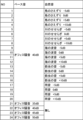
- the memory unit 11 also stores a first selection table (Figure 13) and a second selection table ( Figure 15) described below.
- the communication unit 12 is a communication circuit that connects the information processing device 1 to the network 8.
- the communication unit 12 receives the user's biometric information from the sensor 2.
- the communication unit 12 transmits a control signal indicating sound content to the speaker 3.
- the communication unit 12 transmits a control signal indicating an instruction to transmit audio data to the information processing device 1 to the microphone 4.
- the communication unit 12 receives audio data indicating audio within the space 5 from the microphone 4.
- the control unit 10 (computer) is responsible for the overall control of the information processing device 1.
- the control unit 10 is configured by a computer executing an information processing program.
- the control unit 10 may also be configured by a dedicated hardware circuit.
- the control unit 10 includes an acquisition unit 101 (biometric information acquisition unit, factor acquisition unit), an estimation unit 102, a selection unit 103, and a reproduction unit 104.
- the acquisition unit 101 acquires information received by the communication unit 12. For example, the acquisition unit 101 acquires biometric information of the user received by the communication unit 12 from the sensor 2.
- the acquisition unit 101 acquires priority information indicating whether to prioritize the degree of relaxation or the degree of concentration. Specifically, the acquisition unit 101 acquires priority information received by the communication unit 12 from an external device (not shown). Alternatively, the priority information may be pre-stored in the storage unit 11. In this case, the acquisition unit 101 acquires the priority information from the storage unit 11.
- the acquisition unit 101 also acquires from the memory unit 11 the value of the factor "relaxation/motivation,” the value of the factor “concentration,” and the value of the factor "preferred space” for the sound content classified into the above-mentioned six types and four volume levels.
- the estimation unit 102 estimates a state related to the user's factors (hereinafter, the user state) based on the user's biometric information acquired by the acquisition unit 101.
- the estimation unit 102 estimates a relaxation level indicating the degree to which the user is relaxed as a user state related to the factor "relaxation motivation" based on the user's biometric information. In addition, the estimation unit 102 estimates a concentration level indicating the degree to which the user is concentrated as a state related to the factor "concentration” based on the user's biometric information.
- the estimation unit 102 calculates physiological indices for estimating a state related to the user's factors based on the user's biometric information.
- the physiological indices are indices that the estimation unit 102 uses to derive a state related to the user's factors.
- the physiological indices that can be used include the pulse wave shown in document D1 (Japanese Patent Publication No. 7349629), the user's condition shown in document D2 (Japanese Patent Publication No. 2020-8278), the hemoglobin concentration shown in document D3 (International Publication No. 2012/150657), and data showing habitual postures shown in document D4 (Japanese Patent Publication No. 2020-201755).
- the estimation unit 102 estimates the user state based on the calculated physiological index.
- the user state is expressed as a continuous numerical value such as 0.01 to 1 (1% to 100%) or 1 to 100.
- the user state may be expressed as a binary value.
- An example of a binary expression of the user's relaxation level is 1 when the user is relaxed, and 0 when the user is not relaxed.
- An example of a binary expression of the user's concentration level is 1 when the user is concentrated, and 0 when the user is not concentrated.
- Document D1 is known as a method for calculating a degree of relaxation.
- the estimation unit 102 may use the method of document D1 to calculate the user's degree of relaxation.
- Document D1 discloses a method for calculating the ratio LF/HF of the LF (frequency band 0.05 Hz to 0.15 Hz) and HF (frequency band 0.15 Hz to 0.40 Hz) components by frequency analysis of the RR interval of the second derivative waveform with respect to time of the pulse wave detected by a pulse wave sensor, and for calculating the degree of relaxation based on the LF/HF ratio. Therefore, when the method of document D1 is adopted, the estimation unit 102 may calculate the degree of relaxation by using the pulse wave as a physiological index.
- Documents D2, D3, and D4 are known as methods for calculating the degree of concentration.
- the estimation unit 102 may calculate the degree of concentration of a user using any of the methods in documents D2 to D4.
- document D2 discloses a method of estimating user behavior such as the user's movements, blink frequency, gender, and age by inputting an image of the user taken by a camera into an image processing neural network, and then inputting the estimated user behavior into a concentration estimation neural network to calculate the concentration level. Therefore, when the method of document D2 is adopted, the estimation unit 102 may calculate the concentration level by using the user behavior estimated by the image processing network as a physiological index.
- Literature D3 discloses a method for calculating hemoglobin concentration, which indicates cerebral blood flow, from biological data measured by a near-infrared sensor, and calculating the degree of concentration based on the hemoglobin concentration. Therefore, when adopting the method of literature D3, the estimation unit 102 may calculate the degree of concentration by using the hemoglobin concentration as a physiological index.
- Literature D4 discloses a method for detecting a user's habitual posture when concentrating from an image of the user captured by a camera, and calculating the level of concentration based on the detected habitual posture. Therefore, when adopting the method of literature D4, the estimation unit 102 can calculate the level of concentration of the user by using data indicating the habitual posture when concentrating as a physiological index.
- glasses-type concentration measurement terminals have appeared that are equipped with an electrooculography sensor that measures the potential on the cornea side of the eyeball and can detect the level of concentration based on changes in the measured potential during gaze and blinking.
- Such glasses-type concentration measurement terminals may be used as sensor 2, and the estimation unit 102 may estimate the level of concentration contained in the biometric information transmitted by sensor 2 as the user state.
- the selection unit 103 selects sound content with a factor value corresponding to the user state estimated by the estimation unit 102 from the 24 sound contents classified into the above six types and four volume levels stored in the memory unit 11.
- the selection unit 103 selects any one of the sound contents having a higher factor value than the predetermined sound content.
- the selection unit 103 selects any one of the sound contents having a lower factor value than the predetermined sound content. Details of the selection unit 103 will be described later.
- the playback unit 104 plays the sound content selected by the selection unit 103 in the space 5 in which the user is present.
- the playback unit 104 acquires the sound content selected by the selection unit 103 from the storage unit 11.
- the playback unit 104 controls the communication unit 12 to transmit a control signal including the sound content to the speaker 3, instructing the playback of the sound content.
- the speaker 3 plays the sound content included in the control signal according to the instructions indicated by the control signal.
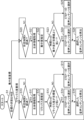
- FIG. 12 is a flowchart showing the processing performed by the information processing device 1.
- the acquisition unit 101 acquires priority information
- the selection unit 103 determines the state of the target (step S1).
- step S1 if the priority information acquired by the acquisition unit 101 indicates that emphasis is placed on the degree of relaxation, the selection unit 103 sets a predetermined value (e.g., 50%, 0.5, etc.) as the target value for the degree of relaxation ("Emphasis on relaxation level" in step S1), and proceeds to step S10.
- a predetermined value e.g. 50%, 0.5, etc.
- the priority information indicating that emphasis is placed on the degree of relaxation may include a setting value to be set as the target value for the degree of relaxation.
- the selection unit 103 may set the setting value included in the priority information as the target value for the degree of relaxation.
- step S10 the selection unit 103 determines whether or not a predetermined time X has elapsed since the processing transitioned to step S10 (step S10). If the selection unit 103 determines in step S10 that the predetermined time X has not elapsed, the selection unit 103 puts the processing on hold (NO in step S10). On the other hand, if the selection unit 103 determines in step S10 that the predetermined time X has elapsed, the selection unit 103 transitions the processing to step S11 (YES in step S10).
- step S11 the acquisition unit 101 acquires the user's biometric information most recently received by the communication unit 12 from the sensor 2 (step S11).
- step S12 the estimation unit 102 estimates the user's level of relaxation based on the biometric information acquired in step S11 (step S12).
- step S13 the selection unit 103 determines whether the degree of relaxation estimated in step S12 is lower than the target value of the degree of relaxation set in step S1 (step S13).
- step S13 if the selection unit 103 determines that the degree of relaxation estimated in step S12 is lower than the target value of the degree of relaxation set in step S1 (if the target state has not been reached) (YES in step S13), the process proceeds to step S14.
- step S14 the selection unit 103 uses the first selection table stored in the storage unit 11 to select one sound content associated with the next step number (order) of the current step number as the sound content to be played (step S14).
- FIG. 13 is a diagram showing an example of the first selection table.
- the first selection table is a table that associates a first step list with a first selection list (list).
- the first step list is a list in which step numbers indicating the order in which processing is executed are arranged in numerical order.
- the first selection list is a list in which sound contents whose value for the factor "relaxation motivation" is equal to or greater than a reference value are arranged in order of the value of the factor "relaxation motivation" from among 24 sound contents classified into six types and four volume levels stored in the memory unit 11.
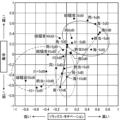
- the first selection list shown in FIG. 13 was created based on the values (horizontal axis values) of the factor “relaxation/motivation” for the 24 sound contents classified into 6 types and 4 volume levels shown in FIG. 14, and the values (vertical axis values) of the factor "preferred space” for the 24 sound contents classified into 6 types and 4 volume levels shown in FIG. 10.
- the first selection list shown in Figure 13 shows an example in which the value of the factor "Relax Motivation" of the sound content of type "bird” and volume "-5 dB", which have the highest value of the factor "Preferred Space” ( Figure 10), is set as a reference value, and eight sound contents whose values of the factor "Relax Motivation” are equal to or greater than the reference value are arranged in order of the value of the factor "Relax Motivation", as shown by the thick arrow in Figure 14.
- the sound contents included in the first selection list do not have to be arranged in order of the value of the factor "Concentration", as long as they are arranged at least in order of the value of the factor "Relax Motivation".
- the number of step numbers included in the first step list and the number of sound contents included in the first selection list are not limited to eight as shown in FIG. 13, and may be any number as long as they are the same.
- the reference value of the first selection list is not limited to the value of the factor "Relaxation Motivation" of the sound content with the highest value of the factor "Preferred Space” (FIG. 10).
- step S14 the selection unit 103 acquires the first selection table (FIG. 13) from the storage unit 11.
- the selection unit 103 acquires the next step number (e.g., "STEP 1") of the current step number (e.g., "STEP 0") from the first step list in the acquired first selection table.
- the selection unit 103 selects, in the first selection list (FIG. 13) of the first selection table acquired from the memory unit 11, the sound content (e.g., "Rain 0 dB" (sound content of type “Rain” and volume “0 dB”)) associated with the acquired next step number (e.g., "STEP 1") that has a higher value for the factor "Relaxation Motivation” than the sound content (predetermined sound content) associated with the current step number (e.g., "STEP 0") as the sound content to be played.
- the sound content e.g., "Rain 0 dB" (sound content of type “Rain” and volume “0 dB”
- next step number e.g., "STEP 1”
- the sound content predetermined sound content
- the selection unit 103 When the selection unit 103 selects the sound content to be played, it updates the current step number (e.g., "STEP 0") with the obtained next step number (e.g., "STEP 1"). Note that when step S14 is performed for the first time after the start of the process shown in FIG. 12, the selection unit 103 sets the current step number to "STEP 0."
- step S13 if the selection unit 103 determines that the degree of relaxation estimated in step S12 is higher than the target value of the degree of relaxation set in step S1 (exceeds the target state) (NO in step S13), the process proceeds to step S15.
- step S15 the selection unit 103 uses the first selection table stored in the storage unit 11 to select one sound content associated with the step number preceding the current step number as the sound content to be played back (step S15).
- Step S15 will be described in detail below.
- the selection unit 103 acquires the first selection table (FIG. 13) from the storage unit 11.
- the selection unit 103 acquires the step number (e.g., "STEP 0") preceding the current step number (e.g., "STEP 1") from the first step list in the acquired first selection table.
- the selection unit 103 selects, in the first selection list (FIG. 13) of the first selection table acquired from the storage unit 11, the sound content (e.g., "Bird -5 dB" (sound content of type "bird” and volume “-5 dB")) associated with the acquired previous step number (e.g., "STEP 0") that has a lower value for the factor "relaxation motivation" than the sound content (predetermined sound content) associated with the current step number (e.g., "STEP 1"), as the sound content to be played.
- the sound content e.g., "Bird -5 dB" (sound content of type "bird” and volume “-5 dB”
- the selection unit 103 When the selection unit 103 selects the audio content to be played, it updates the current step number (e.g., "STEP 1") with the previous step number (e.g., "STEP 0") that it has acquired.
- the current step number e.g., "STEP 1”
- the previous step number e.g., "STEP 0”
- step S15 When step S15 is performed for the first time after the start of the process shown in FIG. 12, the selection unit 103 sets the current step number to "STEP 0." In this case, in step S15, the selection unit 103 selects the sound content associated with the current step number "STEP 0" in the first step list of the first selection table as the sound content to be played.
- step S16 is performed. Also, if sound content to be played is selected in step S15, step S16 is performed.
- step S16 the playback unit 104 plays the sound content to be played back that was selected in step S14 or step S15 in the space 5 in which the user is present (step S16).
- the selection unit 103 uses the first selection table to select the sound content to be played. Therefore, the sound content to be played in the space 5 in which the user is present can be limited to those with a value for the factor "relaxation motivation" equal to or greater than a reference value, and can be efficiently selected according to the order in the list. Furthermore, if the reference value is the value of the factor "relaxation motivation" of the sound content with the highest value for the factor "preferred space" ( Figure 10), then after the space 5 in which the user is present is brought into a preferred state, the user's level of relaxation can be brought closer to a target state.
- the sound contents included in the first selection list may be arranged in order of magnitude of the value of the factor "Relax Motivation” and in order of magnitude of the value of the factor "Concentration".
- the user's level of relaxation can be improved while also improving his/her level of concentration, creating a sound environment suitable for improving the user's performance.
- the sound contents included in the first selection list may be arranged in order of magnitude of the value of the factor "Relax Motivation” and in reverse order of the value of the factor "Concentration” (so that the value becomes smaller).
- the user's level of relaxation can be improved while his/her level of concentration can be reduced, creating a sound environment suitable for the user's rest.
- step S1 if the priority information acquired by the acquisition unit 101 indicates that concentration is emphasized, the selection unit 103 sets a predetermined value (e.g., 80%, 0.8, etc.) as the target value for concentration ("Emphasis on concentration" in step S1) and transitions to step S20.
- a predetermined value e.g., 80%, 0.8, etc.
- the priority information indicating that concentration is emphasized may include a setting value to be set as the target value for concentration. In this case, the selection unit 103 may set the setting value included in the priority information as the target value for concentration.
- step S20 the selection unit 103 determines whether or not a predetermined time X has elapsed since the processing transitioned to step S20, similar to step S10 (step S20). In step S20, if the selection unit 103 determines that the predetermined time X has not elapsed, it puts the processing on hold (NO in step S20), and if it determines that the predetermined time X has elapsed, it transitions the processing to step S21 (YES in step S20).
- step S21 similar to step S11, the acquisition unit 101 acquires the user's biometric information most recently received by the communication unit 12 from the sensor 2 (step S21).
- step S22 the estimation unit 102 estimates the user's concentration level based on the biometric information acquired in step S21 (step S22).
- step S23 the selection unit 103 determines whether the concentration level estimated in step S22 is lower than the target concentration level value set in step S1 (step S23).
- step S23 if the selection unit 103 determines that the concentration level estimated in step S22 is lower than the target concentration level set in step S1 (if the target state has not been reached) (YES in step S23), the process proceeds to step S24.
- step S24 the selection unit 103 uses the second selection table stored in the storage unit 11 to select one sound content associated with the next step number of the current step number as the sound content to be played (step S24).
- FIG. 15 is a diagram showing an example of the second selection table.
- the second selection table is a table that associates a second step list in which step numbers are arranged in numerical order with a second selection list (list).
- the second selection list is a list in which, of the 24 sound contents stored in the memory unit 11 and classified into six types and four volume levels, sound contents whose value of the factor "concentration" is equal to or greater than a reference value are arranged in order of the value of the factor "concentration".
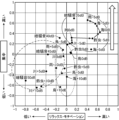
- the second selection list shown in FIG. 15 was created based on the values (vertical axis values) of the factor "concentration” for the 24 sound contents classified into 6 types and 4 volumes shown in FIG. 16 and the values (vertical axis values) of the factor "preferred space” for the 24 sound contents classified into 6 types and 4 volumes shown in FIG. 10.
- the second selection list shown in Figure 15 shows an example in which the value of the factor "concentration” of the sound content of type "bird” and volume "-5 dB", which have the highest value of the factor "preferred space” ( Figure 10), is set as a reference value, and seven sound contents whose values of the factor "concentration” are equal to or greater than the reference value are arranged in order of the value of the factor "concentration", excluding some sound contents, as indicated by the thick arrow in Figure 16.
- the sound contents included in the second selection list do not have to be arranged in order of the value of the factor "relaxation/motivation", as long as they are arranged in order of the value of the factor "concentration".
- the number of step numbers included in the second step list and the number of sound contents included in the second selection list are not limited to seven as shown in FIG. 15, and may be the same number.
- the reference value of the second selection list is not limited to the value of the factor "concentration” of the sound content with the highest value of the factor "preferred space” (FIG. 10).
- step S24 the selection unit 103 acquires the second selection table (FIG. 15) from the storage unit 11.
- the selection unit 103 acquires the next step number (e.g., "STEP 1") of the current step number (e.g., "STEP 0") from the second step list in the acquired second selection table.
- the selection unit 103 selects, in the second selection list (FIG. 15) of the second selection table acquired from the storage unit 11, the sound content (e.g., "River -5 dB" (sound content of type “River” and volume “-5 dB”)) associated with the acquired next step number (e.g., "STEP 1") that has a higher value of the factor "concentration” than the sound content (predetermined sound content) associated with the current step number (e.g., "STEP 0") as the sound content to be played back.
- the sound content e.g., "River -5 dB" (sound content of type “River” and volume “-5 dB”
- next step number e.g., "STEP 1”
- the sound content predetermined sound content
- the selection unit 103 When the selection unit 103 selects the sound content to be played, it updates the current step number (e.g., "STEP 0") with the obtained next step number (e.g., "STEP 1"). Note that when step S24 is performed for the first time after the start of the process shown in FIG. 12, the selection unit 103 sets the current step number to "STEP 0."
- step S23 if the selection unit 103 determines that the concentration level estimated in step S22 is higher than the target concentration level set in step S1 (exceeds the target state) (NO in step S23), the process proceeds to step S25.
- step S25 the selection unit 103 uses the second selection table stored in the storage unit 11 to select one sound content associated with the step number preceding the current step number as the sound content to be played (step S25).
- Step S25 will be described in detail below.
- the selection unit 103 acquires the second selection table (FIG. 15) from the storage unit 11, similar to step S24.
- the selection unit 103 acquires the step number (e.g., "STEP 0") preceding the current step number (e.g., "STEP 1") from the second step list in the acquired second selection table.
- the selection unit 103 selects, in the second selection list (FIG. 15) of the second selection table acquired from the storage unit 11, the sound content (e.g., "Bird -5 dB" (sound content of type “Bird” and volume “-5 dB”)) associated with the acquired previous step number (e.g., "STEP 0") that has a lower value of the factor "concentration” than the sound content (predetermined sound content) associated with the current step number (e.g., "STEP 1") as the sound content to be played back.
- the sound content e.g., "Bird -5 dB" (sound content of type “Bird” and volume “-5 dB”
- the selection unit 103 When the selection unit 103 selects the audio content to be played, it updates the current step number (e.g., "STEP 1") with the previous step number (e.g., "STEP 0") that it has acquired.
- the current step number e.g., "STEP 1”
- the previous step number e.g., "STEP 0”
- step S25 When step S25 is performed for the first time after the start of the process shown in FIG. 12, the selection unit 103 sets the current step number to "STEP 0." In this case, in step S25, the selection unit 103 selects the sound content associated with the current step number "STEP 0" in the second step list of the second selection table as the sound content to be played.
- step S26 is performed. Also, if sound content to be played is selected in step S25, step S26 is performed.
- step S26 the playback unit 104 plays the sound content to be played back that was selected in step S24 or step S25 in the space 5 in which the user is present (step S26).
- the selection unit 103 uses the second selection table to select the sound content to be played. Therefore, the sound content to be played in the space 5 in which the user is present can be limited to those whose factor values are equal to or greater than a reference value, and can be efficiently selected according to the order in the list. Furthermore, if the reference value is the value of the factor "concentration" of the sound content with the highest value of the factor "preferred space" ( Figure 10), then after the space 5 in which the user is present is made into a preferred state, the user's level of concentration can be brought closer to the target state.
- the sound contents included in the second selection list may be arranged in descending order of the value of the factor "concentration” and in descending order of the value of the factor "relaxation motivation".
- the user's level of concentration can be improved while also improving his/her level of relaxation, creating a sound environment suitable for improving the user's performance.
- the sound contents included in the second selection list may be arranged in descending order of the value of the factor "concentration” and in reverse order of the value of the factor "relaxation motivation" (so that the value decreases).
- the user's level of concentration can be improved while his/her level of relaxation can be reduced, creating a sound environment suitable for improving the user's levels of concentration and tension.
- FIG. 17 is a diagram showing an example of a time series change in the user's relaxation level.
- the horizontal axis of FIG. 17 indicates the elapsed time from the start of the process shown in FIG. 12, and the vertical axis indicates the relaxation level estimated from the biometric information transmitted by the sensor 2 to the information processing device 1.
- step S1 the priority information acquired by the acquisition unit 101 indicates that emphasis is placed on the degree of relaxation, and the selection unit 103 sets a target value for the degree of relaxation.
- the process of acquiring bioinformation in step S11, the process of estimating the degree of relaxation in step S12, the process of selecting the sound content to be played in steps S13 to S15, and the process of playing the sound content in step S16 are repeated each time a predetermined time X has elapsed.
- step S14 (FIG. 12) is performed.
- step S14 sound content that is associated with the next step number of the current step number in the first selection list of the first selection table (FIG. 13) and has a higher value for the factor "relaxation motivation" than the sound content associated with the current step number is selected as the sound content to be played, and in step S16, that sound content is played.
- the user's degree of relaxation related to the factor "relaxation motivation" improves from time X1 onwards.
- steps S14 and S16 are performed at time X2, which is a predetermined time X after time X1, and at time X3, which is a predetermined time X after time X2.
- time X2 which is a predetermined time X after time X1
- time X3 which is a predetermined time X after time X2.
- step S15 ( Figure 12) is performed.
- step S15 the sound content associated with the step number preceding the current step number in the first selection list ( Figure 13) of the first selection table and having a lower value for the factor "relaxation motivation" than the sound content associated with the current step number is selected as the sound content to be played, and in step S16, that sound content is played.
- the user's relaxation level related to the factor "relaxation motivation” is suppressed from time X4 onwards, as shown in Figure 17.
- steps S15 and S16 are performed.
- sound content with a lower value of the factor "relax motivation” than the sound content associated with the current step number is played, and the user's degree of relaxation related to the factor "relax motivation” is suppressed from time X5 onwards.
- FIG. 18 is a diagram showing an example of a time series change in the user's concentration level.
- the horizontal axis of FIG. 18 indicates the elapsed time from the start of the process shown in FIG. 12, and the vertical axis indicates the concentration level estimated from the biometric information transmitted by the sensor 2 to the information processing device 1.
- step S1 the priority information acquired by the acquisition unit 101 indicates that concentration level is important, and the selection unit 103 sets a target value for concentration level.
- the process of acquiring bioinformation in step S21, the process of estimating concentration level in step S22, the process of selecting sound content to be played in steps S23 to S25, and the process of playing sound content in step S26 are repeated each time a predetermined time X has elapsed.
- step S24 (FIG. 12) is performed.
- sound content that has a higher value for the factor "concentration” than the sound content associated with the next step number of the current step number in the second selection list (FIG. 15) of the second selection table is selected as the sound content to be played, and that sound content is played in step S26.
- the user's level of concentration related to the factor "concentration” improves after time X1, as shown in FIG. 18.
- steps S24 and S26 are performed.
- sound content with a higher value for the factor "concentration” than the sound content associated with the current step number is played, and the user's level of concentration related to the factor "concentration” improves from time X2 onwards.
- step S25 sound content that is associated with the step number preceding the current step number in the second selection list of the second selection table (FIG. 15) and has a lower value for the factor "concentration" than the sound content associated with the current step number is selected as the sound content to be played, and in step S26, that sound content is played.
- the user's concentration level related to the factor "concentration” is suppressed from time X3 onwards.
- steps S24 and S26 are performed.
- sound content with a higher value for the factor "concentration” than the sound content associated with the current step number is played, and the user's level of concentration related to the factor "concentration” improves from time X4 onwards.
- step S25 sound content with a lower value for the factor "concentration” than the sound content associated with the current step number is selected as the sound content to be played, and in step S26, that sound content is played.
- the user's concentration level related to the factor "concentration” is suppressed from time X5 onwards.
- this configuration forms a sound environment in the space 5 in which the user exists that corresponds to the user's degree of relaxation (or concentration), and can bring the user's degree of relaxation (or concentration) closer to the target state.
- FIG. 26 is a diagram showing an example of a screen related to the process shown in FIG. 12.
- Screen W1 is an operation screen for selecting whether to prioritize relaxation level or concentration level.
- Screen W1 includes button B11 for selecting to prioritize relaxation level, and button B12 for selecting to prioritize concentration level.
- button B11 or button B12 When button B11 or button B12 is selected, the external device displays screen W2 in place of screen W1.
- Screen W2 is an operation screen for setting a target value for relaxation level or concentration level.
- Screen W2 includes a radio button (option button) B21 for selecting one of 1 to 10 as the target value, a back button B22, and a next button B23.
- Figure 26 shows an example in which the radio button B21 corresponding to 5 is selected on screen W2, and 5 is set as the target value.
- radio button B21 corresponding to any one of the predetermined values from 1 to 10 may be automatically selected.
- the values 1 to 10 displayed on screen W2 are examples of target values, and the values displayed selectably on screen W2 do not have to match the target values that are set.
- 2 when radio button B21 corresponding to 2 is selected, 2 may be set as the target value, and when radio button B21 corresponding to 10 is selected, 10 may be set as the target value.
- 4 when radio button B21 corresponding to 2 is selected, 4 may be set as the target value, and when radio button B21 corresponding to 10 is selected, 8 may be set as the target value.
- radio button B21 corresponding to 2 4 or 40% may be set as the target value
- radio button B21 corresponding to 10 8 or 80% may be set as the target value.
- Screen W3 is an operation screen for sending information indicating the contents selected on screens W1 and W2 to the information processing device 1.
- Screen W3 includes a start button B31.
- the external device When button B11 is pressed on screen W1, and then start button B31 is pressed, the external device transmits priority information indicating that emphasis is placed on the degree of relaxation and the target value set on screen W2 to the information processing device 1. On the other hand, when button B12 is pressed on screen W1, and then start button B31 is pressed, the external device transmits priority information indicating that emphasis is placed on the degree of concentration and the target value set on screen W2 to the information processing device 1. In response to this, when the communication unit 12 receives the priority information and the target value from the external device, the acquisition unit 101 acquires the priority information and the target value. Then, the control unit 10 starts the process shown in FIG. 12. After transmitting the priority information and the target value, the external device displays screen W4 instead of screen W3.
- Screen W4 is a screen indicating that the process shown in FIG. 12 is being executed.
- Screen W4 includes a stop button B41 for canceling the process shown in FIG. 12.
- the external device transmits information instructing the process shown in FIG. 12 to be cancelled (hereinafter, cancel instruction information) to the information processing device 1.
- cancel instruction information information instructing the process shown in FIG. 12 to be cancelled
- the control unit 10 ends the process shown in FIG. 12 that is being executed.
- control unit 10 When the control unit 10 ends the ongoing process shown in FIG. 12, it controls the communication unit 12 to transmit information indicating that the process shown in FIG. 12 has ended (hereinafter, processing end information) to the external device.
- processing end information information indicating that the process shown in FIG. 12 has ended
- the external device receives the processing end information from the information processing device 1, it displays a screen W5 informing the user that the process shown in FIG. 12 has ended.
- Screen W5 includes an end button B51. When the end button B51 is pressed, the external device hides screen W5.
- the external device may hide screen W3 and not display screen W4.
- the external device may be configured to allow a predetermined operation to stop the processing shown in FIG. 12, and to display screen W4 when the operation is performed.
- the temporal progression of the user's level of relaxation or concentration during the process may be displayed on an external device.
- control unit 10 may store in the storage unit 11 the user's degree of relaxation estimated in step S12 of the process shown in FIG. 12 or the user's degree of concentration estimated in step S22 in association with the current time. Then, in the external device, after the screen W5 is hidden, when a predetermined operation is performed by the user or administrator to focus on the time progression of the user's state in the process shown in FIG. 12, information instructing the display of the user's state (hereinafter, display instruction information) may be transmitted to the information processing device 1.
- display instruction information information instructing the display of the user's state
- the control unit 10 may obtain from the memory unit 11 the current time from the time the process shown in FIG. 12 is started to the time the communication unit 12 receives the display instruction information, and the user's degree of relaxation or concentration associated with the current time, and return the information to the external device.
- the external device may display a screen that shows the user's relaxation level or concentration level received from the information processing device 1 after the progress display information has been transmitted in association with the current time.
- Screen W61 shown in FIG. 26 shows an example of a screen that shows the user's relaxation level in association with the current time
- screen W62 shown in FIG. 26 shows an example of a screen that shows the user's concentration level in association with the current time.
- FIG. 19 is a diagram showing an example of another experimental environment.
- an example is described in which sound content corresponding to a state related to a user's factors is reproduced based on the values of factors of the above 24 sound contents obtained from a subjective evaluation experiment targeting office workers similar to the above in the anechoic chamber 50a shown in FIG. 19.
- the above subjective evaluation experiment performed in the anechoic chamber 50 shown in FIG. 1 will be described as a first experiment
- the same subjective evaluation experiment performed in the anechoic chamber 50a shown in FIG. 19 will be described as a second experiment.
- the second experiment was conducted over two days in the anechoic chamber 50a shown in FIG. 19, as in the first experiment.
- the subjects were 16 office workers (8 men and 8 women) in their 30s to 60s.
- a desk was placed for the subjects to fill out a questionnaire using a tablet terminal, as in the first experiment.
- potted plants or other plants 90 were placed on and around the desk so that they were within the field of view of the subjects.
- the four speakers 31 that reproduce sound content representing the base sound that becomes background noise were placed 2 m away from the subjects in the diagonal direction.
- the one speaker 32 that reproduces sound content representing natural sounds to be added to the base sound was placed 2 m away from the subjects in the front direction, as in the first experiment.
- the subjects were given the same questionnaire as in the first experiment. Once all subjects had completed the questionnaire, as in the first experiment, a statistical analysis tool was used to perform factor analysis and cluster analysis of the evaluation results of all subjects for the 10 evaluation items excluding the overall evaluation items "desirability,” “ease of working,” and “comfort” for each of the 24 sound environments created within the anechoic chamber 50a.
- Figures 20 and 21 show examples of the results of factor analysis and cluster analysis of other evaluation results.
- Figure 20 shows the results of the evaluation of each sound environment, organized with the factor score for the "Relaxation/Motivation” factor on the horizontal axis and the factor score for the "Concentration” factor on the vertical axis, and further classified into three groups by cluster analysis.
- Figure 21 shows the evaluation results for each sound environment, organized with the factor score for the "Relaxation/Motivation” factor on the horizontal axis and the factor score for the "Preferred Space” factor on the vertical axis, and further classified into three groups using cluster analysis.
- the third selection table and the fourth selection table are stored in the storage unit 11.
- the storage unit 11 also stores planting information indicating whether or not a planting 90 is present in the space 5 in which the user exists.
- the selection unit 103 refers to the planting information stored in the storage unit 11 when performing steps S14, S15, S24, and S25.
- the selection unit 103 selects sound content using the third selection table instead of the first selection table. If the plant information indicates that a plant 90 has been planted in the space 5 in which the user is present in steps S24 and S25, the selection unit 103 selects sound content using the fourth selection table instead of the second selection table.
- FIG. 22 is a diagram showing an example of the third selection table.
- the third selection table has the same structure as the first selection table (FIG. 13), and is a table that associates a third step list corresponding to the first step list of the first selection table with a third selection list (list) corresponding to the first selection list of the first selection table.
- the third selection list is a list of sound contents, which are classified into six types and four volume levels stored in the memory unit 11, and in which the value (adjusted value of the factor) of the factor "relax motivation" when the plant 90 is provided in the space 5 is equal to or greater than a reference value, in order of the value (adjusted value of the factor) of the factor "relax motivation" when the plant 90 is provided in the space 5.
- the third selection list shown in FIG. 22 was created based on the values of the factor “Relaxation/Motivation” (horizontal axis value) and the factor “Concentration” (vertical axis value) of the 24 sound contents classified into 6 types and 4 volume levels shown in FIG. 23, and the value of the factor “Preferred Space” (vertical axis value) of the 24 sound contents classified into 6 types and 4 volume levels shown in FIG. 21.
- the third selection list shown in FIG. 22 sets the value of the factor "relax motivation" of the sound content of type “river” and volume "-5 dB", where the value of the factor “preferable space” (FIG. 21) is higher than the median, and the values of the factors “relax motivation” and “concentration” (FIG. 23) are near the median, as the reference value.
- the third selection list shown in FIG. 22 shows an example in which eight pieces of sound content with values of the factor "relax motivation" equal to or greater than the reference value are arranged in order of the value of the factor "relax motivation", as indicated by the bold arrow in FIG. 23.
- the number of step numbers included in the third step list and the number of sound contents included in the third selection list are not limited to eight as shown in FIG. 22, and may be the same number.
- FIG. 24 is a diagram showing an example of a fourth selection table.
- the fourth selection table has the same structure as the second selection table (FIG. 15), and is a table that associates a fourth step list corresponding to the second step list of the second selection table with a fourth selection list (list) corresponding to the second selection list of the second selection table.
- the fourth selection list is a list of sound contents, which are classified into six types and four volume levels stored in the memory unit 11, and which have a value of the factor "concentration" (adjusted value of the factor) equal to or greater than a reference value when the plant 90 is provided in the space 5, in order of the value of the factor "concentration” (adjusted value of the factor) when the plant 90 is provided in the space 5.
- the fourth selection list shown in FIG. 24 was created based on the values of the factor “Relaxation/Motivation” (horizontal axis value) and the factor “Concentration” (vertical axis value) of the 24 sound contents classified into 6 types and 4 volume levels shown in FIG. 25, and the value of the factor “Preferred Space” (vertical axis value) of the 24 sound contents classified into 6 types and 4 volume levels shown in FIG. 21.
- the fourth selection list shown in FIG. 24 uses as a reference value the value of the factor "concentration” of the sound content of type “river” and volume "-5 dB", where the value of the factor “preferable space” (FIG. 21) is higher than the median, and the values of the factors “relaxation motivation” and “concentration” (FIG. 25) are near the median.
- the fourth selection list shown in FIG. 24 shows an example in which eight sound contents with values of the factor "concentration” equal to or greater than the reference value are arranged in order of the value of the factor "concentration", as indicated by the bold arrow in FIG. 25.
- the number of step numbers included in the fourth step list and the number of sound contents included in the fourth selection list are not limited to eight as shown in FIG. 24, and may be the same number.
- the second embodiment when plants 90 are provided in the space 5 in which the user exists, sound content with a factor value corresponding to the user's degree of relaxation (or concentration) is played in the space 5.
- a sound environment suited to the user's degree of relaxation (or concentration) is created in the space 5, and the user's degree of relaxation (or concentration) can be brought closer to a target state.
- the sound content associated with step number "STEP 0" may be changed to background noise in space 5 that is actually collected by microphone 4.
- This configuration can be realized, for example, as follows.
- the selection unit 103 selects the sound content associated with step number "STEP 0" as the sound content to be played in steps S14, S15, S24, and S25, it interrupts processing and controls the communication unit 12 to send a control signal to the microphone 4 indicating an instruction to transmit audio data to the information processing device 1.
- the microphone 4 transmits audio data indicating the sound collected in the space 5 to the information processing device 1, and when the communication unit 12 receives the audio data, the selection unit 103 performs audio analysis on the audio data and extracts audio data indicating background noise in the space 5 contained in the audio data (hereinafter, background noise data).
- the selection unit 103 reselects the background noise data as the sound content to be played, and proceeds to processing in step S16 or step S26.
- step S13 the selection unit 103 may further shorten the predetermined time X the greater the difference between the degree of relaxation estimated in step S12 and the target value of the degree of relaxation set in step S1.
- step S23 the selection unit 103 may further shorten the predetermined time X the greater the difference between the degree of concentration estimated in step S22 and the target value of the degree of concentration set in step S1.
- step S24 (FIG. 12) is performed in a sound environment in which sound content of type "rain” and volume “0 dB” is being played
- step S25 (FIG. 12) is performed in a sound environment in which sound content of type "sea” and volume “0 dB” is being played
- the value of the factor "concentration” is significantly higher than that of sound content of type "rain” and volume “0 dB”
- the order of the sound content may be changed to reduce the change in the value of the factor "concentration.”
- the order of the sound content may be changed to reduce the change in the value of the factor "relaxation/motivation.”
- step S1 may be omitted, and after the process shown in FIG. 12 starts, the selection unit 103 may set a target value for the user's degree of relaxation, similar to step S1, and then perform the process from step S10 onwards.
- step S1 may be omitted, and after the process shown in FIG. 12 starts, the selection unit 103 may set a target value for the user's degree of concentration, similar to step S1, and then perform the process from step S20 onwards.
- steps S15 and S25 may be omitted.
- step S10 may be omitted, and the process shown in FIG. 12 may end after step S16.
- step S20 may be omitted, and the process shown in FIG. 12 may end after step S26.
- the acquisition unit 101 may acquire the user state received by the communication unit 12 from an external terminal.
- the external terminal may be, for example, a computer or a mobile terminal that transmits and receives subjective evaluation results of the user state based on a questionnaire or the like, or may be a wearable terminal worn by the user that acquires biometric information and estimates the user state.
- the external terminal may be a server that communicates with various terminals.
- the present disclosure is useful in the field of sound environments in biophilic design.
Landscapes
- Engineering & Computer Science (AREA)
- Theoretical Computer Science (AREA)
- General Engineering & Computer Science (AREA)
- Physics & Mathematics (AREA)
- General Physics & Mathematics (AREA)
- Human Computer Interaction (AREA)
- Business, Economics & Management (AREA)
- Multimedia (AREA)
- Health & Medical Sciences (AREA)
- Audiology, Speech & Language Pathology (AREA)
- General Health & Medical Sciences (AREA)
- Entrepreneurship & Innovation (AREA)
- Human Resources & Organizations (AREA)
- Strategic Management (AREA)
- Data Mining & Analysis (AREA)
- Economics (AREA)
- Marketing (AREA)
- Operations Research (AREA)
- Quality & Reliability (AREA)
- Tourism & Hospitality (AREA)
- General Business, Economics & Management (AREA)
- Circuit For Audible Band Transducer (AREA)
- Management, Administration, Business Operations System, And Electronic Commerce (AREA)
- Measurement Of The Respiration, Hearing Ability, Form, And Blood Characteristics Of Living Organisms (AREA)
Priority Applications (3)
| Application Number | Priority Date | Filing Date | Title |
|---|---|---|---|
| CN202480023040.XA CN120958413A (zh) | 2023-03-29 | 2024-02-07 | 信息处理方法、信息处理装置以及程序 |
| JP2025509844A JPWO2024202558A1 (https=) | 2023-03-29 | 2024-02-07 | |
| US19/338,834 US20260017012A1 (en) | 2023-03-29 | 2025-09-24 | Information processing method, information processing device, and non-transitory computer readable storage medium |
Applications Claiming Priority (4)
| Application Number | Priority Date | Filing Date | Title |
|---|---|---|---|
| US202363455345P | 2023-03-29 | 2023-03-29 | |
| US63/455,345 | 2023-03-29 | ||
| JP2023-194521 | 2023-11-15 | ||
| JP2023194521 | 2023-11-15 |
Related Child Applications (1)
| Application Number | Title | Priority Date | Filing Date |
|---|---|---|---|
| US19/338,834 Continuation US20260017012A1 (en) | 2023-03-29 | 2025-09-24 | Information processing method, information processing device, and non-transitory computer readable storage medium |
Publications (1)
| Publication Number | Publication Date |
|---|---|
| WO2024202558A1 true WO2024202558A1 (ja) | 2024-10-03 |
Family
ID=92904071
Family Applications (1)
| Application Number | Title | Priority Date | Filing Date |
|---|---|---|---|
| PCT/JP2024/004027 Ceased WO2024202558A1 (ja) | 2023-03-29 | 2024-02-07 | 情報処理方法、情報処理装置及びプログラム |
Country Status (4)
| Country | Link |
|---|---|
| US (1) | US20260017012A1 (https=) |
| JP (1) | JPWO2024202558A1 (https=) |
| CN (1) | CN120958413A (https=) |
| WO (1) | WO2024202558A1 (https=) |
Citations (6)
| Publication number | Priority date | Publication date | Assignee | Title |
|---|---|---|---|---|
| JP2005056205A (ja) * | 2003-08-05 | 2005-03-03 | Sony Corp | コンテンツ再生装置及びコンテンツ再生方法 |
| JP2006155157A (ja) * | 2004-11-29 | 2006-06-15 | Sanyo Electric Co Ltd | 自動選曲装置 |
| US20140223462A1 (en) * | 2012-12-04 | 2014-08-07 | Christopher Allen Aimone | System and method for enhancing content using brain-state data |
| JP2015212870A (ja) * | 2014-05-01 | 2015-11-26 | Kddi株式会社 | ユーザのストレス度に応じて音楽を選択する装置、プログラム及び方法 |
| CN112416285A (zh) * | 2019-08-20 | 2021-02-26 | 奇酷互联网络科技(深圳)有限公司 | 智能耳机播放方法、智能耳机和存储介质 |
| JP2022083702A (ja) * | 2020-11-25 | 2022-06-06 | エヌ・ティ・ティ・コミュニケーションズ株式会社 | 情報処理装置、再生音楽決定方法および再生音楽決定プログラム |
-
2024
- 2024-02-07 CN CN202480023040.XA patent/CN120958413A/zh active Pending
- 2024-02-07 JP JP2025509844A patent/JPWO2024202558A1/ja active Pending
- 2024-02-07 WO PCT/JP2024/004027 patent/WO2024202558A1/ja not_active Ceased
-
2025
- 2025-09-24 US US19/338,834 patent/US20260017012A1/en active Pending
Patent Citations (6)
| Publication number | Priority date | Publication date | Assignee | Title |
|---|---|---|---|---|
| JP2005056205A (ja) * | 2003-08-05 | 2005-03-03 | Sony Corp | コンテンツ再生装置及びコンテンツ再生方法 |
| JP2006155157A (ja) * | 2004-11-29 | 2006-06-15 | Sanyo Electric Co Ltd | 自動選曲装置 |
| US20140223462A1 (en) * | 2012-12-04 | 2014-08-07 | Christopher Allen Aimone | System and method for enhancing content using brain-state data |
| JP2015212870A (ja) * | 2014-05-01 | 2015-11-26 | Kddi株式会社 | ユーザのストレス度に応じて音楽を選択する装置、プログラム及び方法 |
| CN112416285A (zh) * | 2019-08-20 | 2021-02-26 | 奇酷互联网络科技(深圳)有限公司 | 智能耳机播放方法、智能耳机和存储介质 |
| JP2022083702A (ja) * | 2020-11-25 | 2022-06-06 | エヌ・ティ・ティ・コミュニケーションズ株式会社 | 情報処理装置、再生音楽決定方法および再生音楽決定プログラム |
Also Published As
| Publication number | Publication date |
|---|---|
| US20260017012A1 (en) | 2026-01-15 |
| JPWO2024202558A1 (https=) | 2024-10-03 |
| CN120958413A (zh) | 2025-11-14 |
Similar Documents
| Publication | Publication Date | Title |
|---|---|---|
| KR102743639B1 (ko) | 신경 생리학적 상태의 검출을 위한 센서 데이터를 사용하는 컨텐츠 생성 및 제어 | |
| KR102700934B1 (ko) | 신경 상태의 검출을 위해 생체 센서 데이터를 사용하여 라이브 엔터테인먼트를 디렉팅 | |
| Johnson et al. | Impact of hearing aid technology on outcomes in daily life II: Speech understanding and listening effort | |
| Fabry et al. | Improving speech understanding and monitoring health with hearing aids using artificial intelligence and embedded sensors | |
| CN107427716A (zh) | 人类绩效优化与训练的方法及系统 | |
| Palmer et al. | Amplification with digital noise reduction and the perception of annoying and aversive sounds | |
| US10682078B2 (en) | Apparatus and methods for matching of tinnitus | |
| KR20200049930A (ko) | 생체 신호 분석 시스템 및 이를 이용한 생체 신호 분석 방법 | |
| JP7009342B2 (ja) | 咀嚼や笑みに係る量に基づき食事を評価可能な装置、プログラム及び方法 | |
| KR20210004863A (ko) | 명상시스템 및 명상시스템의 운영방법 | |
| US12211607B2 (en) | Management of psychiatric or mental conditions using digital or augmented reality with personalized exposure progression | |
| IL265860A (en) | A method and device for detecting sensing inputs that affect a person's working memory load | |
| JP2004537343A (ja) | 個人情報配信システム | |
| WO2024202558A1 (ja) | 情報処理方法、情報処理装置及びプログラム | |
| JP2024517047A (ja) | ヒアリングトレーニングのための方法および装置 | |
| KR102069893B1 (ko) | 최적증폭을 위한 보청기 시스템의 제어 방법, 장치 및 프로그램 | |
| Hansen et al. | Active listening and expressive communication for children with hearing loss using getatable environments for creativity | |
| CN206100389U (zh) | 自动调节均衡器的耳机装置 | |
| CN118648054B (zh) | 声音环境控制系统以及声音环境控制方法 | |
| Uhles et al. | Insights into Information-Seeking Behavior in Hearing-Loss Treatment | |
| Kuratomo et al. | Integrating a Binaural Beat into the Soundscape for the Alleviation of Feelings | |
| CN119741859A (zh) | 听力和认知的训练装置 | |
| Durbridge | The Affective Evaluation of Immersive Soundscapes Including Physiological Measures | |
| CN114302296A (zh) | 声音自动调节方法、装置、设备及存储介质 | |
| WO2024209874A1 (ja) | 情報処理方法および情報処理システム |
Legal Events
| Date | Code | Title | Description |
|---|---|---|---|
| 121 | Ep: the epo has been informed by wipo that ep was designated in this application |
Ref document number: 24778703 Country of ref document: EP Kind code of ref document: A1 |
|
| ENP | Entry into the national phase |
Ref document number: 2025509844 Country of ref document: JP Kind code of ref document: A |
|
| WWE | Wipo information: entry into national phase |
Ref document number: 2025509844 Country of ref document: JP |
|
| NENP | Non-entry into the national phase |
Ref country code: DE |
|
| 122 | Ep: pct application non-entry in european phase |
Ref document number: 24778703 Country of ref document: EP Kind code of ref document: A1 |