WO2024201935A1 - 副燃焼室付内燃機関 - Google Patents
副燃焼室付内燃機関 Download PDFInfo
- Publication number
- WO2024201935A1 WO2024201935A1 PCT/JP2023/013309 JP2023013309W WO2024201935A1 WO 2024201935 A1 WO2024201935 A1 WO 2024201935A1 JP 2023013309 W JP2023013309 W JP 2023013309W WO 2024201935 A1 WO2024201935 A1 WO 2024201935A1
- Authority
- WO
- WIPO (PCT)
- Prior art keywords
- combustion chamber
- cylinder
- auxiliary
- auxiliary combustion
- partition wall
- Prior art date
- Legal status (The legal status is an assumption and is not a legal conclusion. Google has not performed a legal analysis and makes no representation as to the accuracy of the status listed.)
- Ceased
Links
Images



Classifications
-
- F—MECHANICAL ENGINEERING; LIGHTING; HEATING; WEAPONS; BLASTING
- F02—COMBUSTION ENGINES; HOT-GAS OR COMBUSTION-PRODUCT ENGINE PLANTS
- F02B—INTERNAL-COMBUSTION PISTON ENGINES; COMBUSTION ENGINES IN GENERAL
- F02B19/00—Engines characterised by precombustion chambers
- F02B19/12—Engines characterised by precombustion chambers with positive ignition
-
- Y—GENERAL TAGGING OF NEW TECHNOLOGICAL DEVELOPMENTS; GENERAL TAGGING OF CROSS-SECTIONAL TECHNOLOGIES SPANNING OVER SEVERAL SECTIONS OF THE IPC; TECHNICAL SUBJECTS COVERED BY FORMER USPC CROSS-REFERENCE ART COLLECTIONS [XRACs] AND DIGESTS
- Y02—TECHNOLOGIES OR APPLICATIONS FOR MITIGATION OR ADAPTATION AGAINST CLIMATE CHANGE
- Y02T—CLIMATE CHANGE MITIGATION TECHNOLOGIES RELATED TO TRANSPORTATION
- Y02T10/00—Road transport of goods or passengers
- Y02T10/10—Internal combustion engine [ICE] based vehicles
- Y02T10/12—Improving ICE efficiencies
Definitions
- the present invention relates to an internal combustion engine having a secondary combustion chamber within a main combustion chamber.
- injector fuel injection device
- spark plug that is positioned facing the combustion chamber inside the cylinder.
- Patent Document 1 discloses an internal combustion engine equipped with a secondary combustion chamber in a combustion chamber (main combustion chamber).
- a mixture with a relatively high fuel concentration is supplied to the secondary combustion chamber, and the mixture in the secondary combustion chamber is ignited by an ignition plug, so that a flame is injected (ejected) from the secondary combustion chamber into the main combustion chamber to combust the mixture in the main combustion chamber.
- This makes it possible to improve the ignition of the mixture in the main combustion chamber and improve the output of the internal combustion engine, or to reduce the fuel concentration in the main combustion chamber and improve fuel efficiency.
- Patent Document 1 discloses an internal combustion engine that is provided with a plurality of nozzle holes for injecting flame from an auxiliary combustion chamber, and is configured so that the flame is injected radially toward the cylinder wall surface.
- JP 2019-31961 A Japanese Patent Application Publication No. 5-44470
- the present invention was made to solve these problems, and aims to provide an internal combustion engine with an auxiliary combustion chamber that promotes combustion by evenly propagating flame from the auxiliary combustion chamber to the main combustion chamber.
- the internal combustion engine with an auxiliary combustion chamber of the present invention has a main combustion chamber formed in a cylinder by a cylinder head, a cylinder block, and a piston, an auxiliary combustion chamber separated from the main combustion chamber by a partition wall provided in the cylinder head, a fuel injection device that supplies fuel to the main combustion chamber and the auxiliary combustion chamber, and an ignition device that ignites in the auxiliary combustion chamber, and the partition wall is provided with a communication passage that connects the auxiliary combustion chamber to the main combustion chamber, and the side of the auxiliary combustion chamber opposite the piston is formed to extend along an axis that is inclined in a predetermined direction relative to the central axis of the cylinder, and the piston side is characterized in that the axis of the auxiliary combustion chamber is located on the opposite side of the predetermined direction relative to the center line of the cylinder.
- auxiliary combustion chamber is inclined, a swirling flow of the mixture containing the fuel flowing in from the connecting passage is generated within the auxiliary combustion chamber, which increases the fuel concentration of the mixture on the inclined side of the auxiliary combustion chamber and improves combustibility within the auxiliary combustion chamber.
- a strong flame can be sprayed into the main combustion chamber in the specified direction.
- the auxiliary combustion chamber Since the auxiliary combustion chamber is located on the opposite side of the predetermined direction from the central axis of the cylinder, it is far from the cylinder block on the predetermined direction side, but by strongly injecting fuel into the predetermined direction side of the main combustion chamber from the connecting passage on the predetermined direction side, the flame in the main combustion chamber can be propagated evenly around the auxiliary combustion chamber.
- the communicating passages are provided in a plurality of rows circumferentially arranged on the side surface of the partition wall, extension lines of the plurality of communicating passages intersect at an intersection on the central axis of the auxiliary combustion chamber, and the intersection is located at a position shifted in the opposite direction from the specified direction with respect to the central axis of the cylinder.
- This allows the flame generated by ignition in the auxiliary combustion chamber to be injected into the main combustion chamber so as to spread outward from the multiple communicating passages, thereby enabling the flame to propagate evenly around the auxiliary combustion chamber in the main combustion chamber.
- the cylinder head is provided with an intake valve and an exhaust valve on either side of the auxiliary combustion chamber,
- the predetermined direction may be a side on which the intake valve is arranged.
- the auxiliary combustion chamber is positioned on the opposite side of the intake valve from the central axis of the cylinder, so that a large opening area of the intake valve can be secured in the cylinder head, thereby improving the introduction of intake air into the main combustion chamber.
- the multiple communication passages include a first communication passage arranged on the specified direction side and a second communication passage arranged on the other side, and the first communication passage is formed to have a larger cross-sectional area than the second communication passage. This makes it possible to inject a large amount of flame from the first communication passage in a predetermined direction into the main combustion chamber.
- the first communication passage and the second communication passage are arranged in the partition wall at equal intervals in the circumferential direction. This allows the multiple flames to propagate more evenly from the auxiliary combustion chamber to the main combustion chamber, thereby further improving combustibility in the main combustion chamber.
- the fuel injection device is disposed facing the main combustion chamber in the predetermined direction. This places the auxiliary combustion chamber away from the fuel injection device, making it less likely that the flame injected from the communication passage towards the fuel injection device will directly impinge on the fuel injection device, thereby protecting the fuel injection device.
- the internal combustion engine with a pre-combustion chamber of the present invention by tilting the pre-combustion chamber in a predetermined direction, a swirling flow is generated in the pre-combustion chamber to improve combustibility in the pre-combustion chamber, and the fuel concentration on the predetermined direction side of the pre-combustion chamber is increased and ignited, and a strong flame is sprayed from the connecting passage in the predetermined direction into the main combustion chamber.
- the auxiliary combustion chamber offset in the opposite direction to a specified direction relative to the central axis of the cylinder the space on the specified side of the combustion chamber is larger than the opposite side.
- the flame can be propagated evenly in the main combustion chamber, improving combustibility and improving power output or fuel efficiency.
- FIG. 1 is a configuration diagram of an intake and exhaust system of an internal combustion engine according to an embodiment of the present invention
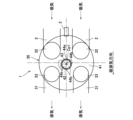
- FIG. 2 is a top view of a cylinder in the internal combustion engine of the present embodiment.
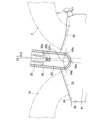
- FIG. 4 is a vertical cross-sectional view of the inside of a cylinder showing a fuel injection state.
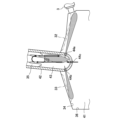
- FIG. 4 is a vertical cross-sectional view showing a detailed structure of an upper part of the cylinder.
- FIG. 4 is a vertical cross-sectional view of an upper part of a cylinder, showing a state of fuel movement within an auxiliary combustion chamber.
- FIG. 4 is a vertical cross-sectional view of the upper part of the cylinder, showing the fuel concentration in the auxiliary combustion chamber and the flame injection state into the main combustion chamber.
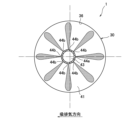
- FIG. 4 is a cross-sectional view of the inside of a cylinder showing a state in which flame is injected from the auxiliary combustion chamber to the main combustion chamber.
- FIG. 1 is a configuration diagram of an intake and exhaust system of an internal combustion engine 1 (an internal combustion engine with an auxiliary combustion chamber) according to one embodiment of the present invention.
- the internal combustion engine 1 of this embodiment is a direct injection type gasoline engine having an injector 3 (fuel injection device) that injects gasoline, which is a fuel, into a combustion chamber.
- an air cleaner 6, an intercooler 7, and a throttle valve 8 are provided upstream of the intake port 2 along the flow of intake air.
- an upstream side exhaust purification catalyst 12 and a downstream side exhaust purification catalyst 13 are provided along the flow of exhaust gas from the exhaust port 31.
- the internal combustion engine 1 is also equipped with a turbocharger 15 and an EGR system 16 .
- the EGR system 16 includes an EGR passage 20 that communicates the exhaust passage 11 and the intake passage 5 of the internal combustion engine 1, an EGR valve 21 that changes the flow path area of the EGR passage 20, and an EGR cooler 22 that cools the exhaust passing through the EGR passage 20.
- the EGR passage 20 connects the exhaust passage 11 between the upstream side exhaust purification catalyst 12 and the downstream side exhaust purification catalyst 13 to the intake passage 5 between the air cleaner 6 and the compressor of the turbocharger 15.
- Fig. 2 is a top view of the inside of a cylinder 30 in the internal combustion engine 1 of this embodiment.
- Fig. 3 is a vertical cross-sectional view of the inside of the cylinder showing a fuel injection state.
- the internal combustion engine 1 is provided with two intake ports 2 and two exhaust ports 31 for each cylinder 30. Furthermore, each of the two intake ports 2 is provided with an intake valve 32, and each of the two exhaust ports 31 is provided with an exhaust valve 33.
- the injector 3 is provided in the cylinder head 34, one for each cylinder, and is disposed at a circumferential position between the two intake ports 2. The injector 3 is disposed so as to inject fuel toward the upper center of the combustion chamber.
- An ignition plug 35 (ignition device) is provided in the center of the cylinder head 34.
- a main combustion chamber 41 is provided, which is a substantially cylindrical space surrounded by a cylinder block 36, a cylinder head 34, and a piston 37, and a sub-combustion chamber 43 is provided in the upper center of the main combustion chamber 41.
- a partition wall 42 is provided in the cylinder head 34 so as to surround the center electrode of the ignition plug 35, and the portion surrounded by the partition wall 42 in the main combustion chamber 41 becomes the sub-combustion chamber 43.
- the main combustion chamber 41 has a substantially cylindrical cross section taken along a plane perpendicular to the moving direction of the piston 37.
- the partition wall 42 is formed in a cylindrical shape that protrudes downward (toward the piston 37) from the ignition plug 35, has a substantially hemispherical lower part, and is disposed so as to cover the center electrode 35a and the ground electrode 35b of the ignition plug 35.
- the center electrode 35a of the ignition plug 35 is located in the upper center of the sub-combustion chamber 43, i.e., at the upper part within the partition wall 42 and on the central axis.
- the partition wall 42 is provided with a plurality of communication passages 44 a , 44 b , 44 c that connect the main combustion chamber 41 and the auxiliary combustion chamber 43 .
- the operation of the internal combustion engine 1 is controlled by a control unit 50 (controller).
- the control unit 50 is composed of an output device, a storage device (ROM, RAM, non-volatile RAM, etc.), a central processing unit (CPU), etc.
- the control unit 50 acquires the crank angle, the intake amount, the exhaust temperature, the amount of EGR gas, etc., and controls the operation of the injector 3, the spark plug 35, the throttle valve 8, the EGR valve 21, etc.
- the partition wall 42 and spark plug 35 of this embodiment are positioned near the central axis of the cylinder 30, with their upper portions inclined toward the intake side (the intake valve 32 side: the specified direction side of the present invention) with respect to the central axis CL1 of the cylinder 30 (the central axis of the main combustion chamber 41).
- the central axis CL2 of the partition wall 42 and the auxiliary combustion chamber 43 therein are inclined toward the intake side with respect to the central axis CL1 of the cylinder 30.
- a plurality of (e.g., eight) communication passages 44a, 44b are arranged at substantially equal intervals in the circumferential direction of the partition wall 42.
- the communication passages 44 a and 44 b are provided at a position slightly below the upper end of the hemispherical portion of the lower part of the partition wall 42 .
- the communication passages 44a, 44b are arranged on the same plane perpendicular to the central axis CL1 of the cylinder 30.
- the communication passages 44a, 44b extend at an angle to the plane perpendicular to the central axis CL1 of the cylinder 30, and are inclined upward (toward the spark plug 35) from the main combustion chamber 41 toward the auxiliary combustion chamber 43.
- the central axes of the communication passages 44a, 44b are set to intersect at the same intersection point CP1 on the central axis Lc2 of the partition wall 42.
- intersection CP1 of the central axes of the communication passages 44a, 44b is disposed so as to be shifted toward the exhaust side from the central axis CL1 of the cylinder 30.
- the intersection CP1 of the central axes of the communication passages 44a, 44b is disposed so as to be shifted in the opposite direction to the inclination direction of the upper part of the auxiliary combustion chamber 43.
- a communication passage 44c is provided at the lower end of the partition wall 42. More specifically, the communication passage 44c is provided at a position of the partition wall 42 closest to the piston 37, and extends parallel to the central axis CL1 of the cylinder 30.
- the internal combustion engine 1 of this embodiment is provided with an auxiliary combustion chamber 43 partitioned by a partition wall 42 in the upper center of the main combustion chamber 41.
- the partition wall 42 is provided with communication passages 44a, 44b, and 44c that connect the main combustion chamber 41 and the auxiliary combustion chamber 43.
- this embodiment uses a direct-injection type injector 3, which injects fuel directly into the main combustion chamber 41.
- the injector 3 is positioned to inject fuel toward the auxiliary combustion chamber 43, and as the piston 37 moves in the compression direction while injecting fuel, some of the fuel that has reached the vicinity of the auxiliary combustion chamber 43 flows into the auxiliary combustion chamber 43 from the communication passages 44a, 44b, and 44c. The remaining fuel that does not flow into the auxiliary combustion chamber 43 is mixed with the intake air in the main combustion chamber 41. Note that the fuel may be injected twice, once into the main combustion chamber 41 and once into the auxiliary combustion chamber 43.
- the flame generated by ignition in the auxiliary combustion chamber 43 passes through the connecting passages 44a, 44b, and 44c and is injected into the main combustion chamber 41, combusting the mixture in the main combustion chamber 41.
- the lower end of the partition wall 42 is provided with a communication passage 44c, which extends parallel to the central axis CL1 of the cylinder 30. During the compression stroke when the piston 37 moves upward, fuel flows from the communication passage 44c toward the upper part of the auxiliary combustion chamber 43.
- the central axis CL2 of the auxiliary combustion chamber 43 is inclined toward the intake side with respect to the central axis CL1 of the cylinder 30, so that the fuel that flows into the auxiliary combustion chamber 43 from the communication passage 44c moves from the center of the auxiliary combustion chamber 43 toward a position biased toward the exhaust side. Then, when it collides with the ignition plug 35 and turns around, a swirling flow is generated in the auxiliary combustion chamber as shown by the arrow in Figure 5.
- the partition wall 42 is also provided with multiple communication passages 44a, 44b arranged in the circumferential direction, so that fuel also flows into the auxiliary combustion chamber 43 through the communication passages 44a, 44b during the compression stroke.
- the extension lines of the communicating passages 44a, 44b are inclined upwardly on the opposite side to the communicating passage 44c with respect to the direction perpendicular to the central axis CL1 of the cylinder 30, the fuel flowing in from the communicating passages 44a, 44b collides on the extension line of the communicating passage 44c, generating a flow that moves toward the upper part of the auxiliary combustion chamber 43.
- a strong swirling flow of the air-fuel mixture can be generated within the auxiliary combustion chamber 43 by the fuel that has passed through the communication passages 44 a , 44 b , and 44 c and flowed into the auxiliary combustion chamber 43 .
- a tumble flow is generated by the intake air that flows in when the intake valve 32 is open.
- the tumble flow of the intake air flows from the intake side to the exhaust side at the top of the main combustion chamber 41.
- the flame is injected radially from the auxiliary combustion chamber 43 through the communication passages 44a and 44b, but the flame injected from the communication passage 44a to the intake side may be blocked by the tumble flow, making it difficult for the flame to reach the vicinity of the wall surface of the cylinder block 36 on the intake side.
- the flame is injected from the communication passage 44a more strongly than the other communication passages 44b, so the flame reaches the vicinity of the wall surface of the cylinder block 36 on the intake side. This allows the flame to propagate evenly within the main combustion chamber 41, improving the combustibility in the main combustion chamber 41, and improving the output or fuel efficiency of the internal combustion engine 1.
- intersection point CP1 of the central axes of the communication passages 44a, 44b is positioned toward the exhaust side from the central axis CL1 of the cylinder 30, i.e., in the opposite direction to the inclination direction of the upper part of the auxiliary combustion chamber 43, so that the distance from the intake side communication passage 44a to the wall surface of the cylinder block 36 is longer than the distance from the other communication passages 44b to the wall surface of the cylinder block 36.
- tilting the auxiliary combustion chamber 43 as described above may cause the flame to be ejected excessively strongly from the connecting passage 44a, but by increasing the distance between the connecting passage 44a and the wall surface of the cylinder block 36, the flame can be propagated evenly around the auxiliary combustion chamber 43 in the main combustion chamber 41.
- the injector 3 is positioned directly opposite the communication passage 44a, the communication passage 44a and the injector 3 are positioned apart. This makes it difficult for the flame injected from the communication passage 44a to directly impinge on the injector 3, thereby protecting the injector 3.
- the communication passages 44a and 44b are arranged in a circumferentially evenly spaced arrangement on the partition wall 42, so that the flames can be propagated from the auxiliary combustion chamber 43 to the main combustion chamber 41 so as to spread more evenly, further improving the combustibility in the main combustion chamber 41.
- the cross-sectional area of the intake side communication passage 44a (first communication passage) larger than the cross-sectional area of the other communication passage 44b (second communication passage). This allows the flame to be injected from the communication passage 44a to the intake side of the main combustion chamber 41 in greater quantities. Therefore, the flame can be injected in greater quantities into the auxiliary combustion chamber 43 in accordance with the volume of the exhaust side main combustion chamber 41, which is larger than the volume of the intake side main combustion chamber 41, and the flame can be propagated evenly within the main combustion chamber 41.
- the present invention is not limited to the above-described embodiments.
- the shapes of the main combustion chamber 41, the auxiliary combustion chamber 43, etc., and the positions and detailed shapes of each of the communication passages 44a, 44b, 44c may be changed as appropriate.
- one cylinder is provided with two intake valves 32 and two exhaust valves 33, but the present invention can also be applied to an internal combustion engine with, for example, one intake valve 32 and one exhaust valve 33.
- the internal combustion engine of the present invention is a direct injection type internal combustion engine
- the present invention is also applicable to a port injection type internal combustion engine and an internal combustion engine configured to inject fuel directly into a pre-combustion chamber.
- the internal combustion engine of the present invention can be applied to various internal combustion engines such as those used to drive automobiles.
Landscapes
- Engineering & Computer Science (AREA)
- Chemical & Material Sciences (AREA)
- Combustion & Propulsion (AREA)
- Mechanical Engineering (AREA)
- General Engineering & Computer Science (AREA)
- Combustion Methods Of Internal-Combustion Engines (AREA)
Priority Applications (2)
| Application Number | Priority Date | Filing Date | Title |
|---|---|---|---|
| PCT/JP2023/013309 WO2024201935A1 (ja) | 2023-03-30 | 2023-03-30 | 副燃焼室付内燃機関 |
| JP2025509529A JPWO2024201935A1 (https=) | 2023-03-30 | 2023-03-30 |
Applications Claiming Priority (1)
| Application Number | Priority Date | Filing Date | Title |
|---|---|---|---|
| PCT/JP2023/013309 WO2024201935A1 (ja) | 2023-03-30 | 2023-03-30 | 副燃焼室付内燃機関 |
Publications (1)
| Publication Number | Publication Date |
|---|---|
| WO2024201935A1 true WO2024201935A1 (ja) | 2024-10-03 |
Family
ID=92904401
Family Applications (1)
| Application Number | Title | Priority Date | Filing Date |
|---|---|---|---|
| PCT/JP2023/013309 Ceased WO2024201935A1 (ja) | 2023-03-30 | 2023-03-30 | 副燃焼室付内燃機関 |
Country Status (2)
| Country | Link |
|---|---|
| JP (1) | JPWO2024201935A1 (https=) |
| WO (1) | WO2024201935A1 (https=) |
Citations (3)
| Publication number | Priority date | Publication date | Assignee | Title |
|---|---|---|---|---|
| JPH0544470A (ja) * | 1991-08-14 | 1993-02-23 | Daihatsu Motor Co Ltd | 四弁式内燃機関における燃料供給装置 |
| JP2010261407A (ja) * | 2009-05-11 | 2010-11-18 | Nippon Soken Inc | 副燃焼室式点火装置 |
| JP2019031961A (ja) * | 2017-08-09 | 2019-02-28 | トヨタ自動車株式会社 | 内燃機関 |
-
2023
- 2023-03-30 JP JP2025509529A patent/JPWO2024201935A1/ja active Pending
- 2023-03-30 WO PCT/JP2023/013309 patent/WO2024201935A1/ja not_active Ceased
Patent Citations (3)
| Publication number | Priority date | Publication date | Assignee | Title |
|---|---|---|---|---|
| JPH0544470A (ja) * | 1991-08-14 | 1993-02-23 | Daihatsu Motor Co Ltd | 四弁式内燃機関における燃料供給装置 |
| JP2010261407A (ja) * | 2009-05-11 | 2010-11-18 | Nippon Soken Inc | 副燃焼室式点火装置 |
| JP2019031961A (ja) * | 2017-08-09 | 2019-02-28 | トヨタ自動車株式会社 | 内燃機関 |
Also Published As
| Publication number | Publication date |
|---|---|
| JPWO2024201935A1 (https=) | 2024-10-03 |
Similar Documents
| Publication | Publication Date | Title |
|---|---|---|
| EP0694682B1 (en) | A spark-ignited direct fuel injection engine | |
| US4852525A (en) | Combustion chamber in internal combustion engine | |
| US7926463B2 (en) | Cylinder injection type spark ignition internal combustion engine | |
| US5915353A (en) | Cylinder direct injection spark-ignition engine | |
| JP2021127706A (ja) | プレチャンバを備える内燃機関 | |
| JP2022017967A (ja) | 副燃焼室付き内燃機関 | |
| KR20170070750A (ko) | 가솔린-디젤 혼합 연소 엔진 | |
| KR100286995B1 (ko) | 실린더 직접 분사식 스파크 점화 엔진 | |
| CN109973202A (zh) | 内燃机的控制装置 | |
| WO2024201935A1 (ja) | 副燃焼室付内燃機関 | |
| WO2024201934A1 (ja) | 副燃焼室付内燃機関 | |
| WO2024201933A1 (ja) | 副燃焼室付内燃機関 | |
| JP2007138780A (ja) | 副室式内燃機関 | |
| JP7846458B2 (ja) | 内燃機関 | |
| CN110446834A (zh) | 火花点火式内燃机 | |
| WO2024201932A1 (ja) | 副燃焼室付内燃機関 | |
| JP2024089278A (ja) | 副燃焼室付内燃機関 | |
| EP3073099A1 (en) | Adapting flow dynamics for internal combustion engines | |
| JP3591141B2 (ja) | 筒内直接噴射式火花点火内燃機関 | |
| JP2699722B2 (ja) | 成層燃焼型内燃エンジン | |
| WO2020196683A1 (ja) | 副室式内燃機関 | |
| JP7826083B2 (ja) | シリンダヘッド | |
| KR100303979B1 (ko) | 3밸브의직분식가솔린엔진 | |
| JP7143936B2 (ja) | 副室式内燃機関 | |
| JP2024140538A (ja) | 副燃焼室付き内燃機関 |
Legal Events
| Date | Code | Title | Description |
|---|---|---|---|
| 121 | Ep: the epo has been informed by wipo that ep was designated in this application |
Ref document number: 23930572 Country of ref document: EP Kind code of ref document: A1 |
|
| ENP | Entry into the national phase |
Ref document number: 2025509529 Country of ref document: JP Kind code of ref document: A |
|
| WWE | Wipo information: entry into national phase |
Ref document number: 2025509529 Country of ref document: JP |
|
| NENP | Non-entry into the national phase |
Ref country code: DE |
|
| 122 | Ep: pct application non-entry in european phase |
Ref document number: 23930572 Country of ref document: EP Kind code of ref document: A1 |