WO2024195278A1 - 複合センサ - Google Patents
複合センサ Download PDFInfo
- Publication number
- WO2024195278A1 WO2024195278A1 PCT/JP2024/001883 JP2024001883W WO2024195278A1 WO 2024195278 A1 WO2024195278 A1 WO 2024195278A1 JP 2024001883 W JP2024001883 W JP 2024001883W WO 2024195278 A1 WO2024195278 A1 WO 2024195278A1
- Authority
- WO
- WIPO (PCT)
- Prior art keywords
- light
- sensor
- force
- optical proximity
- emitting element
- Prior art date
- Legal status (The legal status is an assumption and is not a legal conclusion. Google has not performed a legal analysis and makes no representation as to the accuracy of the status listed.)
- Ceased
Links
Images






Classifications
-
- G—PHYSICS
- G01—MEASURING; TESTING
- G01D—MEASURING NOT SPECIALLY ADAPTED FOR A SPECIFIC VARIABLE; ARRANGEMENTS FOR MEASURING TWO OR MORE VARIABLES NOT COVERED IN A SINGLE OTHER SUBCLASS; TARIFF METERING APPARATUS; MEASURING OR TESTING NOT OTHERWISE PROVIDED FOR
- G01D21/00—Measuring or testing not otherwise provided for
- G01D21/02—Measuring two or more variables by means not covered by a single other subclass
-
- G—PHYSICS
- G01—MEASURING; TESTING
- G01L—MEASURING FORCE, STRESS, TORQUE, WORK, MECHANICAL POWER, MECHANICAL EFFICIENCY, OR FLUID PRESSURE
- G01L1/00—Measuring force or stress, in general
- G01L1/24—Measuring force or stress, in general by measuring variations of optical properties of material when it is stressed, e.g. by photoelastic stress analysis using infrared, visible light, ultraviolet
-
- G—PHYSICS
- G01—MEASURING; TESTING
- G01B—MEASURING LENGTH, THICKNESS OR SIMILAR LINEAR DIMENSIONS; MEASURING ANGLES; MEASURING AREAS; MEASURING IRREGULARITIES OF SURFACES OR CONTOURS
- G01B11/00—Measuring arrangements characterised by the use of optical techniques
- G01B11/02—Measuring arrangements characterised by the use of optical techniques for measuring length, width or thickness
- G01B11/026—Measuring arrangements characterised by the use of optical techniques for measuring length, width or thickness by measuring distance between sensor and object
-
- G—PHYSICS
- G01—MEASURING; TESTING
- G01C—MEASURING DISTANCES, LEVELS OR BEARINGS; SURVEYING; NAVIGATION; GYROSCOPIC INSTRUMENTS; PHOTOGRAMMETRY OR VIDEOGRAMMETRY
- G01C3/00—Measuring distances in line of sight; Optical rangefinders
- G01C3/02—Details
- G01C3/06—Use of electric means to obtain final indication
-
- G—PHYSICS
- G01—MEASURING; TESTING
- G01L—MEASURING FORCE, STRESS, TORQUE, WORK, MECHANICAL POWER, MECHANICAL EFFICIENCY, OR FLUID PRESSURE
- G01L1/00—Measuring force or stress, in general
Definitions
- the present invention relates to a composite sensor.
- Patent Documents 1 and 2 A composite sensor that combines a proximity sensor that measures the distance to an object with a force sensor that detects the applied force is known (Patent Documents 1 and 2).
- the composite sensor disclosed in Patent Document 1 includes a distance measurement sensor mounted on the front surface of the substrate, and a pressure measurement sensor and a contact detection sensor mounted on the back surface.
- the distance measurement sensor calculates distance by measuring the time interval between transmission and reception of ultrasonic waves.
- the pressure measurement sensor detects changes in capacitance due to deformation of the membrane, and calculates pressure from the change in capacitance.
- the contact detection sensor is designed to cause a larger amount of deformation of the membrane than the pressure measurement sensor, and detects contact with high sensitivity.
- the composite sensor disclosed in Patent Document 2 includes a light-emitting unit, a light-receiving unit, and a dome-shaped elastic member that covers the light-emitting unit and the light-receiving unit.
- Light emitted from the light-emitting unit passes through the elastic member and is guided to the outside, and light reflected by the target object passes through the elastic member and is received by the light-receiving unit.
- a mirror is disposed in a part of the elastic member, and light emitted from the light-emitting unit and reflected by the mirror is received by the light-receiving unit.
- the elastic member deforms, the amount of reflected light received from the mirror disposed on the elastic member changes. From this change, the force applied to the elastic member is calculated.
- the distance to the target object is calculated based on the light reception information of the light that passes through the elastic member, is reflected by the target object, and is received by the light-receiving unit.
- the composite sensor disclosed in Patent Document 1 uses ultrasonic waves as a distance measurement sensor.
- Contact with the object is detected by a contact detection sensor, but when the distance to the object is between a certain proximity distance and contact (distance is zero), it becomes impossible to measure the distance to the object. In other words, when an object approaches, it is difficult to continuously measure the distance from the proximity state to contact.
- the light-emitting unit and the light-receiving unit are shared for measuring distance and force. This makes it difficult to design a sensor for measuring distance and a sensor for measuring force independently.
- the object of the present invention is to provide a composite sensor that can perform almost continuous measurements from the distance to an object to the force after contact, and that can be designed independently and optimally to measure distance and force.
- a substrate having a first surface and a second surface facing in opposite directions; an optical proximity sensor including a first light emitting element and a first light receiving element disposed on the first surface of the substrate, the optical proximity sensor outputting a signal that depends on a distance to the object by receiving light that is emitted from the first light emitting element and reflected by the object with the first light receiving element; a force sensor disposed on the second surface of the substrate and outputting a signal dependent on a component of a force perpendicular to the substrate;
- a composite sensor is provided that includes a processing unit that processes a signal from the optical proximity sensor and a signal from the force sensor and calculates distance information to the object and force information received from the object.
- an optical proximity sensor is used to measure distance, there is no reverberation effect as occurs with ultrasonic sensors. This eliminates the difficulty of measurement caused by the reverberation effect when an object approaches the sensor.
- the optical proximity sensor is placed on the first surface of the board and the force sensor is placed on the second surface of the board, the design independence of the optical proximity sensor and the force sensor can be increased compared to a configuration in which the optical proximity sensor and the force sensor share the same light-receiving and light-emitting element.
- FIG. 1A and 1B are a schematic perspective view and a schematic side view, respectively, of a composite sensor according to a first embodiment.
- FIG. 2 is a schematic cross-sectional view of a composite sensor focusing on an optical proximity sensor.
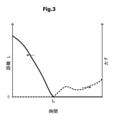
- FIG. 3 is a graph showing an example of distance measurement values and force measurement values when an object gradually approaches the composite sensor, comes into contact with the cover, and then applies a force to the cover.
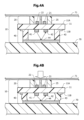
- FIG. 4A is a schematic cross-sectional view of the composite sensor according to the second embodiment
- FIG. 4B is a schematic cross-sectional view of the composite sensor in a state in which the elastic member is elastically deformed.
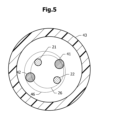
- FIG. 5 is a diagram showing the positional relationship of a plurality of components when the first surface or the second surface of the substrate is viewed in plan.
- FIG. 6 is a block diagram of a processing unit of a composite sensor according to the second embodiment.
- FIG. 7 is a schematic cross-sectional view of a composite sensor according to the third embodiment.
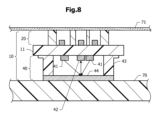
- FIG. 8 is a schematic cross-sectional view of a composite sensor according to a modified example of the third embodiment.
- Figure 9A is a schematic oblique view of a substrate of a composite sensor according to the fourth embodiment, and a first light-emitting element and a first light-receiving element of an optical proximity sensor
- Figure 9B is a diagram showing an example of the positional relationship in a plan view of four first light-emitting elements and one first light-receiving element.
- FIG. 10 is a diagram showing the positional relationship between one first light-emitting element, one first light-receiving element, and an object, and a coordinate system.
- FIG. 11 is a diagram showing the planar positional relationship between the first light emitting element and the first light receiving element of a composite sensor according to a modified example of the fourth embodiment.
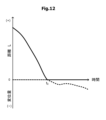
- FIG. 12 is a graph showing an example of a signal output by the composite sensor according to the fifth embodiment.
- FIG. 1A and 1B are respectively a schematic perspective view and a schematic side view of a composite sensor 10 according to a first embodiment.
- the composite sensor 10 according to the first embodiment includes a substrate 11, an optical proximity sensor 20, and a force sensor 40.
- the optical proximity sensor 20 is disposed on one surface (hereinafter referred to as a first surface 11A) of the substrate 11, and the force sensor 40 is disposed on a surface (hereinafter referred to as a second surface 11B) of the substrate 11 facing in the opposite direction to the first surface 11A.
- the substrate 11 may be a multilayer wiring substrate, such as a printed wiring substrate or a low-temperature co-fired ceramics (LTCC) substrate.
- the substrate 11 includes wiring that is connected to the optical proximity sensor 20 and the force sensor 40.
- the surface of the force sensor 40 facing the same direction as the second surface 11B is fixed to the housing while in contact with the housing 70 of a device, for example, a game controller.
- the housing 70 is made of a thermoplastic material that is commonly used for housings of home appliances, for example.
- the surface of the optical proximity sensor 20 facing the same direction as the first surface 11A is in contact with a cover 71 of the device.
- the cover 71 is transparent in the wavelength range of light used by the optical proximity sensor 20.
- the optical proximity sensor 20 emits measurement light to the outside through the cover 71 under the control of the processing unit 50.
- the light reflected by the object passes through the cover 71 and is received by the optical proximity sensor 20.
- a signal including information about the received light is sent to the processing unit 50.
- the processing unit 50 calculates the distance to the object based on the information about the received light.
- the processing unit 50 is mounted on, for example, the substrate 11.
- the force applied to the cover 71 is applied to the housing 70 via the optical proximity sensor 20, the substrate 11, and the force sensor 40.
- the force sensor 40 receives a reaction force from the housing 70 and measures the magnitude of the reaction force. That is, the force sensor sends a signal that depends on the component of the force perpendicular to the substrate 11 to the processing unit 50.
- the processing unit 50 calculates the magnitude of the force applied to the cover 71 based on the signal received from the force sensor 40.
- the force sensor 40 may have a function to measure not only the component perpendicular to the substrate 11, but also the component of the force in a parallel direction (shear force).
- a piezoelectric force sensor for example, a piezoelectric force sensor, an optical force sensor, a capacitance force sensor, etc. can be used.
- FIG. 2 is a schematic cross-sectional view of the composite sensor 10 focusing on the optical proximity sensor 20.
- the optical proximity sensor 20 includes a first light-emitting element 21 and a first light-receiving element 22 arranged on the first surface 11A of the substrate 11.
- a first light-emitting element 21 for example, a light-emitting diode (LED) or a vertical cavity surface-emitting laser (VCSEL) is used.
- VCSEL vertical cavity surface-emitting laser
- the first light-receiving element 22 for example, a photodiode, a phototransistor, a CdS cell, etc. is used.
- a spacer 25 is disposed between the cover 71 and the substrate 11.
- the spacer 25 maintains a constant distance between the first surface 11A and the cover 71.
- the surface of the cover 71 facing outward is referred to as the measurement reference surface 71A.
- the measurement reference surface 71A is parallel to the first surface 11A.
- the height from the light receiving surface of the first light receiving element 22 to the measurement reference surface 71A is marked as H.
- the distance from the measurement reference surface 71A to the object 80 in the direction perpendicular to the first surface 11A is marked as L.
- the first light-emitting element 21 emits measurement light.
- the light emitted from the first light-emitting element 21 passes through the cover 71 and is emitted outside the device, and is reflected by the object 80.
- a portion of the reflected light from the object 80 passes through the cover 71 and is received by the first light-receiving element 22.
- a signal including information on the light received by the first light-receiving element 22 is input to the processing unit 50.
- the processing unit 50 acquires the signal from the optical proximity sensor 20 and the signal from the force sensor 40 in synchronization with each other.
- “acquiring in synchronization” includes cases where the two signals are acquired simultaneously in time, where the acquisition times of the two signals are shifted in time but the amount of the shift in acquisition time falls within a predetermined range, and where acquisition of one signal is used as a trigger to acquire the other signal.
- the processing unit 50 outputs data based on the signal from the optical proximity sensor 20 and data based on the signal from the force sensor 40, which are acquired in synchronization with each other, in a mutually associated manner.
- the data based on each of the two signals may be stored in the same packet and output.
- a timestamp may be added to each of the data based on the two signals, and the two data may be associated via the timestamps.
- the processing unit 50 may have a function of calculating the distance to the object 80 based on the received light information. For example, if the reflectance of the object 80 is known, the processing unit 50 can calculate the distance to the object 80 based on the amount of received light.
- the composite sensor 10 is calibrated so that the calculation result (measured value) of the distance L becomes zero when the object 80 comes into contact with the cover 71.
- FIG. 3 is a graph showing an example of the measured values of distance L and force F when an object 80 (FIG. 2) gradually approaches the composite sensor 10, comes into contact with the cover 71, and then applies force F to the cover 71.
- the horizontal axis represents the elapsed time
- the left vertical axis represents distance L
- the right vertical axis represents force F.
- the solid line in the graph represents the measured value of distance L
- the dashed line represents the measured value of force F.
- the object 80 ( FIG. 2 ) approaches the composite sensor 10 and comes into contact with the cover 71 at time t0 . That is, the measured value of the distance L becomes zero. After time t0 , the measured value of the distance L is maintained at zero. During the period in which the measured value of the distance L is greater than zero (the period before time t0 ), the measured value of the force F by the force sensor 40 is zero. After the object 80 comes into contact with the cover 71, a force is applied from the object 80 toward the housing 70 ( FIG. 2 ). As a result, the measured value of the force F by the force sensor 40 rises from zero and fluctuates over time.
- FIG. 3 shows an example in which the time when the measured value of distance L by optical proximity sensor 20 becomes zero and the time when the measured value of force F by force sensor 40 becomes zero coincide with each other, but the two do not have to coincide strictly.
- the measured value of force F may rise before the measured value of distance L becomes zero, and the measured value of force F may rise after the measured value of distance L becomes zero. Even if the time when the measured value of distance L becomes zero and the time when the measured value of force F becomes zero do not coincide with each other, it is sufficient if the deviation between the two is within an acceptable range determined by the application that uses the output from composite sensor 10.
- an optical proximity sensor 20 is used as a sensor for measuring the distance to an object 80 (FIG. 2). Since there is no influence of reverberation time, etc., which occurs when an ultrasonic sensor is used, the distance can be measured until the object 80 almost comes into contact with the cover 71 (FIG. 2). When the object 80 comes into contact with the cover 71, a force F is measured by a signal from the force sensor 40. Therefore, the distance and force can be measured almost continuously (seamlessly) from when the object 80 is away from the cover 71 to when it approaches the cover 71, comes into contact with the cover 71, and applies a force to the cover 71.
- the processing unit 50 acquires the signals from the optical proximity sensor 20 and the force sensor 40 in synchronization with each other, it is possible to obtain distance measurements and force measurements at approximately the same time from these signals. Furthermore, since the processing unit 50 outputs data based on the signals from the optical proximity sensor 20 and the signals from the force sensor 40 acquired in synchronization with each other in a mutually associated manner, an application that uses the composite sensor 10 can continuously transition on the time axis from a state in which the distance changes over time to a state in which the force changes over time, or vice versa.
- the optical proximity sensor 20 and the force sensor 40 can be designed independently. Therefore, it is easier to design the two sensors to meet the required specifications of the optical proximity sensor 20 and the force sensor 40, compared to a configuration in which the operations of the two sensors affect each other.
- FIG. 4A is a schematic cross-sectional view of the composite sensor 10 according to the second embodiment.
- the configuration of the optical proximity sensor 20 is the same as that of the optical proximity sensor 20 (FIG. 2) of the composite sensor 10 according to the first embodiment.
- an optical proximity sensor is also used for the force sensor 40.
- the force sensor 40 includes a second light-emitting element 41, a second light-receiving element 42, an elastic member 43, and a reflector 44.
- a light-emitting diode (LED) or a vertical cavity surface-emitting laser (VCSEL) is used as the second light-emitting element 41.
- a photodiode, a phototransistor, a CdS cell, etc. is used as the second light-receiving element 42.
- the second light emitting element 41 and the second light receiving element 42 are disposed on the second surface 11B of the substrate 11.
- the reflector 44 is disposed at a distance from the second surface 11B.
- the reflector 44 is supported by the substrate 11 via the elastic member 43.
- the reflector 44 is in contact with the housing 70.
- the Young's modulus of the elastic member 43 is lower than the Young's modulus of the housing 70, the substrate 11, and the spacer 25.
- the elastic member 43 elastically deforms.
- the Young's modulus (flexural modulus) of the elastic member 43 is less than 1000 MPa.
- FIG. 4B is a schematic cross-sectional view of the composite sensor 10 with the elastic member 43 elastically deformed.
- the elastic deformation of the elastic member 43 changes the relative position of the reflector 44 with respect to the second light-emitting element 41 and the second light-receiving element 42.
- the reflector 44 moves closer to the second light-emitting element 41 and the second light-receiving element 42.
- the amount of change in the relative position depends on the magnitude of the applied force.
- the processing unit 50 calculates the amount of displacement of the reflector 44 based on the light reception information of the second light-receiving element 42, and calculates the magnitude of the applied force from the amount of displacement.
- FIG. 5 is a diagram showing the positional relationship of multiple components when the first surface 11A or the second surface 11B (FIG. 4A) of the substrate 11 is viewed in a plan view (hereinafter simply referred to as "in a plan view").
- the elastic member 43 is disposed so as to surround the second light-emitting element 41 and the second light-receiving element 42.
- the elastic member 43 has, for example, a circular ring shape.
- the minimum inclusive circle 26 that includes the first light emitting element 21 and the first light receiving element 22 of the optical proximity sensor 20 and the minimum inclusive circle 46 that includes the second light emitting element 41 and the second light receiving element 42 of the force sensor 40 have a mutually overlapping portion.
- the composite sensor 10 has a structure in which the force sensor 40 and the optical proximity sensor 20 are stacked in the thickness direction of the substrate 11.
- FIG. 5 shows an example in which the minimum inclusive circle 26 that includes the first light emitting element 21 and the first light receiving element 22 is smaller than the minimum inclusive circle 46 that includes the second light emitting element 41 and the second light receiving element 42, the size relationship may be reversed. Also, a configuration in which a portion of one minimum inclusive circle 26 overlaps a portion of the other minimum inclusive circle 46 may be used.
- FIG. 6 is a block diagram of the processing unit 50 of the composite sensor 10 according to the second embodiment.
- the anodes of the first light-emitting element 21 and the second light-emitting element 41 are each connected to a power source 51, and the cathodes are connected to a light-emitting element driver 53 via a switch matrix 52.
- a calculation unit 58 controls the light-emitting element driver 53 and the switch matrix 52 via an interface unit 54. When one of the first light-emitting element 21 and the second light-emitting element 41 is selected by the switch matrix 52, the selected light-emitting element emits light.
- the first light receiving element 22 and the second light receiving element 42 are connected to a switch matrix 55.
- the calculation unit 58 controls the switch matrix 55 via the interface unit 54.
- a current generated in the selected light receiving element according to the amount of light received is input to the transimpedance amplifier 56 via the switch matrix 55.
- the current output from the first light receiving element 22 or the second light receiving element 42 is converted to a voltage signal by the transimpedance amplifier 56 and input to the AD converter 57.
- the voltage signal is converted to a digital signal by the AD converter 57 and input to the calculation unit 58 via the interface unit 54.
- an optical proximity sensor for measuring distance similar to the optical proximity sensor 20 is used for the force sensor 40. Therefore, the optical proximity sensor 20 and the force sensor 40 can share the analog front-end circuit including the light-emitting element driver 53, the transimpedance amplifier 56, the AD converter 57, etc.
- Sharing the analog front-end circuitry facilitates synchronization and timing control between the optical proximity sensor 20 and the force sensor 40. This makes it easy to seamlessly measure distance using the optical proximity sensor 20 and measure force using the force sensor 40.
- the minimum inclusive circle 26 of the first light-emitting element 21 and the first light-receiving element 22 and the minimum inclusive circle 46 of the second light-emitting element 41 and the second light-receiving element 42 at least partially overlap in a plan view, so that the position serving as the reference for measuring distance and the position serving as the reference for measuring force are close to each other within the first surface 11A (FIG. 4A) of the substrate 11. This reduces the deviation between the approach detection position and the contact detection position of the object 80 (FIG. 2), making it possible to provide a detection result that is less uncomfortable for the user.
- the Young's modulus of the elastic member 43 of the force sensor 40 is smaller than the Young's modulus of the spacer 25, the substrate 11, and the housing 70 ( Figure 4A), deformation due to the force applied to the cover 71 is mostly localized to the elastic member 43. This makes it possible for the force sensor 40 to accurately measure the force applied to the cover 71. Furthermore, if the condition that the rigidity of the elastic member 43 of the force sensor 40 is lower than the rigidity of the spacer 25 of the optical proximity sensor 20 is met, the independence of the designs of the optical proximity sensor 20 and the force sensor 40 can be increased. This makes it easier to design the two sensors to meet the required specifications of the optical proximity sensor 20 and the force sensor 40, compared to a configuration in which the operations of the two sensors affect each other.
- the analog front-end circuit (FIG. 6) including the light-emitting element driver 53, the transimpedance amplifier 56, the AD converter 57, etc. is shared by the optical proximity sensor 20 and the force sensor 40, but one analog front-end circuit may be provided for each of the optical proximity sensor 20 and the force sensor 40.
- the optical proximity sensor 20 and the force sensor 40 can be operated simultaneously. This makes it possible to eliminate the difference in timing between the acquisition of distance information and the acquisition of force information at the time when the object 80 contacts the cover 71 (FIG. 4A). In addition, the time resolution of the measured distance value and the measured force value can be improved.
- FIG. 7 is a schematic cross-sectional view of a composite sensor 10 according to a third embodiment.
- the optical proximity sensor 20 includes one first light-emitting element 21 and one first light-receiving element 22.
- the optical proximity sensor 20 includes two first light-emitting elements 21 and one first light-receiving element 22.
- An optical proximity sensor 20 configured in this manner is shown, for example, in Japanese Patent Publication No. 57-133306. Below, the principle of measuring distance using the optical proximity sensor 20 according to the third embodiment will be briefly described.
- Each of the two first light-emitting elements 21 emits light that spreads uniformly and has a strong diffused characteristic.
- the center points of the light-emitting parts of the two first light-emitting elements 21 are marked as Q and R, respectively.
- the first light-receiving element 22 has a strong directivity in the normal direction of the first surface 11A.
- the center point of the light-receiving surface of the first light-receiving element 22 is marked as S.
- the two first light-emitting elements 21 are driven by repeating signals that are out of phase with each other by 90°.
- An object 80 exists on a line extending from point S in a direction perpendicular to the first surface 11A.
- the intersection of the surface of the object 80 and the line extending from point S in a direction perpendicular to the first surface 11A is marked as P.
- the angle between line segments PQ and PS is marked as ⁇ 1
- the angle between line segments PR and PS is marked as ⁇ 2 .
- the lengths of line segments QS and RS are marked as a and b, respectively.
- the light emitted from each of the two first light-emitting elements 21 is diffusely reflected at point P on the surface of the object 80, and a portion of the diffusely reflected light is received by the first light-receiving element 22.
- the brightness of the light emitted from each of the two first light-emitting elements 21 can be considered to change periodically in a sine wave and cosine wave pattern.
- the length of the line segment PS can be calculated using the relationship between the phase of the intensity change of the light emitted from one of the first light-emitting elements 21 and the phase of the intensity change of the light received by the first light-receiving element 22, the lengths a, b, and the angles ⁇ 1 and ⁇ 2.
- the calculation formula is shown in Japanese Patent Publication No. 57-133306. Since the height H from the light-receiving surface of the first light-receiving element 22 to the measurement reference surface 71A is known, the distance L from the measurement reference surface 71A to the object 80 can be obtained.
- the distance L to the object 80 can be measured without depending on the reflectance of the surface of the object 80 .
- FIG. 8 is a schematic cross-sectional view of the composite sensor 10 according to a modification of the third embodiment.
- the force sensor 40 includes two second light-emitting elements 41 and one second light-receiving element 42, similar to the optical proximity sensor 20. With this configuration, it is possible to measure the distance from the second light-receiving element 42 to the reflector 44 without depending on the reflectance of the reflector 44.
- FIG. 9A is a schematic perspective view of the substrate 11 of the composite sensor according to the fourth embodiment, and the first light-emitting element 21 and the first light-receiving element 22 of the optical proximity sensor 20.
- the optical proximity sensor 20 includes four first light-emitting elements 21 and one first light-receiving element 22.
- the first light-emitting element 21 is represented by a hollow circle
- the first light-receiving element 22 is represented by a hatched circle.
- the four first light-emitting elements 21 and one first light-receiving element 22 are arranged on a common virtual plane.
- the four first light-emitting elements 21 and one first light-receiving element 22 are mounted on the flat first surface 11A of the substrate 11.
- the object 80 is located on a virtual straight line (hereinafter referred to as the reference axis 27) that passes through the first light-receiving element 22 and extends in the normal direction of the first surface 11A.
- the reference axis 27 a virtual straight line that passes through the first light-receiving element 22 and extends in the normal direction of the first surface 11A.
- the distance from the first surface 11A to the object 80 and the attitude of the object 80 are detected.
- "passing through the first light-receiving element 22" means passing through the geometric center of the light-receiving area of the first light-receiving element 22.
- FIG. 9B is a diagram showing an example of the positional relationship of four first light-emitting elements 21 and one first light-receiving element 22 in a plan view.
- the four first light-emitting elements 21 are not arranged on one common straight line passing through the first light-receiving element 22, nor on one common circumference centered on the first light-receiving element 22. That is, when a straight line SL passing through the first light-receiving element 22 and one first light-emitting element 21 is drawn, at least one of the other three first light-emitting elements 21 is arranged at a position deviating from the straight line SL. In the example shown in FIG.
- two first light-emitting elements 21 are arranged at a position deviating from the straight line SL. Also, when a circumference C is drawn centered on the first light-receiving element 22 and passing through one first light-emitting element 21, at least one of the other three first light-emitting elements 21 is arranged at a position deviating from the circumference C. In the example shown in FIG. 1B, two first light-emitting elements 21 are arranged at a position deviating from the circumference C.
- first light-emitting element 21 is located on the line SL or on the circumference C is determined based on the geometric center of the light-emitting area of the first light-emitting element 21.
- a circumference centered on the first light-receiving element 22 means a circumference centered on the geometric center of the light-receiving area of the first light-receiving element 22.
- the distance between at least one first light-emitting element 21 and the first light-receiving element 22 is different from the distance between the other three first light-emitting elements 21 and the first light-receiving element 22.
- a total of four light-receiving and emitting pairs are formed by each of the four first light-emitting elements 21 and one first light-receiving element 22.
- FIG. 10 is a diagram showing the positional relationship and coordinate system of one first light-emitting element 21i, the first light-receiving element 22, and the target object 80.
- the xy plane of the xyz Cartesian coordinate system corresponds to the first surface 11A (FIG. 9A), and the first light-receiving element 22 is disposed at the origin O.
- the z-axis corresponds to the reference axis 27. Note that the left-handed system is used as the xyz Cartesian coordinate system.
- the i-th first light-emitting element 21 is denoted as 21i.
- the x-coordinate and y-coordinate of the first light-emitting element 21i are denoted as axi and ayi , respectively.
- the distance from the origin O to the first light-emitting element 21i is denoted as ri .
- the azimuth angle of the position of the first light-emitting element 21 when the x-axis is the reference direction is denoted as ⁇ ri .
- the intersection point between the surface of the object 80 facing the origin O and the reference axis 27 (hereinafter referred to as the representative point of the object 80) is marked as P.
- the distance from the origin O (first light receiving element 22) to the representative point P of the object 80 is marked as z.
- the distance z from the first light receiving element 22 to the representative point P of the object 80 may be simply referred to as the distance z from the first light receiving element 22 to the object 80.
- the unit vector from the representative point P of the object 80 toward the first light emitting element 21i is marked as n i .
- the angle between the unit vector n i and the reference axis 27 is marked as ⁇ i .
- the unit normal vector of the surface of the object 80 at the position of the representative point P is denoted as n s .
- the angle between the unit normal vector n s and the reference axis 27 is denoted as ⁇ z .
- the angle ⁇ z is called the tilt angle of the object 80.
- the angle between the perpendicular projection image of the unit normal vector n s onto the xy plane and the x-axis is denoted as ⁇ x .
- the angle ⁇ x is called the tilt azimuth angle of the surface of the object 80.
- the directivity characteristics of the first light-emitting element 21 and the first light-receiving element 22 will be described.
- the first light-emitting element 21 the light intensity is maximum in the front direction, and decreases as the tilt angle ⁇ from the front direction increases.
- the tilt angle ⁇ at which the light intensity is half of the light intensity in the front direction is called the half-maximum angle ⁇ 1 /2 .
- the first light-receiving element 22 the light sensitivity is maximum in the front direction, and decreases as the tilt angle ⁇ increases.
- the tilt angle ⁇ at which the light sensitivity is half of the light sensitivity in the front direction is called the half-maximum angle ⁇ 1 /2 .
- the first light-emitting element 21 has a wider angle than the directional characteristic of the first light-receiving element 22.
- the first light-emitting element 21 has a wide-angle directional characteristic such that light of sufficient intensity is irradiated onto an object 80 ( FIG. 9A ) located on the reference axis 27.
- the first light-receiving element 22 has a sharp directional characteristic such that the sensitivity is sufficiently low to reflected light from an object located far away from the reference axis 27.
- the half-maximum half angle ⁇ 1/2 of the directional characteristic of the first light-receiving element 22 is preferably 15° or less, more preferably 10° or less, and most preferably 5° or less.
- n is a parameter determined by the directional characteristics of the first light-emitting element 21. The larger n is, the sharper the directional characteristics is.
- the light emission intensity in the front direction of the i-th first light-emitting element 21i is denoted as Gi , and the light receiving sensitivity of the first light-receiving element 22 is denoted as C.
- the reflectance of the surface of the object 80 is denoted as ⁇ .
- the light intensity LIi at the representative point P is expressed by the following formula.
- the four first light-emitting elements 21 have the same directional characteristic LD( ⁇ ).
- the intensity of light detected by the first light receiving element 22, that is, the luminance Li of the representative point P when the representative point P is viewed as a new light source from the first light receiving element 22, is expressed by the following formula.
- z ⁇ in the denominator of the right side of formula (3) indicates that as the distance z increases, the field of view of the first light receiving element 22 widens, and the contribution of the luminance per unit area of the surface of the object 80 (FIG. 1A) decreases.
- the influence of the term z ⁇ becomes small.
- ⁇ in formula (3) actually takes any value within the range of 0 to 2.
- the distance z, the tilt azimuth angle ⁇ x , and the tilt angle ⁇ z can be obtained by using four first light-emitting elements 21 and one first light-receiving element 22. That is, in addition to the distance to the object 80, the azimuth and tilt angle at which the surface of the object 80 is tilted can be obtained.
- the directional characteristics LD( ⁇ ) of the four first light-emitting elements 21 are isotropic and do not depend on the azimuth angle, but they do not necessarily have to be isotropic.
- the directional characteristics can be converted into a form that is not azimuth-dependent by coordinate transformation, the directional characteristics do not necessarily have to be isotropic.
- FIG. 11 is a diagram showing the planar positional relationship between the first light emitting element 21 and the first light receiving element 22 of a composite sensor according to a modified example of the fourth embodiment.
- none of the three of the four first light-emitting elements 21 are arranged on a single straight line, nor are the four first light-emitting elements 21 arranged on a common circumference centered on the first light-receiving element 22.
- the four first light-emitting elements 21 are arranged so as to satisfy the condition described below.
- two of the four first light-emitting elements 21, 21a 1 and 21a 2 are arranged in a point-symmetrical position with respect to the first light-receiving element 22, and the other two first light-emitting elements 21b 1 and 21b 2 are also arranged in a point-symmetrical position with respect to the second light element.
- the distance from the first light-receiving element 22 to each of the first light-emitting elements 21a 1 and 21a 2 is marked as r a
- the distance from the first light-receiving element 22 to each of the first light-emitting elements 21b 1 and 21b 2 is marked as r b .
- the angle between a straight line passing through the two first light-emitting elements 21a 1 and 21a 2 and a straight line passing through the other two first light-emitting elements 21b 1 and 21b 2 is marked as ⁇ .
- the angle ⁇ is greater than 0° and less than 180°.
- first light-emitting elements 21 Two first light-emitting elements 21 that are point-symmetric to each other are referred to as a first light-emitting element pair.
- the two first light-emitting elements 21a1 and 21a2 constitute one first light-emitting element pair 21a
- the other two first light-emitting elements 21b1 and 21b2 constitute another first light-emitting element pair 21b.
- the value of parameter A1 can be calculated from equation (11).
- the tilt angle ⁇ z can be calculated from equation (12).
- the tilt azimuth angle ⁇ x can be calculated from equation (9). In this way, the tilt angle ⁇ z and the tilt azimuth angle ⁇ x can be calculated by determining the sum and difference of the measured values from the two first light-emitting element pairs 21a , 21b and performing simple algebraic calculations.
- the distance z to the object 80, the inclination angle ⁇ z of the surface of the object 80, and the inclination azimuth angle ⁇ x can be obtained by performing simple algebraic operations without solving four simultaneous equations.
- FIG. 12 is a graph showing an example of a signal output by the composite sensor according to the fifth embodiment.
- the composite sensor 10 according to the first embodiment outputs a measurement value of distance L calculated based on a signal from the optical proximity sensor 20 and a measurement value of force F calculated based on a signal from the force sensor 40.
- the composite sensor 10 determines the amount of displacement of the reflector 44 relative to the second light-emitting element 41 and the second light-receiving element 42 shown in FIG. 4A based on a signal from the force sensor 40.
- the amount of displacement when no external force is applied to the force sensor 40 is defined as zero.
- the reflector 44 displaces in a direction approaching the second light-emitting element 41 and the second light-receiving element 42.
- the amount of displacement in this direction is defined as negative.
- the magnitude of the amount of displacement changes depending on the magnitude of the force applied to the composite sensor 10. In FIG. 12, the change in the amount of displacement over time is indicated by a dashed line.
- An application that uses the composite sensor 10 can calculate the force applied to the composite sensor 10 based on the measured displacement output from the composite sensor 10.
- the excellent effects of the fifth embodiment will be described.
- the application can calculate the force applied to the force sensor 40 based on the measurement value of the amount of displacement output from the composite sensor 10.
Landscapes
- Physics & Mathematics (AREA)
- General Physics & Mathematics (AREA)
- Electromagnetism (AREA)
- Engineering & Computer Science (AREA)
- Radar, Positioning & Navigation (AREA)
- Remote Sensing (AREA)
- Length Measuring Devices By Optical Means (AREA)
Priority Applications (2)
| Application Number | Priority Date | Filing Date | Title |
|---|---|---|---|
| JP2025508160A JP7803461B2 (ja) | 2023-03-20 | 2024-01-23 | 複合センサ |
| US19/299,672 US20250369783A1 (en) | 2023-03-20 | 2025-08-14 | Composite sensor |
Applications Claiming Priority (2)
| Application Number | Priority Date | Filing Date | Title |
|---|---|---|---|
| JP2023-044176 | 2023-03-20 | ||
| JP2023044176 | 2023-03-20 |
Related Child Applications (1)
| Application Number | Title | Priority Date | Filing Date |
|---|---|---|---|
| US19/299,672 Continuation US20250369783A1 (en) | 2023-03-20 | 2025-08-14 | Composite sensor |
Publications (1)
| Publication Number | Publication Date |
|---|---|
| WO2024195278A1 true WO2024195278A1 (ja) | 2024-09-26 |
Family
ID=92841193
Family Applications (1)
| Application Number | Title | Priority Date | Filing Date |
|---|---|---|---|
| PCT/JP2024/001883 Ceased WO2024195278A1 (ja) | 2023-03-20 | 2024-01-23 | 複合センサ |
Country Status (3)
| Country | Link |
|---|---|
| US (1) | US20250369783A1 (https=) |
| JP (1) | JP7803461B2 (https=) |
| WO (1) | WO2024195278A1 (https=) |
Citations (4)
| Publication number | Priority date | Publication date | Assignee | Title |
|---|---|---|---|---|
| JP2007071564A (ja) * | 2005-09-05 | 2007-03-22 | Institute Of Physical & Chemical Research | 光学式触覚近接センサ |
| JP2019039835A (ja) * | 2017-08-25 | 2019-03-14 | キヤノン株式会社 | 複合センサ |
| WO2021100261A1 (ja) * | 2019-11-18 | 2021-05-27 | 株式会社村田製作所 | 光学センサ |
| JP7211522B2 (ja) * | 2019-08-19 | 2023-01-24 | 株式会社村田製作所 | 力センサ、及びそれを含むセンサアレイ並びに把持装置 |
-
2024
- 2024-01-23 WO PCT/JP2024/001883 patent/WO2024195278A1/ja not_active Ceased
- 2024-01-23 JP JP2025508160A patent/JP7803461B2/ja active Active
-
2025
- 2025-08-14 US US19/299,672 patent/US20250369783A1/en active Pending
Patent Citations (4)
| Publication number | Priority date | Publication date | Assignee | Title |
|---|---|---|---|---|
| JP2007071564A (ja) * | 2005-09-05 | 2007-03-22 | Institute Of Physical & Chemical Research | 光学式触覚近接センサ |
| JP2019039835A (ja) * | 2017-08-25 | 2019-03-14 | キヤノン株式会社 | 複合センサ |
| JP7211522B2 (ja) * | 2019-08-19 | 2023-01-24 | 株式会社村田製作所 | 力センサ、及びそれを含むセンサアレイ並びに把持装置 |
| WO2021100261A1 (ja) * | 2019-11-18 | 2021-05-27 | 株式会社村田製作所 | 光学センサ |
Also Published As
| Publication number | Publication date |
|---|---|
| JPWO2024195278A1 (https=) | 2024-09-26 |
| JP7803461B2 (ja) | 2026-01-21 |
| US20250369783A1 (en) | 2025-12-04 |
Similar Documents
| Publication | Publication Date | Title |
|---|---|---|
| CN112105900B (zh) | 触觉以及接近传感器和传感器阵列 | |
| CN102575925B (zh) | 具有波导结构的自混合干涉设备 | |
| US8233153B2 (en) | Position detection system for the contactless interferometric detection of a location of a target object and scanning system equipped with the same | |
| US20090051921A1 (en) | Optical sensor | |
| US11029154B2 (en) | Deflecting device and surveying instrument | |
| US20170059710A1 (en) | Object recognition device | |
| US20120033710A1 (en) | Optical temperature sensor | |
| JPH10221064A (ja) | 光学式測距装置 | |
| JP2008268024A (ja) | 追尾式レーザ干渉計による測定方法および測定装置 | |
| CN108444396A (zh) | 光路一致式位移传感器及其测量方法 | |
| JP7803461B2 (ja) | 複合センサ | |
| TW202140996A (zh) | 標定裝置、標定系統、電子設備及標定方法 | |
| CN113009497A (zh) | 激光发射模块、tof组件及电子设备 | |
| CN112013887A (zh) | 光学编码器 | |
| TWI275987B (en) | Optical input device with a light source die mounted on a detecting die and manufacture method thereof | |
| US20050225743A1 (en) | Laser range finder having reflective micro-mirror and laser measuring method | |
| CN212471510U (zh) | 移动机器人 | |
| TW202043851A (zh) | 成像裝置及成像方法 | |
| CN213690182U (zh) | 一种基于结构光的三维成像装置及电子设备 | |
| JP4363174B2 (ja) | 座標入力装置 | |
| TW201604745A (zh) | 模組和操作模組的方法 | |
| CN116242265A (zh) | 检测风力设备转子叶片的至少一个第一扭转的传感器组件 | |
| JP2022139837A (ja) | 光学式センサ、光学式センサの制御方法及び光学式センサの制御プログラム | |
| JPWO2024195278A5 (https=) | ||
| JP7666752B2 (ja) | 光学センサ |
Legal Events
| Date | Code | Title | Description |
|---|---|---|---|
| 121 | Ep: the epo has been informed by wipo that ep was designated in this application |
Ref document number: 24774424 Country of ref document: EP Kind code of ref document: A1 |
|
| WWE | Wipo information: entry into national phase |
Ref document number: 2025508160 Country of ref document: JP |
|
| NENP | Non-entry into the national phase |
Ref country code: DE |
|
| 122 | Ep: pct application non-entry in european phase |
Ref document number: 24774424 Country of ref document: EP Kind code of ref document: A1 |