WO2024195086A1 - 情報処理装置、情報処理方法、およびプログラム - Google Patents
情報処理装置、情報処理方法、およびプログラム Download PDFInfo
- Publication number
- WO2024195086A1 WO2024195086A1 PCT/JP2023/011408 JP2023011408W WO2024195086A1 WO 2024195086 A1 WO2024195086 A1 WO 2024195086A1 JP 2023011408 W JP2023011408 W JP 2023011408W WO 2024195086 A1 WO2024195086 A1 WO 2024195086A1
- Authority
- WO
- WIPO (PCT)
- Prior art keywords
- feature points
- image
- noise
- feature point
- information processing
- Prior art date
- Legal status (The legal status is an assumption and is not a legal conclusion. Google has not performed a legal analysis and makes no representation as to the accuracy of the status listed.)
- Ceased
Links
Images





Classifications
-
- G—PHYSICS
- G06—COMPUTING OR CALCULATING; COUNTING
- G06T—IMAGE DATA PROCESSING OR GENERATION, IN GENERAL
- G06T7/00—Image analysis
- G06T7/70—Determining position or orientation of objects or cameras
- G06T7/73—Determining position or orientation of objects or cameras using feature-based methods
-
- G—PHYSICS
- G06—COMPUTING OR CALCULATING; COUNTING
- G06V—IMAGE OR VIDEO RECOGNITION OR UNDERSTANDING
- G06V10/00—Arrangements for image or video recognition or understanding
- G06V10/20—Image preprocessing
- G06V10/26—Segmentation of patterns in the image field; Cutting or merging of image elements to establish the pattern region, e.g. clustering-based techniques; Detection of occlusion
-
- G—PHYSICS
- G06—COMPUTING OR CALCULATING; COUNTING
- G06V—IMAGE OR VIDEO RECOGNITION OR UNDERSTANDING
- G06V10/00—Arrangements for image or video recognition or understanding
- G06V10/20—Image preprocessing
- G06V10/30—Noise filtering
-
- G—PHYSICS
- G06—COMPUTING OR CALCULATING; COUNTING
- G06V—IMAGE OR VIDEO RECOGNITION OR UNDERSTANDING
- G06V20/00—Scenes; Scene-specific elements
- G06V20/50—Context or environment of the image
- G06V20/56—Context or environment of the image exterior to a vehicle by using sensors mounted on the vehicle
-
- G—PHYSICS
- G06—COMPUTING OR CALCULATING; COUNTING
- G06T—IMAGE DATA PROCESSING OR GENERATION, IN GENERAL
- G06T2207/00—Indexing scheme for image analysis or image enhancement
- G06T2207/20—Special algorithmic details
- G06T2207/20076—Probabilistic image processing
-
- G—PHYSICS
- G06—COMPUTING OR CALCULATING; COUNTING
- G06T—IMAGE DATA PROCESSING OR GENERATION, IN GENERAL
- G06T2207/00—Indexing scheme for image analysis or image enhancement
- G06T2207/30—Subject of image; Context of image processing
- G06T2207/30244—Camera pose
-
- G—PHYSICS
- G06—COMPUTING OR CALCULATING; COUNTING
- G06T—IMAGE DATA PROCESSING OR GENERATION, IN GENERAL
- G06T2207/00—Indexing scheme for image analysis or image enhancement
- G06T2207/30—Subject of image; Context of image processing
- G06T2207/30248—Vehicle exterior or interior
- G06T2207/30252—Vehicle exterior; Vicinity of vehicle
-
- G—PHYSICS
- G06—COMPUTING OR CALCULATING; COUNTING
- G06T—IMAGE DATA PROCESSING OR GENERATION, IN GENERAL
- G06T2207/00—Indexing scheme for image analysis or image enhancement
- G06T2207/30—Subject of image; Context of image processing
- G06T2207/30248—Vehicle exterior or interior
- G06T2207/30252—Vehicle exterior; Vicinity of vehicle
- G06T2207/30261—Obstacle
Definitions
- the present invention has been made in consideration of these circumstances, and one of its objectives is to provide an information processing device, an information processing method, and a program that can improve the robustness of self-location estimation.
- the feature point removal unit assigns a higher noise rank to the one or more feature points as the density of the one or more feature points increases.
- the feature point removal unit recognizes an object captured in the image, and assigns a noise rank to the one or more feature points included in the recognized object according to the type of the object.
- a program causes a computer to obtain an image of the surroundings of a moving object, extract one or more feature points from the image using a predetermined method, assign a noise rank to each of the one or more feature points indicating the likelihood that the feature points are noise, remove at least a portion of the one or more feature points based on the assigned noise rank, and estimate the position of the moving object in the surroundings based on the one or more feature points remaining after the removal.
- FIG. 1 is a diagram illustrating an example of the configuration of a moving object 1 and a control device 100 according to an embodiment.
- FIG. 2 is a perspective view of the moving body 1 seen from above.
- 1 is a diagram showing an example of an image IM acquired by an image acquisition unit 110.
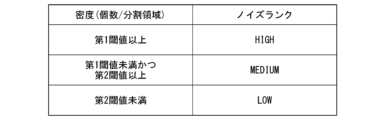
- FIG. 13 is a diagram showing an example of a noise rank determination table 72.
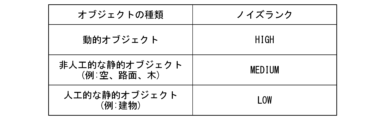
- FIG. 13 is a diagram showing another example of the noise rank determination table 72.
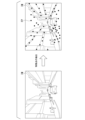
- 11 is a diagram showing an example of a feature point removal process executed by a feature point removal unit 130.
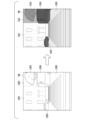
- FIG. 11A and 11B are diagrams illustrating another example of image division processing executed by the feature point removal unit 130.
- 10 is a diagram showing an example of a map generation and self-location estimation process executed by a self-location estimation unit 140.
- FIG. 4 is a flowchart showing an example of a flow of processing executed by the control device 100.
- the information processing device of the present invention is mounted on, for example, a mobile body.
- the mobile body may move on both roadways and a predetermined area different from the roadway.
- the mobile body may be called micromobility.
- An electric kick scooter is a type of micromobility.
- the predetermined area is, for example, a sidewalk.
- the predetermined area may be a part or all of a sidewalk, a bicycle lane, a public open space, etc., or may include all of a sidewalk, a sidewalk, a bicycle lane, a public open space, etc.
- the mobile body may be a mobile body on which a person can ride, or may be an autonomous mobile body capable of autonomous travel without a person. The latter autonomous mobile body is used for purposes such as leading and guiding people, following people, and transporting luggage.
- the external environment detection device 10 is a device of various types whose detection range is the traveling direction of the moving body 1.
- the external environment detection device 10 includes an external camera, a radar device, a LIDAR (Light Detection and Ranging), a sensor fusion device, etc.
- the external environment detection device 10 outputs information indicating the detection result (images, object positions, etc.) to the control device 100.
- the mobile body sensor 12 includes, for example, a speed sensor, a yaw rate (angular velocity) sensor, a direction sensor, and an operation amount detection sensor attached to the operator 14.
- the operator 14 includes, for example, an operator for instructing acceleration/deceleration (for example, an accelerator pedal or a brake pedal) and an operator for instructing steering (for example, a steering wheel).
- the mobile body sensor 12 may include an accelerator opening sensor, a brake depression amount sensor, a steering torque sensor, etc.
- the mobile body 1 may also be provided with an operator 14 of a type other than those described above (for example, a non-annular rotary operator, a joystick, a button, etc.).
- the internal camera 16 captures an image of at least the head of an occupant of the vehicle 1 from the front.
- the internal camera 16 is a digital camera that uses an imaging element such as a CCD (Charge Coupled Device) or a CMOS (Complementary Metal Oxide Semiconductor).
- the internal camera 16 outputs the captured image to the control device 100.
- the positioning device 18 is a device that measures the position of the mobile body 1.
- the positioning device 18 is, for example, a GNSS (Global Navigation Satellite System) receiver, and identifies the position of the mobile body 1 based on signals received from GNSS satellites and outputs it as position information.
- the position information of the mobile body 1 may be estimated from the position of a Wi-Fi base station to which a communication device (described later) is connected.
- the mode changeover switch 22 is a switch operated by the occupant.
- the mode changeover switch 22 may be a mechanical switch or a GUI (Graphical User Interface) switch set on a touch panel.
- the mode changeover switch 22 accepts an operation to switch the driving mode to one of the following modes: mode A: an assist mode in which one of the steering operation and acceleration/deceleration control is performed by the occupant and the other is performed automatically; mode A-1 in which the steering operation is performed by the occupant and acceleration/deceleration control is performed automatically; mode A-2 in which the acceleration/deceleration operation is performed by the occupant and steering control is performed automatically; mode B: a manual driving mode in which the steering operation and acceleration/deceleration operation are performed by the occupant; and mode C: an automatic driving mode in which operation control and acceleration/deceleration control are performed automatically.
- the moving mechanism 30 is a mechanism for moving the mobile body 1 on a road.
- the moving mechanism 30 is, for example, a group of wheels including steering wheels and drive wheels.
- the moving mechanism 30 may also be legs for multi-legged walking.
- the driving device 40 outputs a force to the moving mechanism 30 to move the moving body 1.
- the driving device 40 includes a motor that drives the driving wheels, a battery that stores the power to be supplied to the motor, and a steering device that adjusts the steering angle of the steering wheels.
- the driving device 40 may also include an internal combustion engine or a fuel cell as a driving force output means or a power generation means.
- the driving device 40 may also further include a brake device that utilizes frictional force or air resistance.
- the external notification device 50 is, for example, a lamp, a display device, a speaker, etc., provided on the outer panel of the mobile unit 1, for notifying the outside of the mobile unit 1 of information.
- the external notification device 50 operates differently depending on whether the mobile unit 1 is moving on a sidewalk or on a roadway.
- the external notification device 50 is controlled to emit a lamp when the mobile unit 1 is moving on a sidewalk and not emit a lamp when the mobile unit 1 is moving on a roadway. It is preferable that the light color of this lamp is a color specified by law.
- the external notification device 50 may be controlled so that the lamp emits green light when the mobile unit 1 is moving on a sidewalk and emits blue light when the mobile unit 1 is moving on a roadway. If the external notification device 50 is a display device, the external notification device 50 displays the message "traveling on the sidewalk" in text or graphics when the mobile unit 1 is traveling on the sidewalk.
- FW is the steering wheel
- RW is the driving wheel
- SD is the steering device
- MT is the motor
- BT is the battery.
- the steering device SD, the motor MT, and the battery BT are included in the drive device 40.
- AP is the accelerator pedal
- BP is the brake pedal
- WH is the steering wheel
- SP is the speaker
- MC is the microphone.
- the moving body 1 shown in the figure is a one-seater moving body, and an occupant P is seated in the driver's seat DS and fastened with a seat belt SB.
- Arrow D1 is the traveling direction (velocity vector) of the moving body 1.
- the external environment detection device 10 is provided near the front end of the moving body 1, the internal camera 16 is provided in a position where it can capture an image of the head of the occupant P from in front of the occupant P, and the mode changeover switch 22 is provided in the boss part of the steering wheel WH.
- An external notification device 50 as a display device is provided near the front end of the moving body 1.
- the program may be stored in the storage device 70 in advance, or may be stored in a removable storage medium (non-transient storage medium) such as a DVD or CD-ROM, and may be installed in the storage device 70 by mounting the storage medium in a drive device.
- a removable storage medium non-transient storage medium
- the combination of the image acquisition section 110, the feature point extraction section 120, the feature point removal section 130, and the self-position estimation section 140 is an example of an "information processing device" in the claims.
- the image acquisition unit 110 acquires an image IM captured by the external environment detection device 10, which is an external camera, of the surrounding conditions of the moving object 1.
- the image acquisition unit 110 acquires an image IM captured by the external environment detection device 10, which is an external camera, of the area ahead in the direction of travel of the moving object 1.
- FIG. 3 is a diagram showing an example of an image IM acquired by the image acquisition unit 110.
- FIG. 3 shows an image of the moving object 1 traveling on a roadway, but as described above, the image IM may be an image of the moving object 1 traveling on a sidewalk.
- FIG. 4 is a diagram showing an example of the noise rank determination table 72.
- FIG. 4 shows, as an example, a method in which the feature point removal unit 130 divides the image IM into a plurality of regions (e.g., 16 ⁇ 16) and assigns a noise rank to the feature points included in each divided region according to the number of feature points in the divided region. As shown in FIG. 4, for example, when the number of feature points included in one divided region is equal to or greater than a first threshold, the feature point removal unit 130 may assign "HIGH" to all feature points included in the divided region, indicating that the noise rank is high (i.e., the probability that the feature points are noise is high).
- the feature point removal unit 130 may assign "MEDIUM" to all feature points included in the divided region, indicating that the noise rank is medium (i.e., the probability that the feature points are noise is medium). Furthermore, for example, when the number of feature points included in one divided region is less than the second threshold, the feature point removal unit 130 may assign "LOW" to all feature points included in the divided region, indicating that the noise rank is low (i.e., the probability that they are noise is low).
- FIG. 5 is a diagram showing another example of the noise rank determination table 72.
- FIG. 5 shows, as an example, a method in which the feature point removal unit 130 recognizes the type of object depicted in the image IM by a predetermined image recognition process (e.g., image recognition process using a CNN (convolutional neural network)) and assigns a noise rank to the feature points included in the object according to the type of the recognized object.
- a predetermined image recognition process e.g., image recognition process using a CNN (convolutional neural network)
- the feature point removal unit 130 may assign a noise rank of "HIGH" to all the feature points included in the object.
- the "dynamic object” may be an object that is detected as being in motion as a result of the external environment detection device 10, which is an external camera, capturing images in a time series, or may further include an object that is not in motion but may potentially be in motion (e.g., a car, etc.).
- the feature point removal unit 130 may assign a noise rank of "MEDIUM" to all feature points included in the object.
- the type of object recognized from image IM is an artificial static object (e.g., building, etc.)
- the feature point removal unit 130 may assign a noise rank of "LOW" to all feature points included in the object.
- the feature point removal unit 130 determines whether or not to remove each feature point as noise based on the assigned noise rank. For example, the feature point removal unit 130 may remove all feature points whose noise rank is set to "HIGH”, or may remove all feature points whose noise rank is set to "HIGH” or "MEDIUM". For example, the feature point removal unit 130 may remove all feature points whose noise rank is set to "HIGH” by either the assignment method of FIG. 4 or the assignment method of FIG. 5, or whose noise rank is set to "MEDIUM” by both the assignment method of FIG. 4 and the assignment method of FIG. 5. In this way, it may be determined whether or not to remove each feature point as noise depending on the combination of two types of noise ranks assigned by the assignment method of FIG. 4 and the assignment method of FIG. 5.
- FIG. 6 is a diagram showing an example of the feature point removal process executed by the feature point removal unit 130.
- the feature point removal unit 130 may, for example, recognize the entire area AR1, which is one of the areas obtained by dividing the image IM, as a sky object, assign a noise rank of "MEDIUM" to all feature points included in the area AR1, and remove the feature points from the image IM.
- the feature point removal unit 130 may determine that the density of feature points contained in area AR2 is equal to or greater than a first threshold, assign a noise rank of "HIGH” to all of these feature points, and remove them from image IM.Furthermore, for example, the feature point removal unit 130 may recognize the automobile V from area AR3 as a dynamic object, assign a noise rank of "HIGH" to feature point AR3_FP contained in automobile V, and remove that feature point from image IM.
- the feature point removal unit 130 will assign a noise rank of "HIGH" to the feature points included in area AR4 and remove them from the image IM.
- a noise rank of "HIGH” the feature point removal unit 130 may leave these feature points without removing them if the feature points match a predetermined shape (for example, a straight line representing the edge of a building or road). For example, in the case of FIG.
- the feature point removal unit 130 may apply a straight line L to the feature points FP1, FP2, and FP3, and may leave these feature points FP1, FP2, and FP3 without removing them if the error between each of the feature points FP1, FP2, and FP3 and the straight line L is equal to or less than the threshold.
- the feature point removal unit 130 removing feature points from image IM using the method described above, feature points unnecessary for map generation are removed from image IM shown in the left part of Figure 6, and image IM shown in the right part of Figure 6 is obtained.
- the feature point removal unit 130 divides the image IM equally, recognizes objects contained in the divided areas, and determines the noise rank of the feature points contained in the recognized objects according to the type of the objects.
- the present invention is not limited to such a configuration, and the feature point removal unit 130 may recognize objects before dividing the image IM, and divide the image IM with each recognized object as one segment.
- FIG. 7 is a diagram showing another example of image segmentation processing executed by the feature point removal unit 130.
- the feature point removal unit 130 recognizes the following objects from the image IM shown on the left side of FIG. 7: a building OB1, a sky OB2, a tree OB3, a bus OB4, a car OB5, and a road OB6.
- the feature point removal unit 130 divides the image IM into segments SG1 to SG6 for each of the recognized objects OB1 to OB6.
- the feature point removal unit 130 assigns a noise rank according to the type of object OB1 to OB6 to the feature points contained in each of the segments SG1 to SG6, and removes the feature points according to the assigned noise rank. This also makes it possible to narrow down the feature points required for generating a map from the image IM.
- the self-position estimation unit 140 generates a map showing the surrounding situation of the moving object 1 based on the feature points remaining after the feature point removal unit 130 has removed the feature points from the image IM, and estimates the self-position of the moving object 1 on the map.
- FIG. 8 is a diagram showing an example of the map generation and self-position estimation process executed by the self-position estimation unit 140.
- the self-position estimation unit 140 may, for example, obtain a map that is a set of all the feature points remaining after the feature points have been removed from the image IM, and estimate the self-position of the moving object 1 as a relative distance from the feature points on the obtained map.
- the self-position estimation unit 140 may fit a predetermined shape (plane or curved surface) to the three-dimensional feature points remaining after removing the feature points from the image IM, acquire the predetermined shape that minimizes the error between each feature point and the predetermined shape as a map, and estimate the self-position of the moving body 1 as the relative distance from the predetermined shape in the acquired map.
- the self-position estimation unit 140 may acquire a plane fitted to the feature points as a three-dimensional map MP1, and estimate the self-position of the moving body 1 as the relative distance from the plane in the three-dimensional map MP1.
- the self-position estimation unit 140 may obtain a two-dimensional map MP2 by performing coordinate conversion of a predetermined shape fitted to the feature points into a two-dimensional bird's-eye view coordinate system, and estimate the self-position of the moving body 1 as a relative distance from the predetermined shape in the obtained two-dimensional map MP2.
- the self-position estimation unit 140 may obtain a two-dimensional map MP2 by performing coordinate conversion of a plane in the three-dimensional map MP1 into a bird's-eye view coordinate system, and estimate the self-position of the moving body 1 as a relative distance from a straight line in the two-dimensional map MP2.
- the self-position estimation unit 140 stores the map obtained by the above method in the storage device 70 as map information 74.
- the control unit 150 controls the drive device 40 according to the set driving mode while referring to the map information 74, and performs driving assistance for the occupant.
- the control unit 150 detects a free space from the map information 74, and controls the drive device 40 so that the moving body 1 runs in the free space starting from the estimated self-position.
- the control unit 150 may detect a space sandwiched between left and right planes as the free space.
- the control unit 150 may detect a space sandwiched between left and right straight lines as the free space.
- the control unit 150 displays the map information 74 on the external notification device 50, which is a display device, and the occupant can drive while referring to the map information 74 displayed on the display device.
- FIG. 9 is a flowchart showing an example of the flow of processing executed by the control device 100.
- the image acquisition unit 110 acquires an image IM captured by the external environment detection device 10, which is an external camera, of the surroundings of the moving object 1 (step S100).
- the feature point extraction unit 120 extracts one or more feature points from the acquired image IM using a predetermined method (step S102).
- the feature point removal unit 130 assigns a noise rank to each of the extracted one or more feature points (step S104).
- the feature point removal unit 130 removes at least a part of the extracted one or more feature points based on the assigned noise rank (step S106).
- the self-position estimation unit 140 generates a map representing the surroundings of the moving object 1 based on the one or more feature points remaining after the removal, and estimates the self-position of the moving object 1 on the map (step S108).
- the control unit 150 drives the moving object 1 or performs driving assistance for the moving object 1 based on the generated map and the estimated self-position (step S110). This ends the processing of this flowchart.
- an image capturing the surroundings of a moving object is acquired, one or more feature points are extracted from the image using a predetermined method, a noise rank indicating the likelihood that each of the one or more feature points is noise is assigned to each of the one or more feature points, at least a portion of the one or more feature points is removed based on the assigned noise rank, and the position of the moving object in the surroundings is estimated based on the one or more feature points remaining after removal.
- a storage device storing a program; a hardware processor; The hardware processor executes the program, Acquire images of the surroundings of the moving object, Extracting one or more feature points from the image using a predetermined method; assigning a noise rank indicating a degree of likelihood that each of the one or more feature points is noise, and removing at least a portion of the one or more feature points based on the assigned noise rank; estimating a position of the moving object in the surrounding environment based on the one or more feature points remaining after the removal;
- the vehicle control device is configured as follows.
Landscapes
- Engineering & Computer Science (AREA)
- Physics & Mathematics (AREA)
- General Physics & Mathematics (AREA)
- Theoretical Computer Science (AREA)
- Multimedia (AREA)
- Computer Vision & Pattern Recognition (AREA)
- Image Analysis (AREA)
- Traffic Control Systems (AREA)
Priority Applications (4)
| Application Number | Priority Date | Filing Date | Title |
|---|---|---|---|
| PCT/JP2023/011408 WO2024195086A1 (ja) | 2023-03-23 | 2023-03-23 | 情報処理装置、情報処理方法、およびプログラム |
| CN202380093018.8A CN120548553A (zh) | 2023-03-23 | 2023-03-23 | 信息处理装置、信息处理方法及程序 |
| JP2025508051A JPWO2024195086A1 (https=) | 2023-03-23 | 2023-03-23 | |
| EP23928665.1A EP4668212A4 (en) | 2023-03-23 | 2023-03-23 | INFORMATION PROCESSING DEVICE, INFORMATION PROCESS AND PROGRAM |
Applications Claiming Priority (1)
| Application Number | Priority Date | Filing Date | Title |
|---|---|---|---|
| PCT/JP2023/011408 WO2024195086A1 (ja) | 2023-03-23 | 2023-03-23 | 情報処理装置、情報処理方法、およびプログラム |
Publications (1)
| Publication Number | Publication Date |
|---|---|
| WO2024195086A1 true WO2024195086A1 (ja) | 2024-09-26 |
Family
ID=92841446
Family Applications (1)
| Application Number | Title | Priority Date | Filing Date |
|---|---|---|---|
| PCT/JP2023/011408 Ceased WO2024195086A1 (ja) | 2023-03-23 | 2023-03-23 | 情報処理装置、情報処理方法、およびプログラム |
Country Status (4)
| Country | Link |
|---|---|
| EP (1) | EP4668212A4 (https=) |
| JP (1) | JPWO2024195086A1 (https=) |
| CN (1) | CN120548553A (https=) |
| WO (1) | WO2024195086A1 (https=) |
Citations (3)
| Publication number | Priority date | Publication date | Assignee | Title |
|---|---|---|---|---|
| JP2014095553A (ja) * | 2012-11-07 | 2014-05-22 | Nippon Telegr & Teleph Corp <Ntt> | カメラポーズ推定装置、及びカメラポーズ推定プログラム |
| JP2020204525A (ja) * | 2019-06-17 | 2020-12-24 | 株式会社東芝 | 障害物検知装置 |
| JP2022119451A (ja) | 2021-02-04 | 2022-08-17 | 株式会社豊田自動織機 | 環境マップ作成方法及び装置 |
Family Cites Families (2)
| Publication number | Priority date | Publication date | Assignee | Title |
|---|---|---|---|---|
| KR101665386B1 (ko) * | 2010-11-15 | 2016-10-12 | 한화테크윈 주식회사 | 로봇 위치 추정 장치 및 방법 |
| JP5714940B2 (ja) * | 2011-03-04 | 2015-05-07 | 国立大学法人 熊本大学 | 移動体位置測定装置 |
-
2023
- 2023-03-23 WO PCT/JP2023/011408 patent/WO2024195086A1/ja not_active Ceased
- 2023-03-23 JP JP2025508051A patent/JPWO2024195086A1/ja active Pending
- 2023-03-23 EP EP23928665.1A patent/EP4668212A4/en active Pending
- 2023-03-23 CN CN202380093018.8A patent/CN120548553A/zh active Pending
Patent Citations (3)
| Publication number | Priority date | Publication date | Assignee | Title |
|---|---|---|---|---|
| JP2014095553A (ja) * | 2012-11-07 | 2014-05-22 | Nippon Telegr & Teleph Corp <Ntt> | カメラポーズ推定装置、及びカメラポーズ推定プログラム |
| JP2020204525A (ja) * | 2019-06-17 | 2020-12-24 | 株式会社東芝 | 障害物検知装置 |
| JP2022119451A (ja) | 2021-02-04 | 2022-08-17 | 株式会社豊田自動織機 | 環境マップ作成方法及び装置 |
Non-Patent Citations (1)
| Title |
|---|
| See also references of EP4668212A1 |
Also Published As
| Publication number | Publication date |
|---|---|
| JPWO2024195086A1 (https=) | 2024-09-26 |
| EP4668212A1 (en) | 2025-12-24 |
| CN120548553A (zh) | 2025-08-26 |
| EP4668212A4 (en) | 2026-03-04 |
Similar Documents
| Publication | Publication Date | Title |
|---|---|---|
| CN107848533B (zh) | 车辆控制装置、车辆控制方法及存储车辆控制程序的介质 | |
| US11634139B2 (en) | Vehicle control device, vehicle control method, and storage medium | |
| CN113511219B (zh) | 车辆控制系统 | |
| CN114689076A (zh) | 车辆控制系统和本车道识别方法 | |
| JP7688220B2 (ja) | 移動体の制御装置、移動体の制御方法、および記憶媒体 | |
| CN115050205B (zh) | 地图生成装置以及位置识别装置 | |
| US12260581B2 (en) | Distance calculation apparatus and vehicle position estimation apparatus | |
| CN115050203B (zh) | 地图生成装置以及车辆位置识别装置 | |
| CN115214713B (zh) | 移动体的控制装置、移动体的控制方法及存储介质 | |
| JP7340579B2 (ja) | 車両制御装置、車両制御方法、およびプログラム | |
| JP2021047609A (ja) | 周辺認識装置、周辺認識方法、およびプログラム | |
| JP7332731B1 (ja) | 外界認識装置 | |
| US20250136148A1 (en) | Control device, control method, and storage medium | |
| WO2024195086A1 (ja) | 情報処理装置、情報処理方法、およびプログラム | |
| US20220276069A1 (en) | Map generation apparatus | |
| CN111717201B (zh) | 车辆系统、车辆系统的控制方法及存储介质 | |
| JP7738510B2 (ja) | 白線認識装置、移動体の制御システム、白線認識方法、およびプログラム | |
| EP4667874A1 (en) | Information processing device, information processing method, and program | |
| JP7714122B2 (ja) | 移動体の制御装置、移動体の制御方法、および記憶媒体 | |
| EP4664435A1 (en) | Control apparatus for moving body, control method for moving body, and program | |
| JP7614261B2 (ja) | 画像認識装置、画像認識方法、およびプログラム | |
| JP7799040B2 (ja) | 移動体の制御装置、移動体の制御方法、および記憶媒体 | |
| US20250258294A1 (en) | Object detection apparatus | |
| WO2024201553A1 (ja) | 移動体の制御装置、移動体の制御方法、およびプログラム | |
| WO2023187995A1 (ja) | 移動体の制御装置、移動体の制御方法、および記憶媒体 |
Legal Events
| Date | Code | Title | Description |
|---|---|---|---|
| 121 | Ep: the epo has been informed by wipo that ep was designated in this application |
Ref document number: 23928665 Country of ref document: EP Kind code of ref document: A1 |
|
| WWE | Wipo information: entry into national phase |
Ref document number: 202380093018.8 Country of ref document: CN |
|
| ENP | Entry into the national phase |
Ref document number: 2025508051 Country of ref document: JP Kind code of ref document: A |
|
| WWE | Wipo information: entry into national phase |
Ref document number: 2025508051 Country of ref document: JP |
|
| WWP | Wipo information: published in national office |
Ref document number: 202380093018.8 Country of ref document: CN |
|
| WWE | Wipo information: entry into national phase |
Ref document number: 2023928665 Country of ref document: EP |
|
| NENP | Non-entry into the national phase |
Ref country code: DE |
|
| ENP | Entry into the national phase |
Ref document number: 2023928665 Country of ref document: EP Effective date: 20250917 |
|
| WWP | Wipo information: published in national office |
Ref document number: 2023928665 Country of ref document: EP |