WO2024190886A1 - セラミック可逆セル、ならびにそれを含む水蒸気電解セル、燃料電池及びアンモニア共電解セル - Google Patents
セラミック可逆セル、ならびにそれを含む水蒸気電解セル、燃料電池及びアンモニア共電解セル Download PDFInfo
- Publication number
- WO2024190886A1 WO2024190886A1 PCT/JP2024/010102 JP2024010102W WO2024190886A1 WO 2024190886 A1 WO2024190886 A1 WO 2024190886A1 JP 2024010102 W JP2024010102 W JP 2024010102W WO 2024190886 A1 WO2024190886 A1 WO 2024190886A1
- Authority
- WO
- WIPO (PCT)
- Prior art keywords
- layer
- cell
- metal oxide
- ceramic
- perovskite
- Prior art date
- Legal status (The legal status is an assumption and is not a legal conclusion. Google has not performed a legal analysis and makes no representation as to the accuracy of the status listed.)
- Ceased
Links
Images

















Classifications
-
- C—CHEMISTRY; METALLURGY
- C04—CEMENTS; CONCRETE; ARTIFICIAL STONE; CERAMICS; REFRACTORIES
- C04B—LIME, MAGNESIA; SLAG; CEMENTS; COMPOSITIONS THEREOF, e.g. MORTARS, CONCRETE OR LIKE BUILDING MATERIALS; ARTIFICIAL STONE; CERAMICS; REFRACTORIES; TREATMENT OF NATURAL STONE
- C04B35/00—Shaped ceramic products characterised by their composition; Ceramics compositions; Processing powders of inorganic compounds preparatory to the manufacturing of ceramic products
- C04B35/01—Shaped ceramic products characterised by their composition; Ceramics compositions; Processing powders of inorganic compounds preparatory to the manufacturing of ceramic products based on oxide ceramics
- C04B35/48—Shaped ceramic products characterised by their composition; Ceramics compositions; Processing powders of inorganic compounds preparatory to the manufacturing of ceramic products based on oxide ceramics based on zirconium or hafnium oxides, zirconates, zircon or hafnates
- C04B35/486—Fine ceramics
-
- C—CHEMISTRY; METALLURGY
- C01—INORGANIC CHEMISTRY
- C01G—COMPOUNDS CONTAINING METALS NOT COVERED BY SUBCLASSES C01D OR C01F
- C01G25/00—Compounds of zirconium
- C01G25/02—Oxides
-
- C—CHEMISTRY; METALLURGY
- C04—CEMENTS; CONCRETE; ARTIFICIAL STONE; CERAMICS; REFRACTORIES
- C04B—LIME, MAGNESIA; SLAG; CEMENTS; COMPOSITIONS THEREOF, e.g. MORTARS, CONCRETE OR LIKE BUILDING MATERIALS; ARTIFICIAL STONE; CERAMICS; REFRACTORIES; TREATMENT OF NATURAL STONE
- C04B35/00—Shaped ceramic products characterised by their composition; Ceramics compositions; Processing powders of inorganic compounds preparatory to the manufacturing of ceramic products
- C04B35/01—Shaped ceramic products characterised by their composition; Ceramics compositions; Processing powders of inorganic compounds preparatory to the manufacturing of ceramic products based on oxide ceramics
-
- C—CHEMISTRY; METALLURGY
- C04—CEMENTS; CONCRETE; ARTIFICIAL STONE; CERAMICS; REFRACTORIES
- C04B—LIME, MAGNESIA; SLAG; CEMENTS; COMPOSITIONS THEREOF, e.g. MORTARS, CONCRETE OR LIKE BUILDING MATERIALS; ARTIFICIAL STONE; CERAMICS; REFRACTORIES; TREATMENT OF NATURAL STONE
- C04B41/00—After-treatment of mortars, concrete, artificial stone or ceramics; Treatment of natural stone
- C04B41/0072—Heat treatment
-
- C—CHEMISTRY; METALLURGY
- C04—CEMENTS; CONCRETE; ARTIFICIAL STONE; CERAMICS; REFRACTORIES
- C04B—LIME, MAGNESIA; SLAG; CEMENTS; COMPOSITIONS THEREOF, e.g. MORTARS, CONCRETE OR LIKE BUILDING MATERIALS; ARTIFICIAL STONE; CERAMICS; REFRACTORIES; TREATMENT OF NATURAL STONE
- C04B41/00—After-treatment of mortars, concrete, artificial stone or ceramics; Treatment of natural stone
- C04B41/009—After-treatment of mortars, concrete, artificial stone or ceramics; Treatment of natural stone characterised by the material treated
-
- C—CHEMISTRY; METALLURGY
- C04—CEMENTS; CONCRETE; ARTIFICIAL STONE; CERAMICS; REFRACTORIES
- C04B—LIME, MAGNESIA; SLAG; CEMENTS; COMPOSITIONS THEREOF, e.g. MORTARS, CONCRETE OR LIKE BUILDING MATERIALS; ARTIFICIAL STONE; CERAMICS; REFRACTORIES; TREATMENT OF NATURAL STONE
- C04B41/00—After-treatment of mortars, concrete, artificial stone or ceramics; Treatment of natural stone
- C04B41/45—Coating or impregnating, e.g. injection in masonry, partial coating of green or fired ceramics, organic coating compositions for adhering together two concrete elements
- C04B41/52—Multiple coating or impregnating multiple coating or impregnating with the same composition or with compositions only differing in the concentration of the constituents, is classified as single coating or impregnation
-
- C—CHEMISTRY; METALLURGY
- C04—CEMENTS; CONCRETE; ARTIFICIAL STONE; CERAMICS; REFRACTORIES
- C04B—LIME, MAGNESIA; SLAG; CEMENTS; COMPOSITIONS THEREOF, e.g. MORTARS, CONCRETE OR LIKE BUILDING MATERIALS; ARTIFICIAL STONE; CERAMICS; REFRACTORIES; TREATMENT OF NATURAL STONE
- C04B41/00—After-treatment of mortars, concrete, artificial stone or ceramics; Treatment of natural stone
- C04B41/80—After-treatment of mortars, concrete, artificial stone or ceramics; Treatment of natural stone of only ceramics
- C04B41/81—Coating or impregnation
- C04B41/89—Coating or impregnation for obtaining at least two superposed coatings having different compositions
-
- C—CHEMISTRY; METALLURGY
- C25—ELECTROLYTIC OR ELECTROPHORETIC PROCESSES; APPARATUS THEREFOR
- C25B—ELECTROLYTIC OR ELECTROPHORETIC PROCESSES FOR THE PRODUCTION OF COMPOUNDS OR NON-METALS; APPARATUS THEREFOR
- C25B1/00—Electrolytic production of inorganic compounds or non-metals
- C25B1/01—Products
- C25B1/02—Hydrogen or oxygen
- C25B1/04—Hydrogen or oxygen by electrolysis of water
- C25B1/042—Hydrogen or oxygen by electrolysis of water by electrolysis of steam
-
- C—CHEMISTRY; METALLURGY
- C25—ELECTROLYTIC OR ELECTROPHORETIC PROCESSES; APPARATUS THEREFOR
- C25B—ELECTROLYTIC OR ELECTROPHORETIC PROCESSES FOR THE PRODUCTION OF COMPOUNDS OR NON-METALS; APPARATUS THEREFOR
- C25B1/00—Electrolytic production of inorganic compounds or non-metals
- C25B1/01—Products
- C25B1/27—Ammonia
-
- C—CHEMISTRY; METALLURGY
- C25—ELECTROLYTIC OR ELECTROPHORETIC PROCESSES; APPARATUS THEREFOR
- C25B—ELECTROLYTIC OR ELECTROPHORETIC PROCESSES FOR THE PRODUCTION OF COMPOUNDS OR NON-METALS; APPARATUS THEREFOR
- C25B11/00—Electrodes; Manufacture thereof not otherwise provided for
- C25B11/04—Electrodes; Manufacture thereof not otherwise provided for characterised by the material
- C25B11/051—Electrodes formed of electrocatalysts on a substrate or carrier
- C25B11/052—Electrodes comprising one or more electrocatalytic coatings on a substrate
- C25B11/053—Electrodes comprising one or more electrocatalytic coatings on a substrate characterised by multilayer electrocatalytic coatings
-
- C—CHEMISTRY; METALLURGY
- C25—ELECTROLYTIC OR ELECTROPHORETIC PROCESSES; APPARATUS THEREFOR
- C25B—ELECTROLYTIC OR ELECTROPHORETIC PROCESSES FOR THE PRODUCTION OF COMPOUNDS OR NON-METALS; APPARATUS THEREFOR
- C25B11/00—Electrodes; Manufacture thereof not otherwise provided for
- C25B11/04—Electrodes; Manufacture thereof not otherwise provided for characterised by the material
- C25B11/051—Electrodes formed of electrocatalysts on a substrate or carrier
- C25B11/073—Electrodes formed of electrocatalysts on a substrate or carrier characterised by the electrocatalyst material
- C25B11/075—Electrodes formed of electrocatalysts on a substrate or carrier characterised by the electrocatalyst material consisting of a single catalytic element or catalytic compound
- C25B11/077—Electrodes formed of electrocatalysts on a substrate or carrier characterised by the electrocatalyst material consisting of a single catalytic element or catalytic compound the compound being a non-noble metal oxide
- C25B11/0773—Electrodes formed of electrocatalysts on a substrate or carrier characterised by the electrocatalyst material consisting of a single catalytic element or catalytic compound the compound being a non-noble metal oxide of the perovskite type
-
- H—ELECTRICITY
- H01—ELECTRIC ELEMENTS
- H01M—PROCESSES OR MEANS, e.g. BATTERIES, FOR THE DIRECT CONVERSION OF CHEMICAL ENERGY INTO ELECTRICAL ENERGY
- H01M8/00—Fuel cells; Manufacture thereof
- H01M8/10—Fuel cells with solid electrolytes
- H01M8/12—Fuel cells with solid electrolytes operating at high temperature, e.g. with stabilised ZrO2 electrolyte
- H01M8/124—Fuel cells with solid electrolytes operating at high temperature, e.g. with stabilised ZrO2 electrolyte characterised by the process of manufacturing or by the material of the electrolyte
- H01M8/1246—Fuel cells with solid electrolytes operating at high temperature, e.g. with stabilised ZrO2 electrolyte characterised by the process of manufacturing or by the material of the electrolyte the electrolyte consisting of oxides
- H01M8/1253—Fuel cells with solid electrolytes operating at high temperature, e.g. with stabilised ZrO2 electrolyte characterised by the process of manufacturing or by the material of the electrolyte the electrolyte consisting of oxides the electrolyte containing zirconium oxide
-
- C—CHEMISTRY; METALLURGY
- C04—CEMENTS; CONCRETE; ARTIFICIAL STONE; CERAMICS; REFRACTORIES
- C04B—LIME, MAGNESIA; SLAG; CEMENTS; COMPOSITIONS THEREOF, e.g. MORTARS, CONCRETE OR LIKE BUILDING MATERIALS; ARTIFICIAL STONE; CERAMICS; REFRACTORIES; TREATMENT OF NATURAL STONE
- C04B2111/00—Mortars, concrete or artificial stone or mixtures to prepare them, characterised by specific function, property or use
- C04B2111/00474—Uses not provided for elsewhere in C04B2111/00
- C04B2111/00853—Uses not provided for elsewhere in C04B2111/00 in electrochemical cells or batteries, e.g. fuel cells
-
- C—CHEMISTRY; METALLURGY
- C04—CEMENTS; CONCRETE; ARTIFICIAL STONE; CERAMICS; REFRACTORIES
- C04B—LIME, MAGNESIA; SLAG; CEMENTS; COMPOSITIONS THEREOF, e.g. MORTARS, CONCRETE OR LIKE BUILDING MATERIALS; ARTIFICIAL STONE; CERAMICS; REFRACTORIES; TREATMENT OF NATURAL STONE
- C04B2235/00—Aspects relating to ceramic starting mixtures or sintered ceramic products
- C04B2235/02—Composition of constituents of the starting material or of secondary phases of the final product
- C04B2235/30—Constituents and secondary phases not being of a fibrous nature
- C04B2235/32—Metal oxides, mixed metal oxides, or oxide-forming salts thereof, e.g. carbonates, nitrates, (oxy)hydroxides, chlorides
- C04B2235/3205—Alkaline earth oxides or oxide forming salts thereof, e.g. beryllium oxide
- C04B2235/3213—Strontium oxides or oxide-forming salts thereof
-
- C—CHEMISTRY; METALLURGY
- C04—CEMENTS; CONCRETE; ARTIFICIAL STONE; CERAMICS; REFRACTORIES
- C04B—LIME, MAGNESIA; SLAG; CEMENTS; COMPOSITIONS THEREOF, e.g. MORTARS, CONCRETE OR LIKE BUILDING MATERIALS; ARTIFICIAL STONE; CERAMICS; REFRACTORIES; TREATMENT OF NATURAL STONE
- C04B2235/00—Aspects relating to ceramic starting mixtures or sintered ceramic products
- C04B2235/02—Composition of constituents of the starting material or of secondary phases of the final product
- C04B2235/30—Constituents and secondary phases not being of a fibrous nature
- C04B2235/32—Metal oxides, mixed metal oxides, or oxide-forming salts thereof, e.g. carbonates, nitrates, (oxy)hydroxides, chlorides
- C04B2235/3205—Alkaline earth oxides or oxide forming salts thereof, e.g. beryllium oxide
- C04B2235/3215—Barium oxides or oxide-forming salts thereof
-
- C—CHEMISTRY; METALLURGY
- C04—CEMENTS; CONCRETE; ARTIFICIAL STONE; CERAMICS; REFRACTORIES
- C04B—LIME, MAGNESIA; SLAG; CEMENTS; COMPOSITIONS THEREOF, e.g. MORTARS, CONCRETE OR LIKE BUILDING MATERIALS; ARTIFICIAL STONE; CERAMICS; REFRACTORIES; TREATMENT OF NATURAL STONE
- C04B2235/00—Aspects relating to ceramic starting mixtures or sintered ceramic products
- C04B2235/02—Composition of constituents of the starting material or of secondary phases of the final product
- C04B2235/30—Constituents and secondary phases not being of a fibrous nature
- C04B2235/32—Metal oxides, mixed metal oxides, or oxide-forming salts thereof, e.g. carbonates, nitrates, (oxy)hydroxides, chlorides
- C04B2235/3224—Rare earth oxide or oxide forming salts thereof, e.g. scandium oxide
-
- C—CHEMISTRY; METALLURGY
- C04—CEMENTS; CONCRETE; ARTIFICIAL STONE; CERAMICS; REFRACTORIES
- C04B—LIME, MAGNESIA; SLAG; CEMENTS; COMPOSITIONS THEREOF, e.g. MORTARS, CONCRETE OR LIKE BUILDING MATERIALS; ARTIFICIAL STONE; CERAMICS; REFRACTORIES; TREATMENT OF NATURAL STONE
- C04B2235/00—Aspects relating to ceramic starting mixtures or sintered ceramic products
- C04B2235/02—Composition of constituents of the starting material or of secondary phases of the final product
- C04B2235/30—Constituents and secondary phases not being of a fibrous nature
- C04B2235/32—Metal oxides, mixed metal oxides, or oxide-forming salts thereof, e.g. carbonates, nitrates, (oxy)hydroxides, chlorides
- C04B2235/3224—Rare earth oxide or oxide forming salts thereof, e.g. scandium oxide
- C04B2235/3229—Cerium oxides or oxide-forming salts thereof
-
- C—CHEMISTRY; METALLURGY
- C04—CEMENTS; CONCRETE; ARTIFICIAL STONE; CERAMICS; REFRACTORIES
- C04B—LIME, MAGNESIA; SLAG; CEMENTS; COMPOSITIONS THEREOF, e.g. MORTARS, CONCRETE OR LIKE BUILDING MATERIALS; ARTIFICIAL STONE; CERAMICS; REFRACTORIES; TREATMENT OF NATURAL STONE
- C04B2235/00—Aspects relating to ceramic starting mixtures or sintered ceramic products
- C04B2235/02—Composition of constituents of the starting material or of secondary phases of the final product
- C04B2235/30—Constituents and secondary phases not being of a fibrous nature
- C04B2235/32—Metal oxides, mixed metal oxides, or oxide-forming salts thereof, e.g. carbonates, nitrates, (oxy)hydroxides, chlorides
- C04B2235/3231—Refractory metal oxides, their mixed metal oxides, or oxide-forming salts thereof
- C04B2235/3232—Titanium oxides or titanates, e.g. rutile or anatase
- C04B2235/3234—Titanates, not containing zirconia
-
- C—CHEMISTRY; METALLURGY
- C04—CEMENTS; CONCRETE; ARTIFICIAL STONE; CERAMICS; REFRACTORIES
- C04B—LIME, MAGNESIA; SLAG; CEMENTS; COMPOSITIONS THEREOF, e.g. MORTARS, CONCRETE OR LIKE BUILDING MATERIALS; ARTIFICIAL STONE; CERAMICS; REFRACTORIES; TREATMENT OF NATURAL STONE
- C04B2235/00—Aspects relating to ceramic starting mixtures or sintered ceramic products
- C04B2235/02—Composition of constituents of the starting material or of secondary phases of the final product
- C04B2235/30—Constituents and secondary phases not being of a fibrous nature
- C04B2235/32—Metal oxides, mixed metal oxides, or oxide-forming salts thereof, e.g. carbonates, nitrates, (oxy)hydroxides, chlorides
- C04B2235/3231—Refractory metal oxides, their mixed metal oxides, or oxide-forming salts thereof
- C04B2235/3244—Zirconium oxides, zirconates, hafnium oxides, hafnates, or oxide-forming salts thereof
- C04B2235/3248—Zirconates or hafnates, e.g. zircon
-
- C—CHEMISTRY; METALLURGY
- C04—CEMENTS; CONCRETE; ARTIFICIAL STONE; CERAMICS; REFRACTORIES
- C04B—LIME, MAGNESIA; SLAG; CEMENTS; COMPOSITIONS THEREOF, e.g. MORTARS, CONCRETE OR LIKE BUILDING MATERIALS; ARTIFICIAL STONE; CERAMICS; REFRACTORIES; TREATMENT OF NATURAL STONE
- C04B2235/00—Aspects relating to ceramic starting mixtures or sintered ceramic products
- C04B2235/02—Composition of constituents of the starting material or of secondary phases of the final product
- C04B2235/30—Constituents and secondary phases not being of a fibrous nature
- C04B2235/32—Metal oxides, mixed metal oxides, or oxide-forming salts thereof, e.g. carbonates, nitrates, (oxy)hydroxides, chlorides
- C04B2235/327—Iron group oxides, their mixed metal oxides, or oxide-forming salts thereof
- C04B2235/3272—Iron oxides or oxide forming salts thereof, e.g. hematite, magnetite
-
- C—CHEMISTRY; METALLURGY
- C04—CEMENTS; CONCRETE; ARTIFICIAL STONE; CERAMICS; REFRACTORIES
- C04B—LIME, MAGNESIA; SLAG; CEMENTS; COMPOSITIONS THEREOF, e.g. MORTARS, CONCRETE OR LIKE BUILDING MATERIALS; ARTIFICIAL STONE; CERAMICS; REFRACTORIES; TREATMENT OF NATURAL STONE
- C04B2235/00—Aspects relating to ceramic starting mixtures or sintered ceramic products
- C04B2235/02—Composition of constituents of the starting material or of secondary phases of the final product
- C04B2235/30—Constituents and secondary phases not being of a fibrous nature
- C04B2235/32—Metal oxides, mixed metal oxides, or oxide-forming salts thereof, e.g. carbonates, nitrates, (oxy)hydroxides, chlorides
- C04B2235/327—Iron group oxides, their mixed metal oxides, or oxide-forming salts thereof
- C04B2235/3275—Cobalt oxides, cobaltates or cobaltites or oxide forming salts thereof, e.g. bismuth cobaltate, zinc cobaltite
-
- C—CHEMISTRY; METALLURGY
- C04—CEMENTS; CONCRETE; ARTIFICIAL STONE; CERAMICS; REFRACTORIES
- C04B—LIME, MAGNESIA; SLAG; CEMENTS; COMPOSITIONS THEREOF, e.g. MORTARS, CONCRETE OR LIKE BUILDING MATERIALS; ARTIFICIAL STONE; CERAMICS; REFRACTORIES; TREATMENT OF NATURAL STONE
- C04B2235/00—Aspects relating to ceramic starting mixtures or sintered ceramic products
- C04B2235/02—Composition of constituents of the starting material or of secondary phases of the final product
- C04B2235/30—Constituents and secondary phases not being of a fibrous nature
- C04B2235/32—Metal oxides, mixed metal oxides, or oxide-forming salts thereof, e.g. carbonates, nitrates, (oxy)hydroxides, chlorides
- C04B2235/327—Iron group oxides, their mixed metal oxides, or oxide-forming salts thereof
- C04B2235/3279—Nickel oxides, nickalates, or oxide-forming salts thereof
-
- C—CHEMISTRY; METALLURGY
- C04—CEMENTS; CONCRETE; ARTIFICIAL STONE; CERAMICS; REFRACTORIES
- C04B—LIME, MAGNESIA; SLAG; CEMENTS; COMPOSITIONS THEREOF, e.g. MORTARS, CONCRETE OR LIKE BUILDING MATERIALS; ARTIFICIAL STONE; CERAMICS; REFRACTORIES; TREATMENT OF NATURAL STONE
- C04B2235/00—Aspects relating to ceramic starting mixtures or sintered ceramic products
- C04B2235/02—Composition of constituents of the starting material or of secondary phases of the final product
- C04B2235/30—Constituents and secondary phases not being of a fibrous nature
- C04B2235/32—Metal oxides, mixed metal oxides, or oxide-forming salts thereof, e.g. carbonates, nitrates, (oxy)hydroxides, chlorides
- C04B2235/3286—Gallium oxides, gallates, indium oxides, indates, thallium oxides, thallates or oxide forming salts thereof, e.g. zinc gallate
-
- C—CHEMISTRY; METALLURGY
- C04—CEMENTS; CONCRETE; ARTIFICIAL STONE; CERAMICS; REFRACTORIES
- C04B—LIME, MAGNESIA; SLAG; CEMENTS; COMPOSITIONS THEREOF, e.g. MORTARS, CONCRETE OR LIKE BUILDING MATERIALS; ARTIFICIAL STONE; CERAMICS; REFRACTORIES; TREATMENT OF NATURAL STONE
- C04B2235/00—Aspects relating to ceramic starting mixtures or sintered ceramic products
- C04B2235/02—Composition of constituents of the starting material or of secondary phases of the final product
- C04B2235/30—Constituents and secondary phases not being of a fibrous nature
- C04B2235/32—Metal oxides, mixed metal oxides, or oxide-forming salts thereof, e.g. carbonates, nitrates, (oxy)hydroxides, chlorides
- C04B2235/3293—Tin oxides, stannates or oxide forming salts thereof, e.g. indium tin oxide [ITO]
-
- C—CHEMISTRY; METALLURGY
- C04—CEMENTS; CONCRETE; ARTIFICIAL STONE; CERAMICS; REFRACTORIES
- C04B—LIME, MAGNESIA; SLAG; CEMENTS; COMPOSITIONS THEREOF, e.g. MORTARS, CONCRETE OR LIKE BUILDING MATERIALS; ARTIFICIAL STONE; CERAMICS; REFRACTORIES; TREATMENT OF NATURAL STONE
- C04B2235/00—Aspects relating to ceramic starting mixtures or sintered ceramic products
- C04B2235/70—Aspects relating to sintered or melt-casted ceramic products
- C04B2235/74—Physical characteristics
- C04B2235/76—Crystal structural characteristics, e.g. symmetry
- C04B2235/768—Perovskite structure ABO3
-
- C—CHEMISTRY; METALLURGY
- C04—CEMENTS; CONCRETE; ARTIFICIAL STONE; CERAMICS; REFRACTORIES
- C04B—LIME, MAGNESIA; SLAG; CEMENTS; COMPOSITIONS THEREOF, e.g. MORTARS, CONCRETE OR LIKE BUILDING MATERIALS; ARTIFICIAL STONE; CERAMICS; REFRACTORIES; TREATMENT OF NATURAL STONE
- C04B2235/00—Aspects relating to ceramic starting mixtures or sintered ceramic products
- C04B2235/70—Aspects relating to sintered or melt-casted ceramic products
- C04B2235/74—Physical characteristics
- C04B2235/78—Grain sizes and shapes, product microstructures, e.g. acicular grains, equiaxed grains, platelet-structures
- C04B2235/786—Micrometer sized grains, i.e. from 1 to 100 micron
-
- C—CHEMISTRY; METALLURGY
- C04—CEMENTS; CONCRETE; ARTIFICIAL STONE; CERAMICS; REFRACTORIES
- C04B—LIME, MAGNESIA; SLAG; CEMENTS; COMPOSITIONS THEREOF, e.g. MORTARS, CONCRETE OR LIKE BUILDING MATERIALS; ARTIFICIAL STONE; CERAMICS; REFRACTORIES; TREATMENT OF NATURAL STONE
- C04B2235/00—Aspects relating to ceramic starting mixtures or sintered ceramic products
- C04B2235/70—Aspects relating to sintered or melt-casted ceramic products
- C04B2235/80—Phases present in the sintered or melt-cast ceramic products other than the main phase
-
- C—CHEMISTRY; METALLURGY
- C04—CEMENTS; CONCRETE; ARTIFICIAL STONE; CERAMICS; REFRACTORIES
- C04B—LIME, MAGNESIA; SLAG; CEMENTS; COMPOSITIONS THEREOF, e.g. MORTARS, CONCRETE OR LIKE BUILDING MATERIALS; ARTIFICIAL STONE; CERAMICS; REFRACTORIES; TREATMENT OF NATURAL STONE
- C04B35/00—Shaped ceramic products characterised by their composition; Ceramics compositions; Processing powders of inorganic compounds preparatory to the manufacturing of ceramic products
- C04B35/622—Forming processes; Processing powders of inorganic compounds preparatory to the manufacturing of ceramic products
- C04B35/626—Preparing or treating the powders individually or as batches ; preparing or treating macroscopic reinforcing agents for ceramic products, e.g. fibres; mechanical aspects section B
- C04B35/62605—Treating the starting powders individually or as mixtures
- C04B35/6261—Milling
- C04B35/6262—Milling of calcined, sintered clinker or ceramics
-
- H—ELECTRICITY
- H01—ELECTRIC ELEMENTS
- H01M—PROCESSES OR MEANS, e.g. BATTERIES, FOR THE DIRECT CONVERSION OF CHEMICAL ENERGY INTO ELECTRICAL ENERGY
- H01M8/00—Fuel cells; Manufacture thereof
- H01M8/10—Fuel cells with solid electrolytes
- H01M8/12—Fuel cells with solid electrolytes operating at high temperature, e.g. with stabilised ZrO2 electrolyte
- H01M2008/1293—Fuel cells with solid oxide electrolytes
-
- Y—GENERAL TAGGING OF NEW TECHNOLOGICAL DEVELOPMENTS; GENERAL TAGGING OF CROSS-SECTIONAL TECHNOLOGIES SPANNING OVER SEVERAL SECTIONS OF THE IPC; TECHNICAL SUBJECTS COVERED BY FORMER USPC CROSS-REFERENCE ART COLLECTIONS [XRACs] AND DIGESTS
- Y02—TECHNOLOGIES OR APPLICATIONS FOR MITIGATION OR ADAPTATION AGAINST CLIMATE CHANGE
- Y02E—REDUCTION OF GREENHOUSE GAS [GHG] EMISSIONS, RELATED TO ENERGY GENERATION, TRANSMISSION OR DISTRIBUTION
- Y02E60/00—Enabling technologies; Technologies with a potential or indirect contribution to GHG emissions mitigation
- Y02E60/30—Hydrogen technology
- Y02E60/36—Hydrogen production from non-carbon containing sources, e.g. by water electrolysis
-
- Y—GENERAL TAGGING OF NEW TECHNOLOGICAL DEVELOPMENTS; GENERAL TAGGING OF CROSS-SECTIONAL TECHNOLOGIES SPANNING OVER SEVERAL SECTIONS OF THE IPC; TECHNICAL SUBJECTS COVERED BY FORMER USPC CROSS-REFERENCE ART COLLECTIONS [XRACs] AND DIGESTS
- Y02—TECHNOLOGIES OR APPLICATIONS FOR MITIGATION OR ADAPTATION AGAINST CLIMATE CHANGE
- Y02E—REDUCTION OF GREENHOUSE GAS [GHG] EMISSIONS, RELATED TO ENERGY GENERATION, TRANSMISSION OR DISTRIBUTION
- Y02E60/00—Enabling technologies; Technologies with a potential or indirect contribution to GHG emissions mitigation
- Y02E60/30—Hydrogen technology
- Y02E60/50—Fuel cells
Definitions
- the present disclosure relates to ceramic reversible cells, as well as steam electrolysis cells, fuel cells, and ammonia co-electrolysis cells that include the same.
- Electrochemical cells containing a ceramic electrolyte layer are one of the efficient devices for producing hydrogen from renewable electricity, for example when used as steam electrolysis cells. Ceramic reversible cells are also useful as fuel cells or ammonia co-electrolysis cells.
- Patent Document 1 discloses an ion conductor that is a perovskite oxide essentially consisting of Ba, Zr, Ce, and O and is characterized by conducting essentially only protons, and a ceramic reversible cell using the same.
- Non-Patent Document 1 discloses a ceramic reversible cell using a proton conductor.
- ceramic reversible cells such as those disclosed in Patent Document 1 do not have sufficient characteristics, and further improvements are required.
- the present disclosure has been made in light of these circumstances, and one of its objectives is to provide a ceramic reversible cell that can exhibit better characteristics than conventional techniques (e.g., a high electrolysis current density at 600°C and 1.3V for a steam electrolysis cell, high output at 600°C for a fuel cell, and a Faraday efficiency of ammonia at 600°C of 0.1% or more for an ammonia co-electrolysis cell, etc.).
- conventional techniques e.g., a high electrolysis current density at 600°C and 1.3V for a steam electrolysis cell, high output at 600°C for a fuel cell, and a Faraday efficiency of ammonia at 600°C of 0.1% or more for an ammonia co-electrolysis cell, etc.
- a ceramic reversible cell comprising at least one selected from the group consisting of a perovskite metal oxide, a hydrate of the perovskite metal oxide, and a hydride of the perovskite metal oxide
- the at least one selected from the group consisting of the perovskite metal oxide, the hydrate of the perovskite metal oxide, and the hydride of the perovskite metal oxide contains A (the A is at least one selected from the group consisting of Ba, Sr, and Ca), B (the B is at least one selected from the group consisting of Zr, Sn, Ce, Ti, and Hf), and M (the M is at least one selected from the group consisting of In, Fe, Cr, and Mn) as main metal atoms, satisfies the following formula (1), and is a ceramic reversible cell that contains hydride ions when brought into equilibrium at 500° C.
- [A]:[B]:[M] 1:a(1-x):ax...(1)
- [A], [B] and [M] respectively represent the contents of A, B and M expressed in mol %, and satisfy the relationships of 0.90 ⁇ a ⁇ 1.10 and 0.3 ⁇ x ⁇ 1.0.
- Aspect 3 of the present invention is in the ceramic reversible cell according to aspect 1 or 2, any one or more selected from the group consisting of the perovskite metal oxide, the hydrate of the perovskite metal oxide, and the hydride of the perovskite metal oxide further satisfy the following formula (3) when brought into equilibrium at 500° C. to 900° C. and brought into contact with dry hydrogen having a water content of 20 ppm or less by volume: 1.5 ⁇ [O]/[A] ⁇ 2.30 (3)
- [O] represents the content, in mol %, of oxygen atoms present at oxygen positions in the perovskite structure obtained from the results of Rietveld analysis of the neutron diffraction pattern.
- Aspect 4 of the present invention is a first layer including at least one selected from the group consisting of the perovskite metal oxide, a hydrate of the perovskite metal oxide, and a hydride of the perovskite metal oxide; and a second layer containing one or more selected from the group consisting of the perovskite metal oxide, a hydrate of the perovskite metal oxide, and a hydride of the perovskite metal oxide, and one or more selected from the group consisting of Ni, Fe, Co, Pd, Cu, and Ru.
- Aspect 5 of the present invention is 5.
- Aspect 6 of the present invention is a steam electrolysis cell including a ceramic reversible cell according to any one of aspects 1 to 5.
- Aspect 7 of the present invention is a fuel cell including a ceramic reversible cell according to any one of aspects 1 to 5.
- Aspect 8 of the present invention is an ammonia co-electrolysis cell including a ceramic reversible cell according to any one of aspects 1 to 5.
- Embodiments of the present invention provide a ceramic reversible cell that exhibits better characteristics than conventional techniques, as well as a steam electrolysis cell, a fuel cell, and an ammonia co-electrolysis cell that include the same.
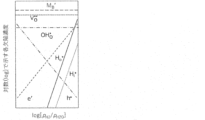
- FIG. 1 is a schematic diagram of the concentration of each defect in a conventional proton-conducting perovskite oxide when the pH is relatively high.
- FIG. 1C is a schematic diagram showing the concentration of each defect in a conventional proton-conducting perovskite oxide or the like when the pH O is approximately the intermediate value between FIG. 1A and FIG. 1C.
- FIG. 1 is a schematic diagram of the concentration of each defect in a conventional proton-conducting perovskite oxide when pH is relatively low.
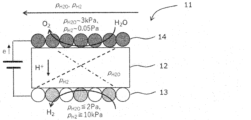
- FIG. 1 is a schematic diagram of a conventional steam electrolysis cell having a proton-conducting perovskite oxide, and a schematic diagram of the distribution of pH2 and pH2O (dashed lines) in the electrolyte.
- FIG. 1 is a schematic diagram of the concentration of each defect in a conventional proton-conducting perovskite oxide when the pH is relatively high.
- FIG. 1C is a schematic diagram showing the concentration of each defect in a conventional proto
- FIG. 1 shows a schematic diagram of the concentration of each defect near the air electrode of a conventional steam electrolysis cell having a proton-conducting perovskite-type metal oxide or the like.
- FIG. 1 shows a schematic diagram of the concentration of each defect near the fuel electrode of a conventional steam electrolysis cell having a proton-conducting perovskite-type metal oxide or the like.
- FIG. 1 is a schematic diagram of a steam electrolysis cell including a perovskite metal oxide according to an embodiment of the present invention, and a schematic diagram of the distribution of pH and pHO (dashed lines) in the perovskite metal oxide.
- FIG. 1 shows a schematic diagram of the concentration of each defect near the air electrode of a conventional steam electrolysis cell having a proton-conducting perovskite-type metal oxide or the like.
- FIG. 1 shows a schematic diagram of the concentration of each defect near the fuel electrode of a conventional steam electrolysis cell having a proton-conducting perovs
- FIG. 2 is a schematic diagram showing the concentration of each defect near the air electrode of a steam electrolysis cell including a perovskite metal oxide according to an embodiment of the present invention.
- FIG. 2 is a schematic diagram showing the concentration of each defect near the fuel electrode of a steam electrolysis cell including a perovskite metal oxide according to an embodiment of the present invention.
- FIG. 2 is a schematic diagram showing the concentration of each defect inside a perovskite metal oxide bulk of a steam electrolysis cell including a perovskite metal oxide according to an embodiment of the present invention.
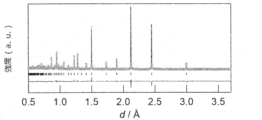
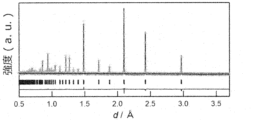
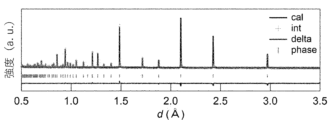
- 1 shows the NRD pattern and Rietveld calculated profile of Sample 1 (corresponding to HBZI 55 in the ceramic reversible cell of the embodiment).
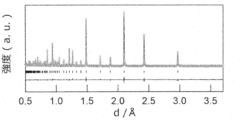
- 1 shows the NRD pattern and Rietveld calculated profile of sample 2 (corresponding to BZI 55 in the comparative ceramic reversible cell).
- 1 shows the NRD pattern and Rietveld calculated profile of Sample 3.
- 1 shows the NRD pattern and Rietveld calculated profile of Sample 4.
- 1 shows the NRD pattern and Rietveld calculated profile of sample 5.
- 1 shows the NRD pattern and Rietveld calculated profile of sample 6.
- the relationship between the hydrogen partial pressure and the amount of hydrogen absorbed at each temperature for Sample 1' (corresponding to HBZI 55 in the ceramic reversible cell of the embodiment) is shown.
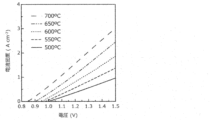
- 1 shows a current-voltage (IV) curve for water electrolysis in a comparative cell.
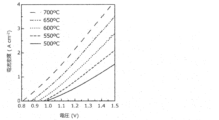
- 1 shows a current-voltage (IV) curve for water electrolysis in the cell of the example.
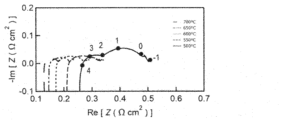
- 1 shows the AC impedance spectrum of a comparative example cell.
- 1 shows the AC impedance spectrum of an example cell.
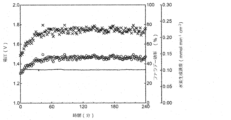
- the cell voltage, hydrogen generation rate (v meas ), and faradaic efficiency ( ⁇ ) are shown when constant current steam electrolysis was performed for 4 hours using the comparative cell.
- the cell voltage, hydrogen generation rate (v meas ), and Faraday efficiency ( ⁇ ) are shown when constant current steam electrolysis was performed for 4 hours using the cell of the example.
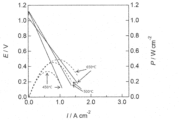
- 1 shows the voltage (solid line, vertical left axis) and output curve (dashed line, vertical right axis) versus current (horizontal axis) for a cell (fuel cell) of a comparative example.
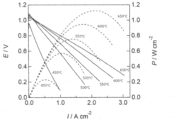
- 1 shows the voltage (solid line, vertical left axis) and output curve (dashed line, vertical right axis) versus current (horizontal axis) for a cell (fuel cell) of an embodiment.
- 1 shows the AC impedance spectrum of a comparative cell (fuel cell).
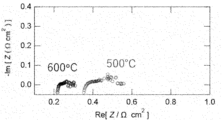
- 1 shows an AC impedance spectrum of a cell (fuel cell) of an example.
- 1 shows a cross-sectional SEM image of a comparative example cell after steam electrolysis.
- 1 shows a cross-sectional SEM image of a cell of an embodiment after steam electrolysis.
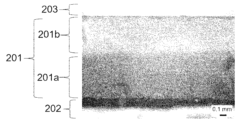
- 1 shows a cross-sectional SEM image (enlarged image between the first layer 102 and the third layer 104) of an example cell after steam electrolysis.
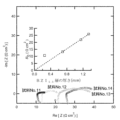
- 1 shows a surface SEM image of the first layer 102 of the example cell after steam electrolysis. The results (voltage change) of N 2 --H 2 O co-electrolysis in the cell of the example are shown. 1 shows the results of N 2 --H 2 O co-electrolysis in the cell of the example (changes in the signal intensities of H 2 , N 2 and NH 3 in the MASS spectrum). 1 shows an optical microscope image of the side surface of the cell of sample No. 14. 1 shows an optical microscope image of the side surface of the cell of sample No. 13. 1 shows an optical microscope image of the side surface of the cell of sample No. 12. 1 shows an optical microscope image of the side surface of the cell of sample No. 11. The electric field current-voltage curves of the cells of Samples No.
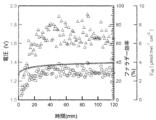
- the cell voltage (V), hydrogen evolution rate (V H2 ), and Faraday efficiency when constant current electrolysis was performed on the cell of Sample No. 14 are shown.
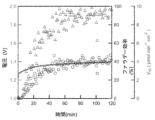
- the cell voltage (V), hydrogen evolution rate (V H2 ), and Faraday efficiency when constant current electrolysis was performed on the cell of Sample No. 12 are shown.
- the AC impedance spectra of the cells of Samples No. 11 to 14 are shown.
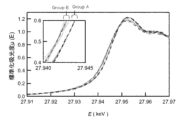
- the ⁇ XAFS measurement results of the cell of sample No. 12 are shown.
- the ⁇ XAFS measurement results of the cell of sample No. 12 are shown.
- 1 is an NRD pattern and a Rietveld calculated profile of the blackened layer of sample No. 12.
- the present inventors have conducted research from various angles in order to realize a ceramic reversible cell capable of exhibiting better characteristics than the conventional technology. As a result, it has been found that a ceramic reversible cell can be obtained that exhibits better characteristics than the conventional technology (for example, a high electrolysis current density at 600° C. and 1.3 V as a steam electrolysis cell, a high output at 600° C. as a fuel cell, and a Faraday efficiency of ammonia at 600° C.
- H - hydride ion
- defect equilibria represented by the following formulas (F1) to (F4) are established in an H 2 --H 2 O atmosphere.
- FIG. 1A to 1C show the defect concentrations of conventional proton-conducting perovskite-type metal oxides such as AB1 - xMxO3 -x/2 disclosed in Patent Document 1, in logarithmic display as a function of pH2 / pH2O .
- Fig. 1A shows the defect concentrations when pH2O is relatively high
- Fig. 1C shows the defect concentrations when pH2O is relatively low
- Fig. 1B shows the defect concentrations when pH2O is approximately halfway between Fig. 1A and Fig. 1C. The following can be seen from Figs. 1A to 1C.
- the ceramic reversible cell according to the embodiment of the present invention comprises: A ceramic reversible cell comprising at least one selected from the group consisting of a perovskite metal oxide, a hydrate of the perovskite metal oxide, and a hydride of the perovskite metal oxide,
- the at least one selected from the group consisting of the perovskite metal oxide, the perovskite metal oxide hydrate, and the perovskite metal oxide hydride contains A (the A is at least one selected from the group consisting of Ba, Sr, and Ca), B (the B is at least one selected from the group consisting of Zr, Sn, Ce, Ti, and Hf), and M (the M is at least one selected from the group consisting of In, Fe, Cr, and Mn) as main metal atoms, satisfies the following formula (1), and contains hydride ions when brought into equilibrium at 500° C.
- [A]:[B]:[M]: 1:a(1-x):ax...(1)
- [A], [B] and [M] respectively represent the contents of A, B and M expressed in mol %, and satisfy the relationships of 0.90 ⁇ a ⁇ 1.10 and 0.3 ⁇ x ⁇ 1.0.
- a ceramic reversible cell can be obtained that exhibits better characteristics than the conventional techniques (for example, as a steam electrolysis cell, it has a high electrolysis current density at 600°C and 1.3V, as a fuel cell, it has a high output at 600°C, and as an ammonia co-electrolysis cell, it has a Faraday efficiency of ammonia of 0.1% or more at 600°C, etc.).
- the Faraday efficiency of ammonia at 600°C is preferably 1% or more, more preferably 5% or more.
- the above metal oxide may be written as "AB a(1-x) M ax O 3- ⁇ ".
- the ceramic reversible cell according to the embodiment of the present invention includes a metal oxide and/or a hydrate and/or a hydride thereof having a perovskite structure that can be represented by the general formula ABO3 .
- the perovskite structure may be a cubic crystal, a hexagonal crystal, an orthorhombic crystal, a monoclinic crystal, a tetragonal crystal, or the like, and is not particularly limited, but a cubic perovskite may be stable and is preferable. Whether or not the cell contains such a perovskite structure can be confirmed by obtaining an electron beam diffraction pattern using a field emission transmission electron microscope (FE-TEM), or the like.
- FE-TEM field emission transmission electron microscope
- the perovskite-type metal oxide or the like contains the above-mentioned A, B, and M as main metal atoms, and can satisfy, for example, the following formula (4). ([A]+[B]+[M])/[X] ⁇ 0.75...(4)
- X is any element except oxygen and hydrogen
- [A], [B], [M], and [X] respectively indicate the contents of A, B, M, and X in mol%.
- the left side of formula (4) increases, for example, when the amount of impurity elements is small. From the viewpoint of reducing the amount of impurities, the left side of formula (4) is preferably 0.90 or more, and more preferably 0.95 or more. In addition, it is preferable to satisfy the following formula (5).
- the left side of formula (5) also increases when the amount of impurity elements is small. From the viewpoint of reducing the amount of impurities, the left side of formula (5) is more preferably 0.55 or more.
- A may be a divalent cation
- B may be a tetravalent cation
- M may be a trivalent or lower cation.
- H - i.e., easy to satisfy formula (2)
- A is any one or more selected from the group consisting of Ba, Sr, and Ca
- B is any one or more selected from the group consisting of Zr, Sn, Ce, Ti, and Hf.
- A is preferably any one or more selected from the group consisting of Ba and Sr.
- M from the viewpoint of easy introduction of H - and the viewpoint of having corrosion resistance by dry hydrogen treatment described later, it is any one or more selected from the group consisting of In, Fe, Cr, and Mn. Furthermore, in order to introduce H - , a certain degree of oxygen deficiency may be required, and the amount x of substitution of B by M is 0.3 or more, preferably 0.4 or more. On the other hand, in view of the structural stability of the perovskite metal oxide, x is less than 1, and preferably 0.8 or less.
- formula (1) can be checked, for example, by general composition analysis (FE-TEM/EDS, etc.). Note that elements other than those specified above (e.g., impurities) may also be detected in the composition analysis, but it is sufficient that formula (1) is satisfied. In addition, measurement errors may occur in the composition analysis, but the a value is set taking this into consideration, and it is sufficient that 0.90 ⁇ a ⁇ 1.10.
- the perovskite metal oxides and the like contained in the ceramic reversible cell according to the embodiment of the present invention can exhibit proton conductivity under normal circumstances, but when they are brought into equilibrium (i.e., the composition change becomes constant) by contacting them with dry hydrogen having a water content of 20 ppm or less by volume at 500°C to 900°C, hydride ions (H - ) are introduced and they contain H - , thereby giving them H - conductivity.
- H - hydride ions
- H- represents a hydrogen atom present at one or more positions selected from the group consisting of oxygen positions and [100] face center positions of the perovskite structure obtained from the Rietveld analysis results of the neutron diffraction pattern, and [A] and [ H- ] represent the contents of A and H- , respectively, expressed in mol %).
- H 2 - may be, for example, a hydrogen atom or a deuterium atom present at a predetermined position.
- H 2 - when the left side of the formula (2) is 0.05 or more, it can be determined that H 2 - has been introduced (H 2 - is included).
- the left side of the formula (2) is preferably 0.15 or more, more preferably 0.30 or more.
- the left side of the formula (2) is less than 0.05, the amount of H 2 - is small, and it is considered that sufficient H 2 -conductivity is not exhibited, so in this specification, it is not considered that H 2 - has been introduced (H 2 - is included).
- the portion that is not in contact with dry hydrogen does not satisfy the formula (2) and can maintain proton conductivity.
- the portion that is not in contact with dry hydrogen has the left side of the formula (2) less than 0.05, preferably 0.03 or less, more preferably 0.01 or less, and most preferably 0.00.
- the portion in contact with dry hydrogen i.e., the portion or layer containing H -
- the portion in contact with dry hydrogen becomes black (darkened) due to the greater oxygen deficiency and the introduction of H - . Therefore, when the portion in contact with dry hydrogen becomes blacker compared to the portion not in contact with dry hydrogen, it can be determined that the portion in contact with dry hydrogen has H - introduced (i.e., contains H - ).
- the portion in contact with dry hydrogen i.e., the portion or layer containing H -
- loses more oxygen and introduces H - so that the ⁇ XAFS spectrum measured by a synchrotron X-ray microprobe is shifted to the lower energy side, specifically, the position where the standardized absorbance is 0.5 is shifted by 0.2 eV or more to the lower energy side. Therefore, when the portion in contact with dry hydrogen shifts the position by 0.2 eV or more to the lower energy side compared to the portion not in contact with dry hydrogen, it can be determined that H - has been introduced to the portion in contact with dry hydrogen (i.e., H - is included).
- the dry hydrogen to be contacted may have a water content within the above range, and may be a mixed gas (H 2 /Ar) of H 2 and an inert gas such as Ar, and the hydrogen concentration may be 10% by volume or more.
- Hydrogen may be, for example, light hydrogen or heavy hydrogen.
- the water related to the above "water content” may be, for example, light water or heavy water (D 2 O).
- the perovskite metal oxide or the like contained in the ceramic reversible cell according to the embodiment of the present invention has a portion (or layer) containing hydride ions.
- the side contacted with dry hydrogen has hydride ion conductivity and can be used as the electrolyte layer on the fuel electrode and/or fuel electrode side.
- the side not contacted with dry hydrogen maintains its original proton conductivity and can be used as the electrolyte layer on the air electrode and/or air electrode side.
- the perovskite metal oxide or the like has a layer containing hydride ions (hereinafter also referred to as a "hydride ion (H - ) conductive layer”) on one side (fuel electrode side) in the thickness direction of the cell, and does not have a layer containing hydride ions on the other side (air electrode side) of the layer containing hydride ions (i.e., the other side maintains proton conductivity and is therefore also referred to as a "proton (H + ) conductive layer” below).
- a layer containing hydride ions hereinafter also referred to as a "hydride ion (H - ) conductive layer”
- Such a ceramic reversible cell is also called a bipolar conduction cell because it has an H 2 -conductive layer and an H 2 + conductive layer.
- H 2 -conductive layer refers to a layer that satisfies one or more of the above (a) to (c).
- H 2 -conductive layer refers to a layer that satisfies the above formula (2) in the above (a), a layer that is blackened (darkened) compared to the H 2 + conductive layer in the above (b), and a layer in which the position at which the standardized absorbance of the ⁇ XAFS spectrum measured by a synchrotron X-ray microprobe becomes 0.5 is shifted to the lower energy side by 0.2 eV or more compared to the H 2 + conductive layer in the above (c).
- H 2 + conductive layer refers to a layer that does not satisfy the above (a) to (c).
- the "H + conductive layer” may be a layer that does not satisfy the above formula (2) (i.e., the left side of the above formula (2) is less than 0.05) in the above (a), may be a layer that is white (light color) compared to the H - conductive layer in the above (b), and may be a layer in which the position where the standardized absorbance of the ⁇ XAFS spectrum measured by a synchrotron X-ray microprobe is 0.5 is shifted to the high energy side by 0.2 eV or more compared to the H - conductive layer in the above (c).
- the "H + conductive layer” may be a layer in which the left side of the above formula (2) is preferably 0.03 or less, more preferably 0.01 or less, and most preferably 0.00.
- the ceramic reversible cell according to the embodiment of the present invention further satisfies the following formula (3) when it is brought into equilibrium at 500° C. to 900° C. and in contact with dry hydrogen having a water content of 20 ppm or less by volume. 1.5 ⁇ [O]/[A] ⁇ 2.30 (3)
- [O] represents the content, in mol %, of oxygen atoms present at oxygen positions in the perovskite structure obtained from the results of Rietveld analysis of a neutron diffraction pattern.
- [O]/[A] in formula (3) is preferably more than 1.5 and 2.25 or less.
- the H 2 -conductive layer satisfies the above formula (3) and the H 2 + conductive layer does not satisfy the above formula (3) (for example, 2.30 ⁇ [O]/[A] ⁇ 3.00).
- the ceramic reversible cell according to an embodiment of the present invention includes the perovskite metal oxide described above, and for example, one surface that comes into contact with the dry hydrogen can be used as a fuel electrode, and the other surface opposite the fuel electrode can be used as an air electrode. That is, in one embodiment of the present invention, the ceramic reversible cell may be a single layer that includes the perovskite metal oxide described above. In one embodiment of the present invention, the single layer of the ceramic reversible cell may include 50 area % or more, 75 area % or more, or 90 area % or more of the perovskite metal oxide when viewed in a cross section parallel to the layer thickness direction. Furthermore, in the single layer, the perovskite metal oxide may have a continuous portion from the fuel electrode to the air electrode.
- the ceramic reversible cell may include multiple layers without departing from the scope of the present invention.
- the ceramic reversible cell according to the present invention may have a first layer including the perovskite metal oxide and a second layer including the perovskite metal oxide and a metal (i.e., a cermet electrode layer).
- the metal may be one or more selected from the group consisting of Ni, Fe, Co, Pd, Cu, and Ru, and preferably one or more selected from the group consisting of Ni, Fe, and Ru.
- the second layer may be porous to increase the area where the electrode reaction occurs.
- the ceramic reversible cell according to the present invention may have a first layer including the perovskite metal oxide and a known fuel electrode layer (e.g., a Pt layer) as the second layer.
- the thickness of the first layer and the second layer is not particularly limited, and the first layer may be, for example, the same thickness as a known electrolyte layer, and the second layer may be, for example, the same thickness as a known fuel electrode layer.
- the manufacturing method of the first layer and the second layer is not particularly limited, and the first layer can be, for example, produced by a method similar to a known electrolyte layer, and the second layer can be, for example, produced by a method similar to a known fuel electrode layer.
- the first layer and the second layer may be in direct contact with each other, but may not be in contact with each other, that is, there may be another layer between the first layer and the second layer.
- the ceramic reversible cell according to the embodiment of the present invention can be used, for example, with the second layer side as the fuel electrode and the first layer side as the air electrode, by contacting the second layer with the above-mentioned dry hydrogen at high temperature.
- the perovskite-type metal oxide or the like contained in the second layer can satisfy the above formula (2) regardless of the presence or absence of a metal (Ni, etc.) in the second layer by contacting the above-mentioned dry hydrogen at high temperature and reaching an equilibrium state.
- the ceramic reversible cell according to the embodiment of the present invention may have, in this order, the second layer, the first layer, and a third layer containing a conductive oxide.
- the third layer may be porous to increase the area where the electrode reaction occurs.
- the conductive oxide may be a dual-conducting material that conducts oxide ions and electrons (holes) (La1 - xSrxCoO3 - ⁇ ( LSC), LaSrCoO4 + ⁇ (LSC4 ) , LaNiO3 - ⁇ (LNO), La1 - xSrxCo1 - yFeyO3- ⁇ (LSCF), La1 - xSrxMnO3 - ⁇ (LSM), SmxSr1 -xCoO3 - ⁇ (SSC) or the like), or a triple-conducting material that conducts protons, oxide ions and electrons (holes) (BaCo1 -x-y- zFexZryYzO3
- BPY PrNi1 - xCoxO3 - ⁇
- PNC PrBa1 - xSrxCo2 - yFeyO5 + ⁇
- PBCC PrBa1 - xCaxCo2O5 + ⁇
- BGLC Ba1- xGd0.8La0.2 +xCo2O6 - ⁇
- the third layer contains at least one selected from the group consisting of a dual conductive material and a triple conductive material, and more preferably, it contains at least one selected from the triple conductive material.
- the ceramic reversible cell according to the embodiment of the present invention can be used, for example, by using the second layer side as a fuel electrode and the third layer side as an air electrode, and by contacting the second layer with the above-mentioned dry hydrogen at high temperature.
- the thickness of the third layer is not particularly limited, and the third layer may have a thickness similar to that of a known air electrode layer.
- the manufacturing method of the third layer is not particularly limited, and the third layer can be manufactured, for example, by a method similar to that of a known air electrode layer.
- the third layer and the first layer may be in direct contact with each other, but may not be in contact with each other, that is, another layer may be present between the third layer and the first layer.
- the ceramic reversible cell according to the embodiment of the present invention may have a fourth layer, which is an interface functional layer, between the first layer and the third layer.
- the fourth layer may contain a second conductive oxide different from the conductive oxide contained in the third layer.
- the fourth layer may contain a second perovskite metal oxide and/or a hydrate thereof, and the second perovskite metal oxide and/or a hydrate thereof may satisfy the following formula (6) and either one of the following formulas (7a) and (8a), and may further satisfy the following formula (7b) when the following formula (7a) is satisfied, and may further satisfy the following formula (8b) when the following formula (8a) is satisfied.
- R 1 is at least one selected from the group consisting of La, Ce, Pr, Nd, Pm, Sm, Eu, and Gd
- R 2 is at least one selected from the group consisting of Sc, Y, Tb, Dy, Ho, Er, Tm, Yb, and Lu
- a 1 is all elements excluding oxygen and hydrogen
- M 1 is at least one selected from the group consisting of Li, Na, Mg, Al, Ca, Cu, Zn, Ga, Ag, Cd, In, Hg, and Tl
- the fourth layer may contain a metal oxide and/or a hydrate thereof having a perovskite structure represented by the general formula ABO3 .
- the perovskite structure may be a cubic crystal, a hexagonal crystal, an orthorhombic crystal, a monoclinic crystal, a tetragonal crystal, or the like, and is not particularly limited. However, a cubic perovskite may be stable and is preferable. Whether or not the fourth layer contains such a perovskite structure can be confirmed by obtaining an electron beam diffraction pattern using a field emission transmission electron microscope (FE-TEM), or the like.
- FE-TEM field emission transmission electron microscope
- the fourth layer may contain 50 area % or more, 75 area % or more, or 90 area % or more of the second perovskite metal oxide and/or its hydrate in a cross section parallel to the stacking direction.
- the fourth layer may also have a portion in which the second perovskite metal oxide and/or its hydrate is continuous from one surface to the other surface in the stacking direction.
- the left side of formula (6) increases when the amount of impurity elements is small, for example. From the viewpoint of reducing the amount of impurities, it is preferable that the left side of formula (6) is 0.80 or more. In addition, it is preferable that the following formula (9) is satisfied. ([Ba]+[ R1 ]+[ R2 ]+[Fe])/[ A2 ] ⁇ 0.60 (9) Here, A2 is any element except oxygen.
- the left side of formula (9) also increases when the amount of impurity elements is small. From the viewpoint of reducing the amount of impurities, the left side of formula (9) is more preferably 0.65 or more.
- the perovskite structure is preferably 0 ⁇ (x a + y a ) ⁇ 1.0, more preferably 0.5 ⁇ (x a + y a ) ⁇ 1.0, and even more preferably 0.7 ⁇ (x a + y a ) ⁇ 1.0.
- formula (8a) when formula (8a) is satisfied (i.e., in the case of Ba 1-xb R 1 xb Fe c(1-lb-mb-nb) M 1 clb M 2 cmb R 2 cnb O 3- ⁇ layer), Ba forming a divalent cation is replaced with R 1 forming a trivalent cation, whereby unstable Fe 4+ can be made to Fe 3+ , and the perovskite structure can be made more stable, which is preferable. From the viewpoint of stabilizing the perovskite structure, preferably 0 ⁇ x b ⁇ 1.0, more preferably 0.5 ⁇ x b ⁇ 1.0, and even more preferably 0.7 ⁇ x b ⁇ 1.0.
- R 1 one or more selected from the group consisting of La, Ce, Pr, Nd, Pm and Sm
- the perovskite structure can be made more stable.
- by decreasing the amount of substitution and increasing Ba more water molecules are adsorbed, and proton conductivity can be improved.
- formula (7a) when formula (7a) is satisfied, it is preferable that 0 ⁇ ( xa + ya ) ⁇ 0.5, and more preferably 0 ⁇ ( xa + ya ) ⁇ 0.3.
- formula (8a) it is preferable that 0 ⁇ xb ⁇ 0.5, and more preferably 0 ⁇ xb ⁇ 0.3.
- Fe can be replaced by M1 (any one or more selected from the group consisting of Li, Na, Mg, Al, Ca, Cu, Zn, Ga, Ag, Cd, In, Hg, and Tl) or M1 and M2 (any one or more selected from the group consisting of metals in periods 4 to 6 and groups 4 to 10 of the periodic table).
- M1 any one or more selected from the group consisting of Li, Na, Mg, Al, Ca, Cu, Zn, Ga, Ag, Cd, In, Hg, and Tl
- M1 and M2 any one or more selected from the group consisting of metals in periods 4 to 6 and groups 4 to 10 of the periodic table.
- Fe can be substituted with one or more selected from the group consisting of M1 , M2 , and R2 (however, substitution with M2 alone is not possible) .
- M 1 and R 2 have a smaller ionic valence than Fe.
- oxygen deficiencies may occur in the Ba 1-xa-ya R 1 xa R 2 ya Fe c(1-la-ma) M 1 cla M 2 cma O 3- ⁇ layer or Ba 1-xb R 1 xb Fe c(1-lb-mb-nb) M 1 clb M 2 cmb R 2 cnb O 3- ⁇ layer.
- Fe may be substituted with M 2 , which has an ionic valence similar to that of Fe.
- M1 is at least one selected from the group consisting of Li, Mg, Al, Cu, Zn, Ga, Cd, In and Tl, because the perovskite structure can be stabilized from the viewpoint of ionic radius. It is more preferable that M1 is at least one selected from the group consisting of Mg, Al, Cu, Zn and Ga, because the perovskite structure can be more stabilized from the viewpoint of ionic radius.
- M2 is preferably at least one selected from the group consisting of Ti, V, Cr and metals in periods 5 to 6 and groups 4 to 10 of the periodic table, since this can stabilize the perovskite structure in terms of ion radius.
- formulas (6) to (8b) can be checked, for example, by general composition analysis (FE-TEM/EDS, etc.). Note that elements other than those specified above (e.g., impurities) may also be detected in the composition analysis, but it is sufficient that formulas (6), (7a), and (7b) are satisfied, or formulas (6), (8a), and (8b) are satisfied. In addition, measurement errors may occur in the composition analysis, but the c value is set taking this into consideration, and it is sufficient that 0.90 ⁇ c ⁇ 1.10.
- the fourth layer can be formed by a known method.
- the thickness of the fourth layer is not particularly limited. In one embodiment, the thickness of the fourth layer can be, for example, 5 to 500 nm, 10 to 200 nm, or 30 to 170 nm, etc.
- the fourth layer and the third layer may be in direct contact with each other, but they may not be in direct contact with each other, i.e., there may be another layer between the fourth layer and the third layer.
- the first layer and the fourth layer may be in direct contact with each other, but they may not be in direct contact with each other, i.e., there may be another layer between the first layer and the fourth layer.
- the ceramic reversible cell according to the embodiment of the present invention can be used as a steam electrolysis cell or an ammonia co-electrolysis cell.
- the ceramic reversible cell according to the embodiment of the present invention can also be used as a fuel cell. That is, the steam electrolysis cell (or the ammonia co-electrolysis cell, or the fuel cell) according to the embodiment of the present invention includes the ceramic reversible cell according to the embodiment of the present invention.
- Example 1 a sample with a relatively thin electrolyte layer was produced and its characteristics were evaluated.
- the powder of perovskite-type metal oxide (and/or its hydrate and/or its hydride) contained in the first and second layers was prepared as follows. First, BaCO 3 (Kojundo Chemical), In 2 O 3 (Kanto Chemical) and ZrO 2 (Kojundo Chemical) were mixed in a ball mill in a predetermined ratio, heated at 900°C for 6 hours, then ball milled again and heated at 1300°C for 8 hours. After ball milling again, the mixture was molded by uniaxial pressing and isostatic pressing, and heated at 1500°C for 8 hours to obtain a dense sintered body.
- the powder of the second perovskite metal oxide (Ba 0.95 La 0.05 FeO 3- ⁇ , hereinafter also referred to as "BLF”) contained in the fourth layer was synthesized by the citric acid precursor method. Specifically, a precursor solution was prepared using citric acid (C 6 H 7 O.H 2 O, purity 99.5%, manufactured by Kanto Chemical Co., Ltd., hereinafter referred to as "CA”) as a chelating agent, so that the total molar ratio of CA to metal atoms was 2:1 and the concentration of metal atoms was 2 mol/dm 2.
- citric acid C 6 H 7 O.H 2 O, purity 99.5%, manufactured by Kanto Chemical Co., Ltd.
- Milli-Q registered trademark
- the gel was calcined at 500°C for 1 hour, and then the crushed precursor powder was calcined in air at 1000°C for 8 hours to obtain a BLF powder.
- the obtained BLF powder was molded into a pellet having a diameter of 25 mm and a thickness of 5 mm, and then sintered at 1100° C. for 6 hours to obtain a BLF target to be used in the pulsed laser deposition (PLD) method described later.
- PLD pulsed laser deposition
- the powder of PrBa0.5Sr0.5Co1.5Fe0.5O5 - ⁇ (hereinafter also referred to as "PBSCF") contained in the third layer was synthesized by the citric acid precursor method .
- the precursor solution was prepared using citric acid ( CA ; C6H7O.H2O , 99.5 %, Kanto Chemical ) as a chelating agent, so that the total molar ratio of CA to metal atom M was 2:1, and the concentration of M was 2 mol/ dm2 .
- the precursor solution was prepared by dissolving Sr( NO3 ) 2 (98 %, Kanto Chemical), Co(NO3)2.6H2O ( 98 %, Kanto Chemical), Ba( NO3 ) 2 (99%, Kanto Chemical), Pr( NO3 ) 3.3H2O (99.5%, FUJIFILM Wako Pure Chemical), and Fe( NO3 ) 3.9H2O (99.9%, Wako Pure Chemical) in Milli-Q water in the required stoichiometric ratio , and adding a specified amount of CA. This was stirred and heated at 80°C to evaporate H2O and promote polymerization to obtain a precursor gel. The gel was calcined at 500°C for 1 hour, and then the crushed precursor powder was calcined at 1000°C in air for 8 hours to obtain PBSCF powder.
- a ceramic reversible cell of the example (second layer (Ni-HBZI 55 )/first layer ((H)BZI 55 )/fourth layer (BLF)/third layer (PBSCF) was obtained.
- humidified air containing 3% H 2 O was supplied to the third layer (corresponding to the air electrode layer) side of the above layer configuration, and humidified H 2 /Ar gas (H 2 O concentration: 3 vol %, H 2 concentration: 9 vol %) was supplied to the second layer (corresponding to the fuel electrode layer) side of the above layer configuration so as to reduce NiO in the second layer to Ni, and forming was performed at 700° C. for 12 hours.
- a ceramic reversible cell of the comparative example (second layer (Ni-BZI 55 )/first layer (BZI 55 )/fourth layer (BLF)/third layer (PBSCF) was obtained.
- a powder sample (Sample 1) corresponding to HBZI 55 in the ceramic reversible cell of the embodiment and a powder sample (Sample 2) corresponding to BZI 55 in the ceramic reversible cell of the comparative example were separately prepared as follows.
- Example 1 The BZI 55 powder prepared according to the above-mentioned ⁇ Preparation of Perovskite Metal Oxide Powder> was heated in dry deuterium (H 2 O concentration: 10 ppm or less by volume) at 800° C. for 12 hours to obtain Sample 1 in which hydride ions were introduced into BZI 55 .
- Example 2 The BZI 55 powder prepared according to the above-mentioned ⁇ Preparation of Perovskite Metal Oxide Powder> was heated at 300° C. for 72 hours in argon gas containing 3 vol. % D 2 O produced by bubbling in heavy water (D 2 O) at 25° C. to obtain Sample 2.
- BZI 37 powder was obtained by changing the ratio of In 2 O 3 (Kanto Chemical) and ZrO 2 (Kojundo Chemical) in the same manner as in the above-mentioned ⁇ Preparation of Perovskite Metal Oxide Powder>.
- the BZI 37 powder was heated in dry deuterium (H 2 O concentration: 10 ppm or less by volume) at 600° C. for 24 hours to obtain sample 3.
- Example 4 Using the same method as in the above-mentioned ⁇ Preparation of Perovskite Metal Oxide Powder>, ZrO 2 (High Purity Chemical) was replaced with SnO 2 (High Purity Chemical) and the mixing ratio was further adjusted to obtain powder of BSI 37.
- the BSI 37 powder was heated in dry deuterium (H 2 O concentration: 10 ppm or less by volume) at 500° C. for 24 hours to obtain Sample 4.
- NRD Neutron diffraction
- the NRD measurements were performed using a JASRI Spica.
- the Z Rietveld program was used for Rietveld analysis of the NRD patterns.
- the Rietveld analysis was performed in the space group Pm-3m.
- 4A shows the NRD pattern and Rietveld calculation profile of sample 1 (corresponding to HBZI 55 in the ceramic reversible cell of the embodiment).
- the structural parameters and composition determined by NRD Rietveld analysis are shown in Table 1.
- D o indicates a hydrogen atom (deuterium atom) present at the oxygen position (oxygen site) of the perovskite structure
- D fcc indicates a hydrogen atom (deuterium atom) present at the [100] face center position of the perovskite structure
- D oH indicates a hydrogen atom (deuterium atom ) bonded to lattice oxygen of the perovskite structure.
- Table 2 shows the analysis of Sample 2, which was heated in argon gas containing 3% by volume of D 2 O, unlike the other samples, and although the accuracy inevitably decreases due to susceptibility to external H 2 O, it was determined that the structure could be refined with sufficient accuracy if the S value was 9% or less and the Rwp value was 15% or less. Furthermore, it was determined that the structure could be refined with even better accuracy if the Rp value was 10% or less.
- sample 1 (corresponding to HBZI 55 in the ceramic reversible cell of the embodiment) satisfies the above formula (1), and as a result of contacting dry hydrogen with a water content of 20 ppm or less by volume at 500°C to 900°C and bringing it into equilibrium, the left side of the above formula (2) was 0.48, satisfying the above formula (2), and hydride ions were introduced.
- sample 1 had a preferable result of [O]/[A] in the above formula (3) being 2.28, which satisfied the above formula (3).
- Figure 4C shows the NRD pattern and Rietveld calculated profile of sample 3.
- the structural parameters and composition determined by NRD Rietveld analysis are shown in Table 3.
- Figure 4D shows the NRD pattern and Rietveld calculated profile of sample 4.
- the structural parameters and composition determined by NRD Rietveld analysis are shown in Table 4.
- Figure 4E shows the NRD pattern and Rietveld calculated profile of sample 5.
- the structural parameters and composition determined by NRD Rietveld analysis are shown in Table 5.
- Figure 4F shows the NRD pattern and Rietveld calculated profile of sample 6.
- the structural parameters and composition determined by NRD Rietveld analysis are shown in Table 6.
- Example 1' ⁇ Relationship between hydrogen partial pressure and hydrogen absorption amount>
- Sample 1' was prepared by heating the BZI 55 powder prepared according to the above-mentioned ⁇ Preparation of Powder of Perovskite-type Metal Oxide> in dry hydrogen (H 2 O concentration: 10 ppm or less by volume) at 800°C for 12 hours. Measurements were performed using PCT-2DWIN (Suzuki Shokan).
- the sample was heated to 800°C in a vacuum ( ⁇ 10 -4 Pa), then cooled to the target temperature, and while maintaining the temperature, pure water gas was introduced to adjust the hydrogen partial pressure (pH 2 ), and the amount of hydrogen absorption at that time was measured.
- the results are shown in Figure 5 (horizontal axis: hydrogen partial pressure (kPa), vertical axis: hydrogen absorption amount ⁇ H ).
- the hydrogen content of sample 1' in vacuum ( ⁇ 10 -4 Pa) at each temperature was used as a reference, and the hydrogen absorption amount ⁇ H was measured when each pH 2 was set from that.
- ⁇ H is expressed as a molar ratio when the Ba content of sample 1' is set to 1.
- Electrochemical measurements were performed using a potentio/galvanostat equipped with a frequency response analyzer (Biologic SP-300).
- the hydrogen evolution rate (v) of the second layer was quantified by analyzing the cathode exhaust gas using gas chromatography (490 Micro GC, Agilent Technologies).
- I is the applied current
- z is the electron transport number in steam electrolysis
- F is the Faraday constant (96485 C/mol).
- IVSCF current-voltage
- the open circuit voltages (OCVs) at 600°C and 500°C were 0.95V and 0.99V, respectively, which were only slightly lower than the ideal values of 0.97V and 1.00V calculated by the Nernst equation.
- the comparative cell exhibited electrolysis current densities of 1.14 A/cm 2 and 0.56 A/cm 2 at 1.3 V bias at 600° C. and 500° C., respectively.
- the OCVs at 600° C. and 500° C. were 0.93 V and 0.98 V, respectively, which were almost the same as those of the cell of the comparative example.
- the electrolysis current densities of the example cell at 600° C. and 500° C. were 1.68 A/cm 2 and 0.84 A/cm 2 at 1.3 V, respectively, which were higher values than those of the comparative example cell, which is a conventional proton-conducting ceramic reversible cell.
- FIG. 6C shows the AC impedance spectrum of the comparative cell measured under OCV conditions in the temperature range of 500° C. to 700° C.
- the x-intercept on the high frequency side is attributed to the ohmic resistance (R O ) associated with ion movement in the first layer (corresponding to the electrolyte layer), and the semicircle that appears afterwards is mainly attributed to the resistance due to the oxygen evolution reaction in the third layer (corresponding to the air cathode layer).
- the electrode resistance (R p ) is estimated from the diameter of the impedance arc.
- the R O and R p of the comparative cell at 500° C. were 0.40 ⁇ cm 2 and 0.21 ⁇ cm 2 , respectively.
- FIG. 6D shows the AC impedance spectrum of the example cell measured under OCV conditions in the temperature range of 500° C. to 700° C.
- the R O of the example cell at 500° C. was 0.27 ⁇ cm 2 , which was lower than that of the comparative cell.
- the R p of the example cell at 500° C. was 0.23 ⁇ cm 2 , which was very close to the R p of the comparative cell (0.21 ⁇ cm 2 ).
- the impedance arcs of the example cell (FIG. 6D) and the comparative cell (FIG. 6C) were in good agreement with each other, indicating that no new arcs were generated when the layer containing HBZI 55 was used in the example cell.
- 7A shows the transients of cell voltage (line, left axis), hydrogen evolution rate (v meas ) (circle plot, right side of right axis), and Faraday efficiency ( ⁇ ) (x plot, left side of right axis) during constant current steam electrolysis for 4 hours using the comparative cell.
- the voltage (cell bias) of the comparative cell was about 1.34 V, and the overpotential defined by the gap between the cell bias and the OCV was calculated to be 0.35 V.
- the comparative cell also showed a v meas of about 1.4 ⁇ 10 -4 (mol cm -2 min -1 ) and an ⁇ value of 73%.
- FIG. 7B shows the transients of cell voltage (broken line, left axis), hydrogen evolution rate (v meas ) (circle plot, right side of right axis), and Faraday efficiency ( ⁇ ) (x plot, left side of right axis) when constant current steam electrolysis was performed for 4 hours using the cell of the example.
- the voltage (cell bias) of the cell of the example was about 1.26 V, and the overpotential defined by the gap between the cell bias and the OCV was calculated to be 0.28 V.
- the cell of the example also showed a v meas of about 1.6 ⁇ 10 -4 (mol cm -2 min -1 ) and an ⁇ value of about 90%, both of which greatly exceeded the results of the cell of the comparative example.
- Electrochemical measurements were performed using a potentio/galvanostat equipped with a frequency response analyzer (Biologic SP-300).
- FIG. 8A shows the voltage (solid line, vertical left axis) and power output curve (dashed line, vertical right axis) versus current (horizontal axis) for the comparative cell.
- the comparative cell did not increase its power output even when the temperature was increased from 550°C (not shown) to 650°C, and its maximum power output was about 0.5 W/ cm2 .
- the power outputs at 600 and 500°C were 0.52 W/ cm2 and 0.45 W/ cm2 , respectively.
- FIG. 8B shows the voltage (solid line, vertical left axis) and output curve (dashed line, vertical right axis) versus current (horizontal axis) for the cell of the embodiment.
- the cell of the embodiment had a higher output than the cell of the comparative example (FIG. 8A).
- the cell of the embodiment showed an increase in output with increasing temperature, with the outputs at 500° C., 550° C., 600° C., and 650° C. being 0.58 W/cm 2 , 0.75 W/cm 2 , 0.9 W/cm 2 , and 1.08 W/cm 2 , respectively.
- Figure 8C shows the AC impedance spectra of the comparative cell measured under OCV conditions at temperatures of 500° C. and 600° C.
- the R O and R p of sample No. 2 at 500° C. were 1.07 ⁇ cm 2 and 0.18 ⁇ cm 2 , respectively.
- Fig. 8D shows the AC impedance spectrum of the example cell measured under OCV conditions at temperatures of 500°C and 600°C.
- R 0 and R p of Sample No. 1 at 500°C were 0.35 ⁇ cm2 and 0.19 ⁇ cm2 , respectively.
- the cell of the example (Fig. 8D) has a larger reduction in the ohmic resistance R 0 of the first layer (corresponding to the electrolyte layer) than the cell of the comparative example (Fig. 8C), which is believed to have increased the output compared to the comparative example.
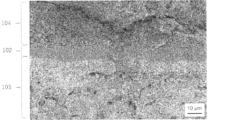
- FIG. 9A shows a cross-sectional SEM image of the comparative cell after steam electrolysis measurement
- FIG. 9B shows a cross-sectional SEM image of the example cell after steam electrolysis measurement.
- the porous second layer 103 which is the bottom layer
- the dense first layer 102 or 112 formed thereon
- the porous third layer 104 or 114) formed on the top layer were observed.
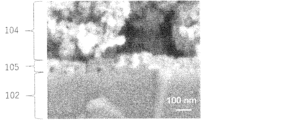
- FIG. 9C is a cross-sectional SEM image of an enlarged view between the first and third layers of the example cell.
- a fourth layer (BLF) 105 was observed between the first layer 102 and the third layer 104.
- the third layer (PBSCF) 104 was composed of particles with a diameter of about 100 nm.
- FIG. 9D is an SEM image of the surface of the example cell after removing the third layer and ultrasonically cleaning. Note that Figure 9D is taken at a low magnification, so the surface morphology of the first layer 102 below the thin fourth layer 105 is clearly visible. As can be seen from Figure 9D, particles with a diameter of several ⁇ m are tightly bonded on the surface of the first layer 102 of the cell of the embodiment, and no pinholes or the like are observed.
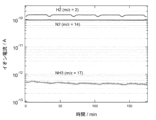
- Figure 10A shows the voltage change versus time when a cycle of H 2 O-N 2 co-electrolysis at 600 °C for 30 minutes at a constant current density of 354 mA cm -2 followed by holding at the open circuit voltage (OCV) for 5 minutes to desorb NH 3 was repeated five times
- Figure 10B shows the signal intensity changes of H 2 , N 2 and NH 3 in the MASS spectrum at that time.
- Example 2 in order to clarify the characteristics of the electrolyte layer, a sample with a relatively thick electrolyte layer was produced and its properties were evaluated.
- a dense sintered body of a perovskite-type metal oxide (and/or its hydrate and/or its hydride) was prepared in the same manner as in Example 1. Specifically, BaCO 3 (Kojundo Chemical), In 2 O 3 (Kanto Chemical), and ZrO 2 (Kojundo Chemical) were mixed in a ball mill at a predetermined ratio, heated at 900° C. for 6 hours, then ball milled again and heated at 1300° C. for 8 hours. After ball milling again, the mixture was molded by a uniaxial press and a hydrostatic press, and heated at 1500° C. for 8 hours to obtain an electrolyte layer (about 1.2 mm thick).
- a Pt layer was formed as a fuel electrode layer on one side of the electrolyte layer by applying a commercially available Pt paste (manufactured by Tanaka Precious Metals) and firing it at 900°C for one hour.
- a commercially available Pt paste manufactured by Tanaka Precious Metals
- a PBSCF layer was formed as an air electrode layer in the same manner as in Example 1. Finally, the resultant was baked at 800° C. to obtain a ceramic reversible cell having the layer structure (fuel electrode layer (Pt)/electrolyte layer (BZI 55 )/air electrode layer (PBSCF, about 100 ⁇ m) before the drying and hydrogen treatment.
- a voltage of OCV up to 0.9 V, sample No. 13), 1.3 V (sample No. 12), and 1.5 V (sample No.
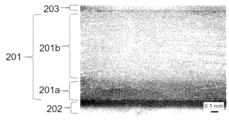
- Fig. 11A shows an optical microscope image of the side of sample No. 14 (no dry hydrogen treatment, steam electrolysis by OCV).
- hydride ions were not introduced into the electrolyte layer 201 between the fuel electrode layer 202 and the air electrode layer 203, and the electrolyte layer was a uniform layer (i.e., proton-conducting BZI 55 layer 201b). This is thought to be because, as shown in the above formula (F4), steam was supplied to both poles of the cell, so that the electrolyte layer was uniformly hydrated and the proton-conducting BZI 55 layer was maintained overall.
- Fig. 11B shows an optical microscope image of the side of sample No. 13 (treated with dry hydrogen, electrolyzed by OCV). As shown in Fig. 11B, on the fuel electrode layer 202 side of the electrolyte layer 201, oxygen was lost and hydride ions were introduced, resulting in a BZI 55 layer (i.e., hydride ion conductive HBZI 55 layer 201a, 0.2 mm thick) in which black (dark) hydride ions were introduced compared to the proton conductive BZI 55 layer 201b.
- Fig. 11C shows an optical microscope image of the side of sample No. 12 (with dry hydrogen treatment, steam electrolysis at 1.3 V), and Fig. 11D shows sample No.
- E E 0 + RT/F ln(p H2 anode / p H2 cathode ) ⁇ (F10)
- R is the gas constant
- T is the temperature
- F is the Faraday constant
- p H2 anode is the hydrogen partial pressure on the air electrode layer 203 side
- p H2 cathode is the hydrogen partial pressure on the fuel electrode layer 202 side.
- Fig. 14 shows the AC impedance spectra of the cells of Samples No. 11 to 14, and the upper part of the figure shows a graph of ohmic resistance (R o ) versus thickness of the BZI 55 layer.
- R o ohmic resistance
- the spectra measured at positions of 0.51 mm, 0.57 mm, 0.60 mm, and 0.63 mm from the air electrode layer side toward the fuel electrode layer side were present in this order between the spectrum of the BZI 55 layer of Example 1 (dashed line on the high energy side) and the spectrum of the HBZI 55 layer (dashed line on the low energy side). It is considered that a layer in which the BZI 55 phase and the HBZI 55 phase are mixed is formed at positions of 0.51 mm, 0.57 mm, 0.60 mm, and 0.63 mm from the air electrode layer side toward the fuel electrode layer side.
- NRD patterns were obtained to confirm that the blackened layers of Samples No. 11 to 13 were HBZI 55 layers.
- a sample was used in which the non-blackened layer (HBZI 55 layer) of Sample No. 12 was removed by polishing.
- Figure 17 shows the NRD pattern and Rietveld calculated profile of the blackened layer of Sample No. 12. The structural parameters and composition determined by NRD Rietveld analysis are shown in Table 8.
- the composition of the blackened layer of sample No. 12 was determined to be BaZr 0.5 In 0.5 O 2.26 D 0.45 , which satisfies the above formula (1) as in sample 1, and when it was brought into equilibrium with dry hydrogen having a water content of 20 ppm or less by volume at 500°C to 900°C, the left side of the above formula (2) was 0.45, which satisfied the above formula (2), and hydride ions were introduced.
- the blackened layer of sample No. 12 had a preferable result of [O]/[A] in the above formula (3) being 2.26, which satisfied the above formula (3).
Landscapes
- Chemical & Material Sciences (AREA)
- Engineering & Computer Science (AREA)
- Ceramic Engineering (AREA)
- Organic Chemistry (AREA)
- Materials Engineering (AREA)
- Structural Engineering (AREA)
- Electrochemistry (AREA)
- Chemical Kinetics & Catalysis (AREA)
- Metallurgy (AREA)
- Manufacturing & Machinery (AREA)
- Inorganic Chemistry (AREA)
- Life Sciences & Earth Sciences (AREA)
- Physics & Mathematics (AREA)
- Thermal Sciences (AREA)
- Sustainable Development (AREA)
- Sustainable Energy (AREA)
- General Chemical & Material Sciences (AREA)
- Composite Materials (AREA)
- Inert Electrodes (AREA)
- Fuel Cell (AREA)
Priority Applications (3)
| Application Number | Priority Date | Filing Date | Title |
|---|---|---|---|
| EP24768897.1A EP4682297A1 (en) | 2023-03-15 | 2024-03-14 | Ceramic reversible cell, steam electrolysis cell comprising same, fuel cell and ammonia co-electrolysis cell |
| JP2025507161A JPWO2024190886A1 (https=) | 2023-03-15 | 2024-03-14 | |
| CN202480018484.4A CN120882912A (zh) | 2023-03-15 | 2024-03-14 | 陶瓷可逆电池、和含有它的水蒸气电解电池、燃料电池及氨共电解电池 |
Applications Claiming Priority (2)
| Application Number | Priority Date | Filing Date | Title |
|---|---|---|---|
| JP2023-041188 | 2023-03-15 | ||
| JP2023041188 | 2023-03-15 |
Publications (1)
| Publication Number | Publication Date |
|---|---|
| WO2024190886A1 true WO2024190886A1 (ja) | 2024-09-19 |
Family
ID=92755382
Family Applications (1)
| Application Number | Title | Priority Date | Filing Date |
|---|---|---|---|
| PCT/JP2024/010102 Ceased WO2024190886A1 (ja) | 2023-03-15 | 2024-03-14 | セラミック可逆セル、ならびにそれを含む水蒸気電解セル、燃料電池及びアンモニア共電解セル |
Country Status (4)
| Country | Link |
|---|---|
| EP (1) | EP4682297A1 (https=) |
| JP (1) | JPWO2024190886A1 (https=) |
| CN (1) | CN120882912A (https=) |
| WO (1) | WO2024190886A1 (https=) |
Citations (4)
| Publication number | Priority date | Publication date | Assignee | Title |
|---|---|---|---|---|
| JP2001307546A (ja) | 2000-02-14 | 2001-11-02 | Matsushita Electric Ind Co Ltd | イオン伝導体 |
| WO2019107194A1 (ja) * | 2017-11-29 | 2019-06-06 | 国立大学法人京都大学 | プロトン伝導体、プロトン伝導型セル構造体、水蒸気電解セルおよび水素極-固体電解質層複合体の製造方法 |
| WO2022191111A1 (ja) * | 2021-03-12 | 2022-09-15 | 国立大学法人北海道大学 | 水素透過材料 |
| JP2023041188A (ja) | 2021-09-13 | 2023-03-24 | 株式会社ユニバーサルエンターテインメント | 遊技機 |
-
2024
- 2024-03-14 JP JP2025507161A patent/JPWO2024190886A1/ja active Pending
- 2024-03-14 WO PCT/JP2024/010102 patent/WO2024190886A1/ja not_active Ceased
- 2024-03-14 CN CN202480018484.4A patent/CN120882912A/zh active Pending
- 2024-03-14 EP EP24768897.1A patent/EP4682297A1/en active Pending
Patent Citations (4)
| Publication number | Priority date | Publication date | Assignee | Title |
|---|---|---|---|---|
| JP2001307546A (ja) | 2000-02-14 | 2001-11-02 | Matsushita Electric Ind Co Ltd | イオン伝導体 |
| WO2019107194A1 (ja) * | 2017-11-29 | 2019-06-06 | 国立大学法人京都大学 | プロトン伝導体、プロトン伝導型セル構造体、水蒸気電解セルおよび水素極-固体電解質層複合体の製造方法 |
| WO2022191111A1 (ja) * | 2021-03-12 | 2022-09-15 | 国立大学法人北海道大学 | 水素透過材料 |
| JP2023041188A (ja) | 2021-09-13 | 2023-03-24 | 株式会社ユニバーサルエンターテインメント | 遊技機 |
Non-Patent Citations (3)
| Title |
|---|
| "Steam electrolysis by solid oxide electrolysis cells (SOECs) with proton-conducting oxides", CHEM. SOC. REV., vol. 43, 2014, pages 8255 - 8270 |
| See also references of EP4682297A1 |
| TORIUMI HAJIME, KOBAYASHI GENKI, SAITO TAKASHI, KAMIYAMA TAKASHI, SAKAI TAKAAKI, NOMURA TAKAHIRO, KITANO SHO, HABAZAKI HIROKI, AOK: "Barium Indate–Zirconate Perovskite Oxyhydride with Enhanced Hydride Ion/Electron Mixed Conductivity", CHEMISTRY OF MATERIALS, vol. 34, no. 16, 23 August 2022 (2022-08-23), US , pages 7389 - 7401, XP093209354, ISSN: 0897-4756, DOI: 10.1021/acs.chemmater.2c01467 * |
Also Published As
| Publication number | Publication date |
|---|---|
| JPWO2024190886A1 (https=) | 2024-09-19 |
| CN120882912A (zh) | 2025-10-31 |
| EP4682297A1 (en) | 2026-01-21 |
Similar Documents
| Publication | Publication Date | Title |
|---|---|---|
| Dai et al. | Manipulating Nb-doped SrFeO3-δ with excellent performance for proton-conducting solid oxide fuel cells | |
| Fu et al. | A-site calcium-doped Pr1− xCaxBaCo2O5+ δ double perovskites as cathodes for intermediate-temperature solid oxide fuel cells | |
| Li et al. | Investigation on Nd1–xCaxBaCo2O5+ δ double perovskite as new oxygen electrode materials for reversible solid oxide cells | |
| Lenka et al. | Comparative investigation on the functional properties of alkaline earth metal (Ca, Ba, Sr) doped Nd2NiO4+ δ oxygen electrode material for SOFC applications | |
| Sharma et al. | Lan+ 1NinO3n+ 1 (n= 2 and 3) phases and composites for solid oxide fuel cell cathodes: Facile synthesis and electrochemical properties | |
| Porotnikova et al. | Recent advances in heteroatom substitution Sr2Fe1. 5Mo0. 5O6–δ oxide as a more promising electrode material for symmetrical solid-state electrochemical devices: A review | |
| Qu et al. | SrCo0. 7Fe0. 2Ta0. 1O3− δ perovskite as a cathode material for intermediate-temperature solid oxide fuel cells | |
| Qi et al. | Single-phase nickel-doped ceria cathode with in situ grown nickel nanocatalyst for direct high-temperature carbon dioxide electrolysis | |
| Li et al. | Investigation of Nd2Ni0. 9M0. 1O4+ δ (M= Ni, Co, Cu, Fe, and Mn) cathodes for intermediate-temperature solid oxide fuel cell | |
| Liu et al. | Synthesis and characterization of PrBa0. 5Sr0. 5Co2− xNixO5+ δ (x= 0.1, 0.2 and 0.3) cathodes for intermediate temperature SOFCs | |
| Ju et al. | Phase transition of doped LaFeO3 anode in reducing atmosphere and their power generation property in intermediate temperature solid oxide fuel cell | |
| Zhou et al. | A high-performance cobalt-free cathode for proton-conducting solid oxide fuel cells via multi-element doping in Sr2Fe2O6 | |
| Wen et al. | High performance and stability of PrBa0. 5Sr0. 5Fe2O5+ δ symmetrical electrode for intermediate temperature solid oxide fuel cells | |
| Ding et al. | A highly active and stable cathode for oxygen reduction in intermediate-temperature solid oxide fuel cells | |
| Zhou et al. | Basic properties of low thermal expansion coefficient (Y0. 5Ca0. 5) 1− xInxBaCo3ZnO7+ δ (x= 0, 0.1, 0.2, 0.3) solid solutions for solid oxide fuel cell cathode materials | |
| Liu et al. | Synergistic electron doping and ion conductive phase incorporating of SrCoO3-δ as desirable cathode materials for intermediate-temperature solid oxide fuel cells | |
| Lu et al. | Efficient ion conductivity enhancement mechanism induced by metal ion diffusion of SOFCs based on Fe-doped Gd2O3 electrolyte | |
| Chaianansutcharit et al. | Ni doped PrSr3Fe3O10-δ Ruddlesden-Popper oxide for active oxygen reduction cathode for solid oxide fuel cell | |
| Chen et al. | Ce-doping enhanced ORR kinetics and CO2 tolerance of Nd1-xCexBaCoFeO5+ δ (x= 0–0.2) cathodes for solid oxide fuel cells | |
| Kuterbekov et al. | Effect of the cobalt content on properties of La2Ni1-xCoxO4+ δ | |
| Zhou et al. | CO2-tolerant and cobalt-free La4Ni3-xCuxO10±δ (x= 0, 0.3, 0.5 and 0.7) cathodes for intermediate-temperature solid oxide fuel cells | |
| Park et al. | Electrochemical behavior of Ba0. 5Sr0. 5Co0. 2− xZnxFe0. 8O3− δ (x= 0–0.2) perovskite oxides for the cathode of solid oxide fuel cells | |
| Liao et al. | Enhanced oxygen electrode performance in solid oxide fuel cells via La-doping of Pr 2 NiO 4+ δ-based Ruddlesden–Popper perovskites | |
| Li et al. | Performance improvement of oxygen electrode in reversible protonic ceramic electrochemical cell by co-doping of La and F | |
| Wang et al. | Decreasing the polarization resistance of LaSrCoO4 cathode by Fe substitution for Ba (Zr0. 1Ce0. 7Y0. 2) O3 based protonic ceramic fuel cells |
Legal Events
| Date | Code | Title | Description |
|---|---|---|---|
| 121 | Ep: the epo has been informed by wipo that ep was designated in this application |
Ref document number: 24768897 Country of ref document: EP Kind code of ref document: A1 |
|
| ENP | Entry into the national phase |
Ref document number: 2025507161 Country of ref document: JP Kind code of ref document: A |
|
| WWE | Wipo information: entry into national phase |
Ref document number: 2025507161 Country of ref document: JP Ref document number: 202480018484.4 Country of ref document: CN |
|
| WWE | Wipo information: entry into national phase |
Ref document number: 2024768897 Country of ref document: EP |
|
| NENP | Non-entry into the national phase |
Ref country code: DE |
|
| WWP | Wipo information: published in national office |
Ref document number: 202480018484.4 Country of ref document: CN |
|
| ENP | Entry into the national phase |
Ref document number: 2024768897 Country of ref document: EP Effective date: 20251015 |
|
| ENP | Entry into the national phase |
Ref document number: 2024768897 Country of ref document: EP Effective date: 20251015 |
|
| ENP | Entry into the national phase |
Ref document number: 2024768897 Country of ref document: EP Effective date: 20251015 |
|
| ENP | Entry into the national phase |
Ref document number: 2024768897 Country of ref document: EP Effective date: 20251015 |
|
| ENP | Entry into the national phase |
Ref document number: 2024768897 Country of ref document: EP Effective date: 20251015 |