WO2024190830A1 - 粘着シート - Google Patents
粘着シート Download PDFInfo
- Publication number
- WO2024190830A1 WO2024190830A1 PCT/JP2024/009804 JP2024009804W WO2024190830A1 WO 2024190830 A1 WO2024190830 A1 WO 2024190830A1 JP 2024009804 W JP2024009804 W JP 2024009804W WO 2024190830 A1 WO2024190830 A1 WO 2024190830A1
- Authority
- WO
- WIPO (PCT)
- Prior art keywords
- adhesive
- meth
- mass
- acrylic acid
- biomass
- Prior art date
- Legal status (The legal status is an assumption and is not a legal conclusion. Google has not performed a legal analysis and makes no representation as to the accuracy of the status listed.)
- Ceased
Links
Images

Classifications
-
- B—PERFORMING OPERATIONS; TRANSPORTING
- B32—LAYERED PRODUCTS
- B32B—LAYERED PRODUCTS, i.e. PRODUCTS BUILT-UP OF STRATA OF FLAT OR NON-FLAT, e.g. CELLULAR OR HONEYCOMB, FORM
- B32B27/00—Layered products comprising a layer of synthetic resin
-
- C—CHEMISTRY; METALLURGY
- C09—DYES; PAINTS; POLISHES; NATURAL RESINS; ADHESIVES; COMPOSITIONS NOT OTHERWISE PROVIDED FOR; APPLICATIONS OF MATERIALS NOT OTHERWISE PROVIDED FOR
- C09J—ADHESIVES; NON-MECHANICAL ASPECTS OF ADHESIVE PROCESSES IN GENERAL; ADHESIVE PROCESSES NOT PROVIDED FOR ELSEWHERE; USE OF MATERIALS AS ADHESIVES
- C09J133/00—Adhesives based on homopolymers or copolymers of compounds having one or more unsaturated aliphatic radicals, each having only one carbon-to-carbon double bond, and at least one being terminated by only one carboxyl radical, or of salts, anhydrides, esters, amides, imides, or nitriles thereof; Adhesives based on derivatives of such polymers
-
- C—CHEMISTRY; METALLURGY
- C09—DYES; PAINTS; POLISHES; NATURAL RESINS; ADHESIVES; COMPOSITIONS NOT OTHERWISE PROVIDED FOR; APPLICATIONS OF MATERIALS NOT OTHERWISE PROVIDED FOR
- C09J—ADHESIVES; NON-MECHANICAL ASPECTS OF ADHESIVE PROCESSES IN GENERAL; ADHESIVE PROCESSES NOT PROVIDED FOR ELSEWHERE; USE OF MATERIALS AS ADHESIVES
- C09J133/00—Adhesives based on homopolymers or copolymers of compounds having one or more unsaturated aliphatic radicals, each having only one carbon-to-carbon double bond, and at least one being terminated by only one carboxyl radical, or of salts, anhydrides, esters, amides, imides, or nitriles thereof; Adhesives based on derivatives of such polymers
- C09J133/04—Homopolymers or copolymers of esters
-
- C—CHEMISTRY; METALLURGY
- C09—DYES; PAINTS; POLISHES; NATURAL RESINS; ADHESIVES; COMPOSITIONS NOT OTHERWISE PROVIDED FOR; APPLICATIONS OF MATERIALS NOT OTHERWISE PROVIDED FOR
- C09J—ADHESIVES; NON-MECHANICAL ASPECTS OF ADHESIVE PROCESSES IN GENERAL; ADHESIVE PROCESSES NOT PROVIDED FOR ELSEWHERE; USE OF MATERIALS AS ADHESIVES
- C09J201/00—Adhesives based on unspecified macromolecular compounds
-
- C—CHEMISTRY; METALLURGY
- C09—DYES; PAINTS; POLISHES; NATURAL RESINS; ADHESIVES; COMPOSITIONS NOT OTHERWISE PROVIDED FOR; APPLICATIONS OF MATERIALS NOT OTHERWISE PROVIDED FOR
- C09J—ADHESIVES; NON-MECHANICAL ASPECTS OF ADHESIVE PROCESSES IN GENERAL; ADHESIVE PROCESSES NOT PROVIDED FOR ELSEWHERE; USE OF MATERIALS AS ADHESIVES
- C09J7/00—Adhesives in the form of films or foils
- C09J7/20—Adhesives in the form of films or foils characterised by their carriers
- C09J7/29—Laminated material
-
- C—CHEMISTRY; METALLURGY
- C09—DYES; PAINTS; POLISHES; NATURAL RESINS; ADHESIVES; COMPOSITIONS NOT OTHERWISE PROVIDED FOR; APPLICATIONS OF MATERIALS NOT OTHERWISE PROVIDED FOR
- C09J—ADHESIVES; NON-MECHANICAL ASPECTS OF ADHESIVE PROCESSES IN GENERAL; ADHESIVE PROCESSES NOT PROVIDED FOR ELSEWHERE; USE OF MATERIALS AS ADHESIVES
- C09J7/00—Adhesives in the form of films or foils
- C09J7/30—Adhesives in the form of films or foils characterised by the adhesive composition
- C09J7/38—Pressure-sensitive adhesives [PSA]
Definitions
- the present invention relates to an adhesive sheet.
- adhesive sheets include window films that are attached to windows of moving objects such as automobiles and buildings to impart impact resistance, shatterproofing, and ultraviolet and infrared shielding functions; screen protection films that are attached to display screens of computers, personal digital assistants, flat panel displays, etc. to impart scratch resistance, dust resistance, impact resistance, fingerprint resistance, anti-prying, shatterproofing of glass, anti-reflection, blue light blocking, and decorative functions; and surface protection sheets that are attached to the surfaces of devices made of optical components, electronic components, etc., to prevent contamination, scratches, damage, etc., of the exposed surfaces of the devices during processing, assembly, inspection, etc.
- Patent Document 2 discloses an adhesive sheet that reduces the amount of components derived from fossil resources and uses plant-derived components (hereinafter also referred to as "biomass materials"), thereby reducing the amount of greenhouse gas emissions during incineration, etc.
- the carbon dioxide generated during the incineration of products is derived from fossil resources.
- Fossil resources are not carbon neutral because the cycle in which the carbon dioxide emitted during incineration becomes a fossil resource again is extremely long. Therefore, the carbon dioxide emitted during the incineration of the above products is a factor in increasing the carbon dioxide concentration in the atmosphere, and therefore places a large burden on the environment.
- the amount of carbon dioxide generated when products made from biomass materials are incinerated is roughly equal to the amount of carbon dioxide absorbed from the atmosphere through photosynthesis during the growth process of the plants that are the raw material for the biomass materials. Therefore, since there is no effect on the increase or decrease in the amount of carbon dioxide in the atmosphere, biomass materials are carbon neutral and have a small impact on the environment.
- the pressure-sensitive adhesive layer of the window film described in Patent Document 1 is composed of components derived from fossil resources. Therefore, in order to make the pressure-sensitive adhesive layer into an environmentally friendly product that contributes to environmental conservation, it is necessary to mix a biomass material into the pressure-sensitive adhesive layer and increase the proportion of carbon derived from the biomass material in the total carbon contained in the pressure-sensitive adhesive layer (biomass degree).
- the window film described in Patent Document 1 has a pressure-sensitive adhesive layer with specific adhesive properties in order to exhibit sufficient adhesive strength after a short curing time. Therefore, in an adhesive sheet that contributes to environmental conservation, it is necessary to increase the biomass content of the adhesive while maintaining the specific adhesive properties exhibited by the adhesive.
- the adhesive sheet described in Patent Document 2 although the substrate has a high biomass degree, the adhesive is composed mainly of components derived from fossil resources, as in the past.
- the biomass degree of the adhesive is very low, and the only adhesive sheet disclosed is one that is essentially dependent on the high biomass degree of the substrate, with no mention of increasing the biomass degree of the adhesive.
- the present invention was made in consideration of these circumstances, and aims to provide an adhesive sheet that has an adhesive with a high biomass content.
- a pressure-sensitive adhesive sheet having a substrate and a pressure-sensitive adhesive layer disposed on one main surface of the substrate, This adhesive sheet has a biomass degree, which indicates the proportion of the mass of carbon derived from biomass materials among the carbon contained in the adhesive, when the total mass of carbon contained in the adhesive constituting the adhesive layer is taken as 100%, of 10% or more and 90% or less.
- the present invention makes it possible to provide an adhesive sheet having an adhesive with a high biomass content.
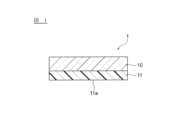
- FIG. 1 is a schematic cross-sectional view showing an example of a pressure-sensitive adhesive sheet according to the present embodiment.
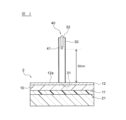
- FIG. 2 is a schematic cross-sectional view showing another example of the pressure-sensitive adhesive sheet according to the present embodiment.
- FIG. 3 is a schematic diagram for explaining the pen drop test in the examples.
- the pressure-sensitive adhesive sheet 1 has a substrate 10 and a pressure-sensitive adhesive layer 11, as shown in FIG. 1.
- the pressure-sensitive adhesive sheet may have other components as long as the effects of the present invention are obtained. That is, the pressure-sensitive adhesive sheet may have a layer that exerts a predetermined function as a layer other than the substrate and the pressure-sensitive adhesive layer.
- a release sheet may be disposed on the main surface 11a of the pressure-sensitive adhesive layer 11 to protect the pressure-sensitive adhesive layer 11 until it is attached to an adherend.
- adherends include window glass and peripheral parts of moving objects (automobiles, ships, aircraft, etc.) and buildings, display components such as display modules and protective panels, plastic parts, paper parts, semiconductor parts such as semiconductor wafers and semiconductor packages, insulating wafers such as glass wafers, etc.
- the adhesive sheet according to this embodiment can be used according to the application, for example, as a window film, a screen protection film, a surface protection sheet, a shatterproof film, a label, a process sheet, a label, a sheet for a delivery slip, a decorative film, a decorative sheet, a back grinding sheet, a dicing sheet, an expanding sheet, a pickup sheet, a repositioning sheet, a support sheet constituting a dicing die bonding sheet, a support sheet constituting a support sheet integrated back protection sheet, an imaging module protection sheet, etc.
- pressure-sensitive adhesive sheets are required to adhere sufficiently to the adherend, as well as to perform a specific function depending on the application.
- a function can be achieved, for example, by an adhesive layer that contains a functional component.
- the adhesive layer must exhibit the desired adhesive properties and perform the desired functions according to the application.
- an adhesive layer made of an adhesive with a biomass content within a specified range exhibits properties equivalent to those of an adhesive layer that does not contain biomass materials.
- the components of the adhesive sheet are described in detail below.
- the substrate according to the present embodiment is a material that provides the rigidity of the pressure-sensitive adhesive sheet and has a function of supporting the pressure-sensitive adhesive layer.
- the material of the substrate is not particularly limited as long as it has the above-mentioned function. In the present embodiment, it is preferable to use a resin material.
- resin materials include polyester resins such as polyethylene terephthalate and polyethylene naphthalate; polyolefin resins such as polyethylene, polypropylene, poly-4-methylpentene-1 and polybutene-1; polyurethane resins; polycarbonate resins; polyvinyl chloride resins; polyethersulfone resins; polyethylene sulfide resins; styrene resins; acrylic resins; polyamide resins; and films made of cellulose resins such as cellulose acetate, or laminated films thereof.
- polyester resins such as polyethylene terephthalate and polyethylene naphthalate
- polyolefin resins such as polyethylene, polypropylene, poly-4-methylpentene-1 and polybutene-1
- polyurethane resins polycarbonate resins
- polyvinyl chloride resins polyethersulfone resins
- polyethylene sulfide resins polyethylene sulfide resins
- styrene resins acrylic
- a material with a high biomass content may be used as the resin material constituting the substrate, or a material that can be recycled or reused from the perspective of the SDGs may be used, or a recycled or reused material may be used.
- films or laminated films made of polyolefin-based resins and polyester-based resins which have excellent mechanical strength and economic value, are preferred, and from the viewpoint of easily obtaining an adhesive sheet that satisfies the optical properties described below, films made of polyester-based resins or laminated films made of these are particularly preferred, and among these, polyethylene terephthalate films or laminated films containing polyethylene terephthalate are preferred.
- the laminate film is preferably a film in which one or more types of resin materials are laminated together, and such laminate films include laminate films having wavelength selectivity, including a multilayer structure having at least two layers with nanoscale thicknesses. If an adhesive sheet that satisfies the optical properties described below can be obtained, a laminate film that does not have wavelength selectivity or a laminate film that has wavelength selectivity can be appropriately selected and used.
- Wavelength selectivity here refers to the property of absorbing or reflecting light in a specific wavelength range
- a laminate film with wavelength selectivity means a laminate film that can control the transmittance in a specific wavelength range.
- the thickness of the substrate is not particularly limited as long as it exhibits a predetermined rigidity, and may be appropriately set according to the purpose of use.
- the thickness of the substrate is preferably 1 to 300 ⁇ m, more preferably 10 to 200 ⁇ m, particularly preferably 20 to 150 ⁇ m, and particularly preferably 30 to 130 ⁇ m.
- the thickness is preferably 40 to 110 ⁇ m, and particularly preferably 50 to 80 ⁇ m.
- the substrate may be transparent or colored.
- Metals such as aluminum, gold, silver, copper, nickel, cobalt, chromium, tin, and indium may also be vapor-deposited onto the substrate.
- the adhesive layer of the adhesive sheet according to the present embodiment is composed of an adhesive described below.
- the adhesive layer may be composed of one layer (single layer) or may be composed of two or more layers. When the adhesive layer has multiple layers, these multiple layers may be the same or different from each other, and the combination of layers constituting these multiple layers is not particularly limited.
- the thickness of the adhesive layer is preferably 1 to 1000 ⁇ m, more preferably 4 to 600 ⁇ m, even more preferably 8 to 300 ⁇ m, particularly preferably 12 to 200 ⁇ m, and of these, preferably 15 to 100 ⁇ m, and most preferably 20 to 50 ⁇ m.
- an adhesive sheet in combination with the substrate and functional layer, an adhesive sheet can be obtained that exhibits shatterproof properties and impact resistance (local or full surface).
- the above thickness is the total thickness of the multiple layers.
- the thickness of each adhesive layer is preferably 1 to 1000 ⁇ m, more preferably 4 to 600 ⁇ m, even more preferably 8 to 300 ⁇ m, and particularly preferably 12 to 200 ⁇ m, and among these, 15 to 100 ⁇ m is preferable, and 20 to 50 ⁇ m is most preferable.
- an adhesive sheet in combination with the substrate and functional layer, an adhesive sheet can be obtained that exhibits shatterproof properties and impact resistance (local or overall).
- Adhesive The adhesive is obtained from an adhesive composition containing the components described below.
- the biomass ratio of the adhesive is 10% or more and 90% or less.
- the biomass ratio is the ratio of the mass of carbon derived from biomass materials to the total mass of carbon contained in the adhesive, as shown in the following formula, when the total mass of carbon contained in the adhesive is 100%.
- Biomass content (%) of adhesive 100 x (mass of carbon derived from biomass materials contained in adhesive) / ((mass of carbon derived from biomass materials contained in adhesive) + (mass of carbon derived from fossil resources contained in adhesive))
- the biomass degree of the adhesive By controlling the biomass degree of the adhesive within the above range, the biomass degree of the adhesive layer in the adhesive sheet is also increased, resulting in a product that contributes to environmental conservation.
- the adhesive's biomass content is too low, it tends to be insufficiently environmentally friendly. If the adhesive's biomass content is too high, it tends to be insufficient in terms of the properties expected of the adhesive layer.
- the biomass content of the adhesive is preferably 30-85%, more preferably 40-80%, even more preferably 50-75%, and particularly preferably 60-70%.
- An example of a method for measuring the biomass content of an adhesive is a method that complies with ISO 16620.
- Adhesive examples include acrylic adhesives, polyester adhesives, polyurethane adhesives, rubber adhesives, and silicone adhesives.
- the adhesive may be in the form of an emulsion, solvent, or solventless type.
- the adhesive may or may not have a crosslinked structure.
- the adhesive composition may be the same or different in each adhesive layer.
- an acrylic adhesive is preferred as the adhesive, and an acrylic adhesive having a crosslinked structure is more preferred.
- the acrylic adhesive is preferably an adhesive obtained from an adhesive composition (hereinafter sometimes referred to as "adhesive composition P") whose main component is a (meth)acrylic acid ester polymer (A), and among them, the acrylic adhesive having a crosslinked structure is preferably an adhesive obtained by crosslinking an adhesive composition P containing a (meth)acrylic acid ester polymer (A) and a crosslinking agent (B).
- adhesive composition P an adhesive obtained from an adhesive composition (hereinafter sometimes referred to as "adhesive composition P") whose main component is a (meth)acrylic acid ester polymer (A), and among them, the acrylic adhesive having a crosslinked structure is preferably an adhesive obtained by crosslinking an adhesive composition P containing a (meth)acrylic acid ester polymer (A) and a crosslinking agent (B).
- an adhesive is likely to satisfy the optical properties and physical properties described below, and is likely to obtain good adhesive properties.
- (meth)acrylic acid means both acrylic acid and me
- the (meth)acrylic acid ester polymer (A) preferably contains, as monomer units constituting the polymer, a (meth)acrylic acid alkyl ester and a monomer having a reactive functional group in the molecule (a reactive functional group-containing monomer), which makes it easier to form a crosslinked structure (three-dimensional network structure) and makes it easier to obtain a pressure-sensitive adhesive having good adhesion and cohesive strength.
- the (meth)acrylic acid ester polymer (A) contains an alkyl (meth)acrylic acid ester as a monomer unit constituting the polymer, which allows the resulting adhesive to exhibit desirable adhesiveness.
- an alkyl (meth)acrylic acid ester an alkyl group having 1 to 20 carbon atoms is preferred.
- the alkyl group may be linear or branched, or may have a cyclic structure.
- the biomass degree of the above-mentioned adhesive in order to set the biomass degree of the above-mentioned adhesive within the above-mentioned range, it is preferable to replace at least a portion of the (meth)acrylic acid alkyl ester having an alkyl group containing 1 to 20 carbon atoms, which is a monomer that does not contain carbon derived from a biomass material (hereinafter also referred to as a non-biomass monomer), with a monomer that contains carbon derived from a biomass material (hereinafter also referred to as a biomass monomer).
- the alkyl group has 1 to 20 carbon atoms. From the viewpoint of easily improving the adhesive properties of the adhesive, it is preferable that the biomass monomer of (meth)acrylic acid alkyl ester has 1 to 11 carbon atoms in the alkyl group, more preferable that the biomass monomer of (meth)acrylic acid alkyl ester has 3 to 10 carbon atoms in the alkyl group, even more preferable that the biomass monomer of (meth)acrylic acid alkyl ester has 4 to 9 carbon atoms in the alkyl group, and particularly preferable that the biomass monomer of (meth)acrylic acid alkyl ester has 5 to 8 carbon atoms in the alkyl group.
- the glass transition temperature (Tg) of the biomass monomer of (meth)acrylic acid alkyl ester is preferably -100 to -40°C, more preferably -80 to -50°C, and even more preferably -70 to -60°C.
- (meth)acrylic acid alkyl ester biomass monomer By using the above-mentioned (meth)acrylic acid alkyl ester biomass monomer, it is possible to obtain an adhesive with good adhesive properties while keeping the biomass degree of the adhesive within the above-mentioned range.
- a specific example of a (meth)acrylic acid alkyl ester biomass monomer is n-octyl acrylate (Tg; -65°C).
- the biomass monomer of (meth)acrylic acid alkyl ester may be a commercially available product, or may be synthesized using raw materials derived from biomass materials ((meth)acrylic acid and alcohol).
- non-biomass monomers of (meth)acrylic acid alkyl esters with an alkyl group having 1 to 20 carbon atoms include methyl (meth)acrylate, ethyl (meth)acrylate, propyl (meth)acrylate, n-butyl (meth)acrylate, n-pentyl (meth)acrylate, n-hexyl (meth)acrylate, 2-ethylhexyl (meth)acrylate, isooctyl (meth)acrylate, n-octyl (meth)acrylate, n-decyl (meth)acrylate, n-dodecyl (meth)acrylate, myristyl (meth)acrylate, palmityl (meth)acrylate, and stearyl (meth)acrylate. These may be used alone or in combination of two or more.
- the non-biomass monomer of (meth)acrylic acid alkyl ester may be selected from the viewpoint of reinforcing the adhesive properties and cohesive strength exhibited by the biomass monomer of (meth)acrylic acid alkyl ester.
- the (meth)acrylic acid ester polymer (A) preferably contains, as a monomer unit constituting the polymer, 1 to 99.9 mass% of (meth)acrylic acid alkyl esters, which are biomass monomers, with the alkyl group having 1 to 20 carbon atoms (preferably 1 to 11, more preferably 3 to 10, even more preferably 4 to 9, and particularly preferably 5 to 8), per 100 mass% of the polymer. It is more preferable that it contains 15 to 95 mass%, more preferably that it contains 30 to 90 mass%, and particularly preferably that it contains 45 to 85 mass%. From the viewpoint of contributing to environmental conservation, it is preferable that it contains 55 to 80 mass%, and of these, it is preferable that it contains 60 to 75 mass%. This increases the biomass degree of the resulting adhesive, and it is possible to obtain an adhesive that satisfies the desired adhesive properties, optical properties, mechanical properties, etc.
- the (meth)acrylic acid ester polymer (A) preferably contains 80% by mass or less, and more preferably 70% by mass or less, of (meth)acrylic acid alkyl esters having an alkyl group with 1 to 20 carbon atoms, which are non-biomass monomers, in 100% by mass of the polymer, as monomer units constituting the polymer.
- the total content of non-biomass monomers, methyl (meth)acrylate, n-butyl (meth)acrylate, and 2-ethylhexyl (meth)acrylate, in 100% by mass of the polymer is preferably 65% by mass or less, more preferably 50% by mass or less, even more preferably 35% by mass or less, particularly preferably 20% by mass or less, even more preferably 5% by mass or less, and most preferably 0% by mass.
- This increases the biomass degree of the resulting adhesive, and an adhesive that satisfies the desired adhesive properties, optical properties, mechanical properties, etc. can be obtained.
- the (meth)acrylic acid ester polymer (A) preferably contains a monomer having an alicyclic structure in the molecule (alicyclic structure-containing monomer) as a monomer unit constituting the polymer. Since the alicyclic structure-containing monomer is bulky, its presence in the polymer is presumed to increase the distance between the polymers, and the resulting adhesive can have excellent flexibility. This allows the adhesive to conform well to the adherend, even if it is a member having unevenness (for example, steps), a curved member, a member having flexibility (bendable), etc.
- the carbon ring of the alicyclic structure in the alicyclic structure-containing monomer may be a saturated structure or may have an unsaturated bond in part.
- the alicyclic structure may be a monocyclic alicyclic structure or a polycyclic alicyclic structure (polycyclic structure) such as a bicyclic or tricyclic structure. From the viewpoint of optimizing the distance between the resulting (meth)acrylic acid ester polymer (A) and imparting high stress relaxation properties to the adhesive, it is preferable that the alicyclic structure is a polycyclic structure. Furthermore, in consideration of the compatibility of the (meth)acrylic acid ester polymer (A) with other components, it is particularly preferable that the polycyclic structure is a bicyclic to tetracyclic structure.
- the carbon number of the alicyclic structure meaning the total number of carbon atoms in the portion forming the ring, and in the case where multiple rings exist independently, means the total carbon number
- the carbon number is 5 to 15, and it is more preferable that the carbon number is 7 to 10.
- the glass transition temperature (Tg) of the biomass monomer containing an alicyclic structure is preferably 50 to 200°C, more preferably 70 to 160°C, even more preferably 80 to 130°C, and particularly preferably 90 to 110°C.
- biomass monomer that contains an alicyclic structure By using a biomass monomer that contains an alicyclic structure, it is possible to obtain an adhesive that has good adhesive properties while keeping the biomass degree of the adhesive within the above-mentioned range.
- a specific example of a biomass monomer that contains an alicyclic structure is isobornyl acrylate (Tg: 94°C).
- the biomass monomer containing an alicyclic structure may be a commercially available product, or may be synthesized using raw materials derived from biomass materials ((meth)acrylic acid and alcohol).
- non-biomass monomers containing an alicyclic structure examples include cyclohexyl (meth)acrylate, dicyclopentanyl (meth)acrylate, adamantyl (meth)acrylate, isobornyl (meth)acrylate, dicyclopentenyl (meth)acrylate, and dicyclopentenyloxyethyl (meth)acrylate.
- the non-biomass monomer of the alicyclic structure-containing monomer may be selected from the perspective of reinforcing the stress relaxation properties exhibited by the biomass monomer of the alicyclic structure-containing monomer.
- the (meth)acrylic acid ester polymer (A) preferably contains, as a monomer unit constituting the polymer, 1 to 30 mass % of an alicyclic structure-containing monomer having 5 to 15 carbon atoms, preferably 7 to 10 carbon atoms in the alicyclic structure, which is a biomass monomer, based on 100 mass % of the polymer, more preferably 4 to 26 mass %, even more preferably 8 to 22 mass %, and particularly preferably 12 to 18 mass %.
- This increases the biomass degree of the resulting adhesive, and also makes it possible to obtain an adhesive that satisfies the desired adhesive properties, optical properties, mechanical properties, etc.
- the (meth)acrylic acid ester polymer (A) preferably contains, as a monomer unit constituting the polymer, 30 mass% or less of an alicyclic structure-containing monomer, which is a non-biomass monomer, per 100 mass% of the polymer, more preferably 15 mass% or less, and even more preferably 10 mass% or less.
- the (meth)acrylic acid ester polymer (A) contains, as a monomer unit constituting the polymer, 8 mass% or less of isobornyl acrylate, which is a non-biomass monomer, per 100 mass% of the polymer, more preferably 4 mass% or less, and even more preferably 1 mass% or less. This increases the biomass degree of the resulting adhesive, and makes it possible to obtain an adhesive that satisfies the desired adhesive properties, optical properties, mechanical properties, etc.
- the (meth)acrylic acid ester polymer (A) contains an alicyclic structure-containing monomer as a monomer unit constituting the polymer, it preferably contains 10 to 99.9 mass% in total of the (meth)acrylic acid alkyl ester having 1 to 20 carbon atoms (preferably 1 to 11, more preferably 3 to 10, even more preferably 4 to 9, and particularly preferably 5 to 8) in the alkyl group as the biomass monomer, and the alicyclic structure-containing monomer having 5 to 15 carbon atoms, preferably 7 to 10, in the alicyclic structure as the biomass monomer, more preferably 30 to 99 mass%, even more preferably 50 to 95 mass%, particularly preferably 65 to 90%, and particularly preferably 75 to 85%.
- This makes it possible to obtain an adhesive that contributes to environmental conservation while satisfying the desired adhesive properties, optical properties, mechanical properties, etc.
- the total content of the (meth)acrylic acid alkyl ester having 1 to 20 carbon atoms in the alkyl group, which is a non-biomass monomer, and the alicyclic structure-containing monomer, which is a non-biomass monomer, in 100% by mass of the polymer is preferably 70% by mass or less, more preferably 50% by mass or less, even more preferably 25% by mass or less, particularly preferably 10% by mass or less, and even more preferably 1% by mass or less, with 0% by mass being preferred.
- the (meth)acrylic acid ester polymer (A) preferably contains a nitrogen atom-containing monomer as a monomer unit constituting the polymer. This gives the adhesive a predetermined polarity, making it easier to obtain an adhesive with excellent affinity even for adherends that have a certain degree of polarity.
- Nitrogen atom-containing monomers include monomers having an amino group, monomers having an amide group, and monomers having a nitrogen-containing heterocycle. Among them, from the viewpoint of imparting appropriate rigidity and polarity to the (meth)acrylic acid ester polymer (A), a monomer having a nitrogen-containing heterocycle is preferred. In addition, from the viewpoint of increasing the degree of freedom of the portion derived from the nitrogen atom-containing monomer in the higher-order structure of the pressure-sensitive adhesive to be formed, it is preferred that the nitrogen atom-containing monomer does not contain a reactive unsaturated double bond group other than one polymerizable group used in the polymerization to form the (meth)acrylic acid ester polymer (A). The nitrogen atom-containing monomer may be used alone or in combination of two or more kinds.
- Examples of monomers having an amino group include monomethylaminoethyl (meth)acrylate, monoethylaminoethyl (meth)acrylate, monomethylaminopropyl (meth)acrylate, monoethylaminopropyl (meth)acrylate, dimethylaminoethyl (meth)acrylate, etc.
- Examples of monomers having an amide group include (meth)acrylamide, N-methyl(meth)acrylamide, N-methylol(meth)acrylamide, N-tert-butyl(meth)acrylamide, N,N-dimethyl(meth)acrylamide, N-ethyl(meth)acrylamide, N,N-dimethylaminopropyl(meth)acrylamide, N-isopropyl(meth)acrylamide, N-phenyl(meth)acrylamide, N-(n-butoxymethyl)(meth)acrylamide, dimethylaminopropyl(meth)acrylamide, and N-vinylcaprolactam.
- Examples of monomers having a nitrogen-containing heterocycle include N-(meth)acryloylmorpholine, N-vinyl-2-pyrrolidone, N-(meth)acryloylpyrrolidone, N-(meth)acryloylpiperidine, N-(meth)acryloylpyrrolidine, N-(meth)acryloylaziridine, aziridinylethyl (meth)acrylate, 2-vinylpyridine, 4-vinylpyridine, 2-vinylpyrazine, 1-vinylimidazole, N-vinylcarbazole, and N-vinylphthalimide.
- N-(meth)acryloylmorpholine is preferred, and N-acryloylmorpholine is particularly preferred.
- the (meth)acrylic acid ester polymer (A) preferably contains 1 to 20 mass% of nitrogen atom-containing monomers as monomer units constituting the polymer, more preferably 2 to 16 mass%, even more preferably 3 to 12 mass%, and particularly preferably 4 to 8 mass%, based on 100 mass% of the polymer. This ensures sufficient adhesion to the adherend to which it is bonded.
- the (meth)acrylic acid ester polymer (A) contains a nitrogen atom-containing monomer as a monomer unit constituting the polymer, it preferably contains 10 to 99.9 mass % of a (meth)acrylic acid alkyl ester having 1 to 20 carbon atoms (preferably 1 to 11, more preferably 3 to 10, even more preferably 4 to 9, and particularly preferably 5 to 8) in the alkyl group, which is a biomass monomer, more preferably 30 to 95 mass %, even more preferably 50 to 90 mass %, and particularly preferably 70 to 85 mass %.
- the (meth)acrylic acid ester polymer (A) contains a nitrogen atom-containing monomer as a monomer unit constituting the polymer
- the (meth)acrylic acid alkyl ester which is a non-biomass monomer, and has an alkyl group with 1 to 20 carbon atoms
- the (meth)acrylic acid alkyl ester is preferably contained in an amount of 70 mass% or less, more preferably 50 mass% or less, even more preferably 25 mass% or less, particularly preferably 10 mass% or less, and of these, preferably 1 mass% or less, and preferably 0 mass%.
- This allows the (meth)acrylic acid ester polymer (A) to contain a large amount of the above-mentioned biomass monomer, and also allows the production of an adhesive that satisfies the desired adhesive properties, optical properties, mechanical properties, etc.
- the (meth)acrylic acid ester polymer (A) contains an aromatic ring-containing monomer as a monomer unit constituting the polymer. This gives the adhesive a certain degree of rigidity and adhesion, making it easier to obtain an adhesive that exhibits good adhesive strength.
- aromatic ring-containing monomers examples include phenyl (meth)acrylate, 2-phenylethyl (meth)acrylate, benzyl (meth)acrylate, naphthyl (meth)acrylate, 2-phenoxyethyl (meth)acrylate, phenoxybutyl (meth)acrylate, ethoxylated-o-phenylphenol acrylate, phenoxydiethylene glycol (meth)acrylate, phenoxypolyethylene glycol (meth)acrylate, biphenyl di(meth)acrylate, pentafluorobenzyl (meth)acrylate, and the like.
- phenyl (meth)acrylate, benzyl (meth)acrylate, 2-phenoxyethyl (meth)acrylate, phenoxybutyl (meth)acrylate, and the like are preferred, with 2-phenoxyethyl (meth)acrylate being particularly preferred.
- 2-phenoxyethyl (meth)acrylate may be used alone or in combination of two or more.
- the (meth)acrylic acid ester polymer (A) preferably contains 0.1 to 25 mass% of aromatic ring-containing monomers as monomer units constituting the polymer, and more preferably 1 to 20 mass% of the monomers, based on 100 mass% of the polymer. This makes it possible to impart a desired rigidity and adhesiveness to the adhesive, and makes it easier to obtain an adhesive that exhibits good adhesive strength.
- the (meth)acrylic acid ester polymer (A) contains an aromatic ring-containing monomer as a monomer unit constituting the polymer, it preferably contains 10 to 99.9 mass % of (meth)acrylic acid alkyl ester, which is a biomass monomer, having an alkyl group with 1 to 20 carbon atoms (preferably 1 to 11, more preferably 3 to 10, even more preferably 4 to 9, and particularly preferably 5 to 8), more preferably 30 to 99 mass %, even more preferably 50 to 95 mass %, particularly preferably 65 to 90%, and especially preferably 75 to 85%.
- This makes it possible to obtain an adhesive that contributes to environmental conservation while satisfying the desired adhesive properties, optical properties, mechanical properties, etc.
- the (meth)acrylic acid ester polymer (A) contains an aromatic ring-containing monomer as a monomer unit constituting the polymer
- the (meth)acrylic acid alkyl ester which is a non-biomass monomer, and has an alkyl group with 1 to 20 carbon atoms, is preferably contained in 70 mass% or less of the polymer, more preferably 50 mass% or less, even more preferably 25 mass% or less, particularly preferably 10 mass% or less, and of these, preferably 1 mass% or less, and preferably 0 mass%.
- This allows the (meth)acrylic acid ester polymer (A) to contain a large amount of the above-mentioned biomass monomer, and also allows the production of an adhesive that satisfies the desired adhesive properties, optical properties, mechanical properties, etc.
- the (meth)acrylic acid ester polymer (A) contains a reactive functional group-containing monomer as a monomer unit constituting the polymer, and the (meth)acrylic acid ester polymer (A) reacts with the crosslinking agent (B) described below via the reactive functional group derived from the reactive functional group-containing monomer, forming a crosslinked structure (three-dimensional network structure) in the adhesive.
- the crosslinking agent (B) described below the reactive functional group derived from the reactive functional group-containing monomer
- a functional group-containing monomer exhibiting hydrophilicity is preferable, and among them, a monomer having a hydroxyl group in the molecule (hydroxyl group-containing monomer), a monomer having a carboxyl group in the molecule (carboxyl group-containing monomer), a monomer having an amino group in the molecule (amino group-containing monomer), etc. are preferable.
- the reactive functional group-containing monomer may be used alone or in combination of two or more kinds.
- hydroxyl group-containing monomers examples include (meth)acrylic acid hydroxyalkyl esters such as 2-hydroxyethyl (meth)acrylate, 2-hydroxypropyl (meth)acrylate, 3-hydroxypropyl (meth)acrylate, 2-hydroxybutyl (meth)acrylate, 3-hydroxybutyl (meth)acrylate, and 4-hydroxybutyl (meth)acrylate.
- (meth)acrylic acid hydroxyalkyl esters having a hydroxyalkyl group with 1 to 4 carbon atoms are preferred.
- preferred examples include 2-hydroxyethyl (meth)acrylate and 4-hydroxybutyl (meth)acrylate. These may be used alone or in combination of two or more.
- carboxyl group-containing monomers examples include ethylenically unsaturated carboxylic acids such as acrylic acid, methacrylic acid, crotonic acid, maleic acid, itaconic acid, and citraconic acid.
- carboxylic acids such as acrylic acid, methacrylic acid, crotonic acid, maleic acid, itaconic acid, and citraconic acid.
- acrylic acid and methacrylic acid are preferred, and acrylic acid is more preferred, from the viewpoint of reactivity with the crosslinking agent (B) and copolymerizability with other monomers. These may be used alone or in combination of two or more.
- amino group-containing monomers examples include aminoethyl (meth)acrylate and n-butylaminoethyl (meth)acrylate. These may be used alone or in combination of two or more.
- the (meth)acrylic acid ester polymer (A) preferably contains 0.1 to 50 mass% of reactive functional group-containing monomers as monomer units constituting the polymer, based on 100 mass% of the polymer, more preferably 1 to 40 mass%, even more preferably 4 to 30 mass%, and particularly preferably 8 to 25 mass%. This ensures that the cohesive strength of the adhesive obtained by the crosslinking reaction with the crosslinking agent (B) is appropriate, making it easier to achieve the desired adhesive strength. In particular, it is possible to obtain an adhesive that satisfies the desired adhesive properties, optical properties, mechanical properties, etc., while still containing a large amount of the above-mentioned biomass monomer in the (meth)acrylic acid ester polymer (A).
- the (meth)acrylic acid ester polymer (A) does not contain a carboxyl group-containing monomer as a monomer unit of the reactive functional group-containing monomer that constitutes the polymer. Since a carboxyl group is an acid component, by not containing a carboxyl group-containing monomer, even if the object to which the pressure-sensitive adhesive is applied contains an object that may be damaged by acid, such as a transparent conductive film such as tin-doped indium oxide (ITO), a metal film, or a metal mesh, such damage caused by acid (corrosion, change in resistance, etc.) can be suppressed.
- a transparent conductive film such as tin-doped indium oxide (ITO), a metal film, or a metal mesh
- not containing a carboxyl group-containing monomer means that the carboxyl group-containing monomer is not substantially contained, and includes the case where the carboxyl group-containing monomer is contained to an extent that the carboxyl group does not cause corrosion of the transparent conductive film, metal wiring, etc., in addition to the case where the carboxyl group-containing monomer is not contained at all.
- the (meth)acrylic acid ester polymer (A) may contain the carboxyl group-containing monomer as a monomer unit in an amount of 0.1 mass % or less, preferably 0.01 mass % or less, and more preferably 0.001 mass % or less.
- the (meth)acrylic acid ester polymer (A) may contain other monomers as monomer units constituting the polymer, if desired.
- monomers that do not contain reactive functional groups are preferred so as not to inhibit the above-mentioned action of the reactive functional group-containing monomer.
- monomers include (meth)acrylic acid alkoxyalkyl esters such as methoxyethyl (meth)acrylate and ethoxyethyl (meth)acrylate, vinyl acetate, and styrene. These may be used alone or in combination of two or more.
- crosslinking agent (B) crosslinks the (meth)acrylic acid ester polymer (A) and forms a crosslinked structure (three-dimensional network structure) when the pressure-sensitive adhesive composition P containing the crosslinking agent (B) is heated, etc.
- the cohesive strength of the resulting pressure-sensitive adhesive is improved, the desired adhesive strength is easily achieved, and the adhesive has excellent adhesion to the adherend.
- the crosslinking agent (B) may be any that reacts with the reactive functional group of the (meth)acrylic acid ester polymer (A).
- the crosslinking agent include isocyanate-based crosslinking agents, epoxy-based crosslinking agents, amine-based crosslinking agents, melamine-based crosslinking agents, aziridine-based crosslinking agents, hydrazine-based crosslinking agents, aldehyde-based crosslinking agents, oxazoline-based crosslinking agents, metal alkoxide-based crosslinking agents, metal chelate-based crosslinking agents, metal salt-based crosslinking agents, and ammonium salt-based crosslinking agents.
- the isocyanate-based crosslinking agent contains at least a polyisocyanate compound.
- polyisocyanate compounds include aromatic polyisocyanates such as tolylene diisocyanate, diphenylmethane diisocyanate, and xylylene diisocyanate; aliphatic polyisocyanates such as hexamethylene diisocyanate; alicyclic polyisocyanates such as isophorone diisocyanate and hydrogenated diphenylmethane diisocyanate; and their biurets, isocyanurates, and adducts which are reactants with low-molecular-weight active hydrogen-containing compounds such as ethylene glycol, propylene glycol, neopentyl glycol, trimethylolpropane, and castor oil.
- trimethylolpropane-modified aromatic polyisocyanates are preferred from the viewpoint of reactivity with hydroxyl groups.
- 1,3-bis(N,N'-diglycidylaminomethyl)cyclohexane or N,N,N',N'-tetraglycidyl-m-xylylenediamine are preferred from the viewpoint of reactivity with carboxy groups.
- the content of the crosslinking agent (B) in the adhesive composition P is preferably 0.01 to 10 parts by mass, more preferably 0.04 to 5 parts by mass, particularly preferably 0.08 to 1 part by mass, even more preferably 0.1 to 0.6 parts by mass, and of these, preferably 0.12 to 0.3 parts by mass, relative to 100 parts by mass of the (meth)acrylic acid ester polymer (A).
- it makes it easier to obtain an adhesive having a high biomass degree while still satisfying the desired adhesive characteristics, optical properties, mechanical properties, etc.
- the pressure-sensitive adhesive composition P preferably contains a silane coupling agent (C), which improves adhesion to an adherend.
- the silane coupling agent is preferably an organosilicon compound having at least one alkoxysilyl group in the molecule, which has good compatibility with the adhesive component, especially the (meth)acrylic acid ester polymer (A), and has optical transparency.
- Silane coupling agents include, for example, silicon compounds containing polymerizable unsaturated groups, such as vinyltrimethoxysilane, vinyltriethoxysilane, and methacryloxypropyltrimethoxysilane; silicon compounds having an epoxy structure, such as 3-glycidoxypropyltrimethoxysilane and 2-(3,4-epoxycyclohexyl)ethyltrimethoxysilane; silicon compounds containing mercapto groups, such as 3-mercaptopropyltrimethoxysilane, 3-mercaptopropyltriethoxysilane, and 3-mercaptopropyldimethoxymethylsilane; Examples of such compounds include amino group-containing silicon compounds such as 3-aminopropyltrimethoxysilane, N-(2-aminoethyl)-3-aminopropyltrimethoxysilane, and N-(2-aminoethyl)-3-aminopropylmethyldimethoxysi
- the content of the silane coupling agent in the adhesive composition P is preferably 0.01 to 2 parts by mass, more preferably 0.05 to 1 part by mass, even more preferably 0.1 to 0.7 parts by mass, and particularly preferably 0.2 to 0.4 parts by mass, per 100 parts by mass of the (meth)acrylic acid ester polymer (A).
- the adhesive is likely to exhibit good unevenness-following properties and blister resistance.
- the content of the silane coupling agent is preferably in the above range per 100 parts by mass of the adhesive.
- the pressure-sensitive adhesive composition P also preferably contains an ultraviolet absorber (D) in order to impart an ultraviolet shielding function to the pressure-sensitive adhesive layer.
- ultraviolet absorbents examples include hydroxyphenyltriazine-based ultraviolet absorbents, benzophenone-based ultraviolet absorbents, and benzotriazole-based ultraviolet absorbents.
- the ultraviolet absorbents (D) can be used alone or in combination of two or more.
- hydroxyphenyltriazine-based UV absorbers examples include 2,4-bis(2-hydroxy-4-butoxyphenyl)-6-(2,4-dibutoxyphenyl)-1,3,5-triazine, 2,4,6-tris(2-hydroxy-4-octyloxyphenyl)-1,3,5-triazine, 2,4,6-tris[2-hydroxy-4-(3-butoxy-2-hydroxypropyloxy)phenyl]-1,3,5-triazine, and 2,4,6-tris(2-hydroxy-4-hexyloxy-3-methylphenyl)-1,3,5-triazine.
- benzophenone-based UV absorbers examples include 2,2'-dihydroxy-4-methoxybenzophenone, 2,2'-dihydroxy-4,4'-dimethoxybenzophenone, 2,2',4,4'-tetrahydroxybenzophenone, 2-hydroxy-4-methoxybenzophenone, 2,4-dihydroxybenzophenone, and 2-hydroxy-4-octoxybenzophenone.
- benzotriazole-based UV absorbers examples include 2-(2'-hydroxy-3',5'-di-tert-butylphenyl)-5-chlorobenzotriazole, 2-(2'-hydroxy-3'-tert-butyl-5'-methylphenyl)-5-chlorobenzotriazole, 2-(2'-hydroxy-3'-tert-amyl-5'-isobutylphenyl)-5-chlorobenzotriazole, 2-(2'-hydroxy-3'-isobutyl-5'-methylphenyl)-5-chlorobenzotriazole, 2-(2'-hydroxy-3'-isobutyl-5'-propylphenyl)-5-chlorobenzotriazole, 2-(2'-hydroxy-3',5'-di-tert-butylphenyl)benzotriazole, 2-(2'-hydroxy-5'-methylphenyl)benzotriazole, and 2-[2'-hydroxy-5'-(1,1,3,3
- the content of the ultraviolet absorber (D) in the adhesive composition P is preferably 0.01 to 30 parts by mass, more preferably 0.1 to 20 parts by mass, even more preferably 1 to 10 parts by mass, and particularly preferably 1.5 to 5 parts by mass, per 100 parts by mass of the (meth)acrylic acid ester polymer (A).
- the content of the ultraviolet absorber (D) is preferably in the above range per 100 parts by mass of the adhesive.
- the pressure-sensitive adhesive composition P preferably contains an infrared absorbing agent (E).
- the infrared absorbing agent (E) is preferably an infrared absorbing agent having excellent near-infrared absorbing properties, and examples of the infrared absorbing agent include organic infrared absorbing agents and inorganic infrared absorbing agents.
- Organic infrared absorbing agents include cyanine compounds, squarylium compounds, thiol nickel complex compounds, naphthalocyanine compounds, phthalocyanine compounds, triarylmethane compounds, naphthoquinone compounds, anthraquinone compounds, and amino compounds such as N,N,N',N'-tetrakis(p-di-n-butylaminophenyl)-p-phenylenediaminium perchlorate, phenylenediaminium chloride, phenylenediaminium hexafluoroantimonate, phenylenediaminium borate fluorosalt, phenylenediaminium fluoride, and phenylenediaminium perchlorate; copper compounds obtained by reacting copper compounds with copper compounds and bisthiourea compounds, phosphorus compounds with copper compounds, and phosphate compounds with copper compounds.
- inorganic infrared absorbers include titanium oxide, zirconium oxide, tantalum oxide, niobium oxide, zinc oxide, indium oxide, tin-doped indium oxide (ITO), tin oxide, antimony-doped tin oxide (ATO), zinc antimonate, cesium oxide, zinc sulfide, hexaborides ( LaB6 , CeB6 , PrB6 , NdB6 , GdB6 , TbB6 , DyB6 , HoB6 , YB6 , SmB6, EuB6 , ErB6 , TmB6 , YbB6 , LuB6 , SrB6 , CaB6 , etc.), tungsten oxide compounds, and the like.
- tungsten oxide-based compounds, tin-doped indium oxide (ITO), and antimony-doped tin oxide (ATO) are preferred, with tungsten oxide-based compounds being particularly
- the tungsten oxide compound may be a compound represented by the following general formula (1).
- the element M represents one or more elements selected from H, He, alkali metals, alkaline earth metals, rare earth elements, Zr, Cr, Mn, Fe, Ru, Co, Rh, Ir, Ni, Pd, Pt, Cu, Ag, Au, Zn, Cd, Al, Ga, In, Tl, Si, Ge, Sn, Pb, Sb, B, F, P, S, Se, Br, Te, Ti, Nb, V, Mo, Ta, Re, Be, Hf, Os, Bi, and I, and m and n are numbers that satisfy 0.001 ⁇ m ⁇ 1.0 and 2.2 ⁇ n ⁇ 3.0.)
- Preferred element M of the tungsten oxide compound represented by the above general formula (1) is a tungsten oxide compound containing one or more elements selected from the group consisting of Cs, Rb, K, Tl, In, Ba, Li, Ca, Sr, Fe, and Sn.
- Cs is preferred from the viewpoint of easily adjusting optical properties such as near-infrared transmittance, visible light transmittance, and haze to the desired ranges, as described below, that is, cesium-containing tungsten oxide is preferred.
- cesium-containing tungsten oxide include "YMF-02AS" manufactured by Sumitomo Metal Mining Co., Ltd., and can be preferably used.
- the infrared absorbing agent is preferably an inorganic infrared absorbing agent from the viewpoint of near-infrared transmittance and weather resistance, which will be described later.
- the infrared absorbing agent (E) may be used alone or in combination of two or more kinds.
- the infrared absorbing agent is a fine particle
- the average particle size is preferably 1 to 800 nm, and more preferably 5 to 300 nm, from the viewpoint of easily satisfying the optical properties described below.
- the adhesive according to this embodiment contains particulate infrared absorbing agents, it is preferable that the particulates be confirmed when observing a cross section of the adhesive layer using a SEM or the like.
- the adhesive according to this embodiment contains an infrared absorbing agent
- any of Cs, W, or O is detected when a cross-section of the adhesive layer is subjected to composition analysis using an apparatus such as XPS, and it is particularly preferable that Cs or W is detected.
- the content of the infrared absorber (E) in the adhesive composition P is preferably 0.1 to 30 parts by mass, more preferably 0.5 to 20 parts by mass, even more preferably 1 to 15 parts by mass, and particularly preferably 3 to 10 parts by mass, per 100 parts by mass of the (meth)acrylic acid ester polymer (A). This makes it easier to set the optical properties of the adhesive layer within the desired range.
- the content of the infrared absorber (E) is preferably in the above range per 100 parts by mass of the adhesive.
- the adhesive composition P contains a light diffusing component (F).
- the adhesive layer may contain one type of light diffusing component or two or more types.
- the adhesive layer is composed of two or more layers, it is preferred to prepare the adhesive composition so that at least one layer contains a light diffusing component.
- the light diffusing component may be used alone or in combination of two or more types.
- the light diffusing components of each layer may be the same or different.
- the light diffusing component (F) By including the light diffusing component (F), it becomes easier to adjust the optical properties (total light transmittance, haze value, brightness, chromaticity, etc.) of the adhesive layer to within the desired range. This makes it possible to improve the performance required of the adhesive layer.
- the performance required of the adhesive layer mentioned above includes, for example, the design (seamlessness) of the display body described below, optimization of color, concealment of the light source array pattern and circuit pattern, prevention of forgetting to inspect the adhesive layer, prevention of forgetting to attach it to a component, etc.
- the light-diffusing component (F) is preferably a light-diffusing particle.
- light-diffusing particles include inorganic particles such as silica, calcium carbonate, aluminum hydroxide, magnesium hydroxide, clay, talc, and titanium dioxide; organic light-transmitting particles such as acrylic resin, polystyrene resin, polyethylene resin, and epoxy resin; and particles made of silicon-containing compounds having an intermediate structure between inorganic and organic, such as silicone resin (for example, the Tospearl series manufactured by Momentive Performance Materials Japan).
- acrylic resin particles and particles made of silicon-containing compounds having an intermediate structure between inorganic and organic are preferred because they have excellent dispersibility in the above-mentioned adhesive component and can provide uniform optical properties.
- the light-diffusing particles may be used alone or in combination of two or more types.
- the light diffusing particles may be either regular or irregular in shape, but from the viewpoint of excellent dispersibility in the above-mentioned adhesive component, regular particles are preferred, spherical particles are more preferred, and truly spherical particles are particularly preferred.
- the average particle size of the light diffusing particles is preferably 0.1 to 20 ⁇ m, more preferably 1 to 16 ⁇ m, and when the light diffusing particles are particles made of a silicon-containing compound, it is even more preferably 2 to 12 ⁇ m, particularly preferably 3 to 10 ⁇ m, and of these, preferably 4 to 8 ⁇ m. This makes it easy to adjust the optical properties of the adhesive layer to a range that achieves the performance required of the adhesive layer described above.
- the average particle size of the light diffusing particles is preferably smaller than the thickness of the adhesive layer (single layer) containing the light diffusing particles.
- the ratio (X/Y) is preferably 0.001 to 0.8, more preferably 0.01 to 0.4, even more preferably 0.02 to 0.5, particularly preferably 0.04 to 0.2, and of these, preferably 0.07 to 0.15. This allows a good adhesive surface to be formed without the light diffusing particles protruding from the resulting adhesive layer, so that the desired adhesive force is exerted and the adhesion to the adherend is good.
- the light diffusing particles are easily uniformly dispersed in the adhesive layer, resulting in an adhesive layer that exhibits the desired optical properties.
- the above average particle size was measured by the centrifugal sedimentation light transmission method using a centrifugal automatic particle size distribution analyzer (Horiba, Ltd., CAPA-700) with a measurement sample of 1.2 g of particles and 98.8 g of isopropyl alcohol that had been thoroughly mixed.
- a centrifugal automatic particle size distribution analyzer Horiba, Ltd., CAPA-700
- the refractive index of the light diffusing particles is preferably 1.20 to 1.80, more preferably 1.30 to 1.70, even more preferably 1.35 to 1.60, and particularly preferably 1.40 to 1.50. This makes it easier to satisfy the optical properties described above.
- the refractive index of the light diffusing particles can be measured, for example, by the following method. That is, the particles are placed on a slide glass, a refractive index standard solution is dropped onto the particles, and a cover glass is placed on top to prepare a sample. The sample is observed under a microscope, and the refractive index of the refractive index standard solution that makes it most difficult to see the outline of the particle is taken as the refractive index of the particle.
- the content of the light diffusing component (F) in the adhesive composition P is preferably 1 to 100 parts by mass, more preferably 3 to 80 parts by mass, and even more preferably 5 to 60 parts by mass, per 100 parts by mass of the (meth)acrylic acid ester polymer (A).
- the content is more preferably 7 to 40 parts by mass, even more preferably 9 to 30 parts by mass, particularly preferably 10 to 25 parts by mass, and even more preferably 11 to 20 parts by mass.
- the optical properties of the adhesive layer to be adjusted to a range that achieves the performance required of the adhesive layer described above.
- the content of the light diffusing component is preferably in the above range per 100 parts by mass of the adhesive.
- the pressure-sensitive adhesive composition P also preferably contains a coloring component (G).
- the pressure-sensitive adhesive layer may contain one type of coloring component or two or more types of coloring components.
- the pressure-sensitive adhesive layer is composed of two or more layers, it is preferable to prepare the pressure-sensitive adhesive composition so that at least one layer contains a coloring component. Two or more of these may be used in combination.
- the coloring components in each layer may be the same or different.
- the optical properties (total light transmittance, haze value, lightness L * , chromaticity a * , chromaticity b *, etc. defined by the CIE1976L * a * b * color system) of the pressure-sensitive adhesive layer can be adjusted to a desired range, which makes it easier to satisfy the performance required of the pressure-sensitive adhesive layer.
- the performance required for the above-mentioned adhesive layer includes, for example, enhancing the design (seamlessness) of the display when the display to which the adhesive is attached is turned off by creating a sense of unity with the surrounding materials of the display, such as the frame material, and making the display surface of the display suitable in color.
- the required performance includes making the appearance defect due to the presence and absence of light-emitting bodies less visible by using the adhesive and improving the concealment.
- the required performance includes making the circuit pattern that should not be visible from the outside less visible by using the adhesive and improving the concealment. Furthermore, by using this adhesive in the inspection of adhesive sheets, the adhesive sheet lamination process, etc., the presence of the adhesive can be visually confirmed, which can prevent forgetting to inspect the adhesive layer or forgetting to apply it to a component.
- the coloring component may be a pigment or a dye.
- the pigment may be an inorganic pigment or an organic pigment. From the viewpoint of the durability of the resulting adhesive and of making it easier to satisfy the above-mentioned optical properties, inorganic pigments are preferred.
- the color of the coloring component can be appropriately selected depending on the purpose, but generally, a dark or deep color such as black, brown, navy blue, purple, or blue is preferred, and black is particularly preferred.
- inorganic pigments include carbon black, cobalt-based pigments, iron-based pigments, chromium-based pigments, titanium-based pigments, vanadium-based pigments, zirconium-based pigments, molybdenum-based pigments, ruthenium-based pigments, platinum-based pigments, ITO (tin-doped indium oxide)-based pigments, and ATO (antimony tin oxide)-based pigments.
- organic pigments and dyes examples include aminium dyes, cyanine dyes, merocyanine dyes, croconium dyes, squalium dyes, azulenium dyes, polymethine dyes, naphthoquinone dyes, pyrylium dyes, phthalocyanine dyes, naphthalocyanine dyes, naphtholactam dyes, azo dyes, condensed azo dyes, indigo dyes, perinone dyes, perylene dyes, dioxazine dyes, quinacridone dyes, isoindolinone dyes, quinophthalone dyes, pyrrole dyes, thioindigo dyes, metal complex dyes (metal complex dyes), dithiol metal complex dyes, indolephenol dyes, triarylmethane dyes, anthraquinone dyes, dioxazine dyes, naphthol dyes, azomethine dyes, benz
- black pigments include carbon black, copper oxide, iron oxide, manganese dioxide, aniline black, and activated carbon.
- black dyes include high-concentration vegetable dyes and azo dyes.
- the above pigments or dyes can be mixed appropriately to obtain the desired physical properties in the adhesive layer.
- black pigments or dyes are preferred from the viewpoint of easily satisfying the optical properties required to achieve the above-mentioned required performance, and carbon black, nigrosine-based black dyes, and chromate-based black dyes are particularly preferred.
- the carbon black may or may not have been subjected to a specified treatment (e.g., a solvent-philic treatment) on its surface.
- the above coloring component (G) satisfies the properties shown below.
- the optical properties total light transmittance, haze value, brightness, chromaticity, etc.
- the coloring component (G) is preferably one that has an average haze, which is the average of the haze value at a wavelength of 780 nm and the haze value at a wavelength of 380 nm, of 1 to 60%, more preferably 2 to 40%, and even more preferably 3 to 30%, and even more preferably 3.5 to 20%, and most preferably 4 to 10%.
- the coloring component (G) is preferably one in which the difference between the haze value at a wavelength of 780 nm and the haze value at a wavelength of 380 nm, when the coloring component is diluted 10,000 times with ethyl acetate, is 0 to 30 points, more preferably 1 to 20 points, particularly preferably 2 to 10 points, and even more preferably 3 to 8 points.
- the haze value at a wavelength of 780 nm of a solution obtained by diluting coloring component (G) 10,000 times with ethyl acetate is preferably 0.1 to 50%, more preferably 0.5 to 30%, particularly preferably 1 to 20%, and even more preferably 2 to 10%.
- the haze value at a wavelength of 380 nm of a solution obtained by diluting coloring component (G) 10,000 times with ethyl acetate is preferably 1 to 60%, more preferably 3 to 40%, particularly preferably 6 to 30%, and even more preferably 10 to 20%.
- the standard deviation of the haze value at each wavelength in the wavelength range of 380 nm to 780 nm at 5 nm intervals (i.e., 380 nm, 385 nm, 390 nm, ..., 775 nm, 780 nm) of a solution obtained by diluting the coloring component (G) 10,000 times with ethyl acetate is preferably 0.1 to 10, more preferably 0.4 to 7, particularly preferably 0.8 to 4, and even more preferably 1 to 2.
- the lightness L * of the surface of the formed pressure-sensitive adhesive layer is measured, and when the lightness L * is 90 or less, the additive component is determined to be a coloring component, and when the lightness L * is greater than 90, the additive component is determined to be a light diffusing component.
- the adhesive constituting the adhesive layer is active energy ray curable
- the adhesive composition P contains an active energy ray curable component. This makes it easier to obtain favorable adhesive properties, described below, while maintaining optical properties.
- the active energy ray curable component is not particularly limited as long as it is a component that cures by irradiation with active energy rays and provides the above-mentioned effects and optical and adhesive properties, and may be any of a monomer, oligomer, or polymer, or a mixture thereof. Among these, monofunctional acrylate monomers and polyfunctional acrylate monomers are preferred, and polyfunctional acrylate monomers are preferred from the viewpoint of the resulting adhesive maintaining its optical and adhesive properties.
- Polyfunctional acrylate monomers are preferred from the viewpoint of compatibility with adhesive components, particularly the (meth)acrylic acid ester polymer (A), and from the viewpoint of dispersibility of light diffusing components, coloring components, and the like in the adhesive, preferably have a molecular weight of less than 1000.
- polyfunctional acrylate monomer bifunctional, trifunctional, tetrafunctional, pentafunctional, and hexafunctional acrylate monomers are preferred.
- polyfunctional acrylate monomers containing an isocyanurate structure in the molecule such as di(acryloxyethyl)isocyanurate, tris(acryloxyethyl)isocyanurate, and ⁇ -caprolactone-modified tris-(2-(meth)acryloxyethyl)isocyanurate, or polyfunctional acrylate monomers containing a cyclic structure (particularly a cycloalkane structure) in the molecule, such as tricyclodecane dimethanol (meth)acrylate, are preferred. These may be used alone or in combination of two or more.
- the content of the active energy ray curable component in the adhesive composition P is preferably 0.1 to 30 parts by mass, more preferably 1 to 20 parts by mass, and even more preferably 2 to 10 parts by mass, per 100 parts by mass of the (meth)acrylic acid ester polymer (A).
- the adhesive is other than an acrylic adhesive
- the content of the active energy ray curable component is preferably in the above range per 100 parts by mass of the adhesive.
- the adhesive composition P When ultraviolet light is used as the active energy ray for curing the adhesive composition P, it is preferable that the adhesive composition P further contains a photopolymerization initiator in addition to the active energy ray curable component. This allows the active energy ray curable component to be polymerized efficiently, and also reduces the polymerization and curing time and the amount of active energy ray irradiation.
- photopolymerization initiators include benzoin, benzoin methyl ether, benzoin ethyl ether, benzoin isopropyl ether, benzoin-n-butyl ether, benzoin isobutyl ether, acetophenone, dimethylaminoacetophenone, 2,2-dimethoxy-2-phenylacetophenone, 2,2-diethoxy-2-phenylacetophenone, 2-hydroxy-2-methyl-1-phenylpropan-1-one, 1-hydroxycyclohexyl phenyl ketone, 2-methyl-1-[4-(methylthio)phenyl]-2-morpholino-propan-1-one, 4-(2-hydroxyethoxy)phenyl-2-(hydroxy-2-propyl)ketone, benzophenone, p-phenylbenzophenone, 4,4 '-Diethylaminobenzophenone, dichlorobenzophenone, 2-methylanthraquinone, 2-ethylanthraquino
- phosphine oxide-based photopolymerization initiators are preferred from the viewpoint of ease of cleavage upon exposure to ultraviolet light and ease of reliably curing the adhesive. Specifically, 2,4,6-trimethylbenzoyl-diphenyl-phosphine oxide, bis(2,4,6-trimethylbenzoyl)-phenylphosphine oxide, etc. are preferred. Even when ultraviolet light is irradiated through a member that has ultraviolet light blocking properties, the above-mentioned phosphine oxide-based photopolymerization initiators can promote curing of the active energy ray-curable component.
- the content of the photopolymerization initiator in the adhesive composition P is preferably 1 to 30 parts by mass, more preferably 4 to 20 parts by mass, and even more preferably 8 to 15 parts by mass, per 100 parts by mass of the active energy ray-curable component.
- the adhesive composition P contains an antistatic agent to the extent that it does not impair the optical properties and adhesive properties described above. This allows the adhesive layer to exhibit excellent antistatic performance.
- the antistatic agent may be any agent capable of imparting antistatic properties to the adhesive layer, and examples thereof include ionic compounds and nonionic compounds, with ionic compounds being preferred.
- the ionic compound may be a liquid (ionic liquid) or a solid (ionic solid) at room temperature.
- an ionic compound refers to a compound in which a cation and an anion are primarily bound together by electrostatic attraction.
- the antistatic agent may be used alone or in combination of two or more types.
- nitrogen-containing onium salts sulfur-containing onium salts, phosphorus-containing onium salts, alkali metal salts or alkaline earth metal salts are preferred. From the viewpoint of easily imparting good antistatic properties to the obtained adhesive layer while maintaining the above-mentioned optical properties and adhesive properties, nitrogen-containing onium salts or alkali metal salts are particularly preferred.
- the nitrogen-containing onium salt is preferably an ionic compound composed of a nitrogen-containing heterocyclic cation and its counter anion.
- the content of the antistatic agent in the adhesive composition P is preferably 0.01 to 20 parts by mass, more preferably 0.1 to 10 parts by mass, and even more preferably 0.5 to 5 parts by mass, per 100 parts by mass of the (meth)acrylic acid ester polymer (A).
- the content of the antistatic agent is preferably within the above range per 100 parts by mass of the adhesive.
- the adhesive composition P can be produced, for example, by first producing a (meth)acrylic acid ester polymer (A), and then mixing the resulting (meth)acrylic acid ester polymer (A) with a crosslinking agent (B) and, if necessary, a silane coupling agent (C). Furthermore, depending on the application, etc., an ultraviolet absorbing agent (D), an infrared absorbing agent (E), a light diffusing component (F), a coloring component (G), and other components (active energy ray curable components, photopolymerization initiators, antistatic agents, etc.) may be appropriately selected and added.
- a separate adhesive composition may be prepared to form each adhesive layer.
- the (meth)acrylic acid ester polymer (A) can be produced, for example, by polymerizing a mixture of monomers constituting the polymer by a normal radical polymerization method.
- the polymerization of the (meth)acrylic acid ester polymer (A) can be carried out by a solution polymerization method, using a polymerization initiator as necessary.
- polymerization solvents used in the solution polymerization method include ethyl acetate, n-butyl acetate, isobutyl acetate, toluene, acetone, hexane, and methyl ethyl ketone.
- One type of polymerization solvent may be used, or two or more types may be used in combination.
- polymerization initiators include azo compounds and organic peroxides, and two or more types may be used in combination.
- a chain transfer agent such as 2-mercaptoethanol in the above polymerization process, the weight average molecular weight of the resulting polymer can be adjusted.
- a crosslinking agent (B) and, if necessary, a silane coupling agent (C) are added to the obtained solution of the (meth)acrylic acid ester polymer (A) and mixed thoroughly to obtain a solvent-diluted adhesive composition P (coating solution).
- a solvent-diluted adhesive composition P coating solution
- an ultraviolet absorber (D), an infrared absorber (E), a light diffusing component (F), a coloring component (G), and other components active energy ray-curable components, photopolymerization initiators, antistatic agents, etc.
- any of the above components is a solid component, or if it is a component that will precipitate when mixed with other components in an undiluted state, that component may be dissolved or diluted in a dilution solvent before being mixed with the other components.
- dilution solvents examples include aliphatic hydrocarbons such as hexane, heptane, and cyclohexane; aromatic hydrocarbons such as toluene and xylene; halogenated hydrocarbons such as methylene chloride and ethylene chloride; alcohols such as methanol, ethanol, propanol, butanol, and 1-methoxy-2-propanol; ketones such as acetone, methyl ethyl ketone, 2-pentanone, isophorone, and cyclohexanone; esters such as ethyl acetate and butyl acetate; and cellosolve-based solvents such as ethyl cellosolve.
- aliphatic hydrocarbons such as hexane, heptane, and cyclohexane
- aromatic hydrocarbons such as toluene and xylene
- halogenated hydrocarbons such as methylene chloride and
- the concentration and viscosity of the prepared coating solution may be within the range that allows coating, and may be appropriately selected depending on the situation.
- the adhesive composition P is diluted so that the concentration is 10 to 60% by mass. Note that the addition of a dilution solvent or the like is not a necessary condition for obtaining the coating solution, and if the adhesive composition P has a viscosity that allows coating, it is not necessary to add a dilution solvent. In this case, the adhesive composition P becomes a coating solution in which the polymerization solvent for the (meth)acrylic acid ester polymer (A) itself serves as the dilution solvent.
- the adhesive constituting the adhesive layer is preferably obtained by crosslinking the above-mentioned adhesive composition P.
- the crosslinking of the adhesive composition P can usually be carried out by a heat treatment. This heat treatment can also serve as a drying treatment for volatilizing a diluting solvent and the like from a coating film of the adhesive composition P applied to a desired object.
- the heating temperature for the heat treatment is preferably 50 to 150°C, and more preferably 70 to 120°C.
- the heating time is preferably 10 seconds to 10 minutes, and more preferably 50 seconds to 2 minutes.
- a curing period of about 1 to 2 weeks may be provided at room temperature (e.g., 23°C, relative humidity 50%). If curing is required, an adhesive with a cross-linked structure will be obtained after the curing period has elapsed. If curing is not required, an adhesive with a cross-linked structure will be obtained after the heat treatment is completed.
- the pressure-sensitive adhesive layer according to this embodiment preferably has the following physical properties.
- the following physical properties are those of the entire pressure-sensitive adhesive layer.
- the gel fraction of the pressure-sensitive adhesive layer according to the present embodiment is preferably 20 to 99%, more preferably 30 to 90%, and even more preferably 40 to 80%. This allows the pressure-sensitive adhesive layer to exhibit good cohesiveness while easily exhibiting the desired adhesive strength. In addition, it is easy to set the mechanical properties (elongation at break, stress at break, etc.) of the pressure-sensitive adhesive sheet to the desired range, and it is easy to obtain a pressure-sensitive adhesive sheet that exhibits shatterproofness and impact resistance (local or full surface), and the protection of the adherend can be improved.
- the method for measuring the gel fraction of the pressure-sensitive adhesive will be described in detail in the examples described later.
- the adhesive sheet according to the present embodiment may have a functional layer in addition to the substrate and the adhesive layer. This allows the adhesive sheet to have various functions.
- the functions of the functional layer include hard coat properties, anti-glare properties, anti-reflection properties, ultraviolet absorption properties, infrared absorption properties, improved writing feel, Newton ring prevention properties, transparency, semi-transparency, antibacterial properties, antiviral properties, anti-fogging properties, water repellency, hydrophilic properties, oil repellency, lipophilic properties, sebum resistance (sebum wiping properties, sebum compatibility, sebum absorption properties, etc.), decorative properties, and antifouling properties.
- the functional layer 12 is preferably disposed on the main surface 10b of the substrate 10 opposite to the main surface 10a on which the adhesive layer 11 is disposed. Furthermore, it is also preferable that the functional layer is disposed between the substrate 10 and the adhesive layer 11.
- the functional layer may be composed of one layer having one or more of the above functions, or may have multiple layers having one or more of the above functions.
- the functional layer is preferably a hard coat layer having hard coat properties, and more preferably a hard coat layer having hard coat properties and at least one of the following functions: anti-glare properties, anti-reflection properties, ultraviolet absorption properties, infrared absorption properties, writing feel improvement properties, Newton ring prevention properties, transparency, semi-transparency, antibacterial properties, anti-viral properties, anti-fogging properties, water repellency, hydrophilic properties, oil repellency, lipophilic properties, sebum resistance (sebum wiping properties, sebum compatibility, sebum absorbency, etc.), decorative properties, and stain resistance.
- the functional layer is a hard coat layer.
- the hard coat layer is composed of a material that is superior in hardness, scratch resistance, weather resistance, etc. to the substrate.
- the adhesive sheet has the configuration shown in FIG. 2, when the adhesive layer is applied to an adherend, the hard coat layer is exposed to the outside of the adhesive sheet. This makes it possible to suppress scratches during application of the adhesive sheet and deformation of the adhesive layer.
- the adhesive sheet after application can also exhibit excellent impact resistance, scratch resistance, and weather resistance, and the physical properties of the adhesive sheet described above can be easily optimized. In particular, in combination with the adhesive layer and substrate, it becomes easier to obtain an adhesive sheet that exhibits shatterproof properties and impact resistance (local or full surface), and the protection of the adherend can be enhanced.
- the thickness of the hard coat layer may be set according to the application, and in this embodiment, from the viewpoint of the surface hardness, scratch resistance, and weather resistance of the adhesive sheet, it is preferably 1 to 20 ⁇ m, more preferably 2 to 14 ⁇ m, and even more preferably 3 to 7 ⁇ m. Such a thickness, in combination with the adhesive layer and substrate, makes it easier to obtain an adhesive sheet that exhibits shatterproof properties and impact resistance (localized or overall), and can enhance the protection of the adherend.
- the material constituting the hard coat layer is not particularly limited as long as it is a material that is superior to the substrate in hardness, scratch resistance, weather resistance, etc.
- a commercially available substrate with a hard coat layer may be used, or a cured product obtained by curing a composition for forming a hard coat layer may be used.
- An example of a commercially available substrate with a hard coat layer is the functional hard coat film Opteria H series manufactured by Lintec Corporation.
- compositions for forming a hard coat layer are examples of compositions for forming a hard coat layer:
- the hard coat layer forming composition Q may be composed of a thermosetting material or an active energy ray curable material. From the viewpoint of productivity and the viewpoint of easily obtaining a desired scratch resistance, it is preferable that it is composed of an active energy ray curable material, and it is preferable that it is a material containing an active energy ray curable component and a photopolymerization initiator.
- the active energy ray-curable component is not particularly limited and can be selected from conventionally known components, such as active energy ray-curable monomers, oligomers, and compositions containing them.
- active energy ray-curable monomers include polyfunctional (meth)acrylates.
- active energy ray-curable oligomers include urethane (meth)acrylates, polyester (meth)acrylates, polyether (meth)acrylates, silicone (meth)acrylates, etc.
- polyfunctional (meth)acrylates examples include 1,4-butanediol di(meth)acrylate, 1,6-hexanediol di(meth)acrylate, neopentyl glycol di(meth)acrylate, ethylene glycol di(meth)acrylate, propylene glycol di(meth)acrylate, hexanediol di(meth)acrylate, trimethylolethane tri(meth)acrylate, trimethylolpropane tri(meth)acrylate, pentaerythritol polyfunctional (meth)acrylates such as pentaerythritol tri(meth)acrylate and pentaerythritol tetra(meth)acrylate, dipentaerythritol polyfunctional (meth)acrylates such as dipentaerythritol penta(meth)acrylate and dipentaerythritol hexa(meth)acrylate, glycerol
- pentaerythritol polyfunctional (meth)acrylate or dipentaerythritol polyfunctional (meth)acrylate is more preferred because it can impart appropriate rigidity, scratch resistance, weather resistance, etc. to the hard coat layer.
- the hard coat layer forming composition Q preferably contains a photopolymerization initiator (b).
- a photopolymerization initiator By containing the photopolymerization initiator (b), a hard coat layer can be efficiently formed when the hard coat layer forming composition is irradiated with ultraviolet rays.
- Examples of the photopolymerization initiator (b) include the same photopolymerization initiators as those mentioned above. One of the examples may be used alone, or two or more may be used in combination.
- the content of the photopolymerization initiator (b) is preferably 1 to 50 parts by mass, more preferably 3 to 30 parts by mass, and even more preferably 5 to 20 parts by mass, per 100 parts by mass of the active energy ray-curable component (a).
- the hard coat layer forming composition Q may contain other additives as appropriate within the scope of not impairing the effects of the present invention.
- other additives include antioxidants, infrared absorbing agents, ultraviolet absorbing agents, antistatic agents, colorants, polymerization accelerators, polymerization inhibitors, plasticizers, leveling agents, antiviral agents, antibacterial agents, fillers, and dilution solvents.
- the hard coat layer preferably has the following physical properties.
- the pencil hardness of the surface of the hard coat layer is preferably B or more, more preferably HB or more, even more preferably F or more, and particularly preferably H or more.
- the upper limit of the pencil hardness is not particularly limited, but is preferably 9H or less, more preferably 6H or less, even more preferably 4H or less, and particularly preferably 3H or less.
- the method for measuring the pencil hardness is as shown in the test example described below.
- the method for producing the adhesive sheet 1 is not particularly limited, and may be produced by a known method.
- the above-mentioned coating liquid of the adhesive composition P is applied onto one main surface of the substrate, and the adhesive composition P is crosslinked by heat treatment to form a coating layer having a predetermined thickness, and the release surface of the release sheet is superposed on the coating layer.
- the above-mentioned coating liquid of the adhesive composition P is applied onto the release surface of the release sheet, and the adhesive composition P is crosslinked by heat treatment to form a coating layer having a predetermined thickness, and one main surface of the substrate is superposed on the coating layer.
- the coating layer becomes the adhesive layer 11 after a predetermined curing period.
- the coating layer becomes the adhesive layer 11 as it is. This results in an adhesive sheet 1 having a single adhesive layer.
- a coating liquid of adhesive composition P for forming one adhesive layer is applied to the release surface of one release sheet, a heat treatment is performed to crosslink the adhesive composition, a coating layer is formed, and a release sheet with a coating layer is obtained.
- a coating liquid of adhesive composition P for forming the other adhesive layer is applied to the release surface of the other release sheet, a heat treatment is performed to crosslink the adhesive composition, and a coating layer is formed, and a release sheet with a coating layer is obtained. Then, the release sheet with the coating layer and the release sheet with the coating layer are attached together so that the two coating layers are in contact with each other.
- the adhesive layer is three or more layers, multiple release sheets with coating layers may be prepared and the desired number of coating layers may be laminated in the desired stacking order.
- the coating layer will become an adhesive layer after a specified curing period. If curing is not required, the coating layer will become an adhesive layer as is. This results in an adhesive sheet 1 having multiple adhesive layers.
- the adhesive sheet has a hard coat layer
- a coating solution of the above-mentioned hard coat layer forming composition Q is applied to the other main surface of the substrate and dried. After drying, the solvent is evaporated from the hard coat layer forming composition Q, and the composition is cured by irradiating it with active energy rays such as ultraviolet rays and electron beams, thereby forming a hard coat layer on the substrate.
- ultraviolet light When ultraviolet light is used as the active energy ray, known ultraviolet light irradiation devices such as high-pressure mercury lamps, Heraeus H lamps, xenon lamps, etc. can be used.
- Examples of methods for applying the adhesive composition P and the hard coat layer forming composition Q include bar coating, knife coating, roll coating, blade coating, die coating, and gravure coating.
- the pressure-sensitive adhesive sheet according to this embodiment preferably has the following physical properties.
- the total light transmittance of the pressure-sensitive adhesive sheet according to the present embodiment is preferably 10% or more, more preferably 25% or more, even more preferably 50% or more, particularly preferably 75% or more, and of these, preferably 90% or more.
- the total light transmittance is preferably 100% or less, more preferably 94% or less, even more preferably 80% or less, particularly preferably 70% or less, and of these, preferably 50% or less.
- the total light transmittance in this specification is a value measured in accordance with JIS K7361-1:1997.
- the haze value of the adhesive sheet according to the present embodiment is preferably 0.01% or more from the viewpoint of design (seamlessness), concealment, prevention of forgetting to inspect, prevention of forgetting to attach to a member, etc., more preferably 0.1% or more, even more preferably 1% or more, particularly preferably 10% or more, among which, preferably 50% or more, and most preferably 80% or more.
- the haze value is preferably 100% or less, and from the viewpoint of ensuring good visibility, more preferably 60% or less, even more preferably 30% or less, particularly preferably 10% or less, among which, preferably 1% or less, and most preferably 0.5% or less.
- the haze value in this specification is a value measured in accordance with JIS K7136:2000.
- the lightness L * of the pressure-sensitive adhesive sheet according to the present embodiment is preferably 10 or more from the viewpoint of transparency and visibility, more preferably 50 or more, even more preferably 80 or more, and particularly preferably 90 or more. From the viewpoints of design (seamlessness), concealment, prevention of forgetting to inspect, prevention of forgetting to apply to a member, etc. , the lightness L* is preferably 100 or less, preferably 90 or less, more preferably 80 or less, and even more preferably 70 or less.
- the chromaticity a * defined by the CIE1976L * a * b * color system of the pressure-sensitive adhesive sheet according to this embodiment is preferably -30 to 30, more preferably -15 to 15, even more preferably -5 to 5, and particularly preferably -2 to 2.
- the chromaticity b * defined by the CIE1976L * a * b * color system of the pressure-sensitive adhesive sheet according to this embodiment is preferably -30 to 30, more preferably -15 to 15, even more preferably -5 to 5, and particularly preferably -2 to 2.
- the adhesive strength to soda-lime glass is preferably 1 to 100 N/25 mm, more preferably 5 to 75 N/25 mm, and even more preferably 10 to 50 N/25 mm. This ensures sufficient adhesion to the adherend to which it is attached. In particular, it becomes easier to obtain a pressure-sensitive adhesive sheet that exhibits shatterproof properties and impact resistance (local or full-surface), and the protective properties of the adherend can be improved.
- the method for measuring the adhesive strength of the pressure-sensitive adhesive sheet will be described in detail in the Examples below.
- the breaking elongation of the pressure-sensitive adhesive sheet is preferably 50 to 1000%, more preferably 70 to 700%, even more preferably 90 to 400%, and particularly preferably 100 to 300%.
- the method for measuring the breaking elongation of the pressure-sensitive adhesive sheet will be described in detail in the examples described below.
- the breaking stress of the pressure-sensitive adhesive sheet is preferably 50 to 1000 kN/ mm2 , more preferably 70 to 700 kN/ mm2 , even more preferably 90 to 400 kN/ mm2 , and particularly preferably 100 to 200 kN/ mm2 .
- This allows the pressure-sensitive adhesive sheet to be suitably used for various applications while maintaining a good usability. In particular, it becomes easier to obtain a pressure-sensitive adhesive sheet that exhibits shatterproof properties and impact resistance (local or full surface), and the protection of the adherend can be improved.
- the method for measuring the breaking stress of the pressure-sensitive adhesive sheet will be described in detail in the examples described below.
- Example 1 Preparation of (meth)acrylic acid ester polymer 15 parts by mass of isobornyl acrylate as a biomass monomer was copolymerized with 65 parts by mass of 2-ethylhexyl acrylate, 5 parts by mass of N-acryloylmorpholine, and 15 parts by mass of 2-hydroxyethyl acrylate as non-biomass monomers to prepare a (meth)acrylic acid ester polymer (A). The molecular weight of the obtained (meth)acrylic acid ester polymer (A) was measured by the method described below, and the weight average molecular weight (Mw) was 500,000.
- Mw weight average molecular weight
- the weight average molecular weight (Mw) is a polystyrene-equivalent weight average molecular weight measured by gel permeation chromatography (GPC) under the following conditions (GPC measurement).
- GPC measurement ⁇ GPC measurement device: Tosoh Corporation, HLC-8020 GPC column (passed in the following order): TSK guard column HXL-H manufactured by Tosoh Corporation TSK gel GMHXL (x2) TSK gel G2000HXL Measurement solvent: tetrahydrofuran Measurement temperature: 40°C
- the obtained coating solution of the adhesive composition was applied by a knife coater to the release-treated surface of a release sheet, one side of which was a polyethylene terephthalate film treated with a silicone-based release agent.
- the coating layer was then heated at 90°C for 1 minute to promote a crosslinking reaction, forming an adhesive layer having a thickness of 25 ⁇ m, and a laminate of a release sheet and an adhesive layer was obtained.
- the adhesive layer of the laminate and one main surface of a polyethylene terephthalate (PET) film having a thickness of 125 ⁇ m as a substrate were bonded together so as to be in contact with each other, to obtain an adhesive sheet having a substrate/adhesive layer/release sheet configuration.
- the thickness of the adhesive layer was measured using a constant pressure thickness measuring instrument (PG-02 manufactured by Teclock Co., Ltd.) in accordance with JIS K7130.
- Example 2 A pressure-sensitive adhesive sheet having a configuration of hard coat layer A/substrate/pressure-sensitive adhesive layer/release sheet was obtained in the same manner as in Example 1, except that the composition of the biomass monomer and non-biomass monomer of the (meth)acrylic acid ester polymer (A) was the composition shown in Table 1, a substrate with an antiglare hard coat layer formed using the composition for forming a hard coat layer shown below was used as the substrate, and a pressure-sensitive adhesive layer was formed on the main surface of the substrate on which the hard coat layer was not formed.
- the prepared coating solution of the composition for forming a hard coat layer was gravure coated on one main surface of a polyethylene terephthalate (PET) film having a thickness of 125 ⁇ m as a substrate so that the thickness after drying was 3 ⁇ m, and the coating was heated at 70° C. for 1 minute to thoroughly remove the dilution solvent.
- PET polyethylene terephthalate
- the composition for forming a hard coat layer was cured by irradiating ultraviolet rays under the following conditions using an ultraviolet irradiator (manufactured by GS Yuasa Corporation, product name "nitrogen purged small conveyor type UV irradiator CSN2-40") to form an antiglare hard coat layer A (thickness: 3 ⁇ m), and a substrate with an antiglare hard coat layer (haze value: 4.0%) was obtained.
- ultraviolet irradiator manufactured by GS Yuasa Corporation, product name "nitrogen purged small conveyor type UV irradiator CSN2-40"
- Example 5 A pressure-sensitive adhesive sheet having a configuration of hard-coat layer B/substrate/pressure-sensitive adhesive layer/release sheet was obtained in the same manner as in Example 2, except that a substrate with a hard-coat layer formed using a composition for forming a hard-coat layer shown below was used instead of the substrate with an antiglare hard-coat layer prepared in Example 2.
- the prepared coating solution of the composition for forming a hard coat layer was gravure coated on one main surface of a polyethylene terephthalate (PET) film having a thickness of 75 ⁇ m as a substrate so that the thickness after drying was 3 ⁇ m, and the coating was heated under conditions of 70° C. and 1 minute to thoroughly remove the dilution solvent.
- PET polyethylene terephthalate
- the composition for forming a hard coat layer was cured by irradiating ultraviolet rays under the following conditions using an ultraviolet irradiator (manufactured by GS Yuasa Corporation, product name "nitrogen purged small conveyor type UV irradiator CSN2-40") to form a hard coat layer B (thickness: 3 ⁇ m), and a substrate with a hard coat layer (haze value: 0.3%) was obtained.
- ultraviolet irradiator manufactured by GS Yuasa Corporation, product name "nitrogen purged small conveyor type UV irradiator CSN2-40"
- Examples 3, 4, 10-12 and 17-19 Except for changing the composition and weight average molecular weight of the biomass monomer and non-biomass monomer of the (meth)acrylic acid ester polymer (A), the amount of the ultraviolet absorber (D), the amount of the infrared absorber (E), the amount of the light diffusing component (F), and the amount of the coloring component (G) as shown in Table 1, a pressure-sensitive adhesive sheet having a configuration of hard coat layer A/substrate/pressure-sensitive adhesive layer/release sheet was produced in the same manner as in Example 2.
- Examples 6, 7, 13-15 and 20-22 Except for changing the composition and weight average molecular weight of the biomass monomer and non-biomass monomer of the (meth)acrylic acid ester polymer (A), the amount of the ultraviolet absorber (D), the amount of the infrared absorber (E), the amount of the light diffusing component (F), and the amount of the coloring component (G) as shown in Table 1, a pressure-sensitive adhesive sheet having a configuration of hard coat layer B/substrate/pressure-sensitive adhesive layer/release sheet was produced in the same manner as in Example 5.
- Examples 8, 9, 16, 23 and Comparative Example 1 Except for changing the composition and weight average molecular weight of the biomass monomer and non-biomass monomer of the (meth)acrylic acid ester polymer (A) as shown in Table 1, a pressure-sensitive adhesive sheet having a substrate/pressure-sensitive adhesive layer/release sheet structure was produced in the same manner as in Example 1.
- the amounts of the crosslinking agent (B), silane coupling agent (C), ultraviolet absorber (D), infrared absorber (E), light diffusing component (F) and coloring component (G) are expressed as amounts (solids equivalent) per 100 parts by mass (solids equivalent) of the (meth)acrylic acid ester polymer (A).
- Table 1 Details of the abbreviations and the like in Table 1 are as follows.
- the coloring component (G) the optical properties of a solution obtained by diluting the coloring component in Table 1 by 10,000 times with ethyl acetate are shown in Table 2.
- the optical properties shown in Table 2 were calculated from the haze value (%) obtained for the above-mentioned diluted solution using a haze meter (manufactured by Nippon Denshoku Industries Co., Ltd., product name "SH-7000”) in accordance with JIS K7136:2000.
- the difference from the haze value is the difference between the haze value at a wavelength of 780 nm and the haze value at a wavelength of 380 nm
- the average haze is the average value of the haze value at a wavelength of 780 nm and the haze value at a wavelength of 380 nm
- the standard deviation of the haze value is the standard deviation of the haze value at each wavelength at a 5 nm pitch in the wavelength range of 380 nm to 780 nm.
- the release sheet was peeled off from the pressure-sensitive adhesive sheet according to the embodiment and the comparative example, and the exposed pressure-sensitive adhesive layer was attached to soda glass to obtain a measurement sample. After performing blank correction only on the soda glass, measurement light from a haze meter (manufactured by Nippon Denshoku Industries Co., Ltd., product name "NDH-5000") was incident on the pressure-sensitive adhesive layer side of the measurement sample, and the total light transmittance (%) was measured according to JIS K7316-1:1997. The measurement was performed three times, and the average value was taken as the total light transmittance. The results are shown in Table 3.
- the adhesive sheets according to the examples and comparative examples were cut into a width of 25 mm and a length of 100 mm, which were used as samples.
- the release sheet was peeled off from the sample, and the exposed adhesive layer was attached to soda lime glass (thickness: 1.1 mm), and then pressurized for 20 minutes at 0.5 MPa and 50°C in an autoclave manufactured by Kurihara Seisakusho Co., Ltd.
- the adhesive layer in the laminate of the release sheet and the adhesive layer used in producing the adhesive sheets according to the examples and comparative examples was cut to a size of 80 mm x 80 mm, the adhesive layer was wrapped in a polyester mesh (product name: Tetron mesh #200), and the mass was weighed using a precision balance. The mass of the adhesive alone was calculated by subtracting the mass of the mesh alone from the weighed value. The mass at this time was designated as M1.
- the printed ultraviolet-curable ink was then cured by irradiation with ultraviolet light (80 W/cm 2 , two metal halide lamps, lamp height 15 cm, belt speed 10-15 m/min), producing a stepped glass plate having steps (convex and concave) caused by the printed layer (step height: 5 ⁇ m).
- the adhesive layer in the laminate of the release sheet and adhesive layer used in producing the adhesive sheets of the Examples and Comparative Examples was attached to the easy-adhesion layer of a polyethylene terephthalate (PET) film (manufactured by Toyobo Co., Ltd., product name "Cosmoshine A4160", thickness: 100 ⁇ m) having an easy-adhesion layer.
- PET polyethylene terephthalate
- the release sheet was peeled off to expose the adhesive layer, and using a laminator (manufactured by Fujipla Co., Ltd., product name "LPD3214"), the adhesive layer was laminated onto a stepped glass plate so that it covered the entire frame-shaped print. After that, it was autoclaved for 30 minutes under conditions of 50°C and 0.5 MPa, and left for 24 hours at normal pressure, 23°C, and relative humidity of 50%.
- the pencil hardness of the surface of the hard coat layer of the adhesive sheet according to the embodiment was measured according to JIS K5600. Specifically, a test was carried out on the surface of the hard coat layer by running pencils with different hardnesses (manufactured by Mitsubishi Pencil Co., Ltd., product name "Mitsubishi Pencil Uni") at a load of 750 g and an angle of 45° for 7 mm or more. The test was carried out five times, and the hardness of the pencil core that did not scratch the film surface four or more times was taken as the pencil hardness of the surface of the hard coat layer. The results are shown in Table 3.
- the release sheet was peeled off from the adhesive sheet according to the embodiment, and the exposed adhesive layer was attached to a float glass plate having a thickness of 3 mm.
- Steel wool with a number of #0000 was placed on the hard coat layer of the adhesive sheet, and the steel wool was pressed with a load of 250 g/cm 2 and rubbed 10 times back and forth over 10 cm on the hard coat layer. Thereafter, the surface of the hard coat layer rubbed with the steel wool was visually confirmed under a three-wavelength fluorescent lamp, and the scratch resistance was evaluated according to the following criteria.
- the scratch resistance was evaluated for the surface of the substrate opposite to the adhesive layer. The results are shown in Table 3.
- ⁇ The number of scratches was 0.
- ⁇ The number of scratches was 1 or more.
- the release sheet of the adhesive sheet obtained in the examples and comparative examples was peeled off and the exposed adhesive layer was attached to a soda lime glass plate (manufactured by Nippon Sheet Glass Co., Ltd.) having a length of 170 mm, a width of 150 mm, and a thickness of 1 mm. Then, a laminate consisting of the glass plate and the adhesive sheet was placed on two tables having a height of 10 mm placed on a table.
- a soda lime glass plate manufactured by Nippon Sheet Glass Co., Ltd.
- the adhesive sheet side was facing upward (opposite the above-mentioned tables), and the laminate was placed so that the portions from both ends in the long side direction to 10 mm were placed on the above-mentioned tables, and the center was placed in a floating state (height 10 mm). Then, an iron ball (200 g) having a diameter of 31.75 mm was dropped from a height of 30 cm onto the center of the laminate. The state of the laminate was then visually observed, and the shatterproofness was evaluated according to the following criteria. The results are shown in Table 3. ⁇ ...The adhesive sheet did not tear and the glass did not shatter. ⁇ : The adhesive sheet broke and glass shattered.
- the release sheets were peeled off from the pressure-sensitive adhesive sheets according to the Examples and Comparative Examples, and the exposed pressure-sensitive adhesive layers were attached to soda glass (thickness: 700 ⁇ m) to obtain laminates of hard coat layer/substrate/pressure-sensitive adhesive layer/soda glass.
- the pen drop test will be explained with reference to FIG. 3.
- a laminate 2 having a hard coat layer 12/substrate 10/adhesive layer 11/glass 21 structure was placed with the hard coat layer 12 side facing up.
- a cylinder 30 with both ends open was contacted with one end 31 perpendicular to the main surface 12a of the hard coat layer 12 of the laminate 2, and a ballpoint pen 40, the total weight of which was adjusted to 100 g with a weight, was dropped from the other end 32 from a height of 30 cm from the main surface 12a of the hard coat layer 12.
- the ballpoint pen 40 was dropped with the pen tip 41 facing downward, and the pen tip 41 was brought into contact with the main surface 12a of the hard coat layer 12.
- a laminate having a substrate 10/adhesive layer 11/glass 21 structure was placed with the substrate 10 side facing up, and the pen drop test was performed.
- the environmental conservation contribution of the adhesive was evaluated based on the calculated biomass ratio according to the following criteria. The results are shown in Table 3.
- ⁇ The biomass degree of the pressure-sensitive adhesive layer was 60% or more.
- ⁇ The biomass degree of the pressure-sensitive adhesive layer was 40% or more and less than 60%.
- ⁇ The biomass degree of the pressure-sensitive adhesive layer was 10% or more and less than 40%.
- ⁇ The biomass degree of the pressure-sensitive adhesive layer was less than 10%.
- the adhesive sheet of the present invention can be used favorably as an environmentally friendly product.
- Adhesive sheet 10 Substrate 11: Adhesive layer 12: Functional layer
Landscapes
- Chemical & Material Sciences (AREA)
- Organic Chemistry (AREA)
- Adhesives Or Adhesive Processes (AREA)
Abstract
Description
粘着剤層を構成する粘着剤に含まれる炭素の合計質量を100%とした時に、粘着剤に含まれる炭素のうち、バイオマス材料由来の炭素の質量が占める割合を示すバイオマス度が、10%以上90%以下である粘着シートである。
本実施形態に係る粘着シート1は、図1に示すように、基材10と、粘着剤層11と、を有する。また、本発明の効果が得られる限りにおいて、粘着シートは他の構成要素を有していてもよい。すなわち、粘着シートは、基材および粘着剤層以外の層として、所定の機能を発揮する層を有していてもよい。また、被着体に貼付するまで粘着剤層11を保護するために、粘着剤層11の主面11aに剥離シートが配置されていてもよい。
本実施形態に係る基材は、粘着シートの剛性を担う材料であり、粘着剤層を支持する機能を有している。基材の材質は、上記の機能を有していれば特に制限されない。本実施形態では、樹脂材料が好適に用いられることが好ましい。
本実施形態に係る粘着シートが有する粘着剤層は、後述する粘着剤から構成される。また、粘着剤層は、1層(単層)から構成されていてもよいし、2層以上の複数層から構成されていてもよい。粘着剤層が複数層を有する場合、これら複数層は、互いに同一でも異なっていてもよく、これら複数層を構成する層の組み合わせは特に制限されない。
粘着剤は、後述する成分を含む粘着性組成物から得られる。
本実施形態では、粘着剤のバイオマス度は、10%以上90%以下である。バイオマス度は、下記の式に示すように、粘着剤に含まれる炭素の合計質量を100%とした時に、粘着剤に含まれる炭素のうち、バイオマス材料由来の炭素の質量が占める割合である。
粘着剤のバイオマス度(%)=100×(粘着剤に含まれるバイオマス材料由来の炭素の質量)/((粘着剤に含まれるバイオマス材料由来の炭素の質量)+(粘着剤に含まれる化石資源由来の炭素の質量))
粘着剤の組成系としては、たとえば、アクリル系粘着剤、ポリエステル系粘着剤、ポリウレタン系粘着剤、ゴム系粘着剤、シリコーン系粘着剤が例示される。また、当該粘着剤の形態は、エマルション型、溶剤型または無溶剤型のいずれであってもよい。さらに、当該粘着剤は、架橋構造を有していてもよいし、架橋構造を有していなくてもよい。
(メタ)アクリル酸エステル重合体(A)は、当該重合体を構成するモノマー単位として、(メタ)アクリル酸アルキルエステルと、分子内に反応性官能基を有するモノマー(反応性官能基含有モノマー)と、を含有することが好ましい。これにより、架橋構造(三次元網目構造)が形成されやすくなり、良好な粘着性および凝集力を有する粘着剤が得られやすくなる。
架橋剤(B)は、当該架橋剤(B)を含有する粘着性組成物Pの加熱等を契機として、(メタ)アクリル酸エステル重合体(A)を架橋し、架橋構造(三次元網目構造)を形成する。その結果、得られる粘着剤の凝集力が向上し、所望の粘着力を満たしやすくなって、被着体との密着性に優れるものとなる。
粘着性組成物Pは、シランカップリング剤(C)を含むことが好ましい。これにより、被着体との密着性が向上する。
粘着性組成物Pは、粘着剤層に紫外線遮蔽機能を付与するために、紫外線吸収剤(D)を含むことも好ましい。
粘着性組成物Pは、粘着剤層に遮熱性能を付与する為に、赤外線吸収剤(E)を含むことも好ましい。赤外線吸収剤(E)は、近赤外線吸収性に優れる赤外線吸収剤であることが好ましく、有機系赤外線吸収剤、無機系赤外線吸収剤等が例示される。
MmWOn…(1)
(式中、元素MはH、He、アルカリ金属、アルカリ土類金属、希土類元素、Zr、Cr、Mn、Fe、Ru、Co、Rh、Ir、Ni、Pd、Pt、Cu、Ag、Au、Zn、Cd、Al、Ga、In、Tl、Si、Ge、Sn、Pb、Sb、B、F、P、S、Se、Br、Te、Ti、Nb、V、Mo、Ta、Re、Be、Hf、Os、Bi、Iのうちから選択される1種類以上の元素を示し、m及びnは、0.001≦m≦1.0及び2.2≦n≦3.0を満たす数である。)
粘着性組成物Pは、光拡散成分(F)を含むことも好ましい。粘着剤層が1層である場合、当該粘着剤層は光拡散成分を1種含んでもよいし、2種以上含んでもよい。粘着剤層が2層以上から構成される場合には、少なくとも1層が光拡散成分を含むように粘着性組成物を調製することが好ましい。なお、光拡散成分は、1種を単独で、または2種以上を組み合わせて使用することができる。また、複数の層が光拡散成分を含む場合には、各層の光拡散成分が同じであってもよいし、異なっていてもよい。
粘着性組成物Pは、着色成分(G)を含むことも好ましい。粘着剤層が1層である場合、当該粘着剤層は、着色成分を1種含んでもよいし、2種以上含んでもよい。粘着剤層が2層以上から構成される場合には、少なくとも1層が着色成分を含むように粘着性組成物を調製することが好ましい。なお、着色成分は、1種を単独で、または2種以上を組み合わせて使用することができる。また、複数の層が着色成分を含む場合には、各層の着色成分が同じであってもよいし、異なっていてもよい。
粘着性組成物Pは、必要に応じて、粘着剤に通常使用されている添加剤を含有してもよい。このような添加剤としては、活性エネルギー線硬化性成分、光重合開始剤、帯電防止剤、粘着付与剤、酸化防止剤、光安定剤、軟化剤、防錆剤、充填剤、屈折率調整剤等が例示される。なお、後述の重合溶媒や希釈溶媒は、粘着性組成物Pを構成する添加剤に含まれないものとする。
粘着性組成物Pは、たとえば、まず、(メタ)アクリル酸エステル重合体(A)を製造し、得られた(メタ)アクリル酸エステル重合体(A)と、架橋剤(B)と、必要に応じて、シランカップリング剤(C)と、を混合することにより製造することができる。さらに、用途等に応じて、紫外線吸収剤(D)と、赤外線吸収剤(E)と、光拡散成分(F)と、着色成分(G)と、その他の成分(活性エネルギー線硬化性成分、光重合開始剤、帯電防止剤等)と、を適宜選択して加えてもよい。
粘着剤層を構成する粘着剤は、上述した粘着性組成物Pを架橋して得られることが好ましい。粘着性組成物Pの架橋は、通常は加熱処理により行うことができる。なお、この加熱処理は、所望の対象物に塗布した粘着性組成物Pの塗膜から希釈溶剤等を揮発させる際の乾燥処理で兼ねることもできる。
本実施形態に係る粘着剤層は以下に示すような物性を有していることが好ましい。なお、粘着剤層が複数層である場合には、以下に示す物性は、粘着剤層全体が示す物性である。
本実施形態に係る粘着剤層のゲル分率は、20~99%であることが好ましく、30~90%であることがより好ましく、40~80%であることがさらに好ましい。これにより、粘着剤層は良好な凝集性を発揮しつつ、所望の粘着力を発揮し易い。また、粘着シートの機械物性(破断伸長率や破断応力等)を所望の範囲とし易くなるとともに、飛散防止性や耐衝撃性(局所的又は全面的)を発揮する粘着シートを得やすくなり、被着体の保護性を高めることができる。粘着剤のゲル分率の測定方法は、後述する実施例において詳述する。
本実施形態に係る粘着シートは、基材および粘着剤層以外に、機能層を有していてもよい。これにより、粘着シートに様々な機能を付与することができる。機能層が有する機能としては、たとえば、ハードコート性、防眩性、反射防止性、紫外線吸収性、赤外線吸収性、書き味向上性、ニュートンリング防止性、透明性、半透過性、抗菌性、抗ウイルス性、防曇性、撥水性、親水性、撥油性、親油性、耐皮脂性(皮脂拭取り性、皮脂馴染み性、皮脂吸収性等)、加飾性、防汚性等が例示される。この場合、図2に示すように、機能層12は、基材10において、粘着剤層11が配置されている主面10aとは反対側の主面10b上に配置されていることが好ましい。さらに、基材10と粘着剤層11の間に機能層が配置されることも好ましい。
本実施形態では、ハードコート層形成用組成物Qは、熱硬化性の材料から構成されていても、活性エネルギー線硬化性の材料から構成されていてもよい。生産性の観点や所望の耐擦傷性を得られ易い観点から、活性エネルギー線硬化性の材料から構成されていることが好ましく、活性エネルギー線硬化性成分と、光重合開始剤と、を含む材料であることが好ましい。
活性エネルギー線硬化性成分は、特に制限されず、従来公知のものから選択できる。たとえば、活性エネルギー線硬化性のモノマー、オリゴマーまたはそれらを含む組成物等が例示される。
ハードコート層形成用組成物Qを硬化させるための活性エネルギー線として紫外線を用いる場合には、ハードコート層形成用組成物Qは光重合開始剤(b)を含むことが好ましい。光重合開始剤(b)を含むことにより、ハードコート層形成用組成物に対して紫外線を照射した際に、効率的にハードコート層を形成することができる。
また、本発明の効果を損なわない範囲で、ハードコート層形成用組成物Qは、適宜、その他の添加剤を含むことができる。その他の添加剤としては、例えば、酸化防止剤、赤外線吸収剤、紫外線吸収剤、帯電防止剤、着色剤、重合促進剤、重合禁止剤、可塑剤、レベリング剤、抗ウイルス剤、抗菌剤、充填材および希釈溶剤等が挙げられる。
本実施形態に係る粘着シートがハードコート層を有する場合、ハードコート層は以下に示すような物性を有していることが好ましい。
ハードコート層の表面の鉛筆硬度は、B以上であることが好ましく、HB以上であることがより好ましく、F以上であることがさらに好ましく、H以上であることが特に好ましい。ハードコート層がこのような鉛筆硬度を有することにより、粘着シートの表面は十分な硬度を有するものとなり、優れた耐擦傷性を発揮することができる。鉛筆硬度の上限値は、特に限定されないが、9H以下であることが好ましく、6H以下であることがより好ましく、4H以下であることがさらに好ましく、3H以下であることが特に好ましい。なお、鉛筆硬度の測定方法は、後述する試験例に示す通りである。
粘着シート1を製造する方法としては特に制限されず、公知の方法により製造すればよい。たとえば、基材の一方の主面上に、上記の粘着性組成物Pの塗布液を塗布し、加熱処理を行って粘着性組成物Pを架橋することで所定の厚みを有する塗布層を形成し、当該塗布層に剥離シートの剥離面を重ね合わせる。または、剥離シートの剥離面上に、上記の粘着性組成物Pの塗布液を塗布し、加熱処理を行って粘着性組成物Pを架橋することで所定の厚みを有する塗布層を形成し、当該塗布層に、基材の一方の主面を重ね合わせる。養生が必要な場合は、所定の養生期間を経ると、塗布層が粘着剤層11となる。また、養生が不要な場合は塗布層がそのまま粘着剤層11となる。これにより、単層の粘着剤層を備えた粘着シート1が得られる。
本実施形態に係る粘着シートは以下に示すような物性を有していることが好ましい。
本実施形態に係る粘着シートの全光線透過率は、透明性や視認性の観点からは、10%以上であることが好ましく、25%以上であることがより好ましく、50%以上であることがさらに好ましく、75%以上であることが特に好ましく、中でも90%以上であることが好ましい。当該全光線透過率は、意匠性(シームレス化性)、隠蔽性、検品し忘れ防止、部材への貼り忘れ防止等の観点からは、100%以下であることが好ましく、94%以下であることがより好ましく、80%以下であることがさらに好ましく、70%以下であることが特に好ましく、中でも50%以下であることが好ましい。なお、本明細書における全光線透過率は、JISK7361-1:1997に準じて測定した値とする。
本実施形態に係る粘着シートのヘイズ値は、意匠性(シームレス化性)、隠蔽性、検品し忘れ防止、部材への貼り忘れ防止等の観点からは、0.01%以上であることが好ましく、0.1%以上であることがより好ましく、1%以上であることがさらに好ましく、10%以上であることが特に好ましく、中でも50%以上であることが好ましく、80%以上であることが最も好ましい。当該ヘイズ値は、100%以下であることが好ましく、良好な視認性を確保することができる観点からは、60%以下であることがより好ましく、30%以下であることがさらに好ましく、10%以下であることが特に好ましく、中でも1%以下であることが好ましく、0.5%以下であることが最も好ましい。なお、本明細書におけるヘイズ値は、JISK7136:2000に準じて測定した値とする。
本実施形態に係る粘着シートのCIE1976L*a*b*表色系により規定される明度L*は、透明性や視認性の観点からは、10以上であることが好ましく、50以上であることがより好ましく、80以上であることがさらに好ましく、90以上であることが特に好ましい。当該明度L*は、意匠性(シームレス化性)、隠蔽性、検品し忘れ防止、部材への貼り忘れ防止等の観点からは、100以下であることが好ましく、90以下であることが好ましく、80以下であることがより好ましく、70以下であることがさらに好ましい。
本実施形態に係る粘着シートでは、ソーダライムガラスに対する粘着力は、1~100N/25mmであることが好ましく、5~75N/25mmであることがより好ましく、10~50N/25mmであることがさらに好ましい。これにより、貼合する被着対象との密着性を十分に確保できる。特に、飛散防止性や耐衝撃性(局所的又は全面的)を発揮する粘着シートを得やすくなり、被着体の保護性を高めることができる。粘着シートの粘着力の測定方法は、後述する実施例において詳述する。
本実施形態では、粘着シートの破断伸長率は、50~1000%であることが好ましく、70~700%であることがより好ましく、90~400%であることがさらに好ましく、100~300%であることが特に好ましい。これにより、粘着シートは良好な使用感を維持したまま、様々な用途に好適に使用できる。特に、飛散防止性や耐衝撃性(局所的又は全面的)を発揮する粘着シートを得やすくなり、被着体の保護性を高めることができる。粘着シートの破断伸長率の測定方法は、後述する実施例において詳述する。
本実施形態では、粘着シートの破断応力は、50~1000kN/mm2であることが好ましく、70~700kN/mm2であることがより好ましく、90~400kN/mm2であることがさらに好ましく、100~200kN/mm2であることが特に好ましい。これにより、粘着シートは良好な使用感を維持したまま、様々な用途に好適に使用できる。特に、飛散防止性や耐衝撃性(局所的又は全面的)を発揮する粘着シートを得やすくなり、被着体の保護性を高めることができる。粘着シートの破断応力の測定方法は、後述する実施例において詳述する。
1.(メタ)アクリル酸エステル重合体の調製
バイオマスモノマーとしてのアクリル酸イソボルニル15質量部と、非バイオマスモノマーとしてのアクリル酸2-エチルヘキシル65質量部、N-アクリロイルモルホリン5質量部およびアクリル酸2-ヒドロキシエチル15質量部と、を共重合させて、(メタ)アクリル酸エステル重合体(A)を調製した。得られた(メタ)アクリル酸エステル重合体(A)の分子量を以下に示す方法で測定したところ、重量平均分子量(Mw)は50万であった。
(測定条件)
・GPC測定装置:東ソー社製,HLC-8020
・GPCカラム(以下の順に通過):東ソー社製
TSK guard column HXL-H
TSK gel GMHXL(×2)
TSK gel G2000HXL
・測定溶媒:テトラヒドロフラン
・測定温度:40℃
上記で得られた(メタ)アクリル酸エステル重合体(A)100質量部(固形分換算値;以下同じ)と、架橋剤(B)としてのイソシアネート系架橋剤(三井化学社製,製品名「タケネートD-101E」)0.15質量部と、シランカップリング剤(C)としての3-グリシドキシプロピルトリメトキシシラン0.28質量部と、を混合し、十分に撹拌して、メチルエチルケトンで希釈することにより、粘着性組成物の塗布溶液を得た。
得られた粘着性組成物の塗布溶液を、ポリエチレンテレフタレートフィルムの片面をシリコーン系剥離剤で剥離処理した剥離シートの剥離処理面に、ナイフコーターで塗布した。そして、塗布層に対し、90℃で1分間加熱処理して架橋反応を進行させ、厚さが25μmである粘着剤層を形成し、剥離シートと粘着剤層との積層体を得た。当該積層体の粘着剤層と、基材としての厚さ125μmであるポリエチレンテレフタレート(PET)フィルムの一方の主面と、を互いに接触するように貼り合わせて、基材/粘着剤層/剥離シートの構成を有する粘着シートを得た。粘着剤層の厚みは、JIS K7130に準拠し、定圧厚み測定器(テクロック社製PG-02)を使用して測定した値である。
(メタ)アクリル酸エステル重合体(A)のバイオマスモノマーおよび非バイオマスモノマーの組成を表1に示す組成とし、基材として、下記に示すハードコート層形成用組成物を用いて形成した防眩性ハードコート層付き基材を用いて、粘着剤層を、基材においてハードコート層が形成されていない側の主面に形成した以外は、実施例1と同じ方法により、ハードコート層A/基材/粘着剤層/剥離シートの構成を有する粘着シートを得た。
[紫外線照射条件]
・光源:高圧水銀灯
・ランプ電力:1.4kW
・コンベアスピード:1.2m/min
・照度:120mW/cm2
・光量:240mJ/cm2
実施例2において作製した防眩性ハードコート層付き基材の代わりに、下記に示すハードコート層形成用組成物を用いて形成したハードコート層付き基材を用いた以外は、実施例2と同じ方法により、ハードコート層B/基材/粘着剤層/剥離シートの構成を有する粘着シートを得た。
[紫外線照射条件]
・光源:高圧水銀灯
・ランプ電力:1.4kW
・コンベアスピード:1.2m/min
・照度:120mW/cm2
・光量:240mJ/cm2
(メタ)アクリル酸エステル重合体(A)のバイオマスモノマーおよび非バイオマスモノマーの組成および重量平均分子量、紫外線吸収剤(D)の配合量、赤外線吸収剤(E)、光拡散成分(F)の配合量および着色成分(G)の配合量を表1に示すように変更した以外は、実施例2と同じ方法によりハードコート層A/基材/粘着剤層/剥離シートの構成を有する粘着シートを製造した。
(メタ)アクリル酸エステル重合体(A)のバイオマスモノマーおよび非バイオマスモノマーの組成および重量平均分子量、紫外線吸収剤(D)の配合量、赤外線吸収剤(E)、光拡散成分(F)の配合量および着色成分(G)の配合量を表1に示すように変更した以外は、実施例5と同じ方法によりハードコート層B/基材/粘着剤層/剥離シートの構成を有する粘着シートを製造した。
(メタ)アクリル酸エステル重合体(A)のバイオマスモノマーおよび非バイオマスモノマーの組成および重量平均分子量を表1に示すように変更した以外は、実施例1と同じ方法により基材/粘着剤層/剥離シートの構成を有する粘着シートを製造した。

((メタ)アクリル酸エステル重合体(A))
バイオマスモノマー
NOAA:アクリル酸n-オクチル(大阪有機化学工業社製、製品名「NOAA」、バイオマス度:72%)
IBXA:アクリル酸イソボルニル(大阪有機化学工業社製、製品名「IBXA」、バイオマス度:76%)
非バイオマスモノマー
2EHA:アクリル酸2-エチルヘキシル
BA:アクリル酸n-ブチル
ACMO:N-アクリロイルモルホリン
MMA:メタクリル酸メチル
HEA:アクリル酸2-ヒドロキシエチル
(架橋剤(B))
イソシアネート系架橋剤(三井化学社製,製品名「タケネートD-101E」)
(シランカップリング剤(C))
3-グリシドキシプロピルトリメトキシシラン
(紫外線吸収剤(D))
ベンゾフェノン系紫外線吸収剤(ソルベイジャパン社製,製品名「サイアソーブUV-24」)
(赤外線吸収剤(E))
セシウム含有酸化タングステン(住友金属鉱山社製,製品名「YMF-02AS」)
(光拡散成分(F))
シリコーン樹脂(無機と有機の中間的な構造を有するケイ素含有化合物)からなる微粒子(モメンティブ・パフォーマンス・マテリアルズ・ジャパン社製,商品名「トスパール145L」,真球状,平均粒径:4.5μm,屈折率:1.43)
(着色成分(G))
カーボンブラック系黒色顔料
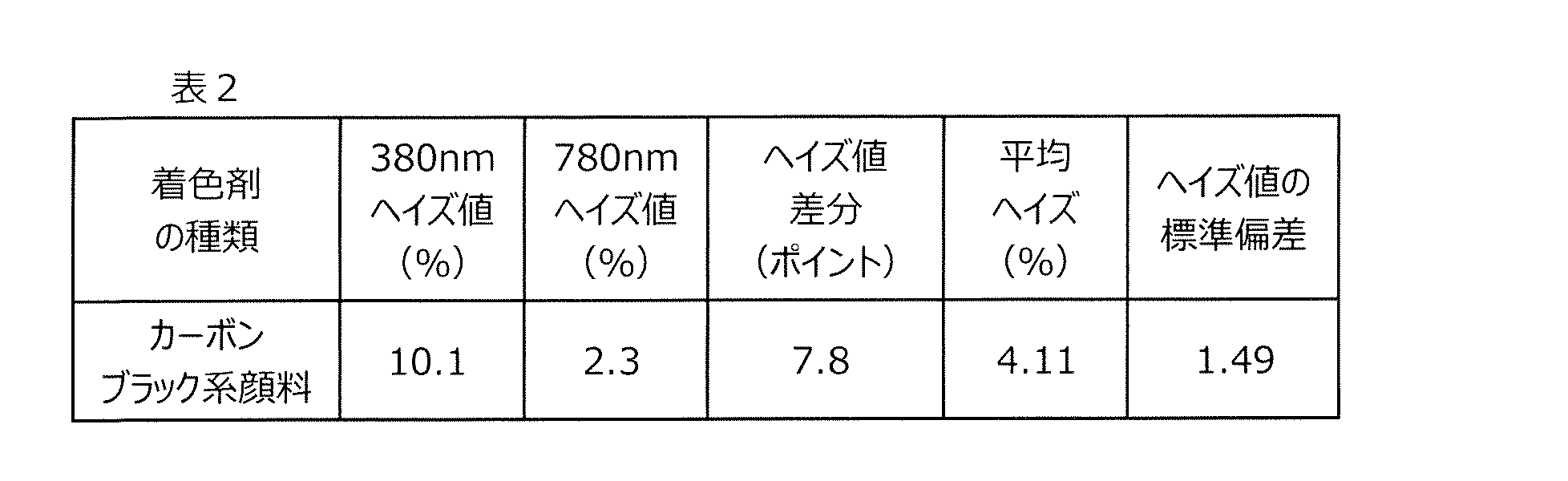
実施例および比較例に係る粘着シートから剥離シートを剥離し、露出した粘着剤層をソーダガラスに貼付して、測定用サンプルを得た。ソーダガラスのみについてブランク補正を行った後、当該測定用サンプルの粘着剤層側から、ヘイズメーター(日本電色工業社製,製品名「NDH-5000」)の測定光を入射して、JIS K7316―1:1997に準じて、全光線透過率(%)を測定した。測定は、それぞれ3回行い、それらの平均値を全光線透過率とした。結果を表3に示す。
実施例および比較例に係る粘着シートから剥離シートを剥離し、露出した粘着剤層をソーダガラスに貼付して、測定用サンプルを得た。ソーダガラスのみについてブランク補正を行った後、当該測定用サンプルの粘着剤層側から、ヘイズメーター(日本電色工業社製,製品名「NDH-5000」)の測定光を入射して、JIS K7136:2000に準じて、ヘイズ値(%)を測定した。測定は、それぞれ3回行い、それらの平均値をヘイズ値とした。結果を表3に示す。
実施例および比較例に係る粘着シートから剥離シートを剥離し、露出した粘着剤層の表面について、同時測光分光式色度計(日本電色工業社製,製品名「SQ2000」)を使用し、CIE1976L*a*b*表色系により規定される明度L*および色度b*を測定した。結果を表3に示す。
実施例および比較例に係る粘着シートを25mm幅、100mm長に裁断し、これをサンプルとした。23℃、相対湿度50%の環境下にて、上記サンプルから剥離シートを剥離し、露出した粘着剤層をソーダライムガラス(厚み:1.1mm)に貼付したのち、栗原製作所社製オートクレーブにて0.5MPa、50℃で、20分加圧した。その後、23℃、相対湿度50%の条件下で24時間放置してから、引張試験機(オリエンテック社製,製品名「テンシロン」)を用い、剥離速度300mm/min、剥離角度180度の条件で粘着力(N/25mm)を測定した。ここに記載した以外の条件はJISZ0237:2009に準拠して、測定を行った。結果を表3に示す。
実施例および比較例に係る粘着シートから10mm幅×75mm長のサンプルを切り出し、粘着シートの剥離シートを剥し、サンプル測定部位が10mm幅×20mm長(伸長方向)になるようにサンプルをセットし、23℃、相対湿度50%の環境下で引張試験機(オリエンテック社製,テンシロン)を用いて引張速度200mm/分で伸長させ、破断伸長率(%)および破断応力(kN/mm2)を測定した。結果を表3に示す。
実施例および比較例に係る粘着シートを製造する際に用いた、剥離シートと粘着剤層との積層体における粘着剤層を80mm×80mmのサイズに裁断して、その粘着剤層をポリエステル製メッシュ(品名:テトロンメッシュ#200)に包み、その質量を精密天秤にて秤量した。秤量値から上記メッシュ単独の質量を差し引くことにより、粘着剤のみの質量を算出した。このときの質量をM1とした。
ゲル分率(%)=(M2/M1)×100
ガラス板(NSGプレシジョン社製,製品名「コーニングガラスイーグルXG」,縦90mm×横50mm×厚み0.5mm)の表面に、紫外線硬化型インク(帝国インキ社製,製品名「POS-911墨」)を額縁状(外形:縦90mm×横50mm,幅5mm)にスクリーン印刷した。次いで、紫外線を照射(80W/cm2,メタルハライドランプ2灯,ランプ高さ15cm,ベルトスピード10~15m/分)して、印刷した上記紫外線硬化型インクを硬化させ、印刷層による段差(凹凸)(段差の高さ:5μm)を有する段差付ガラス板を作製した。
○:段差に追従し、気泡、浮き剥がれが見られない。
×:界面に気泡、浮き剥がれが見られた
実施例に係る粘着シートのハードコート層の表面について、JIS K5600に準じて、鉛筆硬度を測定した。具体的には、ハードコート層の表面上にて、鉛筆芯の硬度の異なる鉛筆(三菱鉛筆社製,製品名「三菱鉛筆ユニ」)を750gの荷重、45°の角度で7mm以上走らせる試験を行った。当該試験を5回行い、4回以上フィルム表面に傷が付かなかった鉛筆芯の硬さを、当該ハードコート層の表面の鉛筆硬度とした。結果を表3に示す。
実施例に係る粘着シートから剥離シートを剥離し、露出した粘着剤層を厚さ3mmのフロートガラス板に貼付した。粘着シートのハードコート層上に番手が#0000のスチールウールを載置し、当該スチールウールを250g/cm2の荷重で押圧しながら、ハードコート層上を10cm、10往復擦った。その後、スチールウールで擦ったハードコート層の表面を、3波長蛍光灯下で目視により確認し、以下の基準で耐擦傷性を評価した。なお、実施例1,8,9,16,23,比較例1については、基材の粘着剤層とは反対側の表面について、耐擦傷性を評価した。結果を表3に示す。
○:キズの本数が0本であった
×:キズの本数が1本以上であった
長さ170mm×幅150mm×厚み1mmのソーダライムガラス板(日本板硝子社製)に、実施例および比較例で得られた粘着シートの剥離シートを剥離して、露出した粘着剤層を貼り合せた。その後、テーブルの上に設置した高さ10mmの2つの台の上に、上記ガラス板と粘着シートからなる積層体を配置した。このとき、粘着シート側が上向き(上記の台とは反対側の向き)となり、当該積層体の長辺方向の両端部から10mm部分までが上記台上にそれぞれ載置され、中央部が浮いた状態(高さ10mm)となるように配置した。そして、その積層体の中央部に対して、高さ30cmから直径31.75mmの鉄球(200g)を落下させた。その後の積層体の状態を目視により観察し、以下の基準により飛散防止性を評価した。結果を表3に示す。
〇…粘着シートが裂けず、ガラスが飛散しなかった。
×…粘着シートが裂けて、ガラスが飛散した。
実施例および比較例に係る粘着シートから剥離シートを剥離し、露出した粘着剤層をソーダガラス(厚さ:700μm)に貼付して、ハードコート層/基材/粘着剤層/ソーダガラスの積層体を得た。
○:ガラスにひびも割れも生じていない。
×:ガラスにひびまたは割れが生じている。
実施例および比較例に係る粘着シートの粘着剤のバイオマス度(%)を下記式より算出した。なお、バイオマス由来の炭素量は、用いたバイオマスモノマーのバイオマス度と含有割合とから算出し、粘着剤層全体の炭素量は、粘着剤層に含まれる成分の含有割合から算出した。
バイオマス度(%)=100×(バイオマス由来の炭素量)/(粘着剤層全体の炭素量)
◎:粘着剤層のバイオマス度が60%以上であった
○:粘着剤層のバイオマス度が40%以上60%未満であった
△:粘着剤層のバイオマス度が10%以上40%未満であった
×:粘着剤層のバイオマス度が10%未満であった
実施例および比較例で得られた粘着シートを縦70mm×横70mmに裁断し、当該粘着シートの粘着剤層を、2枚のソーダライムガラス(日本板硝子社製,縦70mm×横70mm×厚み1.1mm)で挟持するように貼合して積層体を得て、これをサンプルとした。得られたサンプルを、消灯状態のディスプレイ(富士通社製,製品名「LIFEBOOKA574/H」,サイズ15.6インチ,解像度1366×768)の直前に設置した。このとき、サンプルの周縁部とディスプレイの枠材とが隣接するように当該サンプルを設置した。枠材との境界の見え方を目視で判断し、以下の基準によりシームレス化性に関する意匠性を評価した。結果を表3に示す。
A:境界が視認できない。
B:境界がわずかに視認されるものの目立たない。
F:境界が明瞭に視認できる。
上記意匠性の評価で作製したサンプルの表面から3cm離れた場所に、下記の2サイズの文字を黒色で印刷した白い紙を配置した。
1:フォントサイズ:16pt、フォント:MSゴシック体、文字:リンテック
2:フォントサイズ:8pt、フォント:MSゴシック体、文字:リンテック
B:1は視認できるが、2は視認しづらい
F1:1、2ともに容易に視認できる
F2:1、2ともに視認できない

10…基材
11…粘着剤層
12…機能層
Claims (8)
- 基材と、前記基材の一方の主面上に配置された粘着剤層と、を有する粘着シートであって、
前記粘着剤層を構成する粘着剤に含まれる炭素の合計質量を100%とした時に、前記粘着剤に含まれる炭素のうち、バイオマス材料由来の炭素の質量が占める割合を示すバイオマス度が、10%以上90%以下である粘着シート。 - 前記粘着剤が、アクリル系粘着剤である請求項1に記載の粘着シート。
- 前記アクリル系粘着剤が、(メタ)アクリル酸エステル重合体を含む請求項2に記載の粘着シート。
- 前記(メタ)アクリル酸エステル重合体が、モノマー単位として、アルキル基の炭素数が1~11であり、バイオマス材料由来の炭素を含む(メタ)アクリル酸アルキルエステルを含む請求項3に記載の粘着シート。
- 前記(メタ)アクリル酸エステル重合体が、モノマー単位として、バイオマス材料由来の炭素を含む脂環式構造含有モノマーを含む請求項3または4に記載の粘着シート。
- 前記(メタ)アクリル酸エステル重合体の合計質量を100%とした時に、前記バイオマス材料由来の炭素を含む(メタ)アクリル酸アルキルエステルと、前記バイオマス材料由来の炭素を含む脂環式構造含有モノマーと、の合計質量が占める割合が、10%以上である請求項5に記載の粘着シート。
- 前記基材の他方の主面上に配置された機能層を有する請求項1から4のいずれかに記載の粘着シート。
- 前記機能層がハードコート層である請求項7に記載の粘着シート。
Priority Applications (1)
| Application Number | Priority Date | Filing Date | Title |
|---|---|---|---|
| JP2025506904A JPWO2024190830A1 (ja) | 2023-03-16 | 2024-03-13 |
Applications Claiming Priority (2)
| Application Number | Priority Date | Filing Date | Title |
|---|---|---|---|
| JP2023-042375 | 2023-03-16 | ||
| JP2023042375 | 2023-03-16 |
Publications (1)
| Publication Number | Publication Date |
|---|---|
| WO2024190830A1 true WO2024190830A1 (ja) | 2024-09-19 |
Family
ID=92755285
Family Applications (1)
| Application Number | Title | Priority Date | Filing Date |
|---|---|---|---|
| PCT/JP2024/009804 Ceased WO2024190830A1 (ja) | 2023-03-16 | 2024-03-13 | 粘着シート |
Country Status (3)
| Country | Link |
|---|---|
| JP (1) | JPWO2024190830A1 (ja) |
| TW (1) | TW202446910A (ja) |
| WO (1) | WO2024190830A1 (ja) |
Citations (8)
| Publication number | Priority date | Publication date | Assignee | Title |
|---|---|---|---|---|
| JP2020041023A (ja) * | 2018-09-07 | 2020-03-19 | Dic株式会社 | 粘着テープ及び物品 |
| JP2020189932A (ja) * | 2019-05-22 | 2020-11-26 | リンテック株式会社 | ラベル用粘着シート |
| WO2022255210A1 (ja) * | 2021-05-31 | 2022-12-08 | 日東電工株式会社 | 粘着剤組成物、粘着剤および表面保護フィルム |
| JP2022190753A (ja) * | 2021-06-15 | 2022-12-27 | サイデン化学株式会社 | 粘着剤組成物 |
| JP2023080418A (ja) * | 2021-11-30 | 2023-06-09 | ライオン・スペシャリティ・ケミカルズ株式会社 | 粘着剤組成物およびこれを用いた粘着シート |
| JP2023147185A (ja) * | 2022-03-29 | 2023-10-12 | 藤森工業株式会社 | 粘着剤組成物、積層体、プリント配線基板、粘着フィルム、光学フィルム用粘着剤層、画像表示装置及び偏光板 |
| JP2024007205A (ja) * | 2022-07-05 | 2024-01-18 | 東洋インキScホールディングス株式会社 | 水性粘着剤組成物、粘着シート、および水性粘着剤組成物の製造方法 |
| JP2024064172A (ja) * | 2022-10-27 | 2024-05-14 | 三菱ケミカル株式会社 | 活性エネルギー線硬化性剥離型粘着剤組成物及び活性エネルギー線硬化性剥離型粘着シート |
-
2024
- 2024-03-13 JP JP2025506904A patent/JPWO2024190830A1/ja active Pending
- 2024-03-13 WO PCT/JP2024/009804 patent/WO2024190830A1/ja not_active Ceased
- 2024-03-14 TW TW113109423A patent/TW202446910A/zh unknown
Patent Citations (8)
| Publication number | Priority date | Publication date | Assignee | Title |
|---|---|---|---|---|
| JP2020041023A (ja) * | 2018-09-07 | 2020-03-19 | Dic株式会社 | 粘着テープ及び物品 |
| JP2020189932A (ja) * | 2019-05-22 | 2020-11-26 | リンテック株式会社 | ラベル用粘着シート |
| WO2022255210A1 (ja) * | 2021-05-31 | 2022-12-08 | 日東電工株式会社 | 粘着剤組成物、粘着剤および表面保護フィルム |
| JP2022190753A (ja) * | 2021-06-15 | 2022-12-27 | サイデン化学株式会社 | 粘着剤組成物 |
| JP2023080418A (ja) * | 2021-11-30 | 2023-06-09 | ライオン・スペシャリティ・ケミカルズ株式会社 | 粘着剤組成物およびこれを用いた粘着シート |
| JP2023147185A (ja) * | 2022-03-29 | 2023-10-12 | 藤森工業株式会社 | 粘着剤組成物、積層体、プリント配線基板、粘着フィルム、光学フィルム用粘着剤層、画像表示装置及び偏光板 |
| JP2024007205A (ja) * | 2022-07-05 | 2024-01-18 | 東洋インキScホールディングス株式会社 | 水性粘着剤組成物、粘着シート、および水性粘着剤組成物の製造方法 |
| JP2024064172A (ja) * | 2022-10-27 | 2024-05-14 | 三菱ケミカル株式会社 | 活性エネルギー線硬化性剥離型粘着剤組成物及び活性エネルギー線硬化性剥離型粘着シート |
Also Published As
| Publication number | Publication date |
|---|---|
| TW202446910A (zh) | 2024-12-01 |
| JPWO2024190830A1 (ja) | 2024-09-19 |
Similar Documents
| Publication | Publication Date | Title |
|---|---|---|
| JP6906560B2 (ja) | 粘着シートおよび表示体 | |
| JP6937338B2 (ja) | 表示体および粘着シート | |
| JP6498991B2 (ja) | 粘着シートおよび表示体 | |
| JP6356786B2 (ja) | 粘着シートおよび積層体 | |
| JP6792662B2 (ja) | 着色粘着シートおよび表示体 | |
| JP6356383B2 (ja) | 粘着性組成物、粘着剤および粘着シート | |
| JP2020007500A (ja) | 粘着シートおよび表示体 | |
| JP7054348B2 (ja) | 粘着シート、構成体およびその製造方法 | |
| JP7602858B2 (ja) | 粘着シートおよび光学積層体 | |
| JPWO2015145635A1 (ja) | 粘着剤層および飛散防止粘着シート | |
| CN110734710B (zh) | 窗膜 | |
| JP2021038365A (ja) | 粘着シートおよび光学積層体 | |
| JP6290377B2 (ja) | 積層体 | |
| JP2017066329A (ja) | 粘着シート | |
| JP7184528B2 (ja) | 表示体の製造方法 | |
| JP7829020B2 (ja) | 飛散防止粘着シートおよび表示体 | |
| KR102625922B1 (ko) | 점착제, 점착 시트 및 표시체 | |
| JP7426539B2 (ja) | 構成体の製造方法 | |
| JP6500077B2 (ja) | 積層体 | |
| JP2023146401A (ja) | ウィンドウフィルム | |
| JP2021066771A (ja) | 粘着剤、粘着シート、バックライトユニットおよび表示装置 | |
| TW202446910A (zh) | 黏著片 | |
| WO2024190828A1 (ja) | 粘着シート、積層体および表示体 | |
| JP2021014591A (ja) | 着色粘着シートおよび表示体 | |
| WO2024172011A1 (ja) | 粘着シート、積層体および表示体 |
Legal Events
| Date | Code | Title | Description |
|---|---|---|---|
| 121 | Ep: the epo has been informed by wipo that ep was designated in this application |
Ref document number: 24770935 Country of ref document: EP Kind code of ref document: A1 |
|
| ENP | Entry into the national phase |
Ref document number: 2025506904 Country of ref document: JP Kind code of ref document: A |
|
| WWE | Wipo information: entry into national phase |
Ref document number: 2025506904 Country of ref document: JP |
|
| NENP | Non-entry into the national phase |
Ref country code: DE |
|
| 122 | Ep: pct application non-entry in european phase |
Ref document number: 24770935 Country of ref document: EP Kind code of ref document: A1 |