WO2024189979A1 - 生体情報計測装置 - Google Patents
生体情報計測装置 Download PDFInfo
- Publication number
- WO2024189979A1 WO2024189979A1 PCT/JP2023/041024 JP2023041024W WO2024189979A1 WO 2024189979 A1 WO2024189979 A1 WO 2024189979A1 JP 2023041024 W JP2023041024 W JP 2023041024W WO 2024189979 A1 WO2024189979 A1 WO 2024189979A1
- Authority
- WO
- WIPO (PCT)
- Prior art keywords
- measuring device
- subject
- bioinformation
- fixing
- cover member
- Prior art date
- Legal status (The legal status is an assumption and is not a legal conclusion. Google has not performed a legal analysis and makes no representation as to the accuracy of the status listed.)
- Ceased
Links
Images









Classifications
-
- A—HUMAN NECESSITIES
- A61—MEDICAL OR VETERINARY SCIENCE; HYGIENE
- A61B—DIAGNOSIS; SURGERY; IDENTIFICATION
- A61B5/00—Measuring for diagnostic purposes; Identification of persons
- A61B5/01—Measuring temperature of body parts ; Diagnostic temperature sensing, e.g. for malignant or inflamed tissue
Definitions
- the present invention relates to a technology for measuring biometric information by attaching a biometric measuring device to clothing worn by a subject and to the subject.
- Deep body temperature is the temperature that protects the central functions of the body, such as the brain and organs.
- a sensor it is difficult to measure deep body temperature invasively by inserting a sensor into the central part of the body (for example, the esophagus or rectum).
- Patent Documents 1 and 2 disclose, for example, a bioinformation measuring device as a simple method for measuring core body temperature.
- the bioinformation measuring device in Patent Document 1 comprises a device body and a case-like holder that is attached to the surface of the device body.
- the device body is held inside the holder.
- the holder is provided with clamping pieces that serve as clamping means. The clamping pieces clamp the subject's clothing, etc., thereby fixing the bioinformation measuring device to the subject's clothing, etc.
- Patent Document 2 also discloses an adhesive member for attaching a biological information measuring device (core thermometer) to the surface of the human body (skin, body surface).
- the adhesive member has a surface that contacts the core thermometer and a surface that contacts the human body.
- the surface of the adhesive member that contacts the human body is adhesive.
- the bioinformation measuring device of the configuration described in Patent Document 1 is fixed to clothing etc. using only the clamping pieces. In other words, it does not have the function of fixing to the subject's skin. Therefore, if the clamping pieces are not fixed to the clothing etc. with sufficient force, it is difficult to fix the bioinformation measuring device to the clothing. In other words, the bioinformation measuring device will slip off the clothing or it will be difficult to keep it in a specified position. In other words, the bioinformation measuring device will come off the subject's skin. This may cause a loss of stability in measurements taken by the bioinformation measuring device.
- the adhesive member that comes into contact with the skin needs to be adhesive to secure the deep body thermometer.
- the adhesive member needs to have enough adhesiveness to support the weight of the deep body thermometer. Therefore, when removing the adhesive member or when the adhesive member is attached for a long period of time, there is a risk of causing skin irritation (redness, itchiness, pain, etc.). Furthermore, the adhesive member's adhesiveness decreases with frequency of use, so the adhesive member needs to be replaced periodically.
- the object of the present invention is therefore to provide technology that can stably hold a measuring device at a desired position on a subject and measure biological information.
- a bioinformation measuring device comprises a bioinformation measuring device, a cover member, a fixing portion, and an anti-slip portion.
- the bioinformation measuring device has a measuring surface that contacts a subject, and measures the bioinformation of the subject.
- the cover member has a first surface and a second surface that faces the first surface and contacts the subject, and houses the bioinformation measuring device.
- the fixing portion is formed on the first surface and has a structure for fixing the cover member to clothing worn by the subject.
- the anti-slip portion is formed with at least a portion exposed on the second surface, and holds the cover member against the subject.
- the bioinformation measuring device is fixed to clothing, etc., by a fixing portion formed on the cover member. Furthermore, the bioinformation measuring device is held to the subject (skin) by an anti-slip member. This allows the bioinformation measuring device to be fixed more securely, so that bioinformation can be continuously measured at the desired position on the subject.
- This invention allows the biometric measuring device to be stably held at a desired position on the subject. This allows biometric information to be continuously measured at the desired position on the subject.
- FIG. 1 is a perspective view of the appearance of a biological information measuring device according to a first embodiment.
- FIG. 2 is a five-view diagram of a thermometer as a biological information measuring device according to the first embodiment.
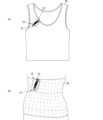
- 3A and 3B are schematic diagrams showing a state in which the biological information measuring device according to the first embodiment is attached to clothing.
- FIG. 4A is a side cross-sectional view of the bio-information measuring device according to the first embodiment
- FIG. 4B is a schematic diagram of the surface of the bio-information measuring device that comes into contact with a subject.
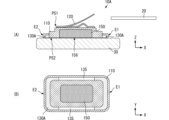
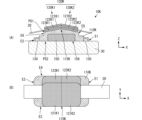
- FIG. 5A is a side cross-sectional view of a bioinformation measuring device according to the second embodiment, and FIG.
- FIG. 5B is a schematic diagram of a surface of the bioinformation measuring device that comes into contact with a subject.
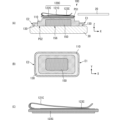
- FIG. 6A is a side cross-sectional view of a bioinformation measuring device according to a modified example of the second embodiment, and FIG. 6B is a schematic diagram of the surface of the bioinformation measuring device that comes into contact with a subject.
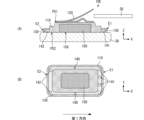
- Figure 7 (A) is a side cross-sectional view of a bio-information measuring device related to the third embodiment
- Figure 7 (B) is a schematic diagram of the surface where the bio-information measuring device contacts the subject
- Figure 7 (C) is a diagram showing an overview of the fixing part of the bio-information measuring device.
- FIG. 8A is a side cross-sectional view of a bioinformation measuring device according to the fourth embodiment, and FIG.
- FIG. 8B is a schematic diagram of the surface of the bioinformation measuring device that comes into contact with a subject.
- FIG. 9A is a side cross-sectional view of a bioinformation measuring device according to a modified example of the fourth embodiment, and FIG. 9B is a schematic diagram of the surface of the bioinformation measuring device that comes into contact with a subject.
- FIG. 10A is a side cross-sectional view of a bio-information measuring device according to the fifth embodiment, and FIG. 10B is a schematic diagram of the surface of the bio-information measuring device that comes into contact with a subject.
- FIG. 11A is a side cross-sectional view of a bio-information measuring device according to the sixth embodiment, and FIG.
- FIG. 11B is a schematic diagram of the surface of the bio-information measuring device that comes into contact with a subject.
- FIG. 12A is a side cross-sectional view of a bio-information measuring device according to the seventh embodiment
- FIG. 12B is a schematic diagram of the surface of the bio-information measuring device that comes into contact with a subject.
- 13A and 13B are schematic diagrams showing a biological information measuring device according to the seventh embodiment attached to clothing.
- FIG. 14A is a side cross-sectional view of a biological information measuring device according to a modified example of the seventh embodiment
- FIG. 14B is a schematic diagram showing the biological information measuring device attached to clothing.
- FIG. 15(A) is a side cross-sectional view of a biological information measuring device according to the eighth embodiment, and FIG.
- FIG. 15(B) is a schematic diagram showing the biological information measuring device attached to clothing.
- Figure 16 (A) is a side cross-sectional view of a bio-information measuring device of the ninth embodiment
- Figure 16 (B) is a view from the first surface side
- Figure 16 (C) is a schematic diagram showing an image of the bio-information measuring device attached to clothing.
- FIG. 17A is a side cross-sectional view of a biological information measuring device according to a tenth embodiment
- FIG. 17B is a schematic diagram showing the biological information measuring device attached to clothing.
- FIG. 18(A) is a side cross-sectional view of a biological information measuring device according to an eleventh embodiment
- FIG. 18(B) is a schematic diagram showing the biological information measuring device attached to clothing.
- thermometer will be used as the bio-information measuring device.
- the technology of the present invention can be applied to any device that measures bio-information by directly contacting the human body (subject), such as heart sounds and auscultatory sounds, in addition to body temperature.
- a biological information measuring device according to a first embodiment of the present invention will be described with reference to the drawings.
- a female underwear is used as an example of clothing
- a thermometer is used as an example of a biological information measuring device.
- the type of underwear is not limited to this, and as long as the temperature of the object to be measured and the measurement position are different, the clothing may be an undergarment, a shirt that fits closely to the body, etc.
- FIG. 1 is an external perspective view of a bioinformation measuring device 10 according to a first embodiment.
- the bioinformation measuring device 10 includes a cover member 110, a fixing portion 120, an anti-slip portion 130, and a bioinformation measuring instrument 150.
- the cover member 110 includes a first surface PS1 and a second surface PS2 that faces the first surface PS1.
- the second surface PS2 is a surface that contacts the skin of a subject.
- the cover member 110 includes a first end E1 and a second end E2 at a position facing the first end E1 in the XY plane in FIG. 1.
- the ends that are perpendicular to the direction connecting the first end E1 and the second end E2 are a third end E3 and a fourth end E4.
- the Z-axis direction in FIG. 1 is the thickness direction of the cover member 110, and is perpendicular to the XY plane.
- the cover member 110 houses the bio-information measuring device 150 inside so as to protect the portions other than the measurement surface 156 while exposing the measurement surface 156.
- the shape of the cover member 110 shown in Fig. 1 is one example. In other words, the cover member 110 may have any shape that allows the bio-information measuring device 150 to be housed inside.
- the fixing portion 120 is formed on the first surface PS1 of the cover member 110.
- the non-slip portion 130 is formed so as to be exposed on at least a portion of the second surface PS2 of the cover member 110. That is, as described above, the non-slip portion 130 comes into contact with the skin of the subject 30.
- Fig. 2 is a five-view diagram of a thermometer as the biological information measuring device 150 according to the first embodiment.
- the biological information measuring device (thermometer) 150 includes a first member 151 and a second member 152.
- An electronic circuit for measuring body temperature is formed in the first member 151.
- the second member 152 covers the electronic circuit for measuring body temperature formed in the first member 151.
- the biological information measuring device (thermometer) 150 measures deep body temperature by, for example, converting heat transmitted from the surface of the subject's skin into an electrical signal and detecting it.
- the main surface of this bioinformation measuring device (thermometer) on the first member 151 side becomes the attachment surface 155 to the cover member 110, and the main surface on the second member 152 side becomes the measurement surface 156 that faces the skin of the human body.
- the first member 151 has a pair of side surfaces 157 and 158. In the example of FIG. 2, the first member 151 is rectangular in a plan view, with the side surface 157 being the long side surface and the side surface 158 being the short side surface.
- the bioinformation measuring device (thermometer) 150 is positioned so that the measurement surface 156 is approximately flush with the second surface PS2 of the cover member 110 described above.
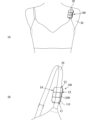
- FIG. 3(A) and Fig. 3(B) are schematic diagrams showing a state in which the bioinformation measuring device according to the first embodiment is attached to clothing.
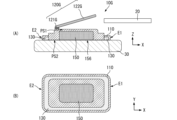
- Fig. 4(A) is a side cross-sectional view of the bioinformation measuring device according to the first embodiment
- Fig. 4(B) is a schematic diagram of the surface of the bioinformation measuring device that comes into contact with a subject.
- the bioinformation measuring device 10 is fixed so that the fixing part 120 pinches a part of the fabric of the chest opening of the clothing (upper body undergarment) 20.
- the bioinformation measuring device 10 is fixed so that the fixing part 120 pinches a part of the tubular fabric of the clothing (belly warmer) 20. That is, the fixing part 120 fixes the clothing 20 so that it pinches the outer surface and the inner surface (the surface that contacts the skin of the subject 30).
- the non-slip part 130 holds the bioinformation measuring device 10 (cover member 110) so that it contacts the skin of the subject.
- the bioinformation measuring device 10 is fixed by the fixing part 120 so that the measuring surface 156 of the bioinformation measuring instrument (thermometer) 150 described above contacts the skin of the subject, and is held by the non-slip part 130.
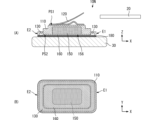
- FIG. 4(A) is a side cross-sectional view (XZ plane in Figure 1) showing the state in which the bio-information measuring device 10 is fixed to and held by the subject 30.
- Figure 4(B) is a schematic diagram of the surface (XY plane in Figure 1) where the bio-information measuring device 10 abuts against the subject 30, in other words the second surface PS2.
- the fixing portion 120 is formed on the first surface PS1 of the cover member 110.
- the fixing portion 120 includes a first fixing member 121 and a second fixing member 122.
- the first fixing member 121 and the second fixing member 122 include a connecting portion 123.
- the first fixing member 121 and the second fixing member 122 open and close with the connecting portion 123 as a fulcrum.
- the second fixing member 122 is fixed to the first surface PS1. Therefore, the first fixing member 121 is structured to open. More specifically, as shown in FIG. 4(A), the connecting portion 123 is formed on the second end E2 side of the center of the cover member 110 in the direction connecting the first end E1 and the second end E2 of the cover member 110 (X-axis direction). As a result, the fixing portion 120 is shaped so that the first end E1 side of the first fixing member 121 opens.
- a part of the first fixing member 121 is shaped to fit into a part of the second fixing member 122. That is, when the first fixing member 121 and the second fixing member 122 are in a closed state, a part of the first fixing member 121 and the second fixing member 122 fit into each other. In this fitted state, the garment 20 is sandwiched between the first fixing member 121 and the second fixing member 122.
- the closed state includes a state in which the garment 20 is fixed by the fixing portion 120 even when the garment 20 is sandwiched between the first fixing member 121 and the second fixing member 122. That is, in this embodiment, the closed state is referred to even if the garment 20 is between the first fixing member 121 and the second fixing member 122.
- the first fixing member 121 and the second fixing member 122 have an uneven surface formed on the surface that comes into contact with the garment 20. By forming this uneven surface, it is possible to prevent the bio-information measuring device 10 from being misaligned with the garment 20.
- the structure is not limited to having uneven surfaces, and the surfaces of the first fixing member 121 and the second fixing member 122 that come into contact with the garment 20 may be formed of a non-slip material such as silicone rubber or gel.
- the fixing part 120 may be made of, for example, a metal (e.g., iron) or an elastic resin (e.g., silicone).
- the material of the fixing part 120 is not limited to these, and any material that can fix the garment 20 and is unlikely to be damaged or worn even when opened and closed multiple times may be used.
- the coupling portion 123 can be omitted if the first fixing member 121 and the second fixing member 122 are shaped to fit together and be openable and closable. In other words, if the first fixing member 121 and the second fixing member 122 can be opened and closed, the coupling portion 123 can be omitted.
- the anti-slip portion 130 is formed on the second surface PS2 of the cover member 110. As shown in FIG. 4B, the anti-slip portion 130 is formed along the outer periphery of the cover member 110. When viewed from the mounting surface side, the anti-slip portion 130 is formed around the entire periphery, outside the bio-information measuring device (thermometer) 150. The width of the anti-slip portion 130 in the XY plane may be determined based on the weight and size of the bio-information measuring device 10. The outer periphery of the anti-slip portion 130 in the XY plane may overlap with the outer periphery of the cover member 110.
- the anti-slip portion 130 prevents lateral slippage by utilizing the friction (resistance) and elasticity of the surface of the material.
- the anti-slip portion 130 and the skin of the subject 30 are positioned by friction.
- the anti-slip portion 130 is made of a material that does not exhibit resistance to the force (force in the Z-axis direction (direction perpendicular to the XY plane)) that would peel it off from the skin of the subject 30.
- the anti-slip portion 130 may be made of, for example, silicone rubber or acrylic resin. It is also preferable that the anti-slip portion 130 is water-based so that it can be washed off with water even if it adheres to the skin of the subject 30.
- the anti-slip portion 130 may be structured to be removable from the cover member 110. For example, it is preferable that the anti-slip portion 130 is fixed to the cover member 110 using a hook-and-loop fastener or the like.
- the bio-information measuring device 10 is fixed and held in place by using the fixing portion 120 and the non-slip portion 130 so that the second surface PS2 of the cover member 110 and the measuring surface 156 of the bio-information measuring instrument (thermometer) 150 abut against the subject 30.
- the bioinformation measuring device 10 can be stably fixed and held in the desired position of the subject 30. This allows the body temperature to be continuously measured at the desired position of the subject 30.
- the bio-information measuring device 10 can be prevented from coming off or shifting from the subject 30, so the body temperature of the subject 30 can be measured accurately.
- the anti-slip portion 130 has almost no adhesiveness. Therefore, even if the subject 30 wears the bio-information measuring device 10 for a long period of time, adverse health effects such as rough skin (redness, itchiness, pain, etc.) are suppressed. Furthermore, the anti-slip portion 130 has almost no adhesiveness. Therefore, the anti-slip portion 130 does not need to be replaced periodically due to a decrease in adhesiveness depending on the frequency of use. Therefore, it is easy for the subject to use.
- the surfaces of the first fixing member 121 and the second fixing member 122 that come into contact with the garment 20 may be configured with small protrusions that generate frictional forces.
- Fig. 5(A) is a side cross-sectional view showing a state in which the bioinformation measuring device 10A is fixed to and held by a subject 30.
- Fig. 5(B) is a schematic diagram of a surface of the bioinformation measuring device 10A that contacts the subject 30.
- the bioinformation measuring device according to the second embodiment differs from the bioinformation measuring device according to the first embodiment in the shape of the anti-slip portion 130A.
- the other configuration of the bioinformation measuring device according to the second embodiment is the same as that of the bioinformation measuring device according to the first embodiment, and a description of similar parts will be omitted.
- anti-slip portion 130A has a shape in which a portion of anti-slip portion 130 in the first embodiment is cut out. More specifically, as shown in Figure 5(B), anti-slip portion 130A has a cutout portion 135 extending along the X-axis direction. This cutout portion 135 is an area in which anti-slip portion 130A is not formed.
- the bioinformation measuring device 10A is stably held in the desired position of the subject 30. This allows the body temperature to be continuously measured at the desired position of the subject 30.
- the bio-information measuring device 10A can be prevented from coming off or shifting from the subject 30, so the body temperature of the subject 30 can be measured accurately.
- the cutout portion 135 is formed in two places along the X-axis direction. However, the cutout portion 135 may be formed in one place. Also, the cutout portion 135 may be formed along the Y-axis direction.
- FIG. 6(A) is a side cross-sectional view showing a state in which the bioinformation measuring device 10B is fixed to and held by a subject 30.
- Fig. 6(B) is a schematic diagram of a surface of the bioinformation measuring device 10B that contacts the subject 30.
- the bioinformation measuring device according to the modified example of the second embodiment differs from the bioinformation measuring device according to the second embodiment in the shape of the anti-slip portion 130B.
- the other configuration of the bioinformation measuring device according to the modified example of the second embodiment is similar to that of the bioinformation measuring device according to the second embodiment, and a description of similar parts will be omitted.
- anti-slip portion 130B As shown in Figures 6(A) and 6(B), the shape of a portion of anti-slip portion 130B is different from that of anti-slip portion 130B in the second embodiment. More specifically, anti-slip portion 130B includes first anti-slip portion 131B and second anti-slip portion 132B. The area of first anti-slip portion 131B in the XY plane is larger than the area of second anti-slip portion 132B.
- the structure for fixing and holding the bio-information measuring device 10B will be described with reference to FIG. 3(A).
- the second end E2 connection portion 123
- the first direction the direction from the second end E2 to the first end E1 (hereinafter referred to as the first direction). Therefore, the bio-information measuring device 10B becomes more likely to slide in the first direction.
- first anti-slip portion 131B has a larger area than the second anti-slip portion 132B, slippage in the first direction (the direction of gravity) can be suppressed, and the bioinformation measuring device 10B can be more effectively fixed and held.
- This structure is also effective against the force caused by the subject 30's movement pulling the garment 20 in the first direction.
- the bioinformation measuring device 10B can be stably fixed and held in a desired position on the subject 30. This allows the body temperature to be continuously measured at the desired position on the subject 30.
- the bio-information measuring device 10B can be prevented from coming off or shifting from the subject 30, so the body temperature of the subject 30 can be measured accurately.
- FIG. 7(A) is a side cross-sectional view showing a state in which a bioinformation measuring device 10C is fixed to and held by a subject 30.
- Fig. 7(B) is a schematic diagram of a surface of the bioinformation measuring device 10C that contacts the subject 30.
- Fig. 7(C) is a diagram showing an overview of a fixing part 120C in the bioinformation measuring device.
- the bioinformation measuring device according to the third embodiment differs from the bioinformation measuring device according to the first embodiment in the shape of the fixing part 120C.
- the other configuration of the bioinformation measuring device according to the third embodiment is similar to that of the bioinformation measuring device according to the first embodiment, and a description of similar parts will be omitted.
- the fixing part 120C includes a first fixing member 121C and a second fixing member 122C.
- the first fixing member 121C and the second fixing member 122C are connected.
- the fixing part 120C is folded in two starting from the point where the first fixing member 121C and the second fixing member 122C are connected.
- the fixing part 120C is folded so that the first fixing member 121C and the second fixing member 122C are in contact at a fixing point 123C near the side opposite to the folded side.
- by lifting the second fixing member 122C in the Z-axis direction upward in Fig. 7(A)
- the bioinformation measuring device 10C can be stably fixed and held in a desired position on the subject 30. This allows the body temperature to be continuously measured at the desired position on the subject 30.
- the bioinformation measuring device 10C can be prevented from coming off or shifting from the subject 30, so the body temperature of the subject 30 can be measured accurately.
- FIG. 8(A) is a side cross-sectional view showing a state in which a bioinformation measuring device 10D is fixed to and held by a subject 30.
- Fig. 8(B) is a schematic diagram of a surface of the bioinformation measuring device 10D that contacts the subject 30.
- the bioinformation measuring device according to the fourth embodiment differs from the bioinformation measuring device according to the first embodiment in that it is provided with a recessed portion 140.
- the other configuration of the bioinformation measuring device according to the fourth embodiment is similar to that of the bioinformation measuring device according to the first embodiment, and a description of similar parts will be omitted.
- the recessed portion 140 is a recess formed in the non-slip portion 130D.
- the recessed portion 140 is formed in the four corners of the cover member 110 (non-slip portion 130D) and in the portion extending along the X-axis direction.
- the non-slip portion 130D is formed from silicone rubber, acrylic resin, or the like, and has a certain degree of elasticity. For this reason, the recessed portion 140 acts like a suction cup. More specifically, the recessed portion 140 creates a pressure difference with the atmospheric pressure by creating a low pressure state inside. This improves the adhesive effect of the recessed portion 140 on the skin of the subject 30.
- the bioinformation measuring device 10D is stably fixed and held in the desired position of the subject 30. This allows the body temperature to be continuously measured at the desired position of the subject 30.
- the biological information measuring device 10D can be prevented from coming off or shifting from the subject 30, so the body temperature of the subject 30 can be measured accurately.
- FIG. 9(A) is a side cross-sectional view showing a state in which the bioinformation measuring device 10E is fixed to and held by a subject 30.
- Fig. 9(B) is a schematic diagram of a surface of the bioinformation measuring device 10E that contacts the subject 30.
- the bioinformation measuring device according to the modified example of the fourth embodiment differs from the bioinformation measuring device according to the fourth embodiment in the number of recessed portions 140 it has.
- the other configuration of the bioinformation measuring device according to the modified example of the fourth embodiment is similar to that of the bioinformation measuring device according to the fourth embodiment, and a description of similar parts will be omitted.
- the number of recessed portions 140 formed is different from that of the fourth embodiment.
- the recessed portions 140 include first recessed portions 141 and second recessed portions 142. More specifically, the number of first recessed portions 141 formed at the first end portion E1 is greater than the number of second recessed portions 142 formed at the second end portion E2.
- the second end E2 (connection portion 123) is positioned near the neck of the subject 30.
- gravity is applied to the bio-information measuring device 10E in the direction from the second end E2 to the first end E1 (first direction). Therefore, the bio-information measuring device 10E becomes more likely to slide in the first direction.
- first recesses 141 formed at the first end E1 is greater than the number of second recesses 142 formed at the second end E2
- slippage in the first direction can be suppressed, and the bioinformation measuring device 10E can be more effectively fixed and held.
- this structure is also effective against the force caused by the subject 30's movement pulling the garment 20 in the first direction.
- the bioinformation measuring device 10E is stably fixed and held at a desired position on the subject 30. This allows the body temperature to be continuously measured at a desired position on the subject 30.
- the bioinformation measuring device 10E can be prevented from coming off or shifting from the subject 30, so the body temperature of the subject 30 can be measured accurately.
- the number of first recesses 141 and the number of second recesses 142 are different.
- the size of the first recesses 141 at the first end E1 may be larger than the size of the second recesses 142 at the second end E2.
- FIG. 10(A) is a side cross-sectional view showing a state in which a bioinformation measuring device 10F is fixed to and held by a subject 30.
- Fig. 10(B) is a schematic diagram of a surface of the bioinformation measuring device 10F that contacts the subject 30.
- the bioinformation measuring device according to the fifth embodiment differs from the bioinformation measuring device according to the first embodiment in that it is provided with an adhesive layer 160.
- the other configuration of the bioinformation measuring device according to the fifth embodiment is the same as that of the bioinformation measuring device according to the first embodiment, and a description of similar parts will be omitted.
- an adhesive layer 160 is formed on the second surface PS2 of the cover member 110.
- the adhesive layer 160 is formed inside where the anti-slip portion 130 is formed in the XY plane.
- the adhesive layer 160 holds the bio-information measuring device 10F by utilizing the adhesive properties of the material.
- the adhesive layer 160 is attached to the skin of the subject 30 to such an extent that it will not come off when a certain force is applied in the X-axis direction or Y-axis direction.
- the material of the bio-information measuring device 10F will come off from the skin of the subject 30 when a certain force or more (a force that would peel off the adhesive layer 160) is applied to the bio-information measuring device 10F in the Z-axis direction (a direction perpendicular to the XY plane).
- the adhesive layer 160 does not hold the position of the bio-information measuring device 10F by itself as in the past, but has enough adhesiveness to assist the holding state by the fixing part 120 and the anti-slip part 130.
- the adhesive layer 160 may be formed, for example, from an adhesive gel or nonwoven tape used for medical purposes.
- the adhesive layer 160 may be made of a material that has a certain level of adhesiveness when applied to the skin of the subject 30, but does not cause skin irritation.
- the bioinformation measuring device 10F can be more stably fixed and held at the desired position of the subject 30. This allows the body temperature to be continuously measured at the desired position of the subject 30.
- the biological information measuring device 10F can be prevented from coming off or shifting from the subject 30, so the body temperature of the subject 30 can be measured accurately.
- FIG. 11(A) is a side cross-sectional view showing a state in which a bioinformation measuring device 10G is fixed to and held by a subject 30.
- Fig. 11(B) is a schematic diagram of a surface of the bioinformation measuring device 10G that contacts the subject 30.
- the bioinformation measuring device according to the sixth embodiment differs from the bioinformation measuring device according to the first embodiment in the shape of the fixing part 120G.
- the other configuration of the bioinformation measuring device according to the sixth embodiment is the same as that of the bioinformation measuring device according to the first embodiment, and a description of similar parts will be omitted.
- the fixing part 120G includes a spring part 121G and a fixing member 122G.
- the fixing member 122G is fixed to the first surface PS1 of the cover member 110 by the spring part 121G.
- the spring part 121G assists in opening and closing the fixing member 122G. More specifically, the spring part 121G uses elastic force to open and close the fixing member 122G. In this case, it is preferable that the spring part 121G has a stopper that can maintain the closed state when the fixing member 122G is in the closed state (closed state with the garment 20 clamped).
- the bioinformation measuring device 10G can be stably fixed and held in the desired position of the subject 30. This allows the body temperature to be continuously measured at the desired position of the subject 30.
- the biological information measuring device 10G can be prevented from coming off or shifting from the subject 30, so the body temperature of the subject 30 can be measured accurately.
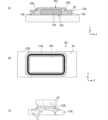
- FIG. 12(A) is a side cross-sectional view showing a state in which a bioinformation measuring device 10H is fixed to and held by a subject 30.
- Fig. 12(B) is a view of the bioinformation measuring device 10H fixed to and held by a subject 30 as viewed from the first surface PS1 side.
- Figs. 13(A) and 13(B) are schematic diagrams showing a state in which a bioinformation measuring device 10H according to a sixth embodiment is attached to clothing.
- the bioinformation measuring device according to the seventh embodiment differs from the bioinformation measuring device according to the first embodiment in the shape of the fixing part 120H.
- the other configuration of the bioinformation measuring device according to the seventh embodiment is similar to that of the bioinformation measuring device according to the first embodiment, and a description of similar parts will be omitted.
- the fixing portion 120H of the bio-information measuring device 10H is structured to be attached to the strings of a brassiere, for example, as shown in Figures 13(A) and 13(B). That is, in the example shown below, the strings of a brassiere will be described as clothing 20.
- the fixing part 120H includes a first fixing member 121H, a second fixing member 122H, and a third fixing member 123H.
- the fixing part 120H is made of synthetic resin such as plastic.
- One end of the first fixing member 121H is attached to an end of the third fixing member 123H (the third end E3 of the cover member 110).
- One end of the second fixing member 122H is attached to an end of the third fixing member 123H (the fourth end E4 of the cover member 110).
- the width of the third fixing member 123H in the Y-axis direction is the same as the width of the cover member 110 in the Y-axis direction.
- the width of the third fixing member 123H in the Y-axis direction is formed to a length that can at least fix the clothing (bra strap) 20.
- the first fixing member 121H and the second fixing member 122H are flat membrane-like and made of a material that can be deformed by human force. This allows the first fixing member 121H and the second fixing member 122H to have a structure that allows them to break or bend relative to the third fixing member 123H. On the other hand, the first fixing member 121H and the second fixing member 122H can easily return to a shape in which they overlap in a state that is approximately parallel to the third fixing member 123H due to a restoring force.
- the first fixing member 121H and the second fixing member 122H may be fixed to the third fixing member 123H by a member having elastic force. This allows the first fixing member 121H and the second fixing member 122H of the fixing part 120H to be easily opened and closed, making it easy to attach the bio-information measuring device 10H.
- the first fixing member 121H and the second fixing member 122H may have a stopper that uses elastic force to maintain the closed state when the fixing part 120H is in a closed state (closed state with the garment 20 clamped). The state in which the garment 20 is not clamped by the fixing part 120H is considered to be an open state.
- the bio-information measuring device 10H is fixed by the fixing portion 120H so as to pinch the clothing (bra strap) 20. More specifically, the first fixing member 121H is structured to overlap the second fixing member 122H in the Z-axis direction. In other words, the second fixing member 122H fixes the clothing 20. Furthermore, the first fixing member 121H fixes the second fixing member 122H and the clothing 20. In this way, the bio-information measuring device 10H is fixed to the clothing 20.
- the bioinformation measuring device 10H can be stably fixed and held in a desired position on the subject 30. This allows the body temperature to be continuously measured at the desired position on the subject 30.
- the biological information measuring device 10H can be prevented from coming off or shifting from the subject 30, so the body temperature of the subject 30 can be measured accurately.
- Fig. 14(A) is a side cross-sectional view showing a state in which the bioinformation measuring device 10J is fixed to and held by a subject 30.
- Fig. 14(B) is a view of the bioinformation measuring device 10J fixed to and held by the subject 30 as viewed from the first surface PS1 side.
- the bioinformation measuring device according to the modified example of the seventh embodiment differs from the bioinformation measuring device according to the seventh embodiment in the shape of the cover member 110J.
- the other configuration of the bioinformation measuring device according to the modified example of the seventh embodiment is similar to that of the bioinformation measuring device according to the seventh embodiment, and a description of similar parts will be omitted.
- the first surface PS1 of the cover member 110J has a fifth end E5 and a sixth end E6.
- the cover member 110J has a shape with a convex portion 115J on the sixth end E6 side (close to the neck of the subject 30) of the first surface PS1.
- the convex portion 115J has a shape that protrudes outward (in a direction different from the measurement surface 156) from the first surface PS1.
- the bioinformation measuring device 10J is stably fixed and held in the desired position of the subject 30. This allows the body temperature to be continuously measured at the desired position of the subject 30.
- the bio-information measuring device 10J can be prevented from coming off or shifting from the subject 30, so the body temperature of the subject 30 can be measured accurately.
- FIG. 15(A) is a side cross-sectional view showing a state in which a bioinformation measuring device 10K is fixed to and held by a subject 30.
- Fig. 15(B) is a view of the bioinformation measuring device 10K fixed to and held by the subject 30 as viewed from the first surface PS1 side.
- the bioinformation measuring device according to the eighth embodiment differs from the bioinformation measuring device according to the seventh embodiment in the shape of the fixing part 120K and the shape of the cover member 110K.
- the other configuration of the bioinformation measuring device according to the eighth embodiment is similar to that of the bioinformation measuring device according to the seventh embodiment, and a description of similar parts will be omitted.
- the fixing part 120K has a first fixing part 120K1 and a second fixing part 120K2.
- the first fixing part 120K1 and the second fixing part 120K2 may be molded integrally or separately.
- the cover member 110K has a shape that includes a protrusion 115K at approximately the center of the cover member 110K in the XZ plane.
- the connection between the first fixing portion 120K1 and the second fixing portion 120K2 is shaped to bend along the corner of the protrusion 115K.
- the first fixing part 120K1 includes a first fixing member 121K1, a second fixing member 122K1, and a third fixing part 123K1.
- the second fixing part 120K2 includes a first fixing member 121K2, a second fixing member 122K2, and a third fixing part 123K2.
- the fixing portion 120K (first fixing portion 120K1 and second fixing portion 120K2) are made of synthetic resin such as plastic.
- the first fixing member 121K1 is attached to an end of the third fixing portion 123K1 (the third end E3 side of the cover member 110K).
- the second fixing member 122K1 is attached to an end of the third fixing portion 123K1 (the fourth end E4 side of the cover member 110K).
- the first fixing member 121K2 is attached to an end of the third fixing portion 123K2 (the third end E3 side of the cover member 110K).
- the second fixing member 122K2 is attached to an end of the third fixing portion 123K2 (the fourth end E4 side of the cover member 110K).
- the first fixing member 121K1 and the second fixing member 122K1 may be fixed to the third fixing portion 123K1 by a member having elasticity. This allows the first fixing member 121K1 and the second fixing member 122K1 of the first fixing portion 120K1 to be easily opened and closed, and makes it easy to attach the bioinformation measuring device 10K.
- first fixing member 121K2 and the second fixing member 122K2 may be fixed to the third fixing portion 123K2 by a member having elasticity. This allows the first fixing member 121K2 and the second fixing member 122K2 of the second fixing portion 120K2 to be easily opened and closed, making it easy to attach the bioinformation measuring device 10K.
- first fixing member 121K1 and the second fixing member 122K1 may have a stopper that can maintain the closed state when the first fixing part 120K1 is in the closed state (closed with the garment 20 clamped).
- first fixing member 121K2 and the second fixing member 122K2 may have a stopper that can maintain the closed state when the second fixing part 120K2 is in the closed state (closed with the garment 20 clamped).
- the bio-information measuring device 10K is fixed so that the clothing (bra strap) 20 is pinched by the fixing part 120K.
- the first fixing member 121K1 is structured so that a portion of the first fixing member 121K1 overlaps with the second fixing member 122K1 in the Z-axis direction.
- the second fixing member 122K1 fixes the clothing 20.
- the first fixing member 121K1 fixes the second fixing member 122K2 and the clothing 20.
- the first fixing member 121K2 is structured to partially overlap the second fixing member 122K2 in the Z-axis direction.
- the second fixing member 122K2 fixes the garment 20.
- the first fixing member 121K2 fixes the second fixing member 122K2 and the garment 20. In this way, the bio-information measuring device 10K is fixed to the garment 20.
- the bioinformation measuring device 10K can be stably fixed and held in the desired position of the subject 30, similar to the structure with the fixing portion 120K described above. This allows the body temperature of the subject 30 to be continuously measured in the desired position. Furthermore, by providing this structure, it is also effective against the force caused by the subject 30's movement pulling the clothing 20 in the first direction.
- the bio-information measuring device 10K can be prevented from coming off or shifting from the subject 30, so the body temperature of the subject 30 can be measured accurately.
- FIG. 16 (A) is a side cross-sectional view of the bio-information measuring device according to the ninth embodiment
- Figure 16 (B) is a view from the first surface PS1 side
- Figure 16 (C) is a schematic diagram showing an image of the bio-information measuring device attached to clothing.
- the bioinformation measuring device according to the ninth embodiment differs from the bioinformation measuring device according to the first embodiment in the shape of the fixing part 120L.
- the other configuration of the bioinformation measuring device according to the ninth embodiment is similar to that of the bioinformation measuring device according to the first embodiment, and a description of similar parts will be omitted.
- the cover member 110 of the bioinformation measuring device 10L is covered with the clothing 20 in the Z-axis direction.
- the fixing part 120L is wrapped around the cover member 110 in the XY plane when the clothing 20 is covered.
- the clothing 20 is fastened to the cover member 110 by the fixing part 120L.
- the bioinformation measuring device 10L is fixed to the clothing 20.
- the fixing part 120L is preferably made of elastic rubber or the like. If the fixing part 120L has elasticity, the effects of the material, thickness, surface protrusions, etc. of the garment 20 can be suppressed. In other words, the fixing part 120L can stably fix the garment 20.
- the fixing part 120L is preferably ring-shaped. By having the fixing part 120L in a ring shape, the subject 30 can fix the bio-information measuring device 10L in a simpler manner.
- the fixing part 120L may be made of a material that can fix the garment 20 even if it has no elasticity.
- the cover member 110L may have a protrusion (not shown) whose upper end protrudes laterally further than the lower end.
- the fixing part 120L fits into a groove formed by the protrusion, thereby fixing the bio-information measuring device 10L to the garment 20 and preventing it from coming off the garment 20. If the fixing part 120L does not have elasticity, it is preferably string-like.
- the bio-information measuring device 10L and the garment 20 can be fixed by tying the ends of the string-like fixing part 120L.
- the bioinformation measuring device 10L is stably fixed and held in the desired position of the subject 30. This allows the body temperature to be continuously measured at the desired position of the subject 30.
- the biological information measuring device 10L can be prevented from coming off or shifting from the subject 30, so the body temperature of the subject 30 can be measured accurately.
- FIG. 17(A) is a side cross-sectional view showing a state in which a bioinformation measuring device 10M is fixed to and held by a subject 30.
- Fig. 17(B) is a schematic diagram of a surface of the bioinformation measuring device 10M that contacts the subject 30.
- the bioinformation measuring device according to the tenth embodiment differs from the bioinformation measuring device according to the first embodiment in the shape of the cover member 110M and the configuration of the anti-slip portion 130M.
- the other configuration of the bioinformation measuring device according to the tenth embodiment is the same as that of the bioinformation measuring device according to the first embodiment, and a description of similar parts will be omitted.
- the bio-information measuring device 150 is stored inside the cover member 110M.
- the cover member 110M may have any shape that can store the bio-information measuring device 150.
- the cover member 110M abuts against the subject 30 at the second surface PS2.
- the cover member 110M is made of a cloth-like material. Examples of such cloth-like materials include cotton, acrylic, polyester, nylon, rayon, and polyurethane elastic fibers. By making the cover member 110M out of a cloth-like material in this way, it is possible to prevent rough skin of the subject 30.
- the cover member 110M is preferably bag-shaped, and is preferably made of a material that has elasticity that allows it to fit the outer surface of the bio-information measuring device 150. Furthermore, it is preferable that the cover member 110M has strength (elasticity) sufficient to fix the position of the bio-information measuring device 150 inside.
- an anti-slip portion 130M is formed on the surface (second surface PS2) of the cover member 110M that contacts the subject 30.
- This anti-slip portion 130M is made of a material that has anti-slip and elastic properties, such as acrylic.
- the structure that includes this anti-slip portion 130M makes it possible for the bioinformation measuring device 10M to be easily fixed to the subject's skin.
- anti-slip portion 130M a structure including anti-slip portion 130M is shown.
- cover member 110M is made of a blend of materials, such as a blend of cotton and acrylic, or a blend of cotton and polyester, it will have a certain level of anti-slip effect. In this case, it is also possible to omit anti-slip portion 130M. This will make it possible to further prevent skin irritation of subject 30.
- the bioinformation measuring device 10M can be more stably fixed and held in the desired position of the subject 30. This allows the body temperature to be continuously measured in the desired position of the subject 30. Furthermore, because the cover member 110M and the anti-slip portion 130M are made of a cloth-like material that can prevent rough skin of the subject 30, the subject 30 can continuously measure body temperature without feeling any discomfort during measurement.
- the bio-information measuring device 10M is prevented from coming off or shifting from the subject 30, and is less likely to cause discomfort to the subject 30, so the subject 30's body temperature can be measured accurately and can be measured continuously and without difficulty by the subject 30.
- FIG. 18(A) is a side cross-sectional view showing a state in which a bioinformation measuring device 10N is fixed to and held by a subject 30.
- Fig. 18(B) is a schematic diagram of a surface of the bioinformation measuring device 10N that contacts the subject 30.
- the bioinformation measuring device according to the 11th embodiment differs from the bioinformation measuring device according to the fifth embodiment in that it further includes a cloth adhesive portion 180.
- the other configuration of the bioinformation measuring device according to the 11th embodiment is the same as that of the bioinformation measuring device according to the fifth embodiment, and a description of similar parts will be omitted.
- a cloth adhesive portion 180 is formed on the second surface PS2 of the cover member 110 so as to abut against the adhesive layer 160.
- the cloth adhesive portion 180 is formed so as to include the portion in the XY plane where the anti-slip portion 130 is formed. This cloth adhesive portion 180 abuts against the skin of the subject 30.
- the cloth adhesive portion 180 is made of a cloth-like material.
- This cloth-like material is cotton, acrylic, polyester, nylon, rayon, polyurethane elastic fiber, etc.
- the cloth adhesive portion 180 is made of a blend of materials, such as a blend of cotton and acrylic, or a blend of cotton and polyester, it has a certain level of anti-slip effect.
- the bioinformation measuring device 10N can be more stably fixed and held at the desired position of the subject 30. This allows the body temperature to be continuously measured at the desired position of the subject 30. Furthermore, because the cloth adhesive portion 180 is made of a cloth-like material that can prevent rough skin of the subject 30, the subject 30 can continuously measure body temperature without feeling any discomfort during measurement.
- the bio-information measuring device 10N is prevented from coming off or shifting from the subject 30, and is less likely to cause discomfort to the subject 30, so the body temperature of the subject 30 can be measured accurately and continuously without any strain on the subject 30.
- the biometric measuring device is attached to a position on the chest side, but this is not limited to the chest side.
- the attachment position can be changed as appropriate depending on the biometric information to be measured.
- the thermometer may have additional functions other than the function of measuring body temperature.
- the thermometer has a transmission unit.
- the thermometer can transmit the measured body temperature to an external device (e.g., a personal computer, a smartphone, etc.) by wireless communication using the transmission unit.
- the thermometer also has a storage medium.
- the thermometer can store the measured body temperature in the storage medium.
- the thermometer can transmit the stored body temperature by wireless communication using the transmission unit.
- the thermometer has a notification unit.
- the thermometer can issue various notifications using the measured body temperature as a trigger.
- the notification unit can use, for example, a light-emitting element such as an LED, a speaker, a vibrator, etc.
- a biological information measuring device that has a measurement surface that comes into contact with a subject and measures biological information of the subject; a cover member that houses the bioinformation measuring device and has a first surface and a second surface that faces the first surface and contacts the subject; A fixing portion formed on the first surface and having a structure for fixing the cover member to clothing worn by the subject; a non-slip portion formed with at least a portion exposed on the second surface and configured to hold the cover member against the subject;
- a biological information measuring device comprising:
- ⁇ 2> The bioinformation measuring device described in ⁇ 1>, wherein the anti-slip portion is made of a material that prevents lateral slippage by utilizing frictional force or elastic force.
- ⁇ 3> The bioinformation measuring device described in ⁇ 1> or ⁇ 2>, wherein the anti-slip portion is formed on a part of the outer periphery of the second surface.
- ⁇ 4> The bioinformation measuring device described in ⁇ 3>, wherein the anti-slip portion is formed along an outer periphery of the second surface.
- the cover member includes a first end portion on the second surface and a second end portion at a position opposite to the first end portion,
- the anti-slip portion has a first anti-slip portion and a second anti-slip portion,
- ⁇ 6> The bioinformation measuring device according to any one of ⁇ 1> to ⁇ 4>, wherein the anti-slip portion has a recess.
- the anti-slip portion has a plurality of recesses,
- the bioinformation measuring device according to any one of ⁇ 1> to ⁇ 4>, wherein the plurality of recesses are formed along an outer periphery of the second surface.
- the anti-slip portion has a plurality of recesses,
- the plurality of recesses include a first recess and a second recess,
- a bioinformation measuring device as described in ⁇ 1> or ⁇ 2>, wherein, when viewing the second surface in a plane, the number of first recesses formed at a position close to the first end is greater than the number of second recesses formed at a position close to the second end.
- the adhesive layer is formed from a material that does not move away from the subject in a direction parallel to the first surface, and moves away from the subject in a direction perpendicular to the first surface.
- ⁇ 12> The bioinformation measuring device described in ⁇ 1>, wherein the fixing portion has a structure for fixing the cover member by tying clothing worn by the subject.
- the fixing portion has a first fixing member and a second fixing member, the first fixing member and the second fixing member are movable to a closed state in which the garment is clamped, or an open state in which the garment is not clamped,
- ⁇ 16> The bioinformation measuring device described in ⁇ 15>, wherein the convex portion is formed at a position close to a center when the first surface is viewed in a plane.
- the cover member includes a fifth end on the first surface and a sixth end at a position opposite to the fifth end, The bioinformation measuring device described in ⁇ 15>, wherein the convex portion is formed at a position close to the sixth end when the first surface is viewed in a plan view.
- the biological information measuring device according to ⁇ 9> or ⁇ 10>, further comprising an adhesive cloth portion between the subject and the adhesive layer.
- ⁇ 21> The biological information measuring device according to ⁇ 1>, wherein the cover member is bag-shaped and made of a stretchable material.
Landscapes
- Life Sciences & Earth Sciences (AREA)
- Health & Medical Sciences (AREA)
- Medical Informatics (AREA)
- Biophysics (AREA)
- Pathology (AREA)
- Engineering & Computer Science (AREA)
- Biomedical Technology (AREA)
- Heart & Thoracic Surgery (AREA)
- Physics & Mathematics (AREA)
- Molecular Biology (AREA)
- Surgery (AREA)
- Animal Behavior & Ethology (AREA)
- General Health & Medical Sciences (AREA)
- Public Health (AREA)
- Veterinary Medicine (AREA)
- Measuring And Recording Apparatus For Diagnosis (AREA)
Priority Applications (1)
| Application Number | Priority Date | Filing Date | Title |
|---|---|---|---|
| JP2025506473A JPWO2024189979A1 (https=) | 2023-03-16 | 2023-11-15 |
Applications Claiming Priority (2)
| Application Number | Priority Date | Filing Date | Title |
|---|---|---|---|
| JP2023041496 | 2023-03-16 | ||
| JP2023-041496 | 2023-03-16 |
Publications (1)
| Publication Number | Publication Date |
|---|---|
| WO2024189979A1 true WO2024189979A1 (ja) | 2024-09-19 |
Family
ID=92754664
Family Applications (1)
| Application Number | Title | Priority Date | Filing Date |
|---|---|---|---|
| PCT/JP2023/041024 Ceased WO2024189979A1 (ja) | 2023-03-16 | 2023-11-15 | 生体情報計測装置 |
Country Status (2)
| Country | Link |
|---|---|
| JP (1) | JPWO2024189979A1 (https=) |
| WO (1) | WO2024189979A1 (https=) |
Citations (5)
| Publication number | Priority date | Publication date | Assignee | Title |
|---|---|---|---|---|
| JP2007530154A (ja) * | 2004-03-22 | 2007-11-01 | ボディーメディア インコーポレイテッド | 非侵襲温度モニターデバイス |
| WO2012124330A1 (ja) * | 2011-03-15 | 2012-09-20 | テルモ株式会社 | 水分計および体内水分計 |
| JP2021518547A (ja) * | 2018-03-20 | 2021-08-02 | グラフウェア テクノロジーズ インコーポレイテッド | 交換可能センサシステムおよび方法 |
| JP2022106778A (ja) * | 2014-11-19 | 2022-07-20 | ナイキ イノベイト シーブイ | 取り外し可能なモジュールを備える運動バンド |
| JP2022185032A (ja) * | 2016-10-13 | 2022-12-13 | マシモ・コーポレイション | 患者転倒検出のためのシステムおよび方法 |
-
2023
- 2023-11-15 JP JP2025506473A patent/JPWO2024189979A1/ja active Pending
- 2023-11-15 WO PCT/JP2023/041024 patent/WO2024189979A1/ja not_active Ceased
Patent Citations (5)
| Publication number | Priority date | Publication date | Assignee | Title |
|---|---|---|---|---|
| JP2007530154A (ja) * | 2004-03-22 | 2007-11-01 | ボディーメディア インコーポレイテッド | 非侵襲温度モニターデバイス |
| WO2012124330A1 (ja) * | 2011-03-15 | 2012-09-20 | テルモ株式会社 | 水分計および体内水分計 |
| JP2022106778A (ja) * | 2014-11-19 | 2022-07-20 | ナイキ イノベイト シーブイ | 取り外し可能なモジュールを備える運動バンド |
| JP2022185032A (ja) * | 2016-10-13 | 2022-12-13 | マシモ・コーポレイション | 患者転倒検出のためのシステムおよび方法 |
| JP2021518547A (ja) * | 2018-03-20 | 2021-08-02 | グラフウェア テクノロジーズ インコーポレイテッド | 交換可能センサシステムおよび方法 |
Also Published As
| Publication number | Publication date |
|---|---|
| JPWO2024189979A1 (https=) | 2024-09-19 |
Similar Documents
| Publication | Publication Date | Title |
|---|---|---|
| US8560044B2 (en) | Garment accessory with electrocardiogram sensors | |
| JP5441977B2 (ja) | 生体情報検出装置 | |
| US20040143172A1 (en) | Pulse oximetry sensor and dispensing method | |
| US20170311886A1 (en) | A wearable sensing assembly | |
| JP2009240511A (ja) | 生体測定装置 | |
| CN104921874A (zh) | 一种穿戴式纸尿裤状态监测装置 | |
| CN111329456A (zh) | 身体贴附型生物信号获取装置 | |
| JP4519123B2 (ja) | 医療センサ | |
| CN201469257U (zh) | 弹性生理讯号传输带 | |
| WO2017175618A1 (ja) | 脈波検出装置及び生体情報測定装置 | |
| US12364433B2 (en) | Wearable device and sensor device | |
| WO2024189979A1 (ja) | 生体情報計測装置 | |
| KR20210063690A (ko) | 화상 안면 마스크 | |
| JP7459862B2 (ja) | 生体信号取得用具 | |
| KR20200003503A (ko) | 신체 부착형 생체신호 획득 장치 및 그 부착 방법 | |
| US20170332968A1 (en) | Location device for identifying location(s) for physiological measurements and methods using the same | |
| KR102169973B1 (ko) | 신체 부착형 생체신호 획득 장치 | |
| CN210158584U (zh) | 身体附着型生物信号取得装置 | |
| CN110996656A (zh) | 佩戴器具以及佩戴方法 | |
| JP7721952B2 (ja) | 生体情報計測システム | |
| JP5571021B2 (ja) | プローブ | |
| KR102062257B1 (ko) | 신체 부착형 생체신호 획득 장치 | |
| CN215017470U (zh) | 一种用于加固指夹式血氧仪的防挣脱手套 | |
| KR102688019B1 (ko) | 공기 진동 전달형 다중 배열 압력 센서 및 이를 포함하는 웨어러블 장치 | |
| CN216675944U (zh) | 一种医用腕带 |
Legal Events
| Date | Code | Title | Description |
|---|---|---|---|
| 121 | Ep: the epo has been informed by wipo that ep was designated in this application |
Ref document number: 23927588 Country of ref document: EP Kind code of ref document: A1 |
|
| ENP | Entry into the national phase |
Ref document number: 2025506473 Country of ref document: JP Kind code of ref document: A |
|
| WWE | Wipo information: entry into national phase |
Ref document number: 2025506473 Country of ref document: JP |
|
| NENP | Non-entry into the national phase |
Ref country code: DE |
|
| 122 | Ep: pct application non-entry in european phase |
Ref document number: 23927588 Country of ref document: EP Kind code of ref document: A1 |