WO2024189789A1 - ハイブリッド車両の走行制御装置 - Google Patents
ハイブリッド車両の走行制御装置 Download PDFInfo
- Publication number
- WO2024189789A1 WO2024189789A1 PCT/JP2023/009918 JP2023009918W WO2024189789A1 WO 2024189789 A1 WO2024189789 A1 WO 2024189789A1 JP 2023009918 W JP2023009918 W JP 2023009918W WO 2024189789 A1 WO2024189789 A1 WO 2024189789A1
- Authority
- WO
- WIPO (PCT)
- Prior art keywords
- output
- motor
- generator
- hybrid vehicle
- assist
- Prior art date
- Legal status (The legal status is an assumption and is not a legal conclusion. Google has not performed a legal analysis and makes no representation as to the accuracy of the status listed.)
- Ceased
Links
Images






Classifications
-
- B—PERFORMING OPERATIONS; TRANSPORTING
- B60—VEHICLES IN GENERAL
- B60L—PROPULSION OF ELECTRICALLY-PROPELLED VEHICLES; SUPPLYING ELECTRIC POWER FOR AUXILIARY EQUIPMENT OF ELECTRICALLY-PROPELLED VEHICLES; ELECTRODYNAMIC BRAKE SYSTEMS FOR VEHICLES IN GENERAL; MAGNETIC SUSPENSION OR LEVITATION FOR VEHICLES; MONITORING OPERATING VARIABLES OF ELECTRICALLY-PROPELLED VEHICLES; ELECTRIC SAFETY DEVICES FOR ELECTRICALLY-PROPELLED VEHICLES
- B60L50/00—Electric propulsion with power supplied within the vehicle
- B60L50/10—Electric propulsion with power supplied within the vehicle using propulsion power supplied by engine-driven generators, e.g. generators driven by combustion engines
- B60L50/16—Electric propulsion with power supplied within the vehicle using propulsion power supplied by engine-driven generators, e.g. generators driven by combustion engines with provision for separate direct mechanical propulsion
-
- B—PERFORMING OPERATIONS; TRANSPORTING
- B60—VEHICLES IN GENERAL
- B60W—CONJOINT CONTROL OF VEHICLE SUB-UNITS OF DIFFERENT TYPE OR DIFFERENT FUNCTION; CONTROL SYSTEMS SPECIALLY ADAPTED FOR HYBRID VEHICLES; ROAD VEHICLE DRIVE CONTROL SYSTEMS FOR PURPOSES NOT RELATED TO THE CONTROL OF A PARTICULAR SUB-UNIT
- B60W10/00—Conjoint control of vehicle sub-units of different type or different function
- B60W10/04—Conjoint control of vehicle sub-units of different type or different function including control of propulsion units
- B60W10/08—Conjoint control of vehicle sub-units of different type or different function including control of propulsion units including control of electric propulsion units, e.g. motors or generators
-
- B—PERFORMING OPERATIONS; TRANSPORTING
- B60—VEHICLES IN GENERAL
- B60W—CONJOINT CONTROL OF VEHICLE SUB-UNITS OF DIFFERENT TYPE OR DIFFERENT FUNCTION; CONTROL SYSTEMS SPECIALLY ADAPTED FOR HYBRID VEHICLES; ROAD VEHICLE DRIVE CONTROL SYSTEMS FOR PURPOSES NOT RELATED TO THE CONTROL OF A PARTICULAR SUB-UNIT
- B60W20/00—Control systems specially adapted for hybrid vehicles
- B60W20/10—Controlling the power contribution of each of the prime movers to meet required power demand
Definitions
- This disclosure relates to a driving control device for a hybrid vehicle.
- Patent Document 1 discloses a driving control device for a hybrid vehicle equipped with an engine, a drive motor, and a generator, which transmits the engine power and the drive motor power separately to the drive wheels via different power transmission paths, and also transmits the engine power to the generator to generate electricity.
- the hybrid vehicle is provided with a motor clutch on the power transmission path that transmits the drive motor power to the drive wheels, and the driving control device calculates the required driving force for the hybrid vehicle, and when the motor clutch is disconnected from the drive motor power and the engine drives the drive wheels while the engine is running, if the motor clutch is switched from a disconnected state to a connected state as the required driving force increases, the generator is powered to transmit the generator power to the drive wheels.
- the motor clutch (clutch shaft) needs to synchronize the rotation speed of the drive motor with the rotation speed of the drive wheels, and when the motor clutch is to be switched from a disconnected state to a connected state, electricity needs to be supplied from the drive battery to the generator and drive motor.
- the drive battery does not have enough battery output to simultaneously supply electricity to both the generator and the drive motor, the drive motor will take priority over the generator, and even when the hybrid vehicle is accelerating, the drive battery may not be able to provide sufficient power to the generator, which could result in the hybrid vehicle accelerating slowly.
- At least one embodiment of the present invention aims to provide a driving control device for a hybrid vehicle that can prevent the acceleration of the hybrid vehicle from becoming sluggish when the vehicle is running on the engine and the drive wheels are driven by the engine with the motor clutch cutting off the power of the drive motor, even when the battery output of the drive battery is insufficient to simultaneously supply electricity to the generator and the drive motor.
- a driving control device for a hybrid vehicle is a driving control device for a hybrid vehicle in which driving wheels are driven by at least one of a driving motor or an engine, the hybrid vehicle comprising: a driving battery that supplies electricity to the driving motor; a generator that is driven by the engine to generate electricity while assisting the driving force with the electricity supplied from the driving battery; and a motor clutch that transmits or cuts off the power of the driving motor on a motor clutch shaft provided between the driving motor and the driving wheels, the driving control device comprising an assist control unit that causes the generator to assist the driving force when the motor clutch cuts off the power of the driving motor; a synchronization control unit that synchronizes the rotation of the driving motor with the rotation of the driving wheels on the motor clutch shaft when the motor clutch cuts off the power of the driving motor; and a synchronization control unit that controls the motor clutch shaft when the output required for the hybrid vehicle exceeds the maximum output of the engine.
- a battery output determination unit that determines whether the sum of a generator assist output target value required for the generator to assist the driving force and a motor rotation synchronous output upper limit value required to synchronize the rotation of the drive motor with the rotation of the drive wheels exceeds a battery maximum output value of the drive battery; and a motor rotation synchronization start determination unit that causes the assist control unit to make the generator assist the driving force until the output value of the generator becomes the generator assist output target value, and causes the synchronization control unit to synchronize the rotation of the drive motor with the rotation of the drive wheels when the required output determination unit determines that the maximum output of the engine will be exceeded and the battery output determination unit determines that the maximum battery output of the drive battery will be exceeded during engine running in which the engine drives the drive wheels with the motor clutch cut off the power of the drive motor.
- the generator is made to assist the drive force until its output value reaches the generator assist output target value.
- the battery output of the drive battery is used so that the generator assists the drive force until the generator output value reaches the generator assist output target value. This makes it possible to prevent the acceleration of the hybrid vehicle from becoming sluggish until the generator output value reaches the generator assist target value.
- the drive motor rotation is synchronized with the drive wheels.
- the drive battery's battery output is also used to synchronize the drive motor rotation with the drive wheels, but in the operation up to this point, the battery output for generator assist and the battery output for synchronizing the drive motor rotation with the drive wheels are not used simultaneously, and the battery output is used only for generator assist, so the acceleration rises quickly after generator assist is required.
- the motor clutch cuts off the power of the drive motor and the engine is driving the drive wheels by the engine, even if the drive battery's battery output does not have enough capacity to supply electricity to both the generator and the drive motor at the same time, it is possible to prevent the hybrid vehicle from accelerating slowly.
- the configuration of (1) above includes a motor control unit that controls the drive motor, and the synchronization control unit includes a motor torque calculation unit that calculates the rotational synchronous torque of the drive motor.
- the motor control unit controls the drive motor using the rotational synchronous torque calculated by the motor torque calculation unit, while the motor torque calculation unit has a change rate limiting unit that limits the rate of change of the rotational synchronous torque.
- the above configuration (2) limits the rate of change of the rotational synchronous torque, making it possible to suppress the reduction in the amount of electricity supplied from the drive battery to the generator caused by synchronizing the rotation speed of the drive motor with the rotation speed of the drive wheels. This makes it possible to suppress a drop in acceleration of the hybrid vehicle caused by a reduction in the amount of electricity supplied from the drive battery to the generator.
- the hybrid vehicle includes a speed sensor that measures the speed of the hybrid vehicle and an accelerator position sensor that detects the accelerator opening
- the cruise control device includes a required output calculation unit that calculates the output required of the hybrid vehicle based on the speed measured by the speed sensor and the accelerator opening detected by the accelerator position sensor.
- the output required for the hybrid vehicle is calculated based on the speed measured by the speed sensor and the accelerator opening detected by the accelerator position sensor. This makes it possible to accurately calculate the output required for the hybrid vehicle.
- the driving control device has a generator assist output target value calculation unit that calculates the generator assist output target value based on the output required for the hybrid vehicle calculated by the required output calculation unit and the maximum torque of the engine.
- the generator assist output target value is calculated based on the output required for the hybrid vehicle and the maximum torque of the engine. This allows the generator assist output target value to be calculated accurately.
- the motor clutch cuts off the power of the drive motor and the drive wheels are driven by the engine, even if the battery output of the drive battery is insufficient to simultaneously supply electricity to the generator and the drive motor, it is possible to prevent the acceleration of the hybrid vehicle from becoming sluggish.
- FIG. 1 is a diagram illustrating a schematic diagram of a hybrid vehicle according to a first embodiment.
- FIG. 2 is a diagram illustrating a schematic configuration of the hybrid vehicle illustrated in FIG. 1 .
- 3 is a block diagram showing a schematic control configuration of the hybrid vehicle shown in FIG. 2 .
- 4 is a block diagram showing a schematic configuration of a driving control device for the hybrid vehicle shown in FIG. 3.
- 5 is a flowchart showing control operations of a driving control device for the hybrid vehicle shown in FIG. 4 .
- 4 is a diagram showing a battery output for a generator that assists the engine of the hybrid vehicle according to the first embodiment, and a battery output for a drive motor that is synchronized with motor rotation.
- FIG. 11 is a block diagram showing a configuration of a driving control device for a hybrid vehicle according to a second embodiment.
- 1A is a diagram comparing the battery output of a driving battery according to a first embodiment with the battery output of a driving battery according to a second embodiment;
- FIG. 11 is a block diagram showing a configuration of a driving control device for a hybrid vehicle according to a third embodiment.
- FIG. 11 is a block diagram showing the configuration of a driving control device for a hybrid vehicle according to a fourth embodiment.
- expressions expressing shapes such as a square or cylindrical shape not only express shapes such as a square or cylindrical shape in the strict geometric sense, but also express shapes including uneven parts and chamfered parts to the extent that the same effect is obtained.
- expressions such as “comprise,” “include,” “include,” “include,” or “have” one component are not exclusive expressions that exclude the existence of other components.
- FIG. 1 is a diagram that shows a schematic of a hybrid vehicle 1 according to a first embodiment.
- the hybrid vehicle 1 according to the first embodiment is a hybrid vehicle that drives drive wheels 14 by at least one of a drive motor 10 or an engine 12.
- the hybrid vehicle 1 according to the first embodiment is a plug-in hybrid vehicle (PHEV) that can be charged (referred to as "external charging") from an external device (e.g., a quick charger) while stopped, and can supply power (referred to as “external power supply”) to an outside (e.g., a general household) while stopped, but is not limited thereto.
- the hybrid vehicle 1 according to the first embodiment is a hybrid vehicle that drives two front wheels, but may be a hybrid vehicle that drives four wheels.
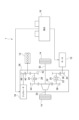
- FIG. 2 is a diagram showing a schematic configuration of the hybrid vehicle 1 shown in Fig. 1.
- the hybrid vehicle 1 in addition to the drive motor 10 and the engine 12 described above, the hybrid vehicle 1 according to the first embodiment includes a drive battery 16 that supplies electricity to the drive motor 10, a generator 18 that is driven by the engine 12 to generate electricity and assists the driving force with the electricity supplied from the drive motor 10, and a motor clutch 22 that transmits or interrupts the power of the drive motor 10 on a motor clutch shaft 20 provided between the drive motor 10 and the drive wheels 14.
- the motor clutch 22 can be connected and disconnected; when the clutch is disconnected (disconnected), the power transmission of the drive motor 10 is cut off, and when the clutch is connected (connected), the power of the drive motor 10 is transmitted.
- the hybrid vehicle 1 according to the first embodiment is capable of engine running, in which the engine 12 drives the drive wheels 14 when the motor clutch 22 cuts off the power of the drive motor 10, and parallel running (hereinafter referred to as "PR running"), in which the engine 12 drives the drive wheels 14 and the drive motor 10 assists the driving force when the motor clutch 22 transmits the power of the drive motor 10.
- the hybrid vehicle 1 further includes an engine clutch 26 that transmits or cuts off the power of the engine 12 on an engine clutch shaft 24 provided between the engine 12 and the drive shaft.
- the engine clutch 26 can be disconnected, and when the clutch is disconnected (disconnected), the power transmission of the engine 12 is cut off, and when the clutch is connected (connected), the power of the engine 12 is transmitted.
- the hybrid vehicle 1 can perform motor running (hereinafter referred to as "EV running”) in which the drive motor 10 drives the drive wheels 14 with electricity supplied from the drive battery 16 when the engine clutch 26 cuts off the power of the engine 12 and transmits the power of the drive motor 10, and series running (hereinafter referred to as “SR running”) in which the drive motor drives the drive wheels 14 with electricity supplied from the generator 18 driven by the engine 12.
- EV running motor running
- SR running series running
- the hybrid vehicle 1 is provided with a transaxle 28 incorporating the motor clutch shaft 20 and engine clutch shaft 24 described above.
- the transaxle 28 is also connected to a drive shaft 30 that drives the drive wheels (front wheels) 14 described above.
- the transaxle 28 is provided with a final gear 32 provided on the drive shaft 30, a motor gear 34 provided on the output shaft of the drive motor 10, a first gear 36 provided on one side of the motor clutch shaft 20 and meshing with the motor gear 34, a second gear 38 provided on the other side of the motor clutch shaft 20 and meshing with the final gear 32, an engine gear 40 provided on the output shaft (crankshaft) of the engine 12, a third gear 42 provided on one side of the engine clutch shaft 24 and meshing with the engine gear 40, a fourth gear 44 provided on the other side of the engine clutch shaft 24 and meshing with the final gear 32, and a generator gear 46 provided on the input shaft (output shaft) of the generator 18 and meshing with the engine gear 40.
- the power of the drive motor 10 is transmitted to the drive shaft 30 (drive wheels 14) via the motor gear 34, the first gear 36, the second gear 38, and the final gear 32
- the power of the engine 12 is transmitted to the drive shaft 30 (drive wheels 14) via the engine gear 40, the third gear 42, the fourth gear 44, and the final gear 32.
- the power of the engine 12 is transmitted to the generator 18 via the engine gear 40 and the generator gear 46 and used to generate electricity, while the power of the generator 18, which is driven by electricity supplied from the drive battery 16, is transmitted to the engine gear 40 via the generator gear 46 and assists the rotation of the drive shaft 30.
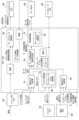
- FIG. 3 is a block diagram showing a schematic control configuration of the hybrid vehicle 1 shown in Fig. 2.
- a motor control unit 48 (hereinafter referred to as “motor ECU 48") is electrically connected to the drive motor 10, and the drive motor 10 is electrically controlled by the motor ECU 48.
- a fuel tank 50 (see FIG. 1) is connected to the engine 12, and fuel is supplied to the engine 12 from the fuel tank 50.
- an engine control unit 52 (hereinafter referred to as “engine ECU 52") is electrically connected to the engine 12, and the engine 12 is electrically controlled by the engine ECU 52.
- a battery control unit 54 (hereinafter referred to as “battery ECU 54") is electrically connected to the driving battery 16 described above, and the charging rate (SOC (State of Charge)), battery temperature, maximum battery output, etc. of the driving battery 16 are electrically managed by the battery ECU 54.
- SOC State of Charge
- the generator 18 is electrically connected to a generator control unit 56 (hereinafter referred to as "generator ECU 56"), and the generator 18 is electrically controlled by the generator ECU 56.
- generator ECU 56 generator control unit 56
- transaxle ECU 58 The motor clutch 22 and engine clutch 26 built into the transaxle 28 described above are electrically connected to a transaxle control unit 58 (hereinafter referred to as the "transaxle ECU 58"), and the engagement and disengagement of the motor clutch 22 and engine clutch 26 are electrically controlled by the transaxle ECU 58.
- the motor ECU 48, engine ECU 52, battery ECU 54, generator ECU 56 and transaxle ECU 58 each include a processor made up of an arithmetic unit, registers for storing instructions and information, and peripheral circuits, memories such as ROM (Read Only Memory) and RAM (Random Access Memory), and an input interface.
- a processor made up of an arithmetic unit, registers for storing instructions and information, and peripheral circuits, memories such as ROM (Read Only Memory) and RAM (Random Access Memory), and an input interface.
- the motor ECU 48, engine ECU 52, battery ECU 54, generator ECU 56 and transaxle ECU 58 are electrically connected to a vehicle control device 60 (hereinafter referred to as "HEV-ECU 60") via an in-vehicle network (CAN (Control Area Network)).
- HEV-ECU 60 vehicle control device 60
- CAN Controller Area Network
- the motor ECU 48, engine ECU 52, generator ECU 56 and transaxle ECU 58 are managed by the HEV-ECU 60, and in response to commands from the HEV-ECU 60, the motor ECU 48, engine ECU 52, battery ECU 54, generator ECU 56 and transaxle ECU 58 control the drive motor 10, engine 12, drive battery 16, generator 18 and transaxle 28.
- the motor ECU 48 controls the drive motor 10 so that the drive motor 10 is driven by the torque (rotational torque, rotational synchronous torque, etc.) input from the HEV-ECU 60 to the motor ECU 48.
- the HEV-ECU 60 is also connected to a chassis system control unit 62 (hereinafter referred to as the "chassis system ECU 62") via a CAN.
- the chassis system ECU 62 is made up of a processor consisting of an arithmetic unit, registers for storing instructions and information, and peripheral circuits, memories such as ROM (Read Only Memory) and RAM (Random Access Memory), and an input interface.
- a speed sensor 64 is electrically connected to the chassis system ECU 62, and information (vehicle speed) from the speed sensor 64 is input to the chassis system ECU 62, and the vehicle speed is input from the chassis system ECU 62 to the HEV-ECU 60.
- an accelerator position sensor 66 (hereinafter referred to as "APS66") is connected to the HEV-ECU60, and the accelerator opening degree is input from the APS66 to the HEV-ECU60.
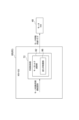
- FIG. 4 is a block diagram showing a schematic configuration of the driving control device 68 of the hybrid vehicle 1 shown in Fig. 3.
- the HEV-ECU 60 of the hybrid vehicle 1 according to the first embodiment constitutes the driving control device 68.
- the driving control device 68 includes an assist control unit 70, a synchronization control unit 72, a required output determination unit 74, a battery output determination unit 76, and a motor rotation synchronization start determination unit 78.
- the assist control unit 70 is a part that causes the generator 18 to assist the rotation of the drive shaft 30 when the motor clutch 22 cuts off the power of the drive motor 10.
- the assist control unit 70 determines that the sum of the generator assist output target value required for the generator 18 to assist the rotation of the drive shaft 30 and the motor rotation synchronous output upper limit value required to synchronize the rotation of the drive motor 10 with the rotation of the drive wheels 14 during engine running in which the engine 12 drives the drive wheels 14 with the motor clutch 22 cutting off the power of the drive motor 10, is equal to or less than the maximum battery output value of the drive battery 16, and that the output required for the hybrid vehicle 1 exceeds the maximum output of the engine 12, the assist control unit 70 causes the generator 18 to assist the rotation of the drive shaft 30.
- the assist control unit 70 includes a generator torque calculation unit 80 that calculates the assist torque of the generator 18, and the assist torque of the generator 18 calculated by the generator torque calculation unit 80 is output to the generator ECU 56.
- the generator ECU 56 controls the generator 18 so that the generator 18 is driven by the assist torque calculated by the assist control unit 70 (generator torque calculation unit 80).
- the synchronization control unit 72 is a part that synchronizes the rotation of the drive motor 10 with the rotation of the drive wheels 14 on the motor clutch shaft 20 when the motor clutch 22 cuts off the power of the drive motor 10.
- the synchronization control unit 72 includes a motor torque calculation unit 82 that calculates the rotational synchronization torque of the drive motor 10, and the rotational synchronization torque of the drive motor 10 calculated by the motor torque calculation unit 82 is output to the motor ECU 48.
- the motor ECU 48 controls the drive motor 10 so that the drive motor 10 is driven by the rotational synchronization torque calculated by the synchronization control unit 72 (motor torque calculation unit 82).
- the required output determination unit 74 is a part that determines whether the output required of the hybrid vehicle 1 exceeds the maximum output of the engine 12. For example, the output required of the hybrid vehicle 1 is calculated based on the vehicle speed input from the chassis ECU 62 to the HEV-ECU 60 and the accelerator opening input from the APS 66 to the HEV-ECU 60, and the maximum output of the engine 12 is set to a value (fixed value) determined in advance by experiments, etc.
- the battery output determination unit 76 is a part that determines whether the sum of the generator assist output target value required for the generator 18 to assist the rotation of the drive shaft 30 and the motor rotation synchronous output upper limit value required to synchronize the rotation of the drive motor 10 with the rotation of the drive wheels 14 exceeds the maximum battery output value of the drive battery 16.
- the motor rotation synchronization start determination unit 78 is a part that, when the battery output determination unit 76 determines that the output required for the hybrid vehicle 1 exceeds the maximum battery output of the driving battery 16 and the required output determination unit 74 determines that the output required for the hybrid vehicle 1 exceeds the maximum output of the engine 12 during engine running in which the engine 12 drives the driving wheels 14 with the motor clutch 22 cutting off the power of the driving motor 10, causes the assist control unit 70 to make the generator 18 assist the rotation of the driving shaft 30 until the output value of the generator 18 reaches the generator assist output target value, and after the output value of the generator 18 reaches the generator assist output target value, causes the synchronization control unit 72 to synchronize the rotation of the driving motor 10 with the rotation of the driving wheels 14.
- the driving control device 68 of the hybrid vehicle 1 further includes a motor clutch control unit 84.
- the motor clutch control unit 84 is a part that connects the motor clutch 22 when the rotation speed of the drive motor 10 is synchronized with the rotation speed of the drive wheels 14 in the motor clutch 22 (motor clutch shaft 20).
- the motor clutch control unit 84 outputs a connection instruction for the motor clutch 22 to the transaxle ECU 58.
- the transaxle ECU 58 controls the motor clutch 22 so that the motor clutch 22 is connected.
- the rotation speed of the drive motor 10 needs to be synchronized with the rotation speed of the drive wheels 14 in the motor clutch 22 (motor clutch shaft 20), the rotation speed of the drive motor 10 is converted to the rotation speed in the motor clutch 22 (motor clutch shaft 20), and the rotation speed of the drive wheels 14 is converted to the rotation speed in the motor clutch 22 (motor clutch shaft 20).
- Fig. 5 is a flow chart showing an outline of the control contents of the driving control device 68 of the hybrid vehicle 1 shown in Fig. 4.
- the motor rotation synchronization start determination unit 78 determines whether or not the motor clutch 22 has cut off the power of the drive motor 10 (step S11).
- step S11: Yes the vehicle is running on the engine, so the required output determination unit 74 determines whether the output required of the hybrid vehicle 1 exceeds the maximum output of the engine 12 (step S12).
- step S12 When the output required of the hybrid vehicle 1 exceeds the maximum output of the engine 12 (step S12: Yes), the output required of the hybrid vehicle 1 cannot be met by running on the engine, so the battery output determination unit 76 determines whether the sum of the generator assist output target value required for the generator 18 to assist the rotation of the drive shaft 30 and the motor rotation synchronous output upper limit value required to synchronize the rotation of the drive motor 10 with the rotation of the drive wheels 14 exceeds the battery maximum output value of the drive battery 16 (step S13).
- step S13: Yes If the sum of the generator assist output target value and the motor rotation synchronization output upper limit value exceeds the maximum battery output value of the drive battery 16 (step S13: Yes), the battery output of the drive battery 16 is insufficient to simultaneously supply electricity to the generator 18 and the drive motor 10, so the system transitions to PR driving (generator assist) in which the generator 18 assists the rotation of the drive shaft 30 (step S14). Then, when the output value of the generator 18 reaches the generator assist output target value (step S15: Yes), rotation synchronization of the drive motor 10 begins (step S16).
- PR driving generator assist
- step S17 When the rotation of the drive motor 10 is synchronized with the rotation of the drive wheels 14 in the motor clutch 22 (motor clutch shaft 20) (step S17: Yes), the motor clutch 22 can be connected, and the motor clutch control unit 84 connects the motor clutch 22 (step S18). This makes it possible to transmit the power of the drive motor 10 to the drive wheels 14, and transitions from generator assist to motor assist (step S19).
- step S13 if the sum of the generator assist output target value and the motor rotation synchronization output upper limit value exceeds the maximum battery output value of the drive battery 16 (step S13: No), the system transitions to PR driving (generator assist) in which the generator 18 assists the rotation of the drive shaft 30 (step S20), and rotation synchronization of the drive motor 10 begins (step S16).
- PR driving generator assist
- [Effects of the driving control device] 6 is a diagram showing the battery output of the generator assisting the rotation of the drive shaft 30 of the hybrid vehicle 1 according to the first embodiment and the battery output of the motor rotation synchronous portion of the drive motor 10.
- the output required for the hybrid vehicle 1 exceeds the maximum output of the engine 12 during engine running in which the engine 12 drives the drive wheels 14 with the motor clutch 22 cutting off the power of the drive motor 10
- the sum of the generator assist output target value and the motor rotation synchronous output upper limit value exceeds the battery maximum output of the drive battery 16
- the travel control device 68 of the hybrid vehicle 1 causes the generator 18 to assist the rotation of the drive shaft 30 until the output value of the generator 18 reaches the generator assist output target value.
- the battery output of the drive battery 16 is used to assist the rotation of the drive shaft 30 until the output value of the generator 18 reaches the generator assist target value. This makes it possible to prevent the acceleration of the hybrid vehicle 1 from becoming slow until the output value of the generator 18 reaches the generator assist target value.
- the rotation speed of the drive motor 10 is synchronized with the rotation speed of the drive wheels 14.
- the battery output of the drive battery 16 is also used to synchronize the rotation of the drive motor 10 with the rotation of the drive wheels 14.
- the battery output for generator assist and the battery output for synchronizing the rotation of the drive motor 10 with the rotation of the drive wheels 14 are not used simultaneously, and the battery output is used only for generator assist, so the acceleration rises quickly after generator assist is required.
- generator assist battery output When the sum of the generator assist output target value and the motor rotation synchronization output upper limit value exceeds the maximum battery output value of the drive battery 16, the battery output used by the generator 18 to assist the rotation of the drive shaft 30 (hereinafter referred to as "generator assist battery output") decreases, but the acceleration rises quickly after generator assist is required. As a result, when the motor clutch 22 cuts off the power of the drive motor 10 and the engine 12 drives the drive wheels 14, even if the battery output of the drive battery 16 does not have enough capacity to simultaneously supply electricity to the generator 18 and the drive motor 10, the acceleration of the hybrid vehicle 1 can be prevented from becoming sluggish.
- FIG. 7 is a block diagram showing the configuration of the driving control device 68 of the hybrid vehicle 1 according to the embodiment 2.
- the hybrid vehicle 1 according to the embodiment 2 and the driving control device 68 of the hybrid vehicle 1 have the same configuration as the hybrid vehicle 1 according to the embodiment 1 and the driving control device 68 of the hybrid vehicle 1, except for the synchronization control unit 72. Therefore, a description of the same configuration as the hybrid vehicle 1 according to the embodiment 1 and the driving control device 68 of the hybrid vehicle 1 will be omitted.
- the synchronization control unit 72 includes a motor torque calculation unit 82 that calculates the rotational synchronous torque of the drive motor 10, and the motor ECU 48 controls the drive motor 10 using the synchronous torque calculated by the motor torque calculation unit 82, while the motor torque calculation unit 82 has a rate of change limiting unit 86 that limits the rate of change of the rotational synchronous torque.
- the battery output of the drive battery 16 is used not only for the generator 18 to assist the rotation of the drive shaft 30, but also for synchronizing the rotation of the drive motor 10 with the rotation of the drive wheels 14.
- the battery output of the drive battery 16 synchronizes the rotation of the drive motor 10 with the rotation of the drive wheels 14, and the sum of the generator assist output target value and the motor rotation synchronous output upper limit value exceeds the maximum battery output value of the drive battery 16, the battery output used by the generator 18 to assist the rotation of the drive shaft 30 (hereinafter referred to as "battery output for generator assist") decreases, but this decrease is suppressed by the change rate limiting unit 86, which limits the change rate of the synchronous torque.
- [Effects of the driving control device] 8A is a diagram comparing the battery output of the driving battery 16 according to embodiment 1 with the battery output of the driving battery 16 according to embodiment 2.
- the battery output of the driving battery 16 according to embodiment 1 is such that after the output value of the generator 18 reaches the generator assist target value, the battery output used to synchronize the rotation of the driving motor 10 with the rotation of the driving wheels 14 (hereinafter referred to as "battery output synchronized with the motor rotation”) gradually increases, and when the sum of the battery output for the generator assist and the battery output for the motor rotation synchronized reaches the maximum battery output value, the battery output for the motor rotation synchronized gradually reduces the battery output for the generator assist.
- the battery output of the driving battery 16 in embodiment 1 also gradually increases in the motor rotation synchronous portion after the output value of the generator 18 reaches the generator assist target value, and when the sum of the battery output of the generator assist portion and the battery output of the motor rotation synchronous portion reaches the maximum battery output value, the battery output of the motor rotation synchronous portion gradually reduces the generator assist portion, but the amount of reduction is limited because the rate of change limiting unit 86 limits the rate of change of the synchronous torque.
- the hybrid vehicle 1 in embodiment 2 is more able to suppress acceleration from becoming sluggish than the hybrid vehicle 1 in embodiment 1.
- FIG. 9 is a block diagram showing the configuration of the hybrid vehicle 1's cruise control device 68 according to embodiment 3.
- the hybrid vehicle 1 according to embodiment 3 and the cruise control device 68 of the hybrid vehicle 1 have the same configuration as the hybrid vehicle 1 according to embodiment 1 and the cruise control device 68 of the hybrid vehicle 1, except for a required output calculation unit 88. Therefore, a description of the same configuration as the hybrid vehicle 1 according to embodiment 1 and the cruise control device 68 of the hybrid vehicle 1 will be omitted.
- the driving control device 68 of the hybrid vehicle 1 has a required output calculation unit 88 that calculates the output required of the hybrid vehicle 1 based on the vehicle speed measured by the speed sensor 64 and the accelerator opening detected by the APS 66.
- the vehicle speed of any vehicle changes from time to time, not just the hybrid vehicle 1.
- the output required of the vehicle is calculated based on the vehicle speed which changes from time to time and the accelerator opening detected by the APS 66, so the required output calculation unit 88 calculates the vehicle speed in a feedforward manner.
- the output required for the hybrid vehicle 1 is calculated based on the speed measured by the speed sensor 64 and the accelerator opening detected by the APS 66. This makes it possible to accurately calculate the output required for the hybrid vehicle 1.
- [Embodiment 4] is a block diagram showing the configuration of a driving control device 68 of a hybrid vehicle 1 according to embodiment 4.
- the hybrid vehicle 1 according to embodiment 4 and the driving control device 68 of the hybrid vehicle 1 have the same configuration as the hybrid vehicle 1 according to embodiment 3 and the driving control device 68 of the hybrid vehicle 1, except for the generator assist output target calculation unit. Therefore, a description of the same configuration as the hybrid vehicle 1 according to embodiment 3 and the driving control device 68 of the hybrid vehicle 1 will be omitted.
- the driving control device 68 of the hybrid vehicle 1 has a generator assist output target value calculation unit 90 that calculates a generator assist output target value based on the output required for the hybrid vehicle 1 calculated by the required output calculation unit 88 and the maximum torque of the engine 12.
- the assist torque output target value is calculated from the generator assist torque calculated by the required output calculation unit 88 and the maximum torque of the engine 12.
- the required torque calculated by the required output calculation unit 88 is, for example, the required torque required of the generator 18, but the required torque required of the drive wheels 14 may be converted to the torque required of the generator 18 by the generator torque calculation unit 80.
- the generator assist torque is the difference between the required torque calculated by the required output calculation unit 88 and the maximum torque of the engine 12, and the torque required of the generator 18 is calculated.
- the generator assist output target value is the shortage output obtained by subtracting the maximum engine output from the output required of the hybrid vehicle 1 (required output), and the generator assist output target value calculation unit 90 according to the fourth embodiment calculates the generator assist output target value by converting the generator assist torque into output.
- the generator assist output target value is calculated based on the output required for the hybrid vehicle 1 and the maximum torque of the engine 12. This makes it possible to accurately calculate the generator assist output target value.
- the present invention is not limited to the above-described embodiments, but also includes modifications to the above-described embodiments and appropriate combinations of these embodiments.
Landscapes
- Engineering & Computer Science (AREA)
- Transportation (AREA)
- Mechanical Engineering (AREA)
- Chemical & Material Sciences (AREA)
- Combustion & Propulsion (AREA)
- Automation & Control Theory (AREA)
- Power Engineering (AREA)
- Electric Propulsion And Braking For Vehicles (AREA)
- Hybrid Electric Vehicles (AREA)
Priority Applications (2)
| Application Number | Priority Date | Filing Date | Title |
|---|---|---|---|
| JP2025506327A JPWO2024189789A1 (https=) | 2023-03-14 | 2023-03-14 | |
| PCT/JP2023/009918 WO2024189789A1 (ja) | 2023-03-14 | 2023-03-14 | ハイブリッド車両の走行制御装置 |
Applications Claiming Priority (1)
| Application Number | Priority Date | Filing Date | Title |
|---|---|---|---|
| PCT/JP2023/009918 WO2024189789A1 (ja) | 2023-03-14 | 2023-03-14 | ハイブリッド車両の走行制御装置 |
Publications (1)
| Publication Number | Publication Date |
|---|---|
| WO2024189789A1 true WO2024189789A1 (ja) | 2024-09-19 |
Family
ID=92754706
Family Applications (1)
| Application Number | Title | Priority Date | Filing Date |
|---|---|---|---|
| PCT/JP2023/009918 Ceased WO2024189789A1 (ja) | 2023-03-14 | 2023-03-14 | ハイブリッド車両の走行制御装置 |
Country Status (2)
| Country | Link |
|---|---|
| JP (1) | JPWO2024189789A1 (https=) |
| WO (1) | WO2024189789A1 (https=) |
Citations (3)
| Publication number | Priority date | Publication date | Assignee | Title |
|---|---|---|---|---|
| JP2008221948A (ja) * | 2007-03-09 | 2008-09-25 | Toyota Motor Corp | 動力出力装置およびこれを搭載する車両並びに動力出力装置の制御方法、駆動装置、駆動装置の制御方法 |
| JP2013103673A (ja) * | 2011-11-16 | 2013-05-30 | Toyota Motor Corp | ハイブリッド車両の制御装置 |
| WO2020148973A1 (ja) * | 2019-01-18 | 2020-07-23 | 三菱自動車工業株式会社 | 車両の制御装置 |
-
2023
- 2023-03-14 WO PCT/JP2023/009918 patent/WO2024189789A1/ja not_active Ceased
- 2023-03-14 JP JP2025506327A patent/JPWO2024189789A1/ja active Pending
Patent Citations (3)
| Publication number | Priority date | Publication date | Assignee | Title |
|---|---|---|---|---|
| JP2008221948A (ja) * | 2007-03-09 | 2008-09-25 | Toyota Motor Corp | 動力出力装置およびこれを搭載する車両並びに動力出力装置の制御方法、駆動装置、駆動装置の制御方法 |
| JP2013103673A (ja) * | 2011-11-16 | 2013-05-30 | Toyota Motor Corp | ハイブリッド車両の制御装置 |
| WO2020148973A1 (ja) * | 2019-01-18 | 2020-07-23 | 三菱自動車工業株式会社 | 車両の制御装置 |
Also Published As
| Publication number | Publication date |
|---|---|
| JPWO2024189789A1 (https=) | 2024-09-19 |
Similar Documents
| Publication | Publication Date | Title |
|---|---|---|
| US8043194B2 (en) | Vehicle creep control in a hybrid electric vehicle | |
| EP1894805B1 (en) | Hybrid vehicle control apparatus | |
| US7691027B2 (en) | Idle speed control of a hybrid electric vehicle | |
| CN107021093B (zh) | 混合动力电动车辆 | |
| EP2670641B1 (en) | Hybrid electric vehicle and method of controlling a hybrid electric vehicle | |
| EP2873576B1 (en) | Hybrid vehicle control device and hybrid vehicle control method | |
| JP5565468B2 (ja) | ハイブリッド車両の制御装置 | |
| US20060293144A1 (en) | Gear shift control system of hybrid vehicle | |
| JP6583295B2 (ja) | 車両の制御装置 | |
| US11040709B2 (en) | Electrically driven vehicle | |
| US9988041B2 (en) | System and method for controlling a vehicle powertrain | |
| JP2011105024A (ja) | ハイブリッド自動車の変速制御装置 | |
| US20170253244A1 (en) | Hybrid vehicle and lash mitigation strategy | |
| WO2014170749A1 (en) | Control device for vehicle | |
| JP5163707B2 (ja) | ハイブリッド車の制御装置 | |
| JP7254816B2 (ja) | 電気式ハイブリッドパワーユニットを制御するための方法 | |
| JP5716914B2 (ja) | ハイブリッド車両の制御装置 | |
| CN107585156B (zh) | 用于车辆的变速控制装置 | |
| JP2011105022A (ja) | ハイブリッド自動車の変速制御装置 | |
| KR102752357B1 (ko) | 하이브리드 차량 및 그 제어 방법 | |
| WO2024189789A1 (ja) | ハイブリッド車両の走行制御装置 | |
| EP4316897A1 (en) | Vehicle drive device | |
| JP6897273B2 (ja) | ハイブリッド車両 | |
| JP7518488B2 (ja) | 4輪駆動車の走行駆動制御装置 | |
| WO2024189787A1 (ja) | ハイブリッド車両の走行制御装置 |
Legal Events
| Date | Code | Title | Description |
|---|---|---|---|
| 121 | Ep: the epo has been informed by wipo that ep was designated in this application |
Ref document number: 23927410 Country of ref document: EP Kind code of ref document: A1 |
|
| ENP | Entry into the national phase |
Ref document number: 2025506327 Country of ref document: JP Kind code of ref document: A |
|
| WWE | Wipo information: entry into national phase |
Ref document number: 2025506327 Country of ref document: JP |
|
| NENP | Non-entry into the national phase |
Ref country code: DE |
|
| 122 | Ep: pct application non-entry in european phase |
Ref document number: 23927410 Country of ref document: EP Kind code of ref document: A1 |