WO2024189664A1 - 検査用光学装置、欠陥検査装置、および基板の製造方法 - Google Patents
検査用光学装置、欠陥検査装置、および基板の製造方法 Download PDFInfo
- Publication number
- WO2024189664A1 WO2024189664A1 PCT/JP2023/009219 JP2023009219W WO2024189664A1 WO 2024189664 A1 WO2024189664 A1 WO 2024189664A1 JP 2023009219 W JP2023009219 W JP 2023009219W WO 2024189664 A1 WO2024189664 A1 WO 2024189664A1
- Authority
- WO
- WIPO (PCT)
- Prior art keywords
- substrate
- light
- optical system
- unit
- irradiation
- Prior art date
- Legal status (The legal status is an assumption and is not a legal conclusion. Google has not performed a legal analysis and makes no representation as to the accuracy of the status listed.)
- Ceased
Links
Images








Classifications
-
- G—PHYSICS
- G02—OPTICS
- G02B—OPTICAL ELEMENTS, SYSTEMS OR APPARATUS
- G02B21/00—Microscopes
Definitions
- the present invention relates to an optical inspection device, a defect inspection device, and a method for manufacturing a substrate.
- Some substrate inspection devices irradiate the surface of the substrate with laser light and detect reflected or scattered light of the laser light to inspect the substrate surface for defects (see, for example, Patent Document 1).
- substrate defect inspection there is an increasing demand to inspect not only the surface of the substrate, but also the interior of the substrate for defects.
- the first optical inspection device is an optical inspection device used in a defect inspection device that inspects defects in a substrate, and includes a first irradiation optical system that irradiates a first irradiation light toward the substrate via an objective optical system, a first light receiving unit that receives light generated inside the substrate by the first irradiation light irradiated to the substrate via the objective optical system and outputs a first light receiving signal, a processing unit that generates information about the inside of the substrate based on the first light receiving signal from the first light receiving unit, a second irradiation optical system that irradiates a second irradiation light toward the substrate via the objective optical system, a second light receiving unit that receives reflected light from the surface of the substrate irradiated with the second irradiation light and outputs a second light receiving signal, and a control unit that outputs a control signal to a moving unit that moves at least one of the focusing position of the first irradiation light and
- the second optical inspection device is an optical inspection device used in a defect inspection device that inspects defects in a substrate, and includes an illumination optical system that illuminates the substrate with illumination light from a light source via an objective optical system, a light receiving unit that receives, via the objective optical system, light generated inside the substrate by the illumination light illuminated onto the substrate and outputs a light receiving signal, a processing unit that generates information about the inside of the substrate based on the light receiving signal from the light receiving unit, and a control unit that controls the light source to illuminate the illumination light toward the substrate when the focal position of the illumination light in the optical axis direction of the objective optical system is the inside of the substrate.
- the third optical inspection device is an optical inspection device used in a defect inspection device that inspects defects in a substrate, and includes an illumination optical system that irradiates illumination light from a light source toward the substrate via an objective optical system, a light receiving unit that receives, via the objective optical system, light generated inside the substrate by the illumination light irradiated onto the substrate and outputs a light receiving signal, a processing unit that generates information about the inside of the substrate based on the light receiving signal from the light receiving unit, and a control unit that controls the light source to restrict the irradiation of the illumination light toward the substrate when the focusing position of the illumination light in the optical axis direction of the objective optical system is not inside the substrate.
- the fourth optical inspection device is an optical inspection device used in a defect inspection device that inspects defects in a substrate, and includes an illumination optical system that irradiates illumination light toward the substrate via an objective optical system, a light receiving unit that receives, via the objective optical system, light generated inside the substrate by the illumination light irradiated onto the substrate and outputs a light receiving signal, and a processing unit that generates information about the inside of the substrate based on substrate topography information related to the topography of the substrate and the light receiving signal from the light receiving unit.
- a fifth aspect of the present invention provides an inspection optical device used in a defect inspection device for inspecting defects in a substrate, the inspection optical device comprising: an irradiation optical system that irradiates a first irradiation light toward the substrate via an objective optical system; a light receiving unit that receives, via the objective optical system, light generated inside the substrate by the first irradiation light irradiated to the substrate and outputs a light receiving signal; a processing unit that generates information about the inside of the substrate based on the light receiving signal from the light receiving unit; a substrate surface position detection unit that irradiates a surface of the substrate with a second irradiation light and receives the second irradiation light reflected by the surface of the substrate and detects the position of the substrate surface in the optical axis direction of the objective optical system or in a direction parallel to the optical axis direction; and a control unit that outputs a control signal to a moving unit that moves at least one of the focusing position of the first
- the sixth optical inspection device is an optical inspection device used in a defect inspection device that inspects for defects in a substrate having multiple layers stacked in the thickness direction, and includes an irradiation optical system that irradiates a first irradiation light toward the substrate via an objective optical system, a light receiving unit that receives, via the objective optical system, light generated inside at least one of the multiple layers of the substrate by the first irradiation light irradiated toward the substrate and outputs a light receiving signal, a substrate interface position detection unit that irradiates at least one interface of the multiple layers of the substrate with a second irradiation light and receives the second irradiation light reflected at the interface to detect the position of the interface of the substrate in the optical axis direction of the objective optical system or in a direction parallel to the optical axis direction, and a processing unit that generates information about the inside of the at least one layer of the substrate based on position information regarding the position of the interface of the substrate and the light receiving signal
- the defect inspection device is a defect inspection device for inspecting defects in a substrate, and is equipped with the above-mentioned inspection optical device, and inspects the substrate for defects based on the information about the inside of the substrate generated by the inspection optical device.
- the method for manufacturing a substrate according to the present invention includes creating a substrate and inspecting the created substrate using the above-mentioned defect inspection device.
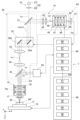
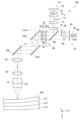
- FIG. 1 is a schematic configuration diagram showing a defect inspection device according to a first embodiment.
- FIG. 2 is a cross-sectional view showing an example of a substrate.
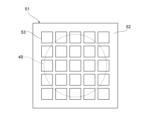
- FIG. 2 is a schematic diagram showing a first detector.
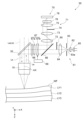
- FIG. 2 is a schematic configuration diagram showing a surface detection unit according to the first embodiment.
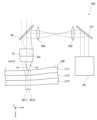
- 13 is a schematic diagram showing a state in which the imaging position of the image of the slit opening of the second irradiation light coincides with the focal position of the objective optical system.
- FIG. 13 is a schematic diagram showing a state in which the imaging position of the image of the slit opening of the second irradiation light is separated from the focal position of the objective optical system.
- FIG. 13 is a schematic diagram showing a state in which the image of the slit opening of the second irradiation light is formed at a position on the surface of the substrate.
- FIG. 5A to 5C are schematic diagrams showing a case in which the focusing position of the first irradiation light is set inside a second layer of the substrate in the first embodiment.
- 5A is a schematic diagram showing a case where the focusing position of the first irradiation light is set inside a third layer of the substrate in the first embodiment.
- FIG. FIG. 11 is a schematic diagram showing a deflection section for front surface detection and a front surface detection unit according to a second embodiment.
- FIG. 13 is a schematic diagram showing a case where a deflection mirror for front surface detection of a deflection unit for front surface detection is rotationally moved to a second rotation position.
- FIG. 13 is a schematic diagram showing a modified example of the deflection unit for surface detection.
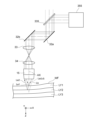
- FIG. 13 is a schematic configuration diagram showing a defect inspection device according to a third embodiment.
- FIG. 13 is a schematic configuration diagram showing a surface detection unit according to a third embodiment.
- 13 is a schematic diagram showing a case in which the focusing position of the first irradiation light is set inside a second layer of the substrate in the third embodiment.
- FIG. FIG. 13 is a schematic configuration diagram showing a defect inspection device according to a fourth embodiment.
- FIG. 13 is a schematic configuration diagram showing a surface detection unit according to a fourth embodiment.
- 13 is a schematic diagram showing a case where the focusing position of the first irradiation light is set inside a second layer of the substrate in the fourth embodiment.
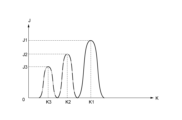
- FIG. 13 is a graph showing an example of a signal voltage of a second light receiving signal.
- 1 is a flowchart showing a method for manufacturing a substrate.
- the directions indicated by the arrows in FIG. 1 may be referred to as the X direction, Y direction, and Z direction, respectively.
- the X direction, Y direction, and Z direction are mutually perpendicular.
- the Z direction is parallel to the optical axis AX of the objective optical system 15.
- the coordinate position in the X direction may be referred to as the X position
- the coordinate position in the Y direction may be referred to as the Y position
- the coordinate position in the Z direction may be referred to as the Z position.
- the defect inspection device 1 includes an inspection optical device 10 and an information processing device 90.
- the inspection optical device 10 and the information processing device 90 are configured to be able to transmit and receive data to and from each other via a network cable NW.
- the inspection optical device 10 is also called a scanning microscope.
- the inspection optical device 10 includes a stage 11 on which a substrate WF is placed, an objective optical system 15, a first light source unit 20, a first irradiation optical system 30, a first light receiving unit 40, a surface detection unit 55, and an optical device control unit 80.
- the stage 11 supports the substrate WF, which is the object to be inspected.
- the substrate WF is formed in a plate shape having multiple layers (e.g., five layers) stacked in the plate thickness direction.
- the substrate WF has, in order from the front surface side of the substrate WF, a first layer LY1, a second layer LY2, a third layer LY3, a fourth layer LY4, and a fifth layer LY5.
- AlGaN aluminum gallium nitride
- GaN gallium nitride
- the fourth layer LY4 is a buffer layer.
- the fifth layer LY5 is a layer of a base substrate.
- Si silicon
- Such a substrate WF may be a substrate used in the manufacture of a power device (power semiconductor) such as a high electron mobility transistor (HEMT).
- the materials of the first layer LY1 to the fourth layer LY4 are not limited to the above-mentioned materials and may be other materials.
- the number of layers of the substrate WF is not limited to five layers and may be less than five layers or more than five layers.
- the material of the fifth layer LY5 (base substrate) is not limited to Si, but may be SiC, GaN, or sapphire.
- a substrate in which at least one layer is formed using GaN may be referred to as a GaN substrate.
- the stage 11 is provided with a stage moving unit 12.
- the stage moving unit 12 moves the stage 11 in a direction perpendicular to the optical axis AX (Z direction) of the objective optical system 15, i.e., in the X direction and the Y direction.
- the observation area of the substrate WF facing the objective optical system 15 can be displaced in the X direction and the Y direction (directions along the cross section of the substrate WF).
- the observation area is a partial area of the substrate WF that is scanned by the deflection unit 32 described below via the objective optical system 15.
- the observation area may be set to a range narrower than the actual field of view of the inspection optical device 10, or may be set to the same range as the actual field of view of the inspection optical device 10.
- the stage moving unit 12 can also move the stage 11 in a direction along the optical axis AX of the objective optical system 15, i.e., in the Z direction.
- the stage moving unit 12 moves the stage 11 in the Z direction
- the relative position of the objective optical system 15 with respect to the substrate WF supported by the stage 11 changes in the Z direction
- the focal position of the objective optical system 15 changes in the Z direction inside the substrate WF.
- the direction along the optical axis AX of the objective optical system 15 may be referred to as the optical axis direction of the objective optical system 15.
- Images of multiple cross sections with different Z positions inside the substrate WF may be referred to as Z stack images inside the substrate WF.
- the objective optical system 15 is disposed above the stage 11.
- the objective optical system 15 faces the substrate WF supported by the stage 11.
- the objective optical system 15 is configured using a plurality of lenses 16 and is housed in a lens housing 17.
- the objective optical system 15 is configured using four lenses 16 as an example, but is not limited to this.
- the objective optical system 15 may be configured using five or more lenses, or may be configured using two or three lenses.
- at least a part of the plurality of lenses 16 may be configured to be movable in the optical axis direction of the objective optical system 15 by rotating a correction collar (not shown) provided on the lens housing 17.
- the objective optical system 15 may be moved in the Z direction (optical axis direction) to change the focal position of the objective optical system 15 in the Z direction inside the substrate WF.
- the first light source unit 20 emits the first irradiation light La toward the first irradiation optical system 30.
- the first light source unit 20 includes a first light source 21 and a light source lens 22.
- a laser light source capable of emitting laser light in a predetermined wavelength range is used as the first light source 21.
- the laser light emitted from the first light source 21 is shaped by the light source lens 22 to become parallel light, and is emitted from the first light source unit 20 as the first irradiation light La.
- the first light source 21 may be a laser light source (for example, a laser light source that emits a femtosecond laser) that emits pulsed light having a pulse width of less than 1 picosecond (for example, a pulse width in femtosecond units).
- the first light source 21 is not limited to a laser light source that emits pulsed light, but may be a laser light source that emits continuous oscillation light.
- the first light source 21 is not limited to a laser light source, but may be configured using an LED (Light Emitting Diode) or a bright line lamp.
- the wavelength of the first irradiation light La is selected in a wavelength range (e.g., a wavelength range of 700 nm to 1030 nm) capable of multi-photon excitation of the material constituting the substrate WF to cause it to emit light.
- the wavelength of the first irradiation light La may be selected in a wavelength range capable of two-photon excitation of the material constituting the substrate WF to cause it to emit light.
- the wavelength of the first irradiation light La may be selected to be 700 nm or 1030 nm.
- the first irradiation optical system 30 irradiates the first irradiation light La emitted from the first light source unit 20 toward the substrate WF via the objective optical system 15.
- the relative position of the objective optical system 15 with respect to the substrate WF supported by the stage 11 is adjusted so that the first irradiation light La emitted from the objective optical system 15 is focused inside the substrate WF.
- the region inside the substrate WF where the first irradiation light La is focused to a size approximately equal to the resolution limit of the objective optical system 15 may be referred to as the irradiation region 25.
- the size of the irradiation region 25 is, for example, the beam width (e.g., 1/ e2 width) of the first irradiation light La, which is a laser beam.
- the resolution limit of the objective optical system 15 corresponds to the radius of the first dark ring of the so-called Airy disc, and is calculated by 0.61 ⁇ 1/NA, where ⁇ 1 is the wavelength of the first irradiation light La and NA is the numerical aperture of the objective optical system 15 (the sine of the opening angle of the first irradiation light La emitted from the objective optical system 15).
- the size of the irradiation area 25 is smaller than 1.22 ⁇ 1/NA, which is the diameter of the first dark ring of the Airy disc, the first irradiation light La is said to be condensed to the resolution limit.
- the first irradiation optical system 30 includes, in order from the first light source unit 20 side, a first dichroic mirror 31, a deflection unit 32, a first relay lens 33, a second relay lens 34, and a second dichroic mirror 35.
- the first dichroic mirror 31 has a characteristic of reflecting, for example, blue light or light in a wavelength range shorter than blue light, and transmitting light in a wavelength range longer than blue light.
- the first dichroic mirror 31 is not limited to the above-mentioned wavelength characteristics, and may have a characteristic of reflecting light generated inside the substrate WF by multi-photon excitation and transmitting the first irradiation light La emitted from the first light source unit 20.
- detection light Ld the light generated inside the substrate WF by multi-photon excitation
- the deflection unit 32 scans the inside of the substrate WF with the first irradiation light La from the first light source unit 20 in two directions, the X direction and the Y direction.
- the deflection unit 32 is provided with an X-direction deflection mirror 32a and a Y-direction deflection mirror 32b capable of changing the traveling direction of the first irradiation light La.
- the X-direction deflection mirror 32a and the Y-direction deflection mirror 32b are configured using a galvanometer mirror, a MEMS mirror, a resonant mirror (resonant mirror), or the like.
- the X-direction deflection mirror 32a and the Y-direction deflection mirror 32b are disposed at a position that is a conjugate plane of the pupil plane Pp of the objective optical system 15, or in the vicinity of a position that is a conjugate plane of the pupil plane Pp of the objective optical system 15.
- the X-direction deflection mirror 32a swinging or rotating in a rotation direction ( ⁇ y direction) centered on the Y axis, the traveling direction of the first irradiation light La changes in the ⁇ y direction around the Y axis, and the irradiation area 25 on the substrate WF moves in the X direction.
- the deflection unit 32 can move the irradiation area 25 on the substrate WF in two directions, the X direction and the Y direction (XY directions), and two-dimensionally scan the inside of the substrate WF.
- a first intermediate image plane Im1 conjugate with the substrate WF (object plane) is formed between the first relay lens 33 and the second relay lens 34.
- the first relay lens 33 focuses the first irradiation light La from the deflection unit 32 on the first intermediate image plane Im1.
- the first intermediate image plane Im1 may also be referred to as the first conjugate plane Im1.
- the second relay lens 34 collimates the first irradiation light La from the first relay lens 33 and guides it to the objective optical system 15 (second dichroic mirror 35).
- the second relay lens 34 also focuses the detection light Ld from the objective optical system 15 (second dichroic mirror 35) on the first intermediate image plane Im1.
- the first relay lens 33 collimates the detection light Ld from the second relay lens 34 and guides it to the deflection unit 32.
- first relay lens 33 and the second relay lens 34 are not limited to being made up of a single lens, and may be made up of multiple lenses.
- the first relay lens 33 is also called a scan lens.
- the second relay lens 34 is also called an imaging lens or a second objective lens.
- the second dichroic mirror 35 has the characteristic of, for example, reflecting light in the wavelength range of green light and transmitting light in a wavelength range longer than green light and light in a wavelength range shorter than green light.
- the second dichroic mirror 35 is not limited to the wavelength characteristics described above, and it is sufficient that it has the characteristic of reflecting the second irradiation light Lb (and the reflected light Le described below) from the surface detection unit 55 and transmitting the first irradiation light La from the second relay lens 34 and the detection light Ld from the objective optical system 15.
- the first light receiving section 40 includes a first light receiving optical system 41 and a first detector 51.
- the first light receiving optical system 41 receives the detection light Ld generated inside the substrate WF (irradiation area 25) by multiphoton excitation by the first irradiation light La via the objective optical system 15, and forms an image 49 of the irradiation area 25 inside the substrate WF on the image plane Imp.
- the first light receiving optical system 41 includes the second dichroic mirror 35 of the first irradiation optical system 30, the second relay lens 34, the first relay lens 33, the deflection unit 32, and the first dichroic mirror 31.
- the first light receiving optical system 41 includes, in order from the first dichroic mirror 31 side (substrate WF side), a barrier filter 42, a condenser lens 43, and a variable magnification optical system 45.
- the barrier filter 42 has a characteristic that light in a predetermined wavelength range (specifically, the detection light Ld) from the first dichroic mirror 31 passes through.
- the barrier filter 42 blocks at least a portion of, for example, the first irradiation light La reflected by the substrate WF, external light, stray light, and the like.
- the barrier filter 42 is also called a bandpass filter.
- a second intermediate image plane Im2 that is conjugate with the substrate WF (object plane) is formed between the condenser lens 43 and the variable magnification optical system 45.
- the condenser lens 43 condenses the detection light Ld that has passed through the barrier filter 42 onto the second intermediate image plane Im2.
- the second intermediate image plane Im2 may be called the second conjugate plane Im2.
- the condenser lens 43 is not limited to a single lens, and may be configured using multiple lenses.
- the variable magnification optical system 45 focuses the detection light Ld from the focusing lens 43 on the image plane Imp, and forms an image 49 of the irradiation area 25 inside the substrate WF.
- the substrate WF (object plane), the first intermediate image plane Im1, the second intermediate image plane Im2, and the image plane Imp are mutually conjugate planes.
- the variable magnification optical system 45 is composed of a plurality of lenses 46, and is held by a zoom lens barrel 48 having cam grooves and the like formed therein via a holding frame 47.
- variable magnification optical system 45 By rotating the zoom lens barrel 48 by an electric motor (not shown), at least a portion of the plurality of lenses 46 moves (in the optical axis direction of the variable magnification optical system 45), and the focal length and the position of the principal point of the variable magnification optical system 45 change. This changes the imaging magnification of the variable magnification optical system 45 (i.e., the imaging magnification of the first light receiving optical system 41), and the size of the image 49 formed on the image plane Imp changes.
- variable magnification optical system 45 is configured using four lenses 46 as an example, but is not limited to this.
- the variable magnification optical system 45 may be configured using five or more lenses, or may be configured using two or three lenses.
- the first detector 51 may be placed at the second intermediate image plane Im2 without providing the variable magnification optical system 45.
- the first detector 51 is configured, for example, using an avalanche photodiode array.
- the first detector 51 has a detection surface 52 having a plurality of detection pixels 53 arranged in a two-dimensional direction (see FIG. 3).
- the detection surface 52 may have 25 detection pixels 53 arranged in five rows and five columns.
- the first detector 51 is disposed at a position where the detection surface 52 overlaps with the image plane Imp. As a result, the detection light Ld from the variable magnification optical system 45 is focused on the detection surface 52 of the first detector 51 to form an image 49 of the irradiation area 25 inside the substrate WF.
- the first detector 51 receives the image 49 of the irradiation area 25 inside the substrate WF formed on the detection surface 52, performs photoelectric conversion, and outputs a light receiving signal (also called a detection signal) of the image 49 of the irradiation area 25 inside the substrate WF.
- the first detector 51 receives the image 49 of the irradiation area 25 inside the substrate WF using a plurality of detection pixels 53, performs photoelectric conversion, and outputs a light reception signal according to the amount of light of the image 49 of the irradiation area 25 inside the substrate WF.
- the light reception signal output from the first detector 51 may be referred to as the first light reception signal.
- a non-descanned (NDD) type detector may be used as the first detector 51.
- the surface detection unit 55 includes a second light source 60, a second irradiation optical system 61, and a second light receiving unit 70. Furthermore, the surface detection unit 55 includes a second dichroic mirror 35 of the first irradiation optical system 30.
- the second light source 60 emits the second irradiation light Lb toward the second irradiation optical system 61.
- the second light source 60 is configured using, for example, an LED.
- the second light source 60 is not limited to an LED, and may be configured using a laser light source.
- the wavelength of the second irradiation light Lb is selected in a wavelength range that can be reflected by the second dichroic mirror 35 (for example, a wavelength range of green light).
- the wavelength of the second irradiation light Lb may be selected in a wavelength range that can be reflected by the surface of the substrate WF, or in a wavelength range that can be reflected by the interfaces of multiple layers (the first layer LY1 to the fifth layer LY5) of the substrate WF.
- the second irradiation optical system 61 irradiates the second irradiation light Lb emitted from the second light source 60 toward the surface of the substrate WF via the objective optical system 15. At this time, the second irradiation optical system 61 irradiates the second irradiation light Lb toward the surface of the substrate WF from a direction inclined with respect to the optical axis AX of the objective optical system 15.
- the second irradiation optical system 61 includes, in order from the second light source 60 side, a first collector lens 62, a slit plate 63, a second collector lens 64, a first pupil limiting mask 65, a half mirror 66, a focus position adjustment lens 67, and a bandpass filter 68.
- the first collector lens 62 collects the second irradiation light Lb emitted from the second light source 60.
- the slit plate 63 is disposed at a position conjugate with the substrate WF (object plane).
- a slit opening 63a is formed in the center of the slit plate 63.
- the slit opening 63a is formed in a rectangular shape whose longitudinal direction extends in the Y direction (a direction perpendicular to the optical axis direction of the second irradiation optical system 61).
- the second irradiation light Lb passing through the slit opening 63a becomes a rectangular light in cross section.
- the second collector lens 64 guides the second irradiation light Lb that has passed through the slit opening 63a to the first pupil limiting mask 65.
- the first pupil limiting mask 65 is disposed at the position of the pupil in the second irradiation optical system 61 and blocks half of the pupil.
- the first pupil limiting mask 65 is disposed so as to block half of the area bounded by the center line in the longitudinal direction of the rectangular cross section of the second irradiation light Lb.
- the half mirror 66 transmits a portion of the second irradiation light Lb that has passed through the first pupil limiting mask 65.
- the half mirror 66 also reflects a portion of the second irradiation light Lb that has been reflected on the surface of the substrate WF and transmitted through the focal position adjustment lens 67 toward the second objective lens 72 for light reception of the second light receiving unit 70 (second light receiving optical system 71).
- the ratio of the transmittance and reflectance of the half mirror 66 is set to, for example, 1:1.
- the second irradiation light Lb reflected on the surface of the substrate WF may be referred to as reflected light Le.
- the focal position adjustment lens 67 has a convex lens 67a and a concave lens 67b.
- One of the convex lens 67a and the concave lens 67b is fixed on the optical axis, and the other is configured to be movable along the optical axis.
- both the convex lens 67a and the concave lens 67b may be configured to be movable along the optical axis.
- the focal position adjustment lens 67 is provided with a lens moving unit 69.
- the lens moving unit 69 is configured with a focal position adjustment lens motor (not shown) that can drive the concave lens 67b of the focal position adjustment lens 67.
- the lens moving unit 69 moves the concave lens 67b of the focal position adjustment lens 67 along the optical axis.
- the convex lens 67a may be a lens group composed of multiple lenses and having positive power as a whole
- the concave lens 67b may be a lens group composed of multiple lenses and having negative power as a whole.
- the lens movement unit 69 may move one or more of these lens groups along the optical axis.
- the lens moving unit 69 may have an electric turret for focus adjustment lenses (not shown).
- the electric turret for focus adjustment lenses of the lens moving unit 69 selects one of the multiple types of focus adjustment lenses 67 and places it on the optical path between the half mirror 66 and the bandpass filter 68 in response to the operation of a focus position changeover operation switch (not shown) provided in, for example, the inspection optical device 10 or the information processing device 90.
- the bandpass filter 68 is disposed on the optical path between the focus position adjustment lens 67 and the second dichroic mirror 35.
- the bandpass filter 68 has a characteristic of transmitting light in the green wavelength range (specifically, the second irradiation light Lb and the reflected light Le), for example.
- the bandpass filter 68 blocks at least a portion of the detection light Ld reflected by the second dichroic mirror 35, external light, stray light, etc., for example.
- the second light receiving unit 70 includes a second light receiving optical system 71 and a second detector 78.
- the second light receiving optical system 71 receives the reflected light Le from the surface of the substrate WF irradiated with the second irradiation light Lb via the objective optical system 15, and focuses the reflected light on the second detector 78.
- the second light receiving optical system 71 includes the bandpass filter 68 of the second irradiation optical system 61, the focal position adjustment lens 67, and the half mirror 66.
- the second light receiving optical system 71 includes, in order from the half mirror 66 side (substrate WF side), a second objective lens 72 for receiving light, a first relay lens 73 for receiving light, a second pupil limiting mask 74, a second relay lens 75 for receiving light, and a cylindrical lens 76.
- the second receiving objective lens 72 collects the reflected light Le reflected by the half mirror 66.
- the first receiving relay lens 73 guides the reflected light Le from the second receiving objective lens 72 to the second pupil limiting mask 74.
- the second pupil limiting mask 74 is positioned at the position of the pupil in the second receiving optical system 71 and blocks half of the pupil.
- the area blocked by the second pupil limiting mask 74 corresponds to the area blocked by the first pupil limiting mask 65. This allows the reflected light Le from the first receiving relay lens 73 to pass through the second pupil limiting mask 74.
- the second receiving relay lens 75 collects the reflected light Le that has passed through the second pupil limiting mask 74 toward the detection surface 79 of the second detector 78.
- the cylindrical lens 76 compresses the reflected light Le collected by the second light receiving relay lens 75 in the longitudinal direction (Y direction) of the rectangular cross section, forming an image of the slit opening 63a on the detection surface 79 of the second detector 78.
- the second detector 78 is configured, for example, using a line sensor.
- the second detector 78 is formed with a detection surface 79 having a plurality of detection pixels (not shown) arranged in one dimension (for example, the X direction, which is the short side direction of the image of the slit opening 63a).
- the reflected light Le (the second irradiation light Lb reflected on the surface of the substrate WF) from the second light receiving optical system 71 is collected on the detection surface 79 of the second detector 78 to form an image of the slit opening 63a.
- the second detector 78 receives the image of the slit opening 63a formed on the detection surface 79, performs photoelectric conversion, and outputs a light receiving signal (also called a detection signal) of the image of the slit opening 63a.
- the second detector 78 may be configured with a two-dimensional image sensor.
- the light receiving signal output from the second detector 78 may be referred to as a second light receiving signal.
- the optical device control unit 80 is configured using, for example, a CPU (central processing unit) or the like.
- the optical device control unit 80 includes an interface unit 81, a memory unit 85, a data acquisition unit 86, an image processing unit 87, and a calculation unit 88. Based on a control program stored in the memory unit 85, the optical device control unit 80 controls the operation of the stage movement unit 12, the first light source unit 20 (first light source 21), the deflection unit 32, the electric motor (not shown) of the variable magnification optical system 45, the surface detection unit 55 (second light source 60, lens movement unit 69), etc.
- the interface unit 81 is electrically connected to one end of the network cable NW.
- the other end of the network cable NW is electrically connected to the interface unit 91 of the information processing device 90.
- the interface unit 81 of the optical device control unit 80 receives setting information on the focusing position of the first irradiation light La and information on the configuration of the substrate WF transmitted from the interface unit 91 of the information processing device 90 via the network cable NW.
- the setting information on the focusing position of the first irradiation light La and information on the configuration of the substrate WF input to the interface unit 81 are stored in the memory unit 85.
- the information on the configuration of the substrate WF will be referred to as substrate configuration information.
- the focusing position of the first irradiation light La is a focusing position of the first irradiation light La offset in the Z direction (optical axis direction of the objective optical system 15) with respect to the surface of the substrate WF.
- the setting information of the focusing position of the first irradiation light La is set according to the Z position of the cross-sectional portion to be inspected inside the substrate WF.
- the focusing position of the first irradiation light La may also be set inside any one of the multiple layers in the substrate WF. In the case of the example shown in FIG. 2, the focusing position of the first irradiation light La may be set inside the second layer LY2 formed, for example, using GaN, or inside the third layer LY3 formed, for example, using C-GaN.
- the substrate configuration information includes information on the layers in the substrate WF.
- the substrate configuration information may include information on the layer thicknesses in the thickness direction of the layers in the substrate WF and the refractive indexes of the layers.
- the substrate configuration information may include information on the layer thickness and refractive index of the first layer LY1 in the substrate WF, information on the layer thickness and refractive index of the second layer LY2, information on the layer thickness and refractive index of the third layer LY3, information on the layer thickness and refractive index of the fourth layer LY4, and information on the layer thickness and refractive index of the fifth layer LY5.
- the refractive indexes of the layers in the substrate WF are the refractive indexes for the wavelength of the first irradiation light La.
- the refractive indexes of the layers in the substrate WF may be the refractive indexes for the central wavelength of the first irradiation light La.
- the refractive indexes of the layers in the substrate WF may be the refractive indexes for one or more wavelengths in the wavelength range of the first irradiation light La.
- the substrate configuration information may be information on some of the layers in the substrate WF.
- the substrate configuration information For example, if the number of layers is five and only the top layer is to be inspected for internal defects, information about the refractive index of the top layer can be used as the substrate configuration information. Also, if the number of layers is five and only the top layer and the layer below it are to be inspected for internal defects, information about the thickness and refractive index of the top layer, and information about the refractive index of the layer below that can be used as the substrate configuration information.
- the memory unit 85 may also store information about the aperture angle of the first irradiation light La directed from the objective optical system 15 to the substrate WF.
- the aperture angle of the first irradiation light La is the maximum angle of the first irradiation light La focused by the objective optical system 15 with respect to the optical axis AX of the objective optical system 15.
- the information about the aperture angle of the first irradiation light La may be referred to as information about the illumination numerical aperture of the first irradiation light La.
- the information about the aperture angle of the first irradiation light La may be information about the sine of the aperture angle of the first irradiation light La, or may be information about the numerical aperture of the objective optical system 15.
- the data acquisition unit 86 acquires the first light receiving signal output from the first detector 51.
- the optical device control unit 80 causes the data acquisition unit 86 to acquire the first light receiving signal in synchronization with the scanning inside the substrate WF by moving the irradiation area 25 in two directions, the X direction and the Y direction (XY direction), by the deflection unit 32.
- the image processing unit 87 generates image data of a cross section in the XY direction (direction perpendicular to the thickness direction of the substrate WF) inside the substrate WF based on the first light receiving signals output from the multiple detection pixels 53 of the first detector 51 acquired by the data acquisition unit 86.
- the image processing unit 87 may also generate intermediate image data of the cross section of the substrate WF for each detection pixel 53 that outputs the first light receiving signal among the multiple detection pixels 53 of the first detector 51. As disclosed in, for example, WO 2022/102584, the image processing unit 87 may shift and add multiple intermediate image data generated for each detection pixel 53 according to the position of the corresponding detection pixel 53 within the detection plane 52 (image plane Imp) to generate image data of the cross section of the substrate WF.
- the data acquisition unit 86 also acquires the second light receiving signal output from the second detector 78.
- the optical device control unit 80 performs autofocus control, which will be described later, based on the second light receiving signal output from the second detector 78 acquired by the data acquisition unit 86.
- the calculation unit 88 determines a control signal to be output to the stage movement unit 12 in the autofocus control.
- the information processing device 90 is configured using, for example, a PC (Personal Computer) or the like.
- the information processing device 90 includes an interface unit 91, an input unit 92, a display unit 93, an input/output control unit 94, a memory unit 95, and a judgment unit 96.
- the interface unit 91 is electrically connected to the other end of the network cable NW.
- Image data of the inside of the substrate WF transmitted from the interface unit 81 of the inspection optical device 10 (optical device control unit 80) via the network cable NW is input to the interface unit 91 of the information processing device 90.
- the image data of the inside of the substrate WF input to the interface unit 91 is stored in the memory unit 95.
- the input unit 92 is an input interface that can be operated by the user.
- the input unit 92 is configured using at least one of, for example, a mouse, a keyboard, a touchpad, a trackball, etc.
- the input unit 92 detects operations by the user and outputs the detection result to the input/output control unit 94 as input information input by the user.
- the input unit 92 may receive setting information for the focusing position of the first irradiation light La described above, and may receive the substrate configuration information described above (information regarding the layer thicknesses of the multiple layers in the substrate WF in the plate thickness direction and the refractive indexes of the multiple layers).
- the determination unit 96 determines whether or not there is a defect inside the substrate WF based on image data of the inside of the substrate WF stored in the memory unit 95. If there is a defect inside the substrate WF (e.g., a crystal defect), multiphoton excitation by irradiation with the first irradiation light La is unlikely to occur in the defective portion inside the substrate WF, and the defective portion becomes dark in the image of the inside of the substrate WF. Therefore, the determination unit 96 may determine whether or not there is a defect inside the substrate WF by determining a portion in the image of the inside of the substrate WF whose brightness value (gradation value) is lower than a predetermined threshold value as a defective portion. The determination result of the determination unit 96 as to whether or not there is a defect inside the substrate WF is stored in the memory unit 95.
- a defect inside the substrate WF e.g., a crystal defect
- the determination unit 96 may determine whether or not there is a defect inside the substrate WF by
- the imaging position PS of the image of the slit opening 63a of the second irradiation light Lb moves by a predetermined distance (also referred to as the offset amount L) from the focal position PF of the objective optical system 15 in the direction approaching the objective optical system 15 (-Z direction).
- the optical device control unit 80 performs the autofocus control described below, the stage moving unit 12 moves the stage 11 in the -Z direction and the surface of the substrate WF moves in the -Z direction, and as shown in FIG.
- the second irradiation light Lb emitted from the second light source 60 of the surface detection unit 55 is incident on the second irradiation optical system 61.
- the second irradiation light Lb incident on the second irradiation optical system 61 is collected by the first collector lens 62 and passes through the slit opening 63a of the slit plate 63.
- the second irradiation light Lb passing through the slit opening 63a passes through the second collector lens 64 and passes through the first pupil limiting mask 65.
- the second irradiation light Lb irradiated from the objective optical system 15 toward the substrate WF is reflected by the surface of the substrate WF and enters the objective optical system 15 again.
- the reflected light Le (second irradiation light Lb) from the surface of the substrate WF that enters the objective optical system 15 passes through the objective optical system 15 and is reflected by the second dichroic mirror 35.
- the reflected light Le reflected by the second dichroic mirror 35 passes through the bandpass filter 68 and enters the focus position adjustment lens 67. A portion of the reflected light Le that passes through the focus position adjustment lens 67 is reflected by the half mirror 66.
- the reflected light Le reflected by the half mirror 66 is collected by the second objective lens 72 for light reception of the second light receiving optical system 71.
- the reflected light Le collected by the second objective lens 72 for light reception passes through the first relay lens 73 for light reception and passes through the second pupil limiting mask 74.
- the reflected light Le that passes through the second pupil limiting mask 74 passes through the second light receiving relay lens 75 and the cylindrical lens 76.
- the reflected light Le that passes through the cylindrical lens 76 is condensed and reaches the detection surface 79 of the second detector 78.
- the second detector 78 receives the image of the slit opening 63a formed on the detection surface 79, performs photoelectric conversion, and outputs a second light receiving signal.
- the distance between the surface of the substrate WF and the objective optical system 15 changes, and the reflection position of the second irradiation light Lb on the surface of the substrate WF changes.
- the reflection position of the second irradiation light Lb on the surface of the substrate WF changes, the position of the image of the slit opening 63a formed on the detection surface 79 of the second detector 78 changes in the extension direction of the detection surface 79 (the short side direction of the image of the slit opening 63a).
- the imaging position of the image of the slit opening 63a on the surface of the substrate WF (the focusing position of the second irradiation light Lb) in the optical axis direction of the objective optical system 15. It is also possible to obtain the position of the surface of the substrate WF in the optical axis direction of the objective optical system 15 or in a direction parallel to the optical axis direction based on the second light receiving signal output from the second detector 78.
- the second light receiving signal output from the second detector 78 is acquired by the data acquisition unit 86.
- the calculation unit 88 calculates a control signal for autofocus control that controls the stage moving unit 12 so that the imaging position of the image of the slit opening 63a (the focusing position of the second irradiation light Lb) is located on the surface of the substrate WF based on the second light receiving signal acquired by the data acquisition unit 86.
- the optical device control unit 80 outputs the control signal for autofocus control calculated by the calculation unit 88 to the stage moving unit 12 to control the stage moving unit 12.
- the calculation unit 88 may also calculate a control signal for autofocus control based on the result of scanning the second light receiving signals output from each of the multiple detection pixels (not shown) of the second detector 78 along the detection surface 79, as disclosed in U.S. Pat. No. 7,071,451, for example.
- the first irradiation light La When the first irradiation light La is focused inside one of the multiple layers in the substrate WF, it is necessary to adjust the focusing position of the first irradiation light La in order to correct the aberration occurring in each layer of the multiple layers in the substrate WF that is located between the focusing position of the first irradiation light La and the surface of the substrate WF.
- the aberration occurring in each layer of the multiple layers in the substrate WF that is located between the focusing position of the first irradiation light La and the surface of the substrate WF may be referred to as index mismatch aberration.
- the index mismatch aberration Wi(kp) occurring in the i-th layer (i is an integer equal to or greater than 1) counting from the surface side of the substrate WF among the multiple layers in the substrate WF is expressed by the following formula (1) within the range where paraxial approximation holds.
- ⁇ is the wavelength of the first irradiation light La
- di is the layer thickness of the i-th layer counted from the front surface side of the substrate WF
- ni is the refractive index of the i-th layer counted from the front surface side of the substrate WF.
- the i-th layer counted from the surface side of the substrate WF is also a layer located between the focusing position of the first irradiation light La and the surface of the substrate WF.
- the refractive index of the i-th layer counted from the surface side of the substrate WF is the refractive index for the wavelength of the first irradiation light La, similar to the refractive index in the substrate configuration information.
- kp is the coordinate in the space obtained by Fourier transforming the real space, i.e., the pupil coordinate (coordinate in wave number space).
- nm is the refractive index of the mth layer counted from the front surface side of the substrate WF.
- the calculation unit 88 calculates the total index mismatch aberration W M (kp) based on the substrate configuration information stored in the storage unit 85, the setting information of the focusing position of the first irradiation light La, and the information of the aperture angle of the first irradiation light La. More specifically, the calculation unit 88 calculates and determines the total index mismatch aberration W M (kp) based on the layer thicknesses in the plate thickness direction of the multiple layers in the substrate WF and the refractive indices of the multiple layers, the focusing position of the first irradiation light La set inside any one of the multiple layers in the substrate WF , and the aperture angle of the first irradiation light La.
- the calculation unit 88 calculates and determines the offset amount L of the focusing position of the second irradiation light Lb relative to the focusing position of the first irradiation light La so that the value of
- W L (kp) is the aberration that occurs when the focusing position of the first irradiation light La moves by an offset amount L in the optical axis direction of the objective optical system 15, and is expressed by the following formula (3).
- n0 is the refractive index of air
- the calculation unit 88 uses equations (2) and (3) to determine the offset amount L of the focusing position of the second irradiation light Lb relative to the focusing position of the first irradiation light La, and adjusts the focusing position of the first irradiation light La. This makes it possible to correct the index mismatch aberration occurring in each layer of the substrate WF, i.e., the total index mismatch aberration for each layer of the substrate WF.
- the calculation unit 88 may determine the offset amount L using the following equation (4), which is approximately determined from the equation
- the calculation unit 88 may determine the offset amount L from the focusing position (depth from the surface of the substrate WF) of the first irradiation light La set inside the substrate WF, based on a focusing position adjustment data table created in advance by optical simulation.
- the focusing position adjustment data table includes information on the ratio m L of the change in the offset amount L of the focusing position of the second irradiation light Lb relative to the focusing position of the first irradiation light La, and the change in the depth d from the surface or interface of the substrate WF.
- this ratio m L will be referred to as the L-d change ratio m L.
- the layer thicknesses in the thickness direction of the layers in the substrate WF, the refractive indexes of the layers, and the focusing position of the first irradiation light La are set.
- the focusing position of the first irradiation light La set inside the first layer LY1, and the opening angle of the first irradiation light La for example, the Strehl ratio of the PFS (point spread function) is calculated to obtain the offset amount L when the focusing position of the first irradiation light La is at a position of a depth d from the surface of the substrate WF in the first layer LY1.
- the offset amount L for positions of a plurality of depths d from the surface of the substrate WF in the first layer LY1 a plot of the offset amount L for a plurality of depths d from the surface of the substrate WF in the first layer LY1 is created.
- the L-d change ratio m L in the first layer LY1 is obtained by fitting the created plot with, for example, a straight line.
- the focusing position of the first irradiation light La set inside the second layer LY2, and the opening angle of the first irradiation light La for example, the Strehl ratio of the PFS (point spread function) is calculated to obtain an offset amount L when the focusing position of the first irradiation light La is at a position of a depth d from the interface of the substrate WF in the second layer LY2.
- the offset amount L for positions of a plurality of depths d from the interface of the substrate WF in the second layer LY2 a plot of the offset amount L for a plurality of depths d from the interface of the substrate WF in the second layer LY2 is created.
- the L-d change ratio m L in the second layer LY2 is obtained by fitting the created plot with, for example, a straight line.
- the L-d change ratio m L in each layer from the third layer LY3 onwards is obtained.
- the calculation unit 88 can determine the offset amount L from the Ld change ratio m L in each layer of the substrate WF contained in the data table for adjusting the focusing position and the focusing position of the first irradiation light La set by the user.
- the optical device control unit 80 outputs a control signal that provides the offset amount L calculated by the calculation unit 88 to the lens movement unit 69 of the surface detection unit 55.
- the lens movement unit 69 moves the concave lens 67b of the focal position adjustment lens 67 in response to the control signal output from the optical device control unit 80.
- the focusing position of the second irradiation light Lb irradiated from the objective optical system 15 moves by the offset amount L from the focusing position of the first irradiation light La irradiated from the objective optical system 15 (the focal position of the objective optical system 15).
- the optical device control unit 80 performs autofocus control to align the focusing position of the first irradiation light La irradiated from the objective optical system 15 with the focusing position of the first irradiation light La set inside any one of the multiple layers of the substrate WF.
- the calculation unit 88 calculates and determines an offset amount L of the focusing position of the second irradiation light Lb relative to the focusing position of the first irradiation light La so as to minimize the value of
- where m 2.
- the offset amount L when the focusing position of the first irradiation light La is set inside the second layer LY2 of the substrate WF may be referred to as offset amount L (LY2).
- the optical device control unit 80 outputs a control signal that provides the offset amount L (LY2) calculated by the calculation unit 88 to the lens movement unit 69 of the surface detection unit 55.
- the lens movement unit 69 moves the concave lens 67b of the focal position adjustment lens 67 in response to the control signal output from the optical device control unit 80.
- the focusing position of the second irradiation light Lb irradiated from the objective optical system 15 moves by the offset amount L (LY2) from the focusing position of the first irradiation light La irradiated from the objective optical system 15.
- the optical device control unit 80 performs autofocus control to align the focusing position of the first irradiation light La irradiated from the objective optical system 15 with the focusing position of the first irradiation light La set inside the second layer LY2 of the substrate WF.
- the optical device control unit 80 controls the first light source unit 20 (first light source 21) to irradiate the first irradiation light La toward the substrate WF when the focusing position of the first irradiation light La in the optical axis direction (Z direction) of the objective optical system 15 is located inside the substrate WF.
- the optical device control unit 80 controls the first light source unit 20 (first light source 21) to restrict the irradiation of the first irradiation light La toward the substrate WF when the focusing position of the first irradiation light La is not located inside the substrate WF. This makes it possible to prevent the first irradiation light La irradiated from the objective optical system 15 from being focused on the surface of the substrate WF.
- the optical device control unit 80 does not need to restrict the irradiation of the first irradiation light La toward the substrate WF when the focusing position of the first irradiation light La in the optical axis direction (Z direction) of the objective optical system 15 is not located inside the substrate WF.
- the movement distance x of the concave lens 67b of the focal position adjustment lens 67 moved by the lens moving unit 69 is measured by, for example, an encoder (not shown).
- the encoder outputs a measurement signal of the movement distance x of the concave lens 67b to the optical device control unit 80.
- the memory unit 85 of the optical device control unit 80 stores in advance the relationship between the offset amount L of the focal position of the composite optical system of the second irradiation optical system 61 and the objective optical system 15 relative to the focal position of the objective optical system 15 and the movement distance x of the concave lens 67b.
- the optical device control unit 80 uses the relationship between the offset amount L and the movement distance x stored in the memory unit 85 to determine the focusing position of the first irradiation light La in the optical axis direction (Z direction) of the objective optical system 15 from the measurement signal of the movement distance x of the concave lens 67b output from the encoder. The optical device control unit 80 then determines whether the focusing position of the first irradiation light La thus determined is located inside the second layer LY2 of the substrate WF.
- the laser light emitted from the first light source 21 under the control of the optical device control unit 80 is shaped by the light source lens 22 to become parallel light, and is emitted from the first light source unit 20 as the first irradiation light La.
- the first irradiation light La emitted from the first light source unit 20 passes through the first dichroic mirror 31 of the first irradiation optical system 30 and enters the deflection unit 32.
- the first irradiation light La that enters the deflection unit 32 is reflected by the X-direction deflection mirror 32a and the Y-direction deflection mirror 32b in this order, and enters the first relay lens 33.
- the first irradiation light La that passes through the first relay lens 33 is focused on the first intermediate image plane Im1 and enters the second relay lens 34.
- the first irradiation light La that passes through the second relay lens 34 becomes parallel light and passes through the second dichroic mirror 35.
- the first irradiation light La that has passed through the second dichroic mirror 35 is irradiated toward the substrate WF by the objective optical system 15 and is focused at a focusing position set inside the second layer LY2 of the substrate WF.
- the deflection unit 32 of the first irradiation optical system 30 scans the inside of the second layer LY2 of the substrate WF with the first irradiation light La from the first light source unit 20. After the deflection unit 32 scans the inside of the second layer LY2 in the observation region of the substrate WF facing the objective optical system 15, the optical device control unit 80 outputs a control signal to the stage moving unit 12 to move the stage 11 in the X direction or Y direction. By moving the stage 11 in the X direction or Y direction by the stage moving unit 12, the observation region of the substrate WF facing the objective optical system 15 can be displaced in the X direction or Y direction.
- the focus position of the first irradiation light La in the optical axis direction of the objective optical system 15 is maintained inside the second layer LY2 by the autofocus control of the optical device control unit 80.
- the detection light Ld generated inside the second layer LY2 (irradiation region 25) of the substrate WF by multiphoton excitation by the first irradiation light La enters the objective optical system 15.
- the detection light Ld from the substrate WF that entered the objective optical system 15 passes through the objective optical system 15 to become parallel light, and passes through the second dichroic mirror 35.
- the detection light Ld that passed through the second dichroic mirror 35 enters the second relay lens 34.
- the detection light Ld that passed through the second relay lens 34 is focused on the first intermediate image plane Im1 and enters the first relay lens 33.
- the detection light Ld that passed through the first relay lens 33 becomes parallel light and enters the deflection unit 32.
- the detection light Ld that entered the deflection unit 32 is reflected by the Y-direction deflection mirror 32b and the X-direction deflection mirror 32a in this order, and is reflected by the first dichroic mirror 31.
- the detection light Ld reflected by the first dichroic mirror 31 passes through the barrier filter 42 of the first light receiving optical system 41 and enters the condenser lens 43.
- the detection light Ld transmitted through the condenser lens 43 is condensed on the second intermediate image plane Im2 and enters the variable magnification optical system 45.
- the detection light Ld transmitted through the variable magnification optical system 45 is condensed on the image plane Imp (detection surface 52 of the first detector 51) and forms an image 49 of the irradiation area 25 inside the second layer LY2 on the substrate WF.
- the first detector 51 receives the image 49 of the irradiation area 25 with a plurality of detection pixels 53, performs photoelectric conversion, and outputs a first light receiving signal.
- the first light receiving signal output from the first detector 51 is acquired by the data acquisition unit 86.
- the image processing unit 87 generates image data of a cross section in the XY direction (direction perpendicular to the thickness direction of the substrate WF) of the second layer LY2 of the substrate WF based on the first light receiving signals output from the multiple detection pixels 53 of the first detector 51 acquired by the data acquisition unit 86.
- the image data of the cross section in the XY direction of the second layer LY2 of the substrate WF generated by the image processing unit 87 is transmitted from the interface unit 81 to the information processing device 90.
- Image data of the XY cross section of the second layer LY2 of the substrate WF transmitted from the interface unit 81 of the inspection optical device 10 (optical device control unit 80) is input to the interface unit 91 of the information processing device 90.
- the image data of the XY cross section of the second layer LY2 of the substrate WF input to the interface unit 91 is stored in the memory unit 95.
- the judgment unit 96 judges the presence or absence of defects in the second layer LY2 of the substrate WF based on the image data of the XY cross section of the second layer LY2 of the substrate WF stored in the memory unit 95.
- the judgment result of the judgment unit 96 on the presence or absence of defects in the second layer LY2 of the substrate WF is stored in the memory unit 95.
- the calculation unit 88 calculates and determines the offset amount L of the focusing position of the second irradiation light Lb relative to the focusing position of the first irradiation light La so that the value of
- where m 3 is minimized.
- the offset amount L when the focusing position of the first irradiation light La is set inside the third layer LY3 of the substrate WF may be referred to as the offset amount L(LY3). Note that L(LY3) > L(LY2).
- the optical device control unit 80 outputs a control signal to the lens movement unit 69 of the surface detection unit 55 to obtain the offset amount L (LY3) calculated by the calculation unit 88.
- the lens movement unit 69 moves the concave lens 67b of the focal position adjustment lens 67 in response to the control signal output from the optical device control unit 80.
- the focusing position of the second irradiation light Lb irradiated from the objective optical system 15 moves by the offset amount L (LY3) from the focusing position of the first irradiation light La irradiated from the objective optical system 15.
- the optical device control unit 80 performs autofocus control to align the focusing position of the first irradiation light La irradiated from the objective optical system 15 with the focusing position of the first irradiation light La set inside the third layer LY3 of the substrate WF.
- the optical device control unit 80 performs autofocus control to align the focusing position of the first irradiation light La irradiated from the objective optical system 15 with the focusing position of the first irradiation light La set inside the third layer LY3 of the substrate WF.
- the optical device control unit 80 controls the first light source unit 20 (first light source 21) to irradiate the first irradiation light La toward the substrate WF when the focusing position of the first irradiation light La in the optical axis direction (Z direction) of the objective optical system 15 is located inside the substrate WF.
- the optical device control unit 80 controls the first light source unit 20 (first light source 21) to restrict the irradiation of the first irradiation light La toward the substrate WF when the focusing position of the first irradiation light La is not located inside the substrate WF.
- the laser light emitted from the first light source 21 under the control of the optical device control unit 80 is shaped by the light source lens 22 to become parallel light, and is emitted from the first light source unit 20 as the first irradiation light La.
- the first irradiation light La emitted from the first light source unit 20 is irradiated toward the substrate WF by the first irradiation optical system 30 and the objective optical system 15, and is focused at a focusing position set inside the third layer LY3 of the substrate WF.
- the deflection unit 32 of the first irradiation optical system 30 scans the inside of the third layer LY3 of the substrate WF with the first irradiation light La from the first light source unit 20. After the deflection unit 32 scans the inside of the third layer LY3 in the observation region of the substrate WF facing the objective optical system 15, the optical device control unit 80 outputs a control signal to the stage moving unit 12 to move the stage 11 in the X direction or Y direction. By moving the stage 11 in the X direction or Y direction by the stage moving unit 12, the observation region of the substrate WF facing the objective optical system 15 can be displaced in the X direction or Y direction.
- the detection light Ld generated inside the third layer LY3 (irradiation region 25) of the substrate WF by multiphoton excitation with the first irradiation light La is incident on the objective optical system 15.
- the detection light Ld from the substrate WF that is incident on the objective optical system 15 is focused on the image plane Imp (detection surface 52 of the first detector 51) by the first light receiving optical system 41, and forms an image 49 of the irradiation region 25 inside the third layer LY3 of the substrate WF.
- the first detector 51 receives the image 49 of the irradiation region 25 with a plurality of detection pixels 53, performs photoelectric conversion, and outputs a first light receiving signal.
- the first light receiving signal output from the first detector 51 is acquired by the data acquisition unit 86.
- the image processing unit 87 generates image data of a cross section in the XY direction (direction perpendicular to the thickness direction of the substrate WF) of the third layer LY3 of the substrate WF based on the first light receiving signals output from the multiple detection pixels 53 of the first detector 51 acquired by the data acquisition unit 86.
- the image data of the cross section in the XY direction of the third layer LY3 of the substrate WF generated by the image processing unit 87 is transmitted from the interface unit 81 to the information processing device 90.
- Image data of the XY cross section of the third layer LY3 of the substrate WF transmitted from the interface unit 81 of the inspection optical device 10 (optical device control unit 80) is input to the interface unit 91 of the information processing device 90.
- the image data of the XY cross section of the third layer LY3 of the substrate WF input to the interface unit 91 is stored in the memory unit 95.
- the judgment unit 96 judges the presence or absence of defects in the third layer LY3 of the substrate WF based on the image data of the XY cross section of the third layer LY3 of the substrate WF stored in the memory unit 95.
- the judgment result of the judgment unit 96 on the presence or absence of defects in the third layer LY3 of the substrate WF is stored in the memory unit 95.
- the optical device control unit 80 outputs a control signal for autofocus control, in other words, a control signal for controlling the positional relationship between the focusing position of the first irradiation light La in the optical axis direction of the objective optical system 15 and the position of the substrate WF, to the stage moving unit 12 based on substrate configuration information relating to the configuration of the substrate WF, the second light receiving signal output from the second detector 78 of the second light receiving unit 70, and setting information on the focusing position of the first irradiation light La.
- a control signal for autofocus control in other words, a control signal for controlling the positional relationship between the focusing position of the first irradiation light La in the optical axis direction of the objective optical system 15 and the position of the substrate WF, to the stage moving unit 12 based on substrate configuration information relating to the configuration of the substrate WF, the second light receiving signal output from the second detector 78 of the second light receiving unit 70, and setting information on the focusing position of the first irradiation light La.
- the optical device control unit 80 may also output a control signal for autofocus control to the stage movement unit 12 based on the substrate configuration information, the second light receiving signal output from the second detector 78 of the second light receiving unit 70, and the setting information of the focusing position of the first irradiation light La.
- This allows the focusing position of the first irradiation light La irradiated from the objective optical system 15 to be aligned with the focusing position of the first irradiation light La set inside any one of the multiple layers in the substrate WF, using the setting information of the focusing position of the first irradiation light La.
- This allows the positional accuracy of the focusing position of the first irradiation light La to be improved, and makes it possible to improve the inspection accuracy in the defect inspection inside the substrate WF.
- the substrate configuration information may include information on multiple layers stacked in the thickness direction of the substrate WF.
- the substrate configuration information may include information on the layer thicknesses of multiple layers in the substrate WF in the thickness direction and the refractive indexes of the multiple layers. This makes it possible to correct aberrations (index mismatch aberrations) that occur in each layer of the multiple layers in the substrate WF that is located between the focusing position of the first irradiation light La and the surface of the substrate WF.
- the optical device control unit 80 may also output a control signal for autofocus control to the stage moving unit 12 based on substrate configuration information including information on the layer thicknesses in the thickness direction of the layers in the substrate WF and the refractive indexes of the layers, the second light receiving signal output from the second detector 78 of the second light receiving unit 70, setting information on the focusing position of the first irradiation light La, and information on the aperture angle of the first irradiation light La directed from the objective optical system 15 to the substrate WF.
- the optical device control unit 80 may output a control signal capable of correcting the index mismatch aberration Wi(kp) expressed by the above-mentioned formula (1) to the stage moving unit 12.
- the optical device control unit 80 may output a control signal capable of correcting the total index mismatch aberration W M (kp) expressed by the above-mentioned formula (2) to the stage moving unit 12.
- the first irradiation light La irradiated from the objective optical system 15 toward the substrate WF may be pulsed light having a pulse width of less than 1 picosecond. Such first irradiation light La may cause multi-photon excitation inside the substrate WF.
- the first light receiving unit 40 may receive light generated by multi-photon excitation inside the substrate WF. This makes it possible to increase the positional accuracy of the light generated inside the substrate WF, and to increase the inspection accuracy when inspecting for defects inside the substrate WF.
- the information processing device 90 may also be provided with a determination unit 96 that determines the presence or absence of defects inside the substrate WF based on image data of the inside of the substrate WF generated by the inspection optical device 10. As described above, by increasing the positional accuracy of the focusing position of the first irradiation light La, it is possible to increase the inspection accuracy in the defect inspection inside the substrate WF.
- the determination unit 96 may also be provided in the optical device control unit 80 of the inspection optical device 10.
- the optical device control unit 80 may control the first light source unit 20 (first light source 21) to irradiate the first irradiation light La toward the substrate WF when the focusing position of the first irradiation light La in the optical axis direction of the objective optical system 15 is located inside the substrate WF.
- the optical device control unit 80 may also control the first light source unit 20 (first light source 21) to restrict the irradiation of the first irradiation light La toward the substrate WF when the focusing position of the first irradiation light La in the optical axis direction of the objective optical system 15 is not located inside the substrate WF.
- the setting information of the focusing position of the first irradiation light La may include a plurality of positions (Z positions) in the optical axis direction of the objective optical system 15 inside the substrate WF that are different.
- the focusing position of the first irradiation light La may be set inside the second layer LY2 in the substrate WF and inside the third layer LY3 in the substrate WF.
- the calculation unit 88 may calculate the offset amount L for the plurality of preset focusing positions of the first irradiation light La, and the optical device control unit 80 may output a control signal that obtains the offset amount L calculated by the calculation unit 88 to the lens movement unit 69 of the surface detection unit 55.
- the optical device control unit 80 performs autofocus control for the plurality of preset focusing positions of the first irradiation light La, so that the focusing positions of the first irradiation light La irradiated from the objective optical system 15 can be aligned with the plurality of focusing positions of the first irradiation light La set inside the substrate WF.
- the first irradiation optical system 30 may irradiate the first irradiation light La at a plurality of preset focusing positions of the first irradiation light La
- the first light receiving unit 40 may receive the light (detection light Ld) generated inside the substrate WF and output a first light receiving signal
- the image processing unit 87 may generate image data of a plurality of cross sections inside the substrate WF at different positions (Z positions) in the optical axis direction of the objective optical system 15 based on the first light receiving signal from the first light receiving unit 40. This makes it possible to obtain images of a plurality of cross sections inside the substrate WF at different positions (Z positions) in the optical axis direction of the objective optical system 15, i.e., Z stack images inside the substrate WF.
- the defect inspection device according to the second embodiment has a configuration in which the main parts are common to the defect inspection device 1 according to the first embodiment, except that the defect inspection device according to the second embodiment further includes a surface detection deflection unit. Therefore, the same components as those in the first embodiment are given the same reference numerals as those in the first embodiment, and detailed descriptions thereof will be omitted.
- a surface detection deflection unit 150 is provided between the second dichroic mirror 35 and the surface detection unit 55, as shown in FIG. 10.
- the surface detection deflection unit 150 includes a surface detection deflection mirror 151, a first surface detection relay lens 155, and a second surface detection relay lens 156.
- the surface detection deflection mirror 151 is configured using a galvanometer mirror, a MEMS mirror, a resonant mirror (resonating mirror), or the like.
- the surface detection deflection mirror 151 is disposed at a position that is a conjugate plane of the pupil plane Pp of the objective optical system 15, or in the vicinity of a position that is a conjugate plane of the pupil plane Pp of the objective optical system 15.
- the surface detection deflection mirror 151 reflects the second irradiation light Lb that has passed through the bandpass filter 68 of the surface detection unit 55 toward the first surface detection relay lens 155.
- the surface detection deflection mirror 151 may be rotatable around one rotation axis or two rotation axes. For example, when the surface detection deflection mirror 151 rotates in a predetermined direction, the direction of travel of the second irradiation light Lb changes, and the irradiation position of the second irradiation light Lb on the surface of the substrate WF moves in the X direction.
- the first relay lens 155 for surface detection collects the second irradiation light Lb reflected by the deflection mirror 151 for surface detection.
- the second relay lens 156 for surface detection guides the second irradiation light Lb from the first relay lens 155 for surface detection to the second dichroic mirror 35.
- the second relay lens 156 for surface detection collects the reflected light Le from the objective optical system 15 (second dichroic mirror 35).
- the first relay lens 155 for surface detection guides the reflected light Le from the second relay lens 156 for surface detection to the deflection mirror 151 for surface detection.
- the first relay lens 155 for surface detection and the second relay lens 156 for surface detection are not limited to being made up of a single lens, and may be made up of multiple lenses.
- the second irradiation light Lb emitted from the second light source 60 of the surface detection unit 55 is incident on the surface detection deflection mirror 151 of the surface detection deflection unit 150 via the second irradiation optical system 61, as in the first embodiment.
- the second irradiation light Lb reflected by the surface detection deflection mirror 151 is collected by the first surface detection relay lens 155.
- the second irradiation light Lb collected by the first surface detection relay lens 155 passes through the second surface detection relay lens 156 and is reflected by the second dichroic mirror 35.
- the second irradiation light Lb reflected by the second dichroic mirror 35 is irradiated by the objective optical system 15 toward the substrate WF and collected.
- the second irradiation light Lb irradiated from the objective optical system 15 towards the substrate WF is reflected from the surface of the substrate WF and enters the objective optical system 15 again.
- the reflected light Le (second irradiation light Lb) from the surface of the substrate WF that enters the objective optical system 15 passes through the objective optical system 15 and is reflected by the second dichroic mirror 35.
- the reflected light Le reflected by the second dichroic mirror 35 is collected by the second relay lens 156 for surface detection of the surface detection deflection unit 150.
- the reflected light Le collected by the second relay lens 156 for surface detection passes through the first relay lens 155 for surface detection and is reflected by the deflection mirror 151 for surface detection.
- the reflected light Le reflected by the deflection mirror 151 for surface detection enters the surface detection unit 55.
- the reflected light Le incident on the surface detection unit 55 is focused on the detection surface 79 of the second detector 78 via the second light receiving optical system 71.
- the second detector 78 receives the image of the slit opening 63a formed on the detection surface 79, performs photoelectric conversion, and outputs a second light receiving signal.
- setting information for the focusing position of the first irradiation light La and substrate configuration information are stored in the memory unit 85 of the optical device control unit 80.
- the optical device control unit 80 controls the lens movement unit 69 of the surface detection unit 55 so that the first irradiation light La is focused at a focusing position inside the substrate WF.
- the optical device control unit 80 outputs a control signal to the surface detection deflection mirror 151 of the surface detection deflection unit 150, and controls the surface detection deflection mirror 151 to rotate and move to the first rotation position shown in FIG. 10.
- the image of the slit opening 63a of the second irradiation light Lb irradiated from the objective optical system 15 is formed on the optical axis AX of the objective optical system 15.
- the concave lens 67b of the focal position adjustment lens 67 is moved to a predetermined close position by the lens movement unit 69, the imaging position of the image of the slit opening 63a of the second irradiation light Lb irradiated from the objective optical system 15 coincides with the focal position of the objective optical system 15, as in the first embodiment.
- the optical device control unit 80 performs autofocus control in the same manner as in the first embodiment, so that the focusing position of the first irradiation light La irradiated from the objective optical system 15 can be aligned with the focusing position of the first irradiation light La set inside any one of the multiple layers in the substrate WF.
- the optical device control unit 80 controls the first light source unit 20 (first light source 21) to irradiate the first irradiation light La toward the substrate WF when the focusing position of the first irradiation light La in the optical axis direction (Z direction) of the objective optical system 15 is located inside the substrate WF.
- the optical device control unit 80 controls the first light source unit 20 (first light source 21) to restrict the irradiation of the first irradiation light La toward the substrate WF when the focusing position of the first irradiation light La is not located inside the substrate WF.
- the laser light emitted from the first light source 21 under the control of the optical device control unit 80 is shaped by the light source lens 22 to become parallel light, and is emitted from the first light source unit 20 as the first irradiation light La.
- the first irradiation light La emitted from the first light source unit 20 is irradiated toward the substrate WF by the first irradiation optical system 30 and the objective optical system 15, and is focused at a focusing position set inside the second layer LY2 of the substrate WF.
- the detection light Ld generated inside the second layer LY2 (irradiation region 25) of the substrate WF by multiphoton excitation with the first irradiation light La is incident on the objective optical system 15.
- the detection light Ld from the substrate WF that is incident on the objective optical system 15 is focused on the image plane Imp (detection surface 52 of the first detector 51) by the first light receiving optical system 41, and forms an image 49 of the irradiation region 25 inside the second layer LY2 of the substrate WF.
- the first detector 51 receives the image 49 of the irradiation region 25 with a plurality of detection pixels 53, performs photoelectric conversion, and outputs a first light receiving signal.
- the image processing unit 87 as in the first embodiment, generates image data of a cross section in the XY direction (direction perpendicular to the thickness direction of the substrate WF) of the second layer LY2 of the substrate WF based on the first light receiving signals output from the multiple detection pixels 53 of the first detector 51 acquired by the data acquisition unit 86.
- the image data of the cross section in the XY direction of the second layer LY2 of the substrate WF generated by the image processing unit 87 is transmitted from the interface unit 81 to the information processing device 90.
- the determination unit 96 of the information processing device 90 determines the presence or absence of defects in the second layer LY2 of the substrate WF based on the image data of the cross section in the XY direction of the second layer LY2 of the substrate WF.
- the deflection unit 32 of the first irradiation optical system 30 scans the inside of the first observation region SC1 (second layer LY2) of the substrate WF with the first irradiation light La from the first light source unit 20.
- the optical device control unit 80 outputs a control signal to the surface detection deflection mirror 151 of the surface detection deflection unit 150 to control the surface detection deflection mirror 151 to rotate to the second rotation position shown in FIG. 11.
- the imaging position of the image of the slit opening 63a of the second irradiation light Lb irradiated from the objective optical system 15 shifts in a direction perpendicular to the optical axis direction of the objective optical system 15 (for example, the X direction) toward the second observation region SC2 different from the first observation region SC1.
- the second observation region SC2 may be a region adjacent to the first observation region SC1 on the substrate WF, or may be a region overlapping with a portion of the first observation region SC1 on the substrate WF.
- the second observation region SC2 may also be a region away from the first observation region SC1 on the substrate WF.
- the second irradiation light Lb irradiated from the objective optical system 15 toward the substrate WF is reflected by the surface of the first observation region SC1 of the substrate WF and enters the objective optical system 15 again.
- the reflected light Le from the surface of the first observation region SC1 that entered the objective optical system 15 enters the surface detection unit 55 via the second dichroic mirror 35 and the surface detection deflection unit 150, as described above.
- the reflected light Le from the surface of the first observation region SC1 that entered the surface detection unit 55 is focused on the detection surface 79 of the second detector 78 via the second light receiving optical system 71, as described above.
- the second detector 78 receives the image of the slit opening 63a formed on the detection surface 79, performs photoelectric conversion, and outputs a second light receiving signal of the reflected light Le from the surface of the first observation region SC1.
- the second irradiation light Lb irradiated from the objective optical system 15 toward the substrate WF is reflected on the surface of the second observation region SC2 of the substrate WF and enters the objective optical system 15 again.
- the reflected light Le from the surface of the second observation region SC2 that entered the objective optical system 15 also enters the surface detection unit 55 via the second dichroic mirror 35 and the surface detection deflection unit 150, as described above.
- the reflected light Le from the surface of the second observation region SC2 that entered the surface detection unit 55 is focused on the detection surface 79 of the second detector 78 via the second light receiving optical system 71, as described above.
- the second detector 78 receives the image of the slit opening 63a formed on the detection surface 79, performs photoelectric conversion, and outputs a second light receiving signal of the reflected light Le from the surface of the second observation region SC2.
- the second light receiving signal output from the second detector 78 during the first period is acquired by the data acquisition unit 86.
- the calculation unit 88 calculates a control signal for autofocus control during the second period in which the first irradiation light La is irradiated to the second observation region SC2 of the substrate WF based on the second light receiving signal acquired by the data acquisition unit 86.
- the optical device control unit 80 After the deflection unit 32 of the first irradiation optical system 30 scans the inside (second layer LY2) of the first observation region SC1 of the substrate WF, the optical device control unit 80 outputs a control signal for moving the stage 11 in the X direction or Y direction and a control signal for autofocus control calculated by the calculation unit 88 to the stage moving unit 12.
- the optical device control unit 80 moves the stage 11 in the X direction or Y direction so that the objective optical system 15 faces the second observation region SC2 of the substrate WF, and controls the stage moving unit 12 to move the stage 11 in the Z direction according to the second light receiving signal output from the second detector 78 during the first period.
- the calculation unit 88 determines a control signal for autofocus control in the second period based on the second light receiving signal output from the second detector 78 in the first period, thereby shortening the time interval between the first period in which the first irradiation light La is irradiated to the first observation region SC1 of the substrate WF and the second period in which the first irradiation light La is irradiated to the second observation region SC2 of the substrate WF, thereby shortening the inspection time of the substrate WF.
- the optical device control unit 80 can control the stage movement unit 12 in the same manner as when scanning the inside of the second observation region SC2 after the first observation region SC1, even when scanning the inside of the third observation region after the second observation region SC2 on the substrate WF or when scanning the inside of the fourth observation region (not shown) after the third observation region.
- the surface detection unit 55 and the deflection section for surface detection 150 constitute a substrate surface position detection section that detects the position of the surface of the substrate WF.
- the second irradiation optical system 61 irradiates the surface of the second observation region SC2 of the substrate WF with the second irradiation light Lb via the objective optical system 15, and the second detector 78 of the second light receiving section 70 receives the second irradiation light Lb reflected by the surface of the second observation region SC2 and outputs a second light receiving signal corresponding to the surface position of the second observation region SC2.
- the calculation section 88 of the optical device control section 80 outputs to the stage moving section 12 a control signal for autofocus control during a second period in which the second observation region SC2 is irradiated with the first irradiation light La, in other words, a control signal for controlling the positional relationship between the focusing position of the first irradiation light La in the optical axis direction of the objective optical system 15 and the position of the substrate WF.
- a control signal for controlling the positional relationship between the focusing position of the first irradiation light La in the optical axis direction of the objective optical system 15 and the position of the substrate WF In this way, as in the first embodiment, the positional accuracy of the focusing position of the first irradiation light La can be increased, and the accuracy of the inspection in the internal defect inspection of the substrate WF can be increased.
- the calculation unit 88 determining a control signal for autofocus control in the second period based on the second light receiving signal output from the second detector 78 in the first period, the time interval between the first period in which the first irradiation light La is irradiated to the first observation region SC1 of the substrate WF and the second period in which the first irradiation light La is irradiated to the second observation region SC2 of the substrate WF can be shortened, and the inspection time of the substrate WF can be shortened.
- the optical device control unit 80 may output a control signal for autofocus control to the stage moving unit 12 based on the substrate configuration information, the second light receiving signal output from the second detector 78 of the second light receiving unit 70, and the setting information of the focusing position of the first irradiation light La.
- This allows the focusing position of the first irradiation light La irradiated from the objective optical system 15 to be aligned with the focusing position of the first irradiation light La set inside any one of the multiple layers in the substrate WF, using the setting information of the focusing position of the first irradiation light La.
- This makes it possible to increase the positional accuracy of the focusing position of the first irradiation light La, and to increase the inspection accuracy in the defect inspection inside the substrate WF.
- the substrate configuration information may include information on multiple layers stacked in the thickness direction of the substrate WF.
- the substrate configuration information may include information on the layer thicknesses of multiple layers in the substrate WF in the thickness direction and the refractive indexes of the multiple layers. This makes it possible to correct aberrations (index mismatch aberrations) that occur in each layer of the multiple layers in the substrate WF that is located between the focusing position of the first irradiation light La and the surface of the substrate WF.
- the optical device control unit 80 may output a control signal capable of correcting the index mismatch aberration Wi(kp) expressed by the above-mentioned formula (1) to the stage moving unit 12.
- the optical device control unit 80 may output a control signal capable of correcting the total index mismatch aberration W M (kp) expressed by the above-mentioned formula (2) to the stage moving unit 12.
- the optical device control unit 80 may include an interface unit 81 (input unit) to which the substrate configuration information is input, and a memory unit 85 that stores the substrate configuration information input to the interface unit 81.
- the optical device control unit 80 may also include a calculation unit 88 that uses the substrate configuration information stored in the memory unit 85 to calculate a control signal to be output to the stage movement unit 12. This allows the substrate configuration information used to calculate the control signal to be output to the stage movement unit 12 to be input from outside the inspection optical device 10.
- the first irradiation light La irradiated from the objective optical system 15 toward the substrate WF may be pulsed light having a pulse width of less than 1 picosecond. Such first irradiation light La may cause multi-photon excitation inside the substrate WF.
- the first light receiving unit 40 may receive light generated by multi-photon excitation inside the substrate WF. This makes it possible to increase the positional accuracy of the light generated inside the substrate WF, and to increase the inspection accuracy when inspecting for defects inside the substrate WF.
- the information processing device 90 may be provided with a determination unit 96 that determines the presence or absence of defects inside the substrate WF based on image data of the inside of the substrate WF generated by the inspection optical device. As described above, by increasing the positional accuracy of the focusing position of the first irradiation light La, it is possible to increase the inspection accuracy in the defect inspection of the inside of the substrate WF.
- the determination unit 96 may be provided in the optical device control unit 80 of the inspection optical device.
- the optical device control unit 80 may control the first light source unit 20 (first light source 21) to irradiate the first irradiation light La toward the substrate WF when the focusing position of the first irradiation light La in the optical axis direction of the objective optical system 15 is located inside the substrate WF.
- the optical device control unit 80 may also control the first light source unit 20 (first light source 21) to restrict the irradiation of the first irradiation light La toward the substrate WF when the focusing position of the first irradiation light La in the optical axis direction of the objective optical system 15 is not located inside the substrate WF.
- the setting information of the focusing position of the first irradiation light La may include a plurality of positions (Z positions) in the optical axis direction of the objective optical system 15 inside the substrate WF that are different.
- the focusing position of the first irradiation light La may be set inside the second layer LY2 in the substrate WF and inside the third layer LY3 in the substrate WF.
- the calculation unit 88 may calculate the offset amount L for the plurality of previously set focusing positions of the first irradiation light La, and the optical device control unit 80 may output a control signal that obtains the offset amount L calculated by the calculation unit 88 to the lens moving unit 69 of the surface detection unit 55.
- the optical device control unit 80 performs autofocus control for the plurality of previously set focusing positions of the first irradiation light La, so that the focusing positions of the first irradiation light La irradiated from the objective optical system 15 can be aligned with the plurality of previously set focusing positions of the first irradiation light La inside the substrate WF.
- the first irradiation optical system 30 may irradiate the first irradiation light La at a plurality of preset focusing positions of the first irradiation light La
- the first light receiving unit 40 may receive the light (detection light Ld) generated inside the substrate WF and output a first light receiving signal
- the image processing unit 87 may generate image data of a plurality of cross sections inside the substrate WF at different positions (Z positions) in the optical axis direction of the objective optical system 15 based on the first light receiving signal from the first light receiving unit 40. This makes it possible to obtain images of a plurality of cross sections inside the substrate WF at different positions (Z positions) in the optical axis direction of the objective optical system 15, i.e., Z stack images inside the substrate WF.
- a surface detection deflection unit 161 may be provided instead of the surface detection deflection mirror 151.
- a surface detection deflection section 160 may include a surface detection deflection unit 161, a first surface detection relay lens 155, and a second surface detection relay lens 156 (not shown in Fig. 12).
- the surface detection deflection unit 161 is disposed at a position that is a conjugate plane of the pupil plane Pp of the objective optical system 15, or in the vicinity of a position that is a conjugate plane of the pupil plane Pp of the objective optical system 15.
- the surface detection deflection unit 161 includes a base portion 162, a diffractive optical element 163, and a reflecting mirror 164.
- the base portion 162 holds the diffractive optical element 163 and the reflecting mirror 164.
- the diffractive optical element 163 is configured using, for example, a reflective diffraction grating.
- the second irradiation light Lb that has passed through the bandpass filter 68 of the surface detection unit 55 is incident on the diffractive optical element 163. From the diffractive optical element 163, the second irradiation light Lb reflected by the diffractive optical element 163 and the diffracted light (for example, +1 diffracted light) diffracted by the diffracting member are emitted toward the first relay lens 155 for surface detection.
- the diffracted light emitted from the diffractive optical element 163 is referred to as the second irradiation light Lb# due to diffraction.
- the reflecting mirror 164 reflects the light from the surface of the substrate WF that has passed through the first relay lens 155 for surface detection (the second irradiation light Lb reflected by the surface of the substrate WF and the second irradiation light Lb# due to diffraction) toward the bandpass filter 68 of the surface detection unit 55.
- the second irradiation light Lb emitted from the second light source 60 of the surface detection unit 55 is incident on the diffractive optical element 163 of the surface detection deflection unit 161 via the second irradiation optical system 61, as in the first embodiment.
- the second irradiation light Lb reflected by the diffractive optical element 163 is collected by the first relay lens 155 for surface detection.
- the second irradiation light Lb collected by the first relay lens 155 for surface detection passes through the second relay lens 156 for surface detection and is reflected by the second dichroic mirror 35.
- the second irradiation light Lb reflected by the second dichroic mirror 35 is irradiated by the objective optical system 15 toward the first observation region SC1 of the substrate WF and collected.
- the second irradiation light Lb# due to diffraction emitted from the diffractive optical element 163 is collected by the first relay lens 155 for surface detection.
- the second irradiation light Lb# due to diffraction collected by the first relay lens 155 for surface detection passes through the second relay lens 156 for surface detection and is reflected by the second dichroic mirror 35.
- the second irradiation light Lb# due to diffraction reflected by the second dichroic mirror 35 is irradiated by the objective optical system 15 towards the second observation region SC2 of the substrate WF and collected therein. In this way, the surface of the substrate WF is irradiated with the second irradiation light Lb and the second irradiation light Lb# due to diffraction.
- the second irradiation light Lb reflected by the surface of the first observation region SC1 of the substrate WF is incident again on the objective optical system 15.
- the second irradiation light Lb# due to diffraction reflected by the surface of the second observation region SC2 of the substrate WF is also incident again on the objective optical system 15.
- the second irradiation light Lb from the surface of the substrate WF and the second irradiation light Lb# due to diffraction that are incident on the objective optical system 15 are incident on the surface detection unit 55 via the second dichroic mirror 35 and the surface detection deflection unit 160.
- the second irradiation light Lb from the surface of the substrate WF and the second irradiation light Lb# due to diffraction that are incident on the surface detection unit 55 are focused on the detection surface 79 of the second detector 78 via the second light receiving optical system 71, as in the first embodiment.
- an image of the slit opening 63a of the second irradiation light Lb reflected on the surface of the first observation region SC1 of the substrate WF and an image of the slit opening 63a of the second irradiation light Lb# due to diffraction reflected on the surface of the second observation region SC2 of the substrate WF are separately formed.
- the second detector 78 receives the image of the slit opening 63a of the second irradiation light Lb and the image of the slit opening 63a of the second irradiation light Lb# due to diffraction, performs photoelectric conversion, and outputs a second received light signal.
- an image of the slit opening 63a of the second irradiation light Lb reflected on the surface of the first observation region SC1 of the substrate WF and an image of the slit opening 63a of the second irradiation light Lb# due to diffraction reflected on the surface of the second observation region SC2 of the substrate WF are separately formed on the detection surface 79 of the second detector 78.
- the calculation unit 88 can also determine the surface position of the first observation region SC1 and the surface position of the second observation region SC2 in the optical axis direction of the objective optical system 15 or in a direction parallel to the optical axis direction.
- the calculation unit 88 determines the position of the surface of the second observation area SC2 in a direction parallel to the optical axis direction of the objective optical system 15 based on the second light receiving signal output from the second detector 78 during the first period, and determines a control signal for autofocus control during the second period, thereby achieving the same effect as the second embodiment described above.
- a reflecting member and a diffractive optical element may be provided on the base portion 162.
- the reflecting member reflects the second irradiation light Lb that has passed through the bandpass filter 68 of the surface detection unit 55 toward the first relay lens 155 for surface detection.
- the diffractive optical element is disposed between the reflecting member and the first relay lens 155 for surface detection, and the second irradiation light Lb reflected by the reflecting member is incident on the diffractive optical element. From the diffractive optical element, the second irradiation light that has passed through the diffractive member and the second irradiation light due to diffraction are emitted toward the first relay lens 155 for surface detection.
- the diffractive optical element may be configured using a birefringent prism such as a Nicol prism, a Glan-Thompson prism, a Rochon prism, or a Wollaston prism.
- the diffractive optical element may also be configured using a thin film plate, a rotating wedge prism, or a transmission type diffraction grating.
- the defect inspection device according to the third embodiment has a configuration in which the main parts are common to the defect inspection device 1 according to the first embodiment, except for the arrangement of the surface detection unit. Therefore, the same components as those in the first embodiment are given the same reference numerals as those in the first embodiment, and detailed descriptions thereof will be omitted.
- the defect inspection device 201 according to the third embodiment is mainly composed of an inspection optical device 210 and an information processing device 90.
- the inspection optical device 210 and the information processing device 90 are configured to be able to transmit and receive data to and from each other via a network cable NW.
- the inspection optical device 210 includes a stage 11 on which a substrate WF is placed, an objective optical system 15, a first light source unit 20, a first irradiation optical system 230, a first light receiving unit 40, a surface detection unit 255, and an optical device control unit 280.
- the first irradiation optical system 230 irradiates the first irradiation light La emitted from the first light source unit 20 toward the substrate WF via the objective optical system 15.
- the first irradiation optical system 230 includes, in order from the first light source unit 20 side, a first dichroic mirror 31, a second dichroic mirror 235, a deflection unit 32, a first relay lens 33, and a second relay lens 34.
- the first dichroic mirror 31, the deflection unit 32, the first relay lens 33, and the second relay lens 34 have the same configuration as the first dichroic mirror 31, the deflection unit 32, the first relay lens 33, and the second relay lens 34 in the first embodiment, and detailed description thereof will be omitted.
- the second dichroic mirror 235 has the characteristic of, for example, reflecting light in the wavelength range of green light and transmitting light in a wavelength range longer than green light and light in a wavelength range shorter than green light.
- the second dichroic mirror 235 is not limited to the wavelength characteristics described above, and it is sufficient that it has the characteristic of reflecting the second irradiation light Lb (and the reflected light Le described below) from the surface detection unit 255 and transmitting the first irradiation light La from the first dichroic mirror 31 and the detection light Ld from the deflection unit 32.
- the deflection unit 32 of the third embodiment is capable of scanning the surface of the substrate WF with the second irradiation light Lb from the surface detection unit 255 in two directions, the X direction and the Y direction. Therefore, the deflection unit 32 can move the irradiation area of the second irradiation light Lb on the substrate WF in two directions, the X direction and the Y direction (XY directions), by swinging or rotating the X-direction deflection mirror 32a and the Y-direction deflection mirror 32b, thereby two-dimensionally scanning the surface of the substrate WF.
- the first light receiving optical system 41 of the first light receiving unit 40 in the third embodiment includes the second relay lens 34 of the first irradiation optical system 230, the first relay lens 33, the deflection unit 32, the second dichroic mirror 235, and the first dichroic mirror 31.
- the surface detection unit 255 includes a second light source 60, a second irradiation optical system 61, and a second light receiving unit 70. Furthermore, the surface detection unit 255 includes a second dichroic mirror 235 of the first irradiation optical system 230.
- the second light source 60, the second irradiation optical system 61, and the second light receiving unit 70 have the same configuration as the second light source 60, the second irradiation optical system 61, and the second light receiving unit 70 of the first embodiment, and detailed description is omitted.
- the second irradiation optical system 61 of the third embodiment irradiates the second irradiation light Lb emitted from the second light source 60 toward the surface of the substrate WF via the deflection unit 32, the first relay lens 33, the second relay lens 34, and the objective optical system 15.
- the second light receiving optical system 71 of the second light receiving unit 70 receives reflected light Le from the surface of the substrate WF irradiated with the second irradiation light Lb via the objective optical system 15, the second relay lens 34, the first relay lens 33, and the deflection unit 32, and focuses the light on the second detector 78.
- the optical device control unit 280 includes an interface unit 281, a memory unit 285, a data acquisition unit 286, an image processing unit 287, and a calculation unit 288, similar to the optical device control unit 80 of the first embodiment.
- the optical device control unit 280 controls the operation of the stage moving unit 12, the first light source unit 20 (first light source 21), the deflection unit 32, the electric motor (not shown) of the variable magnification optical system 45, the surface detection unit 255 (second light source 60, lens moving unit 69), etc. based on the control program stored in the memory unit 285.
- the interface unit 281, the memory unit 285, the data acquisition unit 286, and the image processing unit 287 have the same configuration as the interface unit 81, the memory unit 85, the data acquisition unit 86, and the image processing unit 87 of the first embodiment, and detailed description thereof will be omitted.
- the calculation unit 288 determines the position (Z position) of the surface of the substrate WF in the optical axis direction of the objective optical system 15 or in a direction parallel to the optical axis direction based on the second light receiving signal output from the second detector 78 acquired by the data acquisition unit 286. Also, similar to the first embodiment, the calculation unit 288 may determine the imaging position of the image of the slit opening 63a relative to the surface of the substrate WF (the focusing position of the second irradiation light Lb) based on the second light receiving signal output from the second detector 78, and determine a control signal to be output to the stage movement unit 12 in autofocus control.
- setting information on the focusing position of the first irradiation light La and substrate configuration information transmitted from the interface unit 91 of the information processing device 90 are input to the interface unit 281 of the inspection optical device 210.
- the input setting information on the focusing position of the first irradiation light La and substrate configuration information are stored in the memory unit 285 of the optical device control unit 280.
- the optical device control unit 280 outputs a control signal to the stage movement unit 12, which causes the stage movement unit 12 to move the position of the stage 11 in the optical axis direction of the objective optical system 15 to an inspection position where the first irradiation light La is focused at a focusing position inside the substrate WF.
- the inspection position of the stage 11 in the optical axis direction of the objective optical system 15 may be a position where the first irradiation light La is focused at a focusing position inside the second layer LY2 of the substrate WF, as shown in FIG. 15, for example.
- the inspection position of the stage 11 in the optical axis direction of the objective optical system 15 may be a position where the first irradiation light La is focused at a focusing position inside the third layer LY3 of the substrate WF.
- the optical device control unit 280 may output a control signal for autofocus control to the stage movement unit 12, and the stage movement unit 12 may move the position of the stage 11 in the optical axis direction of the objective optical system 15 to the inspection position.
- the calculation unit 288 of the optical device control unit 280 may determine the control signal for autofocus control based on the second light receiving signal output from the second detector 78, as in the first embodiment.
- the calculation unit 288 of the optical device control unit 280 determines the position (Z position) of the surface of the substrate WF in the optical axis direction of the objective optical system 15 or in a direction parallel to the optical axis direction.
- the second irradiation light Lb emitted from the second light source 60 of the surface detection unit 255 is incident on the second dichroic mirror 235 via the second irradiation optical system 61, as in the first embodiment.
- the second irradiation light Lb reflected by the second dichroic mirror 235 is incident on the deflection unit 32.
- the second irradiation light Lb incident on the deflection unit 32 is reflected by the X-direction deflection mirror 32a and the Y-direction deflection mirror 32b in this order, and is collected by the first relay lens 33.
- the second irradiation light Lb collected by the first relay lens 33 passes through the second relay lens 34.
- the second irradiation light Lb that passes through the second relay lens 34 is irradiated toward the substrate WF by the objective optical system 15 and concentrated.
- the deflection unit 32 scans the surface of the substrate WF with the second irradiation light Lb from the surface detection unit 255.
- the deflection unit 32 may set the area scanned with the second irradiation light Lb from the surface detection unit 255 to the same area (observation area) scanned with the first irradiation light La from the first light source unit 20.
- the optical device control unit 280 outputs a control signal to the stage movement unit 12 to move the stage 11 in the X and Y directions while keeping the position of the stage 11 in the optical axis direction of the objective optical system 15 at the above-mentioned inspection position, thereby irradiating the entire substrate WF with the second irradiation light Lb.
- the second irradiation light Lb irradiated from the objective optical system 15 toward the substrate WF is reflected by the surface of the substrate WF and enters the objective optical system 15 again.
- the reflected light Le (second irradiation light Lb) from the surface of the substrate WF that enters the objective optical system 15 passes through the objective optical system 15 and is collected by the second relay lens 34.
- the reflected light Le collected by the second relay lens 34 passes through the first relay lens 33 and enters the deflection unit 32.
- the reflected light Le that enters the deflection unit 32 is reflected by the Y-direction deflection mirror 32b and the X-direction deflection mirror 32a in this order, and is reflected by the second dichroic mirror 235.
- the reflected light Le reflected by the second dichroic mirror 235 is collected on the detection surface 79 of the second detector 78 via the second light receiving optical system 71 of the surface detection unit 255, as in the first embodiment.
- the second detector 78 receives the image of the slit opening 63a formed on the detection surface 79, performs photoelectric conversion, and outputs a second received light signal.
- the second light receiving signal output from the second detector 78 is acquired by the data acquisition unit 286.
- the calculation unit 288 determines the position (Z position) of the surface of the substrate WF in the optical axis direction of the objective optical system 15 or in a direction parallel to the optical axis direction based on the second light receiving signal acquired by the data acquisition unit 286. Position information regarding the position (Z position) of the surface of the substrate WF determined by the calculation unit 288 is stored in the memory unit 285.
- the optical device control unit 280 controls the first light source unit 20 (first light source 21) to irradiate the first irradiation light La toward the substrate WF when the position of the stage 11 in the optical axis direction of the objective optical system 15 is located at the above-mentioned inspection position.
- the laser light emitted from the first light source 21 under the control of the optical device control unit 280 is shaped by the light source lens 22 to become parallel light, and is emitted from the first light source unit 20 as the first irradiation light La.
- the first irradiation light La emitted from the first light source unit 20 passes through the first dichroic mirror 31 and the second dichroic mirror 235 of the first irradiation optical system 230 and enters the deflection unit 32.
- the first irradiation light La that enters the deflection unit 32 is reflected by the X-direction deflection mirror 32a and the Y-direction deflection mirror 32b in this order, and enters the first relay lens 33.
- the first irradiation light La that has passed through the first relay lens 33 is focused on the first intermediate image plane Im1 and enters the second relay lens 34.
- the first irradiation light La that has passed through the second relay lens 34 is irradiated toward the substrate WF by the objective optical system 15 and is focused at a focusing position set inside the second layer LY2 of the substrate WF.
- the deflection unit 32 of the first irradiation optical system 230 scans the inside of the second layer LY2 of the substrate WF with the first irradiation light La from the first light source unit 20. After the deflection unit 32 scans the inside of the second layer LY2 in the observation region of the substrate WF facing the objective optical system 15, the optical device control unit 280 outputs a control signal to the stage moving unit 12 to move the stage 11 in the X direction or Y direction.
- the stage moving unit 12 moves the stage 11 in the X direction or Y direction, thereby displacing the observation region of the substrate WF facing the objective optical system 15 in the X direction or Y direction.
- the detection light Ld generated inside the second layer LY2 (irradiation region 25) of the substrate WF by multiphoton excitation by the first irradiation light La is incident on the objective optical system 15.
- the detection light Ld from the substrate WF that is incident on the objective optical system 15 passes through the objective optical system 15 to become parallel light and is incident on the second relay lens 34.
- the detection light Ld that is transmitted through the second relay lens 34 is focused on the first intermediate image plane Im1 and is incident on the first relay lens 33.
- the detection light Ld that is transmitted through the first relay lens 33 becomes parallel light and is incident on the deflection unit 32.
- the detection light Ld that is incident on the deflection unit 32 is reflected by the Y-direction deflection mirror 32b and the X-direction deflection mirror 32a in this order, and is transmitted through the second dichroic mirror 235.
- the detection light Ld that is transmitted through the second dichroic mirror 235 is reflected by the first dichroic mirror 31.
- the detection light Ld reflected by the first dichroic mirror 31 passes through the barrier filter 42 of the first light receiving optical system 41 and enters the condenser lens 43.
- the detection light Ld transmitted through the condenser lens 43 is condensed on the second intermediate image plane Im2 and enters the variable magnification optical system 45.
- the detection light Ld transmitted through the variable magnification optical system 45 is condensed on the image plane Imp (detection surface 52 of the first detector 51) and forms an image 49 of the irradiation area 25 inside the second layer LY2 on the substrate WF.
- the first detector 51 receives the image 49 of the irradiation area 25 with a plurality of detection pixels 53, performs photoelectric conversion, and outputs a first light receiving signal.
- the first light receiving signal output from the first detector 51 is acquired by the data acquisition unit 286.
- the image processing unit 287 generates image data of a cross section in the XY direction (direction perpendicular to the thickness direction of the substrate WF) in the second layer LY2 of the substrate WF based on the first light receiving signal output from the multiple detection pixels 53 of the first detector 51 acquired by the data acquisition unit 286.
- the image processing unit 287 corrects the depth position (Z position) from the surface of the substrate WF of the cross section in the XY direction in the second layer LY2 of the substrate WF using position information on the position (Z position) of the surface of the substrate WF stored in the memory unit 285.
- image data of the cross section in the XY direction in the second layer LY2 of the substrate WF can be generated with high accuracy by correcting the image data using position information on the position (Z position) of the surface of the substrate WF.
- Image data of the cross section in the XY direction of the second layer LY2 of the substrate WF generated by the image processing unit 287 is transmitted from the interface unit 281 to the information processing device 90.
- Image data of the XY cross section of the second layer LY2 of the substrate WF transmitted from the interface section 281 of the inspection optical device 210 (optical device control section 280) is input to the interface section 91 of the information processing device 90.
- the image data of the XY cross section of the second layer LY2 of the substrate WF input to the interface section 91 is stored in the memory section 95.
- the judgment section 96 judges the presence or absence of defects inside the substrate WF based on the image data of the XY cross section of the second layer LY2 of the substrate WF stored in the memory section 95.
- the judgment result of the judgment section 96 on the presence or absence of defects in the second layer LY2 of the substrate WF is stored in the memory section 95.
- the image processing unit 287 generates image data of a cross section in the XY direction inside the substrate WF based on position information on the position (Z position) of the surface of the substrate WF in the optical axis direction of the objective optical system 15 or in a direction parallel to the optical axis direction, and the first light receiving signal from the first detector 51.
- image data of a cross section in the XY direction inside the substrate WF can be generated with high accuracy by correcting the image data using the position information on the position (Z position) of the surface of the substrate WF. This makes it possible to improve the accuracy of inspection in defect inspection of the inside of the substrate WF.
- the first irradiation optical system 230 also has a deflection unit 32 that changes the direction of travel of the first irradiation light La to change the focusing position of the first irradiation light La to a direction perpendicular to the optical axis AX of the objective optical system 15, and when the second irradiation optical system 61 irradiates the second irradiation light Lb, the deflection unit 32 can change the direction of travel of the second irradiation light Lb to change the irradiation area of the second irradiation light Lb to a direction perpendicular to the optical axis AX of the objective optical system 15. In this way, by sharing the deflection unit 32, the configuration of the second irradiation optical system 61 (surface detection unit 255) can be simplified.
- the information processing device 90 may also be provided with a determination unit 96 that determines whether or not there are defects inside the substrate WF based on image data of the inside of the substrate WF generated by the inspection optical device 210. As described above, image data of the inside of the substrate WF can be generated with high accuracy, making it possible to improve the accuracy of inspection in defect inspection of the inside of the substrate WF.
- the determination unit 96 may also be provided in the optical device control unit 280 of the inspection optical device 210.
- the setting information of the focusing position of the first irradiation light La may include a plurality of positions (Z positions) of the objective optical system 15 inside the substrate WF that are different in the optical axis direction.
- the focusing position of the first irradiation light La may be set inside the second layer LY2 in the substrate WF and inside the third layer LY3 in the substrate WF.
- the first irradiation optical system 230 may irradiate the first irradiation light La
- the first light receiving unit 40 may receive light (detection light Ld) generated inside the substrate WF and output a first light receiving signal
- the image processing unit 287 may generate image data of a plurality of cross sections (Z positions) of the objective optical system 15 inside the substrate WF that are different in the optical axis direction position (Z position) based on the first light receiving signal from the first light receiving unit 40 and the position information on the position (Z position) of the surface of the substrate WF stored in the memory unit 285.
- This makes it possible to obtain images of multiple cross sections at different positions (Z positions) in the optical axis direction of the objective optical system 15 inside the substrate WF, i.e., Z stack images of the inside of the substrate WF.
- the position information on the position (Z position) of the surface of the substrate WF in the optical axis direction of the objective optical system 15 or in a direction parallel to the optical axis direction can be said to be information on the unevenness of the surface of the substrate WF, that is, information on the topography of the substrate WF.
- information on the topography of the substrate WF is referred to as substrate topography information.
- the substrate topography information is not limited to position information on the position (Z position) of the surface of the substrate WF that can be detected using the surface detection unit 255, but may be information on the surface shape of the substrate WF (uneven shape of the surface of the substrate WF) that can be measured using a surface shape measuring device such as a Fizeau interferometer.
- the optical device control unit 280 may generate image data of a cross section in the XY direction inside the substrate WF based on information on the surface shape of the substrate WF previously measured using a surface shape measuring device and the first light receiving signal from the first detector 51.
- the image processing unit 287 may use a deconvolution technique to reconstruct an image of the inside of the substrate WF generated based on the first light receiving signal from the first detector 51.
- the image processing unit 287 may perform deconvolution taking into account the signal attenuation of the first light receiving signal due to the index mismatch aberration described above.
- the image processing unit 287 uses the substrate configuration information stored in the storage unit 285 (e.g., information on the layer thicknesses in the plate thickness direction of the multiple layers in the substrate WF and the refractive indexes of the multiple layers) to obtain an effective PSF (point spread function) that takes into account the index mismatch aberration, and performs more appropriate deconvolution, thereby making it possible to generate image data of the inside of the substrate WF with improved resolution.
- the deconvolution method is disclosed, for example, in the literature "Awoke Negash et al., Numerical approach for reducing out-of-focus light in bright-field fluorescence microscopy and superresolution speckle microscopy, Vol. 36, No.
- the defect inspection device according to the fourth embodiment has a configuration in which the main parts are common to the defect inspection device 1 according to the first embodiment, except for the arrangement of the surface detection unit. Therefore, the same components as those in the first embodiment are given the same reference numerals as those in the first embodiment, and detailed descriptions thereof will be omitted.
- the defect inspection device 301 according to the fourth embodiment is mainly composed of an inspection optical device 310 and an information processing device 90.
- the inspection optical device 310 and the information processing device 90 are configured to be able to transmit and receive data to and from each other via a network cable NW.
- the inspection optical device 310 includes a stage 11 on which a substrate WF is placed, an objective optical system 15, a first light source unit 20, a first irradiation optical system 330, a first light receiving unit 40, a surface detection unit 355, and an optical device control unit 380.
- the first irradiation optical system 330 irradiates the first irradiation light La emitted from the first light source unit 20 toward the substrate WF via the objective optical system 15.
- the first irradiation optical system 330 includes, in order from the first light source unit 20 side, a dichroic mirror 331, a movable mirror 335, a deflection unit 32, a first relay lens 33, and a second relay lens 34.
- the deflection unit 32, the first relay lens 33, and the second relay lens 34 have the same configuration as the deflection unit 32, the first relay lens 33, and the second relay lens 34 in the first embodiment, and detailed description thereof will be omitted.
- the dichroic mirror 331 has the same configuration as the first dichroic mirror 31 in the first embodiment, and detailed description thereof will be omitted.
- the movable mirror 335 is configured to be movable between a reflecting position (see solid line in FIG. 16) located in the optical path between the dichroic mirror 331 and the deflection unit 32, and a non-reflecting position (see dashed double-dashed line in FIG. 16) removed from the optical path between the dichroic mirror 331 and the deflection unit 32.
- a reflecting position see solid line in FIG. 16
- a non-reflecting position see dashed double-dashed line in FIG. 16
- the movable mirror 335 When the movable mirror 335 is located in the non-reflecting position, the first irradiation light La from the dichroic mirror 331 is incident on the deflection unit 32, and the detection light Ld from the deflection unit 32 is incident on the dichroic mirror 331.
- the deflection unit 32 of the fourth embodiment is capable of scanning the surface of the substrate WF with the second irradiation light Lb from the surface detection unit 355 in two directions, the X direction and the Y direction, when the movable mirror 335 is located at the reflection position. Therefore, the deflection unit 32 can move the irradiation area of the second irradiation light Lb on the substrate WF in two directions, the X direction and the Y direction (XY directions), by swinging or rotating the X-direction deflection mirror 32a and the Y-direction deflection mirror 32b, and can two-dimensionally scan the surface of the substrate WF.
- the first light receiving optical system 41 in the first light receiving unit 40 of the fourth embodiment includes the second relay lens 34 of the first irradiation optical system 330, the first relay lens 33, the deflection unit 32, the movable mirror 335, and the dichroic mirror 331.
- the surface detection unit 355 includes a second light source 360, a second irradiation optical system 61, and a second light receiving unit 70. Furthermore, the surface detection unit 355 includes a movable mirror 335 of the first irradiation optical system 330.
- the second light source 360 is configured similarly to the second light source 60 of the first embodiment.
- the wavelength of the second irradiation light Lb is selected in a wavelength range (for example, a wavelength range of red light) in which a part of the second irradiation light Lb can pass through the surface of the substrate WF.
- the second irradiation optical system 61 and the second light receiving unit 70 are configured similarly to the second irradiation optical system 61 and the second light receiving unit 70 of the first embodiment, and detailed description is omitted. Note that the second irradiation optical system 61 of the fourth embodiment irradiates the second irradiation light Lb emitted from the second light source 360 toward the surface of the substrate WF via the deflection unit 32, the first relay lens 33, the second relay lens 34, and the objective optical system 15.
- the second light receiving optical system 71 of the second light receiving section 70 in the fourth embodiment receives the second irradiation light Lb reflected at the surface of the substrate WF or the interface of a layer inside the substrate WF via the objective optical system 15, the second relay lens 34, the first relay lens 33, and the deflection section 32, and focuses the light on the second detector 78.
- the surface detection unit 355 in the fourth embodiment may also be referred to as a substrate interface position detection section.
- the distance between the interface of the internal layer of the substrate WF and the objective optical system 15 is different from the distance between the surface of the substrate WF and the objective optical system 15. Therefore, an image of the slit opening 63a of the second irradiation light Lb reflected from the surface of the substrate WF and an image of the slit opening 63a of the second irradiation light Lb reflected from the interface of the internal layer of the substrate WF are separately formed on the detection surface 79 of the second detector 78.
- the second detector 78 receives the image of the slit opening 63a of the second irradiation light Lb reflected from the surface of the substrate WF and the image of the slit opening 63a of the second irradiation light Lb reflected from the interface of the internal layer of the substrate WF, performs photoelectric conversion, and outputs a second received light signal.
- the optical device control unit 380 includes an interface unit 381, a memory unit 385, a data acquisition unit 386, an image processing unit 387, and a calculation unit 388, similar to the optical device control unit 80 of the first embodiment.
- the optical device control unit 380 controls the operation of the stage moving unit 12, the first light source unit 20 (first light source 21), the deflection unit 32, the electric motor (not shown) of the variable magnification optical system 45, the movable mirror 335, the surface detection unit 355 (second light source 360, lens moving unit 69), etc. based on the control program stored in the memory unit 385.
- the interface unit 381, the memory unit 385, the data acquisition unit 386, and the image processing unit 387 have the same configuration as the interface unit 81, the memory unit 85, the data acquisition unit 86, and the image processing unit 87 of the first embodiment, and detailed description thereof will be omitted.
- the calculation unit 388 determines the position (Z position) of the surface of the substrate WF and the position (Z position) of the interface of the internal layer of the substrate WF in the optical axis direction of the objective optical system 15 or in a direction parallel to the optical axis direction based on the second light receiving signal output from the second detector 78 acquired by the data acquisition unit 386. Also, similar to the first embodiment, the calculation unit 388 may determine the imaging position of the image of the slit opening 63a relative to the surface of the substrate WF (the focusing position of the second irradiation light Lb) based on the second light receiving signal output from the second detector 78, and may determine a control signal to be output to the stage movement unit 12 in autofocus control.
- an image of the slit opening 63a of the second irradiation light Lb reflected from the surface of the substrate WF and an image of the slit opening 63a of the second irradiation light Lb reflected from the interface of the internal layer of the substrate WF are separately formed on the detection surface 79 of the second detector 78.
- the image of the slit opening 63a of the second irradiation light Lb reflected from the surface of the substrate WF is formed at a first position K1 on the detection surface 79 of the second detector 78.
- a second light receiving signal having a signal voltage J1 (see the solid line in FIG.
- the horizontal axis of the graph shown in FIG. 19 indicates the longitudinal position K on the detection surface 79 of the second detector 78.
- the vertical axis of the graph shown in FIG. 19 indicates the signal voltage J of the second light receiving signal.
- An image of the slit opening 63a of the second irradiation light Lb reflected at the interface between the first layer LY1 and the second layer LY2 in the substrate WF is formed at a second position K2 different from the first position K1 on the detection surface 79 of the second detector 78.
- a second light receiving signal having a signal voltage J2 is output from each pixel corresponding to the second position K2 in the second detector 78.
- An image of the slit opening 63a of the second irradiation light Lb reflected at the interface between the second layer LY2 and the third layer LY3 in the substrate WF is formed at a third position K3 different from the first position K1 and the second position K2 on the detection surface 79 of the second detector 78.
- a second light receiving signal having a signal voltage J3 is output from each pixel corresponding to the third position K3 in the second detector 78.
- the calculation unit 388 can therefore determine the position of the surface of the substrate WF and the position of the interface of the internal layer of the substrate WF in the optical axis direction of the objective optical system 15 or in a direction parallel to the optical axis direction based on the second light receiving signal output from the second detector 78.
- the calculation unit 388 can also determine the imaging position of the image of the slit opening 63a relative to the surface of the substrate WF based on the second light receiving signal output from the second detector 78.
- the optical device control unit 380 when inspecting the substrate WF, the setting information of the focusing position of the first irradiation light La and the substrate configuration information transmitted from the interface unit 91 of the information processing device 90 are input to the interface unit 381 of the inspection optical device 310.
- the input setting information of the focusing position of the first irradiation light La and the substrate configuration information are stored in the memory unit 385 of the optical device control unit 380.
- the optical device control unit 380 outputs a control signal to the stage moving unit 12, which moves the position of the stage 11 in the optical axis direction of the objective optical system 15 to an inspection position where the first irradiation light La is focused at a focusing position inside the substrate WF.
- the optical device control unit 380 also outputs a control signal to the movable mirror 335, which moves the movable mirror 335 to the aforementioned reflection position.
- the inspection position of the stage 11 in the optical axis direction of the objective optical system 15 may be a position where the first irradiation light La is focused at a focusing position inside the second layer LY2 of the substrate WF, as shown in FIG. 18, for example.
- the inspection position of the stage 11 in the optical axis direction of the objective optical system 15 may be a position where the first irradiation light La is focused at a focusing position inside the third layer LY3 of the substrate WF.
- the optical device control unit 380 may output a control signal for autofocus control to the stage movement unit 12, and the stage movement unit 12 may move the position of the stage 11 in the optical axis direction of the objective optical system 15 to the inspection position.
- the calculation unit 388 of the optical device control unit 380 may determine the control signal for autofocus control based on the second light receiving signal output from the second detector 78, as in the first embodiment.
- the calculation unit 388 of the optical device control unit 380 determines the position (Z position) of the surface of the substrate WF in the optical axis direction of the objective optical system 15 or in a direction parallel to the optical axis direction, and the position (Z position) of the interface between the first layer LY1 and the second layer LY2 in the substrate WF.
- the second irradiation light Lb emitted from the second light source 360 of the surface detection unit 355 is incident on the movable mirror 335 via the second irradiation optical system 61, as in the first embodiment.
- the second irradiation light Lb reflected by the movable mirror 335 is incident on the deflection unit 32.
- the second irradiation light Lb incident on the deflection unit 32 is reflected by the X-direction deflection mirror 32a and the Y-direction deflection mirror 32b in this order, and is collected by the first relay lens 33.
- the second irradiation light Lb collected by the first relay lens 33 passes through the second relay lens 34.
- the second irradiation light Lb that passes through the second relay lens 34 is irradiated toward the substrate WF by the objective optical system 15 and concentrated.
- the deflection unit 32 scans the surface of the substrate WF with the second irradiation light Lb from the surface detection unit 255.
- the deflection unit 32 may set the area scanned with the second irradiation light Lb from the surface detection unit 255 to the same area (observation area) scanned with the first irradiation light La from the first light source unit 20.
- the optical device control unit 380 outputs a control signal to the stage movement unit 12 to move the stage 11 in the X direction and Y direction while keeping the position of the stage 11 in the optical axis direction of the objective optical system 15 at the above-mentioned inspection position, thereby irradiating the second irradiation light Lb over the entire substrate WF.
- a part of the second irradiation light Lb irradiated from the objective optical system 15 toward the substrate WF is reflected by the surface of the substrate WF and enters the objective optical system 15 again.
- Another part of the second irradiation light Lb irradiated from the objective optical system 15 toward the substrate WF passes through the surface of the substrate WF, is reflected by the interface between the first layer LY1 and the second layer LY2, and enters the objective optical system 15 again.
- the second irradiation light Lb reflected by the surface of the substrate WF may be referred to as the first reflected light Le1
- the second irradiation light Lb reflected by the interface between the first layer LY1 and the second layer LY2 in the substrate WF may be referred to as the second reflected light Le2.
- the first reflected light Le1 and the second reflected light Le2 from the substrate WF that enter the objective optical system 15 are transmitted through the objective optical system 15 and collected by the second relay lens 34.
- the first reflected light Le1 and the second reflected light Le2 collected by the second relay lens 34 pass through the first relay lens 33 and enter the deflection unit 32.
- the first reflected light Le1 and the second reflected light Le2 that enter the deflection unit 32 are reflected by the Y-direction deflection mirror 32b and the X-direction deflection mirror 32a in this order, and are reflected by the movable mirror 335.
- the first reflected light Le1 and the second reflected light Le2 reflected by the movable mirror 335 are collected on the detection surface 79 of the second detector 78 via the second light receiving optical system 71 of the surface detection unit 355, as in the first embodiment.
- the second detector 78 receives an image of the slit opening 63a of the second irradiation light Lb reflected from the surface of the substrate WF, which is formed on the detection surface 79, and an image of the slit opening 63a of the second irradiation light Lb reflected from the interface between the first layer LY1 and the second layer LY2 in the substrate WF, performs photoelectric conversion, and outputs a second received light signal.
- the second light receiving signal output from the second detector 78 is acquired by the data acquisition unit 386.
- the calculation unit 388 determines the position (Z position) of the surface of the substrate WF in the optical axis direction of the objective optical system 15 or in a direction parallel to the optical axis direction, and the position (Z position) of the interface between the first layer LY1 and the second layer LY2 on the substrate WF, based on the second light receiving signal acquired by the data acquisition unit 386.
- the position information regarding the position (Z position) of the surface of the substrate WF and the position (Z position) of the interface between the first layer LY1 and the second layer LY2 on the substrate WF, determined by the calculation unit 388, are stored in the memory unit 385.
- the optical device control unit 380 controls the first light source unit 20 (first light source 21) to irradiate the first irradiation light La toward the substrate WF when the position of the stage 11 in the optical axis direction of the objective optical system 15 is located at the above-mentioned inspection position. At this time, the optical device control unit 380 also outputs a control signal to the movable mirror 335 to move the movable mirror 335 to the above-mentioned non-reflection position.
- the laser light emitted from the first light source 21 under the control of the optical device control unit 380 is shaped by the light source lens 22 to become parallel light, and is emitted from the first light source unit 20 as the first irradiation light La.
- the first irradiation light La emitted from the first light source unit 20 passes through the dichroic mirror 331 of the first irradiation optical system 330 and enters the deflection unit 32.
- the first irradiation light La incident on the deflection unit 32 is reflected by the X-direction deflection mirror 32a and the Y-direction deflection mirror 32b in this order, and is incident on the first relay lens 33.
- the first irradiation light La transmitted through the first relay lens 33 is focused on the first intermediate image plane Im1 and is incident on the second relay lens 34.
- the first irradiation light La transmitted through the second relay lens 34 is irradiated toward the substrate WF by the objective optical system 15, and is focused at a focusing position set inside the second layer LY2 of the substrate WF.
- the deflection unit 32 of the first irradiation optical system 330 scans the inside of the second layer LY2 of the substrate WF with the first irradiation light La from the first light source unit 20. After the deflection unit 32 scans the inside of the second layer LY2 in the observation region of the substrate WF facing the objective optical system 15, the optical device control unit 380 outputs a control signal to the stage moving unit 12 to move the stage 11 in the X direction or Y direction.
- the stage moving unit 12 moves the stage 11 in the X direction or Y direction, thereby displacing the observation region of the substrate WF facing the objective optical system 15 in the X direction or Y direction.
- the detection light Ld generated inside the second layer LY2 (irradiation region 25) of the substrate WF by multiphoton excitation by the first irradiation light La is incident on the objective optical system 15.
- the detection light Ld from the substrate WF that is incident on the objective optical system 15 passes through the objective optical system 15 to become parallel light and is incident on the second relay lens 34.
- the detection light Ld that is transmitted through the second relay lens 34 is focused on the first intermediate image plane Im1 and is incident on the first relay lens 33.
- the detection light Ld that is transmitted through the first relay lens 33 becomes parallel light and is incident on the deflection unit 32.
- the detection light Ld that is incident on the deflection unit 32 is reflected by the Y-direction deflection mirror 32b and the X-direction deflection mirror 32a in this order, and is reflected by the dichroic mirror 331.
- the detection light Ld reflected by the dichroic mirror 331 passes through the barrier filter 42 of the first light receiving optical system 41 and enters the condenser lens 43.
- the detection light Ld transmitted through the condenser lens 43 is condensed on the second intermediate image plane Im2 and enters the variable magnification optical system 45.
- the detection light Ld transmitted through the variable magnification optical system 45 is condensed on the image plane Imp (detection surface 52 of the first detector 51) and forms an image 49 of the irradiation area 25 inside the second layer LY2 on the substrate WF.
- the first detector 51 receives the image 49 of the irradiation area 25 with a plurality of detection pixels 53, performs photoelectric conversion, and outputs a first light receiving signal.
- the first light receiving signal output from the first detector 51 is acquired by the data acquisition unit 386.
- the image processing unit 387 generates image data of a cross section in the XY direction (direction perpendicular to the thickness direction of the substrate WF) of the second layer LY2 of the substrate WF based on the first light receiving signals output from the multiple detection pixels 53 of the first detector 51 acquired by the data acquisition unit 386.
- the image processing unit 387 uses position information on the position (Z position) of the surface of the substrate WF stored in the memory unit 385 and position information on the position (Z position) of the interface between the first layer LY1 and the second layer LY2 of the substrate WF to correct the depth position (Z position) from the surface of the substrate WF of the cross section in the XY direction of the second layer LY2 of the substrate WF.
- image data can be accurately generated by correcting the image data using position information regarding the position (Z position) of the surface of the substrate WF and position information regarding the position (Z position) of the interface between the first layer LY1 and the second layer LY2 in the substrate WF.
- the image data of the cross section in the XY direction of the second layer LY2 of the substrate WF generated by the image processing unit 387 is transmitted from the interface unit 381 to the information processing device 90.
- Image data of the XY cross section of the second layer LY2 of the substrate WF transmitted from the interface unit 381 of the inspection optical device 310 (optical device control unit 380) is input to the interface unit 91 of the information processing device 90.
- the image data of the XY cross section of the second layer LY2 of the substrate WF input to the interface unit 91 is stored in the memory unit 95.
- the judgment unit 96 judges the presence or absence of defects in the second layer LY2 of the substrate WF based on the image data of the XY cross section of the second layer LY2 of the substrate WF stored in the memory unit 95.
- the judgment result of the judgment unit 96 on the presence or absence of defects in the second layer LY2 of the substrate WF is stored in the memory unit 95.
- the image processing unit 387 generates image data of a cross section in the XY direction in the second layer LY2 of the substrate WF, based on position information on the position (Z position) of the surface of the substrate WF, position information on the position (Z position) of the interface between the first layer LY1 and the second layer LY2 in the substrate WF, and the first light receiving signal from the first detector 51.
- the image processing unit 387 can generate image data of a cross section in the XY direction of the third layer LY3 of the substrate WF based on position information on the position (Z position) of the surface of the substrate WF, position information on the position (Z position) of the interface between the first layer LY1 and the second layer LY2 in the substrate WF, position information on the position (Z position) of the interface between the second layer LY2 and the third layer LY3 in the substrate WF, and the first light receiving signal from the first detector 51.
- the first irradiation optical system 330 also has a deflection unit 32 that changes the direction of travel of the first irradiation light La to change the focusing position of the first irradiation light La to a direction perpendicular to the optical axis AX of the objective optical system 15, and when the second irradiation optical system 61 irradiates the second irradiation light Lb, the deflection unit 32 can change the direction of travel of the second irradiation light Lb to change the irradiation area of the second irradiation light Lb to a direction perpendicular to the optical axis AX of the objective optical system 15. In this way, by sharing the deflection unit 32, the configuration of the second irradiation optical system 61 (surface detection unit 355) can be simplified.
- the information processing device 90 may also be provided with a determination unit 96 that determines whether or not there are defects inside the substrate WF based on image data of the inside of the substrate WF generated by the inspection optical device 310. As described above, image data of the inside of the substrate WF can be generated with high accuracy, making it possible to improve the accuracy of inspection in defect inspection of the inside of the substrate WF.
- the determination unit 96 may also be provided in the optical device control unit 380 of the inspection optical device 310.
- the first irradiation optical system 330 may irradiate the first irradiation light La
- the first light receiving unit 40 may receive light (detection light Ld) generated in the substrate WF and output a first light receiving signal
- the image processing unit 387 may generate image data of a plurality of cross sections having different positions (Z positions) of the optical axis direction of the objective optical system 15 in the substrate WF based on the first light receiving signal from the first light receiving unit 40 and the position information related to the position of at least one interface among the interfaces of the plurality of layers of the substrate WF stored in the memory unit 385.
- the image processing unit 387 may use a deconvolution technique to reconstruct an image of the inside of the substrate WF generated based on the first light receiving signal from the first detector 51, as in the third embodiment.
- the image processing unit 387 may perform deconvolution taking into account the signal attenuation of the first light receiving signal due to the index mismatch aberration described above.
- the image processing unit 387 uses the substrate configuration information stored in the storage unit 385 to find an effective PSF (point spread function) that takes into account the index mismatch aberration, and performs more appropriate deconvolution, making it possible to generate image data of the inside of the substrate WF with improved resolution.
- PSF point spread function
- the movable mirror 335 is provided in the optical path between the dichroic mirror 331 and the deflection unit 32, but this is not limited to the above.
- a half mirror may be provided in the optical path between the dichroic mirror 331 and the deflection unit 32 (at the reflection position described above).
- the substrate WF is created (step ST1).
- the substrate WF which is a GaN substrate, is created using the method disclosed in, for example, the document "Lung-Hsing Hsu et al., Development of GaN HEMTs Fabricated on Silicon, Silicon-on-Insulator, and Engineered Substrates and the Heterogeneous Integration, Micromachines, 2021, 12, 1159" or the document “Jiaqi He et al., Recent Advances in GaN-Based Power HEMT Devices, Advanced Electronic Materials, 2021, 7, 2001045".
- the substrate WF created in the previous step ST1 is inspected (step ST2).
- the presence or absence of defects inside the substrate WF is inspected using any one of the defect inspection devices according to the first to fourth embodiments.
- the presence or absence of defects inside the substrate WF may be inspected using multiple types of defect inspection devices among the defect inspection devices according to the first to fourth embodiments. In this way, the presence or absence of defects inside the substrate WF can be inspected using at least one of the defect inspection devices according to the first to fourth embodiments.
- step ST3 the results of the inspection of the substrate WF performed in the previous step ST2 are fed back (step ST3).
- the production parameters used when producing the substrate WF in step ST1 may be changed based on the results of the inspection of the substrate WF. According to such a method for producing a substrate WF, it is possible to improve the accuracy of the inspection when inspecting for defects inside the substrate WF.
- stage moving unit 12 may move the stage 11 in the Z direction and the optical system moving unit may move the objective optical system 15 in the Z direction to change the relative position of the objective optical system 15 with respect to the substrate WF in the Z direction. In this way, at least one of the focusing position of the first irradiation light La in the optical axis direction of the objective optical system 15 and the position of the substrate WF may be moved.
- the first light source unit 20 is provided in a removable and replaceable manner on the inspection optical device, but this is not limited thereto, and the first light source unit 20 may be provided separately from the inspection optical device.
- the second light receiving unit 70 receives the second irradiation light Lb reflected from the surface of the substrate WF via the objective optical system 15, but this is not limited to the above.
- the second light receiving unit may be provided near the objective optical system 15 and receive the second irradiation light Lb reflected from the surface of the substrate WF without passing through the objective optical system 15.
- a surface detection unit is provided in the inspection optical device of the defect inspection device, but instead of or in addition to this configuration, a surface detection unit may be provided in a device other than the defect inspection device.
- information regarding the surface shape (topography) of the substrate WF acquired by a surface detection unit external to the defect inspection device may be transmitted to the defect inspection device.
- the surface shape of the substrate WF is measured in advance while the substrate WF is held by the substrate holder and the substrate holder is loaded into the defect inspection device, information regarding the Z-direction height distribution of the substrate WF relative to a reference position on the substrate holder may be transmitted to the defect inspection device.
- the defect inspection device measures the Z-direction height of the reference position on the substrate holder, the Z-direction height distribution of the substrate WF in the coordinate system of the defect inspection device can be obtained.
- the reference position is not limited to being on the substrate holder, and may be provided on the substrate WF.
- the substrate configuration information and the setting information of the focusing position of the first irradiation light La are input to the interface unit of the optical device control unit, but this is not limited to this.
- an input unit that can be operated by the user may be connected to the optical device control unit, and the substrate configuration information and the setting information of the focusing position of the first irradiation light La may be input to the input unit.
- the input unit may be configured using at least one of, for example, a mouse, a keyboard, a touchpad, a trackball, etc.
- the substrate WF may be a substrate used in the manufacture of a high frequency device, for example, a substrate in which a layer made of GaN is formed on a base substrate made of SiC.
- the substrate WF may be a substrate used in the manufacture of an LED, for example, a substrate in which a layer made of GaN is formed on a base substrate made of sapphire.
- the substrate WF may be a substrate used in the manufacture of an LD (Laser Diode), for example, a substrate in which a layer made of GaN is formed on a base substrate made of GaN.
- the substrate WF may also be a substrate in which a layer made of SiC is formed on a base substrate made of SiC.
- the substrate WF may be formed using gallium oxide (Ga 2 O 3 ) or diamond.
- At least some of the components of each of the above-described embodiments can be appropriately combined with at least some of the other components of each of the above-described embodiments. Some of the components of each of the above-described embodiments may not be used.
- Defect inspection device (first embodiment) REFERENCE SIGNS LIST 10 Inspection optical device 11 Stage 15 Objective optical system 20 First light source unit 30 First irradiation optical system 40 First light receiving section 55 Surface detection unit 60 Second light source 61 Second irradiation optical system 70 Second light receiving section 80 Optical device control section 81 Interface section 85 Storage section 87 Image processing section 88 Calculation section 90 Information processing device 96 Determination section 150 Deflection section for surface detection (Second embodiment) 160 Surface detection deflection unit (modified example) 201 Defect inspection device (third embodiment) 210 Inspection optical device 230 First irradiation optical system 255 Surface detection unit 280 Optical device control unit 281 Interface unit 285 Storage unit 287 Image processing unit 288 Calculation unit 301 Defect inspection device (fourth embodiment) 310 Inspection optical device 330 First irradiation optical system 355 Surface detection unit (substrate interface position detection unit) 380 Optical device control section 381 Interface section 385 Memory section 387 Image processing section 388 Calculation section WF
Landscapes
- Physics & Mathematics (AREA)
- Chemical & Material Sciences (AREA)
- Analytical Chemistry (AREA)
- General Physics & Mathematics (AREA)
- Optics & Photonics (AREA)
- Investigating Materials By The Use Of Optical Means Adapted For Particular Applications (AREA)
Priority Applications (2)
| Application Number | Priority Date | Filing Date | Title |
|---|---|---|---|
| PCT/JP2023/009219 WO2024189664A1 (ja) | 2023-03-10 | 2023-03-10 | 検査用光学装置、欠陥検査装置、および基板の製造方法 |
| JP2025506228A JPWO2024189664A1 (https=) | 2023-03-10 | 2023-03-10 |
Applications Claiming Priority (1)
| Application Number | Priority Date | Filing Date | Title |
|---|---|---|---|
| PCT/JP2023/009219 WO2024189664A1 (ja) | 2023-03-10 | 2023-03-10 | 検査用光学装置、欠陥検査装置、および基板の製造方法 |
Publications (1)
| Publication Number | Publication Date |
|---|---|
| WO2024189664A1 true WO2024189664A1 (ja) | 2024-09-19 |
Family
ID=92754513
Family Applications (1)
| Application Number | Title | Priority Date | Filing Date |
|---|---|---|---|
| PCT/JP2023/009219 Ceased WO2024189664A1 (ja) | 2023-03-10 | 2023-03-10 | 検査用光学装置、欠陥検査装置、および基板の製造方法 |
Country Status (2)
| Country | Link |
|---|---|
| JP (1) | JPWO2024189664A1 (https=) |
| WO (1) | WO2024189664A1 (https=) |
Citations (5)
| Publication number | Priority date | Publication date | Assignee | Title |
|---|---|---|---|---|
| JP2006184303A (ja) * | 2004-12-24 | 2006-07-13 | Olympus Corp | 画像検査装置 |
| JP2008261769A (ja) * | 2007-04-13 | 2008-10-30 | Olympus Corp | 走査型光学装置および観察方法 |
| US20190004300A1 (en) * | 2017-01-27 | 2019-01-03 | Agilent Technologies, Inc. | Three-Dimensional Infrared Imaging of Surfaces Utilizing Laser Displacement Sensor |
| JP2019208039A (ja) * | 2013-04-03 | 2019-12-05 | ケーエルエー コーポレイション | 垂直スタックメモリにおいて欠陥深さを決定するための方法及びシステム |
| JP2020189762A (ja) * | 2019-05-20 | 2020-11-26 | 株式会社サイオクス | 窒化物半導体基板の製造方法、窒化物半導体基板および積層構造体 |
Family Cites Families (1)
| Publication number | Priority date | Publication date | Assignee | Title |
|---|---|---|---|---|
| US10247910B1 (en) * | 2018-03-14 | 2019-04-02 | Nanotronics Imaging, Inc. | Systems, devices and methods for automatic microscopic focus |
-
2023
- 2023-03-10 JP JP2025506228A patent/JPWO2024189664A1/ja active Pending
- 2023-03-10 WO PCT/JP2023/009219 patent/WO2024189664A1/ja not_active Ceased
Patent Citations (5)
| Publication number | Priority date | Publication date | Assignee | Title |
|---|---|---|---|---|
| JP2006184303A (ja) * | 2004-12-24 | 2006-07-13 | Olympus Corp | 画像検査装置 |
| JP2008261769A (ja) * | 2007-04-13 | 2008-10-30 | Olympus Corp | 走査型光学装置および観察方法 |
| JP2019208039A (ja) * | 2013-04-03 | 2019-12-05 | ケーエルエー コーポレイション | 垂直スタックメモリにおいて欠陥深さを決定するための方法及びシステム |
| US20190004300A1 (en) * | 2017-01-27 | 2019-01-03 | Agilent Technologies, Inc. | Three-Dimensional Infrared Imaging of Surfaces Utilizing Laser Displacement Sensor |
| JP2020189762A (ja) * | 2019-05-20 | 2020-11-26 | 株式会社サイオクス | 窒化物半導体基板の製造方法、窒化物半導体基板および積層構造体 |
Also Published As
| Publication number | Publication date |
|---|---|
| JPWO2024189664A1 (https=) | 2024-09-19 |
Similar Documents
| Publication | Publication Date | Title |
|---|---|---|
| CN101680749B (zh) | 具有深度鉴别的光学再现的方法和装置 | |
| TWI902555B (zh) | 用於追蹤具有可配置焦點偏移之樣本表面的自動對焦系統 | |
| US7903329B2 (en) | Laser scan confocal microscope | |
| KR101223881B1 (ko) | 이미지 형성 방법 및 이미지 형성 장치 | |
| JP6738254B2 (ja) | 欠陥検出装置及び欠陥観察装置 | |
| JP6241858B2 (ja) | 共焦点顕微鏡 | |
| JP2005049363A (ja) | 赤外共焦点走査型顕微鏡および計測方法 | |
| JP2013113650A (ja) | トレンチ深さ測定装置及びトレンチ深さ測定方法並びに共焦点顕微鏡 | |
| US10394009B2 (en) | Polarisation microscope | |
| KR20200125149A (ko) | 실시간으로 자동 초점이 가능한, 측정 대상물의 입체형상을 측정하는 입체형상 측정장치 | |
| WO2022162881A1 (ja) | 欠陥検査装置 | |
| US9746430B2 (en) | Optical inspecting apparatus | |
| JP2013217703A (ja) | 検査装置 | |
| KR101356706B1 (ko) | 광량 변조와 스캐닝 시스템 기반의 구조 조명 현미경 | |
| WO2005106558A1 (ja) | レーザ集光光学系 | |
| JP6629572B2 (ja) | 照明装置および観察システム | |
| CN114236799B (zh) | 超振荡环带片共焦成像系统的样品实时定焦装置与方法 | |
| KR101239409B1 (ko) | 2d 형상 정보와 3d 형상 정보의 동시 획득이 가능하며 레이저와 백색광을 광원으로 한 위상천이기반 형상측정장치 및 형상측정방법 | |
| WO2024189664A1 (ja) | 検査用光学装置、欠陥検査装置、および基板の製造方法 | |
| JP2005017127A (ja) | 干渉計および形状測定装置 | |
| US20190113729A1 (en) | Microscope apparatus | |
| JP2007286310A (ja) | 光学装置及び結像方法 | |
| CN117091501A (zh) | 计算方法、摄像方法以及摄像装置 | |
| JP2012141452A (ja) | 自動合焦機構および顕微鏡装置 | |
| WO2023248459A1 (ja) | 顕微鏡装置およびデータ生成方法 |
Legal Events
| Date | Code | Title | Description |
|---|---|---|---|
| 121 | Ep: the epo has been informed by wipo that ep was designated in this application |
Ref document number: 23927288 Country of ref document: EP Kind code of ref document: A1 |
|
| ENP | Entry into the national phase |
Ref document number: 2025506228 Country of ref document: JP Kind code of ref document: A |
|
| WWE | Wipo information: entry into national phase |
Ref document number: 2025506228 Country of ref document: JP |
|
| NENP | Non-entry into the national phase |
Ref country code: DE |
|
| 122 | Ep: pct application non-entry in european phase |
Ref document number: 23927288 Country of ref document: EP Kind code of ref document: A1 |