WO2024185394A1 - ガスケット、円筒形電池、及び円筒形電池の製造方法 - Google Patents
ガスケット、円筒形電池、及び円筒形電池の製造方法 Download PDFInfo
- Publication number
- WO2024185394A1 WO2024185394A1 PCT/JP2024/004459 JP2024004459W WO2024185394A1 WO 2024185394 A1 WO2024185394 A1 WO 2024185394A1 JP 2024004459 W JP2024004459 W JP 2024004459W WO 2024185394 A1 WO2024185394 A1 WO 2024185394A1
- Authority
- WO
- WIPO (PCT)
- Prior art keywords
- gasket
- cylindrical battery
- cylindrical
- sealing body
- annular groove
- Prior art date
- Legal status (The legal status is an assumption and is not a legal conclusion. Google has not performed a legal analysis and makes no representation as to the accuracy of the status listed.)
- Ceased
Links
Images

Classifications
-
- H—ELECTRICITY
- H01—ELECTRIC ELEMENTS
- H01M—PROCESSES OR MEANS, e.g. BATTERIES, FOR THE DIRECT CONVERSION OF CHEMICAL ENERGY INTO ELECTRICAL ENERGY
- H01M10/00—Secondary cells; Manufacture thereof
- H01M10/04—Construction or manufacture in general
-
- H—ELECTRICITY
- H01—ELECTRIC ELEMENTS
- H01M—PROCESSES OR MEANS, e.g. BATTERIES, FOR THE DIRECT CONVERSION OF CHEMICAL ENERGY INTO ELECTRICAL ENERGY
- H01M10/00—Secondary cells; Manufacture thereof
- H01M10/05—Accumulators with non-aqueous electrolyte
- H01M10/058—Construction or manufacture
- H01M10/0587—Construction or manufacture of accumulators having only wound construction elements, i.e. wound positive electrodes, wound negative electrodes and wound separators
-
- H—ELECTRICITY
- H01—ELECTRIC ELEMENTS
- H01M—PROCESSES OR MEANS, e.g. BATTERIES, FOR THE DIRECT CONVERSION OF CHEMICAL ENERGY INTO ELECTRICAL ENERGY
- H01M50/00—Constructional details or processes of manufacture of the non-active parts of electrochemical cells other than fuel cells, e.g. hybrid cells
- H01M50/10—Primary casings; Jackets or wrappings
- H01M50/183—Sealing members
- H01M50/184—Sealing members characterised by their shape or structure
-
- Y—GENERAL TAGGING OF NEW TECHNOLOGICAL DEVELOPMENTS; GENERAL TAGGING OF CROSS-SECTIONAL TECHNOLOGIES SPANNING OVER SEVERAL SECTIONS OF THE IPC; TECHNICAL SUBJECTS COVERED BY FORMER USPC CROSS-REFERENCE ART COLLECTIONS [XRACs] AND DIGESTS
- Y02—TECHNOLOGIES OR APPLICATIONS FOR MITIGATION OR ADAPTATION AGAINST CLIMATE CHANGE
- Y02E—REDUCTION OF GREENHOUSE GAS [GHG] EMISSIONS, RELATED TO ENERGY GENERATION, TRANSMISSION OR DISTRIBUTION
- Y02E60/00—Enabling technologies; Technologies with a potential or indirect contribution to GHG emissions mitigation
- Y02E60/10—Energy storage using batteries
Definitions
- This disclosure relates to a gasket for a cylindrical battery, a cylindrical battery, and a method for manufacturing a cylindrical battery.
- a cylindrical battery comprises an electrode body, a bottomed cylindrical outer can that houses the electrode body, a sealing body that closes the opening of the outer can, and a gasket that is sandwiched between the outer can and the sealing body (see, for example, Patent Document 1).
- the cylindrical portion of the outer can has a grooved portion and an annular shoulder portion.
- the grooved portion is formed by recessing a part of the cylindrical portion radially inward.
- the shoulder portion is formed when the end on the opening side of the cylindrical portion is bent inward and crimped to the peripheral edge of the sealing body, and extends radially inward.
- the sealing body is clamped between the shoulder portion and the grooved portion via the gasket by crimping, and is fixed to the outer can.
- the object of the present disclosure is to provide a gasket, a cylindrical battery, and a method for manufacturing a cylindrical battery that can prevent damage from occurring to the corners of the outer can adjacent to the tip of the outer can extending radially inward.
- the gasket disclosed herein is a gasket for a cylindrical battery, and includes a tubular portion with an annular groove on its outer peripheral surface, and an annular portion extending radially inward from one end of the tubular portion on one side in the axial direction, and the annular groove is provided within a range in the axial direction of the tubular portion from a first position that corresponds to the surface of the other side of the peripheral portion of the sealing body to a second position 1 mm away on the other side in the axial direction.
- the cylindrical battery according to the present disclosure includes an electrode assembly in which a positive electrode and a negative electrode are wound with a separator interposed therebetween, a bottomed cylindrical outer can that houses the electrode assembly, and a sealing body that is crimped and fixed to the opening of the outer can via a gasket, and the gasket has an annular groove in an area that includes at least a portion of the opposing portion that faces the corner adjacent to the tip portion that extends radially inward of the outer can.
- the gasket, cylindrical battery, and method of manufacturing a cylindrical battery disclosed herein can prevent damage to the corners of the outer can adjacent to the tip of the outer can that extends radially inward.
- FIG. 2 is an axial cross-sectional view of a cylindrical battery according to one embodiment of the present disclosure.
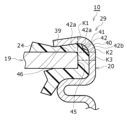
- FIG. 2 is an enlarged cross-sectional view of the periphery of a shoulder portion in FIG. 1 .
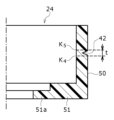
- FIG. 4 is a cross-sectional view of the gasket before the battery is installed.
- the cylindrical battery according to the present disclosure may be a primary battery or a secondary battery. It may also be a battery using an aqueous electrolyte or a battery using a non-aqueous electrolyte.
- a non-aqueous electrolyte secondary battery (lithium ion battery) using a non-aqueous electrolyte is exemplified as the cylindrical battery 10, which is one embodiment, but the cylindrical battery according to the present disclosure is not limited to this, and the electrolyte may also be an aqueous electrolyte.
- FIG. 1 is an axial cross-sectional view of a cylindrical battery 10 according to an embodiment of the present disclosure.
- the cylindrical battery 10 includes an electrode body 14, a non-aqueous electrolyte, a bottomed cylindrical exterior can 20 that contains the electrode body 14 and the electrolyte, and a sealing body 19 that closes the opening of the exterior can 20.
- the electrode body 14 includes a positive electrode 11, a negative electrode 12, and a separator 13 interposed between the positive electrode 11 and the negative electrode 12, and has a wound structure in which the positive electrode 11 and the negative electrode 12 are wound with the separator 13 interposed therebetween.
- the exterior can 20 is a bottomed cylindrical container, and has a bottom 20A and a cylindrical portion 20B.
- the non-aqueous electrolyte includes, for example, a non-aqueous solvent and an electrolyte salt dissolved in the non-aqueous solvent.
- the non-aqueous solvent may be an ester, an ether, a nitrile, an amide, or a mixed solvent of two or more of these.
- the non-aqueous solvent may contain a halogen-substituted body in which at least a part of the hydrogen of these solvents is replaced with a halogen atom such as fluorine.
- the non-aqueous electrolyte is not limited to a liquid electrolyte, and may be a solid electrolyte using a gel polymer or the like.
- the electrolyte salt may be a lithium salt such as LiPF6 .
- the electrode body 14 has a long positive electrode 11, a long negative electrode 12, and two long separators 13.
- the electrode body 14 also has, as electrode leads, a positive electrode lead 17 joined to the positive electrode 11 and a negative electrode lead 18 joined to the negative electrode 12.
- the negative electrode 12 is formed with dimensions slightly larger than the positive electrode 11 to suppress lithium precipitation.
- the two separators 13 are formed with dimensions at least slightly larger than the positive electrode 11, and are arranged, for example, to sandwich the positive electrode 11.
- the positive electrode 11 has a positive electrode core and a positive electrode mixture layer provided on both sides of the positive electrode core.
- the positive electrode core can be a foil of a metal such as aluminum or an aluminum alloy that is stable in the potential range of the positive electrode 11, or a film with the metal disposed on the surface.
- the positive electrode mixture layer contains a positive electrode active material, a conductive agent such as acetylene black, and a binder such as polyvinylidene fluoride (PVdF).
- the positive electrode 11 can be produced by applying a positive electrode mixture slurry containing a positive electrode active material, a conductive agent, and a binder, etc., onto the positive electrode core, drying the coating, and then compressing it to form a positive electrode mixture layer on both sides of the positive electrode core.
- a lithium transition metal composite oxide is used as the positive electrode active material.
- Metal elements contained in the lithium transition metal composite oxide include Ni, Co, Mn, Al, B, Mg, Ti, V, Cr, Fe, Cu, Zn, Ga, Sr, Zr, Nb, In, Sn, Ta, W, etc.
- An example of a suitable lithium transition metal composite oxide is a lithium metal composite oxide containing at least one of Ni, Co, and Mn. Specific examples include a composite oxide containing Ni, Co, and Mn, and a composite oxide containing Ni, Co, and Al.
- the negative electrode 12 has a negative electrode core and a negative electrode mixture layer provided on both sides of the negative electrode core.
- a foil of a metal such as copper or a copper alloy that is stable in the potential range of the negative electrode 12, or a film with such a metal disposed on the surface layer, can be used.
- the negative electrode mixture layer contains a negative electrode active material and a binder such as styrene butadiene rubber (SBR).
- SBR styrene butadiene rubber
- the negative electrode 12 can be produced by applying a negative electrode mixture slurry containing a negative electrode active material and a binder, etc., onto the negative electrode core, drying the coating, and then compressing it to form a negative electrode mixture layer on both sides of the negative electrode core.
- the negative electrode active material may be, for example, natural graphite such as flake graphite, lump graphite, or earthy graphite, or artificial graphite such as lump artificial graphite or graphitized mesophase carbon microbeads.
- the negative electrode active material may be, for example, a metal that alloys with lithium such as Si or Sn, an alloy containing the metal, or a compound containing the metal, which may be used in combination with graphite.
- a suitable example of the active material is a Si-containing material in which Si fine particles are dispersed in a SiO2 phase, a silicate phase such as lithium silicate, or an amorphous carbon phase.
- Insulating plates 15, 16 are arranged above and below the electrode body 14.
- the positive electrode lead 17 attached to the positive electrode 11 extends through the through hole of the insulating plate 15 toward the sealing body 19
- the negative electrode lead 18 attached to the negative electrode 12 extends through the outside of the insulating plate 16 toward the bottom 20A side of the outer can 20.
- the positive electrode lead 17 is connected by welding or the like to the inner surface of the sealing body 19 facing inward of the outer can 20, and the sealing body 19 serves as the positive electrode terminal.
- the negative electrode lead 18 is connected by welding or the like to the inner surface of the bottom 20A of the outer can 20, and the outer can 20 serves as the negative electrode terminal.
- a gasket 24 is provided between the exterior can 20 and the sealing body 19 to ensure the sealing of the inside of the battery and the insulation of the exterior can 20 and the sealing body 19.
- the cylindrical portion 20B includes an annular grooved portion 28 and an annular shoulder portion 29.
- the grooved portion 28 is formed by spinning a part of the cylindrical portion 20B to recess it radially inward.
- the shoulder portion 29 is formed when the upper end of the cylindrical portion 20B is bent radially inward and crimped to the peripheral portion 31 of the sealing body 19, and extends radially inward.
- the sealing body 19 is clamped between the shoulder portion 29 and the grooved portion 28 via the gasket 24 by this crimping, and is fixed to the exterior can 20.
- the sealing body 19 is a disk-shaped member equipped with a current interruption mechanism.
- the sealing body 19 has a structure in which, from the electrode body 14 side, an internal terminal plate 21, an insulating plate 23, and a rupture plate 22 are stacked.
- the internal terminal plate 21 is a metal plate, and includes a thick annular portion 21A to which the positive electrode lead 17 is connected, and a thin central portion 21B that is cut off from the annular portion 21A or detached from the rupture plate 22 when the battery internal pressure exceeds a predetermined threshold.
- An air vent 21C is formed in the annular portion 21A.
- the rupture plate 22 is disposed opposite the internal terminal plate 21 with the insulating plate 23 in between.
- An opening 23A is formed in the radial center of the insulating plate 23, and an air vent 23B is formed in the portion overlapping with the air vent 21C of the internal terminal plate 21.
- the rupture plate 22 has a valve portion 22A that ruptures when the battery internal pressure exceeds a predetermined threshold, and the valve portion 22A is connected to the center portion 21B of the internal terminal plate 21 by welding or the like through the opening 23A of the insulating plate 23.
- the insulating plate 23 insulates the annular portion 21A from the valve portion 22A.
- the valve portion 22A includes a lower convex portion that is convex toward the inside of the battery and is provided in the radial center, and a thin-walled portion formed around the lower convex portion. The thickness of the thin-walled portion becomes thinner as it goes radially outward.
- the internal terminal plate 21 to which the positive electrode lead 17 is connected is electrically connected to the rupture plate 22, forming a current path that connects the electrode body 14 to the rupture plate 22.
- valve portion 22A Inverts so that it protrudes axially upward, using the annular end portion on the radially outer side, which has low rigidity, as a fulcrum in the thin-walled portion.
- the center portion 21B is separated from the annular portion 21A or detached from the valve portion 22A, and the current path is interrupted.
- the annular end portion of the thin-walled portion breaks, forming a gas exhaust port.
- the structure of the sealing body 19 is not limited to the structure shown in FIG. 1.
- the sealing body 19 may be composed of only a rupture plate.
- the sealing body 19 may have a laminated structure including two rupture plates, and may have a convex sealing body cap that covers the rupture plate.
- Figure 2 is an enlarged cross-sectional view of the area around the shoulder 29 in Figure 1
- Figure 3 is a cross-sectional view of the gasket 24 before the battery is installed.
- the gasket 24 has an annular groove 42 in an area that includes at least a portion of the facing portion 41 that faces the corner portion 40 adjacent to the tip portion 39 that extends radially inward of the outer can 20.
- the corner portion 40 is a portion of the outer can 20 that is located between a first point K1 that overlaps with the radial outer peripheral edge 45 of the sealing body 19 on the axially upper side, and a second point K2 that overlaps with the upper surface 46 of the peripheral portion of the sealing body 19 in the radial direction.
- the outer can 20 having the annular groove 42 can be manufactured, for example, by the following procedure.
- this gasket 24 has a cylindrical portion 50 with an annular groove 42 on its outer circumferential surface, and an annular portion 51 that extends radially inward from one end portion (the axially lower end portion) on one side of the axial direction of the cylindrical portion 50.
- the annular groove 42 is provided within a range in the axial direction of the tubular portion 50 from a first position K4 that corresponds to the other surface (upper surface 46) of the peripheral portion 31 of the sealing body 17 of the tubular portion 50 to a second position K5 that is 1 mm away on the other side.
- t indicates the axial length from the first position K4 to the second position K5. t is 1 mm.
- the annular groove 42 is a groove with a V-shaped cross section, but the cross-sectional shape of the annular groove 42 may be any shape, such as a U-shape or an arc shape.
- the thin-walled portion 51a formed at the radially inner end of the annular portion 51 and thinner than the radially outer end of the annular portion 51 constitutes a covering portion 55 (see FIG. 1) that covers the radially inner tip of the grooved portion 28 in the cylindrical battery 10. By forming the covering portion 55, a short circuit between the outer can 20 and the sealing body 19 is reliably prevented.
- a portion of the cylindrical portion 20B is spun to recess it radially inward, forming a grooved portion 28.
- the sealing body 19 and gasket 24 are then placed on the grooved portion 28 so that the gasket 24 is positioned between the outer can 20 and the sealing body 19.
- the upper end of the cylindrical portion 20B is then bent radially inward and crimped to the peripheral portion 31 of the sealing body 19, completing the cylindrical battery 10.
- the gasket 24 has an annular groove 42 in a range including at least a portion of the opposing portion 41 that faces the corner 40 adjacent to the tip portion 39 that extends radially inward of the outer can 20. Therefore, when the upper end of the outer can 20 is crimped to the peripheral portion 31 of the sealing body 19, the force that the corner 40 of the outer can 20 receives from the gasket 24 can be reduced, and damage to the corner 40 of the outer can 20 can be suppressed.
- the annular groove 42 is provided only on a portion of the outer circumferential surface of the tubular portion 50 of the gasket 24, which improves the sealing performance of the gasket 24 sandwiched between the outer can 20 and the sealing body 19, and reliably prevents the non-aqueous electrolyte from creeping up and foreign matter (e.g., moisture) from entering from the outside.
- the depth of the deepest part of the annular groove 42 of the gasket 24 before the battery is installed is 10% or more of the thickness of the cylindrical portion 50, the force that the corner portion 40 receives from the gasket 24 can be effectively reduced, resulting in an excellent effect of preventing damage to the corner portion 40 of the outer can 20. Furthermore, if the depth of the deepest part of the annular groove 42 is 40% or less of the thickness of the cylindrical portion 50, the gasket 24 will have excellent sealing properties.
Landscapes
- Chemical & Material Sciences (AREA)
- Chemical Kinetics & Catalysis (AREA)
- Electrochemistry (AREA)
- General Chemical & Material Sciences (AREA)
- Engineering & Computer Science (AREA)
- Manufacturing & Machinery (AREA)
- Sealing Battery Cases Or Jackets (AREA)
Priority Applications (2)
| Application Number | Priority Date | Filing Date | Title |
|---|---|---|---|
| CN202480014954.XA CN120693729A (zh) | 2023-03-08 | 2024-02-09 | 衬垫、圆筒形电池以及圆筒形电池的制造方法 |
| JP2025505153A JPWO2024185394A1 (https=) | 2023-03-08 | 2024-02-09 |
Applications Claiming Priority (2)
| Application Number | Priority Date | Filing Date | Title |
|---|---|---|---|
| JP2023035621 | 2023-03-08 | ||
| JP2023-035621 | 2023-03-08 |
Publications (1)
| Publication Number | Publication Date |
|---|---|
| WO2024185394A1 true WO2024185394A1 (ja) | 2024-09-12 |
Family
ID=92674483
Family Applications (1)
| Application Number | Title | Priority Date | Filing Date |
|---|---|---|---|
| PCT/JP2024/004459 Ceased WO2024185394A1 (ja) | 2023-03-08 | 2024-02-09 | ガスケット、円筒形電池、及び円筒形電池の製造方法 |
Country Status (3)
| Country | Link |
|---|---|
| JP (1) | JPWO2024185394A1 (https=) |
| CN (1) | CN120693729A (https=) |
| WO (1) | WO2024185394A1 (https=) |
Citations (6)
| Publication number | Priority date | Publication date | Assignee | Title |
|---|---|---|---|---|
| JPS5828714B2 (ja) * | 1976-11-19 | 1983-06-17 | 松下電器産業株式会社 | 電池のガスケツト製造法 |
| JP2000173565A (ja) * | 1998-12-02 | 2000-06-23 | Mitsubishi Cable Ind Ltd | 密閉電池 |
| JP2002093383A (ja) * | 2000-09-18 | 2002-03-29 | Sanyo Electric Co Ltd | 電池と電池の製造方法 |
| JP2002329485A (ja) * | 2001-05-02 | 2002-11-15 | Nok Corp | 封口板 |
| JP2017224426A (ja) * | 2016-06-14 | 2017-12-21 | 三洋電機株式会社 | 円筒形電池 |
| WO2022091934A1 (ja) * | 2020-10-28 | 2022-05-05 | 三洋電機株式会社 | 円筒形電池用ガスケット、これを用いた円筒形電池の製造方法及び円筒形電池 |
-
2024
- 2024-02-09 CN CN202480014954.XA patent/CN120693729A/zh active Pending
- 2024-02-09 WO PCT/JP2024/004459 patent/WO2024185394A1/ja not_active Ceased
- 2024-02-09 JP JP2025505153A patent/JPWO2024185394A1/ja active Pending
Patent Citations (6)
| Publication number | Priority date | Publication date | Assignee | Title |
|---|---|---|---|---|
| JPS5828714B2 (ja) * | 1976-11-19 | 1983-06-17 | 松下電器産業株式会社 | 電池のガスケツト製造法 |
| JP2000173565A (ja) * | 1998-12-02 | 2000-06-23 | Mitsubishi Cable Ind Ltd | 密閉電池 |
| JP2002093383A (ja) * | 2000-09-18 | 2002-03-29 | Sanyo Electric Co Ltd | 電池と電池の製造方法 |
| JP2002329485A (ja) * | 2001-05-02 | 2002-11-15 | Nok Corp | 封口板 |
| JP2017224426A (ja) * | 2016-06-14 | 2017-12-21 | 三洋電機株式会社 | 円筒形電池 |
| WO2022091934A1 (ja) * | 2020-10-28 | 2022-05-05 | 三洋電機株式会社 | 円筒形電池用ガスケット、これを用いた円筒形電池の製造方法及び円筒形電池 |
Also Published As
| Publication number | Publication date |
|---|---|
| CN120693729A (zh) | 2025-09-23 |
| JPWO2024185394A1 (https=) | 2024-09-12 |
Similar Documents
| Publication | Publication Date | Title |
|---|---|---|
| US20220416338A1 (en) | Sealed battery | |
| JP7669293B2 (ja) | 密閉電池 | |
| WO2023145679A1 (ja) | 非水電解質二次電池 | |
| US20240039096A1 (en) | Gasket and cylindrical battery | |
| WO2023167010A1 (ja) | 円筒形電池 | |
| US20240387966A1 (en) | Cylindrical battery | |
| JP7664220B2 (ja) | 密閉電池 | |
| JP7531402B2 (ja) | 円筒形電池 | |
| US20250273834A1 (en) | Cylindrical battery | |
| US20250210763A1 (en) | Cylindrical battery | |
| WO2024185394A1 (ja) | ガスケット、円筒形電池、及び円筒形電池の製造方法 | |
| JP7793532B2 (ja) | 円筒形電池 | |
| WO2024161974A1 (ja) | 円筒形電池 | |
| WO2024203592A1 (ja) | 円筒形電池及び円筒形電池の製造方法 | |
| US20250379301A1 (en) | Sealed battery | |
| WO2024185382A1 (ja) | 円筒形電池 | |
| WO2024048145A1 (ja) | 円筒形電池 | |
| WO2024161960A1 (ja) | 円筒形の非水電解質二次電池 | |
| WO2025047154A1 (ja) | 円筒形電池 | |
| WO2025154533A1 (ja) | 密閉型電池および密閉型電池の製造方法 | |
| WO2024161967A1 (ja) | 円筒形電池 | |
| WO2025028054A1 (ja) | 円筒形電池 | |
| WO2026070618A1 (ja) | 円筒形電池 | |
| WO2024161920A1 (ja) | 円筒形電池 | |
| WO2024161982A1 (ja) | 円筒形の非水電解質二次電池 |
Legal Events
| Date | Code | Title | Description |
|---|---|---|---|
| 121 | Ep: the epo has been informed by wipo that ep was designated in this application |
Ref document number: 24766767 Country of ref document: EP Kind code of ref document: A1 |
|
| ENP | Entry into the national phase |
Ref document number: 2025505153 Country of ref document: JP Kind code of ref document: A |
|
| WWE | Wipo information: entry into national phase |
Ref document number: 2025505153 Country of ref document: JP |
|
| WWE | Wipo information: entry into national phase |
Ref document number: 202480014954.X Country of ref document: CN |
|
| WWP | Wipo information: published in national office |
Ref document number: 202480014954.X Country of ref document: CN |
|
| NENP | Non-entry into the national phase |
Ref country code: DE |
|
| 122 | Ep: pct application non-entry in european phase |
Ref document number: 24766767 Country of ref document: EP Kind code of ref document: A1 |