WO2024184993A1 - 表示装置 - Google Patents
表示装置 Download PDFInfo
- Publication number
- WO2024184993A1 WO2024184993A1 PCT/JP2023/008267 JP2023008267W WO2024184993A1 WO 2024184993 A1 WO2024184993 A1 WO 2024184993A1 JP 2023008267 W JP2023008267 W JP 2023008267W WO 2024184993 A1 WO2024184993 A1 WO 2024184993A1
- Authority
- WO
- WIPO (PCT)
- Prior art keywords
- light
- display device
- emitting elements
- electrode
- display
- Prior art date
- Legal status (The legal status is an assumption and is not a legal conclusion. Google has not performed a legal analysis and makes no representation as to the accuracy of the status listed.)
- Ceased
Links
Images



Classifications
-
- G—PHYSICS
- G09—EDUCATION; CRYPTOGRAPHY; DISPLAY; ADVERTISING; SEALS
- G09F—DISPLAYING; ADVERTISING; SIGNS; LABELS OR NAME-PLATES; SEALS
- G09F9/00—Indicating arrangements for variable information in which the information is built-up on a support by selection or combination of individual elements
- G09F9/30—Indicating arrangements for variable information in which the information is built-up on a support by selection or combination of individual elements in which the desired character or characters are formed by combining individual elements
-
- G—PHYSICS
- G09—EDUCATION; CRYPTOGRAPHY; DISPLAY; ADVERTISING; SEALS
- G09F—DISPLAYING; ADVERTISING; SIGNS; LABELS OR NAME-PLATES; SEALS
- G09F9/00—Indicating arrangements for variable information in which the information is built-up on a support by selection or combination of individual elements
- G09F9/30—Indicating arrangements for variable information in which the information is built-up on a support by selection or combination of individual elements in which the desired character or characters are formed by combining individual elements
- G09F9/302—Indicating arrangements for variable information in which the information is built-up on a support by selection or combination of individual elements in which the desired character or characters are formed by combining individual elements characterised by the form or geometrical disposition of the individual elements
-
- H—ELECTRICITY
- H10—SEMICONDUCTOR DEVICES; ELECTRIC SOLID-STATE DEVICES NOT OTHERWISE PROVIDED FOR
- H10K—ORGANIC ELECTRIC SOLID-STATE DEVICES
- H10K59/00—Integrated devices, or assemblies of multiple devices, comprising at least one organic light-emitting element covered by group H10K50/00
- H10K59/10—OLED displays
- H10K59/12—Active-matrix OLED [AMOLED] displays
Definitions
- This disclosure relates to a display device in which a camera area that takes in imaging light from the display surface side is formed in the display section.
- Cited Document 1 discloses an image display device for improving the characteristics of light passing through a display panel.
- a light-emitting element is formed in the camera area so that the camera area functions as part of the display section. In this case, diffraction occurs in the imaging light that passes between the electrodes of the light-emitting element, which can reduce the quality of the image captured by the camera unit.
- a light-emitting device comprises a display section including a camera area that takes in imaging light and a non-camera area, the non-camera area including a plurality of first light-emitting elements each having an electrode and emitting a first color, the camera area including a plurality of second light-emitting elements each having an electrode and emitting the first color, the plurality of first light-emitting elements being formed such that the electrode centers of each of the first light-emitting elements coincide with the intersections of a virtual regular grid pattern of the display section, and the plurality of second light-emitting elements being formed such that the electrode centers of each of the second light-emitting elements are offset from the intersections.
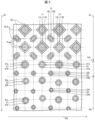
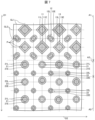
- FIG. 4A to 4C are schematic enlarged views of the vicinity of the boundary between the first display region and the third display region and the vicinity of the boundary between the third display region and the second display region according to the first embodiment.
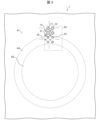
- 1 is a schematic plan view of a display device according to a first embodiment.
- 2 is an enlarged schematic diagram of the vicinity of a first display region and a third display region in the display unit of the display device according to the first embodiment.
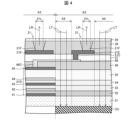
- FIG. 2 is a schematic side cross-sectional view of a first display region and a third display region of the display device according to the first embodiment.
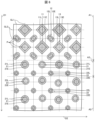
- FIG. 13A and 13B are schematic enlarged views of the vicinity of the boundary between the first display region and the third display region and the vicinity of the boundary between the third display region and the second display region according to the second embodiment.
- 13A and 13B are schematic enlarged views of the vicinity of the boundary between the first display region and the third display region and the vicinity of the boundary between the third display region and the second display region in the third embodiment.
- 13A and 13B are schematic enlarged views of the vicinity of the boundary between the first display region and the third display region and the vicinity of the boundary between the third display region and the second display region in a fourth embodiment.
- 13A and 13B are schematic enlarged views of the vicinity of the boundary between the first display region and the third display region and the vicinity of the boundary between the third display region and the second display region in the fifth embodiment.
- Display Device Overview> 2 is a schematic plan view of the display device 1.
- the display device 1 includes a display unit DA and a frame unit NA formed on the outer periphery of the display unit DA.
- the display device 1 performs display on the display unit DA by controlling light emission from each of a plurality of light-emitting elements (described later) formed in the display unit DA.
- Drivers and the like for driving each of the plurality of light-emitting elements of the display unit DA may be formed in the frame unit NA.
- a plan view of the display device 1 refers to viewing the display device 1 from a direction perpendicular to the upper surface, which is the light-emitting surface of the display unit DA of the display device 1.
- a direction from above to below the display device 1 is defined as a first direction D1
- a direction from left to right of the display device 1 is defined as a second direction D2.
- the first direction D1 is defined as a direction from above to below the paper
- the second direction D2 is defined as a direction from left to right on the paper.
- the display device 1 includes, for example, a light-emitting element formed for each subpixel of the display unit DA.
- the light-emitting element includes, for example, a pixel electrode formed for each subpixel, a common electrode formed in common to the multiple subpixels, and a functional layer including a light-emitting layer formed between the pixel electrode and the common electrode.
- the display unit DA drives each pixel electrode based on a signal input from a driver in the frame unit NA, thereby controlling the emission of each light-emitting element and performing display.
- each pixel electrode in the display unit DA is a light-reflective electrode that reflects visible light
- the common electrode is a transparent electrode that transmits visible light
- each pixel electrode in the display unit DA is an anode of a light-emitting element
- the common electrode is a cathode of the light-emitting element.
- each pixel circuit that drives each pixel electrode in the display unit DA may be made of a material that reflects visible light.
- the display unit DA has a first display area A1 as a non-camera area, a second display area A2 as a camera area, and a third display area A3 as a non-camera area.
- the second display area A2 and the third display area A3 are formed inside the display unit DA from the first display area A1.
- the second display area A2 is formed inside the display unit DA from the third display area A3.
- the second display area A2 has a substantially circular shape in a planar view of the display device 1.
- the third display area A3 is, for example, located between the first display area A1 and the second display area A2, and has a ring shape of substantially the same width in a planar view of the display device 1.
- Fig. 3 is a schematic enlarged view of the area E1 shown in Fig. 2, in other words, a view showing the display unit DA with the second display area A2, the third display area A3, and the first display area A1 near the second display area A2 enlarged.
- Fig. 1 is a schematic enlarged view of the area E2 shown in Fig. 3, in other words, a view showing the vicinity of the boundary between the first display area A1 and the third display area A3, and the vicinity of the boundary between the second display area A2 and the third display area A3 further enlarged.
- each pixel electrode is shown through a functional layer formed for each pixel electrode and a common electrode formed in common to multiple pixel electrodes. Also, in FIG. 1, only each pixel electrode, one of the transparent wirings 46 electrically connected to electrode 21E (described later), and one of the pixel circuits 21D that drives electrode 21E are shown.
- the first display area A1 includes, for example, a plurality of light-emitting elements 11, 12, and 13 as first light-emitting elements.
- the light-emitting elements 11, 12, and 13 are arranged two-dimensionally on the first display area A1.
- Each of the light-emitting elements 11, 12, and 13 has electrodes 11E, 12E, and 13E as electrodes.
- Each of the electrodes 11E, 12E, and 13E is a pixel electrode formed for each subpixel of the display unit DA.
- the display device 1 has a functional layer of each light-emitting element formed at a position overlapping with the electrodes 11E, 12E, and 13E, respectively, in a plan view of the display device 1, and a common electrode common to each pixel electrode. Therefore, as shown in FIG.
- the light-emitting region 11L, the light-emitting region 12L, and the light-emitting region 13L are formed at a position overlapping with the electrodes 11E, 12E, and 13E, respectively, in a plan view of the display device 1.
- a virtual regular grid pattern including a plurality of first grid lines GL1 along a first direction D1 and a plurality of second grid lines GL2 along a second direction D2 is formed on the display unit DA of the display device 1.
- the first grid lines GL1 are formed at approximately regular intervals in the second direction D2
- the second grid lines GL2 are formed at approximately regular intervals in the first direction D1.
- intersection points P of the regular grid pattern are virtually formed on the display unit DA of the display device 1 at each of the positions where the first grid lines GL1 and the second grid lines GL2 intersect.
- each light-emitting element in the first display region A1 is formed so that the electrode center of each pixel electrode coincides with an intersection point P of the virtual regular grid pattern.
- the electrode centers of electrodes 11E, 12E, and 13E are formed at positions that overlap with one of the multiple intersection points P. Therefore, each of light-emitting elements 11, 12, and 13 is arranged along the first direction D1 and the second direction D2.
- each electrode 11E is formed such that the electrode center is twice the distance LP in each of the first direction D1 and the second direction D2 from the adjacent electrodes 11E.
- each electrode 12E is formed such that the electrode center is twice the distance LP in one of the first direction D1 and the second direction D2 from the adjacent electrodes 12E.
- each electrode 13E is formed such that the electrode center is twice the distance LP in each of the first direction D1 and the second direction D2 from the adjacent electrodes 13E, similar to each electrode 11E.
- each electrode 12E is formed such that the electrode center is twice the distance LP in each of the first direction D1 and the second direction D2 from the adjacent electrodes 11E and 13E.
- the distance between electrodes 11E and 12E, which are adjacent to each other is the same.
- the distance between electrodes 12E and 13E, which are adjacent to each other is the same, and the distance between electrodes 11E and 13E, which are adjacent to each other, is the same.
- Electrodes 11E and 13E may have, for example, a square shape in a plan view of the display device 1.
- the electrode centers of electrodes 11E and 13E may be the intersection of two diagonals.
- electrode 12E may have, for example, a rounded rectangle in a plan view of the display device 1, in which a pair of straight lines facing each other are connected by a curve.
- one of two adjacent electrodes 12E may have a longitudinal direction perpendicular to the other.
- the electrode center of electrode 12E may be the intersection of the bisectors of electrode 12E in both the longitudinal and lateral directions of electrode 12E.
- each of the light-emitting regions 11L, 12L, and 13L may have a similar shape to each of the electrodes 11E, 12E, and 13E.
- the centers of each of the light-emitting regions 11L, 12L, and 13L may coincide with the electrode centers of each of the electrodes 11E, 12E, and 13E.
- each electrode 13E may be smaller than the electrode area of each electrode 11E, and the electrode area of each electrode 12E may be smaller than the electrode area of each electrode 13E. Accordingly, in a plan view of the display device 1, the area of each light-emitting region 13L may be smaller than the area of each light-emitting region 11L, and the area of each light-emitting region 12L may be smaller than the area of each light-emitting region 13L.
- light-emitting element 11 may emit light of a first color
- light-emitting element 12 may emit light of a second color
- light-emitting element 13 may emit light of a third color.
- the first color may be blue
- the second color may be green
- the third color may be red.
- light-emitting element 11 may be a blue light-emitting element that emits blue light
- light-emitting element 12 may be a green light-emitting element that emits green light
- light-emitting element 13 may be a red light-emitting element that emits red light.
- blue light is, for example, light having a central emission wavelength in a wavelength band of 380 nm or more and 500 nm or less.
- Green light is, for example, light having a central emission wavelength in a wavelength band of more than 500 nm and less than 600 nm.
- Red light is, for example, light having a central emission wavelength in a wavelength band of more than 600 nm and less than 780 nm.
- the first display area A1 has, for example, a pixel circuit that drives a pixel electrode for each light-emitting element.
- Each pixel circuit may drive each pixel electrode based on a signal transmitted from a driver in the frame portion NA, and control the light emission from each light-emitting portion.
- Each pixel circuit may include a thin-film transistor formed by a method described below.
- the display section DA may be formed with a plurality of first signal lines extending in a substantially vertical direction of the display device 1 and a plurality of second signal lines extending in a substantially horizontal direction of the display device 1.
- a signal may be applied to each of the first and second signal lines from a driver in the frame section NA.
- each of the first signal lines and each of the second signal lines may overlap with each of the first grid lines GL1 and each of the second grid lines GL2.
- the intersections of each of the first grid lines GL1 and each of the second grid lines GL2 may coincide with each of the intersections P.
- the display device 1 can arrange each pixel circuit that drives each light-emitting element in the first display area A1 in the vicinity of each light-emitting element, reducing the need to form wiring or the like.
- Each pixel circuit may drive each light-emitting element in response to a signal from the corresponding first signal line and second signal line.
- a set including at least one each of light-emitting element 11, light-emitting element 12, and light-emitting element 13 may be regarded as a pixel in the first display region A1.
- the first display region A1 may have a plurality of pixels including one light-emitting element 11, two light-emitting elements 12, and one light-emitting element 13.
- the pixel electrodes of the two light-emitting elements 12 included in the same pixel may be short-circuited to each other and may be driven by the same pixel circuit.
- each of the four light-emitting elements included in a pixel may be driven by three pixel circuits.
- the second display area A2 includes, for example, a plurality of light-emitting elements 21 as the second light-emitting element, a plurality of light-emitting elements 22 as the fourth light-emitting element, and a plurality of light-emitting elements 23 as the fifth light-emitting element.
- Each of the light-emitting elements 21, 22, and 23 may have the same configuration as each of the light-emitting elements 11, 12, and 13, except for differences in the formation position and the shape.
- each of the light-emitting elements 21, 22, and 23 has electrodes 21E, 22E, and 23E as electrodes.
- Each of the electrodes 21E, 22E, and 23E is a pixel electrode formed for each subpixel of the display unit DA.
- the display device 1 has a functional layer of each light-emitting element formed at a position overlapping with each of the electrodes 21E, 22E, and 23E in a plan view of the display device 1, and a common electrode common to each pixel electrode. Therefore, as shown in FIG.
- the light-emitting area 21L, the light-emitting area 22L, and the light-emitting area 23L are formed at a position overlapping with each of the electrodes 21E, 22E, and 23E in a plan view of the display device 1.
- each light-emitting element in the second display area A2 is formed so that the electrode center of each pixel electrode is shifted from the intersection point P.
- the electrode centers of electrodes 21E, 22E, and 23E in the second display area A2 are formed at positions shifted from the intersection point P.
- light-emitting element 21 may emit light of a first color
- light-emitting element 22 may emit light of a second color
- light-emitting element 23 may emit light of a third color.
- light-emitting element 21 may be a blue light-emitting element that emits blue light
- light-emitting element 22 may be a green light-emitting element that emits green light
- light-emitting element 23 may be a red light-emitting element that emits red light.
- a set including at least one each of the light-emitting element 21, the light-emitting element 22, and the light-emitting element 23 in the second display area A2 may be regarded as a pixel in the second display area A2.
- the second display area A2 may have a plurality of pixels including one light-emitting element 21, two light-emitting elements 22, and one light-emitting element 23.
- the number of light-emitting elements 22 may be greater than the number of light-emitting elements 21.
- the electrodes 22E of the two light-emitting elements 22 included in the same pixel may be short-circuited to each other and may be driven by the same pixel circuit.
- each of the four light-emitting elements included in the pixel may be driven by three pixel circuits.
- each electrode 23E may be smaller than the electrode area of each electrode 21E, and the electrode area of each electrode 22E may be smaller than the electrode area of each electrode 23E. Accordingly, in a plan view of the display device 1, the area of each light-emitting region 23L may be smaller than the area of each light-emitting region 21L, and the area of each light-emitting region 22L may be smaller than the area of each light-emitting region 23L.
- the human eye has a characteristic that it is more sensitive to green light than to blue and red light, and more sensitive to red light than to blue light. For this reason, when the light-emitting element 21 emits blue light, the light-emitting element 22 emits green light, and the light-emitting element 23 emits red light, the display device 1 can improve its apparent resolution by having more light-emitting elements 22 than light-emitting elements of other colors. In addition, by decreasing the areas of the light-emitting region 21L, the light-emitting region 23L, and the light-emitting region 22L in that order, the display device 1 can easily improve its apparent white balance. In addition, by reducing the area of each light-emitting region and the area of the pixel electrode, the proportion of the area of the light-transmitting region A4 in the second display region A2 can be increased.
- the third display area A3 includes, for example, a plurality of the above-mentioned light-emitting elements 21, light-emitting elements 22, and light-emitting elements 23.
- the light-emitting elements 21, light-emitting elements 22, and light-emitting elements 23 in the third display area A3 may have the same configuration as the light-emitting elements 21, light-emitting elements 22, and light-emitting elements 23 in the second display area A2, respectively, except for their positional relationships with each other.
- Each light-emitting element in the third display area A3 is formed so that the electrode center of each pixel electrode coincides with the intersection point P.
- the electrode centers of electrodes 21E, 22E, and 23E in the third display area A3 are formed at positions that overlap with one of the multiple intersection points P. Therefore, each of light-emitting elements 21, 22, and 23 in the third display area A3 is arranged along the first direction D1 and the second direction D2.
- the distance between adjacent electrodes 21E and 22E is the same, the distance between adjacent electrodes 22E and 23E is the same, and the distance between adjacent electrodes 21E and 23E is the same.
- the third display area A3 further includes a pixel circuit for driving each light-emitting element in the second display area A2.
- the pixel circuits for driving each light-emitting element in the second display area A2 are formed around the second display area A2 in a plan view of the display device 1.
- the third display area A3 includes a pixel circuit 21D for driving the light-emitting elements 21 in the second display area A2.
- the pixel circuit 21D drives the light-emitting elements 21 in the second display area A2 via transparent wiring 46, which will be described later.
- the third display area A3 may include a pixel circuit that drives each of the light-emitting elements 22 and 23 in the second display area A2.
- the third display area A3 may also include a pixel circuit that drives each light-emitting element in the third display area A3.
- Fig. 4 is a schematic cross-sectional side view showing an enlarged view of the vicinity of the second display area A2 and the third display area A3 in a plane substantially perpendicular to the display surface of the display device 1.
- the display device 1 includes a light-transmitting substrate 31, which may be a glass substrate or a film substrate.
- the display device 1 also includes a first inorganic interlayer film 32, a second inorganic interlayer film 33, a third inorganic interlayer film 34, a first organic interlayer film 35, a second organic interlayer film 36, a third organic interlayer film 37, and a fourth organic interlayer film 38, which are all light-transmitting, arranged in this order on the substrate 31.
- the above-mentioned substrate 31, each inorganic interlayer film, and each organic interlayer film may be formed in a display section DA including a first display area A1, a second display area A2, and a third display area A3.
- the first inorganic interlayer film 32, the second inorganic interlayer film 33, and the third inorganic interlayer film 34 are formed, for example, by depositing an inorganic oxide film or the like by a CVD method or the like.
- the first organic interlayer film 35, the second organic interlayer film 36, the third organic interlayer film 37, and the fourth organic interlayer film 38 are formed, for example, by depositing an organic coating film having optical transparency such as polyimide by a coating method or a photolithography method or the like.
- the display device 1 further includes a common electrode 39 formed on the upper surface of the fourth organic interlayer film 38 in common with the pixel electrodes of the display unit DA.
- each pixel electrode in the second display area A2 and the third display area A3, including the electrode 21E is formed between the third organic interlayer film 37 and the fourth organic interlayer film 38.
- a functional layer 21F including a light-emitting layer is formed between each electrode 21E and the common electrode 39.
- a light-emitting element 21 is formed by each electrode 21E, each functional layer 21F, and the common electrode 39.
- each pixel electrode in the first display region A1 may be formed between the third organic interlayer film 37 and the fourth organic interlayer film 38.
- functional layers including a light-emitting layer may be formed between each pixel electrode and the common electrode 39.
- each pixel electrode, each functional layer, and the common electrode 39 may form a light-emitting element.
- each functional layer in the display unit DA may include, for example, a hole transport layer, a light-emitting layer, and an electron transport layer in this order from the pixel electrode side.
- the light-emitting layer may be, for example, an organic light-emitting layer containing an organic light-emitting material, in other words, the display unit DA of the display device 1 may include an OLED panel having a plurality of organic light-emitting elements.
- the light-emitting layer may be, for example, a quantum dot light-emitting layer containing semiconductor nanoparticles, in other words quantum dots, as the light-emitting material.
- the display device 1 drives the light emitting element 21 to emit the first color light LR from the light emitting layer of the functional layer 21F. This produces a display in the display section DA, which includes the second display area A2 and the third display area A3.
- the display device 1 includes, in order from the substrate 31 side, a first conductive film 41, a semiconductor film 42, a second conductive film 43, a third conductive film 44, a fourth conductive film 45, and a transparent wiring 46.
- the first conductive film 41 is located between the substrate 31 and the first inorganic interlayer film 32.
- the semiconductor film 42 is located between the first inorganic interlayer film 32 and the second inorganic interlayer film 33.
- the second conductive film 43 is located between the second inorganic interlayer film 33 and the third inorganic interlayer film 34.
- the third conductive film 44 is located between the third inorganic interlayer film 34 and the first organic interlayer film 35.
- the fourth conductive film 45 is located between the first organic interlayer film 35 and the second organic interlayer film 36.
- the transparent wiring 46 is located between the second organic interlayer film 36 and the third organic interlayer film 37.
- the transparent wiring 46 is electrically connected to the fourth conductive film 45 through a contact hole 46C formed in the second organic interlayer film 36.
- the transparent wiring 46 is also routed to the second display area A2, and is electrically connected to the electrode 21E through a contact hole 21C formed in the third organic interlayer film 37.
- the first conductive film 41, the second conductive film 43, the third conductive film 44, and the fourth conductive film 45 are all electrically conductive and may be, for example, a conductive film having light reflectivity including a metal film.
- the transparent wiring 46 is a transparent member having translucency and electrical conductivity.
- Each pixel circuit in the third display area A3 may be formed by forming a thin film transistor using the first conductive film 41, the semiconductor film 42, the second conductive film 43, the third conductive film 44, and the fourth conductive film 45.
- the pixel circuits that drive each light-emitting element in the third display region A3 may be formed by forming thin-film transistors in the third display region A3, similar to the pixel circuits that drive each light-emitting element in the second display region A2.
- the pixel circuits that drive each light-emitting element in the first display region A1 may be formed by forming thin-film transistors in the first display region A1. Therefore, the first conductive film 41, the semiconductor film 42, the second conductive film 43, the third conductive film 44, and the fourth conductive film 45 may also be formed in the first display region A1.
- the functional layer of each light-emitting element in the display unit DA including the first display region A1, the second display region A2, and the third display region A3 is formed in an opening formed in the fourth organic interlayer film 38.
- the functional layer may be formed by forming openings in the fourth organic interlayer film 38 at positions overlapping with each pixel electrode in a plan view of the display device 1 after forming the substrate 31 to the fourth organic interlayer film 38, and then forming a layer containing the material of the functional layer in the opening.
- the openings in the fourth organic interlayer film 38 in the second display region A2 may be misaligned in position in accordance with the misalignment of the pixel electrodes corresponding to the openings.
- the centers of the openings in the fourth organic interlayer film 38 in the second display region A2 may be misaligned from the intersection point P. This makes it possible to misalign the center of the light-emitting region of each light-emitting element in the second display region A2 from the intersection point P in accordance with the misalignment between the electrode center of the pixel electrode of each light-emitting element in the second display region A2 and the intersection point P.
- the formation pattern of the functional layer material in the second display region A2 may be the same as the formation pattern of the functional layer material in the first display region A1 and the third display region A3.
- the position of each opening of the fourth organic interlayer film 38 in the second display region A2 may be shifted so that the position of each opening of the fourth organic interlayer film 38 in the second display region A2 is included in the formation position of each functional layer in the second display region A2 in a plan view of the display device 1.
- the pixel electrode of each light-emitting element in the second display region A2 may overlap with the intersection P. Furthermore, the magnitude of deviation between the electrode center of the pixel electrode of each light-emitting element in the second display region A2 and each intersection P may be equal to or less than 1/2 the light-emitting region diameter of each light-emitting element in the second display region A2. This makes it possible to reduce the occurrence of a functional layer not being formed in part of the opening of the fourth organic interlayer film 38 in the second display region A2, even with the above-mentioned method.
- the functional layer is formed by deposition using a deposition mask such as a metal mask having multiple openings.
- the deposition mask may have the same opening shape and arrangement pattern at the positions corresponding to the first display area A1 and the third display area A3 and at the position corresponding to the second display area A2.
- the formation position of each light-emitting area in the second display area A2 can be controlled by controlling the position of each opening of the fourth organic interlayer film 38 in the second display area A2 in a plan view of the display device 1.
- the functional layer is formed by an inkjet method in which the material of the functional layer is dropped into the openings of the fourth organic interlayer film 38.
- the positions at which the material of the functional layer is dropped may be positions corresponding to each intersection P in any of the first display area A1, the second display area A2, and the third display area A3.
- each opening of the fourth organic interlayer film 38 in the second display area A2 overlaps with the intersection P in a plan view of the display device 1, it is possible to reduce the occurrence of the functional layer not being formed in some of the openings of the fourth organic interlayer film 38 in the second display area A2.
- the display device 1 further includes a camera unit CU as a camera equipped with an imaging element and the like on the side opposite to the light emitting element 21 of the substrate 31. Imaging light LT incident from the display surface side of the display device 1 is incident on the camera unit CU.
- a member having optical transparency including transparent wiring 46 is formed in the second display region A2. Therefore, a light-transmitting region A4 through which the imaging light LT transmits from the common electrode 39 to the camera unit CU is formed between each pixel electrode in the second display region A2.
- imaging light LT incident on the light-transmitting area A4 from the display surface side of the display device 1 is captured by the camera unit CU.
- the display device 1 may also capture images from the back side of the display device 1, i.e., the side opposite the display surface of the substrate 31, using the camera unit CU.
- the imaging light LT from the display surface side of the display device 1 is captured by the camera unit CU in the light-transmitting area A4 located between the pixel electrodes in the second display area A2. Therefore, the imaging light LT captured by the camera unit CU passes through the gaps between the pixel electrodes in the second display area A2.
- each pixel electrode in the second display area A2 coincides with a certain intersection point P, just like the electrode centers of each pixel electrode in the first display area A1 and the third display area A3.
- the positional relationship between each of the pixel electrodes in the second display area A2 and the other adjacent pixel electrodes is approximately the same. Therefore, in either direction along the display surface of the display device 1, there are periodically portions in the second display area A2 where pixel electrodes are formed and portions where pixel electrode wiring is not formed.
- the imaging light LT incident on the light-transmitting region A4 is diffracted as it passes through each of the pixel electrodes, and the multiple diffracted lights may interfere with each other.
- each pixel electrode in the light-transmitting region A4 is periodically arranged, and therefore each pixel electrode behaves like a diffraction grating, which may intensify the interference of the diffracted lights described above.
- light of a particular wavelength may be amplified or attenuated, which may reduce the quality of the image captured by the camera unit CU.
- each light-emitting element in the second display area A2 is formed so that the electrode center of each pixel electrode is offset from the intersection point P. This reduces the periodicity of the presence or absence of pixel electrodes in the light-transmitting area A4 in any direction on the display surface. Therefore, the display device 1 according to this embodiment can reduce interference between the diffracted lights of the imaging light LT that pass through each of the pixel electrodes. Therefore, the display device 1 reduces interference between the diffracted lights of the imaging light LT that are captured by the camera unit CU from the second display area A2, particularly the light-transmitting area A4, and reduces degradation in the quality of imaging by the camera unit CU.
- each light-emitting element in the second display region A2 may be formed, for example, such that the electrode center of any pixel electrode is shifted from the intersection point P.
- the display device 1 can more efficiently reduce the periodicity of the presence or absence of pixel electrodes of each light-emitting element in the second display region A2.
- the direction and distance of the offset of the electrode center of each light-emitting element in the second display area A2 from the intersection point P may be random.
- the direction and distance of the offset of each pixel electrode in the second display area A2 from the intersection point P may be determined according to a separately generated random number table.
- the display device 1 can further reduce interference between the diffracted lights of the imaging light LT captured by the camera unit CU from the light-transmitting area A4.
- each of the electrodes 21E, 22E, and 23E may be formed at a position overlapping the intersection P.
- the display device 1 reduces the deviation between the center of the light-emitting area of each light-emitting element in the second display area A2 and the intersection P from becoming too large, thereby reducing the deterioration of the display quality in the second display area A2.
- a random number table of XY coordinates with equal probability distribution within a range of 1/2 the diameter of the light-emitting area may be set for each light-emitting element in the second display area A2.
- the direction and distance of deviation of the electrode center of each light-emitting element in the second display area A2 from the intersection point P may be determined according to the random number table.
- the deviation of the electrode center of each light-emitting element in the second display area A2 from the intersection point P is equal to or less than half the diameter of each light-emitting area.
- the random number table may be expressed in polar form with the argument ⁇ and the deviation r.
- the random number table may be set for the entire second display area A2.
- the second display area A2 may be divided into a number of small areas and a separate random number table may be set for each small area, or the same random number table may be set for each small area.
- the distance between electrodes 21E and 22E that are close to each other may differ.
- the distance between electrodes 22E and 23E that are close to each other may differ, and the distance between electrodes 21E and 23E that are close to each other may differ.
- the electrode center of a portion of each pixel electrode in the second display region A2 may be formed to coincide with the intersection point P in a plan view of the display device 1.
- the second display region A2 may include a light-emitting element 21 having an electrode 21E whose electrode center is offset from the intersection point P, and may also include a light-emitting element 21 having an electrode 21E whose electrode center coincides with the intersection point P as a third light-emitting element.
- the electrode centers of some of the electrodes 21E of the light-emitting elements 21 in the second display area A2 are offset from the intersection point P, so the display device 1 can reduce the periodicity of the presence or absence of pixel electrodes in the second display area A2.
- the electrode centers of some of the electrodes 21E of the light-emitting elements 21 in the second display area A2 overlap with the intersection point P. Therefore, the display device 1 reduces the difference between the arrangement pattern of some of the light-emitting elements 11 in the first display area A1 and the arrangement pattern of the light-emitting elements 22 in the second display area A2. Therefore, the display device 1 according to this embodiment reduces the difference in the display pattern between the first display area A1 and the second display area A2, improving the display quality.
- the multiple intersections P are located along the first direction D1 and the second direction D2. Furthermore, the electrode center of the pixel electrode of each light-emitting element in the second display area A2 is shifted from the intersections P in at least one of the first direction D1 and the second direction D2. This allows the display device 1 to reliably generate a shift of the electrode center of the pixel electrode of each light-emitting element in the second display area A2 from the intersections P with a simple configuration.
- the shift of the electrode center of each light-emitting element in the second display area A2 described above can be easily achieved by setting the shift according to the random number table of XY coordinates as described above. Therefore, with the above configuration, the shift of the electrode center of each light-emitting element in the second display area A2 can be achieved with a simple design.
- the electrodes 21E, 22E, and 23E may each have a circular shape in a plan view of the display device 1.
- the center of each of the electrodes 21E, 22E, and 23E may be the center of the circle.
- the electrodes 21E, 22E, and 23E may each have a different shape from the electrodes 11E, 12E, and 13E.
- the electrode shapes of each light-emitting element may be different between the first display area A1 and the second display area A2.
- the display device 1 can further reduce interference of imaging light in the translucent area A4 near the boundary with the first display area A1 and between the pixel electrodes of the light-emitting elements of the first display area A1 and the pixel electrodes of the light-emitting elements of the second display area A2.
- the electrode area of each of electrodes 21E, 22E, and 23E may be smaller than the electrode area of each of electrodes 11E, 12E, and 13E.
- the size of the pixel electrode of each light-emitting element in the second display region A2 may be smaller than the size of the pixel electrode of each light-emitting element in the first display region A1.
- the size of the pixel electrode of each light-emitting element in the third display region A3 may also be smaller than the size of the pixel electrode of each light-emitting element in the first display region A1. This reduces the proportion of the area occupied by each pixel electrode in the third display region A3. Therefore, the display device 1 makes it easier to form a pixel circuit in the third display region A3 that drives each light-emitting element in both the second display region A2 and the third display region A3.
- each of the light-emitting regions 21L, 22L, and 23L may have a similar shape to each of the electrodes 21E, 22E, and 23E.
- the centers of each of the light-emitting regions 21L, 22L, and 23L may coincide with the electrode centers of each of the electrodes 21E, 22E, and 23E.
- the directions in which the centers of the electrodes are shifted from the intersection P may be different from each other.
- the direction in which the electrode center of electrode 21E is shifted from the intersection P may be different from the direction in which the electrode center of electrode 22E is shifted from the intersection P.
- the directions in which the centers of the electrodes are shifted from the intersection P may be different from each other.
- the directions in which the center of the electrode 21E is shifted from the intersection P may be different from the directions in which the center of the electrode 23E is shifted from the intersection P.
- the pixel electrode of each light-emitting element in the display unit DA is a light-reflecting electrode. Therefore, the display device 1 can more efficiently increase the intensity of light emitted from each light-emitting element.
- the display device 1 improves the freedom of the material of the pixel electrode to make the pixel electrode a light-reflecting electrode.
- a light-transmitting area A4 is formed, so the display device 1 can capture imaging light into the camera unit CU while ensuring the intensity of light emitted from each light-emitting element.
- transparent wiring 46 is formed in the second display region A2, electrically connecting the pixel electrode of any light-emitting element in the second display region A2 to any pixel circuit in the third display region A3. Therefore, in the display device 1, a pixel circuit for driving a light-emitting element having a pixel electrode connected to the transparent wiring 46 can be formed at a position away from the light-emitting element. Furthermore, because the transparent wiring 46 is translucent, the display device 1 can reduce the inhibition of the capture of imaging light by the camera unit CU caused by the transparent wiring 46 even when the transparent wiring 46 is formed in the translucent region A4.
- the pixel circuits that drive each light-emitting element in the second display area A2 are located in a third display area A3 that is located around the second display area A2, and drive each light-emitting element in the second display area A2 via transparent wiring 46. Therefore, the display device 1 can reduce the inhibition of capture of imaging light into the camera unit CU by the pixel circuits that drive each light-emitting element in the second display area A2.
- FIG. 5 is a diagram showing, in a further enlarged manner, the vicinity of the boundary between the first display area A1 and the third display area A3, and the vicinity of the boundary between the second display area A2 and the third display area A3 of the display device 1 according to the present embodiment.
- FIG. 5 is a diagram showing positions corresponding to the schematic enlarged view shown in FIG.
- the display device 1 according to this embodiment differs in the size of the pixel electrode and light-emitting area of each light-emitting element in the second display area A2 and the third display area A3.
- the size of the electrode 21E of the light-emitting element 21 in the second display area A2 and the third display area A3 varies depending on the distance from the center of the second display area A2.
- the size of the electrode 21E in the second display area A2 and the third display area A3 becomes smaller as it approaches the center of the second display area A2.
- the size of the light-emitting area 21L in the second display area A2 and the third display area A3 may be constant regardless of the distance from the center of the second display area A2.
- the size of the electrode 22E of the light-emitting element 22 in the second display area A2 and the third display area A3, and the size of the electrode 22E of the light-emitting element 22 may differ depending on the distance from the center of the second display area A2.
- the size of each of the electrodes 22E and 23E in the second display area A2 and the third display area A3 may become smaller as they approach the center of the second display area A2.
- the size of each of the light-emitting areas 22L and 23L in the second display area A2 and the third display area A3 may be constant regardless of the distance from the center of the second display area A2.
- the display device 1 has the same configuration as the display device 1 according to the previous embodiment.
- the electrode center of the pixel electrode of each light-emitting element is offset from the intersection point P. Therefore, also in this embodiment, the display device 1 reduces interference between diffracted lights of the imaging light LT captured by the camera unit CU from the second display area A2, particularly the light-transmitting area A4, and reduces degradation in the quality of imaging by the camera unit CU.
- the size of the electrode 21E of the light-emitting element 21 varies depending on the distance from the center of the second display area A2, so that the display device 1 can further reduce the periodicity of the presence or absence of pixel electrodes in the second display area A2.
- the size of the light-emitting area of each light-emitting element in the second display area A2 and the third display area A3 may be the same depending on the distance from the center of the second display area A2.
- the size of the light-emitting area of each light-emitting element in the second display area A2 and the third display area A3 may differ depending on the distance from the center of the second display area A2.
- the smaller the pixel electrode of each light-emitting element the smaller the size of the light-emitting area of each light-emitting element may be.
- the drive current value of the light-emitting element required to obtain the same brightness in the multiple light-emitting elements if there is a difference in the area of the light-emitting regions of multiple light-emitting elements in the display device 1, there will also be a difference in the drive current value of the light-emitting element required to obtain the same brightness in the multiple light-emitting elements.
- the smaller the light-emitting region of a light-emitting element in the display device 1 the greater the drive current value of the light-emitting element required to obtain the same brightness in the light-emitting element tends to be.
- the greater the drive current value the faster the degradation of the brightness of the light-emitting element tends to progress.
- the size of electrode 21E gradually changes depending on the distance from the center of second display area A2, while the size of light-emitting area 21L is the same regardless of the distance from the center of second display area A2.
- display device 1 according to this embodiment can reduce sudden changes in luminance degradation of each light-emitting element due to changes in the position of display unit DA, improving display quality.
- display device 1 according to this embodiment reduces sudden changes in luminance degradation of each light-emitting element at the boundaries between first display area A1, second display area A2, and third display area A3, reducing the visibility of these boundaries.
- FIG. 6 is a view showing positions corresponding to the schematic enlarged view shown in FIG.
- the display device 1 according to this embodiment differs from the display device 1 according to the above-described first embodiment in that the electrode centers of the light-emitting elements 22 in the second display area A2 coincide with the intersection point P.
- the center of the electrode 22E according to this embodiment coincides with the intersection point P.
- the center of the light-emitting area 22L according to this embodiment may coincide with the intersection point P.
- the display device 1 according to this embodiment reduces the difference between the arrangement pattern of the light-emitting elements 12 in the first display area A1 and the arrangement pattern of the light-emitting elements 22 in the second display area A2. Therefore, the display device 1 according to this embodiment reduces the difference in the display pattern between the first display area A1 and the second display area A2, improving the display quality.
- the display device 1 according to this embodiment exerts the above-mentioned effects more efficiently.
- the display device 1 according to this embodiment has the same configuration as the display device 1 according to the above-mentioned embodiment 1.
- the electrode centers of the pixel electrodes of the light-emitting elements 21 and 23 are offset from the intersection point P.
- the display device 1 according to this embodiment improves the display quality for the reasons described above, while reducing interference between diffracted lights of the imaging light LT captured by the camera unit CU from the second display area A2, particularly the light-transmitting area A4, and reducing degradation in the quality of imaging by the camera unit CU.
- Periodic arrangement of pixel electrodes of red light-emitting element 7 is a further enlarged view showing the vicinity of the boundary between the first display area A1 and the third display area A3, and the vicinity of the boundary between the second display area A2 and the third display area A3 of the display device 1 according to the present embodiment.
- FIG. 7 is a view showing positions corresponding to the schematic enlarged view shown in FIG.
- the display device 1 according to this embodiment differs from the display device 1 according to the previous embodiment in that the electrode centers of the light-emitting elements 23 in the second display area A2 coincide with the intersection point P.
- the center of the electrode 23E according to this embodiment coincides with the intersection point P.
- the center of the light-emitting area 23L according to this embodiment may coincide with the intersection point P.
- the display device 1 according to this embodiment reduces the difference between the arrangement pattern of the light-emitting elements 13 in the first display area A1 and the arrangement pattern of the light-emitting elements 23 in the second display area A2. Therefore, the display device 1 according to this embodiment further reduces the difference in the display pattern between the first display area A1 and the second display area A2, and further improves the display quality.
- the display device 1 according to this embodiment more efficiently achieves the above-mentioned effects.
- the display device 1 according to this embodiment has the same configuration as the display device 1 according to the above-mentioned embodiment 1.
- the electrode center of each pixel electrode of the light-emitting element 21 is offset from the intersection point P. Therefore, the display device 1 according to this embodiment improves the display quality for the reasons described above, while reducing interference between diffracted lights of the imaging light LT captured by the camera unit CU from the second display area A2, particularly the light-transmitting area A4, and reducing deterioration in the quality of imaging by the camera unit CU.
- FIG. 8 is a further enlarged view showing the vicinity of the boundary between the first display area A1 and the third display area A3, and the vicinity of the boundary between the second display area A2 and the third display area A3 of the display device 1 according to this embodiment.
- Fig. 8 is a view showing positions corresponding to the schematic enlarged view shown in Fig. 1.
- the display device 1 according to this embodiment differs in configuration from the display device 1 according to the previous embodiment only in that the center of each light-emitting area in the second display area A2 coincides with the intersection point P.
- the electrode center of the electrode 21E of each light-emitting element 21 is offset from the intersection point P, while the center of the light-emitting area 21L of each light-emitting element 21 coincides with the intersection point P.
- the electrode centers of the electrode 22E of each light-emitting element 22 and the electrode 23E of each light-emitting element 23 may be offset from the intersection point P, and the centers of the light-emitting area 22L of each light-emitting element 22 and the light-emitting area 23L of each light-emitting element 23 may coincide with the intersection point P.
- the display device 1 can reduce the periodicity of the presence or absence of pixel electrodes in the second display area A2, while reducing the difference in the formation pattern of the light-emitting areas of each light-emitting element in the first display area A1 and the second display area A2. Therefore, the display device 1 according to this embodiment improves the display quality in the display section DA while reducing the deterioration of the quality of the image captured by the camera unit CU.
- Display device 11 Light-emitting element (first light-emitting element) 21 Light-emitting element (second light-emitting element, third light-emitting element) 22 Light-emitting element (fourth light-emitting element) 23 Light-emitting element (fifth light-emitting element) 21D Pixel circuit 46 Transparent wiring A1 First display area (non-camera area) A2 Second display area (camera area) A3 Third display area (non-camera area) D1 First direction D2 Second direction GL1 First grid line GL2 Second grid line CU Camera unit DA Display unit P Intersection
Landscapes
- Engineering & Computer Science (AREA)
- Physics & Mathematics (AREA)
- General Physics & Mathematics (AREA)
- Theoretical Computer Science (AREA)
- Microelectronics & Electronic Packaging (AREA)
- Electroluminescent Light Sources (AREA)
Priority Applications (2)
| Application Number | Priority Date | Filing Date | Title |
|---|---|---|---|
| JP2025504927A JPWO2024184993A1 (https=) | 2023-03-06 | 2023-03-06 | |
| PCT/JP2023/008267 WO2024184993A1 (ja) | 2023-03-06 | 2023-03-06 | 表示装置 |
Applications Claiming Priority (1)
| Application Number | Priority Date | Filing Date | Title |
|---|---|---|---|
| PCT/JP2023/008267 WO2024184993A1 (ja) | 2023-03-06 | 2023-03-06 | 表示装置 |
Publications (1)
| Publication Number | Publication Date |
|---|---|
| WO2024184993A1 true WO2024184993A1 (ja) | 2024-09-12 |
Family
ID=92674252
Family Applications (1)
| Application Number | Title | Priority Date | Filing Date |
|---|---|---|---|
| PCT/JP2023/008267 Ceased WO2024184993A1 (ja) | 2023-03-06 | 2023-03-06 | 表示装置 |
Country Status (2)
| Country | Link |
|---|---|
| JP (1) | JPWO2024184993A1 (https=) |
| WO (1) | WO2024184993A1 (https=) |
Citations (5)
| Publication number | Priority date | Publication date | Assignee | Title |
|---|---|---|---|---|
| JP2010230797A (ja) * | 2009-03-26 | 2010-10-14 | Seiko Epson Corp | 表示装置、および電子機器 |
| JP2011120200A (ja) * | 2009-11-02 | 2011-06-16 | Sony Corp | 撮像装置付き画像表示装置 |
| JP2013152466A (ja) * | 2013-02-04 | 2013-08-08 | Semiconductor Energy Lab Co Ltd | 表示装置 |
| JP2020204762A (ja) * | 2019-06-17 | 2020-12-24 | 三星ディスプレイ株式會社Samsung Display Co.,Ltd. | 表示装置 |
| US20210351255A1 (en) * | 2019-07-03 | 2021-11-11 | Kunshan Go-Visionox Opto-Electronics Co., Ltd. | Array substrate, display panel and display apparatus |
-
2023
- 2023-03-06 JP JP2025504927A patent/JPWO2024184993A1/ja active Pending
- 2023-03-06 WO PCT/JP2023/008267 patent/WO2024184993A1/ja not_active Ceased
Patent Citations (5)
| Publication number | Priority date | Publication date | Assignee | Title |
|---|---|---|---|---|
| JP2010230797A (ja) * | 2009-03-26 | 2010-10-14 | Seiko Epson Corp | 表示装置、および電子機器 |
| JP2011120200A (ja) * | 2009-11-02 | 2011-06-16 | Sony Corp | 撮像装置付き画像表示装置 |
| JP2013152466A (ja) * | 2013-02-04 | 2013-08-08 | Semiconductor Energy Lab Co Ltd | 表示装置 |
| JP2020204762A (ja) * | 2019-06-17 | 2020-12-24 | 三星ディスプレイ株式會社Samsung Display Co.,Ltd. | 表示装置 |
| US20210351255A1 (en) * | 2019-07-03 | 2021-11-11 | Kunshan Go-Visionox Opto-Electronics Co., Ltd. | Array substrate, display panel and display apparatus |
Also Published As
| Publication number | Publication date |
|---|---|
| JPWO2024184993A1 (https=) | 2024-09-12 |
Similar Documents
| Publication | Publication Date | Title |
|---|---|---|
| KR102033348B1 (ko) | 유기전계발광표시장치 및 그 제조방법 | |
| KR102717868B1 (ko) | 표시 장치 | |
| KR102448651B1 (ko) | 표시장치, 및 전자기기 | |
| KR102142481B1 (ko) | 유기전계 발광소자 | |
| KR102587398B1 (ko) | 유기발광 표시장치 | |
| KR20200050059A (ko) | 표시 장치 | |
| KR102572407B1 (ko) | 박막 트랜지스터 어레이 기판 및 이를 포함하는 유기발광 표시장치 | |
| KR20090106099A (ko) | 유기 발광 표시 장치 및 그 제조 방법 | |
| US11398530B2 (en) | Display panel | |
| WO2005107327A1 (ja) | 発光ディスプレイ | |
| US9362342B2 (en) | Light-emitting element display device | |
| KR101975570B1 (ko) | 박막 트랜지스터 표시판 및 그를 포함하는 유기 발광 표시 장치 | |
| KR20090087273A (ko) | 유기 발광 표시 장치 및 그 제조 방법 | |
| CN114725163A (zh) | 显示装置 | |
| JP2019012684A (ja) | Oled表示装置及びその製造方法 | |
| JP2015037065A (ja) | 有機el表示装置 | |
| KR20220090859A (ko) | 표시 장치 | |
| JP2024003060A5 (https=) | ||
| KR20230153321A (ko) | 유기발광 디스플레이 장치 | |
| US12414436B2 (en) | Display device | |
| JP2022087011A (ja) | 電界発光表示装置 | |
| WO2024184993A1 (ja) | 表示装置 | |
| CN115398633B (zh) | 显示基板及其制备方法、显示装置、彩膜基板 | |
| KR102484892B1 (ko) | 투명표시장치 및 이의 제조방법 | |
| JP7834938B2 (ja) | 表示装置 |
Legal Events
| Date | Code | Title | Description |
|---|---|---|---|
| 121 | Ep: the epo has been informed by wipo that ep was designated in this application |
Ref document number: 23926207 Country of ref document: EP Kind code of ref document: A1 |
|
| ENP | Entry into the national phase |
Ref document number: 2025504927 Country of ref document: JP Kind code of ref document: A |
|
| WWE | Wipo information: entry into national phase |
Ref document number: 2025504927 Country of ref document: JP |
|
| NENP | Non-entry into the national phase |
Ref country code: DE |
|
| 122 | Ep: pct application non-entry in european phase |
Ref document number: 23926207 Country of ref document: EP Kind code of ref document: A1 |