WO2024180932A1 - フィルタ及びフィルタデバイス - Google Patents
フィルタ及びフィルタデバイス Download PDFInfo
- Publication number
- WO2024180932A1 WO2024180932A1 PCT/JP2024/001154 JP2024001154W WO2024180932A1 WO 2024180932 A1 WO2024180932 A1 WO 2024180932A1 JP 2024001154 W JP2024001154 W JP 2024001154W WO 2024180932 A1 WO2024180932 A1 WO 2024180932A1
- Authority
- WO
- WIPO (PCT)
- Prior art keywords
- filter
- tab
- holder
- protrusions
- main surface
- Prior art date
- Legal status (The legal status is an assumption and is not a legal conclusion. Google has not performed a legal analysis and makes no representation as to the accuracy of the status listed.)
- Ceased
Links
Images










Classifications
-
- B—PERFORMING OPERATIONS; TRANSPORTING
- B01—PHYSICAL OR CHEMICAL PROCESSES OR APPARATUS IN GENERAL
- B01D—SEPARATION
- B01D39/00—Filtering material for liquid or gaseous fluids
- B01D39/14—Other self-supporting filtering material ; Other filtering material
- B01D39/20—Other self-supporting filtering material ; Other filtering material of inorganic material, e.g. asbestos paper, metallic filtering material of non-woven wires
- B01D39/2027—Metallic material
-
- B—PERFORMING OPERATIONS; TRANSPORTING
- B01—PHYSICAL OR CHEMICAL PROCESSES OR APPARATUS IN GENERAL
- B01D—SEPARATION
- B01D29/00—Filters with filtering elements stationary during filtration, e.g. pressure or suction filters, not covered by groups B01D24/00 - B01D27/00; Filtering elements therefor
- B01D29/01—Filters with filtering elements stationary during filtration, e.g. pressure or suction filters, not covered by groups B01D24/00 - B01D27/00; Filtering elements therefor with flat filtering elements
-
- B—PERFORMING OPERATIONS; TRANSPORTING
- B01—PHYSICAL OR CHEMICAL PROCESSES OR APPARATUS IN GENERAL
- B01D—SEPARATION
- B01D29/00—Filters with filtering elements stationary during filtration, e.g. pressure or suction filters, not covered by groups B01D24/00 - B01D27/00; Filtering elements therefor
- B01D29/01—Filters with filtering elements stationary during filtration, e.g. pressure or suction filters, not covered by groups B01D24/00 - B01D27/00; Filtering elements therefor with flat filtering elements
- B01D29/05—Filters with filtering elements stationary during filtration, e.g. pressure or suction filters, not covered by groups B01D24/00 - B01D27/00; Filtering elements therefor with flat filtering elements supported
-
- B—PERFORMING OPERATIONS; TRANSPORTING
- B01—PHYSICAL OR CHEMICAL PROCESSES OR APPARATUS IN GENERAL
- B01D—SEPARATION
- B01D39/00—Filtering material for liquid or gaseous fluids
- B01D39/10—Filter screens essentially made of metal
-
- B—PERFORMING OPERATIONS; TRANSPORTING
- B01—PHYSICAL OR CHEMICAL PROCESSES OR APPARATUS IN GENERAL
- B01D—SEPARATION
- B01D39/00—Filtering material for liquid or gaseous fluids
- B01D39/14—Other self-supporting filtering material ; Other filtering material
- B01D39/20—Other self-supporting filtering material ; Other filtering material of inorganic material, e.g. asbestos paper, metallic filtering material of non-woven wires
-
- B—PERFORMING OPERATIONS; TRANSPORTING
- B01—PHYSICAL OR CHEMICAL PROCESSES OR APPARATUS IN GENERAL
- B01D—SEPARATION
- B01D46/00—Filters or filtering processes specially modified for separating dispersed particles from gases or vapours
- B01D46/10—Particle separators, e.g. dust precipitators, using filter plates, sheets or pads having plane surfaces
-
- B—PERFORMING OPERATIONS; TRANSPORTING
- B01—PHYSICAL OR CHEMICAL PROCESSES OR APPARATUS IN GENERAL
- B01D—SEPARATION
- B01D71/00—Semi-permeable membranes for separation processes or apparatus characterised by the material; Manufacturing processes specially adapted therefor
- B01D71/02—Inorganic material
-
- B—PERFORMING OPERATIONS; TRANSPORTING
- B01—PHYSICAL OR CHEMICAL PROCESSES OR APPARATUS IN GENERAL
- B01D—SEPARATION
- B01D2201/00—Details relating to filtering apparatus
- B01D2201/04—Supports for the filtering elements
-
- B—PERFORMING OPERATIONS; TRANSPORTING
- B01—PHYSICAL OR CHEMICAL PROCESSES OR APPARATUS IN GENERAL
- B01D—SEPARATION
- B01D2201/00—Details relating to filtering apparatus
- B01D2201/18—Filters characterised by the openings or pores
- B01D2201/184—Special form, dimension of the openings, pores of the filtering elements
Definitions
- the present invention relates to filters and filter devices.
- Patent Document 1 discloses a void arrangement structure having a void arrangement section in which multiple voids are arranged.
- the present invention aims to provide a filter that can be easily held and a filter device equipped with the same.
- the filter according to one aspect of the present invention comprises: A filter portion having a plurality of through holes; A frame portion provided on an outer periphery of the filter portion; a tab protruding from an outer periphery of the frame and provided with a plurality of protrusions; Equipped with.
- a filter device comprises: A filter, A holder for holding the filter; Equipped with The filter comprises: A filter portion having a plurality of through holes; A frame portion provided on an outer periphery of the filter portion; a tab protruding from an outer periphery of the frame and provided with a plurality of protrusions; Including, The holder includes: A first holder having a cylindrical shape; a second holder having a cylindrical shape and an inner flange protruding from an inner wall; Including, the first holder is disposed within the second holder, the tab of the filter is disposed between an end face of the first holder and the inner flange of the second holder; The projections of the tab contact at least one of an end face of the first holder and the inner flange of the second holder.
- the present invention provides a filter that can be easily held and a filter device that includes the filter.
- FIG. 1 is a schematic plan view of an example of a filter according to a first embodiment of the present invention, as viewed from a first main surface side.
- FIG. FIG. 4 is an enlarged perspective view of a portion of the filter unit.
- FIG. 4 is an enlarged plan view of a portion of the filter portion.
- FIG. FIG. 1 is a schematic perspective view of an example of a filter device according to a first embodiment of the present invention; 7 is a schematic cross-sectional view of the filter device of FIG. 6 taken along line AA.
- FIG. 2 is an enlarged cross-sectional view of a portion of the filter device.
- FIG. 11 is a schematic enlarged cross-sectional view of a portion of the filter of Modification 1.
- FIG. 11 is a schematic enlarged view of a portion of a filter according to a second modified example.
- FIG. 11 is a schematic enlarged cross-sectional view of a portion of a filter according to a third modified example.
- FIG. 11 is a schematic enlarged cross-sectional view of a portion of the filter of Modification 4.
- FIG. 13 is a schematic plan view of a filter according to a fifth modified example.
- FIG. 14 is a schematic enlarged view of a Z1 portion of the filter of the fifth modified example of FIG. 13.
- 3A to 3C are schematic diagrams showing an example of a manufacturing process for the filter according to the first embodiment of the present invention.
- 3A to 3C are schematic diagrams showing an example of a manufacturing process for the filter according to the first embodiment of the present invention.
- 3A to 3C are schematic diagrams showing an example of a manufacturing process for the filter according to the first embodiment of the present invention.
- 3A to 3C are schematic diagrams showing an example of a manufacturing process for the filter according to the first embodiment of the present invention.
- 3A to 3C are schematic diagrams showing an example of a manufacturing process for the filter according to the first embodiment of the present invention.
- 3A to 3C are schematic diagrams showing an example of a manufacturing process for the filter according to the first embodiment of the present invention.
- 3A to 3C are schematic diagrams showing an example of a manufacturing process for the filter according to the first embodiment of the present invention.
- FIG. 2 is a schematic diagram showing an example of a filter sheet.
- 3A to 3C are schematic diagrams showing an example of a manufacturing process for the filter according to the first embodiment of the present invention.
- 3A to 3C are schematic diagrams showing an example of a manufacturing process for the filter according to the first embodiment of the present invention.
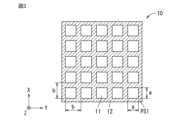
- [filter] 1 is a schematic plan view of an example of a filter 1 according to a first embodiment of the present invention, as viewed from a first main surface PS1 side.
- the X, Y, and Z directions indicate the vertical direction, horizontal direction, and thickness direction of the filter 1, respectively.
- filter 1 is a filter that filters a fluid that contains a substance to be filtered.
- the term "filtering target” refers to an object contained in a fluid that is to be filtered.
- the filtering target may be a biological substance contained in the fluid.
- biological substance refers to a substance derived from an organism, such as a cell (eukaryote), bacteria (true bacteria), or virus.
- cells include induced pluripotent stem cells (iPS cells), ES cells, stem cells, mesenchymal stem cells, mononuclear cells, single cells, cell clumps, floating cells, adhesive cells, nerve cells, white blood cells, cells for regenerative medicine, autologous cells, cancer cells, circulating cancer cells (CTCs), HL-60, HELA, and fungi.
- bacteria include gram-positive bacteria, gram-negative bacteria, Escherichia coli, and Mycobacterium tuberculosis.
- Fluids include, for example, liquids and gases.
- Liquids include, for example, electrolyte solutions, cell suspensions, cell culture media, etc.
- Filter 1 is a metal filter.
- the material that constitutes filter 1 is mainly composed of at least one of metal and metal oxide. This configuration can improve the mechanical strength while further improving usability.
- the material that constitutes filter 1 may be, for example, gold, silver, copper, platinum, nickel, palladium, titanium, alloys thereof, and oxides thereof. In particular, by using titanium or a nickel-palladium alloy, metal elution is reduced, and the impact on the object to be filtered can be reduced.
- the filter 1 includes a filter portion 10, a frame portion 20 provided on the outer periphery of the filter portion 10, and a tab 30 protruding from the outer periphery 21 of the frame portion 20.
- the filter portion 10, the frame portion 20, and the tab 30 are integrally formed.
- the filter section 10 is a section that filters a fluid that contains a substance to be filtered.
- FIG. 2 is an enlarged perspective view of a portion of the filter portion 10.
- FIG. 3 is an enlarged plan view of a portion of the filter portion 10.
- the filter portion 10 has a first main surface PS1 and a second main surface PS2 opposite the first main surface PS1.
- the filter portion 10 is composed of a filter base portion 12 having a plurality of through holes 11 that connect the first main surface PS1 and the second main surface PS2.
- the filter base 12 is formed in a lattice pattern. Specifically, the filter base 12 is formed of a number of rod-shaped members extending at equal intervals in the X and Y directions. As a result, a number of square through holes 11 are formed in the filter section 10.
- the through hole 11 has a square shape with a side a when viewed from the first main surface PS1 side of the filter part 10, i.e., from the Z direction.
- the side a of the through hole 11 is appropriately designed according to the size, shape, properties, elasticity, or amount of the object to be filtered.
- one side a of the through hole 11 is 0.01 ⁇ m or more and 500 ⁇ m or less.
- one side a of the through hole 11 is 1 ⁇ m or more and 200 ⁇ m or less.
- the shape of the through hole 11 is not limited to a square when viewed from the first main surface PS1 side.
- the shape of the through hole 11 may be a circle, an ellipse, a rectangle, a polygon, etc. when viewed from the first main surface PS1 side.
- the multiple through holes 11 are provided periodically. Specifically, the multiple through holes 11 are provided at equal intervals in a matrix pattern in the filter section 10.
- the multiple through holes 11 are arranged along two arrangement directions parallel to each side of the square when viewed from the first main surface PS1 side (Z direction) of the filter part 10, i.e., along the X direction and Y direction in FIG. 3.
- Z direction the first main surface PS1 side
- the multiple through holes 11 are arranged along two arrangement directions parallel to each side of the square when viewed from the first main surface PS1 side (Z direction) of the filter part 10, i.e., along the X direction and Y direction in FIG. 3.
- the arrangement of the multiple through holes 11 is not limited to a square lattice arrangement, and may be, for example, a quasi-periodic arrangement or a periodic arrangement.
- Examples of periodic arrangements include a rectangular arrangement in which the spacing between the two arrangement directions is not equal, as long as the arrangement is a square arrangement, and may be a triangular lattice arrangement or a regular triangular lattice arrangement.
- the arrangement of the through holes 11 is not limited as long as a plurality of the through holes 11 are provided in the filter section 10.
- the spacing b of the through holes 11 is designed appropriately according to the object to be filtered to be separated.
- the spacing b of the through holes 11 is designed appropriately according to the type (size, shape, properties, elasticity) or amount of the cell.
- the spacing b of the square through holes 11 means the distance between one side of any through hole 11 and one side of an adjacent through hole 11 when viewed from the first main surface PS1 side of the filter part 10.
- the spacing b of the through holes 11 is, for example, greater than 1 and less than 10 times the length of one side a of the through holes 11, and preferably less than 3 times the length of one side a of the through holes 11.
- the aperture ratio of the filter part 10 is 10% or more, and preferably the aperture ratio is 25% or more.
- the through-hole 11 has an opening on the first main surface PS1 side and an opening on the second main surface PS2 side that communicate with each other through a continuous wall surface. Specifically, the through-hole 11 is provided so that the opening on the first main surface PS1 side can be projected onto the opening on the second main surface PS2 side. That is, when the filter unit 10 is viewed from the second main surface PS2 side, the through-hole 11 is provided so that the opening on the second main surface PS2 side overlaps with the opening on the first main surface PS1 side.
- the inner wall that defines the through-hole 11 is provided so as to be perpendicular to the first main surface PS1 and the second main surface PS2. With this configuration, cells are less likely to hit the inner wall surface of the through-hole 11, and stress on the cells can be reduced. Furthermore, clogging of the through-hole 11 by cells or the like can be easily detected.
- the external shape of the filter section 10 is, for example, circular, polygonal, or elliptical when viewed from the thickness direction (Z direction) of the filter 1.
- the shape of the filter section 10 is substantially circular.
- substantially circular means that the ratio of the length of the major axis to the length of the minor axis is 1.0 or more and 1.2 or less.
- the surface roughness of the first principal surface PS1 and the second principal surface PS2 is small.
- surface roughness means the average value of the difference between the maximum and minimum values measured at any five locations with a stylus-type step gauge.
- the surface roughness is preferably smaller than the size of the object to be filtered, and more preferably smaller than half the size of the object to be filtered. This is because it reduces adhesion of the object to be filtered and enables the object to be collected with high efficiency after being captured by the filter 1.
- the frame part 20 is provided on the outer periphery of the filter part 10, and is a part having a smaller number of through-holes 11 per unit area than the filter part 10.
- the number of through-holes 11 in the frame part 20 is 25% or less of the number of through-holes 11 in the filter part 10.
- the thickness of the frame part 20 may be thicker than the thickness of the filter part 10. With such a configuration, the mechanical strength of the filter 1 can be increased, and cells can be prevented from flowing into the frame part.
- Information about the filter 1 may be displayed on the frame 20 using letters, symbols, etc. For example, the dimensions of the through hole 11, the outer diameter of the filter 1, etc. may be displayed on the frame 20.
- the frame portion 20 is formed in a ring shape when viewed from the first main surface PS1 side of the filter portion 10.
- the center of the frame portion 20 coincides with the center of the filter portion 10.
- the frame portion 20 is formed concentrically with the filter 1.
- the tab 30 protrudes from the outer periphery 21 of the frame portion 20.
- the tab 30 is provided so as to extend in the frame portion 20 on the side opposite to the side on which the filter portion 10 is located.
- the tab 30 is provided partially on the outer periphery of the frame portion 20.
- the length of the tab 30 in the protruding direction is 500 ⁇ m or less.
- the length of the tab 30 in the width direction is 0.1 ⁇ m or more and 500 ⁇ m or less.
- the width direction of the tab 30 is the direction perpendicular to the protruding direction of the tab 30 when viewed from the first main surface PS1 side.
- the thickness of the tab 30 is the same as the thickness of the frame portion 20. This configuration can increase the mechanical strength of the filter 1.
- the tab 30 includes a plurality of tabs 30.
- the plurality of tabs 30 are provided at equal intervals on the outer periphery 21 of the frame portion 20.
- the number of the plurality of tabs 30 may be at least two.
- the number of the plurality of tabs 30 is 4 or more and 400 or less.
- the arrangement and number of the tabs 30 are not limited.
- the size of the through hole 11 can be identified by changing the arrangement and number of the tabs 30 for each size of the through hole.
- FIG. 4 is an enlarged perspective view of the tab 30.
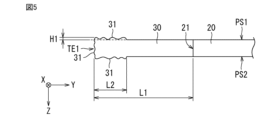
- FIG. 5 is an enlarged side view of the tab 30.
- the tab 30 has a plate shape.
- the tab 30 has a substantially rectangular shape when viewed from the first main surface PS1 side.
- the corners of the tab 30 may be rounded. This configuration can reduce the load when a cell comes into contact with it.
- the tab 30 is provided with a plurality of protrusions 31.
- the plurality of protrusions 31 are provided on the surface near the end of the tab 30.
- the plurality of protrusions 31 are provided on the first main surface PS1, the second main surface PS2, and the end surface TE1 of the tab 30.
- the end surface TE1 is a surface provided at the tip of the tab 30.
- the plurality of protrusions 31 protrude in the thickness direction of the tab 30 on the first main surface PS1 and the second main surface PS2, and protrude in the protruding direction of the tab 30 on the end surface TE1.
- the plurality of protrusions 31 are formed so as to extend from one side surface of the tab 30 to the other side surface.
- the one side surface to the other side surface of the tab 30 refers to a surface that connects the first main surface PS1 and the second main surface PS2 in the thickness direction of the tab 30 and is connected to each other via the end surface TE1 of the tab 30.
- the one side surface to the other side surface of the tab 30 are arranged opposite each other.
- the height H1 of the multiple protrusions 31 is smaller than the size of the openings of the multiple through holes 11. Specifically, the height H1 of the multiple protrusions 31 is smaller than the maximum width of the openings of the multiple through holes 11 when viewed from the first main surface PS1. For example, if the shape of the through hole 11 is circular, the maximum width of the opening is the diameter. If the shape of the through hole 11 is elliptical, the maximum width of the opening is the length of the major axis. If the shape of the through hole 11 is rectangular, the maximum width of the opening is the length of the longitudinal side. In the first embodiment, the through hole 11 has a square shape, and therefore the height H1 of the multiple protrusions 31 is smaller than one side a of the multiple through holes 11.
- the multiple protrusions 31 are arranged in a line in a specific direction.
- the multiple protrusions 31 are arranged in a line in the protruding direction of the tab 30.
- the arrangement direction of the multiple protrusions 31 is the protruding direction of the tab 30.
- the multiple protrusions 31 are provided within a predetermined distance L2 from the end surface TE1 of the tab 30.
- the predetermined distance L2 is 1/20 to 3/4 of the length L1 of the tab 30 in the protruding direction.
- the predetermined distance L2 is 1/10 to 2/3 of the length L1 of the tab 30 in the protruding direction.
- the multiple protrusions 31 have a convex shape.
- the multiple protrusions 31 have a substantially semicircular shape.
- the multiple protrusions 31 may have a substantially trapezoidal shape.
- the multiple protrusions 31 are not limited to being formed so as to extend from one side surface of the tab 30 to the other side surface, and the direction in which the multiple protrusions 31 are provided is not limited to the protruding direction of the tab 30.
- the multiple protrusions 31 may be formed so as to extend from the end surface TE1 of the tab 30 toward the frame portion 20.
- the multiple protrusions 31 may be provided side by side in a direction intersecting the protruding direction of the tab 30.
- the arrangement direction of the multiple protrusions 31 may be a direction intersecting the protruding direction of the tab 30.
- the filter device is an apparatus including the above-mentioned filter 1, and is, for example, a filtering device.
- the filter device can be made of, for example, a material such as a synthetic resin having transparency. By making the filter device out of a material having transparency, the held filter 1 can be visually confirmed from the outside of the filter device.
- FIG. 6 is a schematic perspective view of an example of a filter device 2 according to the first embodiment of the present invention.
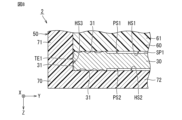
- FIG. 7 is a schematic cross-sectional view of the filter device 2 of FIG. 6 taken along line A-A.
- FIG. 8 is an enlarged cross-sectional view of a portion of the filter device 2.
- the filter device 2 includes a filter 1 and a holder 50 that holds the filter 1.
- the holder 50 includes a first holder 60 and a second holder 70.
- the filter 1 is held by being sandwiched between the first holder 60 and the second holder 70.
- the first holder 60 is configured of a member having a cylindrical shape. Specifically, the first holder 60 includes a first cylindrical body 61 and a first flange 62 protruding from an outer wall of the first cylindrical body 61.
- the first cylindrical body 61 has a space inside through which a fluid can pass.
- the first cylindrical body 61 has a cylindrical shape.
- the first flange 62 is formed by a ring-shaped plate member.
- the first flange 62 is provided at the end of the first cylindrical body 61.
- the first flange 62 may be referred to as the outer flange 62.
- the first flange 62 makes it easy to detect unevenness in the force applied when assembling the holder 50. This makes it possible to control unevenness in the flow of liquid when cells are passed through. Note that if the force applied during assembly of the first holder 60 and the second holder 70 is uneven, the gap between the first flange 62 and the second cylindrical body 71 of the second holder 70 described below will not be constant. If cells are passed through with the gap not constant, the amount of liquid passing through the area where the force is small (areas with a large gap) will be greater.
- the second holder 70 is configured of a member having a cylindrical shape. Specifically, the second holder 70 includes a second cylindrical body 71 and a second flange 72 protruding from an inner wall of the second cylindrical body 71.
- a space is provided inside the second cylindrical body 71 in which the first cylindrical body 61 can be placed.
- the second cylindrical body 71 has a cylindrical shape.
- the inner diameter of the second cylindrical body 71 is larger than the outer diameter of the first cylindrical body 61.
- the first cylindrical body 61 moves inside the second cylindrical body 71 while contacting the inner wall of the second cylindrical body 71, and can be placed inside the second cylindrical body 71.
- the second flange 72 is formed by a ring-shaped plate member.
- the second flange 72 is provided at the end of the second cylindrical body 71.
- the second flange 72 may also be referred to as the inner flange 72.
- the filter 1 is placed on the second flange 72 of the second holder 70. Specifically, the frame 20 and tab 30 of the filter 1 are placed on the second flange 72. Furthermore, with the frame 20 and tab 30 of the filter 1 placed on the second flange 72, the first holder 60 is placed in the second holder 70. The tab 30 is clamped between the first holder 60 and the second holder 70.
- the tab 30 of the filter 1 is disposed between the end face HS1 of the first holder 60 and the flange surface HS2 of the second flange 72 of the second holder 70.
- the multiple protrusions 31 contact the end face HS1 of the first holder 60, the flange surface HS2 of the second flange 72, and the inner wall HS3 of the second holder 70.
- the positions at which the tab 30 contacts the end face HS1 of the first holder 60 and the flange surface HS2 of the second flange 72 are limited to the multiple protrusions 31. This ensures that the multiple protrusions 31 contact and are supported by the end face HS1 of the first holder 60 and the flange surface HS2 of the second flange 72. As a result, the tab 30 can be firmly held by the holder 50.
- first holder 60 and the second holder 70 contact the multiple protrusions 31 to hold the tab 30, it is easier to apply force to the filter 1 compared to when the first holder 60 and the second holder 70 hold a tab that does not have multiple protrusions 31.
- the first main surface PS1 and the second main surface PS2 of the tab 30 are formed as flat surfaces, and the end surface HS1 of the first holder 60 and the flange surface HS2 of the second flange 72 are also formed as flat surfaces.
- the flat surfaces come into contact with each other, dispersing the force applied to the tab. This causes the force clamping the tab to be dispersed, making it difficult to apply sufficient force to hold the tab.
- the thickness of the tab 30 is generally uniform, there may be variations due to manufacturing. For this reason, in the case of a tab that does not have multiple protrusions 31, when the end surface HS1 of the first holder 60 and the flange surface HS2 of the second flange 72, which are flat surfaces, are brought into contact with the surface of the tab, the surfaces may not make sufficient contact with each other, making it difficult to apply an even force.
- the positions where the tab 30 contacts the end face HS1 of the first holder 60 and the flange face HS2 of the second flange 72 are limited to the multiple protrusions 31. This allows the multiple protrusions 31 to reliably contact the end face HS1 of the first holder 60 and the flange face HS2 of the second flange 72, concentrating force at the contacting portions. This allows the tab 30 to be firmly held by the holder 50.
- the end surface HS1 of the first holder 60 comes into contact with the multiple protrusions 31, forming a gap SP1 between the tab 30 and the frame 20 and the first holder 60.
- the gap SP1 is formed between the end surface HS1 of the first holder 60 and the first main surface PS1 of the tab 30 and the frame 20.
- the size of the gap SP1 is approximately equal to the height of the multiple protrusions 31.
- the height of the multiple protrusions 31 is smaller than the size of the openings of the multiple through-holes 11 of the filter section 10. Therefore, the gap SP1 is large enough that the objects to be filtered that are captured by the multiple through-holes 11 cannot pass through it.
- the gap SP1 allows fluid to pass through.
- the filter portion 10 when filtering a liquid containing a substance to be filtered using the filter device 2, if the filter portion 10 becomes clogged with the substance to be filtered, the liquid can escape through the gap SP1. Also, by providing tabs 30 partially on the outer periphery of the frame portion 20, it becomes easier for the liquid to escape through the gap SP1 in the portion where the tabs 30 are not provided.
- the filter 1 according to the first embodiment can provide the following effects.
- the filter 1 includes a filter portion 10 having a plurality of through holes 11, a frame portion 20 provided on the outer periphery of the filter portion 10, and a tab 30 that protrudes from the outer periphery of the frame portion 20 and has a plurality of protrusions 31.
- This configuration allows the filter 1 to be easily held. For example, the filter 1 can be easily held by clamping the tab 30 with the holder 50.
- the position where the holder 50 comes into contact can be limited to the multiple protrusions 31. This allows the force held by the holder 50 to be concentrated on the multiple protrusions 31, improving the holding force of the filter 1. As a result, the filter 1 can be held firmly.
- a gap SP1 can be provided between the tab 30 and frame 20 and the holder 50. This allows liquid to escape from the gap SP1, for example, if the filter 1 becomes clogged, and damage to the filter 1 can be suppressed. Furthermore, by contacting the multiple protrusions 31 with the holder 50, it is possible to prevent cells from moving around the end surface TE1 of the tab 30, and to reduce variation in the size of the desired object to be filtered.
- the multiple protrusions 31 are provided on the main surface of the tab 30.
- the main surface of the tab 30 includes a first main surface PS1 and a second main surface PS2.
- the multiple protrusions 31 are provided on the end surface TE1 of the tab 30. With this configuration, when the filter 1 is placed in the holder 50, the multiple protrusions 31 come into contact with the inner wall of the holder 50, and the position of the filter 1 can be fixed. This makes it possible to suppress misalignment of the filter 1 and suppress variation in the gap SP1 over the entire outer periphery of the frame portion 20.
- the multiple protrusions 31 are arranged in a line in a specific direction. This configuration allows the multiple protrusions 31 to be in stable contact with the holder 50, making it easier to hold the filter 1 and further improving the retention force of the filter 1, allowing it to be held firmly.
- the multiple protrusions 31 are provided within a predetermined distance L2 from the end surface TE1 of the tab 30, and the predetermined distance L2 is 1/20 to 3/4 of the length L1 of the tab 30 in the protruding direction. This configuration makes it possible to hold the filter 1 more easily and firmly.
- the height H1 of the multiple protrusions 31 is smaller than the size of the openings of the multiple through holes 11.
- the size of the gap SP1 formed between the tab 30 and frame 20 and the holder 50 is smaller than the size of the object to be filtered captured by the filter part 10. This makes it possible to allow liquid to escape from the gap SP1 while preventing the object to be filtered from passing through the gap SP1 in the event of clogging or the like. As a result, damage to the filter 1 can be further suppressed.
- the tab 30 includes multiple tabs 30, which are arranged at equal intervals around the outer periphery of the frame portion 20. This configuration makes it possible to hold the filter 1 more easily and firmly.
- Filter 1 is primarily composed of at least one of metal and metal oxide. This configuration makes it possible to hold filter 1 more easily and firmly.
- the filter device 2 includes the filter 1 described above and a holder 50 that holds the filter 1.
- the holder 50 includes a first holder 60 having a cylindrical shape and a second holder 70 having a cylindrical shape and an inner flange 72 protruding from an inner wall.
- the first holder 60 is disposed within the second holder 70.
- the tab 30 of the filter 1 is disposed between the end face HS1 of the first holder 60 and the inner flange 72 of the second holder 70.
- the multiple protrusions 31 of the tab 30 contact at least one of the end face HS1 of the first holder 60 and the inner flange 72 of the second holder 70. This configuration allows the filter 1 to be easily held.
- the multiple protrusions 31 are securely in contact with and supported by the end surface HS1 of the first holder 60 and the flange surface HS2 of the second flange 72. As a result, the tab 30 can be firmly held by the holder 50.
- the multiple protrusions 31 are provided on the end surface TE1 of the tab 30 and contact the inner wall HS3 of the second holder 70. This configuration can suppress misalignment of the filter 1. This can reduce the variation in the size of the gap SP1 around the entire outer periphery of the filter 1.
- the multiple protrusions 31 may be provided on at least one of the first main surface PS1, the second main surface PS2, and the end surface TE1 of the tab 30.
- the multiple protrusions 31 are provided on the first main surface PS1 of the tab 30, but do not have to be provided on the second main surface PS2 and the end surface TE1 of the tab 30.
- the multiple protrusions 31 are provided on either the first main surface PS1 or the second main surface PS2, it becomes easier to distinguish the front and back of the filter 1.
- the tabs 30 are provided at equal intervals around the outer periphery of the frame 20
- the present invention is not limited to this.
- the tabs 30 may be provided randomly around the outer periphery of the frame 20.
- the arrangement and number of the tabs 30 may also be changed depending on the dimensions of the through holes and/or the material of the filter 1. This allows the filter specifications to be identified visually.
- the amount of deformation of the filter 1 is small in areas with a large number of tabs 30, and the amount of deformation of the filter 1 is large in areas with a small number of tabs 30. This distributes the deformation in the center of the filter, allowing the entire filter to be used evenly, and shortening the liquid passage time.
- the filter 1 is a metal filter
- the present invention is not limited to this.
- the filter 1 may be a resin filter.
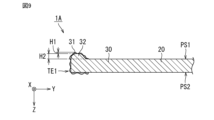
- FIG. 9 is a schematic enlarged cross-sectional view of a portion of filter 1A of modified example 1.
- tab 30 has a first raised portion 32 that rises in the thickness direction of tab 30.
- Height H2 of first raised portion 32 is greater than height H1 of multiple protrusions 31, and multiple protrusions 31 are provided on first raised portion 32.
- the other configuration of modified example 1 is similar to that of embodiment 1.
- the first raised portion 32 is provided on the first main surface PS1 of the tab 30 along the end surface TE1 of the tab 30.
- the first raised portion 32 has a convex shape.
- the first raised portion 32 has a substantially semicircular shape.
- the filter 1 can be easily held. Furthermore, the first raised portion 32 can firmly hold the filter 1 while maintaining the gap SP1.
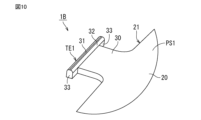
- Fig. 10 is a schematic enlarged view of a portion of filter 1B of modified example 2.
- tab 30 has second raised portion 33 that rises in the width direction of tab 30 at an end portion of tab 30.
- a plurality of protrusions 31 are provided on second raised portion 33.
- the other configuration of modified example 2 is similar to that of modified example 1.
- the second raised portion 33 is raised in a direction along the end surface TE1 of the tab 30, and protrudes from the side surface of the tab 30.
- the second raised portion 33 may have a shape similar to that of the first raised portion 32, or may be lower than the first raised portion 32.
- the filter 1 can be easily held.
- the second raised portion 33 allows the multiple protrusions 31 to be longer in the width direction of the tab 30, improving the holding force of the filter 1 and allowing the filter 1 to be held firmly.
- Fig. 11 is a schematic enlarged cross-sectional view of a portion of a filter 1C of modified example 3. As shown in Fig. 11, in filter 1C of modified example 3, end face TE1 of tab 30 may form an inclined surface 34. Furthermore, the tab 30 of filter 1C is not provided with a plurality of protrusions 31.
- the other configuration of modified example 3 is similar to that of embodiment 1.
- This configuration allows the tip of the tab 30 to deform easily, making it easy to place in the holder 50. Furthermore, in the tab 30, the area of the first main surface PS1 is smaller than that of the second main surface PS2, and the area of contact of the first main surface PS1 with the holder 50 is smaller than that of the second main surface PS2. Therefore, in the filter 1C, the amount of deformation of the filter when a fluid is passed through it is greater than in a filter that does not have an inclined surface 34. As a result, the fluid is dispersed over the filter 1C, reducing the load on the filter 1C.
- the tab 30 may be provided with multiple protrusions 31.
- Fig. 12 is a schematic enlarged cross-sectional view of a portion of filter 1D of modified example 4. As shown in Fig. 12, filter 1D of modified example 4 differs from filter 1A of modified example 2 in that it does not include a plurality of protrusions 31. The rest of the configuration of modified example 4 is similar to that of modified example 2.
- the filter 1 can be easily held.
- FIG. 13 is a schematic plan view of a filter 1E of the modified example 5.
- Fig. 14 is a schematic enlarged view of a Z1 portion of the filter of the modified example 5 of Fig. 13.
- a notch 35 is provided on the outer periphery of the frame portion 20.
- the filter 1 can be easily attached to and detached from the holder 50, for example, by inserting the tip of tweezers into the notch 35 and grasping the filter 1E.
- the filter 1E is deformed to a greater extent than a filter without a notch, so the fluid is dispersed over the filter 1E, reducing the load on the filter 1E.
- the filter 1E has the notch 35
- the notch 35 does not have to be a required component of the filter 1E.
- the distance between two adjacent tabs 30 may be made larger than the other distances, and the part where no tabs 30 are provided may be made larger. Even with such a configuration, the amount of deformation of the filter 1E can be increased when a fluid is passed through it, and the load on the filter 1E can be reduced.
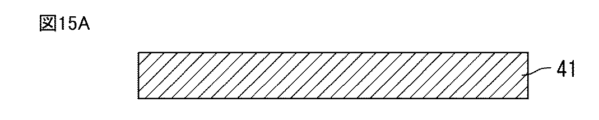
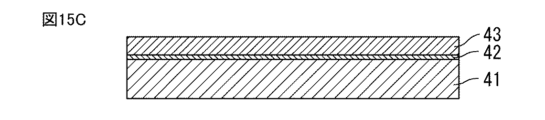
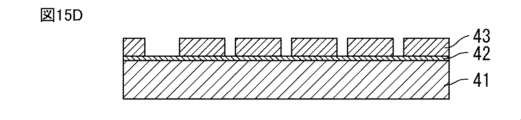
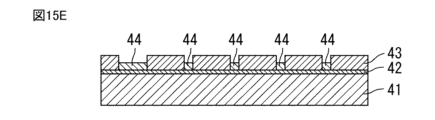
- FIGS. 15A to 15G are schematic views showing an example of a manufacturing process for filter 1 according to the first embodiment of the present invention.
- a substrate 41 such as silicon is prepared.
- the surface of the substrate 41 may be cleaned, for example.
- a Cu film 42 is formed on a substrate 41.
- the Cu film 42 is formed by sputtering using a sputtering film formation device.
- the Cu film 42 may be formed by vapor deposition using a vapor deposition device.
- a Ti film may be formed between the substrate 41 and the Cu film 42 to improve the adhesion between the substrate 41 and the Cu film 42.
- the thickness of the Cu film is 500 nm
- the thickness of the Ti film is 50 nm.
- resist is applied onto the Cu film 42 and dried to form a resist film 43.
- a photosensitive positive liquid resist Pfi-3A manufactured by Sumitomo Chemical Co., Ltd.
- the resist is then heated and dried using a hot plate to form the resist film 43.
- the thickness of the resist film 43 is 2 ⁇ m.
- the resist film 43 is exposed and developed to remove the resist film 43 from the areas corresponding to the filter base 12 and frame 20.
- an i-line stepper (Canon Pfi-37A) is used as the exposure machine.
- the developing solution used is TMAH (Tetramethylammonium hydroxide). After exposure and development, the film is washed with water and dried.
- TMAH Tetramethylammonium hydroxide
- electrolytic plating is performed using an electrolytic plating device.
- This forms a plating film 44 in the area where the resist film 43 has been removed.
- the plating film 44 is a PdNi plating film.
- a resist stripping device capable of high-pressure spray processing is used to strip the resist film 43 using a stripping solution.
- the plating film 44 is then washed with IPA (isopropyl alcohol) and water, and dried.
- the stripping solution is an organic solvent, such as NMP (N-methyl-2-pyrrolidone).
- an etchant containing acetic acid and hydrogen peroxide is prepared, and the Cu film 42 is etched away by immersion while stirring with a stirrer. This causes the plating film 44 to peel off from the substrate 41, producing the filter base 12 and frame 20. In other words, a filter body 45 is produced that includes the filter 10 and frame 20.
- a reinforcing layer may be formed on the second main surface PS2 of the filter 1.
- a resist film with a thickness of 20 ⁇ m is formed on the Cu film 42.
- the resist film is exposed and developed to remove the resist film from the portions corresponding to the frame portion 20 and the reinforcing layer.
- the filter 1 may be produced by plating the Cu film 42 and removing the resist film using an organic solvent.
- the reinforcing layer has a thickness of 10 ⁇ m, and through holes with a side length of 285 ⁇ m are arranged in a square lattice pattern at intervals (pitch) of 300 ⁇ m.
- a filter sheet including multiple filter bodies 45 is formed.
- FIG. 16 is a schematic diagram showing an example of a filter sheet 46.
- the filter sheet 46 has a sheet body 47 on which a plurality of filter bodies 45 are provided.
- the plurality of filter bodies 45 are connected to the sheet body 47 by a plurality of connection tabs 48.
- the multiple connection tabs 48 are spaced apart on the outer periphery of the filter body 45.
- the multiple connection tabs 48 are spaced apart at equal intervals.
- the filter body 45 is separated from the sheet body 47 by cutting the multiple connection tabs 48 with laser light LC1. This allows filter 1 to be obtained.
- the multiple tabs 48 do not need to have a uniform width. In other words, the multiple tabs 48 may have different widths. This allows for both sufficient strength to connect to the sheet 47 and ease of cutting.
- 17A and 17B are schematic diagrams showing an example of a manufacturing process for filter 1 according to embodiment 1 of the present invention.
- 17A and 17B show partial cross-sectional views of a portion where connection tab 48 is provided.
- the filter body 45 is connected to the sheet body 47 via a connection tab 48.
- the connection tab 48 is cut by irradiating the connection tab 48 with laser light LC1.
- the laser beam LC1 is emitted by, for example, a laser processing device.
- the laser is a CO2 laser, a YAG laser, a fiber laser, or a semiconductor laser.
- the laser light LC1 is irradiated onto the connection tab 48 along the outer periphery of the frame portion 20 of the filter body 45.
- the connection tab 48 is melted and cut by the thermal energy of the laser light LC1.
- connection tab 48 is melted and cut by the laser LC1 to form a tab 30 having multiple protrusions 31 on the outer periphery of the frame portion 20.
- connection tabs 48 provided on the outer periphery of the filter body 45 are cut by irradiation with the laser LC1
- the filter body 45 provided with the multiple tabs 30 is separated from the sheet body 47. This allows the filter 1 to be obtained.
- a filter of one aspect of the present invention includes a filter portion having a plurality of through holes, a frame portion provided on an outer periphery of the filter portion, and a tab protruding from the outer periphery of the frame portion and provided with a plurality of protrusions.
- the multiple protrusions may be provided on the main surface of the tab.
- the multiple protrusions may be provided on the end face of the tab.
- the multiple protrusions may be arranged in a predetermined direction.
- the multiple protrusions may be located within a predetermined distance from the end face of the tab.
- the predetermined distance may be 1/20 or more and 3/4 or less of the length of the tab in the protruding direction.
- the height of the multiple protrusions may be smaller than the maximum width of the openings of the multiple through holes.
- the tab may have a first raised portion that is raised in the thickness direction of the tab.
- the height of the first raised portion may be greater than the height of the multiple protrusions.
- the multiple protrusions may be provided on the first raised portion.
- the tab may have a second raised portion that is raised in the width direction of the tab at an end of the tab.
- the multiple protrusions may be provided on the second raised portion.
- the tab may include a plurality of tabs.
- the plurality of tabs may be provided at equal intervals around the outer periphery of the frame.
- the filter may contain at least one of a metal and a metal oxide as a main component.
- a filter device includes a filter and a holder that holds the filter.
- the filter includes a filter portion having a plurality of through holes, a frame portion provided on the outer periphery of the filter portion, and a tab that protrudes from the outer periphery of the frame portion and has a plurality of protrusions.
- the holder includes a first holder having a cylindrical shape and a second holder having a cylindrical shape and an inner flange that protrudes from the inner wall.
- the first holder is disposed within the second holder.
- the tab of the filter is disposed between an end face of the first holder and the inner flange of the second holder.
- the plurality of protrusions of the tab contact at least one of the end face of the first holder and the inner flange of the second holder.
- the multiple protrusions may be provided on the end surface of the tab and may contact the inner wall of the second holder.
- the filter of the present invention is useful for filtering objects contained in a fluid.
Landscapes
- Chemical & Material Sciences (AREA)
- Chemical Kinetics & Catalysis (AREA)
- Life Sciences & Earth Sciences (AREA)
- Geology (AREA)
- Inorganic Chemistry (AREA)
- Filtering Materials (AREA)
Priority Applications (3)
| Application Number | Priority Date | Filing Date | Title |
|---|---|---|---|
| JP2025503630A JPWO2024180932A1 (https=) | 2023-03-02 | 2024-01-17 | |
| CN202480007534.9A CN120529953A (zh) | 2023-03-02 | 2024-01-17 | 过滤器和过滤器装置 |
| US19/227,678 US20250296022A1 (en) | 2023-03-02 | 2025-06-04 | Filter and filter device |
Applications Claiming Priority (2)
| Application Number | Priority Date | Filing Date | Title |
|---|---|---|---|
| JP2023-031773 | 2023-03-02 | ||
| JP2023031773 | 2023-03-02 |
Related Child Applications (1)
| Application Number | Title | Priority Date | Filing Date |
|---|---|---|---|
| US19/227,678 Continuation US20250296022A1 (en) | 2023-03-02 | 2025-06-04 | Filter and filter device |
Publications (1)
| Publication Number | Publication Date |
|---|---|
| WO2024180932A1 true WO2024180932A1 (ja) | 2024-09-06 |
Family
ID=92590305
Family Applications (1)
| Application Number | Title | Priority Date | Filing Date |
|---|---|---|---|
| PCT/JP2024/001154 Ceased WO2024180932A1 (ja) | 2023-03-02 | 2024-01-17 | フィルタ及びフィルタデバイス |
Country Status (4)
| Country | Link |
|---|---|
| US (1) | US20250296022A1 (https=) |
| JP (1) | JPWO2024180932A1 (https=) |
| CN (1) | CN120529953A (https=) |
| WO (1) | WO2024180932A1 (https=) |
Citations (5)
| Publication number | Priority date | Publication date | Assignee | Title |
|---|---|---|---|---|
| JP2012121214A (ja) * | 2010-12-08 | 2012-06-28 | Toshiba Tec Corp | インクジェットプリンタ用のフィルタ装置、フィルタ装置の製造方法、およびフィルタ |
| WO2015005088A1 (ja) * | 2013-07-09 | 2015-01-15 | 株式会社村田製作所 | 測定装置及びその製造方法 |
| JP2017029974A (ja) * | 2015-05-11 | 2017-02-09 | ポール・コーポレーションPall Corporation | 液体処理モジュールおよび液体処理アセンブリ |
| WO2018030081A1 (ja) * | 2016-08-10 | 2018-02-15 | 株式会社村田製作所 | 濾過フィルタデバイス |
| WO2019181158A1 (ja) * | 2018-03-19 | 2019-09-26 | 株式会社村田製作所 | 濾過フィルタ及び濾過装置 |
-
2024
- 2024-01-17 JP JP2025503630A patent/JPWO2024180932A1/ja active Pending
- 2024-01-17 WO PCT/JP2024/001154 patent/WO2024180932A1/ja not_active Ceased
- 2024-01-17 CN CN202480007534.9A patent/CN120529953A/zh active Pending
-
2025
- 2025-06-04 US US19/227,678 patent/US20250296022A1/en active Pending
Patent Citations (5)
| Publication number | Priority date | Publication date | Assignee | Title |
|---|---|---|---|---|
| JP2012121214A (ja) * | 2010-12-08 | 2012-06-28 | Toshiba Tec Corp | インクジェットプリンタ用のフィルタ装置、フィルタ装置の製造方法、およびフィルタ |
| WO2015005088A1 (ja) * | 2013-07-09 | 2015-01-15 | 株式会社村田製作所 | 測定装置及びその製造方法 |
| JP2017029974A (ja) * | 2015-05-11 | 2017-02-09 | ポール・コーポレーションPall Corporation | 液体処理モジュールおよび液体処理アセンブリ |
| WO2018030081A1 (ja) * | 2016-08-10 | 2018-02-15 | 株式会社村田製作所 | 濾過フィルタデバイス |
| WO2019181158A1 (ja) * | 2018-03-19 | 2019-09-26 | 株式会社村田製作所 | 濾過フィルタ及び濾過装置 |
Also Published As
| Publication number | Publication date |
|---|---|
| US20250296022A1 (en) | 2025-09-25 |
| JPWO2024180932A1 (https=) | 2024-09-06 |
| CN120529953A (zh) | 2025-08-22 |
Similar Documents
| Publication | Publication Date | Title |
|---|---|---|
| EP3838370B1 (en) | Filtration filter and filtration method | |
| KR20010014651A (ko) | 미세구조 어레이, 미세구조 어레이의 형성 방법 및 장치,및 미세구조 어레이를 제조하기 위한 주형 | |
| US10960331B2 (en) | Cell-capturing filter | |
| CN102320559B (zh) | 一种中空结构的微阵列电极的制备方法 | |
| US11052337B2 (en) | Filtration filter and filtration filter device | |
| US20240207762A1 (en) | Filtration filter | |
| JP5141320B2 (ja) | ワイヤーグリッド用金属板、自立型ワイヤーグリッド及びワイヤーグリッド用金属板の製造方法 | |
| WO2024180932A1 (ja) | フィルタ及びフィルタデバイス | |
| US5569855A (en) | Method of manufacturing a frame-mounted membrane | |
| JP7806794B2 (ja) | フィルタ | |
| US20230053689A1 (en) | Filter | |
| JP6406480B1 (ja) | 濾過フィルタ | |
| JP7343079B1 (ja) | フィルタ | |
| JP7111184B2 (ja) | 濾過フィルタ | |
| CN114364313B (zh) | 电极基板及其制造方法以及使用了这种电极基板的生物传感器 | |
| CN111801150A (zh) | 过滤滤除器以及过滤装置 | |
| JP2023140473A (ja) | 細胞培養基材および細胞培養基板キット | |
| US20040191561A1 (en) | Surface structure of metallic body | |
| JP2006016654A (ja) | 貫通型金属構造体の製造方法 | |
| CN119320696A (zh) | 光热空化微纳针尖阵列、其制造方法以及细胞转染方法 | |
| JP2007212344A (ja) | ウエルプレート及びウエルプレートを用いた検査方法 |
Legal Events
| Date | Code | Title | Description |
|---|---|---|---|
| 121 | Ep: the epo has been informed by wipo that ep was designated in this application |
Ref document number: 24763417 Country of ref document: EP Kind code of ref document: A1 |
|
| WWE | Wipo information: entry into national phase |
Ref document number: 2025503630 Country of ref document: JP |
|
| WWE | Wipo information: entry into national phase |
Ref document number: 202480007534.9 Country of ref document: CN |
|
| WWP | Wipo information: published in national office |
Ref document number: 202480007534.9 Country of ref document: CN |
|
| NENP | Non-entry into the national phase |
Ref country code: DE |
|
| 122 | Ep: pct application non-entry in european phase |
Ref document number: 24763417 Country of ref document: EP Kind code of ref document: A1 |