WO2024180735A1 - 側面研磨光ファイバを用いた合分波カプラの光分岐比調整方法及び光分岐比調整装置 - Google Patents
側面研磨光ファイバを用いた合分波カプラの光分岐比調整方法及び光分岐比調整装置 Download PDFInfo
- Publication number
- WO2024180735A1 WO2024180735A1 PCT/JP2023/007637 JP2023007637W WO2024180735A1 WO 2024180735 A1 WO2024180735 A1 WO 2024180735A1 JP 2023007637 W JP2023007637 W JP 2023007637W WO 2024180735 A1 WO2024180735 A1 WO 2024180735A1
- Authority
- WO
- WIPO (PCT)
- Prior art keywords
- optical fiber
- optical
- branching ratio
- propagation constant
- light
- Prior art date
- Legal status (The legal status is an assumption and is not a legal conclusion. Google has not performed a legal analysis and makes no representation as to the accuracy of the status listed.)
- Ceased
Links
Images





Classifications
-
- G—PHYSICS
- G02—OPTICS
- G02B—OPTICAL ELEMENTS, SYSTEMS OR APPARATUS
- G02B6/00—Light guides; Structural details of arrangements comprising light guides and other optical elements, e.g. couplings
- G02B6/24—Coupling light guides
- G02B6/26—Optical coupling means
- G02B6/28—Optical coupling means having data bus means, i.e. plural waveguides interconnected and providing an inherently bidirectional system by mixing and splitting signals
Definitions
- This disclosure relates to a method and device for adjusting the optical branching ratio of a multiplexing/demultiplexing coupler using side polished optical fiber.
- a method for manufacturing an optical fiber coupler using an optical fiber side polishing method has been studied as an optical multiplexing/demultiplexing technology that can separate light from an optical fiber and multiplex light into an optical fiber without cutting the optical fiber during communication (see Non-Patent Document 1).
- This method for manufacturing an optical fiber coupler includes the following steps.
- the optical fiber during communication will be referred to as the first optical fiber
- the optical fiber optically coupled to the first optical fiber by the optical fiber coupler will be referred to as the second optical fiber.
- Step (1) A bend is applied to a first optical fiber so as to result in a loss that does not affect communication, and the optical intensity of communication light leaking from the bent portion is monitored.
- Step (2) While monitoring the light intensity, the side surface of the first optical fiber is polished. As the polished surface approaches the core of the first optical fiber, the light intensity of the leaked light decreases. When the light intensity reaches a predetermined value, polishing is stopped and the bend is released.
- optical branching ratio of an optical multiplexing/demultiplexing technique that can demultiplex light from an optical fiber and multiplex light into an optical fiber is expressed by the following formula (1) derived from mode coupling theory.
- ( ⁇ /q) 2 (sin(qz)) 2 ...(1) q ( ⁇ 2 + ⁇ 2 ) 1/2
- ⁇ is the mode coupling constant
- ⁇ is the half value of the propagation constant difference between the optical fibers that are multiplexed and branched
- z is the coupling distance.
- the maximum value of the optical branching ratio depends on the propagation constant difference between the optical fibers that are multiplexed and branched.
- optical multiplexing and demultiplexing technology that multiplexes and demultiplexes light
- optical fibers are manufactured to international standards and other specifications, their propagation constants vary within the range of the specifications. Therefore, even when optical fibers manufactured to the same specifications are optically coupled, differences in the propagation constants are likely to occur. As a result, as can be seen from equation (1), there is a reduction in the optical branching ratio, which depends on the difference in the propagation constants.
- the present disclosure has been made in consideration of the above circumstances, and aims to provide a method and device for adjusting the optical branching ratio of a multiplexing/demultiplexing coupler that can suppress a decrease in the optical branching ratio due to differences in the propagation constant, even when fabricating a multiplexing/demultiplexing coupler using optical fibers that are in a communicable state.
- a method for adjusting an optical branching ratio involves adjusting the optical coupling state due to the difference in propagation constant between the first optical fiber and the second optical fiber by monitoring changes in the intensity of light from the second optical fiber while the first optical fiber and the second optical fiber are optically coupled by bringing a first polished surface formed on the side of the first optical fiber into contact with a second polished surface formed on the side of the second optical fiber.
- An optical branching ratio adjustment device includes a light intensity measurement unit that monitors changes in the intensity of light from the second optical fiber when the first optical fiber and the second optical fiber are optically coupled by surface alignment of a first polished surface formed on a side of the first optical fiber with a second polished surface formed on a side of the second optical fiber, and an adjustment device that adjusts the optical coupling state due to the difference in propagation constant between the first optical fiber and the second optical fiber in the above state.
- the present disclosure provides a method and device for adjusting the optical branching ratio of a multiplexing/demultiplexing coupler that can suppress a decrease in the optical branching ratio due to a difference in the propagation constant, even when fabricating a multiplexing/demultiplexing coupler using optical fibers that are in a communicable state.
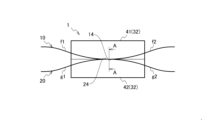
- FIG. 1A is a cross-sectional view of an optical multiplexer according to an embodiment of the present disclosure.
- FIG. 1B is a side view of the multiplexing/demultiplexing coupler.
- FIG. 1C is a cross-sectional view taken along line AA in FIG. 1B.
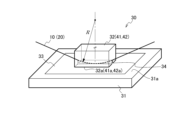
- FIG. 2A is a perspective view showing an example of a polishing apparatus.
- FIG. 2B is an enlarged cross-sectional view of the holding portion shown in FIG. 2A.
- FIG. 3A is a block diagram showing an example of the configuration of an optical branching ratio adjustment device according to this embodiment.
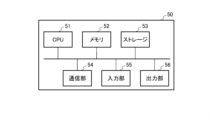
- FIG. 3B is a block diagram showing an example of the configuration of the control unit shown in FIG. 3A.
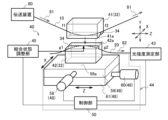
- FIG. 3C is a perspective view showing an example of the configuration of the optical branching ratio adjustment device according to the present embodiment.
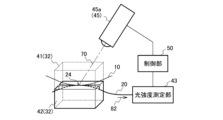
- FIG. 4 is a diagram illustrating an example of the configuration of the optical coupling state adjustment unit according to the first embodiment.
- FIG. 5 is a graph showing the change in the optical branching ratio depending on the presence or absence of a propagation constant difference.
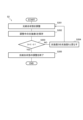
- FIG. 6A is a flowchart showing an example of steps of an optical branching ratio adjusting method according to this embodiment.
- FIG. 6B is a flowchart showing an example of a position adjustment process according to this embodiment.
- FIG. 6C is a flowchart showing an example of an optical coupling state adjustment process according to this embodiment.
- FIG. 7 is a diagram illustrating an example of the configuration of an optical coupling state adjustment unit according to the second embodiment.
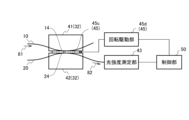
- FIG. 8 is a diagram illustrating an example of the configuration of an optical coupling state adjustment unit according to the third embodiment.
- an optical fiber that has already been installed in a PON (Passive Optical Network) network and is ready for communication may be referred to as the first optical fiber.
- the first optical fiber is installed in facilities that construct the network, such as utility tunnels or overhead lines. It may be installed either indoors or outdoors.
- the first optical fiber may already be used for optical communications in the network, or it may not be used for optical communications once installed.
- an optical fiber that is newly installed in the network and connected to the first optical fiber may be referred to as the second optical fiber.
- the second optical fiber is an optical fiber that constructs a path that branches off from a path (transmission path) constructed by the first optical fiber, or that merges into that path.
- the X, Y, and Z directions are defined as being orthogonal to each other.
- the X and Z directions are the directions in which one of the two holding parts 41, 42 according to this embodiment moves relative to the other, and are, for example, both horizontal directions.
- the Y direction is the arrangement direction of the two holding parts 41, 42, and is, for example, the vertical direction.
- the Z direction is also the extension direction (longitudinal direction) of each optical fiber 10, 20 and the extension direction of the V-groove 34 formed in each holding part 41 (42). Therefore, the X direction is the short direction of each optical fiber 10, 20.
- FIG. 1A is a cross-sectional view of the multiplexing/demultiplexing coupler 1.
- FIG. 1B is a side view of the multiplexing/demultiplexing coupler 1.
- FIG. 1C is a cross-sectional view taken along line A-A in FIG. 1B.
- the multiplexing/demultiplexing coupler 1 is a so-called optical fiber coupler that splits light propagating through one optical fiber into two optical fibers, or combines light propagating through two optical fibers into one optical fiber. As shown in FIG.
- the multiplexing/demultiplexing coupler 1 includes an optical fiber 10 and an optical fiber 20.
- the cross-sectional view shown in FIG. 1A includes a central axis 10a of the optical fiber 10 and a central axis 20a of the optical fiber 20.
- the optical fiber 10 is, for example, the first optical fiber described above, and has already been laid in a network (not shown).
- the optical fiber 10 has a core (first core) 11, a cladding (first cladding) 12, and a coating (first coating) 13.
- the optical fiber 10 is a single-mode optical fiber or a multimode optical fiber.
- the optical fiber 20 is, for example, the second optical fiber described above, and is newly connected to the optical fiber 10 as an additional path of a network (not shown).
- the optical fiber 20 has a core (second core) 21 and a cladding (second cladding) 22.
- the optical fiber 20 is also a single-mode optical fiber or a multimode optical fiber.
- the optical fiber 20 may or may not have a coating (second coating) 23.
- the optical fiber 20 according to the first embodiment is a photosensitive optical fiber.
- a photosensitive optical fiber is also called a photosensitive optical fiber.
- a photosensitive optical fiber has a property that the refractive index increases and the propagation constant increases when irradiated with ultraviolet light.
- the propagation constant of the optical fiber 20, which is a photosensitive optical fiber, before the optical coupling state is adjusted as described below is lower than the propagation constant of the optical fiber 10.
- the optical fiber 10 has a polished surface (first polished surface) 14 on a side surface 15.
- the polished surface 14 is formed by polishing the side surface 15. This polishing process can be performed, for example, by a polishing device 30 (see FIGS. 2A and 2B ) described below. By this polishing process, the coating 13 is removed from the polished surface 14, and a part of the cladding 12 remains.
- the minimum thickness of the cladding 12 from the polished surface 14 to the core 11 is defined as the remaining cladding thickness d lv (see FIG. 1C ).
- the optical fiber 20 has a polished surface (second polished surface) 24 on a side surface 25.
- the polished surface 24 is formed by polishing the side surface 25.
- This polishing process can also be performed by, for example, a polishing device 30 described below.
- the coating 23 is removed from the polished surface 24, and a part of the cladding 22 remains.
- the minimum thickness of the cladding 22 from the polished surface 24 to the core 21 is defined as the remaining cladding thickness d br (see FIG. 1C ).
- the optical fiber 10 extends in the Z direction while being bent with a radius of curvature R lv at least in a portion including the polished surface 14.
- the polished surface 14 is formed by polishing a side surface 15 of the optical fiber 10 placed in a state in which it is bent with a radius of curvature R lv . Therefore, when the optical fiber 10 is bent with a radius of curvature R lv , the polished surface 14 forms an elliptical plane extending in the longitudinal direction (Z direction) of the optical fiber 10.
- the optical fiber 20 extends in the Z direction while being bent with a radius of curvature R br at least in a portion including the polished surface 24.
- the polished surface 24 is formed by polishing a side surface 25 of the optical fiber 20 placed in a state in which the optical fiber 20 is bent with a radius of curvature R br . Therefore, when the optical fiber 20 is bent with a radius of curvature R br , the polished surface 24 forms an elliptical plane extending in the longitudinal direction of the optical fiber 20.
- a refractive index matching agent (not shown) is interposed between polished surface 14 and polished surface 24.
- the refractive index matching agent may be a viscous liquid or a deformable solid.
- the refractive index of the refractive index matching agent is smaller than the refractive indexes of cladding 12 and cladding 22. This prevents an increase in insertion loss.
- the polished surface 14 and the polished surface 24 are in contact with each other via a refractive index matching material (not shown). Therefore, the core 11 and the core 21 are positioned relative to each other with a core distance d (see FIG. 1C ).
- the core distance d is the distance between the core 11 and the core 21, and its minimum value is the sum of the remaining cladding thickness d lv of the cladding 12, the remaining cladding thickness d br of the cladding 22, and the thickness of the refractive index matching material (not shown).
- core 11 and core 21 are optically coupled, and a multiplexing/demultiplexing coupler 1 having four ports f1, f2, g1, and g2 is constructed (see FIG. 1B), enabling the multiplexing or demultiplexing of light, which is the function of the multiplexing/demultiplexing coupler 1.
- FIG. 2A is a perspective view showing an example of a polishing device 30 used to form the polishing surface 14 (24).
- FIG. 2B is a cross-sectional view of the holding part 32 shown in FIG. 2A.
- the polishing device 30 includes a polishing table 31 and a holding part 32.
- the formation of the polishing surface 14 will be described as an example.
- the polishing table 31 has a flat upper surface 31a, on which a polishing sheet 33 is placed.
- the holding part 32 has a flat surface 32a facing the upper surface 31a of the polishing table 31, and a V-shaped groove 34 curved with a radius R is formed on the flat surface 32a.
- the radius R is slightly smaller than the radius of curvature Rlv .
- the material of the polishing table 31 and the holding part 32 is, for example, glass.
- the V-groove 34 is formed so that its depth from the plane 32a is shallowest near the center of the plane 32a. Also, as shown in Fig. 2B, the minimum depth of the V-groove 34 is set to a value that allows the cladding 12 to have a remaining cladding thickness d lv .
- the polishing process of the optical fiber 10 using the polishing device 30 is performed at the site where the optical fiber 20 is connected to the optical fiber 10.
- a state is prepared for measuring the leakage light from the optical fiber 10. Specifically, while communication light 81 or pseudo communication light introduced using a specified light source is propagating through the optical fiber 10, a bend is imparted to the optical fiber 10, and the intensity of the communication light 81 leaking from the bent portion or the leakage light of the pseudo communication light introduced using a specified light source is measured by a light intensity meter (not shown).
- the optical fiber 10 is the first optical fiber described above. Therefore, communication light 81 output from a transmission device 80 on the network or pseudo communication light introduced using a specified light source propagates through the optical fiber 10. In either case, a bend that causes a loss that does not affect communication is imparted to the optical fiber 10, and the intensity of the leaked light from the bent portion is measured until polishing is completed.
- adhesive 35 (see FIG. 5) is filled into the V-groove 34 of the holding portion 32, and the optical fiber 10 is fixed in the V-groove 34.
- the adhesive 35 hardens and the optical fiber 10 is fixed in the V-groove 34, a part of the side surface 15 of the optical fiber 10 is exposed from the flat surface 32a of the holding portion 32 (see FIG. 2B).
- the flat surface 32a of the holding portion 32 is opposed to the polishing sheet 33 placed on the polishing table 31. After that, the side surface 15 of the optical fiber 10 exposed from the flat surface 32a of the holding portion 32 is pressed against the polishing sheet 33 and polished.
- the polishing of the side surface 15 is performed while monitoring the intensity of the leaking communication light 81 (or pseudo communication light). As the polishing progresses, the polished surface approaches the core 11 (i.e., the remaining cladding thickness d lv decreases), and the intensity of the leaked light being measured gradually decreases. Then, when the intensity of the leaked light reaches a predetermined value, the polishing is stopped and the bend is released. Through this series of steps, the formation of the polished surface 14 is completed.
- the polished surface 24 of the optical fiber 20 having the remaining cladding thickness d br is also formed through the same process as described above.
- the optical fiber 20 is an optical fiber to be newly installed in a network, i.e., an unused optical fiber. Therefore, the formation and processing of the polished surface 24 can be performed in advance at a remote location such as a factory. In this case, more precise processing is possible than on-site processing.
- Fig. 3A is a block diagram showing an example of the configuration of the optical branching ratio adjustment device 40.
- Fig. 3B is a block diagram showing the configuration of the control unit 50 shown in Fig. 3A.
- Fig. 3C is a perspective view showing an example of the configuration of the optical branching ratio adjustment device 40.
- the optical branching ratio adjustment device 40 includes a holding unit (first holding unit) 41, a holding unit (second holding unit) 42, a light intensity measurement unit 43, an alignment unit (alignment device) 44, and an optical coupling state adjustment unit (adjustment device) 45.
- the holding portion 41 is the same as the holding portion 32 that holds the optical fiber 10.
- the holding portion 42 is the same as the holding portion 32 that holds the optical fiber 20. That is, the holding portion 41 is the holding portion 32 in which the V groove 34 having a radius R slightly smaller than the radius of curvature Rlv is formed, and the holding portion 42 is the holding portion 32 in which the V groove 34 having a radius R slightly smaller than the radius of curvature Rbr is formed.
- the holding portion 41 holds the optical fiber 10 after the above-mentioned polishing process has been completed. That is, the holding portion 41 holds the optical fiber 10 with the polished surface 14 exposed on the plane 41a.
- the plane 41a is parallel to the XZ plane.
- the holding portion 42 holds the optical fiber 10 with the polished surface 24 exposed on the plane 42a.
- the plane 42a is also parallel to the XZ plane.
- the holding portion 41 and the holding portion 42 hold the corresponding optical fiber with the polished surface 14 and the polished surface 24 in slidable contact with each other.
- the holding portion 41 and the holding portion 42 are lined up in the Y direction with their respective planes 41a, 42a in slidable contact with each other. For example, when the Y direction is parallel to the direction of gravity, the holding portion 41 is stacked on the holding portion 42.
- the light intensity measuring unit 43 is a so-called light intensity meter, and includes a light receiving unit 46 that receives the test light 82.
- the light receiving unit 46 is, for example, a photodiode or an avalanche photodiode, and converts the test light 82 into an electrical signal with a voltage corresponding to the light intensity.
- the test light 82 is a branched light of the communication light 81 that propagates from the optical fiber 10 to the optical fiber 20 when the optical fiber 10 and the optical fiber 20 are optically coupled.
- the light intensity measuring unit 43 measures (calculates) the intensity of the test light 82 received by the light receiving unit 46, and outputs the measurement result to the control unit 50. As described later, the intensity of the test light 82 changes depending on the operation of the optical coupling state adjustment unit 45.
- the light intensity measuring unit 43 monitors the change in the intensity of this test light 82.
- the alignment unit 44 includes an operation unit 48 and a control unit 50 that controls the operation unit 48.
- the alignment unit 44 moves one of the holding unit 41 (i.e., the polished surface 14) and the holding unit 42 (i.e., the polished surface 24) relative to the other so that the difference between the intensity of the test light 82 and a predetermined reference value P rf decreases.
- the predetermined reference value P rf is the intensity of the test light 82 measured by the optical intensity measuring unit 43 when the optical branching ratio set in the multiplexing/demultiplexing coupler 1 is obtained.
- the operation unit 48 operates the position of the holding unit 41 or the holding unit 42.
- the operation unit 48 includes a linear actuator 58 and a stage 59 operated by the linear actuator 58.
- the linear actuator 58 is composed of, for example, a motor and a micrometer head, and moves the stage 59 along the X direction under the control of the control unit 50. Note that the movement of the stage 59 may also be performed manually.
- the upper surface 59a of the stage 59 is parallel to the XZ plane.
- the holding part 41 or the holding part 42 is placed on this upper surface 59a.
- the holding part 42 is placed on the stage 59 and fixed to the stage 59 using a holding means such as a clamp (not shown) or an adhesive.
- the holding part 41 is placed on the holding part 42.
- the movement of the holding part 41 in all directions is restricted by a stopper (not shown).
- the control unit 50 is, for example, a general-purpose computer as shown in FIG. 3B.
- the computer serving as the control unit 50 comprises a CPU (Central Processing Unit, processor) 51, memory 52, storage 53 (HDD: Hard Disk Drive, SSD: Solid State Drive), a communication unit 54, an input unit 55, and an output unit 56.
- the memory 52 and storage 53 are storage devices.
- the CPU 51 executes a specific program loaded into the memory 52, thereby realizing the various functions of the adjustment device 40, such as measuring the intensity of the test light 82 and controlling the operation unit 48.
- the programs executed by the control unit 50 may be stored in a computer-readable recording medium such as a Universal Serial Bus (USB) memory, a Compact Disc (CD), or a Digital Versatile Disc (DVD), and may be distributed to the control unit 50 via a network.
- a computer-readable recording medium such as a Universal Serial Bus (USB) memory, a Compact Disc (CD), or a Digital Versatile Disc (DVD), and may be distributed to the control unit 50 via a network.
- the computer-readable recording medium is, for example, a non-transitory recording medium.
- the optical coupling state adjustment unit 45 adjusts the optical coupling state due to the difference in propagation constant between the optical fiber 10 and the optical fiber 20.
- the optical coupling state adjustment unit 45 can take various forms.
- an ultraviolet ray irradiation device 45a is used as the optical coupling state adjustment unit 45.
- the light source of the ultraviolet ray irradiation device 45a is, for example, an ultraviolet ray LED (UVLED), a mercury lamp, or a xenon lamp. Note that it is preferable that the ultraviolet ray irradiation device 45a does not generate heat in order to reduce changes in characteristics due to temperature.
- FIG. 4 is a diagram showing an example of the configuration of the optical coupling state adjustment unit 45 according to the first embodiment.
- the ultraviolet ray irradiation device 45a serving as the optical coupling state adjustment unit 45 irradiates ultraviolet ray 70 toward the polished surface 24 of the optical fiber 20 held by the holding unit 42.
- the ultraviolet ray 70 has sufficient intensity to change the propagation constant of the optical fiber 20.
- the irradiation time of the ultraviolet ray 70 is controlled by the control unit 50.
- Figure 5 is a graph showing the change in the optical branching ratio depending on whether there is a propagation constant difference.
- the horizontal axis indicates the wavelength (nm), and the vertical axis indicates the maximum optical branching ratio.
- the optical branching ratio increases by suppressing the propagation constant difference.
- the maximum optical branching ratio F is expressed as shown in formula (2).
- the optical coupling state adjustment unit 45 is used to adjust the propagation constant of the optical fiber 20, and the propagation constant of the optical fiber 20 is brought closer to the propagation constant of the optical fiber 10. Specifically, the optical coupling state adjustment unit 45 increases the propagation constant of the optical fiber 20 by irradiating it with ultraviolet light.
- the optical fiber 20 before the optical coupling state is adjusted (i.e., before the propagation constant of the optical fiber 20 is adjusted) has a propagation constant lower than that of the optical fiber 10.
- an optical fiber that is photosensitive to ultraviolet light and contains a material that reduces the refractive index can be used.
- an optical fiber containing boron, or a photosensitive optical fiber containing a mixture of fluorine and a photosensitive material can be used.
- the optical branching ratio adjustment method includes a position adjustment step S1 and an optical coupling state adjustment step S2.
- the position adjustment step S1 may be omitted.
- the position adjustment step S1 may be performed during the optical coupling state adjustment step S2, and these two steps may be repeated alternately. That is, the adjustment of the optical coupling state is not limited to a step performed continuously, but also includes a step performed intermittently.
- the position adjustment step S1 is a step of performing relative alignment (i.e., position adjustment) of the polished surface 14 and the second polished surface 24 to obtain optical coupling between the optical fiber 10 and the optical fiber 20 before performing the optical coupling state adjustment step S2.
- This alignment is performed by the control unit 50 controlling the operation unit 48.
- the light intensity of the test light 82 acquired by the light intensity measurement unit 43 is stored in the storage 53 of the control unit 50.
- the control unit 50 compares the multiple light intensities stored in the storage 53, and controls the operation unit 48 based on the comparison result.
- the polished surface 14 of the optical fiber 10 and the polished surface 24 of the optical fiber 20 are aligned with each other (see FIG. 3C). Then, the optical fiber 10 (polished surface 14) and the optical fiber 20 (polished surface 24) are aligned along the X direction (step S101). During alignment, the light intensity A and the alignment position are stored (step S102).
- the alignment position is the relative position (relative coordinates) of the optical fiber 20 (polished surface 24) with respect to a reference position such as the optical fiber 10 (polished surface 14).
- step S103 the maximum value B of the stored light intensity A and its alignment position are stored (step S103).
- step S104 alignment is performed in the Z direction from the alignment position of maximum value B (step S104).
- step S105 the light intensity A and the alignment position continue to be stored during alignment
- step S106 the maximum value C of the stored light intensity A and its alignment position are stored (step S106).
- step S107 the stored maximum values B and C are compared (step S107), and if maximum value C is greater than maximum value B (No in step S107), the alignment position of maximum value C is regarded as the alignment position of maximum value B (step S108), and alignment is performed again along the X direction from the alignment position of maximum value C (step S104).
- step S105 the light intensity A and the alignment position are continuously stored (step S105), and the maximum value C of the stored light intensity A and its alignment position are stored (step S106).
- step S107 the stored maximum values B and C are compared, and steps S104 to S108 are repeated until maximum value C becomes smaller than maximum value B.
- step S109 alignment is terminated (step S109), and the light intensity D at the end is stored (step S110).
- the optical coupling state adjustment process S2 is performed.
- the optical coupling state is adjusted based on the difference in the propagation constant between the optical fiber 10 and the optical fiber 20.
- the adjustment of the optical coupling state is an adjustment of the propagation constant of the optical fiber 20 located within the polishing surface 24.
- the optical coupling state between the optical fiber 10 and the optical fiber 20 is adjusted by the optical coupling state adjustment unit 45 due to the difference in propagation constant (step S201).
- the ultraviolet ray irradiation device 45a serving as the optical coupling state adjustment unit 45 irradiates ultraviolet ray 70 toward the optical fiber 20 within the polishing surface 24, gradually increasing the propagation constant of the optical fiber 20.
- the changing light intensity E is stored (step S202), and the stored light intensity E is compared with the light intensity D stored in the process of step S20 (step S203). If the light intensity E is greater than the light intensity D (No in step S203), the light intensity E is regarded as the light intensity D (step S204) and compared.
- the light intensity D becomes greater (Yes in step S203)
- the irradiation of the ultraviolet light 70 is stopped and the adjustment of the optical coupling state is terminated (step S205). In other words, when it is confirmed that the intensity of the test light 82 has decreased after reaching a maximum value, the adjustment of the optical coupling state is terminated.
- the optical coupling state can be set to a state close to the optimum.
- the propagation constant difference between the optical fiber 10 and the optical fiber 20 can be set to a value close to the minimum value.
- the maximum value and the decrease from the maximum value and the subsequent adjustment of the optical coupling state may be manually performed, including visually checking the displayed intensity.
- the optical fiber 10 to which the optical fiber 20 is connected may be an optical fiber that is in a state in which communication is possible.
- the optical fiber 10 is processed as a side-polished optical fiber, but is not cut for this processing and is always in a state in which communication is possible. According to this embodiment, even when manufacturing a multiplexing/demultiplexing coupler using such optical fibers, it is possible to suppress a reduction in the optical branching ratio due to a difference in the propagation constant by adjusting the optical coupling state, specifically, by adjusting the propagation constant.
- FIG. 7 is a diagram showing an example of the configuration of the optical coupling state adjustment unit 45 according to the second embodiment.
- a heating device 45b is used as the optical coupling state adjustment unit 45.
- Other configurations of the optical branching ratio adjustment device 40 are similar to those of the first embodiment. Therefore, only the changes from the first embodiment will be described, and duplicated explanations will be omitted.
- the heating device 45b serving as the optical coupling state adjustment unit 45 heats the optical fiber 20.
- the optical fiber 20 is indirectly heated by heating the holding unit 42 that holds the optical fiber 20.
- the heating time by the heating device is controlled by the control unit 50.
- the heating device 45b is, for example, an electric furnace or an infrared heating furnace.
- the heating device may be composed of a heating wire such as a nichrome wire arranged near the optical fiber 20 or around the holding portion 42, and a power source that supplies power to the heating wire.
- This embodiment utilizes this characteristic to heat the optical fiber 20 and adjust the optical coupling state between the optical fiber 10 and the optical fiber 20.
- the optical fiber 20 before the optical coupling state is adjusted (i.e., before the propagation constant of the optical fiber 20 is adjusted) has a higher propagation constant than the optical fiber 10.
- an optical fiber containing a material that increases the refractive index can be used.
- an optical fiber containing germanium can be used.
- a means for suppressing the temperature rise of the optical fiber 10 may be taken.
- a heat sink or a cooling device may be attached to the holding portion 41 of the optical fiber 10.
- each step of the optical branching ratio adjustment method shown in Figures 6A to 6C can also be applied.
- step S201 "irradiation of ultraviolet light” is replaced with “heating”.
- step S205 "stopping irradiation of ultraviolet light” is replaced with "maintaining the heating temperature”.
- the optical fiber 20 and the holding part 42 thermally expand when heated, their relative positions to the optical fiber 10 may vary significantly. Therefore, at least the optical fiber 20 and the holding part 42 may be preheated before performing the position adjustment step S1.
- the second embodiment also provides the same effect as the first embodiment. That is, the optical coupling state can be set to a state close to the optimum. In other words, the propagation constant difference between the optical fiber 10 and the optical fiber 20 can be set to a value close to the minimum value.
- FIG. 8 is a diagram showing an example of the configuration of the optical coupling state adjustment unit 45 according to the third embodiment.
- a diffraction grating 45c and its rotation drive device 45d are used as the optical coupling state adjustment unit 45.
- the other configuration of the optical branching ratio adjustment device 40 is similar to that of the first embodiment. Therefore, only the changes from the first embodiment will be described, and duplicated explanations will be omitted.
- the diffraction grating 45c serving as the optical coupling state adjustment unit 45 is provided between the optical fiber 10 (polished surface 14) and the optical fiber 20 (polished surface 24) and is rotatable on a plane parallel to the polished surfaces 14 and 24.
- the diffraction grating 45c is a transmission type diffraction grating, for example a volume phase holographic diffraction grating (VPH grating) that has no irregularities on its surface.
- VPH grating volume phase holographic diffraction grating
- the diffraction grating 45c rotates on a plane parallel to the polished surfaces 14 and 24, with a perpendicular line passing through the polished surfaces 14 and 24 as the central axis of rotation.
- the grating spacing ⁇ of the diffraction grating 45c must satisfy the Bragg condition, formula (3).
- 2 ⁇ / ⁇ ... (3)
- ⁇ 1 is the propagation constant of the optical fiber 10
- ⁇ 2 is the propagation constant of the optical fiber 20.
- the grating spacing ⁇ that satisfies the Bragg condition depends on the difference in the propagation constants.
- the rotary drive device 45d rotates the diffraction grating 45c.
- This rotation can change the grating spacing ⁇ .
- the grating spacing ⁇ is expanded by a factor of 1/cos ⁇ .
- the optical coupling state approaches a state close to the Bragg condition, improving the optical branching ratio.
- the adjustment of the optical coupling state in the third embodiment is the rotation of the diffraction grating 45c to satisfy equation (3).
- each step of the optical branching ratio adjustment method shown in Figures 6A to 6C can also be applied.
- step S201 "irradiation of ultraviolet light” is replaced with “rotation of the rotating grating.”
- step S205 "stopping irradiation of ultraviolet light” is replaced with “stopping rotation of the rotating grating.”
- the second embodiment also provides the same effect as the first embodiment. That is, the optical coupling state can be set to a state close to the optimum. In other words, the propagation constant difference between the optical fiber 10 and the optical fiber 20 can be set to a value close to the minimum value.
- the coupling distance z shown in formula (1) becomes longer as the distance between the optical fiber 10 and the optical fiber 20 increases because the mode coupling coefficient ⁇ becomes smaller, so it is preferable that the diffraction grating 45c is thin.
- a grating may be provided in advance in the core 21 of the optical fiber 20 to cause a periodic change in the refractive index of the core 21.
- a method for adjusting the propagation constant other than that of the above-described embodiment may be used.
- a material for adjusting the refractive index may be injected into at least one of the core 11 of the optical fiber 10 and the core 21 of the optical fiber 20 by an ion implantation device.
- Wave-multiplexing coupler 10 Optical fiber 11 Core (first core) 12 Clad (first clad) 13 Coating (first coating) 14 Polished surface (first polished surface) 15 Side surface 20 Optical fiber 21 Core (second core) 22 Clad (second clad) 23 Coating (second coating) 24 Polished surface (second polished surface) 25 Side surface 30 Polishing device 32 Holding unit 40 Optical branching ratio adjustment device 41 Holding unit (first holding unit) 42 Holding part (second holding part) 43 Light intensity measuring unit 44 Alignment unit (alignment device) 45 Optical coupling state adjustment unit (adjustment device) 45a: ultraviolet irradiation device 45b: heating device 45c: diffraction grating 45d: rotation drive device 46: control unit 70: ultraviolet light 80: transmission device 81: communication light 82: test light
Landscapes
- Physics & Mathematics (AREA)
- General Physics & Mathematics (AREA)
- Optics & Photonics (AREA)
- Optical Couplings Of Light Guides (AREA)
Priority Applications (2)
| Application Number | Priority Date | Filing Date | Title |
|---|---|---|---|
| JP2025503524A JPWO2024180735A1 (https=) | 2023-03-01 | 2023-03-01 | |
| PCT/JP2023/007637 WO2024180735A1 (ja) | 2023-03-01 | 2023-03-01 | 側面研磨光ファイバを用いた合分波カプラの光分岐比調整方法及び光分岐比調整装置 |
Applications Claiming Priority (1)
| Application Number | Priority Date | Filing Date | Title |
|---|---|---|---|
| PCT/JP2023/007637 WO2024180735A1 (ja) | 2023-03-01 | 2023-03-01 | 側面研磨光ファイバを用いた合分波カプラの光分岐比調整方法及び光分岐比調整装置 |
Publications (1)
| Publication Number | Publication Date |
|---|---|
| WO2024180735A1 true WO2024180735A1 (ja) | 2024-09-06 |
Family
ID=92589354
Family Applications (1)
| Application Number | Title | Priority Date | Filing Date |
|---|---|---|---|
| PCT/JP2023/007637 Ceased WO2024180735A1 (ja) | 2023-03-01 | 2023-03-01 | 側面研磨光ファイバを用いた合分波カプラの光分岐比調整方法及び光分岐比調整装置 |
Country Status (2)
| Country | Link |
|---|---|
| JP (1) | JPWO2024180735A1 (https=) |
| WO (1) | WO2024180735A1 (https=) |
Cited By (2)
| Publication number | Priority date | Publication date | Assignee | Title |
|---|---|---|---|---|
| WO2026062794A1 (ja) * | 2024-09-18 | 2026-03-26 | Ntt株式会社 | 光ファイバ保護装置 |
| WO2026069615A1 (ja) * | 2024-09-27 | 2026-04-02 | Ntt株式会社 | 光ファイバカプラの光学特性調整方法 |
Citations (10)
| Publication number | Priority date | Publication date | Assignee | Title |
|---|---|---|---|---|
| JPS5355132A (en) * | 1976-10-29 | 1978-05-19 | Nec Corp | Coupling method of optical fibers |
| JPS5692504A (en) * | 1979-12-27 | 1981-07-27 | Fujitsu Ltd | Optical filter |
| US4302267A (en) * | 1980-02-20 | 1981-11-24 | General Dynamics, Pomona Division | Optical fiber mating apparatus and method |
| JPH01177001A (ja) * | 1987-05-29 | 1989-07-13 | Kokusai Denshin Denwa Co Ltd <Kdd> | ファイバ形光合分波器 |
| JP2000501855A (ja) * | 1995-12-19 | 2000-02-15 | ハインリッヒ―ヘルツ―インステイテユート フユール ナツハリヒテンテヒニーク ベルリン ゲゼルシヤフト ミツト ベシユレンクテル ハフツング | 熱光スイッチ |
| US6031948A (en) * | 1998-03-03 | 2000-02-29 | Applied Fiber Optics, Inc. | Fused-fiber multi-window wavelength division multiplexer using an unbalanced Mach-Zehnder interferometer and method of making same |
| US6324322B1 (en) * | 1999-06-07 | 2001-11-27 | Wavesplitter Technologies, Inc. | Fused-fiber multi-window wavelength filter using unbalanced Michelson Interferometer |
| US6968103B1 (en) * | 2002-10-10 | 2005-11-22 | General Dynamics Advanced Information Systems, Inc. | Optical fiber coupler and method for making same |
| WO2021064916A1 (ja) * | 2019-10-02 | 2021-04-08 | 日本電信電話株式会社 | 光分岐回路作製方法及び光分岐回路作製装置 |
| WO2021166262A1 (ja) * | 2020-02-21 | 2021-08-26 | 日本電信電話株式会社 | 光合分波方法、光合分波回路及び光合分波回路製造方法 |
-
2023
- 2023-03-01 JP JP2025503524A patent/JPWO2024180735A1/ja active Pending
- 2023-03-01 WO PCT/JP2023/007637 patent/WO2024180735A1/ja not_active Ceased
Patent Citations (10)
| Publication number | Priority date | Publication date | Assignee | Title |
|---|---|---|---|---|
| JPS5355132A (en) * | 1976-10-29 | 1978-05-19 | Nec Corp | Coupling method of optical fibers |
| JPS5692504A (en) * | 1979-12-27 | 1981-07-27 | Fujitsu Ltd | Optical filter |
| US4302267A (en) * | 1980-02-20 | 1981-11-24 | General Dynamics, Pomona Division | Optical fiber mating apparatus and method |
| JPH01177001A (ja) * | 1987-05-29 | 1989-07-13 | Kokusai Denshin Denwa Co Ltd <Kdd> | ファイバ形光合分波器 |
| JP2000501855A (ja) * | 1995-12-19 | 2000-02-15 | ハインリッヒ―ヘルツ―インステイテユート フユール ナツハリヒテンテヒニーク ベルリン ゲゼルシヤフト ミツト ベシユレンクテル ハフツング | 熱光スイッチ |
| US6031948A (en) * | 1998-03-03 | 2000-02-29 | Applied Fiber Optics, Inc. | Fused-fiber multi-window wavelength division multiplexer using an unbalanced Mach-Zehnder interferometer and method of making same |
| US6324322B1 (en) * | 1999-06-07 | 2001-11-27 | Wavesplitter Technologies, Inc. | Fused-fiber multi-window wavelength filter using unbalanced Michelson Interferometer |
| US6968103B1 (en) * | 2002-10-10 | 2005-11-22 | General Dynamics Advanced Information Systems, Inc. | Optical fiber coupler and method for making same |
| WO2021064916A1 (ja) * | 2019-10-02 | 2021-04-08 | 日本電信電話株式会社 | 光分岐回路作製方法及び光分岐回路作製装置 |
| WO2021166262A1 (ja) * | 2020-02-21 | 2021-08-26 | 日本電信電話株式会社 | 光合分波方法、光合分波回路及び光合分波回路製造方法 |
Cited By (2)
| Publication number | Priority date | Publication date | Assignee | Title |
|---|---|---|---|---|
| WO2026062794A1 (ja) * | 2024-09-18 | 2026-03-26 | Ntt株式会社 | 光ファイバ保護装置 |
| WO2026069615A1 (ja) * | 2024-09-27 | 2026-04-02 | Ntt株式会社 | 光ファイバカプラの光学特性調整方法 |
Also Published As
| Publication number | Publication date |
|---|---|
| JPWO2024180735A1 (https=) | 2024-09-06 |
Similar Documents
| Publication | Publication Date | Title |
|---|---|---|
| CA1204010A (en) | Fiber optic directional coupler | |
| WO2024180735A1 (ja) | 側面研磨光ファイバを用いた合分波カプラの光分岐比調整方法及び光分岐比調整装置 | |
| US6275627B1 (en) | Optical fiber having an expanded mode field diameter and method of expanding the mode field diameter of an optical fiber | |
| US4749248A (en) | Device for tapping radiation from, or injecting radiation into, single made optical fiber, and communication system comprising same | |
| KR100274075B1 (ko) | 광섬유 격자 및 이를 이용한 광섬유 소자 | |
| KR20010080687A (ko) | 관으로 싸인 섬유 격자 | |
| US4564262A (en) | Fiber optic directional coupler | |
| CA2292974A1 (en) | Tunable, mechanically induced long-period fiber grating with enhanced polarizing characteristics | |
| US5694512A (en) | Compact tunable wavelength independent all-fiber optical attenuator and method of making same | |
| JPS62160406A (ja) | 光フアイバカプラとその製法 | |
| US20060266743A1 (en) | Laser-ablated fiber devices and method of manufacturing the same | |
| US20030059195A1 (en) | Optical devices using shaped optical fibers and methods for making optical devices with shaped optical fibers | |
| IT8349314A1 (it) | "linea di ritardo variabile in modo continuo a fibra ottica e metodo per produrla" | |
| WO2021033217A1 (ja) | 光接続構造およびその製造方法 | |
| WO2024166205A1 (ja) | 光ファイバカプラ、光ファイバカプラの製造方法、及び光合分波方法 | |
| JP2002536698A (ja) | 導波路を含む光学素子の加工方法及び導波路を含む素子 | |
| JP2001194549A (ja) | 光導波路装置の複屈折制御方法、光導波路装置及びグレーティングデバイス | |
| US6763685B1 (en) | Fabrication of multiplexing and demultiplexing single-mode fiber optic couplers | |
| JP2010250238A (ja) | 光波長合分波回路およびその偏波依存性調整方法 | |
| CN117650411A (zh) | 一种基于多芯光纤布拉格光栅的可切换多波长光纤激光产生方法 | |
| KR101100082B1 (ko) | 열 광학 가변 광커플러 | |
| Uematsu et al. | Optical coupling technique based on fiber side-polishing without service interruption | |
| CN1595212A (zh) | 一种对偏振不敏感的可调长周期光纤光栅 | |
| WO2024111122A1 (ja) | 光分岐率調整方法および光分岐率調整装置 | |
| Johnson | Grating devices in polymer optical fibre |
Legal Events
| Date | Code | Title | Description |
|---|---|---|---|
| 121 | Ep: the epo has been informed by wipo that ep was designated in this application |
Ref document number: 23925290 Country of ref document: EP Kind code of ref document: A1 |
|
| ENP | Entry into the national phase |
Ref document number: 2025503524 Country of ref document: JP Kind code of ref document: A |
|
| WWE | Wipo information: entry into national phase |
Ref document number: 2025503524 Country of ref document: JP |
|
| NENP | Non-entry into the national phase |
Ref country code: DE |
|
| 122 | Ep: pct application non-entry in european phase |
Ref document number: 23925290 Country of ref document: EP Kind code of ref document: A1 |