WO2024180633A1 - 音響システム - Google Patents
音響システム Download PDFInfo
- Publication number
- WO2024180633A1 WO2024180633A1 PCT/JP2023/007141 JP2023007141W WO2024180633A1 WO 2024180633 A1 WO2024180633 A1 WO 2024180633A1 JP 2023007141 W JP2023007141 W JP 2023007141W WO 2024180633 A1 WO2024180633 A1 WO 2024180633A1
- Authority
- WO
- WIPO (PCT)
- Prior art keywords
- sound source
- sound
- group
- sound field
- signal
- Prior art date
- Legal status (The legal status is an assumption and is not a legal conclusion. Google has not performed a legal analysis and makes no representation as to the accuracy of the status listed.)
- Ceased
Links
Images








Classifications
-
- H—ELECTRICITY
- H04—ELECTRIC COMMUNICATION TECHNIQUE
- H04S—STEREOPHONIC SYSTEMS
- H04S7/00—Indicating arrangements; Control arrangements, e.g. balance control
- H04S7/30—Control circuits for electronic adaptation of the sound field
- H04S7/302—Electronic adaptation of stereophonic sound system to listener position or orientation
-
- H—ELECTRICITY
- H04—ELECTRIC COMMUNICATION TECHNIQUE
- H04R—LOUDSPEAKERS, MICROPHONES, GRAMOPHONE PICK-UPS OR LIKE ACOUSTIC ELECTROMECHANICAL TRANSDUCERS; ELECTRIC HEARING AIDS; PUBLIC ADDRESS SYSTEMS
- H04R1/00—Details of transducers, loudspeakers or microphones
- H04R1/20—Arrangements for obtaining desired frequency or directional characteristics
- H04R1/32—Arrangements for obtaining desired frequency or directional characteristics for obtaining desired directional characteristic only
- H04R1/40—Arrangements for obtaining desired frequency or directional characteristics for obtaining desired directional characteristic only by combining a number of identical transducers
-
- H—ELECTRICITY
- H04—ELECTRIC COMMUNICATION TECHNIQUE
- H04R—LOUDSPEAKERS, MICROPHONES, GRAMOPHONE PICK-UPS OR LIKE ACOUSTIC ELECTROMECHANICAL TRANSDUCERS; ELECTRIC HEARING AIDS; PUBLIC ADDRESS SYSTEMS
- H04R3/00—Circuits for transducers
- H04R3/12—Circuits for transducers for distributing signals to two or more loudspeakers
-
- H—ELECTRICITY
- H04—ELECTRIC COMMUNICATION TECHNIQUE
- H04R—LOUDSPEAKERS, MICROPHONES, GRAMOPHONE PICK-UPS OR LIKE ACOUSTIC ELECTROMECHANICAL TRANSDUCERS; ELECTRIC HEARING AIDS; PUBLIC ADDRESS SYSTEMS
- H04R2420/00—Details of connection covered by H04R, not provided for in its groups
- H04R2420/01—Input selection or mixing for amplifiers or loudspeakers
-
- H—ELECTRICITY
- H04—ELECTRIC COMMUNICATION TECHNIQUE
- H04R—LOUDSPEAKERS, MICROPHONES, GRAMOPHONE PICK-UPS OR LIKE ACOUSTIC ELECTROMECHANICAL TRANSDUCERS; ELECTRIC HEARING AIDS; PUBLIC ADDRESS SYSTEMS
- H04R2499/00—Aspects covered by H04R or H04S not otherwise provided for in their subgroups
- H04R2499/10—General applications
- H04R2499/13—Acoustic transducers and sound field adaptation in vehicles
-
- H—ELECTRICITY
- H04—ELECTRIC COMMUNICATION TECHNIQUE
- H04R—LOUDSPEAKERS, MICROPHONES, GRAMOPHONE PICK-UPS OR LIKE ACOUSTIC ELECTROMECHANICAL TRANSDUCERS; ELECTRIC HEARING AIDS; PUBLIC ADDRESS SYSTEMS
- H04R5/00—Stereophonic arrangements
- H04R5/04—Circuit arrangements, e.g. for selective connection of amplifier inputs/outputs to loudspeakers, for loudspeaker detection, or for adaptation of settings to personal preferences or hearing impairments
-
- H—ELECTRICITY
- H04—ELECTRIC COMMUNICATION TECHNIQUE
- H04S—STEREOPHONIC SYSTEMS
- H04S7/00—Indicating arrangements; Control arrangements, e.g. balance control
- H04S7/30—Control circuits for electronic adaptation of the sound field
Definitions
- the present invention relates to an audio system.
- the in-vehicle sound processing device of Patent Document 1 receives a front seat sound source signal and a rear seat sound source signal as inputs, and drives speakers in the vehicle cabin using these sound source signals.
- the sound source signals are output from multiple sound sources. For this reason, the in-vehicle sound processing device needs to have the same number of sound source inputs as the sound sources, and needs to control the speakers to be driven for all input sound source signals. This can result in a complex device configuration and a sound source signal processing system.
- the objective of this disclosure is to provide an audio system that reduces the number of audio inputs to the amplifier and simplifies speaker control.
- An audio system includes a sound source control device that outputs multiple sound source group signals, and an amplifier that has audio inputs at least as many as the sound source group signals and drives speakers using the sound source group signals input to each of the audio inputs.
- the sound source control device classifies sound sources, the number of which is greater than the sound source group signals, into multiple groups, and outputs sound source group signals from the multiple sound sources belonging to each group for each group.
- the amplifier determines the speakers to be driven and the sound source group signals to drive each speaker based on the type of each sound source group signal and the sound field settings.
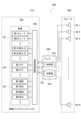
- FIG. 1A is a block diagram showing the configuration of a sound field control system 1000 including a sound field control device 100 and an acoustic system 300 according to an embodiment.
- FIG. 1B is a flowchart showing an example of a sound field control method using the sound field control device 100.
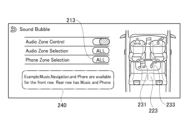
- FIG. 2 shows a display layout of the touch panel 400 according to the first embodiment (part 1).
- FIG. 3 shows another example of the layout diagram 220 showing the seating arrangement of FIG.
- FIG. 4 shows a display layout of the touch panel 400 according to the first embodiment (part 2).
- FIG. 5 shows a display layout of the touch panel 400 according to the first embodiment (part 3).
- FIG. 6 shows a display layout of the touch panel 400 according to the first embodiment (part 4).
- FIG. 2 shows a display layout of the touch panel 400 according to the first embodiment (part 1).
- FIG. 3 shows another example of the layout diagram 220 showing the seating arrangement of FIG.
- FIG. 4 shows a display layout of the touch panel 400 according to the first embodiment
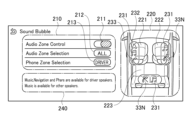
- FIG. 7 shows a display layout of a touch panel 400 according to the second embodiment (part 1).
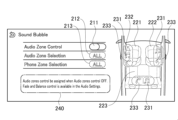
- FIG. 8 shows a display layout of the touch panel 400 according to the second embodiment (part 2).
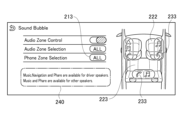
- FIG. 9 shows a display layout of the touch panel 400 according to the second embodiment (part 3).
- FIG. 10 shows a display layout of a touch panel 400 according to the second embodiment (part 4).
- FIG. 11 shows a display layout of the touch panel 400 according to the second embodiment (part 5).
- FIG. 12 is a block diagram showing the configuration of an audio system 300 according to the third embodiment.
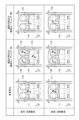
- FIG. 13A is a schematic diagram showing an image of a sound field formed in the vehicle cabin by the acoustic system 300 for each sound field setting (part 1).
- FIG. 13A is a schematic diagram showing an image of a sound field formed in the vehicle cabin by the acoustic system 300 for each sound field setting (part 1).
- FIG. 13A is a schematic diagram showing an image of a sound field formed in the vehicle cabin by the
- FIG. 13B is a schematic diagram showing an image of a sound field formed in the vehicle cabin by the acoustic system 300 for each sound field setting (part 2).
- Figure 14 is a schematic diagram showing specific examples of multiple sound sources (Sound Source) 330 in Figure 12, groups (Streams) 331, 332, 333 to which each sound source 330 belongs, and categories (Categories) to which each sound source 330 belongs.
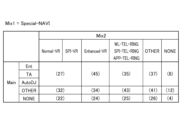
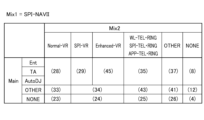
- Figure 15A is part of a table (part 1) that classifies combinations of sound source types belonging to the three groups (Main, Mix1, Mix2) in Figure 14 by identification numbers (1) to (45).
- Figure 15B is part of a table (part 2) that classifies combinations of sound source types belonging to the three groups (Main, Mix1, Mix2) in Figure 14 by identification numbers (1) to (45).
- Figure 15C is part of a table (part 3) that classifies combinations of sound source types belonging to the three groups (Main, Mix1, Mix2) in Figure 14 by identification numbers (1) to (45).
- Figure 15D is part of a table (part 4) that classifies combinations of sound source types belonging to the three groups (Main, Mix1, Mix2) in Figure 14 by identification numbers (1) to (45).
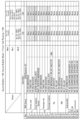
- FIG. 16 is a part of a correspondence table (part 1) showing the correspondence between combinations of sound source types classified by identification numbers (1) to (45) in FIGS. 15A to 15D, the speakers they drive, and the groups of sound sources that drive each speaker.
- FIG. 17 is a part (part 2) of a correspondence table showing the correspondence between combinations of types of sound sources classified by the identification numbers (1) to (45) in FIGS.
- FIG. 18 is a part of a correspondence table (part 3) showing the correspondence between combinations of types of sound sources classified by the identification numbers (1) to (45) in FIGS. 15A to 15D, the speakers they drive, and the groups of sound sources that drive each speaker.
- FIG. 19 is a part of a correspondence table (part 4) showing the correspondence between combinations of types of sound sources classified by the identification numbers (1) to (45) in FIGS. 15A to 15D, the speakers they drive, and the groups of sound sources that drive each speaker.
- the sound field control system 1000 is a system that forms one or more sound fields in the vehicle interior space and controls the sound field.
- a sound field (sound bubble) refers to an area in the vehicle interior where sound is heard.
- the sound includes sounds reproduced from multiple sound sources.
- the sound field control system 1000 includes an acoustic system 300 that forms a sound field by reproducing sound using multiple speakers, and a sound field control device 100 that controls the sound field of the multiple sound sources according to an operation by a vehicle occupant.
- the sound field control system 1000 forms various sound fields in the vehicle interior space according to the type of sound source and the setting of the sound field.
- the sound field control device 100 includes a touch panel 400 and a control unit 200.
- the touch panel 400 is an example of a display that is arranged in the vehicle cabin and displays information indicating the state of the sound field.
- the touch panel 400 has a function as a display and a function as an input device that accepts touch operations by vehicle occupants.
- the control unit 200 can be realized using a microcomputer equipped with a CPU (central processing unit), memory, and input/output units.
- a computer program (sound field control program) for causing the microcomputer to function as the control unit 200 is installed and executed in the microcomputer.
- the microcomputer functions as multiple information processing units included in the control unit 200.
- control unit 200 may be configured by preparing dedicated hardware for executing each information process.
- multiple information processing units included in the control unit 200 may be configured by individual hardware.
- control unit 200 may be configured by the same hardware as the sound source control device 340 (see FIG. 12) included in the acoustic system 300.
- the control unit 200 may also be used as an electronic control unit (ECU) used for other vehicle-related controls.
- ECU electronice control unit
- the sound field control method is a procedure in which the control unit 200 operates according to a sound field control program.
- the control unit 200 displays information indicating the current state of the sound field on the touch panel 400.
- the control unit 200 accepts an operation of the sound field by a vehicle occupant. Specifically, the control unit 200 accepts a touch operation by the occupant on the sound field setting screen displayed on the touch panel 400.
- the control unit 200 proceeds to step S03, where the control unit 200 controls the sound field according to the accepted operation. Specifically, the control unit 200 transmits a signal indicating the sound field setting after the operation to the sound system 300.
- the sound system 300 that has received the signal determines the speaker to be driven and the sound source that drives each speaker based on the sound field setting after the operation, and drives the speaker.
- the control unit 200 displays information indicating the state of the sound field after the control on the touch panel 400.
- the sound field control system 1000 forms various sound fields in the vehicle interior space according to the sound field settings after operation. By displaying information indicating the current state of the sound field on the touch panel 400, it is possible to visually grasp which sound source is being reproduced at which listening position in the vehicle interior. This allows the occupant to accurately operate the sound field (step S02). Also, in step S04, information indicating the state of the sound field after control is displayed on the touch panel 400. This allows the occupant to confirm the accurate operation of the sound field (step S02). In this way, the sound field control device 100 and the acoustic control method allow the occupant to accurately and efficiently operate the sound field by visually grasping the state of the sound field.
- the detailed configuration and operation of the sound system 300 are not particularly important, and an existing sound system 300 capable of realizing a sound field in the vehicle cabin after operation can be used.
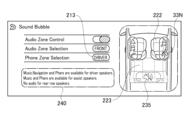
- FIGS. 2 to 6 are specific examples of "information indicating the state of the sound field" displayed on the screen of the touch panel 400 arranged in the vehicle cabin in each of steps S01 and S04 in FIG. 1B.
- the information indicating the state of the sound field includes information indicating the correspondence between the seats in the vehicle cabin and the groups to which the sound sources heard at the seats belong. The multiple sound sources are classified into groups whose number is smaller than the number of sound sources.
- a passenger looking at the touch panel 400 can visually grasp which group of sound sources is being reproduced at which listening position or which seat in the vehicle cabin.
- the information indicating the sound field includes a layout diagram 220 showing the arrangement of seats in the vehicle cabin, and sound source icons 231, 232, 233 superimposed on seats 221, 222, 223 in the layout diagram 220, which indicate groups of sound sources heard at seats 221, 222, 223.
- the layout diagram 220 is displayed from a perspective looking down on the entire vehicle cabin from above.
- the layout diagram 220 and the sound source icons 231, 232, 233 allow the occupants to intuitively understand the groups of sound sources heard at each of the seats 221, 222, 223. In other words, it becomes possible to intuitively grasp the groups of sound fields formed at each of the seats 221, 222, 223.
- the front seats include a driver's seat 221 (left seat) and a passenger seat (right seat).
- a music icon 231 indicating "music”, which is one of the sound source groups, a telephone icon 233 indicating "telephone”, which is one of the groups, and a navigation icon 232 indicating "navigation” (hereinafter sometimes abbreviated as “navigation”), which is one of the groups, are displayed in a superimposed manner in the front seats 221, 222.
- the occupant can understand that in the front seats 221, 222, sounds reproduced from sound sources belonging to the music, telephone, and navigation groups are heard. In other words, the occupant can understand that a sound field of sound sources belonging to the music, telephone, and navigation groups is formed in the front seats 221, 222.
- a music icon 231 is displayed superimposed on the rear seat 223.
- the passenger can understand that in the rear seat 223, sound is being played from a sound source belonging to the music group.
- the passenger can understand that a sound field of a sound source belonging to music is being formed in the rear seat 223.
- the screen of the touch panel 400 may display "information indicating the state of the sound field" and an input reception unit 210 that receives touch operations on the touch panel 400 by the occupant.
- the input reception unit 210 includes, for example, a start switch 211, a sound field selection switch 212, and a telephone selection switch 213.
- the occupant can operate the sound field by touching the switches 211, 212, and 213.
- the occupant can also grasp the state of the sound field before and after the operation from the state of the switches 211, 212, and 213. Therefore, the occupant can visually grasp the state of the sound field by the input reception unit 210 and can accurately operate the sound field.
- the start switch 211 is a switch that controls the start or stop of the sound field control device 100, corresponding to "Audio Zone Control" in Figures 2, 4 to 6. Each time the occupant performs a touch operation, the sound field control device 100 is switched between start and stop. As shown in Figure 2, the start switch 211 located to the right of a specified frame corresponds to the start state, and as shown in Figure 4, the start switch 211 located to the left of a specified frame corresponds to the stop state.
- the sound field control device 100 and the sound field control method display information (start switch 211) indicating the start or stop of the sound field control device 100 on the touch panel 400, accept an operation to switch between start and stop of the sound field control device 100, switch between start and stop of the sound field control device 100 in accordance with the operation, and display information (start switch 211) indicating the start or stop of the sound field control device 100 after the switch on the touch panel 400.
- start switch 211 indicating the start or stop of the sound field control device 100 after the switch on the touch panel 400.
- the passenger can visually grasp the operating state of the sound field control device 100 and can operate the sound field control device 100 accurately.
- the sound field control device 100 accepts the operation of the sound field by the occupant only when the sound field control device 100 is activated, and controls the sound field in accordance with the operation.
- information indicating the state of the sound field may be displayed in color.
- the switches 211, 212, 213 and the sound source icons 231, 232, 233 may be displayed in color. This allows the occupant to intuitively understand that the sound field can be operated.
- information indicating the state of the sound field may be displayed in gray.
- the switches 211, 212, 213 and the sound source icons 231, 232, 233 may be grayed out.
- the sound field selection switch 212 is an example of a switchable display between a first sound field in which sound is heard in all seats 221, 222, 223 in the vehicle cabin, and a second sound field in which sound is heard in the driver's seat 221 and passenger seat 222 in the vehicle cabin and not heard in the rear seat 223 in the vehicle cabin, which corresponds to "Audio Zone Selection" in Figures 2, 4 to 6.
- Each time an occupant touches the sound field selection switch 212 the first sound field and the second sound field are switched.
- the sound field selection switch 212 displays "ALL"
- the sound field selection switch 212 displays "FRONT".
- the sound field selection switch 212 indicates the sound field state (ALL/FRONT). Therefore, the passenger can visually grasp the current or post-operation state of the sound field from the state of the sound field selection switch 212, and can accurately operate the sound field.
- the display of the sound source icons 231, 232, and 233 in the layout diagram 220 may also be changed in conjunction with the state of the sound field selection switch 212. Specifically, as shown in Figures 2 and 5, in the first sound field state (ALL), the sound source icons 231 and 233 may be displayed superimposed on the rear seat 223.
- a mute icon 235 may be displayed on the rear seat 223 to indicate that no sound is being heard, i.e., that the vehicle is in a muted state where no sound field is formed. This allows the passengers to intuitively understand that the vehicle is in a muted state where no sound field is formed. Instead of the mute icon 235, no sound source icon may be displayed on the rear seat 223. Note that the sound field selection switch 212 can switch between the first sound field and the second sound field for all sound sources in all groups, regardless of the sound source group.
- the telephone selection switch 213 is a switch for switching the sound field of the sound source belonging to the telephone between a first sound field in which sound is heard in all seats 221, 222, 223, and a second sound field in which sound is heard in the driver's seat 221 and the passenger seat 222 in the vehicle cabin and not heard in the rear seat 223 in the vehicle cabin, which corresponds to "Phone Zone Selection" in Figures 2, 4 to 6.
- the telephone selection switch 213 displays "FRONT", and as shown in Figure 5, when the sound field of the sound source belonging to the telephone is the first sound field, the telephone selection switch 213 displays "ALL".
- the telephone selection switch 213 indicates the state of the sound field (ALL/FRONT)
- the occupant can visually check the state of the sound field of the sound source belonging to the telephone from the telephone selection switch 213.
- the display of the sound source icons 231, 232, 233 in the layout diagram 220 may be changed in conjunction with the state of the telephone selection switch 213. Specifically, as shown in Fig. 5, when the first sound field (ALL) is selected by the telephone selection switch 213, the telephone icon 233 may be displayed in a superimposed manner on both the front seat and the rear seat 223.
- Fig. 5 when the first sound field (ALL) is selected by the telephone selection switch 213, the telephone icon 233 may be displayed in a superimposed manner on both the front seat and the rear seat 223.
- the information indicating the state of the sound field may include a sentence 240 that explains the correspondence between the seats 221, 222, 223 in the vehicle cabin and the group to which the sound source heard at the seats 221, 222, 223 belongs.
- the content of the sentence 240 changes depending on the state of the sound field. For example, in the state of the sound field shown in Fig. 2, a sentence 240 saying "The sound of the sound sources belonging to music, navigation, and telephone can be heard in the front seats. In the rear seats, only music is available.” may be displayed on the screen of the touch panel 400. In Fig. 4, a sentence 240 saying "The sound field control device is stopped.
- a sentence 240 may be displayed stating, "Audio from the sound sources belonging to music, navigation, and telephone can be heard in the front seats. Audio from any sound source cannot be heard in the rear seats.” From the contents of sentence 240, the passenger can visually grasp the current or post-operation state of the sound field and accurately operate the sound field.
- an animation 234 of ripples spreading may be displayed around the sound source icon that is playing sound.
- an animation 234 showing the outer edge of the space in which the sound spreads may be displayed around the sound source icons 231, 232, and 233 that are actually playing sound from the speakers.
- the passenger can intuitively recognize the group of sound sources that are being played.
- the animation 234 may be displayed on each of the three icons 231, 232, and 333 displayed on the front seats 221 and 222 in FIG. 2.
- the three icons 231, 232, and 333 may be regarded as one icon, and the animation 234 may be displayed around it.
- the animation 234 may be controlled so that it is played when the vehicle is stopped and not displayed while the vehicle is moving. This allows the driver to maintain his or her attention while driving.
- the sound field of the sound source belonging to the navigation is not subject to operation or control. However, it may be subject to operation and control in the same way as the sound fields of sound sources belonging to other groups such as music and telephone.
- Second Embodiment In the second embodiment, an example will be described in which the sound field in the vehicle cabin is switched between a first sound field in which sound is heard in all seats in the vehicle cabin, and a third sound field in which sound is heard in the driver's seat and not heard in the seats other than the driver's seat, i.e., the passenger seat and the rear seats.
- the configuration of the sound field control device 100 and the procedure of the sound field control method shown in Figures 1A and 1B are the same as those in the first embodiment, so repeated explanations will be omitted.
- the display layout of the touch panel 400 according to the second embodiment and a specific sound field operation method will be described with reference to Figs. 7 to 11.
- information indicating the state of the sound field is displayed on the screen of the touch panel 400.
- a layout diagram 220 with a sound source icon superimposed thereon, an input receiving section 210, and text 240 are displayed on the screen of the touch panel 400.
- the input receiving section 210 includes a start switch 211, a sound field selection switch 212, and a telephone selection switch 213.
- the operation of the start switch 211 and the sound field selection switch 212, and the text 240 are the same as in the first embodiment, so repeated explanations will be omitted.
- the seats in the vehicle cabin are divided into three sections: the driver's seat 221 (left seat), the passenger seat 222 (right seat), and the rear seat 223, and the sound field is operated and controlled.
- Various sound source icons are displayed superimposed on each of the driver's seat 221, the passenger seat 222, and the rear seat 223 in the layout diagram 220.
- each of the driver's seat 221, the passenger seat 222, and the rear seat 223 is colored a different color, and the sound source icons are also colored similarly to the color of the seats. It can be intuitively understood that different sound fields are formed in the three seats.
- the telephone selection switch 213 is a switch that corresponds to "Phone Zone Selection" in Figures 7 to 11.
- the telephone selection switch 213 is a switch for switching the sound field of the sound source belonging to the telephone between the first sound field and the third sound field.
- the first sound field state the sound of the sound source belonging to the telephone is heard in all seats 221, 222, and 223.
- the third sound field state the sound of the sound source belonging to the telephone is heard in the driver's seat 221 in the vehicle cabin, but is not heard in the passenger seat 222 and the rear seat 223 in the vehicle cabin.
- the telephone selection switch 213 displays "DRIVER", and as shown in Figures 9 and 10, when the sound field of the sound source belonging to the telephone is the first sound field, the telephone selection switch 213 displays "ALL".
- the telephone selection switch 213 indicates the state of the sound field (ALL/DRIVER), the occupant can visually grasp the state of the sound field of the sound source belonging to the telephone from the telephone selection switch 213 and accurately operate the sound field of the sound source belonging to the telephone.
- the display of the telephone icon 233 in the layout diagram 220 may also be changed in conjunction with the state of the telephone selection switch 213. Specifically, as shown in FIG. 9, when the first sound field (ALL) is selected by the telephone selection switch 213, the telephone icon 233 may be displayed superimposed on each of the driver's seat 221, the passenger seat 222, and the rear seat 223. On the other hand, as shown in FIG. 9, when the first sound field (ALL) is selected by the telephone selection switch 213, the telephone icon 233 may be displayed superimposed on each of the driver's seat 221, the passenger seat 222, and the rear seat 223. On the other hand, as shown in FIG.
- the telephone icon 233 may be displayed superimposed on the driver's seat 221, and a telephone mute icon 33N may be displayed on the passenger seat 222 and the rear seat 223, indicating that the sound of the sound source belonging to the telephone cannot be heard, i.e., that a sound field of the sound source belonging to the telephone is not formed.
- a telephone mute icon 33N it is also possible not to display any of the icons 233 and 33N related to the telephone on the passenger seat 222 and the rear seat 223.
- the telephone selection switch 213 is a switch that switches between the driver's seat and all the seats. 10 and 11, even if the second sound field (FRONT) is selected by the sound field selection switch 212, the telephone selection switch 213 can be operated.
- the sound field selection switch 212 has priority over the telephone selection switch 213, even if the second sound field (FRONT) is selected by the sound field selection switch 212 and the first sound field (ALL) is selected by the telephone selection switch 213, as shown in FIG. 10, the sound field of the sound source belonging to the telephone is formed in the driver's seat 221 and the passenger seat 222, but not in the rear seat 223.
- the start switch 211 when the start switch 211 is in the stop position and the sound field control device 100 is in a stop state, information indicating the state of the sound field may be displayed in gray. Specifically, the switches 211, 212, 213 and the sound source icons 231, 232, 233 may be grayed out. This allows the occupant to intuitively understand that the sound field cannot be operated. Note that the color of only one of the switches 211, 212, 213 and the sound source icons 231, 232, 233, or only a part of the switches 211, 212, 213 and a part of the sound source icons 231, 232, 233 may be changed.
- the sound field of the sound source belonging to the navigation is not subject to operation.
- the voice of the sound source belonging to the navigation is output to the driver, like a guide voice related to route guidance. Therefore, as shown in Figures 7 to 11, the navigation icon 232 is superimposed on the driver's seat 221, and the navigation icon 232 is not superimposed on the passenger seat 222 and the rear seat 223. However, it may be subject to operation and control in the same way as the sound fields of sound sources belonging to other groups such as music and telephone.
- the groups to which sound sources belong include music, navigation, and telephone, there may be sound sources that belong to other groups.
- a sound source icon is displayed indicating the group of sound sources that form a sound field for each seat. This is not limiting, and instead of displaying a sound source icon, a color, pattern, or animation such as ripples that identifies the sound source group may be applied to the seat. Or, letters that identify the sound source group, such as "music", “MUSIC”, “navigation”, “NAVI”, “telephone”, or “PHONE”, may be superimposed on the seat.
- a switch may be displayed on the touch panel 200 that allows the selection of a fourth sound field in which sounds reproduced from all sound sources are heard at the driver's seat 221 in the vehicle cabin and are not heard at the other seats 222, 223 in the vehicle cabin other than the driver's seat 221.
- An operation by the occupant to select the fourth sound field can be accepted. This allows the occupant to change the sound field in the vehicle cabin to the fourth sound field.
- the sound field control device 100 may collect the speech of a passenger seated in a seat where the sound reproduced from the sound source belonging to the telephone cannot be heard, and may switch the sound field so that the voice can be heard in the seat where the voice cannot be heard based on the result of voice recognition of the content of the speech. Furthermore, the sound field control device 100 may display information indicating the state of the sound field after switching on the touch panel 200. For example, a microphone that collects the speech of a passenger seated in the passenger seat 222 or the rear seat 223 is attached in the vehicle interior. The control unit 200 recognizes the speech of the passenger collected by the microphone using existing voice recognition technology.
- the control unit 200 switches the sound field so that the voice can be heard in the seat where the voice cannot be heard without waiting for the touch operation of the passenger.
- the sound field control device 100 can control the sound field according to the passenger's intention to participate in the phone call. Additionally, passengers can visually grasp the state of the sound field after control has been applied.
- the touch panel 400 is taken as an example of a display, and the touch operation on the touch panel 400 is taken as an example of the operation of the sound field by the vehicle occupant.
- the display that displays information indicating the state of the sound field may be a display that does not have a function as a position input device such as a touchpad.
- the occupant instead of touching the touch panel 400, the occupant can operate the sound field by their own voice using known voice recognition technology, or by using other input devices attached to the vehicle, such as a steering switch or a switch on the instrument panel.
- the sound field control device 100 may accept the operation of the sound field by the occupant's voice or other input devices.
- the acoustic system 300 forms a sound field in the vehicle cabin by reproducing sounds using multiple speakers based on the sound field setting specified by the operation of the occupant received by the sound field control device 100.
- the acoustic system 300 includes a sound source control device 340 and an amplifier 350.
- the sound source control device 340 outputs a plurality of sound source group signals.
- the amplifier 350 has audio inputs 351 at least as many as the sound source group signals, and drives a plurality of speakers 360 mounted on the vehicle using the sound source group signals input to each of the audio inputs 351.
- the sound source control device 340 classifies the sound sources 330, which are greater in number than the sound source group signals, into a plurality of groups 331 to 333, the same number as the sound source group signals, and outputs the sound source signals output from the plurality of sound sources 330 belonging to each group 331 to 333 as sound source group signals for each group 331 to 333.
- the amplifier 350 determines the speaker 360 to be driven and the sound source group signal to drive each speaker 360 based on the type of each sound source group signal and the sound field setting in the vehicle cabin.
- Each of the multiple speakers 360 converts the sound source group signal received from the amplifier 350 into sound and outputs it.
- the "sound field" is an area in the vehicle cabin where the sound reproduced from the multiple speakers 360 is heard.
- the sound field is formed in the entirety or part of the vehicle cabin.
- two or more sound fields with different sound sources can be formed simultaneously.
- a smaller number of sound source group signals than the sound sources 330 are input to the audio inputs 351 of the amplifier 350.
- the amplifier 350 determines which speakers 36-1 to 36-N to drive and which sound source group signals to drive each speaker 36-1 to 36-N based on the type of each sound source group signal and the sound field settings.
- the number of audio inputs to the amplifier 350 is smaller than the number of sound sources 330, simplifying the control of the multiple speakers 360 by the amplifier 350.
- N indicates the number of speakers and is a natural number equal to or greater than 2.
- the number of each component is exemplified as follows:
- the number of sound source group signals output by the sound source control device 340 is three.
- the sound source control device 340 classifies the sound sources 330 into three groups 331 to 333, the same number as the sound source group signals.
- the amplifier 350 has three audio inputs 351, the same number as the number of sound source group signals.
- ⁇ Signal and audio input counting> The counting of the number of sound source group signals and audio inputs 351 will be described.
- the sound source 330 is a monaural sound source
- the reproduced sound is monaural
- the waveform of the signal generated from one sound source 330 is one type.
- a stereo sound source including 2-channel stereo, binaural, surround, 4-channel stereo, 5.1-channel stereo, etc.
- the waveform of the signal generated from one sound source 330 is two or more types.
- the number of sound source group signals is counted based on the difference in the sound source from which the sound source group signals are generated, without taking into account the difference in the waveform.
- the number of audio inputs 351 to which the sound source group signals are input is also counted based on the difference in the sound source that generated the input signal, without taking into account the difference in the waveform of the input signal. For example, if signals having different waveforms but generated by the same sound source are input to two or more independent terminals of amplifier 350, the two or more terminals for audio input are counted as a single audio input 351.
- the amplifier 350 may include a control unit 352.
- the control unit 352 may constitute an information processing unit that determines the speaker 360 to be driven and the sound source group signal to drive each of the speakers 36-1 to 36-N based on the type of each sound source group signal and the setting of the sound field.
- the control unit 352 can be realized using a microcomputer that includes a CPU (Central Processing Unit), a memory, and an input/output unit.
- a computer program sounder control program for causing the microcomputer to function as the control unit 352 is installed in the microcomputer and executed. In this way, the microcomputer functions as the control unit 352.
- control unit 352 is realized by software, but it is of course possible to configure the control unit 352 by preparing dedicated hardware for executing information processing.
- control unit 200 may also be used as an electronic control unit (ECU) used for other control related to the vehicle.
- ECU electronice control unit
- the sound source control device 340 transmits to the amplifier 350 a signal indicating the type of each sound source group signal and a signal indicating the sound field setting.
- the amplifier 350 for example the control unit 352 of the amplifier 350, determines the speaker to be driven and the sound source group signal to drive each speaker based on the signal indicating the type of each sound source group signal and the signal indicating the sound field setting received from the sound source control device 340. Since the amplifier 350 can determine the speaker 360 to be driven and the sound source group signal to drive each speaker 36-1 to 36-N based on the signal received from the sound source control device, the control of the speaker 360 by the amplifier 350 is simplified.
- the sound source control device 340 may transfer to the amplifier 350 a signal indicating the sound field setting received from the control unit 200 of the sound field control device 100 of FIG. 1A. Specifically, in step S03 of FIG. 1B, the sound source control device 340 may receive a signal indicating the sound field settings after the operation from the control unit 200 and transfer the signal to the amplifier 350.
- the sound source control device 340 can be realized using a microcomputer equipped with a CPU (central processing unit), memory, and input/output units, or dedicated hardware for executing each information processing.
- the sound source control device 340 may also be used as an electronic control unit (ECU) used for other control related to the vehicle.
- ECU electronice control unit
- the multiple sound sources 330 are classified into three groups 331 to 333.
- Group 331 is a music group.
- the sound sources belonging to the music group 331 include a first tuner, a second tuner, ..., a first external input, a second external input, ....
- Examples of the first tuner, the second tuner, ... include various radio tuners including an AM tuner, an FM tuner, and an XM tuner, and a television tuner. Examples of the first external input, the second external input, ...
- a portable music player, a smartphone, and a mobile phone are connected to the sound source control device 340 mounted in the vehicle by a specified connection cable, or are connected wirelessly via short-range wireless communication or a wireless LAN (local area network).
- a wireless LAN local area network
- Group 332 is a navigation (NAVI) group.
- Sound sources belonging to the navigation group 332 include the first navigation, the second navigation, etc.
- Examples of the first navigation, the second navigation, etc. include voice guidance from a navigation device equipped in the vehicle, and voice guidance from a navigation application installed in the occupant's mobile communication terminal such as a smartphone.
- the occupant's mobile communication terminal is connected to the sound source control device 340 mounted in the vehicle by a specified connection cable, or is connected wirelessly via short-range wireless communication or a wireless LAN (local area network).
- Group 333 is a group of telephones. Sound sources belonging to telephone group 333 include a first call, a first ring, a second call, a second ring, etc. Examples of a first call, a first ring, a second call, a second ring, etc. include a call using a telephone system equipped in a vehicle, a ring tone in the telephone system, a call using a call application installed on a mobile communication terminal of a passenger, and a ring tone in the call application.
- a sound source signal may be output from each of the sound sources 330 described above.
- the sound source control device 340 receives these sound source signals and outputs the sound source signals output from the multiple sound sources 330 belonging to each group 331 to 333 as a sound source group signal.
- the sound source control device 340 may respond as follows.
- the sound source control device 340 may output a representative sound source signal output from the sound source 330 with the highest priority among the sound source signals simultaneously output from the multiple sound sources 330 belonging to the same group 331 to 333 as an audio group signal. This allows the number of audio inputs to the amplifier 350 to be reduced. Mixing of sounds simultaneously played from multiple sound sources is suppressed.
- the priority relationship between the multiple sound sources 330 belonging to the same group 331 to 333 is predetermined, and the sound source control device 340 may store data indicating the priority relationship for each group 331 to 333.
- the multiple sound sources 330 and sound source control device 340 may be collectively referred to as in-vehicle infotainment 310.
- In-vehicle infotainment 310 is an information and communication system that provides both information and entertainment.
- the sound sources 330 and sound source control device 340 mounted on the vehicle including tuners and a telephone system, excluding external input from a smartphone or the like, may be housed in a single housing.
- the sound field selection switch 212 is set to "ALL" and the telephone selection switch 213 is set to "DRIVER".
- "ALL" on the sound field selection switch 212 in FIG. 7 corresponds to the sound field selection in FIG. 13A and FIG. 13B being set to all seats. For this reason, for example, when playing a sound source belonging to music group 331, a music sound field 110 is formed in all seats in the vehicle cabin, i.e., the area including the driver's seat, passenger seat, and rear seats. In sound field 110, the sound of the sound source belonging to music group 331 is heard.
- a new telephone sound field 130 is formed in the area including the driver's seat (left seat) in the vehicle cabin.
- the playback of the sound source belonging to the music group 331 continues, so music sound fields 112 and 113 are simultaneously formed in the area including the passenger seat and the rear seat excluding the driver's seat.
- the telephone selection switch 213 is set to "DRIVER", that is, when it is set to "Call routing: Yes”
- the acoustic system 300 forms the sound field 130 of the telephone sound source in a limited part of the vehicle cabin, in this case the area including the driver's seat.
- the music sound fields 112 and 113 are formed in other areas in the vehicle cabin. In each sound field 130, 112, and 113, the sounds of the music and telephone sound sources are heard without being mixed with each other.
- the sound field selection switch 212 is "ALL" and the telephone selection switch 213 is "ALL".
- "ALL" of the telephone selection switch 213 corresponds to "Call routing: None" in FIG. 13A.
- the telephone sound source is prioritized over the music sound source. Specifically, a sound field 131 of the telephone sound source is formed in an area including all the seats in the vehicle cabin, and a sound field of the music sound source is not formed. In this way, when the music sound field 110 is formed and playback of a sound source belonging to the telephone group 333 begins, the entire vehicle cabin switches from the music sound field 110 to the telephone sound field 131.
- a new navigation sound field 120 is formed in the area including the driver's seat (left seat) in the vehicle cabin, as shown in FIG. 13B.
- music sound fields 112 and 113 are simultaneously formed in the area including the passenger seat and rear seats excluding the driver's seat.
- the sound field 120 of the sound source belonging to the navigation group 332 is formed in the area including the driver's seat, and is not formed in the area including the passenger seat and rear seats excluding the driver's seat.
- the acoustic system 300 simultaneously forms sound fields 120, 112, and 113 of the music and navigation sound sources from different groups. In each sound field 120, 112, and 113, the sounds of the music and navigation sound sources are heard without being mixed with each other.
- the navigation sound field 120 and the telephone sound field 130 are formed in the same area including the driver's seat.
- a sound source belonging to the navigation group 332 and a sound source belonging to the telephone group 333 compete with each other, that is, when the navigation and telephone sound fields are formed simultaneously, one may be prioritized over the other.
- an image of the navigation and telephone sound fields 120, 133 formed when the telephone is prioritized over the navigation is shown in the upper right of FIG. 13B.
- the telephone sound field 133 may be formed in an area close to the passenger's ears, and at the same time, the navigation sound field 120 may be formed in an area surrounding the sound field 133. This allows the navigation and telephone sound fields to be formed without being mixed, and the passenger can hear the sounds of the telephone and navigation sound sources in each sound field 133, 120 without them mixing with each other.
- a music sound field 111 is formed in the front seats of the vehicle interior, i.e., in the area including the driver's seat and passenger seat, but no sound field is formed in the area including the rear seats. In the sound field 111, the sound of the sound source belonging to the music group 331 is heard.
- ⁇ Audio source group (Stream) and audio source type (Category)> 14 a specific example of groups (Stream) 331, 332, 333 to which each sound source 330 belongs and a category (Category) to which each sound source 330 belongs will be described. All sound sources 330 are classified into one of group (Main) 331, group (Mix1) 332, and group (Mix2) 333.
- Group (Main) 331 is a music group
- group (Mix1) 332 is a navigation group
- group (Mix2) 333 is a telephone group.
- All sound sources are classified into multiple categories.
- the sound source categories are set for each group 331, 332, and 333.
- sound sources 330 belonging to music group 331 are classified into any of entertainment, TA (traffic announcement), Auto DJ, e-Call (emergency call), and OTHER.
- Sound sources 330 belonging to navigation group 332 are classified into Normal-NAVI, Special-NAVI, and SPI-NAVI.
- the sound sources 330 belonging to the telephone group 333 are classified as Wireless-TEL (wireless call), Wireless-TEL RING (wireless telephone call), SPI-TEL (special call), SPI-TEL RING (special telephone call), APP-TEL (smartphone call), APP-TEL RING (smartphone telephone call), Normal-VR (Voice recognition), SPI-VR, Enhanced-VR, or other (OTHER).
- the sound sources 330, their groups, and their types shown in FIG. 14 are examples and do not limit the invention.
- 15A to 15D are tables in which combinations of types of sound sources belonging to the three groups (Main, Mix1, Mix2) in FIG. 14 are classified by identification numbers (1) to (45).
- Each of FIG. 15A to 15D shows a combination of each type of music group (Main) 331 and each type of telephone group (Mix2) 333.
- Each of FIG. 15A to 15D shows types (None, Normal-NAVI, Special-NAVI, SPI-NAVI) of navigation group (Main) 332.
- FIG. 15A to 15D one three-dimensional table showing all combinations of types belonging to the three groups (Main, Mix1, Mix2) is formed. For example, the identification number (28) shown in FIG.
- 15B indicates a combination of a type of Entertainment, TA (Traffic announcement), or Auto DJ for the group (Main), a type of Normal-NAVI for the group (Mix1), and a type of Normal-VR or SPI-VR for the group (Mix2).
- the type "None” or “NONE” indicates that no sound source group signal is output from the group.
- the entirety of FIG. 15A shows the case (None) where no sound source signal is output from any of the sound sources belonging to the group (Mix1). Therefore, the combination of the type (NONE) of the group (Mix2) and the type (NONE) of the group (Main) in FIG. 15A indicates a combination where no sound source group signal is output from any of the groups (Main, Mix1, Mix2), and no speaker is driven, so no identification number is assigned.
- the control unit 352 of the amplifier 350 can refer to the combination tables shown in Figs. 15A to 15D to identify the identification numbers corresponding to the combinations of the types of sound source group signals of the groups 331, 332, and 333 received from the sound source control device 340.
- the combination tables shown in Figs. 15A to 15D can be stored in the memory unit 353 provided in the amplifier 350, as shown in Fig. 12.
- 16 to 19 are parts of a correspondence table showing the correspondence between combinations of the types of sound sources classified by the identification numbers (1) to (45) in FIG. 15A to FIG. 15D, the speakers to be driven, and the groups of sound sources that drive each speaker.
- the correspondence tables shown in FIG. 16 to FIG. 19 can be stored in the memory unit 353 provided in the amplifier 350.
- the sound field settings are different in FIG. 16 to FIG. 19.
- FIG. 17 is different from FIG.
- the identification numbers (1), (8), (16), and (35) are selected from the identification numbers (1) to (45) and are displayed, which correspond to the 10 sound field states shown in Figures 13A and 13B.
- the identification numbers (1), (8), (16), and (35) in Figures 16 to 19 correspond to the identification numbers (1), (8), (16), and (35) shown in Figures 13A, 13B, and 15A to 15D, respectively.
- Each of Figures 16 to 19 illustrates 20 speakers 36-1 to 36-20 mounted in a vehicle.
- the front left seat (FL) is the driver's side
- the front right seat (FR) is the passenger side.
- three speakers 36-1 to 36-3 are attached to either the driver's door, the driver's side of the instrument panel, or the driver's side pillar.
- a headrest speaker 36-4 is attached to the headrest of the driver's seat.
- the front left seat (FL) is provided with four speakers 36-1 to 36-4 that are directed toward the driver seated in the driver's seat.
- a total of four speakers 36-6 to 36-9 are attached to the rear right seat (FR) that are directed toward the passenger seated in the passenger seat.
- Speaker 36-5 is also installed in the center of the instrument panel.
- three speakers 36-10 to 36-12 are attached to the left rear seat (RL) and are directed toward the passenger sitting in the left rear seat.
- Three speakers 36-13 to 36-15 are attached to the right rear seat (RR) and are directed toward the passenger sitting in the right rear seat.
- a subwoofer 36-16 is attached under the seat or in the trunk.
- Four surround speakers 36-17 to 36-20 are attached to the left front seat (FL), right front seat (FR), left rear seat (FL), and right rear seat (FR), respectively.
- Identification number (1) in FIG. 16 indicates a case where a sound source group signal is output from a sound source belonging to any of the types of Entertainment, TA (Traffic announcement), and Auto DJ in the music group 331 (Main), and no sound source group signal is output from any sound source belonging to the navigation group 332 (Mix1) and the telephone group 333 (Mix2).
- Identification number (1) in FIG. 16 corresponds to identification number (1) in FIG. 15A.
- the amplifier 350 drives all speakers 36-1 to 36-20 with the sound source group signal from the music group 331 (Main). Therefore, the music sound field 110 shown in the upper left of FIG. 13A is formed in the vehicle cabin.
- Identification number (8) in Figure 16 indicates a case where a sound source group signal is output from a sound source belonging to any of the following categories in the music group 331 (Main): Entertainment, TA (Traffic announcement), or Auto DJ; a sound source group signal is output from a sound source belonging to any of the following categories in the navigation group 332 (Mix1): Normal-NAVI, Special-NAVI, or SPI-NAVI; and no sound source group signal is output from any sound source belonging to the telephone group 333 (Mix2).
- Identification number (8) in Figure 16 corresponds to identification number (8) in Figures 15B to 15D. As shown in FIG.
- amplifier 350 drives all speakers 36-1 to 36-3, 36-5 to 36-20 except for headrest speaker 36-4 embedded in the driver's seat headrest with sound source group signals belonging to music group 331 (Main), and drives headrest speaker 36-4 with sound source group signals belonging to navigation group 332 (Mix1). Therefore, music sound fields 112, 113 and navigation sound field 120 shown in the upper left of FIG. 13B are simultaneously formed in the vehicle cabin.
- Identification number (16) in Figure 16 indicates a case where a sound source group signal is output from a sound source belonging to any of the following types in the music group 331 (Main): Entertainment, TA (Traffic announcement), or Auto DJ; a sound source group signal is output from a sound source belonging to any of the following types in the telephone group 333 (Mix2): WL-TEL, WL-TEL RING, SPI-TEL, SPI-TEL RING, APP-TEL, or APP-TEL RING; and no sound source group signal is output from any sound source belonging to the navigation group 332 (Mix1).
- Identification number (16) in Figure 16 corresponds to identification number (16) in Figure 15A.
- the amplifier 350 drives all speakers 36-1 to 36-4, 36-6 to 36-20, except for the speaker 36-5 located in the center of the instrument panel, with the sound source group signal belonging to the telephone group 333 (Mix2), and does not drive the speaker 36-5. Therefore, the telephone sound field 131 shown in the upper right of Figure 13A is formed inside the vehicle cabin.
- amplifier 350 drives all speakers 36-1 to 36-4, 36-6 to 36-20 except for speaker 36-5 located in the center of the instrument panel, and does not drive speaker 36-5.
- Amplifier 350 drives headrest speaker 36-4 with a sound source group signal belonging to telephone group 333 (Mix2), and drives speakers 36-1 to 36-3, 36-6 to 36-20 with a sound source group signal belonging to music group 331 (Main). Therefore, the telephone sound field 130 and music sound fields 112 and 113 shown in the upper center of Figure 13A are simultaneously formed inside the vehicle cabin.
- Identification number (35) in Figure 17 indicates a case where a sound source group signal is output from a sound source belonging to any one of the types Entertainment, TA (Traffic announcement), or Auto DJ in music group 331 (Main), a sound source group signal is output from a sound source belonging to any one of the types Normal-NAVI, Special-NAVI, or SPI-NAVI in navigation group 332 (Mix1), and a sound source group signal is output from a sound source belonging to any one of the types WL-TEL, WL-TEL RING, SPI-TEL, SPI-TEL RING, APP-TEL, or APP-TEL RING in telephone group 333 (Mix2).
- amplifier 350 drives all speakers 36-1 to 36-4, 36-6 to 36-20 except for speaker 36-5 located in the center of the instrument panel, and does not drive speaker 36-5.
- the amplifier 350 drives the headrest speaker 36-4 with a sound source group signal belonging to the telephone group 333 (Mix2), drives the speakers 36-1 to 36-3 with a sound source group signal belonging to the navigation group 332 (Mix1), and drives the speakers 36-6 to 36-20 with a sound source group signal belonging to the music group 331 (Main). Therefore, in the vehicle cabin, the telephone sound field 133 shown in the upper right of FIG. 13B, the navigation sound field 120 surrounding the sound field 133, and the music sound fields 112 and 113 are simultaneously formed.
- the identification numbers (1), (8), (16) and (35) in Figures 18 and 19 are the same combinations of sound source types as the identification numbers (1), (8), (16) and (35) in Figures 16 and 17, respectively.
- sound fields 111, 112, 120, 130, 132, and 133 are formed in the vehicle interior when the sound field selection is for the front seats, as shown in the lower part of Figures 13A and 13B.
- the amplifier 350 may have a correspondence table between combinations of types of each sound source group signal, the speaker 360 to be driven, and the sound source group signals that drive each of the speakers 36-1 to 36-20.
- the amplifier 350 can refer to the correspondence table to determine the speakers 36-1 to 36-20 to be driven and the sound source group signals that drive each of the speakers 36-1 to 36-20. This simplifies the control of the speaker 360 by the amplifier 350.
- the third embodiment provides the following advantageous effects.
- the sound field 130 of the sound source belonging to the telephone group 333 (Mix2) when "Call Routing: Yes" shown in FIG. 13A and the sound field 120 of the sound source belonging to the navigation group 332 (Mix1) shown in FIG. 13B are limited to only the driver's seat, which is one of the seats in the vehicle cabin.
- the amplifier 350 assigns the first sound source group signal output from the sound source belonging to the first group to the speaker facing the occupant in the driver's seat, and assigns the second sound source group signal output from the sound source belonging to the second group (e.g., music) to the second speaker facing the occupants in the other seats (the passenger seat and the rear seat).
- the amplifier 350 uses the first and second sound source group signals to drive the first and second speakers simultaneously.
- the sound field of the sound reproduced from the sound source belonging to the first group and the sound field of the sound reproduced from the sound source belonging to the second group can be formed simultaneously while being separated from each other.
- sound fields in which two different sounds are heard can be formed simultaneously. Each sound can be clearly heard in each sound field without the two sounds being mixed.
- the amplifier 350 assigns the first sound source group signal with a high priority to the headrest speaker 36-4 that is close to the passenger's ear, and assigns the first sound source group signal with a low priority to the speakers 36-1 to 36-3 that are far from the passenger's ear, as shown by the identification number (35) in FIG. 17.
- the speaker to be assigned is allocated according to the distance from the passenger's ear.
- the speakers with different distances to the passenger's ear are assigned according to the priority of the first and second sound source group signals.
- the sound fields 133 and 120 of the first and second sound source group signals can be formed in an area including the driver's seat, as shown in FIG. 13B.
- the passenger can hear the audio from the first and second sound source group signals according to the priority order.
- the amplifier 350 assigns a high priority sound source group signal (telephone) to the speaker 36-4 that is close to the passenger's ear, and assigns a low priority sound source group signal to the speakers 36-1 to 36-3 that are far from the passenger's ear.
- a high priority sound source group signal telephone
- a low priority sound source group signal to the speakers 36-1 to 36-3 that are far from the passenger's ear.
- the multiple speakers directed at the passenger seated in a specific seat in the vehicle cabin include headrest speakers 36-4, 36-9 attached to the headrest of the specific seat, and specific seat speakers 36-1 to 36-3, 36-6 to 36-8 attached to the door closest to the specific seat, the instrument panel on the specific seat side, or the pillar on the specific seat side.
- the amplifier assigns sound source group signals output from sound sources belonging to the telephone group 331 (Mix2) to the headrest speakers 36-4, 36-9, and assigns sound source group signals output from sound sources belonging to the navigation group 332 (Mix1) to the specific seat speakers.
- the amplifier 350 can appropriately drive the speaker 360 because the sound of the sound source belonging to the telephone, which has a higher priority than the navigation, can be reproduced from the headrest speaker 36-4, which is closer to the passenger's ears.
- the sound source control device 340 may transmit to the amplifier 350 a signal identifying the sound source 330 that outputs each sound source group signal, instead of a signal identifying the type of each sound source group signal.
- the sound source control device 340 can determine the type of sound source 330 from the signal identifying the sound source 330, for example, based on a correspondence table between sound sources 330 and types shown in FIG. 14.
- the amplifier 350 can determine the speaker to drive and the sound source group signal to drive each speaker, based on the signal identifying the sound source and the signal indicating the sound field setting received from the sound source control device 340. This simplifies the control of the speaker 360 by the amplifier 350.
- the amplifier 350 does not drive speakers facing areas in the vehicle cabin where a sound field is not formed.
- the amplifier 350 may drive speakers facing areas in the vehicle cabin where a sound field is not formed using an active noise cancellation signal that is in opposite phase to the sound source group signal that drives the other speakers. This allows the active noise cancellation signal to cancel sounds that leak from areas where a sound field is formed to areas where a sound field is not formed, thereby enabling the outer edges of the sound field to be controlled with precision.
Landscapes
- Health & Medical Sciences (AREA)
- Otolaryngology (AREA)
- Physics & Mathematics (AREA)
- Engineering & Computer Science (AREA)
- Acoustics & Sound (AREA)
- Signal Processing (AREA)
- General Health & Medical Sciences (AREA)
- Fittings On The Vehicle Exterior For Carrying Loads, And Devices For Holding Or Mounting Articles (AREA)
Priority Applications (4)
| Application Number | Priority Date | Filing Date | Title |
|---|---|---|---|
| PCT/JP2023/007141 WO2024180633A1 (ja) | 2023-02-27 | 2023-02-27 | 音響システム |
| CN202380094711.7A CN120752933A (zh) | 2023-02-27 | 2023-02-27 | 音响系统 |
| EP23925190.3A EP4676088A4 (en) | 2023-02-27 | 2023-02-27 | ACOUSTIC SYSTEM |
| JP2025503265A JPWO2024180633A1 (https=) | 2023-02-27 | 2023-02-27 |
Applications Claiming Priority (1)
| Application Number | Priority Date | Filing Date | Title |
|---|---|---|---|
| PCT/JP2023/007141 WO2024180633A1 (ja) | 2023-02-27 | 2023-02-27 | 音響システム |
Publications (1)
| Publication Number | Publication Date |
|---|---|
| WO2024180633A1 true WO2024180633A1 (ja) | 2024-09-06 |
Family
ID=92589365
Family Applications (1)
| Application Number | Title | Priority Date | Filing Date |
|---|---|---|---|
| PCT/JP2023/007141 Ceased WO2024180633A1 (ja) | 2023-02-27 | 2023-02-27 | 音響システム |
Country Status (4)
| Country | Link |
|---|---|
| EP (1) | EP4676088A4 (https=) |
| JP (1) | JPWO2024180633A1 (https=) |
| CN (1) | CN120752933A (https=) |
| WO (1) | WO2024180633A1 (https=) |
Citations (6)
| Publication number | Priority date | Publication date | Assignee | Title |
|---|---|---|---|---|
| JP2009143495A (ja) * | 2007-12-17 | 2009-07-02 | Fujitsu Ten Ltd | 音響制御装置 |
| JP2009147813A (ja) * | 2007-12-17 | 2009-07-02 | Fujitsu Ten Ltd | 音響システムおよび音響システムの設定方法 |
| JP2009143498A (ja) * | 2007-12-17 | 2009-07-02 | Fujitsu Ten Ltd | 音響システム |
| US20150055807A1 (en) * | 2012-03-30 | 2015-02-26 | Iosono Gmbh | Apparatus and method for driving loudspeakers of a sound system in a vehicle |
| JP2018524927A (ja) * | 2015-07-06 | 2018-08-30 | ボーズ・コーポレーションBose Corporation | 音源位置データに対応するロケーションにおける音響出力のシミュレート |
| JP2018170563A (ja) | 2017-03-29 | 2018-11-01 | パナソニックIpマネジメント株式会社 | 音響処理装置、音響処理方法、およびプログラム |
Family Cites Families (2)
| Publication number | Priority date | Publication date | Assignee | Title |
|---|---|---|---|---|
| KR101785699B1 (ko) * | 2016-07-13 | 2017-10-17 | 주식회사 에스큐그리고 | 차량 내 사운드 제어방법 및 차량용 avn 시스템 |
| KR102694487B1 (ko) * | 2019-08-06 | 2024-08-13 | 프라운호퍼 게젤샤프트 쭈르 푀르데룽 데어 안겐반텐 포르슝 에. 베. | 선택적 청취를 지원하는 시스템 및 방법 |
-
2023
- 2023-02-27 EP EP23925190.3A patent/EP4676088A4/en active Pending
- 2023-02-27 WO PCT/JP2023/007141 patent/WO2024180633A1/ja not_active Ceased
- 2023-02-27 JP JP2025503265A patent/JPWO2024180633A1/ja active Pending
- 2023-02-27 CN CN202380094711.7A patent/CN120752933A/zh active Pending
Patent Citations (6)
| Publication number | Priority date | Publication date | Assignee | Title |
|---|---|---|---|---|
| JP2009143495A (ja) * | 2007-12-17 | 2009-07-02 | Fujitsu Ten Ltd | 音響制御装置 |
| JP2009147813A (ja) * | 2007-12-17 | 2009-07-02 | Fujitsu Ten Ltd | 音響システムおよび音響システムの設定方法 |
| JP2009143498A (ja) * | 2007-12-17 | 2009-07-02 | Fujitsu Ten Ltd | 音響システム |
| US20150055807A1 (en) * | 2012-03-30 | 2015-02-26 | Iosono Gmbh | Apparatus and method for driving loudspeakers of a sound system in a vehicle |
| JP2018524927A (ja) * | 2015-07-06 | 2018-08-30 | ボーズ・コーポレーションBose Corporation | 音源位置データに対応するロケーションにおける音響出力のシミュレート |
| JP2018170563A (ja) | 2017-03-29 | 2018-11-01 | パナソニックIpマネジメント株式会社 | 音響処理装置、音響処理方法、およびプログラム |
Non-Patent Citations (1)
| Title |
|---|
| See also references of EP4676088A1 |
Also Published As
| Publication number | Publication date |
|---|---|
| JPWO2024180633A1 (https=) | 2024-09-06 |
| EP4676088A1 (en) | 2026-01-07 |
| EP4676088A4 (en) | 2026-04-15 |
| CN120752933A (zh) | 2025-10-03 |
Similar Documents
| Publication | Publication Date | Title |
|---|---|---|
| EP1494364B1 (en) | Device for controlling audio data output | |
| US10070242B2 (en) | Devices and methods for conveying audio information in vehicles | |
| US20050271219A1 (en) | Audio system with balance setting based on information addresses | |
| US8712564B2 (en) | Audio conversation apparatus | |
| JP7582949B2 (ja) | ハイブリッド車内スピーカ及びヘッドフォンベースの音響拡張現実システム | |
| JP2005350018A (ja) | 車載用電子制御装置 | |
| US20170048606A1 (en) | Audio entertainment system for a vehicle | |
| US12126963B2 (en) | Vehicle assistive hearing | |
| KR102687232B1 (ko) | 차내 헤드폰 음향 증강 현실 시스템 | |
| WO2024180633A1 (ja) | 音響システム | |
| WO2024180632A1 (ja) | 音場制御方法及び音場制御装置 | |
| JPWO2024180633A5 (https=) | ||
| JPWO2024180632A5 (https=) | ||
| JP4370934B2 (ja) | 車載音響装置 | |
| CN118618222B (zh) | 车辆音频播放方法及装置 | |
| JP2006287574A (ja) | 音響再生装置 | |
| CN120496525A (zh) | 车辆人机交互方法、装置、电子设备及存储介质 | |
| CN116055956A (zh) | 一种基于汽车座椅多声场输出语音类音频的方法与系统 | |
| CN118632169A (zh) | 车辆音响系统及其控制方法、装置及存储介质 | |
| CN110650411A (zh) | 一种车载定向声音响装置 |
Legal Events
| Date | Code | Title | Description |
|---|---|---|---|
| 121 | Ep: the epo has been informed by wipo that ep was designated in this application |
Ref document number: 23925190 Country of ref document: EP Kind code of ref document: A1 |
|
| ENP | Entry into the national phase |
Ref document number: 2025503265 Country of ref document: JP Kind code of ref document: A |
|
| WWE | Wipo information: entry into national phase |
Ref document number: 2025503265 Country of ref document: JP |
|
| WWE | Wipo information: entry into national phase |
Ref document number: 202380094711.7 Country of ref document: CN |
|
| WWE | Wipo information: entry into national phase |
Ref document number: 2023925190 Country of ref document: EP |
|
| NENP | Non-entry into the national phase |
Ref country code: DE |
|
| WWP | Wipo information: published in national office |
Ref document number: 202380094711.7 Country of ref document: CN |
|
| ENP | Entry into the national phase |
Ref document number: 2023925190 Country of ref document: EP Effective date: 20250929 |
|
| ENP | Entry into the national phase |
Ref document number: 2023925190 Country of ref document: EP Effective date: 20250929 |
|
| ENP | Entry into the national phase |
Ref document number: 2023925190 Country of ref document: EP Effective date: 20250929 |
|
| WWP | Wipo information: published in national office |
Ref document number: 2023925190 Country of ref document: EP |