WO2024176547A1 - コンデンサモジュールおよびそれを備える電力変換装置 - Google Patents
コンデンサモジュールおよびそれを備える電力変換装置 Download PDFInfo
- Publication number
- WO2024176547A1 WO2024176547A1 PCT/JP2023/042017 JP2023042017W WO2024176547A1 WO 2024176547 A1 WO2024176547 A1 WO 2024176547A1 JP 2023042017 W JP2023042017 W JP 2023042017W WO 2024176547 A1 WO2024176547 A1 WO 2024176547A1
- Authority
- WO
- WIPO (PCT)
- Prior art keywords
- capacitor
- connection terminal
- bus bar
- electrode
- connection terminals
- Prior art date
- Legal status (The legal status is an assumption and is not a legal conclusion. Google has not performed a legal analysis and makes no representation as to the accuracy of the status listed.)
- Ceased
Links
Images




Classifications
-
- H—ELECTRICITY
- H01—ELECTRIC ELEMENTS
- H01G—CAPACITORS; CAPACITORS, RECTIFIERS, DETECTORS, SWITCHING DEVICES, LIGHT-SENSITIVE OR TEMPERATURE-SENSITIVE DEVICES OF THE ELECTROLYTIC TYPE
- H01G2/00—Details of capacitors not covered by a single one of groups H01G4/00-H01G11/00
- H01G2/02—Mountings
-
- H—ELECTRICITY
- H01—ELECTRIC ELEMENTS
- H01G—CAPACITORS; CAPACITORS, RECTIFIERS, DETECTORS, SWITCHING DEVICES, LIGHT-SENSITIVE OR TEMPERATURE-SENSITIVE DEVICES OF THE ELECTROLYTIC TYPE
- H01G4/00—Fixed capacitors; Processes of their manufacture
- H01G4/002—Details
- H01G4/228—Terminals
-
- H—ELECTRICITY
- H01—ELECTRIC ELEMENTS
- H01G—CAPACITORS; CAPACITORS, RECTIFIERS, DETECTORS, SWITCHING DEVICES, LIGHT-SENSITIVE OR TEMPERATURE-SENSITIVE DEVICES OF THE ELECTROLYTIC TYPE
- H01G4/00—Fixed capacitors; Processes of their manufacture
- H01G4/38—Multiple capacitors, i.e. structural combinations of fixed capacitors
-
- H—ELECTRICITY
- H01—ELECTRIC ELEMENTS
- H01G—CAPACITORS; CAPACITORS, RECTIFIERS, DETECTORS, SWITCHING DEVICES, LIGHT-SENSITIVE OR TEMPERATURE-SENSITIVE DEVICES OF THE ELECTROLYTIC TYPE
- H01G4/00—Fixed capacitors; Processes of their manufacture
- H01G4/40—Structural combinations of fixed capacitors with other electric elements, the structure mainly consisting of a capacitor, e.g. RC combinations
Definitions
- the present invention relates to a capacitor module and a power conversion device equipped with the same.
- Patent Document 1 discloses a configuration in which multiple switching transistors and electrolytic capacitors are connected by two parallel plates. The two parallel plates are close to each other, and currents flow in opposite directions between them, canceling out the magnetic fields caused by the currents and reducing the circuit inductance.
- the present invention aims to provide a capacitor module with reduced inductance and a power conversion device equipped with the same.
- a capacitor module comprises first capacitor elements arranged in a first row, each having a first electrode and a second electrode; second capacitor elements arranged in a second row, each having a third electrode and a fourth electrode; a first connection terminal connected to the first electrode and a second connection terminal connected to the second electrode; a third connection terminal connected to the third electrode and a fourth connection terminal connected to the fourth electrode; a first bus bar connected to the first connection terminal and the third connection terminal, one end of which serves as an input terminal and the other end as an output terminal; and a second bus bar connected to the second connection terminal and the fourth connection terminal, one end of which serves as an input terminal and the other end as an output terminal.
- the power conversion device includes the capacitor module and the power semiconductor electrically connected to the first bus bar and the second bus bar of the capacitor module.
- inductance can be reduced.
- FIG. 1 is a side view showing a schematic configuration of a capacitor module and a power conversion device according to a first embodiment
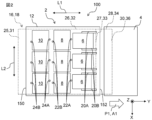
- FIG. 2 is a plan view showing the capacitor module and the power conversion device shown in FIG.
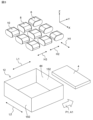
- FIG. 2 is a perspective view showing a schematic configuration of the capacitor module and some components of the power conversion device shown in FIG.
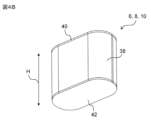
- FIG. 2 is a perspective view of a capacitor element used in the capacitor module of FIG. 1
- FIG. 2 is a perspective view of a capacitor element used in the capacitor module of FIG. 1
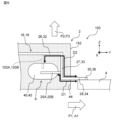
- FIG. 2 is an enlarged schematic side view of a portion of FIG. 1
- FIG. 11 is a side view showing a schematic configuration of a capacitor module and a power conversion device according to a second embodiment.
- FIG. 11 is a side view showing a schematic configuration of a capacitor module and a power conversion device according to a second embodiment.
- FIG. 7 is a plan view showing the capacitor module and the power conversion device shown in FIG.
- FIG. 7 is a perspective view showing the capacitor module and some components of the power conversion device shown in FIG.
- FIG. 13 is a side view illustrating a capacitor module and a power conversion device according to a third embodiment.
- FIG. 10 is a plan view illustrating the capacitor module and the power conversion device of FIG.
- FIG. 10 is a perspective view showing the capacitor module and some components of the power conversion device shown in FIG.
- first capacitor elements arranged in a first row, each of which has a first electrode and a second electrode; second capacitor elements arranged in a second row, each of which has a third electrode and a fourth electrode; a first connection terminal connected to the first electrode and a second connection terminal connected to the second electrode; a third connection terminal connected to the third electrode and a fourth connection terminal connected to the fourth electrode; a first bus bar connected to the first connection terminal and the third connection terminal, one end of which serves as an input terminal and the other end of which serves as an output terminal; and a bus bar connected to the second connection terminal and the fourth connection terminal, one end of which serves as an input terminal and the other end of which serves as an output terminal.
- the capacitor module according to the first aspect is provided with a plurality of the first capacitor elements, the first connection terminals, and the second connection terminals, each of which is disposed between the corresponding first capacitor elements and the first bus bar and the second bus bar along the first direction.
- the capacitor module according to the first or second aspect in which the third connection terminal and the fourth connection terminal of at least one of the second capacitor elements are arranged between the second capacitor element and the first bus bar and the second bus bar along a second direction different from the first direction.
- the capacitor module according to the third aspect is provided with a plurality of the second capacitor elements, the third connection terminals and the fourth connection terminals, and the plurality of third connection terminals and the plurality of fourth connection terminals are arranged along the second direction between the corresponding second capacitor elements and the first bus bar and the second bus bar, respectively.
- the capacitor module is provided as described in any one of the first to fourth aspects, in which the orientation of the first capacitor element to which the first and second connection terminals are connected is different from the orientation of the second capacitor element to which the third and fourth connection terminals are connected.
- the capacitor module according to any one of the first to fifth aspects is provided, in which the orientation of the first capacitor element to which the first and second connection terminals are connected and the orientation of the second capacitor element to which the third and fourth connection terminals are connected are aligned with each other.
- the capacitor module according to the third or fourth aspect is provided, further comprising third capacitor elements arranged in a third row, each of which has a fifth electrode and a sixth electrode, a fifth connection terminal connecting the fifth electrode and the first bus bar to each other, and a sixth connection terminal connecting the sixth electrode and the second bus bar to each other, the third row being farther from the first surface than the second row, and the fifth connection terminal and the sixth connection terminal of at least one of the third capacitor elements being arranged between the third capacitor element and the first bus bar and the second bus bar along a third direction different from the first direction.
- a capacitor module according to the seventh aspect in which the second direction and the third direction are parallel to each other.
- the capacitor module according to the seventh or eighth aspect is provided, in which the orientation of the second capacitor element and the orientation of the third capacitor element are aligned with each other.
- the capacitor module according to any one of the first to ninth aspects, in which the first bus bar includes a first flat plate portion arranged along the first capacitor element and the second capacitor element, and a second flat plate portion bent from the first flat plate portion and arranged along the first surface within the case, the second bus bar includes a third flat plate portion arranged along the first capacitor element and the second capacitor element, and a fourth flat plate portion bent from the third flat plate portion and arranged along the first surface within the case, the first connection terminal is connected to the second flat plate portion, and the second connection terminal is connected to the fourth flat plate portion.
- the capacitor module according to the tenth aspect is provided, in which the third connection terminal is connected to the first flat plate portion, and the fourth connection terminal is connected to the third flat plate portion.
- a capacitor module according to any one of the first to eleventh aspects, in which the output terminal of the first bus bar and the output terminal of the second bus bar are electrically connected to a power semiconductor.
- a power conversion device includes the capacitor module described in any one of the first to twelfth aspects and the power semiconductor that is electrically connected to the first bus bar and the second bus bar of the capacitor module.
- FIG. 1 is a side view that shows a capacitor module 2 according to a first embodiment of the present invention and a power converter 100 including the capacitor module 2.
- FIG. 2 is a plan view that shows the capacitor module 2 and the power converter 100 of FIG. 1.
- FIG. 3 is a perspective view that shows a part of the components of the capacitor module 2 and the power converter 100 of FIG. 1.
- FIGS. 4A and 4B are perspective views showing capacitor elements 6, 8, and 10 used in the capacitor module 2 of FIG. 1.
- FIG. 5 is a side view that shows an enlarged view of a part of FIG. 1.
- the X, Y, and Z directions in the figure respectively indicate the horizontal, vertical, and height directions of the capacitor module 2 and the power converter 100.
- the power conversion device 100 includes a capacitor module 2 and a power semiconductor 4.
- the capacitor module 2 is a module that includes multiple capacitor elements 6, 8, and 10.
- the capacitor elements 6, 8, and 10 of the capacitor module 2 are electrically connected to the power semiconductor 4 via bus bars 16 and 18, which will be described later.
- the power semiconductor 4 is a semiconductor for controlling and converting power.
- the power semiconductor 4 may be any type of power semiconductor, such as a diode, a transistor, or a thyristor.
- the capacitor module 2 includes a plurality of capacitor elements 6, 8, 10, a case 12, a sealing resin 14, a first bus bar 16, a second bus bar 18, connection terminals 20A, 20B, connection terminals 22A, 22B, and connection terminals 24A, 24B.
- the sealing resin 14 is shown diagrammatically with hatching, and in FIG. 2 and FIG. 3, the sealing resin 14 is omitted.
- the components of the capacitor module 2 are described below.
- Capacitor elements 6, 8, and 10 are each a wound film capacitor. As shown in Figures 4A and 4B, in this embodiment, capacitor elements 6, 8, and 10 are film capacitors having a common shape. This is not a limitation, and film capacitors with different shapes/specifications may also be used.
- the capacitor elements 6 in the first row may be referred to as the "first capacitor elements 6"
- the capacitor elements 8 in the second row may be referred to as the “second capacitor elements 8”
- the capacitor elements 10 in the third row may be referred to as the "third capacitor elements 10".
- Each of the capacitor elements 6, 8, and 10 has a main body 38, an electrode 40 on one side, and an electrode 42 on the other side.
- the main body 38 is formed, for example, by rolling up a dielectric film having a metal vapor deposition film formed on its surface and pressing the rolled dielectric film into a flat shape.
- a dielectric film for example, a plastic film such as polyethylene terephthalate, polypropylene, polyphenylene sulfide, or polyethylene naphthalate can be used.
- the metal vapor deposition film formed on the surface of the plastic film Al, Zn, etc. can be used.
- Electrodes 40 and 42 are formed by spraying, for example, Zn, etc., on the ends of the rolled dielectric film.
- the main body 38 extends in the height direction H of the capacitor elements 6, 8, 10, and the electrodes 40 and 42 are formed at positions facing each other in the height direction H.
- the electrodes 40, 42 are conductive members for connecting the internal electrodes of the capacitor elements 6, 8, 10 to the connection terminals 20A, 20B, 22A, 22B, 24A, 24B described below, and are made of, for example, metallicon.
- the electrodes 40, 42 have an oval shape, but may have other shapes, such as a circle.
- the electrode 40 of the first capacitor element 6 may be referred to as the "first electrode 40", and the electrode 42 of the first capacitor element 6 may be referred to as the "second electrode 42".
- the electrode 40 of the second capacitor element 8 may be referred to as the "third electrode 40", and the electrode 42 of the second capacitor element 8 may be referred to as the "fourth electrode 42".
- the electrode 40 of the third capacitor element 10 may be referred to as the fifth electrode 40, and the electrode 42 of the third capacitor element 10 may be referred to as the "sixth electrode 42".
- the capacitor elements 6, 8, and 10 are arranged in different rows relative to the power semiconductor 4. Starting from the row closest to the power semiconductor 4, the capacitor element 6 (first capacitor element) is arranged in the first row, the capacitor element 8 (second capacitor element) in the second row, and the capacitor element 10 (third capacitor element) in the third row. In the example shown in Figures 2 and 3, three capacitor elements 6, 8, and 10 are provided in each row.
- the case 12 is a member that houses each component of the capacitor module 2.
- the inside of the case 12 is filled with sealing resin 14.
- the sealing resin 14 is a resin that is filled inside the case 12 to seal each component of the capacitor module 2.
- the sealing resin 14 may be, for example, a thermosetting resin such as an epoxy resin, or a urethane resin.
- the busbars 16, 18 are conductive members for electrically connecting the electrodes 40, 42 of the capacitor elements 6, 8, 10, respectively, to the power semiconductor 4.
- the first busbar 16 electrically connects the electrodes 40 (FIGS. 4A, 4B) of the capacitor elements 6, 8, 10 to the power semiconductor 4, and the second busbar 18 electrically connects the electrodes 42 of the capacitor elements 6, 8, 10 to the power semiconductor 4.
- the busbars 16, 18 are composed of two parallel flat plates. Currents flowing in opposite directions through the busbars 16, 18 cancel out the magnetic fields caused by the currents, reducing inductance.
- the first busbar 16 is positioned above the second busbar 18 with a gap between them.
- the busbars 16, 18 are each integrally formed by bending a single metal plate made of, for example, Al, Cu, brass, or the like.
- the first bus bar 16 has an input terminal 25, three flat plate portions 26, 27, 28, and an output terminal 30.
- the second bus bar 18 has an input terminal 31, three flat plate portions 32, 33, 34, and an output terminal 36.
- the input terminals 25 and 31 are terminals for supplying power to the capacitor elements 6, 8, and 10 of the capacitor module 2, respectively. In the example shown in Figures 1 and 2, the input terminals 25 and 31 are exposed from the left side surface 150 of the case 12.
- the flat plate portions 26 and 32 are flat plate portions extending from the input terminals 25 and 31 in the XY plane, and form parallel plates adjacent to each other via the sealing resin 14.
- the flat plate portions 27 and 33 are flat plate portions bending approximately vertically from the flat plate portions 26 and 32 and extending in the XZ plane, and form parallel plates adjacent to each other via the sealing resin 14.
- the flat plate portions 28 and 34 are flat plate portions bending approximately vertically from the flat plate portions 27 and 33 and extending in the XY plane, and form parallel plates adjacent to each other via the sealing resin 14. The tips of the flat plate portions 28 and 34 form the output terminals 30 and 36.
- the flat portion 26 of the first busbar 16 may be referred to as the "first flat portion 26," and the flat portion 27 of the first busbar 16 may be referred to as the "second flat portion 27.”
- the flat portion 32 of the second busbar 18 may be referred to as the "third flat portion 32,” and the flat portion 33 of the second busbar 18 may be referred to as the "fourth flat portion 33.”
- the output terminals 30, 36 are terminals for supplying the electrical energy generated by the capacitor elements 6, 8, 10 to the power semiconductor 4.
- the output terminals 30, 36 may be directly connected to the power semiconductor 4, or may be indirectly connected to the power semiconductor 4 via another conductive member such as a bus bar.
- the output terminals 30, 36 are exposed from the right side surface 152 of the case 12.
- the side surface 152 is the surface facing the power semiconductor 4 and may be referred to as the "first surface.”
- the output terminals 30, 36 are pulled out in a pull-out direction A1, which is the direction from the side surface 152 of the case 12 toward the power semiconductor 4.
- the input terminals 25, 31 and the output terminals 30, 36 are exposed from different sides 150, 152 of the case 12, but this is not limited to the above case, and they may be exposed from any side of the case 12, such as from the same side.
- Flat plate portions 26, 27, 28 and flat plate portions 32, 33, 34 do not need to be entirely flat, but may have partial protrusions or recesses, and may simply need to be at least partially flat.
- connection terminals 20A, 20B, 22A, 22B, 24A, and 24B are terminals for connecting the electrodes 40, 42 (FIGS. 4A and 4B) of the capacitor elements 6, 8, and 10 to the bus bars 16 and 18, respectively.
- the connection terminals 20A, 20B, 22A, 22B, 24A, and 24B are formed, for example, of rod-shaped conductive members.
- Connection terminals 20A, 20B connect the electrodes 40, 42 of the capacitor element 6 in the first row to the bus bars 16, 18, respectively.
- Connection terminal 20A connects the electrode 40 of the capacitor element 6 to the first bus bar 16, and connection terminal 20B connects the electrode 42 of the capacitor element 6 to the second bus bar 18.
- Connection terminal 20A may be referred to as the "first connection terminal 20A” and connection terminal 20B may be referred to as the "second connection terminal 20B.”
- Connection terminals 22A and 22B connect the electrodes 40 and 42 of the capacitor elements 8 in the second row to the bus bars 16 and 18, respectively.
- Connection terminal 22A connects the electrode 40 of the capacitor element 8 to the first bus bar 16
- connection terminal 22B connects the electrode 42 of the capacitor element 8 to the second bus bar 18.
- Connection terminal 22A may be referred to as the "third connection terminal 22A” and connection terminal 22B may be referred to as the "fourth connection terminal 22B.”
- Connection terminals 24A, 24B connect the electrodes 40, 42 of the capacitor elements 10 in the third row to the bus bars 16, 18, respectively.
- Connection terminal 24A connects the electrode 40 of the capacitor element 10 to the first bus bar 16, and connection terminal 24B connects the electrode 42 of the capacitor element 10 to the second bus bar 18.
- Connection terminal 24A may be referred to as the "fifth connection terminal 24A” and connection terminal 24B may be referred to as the "sixth connection terminal 24B.”
- the second bus bar 18 has through holes formed therein for passing the connection terminals 20A, 22A, and 24A that are connected to the first bus bar 16.
- the pull-out direction P1 the direction in which the connection terminals 20A and 20B are pulled out from the electrodes 40 and 42 is referred to as the pull-out direction P1
- the direction in which the connection terminals 22A and 22B are pulled out from the electrodes 40 and 42 is referred to as the pull-out direction P2
- the direction in which the connection terminals 24A and 24B are pulled out from the electrodes 40 and 42 is referred to as the pull-out direction P3.
- the pull-out direction P1 and the pull-out directions P2 and P3 are different from each other.
- the pull-out direction P1 of the connection terminals 20A, 20B is the direction toward the power semiconductor 4 (+Y direction) and is parallel to the pull-out direction A1 of the output terminals 30, 36 described above.
- the connection terminals 20A, 20B extending in the pull-out direction P1 are connected to the flat plate portions 27, 33 of the bus bars 16, 18, respectively.
- the pull-out direction P2 of the connection terminals 22A and 22B is a direction (+Z direction) different from the direction toward the power semiconductor 4.
- the connection terminals 22A and 22B extending in the pull-out direction P2 are connected to the flat plate portions 26 and 32 of the bus bars 16 and 18, respectively.
- the pull-out direction P3 of the connection terminals 24A and 24B is a direction (+Z direction) different from the direction toward the power semiconductor 4.
- the connection terminals 24A and 24B extending in the pull-out direction P3 are connected to the flat portions 26 and 32 of the bus bars 16 and 18, respectively.
- the orientation of capacitor element 6 is different from the orientation of capacitor elements 8 and 10.
- the capacitor elements 6 in the first row are arranged so that their height directions H1 roughly correspond to the X direction (horizontal direction L2 of the case 12).
- the capacitor elements 8 and 10 in the second and third rows are arranged so that their height directions H2 and H3 roughly correspond to the Y direction (vertical direction L1 of the case 12).
- the capacitor elements 6 in the first row are arranged along the inner wall surface 44 closest to the power semiconductors 4 in the case 12, and the capacitor elements 8 and 10 in the second and third rows are arranged at positions away from the inner wall surface 44 and the power semiconductors 4 relative to the capacitor elements 6 in the first row.
- the inner wall surface 44 is the rear surface of the side surface 152 shown in Figures 1 and 2.
- connection terminals 20A and 20B connected to capacitor element 6 By making the orientation of capacitor element 6 different from that of capacitor elements 8 and 10, it is possible to easily make the drawing direction P1 of connection terminals 20A and 20B connected to capacitor element 6 different from the drawing directions P2 and P3 of connection terminals 22A, 22B, 24A, and 24B connected to capacitor elements 8 and 10.
- the drawing direction P1 of the connection terminals 20A, 20B the direction toward the power semiconductor 4 (i.e., the drawing direction A1 of the output terminals 30, 36)
- the physical distance D1 from the electrodes 40, 42 of the capacitor element 6 to the power semiconductor 4 via the connection terminals 20A, 20B can be shortened. This makes it possible to reduce the inductance of the capacitor module 2.
- connection terminals 120A, 120B shown by dotted lines were used instead of the connection terminals 20A, 20B and the drawing directions of the connection terminals 120A, 120B were aligned with the drawing directions P2, P3, the distance D2 from the electrodes 40, 42 to the power semiconductor 4 via the connection terminals 120A, 120B would be longer than the distance D1 by the amount of the upward detour.
- connection terminals 20A, 20B with an extension direction P1 which is the direction toward the power semiconductor 4
- the distance D1 can be shortened and the inductance of the capacitor module 2 can be effectively reduced compared to when using connection terminals 120A, 120B with extension directions P2, P3.
- the pull-out directions P2 and P3 of the connection terminals 22A, 22B, 24A, and 24B are different from the pull-out direction P1 of the connection terminals 20A and 20B, and are a direction (+Z direction) different from the direction toward the power semiconductor 4 (+Y direction). If the pull-out direction of the connection terminals 22A, 22B, 24A, and 24B were the same as the pull-out direction P1 of the connection terminals 20A and 20B, they would be more likely to interfere with other components such as other connection terminals and capacitors from the electrodes 40 and 42 of the capacitor elements 8 and 10 to the flat portions 27 and 33 of the bus bars 16 and 18. For this reason, a design that avoids interference is required, which may complicate the arrangement of the capacitor elements and connection terminals and may result in the connection terminals being unnecessarily long.
- the pull-out directions P2 and P3 of the connection terminals 22A, 22B, 24A, and 24B are set in a direction different from the direction toward the power semiconductor 4, making it difficult for interference with other components to occur, while the inductance of the capacitor module 2 is effectively reduced by providing the connection terminals 20A and 20B in the pull-out direction P1. This allows the capacitor module 2 as a whole to have a well-balanced configuration and arrangement.
- the capacitor module 2 according to the first embodiment can provide the following effects.
- the capacitor module 2 of embodiment 1 includes first capacitor elements 6 arranged in a first row and each having a first electrode 40 and a second electrode 42, second capacitor elements 8 arranged in a second row and each having a third electrode 40 and a fourth electrode 42, a first connection terminal 20A connected to the first electrode 40 and a second connection terminal 20B connected to the second electrode 42, a third connection terminal 22A connected to the third electrode 40 and a fourth connection terminal 22B connected to the fourth electrode 42, a first bus bar 16 connected to the first connection terminal 20A and the third connection terminal 22A, one end of which serves as an input terminal 25 and the other end of which serves as an output terminal 30, and a second bus bar 16 connected to the second connection terminal 20B and the fourth connection terminal 22B, one end of which serves as an input terminal 30.
- the first and second ends of the second bus bar 18 are output terminals 36, the first capacitor element 6 and the second capacitor element 8, the first connection terminals 20A to 4th connection terminals 22B, and the case 12 in which the first bus bar 16 and the second bus bar 18 are housed and has a side surface 152 (first surface).
- the output terminal 30 of the first bus bar 16 and the output terminal 36 of the second bus bar 18 are drawn out from the side surface 152 in the drawing direction A1 (first direction), the first row is closer to the side surface 152 than the second row, and the first connection terminal 20A and the second connection terminal 20B of the first capacitor element 6 are arranged between the first capacitor element 6 and the first bus bar 16 and the second bus bar 18 along the drawing direction P1 corresponding to the drawing direction A1.
- the physical distance D1 from the electrodes 40, 42 of the capacitor elements 6 in the first row to the output terminals 30, 36 or the power semiconductors 4 via the connection terminals 20A, 20B can be shortened, and the inductance of the capacitor module 2 can be reduced.
- a plurality of first capacitor elements 6, a plurality of first connection terminals 20A, and a plurality of second connection terminals 20B are provided, and the plurality of first connection terminals 20A and the plurality of second connection terminals 20B are arranged between the corresponding first capacitor elements 6 and the first bus bar 16 and the second bus bar 18 along the pull-out direction P2 corresponding to the pull-out direction A1 (first direction).
- the distance between the electrodes 40, 42 of the capacitor elements 6 in the first row and the output terminals 30, 36 (and the power semiconductor 4) can be shortened, thereby further reducing the inductance.
- the third connection terminal 22A and the fourth connection terminal 22B of the second capacitor element 8 are arranged between the second capacitor element 8 and the first bus bar 16 and the second bus bar 18 along a pull-out direction P2 (second direction) different from the pull-out direction A1 (first direction).
- the second capacitor elements 8, the third connection terminals 22A, and the fourth connection terminals 22B are each provided in plurality, and the plurality of third connection terminals 22A and the plurality of fourth connection terminals 22B are arranged along the pull-out direction P2 (second direction) between the corresponding second capacitor elements 8 and the first bus bar 16 and second bus bar 18.
- P2 second direction
- the orientation of the first capacitor element 6 to which the first connection terminal 20A and the second connection terminal 20B are connected is different from the orientation of the second capacitor element 8 to which the third connection terminal 22A and the fourth connection terminal 22B are connected.
- the capacitor module 2 of embodiment 1 further includes third capacitor elements 10 arranged in a third row, each having a fifth electrode 40 and a sixth electrode 42, and a third connection terminal 24A connecting the fifth electrode 40 to the first bus bar 16 and a sixth connection terminal 24B connecting the sixth electrode 42 to the second bus bar 18, the third row being farther from the side surface 152 (first surface) than the second row, and the fifth connection terminal 24A and the sixth connection terminal 24B of the third capacitor elements 10 being arranged between the third capacitor element 10 and the first bus bar 16 and the second bus bar 18 along a pull-out direction P3 (third direction) different from the pull-out direction A1 (first direction).
- connection terminals 22A, 22B, 24A, 24B corresponding to the capacitor elements 8, 10 in the second and third rows do not need to be aligned with the drawing direction A1 of the output terminals 30, 36, making it possible to prevent interference with other capacitor elements or other connection terminals when extending the connection terminals.
- the drawing direction P2 (second direction) of the connection terminals 22A, 22B and the drawing direction P3 (third direction) of the connection terminals 24A, 24B are parallel to each other. This configuration makes it possible to prevent the connection terminals from interfering with each other.
- the orientation of the second capacitor element 8 and the orientation of the third capacitor element 10 are aligned with each other. This configuration makes it easy to arrange the capacitor elements 8 and 10.
- the first bus bar 16 includes a first flat plate portion 26 arranged along the first capacitor element 6 and the second capacitor element 8, and a second flat plate portion 27 that is bent from the first flat plate portion 26 and arranged along the inner wall surface 44 and the side surface 152 (first surface) in the case 12, and the second bus bar 18 includes a third flat plate portion 32 arranged along the first capacitor element 6 and the second capacitor element 8, and a fourth flat plate portion 33 that is bent from the third flat plate portion 32 and arranged along the inner wall surface 44 and the side surface 152 in the case 12, and the first connection terminal 20A is connected to the second flat plate portion 27, and the second connection terminal 20B is connected to the fourth flat plate portion 33.
- the drawing direction P1 of the connection terminals 20A and 20B can be aligned with the drawing direction A1 of the output terminals 30 and 36 with a simple structure.
- the third connection terminal 22A is connected to the first flat plate portion 26, and the fourth connection terminal 22B is connected to the third flat plate portion 32.
- the output terminal 30 of the first bus bar 16 and the output terminal 36 of the second bus bar 18 are electrically connected to the power semiconductor 4.
- the power conversion device 100 of the first embodiment also includes a capacitor module 2 and a power semiconductor 4 electrically connected to the bus bars 16, 18 of the capacitor module 2. With this configuration, it is possible to achieve the same effects as the capacitor module 2 of the first embodiment.
- connection terminals 22A, 22B are pulled out in the same pull-out direction P2, but this is not limiting. As long as the pull-out direction is different from the direction toward the power semiconductor 4 (+Y direction), some of the connection terminals 22A, 22B may be pulled out in different directions.
- connection terminals 24A, 24B are pulled out in the same pull-out direction P3, this is not limiting. As long as the pull-out direction is different from the direction toward the power semiconductor 4 (+Y direction), some of the connection terminals 24A, 24B may be pulled out in different directions.
- each row may have at least one capacitor element 6, 8, and 10. Also, it is possible to provide only the first and second rows of capacitor elements 6 and 8, without providing a third row of capacitor element 10.
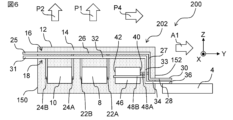
- FIG. 6 is a side view that shows a schematic of a capacitor module 202 and a power conversion device 200 according to a second embodiment of the present invention.
- FIG. 7 is a plan view that shows a schematic of the capacitor module 202 and the power conversion device 200 of FIG. 6.
- FIG. 8 is a perspective view that shows a schematic of some of the components of the capacitor module 202 and the power conversion device 200 of FIG. 6.
- embodiment 1 the orientation of capacitor element 6 (first capacitor element) and the orientation of capacitor elements 8 and 10 (second and third capacitor elements) are different from each other, whereas embodiment 2 differs in that the orientation of capacitor element 46 (first capacitor element) and the orientation of capacitor elements 8 and 10 (second and third capacitor elements) are aligned with each other.
- the orientation of the capacitor elements 46 in the first row is different from the orientation of the capacitor elements 6 in the first row in embodiment 1, and is aligned with the orientations of the capacitor elements 8 and 10 in the second and third rows.
- the capacitor elements 46 like the capacitor elements 8 and 10, are arranged in an orientation such that the height direction H4 generally coincides with the Y direction (the vertical direction L1 of the case 12).
- the pull-out direction P4 of the connection terminals 48A, 48B connected to the electrodes 40, 42 of the capacitor element 46 in the first row is set to the same direction as the pull-out direction P1 of the connection terminals 20A, 20B in embodiment 1.
- connection terminals 48A and 48B are pulled out in a pull-out direction P4, which is the direction toward the power semiconductor 4, and are connected to the flat portions 27 and 33 of the bus bars 16 and 18, respectively.
- the first connection terminal 48A connected to the electrode 40 extends along the surface of the first electrode 40, then bends approximately 90 degrees and is pulled out in the +Y direction.
- the second connection terminal 48B connected to the electrode 42 extends along the surface of the electrode 42, then bends approximately 90 degrees and is pulled out in the +Y direction.
- the lengths of the connection terminals 48A and 48B are different from each other, with the first connection terminal 48A being shorter than the second connection terminal 48B.
- the pull-out direction P4 of the connection terminals 48A, 48B connected to the capacitor elements 46 in the first row is set to the direction toward the power semiconductor 4 (i.e., the pull-out direction A1 of the output terminals 30, 36), thereby shortening the distance D1 shown in FIG. 5, as in the first embodiment, and reducing the inductance of the capacitor module 202.
- the orientation of the capacitor elements 46 in the first row is aligned with the orientation of the capacitor elements 8, 10 in the second and third rows, making it easier to arrange the capacitor elements 46, 8, 10 and reducing the occurrence of dead space within the case 12.
- the orientation of the first capacitor element 46 to which the first connection terminal 48A and the second connection terminal 48B are connected, the orientation of the second capacitor element 8 to which the third connection terminal 22A and the fourth connection terminal 22B are connected, and the orientation of the third capacitor element 10 to which the fifth connection terminal 24A and the sixth connection terminal 24B are connected are all aligned with each other.
- the capacitor elements 46, 8, and 10 can be easily arranged inside the case 12 by aligning the orientation of the capacitor elements 46, 8, and 10, making it less likely that dead space will occur.
- FIG. 9 is a side view that shows a schematic of a capacitor module 302 and a power conversion device 300 according to a third embodiment of the present invention.
- FIG. 10 is a plan view that shows a schematic of the capacitor module 302 and the power conversion device 300 of FIG. 9.
- FIG. 11 is a perspective view that shows a schematic of some of the components of the capacitor module 302 and the power conversion device 300 of FIG. 9.
- the orientation of the capacitor elements 50 and 52 in the second and third rows differs from the orientation of the capacitor elements 8 and 10 in embodiment 1, and the configuration of the bus bars 54 and 56 also differs from the configuration of the bus bars 16 and 18 in embodiment 1.
- the bus bars 54, 56 of the third embodiment are spaced apart from each other so as to sandwich the capacitor elements 6, 50, 52 in the Z direction.
- the first bus bar 54 is disposed above the capacitor elements 6, 50, 52, and the second bus bar 56 is disposed below the capacitor elements 6, 50, 52.
- the first bus bar 54 has an input terminal 25, three flat plate portions 62, 63, 64, and an output terminal 66.
- the second bus bar 56 has an input terminal 31, four flat plate portions 68, 69, 70, 71, and an output terminal 72.
- the capacitor elements 50, 52 in the second and third rows are arranged with the two electrodes 40, 42 facing each other along the Z direction.
- the capacitor elements 50, 52 are arranged with the height directions H5, H6 roughly aligned with the Z direction, which is the height direction of the case 12.
- the electrodes 40 of the capacitor elements 50, 52 are arranged facing upward, a third connection terminal 58A is connected to the third electrode 40 of the second capacitor element 50, and a fifth connection terminal 60A is connected to the fifth electrode 40 of the third capacitor element 52.
- the electrodes 42 of the capacitor elements 50, 52 are arranged facing downward, a fourth connection terminal 58B is connected to the fourth electrode 42 of the second capacitor element 50, and a sixth connection terminal 60B is connected to the sixth electrode 42 of the third capacitor element 52.
- connection terminals 20A, 20B connected to the capacitor elements 6 in the first row are pulled out in the pull-out direction P1, which is the direction toward the power semiconductor 4, and are connected to the flat portions 63, 70 of the bus bars 54, 56, respectively.
- connection terminals 58A, 58B connected to the capacitor elements 8 in the second row are pulled out in a pull-out direction P5 ( Figure 10), which is a direction different from the direction toward the power semiconductor 4, and are connected to the flat portions 62, 69 of the bus bars 54, 56, respectively.
- connection terminals 60A, 60B connected to the capacitor elements 10 in the third row are pulled out in a pull-out direction P6 ( Figure 10), which is a direction different from the direction toward the power semiconductor 4, and are connected to the flat portions 62, 69 of the bus bars 54, 56, respectively.
- the pull-out direction P5 of the connection terminals 58A and 60A is the -X direction
- the pull-out direction P6 of the connection terminals 58B and 60B is the +X direction.
- the drawing direction P1 of the connection terminals 20A, 20B drawn from the electrodes 40, 42 of the capacitor elements 6 in the first row is the direction toward the power semiconductor 4 (i.e., the drawing direction A1 of the output terminals 30, 36), so that the distance D1 shown in FIG. 5 can be shortened and the inductance of the capacitor module 302 can be reduced.
- the orientation of the first capacitor element 6 to which the first connection terminal 20A and the second connection terminal 20B are connected is different from the orientation of the second capacitor element 50 to which the third connection terminal 58A and the fourth connection terminal 58B are connected, and the orientation of the third capacitor element 52 to which the fifth connection terminal 60A and the sixth connection terminal 60B are connected.
- connection terminals 58A and 60A is the +X direction and the drawing direction P6 of the connection terminals 58B and 60B is the ⁇ X direction, but the present invention is not limited to this.
- the drawing directions of the connection terminals 58A and 58B and the connection terminals 58B and 60B may be changed as appropriate as long as they can be connected to the flat plate portions 62 and 69 of the bus bars 54 and 56, respectively.
- the present invention is useful for capacitor modules used in various electronic devices, electrical devices, industrial equipment, vehicle devices, etc., and power conversion devices equipped with the same.
- Second bus bar 20A Connection terminal (first connection terminal) 20B Connection terminal (second connection terminal) 22A Connection terminal (third connection terminal) 22B Connection terminal (fourth connection terminal) 24A Connection terminal (fifth connection terminal) 24B Connection terminal (sixth connection terminal) 40 electrodes (first electrode, third electrode, fifth electrode) 42 electrodes (second electrode, fifth electrode, sixth electrode) A1 Pull-out direction (first direction) P1 to P6 Pull-out direction
Landscapes
- Engineering & Computer Science (AREA)
- Power Engineering (AREA)
- Microelectronics & Electronic Packaging (AREA)
- Manufacturing & Machinery (AREA)
- Inverter Devices (AREA)
Priority Applications (2)
| Application Number | Priority Date | Filing Date | Title |
|---|---|---|---|
| CN202380092743.3A CN120604313A (zh) | 2023-02-24 | 2023-11-22 | 电容器模块以及具备电容器模块的电力变换装置 |
| JP2025502114A JPWO2024176547A1 (https=) | 2023-02-24 | 2023-11-22 |
Applications Claiming Priority (2)
| Application Number | Priority Date | Filing Date | Title |
|---|---|---|---|
| JP2023-027641 | 2023-02-24 | ||
| JP2023027641 | 2023-02-24 |
Publications (1)
| Publication Number | Publication Date |
|---|---|
| WO2024176547A1 true WO2024176547A1 (ja) | 2024-08-29 |
Family
ID=92500811
Family Applications (1)
| Application Number | Title | Priority Date | Filing Date |
|---|---|---|---|
| PCT/JP2023/042017 Ceased WO2024176547A1 (ja) | 2023-02-24 | 2023-11-22 | コンデンサモジュールおよびそれを備える電力変換装置 |
Country Status (3)
| Country | Link |
|---|---|
| JP (1) | JPWO2024176547A1 (https=) |
| CN (1) | CN120604313A (https=) |
| WO (1) | WO2024176547A1 (https=) |
Citations (5)
| Publication number | Priority date | Publication date | Assignee | Title |
|---|---|---|---|---|
| JP2008211129A (ja) * | 2007-02-28 | 2008-09-11 | Matsushita Electric Ind Co Ltd | ケースモールド型コンデンサ |
| JP2009259932A (ja) * | 2008-04-15 | 2009-11-05 | Panasonic Corp | ケースモールド型コンデンサ |
| JP2013161864A (ja) * | 2012-02-02 | 2013-08-19 | Shizuki Electric Co Inc | コンデンサ |
| JP2018018922A (ja) * | 2016-07-27 | 2018-02-01 | 株式会社指月電機製作所 | 樹脂封止電気部品及びその製造方法 |
| JP2022110539A (ja) * | 2021-01-18 | 2022-07-29 | 京セラ株式会社 | フィルムコンデンサ、インバータおよび電動車輌 |
-
2023
- 2023-11-22 CN CN202380092743.3A patent/CN120604313A/zh active Pending
- 2023-11-22 WO PCT/JP2023/042017 patent/WO2024176547A1/ja not_active Ceased
- 2023-11-22 JP JP2025502114A patent/JPWO2024176547A1/ja active Pending
Patent Citations (5)
| Publication number | Priority date | Publication date | Assignee | Title |
|---|---|---|---|---|
| JP2008211129A (ja) * | 2007-02-28 | 2008-09-11 | Matsushita Electric Ind Co Ltd | ケースモールド型コンデンサ |
| JP2009259932A (ja) * | 2008-04-15 | 2009-11-05 | Panasonic Corp | ケースモールド型コンデンサ |
| JP2013161864A (ja) * | 2012-02-02 | 2013-08-19 | Shizuki Electric Co Inc | コンデンサ |
| JP2018018922A (ja) * | 2016-07-27 | 2018-02-01 | 株式会社指月電機製作所 | 樹脂封止電気部品及びその製造方法 |
| JP2022110539A (ja) * | 2021-01-18 | 2022-07-29 | 京セラ株式会社 | フィルムコンデンサ、インバータおよび電動車輌 |
Also Published As
| Publication number | Publication date |
|---|---|
| JPWO2024176547A1 (https=) | 2024-08-29 |
| CN120604313A (zh) | 2025-09-05 |
Similar Documents
| Publication | Publication Date | Title |
|---|---|---|
| US20230171909A1 (en) | Semiconductor device with stacked terminals | |
| US7542318B2 (en) | Capacitor mounting type inverter unit having a recessed cover | |
| JP5747812B2 (ja) | 電力変換装置 | |
| JP5338932B2 (ja) | 電力変換装置 | |
| US20130250489A1 (en) | Electronic part module | |
| CN110168903B (zh) | 母排构造和使用它的电力变换装置 | |
| US9029977B2 (en) | Power conversion apparatus | |
| WO2012098622A1 (ja) | ケースモールド型コンデンサ | |
| US20140140034A1 (en) | Power conversion apparatus | |
| US20220006159A1 (en) | Connection module | |
| US12537141B2 (en) | Capacitor module and a method of making thereof with plurality of bus bars | |
| JP6305731B2 (ja) | ケースモールド型コンデンサおよびその製造方法 | |
| US9078372B2 (en) | Power system and power converting device thereof | |
| WO2024176547A1 (ja) | コンデンサモジュールおよびそれを備える電力変換装置 | |
| JPWO2021220918A5 (https=) | ||
| CN117320365A (zh) | 集成模组、逆变模组及电机控制器 | |
| JP7597759B2 (ja) | バスバモジュール | |
| JP6130959B1 (ja) | コネクタ連結式ゲート並列接続基板 | |
| US10622287B2 (en) | Semiconductor package | |
| CN111755250A (zh) | 电容器单元 | |
| CN210629346U (zh) | 电磁兼容性滤波模块 | |
| JP2019103280A (ja) | 電力変換装置 | |
| CN112787174A (zh) | 用于电互连模块的电气部件的电互连系统和方法 | |
| US11439016B2 (en) | Power converter module | |
| US5361189A (en) | External lead terminal adaptor and semiconductor device |
Legal Events
| Date | Code | Title | Description |
|---|---|---|---|
| 121 | Ep: the epo has been informed by wipo that ep was designated in this application |
Ref document number: 23924191 Country of ref document: EP Kind code of ref document: A1 |
|
| ENP | Entry into the national phase |
Ref document number: 2025502114 Country of ref document: JP Kind code of ref document: A |
|
| WWE | Wipo information: entry into national phase |
Ref document number: 2025502114 Country of ref document: JP |
|
| WWE | Wipo information: entry into national phase |
Ref document number: 202380092743.3 Country of ref document: CN |
|
| WWP | Wipo information: published in national office |
Ref document number: 202380092743.3 Country of ref document: CN |
|
| NENP | Non-entry into the national phase |
Ref country code: DE |
|
| 122 | Ep: pct application non-entry in european phase |
Ref document number: 23924191 Country of ref document: EP Kind code of ref document: A1 |