WO2024171566A1 - 液滴吐出装置 - Google Patents
液滴吐出装置 Download PDFInfo
- Publication number
- WO2024171566A1 WO2024171566A1 PCT/JP2023/043570 JP2023043570W WO2024171566A1 WO 2024171566 A1 WO2024171566 A1 WO 2024171566A1 JP 2023043570 W JP2023043570 W JP 2023043570W WO 2024171566 A1 WO2024171566 A1 WO 2024171566A1
- Authority
- WO
- WIPO (PCT)
- Prior art keywords
- plunger
- liquid chamber
- liquid
- nozzle
- droplet ejection
- Prior art date
- Legal status (The legal status is an assumption and is not a legal conclusion. Google has not performed a legal analysis and makes no representation as to the accuracy of the status listed.)
- Ceased
Links
Images





Classifications
-
- B—PERFORMING OPERATIONS; TRANSPORTING
- B05—SPRAYING OR ATOMISING IN GENERAL; APPLYING FLUENT MATERIALS TO SURFACES, IN GENERAL
- B05C—APPARATUS FOR APPLYING FLUENT MATERIALS TO SURFACES, IN GENERAL
- B05C19/00—Apparatus specially adapted for applying particulate materials to surfaces
- B05C19/04—Apparatus specially adapted for applying particulate materials to surfaces the particulate material being projected, poured or allowed to flow onto the surface of the work
-
- B—PERFORMING OPERATIONS; TRANSPORTING
- B05—SPRAYING OR ATOMISING IN GENERAL; APPLYING FLUENT MATERIALS TO SURFACES, IN GENERAL
- B05C—APPARATUS FOR APPLYING FLUENT MATERIALS TO SURFACES, IN GENERAL
- B05C11/00—Component parts, details or accessories not specifically provided for in groups B05C1/00 - B05C9/00
- B05C11/10—Storage, supply or control of liquid or other fluent material; Recovery of excess liquid or other fluent material
-
- B—PERFORMING OPERATIONS; TRANSPORTING
- B05—SPRAYING OR ATOMISING IN GENERAL; APPLYING FLUENT MATERIALS TO SURFACES, IN GENERAL
- B05C—APPARATUS FOR APPLYING FLUENT MATERIALS TO SURFACES, IN GENERAL
- B05C11/00—Component parts, details or accessories not specifically provided for in groups B05C1/00 - B05C9/00
- B05C11/10—Storage, supply or control of liquid or other fluent material; Recovery of excess liquid or other fluent material
- B05C11/1002—Means for controlling supply, i.e. flow or pressure, of liquid or other fluent material to the applying apparatus, e.g. valves
- B05C11/1034—Means for controlling supply, i.e. flow or pressure, of liquid or other fluent material to the applying apparatus, e.g. valves specially designed for conducting intermittent application of small quantities, e.g. drops, of coating material
-
- B—PERFORMING OPERATIONS; TRANSPORTING
- B05—SPRAYING OR ATOMISING IN GENERAL; APPLYING FLUENT MATERIALS TO SURFACES, IN GENERAL
- B05C—APPARATUS FOR APPLYING FLUENT MATERIALS TO SURFACES, IN GENERAL
- B05C5/00—Apparatus in which liquid or other fluent material is projected, poured or allowed to flow on to the surface of the work
-
- B—PERFORMING OPERATIONS; TRANSPORTING
- B05—SPRAYING OR ATOMISING IN GENERAL; APPLYING FLUENT MATERIALS TO SURFACES, IN GENERAL
- B05C—APPARATUS FOR APPLYING FLUENT MATERIALS TO SURFACES, IN GENERAL
- B05C5/00—Apparatus in which liquid or other fluent material is projected, poured or allowed to flow on to the surface of the work
- B05C5/02—Apparatus in which liquid or other fluent material is projected, poured or allowed to flow on to the surface of the work the liquid or other fluent material being discharged through an outlet orifice by pressure, e.g. from an outlet device in contact or almost in contact, with the work
- B05C5/0225—Apparatus in which liquid or other fluent material is projected, poured or allowed to flow on to the surface of the work the liquid or other fluent material being discharged through an outlet orifice by pressure, e.g. from an outlet device in contact or almost in contact, with the work characterised by flow controlling means, e.g. valves, located proximate the outlet
-
- B—PERFORMING OPERATIONS; TRANSPORTING
- B05—SPRAYING OR ATOMISING IN GENERAL; APPLYING FLUENT MATERIALS TO SURFACES, IN GENERAL
- B05C—APPARATUS FOR APPLYING FLUENT MATERIALS TO SURFACES, IN GENERAL
- B05C5/00—Apparatus in which liquid or other fluent material is projected, poured or allowed to flow on to the surface of the work
- B05C5/02—Apparatus in which liquid or other fluent material is projected, poured or allowed to flow on to the surface of the work the liquid or other fluent material being discharged through an outlet orifice by pressure, e.g. from an outlet device in contact or almost in contact, with the work
- B05C5/0291—Apparatus in which liquid or other fluent material is projected, poured or allowed to flow on to the surface of the work the liquid or other fluent material being discharged through an outlet orifice by pressure, e.g. from an outlet device in contact or almost in contact, with the work the material being discharged on the work through discrete orifices as discrete droplets, beads or strips that coalesce on the work or are spread on the work so as to form a continuous coating
-
- B—PERFORMING OPERATIONS; TRANSPORTING
- B41—PRINTING; LINING MACHINES; TYPEWRITERS; STAMPS
- B41J—TYPEWRITERS; SELECTIVE PRINTING MECHANISMS, i.e. MECHANISMS PRINTING OTHERWISE THAN FROM A FORME; CORRECTION OF TYPOGRAPHICAL ERRORS
- B41J2/00—Typewriters or selective printing mechanisms characterised by the printing or marking process for which they are designed
- B41J2/005—Typewriters or selective printing mechanisms characterised by the printing or marking process for which they are designed characterised by bringing liquid or particles selectively into contact with a printing material
- B41J2/01—Ink jet
- B41J2/135—Nozzles
- B41J2/14—Structure thereof only for on-demand ink jet heads
Definitions
- This disclosure relates to a droplet ejection device.
- One aspect of the droplet ejection device disclosed herein includes a liquid chamber that contains particles and stores liquid to be ejected from a nozzle, and a plunger that moves back and forth inside the liquid chamber, and when the plunger is at its most advanced position toward the nozzle, the distance between the tip of the plunger and the bottom surface inside the liquid chamber is greater than the maximum distance between the side of the plunger and the inner surface of the liquid chamber.
- FIG. 1A is a cross-sectional view showing an example of a configuration in which a plunger of a droplet ejection device 1 is located at a displacement start end.
- FIG. 1B is a cross-sectional view showing an example of a configuration in which the plunger of the droplet ejection device 1 is located at the displacement end.
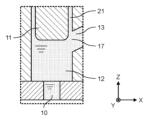
- FIG. 2A is a partial cross-sectional view showing the valve mechanism when the plunger 11 is at the displacement start end indicated by the dashed line C in FIG. 1A.
- FIG. 2B is a partial cross-sectional view of the valve mechanism showing the plunger 11 at the end of its displacement as shown by the dashed line C in FIG. 1B.
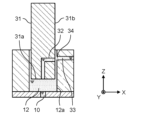
- FIG. 3 is a cross-sectional view showing a plunger 31 according to the first modification.
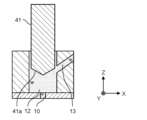
- FIG. 4 is a cross-sectional view showing a plunger 41 according to the second modification.
- FIG. 5 is a cross-sectional view showing a plunger 51 according to the third modification.
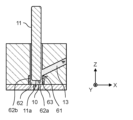
- FIG. 6 is a cross-sectional view showing a valve mechanism 61 according to the fourth modification.
- FIG. 7 is a cross-sectional view showing a liquid chamber 71 according to a fifth modified example.
- the reasons for this include the need to create high pressure inside the liquid chamber so that the plunger can eject the solder without coming into contact with the liquid chamber wall near the nozzle, the need to quickly reduce the clearance between the plunger and the liquid chamber wall near the nozzle to 1/3 to 1/10 times its original size to compress the solder, and the need to narrow the liquid chamber wall near the nozzle to 100 ⁇ m or less to prevent the high pressure from escaping from the nozzle's vicinity, thereby generating a fluid resistance effect.
- the surface that forms the narrowing at the tip of the plunger is displaced with a perpendicular component to the liquid chamber wall, so a force is applied to the liquid chamber wall that crushes the solder particles, resulting in the solder particles being crushed.
- the present disclosure has been made to solve these problems, and aims to provide a droplet ejection device that generates the pressure required for ejection while displacing the plunger in a direction in which the plunger does not come into contact with the liquid chamber inner wall near the nozzle and in which the force that crushes the solder particles against the liquid chamber inner wall is less likely to act, and that ejects the solder particles without crushing them by configuring a throttle to prevent the pressure from escaping, and that adjusts the ejection amount by controlling the displacement of the plunger, making it possible to control the amount of droplets ejected, even in minute quantities.
- each figure is a schematic diagram and is not necessarily a precise illustration.
- the same reference numerals are used for substantially the same configuration, and duplicate explanations are omitted or simplified.
- Figure 1A is a cross-sectional view showing an example of a configuration in which a plunger 11 of the droplet ejection device 1 is located at a displacement start end
- Figure 1B is a cross-sectional view showing an example of a configuration in which a plunger 11 of the droplet ejection device 1 is located at a displacement end end.
- the droplet ejection device 1 includes a nozzle 10, a plunger 11, a liquid chamber 12, a supply path 13, a guide 14, a displacement magnification mechanism 15, and an actuator 16.
- the nozzle 10 has an outlet formed therein and ejects liquid.
- the liquid contains particles such as solder particles.
- the nozzle 10 is disposed on the bottom surface of a space that stores the fluid and is provided inside the liquid chamber 12.
- the shape of the nozzle 10 may be a cylinder, a cone, or a rectangular parallelepiped.
- the plunger 11 moves back and forth in the Z direction in Figures 1A and 1B, thereby generating a pressure change in the liquid chamber 12.
- by moving the plunger 11 back and forth in the Z direction it is possible to increase or decrease the flow resistance of the liquid flowing from the supply path 13 into the liquid chamber 12, or the liquid flowing from the liquid chamber 12 to the supply path 13.
- the distance between the tip of the plunger 11 and the bottom surface inside the liquid chamber 12 is greater than the maximum distance between the side of the plunger 11 and the inner surface of the liquid chamber 12.
- the plunger 11 is inserted into the liquid chamber 12, but does not come into contact with the inner wall of the liquid chamber 12, and maintains a gap (clearance) of a certain distance or more.
- the size of the gap is set to be equal to or larger than the particle diameter. If the ink is not particle-containing ink, the size of the gap may be set to 2 ⁇ m or more.
- the shape of the plunger 11 may be a polygonal prism such as a square prism or a hexagonal prism, in addition to a cylinder.
- the opening size of the opening connecting the inside of the liquid chamber 12 to the supply path 13 is changed depending on whether the plunger 11 is at the start position of its displacement or the end position of its displacement.
- the area of the side of the plunger 11 covering the opening when the plunger 11 is at its most advanced position toward the nozzle 10 is greater than the area of the side of the plunger 11 covering the opening at any other position than the most advanced position toward the nozzle 10.
- the liquid chamber 12 stores therein the liquid to be ejected from the nozzle 10.
- the liquid chamber 12 has the function of compressing the liquid to increase the pressure in conjunction with the displacement of the plunger 11, and maintaining the pressure required to eject the liquid from the nozzle 10.
- the liquid chamber 12 is also connected to the supply path 13.
- the supply path 13 has the function of supplying liquid to the inside of the liquid chamber 12.
- the supply path 13 is formed perpendicular to the direction in which the liquid is ejected from the nozzle 10 (-Z direction), or inclined toward the bottom side of the liquid chamber 12 where the nozzle 10 is provided.
- the guide 14 contacts the plunger 11, restricting its displacement in a direction perpendicular to the direction in which the liquid is ejected from the nozzle 10 (a direction parallel to the XY plane), and prevents the plunger 11 from contacting the inner wall of the liquid chamber 12.
- the displacement magnification mechanism 15 rotates around the Y axis with the fulcrum 18 as the center, magnifying the displacement of the actuator 16 and displacing the plunger 11.
- the displacement magnification mechanism 15 is made of a material and shape that transmits the displacement and has the rigidity to magnify the displacement of the actuator 16 and continue to displace the plunger 11 even when it receives a reaction force from the liquid stored inside the liquid chamber 12 when the plunger 11 is displaced.
- the actuator 16 transmits the displacement to the displacement magnification mechanism 15, and displaces the plunger 11 in the direction of movement of the plunger 11 (Z-axis direction).
- the actuator 16 is not limited to a piezoelectric element, and may be displaced by other means such as a solenoid valve and a spring.
- FIG. 2A is a partial cross-sectional view showing the valve mechanism in which the portion of the plunger 11 surrounded by dashed line C in FIG. 1A is located at the displacement start end.
- FIG. 2B is a partial cross-sectional view showing the valve mechanism in which the portion of the plunger 11 surrounded by dashed line C in FIG. 1B is located at the displacement end.
- the displacement of the plunger 11 in the -Z direction compresses the liquid stored inside the liquid chamber 12, generating the pressure required for ejection.
- the opening of the opening 17 is reduced, and the flow resistance to the liquid flowing out from inside the liquid chamber 12 to the supply path 13 is increased, thereby suppressing a drop in pressure inside the liquid chamber 12.
- the flow resistance to suppress pressure drop is formed by the gap 21 between the plunger 11 and the inner wall of the liquid chamber 12 around the opening 17, but because the displacement direction of the plunger 11 is not perpendicular to the wall of the liquid chamber 12 that forms the gap 21, no force is generated to press particles in the liquid against the wall of the liquid chamber 12, and particles such as solder particles are not crushed.
- the displacement of the plunger 11 can be controlled by the voltage waveform applied to the actuator 16, which is made up of a piezoelectric element, to achieve the desired amount of ejection.
- Fig. 3 is a cross-sectional view showing the plunger 31 according to the modified example 1.
- the same components as those in the above embodiment are denoted by the same reference numerals and the description thereof will be omitted.
- a communicating flow passage 32 is formed in the plunger 31.
- the communicating flow passage 32 is formed at the center of the plunger 31 from the tip 31a of the plunger 31 with a fixed length in the Z direction.
- the communicating flow passage 32 turns at a right angle at the part opposite the tip 31a of the plunger 31, and is formed in the X-axis direction up to the side surface 31b of the plunger 31. Note that although the communicating flow passage 32 is bent at a right angle here, it does not have to be bent at a right angle as long as it is bent.
- the shape of the communicating flow passage 32 at the tip 31a of the plunger 31 is circular, but is not limited to circular and may be square or another shape.
- the shape of the side surface 31b of the communicating flow passage 32 is similar.
- the supply passage 33 is formed in the +X direction from the inner surface 12a of the liquid chamber 12, and is connected to the inner surface 12a of the liquid chamber 12 at an opening 34.
- the distance between the tip of the plunger 31 and the bottom surface inside the liquid chamber 12 becomes greater than the maximum distance between the side of the plunger 31 and the inner surface of the liquid chamber 12.
- the area over which the side of the plunger 31 covers the opening 34 when the plunger 31 is at its most advanced position toward the nozzle 10 is larger than the area over which the side of the plunger 31 covers the opening 34 when the plunger 31 is at any position other than its most advanced position toward the nozzle 10.
- the plunger 31 reduces the opening of the opening 17 by displacing the plunger 31 from a state in which the communicating flow passage 32 and the opening 17 are at the same height to the end of displacement position, thereby suppressing a drop in pressure within the liquid chamber 12.
- the plunger 31 makes it easy to remove bubbles even if they occur in the liquid chamber 12.
- Fig. 4 is a cross-sectional view showing the plunger 41 according to the modified example 2.
- the same components as those in the above embodiment are denoted by the same reference numerals and the description thereof will be omitted.
- the tip 41a of the plunger 41 is formed in a cone shape. Note that the tip 41a of the plunger 41 is not limited to a cone shape, and may be in other shapes such as a polygonal pyramid or a hemisphere.
- the distance between the tip of the plunger 41 and the bottom surface inside the liquid chamber 12 is greater than the maximum distance between the side of the plunger 31 and the inner surface of the liquid chamber 12.
- the area over which the side of the plunger 41 covers the opening 13 when the plunger 41 is at its most advanced position toward the nozzle 10 is larger than the area over which the side of the plunger 41 covers the opening 13 when the plunger 41 is at any position other than its most advanced position toward the nozzle 10.
- the plunger 41 is displaced to the end of its displacement position, and the opening 13 is changed from a state in which it is not covered by the conical tip 41a to a state in which the opening 13 is covered by the side of the plunger 41, thereby decreasing the opening of the opening 17 and suppressing a drop in pressure within the liquid chamber 12.
- the plunger 41 disperses pressure, preventing the particles from being crushed.
- FIG. 5 is a cross-sectional view showing the plunger 51 according to the modified example 3.
- the same components as those in the above embodiment are denoted by the same reference numerals and the description thereof will be omitted.
- a notch 52 is formed on the side of the plunger 51 facing the supply path 13 at the tip 51a of the plunger 51.
- the shape of the notch 52 is formed to be rectangular when viewed from a direction perpendicular to the Y axis. Note that the shape of the notch 52 is not limited to this and may be other shapes.
- the distance between the tip of the plunger 51 and the bottom surface inside the liquid chamber 12 is greater than the maximum distance between the side surface of the plunger 51 and the inner surface of the liquid chamber 12.
- the side surface of the plunger 51 is the side surface on which the notch 52 is not formed.
- the area over which the side of the plunger 51 covers the opening 13 when the plunger 51 is at its most advanced position toward the nozzle 10 is larger than the area over which the side of the plunger 51 covers the opening 13 when the plunger 51 is at any position other than its most advanced position toward the nozzle 10.
- the plunger 51 is displaced to the end of its displacement position, and the opening 13 changes from a state in which it is not covered by the notch 52 to a state in which the opening 13 is covered by the side of the plunger 51, thereby decreasing the opening of the opening 17 and suppressing a drop in pressure within the liquid chamber 12.
- FIG. 6 is a cross-sectional view showing a valve mechanism 61 according to Modification 4.
- the same components as those in the above embodiment are given the same reference numerals and the description thereof will be omitted.
- the valve mechanism 61 has an elastic body 63 that is installed on the bottom surface 62a inside the liquid chamber 62 so as to cover the side surface 62b.
- the tip 11a of the plunger 11 is inserted with a gap inside the elastic body 63.
- the elastic body 63 is made of rubber or the like, but is not limited to rubber and may be other elastic bodies.
- the distance between the tip of the plunger 11 and the bottom surface 62a inside the liquid chamber 62 becomes greater than the maximum distance between the side of the plunger 11 and the inner surface of the liquid chamber 62, which is the surface of the elastic body 63.
- the area of the side of the plunger 11 covering the opening 13 when the plunger 11 is at its most advanced position toward the nozzle 10 is larger than the area of the side of the plunger 11 covering the opening 13 when the plunger 11 is at any other position than its most advanced position toward the nozzle 10.
- the plunger 11 is displaced to the end of displacement position, and the opening 13 changes from a state in which the side of the plunger 11 does not cover the opening 13 to a state in which the side of the plunger 11 covers the opening 13, thereby reducing the opening of the opening 13 and suppressing a drop in pressure within the liquid chamber 62.
- FIG. 7 is a cross-sectional view showing the liquid chamber 71 according to Modification 5.
- the same components as those in the above embodiment are denoted by the same reference numerals and the description thereof will be omitted.
- the liquid chamber 71 has a side surface 71a that is located above the opening 17 of the supply channel 13, and a side surface 71b that is located below the opening 17 of the supply channel 13.
- the side surface 71b of the liquid chamber 71 that is located below the opening 17 of the supply channel 13 is formed to be wider than the side surface 71a.
- the distance between the tip of the plunger 11 and the bottom surface inside the liquid chamber 71 becomes greater than the maximum distance between the side of the plunger 11 and the inner surface of the liquid chamber 71, which is the side surface 71a.
- the area of the side of the plunger 11 covering the opening 13 when the plunger 11 is at its most advanced position toward the nozzle 10 is larger than the area of the side of the plunger 11 covering the opening 13 when the plunger 11 is at any other position than its most advanced position toward the nozzle 10.
- the plunger 11 is displaced to the end of displacement position, and the opening 13 changes from a state in which the side surface 71a of the plunger 11 does not cover the opening 13 to a state in which the opening 13 is covered by the side surface of the plunger 11, thereby decreasing the opening of the opening 13 and suppressing a drop in pressure within the liquid chamber 12.
- particle-containing fluid can be ejected without crushing the particles.
- the technology disclosed herein can be widely used in droplet ejection devices that can eject solder particles without crushing them, adjust the ejection amount by controlling the displacement of the plunger, and control the amount of droplets ejected.
Landscapes
- Coating Apparatus (AREA)
Priority Applications (3)
| Application Number | Priority Date | Filing Date | Title |
|---|---|---|---|
| CN202380093268.1A CN120569263A (zh) | 2023-02-16 | 2023-12-06 | 液滴喷出装置 |
| JP2025500662A JPWO2024171566A1 (https=) | 2023-02-16 | 2023-12-06 | |
| US19/283,412 US20250353033A1 (en) | 2023-02-16 | 2025-07-29 | Droplet ejecting device |
Applications Claiming Priority (2)
| Application Number | Priority Date | Filing Date | Title |
|---|---|---|---|
| JP2023-022509 | 2023-02-16 | ||
| JP2023022509 | 2023-02-16 |
Related Child Applications (1)
| Application Number | Title | Priority Date | Filing Date |
|---|---|---|---|
| US19/283,412 Continuation US20250353033A1 (en) | 2023-02-16 | 2025-07-29 | Droplet ejecting device |
Publications (1)
| Publication Number | Publication Date |
|---|---|
| WO2024171566A1 true WO2024171566A1 (ja) | 2024-08-22 |
Family
ID=92421231
Family Applications (1)
| Application Number | Title | Priority Date | Filing Date |
|---|---|---|---|
| PCT/JP2023/043570 Ceased WO2024171566A1 (ja) | 2023-02-16 | 2023-12-06 | 液滴吐出装置 |
Country Status (4)
| Country | Link |
|---|---|
| US (1) | US20250353033A1 (https=) |
| JP (1) | JPWO2024171566A1 (https=) |
| CN (1) | CN120569263A (https=) |
| WO (1) | WO2024171566A1 (https=) |
Citations (3)
| Publication number | Priority date | Publication date | Assignee | Title |
|---|---|---|---|---|
| WO2008108097A1 (ja) * | 2007-03-08 | 2008-09-12 | Musashi Engineering, Inc. | 液滴吐出装置および方法 |
| WO2013008799A1 (ja) * | 2011-07-11 | 2013-01-17 | 武蔵エンジニアリング株式会社 | 液滴吐出装置および方法 |
| JP2018058007A (ja) * | 2016-10-04 | 2018-04-12 | 武蔵エンジニアリング株式会社 | 流体吐出装置 |
-
2023
- 2023-12-06 JP JP2025500662A patent/JPWO2024171566A1/ja active Pending
- 2023-12-06 WO PCT/JP2023/043570 patent/WO2024171566A1/ja not_active Ceased
- 2023-12-06 CN CN202380093268.1A patent/CN120569263A/zh active Pending
-
2025
- 2025-07-29 US US19/283,412 patent/US20250353033A1/en active Pending
Patent Citations (3)
| Publication number | Priority date | Publication date | Assignee | Title |
|---|---|---|---|---|
| WO2008108097A1 (ja) * | 2007-03-08 | 2008-09-12 | Musashi Engineering, Inc. | 液滴吐出装置および方法 |
| WO2013008799A1 (ja) * | 2011-07-11 | 2013-01-17 | 武蔵エンジニアリング株式会社 | 液滴吐出装置および方法 |
| JP2018058007A (ja) * | 2016-10-04 | 2018-04-12 | 武蔵エンジニアリング株式会社 | 流体吐出装置 |
Also Published As
| Publication number | Publication date |
|---|---|
| JPWO2024171566A1 (https=) | 2024-08-22 |
| CN120569263A (zh) | 2025-08-29 |
| US20250353033A1 (en) | 2025-11-20 |
Similar Documents
| Publication | Publication Date | Title |
|---|---|---|
| JP5806868B2 (ja) | 液滴吐出装置および方法 | |
| CN109382237B (zh) | 涂布喷嘴头和具有该涂布喷嘴头的液体涂布装置 | |
| JP6173467B2 (ja) | ドージングシステム、ドージング方法、および製造方法 | |
| KR102233300B1 (ko) | 계량 밸브 및 계량 방법 | |
| KR101904135B1 (ko) | 도우징 시스템 및 도우징 방법 | |
| TWI747771B (zh) | 液體材料吐出裝置及塗佈裝置 | |
| CN1305398A (zh) | 用于喷射液滴的装置和方法 | |
| JP7783936B2 (ja) | 投与システム、および投与システムを制御する方法 | |
| JP6173466B2 (ja) | ドージングシステム、ドージング方法、および製造方法 | |
| WO2024171566A1 (ja) | 液滴吐出装置 | |
| KR20190016437A (ko) | 도포 노즐 헤드 및 이를 구비하는 액체 도포 장치 | |
| JP7584447B2 (ja) | 機械的増幅器を有するディスペンシングシステム | |
| JP2015221442A (ja) | 液滴吐出装置および方法 | |
| JP2013139745A (ja) | 粘性非接触噴射方法および装置 | |
| JP2021074946A (ja) | インクジェットヘッドおよびインクジェット塗布装置 | |
| JP7506392B2 (ja) | 液剤吐出装置及び液剤吐出方法 | |
| CN120551008A (zh) | 液滴喷出装置 | |
| JP2017136528A (ja) | 液体吐出装置 | |
| HK40059363A (en) | Metering system and method for controlling a metering system | |
| KR20190140843A (ko) | 제트 밸브 | |
| HK1228836B (zh) | 液滴吐出装置及方法 |
Legal Events
| Date | Code | Title | Description |
|---|---|---|---|
| 121 | Ep: the epo has been informed by wipo that ep was designated in this application |
Ref document number: 23922899 Country of ref document: EP Kind code of ref document: A1 |
|
| ENP | Entry into the national phase |
Ref document number: 2025500662 Country of ref document: JP Kind code of ref document: A |
|
| WWE | Wipo information: entry into national phase |
Ref document number: 2025500662 Country of ref document: JP |
|
| WWE | Wipo information: entry into national phase |
Ref document number: 202380093268.1 Country of ref document: CN |
|
| WWP | Wipo information: published in national office |
Ref document number: 202380093268.1 Country of ref document: CN |
|
| NENP | Non-entry into the national phase |
Ref country code: DE |
|
| 122 | Ep: pct application non-entry in european phase |
Ref document number: 23922899 Country of ref document: EP Kind code of ref document: A1 |