WO2024171430A1 - 情報処理装置、検出方法、及び検出プログラム - Google Patents
情報処理装置、検出方法、及び検出プログラム Download PDFInfo
- Publication number
- WO2024171430A1 WO2024171430A1 PCT/JP2023/005707 JP2023005707W WO2024171430A1 WO 2024171430 A1 WO2024171430 A1 WO 2024171430A1 JP 2023005707 W JP2023005707 W JP 2023005707W WO 2024171430 A1 WO2024171430 A1 WO 2024171430A1
- Authority
- WO
- WIPO (PCT)
- Prior art keywords
- image
- information processing
- processing device
- threshold
- abnormal
- Prior art date
- Legal status (The legal status is an assumption and is not a legal conclusion. Google has not performed a legal analysis and makes no representation as to the accuracy of the status listed.)
- Ceased
Links
Images







Classifications
-
- G—PHYSICS
- G06—COMPUTING OR CALCULATING; COUNTING
- G06T—IMAGE DATA PROCESSING OR GENERATION, IN GENERAL
- G06T7/00—Image analysis
- G06T7/0002—Inspection of images, e.g. flaw detection
-
- G—PHYSICS
- G06—COMPUTING OR CALCULATING; COUNTING
- G06T—IMAGE DATA PROCESSING OR GENERATION, IN GENERAL
- G06T7/00—Image analysis
- G06T7/0002—Inspection of images, e.g. flaw detection
- G06T7/0004—Industrial image inspection
-
- G—PHYSICS
- G01—MEASURING; TESTING
- G01N—INVESTIGATING OR ANALYSING MATERIALS BY DETERMINING THEIR CHEMICAL OR PHYSICAL PROPERTIES
- G01N21/00—Investigating or analysing materials by the use of optical means, i.e. using sub-millimetre waves, infrared, visible or ultraviolet light
- G01N21/84—Systems specially adapted for particular applications
- G01N21/88—Investigating the presence of flaws or contamination
-
- G—PHYSICS
- G01—MEASURING; TESTING
- G01N—INVESTIGATING OR ANALYSING MATERIALS BY DETERMINING THEIR CHEMICAL OR PHYSICAL PROPERTIES
- G01N21/00—Investigating or analysing materials by the use of optical means, i.e. using sub-millimetre waves, infrared, visible or ultraviolet light
- G01N21/84—Systems specially adapted for particular applications
- G01N21/88—Investigating the presence of flaws or contamination
- G01N21/95—Investigating the presence of flaws or contamination characterised by the material or shape of the object to be examined
- G01N21/952—Inspecting the exterior surface of cylindrical bodies or wires
-
- G—PHYSICS
- G06—COMPUTING OR CALCULATING; COUNTING
- G06T—IMAGE DATA PROCESSING OR GENERATION, IN GENERAL
- G06T7/00—Image analysis
- G06T7/10—Segmentation; Edge detection
-
- H—ELECTRICITY
- H02—GENERATION; CONVERSION OR DISTRIBUTION OF ELECTRIC POWER
- H02G—INSTALLATION OF ELECTRIC CABLES OR LINES, OR OF COMBINED OPTICAL AND ELECTRIC CABLES OR LINES
- H02G1/00—Methods or apparatus specially adapted for installing, maintaining, repairing or dismantling electric cables or lines
- H02G1/02—Methods or apparatus specially adapted for installing, maintaining, repairing or dismantling electric cables or lines for overhead lines or cables
-
- G—PHYSICS
- G06—COMPUTING OR CALCULATING; COUNTING
- G06T—IMAGE DATA PROCESSING OR GENERATION, IN GENERAL
- G06T2207/00—Indexing scheme for image analysis or image enhancement
- G06T2207/20—Special algorithmic details
- G06T2207/20021—Dividing image into blocks, subimages or windows
-
- G—PHYSICS
- G06—COMPUTING OR CALCULATING; COUNTING
- G06T—IMAGE DATA PROCESSING OR GENERATION, IN GENERAL
- G06T2207/00—Indexing scheme for image analysis or image enhancement
- G06T2207/30—Subject of image; Context of image processing
- G06T2207/30108—Industrial image inspection
Definitions
- This disclosure relates to an information processing device, a detection method, and a detection program.
- Twisted wires are used.
- twisted wires are used in electrical cables.
- a technology has been proposed that uses the average brightness value of an image to detect abnormalities (see Patent Document 1).
- the purpose of this disclosure is to detect anomalies with high accuracy.
- the information processing device includes an acquisition unit that acquires an image of the twisted wire, a division unit that divides the image of the twisted wire, a calculation unit that calculates multiple similarities using multiple target images set from the multiple images obtained by division and multiple comparison images set from the multiple images, normalizes the multiple similarities, calculates a classification threshold using multiple values obtained by normalization, calculates one value for each class obtained by classifying the multiple values based on the classification threshold, and calculates the difference between the two calculated values as an inter-class distance, and a determination unit that determines that the twisted wire is abnormal if the inter-class distance is equal to or greater than a predetermined first threshold.
- abnormalities can be detected with high accuracy.
- FIG. 2 is a diagram illustrating hardware included in the information processing device according to the first embodiment.
- 2 is a block diagram showing functions of the information processing device according to the first embodiment;
- FIG. 11 is a diagram illustrating an example of a process for calculating a plurality of similarities according to the first embodiment.
- FIG. 11 is a diagram illustrating an example of normalization according to the first embodiment.
- FIG. 11 is a diagram illustrating an example of calculation of a classification threshold in the first embodiment.
- 1 is a flowchart showing an example (part 1) of a process executed by the information processing device of the first embodiment.
- 11 is a flowchart showing an example (part 2) of the process executed by the information processing device of the first embodiment.
- FIG. 1 is a flowchart showing an example (part 1) of a process executed by the information processing device of the first embodiment.
- 11 is a flowchart showing an example (part 2) of the process executed by the information processing device of the first embodiment.
- FIG. 11 is a block diagram showing the functions of an information processing device according to a second embodiment; 13 is a flowchart illustrating an example of processing executed by an information processing device according to a second embodiment.
- FIG. 11 is a diagram showing an overview of a process executed by an information processing device according to a third embodiment.
- 13 is a flowchart showing an example (part 1) of a process executed by an information processing device according to the third embodiment; 13 is a flowchart showing an example (part 2) of the process executed by the information processing device of the third embodiment;
- 13 is a flowchart illustrating an example of processing executed by an information processing device according to a fourth embodiment.
- 13 is a flowchart showing an example of processing executed by an information processing device according to a modification of the fourth embodiment.
- Embodiment 1. 1 is a diagram showing hardware included in an information processing device according to embodiment 1.
- the information processing device 100 is a device that executes a detection method.
- the information processing device 100 includes a processor 101, a volatile storage device 102, and a non-volatile storage device 103.
- the processor 101 controls the entire information processing device 100.
- the processor 101 is a CPU (Central Processing Unit), an FPGA (Field Programmable Gate Array), etc.
- the processor 101 may be a multiprocessor.
- the information processing device 100 may also have a processing circuit.
- the volatile memory device 102 is the main memory device of the information processing device 100.
- the volatile memory device 102 is a RAM (Random Access Memory).
- the non-volatile memory device 103 is an auxiliary memory device of the information processing device 100.
- the non-volatile memory device 103 is a HDD (Hard Disk Drive) or an SSD (Solid State Drive).
- the information processing device 100 includes a storage unit 110, an acquisition unit 120, a division unit 130, a calculation unit 140, a determination unit 150, and an output unit 160.
- the memory unit 110 may be realized as a memory area reserved in the volatile memory device 102 or the non-volatile memory device 103.
- the acquisition unit 120, the division unit 130, the calculation unit 140, the determination unit 150, and the output unit 160 may be partly or entirely realized by a processing circuit.
- the acquisition unit 120, the division unit 130, the calculation unit 140, the determination unit 150, and the output unit 160 may be partly or entirely realized as a module of a program executed by the processor 101.
- the program executed by the processor 101 is also called a detection program.
- the detection program is recorded on a recording medium.
- the memory unit 110 stores various information.
- the acquisition unit 120 may acquire an image including the twisted wire.
- the acquisition unit 120 acquires the image from the storage unit 110.
- the acquisition unit 120 acquires the image from a camera.
- the acquisition unit 120 acquires the image from an external device.
- the external device is, for example, a cloud server.
- the illustration of the external device is omitted.
- the stranded wire is an electric wire, a wire supporting a utility pole, a wire supporting a bridge, etc.
- the acquisition unit 120 may acquire an extracted image of the twisted wire from an image including the twisted wire. In other words, the acquisition unit 120 may acquire an extracted image area of the twisted wire from an image including the twisted wire.
- the extraction process may be performed by the information processing device 100.
- the acquisition unit 120 acquires an image of the twisted wire. As described above, the acquisition unit 120 may acquire an extracted image of the twisted wire. The acquisition unit 120 may also acquire the image of the twisted wire from the storage unit 110 or an external device.
- the division unit 130 divides the image of the twisted wire. In detail, the division unit 130 divides the image of the twisted wire into pieces of a predetermined length.
- the calculation unit 140 calculates multiple similarities using multiple target images selected from the multiple images obtained by division and multiple comparison images selected from the multiple images.
- the calculation of multiple similarities will be explained using a specific example.
- Fig. 3 is a diagram showing an example of a process for calculating a plurality of similarities according to the embodiment 1.
- Fig. 3 shows an image 10 of a twisted wire.
- the dividing unit 130 divides the image 10 into four.
- the calculation unit 140 sets the image 11 as a target image from among the multiple images obtained by the division.
- the calculation unit 140 sets the image 12 as a comparison image from among the multiple images.
- the calculation unit 140 calculates the similarity between the image 11 and the image 12 using a template matching technique.
- the template matching is normalized cross-correlation, SSD (Sum of Squared Difference), or the like.
- the similarity may indicate the degree to which the two images are similar, or may indicate the degree to which the two images are dissimilar.
- the calculation unit 140 sets image 12 as the target image from among the multiple images obtained by division.
- the calculation unit 140 sets image 13 as the comparison image from among the multiple images.
- the calculation unit 140 calculates the similarity between image 12 and image 13.
- the calculation unit 140 sets image 13 as the target image from among the multiple images obtained by division.
- the calculation unit 140 sets image 14 as the comparison image from among the multiple images.
- the calculation unit 140 calculates the similarity between image 13 and image 14.
- the calculation unit 140 sets image 14 as the target image from among the multiple images obtained by division.
- the calculation unit 140 sets image 13 as the comparison image from among the multiple images.
- the calculation unit 140 calculates the similarity between image 13 and image 14.
- the calculation unit 140 calculates multiple similarities using multiple target images selected from the multiple images obtained by division and multiple comparison images selected from the multiple images.
- FIG. 3 shows a case where the image next to the target image is set as the comparison image.
- the comparison image does not have to be the image next to the target image.
- the comparison image may be the image two images away from the target image.
- the comparison image may be image 13.
- part of the comparison image and part of the target image may be the same.
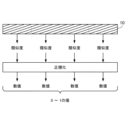
- the calculation unit 140 normalizes the multiple similarities.
- a specific example of normalization will be described with reference to the drawings. 4 is a diagram showing an example of normalization according to the first embodiment.
- the calculation unit 140 normalizes the multiple similarities.
- the calculation unit 140 normalizes the multiple similarities to a value where the minimum value among the multiple similarities is 0 and the maximum value is 1.
- the multiple similarities are converted into values between 0 and 1. In other words, the converted values are represented as "0 ⁇ value ⁇ 1".
- the calculation unit 140 calculates a classification threshold value using a plurality of values obtained by normalization.
- the calculation of the classification threshold value will be described with reference to the drawings.
- 5 is a diagram showing an example of calculation of a classification threshold according to the first embodiment.
- the calculation unit 140 calculates the degree of separation using a plurality of values. Specifically, the calculation unit 140 calculates the degree of separation using formula (1).
- the value at which the degree of separation is maximum is determined as the classification threshold.
- the calculation unit 140 classifies the multiple values based on the classification threshold. In other words, the calculation unit 140 performs two-class classification.
- the calculation unit 140 calculates one value for each classified class. For example, the calculation unit 140 calculates an average value or a representative value for each classified class. For example, when an average value is calculated, the calculation unit 140 calculates the average value of the first class using multiple values belonging to the first class, and calculates the average value of the second class using multiple values belonging to the second class.
- the calculation unit 140 calculates the difference between the two calculated values as the inter-class distance. For example, the calculation unit 140 calculates the difference between the average value of the first class and the average value of the second class as the inter-class distance.
- the determination unit 150 determines that the twisted wire is abnormal.
- This threshold is also called the first threshold. For example, the threshold is 0.7.
- the output unit 160 outputs the result.
- the output unit 160 outputs the result to a display of the information processing device 100.
- the output unit 160 outputs the result to an external device.
- the result is, for example, a result of the judgment.
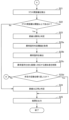
- FIG. 6 is a flowchart illustrating an example (part 1) of the process executed by the information processing device according to the first embodiment.
- the acquisition unit 120 acquires an image of the twisted wire.
- the division unit 130 divides the image of the twisted wire.
- the calculation unit 140 calculates a plurality of similarities using a plurality of target images set from the plurality of images obtained by division and a plurality of comparison images set from the plurality of images.
- Step S14 The calculation unit 140 normalizes the multiple similarities.
- Step S15 The calculation unit 140 calculates a classification threshold value using the multiple values obtained by the normalization.
- Step S16 The calculation unit 140 calculates an average value for each class obtained by classifying the multiple values based on the classification threshold. Then, the process proceeds to step S21.
- FIG. 7 is a flowchart illustrating an example (part 2) of the process executed by the information processing device according to the first embodiment.
- the calculation unit 140 calculates the difference between the two average values as the inter-class distance.
- the determination unit 150 determines whether the inter-class distance is equal to or greater than a predetermined threshold. If the inter-class distance is equal to or greater than the threshold, the process proceeds to step S23. If the inter-class distance is smaller than the threshold, the process proceeds to step S24.
- the determination unit 150 determines that the twisted wire is abnormal.
- the determining unit 150 determines that the twisted wire is normal.
- the output unit 160 outputs the result.
- the information processing device 100 can detect abnormalities with high accuracy by performing the above processing. For example, even if there is a lot of noise in the image of the twisted wire, the information processing device 100 can detect abnormalities with high accuracy by performing the above processing. Furthermore, even if there is a small abnormality in the twisted wire, the information processing device 100 can detect abnormalities with high accuracy by performing the above processing. Thus, the information processing device 100 can detect abnormalities with high accuracy.
- Embodiment 2 Next, a description will be given of embodiment 2. In embodiment 2, differences from embodiment 1 will be mainly described. Furthermore, in embodiment 2, description of matters common to embodiment 1 will be omitted.
- a case has been described in which it is determined whether or not the twisted wire is normal.
- a case will be described in which, if the twisted wire is abnormal, an abnormal portion is detected.
- the information processing device 100 further includes a detection unit 170.
- a part or all of the detection unit 170 may be realized by a processing circuit.
- a part or all of the detection unit 170 may be realized as a module of a program executed by the processor 101. The function of the detection unit 170 will be described in detail later.
- Fig. 9 is a flowchart showing an example of a process executed by the information processing device of the second embodiment.
- the process of Fig. 9 differs from the process of Fig. 7 in that steps S23a and S23b are executed. Therefore, steps S23a and S23b will be described in Fig. 9. Descriptions of processes other than steps S23a and S23b will be omitted.
- the acquisition unit 120 acquires an abnormal part determination threshold.
- the abnormal part determination threshold is also referred to as a second threshold. The process of acquiring the abnormal part determination threshold will be described.
- the abnormal part determination threshold may be a predetermined value.
- the acquisition unit 120 acquires the abnormal part determination threshold from the storage unit 110 or an external device.
- the calculation unit 140 may calculate the abnormal part determination threshold. For example, the calculation unit 140 may calculate the abnormal part determination threshold by using formula (2).
- Abnormality determination threshold Classification threshold x 2 ... (2)
- the calculation unit 140 may also multiply the classification threshold by a value other than "2".
- the acquisition unit 120 acquires the calculated abnormal part determination threshold.
- Step S23b The detection unit 170 detects a value equal to or greater than the abnormal portion determination threshold from among the multiple values obtained by normalization.
- the detection unit 170 detects a portion of the image corresponding to the detected value as an abnormal portion.
- the process of detecting an abnormal portion will be described with reference to Fig. 3.
- the detected value is a value obtained by normalizing the similarity corresponding to the image 12.
- the detection unit 170 detects the portion indicated by the image 12 corresponding to the detected value as an abnormal portion.
- the information processing device 100 can detect abnormal locations.
- Embodiment 3 Next, a third embodiment will be described. In the third embodiment, differences from the first and second embodiments will be mainly described. In the third embodiment, descriptions of the same matters as the first and second embodiments will be omitted.
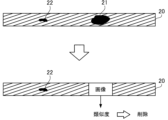
- Fig. 10 is a diagram showing an outline of the process executed by the information processing device of the embodiment 3.
- Fig. 10 shows an image 20 of a twisted wire.
- the image 20 shows an abnormality 21 and an abnormality 22.
- the abnormality 21 is detected.
- the abnormality 22 is not detected. Therefore, the information processing device 100 deletes the similarity corresponding to the image including the abnormality 21. Then, the information processing device 100 executes the detection process of the abnormality again. This allows the information processing device 100 to detect the abnormality 22.
- Fig. 11 is a flowchart showing an example (part 1) of the process executed by the information processing device of the third embodiment.
- the process of Fig. 11 differs from the process of Fig. 6 in that step S14a is executed. Therefore, step S14a will be described in Fig. 11. Descriptions of the processes other than step S14a will be omitted.
- Step S14a The calculation unit 140 normalizes the multiple similarities. Furthermore, when step S14a is executed after step S23d, the similarities corresponding to images that include abnormalities are excluded from the multiple similarities.
- FIG. 12 is a flowchart showing an example (part 2) of the process executed by the information processing device of embodiment 3.
- the process of FIG. 12 differs from the process of FIG. 9 in that steps S23c and 23d are executed. Therefore, steps S23c and 23d are explained in FIG. 12. Explanations of the process other than steps S23c and 23d are omitted.
- the acquisition unit 120 acquires an abnormality location determination threshold calculated based on the class classification threshold.
- Step S23c The detection unit 170 deletes the similarity corresponding to the image including the abnormal portion.
- Step S23d The detection unit 170 determines whether or not the process has been repeated a predetermined number of times. If the process has been repeated a predetermined number of times, the process proceeds to step S25. If the process has not been repeated a predetermined number of times, the process proceeds to step S14a.
- step S23c the detection unit 170 does not have to delete the similarity corresponding to the image including the abnormal portion. If the similarity is not deleted, in step S14a, the calculation unit 140 performs normalization by excluding the similarity corresponding to the image including the abnormal portion from among the multiple similarities.
- the information processing device 100 can detect small anomalies even when large anomalies exist nearby.
- Embodiment 4 Next, a fourth embodiment will be described. In the fourth embodiment, differences from the first and second embodiments will be mainly described. In the fourth embodiment, descriptions of the same matters as the first and second embodiments will be omitted.
- the twisted wire has metal fittings and the like attached.
- the locations where metal fittings and the like are attached may be mistakenly determined to be abnormal locations.
- the locations where the shadows of other twisted wires are present may be mistakenly determined to be abnormal locations.
- embodiment 4 describes a case in which normal locations are prevented from being mistakenly detected as abnormal locations.
- FIG. 13 is a flowchart showing an example of processing executed by an information processing device according to embodiment 4.
- the processing in FIG. 13 differs from the processing in FIG. 9 in that steps S23e and 23f are executed. Therefore, steps S23e and 23f will be explained in FIG. 13. Explanations of processing other than steps S23e and 23f will be omitted. Also, the abnormality detected in step S23b may be considered as a provisionally detected abnormality.
- the acquisition unit 120 acquires a trained model.
- the acquisition unit 120 acquires the trained model from the storage unit 110 or an external device.
- the trained model is generated by using an image including a normal part (for example, a metal fitting) as training data.
- the detection unit 170 uses the image including the abnormal portion and the trained model to determine whether or not the portion is an abnormal portion.
- the detection unit 170 uses the image including the provisionally detected abnormal portion and the trained model to determine whether or not the portion is an abnormal portion.
- the detection unit 170 inputs the image including the abnormal portion to the trained model, and the trained model outputs information indicating whether or not the portion indicated by the input image is an abnormal portion. If the portion indicated by the input image is not an abnormal portion (i.e., if the portion indicated by the input image is a normal portion), the detection unit 170 detects the portion indicated by the input image as a normal portion.
- the detection unit 170 uses the multiple images and the trained model to determine whether or not the locations shown in each of the multiple images are abnormal locations.
- the detection unit 170 excludes normal locations from the multiple detected abnormal locations.
- a result in which the normal locations have been excluded is output in step S25. In other words, only the actual abnormal locations are output as a result.
- the information processing device 100 can prevent normal parts from being mistakenly detected as abnormal parts. Furthermore, there may be an increase in the number of parts, etc. that are to be excluded as normal parts. In such a case, the trained model is retrained using an image that includes the parts, etc. that are to be excluded. Then, by using the retrained trained model, the information processing device 100 can deal with the case where the number of parts, etc. that are to be excluded increases.
- FIG. 14 is a flowchart showing an example of a process executed by an information processing device according to a modified example of the fourth embodiment.
- the process of Fig. 14 differs from the process of Fig. 12 in that steps S23e and 23f are executed.
- the process contents of steps S23e and 23f are the same as those described above. Therefore, the description of the process of steps S23e and 23f will be omitted.
- the information processing device 100 can prevent a normal portion from being mistakenly detected as an abnormal portion.
Landscapes
- Engineering & Computer Science (AREA)
- Physics & Mathematics (AREA)
- General Physics & Mathematics (AREA)
- Computer Vision & Pattern Recognition (AREA)
- Theoretical Computer Science (AREA)
- Quality & Reliability (AREA)
- Health & Medical Sciences (AREA)
- Life Sciences & Earth Sciences (AREA)
- Chemical & Material Sciences (AREA)
- Analytical Chemistry (AREA)
- Biochemistry (AREA)
- General Health & Medical Sciences (AREA)
- Immunology (AREA)
- Pathology (AREA)
- Image Analysis (AREA)
Priority Applications (4)
| Application Number | Priority Date | Filing Date | Title |
|---|---|---|---|
| JP2024559595A JP7603904B1 (ja) | 2023-02-17 | 2023-02-17 | 情報処理装置、検出方法、及び検出プログラム |
| GB2509367.5A GB2640098B (en) | 2023-02-17 | 2023-02-17 | Information processing device, detection method, and program |
| PCT/JP2023/005707 WO2024171430A1 (ja) | 2023-02-17 | 2023-02-17 | 情報処理装置、検出方法、及び検出プログラム |
| US19/246,627 US20250322504A1 (en) | 2023-02-17 | 2025-06-23 | Information processing device, and detection method |
Applications Claiming Priority (1)
| Application Number | Priority Date | Filing Date | Title |
|---|---|---|---|
| PCT/JP2023/005707 WO2024171430A1 (ja) | 2023-02-17 | 2023-02-17 | 情報処理装置、検出方法、及び検出プログラム |
Related Child Applications (1)
| Application Number | Title | Priority Date | Filing Date |
|---|---|---|---|
| US19/246,627 Continuation US20250322504A1 (en) | 2023-02-17 | 2025-06-23 | Information processing device, and detection method |
Publications (1)
| Publication Number | Publication Date |
|---|---|
| WO2024171430A1 true WO2024171430A1 (ja) | 2024-08-22 |
Family
ID=92421380
Family Applications (1)
| Application Number | Title | Priority Date | Filing Date |
|---|---|---|---|
| PCT/JP2023/005707 Ceased WO2024171430A1 (ja) | 2023-02-17 | 2023-02-17 | 情報処理装置、検出方法、及び検出プログラム |
Country Status (4)
| Country | Link |
|---|---|
| US (1) | US20250322504A1 (https=) |
| JP (1) | JP7603904B1 (https=) |
| GB (1) | GB2640098B (https=) |
| WO (1) | WO2024171430A1 (https=) |
Cited By (1)
| Publication number | Priority date | Publication date | Assignee | Title |
|---|---|---|---|---|
| CN119069182A (zh) * | 2024-11-05 | 2024-12-03 | 宁波凯特机械有限公司 | 一种批量绞线方法、系统及智能终端 |
Citations (5)
| Publication number | Priority date | Publication date | Assignee | Title |
|---|---|---|---|---|
| JP2004085216A (ja) * | 2002-08-22 | 2004-03-18 | Toyota Motor Corp | 良否判定装置、良否判定プログラムおよび良否判定方法 |
| JP2005057956A (ja) * | 2003-08-07 | 2005-03-03 | Central Res Inst Of Electric Power Ind | 画像処理による電線異常検出方法および装置およびプログラム並びに電線点検用画像の作成方法 |
| CN110009638A (zh) * | 2019-04-12 | 2019-07-12 | 重庆交通大学 | 基于局部统计特征的桥梁拉索图像外观缺陷检测方法 |
| CN112015937A (zh) * | 2020-08-31 | 2020-12-01 | 核工业北京地质研究院 | 一种图片地理定位方法及系统 |
| JP2022036054A (ja) * | 2020-08-20 | 2022-03-04 | 株式会社四国総合研究所 | 架渉線の点検装置、点検方法及び点検プログラム |
-
2023
- 2023-02-17 WO PCT/JP2023/005707 patent/WO2024171430A1/ja not_active Ceased
- 2023-02-17 JP JP2024559595A patent/JP7603904B1/ja active Active
- 2023-02-17 GB GB2509367.5A patent/GB2640098B/en active Active
-
2025
- 2025-06-23 US US19/246,627 patent/US20250322504A1/en active Pending
Patent Citations (5)
| Publication number | Priority date | Publication date | Assignee | Title |
|---|---|---|---|---|
| JP2004085216A (ja) * | 2002-08-22 | 2004-03-18 | Toyota Motor Corp | 良否判定装置、良否判定プログラムおよび良否判定方法 |
| JP2005057956A (ja) * | 2003-08-07 | 2005-03-03 | Central Res Inst Of Electric Power Ind | 画像処理による電線異常検出方法および装置およびプログラム並びに電線点検用画像の作成方法 |
| CN110009638A (zh) * | 2019-04-12 | 2019-07-12 | 重庆交通大学 | 基于局部统计特征的桥梁拉索图像外观缺陷检测方法 |
| JP2022036054A (ja) * | 2020-08-20 | 2022-03-04 | 株式会社四国総合研究所 | 架渉線の点検装置、点検方法及び点検プログラム |
| CN112015937A (zh) * | 2020-08-31 | 2020-12-01 | 核工业北京地质研究院 | 一种图片地理定位方法及系统 |
Cited By (1)
| Publication number | Priority date | Publication date | Assignee | Title |
|---|---|---|---|---|
| CN119069182A (zh) * | 2024-11-05 | 2024-12-03 | 宁波凯特机械有限公司 | 一种批量绞线方法、系统及智能终端 |
Also Published As
| Publication number | Publication date |
|---|---|
| US20250322504A1 (en) | 2025-10-16 |
| JP7603904B1 (ja) | 2024-12-20 |
| JPWO2024171430A1 (https=) | 2024-08-22 |
| GB202509367D0 (en) | 2025-07-30 |
| GB2640098B (en) | 2026-04-22 |
| GB2640098A (en) | 2025-10-08 |
Similar Documents
| Publication | Publication Date | Title |
|---|---|---|
| US9411883B2 (en) | Audio signal processing apparatus and method, and monitoring system | |
| CN101398900B (zh) | 模式识别方法、参数学习方法和设备 | |
| US9773322B2 (en) | Image processing apparatus and image processing method which learn dictionary | |
| CN1973300A (zh) | 对象图像检测装置、面部图像检测程序及面部图像检测方法 | |
| JP5335536B2 (ja) | 情報処理装置及び情報処理方法 | |
| KR20200052424A (ko) | 시계열 데이터 세그먼테이션 방법 및 그 장치 | |
| US11068595B1 (en) | Generation of file digests for cybersecurity applications | |
| CN107273910B (zh) | 过滤器学习方法及利用过滤器检测测试图像中的对象的方法、学习装置及对象识别支持装置 | |
| US8693739B2 (en) | Systems and methods for performing facial detection | |
| US20230282216A1 (en) | Authentication method and apparatus with transformation model | |
| CN113646758A (zh) | 信息处理设备、个人识别设备、信息处理方法和存储介质 | |
| US20190370982A1 (en) | Movement learning device, skill discriminating device, and skill discriminating system | |
| WO2016015621A1 (zh) | 人脸图片人名识别方法和系统 | |
| CN109118420B (zh) | 水印识别模型建立及识别方法、装置、介质及电子设备 | |
| CN114529965B (zh) | 人物图像聚类方法、装置、计算机设备及存储介质 | |
| CN115053300A (zh) | 从受试者声音诊断呼吸疾病 | |
| CN115267035B (zh) | 一种色谱仪故障诊断分析方法及系统 | |
| US20250322504A1 (en) | Information processing device, and detection method | |
| US20130028468A1 (en) | Example-Based Object Retrieval for Video Surveillance | |
| JP6930195B2 (ja) | モデル同定装置、予測装置、監視システム、モデル同定方法および予測方法 | |
| US20110099137A1 (en) | Graphical user interface component classification | |
| US20240404281A1 (en) | Abnormality analysis apparatus, abnormality analysis method, and non-transitory computer-readable medium | |
| Chaves et al. | CPU vs GPU performance of deep learning based face detectors using resized images in forensic applications | |
| JPWO2024171430A5 (https=) | ||
| JP7540500B2 (ja) | グループ特定装置、グループ特定方法、及びプログラム |
Legal Events
| Date | Code | Title | Description |
|---|---|---|---|
| 121 | Ep: the epo has been informed by wipo that ep was designated in this application |
Ref document number: 23922764 Country of ref document: EP Kind code of ref document: A1 |
|
| WWE | Wipo information: entry into national phase |
Ref document number: 2024559595 Country of ref document: JP |
|
| ENP | Entry into the national phase |
Ref document number: 202509367 Country of ref document: GB Kind code of ref document: A Free format text: PCT FILING DATE = 20230217 |
|
| WWE | Wipo information: entry into national phase |
Ref document number: 2509367.5 Country of ref document: GB |
|
| NENP | Non-entry into the national phase |
Ref country code: DE |
|
| WWP | Wipo information: published in national office |
Ref document number: 2509367.5 Country of ref document: GB |
|
| 122 | Ep: pct application non-entry in european phase |
Ref document number: 23922764 Country of ref document: EP Kind code of ref document: A1 |