WO2024162213A1 - グリース組成物、ボールねじ、及びボールねじ装置 - Google Patents
グリース組成物、ボールねじ、及びボールねじ装置 Download PDFInfo
- Publication number
- WO2024162213A1 WO2024162213A1 PCT/JP2024/002448 JP2024002448W WO2024162213A1 WO 2024162213 A1 WO2024162213 A1 WO 2024162213A1 JP 2024002448 W JP2024002448 W JP 2024002448W WO 2024162213 A1 WO2024162213 A1 WO 2024162213A1
- Authority
- WO
- WIPO (PCT)
- Prior art keywords
- grease composition
- mass
- nut
- ball screw
- oil
- Prior art date
- Legal status (The legal status is an assumption and is not a legal conclusion. Google has not performed a legal analysis and makes no representation as to the accuracy of the status listed.)
- Ceased
Links
Images


Classifications
-
- C—CHEMISTRY; METALLURGY
- C10—PETROLEUM, GAS OR COKE INDUSTRIES; TECHNICAL GASES CONTAINING CARBON MONOXIDE; FUELS; LUBRICANTS; PEAT
- C10M—LUBRICATING COMPOSITIONS; USE OF CHEMICAL SUBSTANCES EITHER ALONE OR AS LUBRICATING INGREDIENTS IN A LUBRICATING COMPOSITION
- C10M169/00—Lubricating compositions characterised by containing as components a mixture of at least two types of ingredient selected from base-materials, thickeners or additives, covered by the preceding groups, each of these compounds being essential
-
- C—CHEMISTRY; METALLURGY
- C10—PETROLEUM, GAS OR COKE INDUSTRIES; TECHNICAL GASES CONTAINING CARBON MONOXIDE; FUELS; LUBRICANTS; PEAT
- C10M—LUBRICATING COMPOSITIONS; USE OF CHEMICAL SUBSTANCES EITHER ALONE OR AS LUBRICATING INGREDIENTS IN A LUBRICATING COMPOSITION
- C10M107/00—Lubricating compositions characterised by the base-material being a macromolecular compound
- C10M107/20—Lubricating compositions characterised by the base-material being a macromolecular compound containing oxygen
- C10M107/30—Macromolecular compounds obtained otherwise than by reactions only involving carbon-to-carbon unsaturated bonds
- C10M107/32—Condensation polymers of aldehydes or ketones; Polyesters; Polyethers
- C10M107/34—Polyoxyalkylenes
-
- C—CHEMISTRY; METALLURGY
- C10—PETROLEUM, GAS OR COKE INDUSTRIES; TECHNICAL GASES CONTAINING CARBON MONOXIDE; FUELS; LUBRICANTS; PEAT
- C10M—LUBRICATING COMPOSITIONS; USE OF CHEMICAL SUBSTANCES EITHER ALONE OR AS LUBRICATING INGREDIENTS IN A LUBRICATING COMPOSITION
- C10M117/00—Lubricating compositions characterised by the thickener being a non-macromolecular carboxylic acid or salt thereof
- C10M117/06—Lubricating compositions characterised by the thickener being a non-macromolecular carboxylic acid or salt thereof having more than one carboxyl group bound to an acyclic carbon atom or cycloaliphatic carbon atom
-
- C—CHEMISTRY; METALLURGY
- C10—PETROLEUM, GAS OR COKE INDUSTRIES; TECHNICAL GASES CONTAINING CARBON MONOXIDE; FUELS; LUBRICANTS; PEAT
- C10M—LUBRICATING COMPOSITIONS; USE OF CHEMICAL SUBSTANCES EITHER ALONE OR AS LUBRICATING INGREDIENTS IN A LUBRICATING COMPOSITION
- C10M133/00—Lubricating compositions characterised by the additive being an organic non-macromolecular compound containing nitrogen
- C10M133/02—Lubricating compositions characterised by the additive being an organic non-macromolecular compound containing nitrogen having a carbon chain of less than 30 atoms
- C10M133/38—Heterocyclic nitrogen compounds
- C10M133/40—Six-membered ring containing nitrogen and carbon only
-
- C—CHEMISTRY; METALLURGY
- C10—PETROLEUM, GAS OR COKE INDUSTRIES; TECHNICAL GASES CONTAINING CARBON MONOXIDE; FUELS; LUBRICANTS; PEAT
- C10M—LUBRICATING COMPOSITIONS; USE OF CHEMICAL SUBSTANCES EITHER ALONE OR AS LUBRICATING INGREDIENTS IN A LUBRICATING COMPOSITION
- C10M135/00—Lubricating compositions characterised by the additive being an organic non-macromolecular compound containing sulfur, selenium or tellurium
- C10M135/08—Lubricating compositions characterised by the additive being an organic non-macromolecular compound containing sulfur, selenium or tellurium containing a sulfur-to-oxygen bond
- C10M135/10—Sulfonic acids or derivatives thereof
-
- C—CHEMISTRY; METALLURGY
- C10—PETROLEUM, GAS OR COKE INDUSTRIES; TECHNICAL GASES CONTAINING CARBON MONOXIDE; FUELS; LUBRICANTS; PEAT
- C10M—LUBRICATING COMPOSITIONS; USE OF CHEMICAL SUBSTANCES EITHER ALONE OR AS LUBRICATING INGREDIENTS IN A LUBRICATING COMPOSITION
- C10M135/00—Lubricating compositions characterised by the additive being an organic non-macromolecular compound containing sulfur, selenium or tellurium
- C10M135/12—Thio-acids; Thiocyanates; Derivatives thereof
- C10M135/14—Thio-acids; Thiocyanates; Derivatives thereof having a carbon-to-sulfur double bond
- C10M135/18—Thio-acids; Thiocyanates; Derivatives thereof having a carbon-to-sulfur double bond thiocarbamic type, e.g. containing the groups
-
- C—CHEMISTRY; METALLURGY
- C10—PETROLEUM, GAS OR COKE INDUSTRIES; TECHNICAL GASES CONTAINING CARBON MONOXIDE; FUELS; LUBRICANTS; PEAT
- C10M—LUBRICATING COMPOSITIONS; USE OF CHEMICAL SUBSTANCES EITHER ALONE OR AS LUBRICATING INGREDIENTS IN A LUBRICATING COMPOSITION
- C10M139/00—Lubricating compositions characterised by the additive being an organic non-macromolecular compound containing atoms of elements not provided for in groups C10M127/00 - C10M137/00
-
- C—CHEMISTRY; METALLURGY
- C10—PETROLEUM, GAS OR COKE INDUSTRIES; TECHNICAL GASES CONTAINING CARBON MONOXIDE; FUELS; LUBRICANTS; PEAT
- C10N—INDEXING SCHEME ASSOCIATED WITH SUBCLASS C10M RELATING TO LUBRICATING COMPOSITIONS
- C10N2010/00—Metal present as such or in compounds
- C10N2010/04—Groups 2 or 12
-
- C—CHEMISTRY; METALLURGY
- C10—PETROLEUM, GAS OR COKE INDUSTRIES; TECHNICAL GASES CONTAINING CARBON MONOXIDE; FUELS; LUBRICANTS; PEAT
- C10N—INDEXING SCHEME ASSOCIATED WITH SUBCLASS C10M RELATING TO LUBRICATING COMPOSITIONS
- C10N2010/00—Metal present as such or in compounds
- C10N2010/12—Groups 6 or 16
-
- C—CHEMISTRY; METALLURGY
- C10—PETROLEUM, GAS OR COKE INDUSTRIES; TECHNICAL GASES CONTAINING CARBON MONOXIDE; FUELS; LUBRICANTS; PEAT
- C10N—INDEXING SCHEME ASSOCIATED WITH SUBCLASS C10M RELATING TO LUBRICATING COMPOSITIONS
- C10N2030/00—Specified physical or chemical properties which is improved by the additive characterising the lubricating composition, e.g. multifunctional additives
- C10N2030/06—Oiliness; Film-strength; Anti-wear; Resistance to extreme pressure
-
- C—CHEMISTRY; METALLURGY
- C10—PETROLEUM, GAS OR COKE INDUSTRIES; TECHNICAL GASES CONTAINING CARBON MONOXIDE; FUELS; LUBRICANTS; PEAT
- C10N—INDEXING SCHEME ASSOCIATED WITH SUBCLASS C10M RELATING TO LUBRICATING COMPOSITIONS
- C10N2040/00—Specified use or application for which the lubricating composition is intended
- C10N2040/02—Bearings
-
- C—CHEMISTRY; METALLURGY
- C10—PETROLEUM, GAS OR COKE INDUSTRIES; TECHNICAL GASES CONTAINING CARBON MONOXIDE; FUELS; LUBRICANTS; PEAT
- C10N—INDEXING SCHEME ASSOCIATED WITH SUBCLASS C10M RELATING TO LUBRICATING COMPOSITIONS
- C10N2050/00—Form in which the lubricant is applied to the material being lubricated
- C10N2050/10—Form in which the lubricant is applied to the material being lubricated semi-solid; greasy
Definitions
- the present disclosure relates to a grease composition, a ball screw, and a ball screw device.
- This application claims priority based on International Patent Application PCT/JP2023/003080 filed on January 31, 2023, and incorporates by reference all of the contents of said International Patent Application.
- An electric brake for an automobile is equipped with a ball screw device.
- a ball screw device In order to improve the service life of a ball screw included in the ball screw device, it is effective to suppress wear between a screw shaft and balls of the ball screw.
- a grease composition is used in the ball screw.
- the ball screw device includes a moved member, a case, and a seal as other components of the ball screw.
- the moved member is fixed to one of the nut and the screw shaft of the ball screw.
- the case rotatably supports the other of the nut and the screw shaft of the ball screw.
- the seal is fixed to the case and slides axially on either the moved member, the nut, or the screw shaft, or is fixed to either the moved member, the nut, or the screw shaft and slides axially on the case.
- the seal defines a space between the case and either the moved member, the nut, or the screw shaft, and an outside space.
- the seal is made of EPDM (ethylene propylene diene rubber).
- EPDM may swell due to the grease composition. Therefore, a grease composition that does not easily cause EPDM to swell is selected for use in ball screws.
- a grease composition that uses a polyglycol-based base oil has been proposed as a grease composition that does not easily cause EPDM to swell (see, for example, Patent Document 1).
- the grease composition of the present disclosure is a grease composition comprising a base oil, a lithium complex soap, and an additive,
- the base oil contains at least a polyglycol oil
- the additives include molybdenum dithiocarbamate, molybdenum disulfide, zinc dithiophosphate, barium sulfonate, melamine cyanuric acid (MCA), and an antioxidant;
- the ratio of the lithium complex soap to the entire grease composition is 5.0 to 11.0 mass%;
- the proportion of molybdenum dithiocarbamate in the entire grease composition is 0.5 to 4.0 mass %,
- the ratio of molybdenum disulfide to the entire grease composition is 0.7 to 5.0 mass %,
- the ratio of zinc dithiophosphate to the entire grease composition is 0.3 to 5.0 mass %,
- the proportion of barium sulfonate in the entire grease composition is 0.7 to 5.0 mass %,
- the ratio of MCA to the entire grease composition is
- the ball screw of the present disclosure includes a screw shaft, a nut, and a plurality of balls.
- the grease composition of the present disclosure is disposed at the location of rolling and sliding contact between the ball and the screw shaft, and at the location of rolling and sliding contact between the ball and the nut.
- the ball screw device of the present disclosure includes the ball screw of the present disclosure, a moved member, a case, and a seal
- the moved member is fixed to one of the nut and the screw shaft of the ball screw
- the case rotatably supports the other of the nut and the screw shaft of the ball screw
- the seal is fixed to the case and slides axially on any one of the moved member, the nut, and the screw shaft, or is fixed to any one of the moved member, the nut, and the screw shaft and slides axially on the case
- the seal defines a space between the case and any one of the moved member, the nut, and the screw shaft, and an outside space;
- the seal is made of EPDM.
- the grease composition of the present disclosure can effectively suppress wear of lubricated members without causing swelling of EPDM members.
- the ball screw and ball screw device of the present disclosure have a screw shaft, a nut, and balls that are resistant to wear and have a long life.
- FIG. 2 is a partial cross-sectional view of a ball screw device including the ball screw shown in FIG. 1, a case, and a portion of a seal.
- FIG. FIG. 4 is an exploded perspective view of the circulation member shown in FIG. 3 .
- the grease composition of the present disclosure is a grease composition comprising a base oil, a lithium complex soap, and an additive,
- the base oil contains at least a polyglycol oil
- the additives include molybdenum dithiocarbamate, molybdenum disulfide, zinc dithiophosphate, barium sulfonate, MCA, and an antioxidant;
- the ratio of the lithium complex soap to the entire grease composition is 5.0 to 11.0 mass%;
- the proportion of molybdenum dithiocarbamate in the entire grease composition is 0.5 to 4.0 mass %,
- the ratio of molybdenum disulfide to the entire grease composition is 0.7 to 5.0 mass %,
- the ratio of zinc dithiophosphate to the entire grease composition is 0.3 to 5.0 mass %,
- the proportion of barium sulfonate in the entire grease composition is 0.7 to 5.0 mass %,
- the above grease composition contains polyglycol oil as a base oil, so it is less likely to swell EPDM. Furthermore, the above grease composition contains a specified amount of a specific additive, so it has a good wear-inhibiting effect on the lubricated members.
- the base oil is a polyglycol oil alone or a mixed oil of a polyglycol oil and an ester oil,
- the proportion of the polyglycol oil relative to the total base oil is preferably 50.0 to 100.0 mass %.
- the proportion of molybdenum dithiocarbamate in the entire grease composition is preferably 1.0 to 3.0 mass %.
- the proportion of molybdenum disulfide in the entire grease composition is preferably 2.0 to 4.0 mass %.
- the proportion of zinc dithiophosphate in the entire grease composition is preferably 0.3 to 4.0 mass %.
- the proportion of barium sulfonate in the entire grease composition is preferably 2.0 to 4.0 mass %.
- the proportion of MCA in the entire grease composition is preferably 2.0 to 4.0 mass %.
- the proportion of the antioxidant in the entire grease composition is preferably 0.5 to 2.0 mass %.
- a ball screw according to the present disclosure includes a screw shaft, a nut, and a plurality of balls, Any one of the grease compositions (1) to (8) above is disposed at a rolling/sliding contact point between the ball and the screw shaft and at a rolling/sliding contact point between the ball and the nut.
- the ball screw is one in which the screw shaft, nut and balls are resistant to wear. Also, even if the ball screw is equipped with an EPDM member, this EPDM member is resistant to swelling.
- the moved member is fixed to one of the nut and the screw shaft of the ball screw
- the case rotatably supports the other of the nut and the screw shaft of the ball screw
- the seal is fixed to the case and slides axially on any one of the moved member, the nut, and the screw shaft, or is fixed to any one of the moved member, the nut, and the screw shaft and slides axially on the case
- the seal defines a space between the case and any one of the moved member, the nut, and the screw shaft, and an outside space;
- the seal is made of EPDM.
- the above-mentioned ball screw device is a ball screw device in which the screw shaft, nut and balls are resistant to wear. Furthermore, even if the above-mentioned ball screw device is equipped with EPDM components, these EPDM components are resistant to swelling.
- the grease composition of the present disclosure is suitable for use in ball screws.
- a ball screw device and a ball screw according to the present disclosure will be described, followed by an embodiment of a grease composition according to the present disclosure.
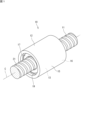
- FIG. 1 is a perspective view of an example of a ball screw
- Fig. 2 is a partial cross-sectional view of a ball screw device including the ball screw shown in Fig. 1, a case, and a part of a seal.
- the ball screw device 1 of this embodiment includes a ball screw 10, a moved member 7, a case 8, and a seal 9.
- the ball screw 10 of this embodiment includes a screw shaft 11, a cylindrical nut 12, a plurality of balls 13, and a grease composition G.
- the nut 12 includes a nut body 15 and two circulation members 16, 17 attached to both axial sides of the nut body 15.
- a central axis C of the screw shaft 11 and a central axis of the nut 12 coincide with each other. This central axis C is also the central axis of the ball screw 10.
- the moved member 7 is fixed to the nut 12 of the ball screw 10.
- the case 8 rotatably supports the screw shaft 11 of the ball screw 10.
- the seal 9 is fixed to the case 8 and slides axially on the moved member 7.
- the seal 9 defines the space between the case 8 and the moved member 7 and the outside space.
- the seal 9 is made of EPDM (ethylene propylene diene rubber).
- the screw shaft 11 is connected to a driving device such as a motor (not shown).
- the screw shaft 11 is driven to rotate around its own central axis C by the driving device.
- the driving device such as a motor (not shown).
- the screw shaft 11 rotates to a first circumferential side (forward rotation)
- the nut 12 moves to a first axial side
- the screw shaft 11 rotates to a second circumferential side (reverse rotation)
- the nut 12 moves to a second axial side.
- the direction along the central axis C is defined as the "axial direction.”
- This axial direction also includes a direction parallel to the central axis C.
- the direction perpendicular to the central axis C is defined as the "radial direction,” and the direction along a circle centered on the central axis C is defined as the “circumferential direction.”
- the ball screw 10 of this embodiment is applied to, for example, an automobile brake device, particularly an electric booster.
- the output shaft of the drive device (motor output shaft) not shown is connected to the second axial side of the screw shaft 11, which is the left side in FIG. 2.
- a member connected to a piston of the brake device is provided on the first axial side, which is the right side of the nut 12 in FIG. 2.
- the member connected to the piston of the brake device is the moved member 7.
- the moved member 7 of this embodiment has a cylindrical portion with the same outer diameter as the nut 12 on its second axial side.
- the screw shaft 11 is a cylindrical member and has one first spiral groove 21 on its outer periphery.
- the nut 12 has a nut body 15 and two circulation members 16, 17.
- the nut body 15 is cylindrical and has a second spiral groove 22 on its inner periphery.
- the pitch and number of threads of the second spiral groove 22 are the same as those of the first spiral groove 21.
- the first spiral groove 21 and the second spiral groove 22 can face each other.
- the spiral passage formed between the first spiral groove 21 and the second spiral groove 22 is the rolling path 23.
- the number of threads of the first spiral groove 21 and the second spiral groove 22 may be multiple.
- a number of balls 13 are arranged in the rolling path 23. As the screw shaft 11 rotates, the balls 13 move while rolling along the rolling path 23. A load acts between the first spiral groove 21 and the ball 13, and between the second spiral groove 22 and the ball 13. The surfaces of the first spiral groove 21 and the second spiral groove 22 are hardened in order to bear the load. To harden the surfaces of the first spiral groove 21 and the second spiral groove 22, the nut body 15 and the screw shaft 11 are heat treated. Specifically, the nut body 15 and the screw shaft 11 are hardened (carburized quenching) and tempered.
- the nut body 15 has a cylindrical central cylindrical portion 30, a cylindrical first end cylindrical portion 31, and a cylindrical second end cylindrical portion 32.
- the central cylindrical portion 30, the first end cylindrical portion 31, and the second end cylindrical portion 32 are provided in a single steel cylindrical block.
- the central portion of the single cylindrical block is the central cylindrical portion 30, and the portions on either side of it are the first end cylindrical portion 31 and the second end cylindrical portion 32.
- the outer diameter of the first end cylindrical portion 31 and the outer diameter of the second end cylindrical portion 32 are the same as the outer diameter of the central cylindrical portion 30, while the inner diameter of the first end cylindrical portion 31 and the inner diameter of the second end cylindrical portion 32 are larger than the inner diameter of the central cylindrical portion 30.
- the second spiral groove 22 is provided on the inner peripheral surface of the central tube portion 30. Furthermore, the central tube portion 30 is provided with a through hole 33 that is long in the axial direction. The ball 13 passes through the through hole 33 that is long in the axial direction.
- the central tube portion 30 has a first end face 34 facing a first axial side and a second end face 35 facing a second axial side.
- the first end face 34 and the second end face 35 are each annular surfaces facing the axial direction and are surfaces along an imaginary plane perpendicular to the central axis C.
- the first axial side of the through hole 33 opens to the first end face 34
- the second axial side of the through hole 33 opens to the second end face 35.
- the first cylindrical end portion 31 surrounds the first end face 34 from the outside in the radial direction.
- the first cylindrical end portion 31 is provided on a first axial side of the radially outer portion of the central cylindrical portion 30.
- the second cylindrical end portion 32 surrounds the second end face 35 from the outside in the radial direction.
- the second cylindrical end portion 32 is provided on a second axial side of the radially outer portion of the central cylindrical portion 30.
- the nut body 15 has a stepped hole shape on both axial sides.
- the inner peripheral surface 31a of the first cylindrical end portion 31 is a cylindrical surface and has a circumferential groove 41 in part of its axial direction.
- the inner peripheral surface 32a of the second cylindrical end portion 32 is a cylindrical surface and has a circumferential groove 42 in part of its axial direction.
- the inner peripheral surfaces 31a, 32a are each cylindrical surfaces centered on the central axis C.
- the end face 39 on the first axial side of the first end tubular portion 31 contacts the moved member 7 from the axial direction and further pushes the moved member 7 to the first axial side. This generates a braking force in the brake device.
- the end face 39 on one axial side of the first end tubular portion 31 is a load transmission surface that transmits the thrust of the nut 12 toward the first axial side to the moved member 7.
- the moved member 7 may be configured to follow the nut 12 on both the first axial side and the second axial side.
- the end face 39 on the first axial side of the first end tubular portion 31 in this embodiment is a load transmission surface that contacts the moved member 7 from the axial direction.
- the end of the first axial side of the first end tubular portion 31 in the modified example is structured to fit closely with the end of the moved member 7. This structure allows the nut 12 and the moved member 7 to move together.
- FIG. 3 is a perspective view of the circulation member 16.
- FIG. 4 is an exploded perspective view of the circulation member 16 shown in FIG. 3.
- the circulation member 16 of this embodiment is made of polyamide 66 containing 30% by mass of glass fiber, and is composed of two molded parts 16a and 16b that can be separated in the axial direction.
- the circulation member 16 of this embodiment is an annular member.
- a first passage 36 is formed in a first circulation member 16 disposed on a first axial side (see FIG. 2 ) of the nut 12.
- the first passage 36 is constituted by a groove and a hole formed between a side surface 45 on the other axial side of the first circulation member 16 and an inner circumferential surface 46.
- a second passage 37 is formed in the second circulation member 17 disposed on the second axial side.
- the second passage 37 is composed of a groove and a hole formed between a side surface 47 on one axial side of the second circulation member 17 and an inner circumferential surface 48.
- the second circulation member 17 has the same configuration as the first circulation member 16, and is attached to the nut body 15 with its axial orientation opposite to that of the first circulation member 16.
- the circulation path 38 of the nut 12 is composed of the first passage 36, the through hole 33 of the central cylindrical portion 30, and the second passage 37.
- the balls 13 are also arranged in the circulation path 38.
- the balls 13 in the rolling path 23 roll along the rolling path 23 (first spiral groove 21 and second spiral groove 22) and apply an axial force to the nut 12, moving the nut 12 in the axial direction.
- the balls 13 pass through the circulation path 38 from the end of the rolling path 23 on the first axial side, and can return to the end of the rolling path 23 on the second axial side depending on the movement stroke of the nut 12. In other words, the balls 13 can circulate through the rolling path 23 and the circulation path 38.
- the first circulation member 16 has a first passage 36 that connects the through hole 33 and the rolling path 23 (the second spiral groove 22 that constitutes the rolling path 23) on the first axial side of the nut 12.
- the first passage 36 has the function of transferring the balls 13 that have passed through the rolling path 23 to the through hole 33 when the screw shaft 11 rotates, and conversely, returning the balls 13 that have passed through the through hole 33 to the rolling path 23 when the screw shaft 11 rotates.
- the second circulation member 17 has a second passage 37 that connects the through hole 33 and the rolling path 23 (the second spiral groove 22 that constitutes the rolling path 23) on the second axial side of the nut 12.
- the second passage 37 has the function of returning the ball 13 that has passed through the through hole 33 to the rolling path 23 when the screw shaft 11 rotates, and conversely, of transferring the ball 13 that has passed through the rolling path 23 to the through hole 33 when the screw shaft 11 rotates.
- the first circulation member 16 is disposed radially inside the first tubular end portion 31 in contact with the first end face 34.
- the ball screw 10 further includes a first retaining ring 18 that fits into a first circumferential groove 41 formed on the inner circumference of the first tubular end portion 31.
- the retaining ring 18 axially sandwiches the first circulation member 16 between itself and the first end face 34, and positions and fixes the first circulation member 16 relative to the nut body 15.
- the second circulation member 17 is disposed radially inside the second tubular end portion 32 in contact with the second end face 35.
- the ball screw 10 further includes a second retaining ring 19 that fits into a second circumferential groove 42 formed on the inner circumference of the second tubular end portion 32.
- the retaining ring 19 and the second end face 35 sandwich the second circulation member 17 in the axial direction, positioning and fixing the second circulation member 17 relative to the nut body 15.
- the first retaining ring 18 for fixing the first circulation member 16 and the second retaining ring 19 for fixing the second circulation member 17 are C-shaped retaining rings of the same configuration. As described above, the first circulation member 16 and the second circulation member 17 are fixed to the nut body 15 by the first retaining ring 18 and the second retaining ring 19, respectively.
- the first circulation member 16 will be described with reference to Figures 3 and 4.
- the circulation member 16 is made of polyamide 66 containing 30% by mass of glass fiber, and is composed of two resin molded products 16a and 16b that can be separated in the axial direction.
- the second resin molded product 16b By fitting the second resin molded product 16b into a recessed portion 51 formed on the side of the first resin molded product 16a, the first resin molded product 16a and the second resin molded product 16b are combined to form one circulation member 16.
- the central axis C1 of the first resin molded product 16a and the central axis C2 of the second resin molded product 16b coincide with each other.
- Each of the two resin molded products 16a and 16b is manufactured by injection molding.
- Each surface of the resin molded products 16a and 16b is configured to have a shape that allows them to be demolded by dividing the molding die in the axial direction.
- the first resin molded product 16a has a groove 52 for forming the first passage 36 in addition to a recessed portion 51 for fitting the second resin molded product 16b. All of the surfaces that form the recessed portion 51 and the groove 52 are parallel to the central axis C1 of the resin molded product 16a, or are visible when the resin molded product 16a is viewed from the axial direction.
- the second resin molded product 16b has grooves 53a and 53b formed therein to form the first passage 36.
- All of the surfaces that form the grooves 53a and 53b are parallel to the central axis C2 of the resin molded product 16b, or are visible when the resin molded product 16a is viewed from the axial direction (the opposite direction to the first resin molded product 16a).
- the resin molded products 16a and 16b are not forcibly removed from the molding die when the molding die is divided in the axial direction.
- the first resin molded product 16a and the second resin molded product 16b are positioned relative to each other in the circumferential direction, so that the convex portion 54 fits into the cutout portion 55.
- the first resin molded product 16a of this embodiment has a convex portion 54.
- the second resin molded product 16b of this embodiment has a cutout portion 55 into which the convex portion 54 fits. By fitting the convex portion 54 into the cutout portion 55, the second resin molded product 16b is positioned relative to the first resin molded product 16a in the circumferential direction.
- the protrusion 54 of the first resin molded product 16a fits into a hole (not shown) provided in the first end face 34 of the central cylindrical portion 30 of the nut body 15 (see FIG. 2).
- the circulation member 16 is positioned in the circumferential direction and attached to the nut body 15. As a result, the through hole 33 of the central cylindrical portion 30 and the first passage 36 of the circulation member 16 are in communication.
- the second circulation member 17 on the other axial side is attached to the nut body 15 in the same manner as the first circulation member 16.
- the ball screw 10 comprises a screw shaft 11 having a first spiral groove 21 formed on its outer periphery, a nut 12 having a nut body 15 having a second spiral groove 22 formed on its inner periphery and a through hole 33 extending in the axial direction, and a plurality of balls 13 arranged in a rolling path 23 formed between the first spiral groove 21 and the second spiral groove 22.
- the ball screw device 1 also includes a ball screw 10 , a moved member 7 , a case 8 , and a seal 9 .
- the nut 12 has a first circulation member 16 and a first retaining ring 18 on a first axial side, which are separate from the nut body 15.
- the first circulation member 16 has a first passage 36 that connects the through hole 33 and the rolling path 23.
- the nut 12 further has, on a second axial side, a second circulation member 17 and a second retaining ring 19 which are separate from the nut body 15.
- the second circulation member 17 has a second passage 37 which connects the through hole 33 and the rolling path 23.
- a grease composition G is disposed in the first spiral groove 21 of the screw shaft 11 of the ball screw 10 configured in this manner, the second spiral groove 22 of the nut body 15 , the balls 13 , and the through hole 33 of the nut body 15 . Therefore, in the ball screw 10, the rolling and sliding contact between the ball 13 and the surface of the rolling path 23, and the rolling and sliding contact between the ball 13 and the wall surface of the through hole 33 are lubricated by the grease composition G. As a result, in the ball screw 10, wear of the ball 13, the first spiral groove 21 of the screw shaft 11, the second spiral groove 22 of the nut body 15, and the through hole 33 of the nut body 15 is suppressed.
- the grease composition G is also allowed to move into the space between the case 8 and the moved member 7.
- the seal 9 of the ball screw device 1 prevents the grease composition G from leaking from the space between the case 8 and the moved member 7 into the external space.
- the grease composition G adheres to the seal 9 made of EPDM.
- EPDM is a material that has poor grease resistance and is easily swollen by a grease composition.
- the ball screw device 1 of this embodiment uses the grease composition G according to the embodiment of the present disclosure, so that the seal 9 made of EPDM is less likely to swell.
- the swelling of the seal 9 prevents deterioration of the sealing property of the seal 9, which prevents leakage of the grease composition G and entry of foreign matter from the external space. Therefore, in the ball screw device 1 of the present embodiment, wear of the screw shaft 11, the nut 12, and the balls 13 is suppressed, and swelling of the seal 9 is also suppressed. Therefore, the ball screw 10 and the ball screw device 1 of the present embodiment have a long life.
- the grease composition according to the embodiment of the present disclosure can be suitably used in ball screws and ball screw devices having members made of EPDM. Next, the grease composition according to an embodiment of the present disclosure will be described.
- a grease composition according to an embodiment of the present disclosure includes a base oil, a lithium complex soap, and an additive.
- the base oil contains at least polyglycol oil.
- the base oil may be composed of only polyglycol oil, or may be a mixed oil with other base oils. When the base oil is a mixed oil, the content of the polyglycol oil relative to the entire base oil is preferably 50.0 mass% or more.
- the base oil may contain two or more types of polyglycol oil as the polyglycol oil.
- polyglycol oil examples include polyoxyethylene glycol, polyoxypropylene glycol, polyoxyethylene polyoxypropylene glycol, polyoxyethylene monobutyl ether, polyoxypropylene monobutyl ether, polyoxyethylene polyoxypropylene monobutyl ether, and derivatives thereof.
- the base oil is a mixed oil of a polyglycol oil and another base oil
- the other base oil is preferably an ester oil.
- the base oil is a mixture of polyglycol oil and ester oil
- the preferred ratio of polyglycol oil to the entire base oil is 50.0 mass% or more.
- a grease composition containing a base oil with a ratio of polyglycol oil of less than 50.0 mass% is likely to swell EPDM members. From the viewpoint of preventing EPDM members from swelling, the more preferred ratio of polyglycol oil to the entire base oil is 85.0 mass% or more.
- the base oil may have a ratio of polyglycol oil to the mass of the base oil of 100.0% by mass. In other words, as described above, the base oil may be composed only of polyglycol oil.
- ester oil examples include a reaction product of trimethylolpropane and a fatty acid, a reaction product of pentaerythritol and a fatty acid, a reaction product of dipentaerythritol and a fatty acid, or a mixture thereof.
- the base oil preferably has a kinematic viscosity at 40° C. of 40 to 80 mm 2 /s.
- a grease composition having a base oil kinematic viscosity of less than 40 mm2 /s at 40°C has poor heat resistance.
- a grease composition having a base oil kinematic viscosity of more than 80 mm2 /s at 40°C is expected to increase the torque of a ball screw when used in a ball screw.
- the grease composition contains a lithium complex soap, which functions as a thickener.
- the reason why the grease composition containing the lithium complex soap is preferable is that it has high heat resistance and a long thermal life.
- the lithium complex soap As the lithium complex soap, a conventionally known one can be used.
- a specific example of the lithium complex soap is a soap obtained by reacting lithium hydroxide with a fatty acid and a dibasic acid.
- Examples of the fatty acid include aliphatic monocarboxylic acids having 12 to 24 carbon atoms, and hydroxyaliphatic monocarboxylic acids having 12 to 24 carbon atoms and at least one hydroxyl group.
- a specific preferred example of the aliphatic monocarboxylic acid is stearic acid.
- a preferred example of the hydroxyaliphatic monocarboxylic acid is hydroxystearic acid.
- a preferred example of the hydroxystearic acid is 12-hydroxystearic acid.
- the dibasic acid may, for example, be an aliphatic dicarboxylic acid having 2 to 12 carbon atoms.
- Specific preferred examples of the aliphatic dicarboxylic acid include azelaic acid and sebacic acid.
- the ratio of the amount of the fatty acid to the amount of the dibasic acid is not particularly limited, but the preferred ratio of the amount of the dibasic acid to the total amount of the fatty acid and the dibasic acid is 20 to 30% by mass.
- the proportion of the lithium complex soap in the entire grease composition is 5.0 to 11.0% by mass.
- a grease composition containing a thickener with a lithium complex soap ratio of less than 5.0% by mass is likely to leak from a ball screw when used with the ball screw due to the small amount of thickener in the grease composition, whereas a grease composition containing a thickener with a lithium complex soap ratio of more than 11.0% by mass is expected to result in high torque when used with a ball screw.
- the grease composition contains a predetermined amount of a plurality of additives (additives (a) to (f) below).
- the content is the mass ratio to the entire grease composition.
- Molybdenum dithiocarbamate (a) Molybdenum dithiocarbamate (MoDTC) is contained in a ratio of 0.5 to 4.0 mass %. MoDTC forms a film on the surface of a lubricated member (for example, the surface of the helical groove of a screw shaft in a ball screw, the surface of the helical groove of a nut, the surface of a through hole of a nut, etc.). A surface on which a sufficient film is formed can suppress wear of the lubricated member. On the other hand, a grease composition containing less than 0.5% by mass of MoDTC cannot form a good film on the surface of a lubricated member. A surface on which a sufficient film is not formed cannot adequately suppress wear of the lubricated member.
- MoDTC Molybdenum dithiocarbamate
- the proportion of MoDTC is preferably 1.0 to 3.0 mass %.
- MoDTC molybdenum dithiocarbamate
- a conventionally known MoDTC can be used as the molybdenum dithiocarbamate (MoDTC).
- the MoDTC is a compound represented by the following formula (1).
- the MoDTC may be one type of MoDTC, or may be two or more types of MoDTCs having different structures.
- Molybdenum disulfide (MoS 2 ) is contained in an amount of 0.7 to 5.0 mass %.
- molybdenum disulfide is present between lubricated members (for example, between the ball and the screw shaft of a ball screw, or between the ball and the nut, etc.) and can suppress wear of the lubricated members.
- a grease composition containing less than 0.7% by mass of molybdenum disulfide cannot sufficiently suppress wear of lubricated members, and the effect of a grease composition containing more than 5.0% by mass of molybdenum disulfide is hardly improved compared to the effect of a grease composition containing 5.0% by mass of molybdenum disulfide.
- the preferred proportion of molybdenum disulfide is 2.0 to 4.0 mass %.
- Zinc dithiophosphate (ZnDTP) is contained in a ratio of 0.3 to 5.0 mass %.
- Zinc dithiophosphate (ZnDTP) forms a film on the surface of the lubricated member. A surface on which a sufficient film is formed can suppress wear of the lubricated member.
- a grease composition containing less than 0.3% by mass of ZnDTP cannot form a good film on the surface of a lubricated member. A surface on which a good film is not formed cannot sufficiently suppress the wear of the lubricated member.
- the upper limit of the ZnDTP ratio is preferably 4.0 mass %, more preferably 3.0 mass %, and even more preferably 2.0 mass %. This is because the higher the ZnDTP ratio, the easier it is to cure EPDM.
- the ZnDTP a conventionally known ZnDTP can be used.
- the ZnDTP is, for example, a compound represented by the following formula (2).
- R 5 to R 8 are each independently any one of a primary alkyl group, a secondary alkyl group, and an aryl group.
- the ZnDTP contained in the grease composition may be one type of ZnDTP, or may be two or more types of ZnDTP having different structures.
- Barium sulfonate is contained in an amount of 0.7 to 5.0 mass %.
- barium sulfonate can suppress the occurrence of rust in the ball screw.
- the grease composition with a barium sulfonate content of less than 0.7% by mass cannot sufficiently suppress the occurrence of rust.
- the effect of the grease composition with a barium sulfonate content of more than 5.0% by mass is hardly improved compared to the effect of the grease composition with a barium sulfonate content of 5.0% by mass.
- the barium sulfonate content exceeds 5.0% by mass, the amount of lubricating components becomes relatively small.
- the preferred proportion of barium sulfonate is 2.0 to 4.0% by mass.
- MCA Melamine Cyanuric Acid
- MCA is contained in an amount of 0.7 to 5.0 mass %.
- MCA is present between members to be lubricated, and can suppress wear of the members to be lubricated.
- a grease composition containing less than 0.7% by mass of MCA cannot sufficiently suppress wear of lubricated members, and the effect of a grease composition containing more than 5.0% by mass of MCA is hardly improved over the effect of a grease composition containing 5.0% by mass of MCA.
- the preferred proportion of MCA is 2.0 to 4.0 mass %.
- MCA is an organic adduct of melamine and isocyanuric acid in a ratio of approximately 1:1.
- the (f) antioxidant is contained in a proportion of 0.3 to 3.0 mass %.
- a grease composition containing an antioxidant in this proportion can effectively prevent deterioration of the grease composition.
- a grease composition containing less than 0.3% by mass of antioxidant cannot sufficiently suppress deterioration of the grease composition, and the effect of a grease composition containing more than 3.0% by mass of antioxidant is hardly improved compared to the effect of a grease composition containing 3.0% by mass of antioxidant.
- the preferred proportion of the antioxidant is 0.5 to 2.0% by mass.
- the antioxidant is not particularly limited, and any known antioxidant may be used. Specific examples of the antioxidant include amine-based antioxidants and phenol-based antioxidants.
- the grease composition may further contain additives other than the above (a) to (f).
- additives other than the above (a) to (f) include dyes, color stabilizers, thickeners, structural stabilizers, metal deactivators, and viscosity index improvers.
- the grease composition can be produced, for example, by producing a base grease through a step of producing soap by saponification in a base oil, and then carrying out a step of mixing additives with the obtained base grease. Specifically, for example, it can be produced by the following method.
- the base oil is either polyglycol oil alone or a mixture of polyglycol oil and ester oil.
- a predetermined amount of fatty acid is added to the base oil, and the mixture is heated to, for example, 80 to 100° C. while being stirred.
- an aqueous solution of lithium hydroxide is added to the base oil containing the fatty acid, and the mixture is stirred and heated to react with the lithium hydroxide.
- the heating temperature is, for example, 160 to 180° C., and the heating time is, for example, 0 to 30 minutes.
- a predetermined amount of dibasic acid is further added to the base oil containing the reaction product of lithium hydroxide and fatty acid, and the mixture is cooled to, for example, 80 to 100° C. while being stirred.
- an aqueous solution of lithium hydroxide is added to the base oil containing the dibasic acid, and the mixture is stirred and heated to react with the lithium hydroxide.
- the heating temperature is, for example, 170 to 190° C.
- the heating time is, for example, 0 to 30 minutes.
- the base oil containing the reactants is cooled to 80° C.
- the preferred cooling rate is 1 to 3° C./min.
- the method for producing the base grease is not limited to this method.
- the base grease may be prepared in the following manner. First, a separately produced reactant of lithium hydroxide with a fatty acid and a separately produced reactant of lithium hydroxide with a dibasic acid are added to the base oil, and the mixture is heated to, for example, 170 to 190°C while being stirred, so that each reactant dissolves in the base oil. The base oil with the dissolved product is then cooled, and the lithium complex soap precipitates in the base oil. In this case as well, a base grease consisting of the base oil and the lithium complex soap is obtained.
- the base grease is mixed with the above-mentioned additives (a) to (f) and other additives added as required to obtain a grease composition.
- the base grease is stirred while the various additives are added.
- the additives may be added one by one or simultaneously.
- the preferred worked penetration (60W) of the grease composition completed through the above steps (1) to (5) is 265 to 340.
- the worked penetration (60W) is measured by a method in accordance with JIS K 2220.7. If the worked penetration (60 W) is within this range, when used in a ball screw, the grease composition is likely to be present at the points of rolling and sliding contact between the screw shaft and the balls and the points of rolling and sliding contact between the nut and the balls, and is also unlikely to leak from the ball screw device.
- the grease composition of the present disclosure can be suitably used to lubricate ball screws.
- the grease composition of the present disclosure can be suitably used to lubricate ball screw devices in automotive brake devices.
- Base oil Polyglycol oil A (polyoxypropylene monobutyl ether, base oil kinematic viscosity at 40°C: 33 mm 2 /s)
- Polyglycol oil B polyoxypropylene monobutyl ether, base oil kinematic viscosity at 37.8°C: 70 mm 2 /s)
- Ester oil prentaerythritol, reaction product of dipentaerythritol and fatty acid, base oil kinematic viscosity at 40°C: 72 mm2 /s
- Thickener Lithium complex soap (a reaction product of lithium hydroxide with 12-hydroxystearic acid and azelaic acid)
- Additive a) Molybdenum dithiocarbamate
- Molybdenum disulfide c) Zinc dithiophosphate (zinc dialkyldithiophosphate (C1-12))
- Example 1 As a base oil, a mixed oil was prepared by mixing polyglycol oil A and ester oil in a mass ratio of 60:40. The base oil kinematic viscosity (40° C.) of the mixed oil was 45 mm 2 /s.
- azelaic acid was dissolved in a base oil containing a reaction product of 12-hydroxystearic acid and lithium hydroxide.
- an aqueous solution of lithium hydroxide was added to the base oil.
- the base oil was then heated at 180°C for 10 minutes while stirring, and the lithium hydroxide and azelaic acid reacted with each other.
- the base oil was cooled to 80° C. at a cooling rate of 1.5° C./min to obtain a base grease.
- the amounts of lithium hydroxide, 12-hydroxystearic acid and azelaic acid were set so that the amount of the lithium complex soap produced would be 9.0 mass % based on the entire grease composition.
- Example 2 The grease composition of Example 2 was completed in the same manner as in Example 1, except that the amounts of lithium hydroxide, 12-hydroxystearic acid, and azelaic acid, as well as the amount of mixed oil, were changed so that the amount of the produced lithium complex soap was 5.3 mass% relative to the total amount of the grease composition.
- Example 3 The grease composition of Example 3 was completed in the same manner as in Example 1, except that the base oil was changed from a mixed oil of polyglycol oil A and ester oil to only polyglycol oil B, and further, the amounts of lithium hydroxide, 12-hydroxystearic acid and azelaic acid were changed so that the amount of the produced lithium complex soap was 8.0 mass% with respect to the entire grease composition.
- Comparative Example 1 The grease composition of Comparative Example 1 was completed in the same manner as in Example 1, except that molybdenum disulfide was not added and further the amounts of lithium hydroxide, 12-hydroxystearic acid and azelaic acid were changed so that the amount of the produced lithium complex soap was 9.6 mass% with respect to the entire grease composition.
- Comparative Example 2 The grease composition of Comparative Example 2 was completed in the same manner as in Example 1, except that barium sulfonate was not added, and further, the amounts of lithium hydroxide, 12-hydroxystearic acid, and azelaic acid were changed so that the amount of the produced lithium complex soap was 9.6 mass% relative to the entire grease composition.
- Comparative Example 3 The grease composition of Comparative Example 3 was completed in the same manner as in Example 1, except that no MCA was added and further that the amounts of lithium hydroxide, 12-hydroxystearic acid and azelaic acid were changed so that the amount of the produced lithium complex soap was 9.6 mass% relative to the entire grease composition.
- Example 4 A grease composition of Example 4 was completed in the same manner as in Example 1, except that the base oil was changed to the following base oil and the amount of zinc dithiophosphate added was changed.
- a mixed oil was prepared by mixing polyglycol oil A, polyglycol oil B, and ester oil in a mass ratio of 45:45:10.
- the base oil kinematic viscosity (40° C.) of this mixed oil was 45 mm 2 /s.
- Comparative Example 4 The grease composition of Comparative Example 4 was completed in the same manner as in Example 4, except that no zinc dithiophosphate was contained.
- Comparative Example 5 The grease composition of Comparative Example 5 was completed in the same manner as in Example 4, except that barium sulfonate was not added, and further, the amounts of lithium hydroxide, 12-hydroxystearic acid, and azelaic acid were changed so that the amount of the produced lithium complex soap was 9.2 mass% relative to the entire grease composition.
- Comparative Example 6 The grease composition of Comparative Example 6 was completed in the same manner as in Example 4, except that no MCA was added and further, the amounts of lithium hydroxide, 12-hydroxystearic acid and azelaic acid were changed so that the amount of the produced lithium complex soap was 9.2 mass% relative to the entire grease composition.
- the worked penetration (60W) of the grease compositions produced in the Examples and Comparative Examples was measured by a method in accordance with JIS K 2220.7.
- the grease compositions produced in the examples and comparative examples were subjected to a ball-on-disk friction and wear test using a friction and wear tester (SRV reciprocating friction and wear tester) to evaluate the amount of wear (wear cross-sectional area).
- the test conditions are shown in Table 1.
- the results are shown in Table 2.
- the wear cross-sectional area is the value obtained by subtracting the cross-sectional area of a circle cut on a plane including the center of the steel ball and the center of the worn surface of the steel ball after the test from the cross-sectional area of a circle cut on a plane including the center of the steel ball before the test.
- the grease compositions produced in the examples and comparative examples were applied to a disk made of SCM415, and a steel ball made of SUJ2 (diameter 10 mm) with a load (100 N) applied was brought into contact with the grease composition.
- the disk was oscillated at a speed of 50 Hz and an amplitude of 1.5 mm for 30 minutes.
- the wear cross-sectional area ( ⁇ m 2 ) of the steel ball was measured.
- the temperature of the disk during the test was 70° C. This evaluation was performed twice, and the results are the average of the two.
- the grease composition according to the embodiment of the present disclosure contains additives such as molybdenum dithiocarbamate, molybdenum disulfide, zinc dithiophosphate, barium sulfonate, MCA, and an antioxidant, and it has been revealed that the composition exhibits good lubricating performance capable of suppressing wear of the lubricated members.
- additives such as molybdenum dithiocarbamate, molybdenum disulfide, zinc dithiophosphate, barium sulfonate, MCA, and an antioxidant
- Ball screw device 7 Moved member 8: Case 9: Seal 10: Ball screw 11: Screw shaft 12: Nut 13: Ball 15: Nut body 16, 17: Circulation member 16a, 16b: Resin molded product 18, 19: Retaining ring 21: First spiral groove 22: Second spiral groove 23: Rolling path 30: Central cylindrical portion 31: First end cylindrical portion 31a: Inner peripheral surface 32: Second end cylindrical portion 32a: Inner peripheral surface 33: Through hole 34: First end face 35: Second end face 36: First passage 37: Second passage 39: End faces 41, 42: Circumferential groove G Grease composition
Landscapes
- Chemical & Material Sciences (AREA)
- Chemical Kinetics & Catalysis (AREA)
- General Chemical & Material Sciences (AREA)
- Oil, Petroleum & Natural Gas (AREA)
- Organic Chemistry (AREA)
- Transmission Devices (AREA)
Priority Applications (1)
| Application Number | Priority Date | Filing Date | Title |
|---|---|---|---|
| JP2024574864A JPWO2024162213A1 (https=) | 2023-01-31 | 2024-01-26 |
Applications Claiming Priority (2)
| Application Number | Priority Date | Filing Date | Title |
|---|---|---|---|
| JPPCT/JP2023/003080 | 2023-01-31 | ||
| JP2023003080 | 2023-01-31 |
Publications (1)
| Publication Number | Publication Date |
|---|---|
| WO2024162213A1 true WO2024162213A1 (ja) | 2024-08-08 |
Family
ID=92146677
Family Applications (1)
| Application Number | Title | Priority Date | Filing Date |
|---|---|---|---|
| PCT/JP2024/002448 Ceased WO2024162213A1 (ja) | 2023-01-31 | 2024-01-26 | グリース組成物、ボールねじ、及びボールねじ装置 |
Country Status (2)
| Country | Link |
|---|---|
| JP (1) | JPWO2024162213A1 (https=) |
| WO (1) | WO2024162213A1 (https=) |
Citations (6)
| Publication number | Priority date | Publication date | Assignee | Title |
|---|---|---|---|---|
| JP2007112866A (ja) * | 2005-10-19 | 2007-05-10 | Nsk Ltd | 直送装置用グリース組成物及び直動装置 |
| JP2008298107A (ja) * | 2007-05-29 | 2008-12-11 | Ntn Corp | ボールねじおよびこれを備えた電動リニアアクチュエータ |
| JP2011037975A (ja) * | 2009-08-10 | 2011-02-24 | Kyodo Yushi Co Ltd | グリース組成物及び機械部品 |
| JP2011529974A (ja) * | 2008-08-01 | 2011-12-15 | シエル・インターナシヨネイル・リサーチ・マーチヤツピイ・ベー・ウイ | 潤滑性グリース組成物 |
| JP2012092220A (ja) * | 2010-10-27 | 2012-05-17 | Lube Corp | 潤滑グリース組成物 |
| JP2016022753A (ja) * | 2014-07-16 | 2016-02-08 | Ntn株式会社 | 電動アクチュエータ |
-
2024
- 2024-01-26 JP JP2024574864A patent/JPWO2024162213A1/ja active Pending
- 2024-01-26 WO PCT/JP2024/002448 patent/WO2024162213A1/ja not_active Ceased
Patent Citations (6)
| Publication number | Priority date | Publication date | Assignee | Title |
|---|---|---|---|---|
| JP2007112866A (ja) * | 2005-10-19 | 2007-05-10 | Nsk Ltd | 直送装置用グリース組成物及び直動装置 |
| JP2008298107A (ja) * | 2007-05-29 | 2008-12-11 | Ntn Corp | ボールねじおよびこれを備えた電動リニアアクチュエータ |
| JP2011529974A (ja) * | 2008-08-01 | 2011-12-15 | シエル・インターナシヨネイル・リサーチ・マーチヤツピイ・ベー・ウイ | 潤滑性グリース組成物 |
| JP2011037975A (ja) * | 2009-08-10 | 2011-02-24 | Kyodo Yushi Co Ltd | グリース組成物及び機械部品 |
| JP2012092220A (ja) * | 2010-10-27 | 2012-05-17 | Lube Corp | 潤滑グリース組成物 |
| JP2016022753A (ja) * | 2014-07-16 | 2016-02-08 | Ntn株式会社 | 電動アクチュエータ |
Also Published As
| Publication number | Publication date |
|---|---|
| JPWO2024162213A1 (https=) | 2024-08-08 |
Similar Documents
| Publication | Publication Date | Title |
|---|---|---|
| EP2540813B1 (en) | Grease composition for hub unit bearing equipped with angular contact ball bearing, and hub unit bearing | |
| EP3187572B1 (en) | Use of grease composition | |
| US7786058B2 (en) | Rolling device employing lubricating grease composition and electric power steering apparatus employing the rolling device | |
| US9217471B2 (en) | Lubricant composition and bearing using same | |
| JP5012021B2 (ja) | 一方向クラッチ内蔵型回転伝達装置用グリース組成物及び一方向クラッチ内臓型回転伝達装置 | |
| WO2006112502A1 (ja) | グリース組成物、グリース封入軸受、および、一方向クラッチ内蔵型回転伝達装置 | |
| US7867956B2 (en) | Urea-based lubricating grease composition | |
| JP4254225B2 (ja) | スタータ用一方向クラッチ装置 | |
| WO2006132349A1 (ja) | 一方向クラッチ内蔵型回転伝達装置 | |
| JP7434953B2 (ja) | グリース組成物および転がり軸受 | |
| WO2024162213A1 (ja) | グリース組成物、ボールねじ、及びボールねじ装置 | |
| EP1967753A2 (en) | Engine startup torque transmitting device | |
| JPH08176578A (ja) | 転がり軸受封入用グリース組成物 | |
| WO2025022570A1 (ja) | グリース組成物、ボールねじ、及びボールねじ装置 | |
| WO2025163704A1 (ja) | グリース組成物、ボールねじ、及びボールねじ装置 | |
| JP5101950B2 (ja) | 玉軸受 | |
| JP2006077967A (ja) | 一方向クラッチ内蔵型回転伝達装置 | |
| JP2004225809A (ja) | ベルト式無段変速機用プーリ幅調節装置及びベルト式無段変速機 | |
| CN115232659A (zh) | 一种汽车服务市场等速万向节外球笼润滑脂组合物及其制备方法 | |
| JP2005003197A (ja) | 一方向クラッチ内蔵型回転伝達装置 | |
| JP4625651B2 (ja) | 自動車電装・補機用転がり軸受 | |
| JP2006162032A (ja) | 一方向クラッチ内蔵型回転伝達装置 | |
| JP2009299897A (ja) | 自動車電装・補機用転がり軸受 | |
| JPH09169989A (ja) | グリース組成物 | |
| JP7807889B2 (ja) | グリース組成物およびグリース封入軸受 |
Legal Events
| Date | Code | Title | Description |
|---|---|---|---|
| 121 | Ep: the epo has been informed by wipo that ep was designated in this application |
Ref document number: 24750162 Country of ref document: EP Kind code of ref document: A1 |
|
| ENP | Entry into the national phase |
Ref document number: 2024574864 Country of ref document: JP Kind code of ref document: A |
|
| WWE | Wipo information: entry into national phase |
Ref document number: 2024574864 Country of ref document: JP |
|
| NENP | Non-entry into the national phase |
Ref country code: DE |
|
| 122 | Ep: pct application non-entry in european phase |
Ref document number: 24750162 Country of ref document: EP Kind code of ref document: A1 |