WO2024154693A1 - こわばり緩和用温熱具 - Google Patents
こわばり緩和用温熱具 Download PDFInfo
- Publication number
- WO2024154693A1 WO2024154693A1 PCT/JP2024/000787 JP2024000787W WO2024154693A1 WO 2024154693 A1 WO2024154693 A1 WO 2024154693A1 JP 2024000787 W JP2024000787 W JP 2024000787W WO 2024154693 A1 WO2024154693 A1 WO 2024154693A1
- Authority
- WO
- WIPO (PCT)
- Prior art keywords
- stiffness
- heating tool
- heating
- skin
- packaging material
- Prior art date
- Legal status (The legal status is an assumption and is not a legal conclusion. Google has not performed a legal analysis and makes no representation as to the accuracy of the status listed.)
- Ceased
Links
Images


Classifications
-
- A—HUMAN NECESSITIES
- A61—MEDICAL OR VETERINARY SCIENCE; HYGIENE
- A61F—FILTERS IMPLANTABLE INTO BLOOD VESSELS; PROSTHESES; DEVICES PROVIDING PATENCY TO, OR PREVENTING COLLAPSING OF, TUBULAR STRUCTURES OF THE BODY, e.g. STENTS; ORTHOPAEDIC, NURSING OR CONTRACEPTIVE DEVICES; FOMENTATION; TREATMENT OR PROTECTION OF EYES OR EARS; BANDAGES, DRESSINGS OR ABSORBENT PADS; FIRST-AID KITS
- A61F7/00—Heating or cooling appliances for medical or therapeutic treatment of the human body
- A61F7/02—Compresses or poultices for effecting heating or cooling
- A61F7/03—Compresses or poultices for effecting heating or cooling thermophore, i.e. self-heating, e.g. using a chemical reaction
-
- A—HUMAN NECESSITIES
- A61—MEDICAL OR VETERINARY SCIENCE; HYGIENE
- A61F—FILTERS IMPLANTABLE INTO BLOOD VESSELS; PROSTHESES; DEVICES PROVIDING PATENCY TO, OR PREVENTING COLLAPSING OF, TUBULAR STRUCTURES OF THE BODY, e.g. STENTS; ORTHOPAEDIC, NURSING OR CONTRACEPTIVE DEVICES; FOMENTATION; TREATMENT OR PROTECTION OF EYES OR EARS; BANDAGES, DRESSINGS OR ABSORBENT PADS; FIRST-AID KITS
- A61F7/00—Heating or cooling appliances for medical or therapeutic treatment of the human body
- A61F2007/0001—Body part
- A61F2007/0029—Arm or parts thereof
Definitions
- Stiffness is known to be one of the symptoms caused by rheumatoid arthritis and osteoarthritis. Stiffness is known to be observed in joints such as the hands, knees, and ankles, with stiffness in the hands being particularly common. For example, it has been reported that one symptom that often appears early in rheumatoid arthritis is "morning stiffness," in which the joints feel difficult to move upon waking (Non-Patent Document 1).
- Known methods for relieving stiffness include taking Chinese herbal medicines and anti-rheumatic drugs.
- Another well-known method for relieving stiffness in the hands and fingers is to immerse the fingers in a paraffin bath heated to about 50°C.
- paraffin baths are generally performed at medical institutions, which requires the patient to go to the hospital in order to do so.
- stiffness it often takes between one hour and half a day for the stiffness to go away, making it difficult to secure enough time for it to go away.
- morning stiffness it is difficult to secure between one hour and half a day after waking up, which causes significant disruption to daily life.
- the present disclosure aims to provide a new means for more easily relieving stiffness caused by rheumatoid arthritis or osteoarthritis. It also aims to provide a method for keeping the skin warm.
- the inventors have manufactured a heating device in which a heat-generating composition that generates heat when it comes into contact with oxygen is contained in a storage bag, at least a portion of which is made of a breathable packaging material. After extensive research, the inventors found that when subjects who suffer from morning stiffness were asked to wear the heating device before going to sleep and the heating temperature of the heating device was set to 47°C or lower, morning stiffness could be alleviated.
- the inventors also discovered that by attaching the heating device to a portion of the skin of a subject suffering from stiffness due to rheumatoid arthritis or osteoarthritis, the portion of skin can be heated and kept at a temperature of 37°C or higher and 42°C or lower for four hours or more.
- a heating device for relieving stiffness caused by rheumatoid arthritis or osteoarthritis comprises an exothermic composition that generates heat upon contact with oxygen, and a storage bag that stores the exothermic composition, At least a part of the storage bag is made of a packaging material having air permeability, A heating device for relieving stiffness that generates heat at a temperature of 47°C or less.
- Item 4. The heating tool for relieving stiffness according to any one of Items 1 to 3, wherein the stiffness is stiffness in the fingers.
- Item 5. The heating tool for relieving stiffness according to any one of Items 1 to 4, wherein the stiffness is morning stiffness.
- the storage bag comprises a first packaging material having breathability and a second packaging material, the first packaging material and the second packaging material are joined together at a periphery of a region of the storage portion so that the exothermic composition can be stored in the storage portion; The heat generating composition is contained in the container.
- the heating device for relieving stiffness according to any one of Items 1 to 9, wherein the first package and the second package include the following combination: (1) A combination of a first packaging material having an air permeation flow rate of 10 ml/min or more and 18 ml/min or less, and a second packaging material having an air permeation flow rate of 0 ml/min or more and 18 ml/min or less, (2) A combination of a first packaging material having an air permeation flow rate of 10 ml/min or more and 17 ml/min or less, and a second packaging material having an air permeation flow rate of 5 ml/min or more and 17 ml/min or less, or (3) a combination of a first packaging material having an air permeation flow rate of 13 ml/min or more and 15 ml/min or less, and a second packaging material having an air permeation flow rate of 10 ml/min or more and 16 ml/min or less.
- a heating tool set for relieving stiffness caused by rheumatoid arthritis or osteoarthritis comprising the heating tool for relieving stiffness described in any one of Items 1 to 10, and a holder to be attached to a part of the skin of a subject experiencing stiffness caused by rheumatoid arthritis or osteoarthritis, the holder having a holding part capable of holding the heating tool for relieving stiffness.
- a method for keeping skin warm comprising the step of attaching a heating tool to a part of the skin of a subject suffering from stiffness due to rheumatoid arthritis or osteoarthritis, and warming the part of the skin at 37° C. or higher and 42° C.
- Item 13 The method according to Item 12, wherein the stiffness is stiffness of fingers. Item 14. The method according to item 12 or 13, wherein the stiffness is morning stiffness. Item 15. The method according to any one of Items 12 to 14, wherein the heating tool is worn before sleeping. Item 16. The method according to any one of Items 12 to 15, wherein the subject is under 60 years old, preferably between 18 and 60 years old. Item 17. The method according to any one of Items 12 to 16, wherein the heating tool is attached to at least a part of the hand. Item 18. The method according to any one of Items 12 to 17, wherein the subject is a female.
- a heating device for relieving stiffness caused by rheumatoid arthritis or osteoarthritis comprising a heat-generating composition that generates heat upon contact with oxygen and a storage bag that contains the heat-generating composition, at least a portion of the storage bag being made of a breathable packaging material, and the heat generated temperature is 47°C or less.
- a method for keeping skin warm comprising the steps of attaching a heating device to a portion of the skin of a subject suffering from stiffness caused by rheumatoid arthritis or osteoarthritis, and warming the portion of the skin to 37°C or higher and 42°C or lower for four hours or more.
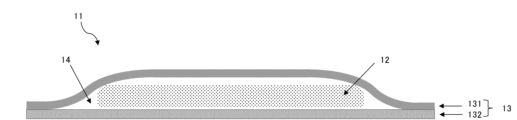
- FIG. 1 shows an example of a heating tool according to the present disclosure.
- An example of a heating tool holder is shown.
- 1 shows an example of a heating tool holder.
- the relationship between the heating temperature and the heating duration of the heating tool used in Test Example 1 is shown. Indicates the skin temperature when the heating tool is attached.
- the results of recording the intensity of morning stiffness (MS score) and the duration of morning stiffness are shown.
- Heat-generating tool for relieving stiffness caused by rheumatoid arthritis or osteoarthritis provides a heat-generating tool for relieving stiffness caused by rheumatoid arthritis or osteoarthritis.
- the present disclosure provides a heat-generating tool for relieving stiffness caused by rheumatoid arthritis or osteoarthritis, comprising an exothermic composition that generates heat upon contact with oxygen and a storage bag containing the exothermic composition, at least a portion of the storage bag being made of a packaging material having air permeability, and having a heat generation temperature of 47°C or lower.
- the heating temperature (maximum heating temperature) of the heating tool of the present disclosure is 47° C. or lower.
- the heating temperature is preferably 46° C. or lower, and more preferably 45° C. or lower.
- the duration for which the heating tool of the present disclosure generates heat to 40°C or higher is preferably 6 hours or more, more preferably 8 hours or more, even more preferably 10 hours or more, and especially preferably 12 hours or more. There is no upper limit to the duration, and it may be determined appropriately depending on the length of time for which a heating tool with a heat temperature of 40°C or higher is desired to be worn on the skin (especially joints such as hands, knees, ankles, etc.).
- the duration for which the heating tool of the present disclosure generates heat to 40°C or higher is more preferably 6 hours or more and 16 hours or less, and especially preferably 8 hours or more and 14 hours or less.
- the average temperature of the heating tool of the present disclosure while it heats up to 40°C or more is preferably 42°C or higher and 46°C or lower.
- the average temperature is more preferably 42.5°C or higher and 45.5°C or lower, and even more preferably 43°C or higher and 45°C or lower.
- the heating temperature (maximum heating temperature) of the heating tool the duration during which the heating tool heats up to 40°C or more, and the average temperature while it heats up to 40°C or more are determined.
- Test Example 1 described below is a value determined according to this procedure.
- the heating tool holder is described in the same manner as the heating tool holder used in Test Example 1 described below.
- the heating tool of the present disclosure is not limited to this extent, but the time it takes to reach a heating temperature of 40°C (rise time) is, for example, within 12 minutes from the time the heating tool is removed from the outer bag, and more preferably within 7 minutes.
- the heating tool of the present disclosure has a heating temperature of 47°C or less, as described above.
- the heating tool satisfies the heating temperature and includes a heat-generating composition that generates heat upon contact with oxygen, and a storage bag that contains the heat-generating composition, with at least a portion of the storage bag being made of a breathable packaging material.
- a heating tool of the present disclosure by attaching the heating tool to a portion of the skin, stiffness caused by rheumatoid arthritis or osteoarthritis can be alleviated, as shown in the test example described below.
- the following heating tool is given as an example of the heating tool.
- the storage bag is a storage bag that stores the exothermic composition, and at least a part of the storage bag has air permeability.
- the storage bag prevents leakage of the exothermic composition and is durable against heat generation at a heat generation temperature of 47°C or less.
- the storage bag is usually a flat bag, and the exothermic composition is stored in the internal space (storage section) of the storage bag.
- the shape of the storage bag is not limited, and may be any shape, including a quadrangular shape (square shape, rectangular shape, etc.), a triangular shape, a circular shape, an elliptical shape, a semicircular shape, etc.
- An example of the storage bag is the bag shown in FIG. 1.
- the heating tool 11 comprises a heat generating composition 12 and a breathable storage bag 13 that contains the heat generating composition 12 inside.
- FIG. 1 shows an example in which the storage bag 13 comprises a first packaging material 131 and a second packaging material 132, and the first packaging material 131 and the second packaging material 132 are joined at the periphery of the storage section 14 area so that the heat generating composition 12 can be contained in the storage section 14.
- the first packaging material 131 is breathable.
- the second packaging material 132 may or may not be breathable.
- the first packaging material 131 is not limited as long as it has breathability, and examples thereof include a breathable resin film, a breathable woven fabric, and a breathable nonwoven fabric.
- the resin film, the woven fabric, the nonwoven fabric, and the like may be used alone or in combination of two or more.
- the resin film, the woven fabric, the nonwoven fabric, and the like may be arbitrarily joined together and used, or may be laminated to form a laminated structure.
- a resin film may be arranged on the inside (the storage section 14 side) of the storage bag 13, and a woven fabric or nonwoven fabric may be arranged on the outside of the storage bag 13.
- a woven fabric or nonwoven fabric may be arranged on the inside of the storage bag 13, and a resin film may be arranged on the outside of the storage section 13.
- the resin film, the woven fabric, the nonwoven fabric, and the like may be arranged in any order and in any number of layers.
- the first packaging material 131 is not limited as long as it has the breathability to allow the heating tool to generate heat at a heating temperature of 47°C or less by contact with oxygen as described above.
- the air permeation flow rate of the first packaging material 131 is preferably 18 ml/min or less.
- an air permeation flow rate of 17.5 ml/min or less is more preferably exemplified, and 17 ml/min or less, 16.5 ml/min or less, 16 ml/min or less, etc. are further exemplified.
- the lower limit of the air permeation flow rate is not limited, and is preferably 10 ml/min or more, more preferably 11.5 ml/min or more, and even more preferably 12 ml/min or more, 12.5 ml/min or more, 13 ml/min or more, etc. are exemplified.
- the air permeation flow rate is preferably 10 ml/min or more and 18 ml/min or less, more preferably 11 ml/min or more and 17 ml/min or less, and even more preferably 12 ml/min or more and 15 ml/min or less, etc.
- the air permeation flow rate of the first packaging material 131 is measured in accordance with JIS K7126-2:2006 "Plastics-Films and sheets-Gas permeability test method-Part 2: Constant pressure method" (Appendix A).
- Test gas: Air (N 2 :O 2 8:2) Measurement conditions: 23 ⁇ 2°C, 50% RH
- the resin used in the breathable resin film is not limited to the present disclosure, but is preferably a thermoplastic resin film.
- thermoplastic resins include polyethylene, polypropylene, polyester, polyamide, polyurethane, polystyrene, polyvinyl alcohol, polyethylene terephthalate, polyvinyl chloride, polyvinylidene chloride, polycarbonate, ethylene-vinyl acetate copolymer, etc.
- resins include polyethylene, polypropylene, polyethylene terephthalate, ethylene-vinyl acetate copolymer, etc.
- the resins may be used alone or in combination of two or more.
- the resin film with breathability has pores at least partially provided to ensure breathability.
- the pores can pass oxygen (air) at least from the outside to the inside of the storage bag, and there are no restrictions on the size, shape, number, or method of forming the pores, as long as they are large enough to prevent the exothermic composition 12 from leaking out of the storage bag.
- the resin film preferably has pores that satisfy the air permeation flow rate. Means for providing pores in a resin film are known, and conventional procedures may be followed. Examples of breathable resin films include perforated films and porous films.
- a porous film is a conventional, general term that refers to a porous film having a large number of pores that are connected to each other. The pores may be formed uniformly throughout the resin film, or may be formed densely in a portion of the resin film.
- the thickness of the resin film is not limited as long as it can be used as a packaging material for the storage bag and has breathability.
- Examples of the thickness of the resin film include a preferable range of 10 ⁇ m to 2000 ⁇ m, more preferably 10 ⁇ m to 1000 ⁇ m, and even more preferably 50 ⁇ m to 200 ⁇ m.
- fiber materials for breathable woven or nonwoven fabrics include semi-synthetic or synthetic fibers such as nylon, vinylon, polyester, rayon, acrylic, polyethylene, polypropylene, acetate, polyvinyl chloride, polybutylene terephthalate, and ethylene-vinyl acetate copolymers; natural fibers such as cotton, hemp, silk, and paper; and any mixed fibers selected from semi-synthetic, synthetic, and natural fibers.
- preferred examples of fiber materials include nylon, polyester, polypropylene, and ethylene-vinyl acetate copolymers, and more preferred examples include nylon, polyester, and ethylene-vinyl acetate copolymers.
- One type of fiber material may be used alone, or two or more types may be used in combination.
- the woven fabric and nonwoven fabric are not limited as long as they can be used as a packaging material for the storage bag and have breathability, and the basis weight is preferably 10 g/ m2 or more and 80 g/ m2 or less, and more preferably 20 g/ m2 or more and 70 g/ m2 or less.
- the thickness of the nonwoven fabric or woven fabric is not limited as long as it can be used as a packaging material for the storage bag and has breathability, and examples of the thickness include a thickness of preferably 10 ⁇ m to 2000 ⁇ m, more preferably 10 ⁇ m to 1000 ⁇ m, and even more preferably 50 ⁇ m to 500 ⁇ m.
- the laminate is not limited as long as it can be used as a packaging material for a storage bag and has breathability.
- the laminate can be laminated by a lamination method, and examples of the lamination method include a method of laminating by thermal bonding, and a method of laminating using any adhesive such as a hot melt adhesive, an acrylic adhesive, or a urethane adhesive.
- the laminate structure may be formed on the entire surface of the first packaging material 131, or on only a part of it.
- the second packaging material 132 may or may not have air permeability.
- the second packaging material 132 may be the same packaging material as the first packaging material 131, or may be a different packaging material. Therefore, both the first packaging material 131 and the second packaging material 132 may have air permeability. Moreover, the first packaging material 131 may have air permeability, and the second packaging material 132 may not have air permeability.
- the first packaging material 131 and the second packaging material 132 may both be breathable resin films.
- the first packaging material 131 may be a breathable resin film
- the second packaging material 132 may be a laminate of a breathable resin film and a breathable nonwoven fabric.
- the first packaging material 131 and the second packaging material 132 may both be laminates. Even if the second packaging material 132 is a laminate having a laminate structure, the laminate structure may be formed over the entire surface of the second packaging material 132, or may be formed over only a portion of it.
- the first packaging material 131 and the second packaging material 132 may both have an air permeation flow rate of 18 ml/min or less.
- the first packaging material 131 and the second packaging material 132 may both have an air permeation flow rate of 16 ml/min or less.
- the first packaging material 131 may be a packaging material with an air permeation flow rate of 10 ml/min or more and 18 ml/min or less
- the second packaging material 132 may be a packaging material with an air permeation flow rate of 16 ml/min or less.
- the air permeation flow rate of the second packaging material 132 is also determined in the same manner as described above.
- the lower limit of the air permeation flow rate of the packaging material is 0 ml/min.
- An air permeation flow rate of 0 ml/min means non-breathability.
- the air permeation flow rate of the second packaging material 132 can also be adjusted by appropriately changing the size and shape of the pores provided in the resin film, the basis weight and thickness of the woven fabric and nonwoven fabric, etc.
- the air permeation flow rate of the second packaging material 132 is 0 ml/min or more.
- Preferred examples of the air permeation flow rate of the second packaging material 132 include 0 ml/min or more and 18 ml/min or less, more preferably 0 ml/min or more and 17 ml/min or less, more preferably 5 ml/min or more and 16 ml/min or less, and even more preferably 10 ml/min or more and 15 ml/min or less.
- examples of combinations of the first packaging material 131 and the second packaging material 132 include (1) a combination in which the first packaging material 131 has an air permeation flow rate of 10 ml/min or more and 18 ml/min or less, and the second packaging material 132 has an air permeation flow rate of 0 ml/min or more and 18 ml/min or less, (2) a combination in which the first packaging material 131 has an air permeation flow rate of 10 ml/min or more and 17 ml/min or less, and the second packaging material 132 has an air permeation flow rate of 5 ml/min or more and 17 ml/min or less, and (3) a combination in which the first packaging material 131 has an air permeation flow rate of 13 ml/min or more and 15 ml/min or less, and the second packaging material 132 has an air permeation flow rate of 10 ml/min or more and 16 ml/min or less.
- Examples of the second packaging material 132 include resin film, woven fabric, nonwoven fabric, etc. Resin film, woven fabric, nonwoven fabric, etc. may be used alone or in combination of two or more types. For the second packaging material 132, resin film, woven fabric, nonwoven fabric, etc. may be joined together as desired and used, or may be layered to form a layered structure. When the second packaging material 132 has a layered structure, similar to the first packaging material 131, resin film, woven fabric, nonwoven fabric, etc. may be arranged in any order and with any number of layers.
- the resin used in the resin film is described in the same manner as the first packaging material 131, except that it does not matter whether it has breathability.
- the size, shape, number, method of forming the pores, presence or absence of pores, etc. of the pores that can be provided in the resin film are not limited as long as they can prevent the exothermic composition 12 from leaking out of the storage bag.
- pores are provided in the resin film of the second packaging material 132, they may be formed uniformly over the entire resin film, or may be formed densely in a part.
- the thickness of the resin film is also not limited as long as it can be used as a packaging material for the storage bag 13.
- thicknesses are preferably 10 ⁇ m or more and 2000 ⁇ m or less, more preferably 10 ⁇ m or more and 1000 ⁇ m or less, even more preferably 50 ⁇ m or more and 500 ⁇ m or less, and even more preferably 100 ⁇ m or more and 300 ⁇ m or less.
- the fiber material of the woven or nonwoven fabric is not limited to the present disclosure, but may be breathable or not, and may be the same as the first packaging material 131.
- the basis weight of the woven or nonwoven fabric is not limited as long as it can be used as a packaging material for the storage bag 13, and is preferably 300 g/m 2 or more and 800 g/m 2 or less, and more preferably 400 g/m 2 or more and 700 g/m 2 or less.
- the thickness of the nonwoven or woven fabric is also not limited as long as it can be used as a packaging material for the storage bag 13.
- the thickness is preferably 10 m or more and 2000 ⁇ m or less, more preferably 10 m or more and 1000 ⁇ m or less, even more preferably 50 ⁇ m or more and 500 ⁇ m or less, and even more preferably 100 ⁇ m or more and 300 ⁇ m or less.
- At least one of the first packaging material 131 and the second packaging material 132 may be provided with any other layer, such as a vapor deposition layer, a metal foil layer, a printed ink layer, an adhesive layer, or a sealant layer, by lamination or the like, so long as the heating temperature of the heating tool is kept below 47°C.
- the other layers may be used alone or in combination.
- the other layers may be provided on a partial surface or the entire surface of at least one of the first packaging material 131 and the second packaging material 132.
- the means for providing the other layers on the packaging material may follow conventionally known means.
- examples of components constituting the deposition layer include metals such as aluminum, chromium, zinc, gold, silver, platinum, and nickel, inorganic oxides such as silicon dioxide, titanium oxide, aluminum oxide, zirconium oxide, and silica, inorganic fluorides such as magnesium fluoride, inorganic nitrides such as titanium nitride, and carbides such as titanium carbide. Any of the deposition layers containing such components may be used alone or in combination. There are no limitations on the thickness, size, shape, and the like of the deposition layer. Examples of the thickness of the deposition layer are preferably 1 nm or more and 1000 nm or less, and more preferably 5 nm or more and 100 nm or less.
- the deposition layer may be laminated, for example, on the inside of the storage bag (the side in contact with the exothermic composition), on the outside of the storage bag, or on both sides.
- the deposition layer may be laminated, for example, between at least one of the layers of the resin film, the nonwoven fabric, and the woven fabric constituting the packaging material.
- the deposition may be performed based on a conventionally known deposition method.
- examples of the metal foil layer include an aluminum foil layer, a stainless steel foil layer, and the like.
- the metal foil layers may be used alone or in combination.
- examples of the thickness of the metal foil layer include a thickness of preferably 10 nm to 1000 nm, and more preferably 20 nm to 500 nm.
- the metal foil layer may also be laminated on the inside, outside, or both sides of the storage bag.
- the storage bag 13 contains the exothermic composition 12 in a storage section 14 formed by using a first packaging material and a second packaging material.
- the first packaging material 131 and the second packaging material 132 are joined at the periphery of the area of the storage section 14 so that the exothermic composition 12 can be stored in the storage section 14, thereby forming the storage section 14.
- the exothermic composition 12 is stored in the storage section 14, which is a space inside the storage bag, located inside the peripheral joint formed by joining the peripheral parts of the first packaging material 131 and the second packaging material 132.
- the joining is not limited as long as the first packaging material 131 and the second packaging material 132 can be joined, and examples include a method of heat sealing (thermal welding using a welding resin, etc.), and a method of bonding them together using an adhesive.
- the exothermic composition 12 is contained in a container bag 13, and generates heat upon contact with oxygen.
- the exothermic composition 12 contains an oxidizable metal powder, an oxidation promoter, and a water retention agent.
- Oxidizable metal powder is not limited as long as it is a metal powder that generates heat by oxidation, and examples thereof include iron powder, zinc powder, aluminum powder, magnesium powder, copper powder, etc., and preferably iron powder. Examples of iron powder include reduced iron powder, cast iron powder, atomized iron powder, electrolytic iron powder, etc.
- the shape of the oxidizable metal powder is also not limited, and examples thereof include powders such as powders, granules, and fibers used in conventional general disposable chemical warmers. The oxidizable metal powder may be used alone or in combination of two or more types.
- the content of the oxidizable metal powder is not limited, and examples of the oxidizable metal powder in the exothermic composition 12 include 20% by mass or more and 80% by mass or less, preferably 25% by mass or more and 70% by mass or less, and more preferably 30% by mass or more and 65% by mass or less.
- Pro-oxidant is used for the purpose of promoting the supply of oxygen to the heat generating composition 12, particularly to the oxidizable metal powder, by taking in oxygen.
- the pro-oxidant include, but are not limited to, activated carbon, coal, charcoal, bamboo charcoal, graphite, carbon black, graphite, acetylene black, and coffee grounds charcoal.
- the pro-oxidant include, but are not limited to, activated carbon, carbon black, bamboo charcoal, charcoal, and coffee grounds charcoal.
- the shape of the pro-oxidant is not limited either, and examples of the pro-oxidant include powder, granules, and fibers that are used in conventional disposable chemical warmers. The pro-oxidant may be used alone or in combination of two or more.
- the content of the pro-oxidant is not limited, but examples of the pro-oxidant include 1% by mass or more and 30% by mass or less, preferably 3% by mass or more and 25% by mass or less, and more preferably 5% by mass or more and 23% by mass or less in the heat generating composition 12.
- the ratio of the oxidizable metal powder to the oxidation promoter can be, for example, 2 parts by mass or more and 60 parts by mass or less, preferably 5 parts by mass or more and 50 parts by mass or less, and more preferably 10 parts by mass or more and 40 parts by mass or less, of the oxidation promoter per 100 parts by mass of the oxidizable metal powder.
- Water retention agent has a function of retaining water, and examples thereof include porous materials and water-absorbent resins.
- water retention agents include natural and synthetic inorganic substances such as vermiculite, perlite, calcium silicate, magnesium silicate, kaolin, talc, smectite, mica, bentonite, calcium carbonate, silica gel, alumina, zeolite, silicon dioxide, and diatomaceous earth, and natural and synthetic organic substances such as pulp, wood flour (sawdust), cotton, polyacrylate resins, polysulfonate resins, maleic anhydride resins, polyacrylamide resins, polyvinyl alcohol resins, polyethylene oxide resins, polyaspartate resins, polyglutamate resins, polyalginate resins, starches, and celluloses.
- water retention agents examples include vermiculite, wood flour, pulp, polyacrylate resins, and the like, and more preferably vermiculite, polyacrylate resins, and the like. Water retention agents may be used alone or in combination of two or more.
- the content of the water retention agent is not particularly limited, but can be 1% by mass or more and 20% by mass or less, preferably 3% by mass or more and 15% by mass or less, and more preferably 5% by mass or more and 10% by mass or less, in the exothermic composition 12.
- those having a porous structure such as vermiculite can function not only as a water retention agent but also as a passageway for oxygen (air).
- the exothermic composition 12 may contain other components that can be blended into the exothermic composition 12 as necessary.
- other components include water-soluble salts, water, hydrogen gas generation inhibitors (such as sodium thiosulfate), thickeners, excipients, surfactants, sequestering agents, and useful components described below.
- the other components may be appropriately selected and used depending on the purpose, and may be used alone or in combination of two or more types, and the amounts blended may be appropriately selected.
- water-soluble salts are exemplified by chloride salts and sulfide salts of alkali metals such as sodium and potassium, chloride salts and sulfide salts of alkaline earth metals such as calcium and magnesium, and chloride salts and sulfide salts of metals such as iron, copper, aluminum, zinc, nickel, silver, and barium.
- chloride salts and sulfide salts of alkali metals such as sodium and potassium
- chloride salts and sulfide salts of alkaline earth metals such as calcium and magnesium
- chloride salts and sulfide salts of metals such as iron, copper, aluminum, zinc, nickel, silver, and barium.
- Preferred examples of water-soluble salts include sodium chloride and potassium chloride.
- Water-soluble salts may be used alone or in combination of two or more.
- the content of the water-soluble salts in the composition is exemplified by 0.1% by mass to 10% by mass, preferably 0.5% by mass to 7% by mass, and more preferably 1% by mass to 5% by mass.
- water can be exemplified by distilled water, tap water, ion-exchanged water, pure water, ultrapure water, industrial water, etc.
- the water content in the exothermic composition 12 is exemplified as 5% by mass or more and 50% by mass or less, preferably 10% by mass or more and 40% by mass or less, and more preferably 15% by mass or more and 35% by mass or less.
- the exothermic composition 12 is prepared by mixing the above-mentioned ingredients.
- the exothermic composition 12 may be prepared in the presence of oxygen, or may be prepared under reduced pressure or in an inert gas atmosphere.
- the exothermic composition 12 is preferably prepared under reduced pressure or in an inert gas atmosphere.
- the preparation can be carried out according to a conventionally known manufacturing procedure for exothermic compositions. By this preparation, an exothermic composition 12 that generates heat in the presence of oxygen (air) is obtained.
- the exothermic composition 12 is contained in the storage bag 13.
- the amount of the exothermic composition 12 contained in the storage bag 13 is not limited as long as the effects of the present disclosure can be obtained, and may be appropriately determined depending on the size, shape, and degree of breathability (air permeability rate) of the storage bag 13.
- the amount of the exothermic composition 12 per 1 cm2 of the first packaging material in the region forming the storage section 14 (inside the storage bag) is about 0.01 g to 2 g, preferably about 0.05 g to 1.5 g, and more preferably about 0.1 g to 1 g.
- the area of the first packaging material 131 in the region forming the storage section 14 is preferably 3 cm2 or more and 9 cm2 or less, more preferably 4 cm2 or more and 8 cm2 or less, etc.
- the heating tool of the present disclosure may have one storage section 14, or may have two or more storage sections 14.
- the heat generating composition 12 is usually stored in each storage section.
- the amount of heat generating composition 12 stored in each storage section may be the same or different.
- the size, shape, and packaging material forming the storage sections 14 of each storage section may be the same or different.
- the storage bag 13 may be provided with an adhesive layer.
- the adhesive layer is usually laminated on the outside of the storage bag 13.
- the adhesive layer is useful from the viewpoint of easily attaching the storage bag 13 to an object such as skin, clothing, or a heating tool holder.
- the adhesive layer can be provided on at least one of the first packaging material 131 and the second packaging material 132 to the extent that the effect of the present disclosure is not hindered.
- the adhesive layer may be provided on a partial surface or the entire surface of at least one of the first packaging material 131 and the second packaging material 132.
- the means for providing the adhesive layer on the packaging material may follow a conventionally known means.
- the adhesive layer usually contains an adhesive that allows the storage bag 13 to be attached to an object.
- Preferred examples of the adhesive include adhesives that are not harmful when applied directly to the skin and are used in conventional patches and the like.
- the adhesive include rubber adhesives such as styrene-butadiene-styrene copolymer (SBS), styrene-isoprene-styrene copolymer (SIS), styrene-ethylene-butylene-styrene copolymer (SEBS), and styrene-ethylene-propylene-styrene copolymer (SEPS); acrylic adhesives such as methyl acrylate (MA), ethyl acrylate (EA), 2-ethylhexyl acrylate (HA), and butyl acrylate (BA); silicone adhesives such as addition curing type and peroxide curing type; and urethane adhesives such as ether type and ester type.
- SBS s
- the adhesives may be used alone or in combination. There are no limitations on the amount of adhesive contained in the adhesive layer as long as the storage bag 13 can be attached to the skin or the like.
- the adhesive content in the adhesive layer is 10% by mass or more and 99% by mass or less, more preferably 30% by mass or more and 98% by mass or less, and even more preferably 50% by mass or more and 97% by mass or less.
- the adhesive layer may further contain useful ingredients (fragrances, vitamins, animal and plant extracts, anti-fatigue ingredients, anti-inflammatory ingredients, blood circulation promoting ingredients, relaxing ingredients, refreshing ingredients, repellent ingredients, sedative ingredients, moisturizing ingredients, whitening ingredients, anti-wrinkle ingredients, antibacterial ingredients, antioxidant ingredients, etc.), oils, preservatives, colorants, and other optional ingredients depending on the purpose, as long as the effects of the present disclosure are not hindered.
- useful ingredients fragments, vitamins, animal and plant extracts, anti-fatigue ingredients, anti-inflammatory ingredients, blood circulation promoting ingredients, relaxing ingredients, refreshing ingredients, repellent ingredients, sedative ingredients, moisturizing ingredients, whitening ingredients, anti-wrinkle ingredients, antibacterial ingredients, antioxidant ingredients, etc.
- oils preservatives, colorants, and other optional ingredients depending on the purpose, as long as the effects of the present disclosure are not hindered.
- the optional ingredients may be used alone or in combination, and the content of the optional ingredients may be determined appropriately.
- examples of the fragrance include fragrances obtained by using natural fragrances such as essential oils alone or in combination, fragrances obtained by using synthetic single fragrances alone or in combination, and blended fragrances obtained by combining natural fragrances and synthetic fragrances in any combination.
- the fragrances may be used alone or in combination of two or more.
- the fragrance can be used as a useful component such as an anti-fatigue component, an anti-inflammatory component, a blood circulation promoting component, or a relaxing component.
- the useful component be a component that can volatilize at 47°C or less, which is the temperature at which the heat-generating composition generates heat in the presence of oxygen (air).
- the useful components may be liquid, solid, etc.
- the content of the active ingredient in the adhesive layer may be appropriately set depending on the desired effect.
- the content of the useful ingredient in the adhesive layer may be, for example, 0.00001% by mass or more and 85% by mass or less, preferably 0.0001% by mass or more and 10% by mass or less, and more preferably 0.0001% by mass or more and 5% by mass or less.
- the thickness, size, shape, etc. of the adhesive layer may also be appropriately determined depending on the purpose.
- the thickness of the adhesive layer may be, for example, 1 ⁇ m or more and less than 3000 ⁇ m, and more preferably 10 ⁇ m or more and less than 300 ⁇ m.
- a release sheet may be attached to the surface of the adhesive layer to prevent the surface of the adhesive layer from drying out.
- release sheets include films of silicone-treated polyethylene terephthalate, polypropylene, etc., and sheets of paper, etc. The release sheet is usually peeled off when the heating tool is used.
- the heating tool of the present disclosure generates heat upon contact with oxygen (air), and is therefore generally provided and stored in an airtight state by being further packaged in an oxygen-impermeable outer bag.
- the heating tool of the present disclosure is used by causing the heat generating composition 12 to generate heat upon contact with oxygen.
- the heating tool is stored in an airtight outer bag to prevent it from coming into contact with oxygen.
- the outer bag is opened and the heating tool is removed from the outer bag, and the heat generating composition 12 is brought into contact with oxygen to generate heat.
- the outer bag is opened and the heating tool is removed from the outer bag, and the heat generating composition 12 is brought into contact with oxygen to generate heat.
- the heating tool i.e., by using a heating tool that includes an exothermic composition that generates heat upon contact with oxygen and a storage bag that stores the exothermic composition, at least a portion of the storage bag is made of a breathable packaging material, and the heating temperature is 47° C. or less, stiffness caused by rheumatoid arthritis or osteoarthritis can be alleviated. Therefore, the heating tool is useful for alleviating stiffness caused by rheumatoid arthritis or osteoarthritis.
- the heating tool of the present disclosure may be used by attaching it to a part of the skin of the body. Although not limiting the present disclosure, the heating tool of the present disclosure is preferably used for the purpose of relieving stiffness in the hands. Furthermore, the heating tool of the present disclosure is more preferably used for the purpose of relieving stiffness in the wrist and fingers (difficulty in moving the wrist joints, difficulty in moving the finger joints). Therefore, the heating tool of the present disclosure is used by attaching it to the hand as part of the skin, and more preferably to at least one of the wrist and fingers.
- the heating tool of the present disclosure is attached to the skin.
- Subjects who experience stiffness due to rheumatoid arthritis or osteoarthritis may feel stiffness continuously throughout the day or may feel stiffness intermittently. Stiffness also often occurs after sleep, and "morning stiffness," in which the joints feel difficult to move upon waking, is known as a symptom that tends to appear early in rheumatoid arthritis or osteoarthritis.
- the heating tool of the present disclosure may be attached to the subject when the subject is feeling stiffness, or when the subject is not feeling stiffness. Furthermore, it is preferable to attach the heating tool of the present disclosure to a part of the skin before sleep.
- stiffness can be alleviated. Furthermore, according to the present disclosure, it is expected that stiffness can be prevented from occurring.
- the method of attaching the heating tool of the present disclosure is not limited as long as the heating tool can be attached to a part of the skin of the subject.
- the heating tool of the present disclosure may be attached directly to the skin or indirectly.
- the means is not limited, but from the viewpoint of easy attachment, a preferred example is to use a heating tool with an adhesive layer and attach the adhesive layer directly to the skin.
- indirectly attached the means is not limited, but from the viewpoint of easy attachment, a preferred example is to use a heating tool with an adhesive layer and attach the adhesive layer to clothing, bedding, etc., and a preferred example is to attach the heating tool to the skin via clothing, bedding, etc.
- a preferred example is to attach the heating tool using a holder capable of holding the heating tool.
- holder capable of holding the heating tool there are no limitations on the holder capable of holding the heating tool, so long as it can be attached to a part of the skin and has a holding part capable of holding the heating tool of the present disclosure.
- Examples of such holders include the holders shown in Figures 2 and 3.
- Figure 2 shows an example of a holder having a structure with a cylindrical main body portion through which the wrist can be inserted and a pocket portion (holding portion) capable of housing the heating tool of the present disclosure.
- the main body portion has a fixing portion to which a hook-and-loop fastener is attached, and by adjusting the position of the fixing portion attached to the main body portion, the heating tool can be fixed to the wrist joint.
- Figure 2B shows an example of the holder attached to the wrist.
- Figure 3 is an example of a glove-shaped holder.
- Figure 3 is an example of a holder with a structure that covers the wrist to the back of the hand and the palm.
- a pocket (holding part) into which a heating tool can be inserted may be provided in the area from the wrist to the back of the hand, and in this case, the heating tool is inserted into the pocket for use.
- the pocket may be located on the inside (skin side) of the area from the wrist to the back of the hand, or on the outside of the area.
- the heating tool can be fixed to the hand by inserting the hand through the holder.
- the heating tool may be fixed to the hand by inserting it between the area of the holder from the wrist to the back of the hand and the back of the hand.
- the area of the holder from the wrist to the back of the hand can be said to be the holding part.
- the heating tool may be attached to the holding part by an adhesive layer provided on the heating tool.
- Figure 3 shows an example of a holder that does not cover the fingertips, but it may be a holder that covers the entire tip of at least one of the fingers. Also, while the parts of the finger that are usually referred to as the first joint, second joint, and third joint in that order from the part closest to the fingertip, this holder may cover up to the third joint, or may even cover up to the second joint, or may even cover up to the first joint. Also, Figure 3 shows an example of a holder that has a holding part for the heating tool on the back of the hand, but it may be a holder that has a holding part for the heating tool on the palm side.
- the holding portion capable of holding the heating tool in the holder of the present disclosure is not limited as long as it can hold the heating tool.
- it may be provided with a pocket portion capable of housing the heating tool as in FIG. 2.
- the portion of the holder to which the heating tool is attached can be said to be the holding portion.
- the heating tool may be attached to a part of the skin by fixing the holder to the body, for example by wrapping a stretchable holder around the skin, and placing the heating tool of the present disclosure between the holder and the skin.
- Examples of materials constituting the holder include natural fibers such as cotton, hemp, silk, and paper; semi-synthetic or synthetic fibers such as rayon, acetate, nylon, vinylon, polyester, polyurethane, acrylic, polyethylene, polypropylene, polyvinyl chloride, and polybutylene terephthalate; and any mixture of these fibers.
- Preferred examples of the material include polyester and polyurethane.
- the holder may further include a fixing string, fixing rubber, hook-and-loop fastener, hooks, buttons, zippers, double-sided tape, and the like for holding the heating device to the body, as necessary.
- the holder may be a commercially available product, or a known attachment such as the attachment for a heating/cooling device described in JP 2018-000389 A may be used as the holder.
- the heating tool of the present disclosure is preferably attached to at least the skin of the hand, neck, knee, ankle, toes, etc., and more preferably to the joints.
- the heating tool of the present disclosure is preferably attached to the hand (particularly parts of the hand such as the wrist, back of the hand, palm, fingers, etc.). Therefore, the holder for attaching the heating tool of the present disclosure is not limited as long as it can be attached to the skin for which the heating tool of the present disclosure is intended.
- the present disclosure can be said to provide a heating tool set for relieving stiffness caused by rheumatoid arthritis or osteoarthritis, which includes the heating tool and a holder that is attached to a part of the skin of a subject having stiffness caused by rheumatoid arthritis or osteoarthritis, and the holder has a holding portion that can hold the heating tool for relieving stiffness.
- the heating tool is usually contained in a non-breathable outer bag. Furthermore, there is no limit to the number of heating tools of the present disclosure that may be included in the set. Furthermore, in addition to the heating tool and holder of the present disclosure, the set may further include instructions for use, etc.
- the instructions for use may include a webpage URL or a readable code, etc., and instructions for use, etc. may be obtained via the URL or readable code, etc. These may be used alone or in combination of two or more types.
- the subject (subject) to which the heating device of the present disclosure is attached may be either a human or a non-human mammal, but is usually a human.
- the subject's age, sex, etc. are also not important, but in the case of humans, ages of 18 years or older are an example. In the case of humans, ages of 18 years or older and younger than 60 years are preferred, ages of 30 years or older and younger than 60 years are more preferred, and ages of 40 years or older and younger than 60 years are even more preferred.
- preferred examples of subjects to which the device is attached are women.
- the heating tool disclosed herein comprises a heat-generating composition that generates heat upon contact with oxygen, and a storage bag that contains the heat-generating composition, at least a portion of which is made of a breathable packaging material, and generates heat at a temperature of 47°C or less, making it useful for relieving stiffness caused by rheumatoid arthritis or osteoarthritis.
- Paraffin baths are known as a typical method for relieving stiffness in the hands, but there is a problem in that the fingers cannot be used during the paraffin bath or while they are covered in paraffin, restricting movement.
- paraffin baths are generally performed at medical institutions, which requires the patient to go to the hospital in order to do so.
- stiffness it often takes between one hour and half a day for the stiffness to go away, making it difficult to secure enough time for it to go away.
- morning stiffness it is difficult to secure between one hour and half a day after waking up, which causes significant disruption to daily life.
- the heating tool of the present disclosure has the advantage that it can be easily used even at home.
- the heating tool of the present disclosure does not limit the time of use, and it can be simply worn while sleeping.
- the heating tool of the present disclosure can alleviate morning stiffness upon waking up and stiffness in the hands. For this reason, the heating tool of the present disclosure has the advantage that it is very easy to use.
- the heating tool of the present disclosure has an extremely low risk of low-temperature burns even when used while sleeping, and is also excellent in terms of safety.
- the present disclosure encompasses a skin warming method comprising the steps of attaching a heating tool to a part of the skin of a subject experiencing stiffness due to rheumatoid arthritis or osteoarthritis, and warming the part of the skin to a temperature of 37° C. or higher and 42° C. or lower for four hours or more.
- the subject who experiences stiffness due to rheumatoid arthritis or osteoarthritis is described as above.
- the part of the skin to which the heating tool is attached is also described as above.
- the disclosed method requires that a portion of the skin be heated to 37°C or higher and 42°C or lower for at least 4 hours.
- the heating tool is not limited as long as it can heat a portion of the skin to 37°C or higher and 42°C or lower for at least 4 hours, but a preferred example is the heating tool described in 1) above. That is, a preferred example is a heating tool that includes a heat-generating composition that generates heat when in contact with oxygen and a storage bag that contains the heat-generating composition, at least a portion of the storage bag is made of a breathable packaging material, and the heating temperature is 47°C or lower.
- the heating tool described in 1) above is usually stored in a non-breathable outer bag until it is used. Therefore, after removing the heating tool from the outer bag, the heating tool is attached to a portion of the skin.
- the method of attaching the heating tool is not limited as long as it can be attached to a part of the subject's skin, and is preferably the same as described above.
- the heating tool may be attached directly or indirectly to the skin, or the heating tool may be attached using a holder capable of holding the heating tool.
- the holder described above is an example of such a holder.
- a portion of the skin has been heated to a temperature between 37°C and 42°C for four hours or more is determined as follows:
- the temperature sensor of the thermometer is attached to the portion of the skin with skin tape.
- the heating tool is attached to the portion of the skin so that it is in direct or indirect contact with the attached temperature sensor, and the skin temperature is recorded.
- the skin temperature is measured at one-minute intervals.
- the temperature is determined according to the procedure described in the test described below. That is, the temperature sensor of a thermometer (product name: Ondotori TR71-nw, manufacturer: T&D Corporation) is attached to a part of the skin (the outside of the wrist (back of the hand)) with skin tape. Next, with the heating tool placed in the pocket (holding part) of the heating tool holder, the holder is attached to the wrist so that the heating tool touches the temperature sensor via the holder. Skin temperature is measured at one-minute intervals.
- a thermometer product name: Ondotori TR71-nw, manufacturer: T&D Corporation
- the heating temperature of the heating tool can be adjusted as necessary with reference to the test example described below, and the heating tool can be selected appropriately.
- the heating temperature of the heating tool, as well as the average temperature and duration, are as described above.
- the time for which the heating device is attached to a part of the skin is not limited, and is typically 4 hours or more.
- Preferred examples of the attachment time include 4 to 12 hours, 4.5 to 12 hours, 5 to 11 hours, 6 to 10 hours, and 8 to 10 hours.
- the time can be determined appropriately depending on the time for which the skin needs to be warmed to 37°C to 42°C.
- the part of the skin to which the heating device is attached is preferably the skin of the hands, neck, knees, ankles, etc., and more preferably the joints. More preferably, the part of the skin is the hand (particularly parts of the hand such as the wrist, back of the hand, palm, and fingers).
- the subject can be any age, but in the case of humans, an example of the subject is 18 years of age or older. In addition, in the case of humans, an age of 18 years of age or older and younger than 60 years of age is preferable, an age of 30 years of age or older and younger than 60 years of age is more preferable, and an age of 40 years of age or older and younger than 60 years of age is even more preferable. In addition, a more preferable example of the subject is a woman.
- heating device may be attached to the subject when the subject feels stiffness, or when the subject does not feel stiffness.
- the method disclosed herein keeps a part of the skin of a subject who has stiffness due to rheumatoid arthritis or osteoarthritis warm at 37°C or higher and 42°C or lower for at least four hours. Furthermore, as can be seen from the test example described below, surprisingly, even when a heating device was worn while sleeping and a part of the skin was warmed at 37°C or higher and 42°C or lower for at least four hours, the risk of low-temperature burns was reduced. Therefore, the skin warming method disclosed herein not only keeps the skin warm at a predetermined temperature, but is also excellent in that it is highly safe as it reduces the risk of low-temperature burns. For this reason, the skin warming method disclosed herein can be easily performed at home.
- Test Example 1 Heating Tool 1. Manufacturing of the heating tool The heating tool was manufactured according to the following procedure. ⁇ Exothermic Composition> The components were mixed in the amounts shown below to prepare a heat-generating composition having a total weight of 13.8 g: 55% by weight of iron powder (metallic iron content: 90% or more), 27.7% by weight of water, 10.4% by weight of activated carbon (particle size: ⁇ 250 mesh), 1.9% by weight of vermiculite (particle size: ⁇ 2.5 mm), 3.2% by weight of water-absorbent resin (absorption capacity: 180 times or more), 1.7% by weight of water-soluble salts (sodium chloride), and 0.1% by weight of sodium thiosulfate.
- ⁇ Storage bag> A breathable porous film (manufactured by Nitoms Corporation, product name Breathlon, thickness: 0.24 mm, laminated structure including resin film and nonwoven fabric) was used as the first packaging material.
- the air permeation flow rate of the first packaging material was 14.5 ml/min.
- a non-breathable film having the laminated structure shown in Table 1 below was used as the second packaging material (thickness: 73 ⁇ m).
- the air permeation flow rate of the second packaging material was 0 ml/min.
- both the first packaging material and the second packaging material were commercially available products, and the air permeation flow rate was the value listed in the catalog of each packaging material.
- the air permeation flow rate of the first packaging material and the second packaging material was measured in accordance with JIS K7126-2:2006 "Plastics - Films and sheets - Gas permeability test method - Part 2: Constant pressure method" (Appendix A).
- Test pieces The first packaging material (breathable porous film) and the second packaging material (non-breathable film) were used.
- the obtained heat-generating tool was stored in an air-impermeable outer bag in order to store the heat-generating tool without contacting oxygen.
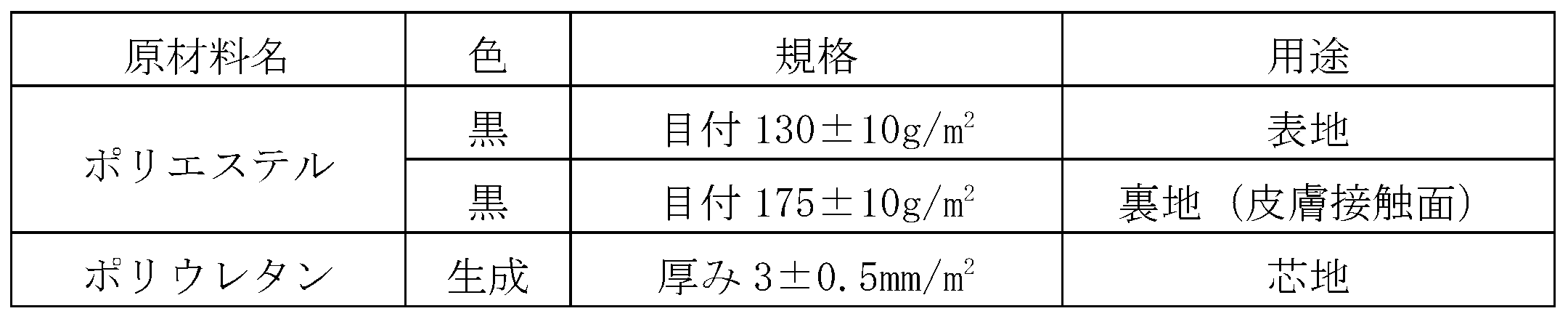
- the heating tool holder used in this test example has a cylindrical main body made of polyester and polyurethane through which the wrist joint can be inserted, and a pocket (holding part) capable of housing the heating tool.
- a dedicated holder for the commercially available product "Kirihai Maki Poka for Wrist" was used.
- a schematic diagram of the holder is shown in Figure 2.
- the main body has a fixing part to which a fixing means (hook and loop fastener) is attached, and the heating tool is fixed to the wrist joint by contacting the fixing means attached to the fixing part with the main body.
- the color, specifications and uses of the raw materials used in the holder are as shown in Table 2 below.
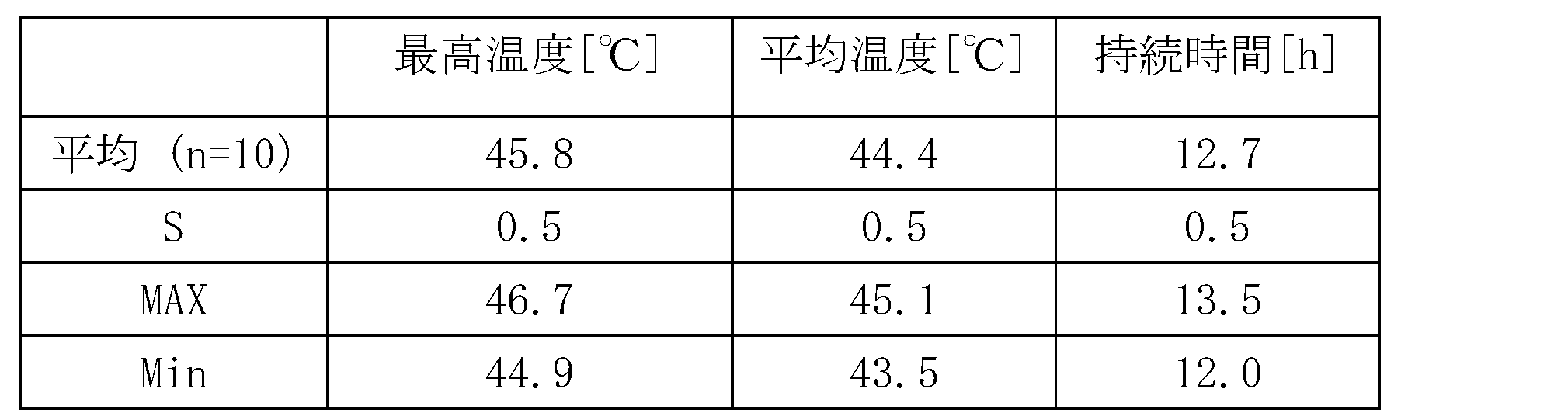
- Table 3 shows the maximum heating time of the heating tool, the average temperature while it heats up to 40°C or more, and the duration of heating up to 40°C or more.
- JIS S4100:2007 measurements were taken from immediately after the start of heating until the temperature reached its maximum and dropped below 40°C.
- the average temperatures in the table were calculated using the following procedure. This procedure followed the procedure for evaluating the average temperature described in the Tokyo Metropolitan Government's guidelines for the labeling of disposable warmers.
- A Using 10 samples (heating tools), a temperature characteristic test was conducted as described above, and measurement values were selected every 15 minutes from when the temperature reached 40°C after the start of heating, through the maximum temperature, until the temperature reached 40°C.
- the maximum and minimum values were excluded every 15 minutes. (However, if there were multiple maximum or minimum values, one of the multiple maximum or minimum values was excluded.) After excluding these, the total value (Tsam) of all remaining measurement values was calculated, and this was divided by the number of measurement values (NT) to calculate the average temperature (Tav).
- Tsam total value of all remaining measurement values was calculated, and this was divided by the number of measurement values (NT) to calculate the average temperature (Tav).
- NT number of measurement values
- the heating temperature of the heating tool (maximum temperature in the table) was 45.8°C
- the duration of heating to 40°C or above was 12.7 hours.
- Test Example 2 Skin warming 1. Test procedure Just before the subjects (6 people) went to sleep, one heating tool manufactured in Test Example 1 was removed from the non-breathable outer bag and placed in the pocket of the heating tool holder used in Test Example 1. The holder was then attached to the skin of the subject's wrist by wrapping it around the skin using a hook-and-loop fastener, and the skin temperature was measured while the subject was sleeping. The temperature measurement was performed as follows.
- thermometer product name: Ondotori TR71-nw, manufacturer: T&D Corporation
- the temperature sensor of a thermometer was attached to the outside of the wrist (back of the hand) with skin tape.
- the heating tool placed in the pocket (holding part) of the heating tool holder
- the holder was attached to the wrist so that the heating tool was placed over the temperature sensor through the holder.
- the skin temperature was recorded at 1-minute intervals. 2.
- Results The results are shown in Figure 5. As shown in Figure 5, the skin temperature rose about 15 minutes after starting to use (attach) the heating tool, and the highest measured skin temperature was 40.8°C over the course of six hours. In addition, the measured temperature remained between 37°C and 42°C for about six hours after starting to use the heating tool.
- the skin could be kept at a constant temperature.
- the measured temperature immediately after starting to use the heating tool was low, less than 35°C, but this was thought to be because it was immediately after the heating tool holder was attached and the heating tool holder was not yet warm.
- the inventors used a conventionally known damage function to evaluate the risk of low-temperature burns. Specifically, in 1947, Henriques et al. used the skin of volunteers and pig skin to investigate how long and at what temperature the skin needs to be before it can become burned, and constructed the following damage function.
- ⁇ is the damage function
- t is the time of skin contact with the heat source (seconds)
- Tt is the bottom epidermis temperature (°C)
- Ts is the skin surface temperature during contact with the heat source (°C). Burns become observable when ⁇ >0.53.
- the heating device used in this test example was a so-called chemical warmer, and it was found that it was possible to keep the skin temperature between 37°C and 42°C while avoiding low-temperature burns even while sleeping.
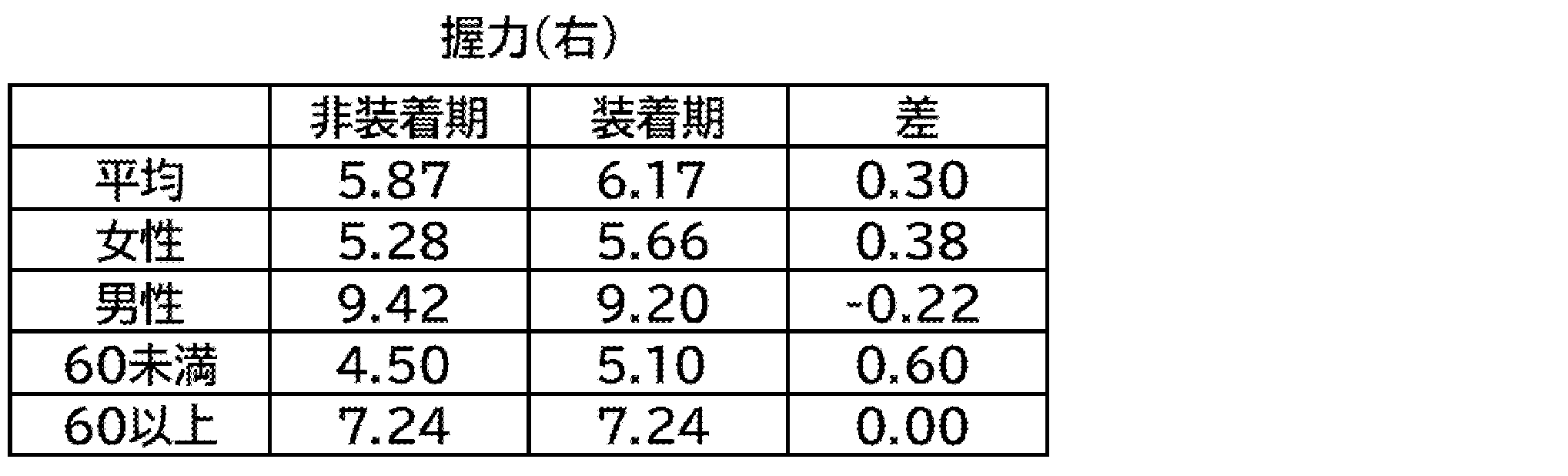
- Test Example 3 Test procedure Subjects (15 people) who suffer from morning stiffness of fingers due to rheumatoid arthritis were selected as subjects. From the first day of the test (day 1) to the 13th day, the subjects went to bed without using a heating device and rated the intensity of morning stiffness of fingers when waking up with an integer value from 0 to 10 (MS score). The subjects also wrote in their diary the duration of morning stiffness of fingers when waking up and their grip strength (left and right) when waking up. Grip strength was measured immediately after waking up using a commercially available grip strength meter.
- a heating device was attached to the wrist joint on the dorsal side of the wrist (wrist joint, hereinafter referred to as the wrist joint) when sleeping in order to keep the fingers warm while sleeping, and the heating device was removed when waking up, and the intensity of morning stiffness of fingers was evaluated in the same way, and the duration and grip strength were also written in the diary.
- the heating tool used in Test Example 1 was placed in the pocket of the holder, and the subject wrapped the holder around the skin of the wrist as shown in Figure 2 just before going to sleep.
- the MS score was evaluated from "0: no stiffness” to "10: most severe stiffness.” This evaluation is a conventionally known method for evaluating stiffness.
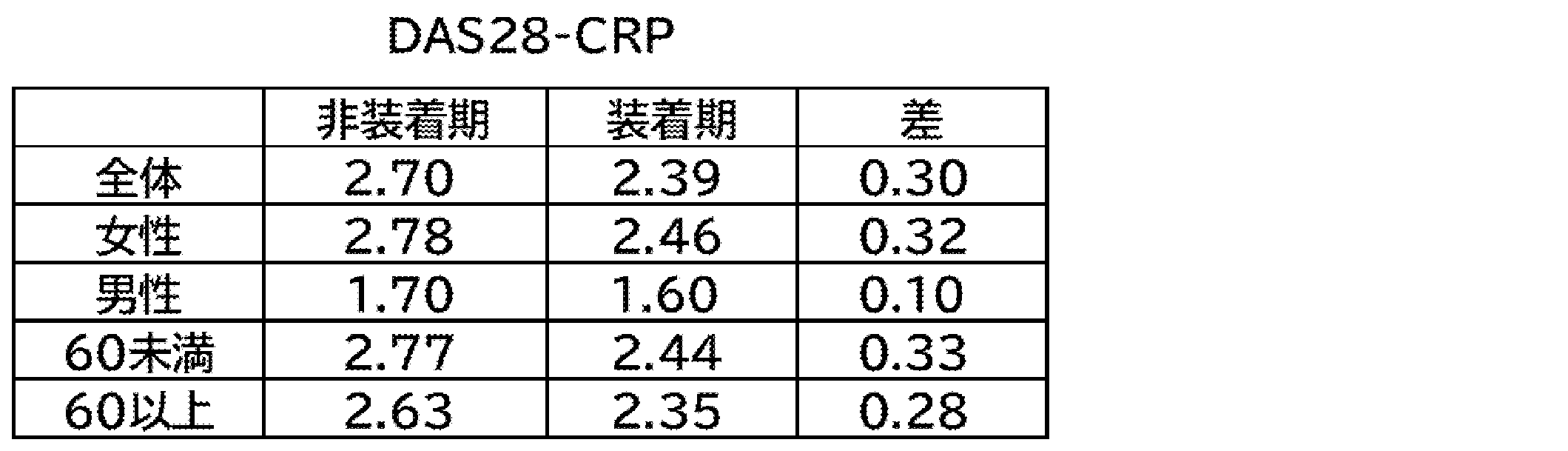
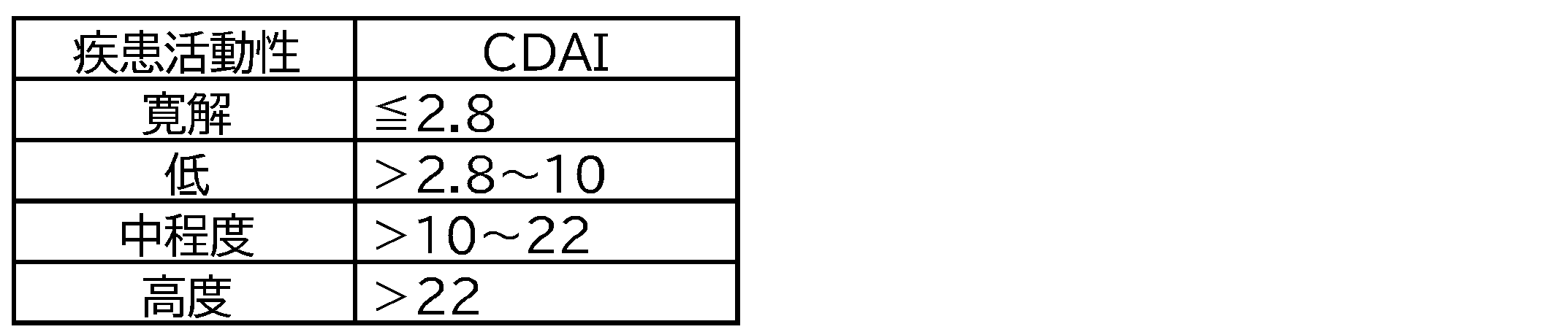
- DAS28-CRP Disease Activity Score 28-CRP
- VAS patient's global assessment
- CRP CRP
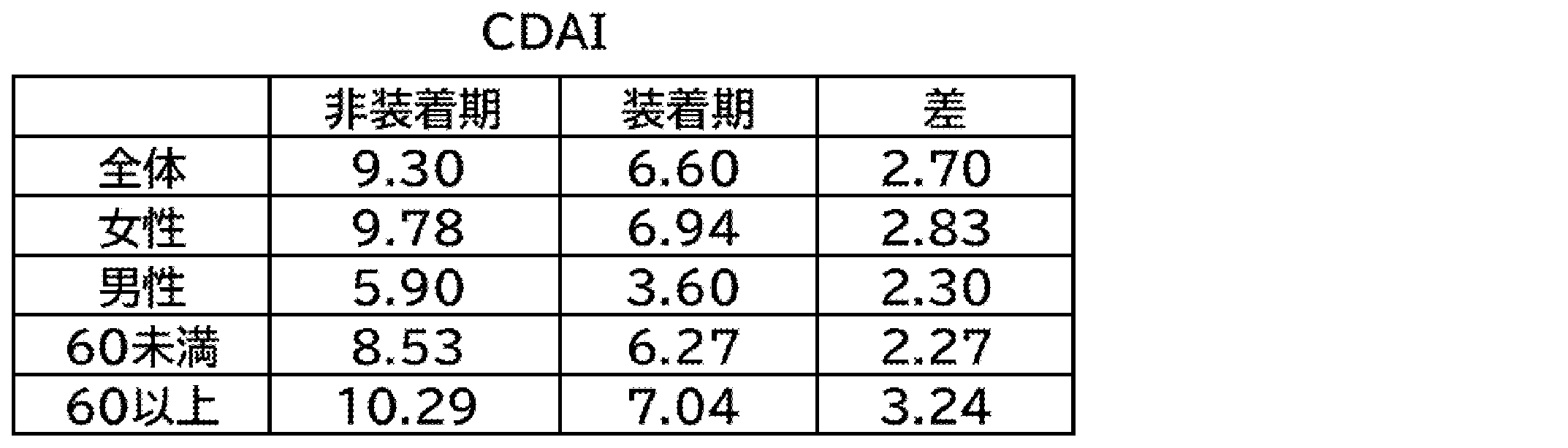
- CDAI Clinical Disease Activity Index
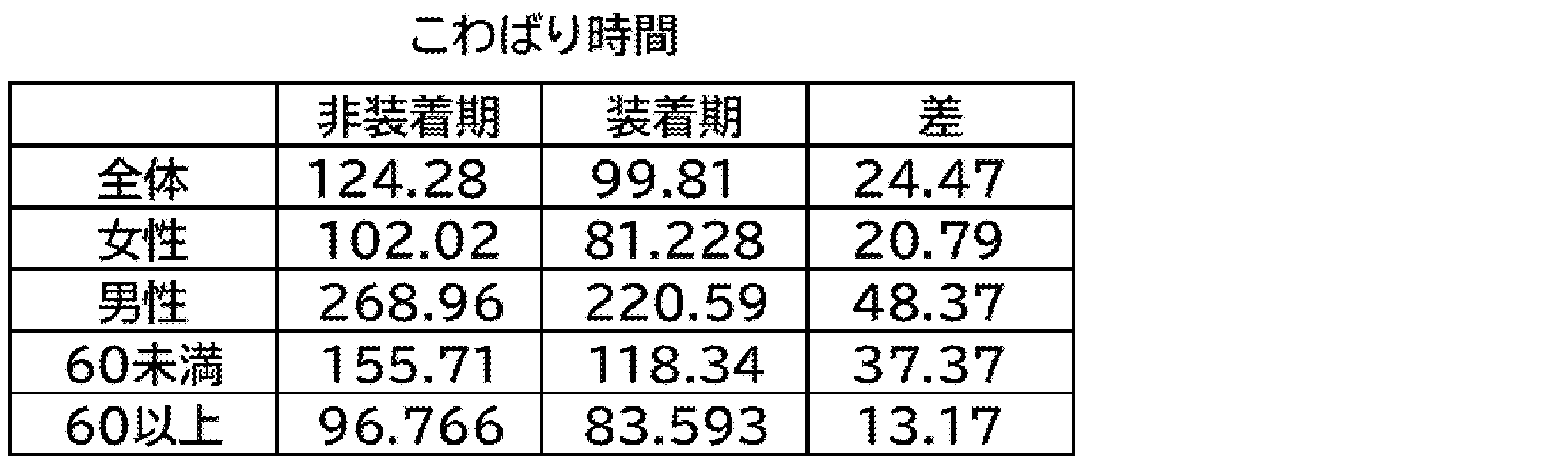
- Results Figure 6 shows the results of recording the intensity of morning stiffness (MS score) and duration of morning stiffness.
- MS score intensity of morning stiffness
- a paired t-test showed that the MS scores during the period when the heating device was worn were significantly lower than the MS scores during the period when the heating device was not worn.
- the duration of stiffness after waking up was also lower during the period when the heating device was worn compared to the period when the heating device was not worn. Furthermore, no adverse events such as burns caused by continuing to wear the heating device while sleeping were confirmed.
- Table 5 shows the results of an evaluation of the intensity of the stiffness mentioned above, focusing on the overall population, gender, and age.
- the intensity of stiffness was reduced when the heating device was worn compared to when it was not worn.
- the intensity of stiffness was further reduced in the group under 60 years old compared to the group over 60 years old.
- age was counted according to the age system.
- the duration of stiffness was shorter when the heating device was worn compared to when it was not worn.
- the duration of stiffness was further shortened in the group under 60 years old compared to the group over 60 years old.
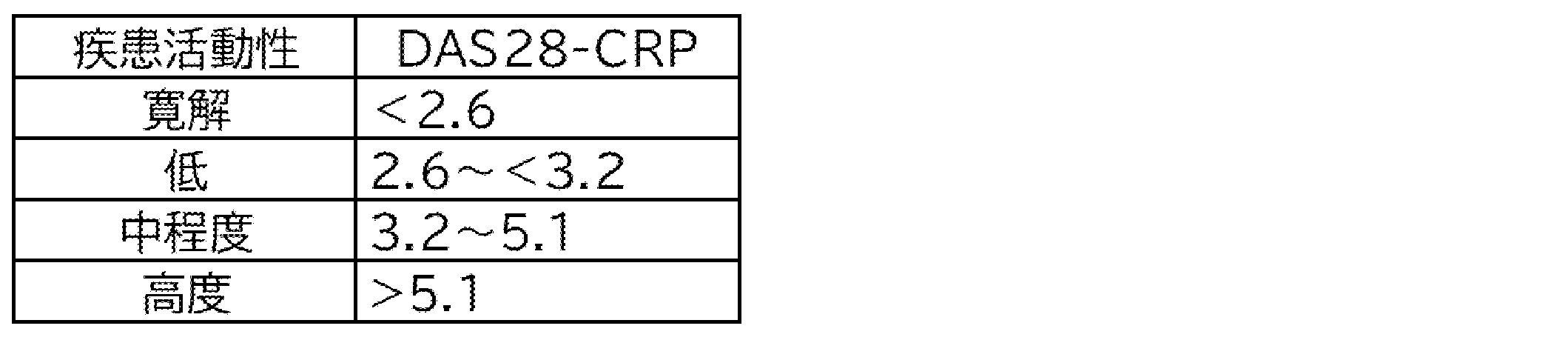
- DAS28-CRP The results and evaluation criteria of the disease activity assessment for rheumatoid arthritis (DAS28-CRP) are shown in Tables 9 and 10, respectively.
- DAS28-CRP and CDAI improved after the heating device was attached compared to the period when the heating device was not attached.
- Tables 13 and 14 The results of joint echo findings (joint ultrasound) are shown in Tables 13 and 14. These are the sum of the Gray Scale (Table 13) and Power Doppler Scale (Table 14) scores for a total of 22 joints, including 10 finger joints and wrist joints on both sides, at the start and end of the study.
- Gray Scale and Power Doppler values were lower after the heating device was attached than before it was attached.
- the Gray Scale and Power Doppler values were lower in women than in men.
- the Gray Scale and Power Doppler values were lower in the group under 60 years old than in the group over 60 years old.
- the stiffness caused by rheumatoid arthritis can be alleviated by using the heating tool. Since the stiffness caused by rheumatoid arthritis could be alleviated, it was found that the stiffness caused by osteoarthritis can also be alleviated. Furthermore, during this test, no skin symptoms such as dermatitis due to heating with the heating tool were observed. From this, it was found that the heating tool can be worn and used even while sleeping. In particular, there are not many useful means known so far that can effectively improve morning stiffness and stiffness of the fingers. From the above results, it was found that the stiffness of the fingers can be significantly improved by warming the wrist with the heating tool. Furthermore, it was found that even morning stiffness can be significantly improved by wearing the heating tool while sleeping.
Landscapes
- Health & Medical Sciences (AREA)
- Vascular Medicine (AREA)
- Thermal Sciences (AREA)
- Engineering & Computer Science (AREA)
- Biomedical Technology (AREA)
- Heart & Thoracic Surgery (AREA)
- Physics & Mathematics (AREA)
- Life Sciences & Earth Sciences (AREA)
- Animal Behavior & Ethology (AREA)
- General Health & Medical Sciences (AREA)
- Public Health (AREA)
- Veterinary Medicine (AREA)
- Thermotherapy And Cooling Therapy Devices (AREA)
Abstract
Description
項1.関節リウマチ又は変形性関節症に起因するこわばり緩和用発熱具であって、
酸素との接触により発熱する発熱性組成物と、前記発熱性組成物を収容した収容袋とを備え、
前記収容袋の少なくとも一部は通気性を有する包材で構成されており、
発熱温度は47℃以下である、こわばり緩和用発熱具。
項2.前記発熱具の40℃以上に発熱する持続時間は、4時間以上、好ましくは6時間以上16時間以下である、項1に記載のこわばり緩和用発熱具。
項3.前記発熱具の40℃以上に発熱する間の平均温度は、42℃以上46℃以下である、項1又は2に記載のこわばり緩和用発熱具。
項4.前記こわばりが手指のこわばりである、項1~3のいずれか一項に記載のこわばり緩和用発熱具。
項5.前記こわばりが朝のこわばりである、項1~4のいずれか一項に記載のこわばり緩和用発熱具。
項6.関節リウマチ又は変形性関節症に起因するこわばりが生じる被検体の皮膚の一部に睡眠前に装着して使用するための、項1~5のいずれか一項に記載のこわばり緩和用発熱具。
項7.関節リウマチ又は変形性関節症に起因するこわばりが生じる60歳未満、好ましくは18歳以上60歳未満の被検体に使用するための、項1~6のいずれか一項に記載のこわばり緩和用発熱具。
項8. 前記収容袋は、通気性を有する第1包材と、第2包材とを備え、
収容部に前記発熱性組成物が収容可能なように前記第1包材と前記第2包材とが収容部の領域の周縁で接合されており、
前記収容部に前記発熱性組成物が収容されている、
項1~7のいずれか一項に記載のこわばり緩和用発熱具。
項9. 装着対象が女性である、項1~8のいずれか一項に記載のこわばり緩和用発熱具。
項10. 前記第1包材及び前記第2包材が次の組み合わせを含む、項1~9のいずれか一項に記載のこわばり緩和用発熱具:
(1)第1包材が空気透過流量10ml/min以上18ml/min以下の包材、第2包材が空気透過流量0ml/min以上18ml/min以下の包材の組み合わせ、
(2)第1包材が空気透過流量l0ml/min以上17ml/min以下の包材、第2包材が空気透過流量5ml/min以上17ml/min以下の包材の組み合わせ、又は
(3)第1包材が空気透過流量13ml/min以上15ml/min以下の包材、第2包材が空気透過流量10ml/min以上16ml/min以下の包材の組み合わせ。
項11.項1~10のいずれか一項に記載するこわばり緩和用発熱具と、関節リウマチ又は変形性関節症に起因するこわばりが生じる被検体の皮膚の一部に装着されるホルダーとを含み、前記ホルダーが前記こわばり緩和用発熱具を保持できる保持部を有する、関節リウマチ又は変形性関節症に起因するこわばり緩和用発熱具セット。
項12.関節リウマチ又は変形性関節症に起因するこわばりが生じる被検体の皮膚の一部に発熱具を装着して、前記皮膚の一部を37℃以上42℃以下で4時間以上(好ましくは6時間以上16時間以下)温める工程を含む、皮膚保温方法。
項13.前記こわばりが手指のこわばりである、項12に記載の方法。
項14.前記こわばりが朝のこわばりである、項12又は13に記載の方法。
項15.前記発熱具の装着が睡眠前に行われる、項12~14のいずれか一項に記載の方法。
項16.前記被検体の年齢が60歳未満、好ましくは18歳以上60歳未満である、項12~15のいずれか一項に記載の方法。
項17.少なくとも手の一部に発熱具を装着する、項12~16のいずれか一項に記載の方法。
項18.前記被検体が女性である、項12~17のいずれか一項に記載の方法。
本開示は、関節リウマチ又は変形性関節症に起因するこわばり緩和用発熱具を提供する。具体的には、本開示は、酸素との接触により発熱する発熱性組成物と、該発熱性組成物を収容した収容袋とを備え、該収容袋の少なくとも一部は通気性を有する包材で構成されており、発熱温度は47℃以下である、関節リウマチ又は変形性関節症に起因するこわばり緩和用発熱具を提供する。
本開示の発熱具の発熱温度(発熱最高温度)は47℃以下である。発熱温度は、好ましくは46℃以下、より好ましくは45℃以下である。
収容袋は、発熱性組成物を収容する収容袋であり、収容袋の少なくとも一部は通気性を有する。収容袋は、発熱性組成物の漏出を防ぎ、発熱温度47℃以下での発熱に対して耐久性がある。収容袋は、通常、扁平な袋状であり、収容袋の内部空間(収容部)に発熱性組成物が収容される。収容袋の形状は制限されず、四角形状(正方形状、長方形状等)、三角形状、円形状、楕円形状、半円形状等を問わず、任意の形状とすればよい。収容袋として図1に示す袋が例示される。
第1包材131は、通気性を有する限り制限されず、通気性を備えた樹脂フィルム、通気性を備えた織布、通気性を備えた不織布等が例示される。該樹脂フィルム、該織布、該不織布等は1種単独で使用してもよく2種以上を組み合わせて使用してもよい。該樹脂フィルム、該織布、該不織布等は任意につなぎ合わされて使用されてもよく、積層されて積層構造を形成していてもよい。一例として、第1包材131が積層構造を備える場合、収容袋13の内側(収容部14側)に樹脂フィルムが配置され、収容袋13の外側に織布又は不織布が配置されてもよい。また、第1包材131が積層構造を備える場合、収容袋13の内側に織布又は不織布が配置され、収容部13の外側に樹脂フィルムが配置されてもよい。第1包材131が積層構造を備える場合、樹脂フィルム、織布、不織布等が任意の順、任意の積層数で配置されてよい。
試験片:第1包材131を用いる
試験気体:空気(N2:O2=8:2)
測定条件:23±2℃、50%RH
第2包材132は、通気性を有していてもよく、通気性を有していなくてもよい。第2包材132は、第1包材131と同一の包材であってもよく、異なる包材であってもよい。従って、第1包材131及び第2包材132はいずれも通気性を有していてもよい。また、第1包材131は通気性を有し、第2包材132は通気性を有していなくてもよい。
本開示において発熱性組成物12は、収容袋13に収容されており、酸素との接触により発熱する。発熱性組成物12は、被酸化性金属粉、酸化促進剤及び保水剤を含む。
被酸化性金属粉は、酸化されることによって発熱する金属粉であれば制限されず、鉄粉、亜鉛粉、アルミニウム粉、マグネシウム粉、銅粉等が例示され、好ましくは鉄粉が例示される。鉄粉として還元鉄粉、鋳鉄粉、アトマイズド鉄粉、電解鉄粉等が例示される。被酸化性金属粉の形状等も制限されず、従来の一般的な使い捨ての化学カイロに使用される粉末状、粒状、繊維状等の粉状が例示される。被酸化性金属粉は1種単独で使用してもよく、2種以上を組み合わせて使用してもよい。被酸化性金属粉の含有量は制限されず、発熱性組成物12中、被酸化性金属粉は20質量%以上80質量%以下、好ましくは25質量%以上70質量%以下、より好ましくは30質量%以上65質量%以下が例示される。
酸化促進剤は、酸素を取り込むことによって発熱性組成物12への、特に被酸化性金属粉への、酸素の供給を促進することを目的として使用される。酸化促進剤として、本開示を制限するものではないが、活性炭、石炭、木炭、竹炭、石墨、カーボンブラック、黒鉛、アセチレンブラック、コーヒーカス炭等が例示される。酸化促進剤として、好ましくは活性炭、カーボンブラック、竹炭、木炭、コーヒーカス炭等が例示される。酸化促進剤の形状等も制限されず、従来の一般的な使い捨ての化学カイロに使用されている粉末状、粒状、繊維状等の粉状が例示される。酸化促進剤は1種単独で使用してもよく、2種以上を組み合わせて使用してもよい。酸化促進剤の含有量は制限されないが、酸化促進剤は、発熱性組成物12中、1質量%以上30質量%以下が例示され、好ましくは3質量%以上25質量%以下、より好ましくは5質量%以上23質量%以下が例示される。
保水剤は、水を保持できる機能を有し、多孔質物質や吸水性樹脂等が例示される。保水剤として、バーミキュライト、パーライト、ケイ酸カルシウム、ケイ酸マグネシウム、カオリン、タルク、スメクタイト、マイカ、ベントナイト、炭酸カルシウム、シリカゲル、アルミナ、ゼオライト、二酸化珪素、珪藻土等の天然無機物及び合成無機物、パルプ、木粉(おがくず)、綿、ポリアクリル酸塩系樹脂、ポリスルホン酸塩系樹脂、無水マレイン酸塩系樹脂、ポリアクリルアミド系樹脂、ポリビニルアルコール系樹脂、ポリエチレンオキシド系樹脂、ポリアスパラギン酸塩系樹脂、ポリグルタミン酸塩系樹脂、ポリアルギン酸塩系樹脂、デンプン類、セルロース類等の天然有機物及び合成有機物が例示される。保水剤として、好ましくはバーミキュライト、木粉、パルプ、ポリアクリル酸塩系樹脂等、より好ましくはバーミキュライト、ポリアクリル酸塩系樹脂等が挙げられる。保水剤は単独で使用してもよく、2種以上を組み合わせて使用してもよい。保水剤の含有量は限り制限されないが、保水剤は、発熱性組成物12中、1質量%以上20質量%以下が例示され、好ましくは3質量%以上15質量%以下、より好ましくは5質量%以上10質量%以下が挙げられる。特にバーミキュライト等の多孔質構造を備えるものは、保水剤としてのみならず、酸素(空気)の通り道を提供するものとしての役割も果たし得る。
本開示の発熱具において、収容袋13には粘着層が設けられていてもよい。粘着層は、通常、収容袋13の外側に積層される。粘着層は、皮膚、衣類、発熱具ホルダー等の対象物に収容袋13を簡便に貼付する観点から有用である。粘着層は、本開示の効果を妨げない範囲で、第1包材131及び第2包材132の少なくとも一方に設けることができる。また、第1包材131及び第2包材132の少なくとも一方の一部の面又は全面に設けられていてもよい。粘着層を包材に設ける手段は、従来公知の手段に従えばよい。
前記発熱具を用いることにより、すなわち、酸素との接触により発熱する発熱性組成物と、前記発熱性組成物を収容した収容袋とを備え、前記収容袋の少なくとも一部は通気性を有する包材で構成されており、発熱温度は47℃以下である発熱具を用いることにより、関節リウマチ又は変形性関節症に起因するこわばりを緩和できる。従って、前記発熱具は、関節リウマチ又は変形性関節症に起因するこわばりの緩和に有用である。
本開示は、関節リウマチ又は変形性関節症に起因するこわばりが生じる被検体の皮膚の一部に発熱具を装着して、該皮膚の一部を37℃以上42℃以下で4時間以上温める工程を含む、皮膚保温方法を包含する。
1.発熱具の製造
次の手順に従い発熱具を製造した。
<発熱性組成物>
次に示す配合量で各成分を混合して、全量13.8gの発熱性組成物を調製した。鉄粉(金属鉄含有率:90%以上)55質量%、水27.7質量%、活性炭(粒度:<250メッシュ)10.4質量%、バーミキュライト(粒度:<2.5mm)1.9質量%、吸水性樹脂(吸水倍率:180倍以上)3.2質量%、水溶性塩類(塩化ナトリウム1.7質量%)、チオ硫酸ナトリウム0.1質量%。
第1包材として通気性多孔質フィルム(株式会社ニトムズ製、商品名ブレスロン、厚み:0.24mm、樹脂フィルム及び不織布を含む積層構造)を用いた。第1包材の空気透過流量は14.5ml/minであった。第2包材として以下の表1に示す積層構造を有する非通気性フィルムを用いた(厚み:73μm)。第2包材の空気透過流量は0ml/minであった。本試験例において第1包材及び第2包材はいずれも市販品であり、空気透過流量は各包材のカタログに記載されている値である。

試験片:前記第1包材(通気性多孔質フィルム)、第2包材(非通気性フィルム)をそれぞれ用いた。
試験気体:空気(N2:O2=8:2)
測定条件:23℃、50%RH
得られた発熱性組成物13.8gを第1包材と第2包材との間に挟み、第1包材と第2包材の周縁部同士(端から約3.5mm)を熱溶着し、発熱性組成物が収容袋に収容された発熱具を製造した。発熱具が酸素と触れないように保存することを目的として、得られた発熱具を非通気性の外袋に収容した。
製造した発熱具の発熱特性(温度特性)を、日本工業規格JIS S4100:2007に従い評価した。具体的には、JIS S4100:2007において定められた手順に従い、温熱部に所定の下敷材及び発熱具ホルダー(被覆材の代わりに本試験例では発熱具ホルダーを用いた)を重ねて30℃に昇温させ±1℃で保持させた。周囲温度と同じ雰囲気に2時間以上放置した発熱具(外袋に収容した発熱具)を、使用方法に基づいて発熱させた後、所定の手順通りに温度を測定した(n=10)。
測定結果を図4に示す。また、次の表3に、発熱具の発熱最高時間、40℃以上に発熱する間の平均温度、40℃以上に発熱する持続時間を示す。JIS S4100:2007と同様に、発熱開始直後から最高温度を経過して40℃以下になるまで測定した。また、表中の平均温度は、以下の手順で算出した。該手順は東京都の使いすてカイロ品質表示実施要領に記載された平均温度の評価手順に従った。
(ア)10個の試料(発熱具)を用いて前述の通り温度特性試験を行い、発熱開始後40℃となってから最高温度を経過し、40℃となるまで15分ごとの測定値を選び出した。15分ごとに、最大値及び最小値を除外した。(ただし、最大値又は最小値が複数となる場合は、複数となる最大値又は最小値の一つを除外した。)除外した後、残るすべての測定値の合計値(Tsam)を求め、これを測定値の数(NT)で割り平均温度(Tav)を求めた。
(イ)(ア)の試験を10ロット以上行い、平均温度(Tav)の平均値(T-av)を求めた。
(ウ)(イ)で求めた平均値(T-av)の小数点第1位の数値を四捨五入した値を平均温度とした。
1.試験手順
被験者(6名)の就寝直前に、試験例1で製造した発熱具1つを、非通気性の外袋から取り出し、試験例1で用いた発熱具ホルダーのポケット部に収容した。次いで、該ホルダーを被験者の手関節部の皮膚に面ファスナーを利用して巻き付けることにより装着し、就寝中の皮膚温度を測定した。温度測定は、次の通り行った。
温度計(商品名:おんどとりTR71-nw、製造元:株式会社ティアンドデイ)の温度センサを手関節部の外側(手の甲側)に皮膚用テープで取り付けた。次いで、発熱具を発熱具ホルダーのポケット部(保持部)に入れた状態で、温度センサの上に発熱具がホルダーを介して当たるようにホルダーを手関節部に装着した。装着後、皮膚の温度を1分間隔で記録した。
2.結果
結果を図5に示す。図5に示す通り、発熱具使用(装着)開始後15分程度で皮膚の温度が上昇し、6時間のあいだ、測定皮膚温の最高温度は40.8℃であった。また、発熱具使用開始後約6時間のあいだ、測定温度は37℃以上42℃以下程度を維持した。このように、皮膚を一定の温度に保温できることが分かった。発熱具使用開始直後の測定温度は低く35℃未満であったが、これは発熱具ホルダー装着直後であり、発熱具ホルダーが温まっていなかったためであると考えられる。


1.試験手順
関節リウマチに起因する手指の朝のこわばりが生じる者を被験者(15名)とした。試験初日を1日目として13日目までの毎晩、被験者は発熱具を使用せず就寝し、起床時の手指の朝のこわばりの強さを0から10までの整数値で評価させた(MSスコア)。また、該被験者には、起床時の手指の朝のこわばりの持続時間、起床時の握力(左右)も日誌に記載させた。握力は市販の握力計を用いて起床直後に測定した。続く15日目から27日目までの毎晩、睡眠中の手指の保温を目的として手関節背側面(手首の関節部分、以下、手関節部)に就寝時に手関節部に発熱具を装着し、起床時に発熱具をはずし、手指の朝のこわばりの強さを同様に評価し、また、持続時間、握力についても同様に日誌に記載させた。
図6に、朝のこわばりの強さ(MSスコア)と、朝のこわばりの持続時間を記録した結果を示す。図6に示す通り、全被験者における発熱具非装着期と発熱具装着期の平均MSスコアはそれぞれ4.47、3.83であった。対応のあるt検定にて、発熱具非装着期のMSスコアと比較し、発熱具装着期のMSスコアは有意に低値であった。また、起床後のこわばりの持続時間も、発熱具非装着と比較して、発熱具装着期では低値であった。更に、就寝中に発熱具を装着し続けることによる熱傷等の有害事象は確認されなかった。




Claims (14)
- 関節リウマチ又は変形性関節症に起因するこわばり緩和用発熱具であって、
酸素との接触により発熱する発熱性組成物と、前記発熱性組成物を収容した収容袋とを備え、
前記収容袋の少なくとも一部は通気性を有する包材で構成されており、
発熱温度は47℃以下である、こわばり緩和用発熱具。 - 前記発熱具の40℃以上に発熱する持続時間は、6時間以上である、請求項1に記載のこわばり緩和用発熱具。
- 前記発熱具の40℃以上に発熱する間の平均温度は、42℃以上46℃以下である、請求項1に記載のこわばり緩和用発熱具。
- 前記こわばりが手指のこわばりである、請求項1~3のいずれか一項に記載のこわばり緩和用発熱具。
- 前記こわばりが朝のこわばりである、請求項1~3のいずれか一項に記載のこわばり緩和用発熱具。
- 関節リウマチ又は変形性関節症に起因するこわばりが生じる被検体の皮膚の一部に睡眠前に装着して使用するための、請求項1~3のいずれか一項に記載のこわばり緩和用発熱具。
- 関節リウマチ又は変形性関節症に起因するこわばりが生じる60歳未満の被検体に使用するための、請求項1~3のいずれか一項に記載のこわばり緩和用発熱具。
- 請求項1~3のいずれか一項に記載するこわばり緩和用発熱具と、関節リウマチ又は変形性関節症に起因するこわばりが生じる被検体の皮膚の一部に装着されるホルダーとを含み、前記ホルダーが前記こわばり緩和用発熱具を保持できる保持部を有する、関節リウマチ又は変形性関節症に起因するこわばり緩和用発熱具セット。
- 関節リウマチ又は変形性関節症に起因するこわばりが生じる被検体の皮膚の一部に発熱具を装着して、前記皮膚の一部を37℃以上42℃以下で4時間以上温める工程を含む、皮膚保温方法。
- 前記こわばりが手指のこわばりである、請求項9に記載の方法。
- 前記こわばりが朝のこわばりである、請求項9に記載の方法。
- 前記発熱具の装着が睡眠前に行われる、請求項9~11のいずれか一項に記載の方法。
- 前記被検体の年齢が60歳未満である、請求項9~11のいずれか一項に記載の方法。
- 少なくとも手の一部に発熱具を装着する、請求項9~11のいずれか一項に記載の方法。
Priority Applications (2)
| Application Number | Priority Date | Filing Date | Title |
|---|---|---|---|
| JP2024571747A JPWO2024154693A1 (ja) | 2023-01-16 | 2024-01-15 | |
| GB2512238.3A GB2641666A (en) | 2023-01-16 | 2024-01-15 | Heating implement for alleviation of stiffness |
Applications Claiming Priority (2)
| Application Number | Priority Date | Filing Date | Title |
|---|---|---|---|
| JP2023-004194 | 2023-01-16 | ||
| JP2023004194 | 2023-01-16 |
Publications (1)
| Publication Number | Publication Date |
|---|---|
| WO2024154693A1 true WO2024154693A1 (ja) | 2024-07-25 |
Family
ID=91956188
Family Applications (1)
| Application Number | Title | Priority Date | Filing Date |
|---|---|---|---|
| PCT/JP2024/000787 Ceased WO2024154693A1 (ja) | 2023-01-16 | 2024-01-15 | こわばり緩和用温熱具 |
Country Status (4)
| Country | Link |
|---|---|
| JP (1) | JPWO2024154693A1 (ja) |
| GB (1) | GB2641666A (ja) |
| TW (1) | TW202435827A (ja) |
| WO (1) | WO2024154693A1 (ja) |
Citations (3)
| Publication number | Priority date | Publication date | Assignee | Title |
|---|---|---|---|---|
| JPS5810104B2 (ja) * | 1978-01-18 | 1983-02-24 | 松下電工株式会社 | 温熱パツド |
| JP2002514104A (ja) * | 1996-12-31 | 2002-05-14 | ザ、プロクター、エンド、ギャンブル、カンパニー | 多数の個別の熱セルを有する熱パック |
| CN103705906A (zh) * | 2014-01-16 | 2014-04-09 | 鞍山市康鑫医疗器械厂 | 一种改善微循环、缓解疼痛的中药热敷贴 |
Family Cites Families (2)
| Publication number | Priority date | Publication date | Assignee | Title |
|---|---|---|---|---|
| JPS5810104A (ja) * | 1981-07-10 | 1983-01-20 | Hitachi Ltd | タ−ビンプラントおよびその制御方法 |
| CN109597236A (zh) * | 2018-12-20 | 2019-04-09 | 华为技术有限公司 | 液晶显示屏、电子设备及液晶显示屏的制作方法 |
-
2024
- 2024-01-15 TW TW113101503A patent/TW202435827A/zh unknown
- 2024-01-15 WO PCT/JP2024/000787 patent/WO2024154693A1/ja not_active Ceased
- 2024-01-15 JP JP2024571747A patent/JPWO2024154693A1/ja active Pending
- 2024-01-15 GB GB2512238.3A patent/GB2641666A/en active Pending
Patent Citations (3)
| Publication number | Priority date | Publication date | Assignee | Title |
|---|---|---|---|---|
| JPS5810104B2 (ja) * | 1978-01-18 | 1983-02-24 | 松下電工株式会社 | 温熱パツド |
| JP2002514104A (ja) * | 1996-12-31 | 2002-05-14 | ザ、プロクター、エンド、ギャンブル、カンパニー | 多数の個別の熱セルを有する熱パック |
| CN103705906A (zh) * | 2014-01-16 | 2014-04-09 | 鞍山市康鑫医疗器械厂 | 一种改善微循环、缓解疼痛的中药热敷贴 |
Also Published As
| Publication number | Publication date |
|---|---|
| GB2641666A (en) | 2025-12-10 |
| TW202435827A (zh) | 2024-09-16 |
| JPWO2024154693A1 (ja) | 2024-07-25 |
Similar Documents
| Publication | Publication Date | Title |
|---|---|---|
| US8430921B2 (en) | Portable moist heat system | |
| US7614399B2 (en) | Body conforming textile holder and filter article | |
| KR20170039267A (ko) | 자체발열 보온필름 및 그로부터 제조되는 페이스 마스크와 아이 마스크 | |
| CN106726165A (zh) | 一种一次性吸收物品 | |
| WO2011039895A1 (ja) | 発熱具 | |
| JP4786349B2 (ja) | 温熱刺激用具 | |
| JP6024029B1 (ja) | 保温具、保温キット、保温キットの製造方法および保温方法 | |
| JP5388724B2 (ja) | 痔の予防または治療具、及び痔の予防または治療方法 | |
| JP5178862B2 (ja) | 温熱刺激用具 | |
| TW202435827A (zh) | 僵硬緩和用溫熱件 | |
| JP7414523B2 (ja) | マスク | |
| JP2006271963A (ja) | 生理機能改善器具 | |
| JP2022087423A (ja) | 温熱懐炉 | |
| JPS58130039A (ja) | 化学的発熱によるカイロ | |
| JP2026016709A (ja) | 発熱具 | |
| AU2013100604A4 (en) | Disposable Hygienic Wrap for cryo- and thermo-therapy | |
| JP2026016708A (ja) | 発熱具 | |
| JP2007090042A (ja) | 生理機能改善器具 | |
| JP2020108423A (ja) | 温熱治療用の医療機器 | |
| HK1153640B (en) | Portable moist heat system |
Legal Events
| Date | Code | Title | Description |
|---|---|---|---|
| 121 | Ep: the epo has been informed by wipo that ep was designated in this application |
Ref document number: 24744616 Country of ref document: EP Kind code of ref document: A1 |
|
| WWE | Wipo information: entry into national phase |
Ref document number: 2024571747 Country of ref document: JP |
|
| ENP | Entry into the national phase |
Ref document number: 202512238 Country of ref document: GB Kind code of ref document: A Free format text: PCT FILING DATE = 20240115 |
|
| WWE | Wipo information: entry into national phase |
Ref document number: 2512238.3 Country of ref document: GB |
|
| NENP | Non-entry into the national phase |
Ref country code: DE |
|
| WWP | Wipo information: published in national office |
Ref document number: 2512238.3 Country of ref document: GB |
|
| 122 | Ep: pct application non-entry in european phase |
Ref document number: 24744616 Country of ref document: EP Kind code of ref document: A1 |