WO2024154323A1 - 冷凍サイクル装置 - Google Patents
冷凍サイクル装置 Download PDFInfo
- Publication number
- WO2024154323A1 WO2024154323A1 PCT/JP2023/001655 JP2023001655W WO2024154323A1 WO 2024154323 A1 WO2024154323 A1 WO 2024154323A1 JP 2023001655 W JP2023001655 W JP 2023001655W WO 2024154323 A1 WO2024154323 A1 WO 2024154323A1
- Authority
- WO
- WIPO (PCT)
- Prior art keywords
- heat exchanger
- side heat
- flow path
- load side
- refrigerant
- Prior art date
- Legal status (The legal status is an assumption and is not a legal conclusion. Google has not performed a legal analysis and makes no representation as to the accuracy of the status listed.)
- Ceased
Links
Images






Classifications
-
- F—MECHANICAL ENGINEERING; LIGHTING; HEATING; WEAPONS; BLASTING
- F25—REFRIGERATION OR COOLING; COMBINED HEATING AND REFRIGERATION SYSTEMS; HEAT PUMP SYSTEMS; MANUFACTURE OR STORAGE OF ICE; LIQUEFACTION SOLIDIFICATION OF GASES
- F25B—REFRIGERATION MACHINES, PLANTS OR SYSTEMS; COMBINED HEATING AND REFRIGERATION SYSTEMS; HEAT PUMP SYSTEMS
- F25B13/00—Compression machines, plants or systems, with reversible cycle
-
- F—MECHANICAL ENGINEERING; LIGHTING; HEATING; WEAPONS; BLASTING
- F25—REFRIGERATION OR COOLING; COMBINED HEATING AND REFRIGERATION SYSTEMS; HEAT PUMP SYSTEMS; MANUFACTURE OR STORAGE OF ICE; LIQUEFACTION SOLIDIFICATION OF GASES
- F25B—REFRIGERATION MACHINES, PLANTS OR SYSTEMS; COMBINED HEATING AND REFRIGERATION SYSTEMS; HEAT PUMP SYSTEMS
- F25B2313/00—Compression machines, plants or systems with reversible cycle not otherwise provided for
- F25B2313/003—Indoor unit with water as a heat sink or heat source
-
- F—MECHANICAL ENGINEERING; LIGHTING; HEATING; WEAPONS; BLASTING
- F25—REFRIGERATION OR COOLING; COMBINED HEATING AND REFRIGERATION SYSTEMS; HEAT PUMP SYSTEMS; MANUFACTURE OR STORAGE OF ICE; LIQUEFACTION SOLIDIFICATION OF GASES
- F25B—REFRIGERATION MACHINES, PLANTS OR SYSTEMS; COMBINED HEATING AND REFRIGERATION SYSTEMS; HEAT PUMP SYSTEMS
- F25B2313/00—Compression machines, plants or systems with reversible cycle not otherwise provided for
- F25B2313/023—Compression machines, plants or systems with reversible cycle not otherwise provided for using multiple indoor units
- F25B2313/0231—Compression machines, plants or systems with reversible cycle not otherwise provided for using multiple indoor units with simultaneous cooling and heating
-
- F—MECHANICAL ENGINEERING; LIGHTING; HEATING; WEAPONS; BLASTING
- F25—REFRIGERATION OR COOLING; COMBINED HEATING AND REFRIGERATION SYSTEMS; HEAT PUMP SYSTEMS; MANUFACTURE OR STORAGE OF ICE; LIQUEFACTION SOLIDIFICATION OF GASES
- F25B—REFRIGERATION MACHINES, PLANTS OR SYSTEMS; COMBINED HEATING AND REFRIGERATION SYSTEMS; HEAT PUMP SYSTEMS
- F25B2313/00—Compression machines, plants or systems with reversible cycle not otherwise provided for
- F25B2313/027—Compression machines, plants or systems with reversible cycle not otherwise provided for characterised by the reversing means
- F25B2313/02731—Compression machines, plants or systems with reversible cycle not otherwise provided for characterised by the reversing means using one three-way valve
-
- F—MECHANICAL ENGINEERING; LIGHTING; HEATING; WEAPONS; BLASTING
- F25—REFRIGERATION OR COOLING; COMBINED HEATING AND REFRIGERATION SYSTEMS; HEAT PUMP SYSTEMS; MANUFACTURE OR STORAGE OF ICE; LIQUEFACTION SOLIDIFICATION OF GASES
- F25B—REFRIGERATION MACHINES, PLANTS OR SYSTEMS; COMBINED HEATING AND REFRIGERATION SYSTEMS; HEAT PUMP SYSTEMS
- F25B2313/00—Compression machines, plants or systems with reversible cycle not otherwise provided for
- F25B2313/027—Compression machines, plants or systems with reversible cycle not otherwise provided for characterised by the reversing means
- F25B2313/02741—Compression machines, plants or systems with reversible cycle not otherwise provided for characterised by the reversing means using one four-way valve
Definitions
- This disclosure relates to a refrigeration cycle device.
- a conventional refrigeration cycle device includes a refrigerant circuit having a compressor that compresses the refrigerant, a flow path switching device, a heat source side heat exchanger, a throttling device that expands the refrigerant to reduce its pressure, and a load side heat exchanger.
- Some of these conventional refrigeration cycle devices include a throttling device that expands the refrigerant to reduce its pressure, and a load side heat exchanger.
- a conventional refrigeration cycle device that includes a plurality of load side heat exchangers has been proposed in which a throttling device is disposed between two load side heat exchangers, and one load side heat exchanger functions as a radiator and the other load side heat exchanger functions as an evaporator (see, for example, Patent Document 1).
- a conventional refrigeration cycle device that can independently function as a radiator or an evaporator can be used, for example, as an air conditioning device to perform cooling and heating operations simultaneously.
- the compressor, the flow path switching device, and the heat source side heat exchanger are defined as heat source side components.
- the throttling device and the load side heat exchanger are defined as load side components.
- the heat source side components and the load side components are connected by multiple refrigerant pipes through which the refrigerant circulating in the refrigerant circuit passes.
- refrigerant does not flow through some of the multiple refrigerant pipes connecting the heat source side components and the load side components.
- the conventional refrigeration cycle device in which two load side heat exchangers can function independently as a radiator or an evaporator has a problem in that the installation space for the refrigerant pipes of the refrigerant circuit cannot be effectively utilized.
- the present disclosure is intended to solve the problems described above, and aims to provide a refrigeration cycle device in which two load-side heat exchangers can function independently as radiators or evaporators, and which can effectively utilize the installation space for the refrigerant piping of the refrigerant circuit.
- the refrigeration cycle device comprises a refrigerant circuit in which a refrigerant circulates, the refrigerant circuit comprising a compressor, a heat source side heat exchanger, a first load side heat exchanger, a second load side heat exchanger, a throttling section, a first flow path switching device, a second flow path switching device, and a branching section, the throttling section is configured to reduce the pressure of the refrigerant flowing into the heat source side heat exchanger, the refrigerant flowing into the first load side heat exchanger, and the refrigerant flowing into the second load side heat exchanger, and to expand the refrigerant, the first flow path switching device is configured to switch between a first flow path and a second flow path, the second flow path switching device is configured to switch between a third flow path and a fourth flow path, the first flow path is a flow path that connects the discharge port of the compressor to the heat source side heat exchanger and connects the suction port of the compressor to the first load side heat exchange
- the third flow path is a flow path connecting the intake port of the compressor and the second load side heat exchanger
- the fourth flow path is a flow path connecting the discharge port of the compressor and the second load side heat exchanger
- the branching section branches the refrigerant piping extending from the heat source side heat exchanger to the first load side heat exchanger and the second load side heat exchanger into a refrigerant piping connected to the first load side heat exchanger and a refrigerant piping connected to the second load side heat exchanger, and the first load side heat exchanger and the second load side heat exchanger are connected in parallel to the heat source side heat exchanger
- the refrigerant circuit is configured such that when the first load side heat exchanger and the second load side heat exchanger function as radiators and the heat source side heat exchanger functions as an evaporator, the first flow path switching device becomes the second flow path and the second flow path switching device becomes the fourth flow path.
- the refrigeration cycle device when both the first load side heat exchanger and the second load side heat exchanger function as radiators, refrigerant flows through all of the multiple refrigerant pipes connecting the heat source side components and the load side components. Therefore, the refrigeration cycle device according to the present disclosure can effectively utilize the installation space for the refrigerant pipes of the refrigerant circuit.
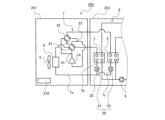
- FIG. 1 is a refrigerant circuit diagram showing a refrigeration cycle device according to a first embodiment.
- 4 is a diagram for explaining the flow of refrigerant in the refrigerant circuit when the first flow path switching device is in the first flow path in the refrigeration cycle apparatus according to the first embodiment.
- FIG. 4 is a diagram for explaining the flow of refrigerant in the refrigerant circuit when the first flow path switching device is in the second flow path in the refrigeration cycle apparatus according to the first embodiment.
- FIG. 4 is a diagram for explaining the flow of refrigerant in the refrigerant circuit when the second flow path switching device is set to the third flow path in the refrigeration cycle apparatus according to the first embodiment.
- FIG. 4 is a diagram for explaining the flow of refrigerant in the refrigerant circuit when the first flow path switching device is in the fourth flow path in the refrigeration cycle apparatus according to the first embodiment.
- FIG. FIG. 4 is a refrigerant circuit diagram showing a modified example of the refrigeration cycle device 200 according to the first embodiment.
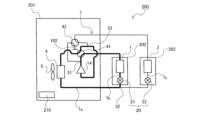
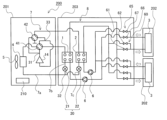
- FIG. 6 is a refrigerant circuit diagram showing a refrigeration cycle device according to a second embodiment.
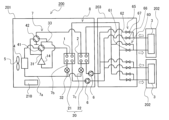
- FIG. 11 is a refrigerant circuit diagram showing another example of a refrigeration cycle device according to the second embodiment.
- FIG. 11 is a diagram for explaining a configuration example of a heat medium circuit of a refrigeration cycle device according to a second embodiment.
- FIG. 11 is a diagram for explaining a configuration example of a heat medium circuit of a refrigeration cycle device according to a second embodiment.
- FIG. 11 is a refrigerant circuit diagram showing a refrigeration cycle device according to a third embodiment.
- FIG. 11 is a refrigerant circuit diagram showing an example of a refrigeration cycle device according to a fourth embodiment.
- FIG. 11 is a refrigerant circuit diagram showing an example of a refrigeration cycle device according to a fourth embodiment.
- the refrigeration cycle device according to the present disclosure described in each embodiment is merely an example.
- the refrigeration cycle device according to the present disclosure is not limited to the form described in the specification.
- an example in which the refrigeration cycle device according to the present disclosure is used as an air conditioning device will be described.
- the use of the refrigeration cycle device according to the present disclosure may be for refrigeration and air conditioning purposes.
- the refrigeration cycle device according to the present disclosure can be used as a refrigerator, a freezer, a vending machine, an air conditioner, a refrigeration device, a water heater, etc.
- FIG. 1 is a refrigerant circuit diagram showing a refrigeration cycle device according to a first embodiment.
- the refrigeration cycle device 200 according to the first embodiment includes a refrigerant circuit 7 in which a refrigerant circulates.
- the refrigerant circulating through the refrigerant circuit 7 is not particularly limited.
- the refrigerant circulating through the refrigerant circuit 7 is an olefin-based refrigerant, an ethylene-based refrigerant, an ethane-based refrigerant, propane, or dimethyl ether.
- the refrigerant circulating through the refrigerant circuit 7 is a mixed refrigerant obtained by mixing at least two of an olefin-based refrigerant, an ethylene-based refrigerant, an ethane-based refrigerant, propane, and dimethyl ether.
- the olefin-based refrigerant is tetrafluoropropene or the like.
- the tetrafluoropropene is HFO1234yf, HFO1234ze(E), or the like.
- the ethylene-based refrigerant is difluoroethylene or the like.
- the ethane-based refrigerant is tetrafluoroethane or the like.
- refrigerants that condense and do not condense when flowing through a radiator and cooled to a heat exchange target there are refrigerants that condense and do not condense when flowing through a radiator and cooled to a heat exchange target.
- a refrigerant that condenses in a radiator is used as the refrigerant circulating through the refrigerant circuit 7.
- the radiator may be called a condenser.
- the refrigerant circuit 7 includes a compressor 14, a heat source side heat exchanger 4, a first load side heat exchanger 1, a second load side heat exchanger 2, a throttling section 20, a first flow path switching device 41, a second flow path switching device 42, and a branch section 32.
- the compressor 14 sucks in the refrigerant, compresses it, and discharges it in a high-temperature, high-pressure state.
- the compressor 14 may be a rotary compressor, a scroll compressor, a screw compressor, or a reciprocating compressor.
- the refrigerant discharge port of the compressor 14 is connected to the first flow path switching device 41 and the second flow path switching device 42.
- the refrigerant piping connected to the refrigerant discharge port of the compressor 14 branches into two refrigerant piping at the branching section 31.
- One of the branched refrigerant piping is connected to the first flow path switching device 41, and the other of the branched refrigerant piping is connected to the second flow path switching device 42.
- the refrigerant discharge port of the compressor 14 may be connected to the first flow path switching device 41 and the second flow path switching device 42 by separate refrigerant piping.
- the refrigerant suction port of the compressor 14 is connected to the first flow path switching device 41 and the second flow path switching device 42.
- the refrigerant piping connected to the refrigerant suction port of the compressor 14 branches into two refrigerant piping at the branching section 33.
- One of the branched refrigerant piping is connected to the first flow path switching device 41, and the other of the branched refrigerant piping is connected to the second flow path switching device 42.
- the refrigerant suction port of the compressor 14 may be connected to the first flow path switching device 41 and the second flow path switching device 42 by separate refrigerant piping.
- the heat source side heat exchanger 4 functions as an evaporator or a radiator.
- the heat source side heat exchanger 4 functions as an evaporator, it exchanges heat between the refrigerant that has flowed into it and the outdoor air, evaporating and vaporizing the refrigerant.
- the heat source side heat exchanger 4 functions as a radiator, it exchanges heat between the refrigerant that has flowed into it and the outdoor air, condensing and liquefying the refrigerant.
- the operating state of the refrigeration cycle device 200 in which the heat source side heat exchanger 4 functions as an evaporator and the operating state of the refrigeration cycle device 200 in which the heat source side heat exchanger 4 functions as a radiator will be described later.
- heat exchangers such as fin-and-tube heat exchangers, microchannel heat exchangers, shell-and-tube heat exchangers, heat pipe heat exchangers, double-tube heat exchangers, and plate heat exchangers. Any of these heat exchangers can be appropriately selected and used as the heat source side heat exchanger 4.
- the blower 5 in order to increase the efficiency of heat exchange between the refrigerant and the outdoor air in the heat source side heat exchanger 4, the blower 5 is disposed adjacent to the heat source side heat exchanger 4.
- the configuration of the blower 5 is not particularly limited.
- the blower 5 may be configured with a propeller fan, a line flow fan (registered trademark), a multi-blade centrifugal fan, or the like, based on the operating conditions such as the flow rate and static pressure of the outdoor air supplied to the heat source side heat exchanger 4.
- the heat source side heat exchanger 4 is configured to exchange heat with a heat medium such as water
- the heat medium may be supplied to the heat source side heat exchanger 4 by a pump or the like.
- One end of the heat source side heat exchanger 4 is connected to the first flow path switching device 41.
- the other end of the heat source side heat exchanger 4 is connected to the branch section 32.
- the branching section 32 branches the refrigerant pipe 7a, which extends from the heat source side heat exchanger 4 to the first load side heat exchanger 1 and the second load side heat exchanger 2, into refrigerant pipe 7b and refrigerant pipe 7c.
- the first load side heat exchanger 1 is connected to the refrigerant pipe 7b.
- the second load side heat exchanger 2 is connected to the refrigerant pipe 7c.
- the branching section 32 connects the first load side heat exchanger 1 and the second load side heat exchanger 2 in parallel with the heat source side heat exchanger 4.
- the first load side heat exchanger 1 and the second load side heat exchanger 2 function as an evaporator or a radiator.
- the first load side heat exchanger 1 and the second load side heat exchanger 2 function as an evaporator, they exchange heat between the refrigerant flowing into the inside and the indoor air, evaporating and vaporizing the refrigerant.
- the first load side heat exchanger 1 and the second load side heat exchanger 2 function as a radiator, they exchange heat between the refrigerant flowing into the inside and the indoor air, condensing and liquefying the refrigerant.
- the operating state of the refrigeration cycle device 200 in which the first load side heat exchanger 1 functions as an evaporator, the operating state of the refrigeration cycle device 200 in which the first load side heat exchanger 1 functions as a radiator, the operating state of the refrigeration cycle device 200 in which the second load side heat exchanger 2 functions as an evaporator, and the operating state of the refrigeration cycle device 200 in which the second load side heat exchanger 2 functions as a radiator will be described later.
- heat exchangers such as fin-and-tube heat exchangers, microchannel heat exchangers, shell-and-tube heat exchangers, heat pipe heat exchangers, double-tube heat exchangers, and plate heat exchangers.
- they can be used as the first load side heat exchanger 1 and the second load side heat exchanger 2.
- a blower (not shown) is disposed adjacent to each of the first load side heat exchanger 1 and the second load side heat exchanger 2.
- the configuration of the blower is not particularly limited.
- the blower may be configured with a propeller fan, a line flow fan (registered trademark), a multi-blade centrifugal fan, or the like, based on the operating conditions such as the flow rate and static pressure of the indoor air supplied to the first load side heat exchanger 1 and the second load side heat exchanger 2.
- the first load side heat exchanger 1 and the second load side heat exchanger 2 are configured to exchange heat with a heat medium such as water, the heat medium may be supplied to the first load side heat exchanger 1 and the second load side heat exchanger 2 by a pump or the like.
- first load heat exchanger 1 connected to the refrigerant pipe 7b is connected to a first flow path switching device 41.
- the second load heat exchanger 2 connected to the refrigerant pipe 7c is connected to a second flow path switching device 42.
- the throttling section 20 reduces the pressure of the refrigerant flowing into the heat source side heat exchanger 4, the refrigerant flowing into the first load side heat exchanger 1, and the refrigerant flowing into the second load side heat exchanger 2, and expands them.
- the throttling section 20 includes a throttling device 21 and a throttling device 22.
- the throttling device 21 is provided between the branching section 32 and the first load side heat exchanger 1.
- the throttling device 21 is provided in the refrigerant piping 7b.
- the throttling device 22 is provided between the branching section 32 and the second load side heat exchanger 2.
- the throttling device 22 is provided in the refrigerant piping 7c.
- the throttling device 21 and the throttling device 22 function as pressure reducing valves or expansion valves, and expand the refrigerant to reduce its pressure.
- the throttling device 21 and the throttling device 22 are, for example, electric expansion valves that can adjust the flow rate of the refrigerant.
- the throttling device 21 and the throttling device 22 are not limited to electric expansion valves.
- the throttling device 21 and the throttling device 22 may be mechanical expansion valves that use a diaphragm in the pressure receiving section.
- the throttling device 21 and the throttling device 22 may be partially composed of a capillary tube or the like. The same applies to the throttling devices other than the throttling device 21 and the throttling device 22 described below.
- the first flow path switching device 41 is, for example, a four-way valve, and switches between the first flow path 101 and the second flow path 102.
- the first flow path 101 is a flow path that connects the discharge port of the compressor 14 to the heat source side heat exchanger 4 and connects the suction port of the compressor 14 to the first load side heat exchanger 1.
- the second flow path 102 is a flow path that connects the discharge port of the compressor 14 to the first load side heat exchanger 1 and connects the suction port of the compressor 14 to the heat source side heat exchanger 4.
- FIG. 2 is a diagram for explaining the flow of refrigerant in the refrigerant circuit when the first flow path switching device is in the first flow path in the refrigeration cycle apparatus according to the first embodiment. 2 from the discharge port of the compressor 14 to the suction port of the compressor 14.
- the refrigerant discharged from the discharge port of the compressor 14 passes through the branching section 31, the first flow path switching device 41, the heat source side heat exchanger 4, the branching section 32, the expansion device 21, the first load side heat exchanger 1, the first flow path switching device 41, and the branching section 33, and flows to the suction port of the compressor 14.
- FIG. 3 is a diagram for explaining the flow of refrigerant in the refrigerant circuit when the first flow path switching device is in the second flow path in the refrigeration cycle apparatus according to the first embodiment. 3 from the discharge port of the compressor 14 to the suction port of the compressor 14.
- the refrigerant discharged from the discharge port of the compressor 14 passes through the branching section 31, the first flow path switching device 41, the first load side heat exchanger 1, the expansion device 21, the branching section 32, the heat source side heat exchanger 4, the first flow path switching device 41, and the branching section 33, and flows to the suction port of the compressor 14.
- the second flow path switching device 42 is, for example, a four-way valve, and switches between the third flow path 103 and the fourth flow path 104.
- the third flow path 103 is a flow path that connects the intake port of the compressor 14 and the second load side heat exchanger 2.
- the fourth flow path 104 is a flow path that connects the discharge port of the compressor 14 and the second load side heat exchanger 2.
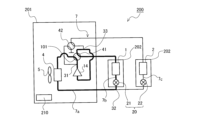
- FIG. 4 is a diagram for explaining the flow of refrigerant in the refrigerant circuit when the second flow path switching device is set to the third flow path in the refrigeration cycle apparatus according to the first embodiment.
- the second flow path switching device 42 is the third flow path 103
- the refrigerant between the compressor 14 and the branching portion 32 flows as shown by the thick line in Fig. 4.
- the refrigerant between the compressor 14 and the branching portion 32 flows from the branching portion 32 through the expansion device 22, the second load side heat exchanger 2, the second flow path switching device 42, and the branching portion 33 to the suction port of the compressor 14.
- FIG. 5 is a diagram for explaining the flow of refrigerant in the refrigerant circuit when the first flow path switching device is in the fourth flow path in the refrigeration cycle apparatus according to the first embodiment.
- the refrigerant flows between the compressor 14 and the branching portion 32 as shown by the thick line in Fig. 5.
- the refrigerant discharged from the discharge port of the compressor 14 flows to the branching portion 32 through the branching portion 31, the second flow path switching device 42, the second load side heat exchanger 2, and the expansion device 22.
- first flow path switching device 41 and the second flow path switching device 42 are not limited to four-way valves.
- the first flow path switching device 41 and the second flow path switching device 42 may be configured as two-way valves or three-way valves, etc.
- the refrigeration cycle device 200 includes a heat source unit 201.
- the refrigeration cycle device 200 also includes a heat load unit 202 as a unit separate from the heat source unit 201.
- the heat source unit 201 includes a compressor 14, a first flow path switching device 41, a second flow path switching device 42, a heat source side heat exchanger 4, and a blower 5.
- the heat load unit 202 includes a throttling device 21, a throttling device 22, a first load side heat exchanger 1, and a second load side heat exchanger 2.
- the first load side heat exchanger 1 and the second load side heat exchanger 2 are mounted on different heat load units 202.
- the throttling device 21 is mounted on the heat load unit 202 in which the first load side heat exchanger 1 is mounted.
- the expansion device 22 is mounted on the heat load unit 202 in which the second load side heat exchanger 2 is mounted.
- the refrigeration cycle device 200 is also provided with a control device 210 that controls the operating state of the refrigeration cycle device 200.
- the control device 210 switches the flow paths of the first flow path switching device 41 and the second flow path switching device 42.
- the control device 210 also starts and stops the compressor 14.
- the control device 210 may control the rotation speed of the compressor 14 when the compressor 14 is driven. This allows the amount of refrigerant discharged from the compressor 14 to be adjusted.
- the control device 210 also controls the opening degree of the throttling device 21 and the throttling device 22.
- the control device 210 also starts and stops the blower 5.
- the control device 210 may control the rotation speed of the blower 5 when the blower 5 is driven.
- There is no particular limitation on the unit in which the control device 210 is mounted but in the first embodiment, the control device 210 is mounted on the heat source unit 201.
- Such a control device 210 is composed of dedicated hardware, or a CPU (Central Processing Unit) that executes programs stored in memory.
- a CPU Central Processing Unit
- a CPU is also called a central processing unit, processing unit, arithmetic unit, microprocessor, microcomputer, or processor.
- control device 210 When the control device 210 is dedicated hardware, the control device 210 is, for example, a single circuit, a composite circuit, an ASIC (Application Specific Integrated Circuit), an FPGA (Field-Programmable Gate Array), or a combination of these. Each of the functional units realized by the control device 210 may be realized by separate hardware, or each functional unit may be realized by a single piece of hardware.
- ASIC Application Specific Integrated Circuit
- FPGA Field-Programmable Gate Array
- each function executed by the control device 210 is realized by software, firmware, or a combination of software and firmware.
- Software and firmware are written as programs and stored in memory.
- the CPU realizes each function of the control device 210 by reading and executing the programs stored in the memory.
- the memory is, for example, a non-volatile or volatile semiconductor memory such as a RAM, ROM, flash memory, EPROM, or EEPROM.
- control device 210 may be realized by dedicated hardware, and some by software or firmware.
- the uniform cooling operation is an operation in which both the first load side heat exchanger 1 and the second load side heat exchanger 2 cool the indoor air.
- the first flow path switching device 41 becomes the first flow path 101
- the second flow path switching device 42 becomes the third flow path 103.
- the heat source side heat exchanger 4 functions as a radiator
- the first load side heat exchanger 1 and the second load side heat exchanger 2 function as evaporators.
- the first flow path switching device 41 becomes the first flow path 101 and the second flow path switching device 42 becomes the third flow path 103.
- high-temperature, high-pressure gas refrigerant is discharged from the discharge port of the compressor 14.
- the high-temperature, high-pressure gas refrigerant discharged from the compressor 14 flows into the first flow path switching device 41 through the branching section 31.
- the high-temperature, high-pressure gas refrigerant that flows into the first flow path switching device 41 flows into the heat source side heat exchanger 4, which functions as a radiator.
- the high-temperature, high-pressure gas refrigerant that flows into the heat source side heat exchanger 4 is cooled and condensed by the outdoor air supplied by the blower 5, becoming a high-pressure liquid refrigerant.
- the high-pressure liquid refrigerant that flows out of the heat source side heat exchanger 4 flows into the throttling device 21 through the branching section 32. Also, a portion of the high-pressure liquid refrigerant that flows out of the heat source side heat exchanger 4 flows into the throttling device 22 through the branching section 32.
- the high-temperature, high-pressure gas refrigerant that flows into the heat source side heat exchanger 4 may be cooled and condensed by the outdoor air, resulting in a two-phase gas-liquid refrigerant mixture of gas refrigerant and liquid refrigerant.
- the high-pressure liquid refrigerant that flows into the throttling device 21 is reduced in pressure to become a low-pressure two-phase gas-liquid refrigerant, which then flows into the first load side heat exchanger 1, which functions as an evaporator.
- the low-pressure two-phase gas-liquid refrigerant that flows into the first load side heat exchanger 1 is heated by the indoor air, causing the liquid refrigerant to evaporate and become a low-pressure gas refrigerant.
- the indoor air that has been cooled by the low-pressure two-phase gas-liquid refrigerant that flows into the first load side heat exchanger 1 is supplied to the room in which the first load side heat exchanger 1 is installed. This cools the room.
- the high-pressure liquid refrigerant that flows into the throttling device 22 is reduced in pressure to become a low-pressure two-phase gas-liquid refrigerant, which then flows into the second load-side heat exchanger 2, which functions as an evaporator.
- the low-pressure two-phase gas-liquid refrigerant that flows into the second load-side heat exchanger 2 is heated by the indoor air, causing the liquid refrigerant to evaporate and become a low-pressure gas refrigerant.
- the indoor air that has been cooled by the low-pressure two-phase gas-liquid refrigerant that flows into the second load-side heat exchanger 2 is supplied to the room in which the second load-side heat exchanger 2 is installed. This cools the room.
- the low-pressure gas refrigerant flowing out from the first load side heat exchanger 1 passes through the first flow path switching device 41 and flows into the branch section 33.
- the low-pressure gas refrigerant flowing out from the second load side heat exchanger 2 passes through the second flow path switching device 42 and flows into the branch section 33.
- the uniform heating operation is an operation in which both the first load side heat exchanger 1 and the second load side heat exchanger 2 heat the indoor air.
- the first flow path switching device 41 becomes the second flow path 102
- the second flow path switching device 42 becomes the fourth flow path 104.
- the first load side heat exchanger 1 and the second load side heat exchanger 2 function as radiators
- the heat source side heat exchanger 4 functions as an evaporator.
- the refrigerant circuit 7 causes the first load side heat exchanger 1 and the second load side heat exchanger 2 to function as radiators and the heat source side heat exchanger 4 to function as an evaporator
- the first flow path switching device 41 becomes the second flow path 102
- the second flow path switching device 42 becomes the fourth flow path 104.
- the high-temperature, high-pressure gas refrigerant that flows into the first flow path switching device 41 flows into the first load side heat exchanger 1, which functions as a radiator.
- the high-temperature, high-pressure gas refrigerant that flows into the first load side heat exchanger 1 is cooled by the indoor air and condenses to become a high-pressure liquid refrigerant.
- the indoor air heated by the high-temperature, high-pressure gas refrigerant that flows into the first load side heat exchanger 1 is supplied to the room in which the first load side heat exchanger 1 is installed. This heats the room.
- the high-pressure liquid refrigerant that flows out of the first load side heat exchanger 1 flows into the throttling device 21, where it is reduced in pressure to become a low-pressure gas-liquid two-phase refrigerant.
- the high-temperature, high-pressure gas refrigerant that flows into the second flow path switching device 42 flows into the second load side heat exchanger 2, which functions as a radiator.
- the high-temperature, high-pressure gas refrigerant that flows into the second load side heat exchanger 2 is cooled by the indoor air and condenses to become high-pressure liquid refrigerant.
- the indoor air heated by the high-temperature, high-pressure gas refrigerant that flows into the second load side heat exchanger 2 is supplied to the room in which the second load side heat exchanger 2 is installed. This heats the room.
- the high-pressure liquid refrigerant that flows out of the second load side heat exchanger 2 flows into the throttling device 22, where it is reduced in pressure to become a low-pressure gas-liquid two-phase refrigerant.
- the low-pressure two-phase gas-liquid refrigerant flowing out of the throttling device 21 and the low-pressure two-phase gas-liquid refrigerant flowing out of the throttling device 22 flow into the branching section 32. Then, these low-pressure two-phase gas-liquid refrigerants that flow into the branching section 32 flow into the heat source side heat exchanger 4 that functions as an evaporator.
- the low-pressure two-phase gas-liquid refrigerant that flows into the heat source side heat exchanger 4 is heated by the outdoor air supplied by the blower 5, and the liquid refrigerant evaporates, becoming a low-pressure gas refrigerant.
- the low-pressure gas refrigerant that flows out of the heat source side heat exchanger 4 passes through the first flow path switching device 41 and the third branch, is sucked into the compressor 14 from the suction port of the compressor 14, and is compressed again by the compressor 14 and discharged. This cycle is repeated in the refrigeration cycle device 200.
- the cooling and heating mixed operation is an operation in which one of the first load side heat exchanger 1 and the second load side heat exchanger 2 cools the indoor air, and the other of the first load side heat exchanger 1 and the second load side heat exchanger 2 heats the indoor air.
- the heat exchange capacity of the first load side heat exchanger 1 is greater than the heat exchange capacity of the second load side heat exchanger 2. For this reason, the refrigeration cycle apparatus 200 according to the first embodiment operates differently depending on whether a large cooling capacity is required relative to a heating capacity or a large heating capacity is required relative to a cooling capacity. This makes it possible to supply heat according to the required load.
- the first flow path switching device 41 becomes the first flow path 101
- the second flow path switching device 42 becomes the fourth flow path 104.
- the heat source side heat exchanger 4 and the second load side heat exchanger 2 function as radiators
- the first load side heat exchanger 1 functions as an evaporator.
- the refrigerant circuit 7 causes the heat source side heat exchanger 4 and the second load side heat exchanger 2 to function as radiators and the first load side heat exchanger 1 to function as an evaporator
- the first flow path switching device 41 becomes the first flow path 101
- the second flow path switching device 42 becomes the fourth flow path 104.
- the high-temperature, high-pressure gas refrigerant that flows into the first flow path switching device 41 flows into the heat source side heat exchanger 4, which functions as a radiator.
- the high-temperature, high-pressure gas refrigerant that flows into the heat source side heat exchanger 4 is cooled and condensed by the outdoor air supplied by the blower 5, becoming a high-pressure liquid refrigerant.
- the high-pressure liquid refrigerant that flows out of the heat source side heat exchanger 4 flows into the branching section 32.
- the high-temperature, high-pressure gas refrigerant that flows into the heat source side heat exchanger 4 may be cooled and condensed by the outdoor air, becoming a gas-liquid two-phase refrigerant in which the gas refrigerant and liquid refrigerant are mixed.
- the high-temperature, high-pressure gas refrigerant that flows into the second flow path switching device 42 flows into the second load-side heat exchanger 2, which functions as a radiator.
- the high-temperature, high-pressure gas refrigerant that flows into the second load-side heat exchanger 2 is cooled by the indoor air and condenses to become a high-pressure liquid refrigerant.
- the indoor air heated by the high-temperature, high-pressure gas refrigerant that flows into the second load-side heat exchanger 2 is supplied to the room in which the second load-side heat exchanger 2 is installed. This heats the room.
- the high-pressure liquid refrigerant that flows out of the second load-side heat exchanger 2 passes through the throttling device 22 and flows into the branching section 32.
- the high-pressure liquid refrigerant that flows through the throttling device 22 may pass through the throttling device 22 as a high-pressure liquid refrigerant, or may be reduced in pressure by the throttling device 22 to become a low-pressure gas-liquid two-phase refrigerant.
- the refrigerant flowing into the throttling device 21 is reduced in pressure to become a low-pressure two-phase gas-liquid refrigerant, and flows into the first load heat exchanger 1, which functions as an evaporator.
- the low-pressure two-phase gas-liquid refrigerant that flows into the first load heat exchanger 1 is heated by the indoor air, and the liquid refrigerant evaporates, becoming a low-pressure gas refrigerant.
- the indoor air cooled by the low-pressure two-phase gas-liquid refrigerant that flows into the first load heat exchanger 1 is supplied to the room in which the first load heat exchanger 1 is installed. This cools the room.
- the low-pressure gas refrigerant flowing out of the first load-side heat exchanger 1 passes through the first flow path switching device 41 and the branching section 33, is sucked into the compressor 14 through its suction port, and is compressed again by the compressor 14 and discharged. This cycle is then repeated in the refrigeration cycle device 200.
- the first flow path switching device 41 becomes the second flow path 102
- the second flow path switching device 42 becomes the third flow path 103.
- the first load side heat exchanger 1 functions as a radiator
- the heat source side heat exchanger 4 and the second load side heat exchanger 2 function as evaporators.
- the refrigerant circuit 7 causes the first load side heat exchanger 1 to function as a radiator and the heat source side heat exchanger 4 and the second load side heat exchanger 2 to function as evaporators, the first flow path switching device 41 becomes the second flow path 102, and the second flow path switching device 42 becomes the third flow path 103.
- high-temperature, high-pressure gas refrigerant is discharged from the discharge port of the compressor 14.
- the high-temperature, high-pressure gas refrigerant discharged from the compressor 14 flows through the branching section 31 and the first flow path switching device 41 into the first load side heat exchanger 1, which functions as a radiator.
- the high-temperature, high-pressure gas refrigerant that flows into the first load side heat exchanger 1 is cooled and condensed by the indoor air, becoming a high-pressure liquid refrigerant.
- the indoor air heated by the high-temperature, high-pressure gas refrigerant that flows into the first load side heat exchanger 1 is supplied to the room in which the first load side heat exchanger 1 is installed. This heats the room.
- the high-pressure liquid refrigerant that flows out of the first load side heat exchanger 1 flows into the throttling device 21, where it is decompressed and becomes a low-pressure gas-liquid two-phase refrigerant.
- This low-pressure gas-liquid two-phase refrigerant flows into the branching section 32.
- a portion of the low-pressure gas-liquid two-phase refrigerant that flows into the branching section 32 flows into the heat source side heat exchanger 4, which functions as an evaporator.
- the remaining portion of the low-pressure gas-liquid two-phase refrigerant that flows into the branching section 32 flows into the expansion device 22.
- the low-pressure gas-liquid two-phase refrigerant that flows into the heat source side heat exchanger 4, which functions as an evaporator, is heated by the outdoor air supplied by the blower 5, causing the liquid refrigerant to evaporate and become low-pressure gas refrigerant.
- the low-pressure gas refrigerant that flows out of the heat source side heat exchanger 4 flows into the branch section 33 through the first flow path switching device 41.
- the low-pressure gas-liquid two-phase refrigerant that flows into the throttling device 22 flows into the second load-side heat exchanger 2, which functions as an evaporator.
- the low-pressure gas-liquid two-phase refrigerant that flows into the second load-side heat exchanger 2 is heated by the indoor air, and the liquid refrigerant evaporates, becoming a low-pressure gas refrigerant.
- the indoor air that has been cooled by the low-pressure gas-liquid two-phase refrigerant that flows into the second load-side heat exchanger 2 is supplied to the room in which the second load-side heat exchanger 2 is installed. This cools the room.
- the low-pressure gas refrigerant that flows out of the second load-side heat exchanger 2 flows into the branch section 33 through the second flow path switching device 42.
- the first load heat exchanger 1 and the second load heat exchanger 2 may be mounted on the same heat load unit 202.
- the refrigeration cycle device 200 performs an operation similar to the above-mentioned cooling and heating mixed operation, whereby the indoor air is cooled and dehumidified by one of the first load heat exchanger 1 and the second load heat exchanger 2, and the indoor air dehumidified by the other of the first load heat exchanger 1 and the second load heat exchanger 2 is heated and returned to the room. Therefore, by mounting the first load heat exchanger 1 and the second load heat exchanger 2 on the same heat load unit 202, a dehumidification operation that dehumidifies the air in the room in which the heat load unit 202 is installed becomes possible.
- the refrigeration cycle device 200 includes a refrigerant circuit 7 in which a refrigerant circulates.
- the refrigerant circuit 7 includes a compressor 14, a heat source side heat exchanger 4, a first load side heat exchanger 1, a second load side heat exchanger 2, a throttling section 20, a first flow path switching device 41, a second flow path switching device 42, and a branching section 32.
- the throttling section 20 is configured to reduce the pressure of the refrigerant flowing into the heat source side heat exchanger 4, the refrigerant flowing into the first load side heat exchanger 1, and the refrigerant flowing into the second load side heat exchanger 2, and expand the same.
- the first flow path switching device 41 is configured to switch between the first flow path 101 and the second flow path 102.
- the second flow path switching device 42 is configured to switch between the third flow path 103 and the fourth flow path 104.
- the first flow path 101 is a flow path that connects the discharge port of the compressor 14 to the heat source side heat exchanger 4 and connects the suction port of the compressor 14 to the first load side heat exchanger 1.
- the second flow path 102 is a flow path that connects the discharge port of the compressor 14 to the first load side heat exchanger 1 and connects the suction port of the compressor 14 to the heat source side heat exchanger 4.
- the third flow path 103 is a flow path that connects the suction port of the compressor 14 to the second load side heat exchanger 2.
- the fourth flow path 104 is a flow path that connects the discharge port of the compressor 14 to the second load side heat exchanger 2.
- the branching section 32 branches the refrigerant pipe 7a extending from the heat source side heat exchanger 4 to the first load side heat exchanger 1 and the second load side heat exchanger 2 into a refrigerant pipe 7b connected to the first load side heat exchanger 1 and a refrigerant pipe 7c connected to the second load side heat exchanger 2, and connects the first load side heat exchanger 1 and the second load side heat exchanger 2 in parallel to the heat source side heat exchanger 4.
- the refrigerant circuit 7 is configured such that when the first load side heat exchanger 1 and the second load side heat exchanger 2 function as radiators and the heat source side heat exchanger 4 functions as an evaporator, the first flow path switching device 41 becomes the second flow path 102 and the second flow path switching device 42 becomes the fourth flow path 104.
- the compressor, the flow path switching device, and the heat source side heat exchanger are referred to as heat source side components.
- the throttling device and the load side heat exchanger are referred to as load side components.
- the heat source side components and the load side components are connected by a plurality of refrigerant pipes through which the refrigerant circulating in the refrigerant circuit passes.
- a conventional refrigeration cycle device capable of independently functioning two load side heat exchangers as a radiator or an evaporator when both of the two load side heat exchangers are made to function as radiators, the refrigerant does not flow through some of the plurality of refrigerant pipes connecting the heat source side components and the load side components. For this reason, the conventional refrigeration cycle device capable of independently functioning two load side heat exchangers as a radiator or an evaporator has a problem in that the installation space for the refrigerant pipes of the refrigerant circuit cannot be effectively utilized.
- the refrigeration cycle device 200 according to the first embodiment as described above in the explanation of the uniform heating operation, when both the first load side heat exchanger 1 and the second load side heat exchanger 2 function as radiators, the refrigerant flows through all of the multiple refrigerant pipes connecting the heat source side components and the load side components. Therefore, the refrigeration cycle device 200 according to the first embodiment can effectively utilize the installation space of the refrigerant pipes of the refrigerant circuit 7. In addition, the refrigeration cycle device 200 according to the first embodiment can reduce the pressure loss of the refrigerant in the refrigerant pipes connecting the heat source side components and the load side components, so that the deterioration of performance can be suppressed. For example, the refrigeration cycle device 200 according to the first embodiment reduces the input to the compressor 14 per required capacity compared to a conventional refrigeration cycle device in which the two load side heat exchangers can function independently as radiators or evaporators.
- the refrigeration cycle device 200 when performing the cooling and heating mixed operation and the dehumidification operation, the heat source side heat exchanger 4 and the second load side heat exchanger 2 are connected in parallel to the first load side heat exchanger 1. Therefore, the refrigeration cycle device 200 according to the first embodiment can suppress the decrease in the capacity of the second load side heat exchanger 2 compared to when the heat source side heat exchanger 4 and the second load side heat exchanger 2 are connected in series in the cooling and heating mixed operation and the dehumidification operation.
- the refrigeration cycle device 200 has improved capacity in the cooling and heating mixed operation and the dehumidification operation compared to when the heat source side heat exchanger 4 and the second load side heat exchanger 2 are connected in series in the cooling and heating mixed operation and the dehumidification operation.
- the first load side heat exchanger 1 functions as an evaporator
- the second load side heat exchanger 2 and the heat source side heat exchanger 4 function as radiators.
- the heat source side heat exchanger 4 and the second load side heat exchanger 2 are connected in series to the first load side heat exchanger 1
- the high-temperature, high-pressure gas refrigerant discharged from the compressor 14 flows through the heat source side heat exchanger 4 and then through the second load side heat exchanger 2.
- a portion of the gas refrigerant condenses into liquid refrigerant in the heat source side heat exchanger 4, and the gas-liquid two-phase refrigerant flows into the second load side heat exchanger 2.
- the second load side heat exchanger 2 has insufficient condensing capacity.
- the indoor temperature drops.
- a drop in heating capacity occurs.
- the heat source side heat exchanger 4 and the second load side heat exchanger 2 are connected in parallel to the first load side heat exchanger 1, the high-temperature, high-pressure gas refrigerant discharged from the compressor 14 can flow directly into the second load side heat exchanger 2.
- the drop in the indoor temperature can be suppressed during dehumidification operation, and the drop in heating capacity can be suppressed during mixed cooling and heating operation.
- FIG. 6 is a refrigerant circuit diagram showing a modification of the refrigeration cycle apparatus 200 according to the first embodiment.
- the refrigerant circuit 7 of the refrigeration cycle apparatus 200 shown in Fig. 6 is provided with a throttling device 23 between the heat source side heat exchanger 4 and the branching portion 32.
- the refrigerant circuit 7 of the refrigeration cycle apparatus 200 shown in Fig. 6 is provided with a throttling device 23 in the refrigerant pipe 7a.
- the refrigeration cycle apparatus 200 configured in this manner can control the amount of refrigerant flowing into the heat source side heat exchanger 4 in dehumidification operation and cooling/heating mixed operation. For example, by reducing the opening degree of the throttling device 23, the heat exchange capacity of the second load side heat exchanger 2 can be improved.
- Embodiment 2 the refrigeration cycle apparatus 200 including the first load heat exchanger 1 and the second load heat exchanger 2 in which the refrigerant flowing through the refrigerant circuit 7 exchanges heat with the air has been described.
- the first load heat exchanger 1 and the second load heat exchanger 2 may be configured to exchange heat between the refrigerant flowing through the refrigerant circuit 7 and a heat medium such as water.
- a heat medium such as water.
- matters not particularly mentioned in the second embodiment are the same as those in the first embodiment.
- the same reference numerals as those in the first embodiment are used for the components that perform the same functions as those in the first embodiment.
- FIG. 7 is a refrigerant circuit diagram showing a refrigeration cycle device according to the second embodiment.
- the refrigeration cycle apparatus 200 according to the second embodiment includes a heat medium circuit 8 in which a heat medium different from the refrigerant circulating in the refrigerant circuit 7 circulates.
- the heat medium circulating in the heat medium circuit 8 is a calcium chloride solution, a sodium chloride solution, a magnesium chloride solution, ethylene glycol-containing brine, antifreeze, water, or the like.
- the first load heat exchanger 1 and the second load heat exchanger 2 are heat exchangers that exchange heat between the refrigerant circulating in the refrigerant circuit 7 and the heat medium circulating in the heat medium circuit 8.
- the heat medium circuit 8 shown in FIG. 7 includes a pump 6 that supplies a heat medium to the first load heat exchanger 1 and a pump 6 that supplies a heat medium to the second load heat exchanger 2.
- the pump 6 that supplies the heat medium to the first load heat exchanger 1 has its discharge port connected to the first load heat exchanger 1.
- the pump 6 that supplies the heat medium to the first load heat exchanger 1 is disposed at a position upstream of the first load heat exchanger 1 in the flow direction of the heat medium.
- the pump 6 that supplies the heat medium to the first load heat exchanger 1 may have its suction port connected to the first load heat exchanger 1.
- the pump 6 that supplies the heat medium to the first load heat exchanger 1 may be disposed at a position downstream of the first load heat exchanger 1 in the flow direction of the heat medium.
- the pump 6 that supplies the heat medium to the second load heat exchanger 2 has its discharge port connected to the second load heat exchanger 2.
- the pump 6 that supplies the heat medium to the second load heat exchanger 2 is disposed at a position upstream of the second load heat exchanger 2 in the flow direction of the heat medium.
- the pump 6 that supplies the heat medium to the second load heat exchanger 2 may have its suction port connected to the second load heat exchanger 2.
- the pump 6 that supplies the heat medium to the second load heat exchanger 2 may be disposed at a position downstream of the second load heat exchanger 2 in the flow direction of the heat medium.
- the heat medium circuit 8 may be configured such that the heat medium is supplied to the first load side heat exchanger 1 and the second load side heat exchanger 2 by the same pump 6.
- FIG. 8 is a refrigerant circuit diagram showing another example of the refrigeration cycle device according to the second embodiment.
- the first load heat exchanger 1 and the second load heat exchanger 2 are connected in parallel to the discharge port of one pump 6.
- the heat medium can be supplied to the first load heat exchanger 1 and the second load heat exchanger 2 by the same pump 6.
- the heat medium circuit 8 configured in this manner the heat medium flowing out from the first load heat exchanger 1 and the heat medium flowing out from the second load heat exchanger 2 join together upstream of the pump 6, and the joined heat medium is sucked into the pump 6 and supplied to the first load heat exchanger 1 and the second load heat exchanger 2.
- the start and stop of the pump 6 are controlled by the control device 210.
- the control device 210 may also control the rotation speed of the pump 6 when the pump 6 is driven.
- FIGS. 9 and 10 are diagrams for explaining a configuration example of a heat medium circuit of a refrigeration cycle apparatus according to the second embodiment.
- the heat medium circuit 8 includes a plurality of use-side heat exchangers 3.
- a heat medium circuit 8 including two use-side heat exchangers 3 is illustrated.
- the refrigeration cycle device 200 is equipped with a heat source unit 201.
- the refrigeration cycle device 200 is also equipped with a heat load unit 202 and a relay unit 203 as units separate from the heat source unit 201.
- the heat source unit 201 is equipped with a compressor 14, a first flow path switching device 41, a second flow path switching device 42, a heat source side heat exchanger 4, and a blower 5.
- the relay unit 203 is equipped with a throttling section 20, a first load side heat exchanger 1, a second load side heat exchanger 2, a branching section 32, and a pump 6.
- the first load side heat exchanger 1, the second load side heat exchanger 2, the throttling section 20, and the branching section 32 are mounted on the relay unit 203, which is a unit separate from the heat source unit 201.
- the heat load unit 202 is also equipped with a user side heat exchanger 3.
- each of the multiple user side heat exchangers 3 is mounted on a different heat load unit 202.
- the refrigeration cycle device 200 shown in embodiment 1 may have the first load heat exchanger 1 and the second load heat exchanger 2 mounted on the same heat load unit 202.
- the throttling section 20 and the branching section 32 are also mounted on the same heat load unit 202.
- the first load heat exchanger 1, the second load heat exchanger 2, the throttling section 20 and the branching section 32 are mounted on the heat load unit 202, which is a separate unit from the heat source unit 201.
- the heat source unit 201 is equipped with a compressor 14, a heat source side heat exchanger 4, a first flow path switching device 41, and a second flow path switching device 42, and a unit other than the heat source unit 201 is equipped with a first load side heat exchanger 1, a second load side heat exchanger 2, a throttling section 20, and a branching section 32, so that the heat source unit 201 and the other unit are connected by a refrigerant pipe that connects the heat source side components and the load side components.
- the heat source unit 201 is equipped with a compressor 14, a heat source side heat exchanger 4, a first flow path switching device 41, and a second flow path switching device 42, and a unit other than the heat source unit 201 is equipped with a first load side heat exchanger 1, a second load side heat exchanger 2, a throttling section 20, and a branching section 32, so that the heat source unit 201 and the other unit can be connected by three refrigerant pipes.
- the heat medium circuit 8 is configured as shown in FIG. 9. Specifically, at least one of the use side heat exchangers 3 is configured to receive heat medium from the first load side heat exchanger 1. Furthermore, at least one of the use side heat exchangers 3 other than the use side heat exchanger 3 to which heat medium is supplied from the first load side heat exchanger 1 is configured to receive heat medium from the second load side heat exchanger 2. More specifically, in the heat medium circuit 8 shown in FIG. 9, the use side heat exchanger 3 on the upper side of the page is configured to receive heat medium from the first load side heat exchanger 1. Furthermore, the use side heat exchanger 3 on the lower side of the page is configured to receive heat medium from the second load side heat exchanger 2.
- the heat medium circuit 8 configured as shown in FIG. 9, when the first load side heat exchanger 1 functions as a radiator, the heat medium heated in the first load side heat exchanger 1 is supplied to the user side heat exchanger 3 on the upper side of the page. As a result, the room in which the user side heat exchanger 3 on the upper side of the page is installed can be heated. Also, when the first load side heat exchanger 1 functions as an evaporator, the heat medium cooled in the first load side heat exchanger 1 is supplied to the user side heat exchanger 3 on the upper side of the page. As a result, the room in which the user side heat exchanger 3 on the upper side of the page is installed can be cooled.
- the heat medium circuit 8 configured as shown in FIG. 9, when the second load side heat exchanger 2 functions as a radiator, the heat medium heated in the second load side heat exchanger 2 is supplied to the user side heat exchanger 3 below the page. As a result, it is possible to heat the room in which the user side heat exchanger 3 below the page is installed. Also, when the second load side heat exchanger 2 functions as an evaporator, the heat medium cooled in the second load side heat exchanger 2 is supplied to the user side heat exchanger 3 below the page. As a result, it is possible to cool the room in which the user side heat exchanger 3 below the page is installed.
- the heat medium circuit 8 shown in FIG. 9 does not require the first connection selection device 60 and the second connection selection device 65 provided in the heat medium circuit 8 shown in FIG. 10. Therefore, the refrigeration cycle device 200 equipped with the heat medium circuit 8 shown in FIG. 9 can reduce the size of the relay unit 203 compared to the refrigeration cycle device 200 equipped with the heat medium circuit 8 shown in FIG. 10, and the installation space of the refrigeration cycle device 200 can be reduced.
- the heat medium circuit 8 is configured as shown in FIG. 10.
- the heat medium circuit 8 includes a first connection destination selection device 60 and a second connection destination selection device 65.
- the first connection destination selection device 60 is provided on the inflow side of the heat medium of each of the use side heat exchangers 3.
- the first connection destination selection device 60 is configured to select at least one of the heat medium outlet of the first load side heat exchanger 1 and the heat medium outlet of the second load side heat exchanger 2 as the connection destination of the inlet of the use side heat exchanger 3.
- the first connection destination selection device 60 includes an opening/closing device 61 and an opening/closing device 62.
- the opening/closing device 61 is provided in a heat medium flow path that connects the inlet of the use side heat exchanger 3 and the heat medium outlet of the first load side heat exchanger 1, and opens and closes the heat medium flow path.
- the opening and closing device 62 is provided in the heat medium flow path that connects the inlet of the utilization side heat exchanger 3 and the heat medium outlet of the second load side heat exchanger 2, and opens and closes the heat medium flow path.
- the opening and closing of the opening and closing devices 61 and 62 is controlled by the control device 210.
- the second connection destination selection device 65 is provided on the heat medium outlet side of each of the use side heat exchangers 3.
- the second connection destination selection device 65 is configured to select at least one of the heat medium inlet of the first load side heat exchanger 1 and the heat medium inlet of the second load side heat exchanger 2 as the connection destination of the outlet of the use side heat exchanger 3.
- the second connection destination selection device 65 includes an opening/closing device 66 and an opening/closing device 67.
- the opening/closing device 66 is provided in a heat medium flow path connecting the outlet of the use side heat exchanger 3 and the heat medium inlet of the first load side heat exchanger 1, and opens and closes the heat medium flow path.
- the opening/closing device 67 is provided in a heat medium flow path connecting the outlet of the use side heat exchanger 3 and the heat medium inlet of the second load side heat exchanger 2, and opens and closes the heat medium flow path.
- the opening and closing of the opening/closing device 66 and the opening/closing device 67 is controlled by the control device 210.
- the first connection selection device 60 and the second connection selection device 65 can arbitrarily select whether each of the utilization side heat exchangers 3 is connected to the first load side heat exchanger 1 or the second load side heat exchanger 2. Also, in the heat medium circuit 8 configured as shown in Figure 10, when the refrigeration cycle device 200 performs uniform cooling operation and uniform heating operation, the opening and closing device 61, the opening and closing device 62, the opening and closing device 66, and the opening and closing device 67 are opened, so that the heat medium can flow into each of the utilization side heat exchangers 3 from both the first load side heat exchanger 1 and the second load side heat exchanger 2. In the case of the heat medium circuit 8 shown in FIG.
- the cooling capacity and heating capacity of each user side heat exchanger 3 may differ due to the difference in heat exchange capacity between the first load side heat exchanger 1 and the second load side heat exchanger 2, the configuration of the heat medium piping connecting these load side heat exchangers and the user side heat exchanger 3, etc.
- the heat medium circuit 8 configured as shown in FIG. 10
- the cooling capacity and heating capacity of each user side heat exchanger 3 can be suppressed from differing.
- the use side heat exchanger 3 to which the heat medium is supplied from the first load side heat exchanger 1 and the use side heat exchanger 3 to which the heat medium is supplied from the second load side heat exchanger 2 may be mounted on the same heat load unit 202.
- the refrigeration cycle device 200 performs an operation similar to the above-mentioned cooling and heating mixed operation, thereby enabling a dehumidification operation to dehumidify the air in the room in which the heat load unit 202 is installed.
- the heat exchange capacity of the first load side heat exchanger 1 is greater than the heat exchange capacity of the second load side heat exchanger 2.
- the refrigeration cycle device 200 performs a dehumidification operation
- a dehumidification operation can be performed in which the first load side heat exchanger 1 functions as an evaporator and the second load side heat exchanger 2 functions as a radiator.
- Embodiment 3 The configuration of the throttling section 20 is not limited to the configurations shown in the first and second embodiments.
- the throttling section 20 may be configured, for example, as shown in the third embodiment. Note that matters not specifically mentioned in the third embodiment are the same as those in the first or second embodiment.
- the configurations that perform the same functions as those shown in the first or second embodiment are given the same reference numerals as those in the first or second embodiment.
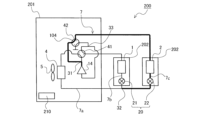
- FIG. 11 is a refrigerant circuit diagram showing a refrigeration cycle device according to the third embodiment.
- the throttling section 20 of the refrigeration cycle apparatus 200 according to the third embodiment includes one throttling device 24 and a connection switching device 25.
- the throttling device 24 is provided between the branching section 32 and the second load side heat exchanger 2.
- the connection switching device 25 switches the connection destination of the connection port on the heat source side heat exchanger 4 side of the first load side heat exchanger 1 between the branching section 32 or between the throttling device 24 and the second load side heat exchanger 2.
- connection switching device 25 includes a first opening and closing device 26 and a second opening and closing device 27.
- the first opening and closing device 26 opens and closes the refrigerant flow path connecting the branch section 32 and the throttling device 24 with the first load side heat exchanger 1.
- the second opening and closing device 27 opens and closes the refrigerant flow path connecting the throttling device 24 and the second load side heat exchanger 2 with the first load side heat exchanger 1.
- the opening and closing of the first opening and closing device 26 and the second opening and closing device 27 is controlled by the control device 210.
- the refrigerant pipe 7b branches at the branch section 35.
- One of the refrigerant pipes branched at the branch section 35 is connected to the connection port on the heat source side heat exchanger 4 side of the first load side heat exchanger 1.
- the other of the refrigerant pipes branched at the branch section 35 is connected to the branch section 34 of the refrigerant pipe 7c.
- the refrigerant pipe 7c branches at the branch section 34.
- One of the refrigerant pipes branched at the branch section 34 is connected to the branch section 35.
- the other of the refrigerant pipes branched at the branch section 34 is connected to the connection port on the heat source side heat exchanger 4 side of the second load side heat exchanger 2.
- the first opening and closing device 26 is provided between the branch section 32 and the branch section 35.
- the second opening and closing device 27 is provided between the branch section 35 and the branch section 34.
- the first opening/closing device 26 of the refrigerant circuit 7 when performing uniform heating operation, the first opening/closing device 26 of the refrigerant circuit 7 is in a closed state and the second opening/closing device 27 is in an open state.
- the first load side heat exchanger 1 and the second load side heat exchanger 2 function as radiators, the first opening/closing device 26 of the refrigerant circuit 7 is in a closed state and the second opening/closing device 27 is in an open state.
- the first opening and closing device 26 of the refrigerant circuit 7 when performing uniform cooling operation, the first opening and closing device 26 of the refrigerant circuit 7 is in a closed state, and the second opening and closing device 27 is in an open state.
- the first load side heat exchanger 1 and the second load side heat exchanger 2 function as evaporators, the first opening and closing device 26 of the refrigerant circuit 7 is in a closed state, and the second opening and closing device 27 is in an open state.
- the first opening and closing device 26 of the refrigerant circuit 7 when performing a cooling and heating mixed operation or a dehumidification operation, the first opening and closing device 26 of the refrigerant circuit 7 is in an open state, and the second opening and closing device 27 is in a closed state.
- the first opening and closing device 26 of the refrigerant circuit 7 when one of the first load side heat exchanger 1 and the second load side heat exchanger 2 functions as a radiator, and the other of the first load side heat exchanger 1 and the second load side heat exchanger 2 functions as an evaporator, the first opening and closing device 26 of the refrigerant circuit 7 is in an open state, and the second opening and closing device 27 is in a closed state.
- the refrigeration cycle device 200 equipped with the throttling section 20 can reduce the size of the unit in which the throttling section 20 is mounted, compared to the refrigeration cycle device 200 equipped with the throttling section 20 shown in the first and second embodiments.
- the vicinity of the branching portion 34 is preferably configured as follows.
- the branching portion 34 is preferably configured as a T-shaped joint or a Y-shaped joint.
- Embodiment 4 In the first to third embodiments, a part of the configuration of the refrigerant circuit 7 is mounted in a unit separate from the heat source unit 201. This is not limiting, and the configuration of the refrigerant circuit 7 may be mounted in the heat source unit 201 as in the fourth embodiment. Note that matters not specifically mentioned in the fourth embodiment are the same as those in any of the first to third embodiments. In the fourth embodiment, the same reference numerals as those in any of the first to third embodiments are used for configurations that perform the same functions as those shown in any of the first to third embodiments.
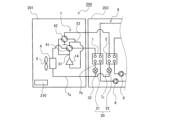
- FIGS. 12 and 13 are refrigerant circuit diagrams showing an example of a refrigeration cycle device according to the fourth embodiment.
- the refrigerant circuit 7 is mounted in a heat source unit 201.
- the heat medium that has exchanged heat in the heat source unit 201 is supplied to the use-side heat exchanger 3 mounted in the heat load unit 202 directly or through a relay unit 203. That is, in the refrigeration cycle apparatus 200 according to the fourth embodiment, the air in a room in which the use-side heat exchanger 3 is installed is heated or cooled by the heat medium that has exchanged heat in the heat source unit 201.
- the refrigeration cycle device 200 according to the fourth embodiment can reduce the length of the refrigerant circuit 7, and can reduce the amount of refrigerant charged into the refrigerant circuit 7. For example, it is desirable to reduce the amount of fluorocarbon-based refrigerants that are generally used in refrigerant circuits that are charged into the refrigerant circuit. When charging the refrigerant circuit 7 with such refrigerants, the configuration of the refrigeration cycle device 200 according to the fourth embodiment is suitable.
- the refrigeration cycle device 200 has been described above in the first to fourth embodiments.
- the refrigeration cycle device 200 described in the first to fourth embodiments is merely one example of a refrigeration cycle device according to the present disclosure.
- the refrigeration cycle device according to the present disclosure may be configured by combining the refrigeration cycle device 200 described in the first to fourth embodiments with a known technology not described in the first to fourth embodiments.
- the refrigeration cycle device according to the present disclosure may be configured by omitting or modifying part of the configuration of the refrigeration cycle device 200 described in the first to fourth embodiments, as long as it does not deviate from the gist of the present disclosure.
- Second flow path switching device 60 First connection destination selection device, 61 Opening and closing device, 62 Opening and closing device, 65 Second connection destination selection device, 66 Opening and closing device, 67 Opening and closing device, 101 First flow path, 102 Second flow path, 103 Third flow path, 104 Fourth flow path, 200 Refrigeration cycle device, 201 Heat source unit, 202 Heat load unit, 203 Relay unit, 210 Control device.
Landscapes
- Engineering & Computer Science (AREA)
- Physics & Mathematics (AREA)
- Mechanical Engineering (AREA)
- Thermal Sciences (AREA)
- General Engineering & Computer Science (AREA)
- Compression-Type Refrigeration Machines With Reversible Cycles (AREA)
Priority Applications (3)
| Application Number | Priority Date | Filing Date | Title |
|---|---|---|---|
| EP23917536.7A EP4653784A4 (en) | 2023-01-20 | 2023-01-20 | REFRIGERATION CYCLE DEVICE |
| PCT/JP2023/001655 WO2024154323A1 (ja) | 2023-01-20 | 2023-01-20 | 冷凍サイクル装置 |
| JP2024571564A JPWO2024154323A1 (https=) | 2023-01-20 | 2023-01-20 |
Applications Claiming Priority (1)
| Application Number | Priority Date | Filing Date | Title |
|---|---|---|---|
| PCT/JP2023/001655 WO2024154323A1 (ja) | 2023-01-20 | 2023-01-20 | 冷凍サイクル装置 |
Publications (1)
| Publication Number | Publication Date |
|---|---|
| WO2024154323A1 true WO2024154323A1 (ja) | 2024-07-25 |
Family
ID=91955630
Family Applications (1)
| Application Number | Title | Priority Date | Filing Date |
|---|---|---|---|
| PCT/JP2023/001655 Ceased WO2024154323A1 (ja) | 2023-01-20 | 2023-01-20 | 冷凍サイクル装置 |
Country Status (3)
| Country | Link |
|---|---|
| EP (1) | EP4653784A4 (https=) |
| JP (1) | JPWO2024154323A1 (https=) |
| WO (1) | WO2024154323A1 (https=) |
Citations (8)
| Publication number | Priority date | Publication date | Assignee | Title |
|---|---|---|---|---|
| JPH05280818A (ja) * | 1992-04-01 | 1993-10-29 | Matsushita Refrig Co Ltd | 多室冷暖房装置 |
| JP2001174089A (ja) * | 1999-12-20 | 2001-06-29 | Fujitsu General Ltd | 多室形空気調和機 |
| JP2002277088A (ja) * | 2001-03-19 | 2002-09-25 | Fujitsu General Ltd | 多室形空気調和機 |
| JP2006078026A (ja) * | 2004-09-08 | 2006-03-23 | Hitachi Ltd | 空気調和機 |
| JP2010139205A (ja) * | 2008-12-15 | 2010-06-24 | Mitsubishi Electric Corp | 空気調和装置 |
| WO2011030407A1 (ja) * | 2009-09-09 | 2011-03-17 | 三菱電機株式会社 | 空気調和装置 |
| WO2011080802A1 (ja) | 2009-12-28 | 2011-07-07 | ダイキン工業株式会社 | ヒートポンプシステム |
| CN104515195A (zh) * | 2013-09-26 | 2015-04-15 | 海尔集团公司 | 风冷多联机及其控制方法 |
-
2023
- 2023-01-20 JP JP2024571564A patent/JPWO2024154323A1/ja active Pending
- 2023-01-20 WO PCT/JP2023/001655 patent/WO2024154323A1/ja not_active Ceased
- 2023-01-20 EP EP23917536.7A patent/EP4653784A4/en active Pending
Patent Citations (8)
| Publication number | Priority date | Publication date | Assignee | Title |
|---|---|---|---|---|
| JPH05280818A (ja) * | 1992-04-01 | 1993-10-29 | Matsushita Refrig Co Ltd | 多室冷暖房装置 |
| JP2001174089A (ja) * | 1999-12-20 | 2001-06-29 | Fujitsu General Ltd | 多室形空気調和機 |
| JP2002277088A (ja) * | 2001-03-19 | 2002-09-25 | Fujitsu General Ltd | 多室形空気調和機 |
| JP2006078026A (ja) * | 2004-09-08 | 2006-03-23 | Hitachi Ltd | 空気調和機 |
| JP2010139205A (ja) * | 2008-12-15 | 2010-06-24 | Mitsubishi Electric Corp | 空気調和装置 |
| WO2011030407A1 (ja) * | 2009-09-09 | 2011-03-17 | 三菱電機株式会社 | 空気調和装置 |
| WO2011080802A1 (ja) | 2009-12-28 | 2011-07-07 | ダイキン工業株式会社 | ヒートポンプシステム |
| CN104515195A (zh) * | 2013-09-26 | 2015-04-15 | 海尔集团公司 | 风冷多联机及其控制方法 |
Non-Patent Citations (1)
| Title |
|---|
| See also references of EP4653784A1 |
Also Published As
| Publication number | Publication date |
|---|---|
| JPWO2024154323A1 (https=) | 2024-07-25 |
| EP4653784A1 (en) | 2025-11-26 |
| EP4653784A4 (en) | 2026-03-11 |
Similar Documents
| Publication | Publication Date | Title |
|---|---|---|
| JP6685409B2 (ja) | 空気調和装置 | |
| JP6644154B2 (ja) | 空気調和装置 | |
| JP5332604B2 (ja) | 冷暖同時運転型空気調和装置 | |
| JP4899489B2 (ja) | 冷凍装置 | |
| WO2014020651A1 (ja) | 空気調和装置 | |
| WO2004008048A1 (ja) | 冷凍装置 | |
| WO2005033593A1 (ja) | 冷凍装置 | |
| US11499727B2 (en) | Air conditioning apparatus | |
| JPWO2018138770A1 (ja) | 熱源側ユニット、及び、冷凍サイクル装置 | |
| CN115151768A (zh) | 热泵 | |
| KR102915885B1 (ko) | 공기 조화 장치 | |
| JP5277854B2 (ja) | 空気調和装置 | |
| CN114127493B (zh) | 空调装置 | |
| WO2020174618A1 (ja) | 空気調和装置 | |
| JP2010048506A (ja) | マルチ型空気調和機 | |
| JP5216557B2 (ja) | 冷凍サイクル装置 | |
| JP6727398B2 (ja) | 熱交換器および空気調和機 | |
| KR100526204B1 (ko) | 공기조화장치 | |
| EP3715735B1 (en) | Air conditioning apparatus | |
| JP2023511677A (ja) | 空気調和装置 | |
| JP7378685B1 (ja) | 冷凍サイクル装置 | |
| WO2024154323A1 (ja) | 冷凍サイクル装置 | |
| JP7573733B2 (ja) | 冷凍サイクル装置 | |
| US11397015B2 (en) | Air conditioning apparatus | |
| JP7343764B2 (ja) | 空気調和機 |
Legal Events
| Date | Code | Title | Description |
|---|---|---|---|
| 121 | Ep: the epo has been informed by wipo that ep was designated in this application |
Ref document number: 23917536 Country of ref document: EP Kind code of ref document: A1 |
|
| WWE | Wipo information: entry into national phase |
Ref document number: 2024571564 Country of ref document: JP |
|
| NENP | Non-entry into the national phase |
Ref country code: DE |
|
| WWP | Wipo information: published in national office |
Ref document number: 2023917536 Country of ref document: EP |