WO2024150800A1 - インクジェット用インク、インクジェットヘッド、及びインクジェット記録装置 - Google Patents
インクジェット用インク、インクジェットヘッド、及びインクジェット記録装置 Download PDFInfo
- Publication number
- WO2024150800A1 WO2024150800A1 PCT/JP2024/000510 JP2024000510W WO2024150800A1 WO 2024150800 A1 WO2024150800 A1 WO 2024150800A1 JP 2024000510 W JP2024000510 W JP 2024000510W WO 2024150800 A1 WO2024150800 A1 WO 2024150800A1
- Authority
- WO
- WIPO (PCT)
- Prior art keywords
- particles
- inkjet ink
- particle size
- resin
- inkjet
- Prior art date
- Legal status (The legal status is an assumption and is not a legal conclusion. Google has not performed a legal analysis and makes no representation as to the accuracy of the status listed.)
- Ceased
Links
Images

Classifications
-
- C—CHEMISTRY; METALLURGY
- C09—DYES; PAINTS; POLISHES; NATURAL RESINS; ADHESIVES; COMPOSITIONS NOT OTHERWISE PROVIDED FOR; APPLICATIONS OF MATERIALS NOT OTHERWISE PROVIDED FOR
- C09D—COATING COMPOSITIONS, e.g. PAINTS, VARNISHES OR LACQUERS; FILLING PASTES; CHEMICAL PAINT OR INK REMOVERS; INKS; CORRECTING FLUIDS; WOODSTAINS; PASTES OR SOLIDS FOR COLOURING OR PRINTING; USE OF MATERIALS THEREFOR
- C09D11/00—Inks
- C09D11/30—Inkjet printing inks
- C09D11/32—Inkjet printing inks characterised by colouring agents
- C09D11/322—Pigment inks
-
- B—PERFORMING OPERATIONS; TRANSPORTING
- B41—PRINTING; LINING MACHINES; TYPEWRITERS; STAMPS
- B41J—TYPEWRITERS; SELECTIVE PRINTING MECHANISMS, i.e. MECHANISMS PRINTING OTHERWISE THAN FROM A FORME; CORRECTION OF TYPOGRAPHICAL ERRORS
- B41J11/00—Devices or arrangements of selective printing mechanisms, e.g. ink-jet printers or thermal printers, for supporting or handling copy material in sheet or web form
- B41J11/0015—Devices or arrangements of selective printing mechanisms, e.g. ink-jet printers or thermal printers, for supporting or handling copy material in sheet or web form for treating before, during or after printing or for uniform coating or laminating the copy material before or after printing
- B41J11/002—Curing or drying the ink on the copy materials, e.g. by heating or irradiating
- B41J11/0021—Curing or drying the ink on the copy materials, e.g. by heating or irradiating using irradiation
- B41J11/00214—Curing or drying the ink on the copy materials, e.g. by heating or irradiating using irradiation using UV radiation
-
- C—CHEMISTRY; METALLURGY
- C09—DYES; PAINTS; POLISHES; NATURAL RESINS; ADHESIVES; COMPOSITIONS NOT OTHERWISE PROVIDED FOR; APPLICATIONS OF MATERIALS NOT OTHERWISE PROVIDED FOR
- C09D—COATING COMPOSITIONS, e.g. PAINTS, VARNISHES OR LACQUERS; FILLING PASTES; CHEMICAL PAINT OR INK REMOVERS; INKS; CORRECTING FLUIDS; WOODSTAINS; PASTES OR SOLIDS FOR COLOURING OR PRINTING; USE OF MATERIALS THEREFOR
- C09D11/00—Inks
- C09D11/02—Printing inks
- C09D11/10—Printing inks based on artificial resins
- C09D11/106—Printing inks based on artificial resins containing macromolecular compounds obtained by reactions only involving carbon-to-carbon unsaturated bonds
-
- C—CHEMISTRY; METALLURGY
- C09—DYES; PAINTS; POLISHES; NATURAL RESINS; ADHESIVES; COMPOSITIONS NOT OTHERWISE PROVIDED FOR; APPLICATIONS OF MATERIALS NOT OTHERWISE PROVIDED FOR
- C09D—COATING COMPOSITIONS, e.g. PAINTS, VARNISHES OR LACQUERS; FILLING PASTES; CHEMICAL PAINT OR INK REMOVERS; INKS; CORRECTING FLUIDS; WOODSTAINS; PASTES OR SOLIDS FOR COLOURING OR PRINTING; USE OF MATERIALS THEREFOR
- C09D11/00—Inks
- C09D11/02—Printing inks
- C09D11/10—Printing inks based on artificial resins
- C09D11/106—Printing inks based on artificial resins containing macromolecular compounds obtained by reactions only involving carbon-to-carbon unsaturated bonds
- C09D11/107—Printing inks based on artificial resins containing macromolecular compounds obtained by reactions only involving carbon-to-carbon unsaturated bonds from unsaturated acids or derivatives thereof
-
- C—CHEMISTRY; METALLURGY
- C09—DYES; PAINTS; POLISHES; NATURAL RESINS; ADHESIVES; COMPOSITIONS NOT OTHERWISE PROVIDED FOR; APPLICATIONS OF MATERIALS NOT OTHERWISE PROVIDED FOR
- C09D—COATING COMPOSITIONS, e.g. PAINTS, VARNISHES OR LACQUERS; FILLING PASTES; CHEMICAL PAINT OR INK REMOVERS; INKS; CORRECTING FLUIDS; WOODSTAINS; PASTES OR SOLIDS FOR COLOURING OR PRINTING; USE OF MATERIALS THEREFOR
- C09D11/00—Inks
- C09D11/30—Inkjet printing inks
- C09D11/38—Inkjet printing inks characterised by non-macromolecular additives other than solvents, pigments or dyes
Definitions
- the present invention relates to inkjet ink, inkjet heads, and inkjet recording devices.
- ink containing coloring material is turned into droplets, which are then ejected toward a print medium in response to an image signal (print signal) and other signals, and an image is formed on the print medium by landing on the print medium.
- inkjet inks examples include water-based inks in which coloring materials such as pigments are dispersed in an aqueous medium such as water.
- Water-based inks are characterized by their high safety, and after the droplets land on the print medium, an image is formed on the print medium by allowing the aqueous medium contained in the water-based ink to penetrate the print medium or evaporate the aqueous medium. Examples of such water-based inks include the inks described in Patent Document 1.
- Patent Document 1 describes an ink containing a colorant, an ultraviolet absorber, a resin, and an aqueous medium that emulsifies or suspends the resin.
- Patent Document 1 also describes a printing method for printing on a medium using an inkjet method, in which the ink is ejected onto a medium using an inkjet head, the ink is deposited on the medium, and an ultraviolet light source is used to irradiate the ink deposited on the medium with ultraviolet light, raising the temperature to a temperature that is lower than the boiling temperature of the ink and that suppresses ink bleeding, and volatilizing and removing at least a portion of the aqueous medium contained in the ink.
- Patent Document 1 discloses that it is possible to prevent the surface from becoming matte, thereby obtaining a printed matter with sufficient gloss, and to more appropriately suppress ink bleeding.
- An inkjet ink includes first particles containing a pigment and a first resin, second particles containing a second resin, an ultraviolet absorber, and an aqueous medium.
- the average particle size of the second particles is smaller than the average particle size of the first particles.
- An inkjet ink includes first particles containing a pigment and a first resin, an ultraviolet absorber, and an aqueous medium.
- the average particle size of the ultraviolet absorber is equal to or smaller than the average particle size of the first particles.
- An inkjet ink includes first particles containing a pigment and a first resin, an ultraviolet absorber, and an aqueous medium.
- the content of the ultraviolet absorber is 0.1% by mass or more and 1.6% by mass or less.
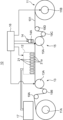
- FIG. 1 is a schematic diagram showing the configuration of an example of an inkjet recording apparatus according to an embodiment of the present invention.
- FIG. 2 is a conceptual diagram for explaining the fixing of an image formed using the inkjet ink according to an embodiment of the present invention.
- the inkjet ink according to one embodiment of the present invention includes first particles containing a pigment and a first resin, second particles containing a second resin, an ultraviolet absorber, and an aqueous medium, and the second particles have an average particle size smaller than the average particle size of the first particles.
- the inkjet ink is applied to a printing medium (recording medium) that is a substrate in response to an image signal (print signal) corresponding to an image to be formed, and then dried, so that the pigment contained in the inkjet ink remains on the printing medium, and an image (note that characters are also a type of image) is formed on the printing medium.
- the second particles are fused to each other by melting the second resin contained in the second particles, and the image formed with the pigment contained in the inkjet ink can be fixed.
- the first particles are fused to the second particles by melting the first resin contained in the first particles, and this fusion also contributes to improving the fixability of the image.
- the first resin contained in the first particles also contributes to the fixation and can improve the fixability of the image.
- the inkjet ink contains the pigment as the first particles that contain the first resin together as described above, the dispersibility of the pigment can be improved, the occurrence of uneven distribution of the pigment in the formed image can be suppressed, and the fixability of the image can be improved.
- the inkjet ink contains an ultraviolet absorbing agent, the inkjet ink is heated by exposure to ultraviolet light, and the aqueous medium is easily removed from the inkjet ink.
- the inkjet ink is an inkjet ink with excellent quick-drying property and fixation property.
- the inkjet ink is an ink containing an aqueous medium (aqueous ink).
- aqueous inks generally tend to be slower to dry and have poorer quick-drying properties than inks containing organic solvents that are more volatile than water.
- the printing medium is a resin or other medium into which the aqueous medium, such as a film, does not easily penetrate, the quick-drying properties are significantly reduced.
- aqueous inks are required to have high quick-drying properties, such as the ease with which the aqueous medium, such as water, contained in the aqueous ink that has landed on the printing medium is evaporated.
- inkjet inks such as aqueous inks are also required to have high fixability of the image formed on the printing medium.
- the inkjet ink is an ink that meets these requirements.
- the inkjet ink is an inkjet ink that is excellent in quick-drying properties and fixability, despite being an aqueous ink.
- the first particles are, for example, pigment dispersions in which the first resin is attached to the pigment, and the pigments are not aggregated and can be stably dispersed in an aqueous medium.
- the method for producing the first particles is not particularly limited, but examples include a method in which a monomer (a monomer mixture in the case of two or more types of monomers) that is a raw material for the first resin is polymerized to obtain the first resin, and the obtained first resin is put into a bead mill together with the pigment to perform a dispersion treatment.
- the first particles may be so-called self-dispersing pigment particles or pigment-containing resin particles.
- the average particle size of the first particles can be adjusted, for example, by adjusting the conditions of the dispersion process in the bead mill.
- the average particle size of the first particles can also be adjusted, for example, by filtering through a filter, and more specifically, by adjusting the number of filtrations (number of passes) and the type of filter used.
- the average particle size of the first particles can also be further adjusted by repeating the dispersion process in a bead mill and the filtration through a filter.
- An example of the bead mill is a bead mill manufactured by Ashizawa Finetech Co., Ltd.
- the conditions of the dispersion process in the bead mill include, for example, the bead diameter and the rotor rotation speed.
- the zeta potential of the first particles and the content of coarse particles contained in the first particles can also be adjusted in the same manner as the adjustment of the average particle size.
- Pigments are not particularly limited as long as they can form a desired image (can express the colors that constitute the desired image), and examples thereof include known organic pigments and inorganic pigments.
- the organic pigments include azo pigments, polycyclic pigments, nitro pigments, nitroso pigments, and aniline black.
- the azo pigments include azo lake pigments, insoluble azo pigments, condensed azo pigments, and chelate azo pigments.
- Examples of the polycyclic pigments include phthalocyanine pigments, perylene pigments, anthraquinone pigments, quinacridone pigments, dioxandine pigments, thioindigo pigments, isoindolinone pigments, and quinophthaloni pigments.
- the inorganic pigments include carbon blacks such as acetylene black and lamp black.
- the pigments can also be classified according to color, for example, pigments for black, pigments for magenta or red, pigments for orange or yellow, pigments for green or cyan, etc.
- black pigment is C.I. Pigment Black 7.
- Examples of the pigment for magenta or red include C.I. Pigment Red 2, C.I. Pigment Red 3, C.I. Pigment Red 5, C.I. Pigment Red 6, C.I. Pigment Red 7, C.I. Pigment Red 15, C.I. Pigment Red 16, C.I. Pigment Red 48:1, C.I. Pigment Red 53:1, C.I. Pigment Red 57:1, C.I. Pigment Red 122, C.I. Pigment Red 123, C.I. Pigment Red 139, C.I. Pigment Red 144, C.I. Pigment Red 149, C.I. Pigment Red 150, C.I. Pigment Red 166, C.
- Examples of the pigments include C.I. Pigment Red 177, C.I. Pigment Red 178, C.I. Pigment Red 202, and C.I. Pigment Red 222.
- orange or yellow pigments examples include C.I. Pigment Orange 31, C.I. Pigment Orange 34, C.I. Pigment Orange 36, C.I. Pigment Orange 43, C.I. Pigment Orange 61, C.I. Pigment Orange 63, C.I. Pigment Orange 71, C.I. Pigment Yellow 12, C.I. Pigment Yellow 13, C.I. Pigment Yellow 14, C.I. Pigment Yellow 15, C.I. Pigment Yellow 17, C.I. Pigment Yellow 74, C.I. Pigment Yellow 93, C.I. Pigment Yellow 94, C.I. Pigment Yellow 95, C.I. Pigment Yellow 109, C.I. Pigment Yellow 110, Pigment Yellow 120, C.I. Pigment Yellow 128, C.I.
- Pigment Yellow 138 C.I. Pigment Yellow 139, C.I. Pigment Yellow 151, C.I. Pigment Yellow 154, C.I. Pigment Yellow 155, C.I. Pigment Yellow 173, C.I. Pigment Yellow 180, C.I. Pigment Yellow 185, and C.I. Pigment Yellow 193.
- green or cyan pigment examples include C.I. Pigment Blue 15, C.I. Pigment Blue 15:2, C.I. Pigment Blue 15:3, C.I. Pigment Blue 16, C.I. Pigment Blue 60, and C.I. Pigment Green 7.
- the pigments may be used alone or in combination of two or more.
- the first resin may be, for example, a resin (so-called dispersion polymer, dispersant polymer, polymer dispersant, etc.) that is attached to the pigment and allows the first particles to be stably dispersed in an aqueous medium. More specifically, the first resin may be a resin having a portion that is attached to the pigment (hydrophobic portion) and a portion that exhibits the dispersibility of the first particles (hydrophilic portion). The first resin may be, for example, a styrene-based resin.
- the styrene-based resin may be, for example, a copolymer of styrene and a carboxylic acid component such as a carboxylic acid or a carboxylic acid ester (for example, at least one selected from acrylic acid, methacrylic acid, acrylic acid ester, methacrylic acid ester, and maleic acid).
- a carboxylic acid component such as a carboxylic acid or a carboxylic acid ester (for example, at least one selected from acrylic acid, methacrylic acid, acrylic acid ester, methacrylic acid ester, and maleic acid).
- styrene-based resin examples include styrene-acrylic acid copolymer, styrene-acrylic acid ester copolymer, styrene-acrylic acid-acrylic acid ester copolymer, styrene-methacrylic acid copolymer, styrene-acrylic acid-methacrylic acid copolymer, styrene-methacrylic acid ester copolymer, styrene-methacrylic acid-methacrylic acid ester copolymer, styrene-methacrylic acid-acrylic acid ester copolymer, styrene-methacrylic acid-acrylic acid ester copolymer, styrene-methacrylic acid-acrylic acid ester copolymer, styrene-methacrylic acid-acrylic acid ester copolymer, styrene-methacrylic acid-acrylic acid
- the first resin may be used alone or in combination of two or more kinds.
- the first resin is appropriately selected from resins having a predetermined glass transition temperature Tg, taking into consideration the temperature of the inkjet head and the temperature at which the inkjet ink dries, and the glass transition temperature Tg of the first resin is, for example, 50°C or higher and lower than 70°C.
- the glass transition temperature Tg (glass transition point) is the temperature at which glass transition occurs, and is, for example, a value (glass transition temperature) obtained by measurement using Differential Scanning Calorimetry (DSC).
- the first resin is appropriately selected to have a predetermined weight average molecular weight, taking into consideration the glass transition temperature of the second resin and the drying temperature of the inkjet ink, and the weight average molecular weight of the first resin may be, for example, 5,000 or more and 30,000 or less.
- the weight average molecular weight may be measured by a general molecular weight measurement method, and specifically, a value measured using gel permeation chromatography (GPC) may be mentioned.
- the second particles may be, for example, particles containing the second resin as a main component, or may be particles made of the second resin.
- the second particles are resin particles (so-called fixing polymer particles, fixing agent polymer particles, and polymer fixing agent particles) capable of increasing the fixability of an image formed with a pigment contained in the inkjet ink.
- the second resin is not particularly limited as long as it is a resin (so-called fixing polymer, fixing agent polymer, and polymer fixing agent) capable of increasing the fixability, and examples thereof include resins that melt when heated, such as thermoplastic resins.
- the second resin is such a resin that melts when heated, the second resin contained in the second particles is melted by heating the inkjet ink, and the second particles are fused to each other, thereby increasing the fixability.
- the second particles are present as particles (solid) in the inkjet ink before being heated, such as before the inkjet ink is discharged.
- the second particles have a low property of being dissolved in the aqueous medium contained in the inkjet ink (for example, water solubility), and are dispersed in the aqueous medium.
- the glass transition temperature Tg of the second resin may be higher than the temperature of the ink-jet ink before heating (for example, room temperature) in order to enhance the fixability, and specifically, may be 70° C. or higher and 120° C. or lower, or 70° C. or higher and 110° C. or lower.
- the second resin may be a resin having a different component from the first resin, or may be a resin having the same component as the first resin, but the first particles differ from the second particles in that they contain a pigment. In other words, the second particles may contain a component other than the second resin, but do not contain a pigment.
- the second resin may be a styrene-based resin, a silicone resin, a polyester resin, a polyurethane resin, or the like.
- the second resin may be used alone or in combination of two or more kinds.
- the styrene-based resin may be, for example, a copolymer of styrene with a carboxylic acid component such as a carboxylic acid or a carboxylic acid ester (for example, at least one selected from acrylic acid, methacrylic acid, acrylic acid esters, methacrylic acid esters, and maleic acid).
- a carboxylic acid component such as a carboxylic acid or a carboxylic acid ester
- acrylic acid methacrylic acid, acrylic acid esters, methacrylic acid esters, and maleic acid
- Specific examples of the styrene-based resin include copolymers of styrene with at least one selected from acrylic acid, methacrylic acid, acrylic acid esters, and methacrylic acid esters.
- styrene-based resin examples include styrene-acrylic acid copolymer, styrene-acrylic acid ester copolymer, styrene-acrylic acid-acrylic acid ester copolymer, styrene-methacrylic acid copolymer, styrene-acrylic acid-methacrylic acid copolymer, styrene-methacrylic acid ester copolymer, styrene-methacrylic acid-methacrylic acid ester copolymer, styrene-methacrylic acid-acrylic acid ester copolymer, styrene-methacrylic acid-acrylic acid ester copolymer, styrene-methacrylic acid-acrylic acid ester copolymer, styrene-methacrylic acid-acrylic acid ester copolymer, styrene-methacrylic acid-acrylic acid
- acrylic acid ester examples include methyl acrylate, methyl acrylate, butyl acrylate, and methoxypolyethylene glycol acrylate.
- methacrylic acid ester examples include methyl methacrylate, methyl methacrylate, butyl methacrylate, and methoxypolyethylene glycol methacrylate.
- silicone resin examples include side-chain modified silicone oil, one-end modified silicone oil, both-end modified silicone oil, and both-end modified silicone oil.
- the polyester resin is a polymer formed by ester bonds between a divalent or higher carboxylic acid and a divalent or higher alcohol.
- divalent carboxylic acids in the polyester resin include terephthalic acid, isophthalic acid, orthophthalic acid, 2,6-naphthalenedicarboxylic acid, sulfoisophthalic acid, succinic acid, adipic acid, azelaic acid, sebacic acid, 1,10-decanedicarboxylic acid, and dimer acid.
- Examples of trivalent or higher carboxylic acids in the polyester resin include trimellitic acid and pyrrolimetic acid.
- dihydric alcohol in the polyester resin examples include ethylene glycol, 1,2-propylene glycol, 1,3-propylene glycol, 1,4-butanediol, 1,5-pentanediol, 1,6-hexanediol, 1,9-nonanediol, neopentyl glycol, 3-methyl-1,5-pentanediol, diethylene glycol, triethylene glycol, polytetraethylene glycol, 1,4-cyclohexanedimethanol, and an ethylene oxide adduct of bisphenol A.
- the urethane resin is a polymer formed by urethane bonding between a divalent or higher alcohol (polyol) and a divalent or higher isocyanate (polyisocyanate).
- polyol divalent or higher alcohol
- polyisocyanate divalent or higher isocyanate
- examples of the polyol in the urethane resin include polypropylene glycol, polyethylene glycol, polytetramethylene glycol, poly(ethylene adipate), poly(diethylene adipate), poly(propylene adipate), poly(tetramethylene adipate), poly(hexamethylene adipate), poly- ⁇ -caprolactone, poly(hexamethylene carbonate), and silicone polyol.
- polyisocyanates in the urethane resin examples include tolylene diisocyanate, 4,4-diphenylmethane diisocyanate, xylylene diisocyanate, naphthalene diisocyanate, hexamethylene diisocyanate, hydrogenated tolylene diisocyanate, hydrogenated 4,4-diphenylmethane diisocyanate, isophorone diisocyanate, and tetramethylxylylene diisocyanate.
- the weight average molecular weight of the second resin is not particularly limited, but may be, for example, 300,000 or more and 1,500,000 or less in order to increase the fluidity of the inkjet ink and reduce the ejection variation, and may be 400,000 or more and 1,000,000 or less in order to provide a fluidity suitable for reducing the ejection variation.
- the weight average molecular weight here may be measured by a general molecular weight measurement method, as with the first resin, and specifically, may be a value measured using gel permeation chromatography (GPC).
- the weight average molecular weight of the second resin is obtained by freeze-drying an aqueous dispersion containing the second resin to obtain a powdered second resin, dissolving the obtained second resin in tetrahydrofuran (THF), and performing GPC analysis using the obtained solution.
- THF tetrahydrofuran
- the method for producing the second particles is not particularly limited, and examples thereof include a method of emulsion polymerizing a monomer (a monomer mixture when there are two or more types of monomers) that is the raw material of the second resin.
- the average particle size of the second particles can be adjusted, for example, by adjusting the conditions during the emulsion polymerization.
- the conditions during the emulsion polymerization include a condition in which the monomer before emulsion polymerization is stirred with a stirrer, and a condition in which the monomer during emulsion polymerization is stirred with a stirrer.
- the stirring conditions include the number of rotations of the blades provided on the stirrer and the processing time.
- stirrer examples include a batch-type high-speed stirrer.
- examples of the batch-type high-speed stirrer include Telecolta R manufactured by Primix Corporation.
- the average particle size of the second particles can also be adjusted by filtering with a filter.
- the zeta potential of the second particles can be adjusted by a method similar to that for adjusting the average particle size.
- the ultraviolet absorbent is not particularly limited, and examples thereof include benzotriazole-based ultraviolet absorbents, triazine-based ultraviolet absorbents, benzophenone-based ultraviolet absorbents, benzoate-based ultraviolet absorbents, and benzimidazole-based ultraviolet absorbents.
- the ultraviolet absorbent may be in a liquid form.
- benzotriazole-based ultraviolet absorbers examples include ultraviolet absorbers containing a benzotriazole structure, and more specifically, 2(2'-hydroxy-5'-methylphenyl)benzotriazole, 2(2'-hydroxy-5'-octylphenyl)benzotriazole, 2[2-hydroxy-3-(3,4,5,6-tetrahydrophthalimido-methyl)-5-methylphenyl]benzotriazole, 2[2'-hydroxy-3',5'-bis( ⁇ , ⁇ '-dimethylbenzyl)phenyl]-2H-benzotriazole, 2(2'-hydroxy-3',5'-di-t-amylphenyl)benzotriazole, 2(2'-hydroxy-3',5'-di-t-butylphenyl)benzotriazole, 2(2'-hydroxy-3'-t-butyl-5'-methylphenyl)benzotriazole, and 2(2'-hydroxy-3'-t-butyl
- Examples of the triazine-based ultraviolet absorbers include ultraviolet absorbers containing a hydroxyphenyltriazine structure, and more specifically, 2,4,6-tris(2-hydroxy-4-hexyloxy-3-methylphenyl)-1,3,5-triazine and 2,4-diphenyl-6-(2-hydroxy-4-hexyloxyphenyl)-1,3,5-triazine.
- Examples of the benzophenone-based ultraviolet absorbers include dihydroxybenzophenone compounds such as 2,2'-dihydroxybenzophenone, and 2-hydroxy-4-alkoxybenzophenone.
- Examples of the benzoate-based ultraviolet absorbers include resorcinol monobenzoate.
- Examples of the benzimidazole-based ultraviolet absorbers include phenylbenzimidazole sulfonic acid.
- UV absorbers not only have a higher UV absorption capacity than general substances, but also basically convert UV rays into heat. Furthermore, after converting UV rays into heat, UV absorbers basically return to their original state where they can convert UV rays into heat, and repeatedly convert UV rays into heat.
- UV polymerization initiators contained in UV-curable (polymerizable) inks and the like have a certain degree of UV absorption capacity, but do not necessarily generate heat in the generation of radicals that start polymerization, and the reaction caused by the generated radicals is not necessarily an exothermic reaction. Furthermore, radicals are generated from UV rays only once, and the reaction is not repeated. From this perspective, UV polymerization initiators can also be considered not to be included in UV absorbers.
- the ultraviolet absorbents may be used alone or in combination of two or more.
- the average particle size of the ultraviolet absorber can be adjusted, for example, by pulverizing.
- the pulverization include pulverization by stirring with a stirrer.
- the stirrer include a batch-type high-speed stirrer.
- the batch-type high-speed stirrer include Telecolta R manufactured by Primix Corporation.
- the average particle size of the ultraviolet absorber can be adjusted by the stirring conditions, such as the number of rotations of the blades of the stirrer and the processing time.
- the average particle size of the ultraviolet absorber can also be adjusted by filtering with a filter.
- the aqueous medium is not particularly limited as long as it is a medium containing water, and may be, for example, an aqueous medium containing water as a main component (for example, 50% by mass or more), or may be an aqueous medium consisting of water.
- the content of water in the aqueous medium may be 50% by mass or more, 90% by mass or more, or 100% by mass.
- the aqueous medium may contain water and further contain a water-soluble organic solvent. That is, the aqueous medium may be an aqueous medium containing water and a water-soluble organic solvent.
- water-soluble organic solvent examples include alcohol compounds, ketone compounds, glycol compounds, glycol ether compounds, lactam compounds, nitrogen-containing compounds, acetate compounds, thiodiglycol, glycerin, and dimethyl sulfoxide.
- alcohol compounds examples include methanol, ethanol, isopropanol, and butanol.
- ketone compounds include methyl ethyl ketone.
- glycol compounds examples include ethylene glycol, 1,3-propanediol, propylene glycol, 1,2-pentanediol, 1,5-pentanediol, 1,2-octanediol, 1,8-octanediol, 3-methyl-1,3-butanediol, 3-methyl-1,5-pentanediol, diethylene glycol, triethylene glycol, and tetraethylene glycol.
- glycol ether compounds include diethylene glycol diethyl ether, diethylene glycol monobutyl ether, ethylene glycol monomethyl ether, ethylene glycol monobutyl ether, diethylene glycol monomethyl ether, diethylene glycol monoethyl ether, diethylene glycol diethyl ether, triethylene glycol monomethyl ether, triethylene glycol monoethyl ether, triethylene glycol monobutyl ether, and propylene glycol monomethyl ether.
- lactam compounds include 2-pyrrolidone and N-methyl-2-pyrrolidone.
- nitrogen-containing compound include 1,3-dimethylimidazolidinone, formamide, and dimethylformamide.
- the acetate compound include diethylene glycol monoethyl ether acetate.
- the water-soluble organic solvent may be used alone or in combination of two or more kinds.
- the aqueous medium may function as a solvent or as a dispersion medium.
- the inkjet ink contains the first particles, the UV absorber, and the aqueous medium, and may further contain the second particles.
- the contents of these are not particularly limited, but the content of the first particles may be 3.0 parts by mass or more and 8.0 parts by mass or less with respect to 100 parts by mass of the inkjet ink.
- the content of the second particles may be 1.0 parts by mass or more and 15.0 parts by mass or less with respect to 100 parts by mass of the inkjet ink.
- the content of the ultraviolet absorber may be 0.1 parts by mass or more and 1.6 parts by mass or less with respect to 100 parts by mass of the inkjet ink. That is, the content of the ultraviolet absorber may be 0.1 parts by mass or more and 1.6 parts by mass or less.
- the ultraviolet absorber being 0.1 parts by mass or more can increase the amount of heat generated inside the inkjet ink. This promotes the progress of drying and improves fixability. In the case where the inkjet ink contains second particles, the fixability is further improved by melting the second particles, etc.
- the inkjet ink attached to the printing medium if the absorption of ultraviolet light on the side of the ultraviolet light irradiation source increases, the amount of ultraviolet light that penetrates to the opposite side of the irradiation source decreases, and the amount of heat generated on the opposite side of the irradiation source may decrease, but if the ultraviolet absorber is 1.6 parts by mass or less, this is unlikely to occur. This promotes the progress of drying and improves fixability.
- the drying of the inkjet ink on the print medium side which is difficult to dry, can be accelerated.
- the fixing property is further improved by melting the second particles, etc.
- the inkjet ink contains the first particles, the second particles, the UV absorber, and the aqueous medium, it may contain other components, and the remainder may be the aqueous medium.
- the average particle size of the second particles is smaller than the average particle size of the first particles, i.e., the ratio of the average particle size of the second particles to the average particle size of the first particles (average particle size of the second particles/average particle size of the first particles) is less than 1. This makes it easier to remove the aqueous medium from the inkjet ink, and the quick-drying property is improved. This is considered to be because the evaporated aqueous medium is easier to pass through the inkjet ink. This also makes it easier for the second particles to be dispersed more uniformly in the aqueous medium, and the fixability is improved.
- the ratio (average particle size of the second particles/average particle size of the first particles) is less than 1, and may be 0.6 or more and 0.9 or less in terms of improving the fixability while improving the quick-drying property.
- the average particle size of the first particles is determined by, for example, determining the dynamic structure factor by dynamic scattering using a particle size distribution meter (ELSZneo Zeta Potential/Particle Size/Molecular Weight Measurement System manufactured by Otsuka Electronics Co., Ltd.) with a helium neon (HeNe) laser as the light source, and then performing cumulant analysis to determine the average particle size.
- the average particle size of the second particles is determined by observing the second particles after drying and removing the aqueous medium with a scanning electron microscope (SEM) and performing image analysis on the obtained image.
- SEM scanning electron microscope
- the average particle size of the first particles is not particularly limited as long as it is larger than the average particle size of the second particles, but may be, for example, 80 nm or more and 100 nm or less from the viewpoint of improving the image quality of the formed image, such as making it easier to achieve a desired image density and increasing color stability, and may be 85 nm or more and 95 nm or less from the viewpoint of further improving the image quality.
- the first particles may undergo aggregation, and coarse particles may inevitably be mixed in.
- the coarse particles include particles having a particle size of 2 ⁇ m or more, and also include particles having a particle size of 2 ⁇ m or more and 10 ⁇ m or less.
- the average particle size of the first particles is an average particle size that does not include the coarse particles. That is, the inkjet ink according to this embodiment includes the first particles, the second particles, the ultraviolet absorber, and the aqueous medium, and the first particles include coarse particles having a particle size of 2 ⁇ m or more, and the average particle size of the first particles other than the coarse particles is smaller than the average particle size of the second particles. Note that, even if the average particle size of the first particles in the inkjet ink is considered to be the average particle size when the coarse particles are included, the average particle size of the first particles is smaller than the average particle size of the second particles.
- the first particles may have 70,000 or less coarse particles having a particle size of 2 ⁇ m or more and 10 ⁇ m or less per mL, and from the viewpoint of further improving the landing accuracy, the number of coarse particles may be 40,000 or less per mL.
- the limit is to reduce the number to about 30,000 particles per mL.
- the first particles may have 30,000 or more coarse particles having a particle size of 2 ⁇ m or more and 10 ⁇ m or less per mL and 70,000 or less coarse particles per mL.
- the number is the number of the coarse particles per 1 mL of the first particles.
- the number of these coarse particles (mixed amount) can be measured, for example, using a particle size distribution measuring device that counts the number of particles (AccuSizer A700APS manufactured by Entegris).
- the average particle size of the second particles is not particularly limited as long as it is smaller than the average particle size of the first particles, and may be, for example, 70 nm or more and 80 nm or less in order to improve the image quality of the formed image while improving fixability.
- the particle size variation of the second particles is small, the ejection variation of the inkjet ink can be reduced, and the landing accuracy of the inkjet ink can be improved.
- the particle size variation of the second particles may be, for example, 7 nm or less in standard deviation ⁇ , and from the viewpoint of further improving the landing accuracy, it may be 5 nm or less.
- the particle size variation of the second particles is preferably smaller from the viewpoint of improving the landing accuracy, but in reality, the limit is to reduce it to about 3 nm. For this reason, the particle size variation of the second particles may be 3 nm or more and 7 nm or less in standard deviation ⁇ .
- the standard deviation ⁇ may be a value calculated from the particle size obtained by observing with a scanning electron microscope (SEM: Scanning Electron Microscope), measuring the particle size from the obtained image, and the like. More specifically, the inkjet ink is applied to a film using a bar coater, dried at 40°C, and the dried product is observed using an SEM, and the particle size is measured from the image obtained, and the value is calculated from the particle size obtained.
- SEM Scanning Electron Microscope
- the average particle size of the ultraviolet absorber may be equal to or smaller than the average particle size of the first particles. That is, the ratio of the average particle size of the ultraviolet absorber to the average particle size of the first particles (average particle size of the ultraviolet absorber/average particle size of the first particles) may be 1 or less. Also, from the viewpoint of further improving the weather resistance, the ratio (average particle size of the ultraviolet absorber/average particle size of the first particles) may be 0.6 or more and 1.0 or less.
- the average particle size of the ultraviolet absorber may be 60 nm or more and 100 nm or less, and from the viewpoint of further improving the weather resistance, it may be 60 nm or more and 80 nm or less. Also, from the viewpoint of improving the weather resistance, the ratio of the average particle size of the ultraviolet absorber to the average particle size of the second particles (average particle size of the ultraviolet absorber/average particle size of the second particles) may be 0.75 or more and 1.25 or less.
- the average particle size of the ultraviolet absorber is determined by, for example, determining the dynamic structure factor by dynamic scattering using a particle size distribution meter (ELSZneo Zeta Potential/Particle Size/Molecular Weight Measurement System manufactured by Otsuka Electronics Co., Ltd.) using a helium neon (HeNe) laser as a light source, and then performing cumulant analysis to determine the average particle size.
- a particle size distribution meter ELSZneo Zeta Potential/Particle Size/Molecular Weight Measurement System manufactured by Otsuka Electronics Co., Ltd.
- HeNe helium neon
- the absolute value of the zeta potential of the second particles When the absolute value of the zeta potential of the second particles is large, the fixability of the image is improved. This is considered to be because, when the absolute value of the zeta potential of the second particles is large, the dispersibility of the second particles is increased, and the effect of the second particles of improving the fixability of the image can be more effectively achieved. From this point of view, the absolute value of the zeta potential of the second particles may be larger than the absolute value of the zeta potential of the first particles.
- the ratio of the absolute value of the zeta potential of the second particles to the absolute value of the zeta potential of the first particles may be greater than 1.
- the ratio (absolute value of the zeta potential of the second particles/absolute value of the zeta potential of the first particles) may be 1.1 or more and 1.3 or less.
- the absolute value of the zeta potential of the second particles may be 50 mV or more from the viewpoint of increasing the dispersibility and the fixability, and may be 55 mV or more and 60 mV or less from the viewpoint of further increasing the dispersibility and the fixability.
- the zeta potential may be, for example, a value measured by an electrophoretic light scattering method (laser Doppler method), and specifically, a value measured by a zeta potential measuring device using an electrophoretic light scattering method (laser Doppler method) for a liquid in which particles (the first particles or the second particles) are diluted 5000 times with water.
- the zeta potential measuring device may be, for example, a zeta potential/particle size/molecular weight measuring system ELSZneo manufactured by Otsuka Electronics Co., Ltd.
- the inkjet ink may contain components other than the first particles, the second particles, the ultraviolet absorbing agent, and the aqueous medium (other components).
- the other components include components that are added to inkjet inks, such as a penetrating agent, a surfactant, a pH adjuster, a preservative, a fungicide, an anti-drying agent (moisturizer), a chelating agent, a defoamer, an oxygen scavenger, a conductivity imparting agent, an infrared absorbing agent, and a curl inhibitor.
- the inkjet ink is used when forming an image with an inkjet recording device.
- the inkjet ink has excellent quick-drying and fixing properties. Therefore, when the inkjet ink is used when forming an image with an inkjet recording device, an image with high fixing properties can be formed while suppressing the occurrence of problems that occur after the inkjet ink is attached to the printing medium.
- the printing medium on which an image is formed with the inkjet ink is not particularly limited, and examples thereof include paper, film, and fabric.
- the paper include plain paper, high-quality paper, matte-coated paper, cast paper, and photo paper.
- the film include resins such as polyethylene terephthalate (PET) film.
- the fabric examples include woven fabrics, knitted fabrics, and nonwoven fabrics. Since the inkjet ink has excellent quick-drying properties, an image can be suitably formed even on a printing medium with low ink permeability. From this point of view, the printing medium may be the film. That is, the inkjet ink is also used when forming an image on a film with an inkjet recording device.
- Fig. 1 is a schematic diagram showing the configuration of an example of an inkjet recording device 10 according to an embodiment of the present invention.
- the inkjet recording device 10 includes an ejection unit 12 having at least one inkjet head 21, a transport unit 11 that transports a print medium (printing substrate) 101 to which the inkjet ink ejected from the inkjet head 21 is applied, and an ultraviolet irradiation unit 14 that irradiates ultraviolet light onto the print medium 101 to which the inkjet ink is applied.
- the inkjet recording device 10 may further include a first heating unit 13 that heats the print medium 101 before the inkjet ink ejected from the ejection unit 12 is applied, and a second heating unit 15 that heats the print medium 101 after the inkjet ink ejected from the ejection unit 12 is applied.
- the inkjet recording device 10 also includes a control unit 16 that controls the transport unit 11, the ejection unit 12, the first heating unit 13, the ultraviolet irradiation unit 14, and the second heating unit 15.
- the transport unit 11 transports the print medium 101 from the supply roller 11A to the recovery roller 11B.
- the inkjet recording device 10 is also provided with the ejection unit 12, the first heating unit 13, the ultraviolet ray irradiation unit 14, the second heating unit 15, etc. along the transport path of the print medium 101 by the transport unit 11.
- the supply roller 11A supplies the print medium 101 to the ejection unit 12, on which the inkjet ink ejected from the inkjet head 21 is adhered.
- the recovery roller 11B recovers the print medium 101 supplied to the ejection unit 12.
- the transport unit 11 may be provided with rollers 19A to 19D for passing the print medium 101 through a predetermined transport path when transporting the print medium 101 from the supply roller 11A to the recovery roller 11B.
- the supply roller 11A, the recovery roller 11B, and the rollers 19A to 19D may each be a drive roller or a driven roller, as long as they are capable of transporting the print medium 101 from the supply roller 11A to the recovery roller 11B.
- the inkjet ink according to this embodiment has excellent quick-drying properties, so by using the inkjet ink according to this embodiment, the image quality of the formed image can be suppressed from decreasing even when the conveying speed of the print medium is high.
- the inkjet ink according to this embodiment tends to reduce the ejection variations of the inkjet ink, so by using the inkjet ink according to this embodiment, particularly the inkjet ink with reduced ejection variations, the ejection variations can be suppressed even when the conveying speed of the print medium is high.
- the conveying speed of the print medium 101 in the conveying unit 11 is not particularly limited, but may be relatively high, for example, 80 m/min to 120 m/min, or more specifically, 100 m/min, in order to suppress the decrease in the image quality of the formed image and the ejection variations, as described above, by using the inkjet ink according to this embodiment.
- the print medium 101 transported by the transport unit 11 may be long or sheet-like.
- the transport unit 11 may include a transport belt.
- the transport unit 11 may transport the print medium 101 by placing the print medium 101 on the transport belt and transporting the transport belt in this state.
- the print medium 101 may be paper or fabric, and since the inkjet ink according to this embodiment has excellent quick-drying properties, it may be a print medium with low permeability, specifically, a film.
- the ejection unit 12 ejects droplets of inkjet ink toward the print medium 101 to deposit the inkjet ink on the print medium 101.
- the ejection unit 12 includes at least one inkjet head 21 that faces the print medium 101 and is directly responsible for ejecting ink, and an ink tank 17 that stores inkjet ink to be supplied to the inkjet head 21.
- the inkjet head 21 ejects inkjet ink supplied from the ink tank 17 toward the print medium 101.
- the inkjet head 21 is held so that an ejection surface 21a that ejects inkjet ink corresponds to the print medium 101.
- the ejection surface 21a of the inkjet head 21 has a plurality of ejection ports 21b that eject inkjet ink onto the print medium 101.
- the smaller the nozzle of the inkjet head the smaller the droplets of the inkjet ink that are ejected, and although a high-resolution image can be formed, there is a tendency for ejection variations to occur. Since the inkjet ink according to this embodiment tends to reduce the ejection variations of the inkjet ink, the use of the inkjet ink according to this embodiment, particularly the inkjet ink with reduced ejection variations, can suppress the occurrence of ejection variations even if the nozzle of the inkjet head is small.
- the diameter R of the ejection opening 21b is not particularly limited as long as it is possible to eject the inkjet ink, but since the use of the inkjet ink according to this embodiment can suppress the occurrence of ejection variations as described above, it may be relatively small, for example, 10 ⁇ m or more and 15 ⁇ m or less, or more specifically, 12 ⁇ m.
- the higher the driving frequency (ejection frequency) for ejecting the inkjet ink the higher the printing speed, but the inkjet ink attached to the printing medium tends to dry insufficiently, which can lead to a decrease in the image quality of the image formed and a tendency for ejection variations to occur.
- the inkjet ink according to this embodiment has excellent quick-drying properties, so by using the inkjet ink according to this embodiment, the image quality deterioration can be suppressed even at a high driving frequency.
- the inkjet ink according to this embodiment tends to reduce the ejection variations of the inkjet ink, so by using the inkjet ink according to this embodiment, particularly the inkjet ink with reduced ejection variations, the ejection variations can be suppressed even at a high driving frequency.
- the driving frequency for ejecting the inkjet ink in the ejection unit 12 is not particularly limited, but may be relatively high, for example, 60 kHz or more and 100 kHz or less, in that the inkjet ink according to this embodiment can be used to suppress the image quality deterioration and ejection variations of the image formed, as described above.
- the image may be divided into multiple sections (e.g., a grid pattern) and printed by forming or not forming pixels (dots) in each section, or by forming pixels of gradually differing sizes.
- One or more droplets are ejected from the ejection port 21b to form one pixel.
- the reciprocal of the period at which the amount of droplets that constitute one pixel are ejected from one ejection port 21b is the drive frequency.
- the first heating section 13 heats the printing medium 101 to promote evaporation of the aqueous medium contained in the inkjet ink applied to the printing medium 101.
- the first heating section 13 may include a first heating roller 13A that contacts the printing medium 101 and directly heats the printing medium 101.
- the first heating roller 13A heats the printing medium 101 and also functions as a roller in the transport section 11.
- the first heating section 13 may heat the printing medium 101 by blowing hot air onto the printing medium 101 instead of or in addition to heating by the first heating roller 13A.
- the heating of the printing medium 101 by the first heating section 13 may be performed before or after the inkjet ink is applied to the printing medium 101, or may be performed both before and after the inkjet ink is applied to the printing medium 101. That is, the first heating unit 13 may be provided on the upstream side of the ejection unit 12 in the transport direction of the print medium 101, or on the downstream side, or on both sides.
- the ultraviolet irradiation unit 14 irradiates the inkjet ink attached to the print medium 101 with ultraviolet (UV) rays to heat the inkjet ink.
- the inkjet ink according to this embodiment contains not only the pigment but also the ultraviolet absorber, and is therefore easily heated. This heating melts the first resin contained in the first particles and the second resin contained in the second particles in the inkjet ink. Then, the melted resins are fixed, and the image formed with the pigment contained in the inkjet ink is fixed on the print medium 101.
- the ultraviolet irradiation unit 14 irradiates ultraviolet rays, and therefore includes at least a light source 14A for irradiating ultraviolet rays.
- the ultraviolet irradiation unit 14 irradiates ultraviolet rays to the inkjet ink attached to the print medium 101, and therefore is performed after the inkjet ink is attached to the print medium 101. That is, the ultraviolet irradiation unit 14 is provided downstream of the ejection unit 12 in the transport direction of the print medium 101.
- the second heating unit 15 heats the printing medium 101, thereby heating the inkjet ink attached to the printing medium 101.
- the heating by the second heating unit 15 assists the melting of the first resin and the second resin by the ultraviolet irradiation unit 14.
- the second heating unit 15 is provided near the ultraviolet irradiation unit 14 because it assists the melting by the ultraviolet irradiation unit 14.
- the second heating unit 15 is located, for example, on the opposite side of the printing medium 101 to the ultraviolet irradiation unit 14.
- the second heating unit 15 may be provided with a second heating roller 15A that contacts the printing medium 101 and directly heats the printing medium 101.
- the second heating roller 15A heats the printing medium 101 and also functions as a roller in the transport unit 11.
- the second heating unit 15 may also heat the print medium 101 by blowing hot air onto the print medium 101, instead of or in addition to heating by the second heating roller 15A.
- the control unit 16 controls the transport unit 11, the ejection unit 12, the first heating unit 13, the ultraviolet ray irradiation unit 14, and the second heating unit 15. Specifically, the control unit 16 also controls the transport speed of the print medium 101 in the transport unit 11 and the drive frequency for ejecting the inkjet ink in the ejection unit 12.
- the control unit 16 includes a computer.
- the control unit 16 includes, for example, a central processing unit (CPU), a read only memory (ROM), a random access memory (RAM), and an external storage device, although not shown in the figure.
- the inkjet recording device is not particularly limited as long as it can form an image using the inkjet ink.
- One example of the inkjet recording device shown in FIG. 1 can fix a high-quality image on the print medium using the inkjet ink.
- the image can be fixed as shown in FIG. 2.
- FIG. 2 is a conceptual diagram for explaining the fixing of an image formed using the inkjet ink according to an embodiment of the present invention. Specifically, the fixing is explained by showing a first state S1 to a fifth state S5.
- FIG. 2 is a conceptual diagram in which the number and size of components constituting the inkjet ink are different from the actual ones.
- the first state S1 is the state of the inkjet ink 103 when it is held in the inkjet head 21 (i.e., before ejection).
- the first particles 105, the second particles 106, and the ultraviolet absorber 107 are dispersed in the aqueous medium 104. That is, the inkjet ink 103 includes the first particles 105, the second particles 106, the ultraviolet absorber 107, and the aqueous medium 104.
- the first particles 105 include the pigment 108 and the first resin 109. More specifically, the first particles 105 are a pigment dispersion in which the first resin 109 is attached to the surface of the pigment 108, and it is preferable that the pigments 108 do not aggregate together.
- the second state S2 is the state (droplet state) of the inkjet ink 103 when it is flying from the inkjet head 21 toward the print medium 101 (i.e., after ejection and before landing).
- the inkjet ink in the second state S2 (the ratio of components, the state of the components, etc.) is basically the same as the first state S1.
- the third state S3 is the state of the inkjet ink 103 after it is applied to the print medium 101 until a certain amount of time has passed. In this state, the aqueous medium 104 gradually evaporates. Because the print medium 101 is heated by the first heating unit 13, the heat is transferred to the inkjet ink 103, accelerating the evaporation of the aqueous medium 104.
- the fourth state S4 is the state of the inkjet ink 103 immediately before ultraviolet light is irradiated by the ultraviolet light irradiation unit 14.
- the evaporation of the aqueous medium 104 has progressed more than in the third state S3.
- the evaporation of the aqueous medium 104 may be complete.
- the components of the inkjet ink 103 other than the aqueous medium 104, specifically, the first particles 105, the second particles 106, and the ultraviolet absorber 107 remain on the printing medium 101.
- the fifth state S5 is the state of the inkjet ink 103 when ultraviolet light is being irradiated by the ultraviolet light irradiation unit 14.
- the pigment 108 and the ultraviolet absorber 107 absorb ultraviolet light and generate heat, which melts the first resin contained in the first particles 105 and the second resin contained in the second particles 106.
- the temperature of the inkjet ink 103 drops, the first resin contained in the first particles 105 and the second resin contained in the second particles 106 solidify, and the image formed by the pigment 108 is fixed by the solidified resin 110.
- the pigment 108 is mainly covered by the second resin.
- the inkjet ink according to the first aspect includes first particles containing a pigment and a first resin, second particles containing a second resin, an ultraviolet absorber, and an aqueous medium, and the average particle size of the second particles is smaller than the average particle size of the first particles.
- the inkjet ink according to the second aspect is the inkjet ink according to the first aspect, in which the particle size variation of the second particles is 7 nm or less in standard deviation ⁇ .
- the inkjet ink according to the third aspect is the inkjet ink according to the first or second aspect, in which the weight average molecular weight of the second resin is 300,000 or more and 1,500,000 or less.
- the inkjet ink according to the fourth aspect is the inkjet ink according to any one of the first to third aspects, in which the first particles have a particle size of 2 ⁇ m to 10 ⁇ m and the number of coarse particles is 70,000 particles/mL or less.
- the inkjet ink of the fifth aspect is the inkjet ink of any one of the first to fourth aspects, in which the absolute value of the zeta potential of the second particles is greater than the absolute value of the zeta potential of the first particles.
- the inkjet ink of the sixth aspect is the inkjet ink of any one of the first to fifth aspects, in which the absolute value of the zeta potential of the second particles is 50 mV or more.
- the seventh aspect of the inkjet ink is the inkjet ink of any one of the first to sixth aspects, in which the average particle size of the UV absorber is equal to or smaller than the average particle size of the first particles.
- the inkjet ink according to the eighth aspect is an inkjet ink that includes first particles containing a pigment and a first resin, an ultraviolet absorber, and an aqueous medium, and the average particle size of the ultraviolet absorber is equal to or smaller than the average particle size of the first particles.
- the inkjet ink of the ninth aspect is the inkjet ink of the eighth aspect, and further includes second particles that include a second resin.
- the inkjet ink of the tenth aspect is the inkjet ink of any one of the first to ninth aspects, in which the content of the ultraviolet absorber is 0.1% by mass or more and 1.6% by mass or less.
- the inkjet ink according to the eleventh aspect is an inkjet ink that includes first particles containing a pigment and a first resin, an ultraviolet absorber, and an aqueous medium, and the content of the ultraviolet absorber is 0.1% by mass or more and 1.6% by mass or less.
- the inkjet ink of the twelfth aspect is the inkjet ink of the eleventh aspect, which contains second particles that include a second resin.
- the inkjet head according to the thirteenth aspect has a plurality of ejection ports that eject the inkjet ink according to any one of the first to twelfth aspects onto a printing medium, and the diameter of the ejection ports is 10 to 15 ⁇ m.
- the inkjet recording device includes an ejection section having at least one inkjet head that ejects the inkjet ink according to any one of the first to twelfth aspects onto a print medium, a transport section that transports the print medium onto which the inkjet ink ejected from the inkjet head is applied, and an ultraviolet irradiation section that irradiates ultraviolet light onto the print medium onto which the inkjet ink is applied.
- the inkjet recording device is the inkjet recording device according to the fourteenth aspect, in which the transport speed of the print medium is 80 m/min or more and 120 m/min or less.
- the inkjet recording device is the inkjet recording device according to the fourteenth or fifteenth aspect, in which the drive frequency for ejecting the inkjet ink is 60 kHz or more and 100 kHz or less.
- the inkjet recording device is an inkjet recording device according to any one of the fourteenth to sixteenth aspects, in which the transport unit transports a film as the print medium.
- the present invention can provide an inkjet ink that has excellent quick-drying and fixing properties.
- the present invention can also provide an inkjet head and an inkjet recording device that use the inkjet ink.
- Styrene manufactured by FUJIFILM Wako Pure Chemical Industries, Ltd.
- butyl acrylate manufactured by FUJIFILM Wako Pure Chemical Industries, Ltd.
- methacrylic acid manufactured by FUJIFILM Wako Pure Chemical Industries, Ltd.
- methoxypolyethylene glycol methacrylate manufactured by NOF Corporation
- the mixture in the reaction vessel was then heated to 75°C while stirring under a nitrogen atmosphere, and the mixture in the dropping funnel was dropped into the reaction vessel over 3 hours. After 2 hours had passed at 75°C from the end of the dropping, a solution in which 3 parts by mass of the polymerization initiator was dissolved in 5 parts by mass of methyl ethyl ketone was added to the reaction vessel. The mixture was then aged at 75°C for 2 hours and at 80°C for 2 hours. After that, 50 parts by mass of methyl ethyl ketone was added to the reaction vessel.
- the solution of the first resin used in this example was obtained.
- the weight average molecular weight of the obtained first resin was measured by GPC analysis, and the weight average molecular weight of the first resin was about 15,000.
- the glass transition temperature Tg of the first resin was measured by DSC analysis, and the glass transition temperature Tg of the first resin was about 60°C.
- the solid content concentration in the solution of the first resin was about 45% by mass.
- the resulting pigment mixture was mixed for 1 hour using a disperser blade at 7000 rpm and 20°C.
- the resulting dispersion was dispersed 15 times using a bead mill (LMZ015, manufactured by Ashizawa Finetech Co., Ltd.) with a bead diameter of 0.3 mm and a rotor speed of 3000 rpm.
- LMZ015 manufactured by Ashizawa Finetech Co., Ltd.
- Methyl ethyl ketone was removed from the obtained dispersion at 60°C under reduced pressure, and water was further removed. Furthermore, the dispersion from which methyl ethyl ketone and water had been removed was subjected to centrifugation, and the liquid layer was filtered through a filter (Mini Sartor Syringe Filter manufactured by Sartorius, pore size: 5 ⁇ m, material: cellulose acetate) to remove coarse particles, and an aqueous dispersion containing the black pigment and the first resin was obtained.
- a filter Mini Sartor Syringe Filter manufactured by Sartorius, pore size: 5 ⁇ m, material: cellulose acetate
- an epoxy crosslinking agent trimethylolpropane polyglycidyl ether, Denacol EX321L manufactured by Nagase ChemteX Corporation, epoxy equivalent: 130
- 15.23 parts by mass of ion-exchanged water were added, and the mixture was heated at 70°C for 3 hours while stirring.
- the aqueous dispersion was cooled to room temperature, and the liquid layer was filtered through a filter (Mini Sart Syringe Filter manufactured by Sartorius, pore size: 5 ⁇ m, material: cellulose acetate) to remove coarse particles, yielding an aqueous dispersion in which the first particles containing the black pigment and the first resin were dispersed.
- a filter Mini Sart Syringe Filter manufactured by Sartorius, pore size: 5 ⁇ m, material: cellulose acetate
- the solids concentration of the obtained aqueous dispersion (a water dispersion in which the first particles containing the black pigment and the first resin are dispersed) was 22% by weight.
- the pigment introduction rate was 68.76% by mass.
- the contents of the black pigment, the first resin, the epoxy crosslinking agent, and the ion-exchanged water in the aqueous dispersion were 15.13 parts by mass, 6.48 parts by mass, 0.39 parts by mass, and 78.00 parts by mass, respectively, relative to 100 parts by mass of the aqueous dispersion.
- the average particle size of the first particles was determined by dynamic structure factor determination by dynamic scattering method using a particle size distribution meter (ZETA potential/particle size/molecular weight measurement system ELSZneo manufactured by Otsuka Electronics Co., Ltd.) using a helium-neon (HeNe) laser as a light source, and was determined by cumulant analysis to be 100 nm.
- the aqueous dispersion had a viscosity of 4.8 mPa ⁇ s and a pH of 9.7.
- the solids concentration of the resulting aqueous dispersion (aqueous dispersion in which the second particles containing the second resin are dispersed) was approximately 42% by weight.
- the average particle size of the second particles was determined by observing the second particles after drying and removing the aqueous medium with a scanning electron microscope (SEM) and analyzing the resulting image, and was found to be 100 nm.
- the resulting mixture was filtered through a filter (Minisart Syringe Filter manufactured by Sartorius, pore size: 5 ⁇ m, material: cellulose acetate) to obtain a black inkjet ink.
- the average particle size of the ultraviolet absorber was determined to be 60 nm by determining the dynamic structure factor by a dynamic scattering method using a particle size distribution meter (ZETA potential/particle size/molecular weight measurement system ELSZneo manufactured by Otsuka Electronics Co., Ltd.) with a helium neon (HeNe) laser as the light source, and then performing cumulant analysis.
- the contents of the water dispersion in which the first particles are dispersed, the water dispersion in which the second particles are dispersed, the propylene glycol, the diethylene glycol monoisobutyl ether, the silicone surfactant, and the benzotriazole UV absorber in the obtained inkjet ink were 508.9 parts by mass, 48.3 parts by mass, 286.0 parts by mass, 44.0 parts by mass, 5.5 parts by mass, 207.3 parts by mass, and 50.9 parts by mass, respectively.
- the average particle size of the particles contained in the inkjet ink was 98.8 nm.
- the inkjet ink had a viscosity of 5.2 mPa ⁇ sec at 32° C., a dynamic surface tension of 28.9 mN/m, and a pH of 9.1.
- the stirring conditions with the stirring blade during the production of the aqueous dispersion in which the second particles produced in Production Example 3 were dispersed, and the number of passes through the filter was adjusted, to prepare the second particles having the average particle size shown in Table 1.
- the zeta potentials of the first particles having an average particle size of 100 ⁇ m and the second particles having an average particle size of 80 ⁇ m were measured with a zeta potential meter (ZETA potential/particle size/molecular weight measurement system ELSZneo manufactured by Otsuka Electronics Co., Ltd.), and were ⁇ 45 mV and ⁇ 60 mV, respectively.
- Weight change due to heating Each inkjet ink was applied onto a film using a bar coater, and the weight of the inkjet ink applied onto the film (weight before heating) was measured. Thereafter, the film onto which the inkjet ink was applied was dried in a 40° C. dryer for 40 minutes, and the weight of the inkjet ink after drying (weight after heating) was measured. The weight change rate was calculated from the weight before heating and the weight after heating. It was found that the greater the weight change rate, the better the quick-drying property of the inkjet ink. For example, if the weight change rate was 54% or more, it was evaluated as " ⁇ ", and if it was less than 54%, it was evaluated as " ⁇ ".
- each inkjet ink was applied to a film with a bar coater to form a black image.
- a cross-cut test (based on JIS K5600-5-6) was performed on the obtained black image. The less the image peeled off during the cross-cut test, the better the image fixation. For example, the cross-cut test was performed on a print medium on which 25 images were printed. If the number of peeled sheets was 2 or less (i.e., 2/25 or less), the result was evaluated as " ⁇ ", and if the number of peeled sheets was 3 or more (i.e., 3/25 or more), the result was evaluated as " ⁇ ".
- an inkjet recording device medium as shown in FIG. 1 equipped with an inkjet head with an ejection port diameter of 12 ⁇ m can be used to suitably print black images with excellent fixability using each of the inkjet inks, even under conditions where the print medium transport speed is 100 m/min and the drive frequency (ejection frequency) for ejecting the inkjet ink is 78.74 kHz.
- the absolute value of the zeta potential of the second particles being larger than the absolute value of the zeta potential of the first particles, and the absolute value of the zeta potential of the second particles being 50 mV or more, contribute to improved quick-drying and fixability.
- the aqueous dispersion in which the first particles produced in Production Example 2 were dispersed was treated with the bead mill, and the treatment conditions were adjusted and the number of passes through the filter were adjusted to prepare first particles having the content of coarse particles shown in Table 2.
- the coarse particles here are coarse particles having a particle diameter of 2 ⁇ m or more and 10 ⁇ m or less.
- the stirring conditions of the stirring blade when producing the aqueous dispersion in which the second particles produced in Production Example 3 were dispersed were adjusted and the number of passes through the filter were adjusted to prepare second particles having each particle diameter variation ⁇ shown in Table 2.
- second particles containing a second resin having a weight average molecular weight shown in Table 2 were prepared.
- the first particles having an average particle size of 100 nm and the second particles having an average particle size of 80 nm were used, and therefore quick-drying properties and fixation properties were excellent.
- each inkjet ink was ejected from a 1200 dpi head manufactured by Kyocera Corporation, and the ejected droplets were observed using an inkjet droplet observation device (JetXpert manufactured by ImageXpert Co., Ltd.) to measure the variation in the ejection speed of the droplets (standard deviation ⁇ ). If this variation (ejection variation) was 0.6 m/sec or less, it was evaluated as " ⁇ ", and if it was more than 0.6 m/sec, it was evaluated as " ⁇ ”. If this ejection variation is small, a suitable image can be formed even in high-speed printing.
- the evaluation is " ⁇ "
- the average droplet ejection speed was approximately 9 m/sec.
- the ejection speed may be between 6 m/sec and 15 m/sec.
- This rate of change is the rate of change in color, and the smaller the absolute value of this value, the higher the weather resistance. For example, if the absolute value is 6% or less (e.g., -6% or more), it was evaluated as “ ⁇ ”, and if the absolute value is more than 6% (e.g., less than -6%), it was evaluated as " ⁇ ".
- the above example is an example in which the first particles obtained in Production Example 2 and containing the black pigment and the first resin are used as the first particles.
- a pigment other than the black pigment a pigment for cyan, a pigment for magenta, and a pigment for yellow
- First Particles Preparation of First Particles Containing a Pigment for Cyan and the First Resin
- the first particles containing the pigment for cyan and the first resin were produced in the same manner as in Production Example 2 (production of first particles), except that C.I. Pigment Blue 15:3 (P.B.15:3 manufactured by DIC Corporation) was used as a pigment for cyan instead of the black pigment.
- the solid content concentration of the aqueous dispersion in which the first particles containing the cyan pigment and the first resin were dispersed was 22% by weight.
- the pigment introduction rate was 68.52% by mass.
- the contents of the cyan pigment, the first resin, the epoxy crosslinking agent, and the ion-exchanged water in the aqueous dispersion were 15.08 parts by mass, 6.46 parts by mass, 0.46 parts by mass, and 78.00 parts by mass, respectively, relative to 100 parts by mass of the aqueous dispersion.
- the average particle size of the first particles was determined by dynamic structure factor determination by dynamic scattering method using a particle size distribution meter (ZETA potential/particle size/molecular weight measurement system ELSZneo manufactured by Otsuka Electronics Co., Ltd.) using a helium-neon (HeNe) laser as a light source, and was determined by cumulant analysis to be 100 nm.
- the aqueous dispersion had a viscosity of 4.2 mPa ⁇ sec and a pH of 9.6.
- First Particles Preparation of First Particles Comprising Magenta Pigment and the First Resin
- the first particles containing the magenta pigment and the first resin were produced in the same manner as in Production Example 2 (production of first particles), except that C.I. Pigment Red 150 (P.R.150 manufactured by Fuji Color Co., Ltd.) was used as a magenta pigment instead of the black pigment.
- the solid content concentration of the aqueous dispersion in which the first particles containing the magenta pigment and the first resin were dispersed was 22% by weight.
- the pigment introduction rate was 68.52% by mass.
- the contents of the magenta pigment, the first resin, the epoxy crosslinking agent, and the ion-exchanged water in the aqueous dispersion were 15.08 parts by mass, 6.46 parts by mass, 0.46 parts by mass, and 78.00 parts by mass, respectively, relative to 100 parts by mass of the aqueous dispersion.
- the average particle size of the first particles was determined by dynamic structure factor determination by dynamic scattering method using a particle size distribution meter (ZETA potential/particle size/molecular weight measurement system ELSZneo manufactured by Otsuka Electronics Co., Ltd.) using a helium-neon (HeNe) laser as a light source, and was determined by cumulant analysis to be 100 nm.
- the aqueous dispersion had a viscosity of 4.6 mPa ⁇ sec and a pH of 9.8.
- First Particles Preparation of First Particles Comprising Yellow Pigment and the First Resin
- the first particles containing the yellow pigment and the first resin were produced in the same manner as in Production Example 2 (production of first particles), except that C.I. Pigment Yellow 74 (P.Y.74 manufactured by Dainichiseika Color & Chemicals Co., Ltd.) was used as a yellow pigment instead of the black pigment.
- C.I. Pigment Yellow 74 P.Y.74 manufactured by Dainichiseika Color & Chemicals Co., Ltd.
- the solid content concentration of the aqueous dispersion in which the yellow pigment and the first particles containing the first resin were dispersed was 22% by weight.
- the pigment introduction rate was 68.52% by mass.
- the contents of the yellow pigment, the first resin, the epoxy crosslinking agent, and the ion-exchanged water in the aqueous dispersion were 15.08 parts by mass, 6.46 parts by mass, 0.46 parts by mass, and 78.00 parts by mass, respectively, relative to 100 parts by mass of the aqueous dispersion.
- the average particle size of the first particles was determined by dynamic structure factor determination by dynamic scattering method using a particle size distribution meter (ZETA potential/particle size/molecular weight measurement system ELSZneo manufactured by Otsuka Electronics Co., Ltd.) using a helium-neon (HeNe) laser as a light source, and was determined by cumulant analysis to be 100 nm.
- the aqueous dispersion had a viscosity of 4.5 mPa ⁇ sec and a pH of 9.6.
- the first particles containing the black pigment and the first resin obtained in Production Example 2 instead of the first particles containing the black pigment and the first resin obtained in Production Example 2, the first particles containing a pigment other than a black pigment (a pigment for cyan, a pigment for magenta, and a pigment for yellow) and the first resin were used as the first particles.
- the results were similar to those of the examples using the first particles containing the black pigment and the first resin. That is, the results were similar to those of the examples using the first particles containing the black pigment and the first resin when the pigment for cyan, the pigment for magenta, and the pigment for yellow were used. From this, it was found that when the average particle size of the second particles is smaller than the average particle size of the first particles, an inkjet ink with excellent quick-drying and fixing properties can be obtained regardless of the color of the pigment.
- the present invention provides an inkjet ink that has excellent quick-drying and fixing properties.
- the present invention also provides an inkjet head and an inkjet recording device that use the inkjet ink.
Landscapes
- Chemical & Material Sciences (AREA)
- Life Sciences & Earth Sciences (AREA)
- Engineering & Computer Science (AREA)
- Materials Engineering (AREA)
- Wood Science & Technology (AREA)
- Organic Chemistry (AREA)
- Chemical Kinetics & Catalysis (AREA)
- Health & Medical Sciences (AREA)
- General Health & Medical Sciences (AREA)
- Toxicology (AREA)
- Inks, Pencil-Leads, Or Crayons (AREA)
- Ink Jet Recording Methods And Recording Media Thereof (AREA)
Priority Applications (3)
| Application Number | Priority Date | Filing Date | Title |
|---|---|---|---|
| CN202480007413.4A CN120476181A (zh) | 2023-01-13 | 2024-01-11 | 喷墨用墨液、喷墨头以及喷墨记录装置 |
| EP24741572.2A EP4636048A1 (en) | 2023-01-13 | 2024-01-11 | Ink for inkjet, inkjet head, and inkjet recording device |
| JP2024570219A JPWO2024150800A1 (https=) | 2023-01-13 | 2024-01-11 |
Applications Claiming Priority (2)
| Application Number | Priority Date | Filing Date | Title |
|---|---|---|---|
| JP2023-003921 | 2023-01-13 | ||
| JP2023003921 | 2023-01-13 |
Publications (1)
| Publication Number | Publication Date |
|---|---|
| WO2024150800A1 true WO2024150800A1 (ja) | 2024-07-18 |
Family
ID=91896957
Family Applications (1)
| Application Number | Title | Priority Date | Filing Date |
|---|---|---|---|
| PCT/JP2024/000510 Ceased WO2024150800A1 (ja) | 2023-01-13 | 2024-01-11 | インクジェット用インク、インクジェットヘッド、及びインクジェット記録装置 |
Country Status (4)
| Country | Link |
|---|---|
| EP (1) | EP4636048A1 (https=) |
| JP (1) | JPWO2024150800A1 (https=) |
| CN (1) | CN120476181A (https=) |
| WO (1) | WO2024150800A1 (https=) |
Citations (8)
| Publication number | Priority date | Publication date | Assignee | Title |
|---|---|---|---|---|
| JP2005281701A (ja) * | 1998-07-21 | 2005-10-13 | Ricoh Co Ltd | 記録液体 |
| JP2010215853A (ja) * | 2009-03-18 | 2010-09-30 | Fujifilm Corp | インクセット及び画像記録方法 |
| WO2014103942A1 (ja) * | 2012-12-28 | 2014-07-03 | 株式会社ミマキエンジニアリング | インク及びインクジェット記録方法 |
| JP2016006150A (ja) * | 2013-11-19 | 2016-01-14 | 株式会社リコー | インクジェット用インク、インクカートリッジ、及びインクジェット記録装置 |
| JP2018177996A (ja) * | 2017-04-14 | 2018-11-15 | Dic株式会社 | 水性顔料分散体及びこれを含有するインクジェット記録用水性インク |
| JP2019089300A (ja) | 2017-11-17 | 2019-06-13 | 株式会社ミマキエンジニアリング | 印刷装置及び印刷方法 |
| JP2022105823A (ja) * | 2021-01-05 | 2022-07-15 | 株式会社リコー | 水系分散体、水系分散体の製造方法、及びインク |
| JP2023003921A (ja) | 2021-06-25 | 2023-01-17 | タカラベルモント株式会社 | 毛髪変形用処理剤 |
-
2024
- 2024-01-11 JP JP2024570219A patent/JPWO2024150800A1/ja active Pending
- 2024-01-11 CN CN202480007413.4A patent/CN120476181A/zh active Pending
- 2024-01-11 EP EP24741572.2A patent/EP4636048A1/en active Pending
- 2024-01-11 WO PCT/JP2024/000510 patent/WO2024150800A1/ja not_active Ceased
Patent Citations (8)
| Publication number | Priority date | Publication date | Assignee | Title |
|---|---|---|---|---|
| JP2005281701A (ja) * | 1998-07-21 | 2005-10-13 | Ricoh Co Ltd | 記録液体 |
| JP2010215853A (ja) * | 2009-03-18 | 2010-09-30 | Fujifilm Corp | インクセット及び画像記録方法 |
| WO2014103942A1 (ja) * | 2012-12-28 | 2014-07-03 | 株式会社ミマキエンジニアリング | インク及びインクジェット記録方法 |
| JP2016006150A (ja) * | 2013-11-19 | 2016-01-14 | 株式会社リコー | インクジェット用インク、インクカートリッジ、及びインクジェット記録装置 |
| JP2018177996A (ja) * | 2017-04-14 | 2018-11-15 | Dic株式会社 | 水性顔料分散体及びこれを含有するインクジェット記録用水性インク |
| JP2019089300A (ja) | 2017-11-17 | 2019-06-13 | 株式会社ミマキエンジニアリング | 印刷装置及び印刷方法 |
| JP2022105823A (ja) * | 2021-01-05 | 2022-07-15 | 株式会社リコー | 水系分散体、水系分散体の製造方法、及びインク |
| JP2023003921A (ja) | 2021-06-25 | 2023-01-17 | タカラベルモント株式会社 | 毛髪変形用処理剤 |
Non-Patent Citations (1)
| Title |
|---|
| See also references of EP4636048A1 |
Also Published As
| Publication number | Publication date |
|---|---|
| JPWO2024150800A1 (https=) | 2024-07-18 |
| CN120476181A (zh) | 2025-08-12 |
| EP4636048A1 (en) | 2025-10-22 |
Similar Documents
| Publication | Publication Date | Title |
|---|---|---|
| US10190008B2 (en) | Method for printing on water-soluble material | |
| EP3473450B1 (en) | Inkjet recording method | |
| ES2992850T3 (en) | Inkjet recording method | |
| JP6541091B2 (ja) | インクジェット記録方法、インクジェット記録物、及びインクジェット記録装置 | |
| EP3415333B1 (en) | Ink jet recording method | |
| EP3415334B1 (en) | Ink jet recording method | |
| EP3415320B1 (en) | Ink jet recording device | |
| US11034177B2 (en) | Ink-jet recording method | |
| EP3415321B1 (en) | Ink jet recording device | |
| CN105339440A (zh) | 油墨 | |
| JP2019214717A (ja) | インクジェット用マゼンタインキ、インキセット、及びそれらを用いた印刷物の製造方法 | |
| WO2018073560A9 (en) | Ink | |
| WO2023195274A1 (ja) | 記録液セット、印刷物の製造方法、及び、印刷物 | |
| JP2012111822A (ja) | 水性インク | |
| JP7528575B2 (ja) | 前処理液、当該前処理液を含むインクジェット記録液セットおよび画像形成方法 | |
| JP7392292B2 (ja) | インクジェット記録用水性インク | |
| WO2026048906A1 (ja) | インク用分散体、インク、インクセット、及びインクの製造方法 | |
| WO2024150800A1 (ja) | インクジェット用インク、インクジェットヘッド、及びインクジェット記録装置 | |
| JP2025028125A (ja) | インクジェット記録用水系インク | |
| JP7230998B2 (ja) | 水性インクジェットインキ及びインクジェット印刷物の製造方法 | |
| WO2025109781A1 (ja) | 水性インクジェットインキ及び印刷物 | |
| JP7191512B2 (ja) | インクジェット記録用水系インク | |
| CN101463206A (zh) | 喷墨记录用墨液组合物 | |
| US12552191B2 (en) | Image forming method, image-formed article manufacturing method, and image forming system | |
| JP2025076978A (ja) | インクジェット用水性顔料分散体、及び、水性インクジェットインキ |
Legal Events
| Date | Code | Title | Description |
|---|---|---|---|
| 121 | Ep: the epo has been informed by wipo that ep was designated in this application |
Ref document number: 24741572 Country of ref document: EP Kind code of ref document: A1 |
|
| ENP | Entry into the national phase |
Ref document number: 2024570219 Country of ref document: JP Kind code of ref document: A |
|
| WWE | Wipo information: entry into national phase |
Ref document number: 2024570219 Country of ref document: JP Ref document number: 202480007413.4 Country of ref document: CN |
|
| WWE | Wipo information: entry into national phase |
Ref document number: 2024741572 Country of ref document: EP |
|
| ENP | Entry into the national phase |
Ref document number: 2024741572 Country of ref document: EP Effective date: 20250716 |
|
| ENP | Entry into the national phase |
Ref document number: 2024741572 Country of ref document: EP Effective date: 20250716 |
|
| ENP | Entry into the national phase |
Ref document number: 2024741572 Country of ref document: EP Effective date: 20250716 |
|
| WWP | Wipo information: published in national office |
Ref document number: 202480007413.4 Country of ref document: CN |
|
| NENP | Non-entry into the national phase |
Ref country code: DE |
|
| WWP | Wipo information: published in national office |
Ref document number: 2024741572 Country of ref document: EP |