WO2024150541A1 - リチウムイオン二次電池用電解液およびリチウムイオン二次電池 - Google Patents
リチウムイオン二次電池用電解液およびリチウムイオン二次電池 Download PDFInfo
- Publication number
- WO2024150541A1 WO2024150541A1 PCT/JP2023/041714 JP2023041714W WO2024150541A1 WO 2024150541 A1 WO2024150541 A1 WO 2024150541A1 JP 2023041714 W JP2023041714 W JP 2023041714W WO 2024150541 A1 WO2024150541 A1 WO 2024150541A1
- Authority
- WO
- WIPO (PCT)
- Prior art keywords
- ion secondary
- electrolyte
- lithium
- secondary battery
- negative electrode
- Prior art date
- Legal status (The legal status is an assumption and is not a legal conclusion. Google has not performed a legal analysis and makes no representation as to the accuracy of the status listed.)
- Ceased
Links
Images

Classifications
-
- H—ELECTRICITY
- H01—ELECTRIC ELEMENTS
- H01M—PROCESSES OR MEANS, e.g. BATTERIES, FOR THE DIRECT CONVERSION OF CHEMICAL ENERGY INTO ELECTRICAL ENERGY
- H01M10/00—Secondary cells; Manufacture thereof
- H01M10/05—Accumulators with non-aqueous electrolyte
- H01M10/056—Accumulators with non-aqueous electrolyte characterised by the materials used as electrolytes, e.g. mixed inorganic/organic electrolytes
- H01M10/0564—Accumulators with non-aqueous electrolyte characterised by the materials used as electrolytes, e.g. mixed inorganic/organic electrolytes the electrolyte being constituted of organic materials only
- H01M10/0566—Liquid materials
- H01M10/0567—Liquid materials characterised by the additives
-
- H—ELECTRICITY
- H01—ELECTRIC ELEMENTS
- H01M—PROCESSES OR MEANS, e.g. BATTERIES, FOR THE DIRECT CONVERSION OF CHEMICAL ENERGY INTO ELECTRICAL ENERGY
- H01M10/00—Secondary cells; Manufacture thereof
- H01M10/05—Accumulators with non-aqueous electrolyte
- H01M10/052—Li-accumulators
-
- H—ELECTRICITY
- H01—ELECTRIC ELEMENTS
- H01M—PROCESSES OR MEANS, e.g. BATTERIES, FOR THE DIRECT CONVERSION OF CHEMICAL ENERGY INTO ELECTRICAL ENERGY
- H01M10/00—Secondary cells; Manufacture thereof
- H01M10/05—Accumulators with non-aqueous electrolyte
- H01M10/052—Li-accumulators
- H01M10/0525—Rocking-chair batteries, i.e. batteries with lithium insertion or intercalation in both electrodes; Lithium-ion batteries
-
- H—ELECTRICITY
- H01—ELECTRIC ELEMENTS
- H01M—PROCESSES OR MEANS, e.g. BATTERIES, FOR THE DIRECT CONVERSION OF CHEMICAL ENERGY INTO ELECTRICAL ENERGY
- H01M10/00—Secondary cells; Manufacture thereof
- H01M10/05—Accumulators with non-aqueous electrolyte
- H01M10/056—Accumulators with non-aqueous electrolyte characterised by the materials used as electrolytes, e.g. mixed inorganic/organic electrolytes
- H01M10/0564—Accumulators with non-aqueous electrolyte characterised by the materials used as electrolytes, e.g. mixed inorganic/organic electrolytes the electrolyte being constituted of organic materials only
- H01M10/0566—Liquid materials
- H01M10/0569—Liquid materials characterised by the solvents
-
- H—ELECTRICITY
- H01—ELECTRIC ELEMENTS
- H01M—PROCESSES OR MEANS, e.g. BATTERIES, FOR THE DIRECT CONVERSION OF CHEMICAL ENERGY INTO ELECTRICAL ENERGY
- H01M2300/00—Electrolytes
- H01M2300/0017—Non-aqueous electrolytes
- H01M2300/0025—Organic electrolyte
-
- Y—GENERAL TAGGING OF NEW TECHNOLOGICAL DEVELOPMENTS; GENERAL TAGGING OF CROSS-SECTIONAL TECHNOLOGIES SPANNING OVER SEVERAL SECTIONS OF THE IPC; TECHNICAL SUBJECTS COVERED BY FORMER USPC CROSS-REFERENCE ART COLLECTIONS [XRACs] AND DIGESTS
- Y02—TECHNOLOGIES OR APPLICATIONS FOR MITIGATION OR ADAPTATION AGAINST CLIMATE CHANGE
- Y02E—REDUCTION OF GREENHOUSE GAS [GHG] EMISSIONS, RELATED TO ENERGY GENERATION, TRANSMISSION OR DISTRIBUTION
- Y02E60/00—Enabling technologies; Technologies with a potential or indirect contribution to GHG emissions mitigation
- Y02E60/10—Energy storage using batteries
Definitions
- This technology relates to electrolytes for lithium-ion secondary batteries and lithium-ion secondary batteries.
- lithium-ion secondary batteries contain a positive electrode, a negative electrode, and an electrolyte (electrolyte for lithium-ion secondary batteries), and various studies are being conducted regarding the configuration of these lithium-ion secondary batteries.
- the electrolyte contains alcohols such as ethanol, and the amount of alcohol contained in the electrolyte is regulated (see, for example, Patent Document 1).
- the electrolyte for a lithium ion secondary battery contains a nitrile compound containing one or more cyano groups in the molecule and a fluorinated alcohol represented by formula (1).
- the content of the nitrile compound is 0.5% by weight or more and 5% by weight or less, and the content of the fluorinated alcohol is 0.05% by weight or more and 1% by weight or less.
- R1R2R3COH is any one of a hydrogen group, an alkyl group, and a fluorinated alkyl group, provided that at least one of R1, R2, and R3 is a fluorinated alkyl group.
- the lithium ion secondary battery of one embodiment of the present technology includes a positive electrode, a negative electrode, and an electrolyte, and the electrolyte has a configuration similar to that of the electrolyte for the lithium ion secondary battery of one embodiment of the present technology described above.
- the electrolyte for lithium ion secondary batteries or the lithium ion secondary battery contains a nitrile compound and a fluorinated alcohol, and the content of the nitrile compound is 0.5% by weight or more and 5% by weight or less, and the content of the fluorinated alcohol is 0.05% by weight or more and 1% by weight or less, so that excellent battery characteristics can be obtained.
- FIG. 1 is a perspective view illustrating a configuration of a lithium-ion secondary battery according to an embodiment of the present technology.
- FIG. 2 is a cross-sectional view showing the configuration of the battery element shown in FIG.
- FIG. 3 is a block diagram showing a configuration of an application example of a lithium ion secondary battery.
- FIG. 4 is a cross-sectional view showing the configuration of a test lithium ion secondary battery.
- electrolyte for lithium-ion secondary batteries an electrolyte for a lithium ion secondary battery (hereinafter simply referred to as “electrolyte”) according to an embodiment of the present technology will be described.
- This electrolyte is used in a lithium ion secondary battery, which is an electrochemical device.
- the electrolyte may also be used in other electrochemical devices other than lithium ion secondary batteries.
- the type of other electrochemical device is not particularly limited, but a specific example is a capacitor.
- the electrolytic solution is a liquid electrolyte and is used as a medium for lithium ions in lithium ion secondary batteries.
- the electrolytic solution contains a nitrile compound and a fluorinated alcohol.
- a nitrile compound is a general term for a compound that contains one or more cyano groups (-CN) in the molecule.
- the type of nitrile compound may be one type or two or more types.
- the nitrile compound contains one or more cyano groups as well as a central group into which the one or more cyano groups are introduced.
- the type of central group is not particularly limited, but specifically, it is a group in which one or more hydrogen groups have been removed from a hydrocarbon group, and the number of hydrogen groups that are removed from the hydrocarbon group is determined according to the number of cyano groups introduced into the central group.
- Hydrocarbon group is a general term for a group composed of carbon and hydrogen. This hydrocarbon group may be linear or cyclic, or may be a combination of linear and cyclic groups.
- nitrile compound that contains one cyano group in the molecule (mononitrile compound) is acetonitrile.
- nitrile compounds may be compounds that contain four or more cyano groups in the molecule.
- the nitrile compound is a compound that contains two cyano groups in the molecule, i.e., a dinitrile compound. This is because in a lithium ion secondary battery using the electrolyte, a good coating is easily formed on the surface of the negative electrode, which suppresses gas generation during storage of the lithium ion secondary battery.
- the fluorinated alcohol is an alcohol into which a fluorine group (-F) has been introduced, and more specifically, is a compound represented by formula (1).
- the type of the fluorinated alcohol may be one type or two or more types.
- R1R2R3COH is any one of a hydrogen group, an alkyl group, and a fluorinated alkyl group, provided that at least one of R1, R2, and R3 is a fluorinated alkyl group.
- R1, R2, and R3 are not particularly limited as long as they are any of a hydrogen group (-H), an alkyl group, and a fluorinated alkyl group.
- the alkyl group may be linear or branched. There are no particular limitations on the number of carbon atoms in the alkyl group, but it is preferable for it to have 1 to 4 carbon atoms. This is because it improves the solubility and compatibility of the fluorinated alcohol.
- alkyl groups include methyl, ethyl, propyl, and butyl groups.
- alkyl groups are not limited to being linear and may be branched.
- a propyl group may be an n-propyl group or an isopropyl group.
- a butyl group may be an n-butyl group, a sec-butyl group, an isobutyl group, or a tert-butyl group.
- a fluorinated alkyl group is an alkyl group in which one or more hydrogen groups have been replaced with fluorine groups. Details regarding the alkyl group (structure and number of carbon atoms) are as described above.
- fluorinated alkyl groups include perfluoromethyl, perfluoroethyl, perfluoropropyl, and perfluorobutyl groups.
- specific examples of fluorinated alkyl groups are not limited to perfluoro groups, and may include monofluoromethyl, monofluoroethyl, monofluoropropyl, and monofluorobutyl groups.
- R1, R2, and R3 are fluorinated alkyl groups.
- a fluorinated alcohol is an alcohol into which one or more fluorine groups have been introduced, and therefore must contain one or more fluorine atoms as a constituent element.
- compounds in which each of R1, R2, and R3 is either a hydrogen group or an alkyl group are excluded from the fluorinated alcohols described here.
- R1, R2, and R3 are fluorinated alkyl groups. This is because in a lithium ion secondary battery using the electrolyte, a good coating is easily formed on the surface of the negative electrode, sufficiently reducing the electrical resistance.
- fluorinated alcohols are CF3CH2OH , CF2HCH2OH , CFH2CH2OH , CF3CF2CH2OH , CF3CFHCH2OH , CF3CH2CH2OH , CF2 HCF2CH2OH , ( CF3 )2CHOH, CF3C( CH3 ) HOH, (CF3)3COH, (CF3)2C (CH3 ) OH , ( CF3 ) C ( CH3 ) 2OH , CF3CF2CF2CH2OH , CF3CF2CH2CH2OH , CF3CH2CH2CH2OH , CF 3CH2CH2CH2CH2OH , CF 3 CF2CH ( OH ) CF3 , CF3CF2CH (OH) CH3 , CF3CH2CH ( OH) CF3 , CF3CH2CH (OH) CH3 , CF3CH2CH ( OH) CF3
- the relationship between the content of the nitrile compound and the content of the fluorinated alcohol is optimized in order to improve the battery characteristics of a lithium ion secondary battery using the electrolyte, and more specifically, the relationship between the content of the nitrile compound and the content of the fluorinated alcohol satisfies the two conditions described below.
- the content C1 of the nitrile compound in the electrolyte is 0.5% by weight to 5% by weight.
- the content C2 of the fluorinated alcohol in the electrolyte is 0.05% by weight to 1% by weight.
- the reason that two conditions are satisfied for the contents C1 and C2 is that the relationship between the contents C1 and C2 is optimized, and therefore the electrical resistance is reduced in a lithium-ion secondary battery that uses an electrolyte.
- nitrile compounds have the function of suppressing the decomposition reaction of the electrolyte.
- an electrolyte contains a nitrile compound, the decomposition reaction of the electrolyte is suppressed, and the generation of gas caused by the decomposition reaction of the electrolyte is suppressed.
- the electrolyte contains a nitrile compound, the decomposition reaction of the electrolyte is suppressed, but the electrical resistance of the lithium-ion secondary battery using that electrolyte increases. This creates a trade-off between suppressing gas generation and suppressing the increase in electrical resistance, meaning that improving one characteristic will result in a deterioration of the other.
- the electrolyte contains a fluorinated alcohol together with a nitrile compound, and two conditions are met with respect to the contents C1 and C2, when a lithium-ion secondary battery using the electrolyte is charged and discharged, a good coating is formed on the surface of the negative electrode due to the synergistic action of the nitrile compound and the fluorinated alcohol.
- This coating functions as a protective film that covers the surface of the highly reactive electrode, and has low electrical resistance.
- the reason why the electrical resistance of this coating is low is thought to be as follows.
- the electrolyte contains a fluorinated alcohol along with a nitrile compound
- the fluorinated alcohol is reduced preferentially over the nitrile compound on the surface of the negative electrode.
- a coating containing lithium ions more specifically, a coating containing lithium alkoxide, is formed.
- a path for lithium ion movement is secured in the coating, and it is thought that the electrical resistance of the coating is low.
- the lithium ions described here are substances that move between the positive and negative electrodes when the lithium ion secondary battery is in operation (charging and discharging), and are so-called electrode reactants.
- the electrical resistance of the electrolyte is prevented from increasing too much, while the decomposition reaction of the electrolyte on the surface of the negative electrode is also suppressed. This breaks the trade-off relationship between the suppression of gas generation and the suppression of an increase in electrical resistance, and reduces the electrical resistance in lithium-ion secondary batteries that use the electrolyte.
- the magnitude relationship between the contents C1 and C2 is not particularly limited and can be set arbitrarily.
- the content C1 is greater than the content C2
- the ratio of the content C1 to the content C2 is greater than 1. This is because the electrical resistance is sufficiently reduced in a lithium-ion secondary battery that uses an electrolyte.
- the content C1 is smaller than the content C2, when the ratio is less than 1, a coating derived mainly from fluorinated alcohol, i.e., a coating having fluorous properties, is likely to be formed on the surface of the negative electrode. This increases the transport resistance of the lithium ions, the solvent described below, and the solvated lithium ions, and therefore the electrical resistance of the coating may increase.
- the above-mentioned fluorous coating is less likely to form on the surface of the negative electrode. This reduces the transport resistance of the lithium ions, the solvent, and the solvated lithium ions, and thus inhibits an increase in the electrical resistance of the coating.
- the lithium ion secondary battery is disassembled to recover the electrolyte, and the electrolyte is then analyzed to calculate the content of the nitrile compound.
- the method for analyzing the electrolyte is not particularly limited, but specifically includes one or more of inductively coupled plasma (ICP) optical emission spectroscopy, nuclear magnetic resonance spectroscopy (NMR), and gas chromatography-mass spectrometry (GC-MS).
- ICP inductively coupled plasma
- NMR nuclear magnetic resonance spectroscopy
- GC-MS gas chromatography-mass spectrometry
- the procedure for measuring the content C2 of fluorinated alcohol in the electrolyte is the same as the procedure for measuring the content of nitrile compounds in the electrolyte described above, except that fluorinated alcohol is the measurement target instead of nitrile compounds.
- the electrolytic solution may further contain a solvent.
- the solvent contains one or more of non-aqueous solvents (organic solvents), and the electrolytic solution containing the non-aqueous solvent is a so-called non-aqueous electrolytic solution.
- the non-aqueous solvent contains esters and ethers, and more specifically, contains carbonate ester compounds, carboxylate ester compounds, lactone compounds, and the like.
- Carbonate compounds include cyclic carbonates and chain carbonates.
- cyclic carbonates include ethylene carbonate and propylene carbonate.
- chain carbonates include dimethyl carbonate, diethyl carbonate, and ethyl methyl carbonate.
- Carboxylic acid ester compounds include chain carboxylates.
- chain carboxylates include methyl acetate, ethyl acetate, propyl acetate, methyl propionate, ethyl propionate, propyl propionate, methyl trimethylacetate, ethyl trimethylacetate, methyl butyrate, and ethyl butyrate.
- Lactone compounds include lactones. Specific examples of lactones include gamma-butyrolactone and gamma-valerolactone.
- the ethers may be compounds in which a portion of the ether is fluorinated.
- Specific examples of ethers include 1,2-dimethoxyethane, tetrahydrofuran, 1,3-dioxolane, 1,4-dioxane, and 1,1,2-tetrafluoroethyl 2,2,2,3,3-tetrafluoropropyl ether.
- the solvent contains a cyclic carbonate ester and a chain carbonate ester. This is because in a lithium ion secondary battery using the electrolyte, a high battery capacity can be stably obtained while the electrical resistance is reduced as described above. Also, in a lithium ion secondary battery, the chemical state of the electrolyte can be easily maintained sufficiently, and the discharge capacity is not likely to decrease sufficiently even when the battery is repeatedly charged and discharged.
- the electrolyte may further contain an electrolyte salt, which is a light metal salt such as a lithium salt.
- lithium salts include lithium hexafluorophosphate (LiPF 6 ), lithium tetrafluoroborate (LiBF 4 ), lithium trifluoromethanesulfonate (LiCF 3 SO 3 ), lithium bis(fluorosulfonyl)imide (LiN(FSO 2 ) 2 ), lithium bis(trifluoromethanesulfonyl)imide (LiN(CF 3 SO 2 ) 2 ), lithium tris(trifluoromethanesulfonyl)methide (LiC(CF 3 SO 2 ) 3 ), lithium bis(oxalato)borate (LiB(C 2 O 4 ) 2 ), lithium monofluorophosphate (Li 2 PFO 3 ), and lithium difluorophosphate (LiPF 2 O 2 ). This is because a high battery capacity can be obtained.
- LiPF 6 lithium hexafluorophosphate
- LiBF 4 lithium tetrafluoroborate
- the amount of electrolyte salt contained is not particularly limited, but is typically 0.3 mol/kg to 3.0 mol/kg relative to the solvent. This is because high ionic conductivity is obtained.
- the electrolyte may further contain one or more of the additives, because the electrochemical stability of the electrolyte is improved, and therefore the decomposition reaction of the electrolyte is suppressed in a lithium ion secondary battery using the electrolyte.
- the type of additive is not particularly limited, but specific examples include unsaturated cyclic carbonates, fluorinated cyclic carbonates, sulfonates, phosphates, acid anhydrides, and isocyanate compounds.
- unsaturated cyclic carbonates include vinylene carbonate, vinylethylene carbonate, and methyleneethylene carbonate.
- fluorinated cyclic carbonates include monofluoroethylene carbonate and difluoroethylene carbonate.
- sulfonic acid esters include propane sultone and propene sultone.
- phosphate esters include trimethyl phosphate and triethyl phosphate.
- acid anhydrides include succinic anhydride, 1,2-ethane disulfonic anhydride, and 2-sulfobenzoic anhydride.
- isocyanate compounds include hexamethylene diisocyanate.
- An example of a method for producing the electrolyte solution is as follows. Specifically, an electrolyte salt is added to a solvent, and then a nitrile compound and a fluorinated alcohol are added to the solvent. As a result, The electrolyte salt, the nitrile compound and the fluorinated alcohol are each dispersed or dissolved to prepare an electrolyte solution.
- the amounts of the nitrile compound and the fluorinated alcohol added are adjusted so that the two conditions for the contents C1 and C2 are met, as described above.
- the electrolyte contains a nitrile compound and a fluorinated alcohol, and two conditions are satisfied with respect to the contents C1 and C2: the content C1 is 0.5% to 5% by weight, and the content C2 is 0.05% to 1% by weight.
- nitrile compounds contain two cyano groups in the molecule, if the nitrile compound is a dinitrile compound, it is easier to form a good coating on the surface of the negative electrode in a lithium-ion secondary battery that uses an electrolyte. This further suppresses gas generation, resulting in greater effectiveness.
- R1, R2, and R3 in formula (1) are fluorinated alkyl groups, a good coating is more likely to form on the surface of the negative electrode in a lithium-ion secondary battery using the electrolyte. This results in a sufficient reduction in electrical resistance, making it possible to achieve even greater effects.
- the electrolyte further contains a cyclic carbonate ester and a chain carbonate ester, in a lithium-ion secondary battery using that electrolyte, not only will the electrical resistance be reduced while maintaining the battery capacity, but the chemical state of the electrolyte will be more easily maintained, and the discharge capacity will be less likely to decrease even with repeated charging and discharging. Therefore, even greater effects can be obtained.
- Lithium-ion secondary battery Next, a lithium ion secondary battery using the above-described electrolyte according to an embodiment of the present technology will be described.
- the lithium-ion secondary battery described here is a secondary battery that obtains battery capacity by absorbing and releasing lithium, and is equipped with a positive electrode, a negative electrode, and an electrolyte. This lithium-ion secondary battery stably obtains sufficient battery capacity by absorbing and releasing lithium.
- the charge capacity of the negative electrode is preferably greater than the discharge capacity of the positive electrode.
- the electrochemical capacity per unit area of the negative electrode is preferably greater than the electrochemical capacity per unit area of the positive electrode. This is to prevent lithium metal from being deposited on the surface of the negative electrode during charging.
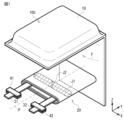
- Fig. 1 shows a perspective configuration of a lithium ion secondary battery
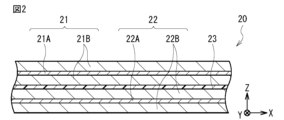
- Fig. 2 shows a cross-sectional configuration of a battery element 20 shown in Fig. 1.
- Fig. 1 shows a state in which an exterior film 10 and the battery element 20 are separated from each other, and shows a cross section of the battery element 20 along the XZ plane by a dashed line.
- this lithium ion secondary battery includes an exterior film 10, a battery element 20, a positive electrode lead 31, a negative electrode lead 32, and sealing films 41, 42.
- the lithium ion secondary battery described here is a laminate film type lithium ion secondary battery that uses a flexible or pliable exterior film 10.
- the exterior film 10 is an exterior member that houses the battery element 20, and has a bag-like structure that is sealed with the battery element 20 housed therein. As a result, the exterior film 10 houses an electrolyte solution therein together with a positive electrode 21 and a negative electrode 22, which will be described later.
- the exterior film 10 is a single film-like member that is folded in the folding direction F.
- This exterior film 10 is provided with a recessed portion 10U (deeply drawn portion) for accommodating the battery element 20.
- the exterior film 10 is a three-layer laminate film in which a fusion layer, a metal layer, and a surface protection layer are laminated in this order from the inside, and when the exterior film 10 is folded, the outer peripheral edges of the opposing fusion layers are fused to each other.
- the fusion layer contains a polymer compound such as polypropylene.
- the metal layer contains a metallic material such as aluminum.
- the surface protection layer contains a polymer compound such as nylon.
- the configuration (number of layers) of the exterior film 10 is not particularly limited, so it may be one or two layers, or four or more layers.
- the battery element 20 is a power generating element including a positive electrode 21, a negative electrode 22, a separator 23, and an electrolyte (not shown), and is housed inside the exterior film 10.
- This battery element 20 is a so-called wound electrode body. That is, the positive electrode 21 and the negative electrode 22 are stacked on top of each other with a separator 23 interposed therebetween, and are wound around a winding axis P while facing each other through the separator 23.
- This winding axis P is a virtual axis that extends in the Y-axis direction.
- the three-dimensional shape of the battery element 20 is not particularly limited.
- the three-dimensional shape of the battery element 20 is flat, and therefore the shape of a cross section (cross section along the XZ plane) of the battery element 20 intersecting with the winding axis P is a flat shape defined by a major axis J1 and a minor axis J2.
- the major axis J1 is an imaginary axis that extends in the X-axis direction and has a length greater than the length of the minor axis J2
- the minor axis J2 is an imaginary axis that extends in the Z-axis direction intersecting with the X-axis direction and has a length smaller than the length of the major axis J1.
- the three-dimensional shape of the battery element 20 is a flat cylindrical shape, and therefore the shape of the cross section of the battery element 20 is a flattened approximate ellipse.
- the positive electrode 21 includes a positive electrode current collector 21A and a positive electrode active material layer 21B.
- the positive electrode collector 21A has a pair of surfaces on which the positive electrode active material layer 21B is provided.
- This positive electrode collector 21A contains a conductive material such as a metal material, and a specific example of the conductive material is aluminum.
- the positive electrode active material layer 21B is provided on both sides of the positive electrode collector 21A, and contains one or more types of positive electrode active materials that absorb and release lithium.
- the positive electrode active material layer 21B may be provided on only one side of the positive electrode collector 21A on the side where the positive electrode 21 faces the negative electrode 22.
- the positive electrode active material layer 21B may further contain one or more types of other materials such as a positive electrode binder and a positive electrode conductor.
- the method of forming the positive electrode active material layer 21B is not particularly limited, but specifically includes a coating method, etc.
- the positive electrode active material contains a lithium-containing compound.
- This lithium-containing compound is a compound that contains one or more types of transition metal elements as constituent elements along with lithium, and may further contain one or more types of other elements as constituent elements.
- the type of other element is not particularly limited as long as it is an element other than a transition metal element (excluding lithium), but specifically, it is an element belonging to groups 2 to 15 of the long period periodic table.
- the type of lithium-containing compound is not particularly limited, but specifically, it is an oxide, a phosphate compound, a silicate compound, a borate compound, etc.
- oxides include LiNiO2 , LiCoO2 , LiCo0.98Al0.01Mg0.01O2 , LiNi0.5Co0.2Mn0.3O2 , LiNi0.8Co0.15Al0.05O2 , LiNi0.33Co0.33Mn0.33O2 , Li1.2Mn0.52Co0.175Ni0.1O2 , Li1.15 ( Mn0.65Ni0.22Co0.13 ) O2 and LiMn2O4 .
- phosphate compounds include LiFePO4 , LiMnPO4 , LiFe0.5Mn0.5PO4 , and LiFe0.3Mn0.7PO4 .
- the positive electrode binder contains one or more of the following compounds: synthetic rubber and polymeric compounds.
- synthetic rubber include styrene-butadiene rubber, fluororubber, and ethylene-propylene-diene.
- polymeric compounds include polyvinylidene fluoride, polyimide, and carboxymethyl cellulose.
- the positive electrode conductive agent contains one or more conductive materials such as carbon materials, and specific examples of the conductive materials include graphite, carbon black, acetylene black, ketjen black, carbon fiber, carbon nanofiber, and carbon nanotubes.
- the conductive material may also be a metal material or a conductive polymer compound.
- the negative electrode current collector 22A has a pair of surfaces on which the negative electrode active material layer 22B is provided.
- This negative electrode current collector 22A contains a conductive material such as a metal material, and a specific example of the conductive material is copper.
- the negative electrode active material layer 22B is provided on both sides of the negative electrode collector 22A, and contains one or more types of negative electrode active materials that absorb and release lithium.
- the negative electrode active material layer 22B may be provided on only one side of the negative electrode collector 22A on the side where the negative electrode 22 faces the positive electrode 21.
- the negative electrode active material layer 22B may further contain one or more types of other materials such as a negative electrode binder and a negative electrode conductor.
- the method of forming the negative electrode active material layer 22B is not particularly limited, but specifically includes a coating method, etc.
- the negative electrode active material contains one or more of the following materials: carbon materials and metal-based materials. This is because it provides a high energy density.
- carbon materials include graphitizable carbon, non-graphitizable carbon, and graphite.
- the graphite may be natural graphite, artificial graphite, or both.
- the metal-based material is a material that contains one or more of metal elements and metalloid elements that can form an alloy with lithium as a constituent element, and specific examples of the metal elements and metalloid elements include silicon and tin.
- the metal-based material may be a single element, an alloy, a compound, a mixture of two or more of them, or a material that contains two or more phases of them.
- Specific examples of the metal-based material include TiSi2 and SiOx (0 ⁇ x ⁇ 2, or 0.2 ⁇ x ⁇ 1.4).
- negative electrode binder and the negative electrode conductor are the same as those regarding the positive electrode binder and the positive electrode conductor, respectively.
- the separator 23 is an insulating porous film interposed between the positive electrode 21 and the negative electrode 22, and allows lithium ions to pass through while preventing contact (short circuit) between the positive electrode 21 and the negative electrode 22.
- This separator 23 contains a polymer compound such as polyethylene.
- electrolyte contains a nitrile compound and a fluorinated alcohol, and satisfies two conditions regarding the contents C1 and C2.
- the positive electrode lead 31 is a positive electrode terminal connected to the positive electrode current collector 21A of the positive electrode 21, and is led out to the outside of the exterior film 10.
- the positive electrode lead 31 contains a conductive material such as a metal material, and a specific example of the conductive material is aluminum.
- the shape of the positive electrode lead 31 is not particularly limited, and specifically, it is either a thin plate shape or a mesh shape.
- the negative electrode lead 32 is a negative electrode terminal connected to the negative electrode current collector 22A of the negative electrode 22, and is led out to the outside of the exterior film 10.
- This negative electrode lead 32 contains a conductive material such as a metal material, and a specific example of the conductive material is copper.
- the details regarding the lead-out direction and shape of the negative electrode lead 32 are the same as the details regarding the lead-out direction and shape of the positive electrode lead 31.
- the sealing film 41 is inserted between the exterior film 10 and the positive electrode lead 31, and the sealing film 42 is inserted between the exterior film 10 and the negative electrode lead 32.
- the sealing films 41 and 42 may be omitted.
- This sealing film 41 is a sealing member that prevents outside air and the like from entering the inside of the exterior film 10.
- the sealing film 41 contains a polymer compound such as polyolefin that has adhesion to the positive electrode lead 31, and a specific example of the polyolefin is polypropylene.
- the configuration of the sealing film 42 is the same as that of the sealing film 41, except that the sealing film 42 is a sealing member that has adhesion to the negative electrode lead 32.
- the sealing film 42 contains a polymer compound such as polyolefin that has adhesion to the negative electrode lead 32.
- a lithium-ion secondary battery operates as described below.
- lithium When charging, lithium is released in an ionic state from the positive electrode 21 of the battery element 20, and the lithium is absorbed in an ionic state into the negative electrode 22 via the electrolyte.
- lithium when discharging, lithium is released in an ionic state from the negative electrode 22 of the battery element 20, and the lithium is absorbed in an ionic state into the positive electrode 21 via the electrolyte.
- a mixture (cathode mixture) in which a cathode active material, a cathode binder, and a cathode conductive agent are mixed together is put into a solvent to prepare a paste-like cathode mixture slurry.
- This solvent may be an aqueous solvent or an organic solvent.
- the cathode mixture slurry is applied to both sides of the cathode current collector 21A to form the cathode active material layer 21B.
- the cathode active material layer 21B may be compression molded using a roll press or the like. In this case, the cathode active material layer 21B may be heated, or the compression molding may be repeated multiple times. As a result, the cathode active material layer 21B is formed on both sides of the cathode current collector 21A, and thus the cathode 21 is produced.
- the negative electrode 22 is produced by the same procedure as the procedure for producing the positive electrode 21 described above. Specifically, a mixture (negative electrode mixture) in which a negative electrode active material, a negative electrode binder, and a negative electrode conductive agent are mixed together is poured into a solvent to prepare a paste-like negative electrode mixture slurry, and then the negative electrode mixture slurry is applied to both sides of the negative electrode current collector 22A to form the negative electrode active material layer 22B. After this, the negative electrode active material layer 22B may be compression molded. As a result, the negative electrode active material layer 22B is formed on both sides of the negative electrode current collector 22A, and the negative electrode 22 is produced.
- An electrolyte solution containing a nitrile compound and a fluorinated alcohol is prepared by the above-mentioned procedure.
- the positive electrode lead 31 is connected to the positive electrode collector 21A of the positive electrode 21 using a joining method such as welding, and the negative electrode lead 32 is connected to the negative electrode collector 22A of the negative electrode 22 using a joining method such as welding.
- the positive electrode 21 and the negative electrode 22 are stacked on top of each other with the separator 23 interposed therebetween to form a laminate, and the laminate is then wound to produce a wound body (not shown).
- This wound body has a similar configuration to that of the battery element 20, except that the positive electrode 21, the negative electrode 22, and the separator 23 are not impregnated with electrolyte.
- the wound body is pressed using a press or the like to form the wound body into a flat shape.
- the exterior film 10 adheresive layer/metal layer/surface protection layer
- the exterior film 10 is folded so that the exterior films 10 face each other.
- the outer edges of two of the opposing adhesive layers are joined to each other using an adhesive method such as heat fusion, thereby placing the roll inside the bag-shaped exterior film 10.
- an electrolyte is injected into the bag-shaped exterior film 10, and then the outer edges of the remaining sides of the opposing fusion layers are joined together using an adhesive method such as heat fusion.
- a sealing film 41 is inserted between the exterior film 10 and the positive electrode lead 31, and a sealing film 42 is inserted between the exterior film 10 and the negative electrode lead 32.
- the wound body is impregnated with the electrolyte, and the battery element 20, which is a wound electrode body, is produced.
- the battery element 20 is then sealed inside the bag-shaped exterior film 10, and a lithium-ion secondary battery is assembled.
- the assembled lithium ion secondary battery is charged and discharged.
- Various conditions such as the environmental temperature, the number of charge/discharge cycles (number of cycles), and the charge/discharge conditions can be set arbitrarily.
- a coating is formed on the surface of each of the positive electrode 21 and the negative electrode 22, so that the state of the lithium ion secondary battery is electrochemically stabilized.
- the lithium ion secondary battery is completed.
- the lithium ion secondary battery includes an electrolyte, and the electrolyte has the above-mentioned configuration. Therefore, for the above-mentioned reasons, a good coating having low electrical resistance is formed on the surface of the negative electrode 22, so that the electrical resistance of the electrolyte is prevented from increasing too much, and the decomposition reaction of the electrolyte on the surface of the negative electrode 22 is also suppressed. Therefore, the electrical resistance is reduced, and excellent battery characteristics can be obtained.
- a porous membrane separator 23 was used. However, although not specifically shown here, a laminated separator including a polymer compound layer may also be used.
- the laminated separator includes a porous membrane having a pair of surfaces and a polymer compound layer provided on one or both surfaces of the porous membrane. This is because the adhesion of the separator to each of the positive electrode 21 and the negative electrode 22 is improved, thereby suppressing miswinding of the battery element 20. This prevents the lithium ion secondary battery from swelling even if a decomposition reaction of the electrolyte occurs.
- the polymer compound layer includes a polymer compound such as polyvinylidene fluoride. Polyvinylidene fluoride has excellent physical strength and is electrochemically stable.
- one or both of the porous film and the polymer compound layer may contain a plurality of insulating particles. This is because the plurality of insulating particles promotes heat dissipation when the lithium ion secondary battery generates heat, improving the safety (heat resistance) of the lithium ion secondary battery.
- the insulating particles contain one or more types of insulating materials such as inorganic materials and resin materials. Specific examples of inorganic materials include aluminum oxide, aluminum nitride, boehmite, silicon oxide, titanium oxide, magnesium oxide, and zirconium oxide. Specific examples of resin materials include acrylic resin and styrene resin.
- a precursor solution containing a polymer compound and a solvent is prepared, and then the precursor solution is applied to one or both sides of a porous film.
- multiple insulating particles may be added to the precursor solution as necessary.
- the positive electrode 21 and the negative electrode 22 are stacked on top of each other with the separator 23 and the electrolyte layer in between, and the positive electrode 21, the negative electrode 22, the separator 23, and the electrolyte layer are wound.
- the electrolyte layer is interposed between the positive electrode 21 and the separator 23, and also between the negative electrode 22 and the separator 23.
- the electrolyte layer contains a polymer compound as well as an electrolyte solution, and the electrolyte solution is held by the polymer compound. This is because leakage of the electrolyte solution is prevented.
- the composition of the electrolyte solution is as described above.
- the polymer compound contains polyvinylidene fluoride and the like.
- the use (application example) of the lithium ion secondary battery is not particularly limited.
- the lithium ion secondary battery used as a power source may be a main power source for electronic devices and electric vehicles, or may be an auxiliary power source.
- the main power source is a power source that is used preferentially regardless of the presence or absence of other power sources.
- the auxiliary power source may be a power source that is used instead of the main power source, or may be a power source that is switched from the main power source.
- lithium-ion secondary batteries are as follows: Electronic devices such as video cameras, digital still cameras, mobile phones, notebook computers, headphone stereos, portable radios, and portable information terminals. Storage devices such as backup power sources and memory cards. Power tools such as electric drills and power saws. Battery packs installed in electronic devices. Medical electronic devices such as pacemakers and hearing aids. Electric vehicles such as electric cars (including hybrid cars). Power storage systems such as home or industrial battery systems that store power in preparation for emergencies. In these applications, one lithium-ion secondary battery may be used, or multiple lithium-ion secondary batteries may be used.
- the battery pack may use a single cell or a battery pack.
- the electric vehicle is a vehicle that operates (runs) using a lithium-ion secondary battery as a driving power source, and may be a hybrid vehicle that also includes a driving source other than the lithium-ion secondary battery.
- a home power storage system it is possible to use home electrical appliances, etc., by utilizing the power stored in the lithium-ion secondary battery, which is the power storage source.
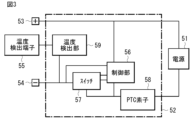
- FIG. 3 shows the block diagram of a battery pack.
- the battery pack described here is a battery pack (a so-called soft pack) that uses one lithium-ion secondary battery, and is installed in electronic devices such as smartphones.
- this battery pack includes a power source 51 and a circuit board 52.
- This circuit board 52 is connected to the power source 51 and includes a positive terminal 53, a negative terminal 54, and a temperature detection terminal 55.
- the power source 51 includes one lithium ion secondary battery.
- the positive electrode lead is connected to the positive electrode terminal 53
- the negative electrode lead is connected to the negative electrode terminal 54.
- This power source 51 can be connected to the outside via the positive electrode terminal 53 and the negative electrode terminal 54, and therefore can be charged and discharged.
- the circuit board 52 includes a control unit 56, a switch 57, a PTC element 58, and a temperature detection unit 59. However, the PTC element 58 may be omitted.
- the control unit 56 includes a central processing unit (CPU) and memory, and controls the overall operation of the battery pack. This control unit 56 detects and controls the usage state of the power source 51 as necessary.
- CPU central processing unit
- the control unit 56 turns off the switch 57 to prevent the charging current from flowing through the current path of the power source 51.
- the overcharge detection voltage is not particularly limited, but is specifically 4.20V ⁇ 0.05V, and the overdischarge detection voltage is not particularly limited, but is specifically 2.40V ⁇ 0.1V.
- Switch 57 includes a charge control switch, a discharge control switch, a charge diode, and a discharge diode, and switches between the presence and absence of a connection between power source 51 and an external device in response to an instruction from control unit 56.
- Switch 57 includes a field effect transistor (MOSFET) that uses a metal oxide semiconductor, and the charge current and discharge current are each detected based on the ON resistance of switch 57.
- MOSFET field effect transistor
- the temperature detection unit 59 includes a temperature detection element such as a thermistor. This temperature detection unit 59 measures the temperature of the power supply 51 using the temperature detection terminal 55, and outputs the temperature measurement result to the control unit 56. The temperature measurement result measured by the temperature detection unit 59 is used when the control unit 56 performs charge/discharge control in the event of abnormal heat generation, and when the control unit 56 performs correction processing when calculating the remaining capacity.
- a test lithium ion secondary battery was fabricated to simply evaluate the battery characteristics.
- Fig. 4 shows the cross-sectional structure of the test secondary battery, which is a so-called coin-type lithium ion secondary battery.
- this lithium ion secondary battery includes a test electrode 61, a counter electrode 62, a separator 63, an exterior cup 64, an exterior can 65, a gasket 66, and an electrolyte (not shown).
- the test electrode 61 is housed in an exterior cup 64, and the counter electrode 62 is housed in an exterior can 65.
- the test electrode 61 and the counter electrode 62 are stacked together via a separator 63, and the test electrode 61, the counter electrode 62, and the separator 63 are each impregnated with an electrolyte.
- the exterior cup 64 and the exterior can 65 are crimped together via a gasket 66, so that the test electrode 61, the counter electrode 62, and the separator 63 are sealed by the exterior cup 64 and the exterior can 65.
- a positive electrode active material LiNi0.80Co0.15Al0.05O2 , which is a lithium-containing compound ( oxide )
- a positive electrode binder polyvinylidene fluoride
- a positive electrode conductive agent Ketjen black, which is amorphous carbon powder
- the positive electrode mixture slurry was applied to one side of the positive electrode current collector 21A (aluminum foil with a thickness of 10 ⁇ m) using a coating device, and the positive electrode mixture slurry was then dried to form the positive electrode active material layer 21B.
- the positive electrode active material layer 21B was compression molded using a roll press, and then the positive electrode current collector 21A on which the positive electrode active material layer 21B was formed was cut into a disk shape. In this way, the positive electrode 21 was produced.
- a negative electrode active material (4 parts by mass of silicon oxide which is a metallic material and 90 parts by mass of artificial graphite which is a carbon material), 1.5 parts by mass of a negative electrode binder (polyvinylidene fluoride), 2.5 parts by mass of a negative electrode conductive agent (2 parts by mass of carbon nanotubes and 0.5 parts by mass of graphite), and 2 parts by mass of a thickener (carboxymethyl cellulose) were mixed together to prepare a negative electrode mixture.
- a negative electrode active material 4 parts by mass of silicon oxide which is a metallic material and 90 parts by mass of artificial graphite which is a carbon material
- a negative electrode binder polyvinylidene fluoride
- a negative electrode conductive agent 2 parts by mass of carbon nanotubes and 0.5 parts by mass of graphite
- a thickener carboxymethyl cellulose
- the negative electrode mixture was added to a solvent (water, which is an aqueous solvent), and the solvent was stirred to prepare a paste-like negative electrode mixture slurry.
- a solvent water, which is an aqueous solvent
- the negative electrode mixture slurry was applied to one side of the negative electrode current collector 22A (copper foil with a thickness of 8 ⁇ m) using a coating device, and the negative electrode mixture slurry was then dried to form the negative electrode active material layer 22B.
- the negative electrode active material layer 22B was compression molded using a roll press, and then the negative electrode current collector 22A on which the negative electrode active material layer 22B was formed was cut into a disk shape. In this way, the negative electrode 22 was produced.
- a solvent was prepared.
- EC ethylene carbonate
- EMC ethyl methyl carbonate
- an electrolyte salt lithium salt, lithium hexafluorophosphate (LiPF 6 )
- LiPF 6 lithium hexafluorophosphate
- the nitrile compound and the fluorinated alcohol were added to the solvent containing the electrolyte salt, and the solvent was then stirred.
- the dinitrile compound succinonitrile ( NCCH2CH2CN )SN) was used as the nitrile compound
- hexafluoroisopropanol (( CF3 ) 2CHOH (HFIP)) was used as the fluorinated alcohol.
- the electrolyte solution was prepared.
- the amount of the nitrile compound added was adjusted so that the content C1 (wt%) of the nitrile compound in the electrolyte solution was the value shown in Table 1, and the amount of the fluorinated alcohol added was adjusted so that the content C2 (wt%) of the fluorinated alcohol in the electrolyte solution was the value shown in Table 1.
- an electrolyte was prepared using the same procedure, except that no fluorinated alcohol was used.
- test electrode 61 was accommodated in the exterior cup 64, and the counter electrode 62 was accommodated in the exterior can 65.
- the test electrode 61 accommodated in the exterior cup 64 and the counter electrode 62 accommodated in the exterior can 65 were stacked together via a separator 63 (a microporous polyethylene film having a thickness of 20 ⁇ m) impregnated with an electrolyte.
- separator 63 a microporous polyethylene film having a thickness of 20 ⁇ m impregnated with an electrolyte.
- the positive electrode active material layer 21B and the negative electrode active material layer 22B were opposed to each other via the separator 63.
- the exterior cup 64 and the exterior can 65 were crimped together via the gasket 66.
- the test electrode 61 and the counter electrode 62 were enclosed inside the exterior cup 64 and the exterior can 65, and thus a lithium ion secondary battery was assembled.
- 0.1 C is the current value at which the battery capacity (theoretical capacity) is fully discharged in 10 hours
- 0.025 C is the current value at which the battery capacity is fully discharged in 40 hours.
- test electrode 61 and the counter electrode 62 were electrochemically stabilized, completing the lithium-ion secondary battery.
- EIS electrochemical impedance
- ⁇ electrochemical impedance
- the EIS values shown in Table 1 are normalized values. Specifically, the EIS values in each of Examples 1 to 4 and Comparative Examples 1 and 2 are normalized with the EIS value in Comparative Example 1 set to 100. The EIS values in each of Examples 5 to 8 and Comparative Examples 3 and 4 are normalized with the EIS value in Comparative Example 3 set to 100. The EIS values in each of Examples 9 to 11 and Comparative Examples 5 to 7 are normalized with the EIS value in Comparative Example 5 set to 100.
- the EIS was sufficiently reduced by using a dinitrile compound (SN) as the nitrile compound, i.e., a nitrile compound containing two cyano groups in the molecule.
- SN dinitrile compound
- the solvent contains a nitrile compound and a fluorinated alcohol as well as a solvent (cyclic carbonate ester and chain carbonate ester), the EIS was sufficiently reduced while ensuring smooth charge/discharge reactions (battery capacity).
- the battery structure of the lithium ion secondary battery has been described as being of a laminate film type, but the battery structure of the secondary battery applied to the battery pack of the present technology is not particularly limited.
- the battery structure of the lithium ion secondary battery may be of a cylindrical type, a square type, a coin type, etc.
- the battery element has been described as having a wound structure.
- the structure of the battery element is not particularly limited, and may be a stacked type or a zigzag type.
- the positive and negative electrodes are alternately stacked with a separator between them, while in the zigzag type, the positive and negative electrodes are folded in a zigzag pattern while facing each other with the separator between them.
- R1R2R3COH...(1) (Each of R1, R2, and R3 is any one of a hydrogen group, an alkyl group, and a fluorinated alkyl group, provided that at least one of R1, R2, and R3 is a fluorinated alkyl group.)
- the nitrile compound contains two of the cyano groups in the molecule.
- two or more of R1, R2, and R3 are the fluorinated alkyl groups.
- the electrolyte further contains a cyclic carbonate ester and a chain carbonate ester.
- ⁇ 1> The lithium ion secondary battery according to any one of ⁇ 1> to ⁇ 3>.
- ⁇ 5> A nitrile compound containing one or more cyano groups in the molecule; and a fluorinated alcohol represented by formula (1), The content of the nitrile compound is 0.5% by weight or more and 5% by weight or less, The content of the fluorinated alcohol is 0.05% by weight or more and 1% by weight or less.
- R1R2R3COH is any one of a hydrogen group, an alkyl group, and a fluorinated alkyl group, provided that at least one of R1, R2, and R3 is a fluorinated alkyl group.
Landscapes
- Chemical & Material Sciences (AREA)
- Engineering & Computer Science (AREA)
- Manufacturing & Machinery (AREA)
- Chemical Kinetics & Catalysis (AREA)
- Electrochemistry (AREA)
- General Chemical & Material Sciences (AREA)
- Physics & Mathematics (AREA)
- Condensed Matter Physics & Semiconductors (AREA)
- General Physics & Mathematics (AREA)
- Inorganic Chemistry (AREA)
- Materials Engineering (AREA)
- Secondary Cells (AREA)
Priority Applications (3)
| Application Number | Priority Date | Filing Date | Title |
|---|---|---|---|
| CN202380088646.7A CN120345095A (zh) | 2023-01-12 | 2023-11-21 | 锂离子二次电池用电解液以及锂离子二次电池 |
| JP2024570068A JPWO2024150541A1 (https=) | 2023-01-12 | 2023-11-21 | |
| US19/240,482 US20250309352A1 (en) | 2023-01-12 | 2025-06-17 | Electrolytic solution for lithium-ion secondary battery, and lithium-ion secondary battery |
Applications Claiming Priority (2)
| Application Number | Priority Date | Filing Date | Title |
|---|---|---|---|
| JP2023-003372 | 2023-01-12 | ||
| JP2023003372 | 2023-01-12 |
Related Child Applications (1)
| Application Number | Title | Priority Date | Filing Date |
|---|---|---|---|
| US19/240,482 Continuation US20250309352A1 (en) | 2023-01-12 | 2025-06-17 | Electrolytic solution for lithium-ion secondary battery, and lithium-ion secondary battery |
Publications (1)
| Publication Number | Publication Date |
|---|---|
| WO2024150541A1 true WO2024150541A1 (ja) | 2024-07-18 |
Family
ID=91896693
Family Applications (1)
| Application Number | Title | Priority Date | Filing Date |
|---|---|---|---|
| PCT/JP2023/041714 Ceased WO2024150541A1 (ja) | 2023-01-12 | 2023-11-21 | リチウムイオン二次電池用電解液およびリチウムイオン二次電池 |
Country Status (4)
| Country | Link |
|---|---|
| US (1) | US20250309352A1 (https=) |
| JP (1) | JPWO2024150541A1 (https=) |
| CN (1) | CN120345095A (https=) |
| WO (1) | WO2024150541A1 (https=) |
Citations (4)
| Publication number | Priority date | Publication date | Assignee | Title |
|---|---|---|---|---|
| JP2010015968A (ja) * | 2008-07-07 | 2010-01-21 | Samsung Sdi Co Ltd | リチウム二次電池 |
| KR20140038676A (ko) * | 2012-09-21 | 2014-03-31 | 주식회사 엘지화학 | 리튬 이차전지용 비수 전해액 및 이를 구비한 리튬 이차전지 |
| CN103996873A (zh) * | 2014-05-20 | 2014-08-20 | 珠海市赛纬电子材料有限公司 | 匹配btr918石墨负极的锂离子电池用非水电解液 |
| WO2020183894A1 (ja) * | 2019-03-11 | 2020-09-17 | パナソニックIpマネジメント株式会社 | 非水電解質二次電池 |
-
2023
- 2023-11-21 JP JP2024570068A patent/JPWO2024150541A1/ja active Pending
- 2023-11-21 WO PCT/JP2023/041714 patent/WO2024150541A1/ja not_active Ceased
- 2023-11-21 CN CN202380088646.7A patent/CN120345095A/zh active Pending
-
2025
- 2025-06-17 US US19/240,482 patent/US20250309352A1/en active Pending
Patent Citations (4)
| Publication number | Priority date | Publication date | Assignee | Title |
|---|---|---|---|---|
| JP2010015968A (ja) * | 2008-07-07 | 2010-01-21 | Samsung Sdi Co Ltd | リチウム二次電池 |
| KR20140038676A (ko) * | 2012-09-21 | 2014-03-31 | 주식회사 엘지화학 | 리튬 이차전지용 비수 전해액 및 이를 구비한 리튬 이차전지 |
| CN103996873A (zh) * | 2014-05-20 | 2014-08-20 | 珠海市赛纬电子材料有限公司 | 匹配btr918石墨负极的锂离子电池用非水电解液 |
| WO2020183894A1 (ja) * | 2019-03-11 | 2020-09-17 | パナソニックIpマネジメント株式会社 | 非水電解質二次電池 |
Also Published As
| Publication number | Publication date |
|---|---|
| US20250309352A1 (en) | 2025-10-02 |
| CN120345095A (zh) | 2025-07-18 |
| JPWO2024150541A1 (https=) | 2024-07-18 |
Similar Documents
| Publication | Publication Date | Title |
|---|---|---|
| JP7589758B2 (ja) | 二次電池用電解液および二次電池 | |
| JP7750412B2 (ja) | 二次電池用電解液および二次電池 | |
| JP7380845B2 (ja) | 二次電池 | |
| WO2023119947A1 (ja) | リチウムイオン二次電池用電解液およびリチウムイオン二次電池 | |
| JP7517480B2 (ja) | 二次電池 | |
| WO2024150541A1 (ja) | リチウムイオン二次電池用電解液およびリチウムイオン二次電池 | |
| JP7694715B2 (ja) | 二次電池 | |
| JP7694716B2 (ja) | 二次電池 | |
| JP7715211B2 (ja) | 二次電池用電解液および二次電池 | |
| JP7726276B2 (ja) | 二次電池用電解液および二次電池 | |
| JP7715210B2 (ja) | 二次電池用電解液および二次電池 | |
| JP7537504B2 (ja) | 二次電池用電解液および二次電池 | |
| JP7715362B2 (ja) | 二次電池用電解液および二次電池 | |
| JP7750378B2 (ja) | 二次電池用電解液および二次電池 | |
| JP7761127B2 (ja) | 二次電池用電解液および二次電池 | |
| JP7761126B2 (ja) | 二次電池用電解液および二次電池 | |
| JP7761128B2 (ja) | 二次電池 | |
| JP7816495B2 (ja) | 二次電池用電解液および二次電池 | |
| JP2024077703A (ja) | リチウムイオン二次電池 | |
| WO2025062886A1 (ja) | 二次電池 | |
| WO2024262634A1 (ja) | 二次電池 | |
| WO2025033413A1 (ja) | 二次電池用電解液および二次電池 | |
| WO2024142877A1 (ja) | 二次電池 | |
| WO2024195306A1 (ja) | 二次電池 | |
| WO2024190050A1 (ja) | 二次電池用電解液および二次電池 |
Legal Events
| Date | Code | Title | Description |
|---|---|---|---|
| 121 | Ep: the epo has been informed by wipo that ep was designated in this application |
Ref document number: 23916158 Country of ref document: EP Kind code of ref document: A1 |
|
| WWE | Wipo information: entry into national phase |
Ref document number: 2024570068 Country of ref document: JP |
|
| WWE | Wipo information: entry into national phase |
Ref document number: CN2023800886467 Country of ref document: CN Ref document number: 202380088646.7 Country of ref document: CN |
|
| WWP | Wipo information: published in national office |
Ref document number: 202380088646.7 Country of ref document: CN |
|
| NENP | Non-entry into the national phase |
Ref country code: DE |
|
| 122 | Ep: pct application non-entry in european phase |
Ref document number: 23916158 Country of ref document: EP Kind code of ref document: A1 |