WO2024143085A1 - 無人搬送車両システム及び無人搬送車両 - Google Patents
無人搬送車両システム及び無人搬送車両 Download PDFInfo
- Publication number
- WO2024143085A1 WO2024143085A1 PCT/JP2023/045607 JP2023045607W WO2024143085A1 WO 2024143085 A1 WO2024143085 A1 WO 2024143085A1 JP 2023045607 W JP2023045607 W JP 2023045607W WO 2024143085 A1 WO2024143085 A1 WO 2024143085A1
- Authority
- WO
- WIPO (PCT)
- Prior art keywords
- pair
- arms
- conveyor
- arm
- article
- Prior art date
- Legal status (The legal status is an assumption and is not a legal conclusion. Google has not performed a legal analysis and makes no representation as to the accuracy of the status listed.)
- Ceased
Links
Images










Classifications
-
- B—PERFORMING OPERATIONS; TRANSPORTING
- B65—CONVEYING; PACKING; STORING; HANDLING THIN OR FILAMENTARY MATERIAL
- B65G—TRANSPORT OR STORAGE DEVICES, e.g. CONVEYORS FOR LOADING OR TIPPING, SHOP CONVEYOR SYSTEMS OR PNEUMATIC TUBE CONVEYORS
- B65G65/00—Loading or unloading
-
- B—PERFORMING OPERATIONS; TRANSPORTING
- B65—CONVEYING; PACKING; STORING; HANDLING THIN OR FILAMENTARY MATERIAL
- B65G—TRANSPORT OR STORAGE DEVICES, e.g. CONVEYORS FOR LOADING OR TIPPING, SHOP CONVEYOR SYSTEMS OR PNEUMATIC TUBE CONVEYORS
- B65G1/00—Storing articles, individually or in orderly arrangement, in warehouses or magazines
- B65G1/02—Storage devices
- B65G1/04—Storage devices mechanical
- B65G1/0485—Check-in, check-out devices
-
- B—PERFORMING OPERATIONS; TRANSPORTING
- B65—CONVEYING; PACKING; STORING; HANDLING THIN OR FILAMENTARY MATERIAL
- B65G—TRANSPORT OR STORAGE DEVICES, e.g. CONVEYORS FOR LOADING OR TIPPING, SHOP CONVEYOR SYSTEMS OR PNEUMATIC TUBE CONVEYORS
- B65G1/00—Storing articles, individually or in orderly arrangement, in warehouses or magazines
- B65G1/02—Storage devices
- B65G1/04—Storage devices mechanical
- B65G1/0492—Storage devices mechanical with cars adapted to travel in storage aisles
-
- B—PERFORMING OPERATIONS; TRANSPORTING
- B66—HOISTING; LIFTING; HAULING
- B66F—HOISTING, LIFTING, HAULING OR PUSHING, NOT OTHERWISE PROVIDED FOR, e.g. DEVICES WHICH APPLY A LIFTING OR PUSHING FORCE DIRECTLY TO THE SURFACE OF A LOAD
- B66F9/00—Devices for lifting or lowering bulky or heavy goods for loading or unloading purposes
- B66F9/06—Devices for lifting or lowering bulky or heavy goods for loading or unloading purposes movable, with their loads, on wheels or the like, e.g. fork-lift trucks
- B66F9/063—Automatically guided
-
- B—PERFORMING OPERATIONS; TRANSPORTING
- B66—HOISTING; LIFTING; HAULING
- B66F—HOISTING, LIFTING, HAULING OR PUSHING, NOT OTHERWISE PROVIDED FOR, e.g. DEVICES WHICH APPLY A LIFTING OR PUSHING FORCE DIRECTLY TO THE SURFACE OF A LOAD
- B66F9/00—Devices for lifting or lowering bulky or heavy goods for loading or unloading purposes
- B66F9/06—Devices for lifting or lowering bulky or heavy goods for loading or unloading purposes movable, with their loads, on wheels or the like, e.g. fork-lift trucks
- B66F9/065—Devices for lifting or lowering bulky or heavy goods for loading or unloading purposes movable, with their loads, on wheels or the like, e.g. fork-lift trucks non-masted
-
- B—PERFORMING OPERATIONS; TRANSPORTING
- B66—HOISTING; LIFTING; HAULING
- B66F—HOISTING, LIFTING, HAULING OR PUSHING, NOT OTHERWISE PROVIDED FOR, e.g. DEVICES WHICH APPLY A LIFTING OR PUSHING FORCE DIRECTLY TO THE SURFACE OF A LOAD
- B66F9/00—Devices for lifting or lowering bulky or heavy goods for loading or unloading purposes
- B66F9/06—Devices for lifting or lowering bulky or heavy goods for loading or unloading purposes movable, with their loads, on wheels or the like, e.g. fork-lift trucks
- B66F9/075—Constructional features or details
- B66F9/12—Platforms; Forks; Other load supporting or gripping members
- B66F9/122—Platforms; Forks; Other load supporting or gripping members longitudinally movable
Definitions
- the present invention relates to an automated guided vehicle system that runs an automated guided vehicle and the automated guided vehicle, and in particular to a technology for transferring items from a conveyor to the automated guided vehicle while the automated guided vehicle runs along the conveyor.
- Patent Document 1 when using the technology disclosed in Patent Document 1, in which luggage is transported by a conveyor and then loaded onto an automated guided vehicle by a robot after the luggage arrives at the end of the conveyor, the time between when the conveyor starts transporting the luggage and when the luggage is loaded onto the automated guided vehicle becomes long, and the luggage is not moved efficiently.
- the present invention was developed in consideration of the above circumstances, and aims to move items efficiently by making it possible to transfer items from a conveyor to an unmanned transport vehicle while the unmanned transport vehicle is traveling along the conveyor with a simple configuration.
- An unmanned guided vehicle system comprises a conveyor for carrying and transporting goods, and an unmanned guided vehicle that travels along the conveyor, the unmanned guided vehicle comprising: drive wheels; a travel drive unit that rotates the drive wheels to travel the unmanned guided vehicle; a pair of arms that are provided at respective positions on the unmanned guided vehicle that are downstream and upstream in the direction in which goods are transported by the conveyor when the unmanned guided vehicle travels along the conveyor, extending in a direction perpendicular to the direction in which the goods are transported, facing each other at positions spaced a distance equivalent to the width of the goods in the direction in which the goods are transported, and configured to reciprocate in the perpendicular direction so as to be capable of protruding outward from the unmanned guided vehicle and being drawn into the unmanned guided vehicle from the protruding position; an arm drive unit that causes each of the pair of arms to reciprocate; a pair of first claws that are provided at the respective tips of the pair of arms and configured to be capable of protruding from the
- the device is equipped with a first claw drive unit that causes each of the claws to perform either a protruding operation or a retracting operation, and a control unit that controls the travel drive unit, arm drive unit, and first claw drive unit to travel the unmanned transport vehicle at a predetermined first travel speed that is faster than the transport speed of the article, and when one arm provided downstream in the transport direction of the article passes the position of the end position downstream in the transport direction of the article being transported by the conveyor, causes one arm to protrude from the unmanned transport vehicle above the conveyor, and in the protruding state, causes the unmanned transport vehicle to travel at a predetermined second travel speed that is slower than the transport speed of the article, and when one arm moves to the position of the end position of the article being transported by the conveyor, causes the other arm provided upstream to protrude from the unmanned transport vehicle above the conveyor, and when an article is present between the pair of arms, causes the pair of first claws to protrude from the tips of the pair of arms into the space between the pair of arms, and causes the
- control unit that controls the travel drive unit, arm drive unit, and first claw drive unit to travel the unmanned transport vehicle at a predetermined first travel speed faster than the transport speed of the article, and when one arm provided downstream in the transport direction of the article passes the position of the end of the article on the downstream side in the transport direction of the conveyor, causes one arm to protrude from the unmanned transport vehicle above the conveyor, and travels the unmanned transport vehicle at a predetermined second travel speed slower than the transport speed of the article with one arm protruding, causes the other arm provided upstream to protrude from the unmanned transport vehicle above the conveyor when one arm moves to the position of the end of the article transported by the conveyor, and causes the pair of first claws to protrude from the tips of the pair of arms into the space between the pair of arms with the article present between the pair of arms, and causes the pair of arms to retract from above the conveyor into the unmanned transport vehicle.
- the present invention uses a simple configuration to enable an automated guided vehicle to move an item from the conveyor belt while the automated guided vehicle is traveling along the conveyor belt, allowing the item to be moved efficiently.
- FIG. 1 is a plan view showing a schematic configuration of an automated guided vehicle system according to an embodiment of the present invention
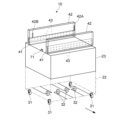
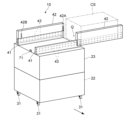
- FIG. 1 is a perspective view showing an automatic guided vehicle.
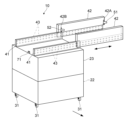
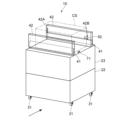
- FIG. 4 is a perspective view showing a sliding state of each arm of the automated guided vehicle.
- FIG. 4 is a diagram illustrating a rack gear and a pinion gear for reciprocating the arm.
- FIG. 13 is a perspective view showing a mechanism for extending and retracting the first and second claws of each arm.
- 13 is a plan view showing a mechanism for extending and retracting the first and second claws of each arm.
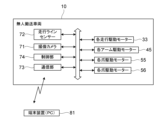
- FIG. FIG. 2 is a block diagram showing a control system of the automated guided vehicle. 13 is a flowchart showing a control procedure for an item movement process.
- FIG. 11 is a perspective view showing a state in which a case is being transported by a first conveyor.
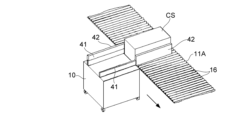
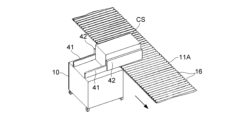
- 1 is a perspective view showing a state in which one arm of the automated guided vehicle is in contact with a case being transported by a first conveyor;
- FIG. 1 is a perspective view showing a state in which one arm of the automated guided vehicle is in contact with a case being transported by a first conveyor;
- FIG. 11 is a perspective view showing a state in which a case being transported by a first conveyor is sandwiched between the arms of an automated guided vehicle.
- FIG. 11 is a perspective view showing a process in which a case being transported by a first conveyor is transferred to an unmanned transport vehicle.
- FIG. 11 is a perspective view showing a process in which a case being transported by a first conveyor is transferred to an unmanned transport vehicle.
- FIG. 13 is a perspective view showing a state in which a case being transported by a first conveyor is sandwiched between the arms and first claw portions on the inside of the tip ends of the arms are protruding.
- FIG. 1 is a perspective view showing an automated guided vehicle carrying a case transferred from a first conveyor;
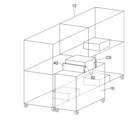
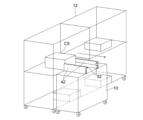
- FIG. 1 is a perspective view showing a state in which an unmanned transport vehicle is stopped in front of a storage shelf.
- FIG. 11 is a perspective view showing a state in which a case is sandwiched between the arms of an automatic guided vehicle and second claw portions on the inside of the rear end portions of the arms are protruded.
- FIG. 11 is a perspective view showing a process of transferring a case from an automated guided vehicle to a storage shelf.
- FIG. FIG. 11 is a perspective view showing the automated guided vehicle in which the case has been transferred to a storage shelf.
- 11 is a perspective view showing a state in which the case has been transferred from the automated guided vehicle to a storage shelf.
- FIG. 1 is a schematic diagram showing an automated guided vehicle system Sy according to one embodiment of the present invention.
- the automated guided vehicle system Sy includes an automated guided vehicle 10 and a conveyor device 11 that carries and transports items.
- the automated guided vehicle system Sy is installed indoors, such as in a warehouse that includes storage shelves 12.
- the unmanned guided vehicle 10 moves by itself along a travel line 15 laid on the floor surface.
- the travel line 15 is a magnetic tape affixed to the floor surface.
- the unmanned guided vehicle 10 is equipped with a magnetic sensor that detects the magnetic tape.
- the control unit 74 described below detects the position of the magnetic tape (travel line 15) based on information obtained from the magnetic sensor, and performs steering control according to the position of the travel line 15 to make the unmanned guided vehicle 10 travel along the travel line 15.
- the travel line 15 is a colored tape that is affixed to the floor and has a different color or reflectance from the floor surface.
- the automated guided vehicle 10 is equipped with an optical sensor such as a CCD that detects the colored tape.
- the control unit 74 described below detects the position of the colored tape (travel line 15) based on information obtained from the optical sensor, and performs steering control according to the position of the travel line 15 to cause the automated guided vehicle 10 to travel along the travel line 15.
- the conveyor device 11 includes a first conveyor 11A and a second conveyor 11B connected to one end of the first conveyor 11A. Both the first conveyor 11A and the second conveyor 11B are equipped with a plurality of rollers 16 arranged in parallel along the transport direction of the cases CS (an example of an article).
- Each roller 16 is supported on the frame of the first conveyor 11A or the second conveyor 11B by its respective axis perpendicular to the transport direction of the cases CS. Each roller 16 is driven to rotate in one direction to transport the cases CS on each roller 16. Note that belt conveyors may also be used as the first conveyor 11A and the second conveyor 11B.
- a caster 31 is provided at each of the four corners of the bottom of the running part 22.
- a number of drive wheels 32 are provided at a distance from each other on the inside of the bottom of the running part 22.
- Each drive wheel 32 is rotated by its own travel drive motor 33, and when the unmanned guided vehicle 10 travels, the wheels of each caster 31 rotate accordingly.
- the travel drive motors 33 that rotate the drive wheels 32 are controlled separately for each drive wheel 32, and the rotation speed of each drive wheel 32 is adjusted. This adjustment changes the traveling direction of the unmanned guided vehicle 10.
- the outward movement of the arm 42 is limited to a position where the arm 42 is not released from the engagement and support by the support wall 41 and the slide rail 43, as shown in FIG. 3, by the engagement of the first and second rails of the slide rail 43 and the rotation control of the arm drive motor 45.
- the communication unit 73 is a communication interface equipped with a communication module such as a LAN chip.
- the communication unit 73 is connected to the terminal device 81 via a wired or wireless LAN, and transmits and receives data to and from the terminal device 81.
- the terminal device 81 is, for example, a PC (personal computer), and is operated by a user.
- control unit 74 detects the position of the travel line 15 based on the detection output of the travel line sensor 72, and controls the drive of the travel drive motor 33 of each drive wheel 32 according to the detected position of the travel line 15 to adjust the rotation speed of the drive wheel 32.
- the control unit 74 changes the traveling direction of the unmanned guided vehicle 10, and causes the unmanned guided vehicle 10 to travel along the travel line 15 with the longitudinal direction of each arm 42 perpendicular to the travel line 15.
- the control unit 74 also adjusts the travel speed V of the unmanned guided vehicle 10.
- the unmanned transport vehicle 10 transfers the case CS to the storage shelf 12, and travels in the order of the third travel line 15C, the fourth travel line 15D, and the first travel line 15A, and returns to the standby position HP.
- the unmanned guided vehicle 10 at the waiting position HP captures an image of the two-dimensional code Q of the case CS with the imaging camera 71 when the case CS is transported to the position indicated by the dashed line in FIG. 1.
- the imaging camera 71 of the unmanned guided vehicle 10 at the waiting position HP is located opposite the two-dimensional code Q on the side of the case CS.
- the two-dimensional code Q contains identification information indicating an ID unique to the case CS.
- the control unit 74 analyzes the two-dimensional code Q captured by the imaging camera 71 and determines whether the ID indicated by the identification information contained in the two-dimensional code Q is the same as the ID indicated by the identification information previously received from the terminal device 81 via the communication unit 73.
- control unit 74 determines that the above is the same, it starts the unmanned transport vehicle 10 traveling in the direction of the arrow shown in FIG. 1 (step S101). At this point, the first conveyor 11A starts transporting the case CS without changing the position of the case CS. Therefore, the case CS has already passed the position shown by the dashed line in FIG. 1, i.e., the standby position HP.
- the control unit 74 acquires the image captured by the imaging camera 71, analyzes the image, and identifies the image showing the mark contained in the image (step S103).
- the control unit 74 starts measuring the time elapsed from the point in time when the mark is identified, and when the elapsed time reaches a certain time, it determines that one arm 42 provided on the downstream side has moved to a position beyond the downstream end position in the conveying direction of the case CS being conveyed by the first conveyor 11A (step S104).
- the control unit 74 controls the drive of one of the two arm drive motors 45 to protrude one of the arms 42 located downstream in the transport direction of the case CS into the space above the first conveyor 11A (step S105), as shown in Figures 8B and 9.
- the control unit 74 controls the drive of the travel drive motor 33 of the drive wheel 32 to set the travel speed V of the automated guided vehicle 10 to a predetermined travel speed VB that is slower than the transport speed VS of the case CS by the first conveyor 11A (step S106).
- step S106 the control unit 74 may perform a second speed control as described below.
- the two-dimensional code Q identified in step S103 includes weight information indicating the weight of the contents contained in the case CS.
- the weight information may indicate the weight itself, or, for example, the weight of each individual item and the number of items.
- the control unit 74 determines the weight of the contents based on the weight information and calculates the weight of the items by adding the known weight of the case CS to the weight of the contents.
- the weight information may indicate the weight of the items themselves, calculated by adding the known weight of the case CS to the weight of the contents. In this case, the control unit 74 obtains the weight of the items directly from the weight information.
- control unit 74 drives and controls the travel drive motors 33 of each drive wheel 32 to cause the unmanned guided vehicle 10 to travel at the travel speed VA set in step S102.
- the control unit 74 compares the calculated weight of the item with a preset threshold value. If the control unit 74 determines that the weight of the item is less than the preset threshold value, it sets the travel speed V of the unmanned guided vehicle 10 to the above-mentioned travel speed VB (step S106).
- the control unit 74 sets the travel speed V of the unmanned guided vehicle 10 to a predetermined adjusted travel speed VD that is faster than the travel speed VB and equal to or less than the conveying speed VS of the case CS (step S106). In this way, by setting the travel speed V of the unmanned guided vehicle 10 to the adjusted travel speed VD, when the weight of the item contained in the case CS is equal to or greater than the threshold value and is heavy, the travel speed V of the unmanned guided vehicle 10 is slower than the conveying speed VS of the case CS, but the speed difference between the travel speed V and the conveying speed VS is small.
- step S106 when the unmanned transport vehicle 10 approaches the position of the case CS being transported by the first conveyor 11A in the transport direction of the case CS and the two-dimensional code Q of the case CS is again positioned within the imaging range of the imaging camera 71, the control unit 74 acquires the image captured by the imaging camera 71, analyzes the image, and again identifies the two-dimensional code Q contained in the image (step S107).
- control unit 74 controls the drive of the arm drive motor 45 for driving the other arm 42 located on the upstream side in the transport direction of the case CS, assuming that the one arm 42 located on the downstream side has moved to the position of the above-mentioned end of the case CS being transported by the first conveyor 11A, and causes the other arm 42 located on the upstream side in the transport direction of the case CS to protrude into the space above the first conveyor 11A, as shown in FIG. 10A (step S108).
- the distance between the arms 42 is set to a distance equivalent to the width of the case CS, which is slightly longer than the width of the case CS. Therefore, when the other arm 42 extends, the case CS is sandwiched between the arms 42.
- the tip of each arm 42 has a length that allows it to reach a position beyond the rear end of the case CS in the direction perpendicular to the transport direction of the case CS.
- the control unit 74 causes each arm 42 to extend until the tip of each arm 42 reaches a position beyond the rear end of the case CS (FIGS. 10A and 11).
- control unit 74 drives and controls each claw drive motor 55 to protrude the first claw portion 51 on the inside of the tip of each arm 42, as shown in Figures 10B and 11 (step S109).
- the control unit 74 completes the process of calculating the weight of the item based on the above-mentioned two-dimensional code Q after the process of step S103 and before the process of step S112 is performed (step S110).
- control unit 74 may set the travel speed V of the automated guided vehicle 10 according to the weight of the item calculated in step S110, in a manner similar to the second speed control described above (step S111).
- the control unit 74 sets the rotation speed of each arm drive motor 45 according to the weight of the item (step S112). For example, the control unit 74 sets the rotation speed of each arm drive motor 45 slower as the weight of the item increases. For example, the control unit 74 stores in advance in its built-in ROM a data table showing the weight of the item and the rotation speed of each arm drive motor 45 corresponding to the weight of the item for each weight of the item. The control unit 74 reads out the rotation speed of each arm drive motor 45 corresponding to the calculated weight of the item from the data table, and sets the read rotation speed as the rotation speed of each arm drive motor 45 corresponding to the calculated weight of the item.
- the control unit 74 controls the drive of each arm drive motor 45 to rotate each arm drive motor 45 at the rotation speed set in step S112, and as shown in FIG. 12, each arm 42 is withdrawn from the space above the first conveyor 11A and retracted from the protruding position as described above into the area within the working section 23 of the unmanned guided vehicle 10.
- each first claw portion 51 hooks onto the end of the case CS, and each arm 42 retracts the case CS from the first conveyor 11A into the working section 23 of the unmanned guided vehicle 10 (step S113).
- the case CS is moved from its position on the first conveyor 11A to the working section 23 of the unmanned transport vehicle 10 while the transport by the first conveyor 11A and the running of the unmanned transport vehicle 10 continue, but since this movement is performed at a low speed, the case CS can be moved stably and reliably from its position on the first conveyor 11A to the working section 23 of the unmanned transport vehicle 10.
- control unit 74 drives and controls each claw drive motor 55 to retract each first claw 51 and store it inside the arm 42. In this way, the control unit 74 moves the case CS being transported by the first conveyor 11A from the first conveyor 11A to the unmanned transport vehicle 10 while causing the unmanned transport vehicle 10 to travel parallel to the first conveyor 11A along the first travel line 15A.
- the control unit 74 detects the position of the driving line 15 based on the detection output of the driving line sensor 72, and controls the driving of the driving motors 33 of each drive wheel 32 according to the detected position of the driving line 15, causing the unmanned guided vehicle 10 to travel along a route in the order of the first driving line 15A, the second driving line 15B, and the third driving line 15C (step S114).
- the control unit 74 uses the imaging camera 71 to capture an image of the two-dimensional code attached to each different position along the traveling direction of the automated guided vehicle 10 on the storage shelf 12.
- the control unit 74 analyzes the captured two-dimensional code and detects the location information of the storage shelf 12 contained in the two-dimensional code.
- the control unit 74 has previously received the location information of the storage shelf 12 linked to the unique ID of the case CS via the communication unit 73.
- control unit 74 When the control unit 74 captures an image of a two-dimensional code containing location information that matches the location information of the storage shelf 12 linked to the ID, it stops the unmanned transport vehicle 10 at this time point, as shown in FIG. 13 (step S115). At this time, the unmanned transport vehicle 10 is in a position where the tip of the arm 42 to which each of the first claws 51 is attached faces the storage shelf 12 due to the direction change during each route change on the first traveling line 15A, the second traveling line 15B, and the third traveling line 15C.
- the control unit 74 controls the drive of each claw drive motor 56 to protrude the second claw portion 52 on the inside of the rear end of each arm 42 (step S116), as shown in Figures 13 and 14. At this time, the second claw portion 52 on the inside of the rear end of each arm 42 is positioned on the end side of the case CS, which is opposite the storage shelf 12.
- the control unit 74 hooks each second claw 52 onto the case CS by protruding each arm 42 towards the storage shelf 12, and pushes the case CS from above the work unit 23 of the unmanned transport vehicle 10 into the storage shelf 12 using each arm 42 and the second claw 52, moving the case CS from above the work unit 23 of the unmanned transport vehicle 10 to the storage shelf 12.
- the control unit 74 drives and controls each claw drive motor 56 to retract each second claw 52 and store it inside the arm 42.
- the control unit 74 detects the position of the travel line 15 based on the detection output of the travel line sensor 72, and drives and controls the travel drive motors 33 of each drive wheel 32 according to the detected position of the travel line 15, causing the unmanned transport vehicle 10 to travel along the third travel line 15C, the fourth travel line 15D, and the first travel line 15A in that order.
- the control unit 74 stops the travel drive motors 33 of each drive wheel 32 a certain time after the travel direction is changed by 90 degrees between the fourth travel line 15D and the first travel line 15A, and stops the unmanned transport vehicle 10 at the waiting position HP (step S118).
- the unmanned guided vehicle 10 travels parallel to the first conveyor 11A along the first travel line 15A, and the travel speed V of the unmanned guided vehicle 10 is set to a travel speed VA that is faster than the transport speed VS of the case CS.
- the travel speed V of the unmanned guided vehicle 10 is set to a travel speed VB that is slower than the transport speed VS of the case CS.
- the case CS being transported by the first conveyor 11A can be transferred to the unmanned transport vehicle 10 while the unmanned transport vehicle 10 is running, thereby moving the case CS efficiently.
- the working unit 23 of the automated guided vehicle 10 moves up and down in the vertical direction.
- a plurality of support pillars are provided protruding from the running unit 22 of the automated guided vehicle 10, and the working unit 23 is supported by the support pillars so as to be freely movable in the vertical direction, and the working unit 23 is raised and lowered by a plurality of ball screws, which are a known mechanism.
- the ball screws include a screw shaft that is provided protruding from the running unit 22 and supported rotatably, and a nut that is fixed to the working unit 23 and screwed onto the screw shaft.
- the running unit 22 is equipped with lifting motors that rotate each screw shaft.
- the control unit 74 rotates each screw shaft in one direction for each lifting motor to raise each nut and working unit 23.
- the control unit 74 also rotates each screw shaft in the opposite direction for each lifting motor to lower each nut and working unit 23.
- the working unit 23 can be raised and lowered to match the height of the conveyor device 11 and storage shelf 12, making it possible to transfer the case CS between the working unit 23 and the conveyor device 11 or storage shelf 12.
- the pinion gear is rotated back and forth by the motor, causing the rack gear to move back and forth. This moves one support wall 41 and arm 42 closer to or farther from the other support wall 41 and arm 42, changing the distance between the arms 42.
- the second modified example even if the width of the case CS changes, it is possible to sandwich the case CS between the arms 42 and transfer the case CS between the working unit 23 and the conveyor device 11 or storage shelf 12.
- the unmanned transport vehicle 10 takes in the case CS being transported by the conveyor device 11 and stores it in the storage shelf 12, but the present invention is not limited to such an embodiment.
Landscapes
- Engineering & Computer Science (AREA)
- Mechanical Engineering (AREA)
- Transportation (AREA)
- Structural Engineering (AREA)
- Civil Engineering (AREA)
- Life Sciences & Earth Sciences (AREA)
- Geology (AREA)
- Control Of Position, Course, Altitude, Or Attitude Of Moving Bodies (AREA)
- Intermediate Stations On Conveyors (AREA)
Priority Applications (3)
| Application Number | Priority Date | Filing Date | Title |
|---|---|---|---|
| JP2024567667A JPWO2024143085A1 (https=) | 2022-12-28 | 2023-12-20 | |
| CN202380088848.1A CN120418165A (zh) | 2022-12-28 | 2023-12-20 | 无人搬运车辆系统以及无人搬运车辆 |
| EP23911865.6A EP4644292A1 (en) | 2022-12-28 | 2023-12-20 | Unmanned transport vehicle system and unmanned transport vehicle |
Applications Claiming Priority (2)
| Application Number | Priority Date | Filing Date | Title |
|---|---|---|---|
| JP2022212695 | 2022-12-28 | ||
| JP2022-212695 | 2022-12-28 |
Publications (1)
| Publication Number | Publication Date |
|---|---|
| WO2024143085A1 true WO2024143085A1 (ja) | 2024-07-04 |
Family
ID=91717545
Family Applications (1)
| Application Number | Title | Priority Date | Filing Date |
|---|---|---|---|
| PCT/JP2023/045607 Ceased WO2024143085A1 (ja) | 2022-12-28 | 2023-12-20 | 無人搬送車両システム及び無人搬送車両 |
Country Status (4)
| Country | Link |
|---|---|
| EP (1) | EP4644292A1 (https=) |
| JP (1) | JPWO2024143085A1 (https=) |
| CN (1) | CN120418165A (https=) |
| WO (1) | WO2024143085A1 (https=) |
Cited By (2)
| Publication number | Priority date | Publication date | Assignee | Title |
|---|---|---|---|---|
| WO2026070288A1 (ja) * | 2024-09-24 | 2026-04-02 | 京セラドキュメントソリューションズ株式会社 | 無人搬送車両 |
| WO2026070287A1 (ja) * | 2024-09-24 | 2026-04-02 | 京セラドキュメントソリューションズ株式会社 | 無人搬送車両 |
Citations (6)
| Publication number | Priority date | Publication date | Assignee | Title |
|---|---|---|---|---|
| JPH0741157A (ja) * | 1993-08-03 | 1995-02-10 | Kawatetsu Metal Fuaburika Kk | 鋼材の移送方法およびその設備 |
| JPH11199017A (ja) * | 1997-11-07 | 1999-07-27 | Nkk Corp | ケース移載装置及びそれを利用した倉庫ユニット並びにケースソート方法 |
| JP2019189392A (ja) * | 2018-04-24 | 2019-10-31 | 株式会社ダイフク | 物品搬送車 |
| JP2020508274A (ja) * | 2018-04-26 | 2020-03-19 | ベイジン ギークプラス テクノロジー カンパニー リミテッド | ロボット、搬送システムおよび方法 |
| JP2020123196A (ja) | 2019-01-31 | 2020-08-13 | 株式会社豊田自動織機 | 無人搬送システム |
| JP2022031031A (ja) * | 2020-08-07 | 2022-02-18 | 株式会社京都製作所 | 物品の搬送装置 |
-
2023
- 2023-12-20 EP EP23911865.6A patent/EP4644292A1/en active Pending
- 2023-12-20 JP JP2024567667A patent/JPWO2024143085A1/ja active Pending
- 2023-12-20 WO PCT/JP2023/045607 patent/WO2024143085A1/ja not_active Ceased
- 2023-12-20 CN CN202380088848.1A patent/CN120418165A/zh active Pending
Patent Citations (6)
| Publication number | Priority date | Publication date | Assignee | Title |
|---|---|---|---|---|
| JPH0741157A (ja) * | 1993-08-03 | 1995-02-10 | Kawatetsu Metal Fuaburika Kk | 鋼材の移送方法およびその設備 |
| JPH11199017A (ja) * | 1997-11-07 | 1999-07-27 | Nkk Corp | ケース移載装置及びそれを利用した倉庫ユニット並びにケースソート方法 |
| JP2019189392A (ja) * | 2018-04-24 | 2019-10-31 | 株式会社ダイフク | 物品搬送車 |
| JP2020508274A (ja) * | 2018-04-26 | 2020-03-19 | ベイジン ギークプラス テクノロジー カンパニー リミテッド | ロボット、搬送システムおよび方法 |
| JP2020123196A (ja) | 2019-01-31 | 2020-08-13 | 株式会社豊田自動織機 | 無人搬送システム |
| JP2022031031A (ja) * | 2020-08-07 | 2022-02-18 | 株式会社京都製作所 | 物品の搬送装置 |
Non-Patent Citations (1)
| Title |
|---|
| See also references of EP4644292A1 |
Cited By (2)
| Publication number | Priority date | Publication date | Assignee | Title |
|---|---|---|---|---|
| WO2026070288A1 (ja) * | 2024-09-24 | 2026-04-02 | 京セラドキュメントソリューションズ株式会社 | 無人搬送車両 |
| WO2026070287A1 (ja) * | 2024-09-24 | 2026-04-02 | 京セラドキュメントソリューションズ株式会社 | 無人搬送車両 |
Also Published As
| Publication number | Publication date |
|---|---|
| JPWO2024143085A1 (https=) | 2024-07-04 |
| EP4644292A1 (en) | 2025-11-05 |
| CN120418165A (zh) | 2025-08-01 |
Similar Documents
| Publication | Publication Date | Title |
|---|---|---|
| JP7674705B2 (ja) | 無人搬送車両システム、及び無人搬送車両 | |
| WO2024143085A1 (ja) | 無人搬送車両システム及び無人搬送車両 | |
| WO2024143092A1 (ja) | コンベアー装置及び無人搬送車両システム | |
| CN120530066A (zh) | 一种仓储货物的出库方法、入库方法及搬运机器人 | |
| US9221605B2 (en) | Article transfer device and stacker crane having same | |
| WO2024143094A1 (ja) | 無人搬送車両、及び無人搬送車両システム | |
| JP2014051345A (ja) | 移載装置 | |
| JP5910723B2 (ja) | 移載装置及び移載装置の制御方法 | |
| JPWO2024143085A5 (https=) | ||
| CN110606320A (zh) | 仓库系统 | |
| JP2002114317A (ja) | 移載装置 | |
| CN110606304A (zh) | 仓库系统 | |
| JP7497751B1 (ja) | 蓋体開閉装置、無人搬送車両システム、及び収容筐体 | |
| CN217436991U (zh) | 一种新型搬运系统 | |
| CN113060568B (zh) | 一种自动装车设备用整理装置 | |
| JP7341713B2 (ja) | 移載装置を有する積込システム | |
| CN118515004B (zh) | 一种箱体运输机构及其运输控制方法 | |
| CN217350576U (zh) | 一种地辊线上下料搬运系统 | |
| CN217436992U (zh) | 一种辊筒线的搬运系统 | |
| WO2026063188A1 (ja) | 無人搬送車両および無人搬送システム | |
| WO2026070287A1 (ja) | 無人搬送車両 | |
| WO2026063187A1 (ja) | 無人搬送車両および無人搬送システム | |
| CN116161392A (zh) | 输送组件、自动导引运输车及输送方法 | |
| JP2003054709A (ja) | 物品収納装置 | |
| JP2012046300A (ja) | 移載装置 |
Legal Events
| Date | Code | Title | Description |
|---|---|---|---|
| 121 | Ep: the epo has been informed by wipo that ep was designated in this application |
Ref document number: 23911865 Country of ref document: EP Kind code of ref document: A1 |
|
| WWE | Wipo information: entry into national phase |
Ref document number: 2024567667 Country of ref document: JP |
|
| WWE | Wipo information: entry into national phase |
Ref document number: 202380088848.1 Country of ref document: CN |
|
| WWE | Wipo information: entry into national phase |
Ref document number: 2023911865 Country of ref document: EP |
|
| NENP | Non-entry into the national phase |
Ref country code: DE |
|
| WWP | Wipo information: published in national office |
Ref document number: 202380088848.1 Country of ref document: CN |
|
| ENP | Entry into the national phase |
Ref document number: 2023911865 Country of ref document: EP Effective date: 20250728 |
|
| ENP | Entry into the national phase |
Ref document number: 2023911865 Country of ref document: EP Effective date: 20250728 |
|
| WWP | Wipo information: published in national office |
Ref document number: 2023911865 Country of ref document: EP |