WO2024143017A1 - 非水電解質二次電池およびこれを用いる正極 - Google Patents
非水電解質二次電池およびこれを用いる正極 Download PDFInfo
- Publication number
- WO2024143017A1 WO2024143017A1 PCT/JP2023/045149 JP2023045149W WO2024143017A1 WO 2024143017 A1 WO2024143017 A1 WO 2024143017A1 JP 2023045149 W JP2023045149 W JP 2023045149W WO 2024143017 A1 WO2024143017 A1 WO 2024143017A1
- Authority
- WO
- WIPO (PCT)
- Prior art keywords
- positive electrode
- active material
- electrode active
- polymer material
- material layer
- Prior art date
- Legal status (The legal status is an assumption and is not a legal conclusion. Google has not performed a legal analysis and makes no representation as to the accuracy of the status listed.)
- Ceased
Links
Images
Classifications
-
- H—ELECTRICITY
- H01—ELECTRIC ELEMENTS
- H01M—PROCESSES OR MEANS, e.g. BATTERIES, FOR THE DIRECT CONVERSION OF CHEMICAL ENERGY INTO ELECTRICAL ENERGY
- H01M4/00—Electrodes
- H01M4/02—Electrodes composed of, or comprising, active material
- H01M4/36—Selection of substances as active materials, active masses, active liquids
- H01M4/48—Selection of substances as active materials, active masses, active liquids of inorganic oxides or hydroxides
- H01M4/52—Selection of substances as active materials, active masses, active liquids of inorganic oxides or hydroxides of nickel, cobalt or iron
- H01M4/525—Selection of substances as active materials, active masses, active liquids of inorganic oxides or hydroxides of nickel, cobalt or iron of mixed oxides or hydroxides containing iron, cobalt or nickel for inserting or intercalating light metals, e.g. LiNiO2, LiCoO2 or LiCoOxFy
-
- H—ELECTRICITY
- H01—ELECTRIC ELEMENTS
- H01M—PROCESSES OR MEANS, e.g. BATTERIES, FOR THE DIRECT CONVERSION OF CHEMICAL ENERGY INTO ELECTRICAL ENERGY
- H01M10/00—Secondary cells; Manufacture thereof
- H01M10/42—Methods or arrangements for servicing or maintenance of secondary cells or secondary half-cells
- H01M10/4235—Safety or regulating additives or arrangements in electrodes, separators or electrolyte
-
- H—ELECTRICITY
- H01—ELECTRIC ELEMENTS
- H01M—PROCESSES OR MEANS, e.g. BATTERIES, FOR THE DIRECT CONVERSION OF CHEMICAL ENERGY INTO ELECTRICAL ENERGY
- H01M4/00—Electrodes
- H01M4/02—Electrodes composed of, or comprising, active material
- H01M4/62—Selection of inactive substances as ingredients for active masses, e.g. binders, fillers
- H01M4/628—Inhibitors, e.g. gassing inhibitors, corrosion inhibitors
-
- H—ELECTRICITY
- H01—ELECTRIC ELEMENTS
- H01M—PROCESSES OR MEANS, e.g. BATTERIES, FOR THE DIRECT CONVERSION OF CHEMICAL ENERGY INTO ELECTRICAL ENERGY
- H01M50/00—Constructional details or processes of manufacture of the non-active parts of electrochemical cells other than fuel cells, e.g. hybrid cells
- H01M50/40—Separators; Membranes; Diaphragms; Spacing elements inside cells
- H01M50/409—Separators, membranes or diaphragms characterised by the material
- H01M50/411—Organic material
- H01M50/414—Synthetic resins, e.g. thermoplastics or thermosetting resins
-
- H—ELECTRICITY
- H01—ELECTRIC ELEMENTS
- H01M—PROCESSES OR MEANS, e.g. BATTERIES, FOR THE DIRECT CONVERSION OF CHEMICAL ENERGY INTO ELECTRICAL ENERGY
- H01M50/00—Constructional details or processes of manufacture of the non-active parts of electrochemical cells other than fuel cells, e.g. hybrid cells
- H01M50/40—Separators; Membranes; Diaphragms; Spacing elements inside cells
- H01M50/409—Separators, membranes or diaphragms characterised by the material
- H01M50/449—Separators, membranes or diaphragms characterised by the material having a layered structure
-
- H—ELECTRICITY
- H01—ELECTRIC ELEMENTS
- H01M—PROCESSES OR MEANS, e.g. BATTERIES, FOR THE DIRECT CONVERSION OF CHEMICAL ENERGY INTO ELECTRICAL ENERGY
- H01M50/00—Constructional details or processes of manufacture of the non-active parts of electrochemical cells other than fuel cells, e.g. hybrid cells
- H01M50/40—Separators; Membranes; Diaphragms; Spacing elements inside cells
- H01M50/489—Separators, membranes, diaphragms or spacing elements inside the cells, characterised by their physical properties, e.g. swelling degree, hydrophilicity or shut down properties
-
- H—ELECTRICITY
- H01—ELECTRIC ELEMENTS
- H01M—PROCESSES OR MEANS, e.g. BATTERIES, FOR THE DIRECT CONVERSION OF CHEMICAL ENERGY INTO ELECTRICAL ENERGY
- H01M4/00—Electrodes
- H01M4/02—Electrodes composed of, or comprising, active material
- H01M2004/021—Physical characteristics, e.g. porosity, surface area
-
- Y—GENERAL TAGGING OF NEW TECHNOLOGICAL DEVELOPMENTS; GENERAL TAGGING OF CROSS-SECTIONAL TECHNOLOGIES SPANNING OVER SEVERAL SECTIONS OF THE IPC; TECHNICAL SUBJECTS COVERED BY FORMER USPC CROSS-REFERENCE ART COLLECTIONS [XRACs] AND DIGESTS
- Y02—TECHNOLOGIES OR APPLICATIONS FOR MITIGATION OR ADAPTATION AGAINST CLIMATE CHANGE
- Y02E—REDUCTION OF GREENHOUSE GAS [GHG] EMISSIONS, RELATED TO ENERGY GENERATION, TRANSMISSION OR DISTRIBUTION
- Y02E60/00—Enabling technologies; Technologies with a potential or indirect contribution to GHG emissions mitigation
- Y02E60/10—Energy storage using batteries
Definitions
- This disclosure relates to a non-aqueous electrolyte secondary battery and a positive electrode using the same.
- Patent Document 1 proposes a positive electrode active material characterized in that the composite oxide having a layered crystal structure and composed mainly of lithium and nickel is a powder having an elemental composition represented by the general formula: LiaNi1 - bcM1bM2cO2 , where 0.95 ⁇ a ⁇ 1.05, 0.01 ⁇ b ⁇ 0.10, 0.10 ⁇ c ⁇ 0.20 (wherein M1 is one or more elements selected from Al, B, Y, Ce, Ti, Sn, V, Ta, Nb, W, and Mo, and M2 is one or more elements selected from Co, Mn, and Fe), and that the conductivity: ⁇ of a green compact at 25°C when the powder is pressed and molded to have a compressed density of 4.0 g/ cm3 is in the range of 5 ⁇ 10-2 ⁇ 5 ⁇ 10-4 [S/cm].
- M1 is one or more elements selected from Al, B, Y, Ce, Ti, Sn, V, Ta, Nb, W, and Mo
- M2 is one or more elements selected
- Patent Document 1 states that the above-mentioned positive electrode active material improves thermal stability in a charged state, suppresses Joule heat caused by short-circuit current even in a situation where an internal short circuit occurs in the battery, and makes it easier to ensure safety.
- a non-aqueous electrolyte secondary battery comprising a positive electrode, a negative electrode, a non-aqueous electrolyte, and a separator interposed between the positive electrode and the negative electrode
- the positive electrode comprising a positive electrode current collector and a positive electrode active material layer supported on the positive electrode current collector, the positive electrode active material layer comprising a positive electrode active material, a binder, and an additive
- the additive being a polymer material having a melting point or thermal decomposition temperature of 200°C or more and 500°C or less, the polymer material being dispersed in a cross section of the positive electrode active material layer forming a plurality of island-like regions, and the positive electrode active material layer having a thickness of T, the existence probability Pb of the polymer material present in the region from the surface of the positive electrode current collector to 0.5T, and the existence probability Pt of the polymer material present in the region of the positive electrode active material layer from a position 0.5T from the surface of the positive electrode
- the non-aqueous electrolyte secondary battery disclosed herein comprises a positive electrode, a negative electrode, and a non-aqueous electrolyte.
- a separator is usually disposed between the positive electrode and the negative electrode.
- the positive electrode current collector is made of a sheet-like conductive material, and may be a non-porous conductive substrate (such as a metal foil) or a porous conductive substrate (such as a mesh, net, or punched sheet).
- the positive electrode active material layer is supported on one or both surfaces of the positive electrode current collector.
- the positive electrode active material layer includes a positive electrode active material, a binder, and an additive, and may further include a conductive assistant.
- the additive is a polymer material having a melting point or a thermal decomposition temperature of 200° C. or more and 500° C. or less (hereinafter, the "melting point or thermal decomposition temperature” may be collectively referred to as the "diffusion temperature").
- the polymer material (P) has the effect of suppressing an increase in the positive electrode resistance at room temperature, while increasing the positive electrode resistance at high temperatures when an internal short circuit occurs in the battery. This makes it possible to achieve both high safety and good battery performance.
- the polymer material (P) decomposes, the distance between the particles of the positive electrode active material increases, thereby increasing the positive electrode resistance. As a result, the short circuit current is suppressed.
- the average area of the island region may be 200 ⁇ m 2 or less. When the average area of the island region is 200 ⁇ m 2 or less, the dispersibility of the polymer material (P) is high, and the polymer material (P) can be sufficiently diffused in a wide area in the positive electrode active material layer at high temperatures, and the resistance can be greatly increased.
- the average area of the island region may be 120 ⁇ m 2 or less, 60 ⁇ m 2 or less, 50 ⁇ m 2 or less, or 30 ⁇ m 2 or less.
- the lower limit of the average area of the island region is not particularly limited, but may be, for example, 10 ⁇ m 2 or more.
- the average perimeter of the island regions is the total perimeter of the multiple island regions included in the observation area of the cross section of the positive electrode active material layer divided by the number of island regions included in the observation area.
- the size of the observation area is the same as when determining the average area of the island regions.
- the Voronoi variance value may be 2 ⁇ 10 6 ⁇ m 4 or less, 2 ⁇ 10 5 ⁇ m 4 or less, 1 ⁇ 10 5 ⁇ m 4 or less, or 5 ⁇ 10 4 ⁇ m 4 or less.
- the lower limit of the Voronoi variance value is not particularly limited, but may be, for example, 1 ⁇ 10 4 ⁇ m 4 or more.
- the lower limit of the aggregated particle area of the island region is not particularly limited, but may be, for example, 100 ⁇ m 2 or more.
- the top three island regions from the maximum area are considered to be aggregated regions of the polymer material (P) or aggregated regions of the polymer material (P) and the positive electrode active material or the conductive assistant. By sufficiently reducing the area of such aggregated regions, the dispersibility of the polymer material (P) is significantly increased.
- the agglomerated particle area of an island region is defined as the total area of the largest, second largest, and third largest island regions among the multiple island regions included in the observation region of the cross section of the positive electrode active material layer, divided by 3.
- the size of the observation region is the same as when determining the average area of the island regions.
- the maximum area of the island regions is determined as the average value of three or more agglomerated particle areas determined in at least three different observation regions (cross sections) that are parallel to each other.
- a cross section of a positive electrode active material layer First, a positive electrode to be measured is prepared. Next, the positive electrode active material layer and the positive electrode current collector are simultaneously cut along the thickness direction of the positive electrode to form a cross section. At this time, a thermosetting resin may be filled in the positive electrode active material layer and cured.
- a cross section sample of the positive electrode active material layer is obtained by a CP (cross section polisher) method, an FIB (focused ion beam) method, or the like.
- the positive electrode to be measured is taken from a secondary battery with a depth of discharge (DOD) of 90% or more.
- the voltage of a battery in a fully charged state corresponds to the end of charge voltage.
- the voltage of a battery in a fully discharged state corresponds to the end of discharge voltage.
- Elemental analysis An elemental analysis is performed by EDX (energy dispersive X-ray spectroscopy) or EPMA (electron probe microanalyzer) using an SEM image of a cross-sectional sample.
- a mapping image of the polymer material (P) is obtained by extracting components (e.g., sulfur element) derived from the polymer material (P) from the cross-sectional analysis data.
- the average area, average perimeter, variance value of the Voronoi diagram, aggregate particle area, etc. of the island regions can be calculated by analyzing the mapping image using image analysis software.
- the mapping image can be obtained by binarizing the cross-sectional analysis data by EDX or EPMA so that the polymer material (P) is black and the other areas are white.
- a mapping image can be obtained by binarizing so that the components (e.g., sulfur element) derived from the polymer material (P) are black and the other areas are white.
- the components e.g., sulfur element
- the length of the outline surrounding the set is the perimeter of the island-like area
- the length of the outline surrounding the single black area is the perimeter of the island-like area
- the area enclosed by each outline is the area of the island-like area.
- the binarized image is subjected to Voronoi division processing using image analysis software.
- Voronoi division processing the center of each independent island region is extracted, and the region is divided into multiple regions (hereinafter also referred to as "Voronoi regions") based on which center other points in the same distance space are closer to for each of the multiple centers.
- the boundary of the Voronoi region corresponds to the locus of the bisector between each center.
- the area of each Voronoi region is extracted, and the variance value of these is taken as the Voronoi variance value.
- V 1/n ⁇ (Xi-Xave) 2
- Desirable SEM-EPMA measurement conditions for analyzing a cross-sectional sample of a positive electrode active material layer are shown below.
- the processing device used is a JEOL IB-19520CCP (cross section polisher).
- the processing conditions are an acceleration voltage of 6 kV, a current value of 150 to 180 ⁇ A, and a vacuum level of 5 ⁇ 10 ⁇ 4 to 2 ⁇ 10 ⁇ 3 Pa.
- the measurement equipment used may be a JSM-7900F (field emission scanning electron microscope) manufactured by JEOL Ltd. and an XM-86030 (EPMA detector) manufactured by JEOL Ltd.
- the accelerating voltage during analysis is 8 kV, and the SEM accelerating voltage is 2 kV.
- the electron beam current is 5 ⁇ 10 ⁇ 8 A, and the observation magnification is 300 times.
- the measurement time is 30 ms.
- regions where the X-ray intensity of the component (e.g., elemental sulfur) derived from the polymer material (P) detected under the above conditions is 50 or more may be binarized as black, and regions where the X-ray intensity is less than 50 may be binarized as white.
- Regions where the X-ray detection count is 50 cps or more and the signal/noise intensity ratio is 1.5 or more may be binarized as black, and other regions may be binarized as white.
- the melting point or thermal decomposition temperature (diffusion temperature) of the polymer material (P) is 200°C or higher and 500°C or lower.
- the positive electrode active material layer usually contains a polymer material that functions as a binder in addition to the polymer material (P). However, the binder has higher binding properties than the polymer material (P). The binder does not need to form an island region. In other words, the positive electrode active material layer may contain a polymer material that forms an island region and a polymer material that does not form an island region.
- the binder may be a polymer that does not melt or thermally decompose at a diffusion temperature of 200°C or higher and 500°C or lower.
- the polymer material (P) is preferably a linear polymer that does not have a cross-linked structure.
- a linear polymer that does not have a cross-linked structure has a large degree of freedom, so it is likely to diffuse within the positive electrode active material layer at high temperatures and is likely to decompose. Therefore, the polymer material (P) is likely to penetrate between particles of the positive electrode active material, between particles of the positive electrode active material and the conductive additive, and between particles of the conductive additive, and the conductive path is likely to be partially blocked.
- the polymer material (P) is a powder before being mixed into the positive electrode mixture.
- the average particle diameter (D50) of the particles of the polymer material (P) constituting the powder is desirably 50 ⁇ m or less. By having the average particle diameter (D50) of 50 ⁇ m or less, it becomes easier to control the average area, average perimeter, maximum area, Voronoi variance value, etc., described above, within the desired numerical range.
- the average particle diameter (D50) is more desirably 40 ⁇ m or less, and even more desirably 30 ⁇ m or less.
- the lower limit of the average particle diameter (D50) is not particularly limited, but may be, for example, 1 ⁇ m or more.
- the average particle diameter (D50) of the polymer material (P) refers to the median diameter when the cumulative volume is 50% in the volume-based particle size distribution of the polymer material (P).
- the volume-based particle size distribution of the polymer material (P) can be measured, for example, by a laser diffraction scattering type particle size distribution measuring device.
- the sample of the polymer material (P) to be measured may be prepared by separating it from the positive electrode active material layer, or, if the raw material polymer material (P) before being mixed with the positive electrode active material layer is available, the raw material polymer material (P) may be used.
- the BET specific surface area may be 5 m 2 /g or less, 2 m 2 /g or less, or 1.8 m 2 /g or less.
- the BET specific surface area of the polymer material (P) is measured by a gas adsorption method (BET single point method). Nitrogen gas is used as the gas. Details of the BET method may conform to JIS R1626.
- the sample of the polymer material (P) to be measured may be prepared by separating it from the positive electrode active material layer, or, if the raw polymer material (P) before being mixed with the positive electrode active material layer is available, the raw polymer material (P) may be used.
- the weight average molecular weight (Mw) of the polymer material (P) is preferably Mw ⁇ 50,000, and more preferably 5,000 ⁇ Mw ⁇ 50,000.
- Mw is more preferably 30,000 or less, further preferably 20,000 or less, and may be 15,000 or less.
- the weight average molecular weight (Mw) of the polymeric material (P) can be measured, for example, by ultra-high temperature gel permeation chromatography (GPC), where Mw is the weight average molecular weight based on polystyrene.
- GPC ultra-high temperature gel permeation chromatography
- the measurement conditions for ultra-high temperature GPC are shown below.
- the measurement device used is an ultra-high temperature GPC SSC-7110.
- the columns used are one TSKguard column HHR(S)HT and two TSKgel GMHHR-H(S)HT (7.8 mm ID * 30 cm).
- the detector used is a differential refractometer (RI detector).
- RI detector differential refractometer
- sample pretreatment a sample of polymer material (P) is weighed, a specified amount of 1-chloronaphthalene (1-CN) is added as a solvent, and the sample is heated and dissolved at 250°C for 1 hour. After that, heated filtration is performed using a PTFE filter with a pore size of 0.5 ⁇ m.
- the acquired data (peak) may overlap with the blank derived from the GPC eluent on the low molecular weight side of the polymer material (P), but the entire peak, including this overlap, is analyzed to calculate the weight average molecular weight.
- the polymer material (P) having a main chain containing a phenylene group and a sulfide group (hereinafter also referred to as "polymer material (PS)”) has high chemical stability and is unlikely to bond with other materials, so that in the positive electrode active material layer, the particles of the positive electrode active material are not excessively covered and island regions are easily formed.
- the polymer material (PS) undergoes a large change in state when melted at or above its melting point, and can exhibit high diffusibility in the positive electrode active material layer.
- sulfur atoms can be used as a component derived from the polymer material (P).
- the polymer includes a repeating structure represented by the formula (n is any integer). In the case of a polymer, n is usually 20 or more, or 30 or more. Such a simple structure has high chemical stability and hardly causes side reactions in the positive electrode active material layer.
- the polymer material (PS) having the structure represented by the above formula is usually a linear polymer without a crosslinked structure, has a large degree of freedom when melted, and has high diffusibility in the positive electrode active material layer after melting.
- the polymer material (PS) having such a structure is highly insulating, and is considered to have a large effect of blocking the conductive path when it penetrates between particles of the positive electrode active material, between particles of the positive electrode active material and the conductive assistant, and between particles of the conductive assistant.
- PS polymer material
- PPS polyphenylene sulfide
- the amount of polymer material (P) contained in the positive electrode active material layer may be small.
- the content of the polymer material contained in the positive electrode active material layer may be, for example, 0.01% by mass to 5% by mass, 0.1% by mass to 5% by mass, 0.3% by mass to 3% by mass, or 0.5% by mass to 2% by mass.
- the polymer material (P) may be unevenly distributed on the positive electrode current collector side, rather than on the outermost side of the positive electrode active material layer (i.e., the separator side).
- the short-circuit current of a battery tends to flow largely on the positive electrode current collector side of the positive electrode active material layer, which has the lowest resistance.
- unevenly distributing the polymer material (P) on the positive electrode current collector side of the positive electrode active material layer it is possible to selectively increase the resistance of low-resistance areas of the positive electrode active material layer. This makes it possible to suppress an increase in short-circuit current.
- the region of the positive electrode active material layer from the surface of the positive electrode current collector to 0.5 T is referred to as the "lower layer region,” and the region of the positive electrode active material layer from the position 0.5 T from the surface of the positive electrode current collector to the outermost surface is also referred to as the "upper layer region.”
- the content of the polymer material (P) contained in the other region can be made very small.
- a small amount of polymer material (P) can efficiently increase the resistance of the positive electrode active material layer when heated, and can suppress the expansion of short-circuited areas and increases in short-circuit current.
- This type of configuration is desirable in that it makes it easier to maintain a high capacity of the positive electrode.
- Pb and Pt can be measured by analyzing a cross-sectional sample of the positive electrode obtained by the above-mentioned method with SEM and EDX (or EPMA). Specifically, a mapping image of the polymer material (P) obtained from the EDX analysis data of the cross-sectional sample is prepared. In the mapping images of the lower layer region and the upper layer region, the area occupied by the component derived from the polymer material (P) (e.g., elemental sulfur) is measured as the area of the polymer material (P). The ratio of the area of the polymer material (P) to the area of the lower layer region and the upper layer region is regarded as Pb and Pt, respectively.
- SEM and EDX or EPMA
- Pb and Pt may be measured in a rectangular observation region defined by a length of 300 ⁇ m in the surface direction of the positive electrode active material layer ⁇ a thickness T of the positive electrode active material layer.
- Pb and Pt may be the average value of Pb and Pt obtained in multiple (e.g., three or more) observation regions.
- the polymer material (P) may be unevenly distributed by overcoating it on the outermost surface side (i.e., the separator side) of the positive electrode active material layer.
- the existence probability Pb(q) of the polymer material (P) existing in the region from the surface of the positive electrode current collector to 0.25T in the positive electrode active material layer and the existence probability Pt(q) of the polymer material (P) existing in the region from a position 0.75T from the surface of the positive electrode current collector to the outermost surface (i.e., the surface of the positive electrode active material layer on the separator side) in the positive electrode active material layer may satisfy 5 ⁇ Pt(q)/Pb(q) ⁇ 250.
- the average particle size (D50) of the positive electrode active material particles is, for example, 1 ⁇ m or more and 50 ⁇ m or less, and may be 5 ⁇ m or more and 25 ⁇ m or less.
- the average particle size (D50) refers to the median diameter when the cumulative volume is 50% in the volume-based particle size distribution.
- the proportion of Al in the metal elements other than Li may be 10 atomic % or less, or 5 atomic % or less.
- the proportion of Al in the metal elements other than Li may be 1 atomic % or more, or 3 atomic % or more, or 5 atomic % or more.
- v representing the atomic ratio of Ni is, for example, 0.8 or more, or may be 0.85 or more, or 0.90 or more, or 0.95 or more. Also, v representing the atomic ratio of Ni may be 0.98 or less, or may be 0.95 or less.
- a non-porous conductive substrate such as metal foil
- a porous conductive substrate such as mesh, net, or punched sheet
- materials for the negative electrode current collector include stainless steel, nickel, nickel alloys, copper, and copper alloys.
- the separator is interposed between the positive electrode and the negative electrode.
- the separator has high ion permeability and has appropriate mechanical strength and insulating properties.
- Examples of the separator include a microporous thin film, a woven fabric, and a nonwoven fabric.
- the separator is made of a polyolefin such as polypropylene or polyethylene.
- the heat-resistant layer may contain an inorganic oxide filler as a main component (e.g., 80% by mass or more of the heat-resistant layer), or may contain a heat-resistant resin as a main component (e.g., 40% by mass or more of the heat-resistant layer).
- the heat-resistant resin may be a polyamide resin such as aromatic polyamide (aramid), a polyimide resin, or a polyamide-imide resin.
- Non-aqueous electrolyte The non-aqueous electrolyte of the lithium ion secondary battery has lithium ion conductivity and may be a liquid electrolyte (electrolytic solution) or a solid electrolyte.
- the solid electrolyte for example, a solid or gel-like polymer electrolyte, an inorganic solid electrolyte, etc. can be used.
- the inorganic solid electrolyte a material known in all-solid-state lithium ion secondary batteries, etc. (for example, an oxide-based solid electrolyte, a sulfide-based solid electrolyte, a halogen-based solid electrolyte, etc.) can be used.
- the polymer electrolyte includes, for example, a lithium salt and a matrix polymer, or a non-aqueous solvent, a lithium salt, and a matrix polymer.
- the matrix polymer for example, a polymer material that absorbs a non-aqueous solvent and gels is used.
- the polymer material for example, a fluororesin, an acrylic resin, a polyether resin, etc. can be used.
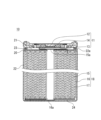
- FIG. 1 is a vertical cross-sectional view of a cylindrical nonaqueous secondary battery 10, which is an example of this embodiment.
- the present disclosure is not limited to the following configuration.
- the battery comprises a positive electrode, a negative electrode, a non-aqueous electrolyte, and a separator interposed between the positive electrode and the negative electrode;
- the positive electrode includes a positive electrode current collector and a positive electrode active material layer supported on the positive electrode current collector,
- the positive electrode active material layer includes a positive electrode active material, a binder, and an additive,
- the additive is a polymer material having a melting point or thermal decomposition temperature of 200° C. or more and 500° C.
- the polymer material is dispersed in a cross section of the positive electrode active material layer to form a plurality of island regions,
- a probability Pt of the polymer material existing in a region of the positive electrode active material layer from a position 0.5T from the surface of the positive electrode current collector to the outermost surface satisfies 1 ⁇ Pb/Pt.
- (Technique 4) 4.
- Technique 5 5.
- the backbone has the formula:
- the battery comprises a positive electrode, a negative electrode, a non-aqueous electrolyte, and a separator interposed between the positive electrode and the negative electrode;
- the positive electrode includes a positive electrode current collector and a positive electrode active material layer supported on the positive electrode current collector,
- the positive electrode active material layer includes a positive electrode active material, a binder, and an additive,
- the additive is a polymer material having a melting point or thermal decomposition temperature of 200° C. or more and 500° C.
- PVDF polyvinylidene fluoride
- the unrolled layer was rolled to form a positive electrode active material layer having a positive electrode active material density of 3.6 g/cm 3.
- the total thickness of the positive electrode after rolling was 160 ⁇ m.
- a non-aqueous electrolyte was prepared by dissolving LiPF 6 at a concentration of 1.0 mol/L in a mixed solvent containing ethylene carbonate (EC) and diethyl carbonate (DEC) in a volume ratio of 3:7.
- EC ethylene carbonate
- DEC diethyl carbonate
- a tab was attached to each electrode, and the positive and negative electrodes were spirally wound through a separator (thickness 14 ⁇ m) so that the tab was located at the outermost periphery to prepare an electrode group.
- the separator has a substrate layer of a microporous thin film made of polyethylene having a thickness of 10 ⁇ m, and a heat-resistant layer having a thickness of 4 ⁇ m laminated on one side (positive electrode side) of the substrate layer.
- the melting point of the microporous thin film is 150° C.
- the heat-resistant layer contains 20 mass% of inorganic oxide filler (alumina), and the remainder is composed of aromatic polyamide (aramid).
- the electrode group was inserted into an exterior body made of aluminum laminate film, vacuum dried at 105° C. for 2 hours, and then an electrolyte was injected and the opening of the exterior body was sealed to obtain a secondary battery sample A1.
- Sample B1 A secondary battery sample B1 was prepared in the same manner as sample A1, except that the positive electrode mixture did not contain the polymer material (P).
- the surface temperature of sample A1 is significantly lower than that of sample B1, which shows that safety in the event of an internal short circuit in the battery is improved without affecting the battery capacity much.
- samples R1d to R4d have significantly lower surface temperatures than samples B1 and CRd. This shows that safety has been improved in the event of an internal short circuit in the battery.
- samples R1e to R4e have significantly lower surface temperatures than samples B1 and CRe. It can also be seen that reducing the BET specific surface area can improve safety in the event of an internal short circuit in the battery.
- samples R1f to R3f have significantly lower surface temperatures than samples B1 and CRf. It can also be seen that reducing the weight-average molecular weight Mw can improve safety in the event of an internal short circuit in the battery.
- Example R1g>> A secondary battery sample R1g was produced in the same manner as sample A1, except that the separator was changed to a separator having a substrate layer of a 10 ⁇ m-thick microporous thin film made of polyethylene and a heat-resistant layer laminated on one side (positive electrode side) of the substrate layer, and was evaluated in the same manner.
- the melting point of the microporous thin film was 150°C, and that of the PPS was 280°C.
- the heat-resistant layer contained 20% by mass of inorganic oxide filler (alumina), with the remainder being aromatic polyamide (aramid), and had a thickness of 4 ⁇ m.
- Example CR 1g, 2g>> Secondary battery samples CR1g and CR2g were prepared in the same manner as samples R1g and R2g, except that the separator was changed to a 13 ⁇ m-thick microporous thin polyethylene film without a heat-resistant layer, and were evaluated in the same manner.
- Example CR3g>> A secondary battery sample CR3g was prepared in the same manner as sample CR1g, except that the positive electrode mixture did not contain the polymer material (P).
- Example R1h, 2h, Sample CR1h-3h> As shown in Table 6, secondary battery samples R1h, R2h, and CR1h to CR3h were prepared in the same manner as sample A1, except that the content of PPS in the positive electrode mixture in the upper layer region and the lower layer region was changed, and were evaluated in the same manner.
- a positive electrode mixture slurry for the upper layer region and a positive electrode mixture slurry for the lower layer region were prepared.
- the content of the polymer material (P) contained in one of the positive electrode mixtures for the upper layer region and the lower layer region was set to the content shown in Table 6, and the other positive electrode mixture did not contain the polymer material (P).
- the positive electrode slurry for the lower layer region was applied to the positive electrode current collector with a thickness half that of Example 1, and then the positive electrode slurry for the upper layer region was applied with a thickness half that of Example 1.
- Example 2 it was dried in the same manner as in Example 1, and the unrolled layer was rolled to form a positive electrode active material layer with a density of the positive electrode active material of 3.6 g/cm 3 , and a positive electrode with a thickness of 160 ⁇ m was obtained.
- positive electrode slurries were prepared with the polymer material (P) content in the positive electrode mixture set to the content shown in Table 6, and the upper and lower layer regions were simultaneously formed using these, as in sample A1.
- the nonaqueous electrolyte secondary battery according to the present disclosure is useful as a main power source for mobile communication devices, portable electronic devices, electric vehicles, and the like.
Landscapes
- Chemical & Material Sciences (AREA)
- Chemical Kinetics & Catalysis (AREA)
- Electrochemistry (AREA)
- General Chemical & Material Sciences (AREA)
- Engineering & Computer Science (AREA)
- Manufacturing & Machinery (AREA)
- Inorganic Chemistry (AREA)
- Battery Electrode And Active Subsutance (AREA)
- Secondary Cells (AREA)
Priority Applications (3)
| Application Number | Priority Date | Filing Date | Title |
|---|---|---|---|
| CN202380087852.6A CN120418968A (zh) | 2022-12-28 | 2023-12-15 | 非水电解质二次电池和使用其的正极 |
| JP2024567636A JPWO2024143017A1 (https=) | 2022-12-28 | 2023-12-15 | |
| EP23911798.9A EP4645418A4 (en) | 2022-12-28 | 2023-12-15 | SECONDARY BATTERY WITH NON-AQUEOUS ELECTROLYTE AND CORRESPONDING POSITIVE ELECTRODE |
Applications Claiming Priority (2)
| Application Number | Priority Date | Filing Date | Title |
|---|---|---|---|
| JP2022211923 | 2022-12-28 | ||
| JP2022-211923 | 2022-12-28 |
Publications (1)
| Publication Number | Publication Date |
|---|---|
| WO2024143017A1 true WO2024143017A1 (ja) | 2024-07-04 |
Family
ID=91717671
Family Applications (1)
| Application Number | Title | Priority Date | Filing Date |
|---|---|---|---|
| PCT/JP2023/045149 Ceased WO2024143017A1 (ja) | 2022-12-28 | 2023-12-15 | 非水電解質二次電池およびこれを用いる正極 |
Country Status (4)
| Country | Link |
|---|---|
| EP (1) | EP4645418A4 (https=) |
| JP (1) | JPWO2024143017A1 (https=) |
| CN (1) | CN120418968A (https=) |
| WO (1) | WO2024143017A1 (https=) |
Cited By (1)
| Publication number | Priority date | Publication date | Assignee | Title |
|---|---|---|---|---|
| WO2025079708A1 (ja) * | 2023-10-13 | 2025-04-17 | パナソニックIpマネジメント株式会社 | 非水電解質二次電池およびこれに用いる電極 |
Citations (5)
| Publication number | Priority date | Publication date | Assignee | Title |
|---|---|---|---|---|
| JP2000315502A (ja) | 1999-04-30 | 2000-11-14 | Dowa Mining Co Ltd | 正極活物質と該正極活物質を用いたリチウム二次電池 |
| JP2003007303A (ja) * | 2001-06-22 | 2003-01-10 | Sony Corp | 非水電解質電池 |
| JP2019164993A (ja) * | 2018-03-14 | 2019-09-26 | 株式会社リコー | 電極形成用組成物、電極の製造方法及び非水系蓄電素子の製造方法 |
| US20200161640A1 (en) * | 2018-11-16 | 2020-05-21 | Contemporary Amperex Technology Co., Limited | Battery |
| WO2022092302A1 (ja) * | 2020-10-30 | 2022-05-05 | 旭化成株式会社 | シロキサン分散架橋型セパレータ |
Family Cites Families (5)
| Publication number | Priority date | Publication date | Assignee | Title |
|---|---|---|---|---|
| JP4602254B2 (ja) * | 2003-09-18 | 2010-12-22 | パナソニック株式会社 | リチウムイオン二次電池 |
| JP6981164B2 (ja) * | 2017-10-13 | 2021-12-15 | トヨタ自動車株式会社 | 正極板および非水電解質二次電池 |
| CN111200103B (zh) * | 2018-11-16 | 2021-01-08 | 宁德时代新能源科技股份有限公司 | 一种电池 |
| CN114824259A (zh) * | 2021-01-27 | 2022-07-29 | 郑州宇通集团有限公司 | 一种锂离子电池复合正极片及其制备方法、锂离子电池 |
| JP7746681B2 (ja) * | 2021-04-16 | 2025-10-01 | 東ソー株式会社 | リチウムイオン電池バインダ用ポリフェニレンサルファイド粉末、リチウムイオン電池負極用バインダ、リチウムイオン電池負極合材層形成用スラリー、リチウムイオン電池用負極及びリチウムイオン電池 |
-
2023
- 2023-12-15 JP JP2024567636A patent/JPWO2024143017A1/ja active Pending
- 2023-12-15 CN CN202380087852.6A patent/CN120418968A/zh active Pending
- 2023-12-15 EP EP23911798.9A patent/EP4645418A4/en active Pending
- 2023-12-15 WO PCT/JP2023/045149 patent/WO2024143017A1/ja not_active Ceased
Patent Citations (5)
| Publication number | Priority date | Publication date | Assignee | Title |
|---|---|---|---|---|
| JP2000315502A (ja) | 1999-04-30 | 2000-11-14 | Dowa Mining Co Ltd | 正極活物質と該正極活物質を用いたリチウム二次電池 |
| JP2003007303A (ja) * | 2001-06-22 | 2003-01-10 | Sony Corp | 非水電解質電池 |
| JP2019164993A (ja) * | 2018-03-14 | 2019-09-26 | 株式会社リコー | 電極形成用組成物、電極の製造方法及び非水系蓄電素子の製造方法 |
| US20200161640A1 (en) * | 2018-11-16 | 2020-05-21 | Contemporary Amperex Technology Co., Limited | Battery |
| WO2022092302A1 (ja) * | 2020-10-30 | 2022-05-05 | 旭化成株式会社 | シロキサン分散架橋型セパレータ |
Non-Patent Citations (1)
| Title |
|---|
| See also references of EP4645418A1 |
Cited By (1)
| Publication number | Priority date | Publication date | Assignee | Title |
|---|---|---|---|---|
| WO2025079708A1 (ja) * | 2023-10-13 | 2025-04-17 | パナソニックIpマネジメント株式会社 | 非水電解質二次電池およびこれに用いる電極 |
Also Published As
| Publication number | Publication date |
|---|---|
| CN120418968A (zh) | 2025-08-01 |
| EP4645418A4 (en) | 2026-04-29 |
| EP4645418A1 (en) | 2025-11-05 |
| JPWO2024143017A1 (https=) | 2024-07-04 |
Similar Documents
| Publication | Publication Date | Title |
|---|---|---|
| US20250038196A1 (en) | Secondary battery positive electrode, production method therefor, and secondary battery | |
| WO2024143017A1 (ja) | 非水電解質二次電池およびこれを用いる正極 | |
| WO2024143010A1 (ja) | 非水電解質二次電池およびこれを用いる正極 | |
| WO2025079708A1 (ja) | 非水電解質二次電池およびこれに用いる電極 | |
| WO2025079706A1 (ja) | 非水電解質二次電池およびこれを用いる電極 | |
| WO2025079707A1 (ja) | 非水電解質二次電池およびこれを用いる電極 | |
| EP4456200B1 (en) | Secondary battery positive electrode, production method therefor, and secondary battery | |
| WO2024143016A1 (ja) | 非水電解質二次電池およびこれを用いる正極 | |
| WO2024143013A1 (ja) | 非水電解質二次電池およびこれを用いる正極 | |
| WO2024143012A1 (ja) | 非水電解質二次電池およびこれを用いる正極 | |
| WO2024143014A1 (ja) | 非水電解質二次電池およびこれを用いる正極 | |
| WO2024143015A1 (ja) | 非水電解質二次電池およびこれを用いる正極 | |
| WO2024143011A1 (ja) | 非水電解質二次電池およびこれを用いる正極 | |
| WO2024143009A1 (ja) | 非水電解質二次電池およびこれを用いる正極 | |
| WO2024143008A1 (ja) | 非水電解質二次電池およびこれを用いる正極 | |
| WO2025063251A1 (ja) | 非水電解質二次電池およびこれに用いる負極 | |
| WO2025079709A1 (ja) | 非水電解質二次電池およびこれを用いる負極 | |
| WO2025079710A1 (ja) | 非水電解質二次電池およびこれに用いる負極 | |
| CN122003743A (zh) | 非水电解质二次电池和使用该二次电池的电极 | |
| JP5005140B2 (ja) | 非水電解質二次電池 | |
| WO2025084254A1 (ja) | 非水電解質二次電池および非水電解質 | |
| CN122003742A (zh) | 非水电解质二次电池和使用该二次电池的电极 |
Legal Events
| Date | Code | Title | Description |
|---|---|---|---|
| 121 | Ep: the epo has been informed by wipo that ep was designated in this application |
Ref document number: 23911798 Country of ref document: EP Kind code of ref document: A1 |
|
| WWE | Wipo information: entry into national phase |
Ref document number: 202380087852.6 Country of ref document: CN |
|
| WWE | Wipo information: entry into national phase |
Ref document number: 2024567636 Country of ref document: JP |
|
| WWE | Wipo information: entry into national phase |
Ref document number: 202547066842 Country of ref document: IN |
|
| WWP | Wipo information: published in national office |
Ref document number: 202547066842 Country of ref document: IN |
|
| WWE | Wipo information: entry into national phase |
Ref document number: 2023911798 Country of ref document: EP |
|
| NENP | Non-entry into the national phase |
Ref country code: DE |
|
| WWP | Wipo information: published in national office |
Ref document number: 202380087852.6 Country of ref document: CN |
|
| ENP | Entry into the national phase |
Ref document number: 2023911798 Country of ref document: EP Effective date: 20250728 |
|
| ENP | Entry into the national phase |
Ref document number: 2023911798 Country of ref document: EP Effective date: 20250728 |
|
| WWP | Wipo information: published in national office |
Ref document number: 2023911798 Country of ref document: EP |