WO2024142855A1 - リアクトル、コンバータ、および電力変換装置 - Google Patents
リアクトル、コンバータ、および電力変換装置 Download PDFInfo
- Publication number
- WO2024142855A1 WO2024142855A1 PCT/JP2023/044032 JP2023044032W WO2024142855A1 WO 2024142855 A1 WO2024142855 A1 WO 2024142855A1 JP 2023044032 W JP2023044032 W JP 2023044032W WO 2024142855 A1 WO2024142855 A1 WO 2024142855A1
- Authority
- WO
- WIPO (PCT)
- Prior art keywords
- core portion
- core
- coil
- sample
- side core
- Prior art date
- Legal status (The legal status is an assumption and is not a legal conclusion. Google has not performed a legal analysis and makes no representation as to the accuracy of the status listed.)
- Ceased
Links
Images





Classifications
-
- H—ELECTRICITY
- H01—ELECTRIC ELEMENTS
- H01F—MAGNETS; INDUCTANCES; TRANSFORMERS; SELECTION OF MATERIALS FOR THEIR MAGNETIC PROPERTIES
- H01F27/00—Details of transformers or inductances, in general
- H01F27/24—Magnetic cores
-
- H—ELECTRICITY
- H01—ELECTRIC ELEMENTS
- H01F—MAGNETS; INDUCTANCES; TRANSFORMERS; SELECTION OF MATERIALS FOR THEIR MAGNETIC PROPERTIES
- H01F27/00—Details of transformers or inductances, in general
- H01F27/24—Magnetic cores
- H01F27/255—Magnetic cores made from particles
-
- H—ELECTRICITY
- H01—ELECTRIC ELEMENTS
- H01F—MAGNETS; INDUCTANCES; TRANSFORMERS; SELECTION OF MATERIALS FOR THEIR MAGNETIC PROPERTIES
- H01F37/00—Fixed inductances not covered by group H01F17/00
Definitions
- the reactor of the present disclosure has The coil has a cylindrical shape and a magnetic core has a ⁇ shape.
- the coil has a first end surface and a second end surface;
- the magnetic core includes a first core and a second core,
- the first core includes a first end core portion and at least a portion of a side core portion,
- the second core includes a second end core portion and a remainder of the side core portion,
- At least one of the first core and the second core includes at least a portion of a middle core portion, the first end core portion is disposed to face the first end surface of the coil, the second end core portion is disposed to face the second end surface of the coil,
- the middle core portion is disposed within the coil,
- the side core portion includes a first side core portion and a second side core portion arranged in parallel with the middle core portion so as to sandwich the coil therebetween,
- the first core is formed of a composite material molded body in which soft magnetic powder is dispersed in a resin,
- the length of the first projecting portion and the length of the second projecting portion may each be 0.05 times or more and 0.5 times or less the length of the first end core portion.
- a width of the first protruding portion is 0.2 to 1.0 times the distance between the middle core portion and the first side core portion
- the width of the second protruding portion may be 0.2 to 1.0 times the distance between the middle core portion and the second side core portion.
- the above configuration (3) can effectively reduce coil loss without suppressing an increase in the volume of the first core.
- By making the width of each protrusion 0.2 times or more the distance between the middle core portion and each side core portion leakage magnetic flux from the first end core portion to the coil can be effectively suppressed.
- the first core may have a relative permeability of 5 or more and 50 or less.
- the above configuration (4) makes it easy to obtain a specified inductance.
- the above configuration (7) can further reduce coil loss.
- the second spacing at the second end is larger than the first spacing at the first end, so that leakage flux linking with the coil can be suppressed. Since leakage flux to the coil is reduced, coil loss can be reduced. Since the ratio of the first spacing to the second spacing is 0.70 or less, leakage flux to the coil is sufficiently suppressed, so that coil loss can be effectively reduced. In particular, when the ratio of the first spacing to the second spacing is 0.32 or more and 0.70 or less, coil loss can be effectively reduced while suppressing a decrease in inductance.
- the first side core portion and the second side core portion may each have a stepped shape whose width narrows from the first end to the second end.
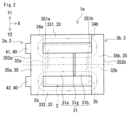
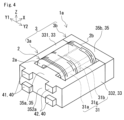
- the coil 2 is disposed in the middle core portion 31 of the magnetic core 3.
- the coil 2 has a cylindrical shape.
- the coil 2 has a first end surface 2a and a second end surface 2b.
- the coil 2 is an edgewise coil formed by edgewise winding a rectangular wire.
- the length of each of the first middle core portion 31a and the second middle core portion 31b can be set as appropriate. In this embodiment, the length of the first middle core portion 31a is different from the length of the second middle core portion 31b.
- the first middle core portion 31a may be longer than the second middle core portion 31b.
- the length of the first middle core portion 31a may be shorter than the second middle core portion 31b.
- the length of the first middle core portion 31a may be the same as the length of the second middle core portion 31b.
- the first end core portion 35a has a protrusion 40.
- the protrusion 40 is provided on an outer side surface 352a of the first end core portion 35a.
- the protrusion 40 protrudes in a direction away from the inner side surface 351a.
- the protrusion 40 extends in the Z-axis direction from the upper edge to the lower edge of the outer side surface 352a. In other words, the protrusion 40 is provided over the entire height of the first end core portion 35a.
- the number of protrusions 40 is two.
- the protrusions 40 include a first protrusion 41 and a second protrusion 42.
- the first protrusion 41 is provided on the outer surface 352a at a location corresponding to between the middle core portion 31 and the first side core portion 331.
- the location on the outer surface 352a corresponding to between the middle core portion 31 and the first side core portion 331 refers to a region sandwiched between an imaginary line extending in the X-axis direction from the outer peripheral surface at the first end 32a of the middle core portion 31 and an imaginary line extending in the X-axis direction from the inner surface at the first end 34a of the first side core portion 331 in a plan view.
- the shape of the protrusion 40 may be any shape.
- the shape of the protrusion 40 here refers to the shape in a planar view.
- the shape of the protrusion 40 is, for example, a polygonal shape or an arc shape.
- the polygonal shape is, for example, a triangular shape, a quadrangular shape, a pentagonal shape, and a hexagonal shape.
- the quadrangular shape includes, for example, a rectangular shape and a trapezoidal shape.
- the rectangular shape includes a square shape.
- the corners of the protrusion 40 may be chamfered.
- the arc shape is a shape having an arc.
- the arc shape includes, for example, a semicircular shape and a semielliptical shape.
- the shape of the first protrusion 41 and the shape of the second protrusion 42 may be the same or different. In this embodiment, the shape of each of the first protrusion 41 and the second protrusion 42 is rectangular.
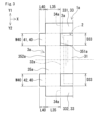
- the length of the first protruding portion 41 and the length of the second protruding portion 42 are, for example, 0.05 times or more and 0.5 times or less than the length of the first end core portion 35a. That is, the ratio of the length L40 of the protruding portion 40 to the length L35 of the first end core portion 35a is 0.05 or more and 0.5 or less. The ratio of the length L40 to the length L35 is expressed as L40/L35.
- the length here refers to the distance along the X-axis direction.
- the length L35 of the first end core portion 35a corresponds to the distance from the inner side surface 351a to the outer side surface 352a at the portion where the first end 32a of the middle core portion 31 is joined.
- the length L40 of the protruding portion 40 corresponds to the distance from a virtual plane extending in the Y-axis direction from the outer side surface 352a at the portion where the first end 32a of the middle core portion 31 is joined to the tip of the protruding portion 40.
- the length L40 is equal to the difference between the distance from the inner surface 351a to the tip of the protrusion 40 and the length L35 of the first end core portion 35a.
- the ratio L40/L35 may further be 0.1 or more, or 0.2 or more.
- the length L40 0.5 times or less the length L35 i.e., the ratio L40/L35 0.5 or less
- an increase in the volume of the first end core portion 35a can be suppressed.
- the ratio L40/L35 may be, for example, 0.1 or more and 0.5 or less, or 0.2 or more and 0.5 or less.
- the interval D33 is the interval between the first end 32a of the middle core portion 31 and the first end 34a of the side core portion 33.
- the interval D33 is equal to the width of each of the first outer region and the second outer region on the outer surface 352a described above.
- the width here refers to the distance along the Y-axis direction.
- the width W40 of the protrusion 40 is the distance along the Y-axis direction.
- the width W40 corresponds to the maximum distance between the side surface of the protrusion 40 facing the Y1 direction and the side surface facing the Y2 direction. When the protrusion 40 is sandwiched between two lines parallel to the X-axis, the width W40 is equal to the distance between the two lines.
- the magnetic core 3 is composed of a first core 3a and a second core 3b.
- the first core 3a has an E-shape
- the second core 3b has a T-shape.
- the magnetic core 3 is an E-T type composed of the E-shaped first core 3a and the T-shaped second core 3b.
- the second core 3b includes a second end core portion 35b and the remaining portion of the side core portion 33.
- the second core 3b has a second end core portion 35b and a second middle core portion 31b.
- the second end core portion 35b and the second middle core portion 31b are integrally molded. Since the second core 3b is an integrally molded product, the core portions constituting the second core 3b are made of the same material. That is, the magnetic properties of the core portions constituting the second core 3b are substantially the same.
- the shape of the second core 3b is T-shaped in a plan view.
- At least one of the first core 3a and the second core 3b includes at least a portion of the middle core portion 31.
- the first core 3a may have the entire middle core portion 31.
- the second core 3b has only the second end core portion 35b.
- the shape of the second core 3b is I-shaped in plan view.
- the second core 3b may have the entire middle core portion 31.
- the first core 3a is composed of the first end core portion 35a, the first side core portion 331, and the second side core portion 332. In this case, the shape of the first core 3a is U-shaped in plan view.
- the side core portion 33 may be divided in the X-axis direction.
- the first side core portion 331 and the second side core portion 332 each have a first portion including the first end 34a and a second portion including the second end 34b.
- the first core 3a may be configured to have the first portions of the first side core portion 331 and the second side core portion 332, and the second core 3b may be configured to have the second portions of the first side core portion 331 and the second side core portion 332.
- each of the first core 3a and the second core 3b has an E-shape in a plan view.
- the relative permeability of the first core 3a is lower than that of the second core 3b. That is, in the magnetic core 3, the relative permeability of the side core portion 33 is lower than that of the second end core portion 35b.
- the relative permeability of each of the first core 3a and the second core 3b is appropriately set so as to obtain a predetermined inductance while satisfying the above relationship.
- the relative permeability of the first core 3a is, for example, 5 or more and 50 or less.
- the relative permeability of the second core 3b is, for example, 50 or more and 500 or less.
- the relative permeability of the first core 3a is in the range of 5 or more and 50 or less, and the relative permeability of the second core 3b is in the range of 50 or more and 500 or less, a predetermined inductance is easily obtained.
- the relative permeability of the first core 3a may be 10 or more and 45 or less, or even 15 or more and 40 or less.
- the relative permeability of the second core 3b may be 100 or more and 450 or less, or even 150 or more and 400 or less.
- the difference between the relative permeability of the first core 3a and the relative permeability of the second core 3b is, for example, not less than 50.
- the difference between the relative permeability of the first core 3a and the relative permeability of the second core 3b may be not less than 50 and not more than 450, or further not less than 100 and not more than 400.
- the relative permeability can be found as follows. A ring-shaped measurement sample is cut out from each of the first core 3a and the second core 3b. Each measurement sample is wound with 300 turns on the primary side and 20 turns on the secondary side.
- the magnetization curve referred to here is what is known as a DC magnetization curve.
- the first core 3a and the second core 3b are each composed of a molded body of a soft magnetic material.
- the molded body is, for example, a powder compact or a composite material compact.
- the first core 3a and the second core 3b are composed of molded bodies of different materials.
- the different materials include not only the case where the materials of the individual components are different in each molded body constituting the first core 3a and the second core 3b, but also the case where the materials of the individual components are the same but the contents of the components are different.
- first core 3a and the second core 3b are composed of a powder compact, if at least one of the material and the content of the soft magnetic powder constituting the powder compact is different, they are different materials. Also, even if the first core 3a and the second core 3b are composed of a composite material compact, if at least one of the material and the content of the soft magnetic powder constituting the composite material is different, they are different materials.
- the powder compact is formed by compressing and molding raw powder containing soft magnetic powder.
- the powder compact contains a larger amount of soft magnetic powder than the composite material compact. Therefore, the powder compact has higher magnetic properties than the composite material compact.
- the magnetic properties are, for example, the relative permeability and the saturation magnetic flux density.
- the powder compact may contain, for example, at least one of a binder resin and a molding aid.
- the soft magnetic powder content in the powder compact is, for example, 85% by volume or more and 99.99% by volume or less, when the powder compact is taken as 100% by volume.
- Composite material compacts are made by dispersing soft magnetic powder in resin.
- Composite material compacts are obtained by filling a mold with a fluid material in which soft magnetic powder is dispersed in unsolidified resin, and then solidifying the resin.
- the soft magnetic powder content of the composite material compact can be easily adjusted. Therefore, the magnetic properties of the composite material compact are easy to adjust.
- the soft magnetic powder content of the composite material compact is, for example, 20% to 80% by volume, when the composite material compact is taken as 100% by volume.
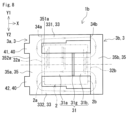
- a reactor 1b of the second embodiment will be described with reference to Fig. 6 and Fig. 7.
- the reactor 1b of the second embodiment differs from the reactor 1a of the first embodiment in that the second distance between the side core portion 33 and the coil 2 at the second end 34b is larger than the first distance at the first end 34a.
- the following description will focus on the differences from the first embodiment.
- the same components as those in the first embodiment are denoted by the same reference numerals and description thereof will be omitted.
- the first end core portion 35a has the protruding portion 40 and satisfies the following requirements (c) and (d).
- the relative permeability of the first core 3a is lower than the relative permeability of the second core 3b.
- the second distance D2 is larger than the first distance D1, and the ratio D1/D2 of the first distance D1 to the second distance D2 is equal to or greater than 0.32 and equal to or less than 0.70.
- the second distance D2 is larger than the first distance D1, which allows for further reduction in loss in coil 2.
- the ratio D1/D2 of the first distance D1 to the second distance D2 is 0.32 or more and 0.70 or less, which allows for effective reduction in loss in coil 2 while suppressing a decrease in inductance.
- the interval between the first side core portion 331 and the coil 2 and the interval between the second side core portion 332 and the coil 2 are not constant along the X-axis direction.
- the interval between the side core portion 33 and the coil 2 is not constant along the entire length of the side core portion 33.
- the interval between the side core portion 33 and the coil 2 increases from the first end 34a to the second end 34b.
- the interval between the side core portion 33 and the coil 2 refers to the interval between the inner surface of the side core portion 33 and the outer circumferential surface of the coil 2.
- the second distance D2 refers to the distance between the inner surface located at the second end 34b of the inner surface of the first side core portion 331 and an imaginary plane extending from the outer circumferential surface of the coil 2. If the corner between the end face of the second end 34b and the inner surface is chamfered, it is considered that there is no chamfering. In other words, the distance between the corner between the extended surface of the end face of the second end 34b and the extended surface of the inner surface and the imaginary plane is considered to be the second distance D2.
- the ratio of the first interval D1 to the second interval D2 is 0.32 or more and 0.70 or less.
- the ratio of the first interval D1 to the second interval D2 is expressed as D1/D2.
- the ratio D1/D2 is 0.70 or less, the leakage flux to the coil 2 is sufficiently suppressed, so the loss of the coil 2 can be effectively reduced. If the ratio D1/D2 is too small, that is, if the second interval D2 is too large, there is a risk that the inductance will decrease, and it may be difficult to obtain a specified inductance. By having the ratio D1/D2 be 0.32 or more, it is easy to suppress the decrease in inductance.
- the ratio D1/D2 may further be 0.35 or more and 0.70 or less, or 0.40 or more and 0.60 or less.
- the distance D33 (see FIG. 3) between the middle core portion 31 and the first side core portion 331 is the distance between the outer peripheral surface at the first end 32a of the middle core portion 31 and the inner surface at the first end 34a of the side core portion 33.
- the side core portion 33 has a shape in which the width of the side core portion 33 narrows from the first end 34a to the second end 34b.
- the side core portion 33 only needs to have a width of the second end 34b narrower than the width of the first end 34a.
- the side core portion 33 only needs to have a narrower width at least in a portion between the first end 34a and the second end 34b, and may have a constant width in a portion between the first end 34a and the second end 34b.
- the width of the side core portion 33 is the dimension of the side core portion 33 in the Y-axis direction.
- the shape of the first side core portion 331 and the shape of the second side core portion 332 are symmetrical with respect to the center line of the middle core portion 31.
- the first side core portion 331 has a tapered shape.
- a tapered shape refers to a shape having a portion whose width continuously narrows from the first end 34a to the second end 34b.
- the first side core portion 331 is formed in a tapered shape over its entire length.
- the inner surface of the first side core portion 331 has an inclined surface 33t that is inclined with respect to the outer peripheral surface of the coil 2.
- the inclined surface 33t is inclined from the first end 34a to the second end 34b so as to move away from the outer peripheral surface of the coil 2.
- the angle of the inclined surface 33t with respect to the outer peripheral surface of the coil 2 is appropriately set so that the ratio of the first interval D1 to the second interval D2 satisfies a predetermined range.
- the angle of the inclined surface 33t refers to the angle between the inclined surface 33t and the outer peripheral surface of the coil 2.
- the outer peripheral surface of the coil 2 is parallel to the X-axis.
- the angle of the inclined surface 33t can be set appropriately depending on the length of the first side core portion 331.
- the angle of the inclined surface 33t is, for example, greater than or equal to 1° and less than 5°, and further greater than or equal to 2° and less than or equal to 4°.
- the distance D33 (see FIG. 3) between the middle core portion 31 and the first side core portion 331 is the distance between the outer peripheral surface at the first end 32a of the middle core portion 31 and the inner surface at the first end 34a of the side core portion 33.
- the number of step portions 33s is one, but there may be multiple step portions 33s.
- the number of step portions 33s is n
- the number of regions constituting the side core portion 33 is n+1.
- the n+1th region is closer to the second end 34b than the nth region, and the width of the n+1th region is narrower than the width of the nth region. The width gradually narrows from the first region toward the n+1th region.
- the reactor of the embodiment can be used in applications that satisfy the following energization conditions: a maximum DC current of about 100 A to 1000 A, an average voltage of about 100 V to 1000 V, and an operating frequency of about 5 kHz to 100 kHz.
- the reactor of the embodiment can be used as a component of a converter mounted on a vehicle such as an electric vehicle or a hybrid vehicle, and as a component of a power conversion device including the converter.
- a vehicle 1200 such as a hybrid vehicle or an electric vehicle includes a main battery 1210, a power conversion device 1100 connected to the main battery 1210, and a motor 1220 that is driven by power supplied from the main battery 1210 and used for traveling.
- the motor 1220 is typically a three-phase AC motor.
- the motor 1220 drives the wheels 1250 when traveling, and functions as a generator during regeneration.
- the vehicle 1200 includes an engine 1300 in addition to the motor 1220.
- FIG. 10 shows an inlet as the charging point for the vehicle 1200, a form including a plug may also be used.
- the power conversion device 1100 has a converter 1110 connected to the main battery 1210, and an inverter 1120 connected to the converter 1110 and converting between DC and AC.
- the converter 1110 shown in this example boosts the input voltage of the main battery 1210, which is between 200V and 300V, to between 400V and 700V when the vehicle 1200 is running, and supplies power to the inverter 1120.
- the converter 1110 steps down the input voltage output from the motor 1220 via the inverter 1120 to a DC voltage suitable for the main battery 1210, and charges the main battery 1210.
- the input voltage is a DC voltage.
- the converter 1110 includes a plurality of switching elements 1111, a drive circuit 1112 that controls the operation of the switching elements 1111, and a reactor 1115, and converts the input voltage by repeatedly switching on and off.
- the conversion of the input voltage means stepping up and down the voltage here.
- the switching elements 1111 are power devices such as field effect transistors and insulated gate bipolar transistors.
- the reactor 1115 utilizes the properties of a coil that prevents changes in the current flowing through the circuit, and has the function of smoothing out changes when the current increases or decreases due to switching operations.
- the reactor 1115 includes the reactor of the embodiment. By including the reactor of the embodiment, the loss in the power conversion device 1100 and the converter 1110 is small.
- the vehicle 1200 is equipped with a power supply converter 1150 connected to the main battery 1210, and an auxiliary power converter 1160 connected to the sub-battery 1230, which serves as a power source for the auxiliary devices 1240, and the main battery 1210, converting the high voltage of the main battery 1210 to low voltage.
- the converter 1110 typically performs DC-DC conversion, while the power supply converter 1150 and the auxiliary power converter 1160 perform AC-DC conversion. Some of the power supply converters 1150 perform DC-DC conversion.
- the reactors of the power supply converter 1150 and the auxiliary power converter 1160 can be reactors that have the same configuration as the reactors of the embodiment, but have been modified in size or shape as appropriate. The reactors of the embodiment can also be used for converters that convert input power and that only step up or only step down.
- reactors were designed as Sample No. 1-0 to Sample No. 1-7 shown in Table 1.
- Sample No. 1-0 to Sample No. 1-7 are models in which the length L40 of each of the first protrusion 41 and the second protrusion 42 is changed in the range from 0 mm to 10 mm.
- the basic configuration of the designed reactor is shown below.
- Magnetic core size Length L of magnetic core 3: 80 mm Width W of magnetic core 3: 65 mm Height H of magnetic core 3: 25 mm 1, the length L is the dimension of the magnetic core 3 in the X-axis direction, the width W is the dimension of the magnetic core 3 in the Y-axis direction, and the height H is the dimension of the magnetic core 3 in the Z-axis direction.
- each core portion 31 Length of middle core portion 31: 53.2 mm Width of middle core portion 31: 25 mm Length of each of the first side core portion 331 and the second side core portion 332: 53.2 mm Width of each of the first side core portion 331 and the second side core portion 332: 9 mm Length of each of the first end core portion 35a and the second end core portion 35b: 13.4 mm Width of each of the first end core portion 35a and the second end core portion 35b: 65 mm Length of gap portion 31g: 2 mm Distance between the middle core portion 31 and the first side core portion 331: 11 mm Distance between the middle core portion 31 and the second side core portion 332: 11 mm
- the length of each core portion is the dimension in the X-axis direction.
- the width of each core portion is the dimension in the Y-axis direction.
- the height of each core portion i.e., the dimension in the Z-axis direction, is 25 mm.
- Relative permeability of first core 3a 20 Relative permeability of second core 3b: 200
- Table 1 shows the length L40 of the protruding portion 40, the length L35 of the first end core portion 35a, and the ratio of length L40 to length L35 (L40/L35) in samples No. 1-0 to 1-7.
- the width W40 of each of the first protruding portion 41 and the second protruding portion 42 is 11 mm.
- the distance D33 between the middle core portion 31 and the side core portion 33 is 11 mm.
- the ratio of width W40 to distance D33 (W40/D33) is 1.
- JMAG-Designer 21.0 a commercially available electromagnetic field analysis software made by JSOL Corporation, was used to perform a magnetic field transient response analysis.
- the coil loss reduction rate A of Sample No. 1-1 to Sample No. 1-7 is 1% or more.
- the coil loss of Sample No. 1-1 to Sample No. 1-7 is reduced by 1% or more compared to the coil loss of Sample No. 1-0.
- Sample No. 1-1 to Sample No. 1-7 have the effect of reducing coil loss due to the protrusion.
- the inductance of Sample No. 1-1 to Sample No. 1-7 is not reduced compared to the inductance of Sample No. 1-0. It can be said that the effect of the protrusion on inductance is small.
- L40/L35 in which L40/L35 is 0.5 or less, have an efficiency of 75% or more and are highly efficient. It is considered that the ratio of length L40 to length L35 at which the efficiency of reducing coil loss is high and the effect of reducing coil loss can be obtained is 0.05 or more and 0.5 or less.
- Sample No. 2-0 to Sample No. 2-7 shown in Table 2 were designed.
- Sample No. 2-0 to Sample No. 2-7 are models in which the width W40 of each of the first protruding portion 41 and the second protruding portion 42 is changed in the range from 0 mm to 10 mm.
- Sample No. 2-0 in which the width W40 of the protruding portion 40 is 0 mm does not have the first protruding portion 41 and the second protruding portion 42.
- Sample No. 2-0 has the same configuration as Sample No. 1-0 in Test Example 1.
- the basic configuration of the designed reactor is the same as that of Test Example 1.
- the inductance and loss of the reactor of each sample were analyzed.
- the inductance and coil loss of each sample were determined in the same manner as in Test Example 1.
- the inductance and coil loss of each sample are shown in Table 2.
- the inductance shown in Table 2 is shown as a ratio with the inductance of sample No. 2-0 as the reference (100%).
- the coil loss shown in Table 2 is shown as a ratio with the coil loss of sample No. 2-0 as the reference (100%).
- the coil loss reduction rate A of each sample is also shown in Table 1.
- the coil loss reduction rate A is the coil loss of each sample minus the coil loss of sample No. 2-0.
- volume increase rate and efficiency of each sample were determined in the same manner as in Test Example 1.
- the volume increase rate B and efficiency of each sample are shown in Table 2.
Landscapes
- Engineering & Computer Science (AREA)
- Power Engineering (AREA)
- Coils Or Transformers For Communication (AREA)
- Dc-Dc Converters (AREA)
Priority Applications (1)
| Application Number | Priority Date | Filing Date | Title |
|---|---|---|---|
| CN202380086222.7A CN120359583A (zh) | 2022-12-26 | 2023-12-08 | 电抗器、转换器及电力变换装置 |
Applications Claiming Priority (2)
| Application Number | Priority Date | Filing Date | Title |
|---|---|---|---|
| JP2022208308A JP2024092405A (ja) | 2022-12-26 | 2022-12-26 | リアクトル、コンバータ、および電力変換装置 |
| JP2022-208308 | 2022-12-26 |
Publications (1)
| Publication Number | Publication Date |
|---|---|
| WO2024142855A1 true WO2024142855A1 (ja) | 2024-07-04 |
Family
ID=91717594
Family Applications (1)
| Application Number | Title | Priority Date | Filing Date |
|---|---|---|---|
| PCT/JP2023/044032 Ceased WO2024142855A1 (ja) | 2022-12-26 | 2023-12-08 | リアクトル、コンバータ、および電力変換装置 |
Country Status (3)
| Country | Link |
|---|---|
| JP (1) | JP2024092405A (https=) |
| CN (1) | CN120359583A (https=) |
| WO (1) | WO2024142855A1 (https=) |
Citations (5)
| Publication number | Priority date | Publication date | Assignee | Title |
|---|---|---|---|---|
| JP2004031647A (ja) * | 2002-06-26 | 2004-01-29 | Sumida Corporation | インバータトランス |
| JP2006186195A (ja) * | 2004-12-28 | 2006-07-13 | Jfe Steel Kk | 磁気素子 |
| JP2012023090A (ja) * | 2010-07-12 | 2012-02-02 | Toyota Central R&D Labs Inc | リアクトル |
| JP2020068315A (ja) * | 2018-10-25 | 2020-04-30 | 株式会社オートネットワーク技術研究所 | リアクトル |
| JP2021141122A (ja) * | 2020-03-02 | 2021-09-16 | 株式会社オートネットワーク技術研究所 | リアクトル、コンバータ、及び電力変換装置 |
-
2022
- 2022-12-26 JP JP2022208308A patent/JP2024092405A/ja active Pending
-
2023
- 2023-12-08 CN CN202380086222.7A patent/CN120359583A/zh active Pending
- 2023-12-08 WO PCT/JP2023/044032 patent/WO2024142855A1/ja not_active Ceased
Patent Citations (5)
| Publication number | Priority date | Publication date | Assignee | Title |
|---|---|---|---|---|
| JP2004031647A (ja) * | 2002-06-26 | 2004-01-29 | Sumida Corporation | インバータトランス |
| JP2006186195A (ja) * | 2004-12-28 | 2006-07-13 | Jfe Steel Kk | 磁気素子 |
| JP2012023090A (ja) * | 2010-07-12 | 2012-02-02 | Toyota Central R&D Labs Inc | リアクトル |
| JP2020068315A (ja) * | 2018-10-25 | 2020-04-30 | 株式会社オートネットワーク技術研究所 | リアクトル |
| JP2021141122A (ja) * | 2020-03-02 | 2021-09-16 | 株式会社オートネットワーク技術研究所 | リアクトル、コンバータ、及び電力変換装置 |
Also Published As
| Publication number | Publication date |
|---|---|
| CN120359583A (zh) | 2025-07-22 |
| JP2024092405A (ja) | 2024-07-08 |
Similar Documents
| Publication | Publication Date | Title |
|---|---|---|
| WO2021193783A1 (ja) | リアクトル、コンバータ、及び電力変換装置 | |
| WO2024142855A1 (ja) | リアクトル、コンバータ、および電力変換装置 | |
| JP7566245B2 (ja) | リアクトル、コンバータ、及び電力変換装置 | |
| JP7838470B2 (ja) | リアクトル、コンバータ、および電力変換装置 | |
| JP7698243B2 (ja) | リアクトル、コンバータ、及び電力変換装置 | |
| JP7630774B2 (ja) | リアクトル、コンバータ、及び電力変換装置 | |
| JP7567740B2 (ja) | リアクトル、コンバータ、及び電力変換装置 | |
| WO2025028175A1 (ja) | リアクトル、コンバータ、および電力変換装置 | |
| WO2024190463A1 (ja) | コア片、リアクトル、コンバータ、および電力変換装置 | |
| JP2024178546A (ja) | コア片、リアクトル、コンバータ、および電力変換装置 | |
| JP7584740B2 (ja) | リアクトル、コンバータ、及び電力変換装置 | |
| WO2013141016A1 (ja) | リアクトル、コア部材、コア部材の製造方法、コンバータ、及び電力変換装置 | |
| JP7367584B2 (ja) | リアクトル、コンバータ、及び電力変換装置 | |
| US20240258025A1 (en) | Reactor, converter, and power converter device | |
| WO2025182594A1 (ja) | リアクトル、コンバータ、および電力変換装置 | |
| JP2026048824A (ja) | リアクトル、分割片、コンバータ、及び電力変換装置 | |
| JP2024083070A (ja) | リアクトル、コンバータ、および電力変換装置 | |
| JP2024083069A (ja) | リアクトル、コンバータ、および電力変換装置 |
Legal Events
| Date | Code | Title | Description |
|---|---|---|---|
| 121 | Ep: the epo has been informed by wipo that ep was designated in this application |
Ref document number: 23911636 Country of ref document: EP Kind code of ref document: A1 |
|
| WWE | Wipo information: entry into national phase |
Ref document number: 202380086222.7 Country of ref document: CN |
|
| WWP | Wipo information: published in national office |
Ref document number: 202380086222.7 Country of ref document: CN |
|
| NENP | Non-entry into the national phase |
Ref country code: DE |
|
| 122 | Ep: pct application non-entry in european phase |
Ref document number: 23911636 Country of ref document: EP Kind code of ref document: A1 |