WO2024142569A1 - 被覆正極活物質及びそれを用いた電池 - Google Patents
被覆正極活物質及びそれを用いた電池 Download PDFInfo
- Publication number
- WO2024142569A1 WO2024142569A1 PCT/JP2023/038202 JP2023038202W WO2024142569A1 WO 2024142569 A1 WO2024142569 A1 WO 2024142569A1 JP 2023038202 W JP2023038202 W JP 2023038202W WO 2024142569 A1 WO2024142569 A1 WO 2024142569A1
- Authority
- WO
- WIPO (PCT)
- Prior art keywords
- positive electrode
- active material
- electrode active
- battery
- lithium
- Prior art date
- Legal status (The legal status is an assumption and is not a legal conclusion. Google has not performed a legal analysis and makes no representation as to the accuracy of the status listed.)
- Ceased
Links
Images


Classifications
-
- H—ELECTRICITY
- H01—ELECTRIC ELEMENTS
- H01M—PROCESSES OR MEANS, e.g. BATTERIES, FOR THE DIRECT CONVERSION OF CHEMICAL ENERGY INTO ELECTRICAL ENERGY
- H01M4/00—Electrodes
- H01M4/02—Electrodes composed of, or comprising, active material
- H01M4/36—Selection of substances as active materials, active masses, active liquids
- H01M4/362—Composites
- H01M4/366—Composites as layered products
-
- H—ELECTRICITY
- H01—ELECTRIC ELEMENTS
- H01M—PROCESSES OR MEANS, e.g. BATTERIES, FOR THE DIRECT CONVERSION OF CHEMICAL ENERGY INTO ELECTRICAL ENERGY
- H01M4/00—Electrodes
- H01M4/02—Electrodes composed of, or comprising, active material
- H01M4/13—Electrodes for accumulators with non-aqueous electrolyte, e.g. for lithium-accumulators; Processes of manufacture thereof
- H01M4/131—Electrodes based on mixed oxides or hydroxides, or on mixtures of oxides or hydroxides, e.g. LiCoOx
-
- H—ELECTRICITY
- H01—ELECTRIC ELEMENTS
- H01M—PROCESSES OR MEANS, e.g. BATTERIES, FOR THE DIRECT CONVERSION OF CHEMICAL ENERGY INTO ELECTRICAL ENERGY
- H01M4/00—Electrodes
- H01M4/02—Electrodes composed of, or comprising, active material
- H01M4/13—Electrodes for accumulators with non-aqueous electrolyte, e.g. for lithium-accumulators; Processes of manufacture thereof
- H01M4/136—Electrodes based on inorganic compounds other than oxides or hydroxides, e.g. sulfides, selenides, tellurides, halogenides or LiCoFy
-
- H—ELECTRICITY
- H01—ELECTRIC ELEMENTS
- H01M—PROCESSES OR MEANS, e.g. BATTERIES, FOR THE DIRECT CONVERSION OF CHEMICAL ENERGY INTO ELECTRICAL ENERGY
- H01M4/00—Electrodes
- H01M4/02—Electrodes composed of, or comprising, active material
- H01M4/36—Selection of substances as active materials, active masses, active liquids
- H01M4/48—Selection of substances as active materials, active masses, active liquids of inorganic oxides or hydroxides
- H01M4/485—Selection of substances as active materials, active masses, active liquids of inorganic oxides or hydroxides of mixed oxides or hydroxides for inserting or intercalating light metals, e.g. LiTi2O4 or LiTi2OxFy
-
- H—ELECTRICITY
- H01—ELECTRIC ELEMENTS
- H01M—PROCESSES OR MEANS, e.g. BATTERIES, FOR THE DIRECT CONVERSION OF CHEMICAL ENERGY INTO ELECTRICAL ENERGY
- H01M4/00—Electrodes
- H01M4/02—Electrodes composed of, or comprising, active material
- H01M4/36—Selection of substances as active materials, active masses, active liquids
- H01M4/58—Selection of substances as active materials, active masses, active liquids of inorganic compounds other than oxides or hydroxides, e.g. sulfides, selenides, tellurides, halogenides or LiCoFy; of polyanionic structures, e.g. phosphates, silicates or borates
- H01M4/582—Halogenides
-
- H—ELECTRICITY
- H01—ELECTRIC ELEMENTS
- H01M—PROCESSES OR MEANS, e.g. BATTERIES, FOR THE DIRECT CONVERSION OF CHEMICAL ENERGY INTO ELECTRICAL ENERGY
- H01M4/00—Electrodes
- H01M4/02—Electrodes composed of, or comprising, active material
- H01M2004/026—Electrodes composed of, or comprising, active material characterised by the polarity
- H01M2004/028—Positive electrodes
-
- Y—GENERAL TAGGING OF NEW TECHNOLOGICAL DEVELOPMENTS; GENERAL TAGGING OF CROSS-SECTIONAL TECHNOLOGIES SPANNING OVER SEVERAL SECTIONS OF THE IPC; TECHNICAL SUBJECTS COVERED BY FORMER USPC CROSS-REFERENCE ART COLLECTIONS [XRACs] AND DIGESTS
- Y02—TECHNOLOGIES OR APPLICATIONS FOR MITIGATION OR ADAPTATION AGAINST CLIMATE CHANGE
- Y02E—REDUCTION OF GREENHOUSE GAS [GHG] EMISSIONS, RELATED TO ENERGY GENERATION, TRANSMISSION OR DISTRIBUTION
- Y02E60/00—Enabling technologies; Technologies with a potential or indirect contribution to GHG emissions mitigation
- Y02E60/10—Energy storage using batteries
Definitions
- This disclosure relates to a coated positive electrode active material and a battery using the same.
- the electrolyte may be decomposed by the active material.
- the electrolyte decomposes a film of electrolyte decomposition products is formed inside the electrode. This leads to disadvantages such as an increase in the internal resistance of the battery and a decrease in the cycle characteristics of the battery.
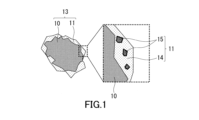
- (Embodiment 1) 1 is a cross-sectional view showing a schematic configuration of a coated cathode active material 13 according to embodiment 1.
- the coated cathode active material 13 includes a first cathode active material 10 and a coating layer 11.
- the first cathode active material 10 has a shape of, for example, a particle shape.
- the coating layer 11 coats at least a part of the surface of the particles of the first cathode active material 10.
- the average particle size of the first positive electrode active material 10 is roughly equal to the average particle size of the coated positive electrode active material 13.
- the first material 14 and the second material 15 may each have a particle shape.
- the particles of the second material 15 may be dispersed in the coating layer 11. With this configuration, the effect of the second material 15 is more likely to be uniformly exerted in the coating layer 11.
- the first material 14 may have lithium ion conductivity. With this configuration, the first positive electrode active material 10 can smoothly absorb and release lithium ions.
- the halide as the first material 14 may be an inorganic compound.
- the halides include, for example, Li, M1, M2, and F.
- M1 is at least one selected from the group consisting of Ti and Nb.
- M2 is at least one selected from the group consisting of Ca, Mg, Al, Y, and Zr.
- Such halides are called halide solid electrolytes and have excellent lithium ion conductivity.
- the halide may consist of Li, M1, M2, and F, excluding inevitable impurities.
- the ratio of the amount of Li to the sum of the amounts of M1 and M2 is, for example, 0.5 or more and 4.5 or less. When this ratio falls within this range, the halide has excellent lithium ion conductivity.
- the first material 14 and the second material 15 may be a halide and a compound A, respectively.
- the average thickness of the coating layer 11 is, for example, 1 nm or more and 150 nm or less, preferably 100 nm or less, and more preferably 50 nm or less. By appropriately adjusting the average thickness of the coating layer 11, it is possible to improve the effects of improving the discharge capacity of the battery and reducing the resistance value of the battery.
- the average thickness of the coating layer 11 can be calculated from a scanning transmission electron microscope (STEM) image obtained by a STEM.
- STEM scanning transmission electron microscope
- the average thickness can be the average value of thicknesses at any number of points (for example, five points).
- the particles of compound A and the particles of the second positive electrode active material may each be nanoparticles. It is desirable that the particles of compound A and/or the particles of the second positive electrode active material are dispersed in the coating layer 11. Therefore, it is desirable that the particles of compound A and the particles of the second positive electrode active material have a particle diameter smaller than the thickness of the coating layer 11. In other words, particles of the second material 15 having a particle diameter smaller than the thickness of the coating layer 11 may be present in the coating layer 11. With this configuration, it is possible to balance the effect of suppressing the decomposition of other materials such as the electrolyte with the effect of improving the discharge capacity of the battery and reducing the resistance value of the battery.
- the presence of the second material 15 in the coating layer 11 can be confirmed by elemental mapping of the particles of the coated positive electrode active material 13.
- the elemental map can be obtained by energy dispersive X-ray spectroscopy combined with a scanning transmission electron microscope (STEM-EDX).
- Devices capable of applying mechanical energy to the mixture of the first positive electrode active material 10 and the coating material include processing devices (particle compounding devices) such as a ball mill, "Mechanofusion” (manufactured by Hosokawa Micron Corporation), “Nobilta” (manufactured by Hosokawa Micron Corporation), and “Balance Gran” (manufactured by Freund Turbo Corporation).
- processing devices particle compounding devices
- particle compounding devices such as a ball mill, "Mechanofusion” (manufactured by Hosokawa Micron Corporation), “Nobilta” (manufactured by Hosokawa Micron Corporation), and “Balance Gran” (manufactured by Freund Turbo Corporation).
- the thickness of the coating layer 11 can be controlled by adjusting conditions such as the rotation speed, processing time, and loading amount. Note that processing using the above-mentioned device is not essential.
- the coated positive electrode active material 13 may be produced by mixing the first positive electrode active material 10 and the coating material using a mortar, mixer, or the like.
- the coating material may be deposited on the surface of the first positive electrode active material 10 by various methods such as a spray method, a spray dry coating method, an electrodeposition method, an immersion method, or a mechanical mixing method using a disperser.
- the positive electrode 23 includes the coated positive electrode active material 13 of embodiment 1. With this configuration, decomposition of other materials such as the electrolyte in the positive electrode 23 is suppressed. As a result, the effects of improving the discharge capacity and reducing the resistance value are obtained.
- the positive electrode current collector 21 is, for example, a sheet or film made of a metal material such as aluminum, an aluminum alloy, stainless steel, titanium, or a titanium alloy.
- the sheet or film may be porous or non-porous.
- Metal foil, metal mesh, or the like may be used as the sheet or film.
- a carbon material may be applied to the surface of the positive electrode current collector 21 as a conductive auxiliary material.
- the positive electrode active material layer 22 may contain other materials such as a conductive additive, an ion conductor, and a binder.
- the conductive assistant and ion conductor are used to reduce the resistance of the positive electrode 23.
- the conductive assistant include carbon materials and conductive polymer compounds.
- the carbon materials include carbon black, graphite, acetylene black, carbon nanotubes, carbon nanofibers, graphene, fullerene, and graphite oxide.
- the conductive polymer compounds include polyaniline, polypyrrole, and polythiophene. At least one selected from these conductive assistants can be used.
- ion conductor examples include gel electrolytes such as polymethyl methacrylate and polymethyl methacrylate, organic solid electrolytes such as polyethylene oxide, and inorganic solid electrolytes such as Li 7 La 3 Zr 2 O 12. At least one selected from these ion conductors can be used.
- the negative electrode current collector 24 is a sheet or film made of a metal material such as stainless steel, nickel, a nickel alloy, copper, or a copper alloy.
- the sheet or film may be porous or non-porous.
- Metal foil, metal mesh, or the like may be used as the sheet or film.
- a carbon material may be applied to the surface of the negative electrode current collector 24 as a conductive auxiliary material.
- Examples of anions constituting the ionic liquid include PF6- , BF4- , SbF6- , AsF6- , SO3CF3- , N ( SO2F ) 2- , N ( SO2CF3 ) 2-, N(SO2C2F5)2- , N ( SO2CF3 ) (SO2C4F9)-, C(SO2CF3)3- , etc.
- the ionic liquid may contain a lithium salt.
- the separator 27 is an electrolyte layer having lithium ion conductivity.
- the material of the separator 27 is not particularly limited as long as the passage of lithium ions is permitted.
- the material of the separator 27 may be at least one selected from the group consisting of a solid electrolyte, a gel electrolyte, an ion exchange resin membrane, a semipermeable membrane, and a porous membrane. If the separator 27 is made of these materials, the safety of the battery 100 can be sufficiently ensured.
- the solid electrolyte include a sulfide solid electrolyte such as Li 2 S-P 2 S 5 , and an oxide solid electrolyte such as Li 7 La 3 Zr 2 O 12 (LLZ).
- LTAF and lithium nickel cobalt manganese oxide were finely pulverized by milling.
- lithium nickel cobalt manganese oxide may be referred to as "NCM”.
- the positive electrode and the negative electrode were punched out to a diameter of 10.8 mm in a low dew point atmosphere of -50°C.
- the positive electrode, the polyolefin thin film and the negative electrode were placed in a 1616 size coin case, and the nonaqueous electrolyte was poured into the coin case.
- the coin case was sealed with a lid to obtain a coin-type nonaqueous electrolyte battery.
- a cathode composite was prepared by mixing Li x YCl 6 as a solid electrolyte, the coated cathode active material, and the conductive assistant in an agate mortar under a dry argon atmosphere.
- the volume ratio of the solid electrolyte to the coated cathode active material was 50:50.
- Carbon nanofiber VGCF, manufactured by Showa Denko K.K.
- the mass ratio of the conductive assistant to the total mass of the solid electrolyte and the coated cathode active material was 1 wt %.
- VGCF is a registered trademark of Showa Denko K.K.
- Comparative Example 3 shows that when the material of the coating layer was changed to lithium niobate, the resistance value of the solid-state battery tended to increase significantly. Furthermore, when the target thickness of the coating layer of the coated active material in Comparative Example 3 was set to the same as in Example 2, the resistance of the solid-state battery increased further.
Landscapes
- Chemical & Material Sciences (AREA)
- Chemical Kinetics & Catalysis (AREA)
- Electrochemistry (AREA)
- General Chemical & Material Sciences (AREA)
- Inorganic Chemistry (AREA)
- Engineering & Computer Science (AREA)
- Materials Engineering (AREA)
- Composite Materials (AREA)
- Battery Electrode And Active Subsutance (AREA)
Priority Applications (3)
| Application Number | Priority Date | Filing Date | Title |
|---|---|---|---|
| JP2024567245A JPWO2024142569A1 (https=) | 2022-12-26 | 2023-10-23 | |
| EP23911353.3A EP4645450A1 (en) | 2022-12-26 | 2023-10-23 | Coated positive electrode active material and battery using same |
| CN202380088709.9A CN120457556A (zh) | 2022-12-26 | 2023-10-23 | 被覆正极活性物质以及使用其的电池 |
Applications Claiming Priority (2)
| Application Number | Priority Date | Filing Date | Title |
|---|---|---|---|
| JP2022-209004 | 2022-12-26 | ||
| JP2022209004 | 2022-12-26 |
Publications (1)
| Publication Number | Publication Date |
|---|---|
| WO2024142569A1 true WO2024142569A1 (ja) | 2024-07-04 |
Family
ID=91717373
Family Applications (1)
| Application Number | Title | Priority Date | Filing Date |
|---|---|---|---|
| PCT/JP2023/038202 Ceased WO2024142569A1 (ja) | 2022-12-26 | 2023-10-23 | 被覆正極活物質及びそれを用いた電池 |
Country Status (4)
| Country | Link |
|---|---|
| EP (1) | EP4645450A1 (https=) |
| JP (1) | JPWO2024142569A1 (https=) |
| CN (1) | CN120457556A (https=) |
| WO (1) | WO2024142569A1 (https=) |
Citations (7)
| Publication number | Priority date | Publication date | Assignee | Title |
|---|---|---|---|---|
| JP2008071750A (ja) * | 2006-08-17 | 2008-03-27 | Tdk Corp | 活物質及び電極の製造方法、活物質及び電極 |
| JP2009104805A (ja) * | 2007-10-19 | 2009-05-14 | Sony Corp | 正極活物質、正極および非水電解質二次電池 |
| JP2009193940A (ja) | 2008-02-18 | 2009-08-27 | Toyota Motor Corp | 電極体及びその製造方法、並びに、リチウムイオン二次電池 |
| US20130071745A1 (en) * | 2011-09-19 | 2013-03-21 | Samsung Electronics Co., Ltd. | Electrode active material, preparation method thereof, and electrode and lithium battery containing the same |
| JP2015527714A (ja) * | 2012-11-06 | 2015-09-17 | エルジー・ケム・リミテッド | 二次電池用正極活物質及びそれを含む二次電池 |
| JP2015530721A (ja) * | 2013-08-29 | 2015-10-15 | エルジー・ケム・リミテッド | リチウム遷移金属複合粒子、この製造方法、及びこれを含む正極活物質 |
| WO2021187391A1 (ja) | 2020-03-18 | 2021-09-23 | パナソニックIpマネジメント株式会社 | 正極材料、および、電池 |
-
2023
- 2023-10-23 JP JP2024567245A patent/JPWO2024142569A1/ja active Pending
- 2023-10-23 EP EP23911353.3A patent/EP4645450A1/en active Pending
- 2023-10-23 WO PCT/JP2023/038202 patent/WO2024142569A1/ja not_active Ceased
- 2023-10-23 CN CN202380088709.9A patent/CN120457556A/zh active Pending
Patent Citations (7)
| Publication number | Priority date | Publication date | Assignee | Title |
|---|---|---|---|---|
| JP2008071750A (ja) * | 2006-08-17 | 2008-03-27 | Tdk Corp | 活物質及び電極の製造方法、活物質及び電極 |
| JP2009104805A (ja) * | 2007-10-19 | 2009-05-14 | Sony Corp | 正極活物質、正極および非水電解質二次電池 |
| JP2009193940A (ja) | 2008-02-18 | 2009-08-27 | Toyota Motor Corp | 電極体及びその製造方法、並びに、リチウムイオン二次電池 |
| US20130071745A1 (en) * | 2011-09-19 | 2013-03-21 | Samsung Electronics Co., Ltd. | Electrode active material, preparation method thereof, and electrode and lithium battery containing the same |
| JP2015527714A (ja) * | 2012-11-06 | 2015-09-17 | エルジー・ケム・リミテッド | 二次電池用正極活物質及びそれを含む二次電池 |
| JP2015530721A (ja) * | 2013-08-29 | 2015-10-15 | エルジー・ケム・リミテッド | リチウム遷移金属複合粒子、この製造方法、及びこれを含む正極活物質 |
| WO2021187391A1 (ja) | 2020-03-18 | 2021-09-23 | パナソニックIpマネジメント株式会社 | 正極材料、および、電池 |
Non-Patent Citations (1)
| Title |
|---|
| See also references of EP4645450A1 |
Also Published As
| Publication number | Publication date |
|---|---|
| CN120457556A (zh) | 2025-08-08 |
| EP4645450A1 (en) | 2025-11-05 |
| JPWO2024142569A1 (https=) | 2024-07-04 |
Similar Documents
| Publication | Publication Date | Title |
|---|---|---|
| CN111480258B (zh) | 电池 | |
| CN109088092B (zh) | 硫化物固体电解质材料和使用该材料的电池 | |
| JP7209169B2 (ja) | 固体電解質材料、電極材料、正極、及び電池 | |
| JP4306697B2 (ja) | 二次電池 | |
| WO2019135344A1 (ja) | 固体電解質材料、および、電池 | |
| WO2019135343A1 (ja) | 固体電解質材料、および、電池 | |
| DE102018123086A1 (de) | Hybride metallorganische gerüst-separatoren für elektrochemische zellen | |
| EP4131489A1 (en) | Coated positive electrode active material and battery using same | |
| WO2023120622A1 (ja) | 二次電池用正極およびその製造方法、ならびに二次電池 | |
| WO2022097366A1 (ja) | 正極複合活物質、リチウムイオン二次電池、複合活物質、正極複合活物質の製造方法、及びリチウムイオン二次電池の製造方法 | |
| EP4456199A1 (en) | Positive electrode for secondary battery, method for manufacturing same, and secondary battery | |
| US20230061385A1 (en) | Battery | |
| KR101044577B1 (ko) | 고전압 리튬 이차 전지 | |
| CN120731515A (zh) | 正极和使用该正极的电池 | |
| WO2024142569A1 (ja) | 被覆正極活物質及びそれを用いた電池 | |
| JP6552788B2 (ja) | 電極及びそれを用いたリチウムイオン二次電池 | |
| EP4675702A1 (en) | Electrode and battery | |
| KR20080070492A (ko) | 복합체 음극 활물질, 그 제조 방법 및 이를 채용한 음극과리튬 전지 | |
| US20260074207A1 (en) | Vanadium oxide composite and battery using same | |
| US20260070804A1 (en) | Vanadium oxide composite and battery using same | |
| US20260074209A1 (en) | Vanadium oxide composite and battery using same | |
| EP4661106A1 (en) | Positive electrode active material and battery | |
| WO2025047625A1 (ja) | 被覆活物質、正極、および二次電池 | |
| WO2025063179A1 (ja) | 被覆活物質、電極、電池及び被覆活物質の製造方法 | |
| EP4704209A1 (en) | Nonaqueous electrolytic liquid and nonaqueous electrolyte secondary battery |
Legal Events
| Date | Code | Title | Description |
|---|---|---|---|
| 121 | Ep: the epo has been informed by wipo that ep was designated in this application |
Ref document number: 23911353 Country of ref document: EP Kind code of ref document: A1 |
|
| WWE | Wipo information: entry into national phase |
Ref document number: 2024567245 Country of ref document: JP |
|
| WWE | Wipo information: entry into national phase |
Ref document number: 202380088709.9 Country of ref document: CN |
|
| WWE | Wipo information: entry into national phase |
Ref document number: 2023911353 Country of ref document: EP |
|
| NENP | Non-entry into the national phase |
Ref country code: DE |
|
| ENP | Entry into the national phase |
Ref document number: 2023911353 Country of ref document: EP Effective date: 20250728 |
|
| WWP | Wipo information: published in national office |
Ref document number: 202380088709.9 Country of ref document: CN |
|
| ENP | Entry into the national phase |
Ref document number: 2023911353 Country of ref document: EP Effective date: 20250728 |
|
| WWP | Wipo information: published in national office |
Ref document number: 2023911353 Country of ref document: EP |