WO2024142451A1 - 電池 - Google Patents
電池 Download PDFInfo
- Publication number
- WO2024142451A1 WO2024142451A1 PCT/JP2023/028496 JP2023028496W WO2024142451A1 WO 2024142451 A1 WO2024142451 A1 WO 2024142451A1 JP 2023028496 W JP2023028496 W JP 2023028496W WO 2024142451 A1 WO2024142451 A1 WO 2024142451A1
- Authority
- WO
- WIPO (PCT)
- Prior art keywords
- battery
- current collector
- unit cell
- covering
- covering portion
- Prior art date
- Legal status (The legal status is an assumption and is not a legal conclusion. Google has not performed a legal analysis and makes no representation as to the accuracy of the status listed.)
- Ceased
Links
Images









Classifications
-
- H—ELECTRICITY
- H01—ELECTRIC ELEMENTS
- H01M—PROCESSES OR MEANS, e.g. BATTERIES, FOR THE DIRECT CONVERSION OF CHEMICAL ENERGY INTO ELECTRICAL ENERGY
- H01M10/00—Secondary cells; Manufacture thereof
- H01M10/05—Accumulators with non-aqueous electrolyte
- H01M10/058—Construction or manufacture
- H01M10/0585—Construction or manufacture of accumulators having only flat construction elements, i.e. flat positive electrodes, flat negative electrodes and flat separators
-
- H—ELECTRICITY
- H01—ELECTRIC ELEMENTS
- H01M—PROCESSES OR MEANS, e.g. BATTERIES, FOR THE DIRECT CONVERSION OF CHEMICAL ENERGY INTO ELECTRICAL ENERGY
- H01M10/00—Secondary cells; Manufacture thereof
- H01M10/05—Accumulators with non-aqueous electrolyte
- H01M10/052—Li-accumulators
-
- H—ELECTRICITY
- H01—ELECTRIC ELEMENTS
- H01M—PROCESSES OR MEANS, e.g. BATTERIES, FOR THE DIRECT CONVERSION OF CHEMICAL ENERGY INTO ELECTRICAL ENERGY
- H01M10/00—Secondary cells; Manufacture thereof
- H01M10/05—Accumulators with non-aqueous electrolyte
- H01M10/054—Accumulators with insertion or intercalation of metals other than lithium, e.g. with magnesium or aluminium
-
- H—ELECTRICITY
- H01—ELECTRIC ELEMENTS
- H01M—PROCESSES OR MEANS, e.g. BATTERIES, FOR THE DIRECT CONVERSION OF CHEMICAL ENERGY INTO ELECTRICAL ENERGY
- H01M10/00—Secondary cells; Manufacture thereof
- H01M10/05—Accumulators with non-aqueous electrolyte
- H01M10/056—Accumulators with non-aqueous electrolyte characterised by the materials used as electrolytes, e.g. mixed inorganic/organic electrolytes
- H01M10/0561—Accumulators with non-aqueous electrolyte characterised by the materials used as electrolytes, e.g. mixed inorganic/organic electrolytes the electrolyte being constituted of inorganic materials only
- H01M10/0562—Solid materials
-
- H—ELECTRICITY
- H01—ELECTRIC ELEMENTS
- H01M—PROCESSES OR MEANS, e.g. BATTERIES, FOR THE DIRECT CONVERSION OF CHEMICAL ENERGY INTO ELECTRICAL ENERGY
- H01M4/00—Electrodes
- H01M4/02—Electrodes composed of, or comprising, active material
- H01M4/64—Carriers or collectors
- H01M4/70—Carriers or collectors characterised by shape or form
-
- H—ELECTRICITY
- H01—ELECTRIC ELEMENTS
- H01M—PROCESSES OR MEANS, e.g. BATTERIES, FOR THE DIRECT CONVERSION OF CHEMICAL ENERGY INTO ELECTRICAL ENERGY
- H01M50/00—Constructional details or processes of manufacture of the non-active parts of electrochemical cells other than fuel cells, e.g. hybrid cells
- H01M50/40—Separators; Membranes; Diaphragms; Spacing elements inside cells
- H01M50/409—Separators, membranes or diaphragms characterised by the material
- H01M50/449—Separators, membranes or diaphragms characterised by the material having a layered structure
-
- H—ELECTRICITY
- H01—ELECTRIC ELEMENTS
- H01M—PROCESSES OR MEANS, e.g. BATTERIES, FOR THE DIRECT CONVERSION OF CHEMICAL ENERGY INTO ELECTRICAL ENERGY
- H01M50/00—Constructional details or processes of manufacture of the non-active parts of electrochemical cells other than fuel cells, e.g. hybrid cells
- H01M50/40—Separators; Membranes; Diaphragms; Spacing elements inside cells
- H01M50/46—Separators, membranes or diaphragms characterised by their combination with electrodes
-
- H—ELECTRICITY
- H01—ELECTRIC ELEMENTS
- H01M—PROCESSES OR MEANS, e.g. BATTERIES, FOR THE DIRECT CONVERSION OF CHEMICAL ENERGY INTO ELECTRICAL ENERGY
- H01M50/00—Constructional details or processes of manufacture of the non-active parts of electrochemical cells other than fuel cells, e.g. hybrid cells
- H01M50/50—Current conducting connections for cells or batteries
- H01M50/531—Electrode connections inside a battery casing
- H01M50/533—Electrode connections inside a battery casing characterised by the shape of the leads or tabs
-
- Y—GENERAL TAGGING OF NEW TECHNOLOGICAL DEVELOPMENTS; GENERAL TAGGING OF CROSS-SECTIONAL TECHNOLOGIES SPANNING OVER SEVERAL SECTIONS OF THE IPC; TECHNICAL SUBJECTS COVERED BY FORMER USPC CROSS-REFERENCE ART COLLECTIONS [XRACs] AND DIGESTS
- Y02—TECHNOLOGIES OR APPLICATIONS FOR MITIGATION OR ADAPTATION AGAINST CLIMATE CHANGE
- Y02E—REDUCTION OF GREENHOUSE GAS [GHG] EMISSIONS, RELATED TO ENERGY GENERATION, TRANSMISSION OR DISTRIBUTION
- Y02E60/00—Enabling technologies; Technologies with a potential or indirect contribution to GHG emissions mitigation
- Y02E60/10—Energy storage using batteries
-
- Y—GENERAL TAGGING OF NEW TECHNOLOGICAL DEVELOPMENTS; GENERAL TAGGING OF CROSS-SECTIONAL TECHNOLOGIES SPANNING OVER SEVERAL SECTIONS OF THE IPC; TECHNICAL SUBJECTS COVERED BY FORMER USPC CROSS-REFERENCE ART COLLECTIONS [XRACs] AND DIGESTS
- Y02—TECHNOLOGIES OR APPLICATIONS FOR MITIGATION OR ADAPTATION AGAINST CLIMATE CHANGE
- Y02P—CLIMATE CHANGE MITIGATION TECHNOLOGIES IN THE PRODUCTION OR PROCESSING OF GOODS
- Y02P70/00—Climate change mitigation technologies in the production process for final industrial or consumer products
- Y02P70/50—Manufacturing or production processes characterised by the final manufactured product
Definitions
- Patent Document 1 discloses a stacked battery in which unit cells are stacked and connected in series.
- Patent Document 2 discloses a series-connected stacked battery that includes bipolar electrodes in which positive and negative electrode layers are formed on the front and back surfaces of a current collector.
- a battery includes a plurality of unit cells, each having a pair of electrode layers with mutually different polarities and a solid electrolyte layer located between the pair of electrode layers, and a plurality of current collectors, and has a structure in which the plurality of unit cells and the plurality of current collectors are stacked, and the plurality of current collectors include a first current collector located between the plurality of unit cells and a second current collector located on a surface portion in the stacking direction in the structure in which the plurality of unit cells and the plurality of current collectors are stacked, and an end portion of the first current collector is thicker than a central portion of the first current collector, and at least a portion of the first current collector is thicker than the second current collector.
- This disclosure makes it possible to provide a highly reliable battery.
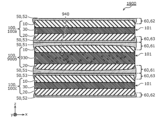
- FIG. 2A is a cross-sectional view of a battery according to a first modified example of the embodiment.
- FIG. 2B is a plan view of a battery according to a first modified example of the embodiment.
- FIG. 3A is a cross-sectional view of a battery according to a second modification of the embodiment.
- FIG. 3B is a plan view of a battery according to a second modification of the embodiment.
- FIG. 4A is a cross-sectional view of a battery according to a third modification of the embodiment.
- FIG. 4B is a plan view of a battery according to a third modification of the embodiment.
- FIG. 5A is a cross-sectional view of a battery according to a fourth modified example of the embodiment.
- FIG. 5A is a cross-sectional view of a battery according to a fourth modified example of the embodiment.
- FIG. 5B is a plan view of a battery according to a fourth modified example of the embodiment.
- FIG. 6A is a cross-sectional view of a battery according to a fifth modification of the embodiment.
- FIG. 6B is a plan view of a battery according to a fifth modification of the embodiment.
- FIG. 7A is a cross-sectional view of a battery according to a sixth modified example of the embodiment.
- FIG. 7B is a plan view of a battery according to a sixth modified example of the embodiment.
- FIG. 8A is a cross-sectional view of a battery according to a seventh modification of the embodiment.
- FIG. 8B is a plan view of a battery according to a seventh modification of the embodiment.
- FIG. 10A is a cross-sectional view of a battery according to a ninth modification of the embodiment.
- FIG. 10B is a plan view of a battery according to a ninth modification of the embodiment.
- FIG. 11A is a cross-sectional view of a battery according to a tenth modification of the embodiment.
- FIG. 11B is a plan view of the battery according to the tenth modification of the embodiment.
- the battery according to the first aspect of the present disclosure includes a plurality of unit cells, each having a pair of electrode layers with mutually different polarities and a solid electrolyte layer located between the pair of electrode layers, and a plurality of current collectors, and has a structure in which the plurality of unit cells and the plurality of current collectors are stacked, and the plurality of current collectors include a first current collector located between the plurality of unit cells and a second current collector located on a surface portion in the stacking direction in the structure in which the plurality of unit cells and the plurality of current collectors are stacked, and an end portion of the first current collector is thicker than a central portion of the first current collector, and at least a portion of the first current collector is thicker than the second current collector.
- the first covering portion which is integral with the first current collector, extends to cover the side surface of the first unit cell at the end of the first current collector, which further promotes heat dissipation from the center of the battery, resulting in a more reliable battery.
- the problem of peeling occurring at the interface between the current collector and the electrode layer due to repeated expansion and contraction of the electrode layer caused by charging and discharging, etc. can be suppressed by having the first covering portion bind the side surface of the first unit cell.
- the battery according to the second aspect further includes a second covering portion that is connected to an end of the second current collector, extends from the end along a side of a second unit cell among the plurality of unit cells that is adjacent to the second current collector, and covers a portion of the side of the second unit cell, and the second covering portion and the second current collector are integrally formed, and the length of the first covering portion in the extension direction may be greater than the length of the second covering portion in the extension direction.
- the first covering portion may cover a portion of the side surface of the electrode layer adjacent to the first current collector of the pair of electrode layers of the first unit cell.
- At least a portion of the first covering portion may be embedded in a side surface of the first unit cell.
- the first covering portion may not protrude beyond the side surface of the first unit cell.
- the first coating portion more firmly binds the end regions of the side surfaces of the first unit cells, which are prone to becoming the starting points for delamination due to repeated charge/discharge and thermal cycles, thereby suppressing delamination. This makes it possible to realize a highly reliable battery.
- the first covering portion covers a portion of the side surface of the first unit cell from one end to the other end of the side surface in a direction perpendicular to the stacking direction, and the length of the extension direction of the first covering portion may be greater in the center than in both ends in the direction perpendicular to the stacking direction.
- the first covering portion may cover a corner of the first unit cell, including an edge of a side surface of the first unit cell in a direction perpendicular to the stacking direction.
- the first coating portion more firmly binds the corners of the first unit cell, which are particularly susceptible to becoming the starting point of delamination due to repeated charge/discharge and thermal cycles, further suppressing delamination.
- the first coating portion protects the corners of the first unit cell, which are brittle and prone to crumbling, improving impact resistance. This makes it possible to realize a highly reliable battery.
- At least a portion of the first coating portion may have poorer crystallinity than the first current collector.
- the plastic deformability of the first coating portion increases due to reduced crystallinity caused by an increase in lattice defects such as dislocations, and the first coating portion can be closely bonded to the fine irregularities on the side surface of the first unit cell.
- This improves the heat dissipation from the first unit cell by increasing the bonding area between the first coating portion and the side surface of the first unit cell.
- the bonding between the first coating portion and the side surface of the first unit cell is also strong. This makes it possible to realize a highly reliable battery.
- the portion of the first coating part on the side surface of the first unit cell may have better crystallinity than the portion of the first coating part on the opposite side to the side surface of the first unit cell.
- the third coating portion isolated on the side surface of the unit cell can promote heat dissipation from the battery without affecting the battery characteristics. This makes it possible to realize a battery with even greater reliability.
- the third coating more firmly binds the corners of the unit cells, which are particularly prone to becoming the starting point for delamination of layers within the unit cells due to repeated charge/discharge and thermal cycles, further suppressing delamination.
- the third coating protects the corners of the unit cells, which are brittle and prone to crumbling, improving impact resistance. This makes it possible to achieve a highly reliable battery.
- the at least one third coating portion may be a plurality of third coating portions, and among the plurality of third coating portions, the third coating portion closer to the center of the battery in the stacking direction may have better crystallinity.
- the electrode layer of the pair of electrode layers of the plurality of unit cells adjacent to the first current collector may be thicker than the electrode layer of the pair of electrode layers of the plurality of unit cells adjacent to the second current collector.
- the electrode layer of the pair of electrode layers of the plurality of unit cells adjacent to the first current collector may contain more pores than the electrode layer of the pair of electrode layers of the plurality of unit cells adjacent to the second current collector.
- covering A means covering at least a part of “A” unless otherwise specified.
- “covering A” includes not only the case of “covering all of A” but also the case of “covering only a part of A.”
- “A” is, for example, a specified member such as a unit cell or layer, as well as the side and main surface of a specified member.
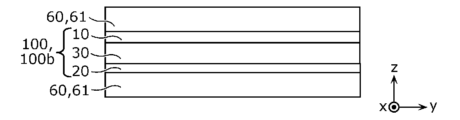
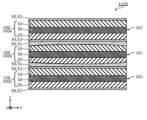
- FIG. 1A is a cross-sectional view of a battery 1000 according to this embodiment.
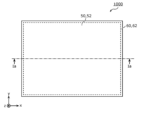
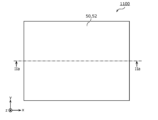
- Fig. 1B is a plan view of the battery 1000 according to this embodiment, as viewed from above in the z-axis direction.
- Fig. 1A shows a cross section at the position indicated by line Ia-Ia in Fig. 1B.
- Fig. 1B also shows the boundary between the current collector 50 and the covering portion 60 by a dashed line. The fact that the boundary between the current collector 50 and the covering portion 60 is shown by a dashed line is the same in other plan views described later.
- the battery 1000 includes a plurality of unit cells 100, a plurality of current collectors 50, and a plurality of coating portions 60.
- the battery 1000 has a structure in which a plurality of unit cells 100 and a plurality of current collectors 50 are stacked along the z-axis.
- the battery 1000 is, for example, an all-solid-state battery.
- the plurality of unit cells 100 included in the battery 1000 may be expressed as unit cell 100a, unit cell 100b, and unit cell 100c in the order of arrangement from the top.
- the unit cell 100b is an example of a first unit cell.
- the unit cell 100a and the unit cell 100c are each an example of a second unit cell.
- the unit cell 100a and the unit cell 100c are unit cells 100 located at both ends in the stacking direction. Additionally, unit cell 100b is a unit cell 100 located midway between unit cell 100a and unit cell 100c in the stacking direction.
- the shape of the battery 1000 in plan view is, for example, rectangular.
- the general shape of the battery 1000 is a flattened rectangular parallelepiped.
- flat means that the thickness (i.e., the length in the z-axis direction) is shorter than the length of each side of the main surface (i.e., the length in each of the x-axis direction and y-axis direction) or the maximum width.
- the shape of the battery 1000 in plan view may be other polygonal shapes such as a square, hexagonal, or octagonal shape, or may be a circular or elliptical shape.
- the thickness of each layer is exaggerated to make the layer structure of the battery 1000 easier to understand. The same applies to each modified example in that the thickness of each layer is exaggerated.
- the unit cell 100 is the minimum component of the power generation section of a battery, and constitutes a single cell.
- a unit cell 100 and a current collector 50 stacked on the unit cell 100 may be referred to as a unit cell.
- a plurality of unit cells 100 are stacked together with a plurality of current collectors 50 so that they are electrically connected in series.
- a plurality of unit cells 100 may be stacked so that they are electrically connected in parallel, or may be stacked so that series and parallel connections are mixed.
- the battery 1000 has three unit cells 100, but this is not limited to this number.
- the number of unit cells 100 in the battery 1000 is not particularly limited as long as it is two or more, and is designed to be the number that results in the desired voltage or capacity.
- the unit cell 100 adjacent to the inner layer current collector 51 described below and the unit cell 100 adjacent to the surface layer current collector 52 may be the same unit cell 100.
- Two adjacent unit cells 100 among the multiple unit cells 100 are stacked via one or more current collectors 50 among the multiple current collectors 50.
- two adjacent unit cells 100 are stacked via two current collectors 50.
- each of the multiple unit cells 100 is sandwiched between two adjacent current collectors 50 among the multiple current collectors 50.
- Each of the multiple current collectors 50 is a current collector layer that is stacked on the upper or lower surface of one of the multiple unit cells 100 and has the same shape as the upper or lower surface in a planar view.
- the multiple unit cells 100 are substantially the same in shape and size, and their respective contours match. Also, for example, in a plan view, the multiple unit cells 100 and the multiple current collectors 50 are substantially the same in shape and size, and their respective contours match.
- Each of the unit cells 100 has a first electrode layer 10 and a second electrode layer 20, which are a pair of electrode layers having different polarities, and a solid electrolyte layer 30 located between the first electrode layer 10 and the second electrode layer 20.
- the first electrode layer 10 and the second electrode layer 20 are each an active material layer containing an active material.
- the first electrode layer 10, the solid electrolyte layer 30, and the second electrode layer 20 are stacked in this order along the z-axis.
- the first electrode layer 10 is one of the positive electrode layer and the negative electrode layer of the unit cell 100.
- the second electrode layer 20 is the other of the positive electrode layer and the negative electrode layer of the unit cell 100. In the following, an example will be described in which the first electrode layer 10 is the positive electrode layer and the second electrode layer 20 is the negative electrode layer.
- the configuration of the multiple unit cells 100 is substantially the same.
- the multiple unit cells 100 are stacked side by side along the z-axis so that the order of the layers constituting the unit cells 100 is the same.
- the multiple unit cells 100 are stacked so that they are electrically connected in series.
- the order of the layers constituting the unit cells 100 is reversed between two adjacent unit cells 100.
- the multiple unit cells 100 are stacked side by side along the z-axis while the order of the layers constituting the unit cells 100 is alternated.
- the first electrode layer 10 is laminated on the adjacent current collector 50 and is in contact with the main surface of the current collector 50. In this embodiment, the first electrode layer 10 covers the entire main surface of the current collector 50. In this embodiment, the first electrode layer 10 is a positive electrode layer and therefore contains at least a positive electrode active material. In other words, the first electrode layer 10 is a positive electrode active material layer that is mainly composed of a positive electrode material such as a positive electrode active material. The positive electrode active material layer is formed, for example, from a powdered material.
- the positive electrode active material layer contains at least a positive electrode active material.
- the positive electrode active material layer is a layer mainly composed of positive electrode materials such as a positive electrode active material.
- the positive electrode active material is a material in which metal ions such as lithium (Li) or magnesium (Mg) are inserted or removed from the crystal structure at a potential higher than that of the negative electrode, and oxidation or reduction occurs accordingly.
- the type of positive electrode active material can be appropriately selected depending on the type of battery 1000, and known positive electrode active materials can be used.
- the positive electrode active material may be a compound containing lithium and a transition metal element, such as an oxide containing lithium and a transition metal element, or a phosphate compound containing lithium and a transition metal element.
- the oxide containing lithium and a transition metal element include lithium nickel composite oxides such as LiNi x M 1-x O 2 (wherein M is at least one element selected from Co, Al, Mn, V, Cr, Mg, Ca, Ti, Zr, Nb, Mo, and W, and x is 0 ⁇ x ⁇ 1), lithium cobalt oxide (LiCoO 2 ), lithium nickel oxide (LiNiO 2 ), and lithium manganate (LiMn 2 O 4 ), as well as lithium manganate having a spinel structure (LiMn 2 O 4 , Li 2 MnO 3 , LiMO 2 ).
- LiNi x M 1-x O 2 wherein M is at least one element selected from Co, Al, Mn, V, Cr, Mg, Ca, Ti, Zr, Nb
- the phosphate compound containing lithium and a transition metal element for example, lithium iron phosphate (LiFePO 4 ) having an olivine structure is used.
- sulfides such as sulfur (S) and lithium sulfide (Li 2 S) can also be used as the positive electrode active material, and in this case, the positive electrode active material particles can be coated with or added with lithium niobate (LiNbO 3 ) or the like and used as the positive electrode active material. Note that only one of these materials may be used as the positive electrode active material, or two or more of these materials may be used in combination.
- the positive electrode active material layer only needs to contain at least a positive electrode active material.
- the positive electrode active material layer may be a mixture layer composed of a mixture of a positive electrode active material and other additive materials.
- the additive materials include solid electrolytes such as inorganic solid electrolytes or sulfide solid electrolytes, conductive assistants such as acetylene black, and binding binders such as polyethylene oxide or polyvinylidene fluoride.
- the thickness of the positive electrode active material layer is, for example, 5 ⁇ m or more and 300 ⁇ m or less, but is not limited to this.
- the second electrode layer 20 is laminated on the adjacent current collector 50 and is in contact with the main surface of the current collector 50.
- the second electrode layer 20 is disposed opposite the first electrode layer 10 with the solid electrolyte layer 30 sandwiched therebetween.
- the second electrode layer 20 covers the entire main surface of the current collector 50.
- the second electrode layer 20 is a negative electrode active material layer, and therefore contains at least a negative electrode active material.
- the second electrode layer 20 is a negative electrode active material layer that is mainly composed of a negative electrode material such as a negative electrode active material.
- the negative electrode active material layer is formed, for example, from a powdered material.
- the negative electrode active material is a material in which metal ions such as lithium (Li) ions or magnesium (Mg) ions are inserted or removed from the crystal structure at a lower potential than the positive electrode, and oxidation or reduction occurs accordingly.
- the type of negative electrode active material can be appropriately selected depending on the type of battery 1000, and known negative electrode active materials can be used.
- the negative electrode active material for example, carbon materials such as natural graphite, artificial graphite, graphite carbon fiber, or resin-sintered carbon, or alloy-based materials mixed with a solid electrolyte, etc.
- the alloy-based material for example, lithium alloys such as LiAl, LiZn, Li 3 Bi, Li 3 Cd, Li 3 Sb, Li 4 Si, Li 4.4 Pb, Li 4.4 Sn, Li 0.17 C, LiC 6 , oxides of lithium and transition metal elements such as lithium titanate (Li 4 Ti 5 O 12 ), zinc oxide (ZnO), or metal oxides such as silicon oxide (SiO x ) can be used.
- lithium alloys such as LiAl, LiZn, Li 3 Bi, Li 3 Cd, Li 3 Sb, Li 4 Si, Li 4.4 Pb, Li 4.4 Sn, Li 0.17 C, LiC 6 , oxides of lithium and transition metal elements such as lithium titanate (Li 4 Ti 5 O 12 ), zinc oxide (ZnO), or metal oxide
- the negative electrode active material layer only needs to contain at least the negative electrode active material.
- the negative electrode active material layer may be a mixture layer composed of a mixture of the negative electrode active material and other additive materials.
- the other additive materials include solid electrolytes such as inorganic solid electrolytes or sulfide solid electrolytes, conductive assistants such as acetylene black, and binding binders such as polyethylene oxide or polyvinylidene fluoride.
- the thickness of the negative electrode active material layer is, for example, 5 ⁇ m or more and 300 ⁇ m or less, but is not limited to this.
- the solid electrolyte layer 30 is disposed between the first electrode layer 10 and the second electrode layer 20, and is in contact with the first electrode layer 10 and the second electrode layer 20.
- the solid electrolyte layer 30 includes at least a solid electrolyte.
- the solid electrolyte may be any known solid electrolyte for batteries that has ion conductivity.
- a solid electrolyte that conducts metal ions such as lithium ions or magnesium ions may be used as the solid electrolyte.
- the type of solid electrolyte may be appropriately selected depending on the type of ions to be conducted.
- an inorganic solid electrolyte such as a sulfide-based solid electrolyte or an oxide-based solid electrolyte
- a lithium-containing sulfide such as Li 2 S-P 2 S 5 system, Li 2 S-SiS 2 system, Li 2 S-B 2 S 3 system, Li 2 S-GeS 2 system, Li 2 S-SiS 2 -LiI system, Li 2 S-SiS 2 -Li 3 PO 4 system, Li 2 S-Ge 2 S 2 system, Li 2 S-GeS 2 -P 2 S 5 system, or Li 2 S-GeS 2 -ZnS system can be used.
- the oxide-based solid electrolyte for example, a lithium-containing metal oxide such as Li 2 O—SiO 2 or Li 2 O—SiO 2 -P 2 O 5 , a lithium-containing metal nitride such as Li x P y O 1-z N z , lithium phosphate (Li 3 PO 4 ), or a lithium-containing transition metal oxide such as lithium titanium oxide can be used.
- a lithium-containing metal oxide such as Li 2 O—SiO 2 or Li 2 O—SiO 2 -P 2 O 5
- a lithium-containing metal nitride such as Li x P y O 1-z N z
- lithium phosphate (Li 3 PO 4 ) lithium phosphate
- the solid electrolyte layer 30 includes, as an example, a solid electrolyte having lithium ion conductivity.
- the solid electrolyte layer 30 may contain, in addition to the solid electrolyte, a bonding binder such as polyethylene oxide or polyvinylidene fluoride.
- the thickness of the solid electrolyte layer 30 is, for example, 5 ⁇ m or more and 500 ⁇ m or less, but is not limited to this.
- the solid electrolyte layer 30 may be configured as an aggregate of solid electrolyte particles.
- the solid electrolyte layer 30 may also be configured as a sintered structure of the solid electrolyte.
- the first electrode layer 10, the solid electrolyte layer 30, and the second electrode layer 20 are substantially the same in shape and size, and their respective contours match.
- the first electrode layer 10 may be a negative electrode layer, and the second electrode layer 20 may be a positive electrode layer.
- Each of the multiple current collectors 50 may be formed of a material having electrical conductivity such as a metal, and is not particularly limited. Each of the multiple current collectors 50 includes, for example, a metal. Each current collector 50 is, for example, a foil or plate made of stainless steel, nickel (Ni), aluminum (Al), iron (Fe), titanium (Ti), copper (Cu), palladium (Pd), gold (Au), platinum (Pt), or an alloy of two or more of these. One current collector 50 is, for example, made of one metal foil.
- each current collector 50 may be appropriately selected in consideration of the fact that it does not melt or decompose during the manufacturing process, the temperature at which it is used, or the pressure at which it is used, and the operating potential and electrical conductivity of the battery applied to each current collector 50. In addition, the material of each current collector 50 may also be selected according to the required tensile strength or heat resistance. Each current collector 50 may be a high-strength electrolytic copper foil or a clad material obtained by laminating different metal foils and then performing bonding and heat treatment to form a single metal foil.
- the multiple current collectors 50 may include current collectors 50 made of different materials. For example, the current collector 50 adjacent to the first electrode layer 10 and the current collector 50 adjacent to the second electrode layer 20 may be made of different materials.
- the surface of the current collector 50 may be processed to have an uneven rough surface in order to improve adhesion with the electrode layer.
- the surface of the current collector 50 may be coated with an adhesive component such as an organic binder having electrical conductivity. This strengthens the bonding at the interface between the current collector 50 and other layers, and improves the mechanical and thermal reliability of the battery 1000, as well as the charge/discharge cycle characteristics.
- the multiple current collectors 50 include inner layer current collectors 51, 53 located between the multiple unit cells 100, and a surface layer current collector 52 located on the surface portion (in other words, the end portion) in the stacking direction in a structure in which the multiple unit cells 100 and the multiple current collectors 50 are stacked.
- the multiple current collectors 50 included in the battery 1000 may be expressed by distinguishing between the inner layer current collector 51, the surface layer current collector 52, and the inner layer current collector 53.
- the inner layer current collector 51 is an example of a first current collector.
- the surface layer current collector 52 is an example of a second current collector.
- the surface current collector 52 is disposed above the unit cell 100a that is located at the top of the multiple unit cells 100, and below the unit cell 100c that is located at the bottom of the multiple unit cells 100. In other words, the surface current collector 52 is disposed at both ends of the battery 1000 in the stacking direction.
- the surface current collector 52 has, for example, a uniform thickness.
- the thickness of the surface current collector 52 is, for example, 10 ⁇ m or more and 100 ⁇ m or less.
- an inner layer current collector 51 and an inner layer current collector 53 are disposed between adjacent unit cells 100. More specifically, an inner layer current collector 51 and an inner layer current collector 53 are disposed between unit cell 100a and unit cell 100b, and between unit cell 100b and unit cell 100c, respectively. The inner layer current collector 51 is in contact with unit cell 100b. The inner layer current collector 53 is in contact with unit cell 100a or unit cell 100c. Adjacent inner layer current collectors 51 and 53 are bonded together, for example, by a conductive resin (not shown). Adjacent inner layer current collectors 51 and 53 may simply be in contact with each other.
- the ends of the inner current collector 51 are thicker than the center of the inner current collector 51. More specifically, all ends of the inner current collector 51 in the x-axis and y-axis directions perpendicular to the stacking direction (i.e., the outlines of the inner current collector 51 in a plan view) are thicker than the center of the inner current collector 51.
- the inner current collector 51 is thicker from the center to the ends.
- the thickness of the ends of the inner current collector 51 is, for example, 101% to 120% of the thickness of the center of the inner current collector 51.
- the ends of the inner current collector 51 By making the ends of the inner current collector 51 thicker than the center of the inner current collector 51, the ends, which are the heat dissipation parts of the inner current collector 51 that dissipate heat to the outside, become larger, and heat dissipation from the battery 1000 is promoted. Note that the ends of the inner current collector 51 may be thicker than the center only in some directions perpendicular to the stacking direction.
- the inner layer collector 51 which is thicker at the ends than at the center, can be formed, for example, by pressure processing using a mold that corresponds to the shape of the inner layer collector 51.
- the method for forming the inner layer collector 51 is not particularly limited, and the inner layer collector 51 may be formed, for example, by applying stress to a metal foil or plating using a method other than pressure processing using the above-mentioned mold.
- At least a portion of the inner current collector 51 is thicker than the surface current collector 52.
- the average thickness of the inner current collector 51 is, for example, greater than the average thickness of the surface current collector 52. In the example shown, the inner current collector 51 is entirely thicker than the surface current collector 52. This promotes heat dissipation from the portion close to the center of the battery 1000 (e.g., unit cell 100b) where the operating temperature is high and the characteristics are prone to deterioration, thereby improving the reliability of the battery 1000.
- the average thickness of the inner current collector 51 is, for example, 110% to 120% of the average thickness of the surface current collector 52.
- the inner layer current collector 53 has, for example, the same thickness characteristics as the surface layer current collector 52.
- the multiple current collectors 50 may include an inner layer current collector 51 instead of the inner layer current collector 53. Also, it is sufficient that the multiple current collectors 50 include at least one inner layer current collector 51.
- At least a portion of the inner current collectors 51 and 53 has better crystallinity than the surface current collector 52, for example. More than half of the inner current collectors 51 and 53 may have better crystallinity than the surface current collector 52, or the entire inner current collectors 51 and 53 may have better crystallinity than the surface current collector 52. This further increases the thermal conductivity of the inner current collectors 51 and 53, thereby further improving heat dissipation. This is because the thermal resistance and electrical resistance are small when the metal has good crystallinity and few defects.
- the crystallinity of the current collector 50 and the covering portion 60 described later refers to the crystallinity of the metal contained in the current collector 50 and the covering portion 60.
- good or bad crystallinity means that the crystallinity is good or bad compared to any part of the comparison target.
- any part of the comparison target means substantially all parts of the comparison target, and does not include a part in which the crystallinity is locally different from other parts in a minute region of 3% or less of the comparison target.
- Such crystallinity of the metal contained in the current collector 50 can be evaluated by observing a crystal lattice image using a TEM (Transmission Electron Microscope) image or the like.
- the crystallinity of the metal contained in the current collector 50 can also be comparatively evaluated from the broadening state of the diffraction peak in micro-area XRD (X-Ray Diffraction). In this case, the crystallinity is lower in areas where broader diffraction peaks are detected. Also, since the lower the crystallinity, the softer the material is, so that the crystallinity can be comparatively evaluated in a pseudo manner by comparatively evaluating the softness using, for example, a micro Vickers.
- the crystallinity of the current collector 50 can be improved, for example, by heat treatment.
- the crystallinity can be improved by subjecting the current collector 50 to heat treatment in a non-oxidizing atmosphere such as nitrogen at a temperature not higher than 150°C and not higher than 350°C, which is equal to or lower than half the melting point of the metal material.
- the crystallinity can be selectively controlled in some regions of the current collector 50, such as only the center or only the ends of the current collector 50.
- Each of the multiple covering portions 60 is a covering layer that covers the side surface 101 of the unit cell 100.
- the side surface 101 is a surface that connects the upper surface and the lower surface, which are two main surfaces of the unit cell 100.
- the unit cell 100 has four flat side surfaces 101 as side surfaces.
- Each of the multiple covering portions 60 is connected to an end of one of the multiple current collectors 50, and extends from the end of the current collector 50 along the side surface 101 of the unit cell 100 adjacent to the current collector 50, thereby covering a part of the side surface 101 of the unit cell 100. In the example shown in FIG. 1A, each covering portion 60 extends along the z-axis direction.
- the current collector 50 and the covering portion 60 connected to the current collector 50 are formed integrally, and the current collector 50 and the covering portion 60 connected to the current collector 50 are made of the same continuous material, for example, the same metal conductor. That is, each covering portion 60 is made of the material exemplified above as the material of the current collector 50. In the battery 1000, a covering portion 60 is formed on each of all of the multiple current collectors 50.
- the covering portion 60 By covering the side surface 101 of the unit cell 100 with the covering portion 60, the covering portion 60, which has better thermal conductivity than the unit cell 100, covers the side surface 101 of the unit cell 100, promoting heat dissipation of the unit cell 100 and improving the reliability of the battery 1000.
- heat generated inside the unit cell 100 is conducted to the covering portion 60, which covers the side surface 101 of the unit cell 100 (specifically, the side surface of the first electrode layer 10 or the second electrode layer 20) and is exposed, via the current collector 50, which has good thermal conductivity.
- this heat is dissipated to the outside of the battery 1000 from the covering portion 60, which has better thermal conductivity than the first electrode layer 10 or the second electrode layer 20, which are mainly made of oxides, etc. Therefore, compared to a case where the side surface of the first electrode layer 10 or the second electrode layer 20 is not covered by the covering portion 60, the heat dissipation of the battery 1000 can be promoted and the reliability of the battery 1000 can be improved.
- the covering portion 60 extending from the current collector 50 laminated on the unit cell 100 covers the side surface 101 of the unit cell 100, so that the interface between the current collector 50 and the unit cell 100 is covered from the side by the covering portion 60, resulting in a configuration in which the current collector 50 and the unit cell 100 (specifically, the first electrode layer 10 or the second electrode layer 20) are bound together. This makes it possible to suppress interlayer delamination between the current collector 50 and the unit cell 100 at the interface between the current collector 50 and the unit cell 100, where delamination is likely to occur.
- Each covering portion 60 covers a part of the side surface 101 from one end to the other end of the side surface 101 in a direction perpendicular to the stacking direction in a plan view of the side surface 101.
- Each covering portion 60 is formed so as to connect to the ends of all the current collectors 50 in the x-axis direction and the y-axis direction perpendicular to the stacking direction (i.e., the outlines of the current collectors 50 in a plan view), and covers the entire circumference of the side surface of the unit cell 100 in a plan view.
- FIG. 1B only the top covering portion 60 (the surface covering portion 62 described later) is shown, but the other covering portions 60 are also formed at the same position as the top covering portion 60 in a plan view.
- the covering portion 60 may cover a part of the entire circumference of the side surface of the unit cell 100 in a plan view.
- the covering portion 60 is formed so as to have a symmetrical shape with the unit cell 100 in between in a plan view, for example.
- Each covering portion 60 covers, for example, a corner of the unit cell 100.
- the corner of the unit cell 100 is, for example, a portion including the edge of the side surface 101 of the unit cell 100 in a direction perpendicular to the stacking direction in a plan view of the side surface 101 of the unit cell 100, and may be said to be a ridge portion of the unit cell 100 connecting the upper and lower surfaces of the unit cell 100.
- the covering portion 60 binds the corners of the unit cell 100, which are likely to become the starting point of delamination due to repeated charging and discharging and cooling and heating cycles, and delamination can be suppressed.
- the covering portion 60 protects the corners of the unit cell 100, which are fragile and easily crumbled, thereby improving impact resistance.
- Each covering portion 60 covers, for example, a portion of the side surface of the first electrode layer 10 or a portion of the side surface of the second electrode layer 20 adjacent to the current collector 50 to which the covering portion 60 is connected.
- the area of the covering portion 60 covering the electrode layer that generates more heat out of the first electrode layer 10 and the second electrode layer 20 may be larger than the area of the covering portion 60 covering the electrode layer that generates less heat out of the first electrode layer 10 and the second electrode layer 20. This can further suppress heat generation in the battery 1000.
- the thickness of the covering portion 60 becomes thinner toward the tip of the extending direction of the covering portion 60, that is, the further away from the current collector 50.
- the extending direction of the covering portion 60 coincides with the stacking direction.
- the thickness of the covering portion 60 may be constant.
- the thickness direction of the covering portion 60 is perpendicular to the side surface 101.
- Each of the multiple covering parts 60 is in contact with the side surface 101 of the unit cell 100.
- Each of the multiple covering parts 60 is in close contact with the side surface of the first electrode layer 10 or the side surface of the second electrode layer 20, which is formed of, for example, a powder-like material, and penetrates into the fine irregularities of the side surface. Note that the irregularities are fine and are not shown in the figure.
- the degree of penetration of the covering parts 60 is, for example, 0.1 ⁇ m or more and 1.0 ⁇ m or less. This corresponds to the surface roughness (Rz) of the side surface of the first electrode layer 10 or the side surface of the second electrode layer 20.
- the crystallinity of the metal contained in the covering part 60 it is preferable to reduce the crystallinity of the metal contained in the covering part 60 and increase its deformability (i.e., to make it soft).
- the application of external stress such as deformation causes lattice defects such as dislocation and disturbances in the lattice arrangement, resulting in a decrease in crystallinity.
- the application of external stress such as deformation increases the number of interface defects between crystal grains, which increases the metal's plastic deformability.
- the method for forming the covering portion 60 is not particularly limited, and various metal processing methods can be used.
- Each covering portion 60 is formed, for example, by making the current collector 50 protrude beyond the side surface 101, and applying pressure to the protruding portion of the current collector 50 so as not to destroy the unit cell 100, while brushing or polishing (or rubbing).
- the crystallinity of the covering portion 60 is reduced from the surface side opposite the side surface 101, and the covering portion 60 is formed by deformation, and the covering portion 60 is adhered to the side surface 101.
- brushing for example, a nylon or polyester brush with a wire diameter of ⁇ 30 ⁇ m or more and 200 ⁇ m or less is used.
- polishing for example, sandpaper of #1500 to #3000 is used.
- selective processing can be performed by masking the areas not to be brushed or polished using a film or metal mask.
- the multiple covering portions 60 may include a covering portion 60 at least a portion of which is embedded in the side surface 101 of the unit cell 100.
- at least a portion of the inner layer covering portion 61 described below may be embedded in the side surface 101 of the unit cell 100. This improves the bond between the covering portion 60 and the side surface 101, and further prevents the current collector 50 and the unit cell 100 from peeling off.
- the portion of each coating portion 60 on the side 101 of the unit cell 100 has better crystallinity than the portion of the coating portion 60 opposite the side 101, which is the exposed portion of the coating portion 60. This reduces the thermal resistance of the portion of the coating portion 60 on the side of the unit cell 100, improving the heat dissipation of the battery 1000.
- the crystallinity of the metal contained in the coating portion 60 can be evaluated in the same manner as the evaluation of the crystallinity of the metal contained in the current collector 50 described above.
- the defect structure of the interface between crystal particles fine peeling at the interface
- each covering portion 60 has poorer crystallinity than the current collector 50 connected to that covering portion 60.
- the poor crystallinity of the portion of the covering portion 60 covering the side surface 101 makes that portion soft, improving adhesion between the side surface 101 and the covering portion 60.
- more than half of each covering portion 60 may have poorer crystallinity than the current collector 50 connected to that covering portion 60.
- the tip of each coated portion 60 in the extension direction has poorer crystallinity than the portion of the coated portion 60 that is connected to the current collector 50. This makes the tip of the coated portion 60, which is likely to be the starting point for peeling of the coated portion 60 from the side surface 101, soften, increasing the bonding strength between the tip and the side surface 101 and suppressing peeling of the coated portion 60.
- the multiple coating portions 60 include an inner layer coating portion 61 connected to the inner layer current collector 51, an inner layer coating portion 63 connected to the inner layer current collector 53, and a surface layer coating portion 62 connected to the surface layer current collector 52.
- the inner layer coating portion 61 is an example of a first coating portion.
- the surface layer coating portion 62 is an example of a second coating portion.
- the inner layer coating portion 61 and the inner layer current collector 51 are integrally formed.
- the inner layer coating portion 63 and the inner layer current collector 53 are integrally formed.
- the surface layer coating portion 62 and the surface layer current collector 52 are integrally formed.
- the inner layer coating portion 61 connected to the inner layer current collector 51 and the inner layer coating portion 63 connected to the inner layer current collector 53, which are adjacent to each other, may be integrated by pressure, heat, etc. generated during processing.
- the length in the extension direction of the inner layer coating portion 61 (the distance between the dashed lines shown in FIG. 1A) is, for example, greater than the length in the extension direction of the surface layer coating portion 62. As described below, when the length in the extension direction of the coating portion 60 is not constant, this length is the average length. This increases the amount of coating of the inner layer coating portion 61 connected to the inner layer current collector 51, and can further promote the dissipation of heat inside the battery 1000. Similarly, the length in the extension direction of the inner layer coating portion 63 may be greater than the length in the extension direction of the surface layer coating portion 62.
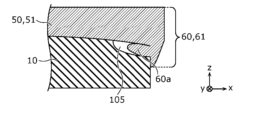
- FIG. 1F is an enlarged cross-sectional view for explaining a state in which a gap 105 is formed between the unit cell 100 and the current collector 50.
- FIG. 1F shows a state in which a gap 105 is formed at the end between the inner layer current collector 51 and the unit cell 100 (specifically, the first electrode layer 10), and the inner layer covering portion 61 covers the gap 105.
- FIG. 1F shows a representative case in which the inner layer covering portion 61 covers the gap 105, but the surface layer covering portion 62 and the inner layer covering portion 63 may also cover the gap 105 in the same way as the inner layer covering portion 61.
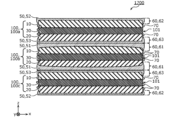
- the side surfaces (end faces) of the multiple current collectors 50 are exposed, and each side surface of the multiple current collectors 50 is flush with each side surface 101 of each of the multiple unit cells 100, forming a flat side surface of the battery 1100. Therefore, when forming additional layers on the side surfaces of the battery 1100, such as when protecting the side surfaces of the battery 1100 from dust, gas, moisture, etc. with insulating resin, etc., it is easy to form the shape and thickness with high precision (for example, by coating or printing, etc.).
- FIG. 4A is a cross-sectional view of the battery 1300 according to this modified example.
- FIG. 4B is a plan view of the battery 1300 according to this modified example, seen from above in the z-axis direction.
- FIG. 4A shows a cross section taken at the position indicated by line IVa-IVa in FIG. 4B.
- each covering portion 60 is formed to cover an area including an end portion in a direction perpendicular to the stacking direction of the side surface 101 in a plan view of the side surface 101, and is not formed in an area including a center portion in a direction perpendicular to the stacking direction of the side surface 101.
- Each covering portion 60 also covers the corners (ridge portions) of the unit cells 100. This allows the covering portion 60 to bind the corners of the unit cells 100, which are likely to be the starting point of delamination, and therefore prevents delamination at the corners of the unit cells 100, which are likely to occur during charge/discharge cycles and thermal cycles. Furthermore, impact resistance is improved by the covering portion 60 protecting the corners of the unit cells 100, which are fragile and easily crumbled. This increases the reliability of the battery 1300.
- FIG. 5A is a cross-sectional view of battery 1400 according to this modified example.
- FIG. 5B is a plan view of battery 1400 according to this modified example, seen from above in the z-axis direction.
- FIG. 5A shows a cross section taken at the position indicated by line Va-Va in FIG. 5B.
- the multiple current collectors 50 do not include the inner layer current collector 53, but only the inner layer current collector 51 and the surface layer current collector 52, out of the inner layer current collector 51, inner layer current collector 53, and surface layer current collector 52 in the battery 1000. Therefore, in the battery 1400, out of the inner layer current collectors 51 and inner layer current collectors 53 in the battery 1000, the inner layer current collector 53 is not arranged between adjacent unit cells 100, and only the inner layer current collector 51 is arranged. Even in this configuration, since the inner layer current collector 51 is arranged between the unit cells 100, heat dissipation from the center of the battery 1400 is promoted, and the reliability of the battery 1400 can be improved.
- the multiple coating portions 60 include an inner layer coating portion 461 connected to the inner layer current collector 51, and a surface layer coating portion 62 connected to the surface layer current collector 52.
- the inner layer coating portion 461 is an example of a first coating portion.
- the inner layer coating portion 461 and the inner layer current collector 51 are integrally formed.
- the inner layer covering portion 461 covers the side surfaces 101 of the unit cells 100a and 100b adjacent to the inner layer current collector 51, or the side surfaces 101 of the unit cells 100b and 100c. In other words, the inner layer covering portion 461 extends in both the vertical direction along the side surfaces 101 of the two unit cells 100 that sandwich the inner layer current collector 51 from above and below, covering a portion of each of the two side surfaces 101.
- FIG. 6A is a cross-sectional view of battery 1500 according to this modified example.
- FIG. 6B is a plan view of battery 1500 according to this modified example, seen from above in the z-axis direction.
- FIG. 6A shows a cross-section at the position indicated by line VIa-VIa in FIG. 6B.
- the battery 1500 of this modified example differs from the battery 1000 of the embodiment in that the multiple coating portions 60 do not include a surface coating portion 62.
- the multiple coating parts 60 do not include the surface layer coating part 62, but only the inner layer coating part 61 and the inner layer coating part 63, out of the inner layer coating part 61, the inner layer coating part 63, and the surface layer coating part 62 in the battery 1000. Even with this configuration, the inner layer coating part 61 and the inner layer coating part 63 can promote the dissipation of heat from the center of the battery 1500, which is prone to becoming hot. Furthermore, even if the thickness of each layer of the unit cell 100 is thin, it is possible to suppress an increase in the risk of short circuits and obtain the effect of improving heat dissipation.
- the side (end face) of the surface current collector 52 is exposed, and the side of the surface current collector 52 is flush with the side of the unit cell 100 adjacent to the surface current collector 52.
- the battery 1600 of this modified example differs from the battery 1000 of the embodiment in that the multiple covering portions 60 are formed to be completely embedded in the side surface 101.
- FIG. 8A is a cross-sectional view of the battery 1700 according to this modified example.
- FIG. 8B is a plan view of the battery 1700 according to this embodiment, as viewed from above in the z-axis direction.
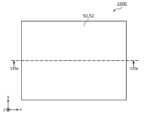
- FIG. 8A shows a cross section at the position indicated by line VIIIa-VIIIa in FIG. 8B.
- FIG. 8C is a diagram showing an example of the arrangement of the multiple covering portions 70 according to this modified example in a plan view.
- illustrations other than the unit cell 100 and the multiple covering portions 70 are omitted.
- the multiple covering portions 70 are given the same pattern as the cross-section shown in FIG. 8A.
- the multiple covering parts 70 are conductive members that cover the side surfaces 101 of the multiple unit cells 100.
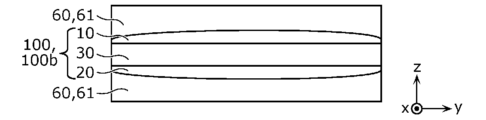
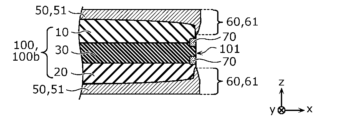
- the multiple covering parts 70 are not in contact with anything other than the side surfaces 101, and are isolated on the side surfaces 101. In other words, the multiple covering parts 70 are not in contact with each other, and each of the multiple covering parts 70 is not in contact with the multiple current collectors 50 and the multiple covering parts 60, so that each covering part 70 is not electrically connected to other conductive members on the side surfaces 101.
- the multiple covering parts 70 only need to cover the side surface 101 of at least one unit cell 100 among the multiple unit cells 100, and may cover the side surface 101 of only unit cell 100b among the multiple unit cells 100, for example.
- the number of covering parts 70 provided in the battery 1700 may be one.
- the covering portions 70 are isolated on the side surface 101, and therefore the heat dissipation of the battery 1700 at the side surface 101 can be improved without affecting the battery characteristics. This promotes heat dissipation from the battery 1700, and improves the reliability of the battery 1700.
- the multiple covering portions 70 may also include covering portions 70 at least partially embedded in the side surfaces 101 of the unit cells 100. This improves the bonding between the covering portions 70 and the side surfaces 101, and improves the thermal shock resistance and bending resistance of the covering portions 70.
- the multiple covering portions 70 may also include covering portions 70 that are completely embedded in the side surface 101.
- FIG. 8D is a partial cross-sectional view illustrating a covering portion 70 that is completely embedded in the side surface 101.
- FIG. 8D shows a cross-section near the side surface 101 of unit cell 100b.
- the covering portion 70 that covers the side surface 101 of unit cell 100b is described as a representative example, but a similar description can also be applied to the covering portions 70 that cover the side surfaces 101 of the other unit cells 100a, 100c.
- the multiple covering portions 70 may include covering portions 70 that are completely embedded in the side surface 101 and do not protrude beyond the side surface 101. Also, all covering portions 70 provided in the battery 1700 may be the covering portions 70 shown in FIG. 8D. In this way, by embedding the covering portions 70 in the side surface 101 so as not to protrude beyond the side surface 101, the bond between the covering portions 70 and the side surface 101 is improved, and the thermal shock resistance and bending resistance of the covering portions 60 are improved. For example, by pressing the covering portions 70 against the side surface 101, the covering portions 70 do not protrude beyond the side surface 101.
- the exposed surface of the covering portion 70 embedded in the side surface 101 that is not in contact with the side surface 101 and the portion of the side surface 101 that is not in contact with the covering portion 70 are flush with each other.
- the end of the unit cell 100 is a flat surface. This makes it easier to form the shape and thickness with high precision (e.g., by coating or printing) when forming an additional layer on the side surface 101, such as when protecting the side surface 101 from dust, gas, moisture, etc. with an insulating resin.
- the portion of the covering portion 70 on the side surface 101 of the unit cell 100 may have better crystallinity than the portion of the covering portion 70 opposite the side surface 101, which is the exposed portion of the covering portion 70. This reduces the thermal resistance of the portion of the covering portion 70 on the side of the unit cell 100, improving the heat dissipation of the battery 1700.
- the crystallinity of the metal contained in the covering portion 70 can be adjusted and evaluated in the same manner as the adjustment and evaluation of the crystallinity of the metal contained in the current collector 50 and covering portion 60 described above.
- the coating portions 70 closer to the center of the battery 1700 in the stacking direction may have better crystallinity. This can further promote the dissipation of heat from the center of the battery 1700, which is prone to becoming hot.
- the multiple coating portions 70 are formed by, for example, applying a conductive resin using a dispenser or screen printing, or by metallizing (metal spraying) a metal through a metal mask, so that the multiple coating portions 70 are applied to the side surface 101 in a predetermined shape, such as a circle, ellipse, or rectangle.
- the formed coating portion 70 may also be subjected to brushing, polishing, or rubbing in the same manner as the coating portion 60.
- the multiple coating portions 70 may also be formed by separating a portion of the coating portion 60 from the coating portion 60 and attaching it to the side surface 101 when the coating portion 60 is formed.
- each covering portion 70 is, for example, smaller than the area of each covering portion 60. Also, the length of each covering portion 70 in the stacking direction is smaller than the thickness of the solid electrolyte layer 30.
- the multiple covering portions 70 may include covering portions 70 of different sizes.
- Figures 8E and 8F are partial cross-sectional views for explaining the size of the covering portion 70.
- Figures 8E and 8F show a cross-section near the side surface 101 of unit cell 100b.
- the covering portion 70 covering the side surface 101 of unit cell 100b is explained as a representative example, but a similar explanation can be applied to the covering portions 70 covering the side surfaces 101 of the other unit cells 100a, 100c.
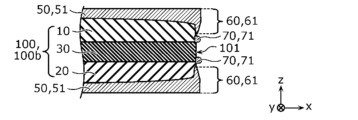
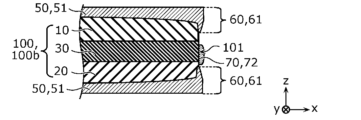
- the multiple covering portions 70 may include covering portions 71 and 72 that have different amounts of coverage of the side surface 101.
- the amount of coverage of covering portion 72 is greater than the amount of coverage of covering portion 71.
- the length of covering portion 72 in the stacking direction is greater than the length of covering portion 71 in the stacking direction.
- Covering portion 72 covers side surface 101 across, for example, solid electrolyte layer 30 and first electrode layer 10 or second electrode layer 20. Note that covering portion 72 may have a greater amount of coverage than covering portion 71 by having a greater length in the direction perpendicular to the stacking direction on side surface 101 than covering portion 71.
- Covering portion 72 has the largest amount of coverage of side surface 101 among the multiple covering portions 70. Also, covering portion 71, for example, has the smallest amount of coverage of side surface 101 among the multiple covering portions 70.
- the covering portion 72 is located at the center and/or near the center of the side surface 101, and the covering portion 71 is located at the end and/or near the end of the side surface 101 in a direction perpendicular to the stacking direction.
- the covering portion 70 closer to the center of the side surface 101 in the direction perpendicular to the stacking direction may cover a larger amount of the side surface 101.
- the amount of coverage by the covering portion 70 on the center side of the side surface 101 which is prone to delamination, increases due to the action of bending stress on the battery 1700, thereby suppressing delamination.
- bending stress is likely to be large, and such a configuration is effective.
- the above-mentioned battery 1700 is configured such that the battery 1000 according to the embodiment further includes multiple covering parts 70, but this is not limited thereto, and the battery according to each modified example may further include at least one covering part 70.
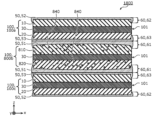
- FIG. 9A is a cross-sectional view of battery 1800 according to this modified example.
- FIG. 9B is a plan view of battery 1800 according to this modified example, viewed from above in the z-axis direction.
- FIG. 9A shows a cross section taken at the position indicated by line IXa-IXa in FIG. 9B.
- the battery 1800 of this modified example differs from the battery 1000 of the embodiment in that the multiple unit cells 100 include unit cell 800b instead of unit cell 100b.
- Unit cell 800b is an example of a first unit cell.
- the unit cell 800b has a configuration in which a first electrode layer 810 and a second electrode layer 820 are included instead of the first electrode layer 10 and the second electrode layer 20 of the unit cell 100b.
- the first electrode layer 810 and the second electrode layer 820 are electrode layers adjacent to the inner layer current collector 51.
- the first electrode layer 810 and the second electrode layer 820 are thicker than the first electrode layer 10 of the unit cell 100a and the second electrode layer 20 of the unit cell 100c, which are the electrode layers adjacent to the surface collector 52. This makes it easier for the thickened first electrode layer 810 and second electrode layer 820 to absorb the stress of thermal expansion of the inner collector 51, which is prone to thermal expansion. Therefore, in the inner collector 51, which is thicker than the surface collector 52, peeling is likely to occur at the interface with the unit cell 800b due to a cooling and heating cycle, but the thickened first electrode layer 810 and second electrode layer 820 absorb the stress, suppressing such peeling and improving thermal shock resistance.
- the thickness of the first electrode layer 810 is, for example, 101% to 120% of the thickness of the first electrode layer 10 of the unit cell 100a.
- the thickness of the second electrode layer 820 is 101% to 120% of the thickness of the second electrode layer 20 of the unit cell 100c. If the thicknesses of these electrode layers are not uniform, this thickness is the average thickness.
- the first electrode layer 810 and the second electrode layer 820 contain more pores 840 than the first electrode layer 10 of the unit cell 100a and the second electrode layer 20 of the unit cell 100c.
- This configuration reduces the heat capacity and heat generation density of the electrode layer in the center of the battery 1800, which is prone to high temperatures.
- the pores 840 are easily exposed on the side surface 101, and the bonding between the covering portion 60 and the side surface 101 is improved by the anchor effect caused by the covering portion 60 penetrating the pores 840. Therefore, the reliability of the battery 1800 is improved.
- the first electrode layer 10 and the second electrode layer 20 of the unit cells 100a and 100c may also contain pores 840.
- the volume fraction of the pores 840 in the first electrode layer 810 and the second electrode layer 820 is, for example, 10% or more and 40% or less.
- the volume fraction of the pores 840 in the first electrode layer 810 and the second electrode layer 820 may be 10% or more and 20% or less, or 20% or more and 40% or less.
- the volume fraction of the pores 840 in the first electrode layer 10 of the unit cell 100a and the second electrode layer 20 of the unit cell 100c is, for example, 0% or more and 10% or less.
- the amount of pores 840 in the first electrode layer 810 may be adjusted so that the capacity of the first electrode layer 810, which increases due to its large thickness, is the same as the capacity of the first electrode layer 10 of the unit cell 100a.
- the amount of pores 840 in the second electrode layer 820 may be adjusted so that the capacity of the second electrode layer 820, which increases due to its large thickness, is the same as the capacity of the second electrode layer 20 of the unit cell 100c.
- the thicknesses of the first electrode layer 810 and the second electrode layer 820 and the amount of pores 840 may be controlled so that the design capacities of the three unit cells 100a, 800b, and 100c are substantially equal.
- the thickness of the first electrode layer 810 and the second electrode layer 820 and the amount of pores 840 can be adjusted by the drying profile, the amount of volatile solvent contained in the slurry, the pressure in the press process, and the like in the printing and coating of the active material.
- the design capacity can be controlled so that it is substantially the same for the three unit cells 100a, 800b, and 100c.
- the number of unit cells 100 in the battery 1800 may be two.
- the first electrode layer 10 or the second electrode layer 20 on the center side of the battery 1800 adjacent to the inner layer current collector 51 is replaced with the first electrode layer 810 or the second electrode layer 820.
- the first electrode layer 810 and the second electrode layer 820 do not have to be included in the same unit cell 100, and the thickness and the amount of pores 840 may be different from each other in a pair of electrode layers in the same unit cell 100.
- the battery 1900 of this modified example differs from the battery 1000 of the embodiment in that the multiple unit cells 100 include unit cell 900b instead of unit cell 100b.
- Unit cell 900b is an example of a first unit cell.
- Unit cell 900b is located between unit cell 100a and unit cell 100c, which are located at both ends in the stacking direction among the multiple unit cells 100. Unit cell 900b is also adjacent to the inner layer current collector 51. Unit cell 900b has a solid electrolyte layer 930 instead of the solid electrolyte layer 30 of unit cell 100b.
- the solid electrolyte layer 930 is thicker than the solid electrolyte layer 30 of the unit cells 100a and 100c. This makes it easier for the elasticity of the thickened solid electrolyte layer 930 to absorb the stress of thermal expansion of the inner layer current collector 51, which is prone to thermal expansion. Therefore, the effect of thermal expansion is particularly large in the inner layer current collector 51, which is thicker than the surface layer current collector 52, and peeling is likely to occur at the interface with the unit cell 900b due to thermal cycles, but the thickened solid electrolyte layer 930 absorbs the stress, suppressing such peeling and improving thermal shock resistance.
- the thickness of the solid electrolyte layer 930 is 101% or more and 120% or less of the thickness of the solid electrolyte layer 30 of the unit cells 100a and 100c. If the thickness of the solid electrolyte layers 30 and 930 is not constant, this thickness is the average thickness.
- the above-described battery 1900 has a configuration in which the solid electrolyte layer 30 of the unit cell 100b of the battery 1000 according to the embodiment is replaced with the solid electrolyte layer 930, but this is not limiting, and the solid electrolyte layer 30 of the unit cell 100b of the battery according to each modified example may be replaced with the solid electrolyte layer 930.
- the first electrode layer 10 is a positive electrode layer and the second electrode layer 20 is a negative electrode layer.
- the positive electrode active material for example, a powder of Li.Ni.Co.Al composite oxide (LiNi 0.8 Co 0.15 Al 0.05 O 2 ) having an average particle size of about 3 ⁇ m and a layered structure is used.
- a paste for the first electrode layer 10 is prepared by dispersing a mixture containing the above-mentioned positive electrode active material and the above-mentioned glass powder in an organic solvent or the like.
- the negative electrode active material is, for example, a powder of natural graphite having an average particle size of about 4 ⁇ m.
- a paste for the second electrode layer 20 is prepared in the same manner by dispersing a mixture containing the above-mentioned negative electrode active material and the above-mentioned glass powder in an organic solvent or the like.
- the plurality of current collectors 50 for example, Al foil and Cu foil having a thickness of about 20 ⁇ m are prepared.
- the paste for the first electrode layer 10 is printed on one surface of the Al foil, and the paste for the second electrode layer 20 is printed on one surface of the Cu foil, in a predetermined shape and with a thickness of about 50 ⁇ m to 100 ⁇ m, respectively, by a screen printing method.
- the paste for the first electrode layer 10 and the paste for the second electrode layer 20 are dried at 80° C. to 130° C. to a thickness of 30 ⁇ m to 60 ⁇ m. This results in a plurality of current collectors 50 (Al foil and Cu foil) on which the first electrode layer 10 and the second electrode layer 20 are formed, respectively.
- the current collector 50 forming the first electrode layer 10 and the second electrode layer 20 of the unit cell 100b has an outer shape larger than that of the other current collectors 50 by 1 ⁇ m to 5 ⁇ m, and a thickness larger than that of the other current collectors 50 by 0.1 ⁇ m to 3 ⁇ m.
- the crystallinity is confirmed by XRD, and the current collector 50 forming the first electrode layer 10 and the second electrode layer 20 of the unit cell 100b is selected and used with a higher crystallinity than the other current collectors 50. Since the crystallinity can also be improved by heat treatment, the current collector 50 is subjected to heat treatment as necessary.
- a paste for the solid electrolyte layer 30 is prepared by dispersing the above-mentioned glass powder in an organic solvent or the like.
- the above-mentioned paste for the solid electrolyte layer 30 is printed on the surfaces of the first electrode layer 10 and the second electrode layer 20 using a metal mask, for example, to a thickness of about 100 ⁇ m.
- the first electrode layer 10 and the second electrode layer 20 on which the paste for the solid electrolyte layer 30 has been printed are dried at a temperature of 80°C or higher and 130°C or lower.
- thermosetting conductive paste containing silver metal particles is used as an example of the conductive paste, but this is not limited to this.
- a thermosetting conductive paste containing highly conductive metal particles with a high melting point e.g., 400°C or higher
- metal particles with a low melting point preferably below the hardening temperature of the conductive paste, e.g., 300°C or lower
- resin e.g., 300°C or lower
- materials for the highly conductive metal particles with a high melting point include silver, copper, nickel, zinc, aluminum, palladium, gold, platinum, or alloys combining these metals.
- the resin used in the thermosetting conductive paste may be any resin that functions as a binder for bonding, and may be selected based on the manufacturing process to be adopted, such as printability and applicability.
- the resin used in the thermosetting conductive paste may include, for example, a thermosetting resin.
- the thermosetting resin include (i) amino resins such as urea resin, melamine resin, and guanamine resin, (ii) epoxy resins such as bisphenol A type, bisphenol F type, phenol novolac type, and alicyclic type, (iii) oxetane resin, (iv) phenol resins such as resol type and novolac type, and (v) silicone-modified organic resins such as silicone epoxy and silicone polyester. Only one of these materials may be used as the resin, or two or more of these materials may be used in combination.
Landscapes
- Chemical & Material Sciences (AREA)
- Chemical Kinetics & Catalysis (AREA)
- Electrochemistry (AREA)
- General Chemical & Material Sciences (AREA)
- Engineering & Computer Science (AREA)
- Manufacturing & Machinery (AREA)
- General Physics & Mathematics (AREA)
- Inorganic Chemistry (AREA)
- Condensed Matter Physics & Semiconductors (AREA)
- Physics & Mathematics (AREA)
- Materials Engineering (AREA)
- Secondary Cells (AREA)
- Connection Of Batteries Or Terminals (AREA)
Priority Applications (2)
| Application Number | Priority Date | Filing Date | Title |
|---|---|---|---|
| JP2024567197A JPWO2024142451A1 (https=) | 2022-12-27 | 2023-08-04 | |
| US19/231,401 US20250300318A1 (en) | 2022-12-27 | 2025-06-06 | Battery |
Applications Claiming Priority (2)
| Application Number | Priority Date | Filing Date | Title |
|---|---|---|---|
| JP2022210809 | 2022-12-27 | ||
| JP2022-210809 | 2022-12-27 |
Related Child Applications (1)
| Application Number | Title | Priority Date | Filing Date |
|---|---|---|---|
| US19/231,401 Continuation US20250300318A1 (en) | 2022-12-27 | 2025-06-06 | Battery |
Publications (1)
| Publication Number | Publication Date |
|---|---|
| WO2024142451A1 true WO2024142451A1 (ja) | 2024-07-04 |
Family
ID=91717173
Family Applications (1)
| Application Number | Title | Priority Date | Filing Date |
|---|---|---|---|
| PCT/JP2023/028496 Ceased WO2024142451A1 (ja) | 2022-12-27 | 2023-08-04 | 電池 |
Country Status (3)
| Country | Link |
|---|---|
| US (1) | US20250300318A1 (https=) |
| JP (1) | JPWO2024142451A1 (https=) |
| WO (1) | WO2024142451A1 (https=) |
Citations (4)
| Publication number | Priority date | Publication date | Assignee | Title |
|---|---|---|---|---|
| JP2017073374A (ja) * | 2015-10-05 | 2017-04-13 | 古河機械金属株式会社 | バイポーラ型リチウムイオン電池およびバイポーラ型リチウムイオン電池の製造方法 |
| WO2020105662A1 (ja) * | 2018-11-20 | 2020-05-28 | Tdk株式会社 | 全固体電池 |
| JP2020140932A (ja) * | 2019-03-01 | 2020-09-03 | トヨタ自動車株式会社 | 全固体電池及びその製造方法 |
| JP2022086543A (ja) * | 2020-11-30 | 2022-06-09 | トヨタ自動車株式会社 | 積層型全固体電池 |
-
2023
- 2023-08-04 JP JP2024567197A patent/JPWO2024142451A1/ja active Pending
- 2023-08-04 WO PCT/JP2023/028496 patent/WO2024142451A1/ja not_active Ceased
-
2025
- 2025-06-06 US US19/231,401 patent/US20250300318A1/en active Pending
Patent Citations (4)
| Publication number | Priority date | Publication date | Assignee | Title |
|---|---|---|---|---|
| JP2017073374A (ja) * | 2015-10-05 | 2017-04-13 | 古河機械金属株式会社 | バイポーラ型リチウムイオン電池およびバイポーラ型リチウムイオン電池の製造方法 |
| WO2020105662A1 (ja) * | 2018-11-20 | 2020-05-28 | Tdk株式会社 | 全固体電池 |
| JP2020140932A (ja) * | 2019-03-01 | 2020-09-03 | トヨタ自動車株式会社 | 全固体電池及びその製造方法 |
| JP2022086543A (ja) * | 2020-11-30 | 2022-06-09 | トヨタ自動車株式会社 | 積層型全固体電池 |
Also Published As
| Publication number | Publication date |
|---|---|
| JPWO2024142451A1 (https=) | 2024-07-04 |
| US20250300318A1 (en) | 2025-09-25 |
Similar Documents
| Publication | Publication Date | Title |
|---|---|---|
| JP7437786B2 (ja) | 電池 | |
| JP7649977B2 (ja) | 電池 | |
| JP7672059B2 (ja) | 電池 | |
| JP7745175B2 (ja) | 電池及び積層電池 | |
| JP7611496B2 (ja) | 電池 | |
| US20230335790A1 (en) | Battery and laminated battery | |
| US20230327129A1 (en) | Battery and method for producing battery | |
| CN115066780A (zh) | 电池 | |
| US20240055735A1 (en) | Battery | |
| JP7692155B2 (ja) | 電池及び積層電池 | |
| WO2024142451A1 (ja) | 電池 | |
| US20220037713A1 (en) | Battery | |
| US20240154262A1 (en) | Battery | |
| US20250286241A1 (en) | Battery | |
| US20240250309A1 (en) | Laminated battery | |
| US20240079658A1 (en) | Battery and stacked battery | |
| US20240250316A1 (en) | Battery | |
| JP2021061102A (ja) | 電池及び積層電池 | |
| CN117581408A (zh) | 电池 | |
| CN121444232A (zh) | 电池 |
Legal Events
| Date | Code | Title | Description |
|---|---|---|---|
| 121 | Ep: the epo has been informed by wipo that ep was designated in this application |
Ref document number: 23911235 Country of ref document: EP Kind code of ref document: A1 |
|
| WWE | Wipo information: entry into national phase |
Ref document number: 2024567197 Country of ref document: JP |
|
| NENP | Non-entry into the national phase |
Ref country code: DE |
|
| 122 | Ep: pct application non-entry in european phase |
Ref document number: 23911235 Country of ref document: EP Kind code of ref document: A1 |