WO2024142168A1 - 香味吸引物品用のフィルタ部および香味吸引物品 - Google Patents
香味吸引物品用のフィルタ部および香味吸引物品 Download PDFInfo
- Publication number
- WO2024142168A1 WO2024142168A1 PCT/JP2022/047989 JP2022047989W WO2024142168A1 WO 2024142168 A1 WO2024142168 A1 WO 2024142168A1 JP 2022047989 W JP2022047989 W JP 2022047989W WO 2024142168 A1 WO2024142168 A1 WO 2024142168A1
- Authority
- WO
- WIPO (PCT)
- Prior art keywords
- filter
- paper
- inhalation article
- flavor inhalation
- section
- Prior art date
- Legal status (The legal status is an assumption and is not a legal conclusion. Google has not performed a legal analysis and makes no representation as to the accuracy of the status listed.)
- Ceased
Links
Images




Classifications
-
- A—HUMAN NECESSITIES
- A24—TOBACCO; CIGARS; CIGARETTES; SIMULATED SMOKING DEVICES; SMOKERS' REQUISITES
- A24D—CIGARS; CIGARETTES; TOBACCO SMOKE FILTERS; MOUTHPIECES OF CIGARS OR CIGARETTES; MANUFACTURE OF TOBACCO SMOKE FILTERS OR MOUTHPIECES
- A24D3/00—Tobacco smoke filters, e.g. filter tips or filtering inserts; Filters specially adapted for simulated smoking devices; Mouthpieces of cigars or cigarettes
- A24D3/04—Tobacco smoke filters characterised by their shape or structure
-
- A—HUMAN NECESSITIES
- A24—TOBACCO; CIGARS; CIGARETTES; SIMULATED SMOKING DEVICES; SMOKERS' REQUISITES
- A24D—CIGARS; CIGARETTES; TOBACCO SMOKE FILTERS; MOUTHPIECES OF CIGARS OR CIGARETTES; MANUFACTURE OF TOBACCO SMOKE FILTERS OR MOUTHPIECES
- A24D1/00—Cigars; Cigarettes
- A24D1/04—Cigars; Cigarettes with mouthpieces or filter-tips
- A24D1/045—Cigars; Cigarettes with mouthpieces or filter-tips with smoke filter means
-
- A—HUMAN NECESSITIES
- A24—TOBACCO; CIGARS; CIGARETTES; SIMULATED SMOKING DEVICES; SMOKERS' REQUISITES
- A24D—CIGARS; CIGARETTES; TOBACCO SMOKE FILTERS; MOUTHPIECES OF CIGARS OR CIGARETTES; MANUFACTURE OF TOBACCO SMOKE FILTERS OR MOUTHPIECES
- A24D1/00—Cigars; Cigarettes
- A24D1/20—Cigarettes specially adapted for simulated smoking devices
-
- A—HUMAN NECESSITIES
- A24—TOBACCO; CIGARS; CIGARETTES; SIMULATED SMOKING DEVICES; SMOKERS' REQUISITES
- A24D—CIGARS; CIGARETTES; TOBACCO SMOKE FILTERS; MOUTHPIECES OF CIGARS OR CIGARETTES; MANUFACTURE OF TOBACCO SMOKE FILTERS OR MOUTHPIECES
- A24D3/00—Tobacco smoke filters, e.g. filter tips or filtering inserts; Filters specially adapted for simulated smoking devices; Mouthpieces of cigars or cigarettes
- A24D3/06—Use of materials for tobacco smoke filters
- A24D3/08—Use of materials for tobacco smoke filters of organic materials as carrier or major constituent
- A24D3/10—Use of materials for tobacco smoke filters of organic materials as carrier or major constituent of cellulose or cellulose derivatives
-
- A—HUMAN NECESSITIES
- A24—TOBACCO; CIGARS; CIGARETTES; SIMULATED SMOKING DEVICES; SMOKERS' REQUISITES
- A24D—CIGARS; CIGARETTES; TOBACCO SMOKE FILTERS; MOUTHPIECES OF CIGARS OR CIGARETTES; MANUFACTURE OF TOBACCO SMOKE FILTERS OR MOUTHPIECES
- A24D3/00—Tobacco smoke filters, e.g. filter tips or filtering inserts; Filters specially adapted for simulated smoking devices; Mouthpieces of cigars or cigarettes
- A24D3/17—Filters specially adapted for simulated smoking devices
Definitions
- the present disclosure relates to a filter portion for a flavor inhalation article and a flavor inhalation article.
- a paper filter is used as a filter for a flavor inhalation article in consideration of the environment.
- the aerosol filtering ability of a paper filter is generally higher than that of a filter using fibers such as cellulose acetate. Therefore, when a paper filter is used, the flavor and taste due to the aerosol is reduced more than in a filter using fibers such as cellulose acetate.
- a long, thin hollow member is placed inside a paper filter to adjust the flavor and hardness of the filter. It is preferable that the hollow member is large enough to penetrate the filter in the longitudinal direction, but it is difficult to place a hollow member large enough to penetrate the filter inside a paper filter from a manufacturing perspective.
- An object of the present disclosure is to achieve both delivery efficiency and ease of manufacture when an elongated hollow member is disposed in a filter portion of a flavor inhalation article.
- a first feature of the present disclosure which has been completed with respect to this objective, is a filter section for a flavor inhalation article, comprising: a paper filter filled with a sheet member so as to form gaps in the longitudinal direction; and a hollow member disposed within the paper filter along the longitudinal direction of the filter section and having a filtration rate lower than that of the paper filter, at least one end of the hollow member being disposed at a position within a predetermined distance from the longitudinal end of the filter section.
- the hollow member may have one end within a predetermined distance from the downstream end side of the filter section, and the other end has an opening disposed on the upstream end side of the filter section.
- the predetermined distance may be 1 ⁇ 2 ⁇ A ⁇ 3 (A is a diameter of a peripheral circle of the opening).
- the hollow member may include at least paper.
- the hollow member may be a straight paper tube made of paper rolled into a cylindrical shape or a spiral paper tube made of a strip of paper rolled obliquely.
- the paper filter is a filter in which the sheet member is gathered.
- the paper filter may be a filter obtained by crimping a sheet member made of paper or nonwoven fabric.
- the sheet member may be subjected to a crimping treatment along a longitudinal direction of the filter portion.
- a ninth feature may be that a packing density of the sheet member is 105 mg/cm 3 or more and 720 mg/cm 3 or less at a location where the hollow member is present.
- a tenth feature is that a ratio of an outer diameter of the hollow member to an outer diameter of the paper filter may be greater than or equal to 0.2 and less than 0.7.
- An eleventh feature is that the paper filter may have an airflow resistance of 0 [mmH 2 O/10 mm] or more and less than 20 [mmH 2 O/10 mm].
- a twelfth feature is a flavor inhalation article including the filter portion and a substrate portion including an aerosol source.
- a thirteenth feature is that the flavor inhalation article may be a non-combustion heating type flavor inhalation article.
- a fourteenth feature may be that the flavor inhalation article is a combustion type flavor inhalation article.
- the first feature it is possible to provide a filter portion of a flavor inhalation article that achieves both delivery efficiency and ease of manufacture, compared to a case in which the hollow member is not located within a predetermined distance from the longitudinal end of the filter portion.
- the second feature it is possible to provide a filter portion of a flavor inhalation article having superior delivery efficiency compared to a case in which one end of the hollow member is positioned beyond a predetermined distance from the downstream end side of the filter portion.
- the third feature it is possible to provide a filter portion of a flavor inhalation article having superior delivery efficiency compared to a case in which the predetermined distance exceeds 1/2 ⁇ A ⁇ 3 (A is the diameter of the outer circumferential circle of the opening).
- a filter portion of a flavor inhalation article can be provided in which the material constituting the hollow member is closer to that of a paper filter than when the hollow member does not contain paper.
- the hollow member is not composed of a straight paper tube made of paper wound into a cylindrical shape or a spiral paper tube made of a strip-shaped paper wound obliquely, it is possible to provide a filter portion of a flavor inhalation article in which even a paper with a small basis weight can be used for the hollow member, the formability is good, and the finished hollow member has excellent strength.
- the sixth feature it is possible to provide a filter portion of a flavor inhalation article that has a higher aerosol filtering ability than a filter in which the sheet member is not gathered.
- a filter portion of a flavor inhalation article can be provided that exhibits good filter portion hardness compared to when the packing density of the paper filter is less than 105 mg/ cm3 in a location where a hollow member is not present, and does not filter out aerosol components too much compared to when the packing density exceeds 720 mg/ cm3 .
- a filter portion of a flavor inhalation article can be provided that can filter aerosol while maintaining the delivery amount, compared to when the ratio of the outer diameter of the hollow member to the outer diameter of the paper filter is less than 0.2 or 0.7 or more.
- a flavor inhalation article can be provided which does not form holes at the filter end and does not adversely affect the smoking flavor, compared to when the airflow resistance of the paper filter is 20 [ mmH2O /10 mm] or more.
- a flavor inhalation article can be provided that achieves both high delivery efficiency and ease of manufacture, compared to a case in which the hollow member is not located within a predetermined distance from the longitudinal end of the filter portion.
- FIG. 1 is a diagram showing a vertical cross section of a non-combustion heating type flavor inhalation article according to a first embodiment.
- FIG. 1 is a schematic diagram showing a configuration example of a suction device according to a first embodiment
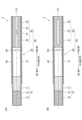
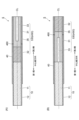
- 2 is a diagram showing a cross section of a filter portion of the non-combustion heating type flavor inhalation article according to the first embodiment.
- FIG. 10 is a diagram showing a cross section of a filter portion of a non-combustion heating type flavor inhalation article according to another example of the first embodiment.
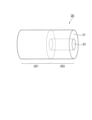
- FIG. 1 is a schematic diagram showing a filter portion of a non-combustion heating type flavor inhalation article according to a first embodiment.
- FIG. 1 is a schematic diagram showing a filter portion of a non-combustion heating type flavor inhalation article according to a first embodiment.
- FIG. 3 is a schematic diagram illustrating a filter portion of the non-combustion heating type flavor inhalation article according to the first embodiment.
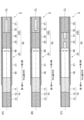
- FIG. FIG. 13 is a diagram showing a vertical cross section of a non-combustion heating type flavor inhalation article according to another embodiment
- FIG. 13 is a diagram showing a vertical cross section of a non-combustion heating type flavor inhalation article according to another embodiment.
- FIG. 11 is a diagram showing a vertical cross section of a combustion heating type flavor inhalation article according to a second embodiment.
- FIG. 11 is a diagram showing a vertical cross section of a combustion heating type flavor inhalation article according to a second embodiment.
- FIG. 13 is a diagram showing a vertical cross section of a combustion heating type flavor inhalation article according to another embodiment.
- the second side is the side opposite to the first side, and is the end side that the user holds in the mouth for inhalation, and is the downstream side in the flow of aerosol during inhalation.
- a cross section along the center line direction is referred to as a "longitudinal cross section", and a cross section cut along a plane perpendicular to the center line direction is defined as a "transverse cross section”.
- the suction device 100 also includes a heating unit 121 that heats the flavor suction article 1, a holding unit 140 that holds the flavor suction article 1, an opening 142 that communicates the internal space 141 with the outside, and a heat insulating unit 144 that prevents heat transfer from the heating unit 121 to other components of the suction device 100.
- the flavor inhalation article 1 is held in the holding portion 140, and the user inhales.
- the heating unit 121 heats the base material 10 of the flavor inhalation article 1.
- the heating unit 121 is made of any material such as metal or polyimide.
- the heating unit 121 is configured in a film shape and arranged to cover the outer periphery of the holding unit 140.
- the aerosol source 11 included in the flavor inhalation article 1 is heated from the outer periphery of the flavor inhalation article 1.
- the heating unit 121 generates heat when power is supplied from the power supply unit 111.
- power may be supplied when the sensor unit 112 detects that a predetermined user input has been made.
- the flavor inhalation article 1 is a non-combustion heating type flavor inhalation article.
- the cross section of the flavor inhalation article 1 is substantially circular, and its outer diameter can be appropriately changed according to the size of the product, but is usually 16 mm to 27 mm, and preferably 21 mm to 23 mm. If the cross section is not circular, the above outer diameter is assumed to be a circle having the same area as the cross section, and the outer diameter of the circle is applied.
- the size of the flavor inhalation article 1 in the center line direction can be appropriately changed according to the size of the product, but is usually 40 mm or more and 100 mm or less, and preferably 50 mm or more and 70 mm or less.
- Fig. 3 is a diagram showing an example of the configuration of the filter section 30 according to the first embodiment, where (A) is a diagram showing an example of a cross section taken along line II in Fig. 1, and (B) is a diagram showing an example of a cross section taken along line II-II in Fig. 1.
- Fig. 4 is a diagram showing another example of the configuration of the filter section 30 according to the first embodiment, where (A) is a diagram showing an example of a cross section taken along line II in Fig. 1, and (B) is a diagram showing another example of a cross section taken along line II-II in Fig. 1.
- the filter unit 30 is formed in a columnar shape whose size in the center line direction is greater than the width of the cross section, and is therefore disposed such that the longitudinal direction of the filter unit 30 coincides with the center line direction.
- the filter unit 30 has a filter 31 through which the aerosol passes, a hollow member 33 having a filtration rate lower than that of the filter 31, and a wrapping paper 35 that is between the filter 31 and the tipping paper 40 and is wrapped around the outer circumferential surface of the filter 31 (see FIG. 1).
- the filter unit 30 is connected (coupled) to the cooling unit 20 by winding up the cooling unit 20 and the filter unit 30 together using the tipping paper 40 (see FIG. 1).
- the wrapping paper 35 may not be provided.
- a paper filter filled with sheet-like pulp paper may be used.
- inorganic adsorbents such as activated carbon, sepiolite, palygorskite, zeolite, activated carbon fiber, activated alumina, sepiolite mixed paper, silica gel, activated clay, permiculite, and diatomaceous earth, pulp, various fibers, and polymeric porous bodies such as ion exchange resins may be used.
- the packing density of the filter material is not particularly limited, but is usually from 90 mg/cm 3 to 360 mg/cm 3 , and preferably from 150 mg/cm 3 to 240 mg/cm 3 .
- the filter 31 may include a crushable additive release container (e.g., a capsule) that includes a crushable shell such as gelatin.
- a crushable additive release container e.g., a capsule
- the form of the additive release container such as a capsule is not particularly limited and may be any known form. In the case of a capsule, when it is broken by a user before, during, or after use, it releases a liquid or substance (usually a flavoring agent) contained in the capsule, which is then carried by an aerosol during use of the stick and dispersed into the surrounding environment after use.
- the form of the capsule is not particularly limited, and may be, for example, a fragile capsule, and its shape is preferably a sphere.
- the additive contained in the capsule may include any additive, and in particular, preferably includes a flavoring agent and activated carbon.
- the aerosol source 11 may be derived from tobacco, such as a processed product in which tobacco shreds or tobacco raw materials are molded into a granular, sheet, or powder form.
- the aerosol source 11 may also include a non-tobacco-derived product made from a plant other than tobacco (e.g., mint, herbs, etc.).
- the aerosol source 11 may include a flavoring component such as menthol.
- the aerosol source 11 may include a drug for the patient to inhale.
- the aerosol source 11 is not limited to a solid, and may be a liquid such as, for example, polyhydric alcohols such as glycerin and propylene glycol, and water. At least a portion of the substrate 10 is accommodated in an internal space 141 of the holding part 140 in a state in which the flavor inhalation article 1 is held by the holding part 140 shown in FIG.
- the aerosol source 11 including tobacco shreds will be described.
- the material of the tobacco shreds contained in the aerosol source 11 is not particularly limited, and known materials such as lamina and ribs can be used.
- the tobacco shreds may be made by crushing dried tobacco leaves to an average particle size of 20 ⁇ m to 200 ⁇ m to obtain tobacco shreds, homogenizing the shredded tobacco leaves, and processing the shredded tobacco into a sheet (hereinafter, also simply referred to as "homogenized sheet").
- the aerosol source 11 may be filled with a homogenized sheet having a size approximately equal to the size of the center line direction of the substrate 10, which is shredded approximately horizontally to the center line direction of the substrate 10, to form a so-called strand type.
- the width of the tobacco shreds is preferably 0.5 mm or more and 2.0 mm or less when filling the aerosol source 11 .
- the second method is to mix a suitable solvent such as water with ground tobacco leaves to homogenize them, and then cast the homogenized mixture thinly on a metal plate or metal plate belt and dry it to produce a cast sheet.
- the third method is to mix a suitable solvent such as water with ground tobacco leaves to homogenize them, and extrude the mixture into a sheet to produce a rolled sheet. Details of the types of homogenizing sheets are disclosed in the "Encyclopedia of Tobacco, Tobacco Research Center, March 31, 2009."
- the aerosol source 11 is not particularly limited and may contain various natural extracts and/or their components depending on the application.
- the extracts and/or their components include glycerin, propylene glycol, triacetin, 1,3-butanediol, and mixtures thereof.
- the content of the extract and/or its constituent components in aerosol source 11 is not particularly limited, and from the viewpoint of generating a sufficient aerosol and imparting a good flavor, is usually 5% by mass or more, and preferably 10% by mass or more, based on the total amount of aerosol source 11.
- the content of the extract and/or its constituent components in aerosol source 11 is usually 50% by mass or less, and preferably 15% by mass or more and 25% by mass or less.
- the aerosol source 11 may be made of a tobacco sheet.
- the number of sheets of the tobacco sheet may be one, or two or more.
- a tobacco sheet having one side of the same size as the center line direction of the filling is folded back multiple times horizontally to the center line direction of the filling (so-called gathered sheet) is included.
- a tobacco sheet having one side of the same size as the center line direction of the filling is rolled up in a direction perpendicular to the center line direction of the filling is included.
- the aerosol source 11 can be manufactured by preparing a plurality of tobacco sheets of different widths, stacking them so that the width decreases from the first side to the second side to prepare a laminate, and passing the laminate through a winding tube to roll and mold it.
- a plurality of tobacco sheets extend in the center line direction and are arranged concentrically around the center line CL.
- the laminate is preferably prepared so that a non-contact portion is formed between adjacent tobacco sheets after rolling. If there is a non-contact portion (gap) between multiple tobacco sheets where the tobacco sheets are not in contact, a flavor flow path can be secured to improve the delivery efficiency of the flavor components.
- a polyol such as glycerin, propylene glycol, 1,3-butanediol, etc. may be added to the tobacco sheet.
- the amount of such a polyol added to the tobacco sheet is preferably 5% by mass or more and 50% by mass or less, and more preferably 15% by mass or more and 25% by mass or less, based on the dry mass of the tobacco sheet.
- the tobacco sheet can be appropriately produced by a known method such as papermaking, slurry, rolling, etc. The above-mentioned homogenized sheet can also be used.
- tobacco can be produced by a method including the following steps: 1) Dried tobacco leaves are roughly crushed and extracted with water to separate the water extract and residue. 2) The water extract is dried under reduced pressure and concentrated.
- a step of removing some components such as nitrosamines may be added (see JP-T 2004-510422).
- the tobacco leaf can be produced by a method including the following steps: 1) mixing water, pulp, and a binder with crushed tobacco leaves; 2) spreading (casting) the mixture thinly and drying.
- a step of removing some of the components such as nitrosamines by irradiating the slurry of the water, pulp, binder, and crushed tobacco leaves with ultraviolet light or X-rays may be added.
- the tobacco sheet may also contain a binder, and examples of such binders include guar gum, xanthan gum, carboxymethylcellulose, and sodium salt of carboxymethylcellulose.
- binders include guar gum, xanthan gum, carboxymethylcellulose, and sodium salt of carboxymethylcellulose.
- the amount of the binder is preferably 1% by mass or more and 10% by mass or less with respect to the total mass of the tobacco sheet.
- the tobacco sheet may further contain other additives. Examples of additives include fillers such as pulp.
- the configuration of the cigarette paper 12 used in the base material 10 is not particularly limited and may be a common embodiment, for example one containing pulp as the main component.
- the pulp may be made from wood pulp such as softwood pulp or hardwood pulp, or may be made by mixing with non-wood pulp generally used in cigarette papers 12 for tobacco products, such as flax pulp, hemp pulp, sisal pulp, or esparto.
- non-wood pulp generally used in cigarette papers 12 for tobacco products, such as flax pulp, hemp pulp, sisal pulp, or esparto.
- type of pulp chemical pulp produced by the kraft cooking method, acidic/neutral/alkaline sulfite cooking method, soda salt cooking method, etc., ground pulp, chemi-ground pulp, thermomechanical pulp, etc. can be used.
- the pulp is used in the papermaking process using a Fourdrinier papermaking machine, a cylinder papermaking machine, a combined cylinder and short-circuit papermaking machine, etc., to adjust and homogenize the texture of the wrapping paper 12.
- a wet strength agent can be added to impart water resistance to the wrapping paper 12, or a sizing agent can be added to adjust the printing condition of the wrapping paper 12.
- papermaking internal additives such as aluminum sulfate, various anionic, cationic, nonionic, or amphoteric retention improvers, drainage improvers, and paper strength enhancers, as well as papermaking additives such as dyes, pH adjusters, defoamers, pitch control agents, and slime control agents can be added.
- the shape of the wrapping paper 12 for producing the base material 10 may be, for example, a square or a rectangle.
- the length of one side can be about 12 mm to 70 mm
- the length of the other side can be 15 mm to 28 mm
- the preferred length of the other side can be 22 mm to 24 mm
- the more preferred length can be about 23 mm.
- wrapping the aerosol source 11 in the wrapping paper 12 in a cylindrical shape for example, an end of the wrapping paper 12 and an end of the wrapping paper 12 on the opposite side are overlapped by about 2 mm in the circumferential direction and glued to form a cylindrical paper tube shape in which the aerosol source 11 is filled.
- the size of the rectangular wrapping paper 12 can be determined depending on the size of the base material 10.
- a filler may be contained in the cigarette paper 12.
- the content of the filler relative to the total mass of the cigarette paper 12 can be 10% by mass or more and 60% by mass or less, and preferably 15% by mass or more and 45% by mass or less.
- the filler content is preferably 15% by mass or more and 45% by mass or less.
- a water resistance improver may be added to improve water resistance.
- the water resistance improver includes a wet strength agent (WS agent) and a sizing agent.
- wet strength agent include urea formaldehyde resin, melamine formaldehyde resin, polyamide epichlorohydrin (PAE), etc.
- PAE polyamide epichlorohydrin
- sizing agent include rosin soap, alkyl ketene dimer (AKD), alkenyl succinic anhydride (ASA), highly saponified polyvinyl alcohol with a saponification degree of 90% or more, etc.
- the cooling unit 20 is disposed adjacent to the base material 10 and the filter unit 30, and is a member formed so that the cross section of a cylinder or the like is hollow (hollow) by wrapping the sheet 21 around it.
- the cooling unit 20 cools the steam generated by heating the base material 10 to generate an aerosol.
- the cooling section 20 is a paper tube formed by winding a sheet 21 made of paper.
- the cooling section 20 is a so-called spiral paper tube, which is a paper tube formed by bonding a plurality of sheets 21 including at least paper to each other and winding them in a spiral shape.
- the spiral paper tube manufacturing method makes it possible to easily form a paper tube having a circular cross section.
- the size of the cooling section 20 in the center line direction is usually 35 mm or less, preferably 30 mm or less, and more preferably 25 mm or less.
- the cooling section 20 is provided with through-holes 60 (also referred to as "ventilation filters (Vf)" in this technical field) in the circumferential direction and concentrically.
- the through-holes 60 are holes that penetrate the sheet 21. Examples of the hole shapes include polygonal, rounded polygonal, circular, and elliptical.
- the through-holes 60 are present in an area through which air can flow in from outside the flavor inhalation article 1, in other words, in an area that protrudes from the opening 142 when the flavor inhalation article 1 is held in the holding section 140 of the inhalation device 100.
- the presence of the through-holes 60 allows the concentration of the inhaled flavor components and aerosol to be adjusted.
- the presence of a plurality of through-holes 60 allows air to flow from the outside into the cooling section 20 during inhalation, and the temperature of the steam and air flowing in from the substrate section 10 can be lowered.
- the through-holes 60 in the cooling section 20 within a region of 4 mm or more in the direction toward the cooling section 20 from the boundary between the cooling section 20 and the filter section 30, not only can the cooling capacity be improved, but also the retention of the product (product) generated by heating in the cooling section 20 can be suppressed, thereby improving the delivery amount of the product.
- the steam generated using the aerosol as a condensation nucleus is liquefied by contacting air from the outside and lowering its temperature, thereby promoting the generation of the aerosol.
- the tipping paper 40 may be prepared and wound with an air hole that overlaps with the through hole 60, but from the viewpoint of ease of production, it is preferable to produce the flavor inhalation article 1 without the through hole 60 and then open a hole penetrating the cooling part 20 and the tipping paper 40 at the same time.
- the region where the through holes 60 exist is not particularly limited as long as it is a region of 4 mm or more from the boundary between the cooling section 20 and the filter section 30 toward the cooling section 20, but from the viewpoint of further improving product delivery, a region of 4.5 mm or more is preferable, a region of 5 mm or more is more preferable, and a region of 5.5 mm or more is even more preferable. Also, from the viewpoint of ensuring cooling function, the region where the through holes 60 exist is preferably a region of 15 mm or less from the boundary between the cooling section 20 and the filter section 30, more preferably a region of 10 mm or less, and even more preferably a region of 7 mm or less.
- the region in which the through holes 60 exist is preferably a region of 5 mm or more from the boundary between the cooling section 20 and the substrate section 10 toward the cooling section 20, more preferably a region of 10 mm or more, and even more preferably a region of 13 mm or more.
- the region in which the through holes 60 exist is preferably a region of 16 mm or less from the boundary between the cooling section 20 and the substrate section 10, more preferably a region of 15.5 mm or less, even more preferably a region of 15 mm or less, and particularly preferably a region of 14.5 mm or less.
- the through holes 60 are provided so that the air inflow rate from the through holes 60 is 10% by volume or more and 90% by volume or less when inhaled at 17.5 ml/sec by an automatic smoking machine.
- This "air inflow rate” is the volumetric rate of air inflowing from the through holes 60 when the rate of air inhaled from the mouth end is 100% by volume.
- the air inflow rate is preferably 50% by volume or more and 80% by volume or less, and more preferably 55% by volume or more and 75% by volume or less.
- These air inflow rates can be achieved, for example, by selecting the number of through holes 60 per through hole group from the range of 5 to 50, selecting the diameter of the through holes 60 from the range of 0.1 mm to 0.5 mm, and combining these selections.
- the air inflow ratio can be measured by a method conforming to ISO9512 using a winding quality measuring device (SODIMAX D74/SODIM manufactured by SAS).
- the tipping paper 40 is wrapped around the outer peripheral surfaces of the base material portion 10 , the cooling portion 20 , and the filter portion 30 .
- the shape of the tipping paper 40 is not particularly limited and can be, for example, square or rectangular.
- the basis weight of the tipping paper 40 is not particularly limited, but is usually 32 gsm or more and 60 gsm or less, preferably 33 gsm or more and 55 gsm or less, and more preferably 34 gsm or more and 53 gsm or less.
- the air permeability of the tipping paper 40 is not particularly limited, but is usually 0 Coresta units or more and 30,000 Coresta units or less, and preferably more than 0 Coresta units and 10,000 Coresta units or less.
- air permeability is a value measured in accordance with ISO2965:2009, and is expressed as the flow rate ( cm3 ) of gas passing through an area of 1 cm2 per minute when the differential pressure between both sides of the paper is 1 kPa.
- 1 Coresta unit (1 Coresta unit, 1 C.U.) is cm3 /(min ⁇ cm2 ) under 1 kPa.
- the configuration of the tipping paper 40 is not particularly limited and may be a general embodiment, for example, one in which pulp is the main component.
- the pulp may be made from wood pulp such as softwood pulp or hardwood pulp, or may be made by mixing non-wood pulp generally used in cigarette papers for tobacco products, such as flax pulp, hemp pulp, sisal pulp, or esparto. These pulps may be used alone or in combination in any ratio.
- the type of pulp that can be used includes chemical pulp produced by the kraft cooking method, acidic/neutral/alkaline sulfite cooking method, soda salt cooking method, etc., ground pulp, chemi-ground pulp, thermomechanical pulp, etc.
- the tip paper 40 may be produced by the above-mentioned production method or may be a commercially available product.
- the tip paper 40 may contain fillers, for example, metal carbonates such as calcium carbonate and magnesium carbonate, metal oxides such as titanium oxide, titanium dioxide and aluminum oxide, metal sulfates such as barium sulfate and calcium sulfate, metal sulfides such as zinc sulfide, quartz, kaolin, talc, diatomaceous earth, gypsum, etc., and it is particularly preferable that the tip paper 40 contains calcium carbonate from the viewpoint of improving whiteness and opacity and increasing the heating rate.
- these fillers may be used alone or in combination of two or more types.
- the tip paper 40 may contain various auxiliary agents, for example, a water resistance improver to improve water resistance.
- Water resistance improvers include wet strength agents (WS agents) and sizing agents.
- wet strength agents include urea formaldehyde resin, melamine formaldehyde resin, polyamide epichlorohydrin (PAE), etc.
- sizing agents include rosin soap, alkyl ketene dimer (AKD), alkenyl succinic anhydride (ASA), and highly saponified polyvinyl alcohol with a saponification degree of 90% or more.
- a coating agent may be added to at least one of the two surfaces, the front surface and the back surface, of the tipping paper 40.
- the coating agent There are no particular limitations on the coating agent, but a coating agent that can form a film on the surface and reduce liquid permeability is preferred.
- a part of the outer surface of the tipping paper 40 may be covered with a lip release material.
- the lip release material means a material configured to assist in easily releasing the contact between the lips and the tipping paper 40 without substantial adhesion when the user holds the filter portion 30 of the flavor inhalation article 1 in the mouth.
- the lip release material may include, for example, ethyl cellulose, methyl cellulose, nitrocellulose, etc.
- the outer surface of the tipping paper 40 may be coated with the lip release material by applying an ethyl cellulose-based or methyl cellulose-based ink to the outer surface of the tipping paper 40.
- the filter section 30 for the flavor inhalation article comprises a paper filter (filter 31) filled with a sheet member so as to form a gap in the longitudinal direction, and a hollow member 33 arranged within the paper filter along the longitudinal direction of the filter section 30 and having a lower filtration rate than the paper filter, with at least one end of the hollow member 33 being arranged at a position within a predetermined distance from the longitudinal end of the filter section 30.
- the flavor inhalation article 4 is a combustion-type flavor inhalation article. It is used by burning an end face of a first side, which is opposite to a second side, which is an end side that a user holds in his mouth for inhalation.
- the aerosol source 11 included in the base member 10 generates steam from which an aerosol is generated by heating associated with combustion.
- the cross section of the flavor inhalation article 4 is substantially circular, and its outer diameter can be appropriately changed according to the size of the product, but is usually 16 mm to 27 mm, and preferably 22 mm to 25 mm. When the cross section is not circular, the above outer diameter is assumed to be a circle having the same area as the cross section, and the outer diameter of the circle is applied.
- the size of the flavor inhalation article 4 in the center line direction can be appropriately changed according to the size of the product, but is usually 60 mm or more and 120 mm or less, and preferably 80 mm or more and 100 mm or less.
- the mouthpiece portion 450 is composed of a filter portion 30 .
- the size of the mouthpiece portion 450 in the center line direction can be changed appropriately according to the size of the product, but is usually 20 mm or more and 40 mm or less, and preferably 25 mm or more and 30 mm or less.
- the mouthpiece portion 450 is provided with a plurality of communication holes 460 arranged circumferentially and concentrically.
- the communication holes 460 are holes that allow air flowing in from an air hole provided in the tipping paper 40 to communicate with a gap in the filter 31. By adjusting the amount of air flowing in from the communication holes 460, the concentration of the aerosol inhaled by the user can be adjusted.
- the filter section 30 of the mouthpiece section 450 is configured such that the filter 31 is wrapped with the wrapping paper 35 and the tipping paper 40
- the tipping paper 40 may be wrapped so that the communication hole 460 and the air hole provided in the tipping paper 40 overlap, but from the viewpoint of ease of production, it is preferable to produce a flavor inhalation article 4 that does not have a communication hole 460, and then open a hole that penetrates the mouthpiece section 450 and the tipping paper 40 at the same time.
- the region in which the communication hole 460 exists is a region of the filter 31 in which the packing density of the sheet member constituting the filter 31 is relatively low, in other words, a region of the filter 31 in which the hollow member 33 is not arranged.
- the hollow member 33 which is smaller than the size of the filter 31 in the center line direction, is located on the second side (downstream side) within the filter 31, and the communication hole 460 is provided in a region of the filter 31 where the hollow member 33 is not disposed.
- the communication hole 460 is provided in a region upstream of the hollow member 33.
- both the upstream and downstream ends of the hollow member 33 are positioned within a predetermined distance from the longitudinal end of the filter section 30.
- Figure 10 (A) shows a state in which the hollow member 33 has an opening on the downstream side (second side) of the filter section 30, and the upstream side (first side) is positioned within a predetermined distance
- (B) is a diagram showing a vertical cross section of a flavor inhalation article 4 in which multiple hollow members 33 are arranged in a straight line.
- the distance between the hollow members 33 is a predetermined distance, specifically, two hollow members 33 are positioned within the filter 31, with the distance between the hollow members 33 being less than 1/2 x A x ⁇ 3.
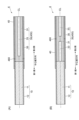
- FIG. 11 is a diagram showing a vertical cross section of the flavor inhalation article 5 according to the second embodiment.
- the flavor inhalation article 5 according to the second embodiment is different from the flavor inhalation article 4 according to the second embodiment in that it has a filter section 530 that corresponds to the filter section 30.
- the differences from the flavor inhalation article 4 will be described below.
- the same reference numerals are used for the same parts in the flavor inhalation article 4 and the flavor inhalation article 5, and detailed descriptions thereof will be omitted.
- the filter section 530 has a filter 31 which is a paper filter, a separate filter 32 which is an independent filter separate from the filter 31, a hollow member 33 which has a filtration rate lower than that of the filter 31, and a winding paper 35 which is present between the filter 31 and the tipping paper 40 and which is wound around the outer circumferential surface of the filter 31.
- the filter section 530 is connected (coupled) to the base material section 10 by winding the base material section 10 and the filter section 230 together using the tipping paper 40. It is preferable that the filter 31 and the separate filter 32 are each wound with a separate winding paper 35, and then wound together with another winding paper 35.
- the configuration of the separate filter 32 of the filter unit 530 can be, for example, the same as the separate filter 32 included in the filter unit 230 according to the first embodiment.
- the shapes and dimensions of the filter 31 and the separate filter 32 can be appropriately adjusted so that the shape and dimensions of the filter unit 530 fall within the above-mentioned ranges.
- the filter section 530 has a separate filter 32 connected to the second side of the base section 10, and a filter 31 located on the second side of the separate filter 32.
- the separate filter 32 is located on the upstream side, and the filter 31 is located on the downstream side, but the reverse arrangement may be used as shown in FIG. 11(B).
- a hollow member 33 smaller than the size of the filter 31 in the center line direction is arranged on the filter 31 with an opening on the second side (downstream side), and the first side (upstream side) of the hollow member 33 is arranged within a predetermined distance from the boundary between the filter 31 and the separate filter 32, and a communication hole 460 may be provided in the upstream region of the hollow member 33.
- the hollow member may be arranged with an opening on the first side (upstream side) of the filter section 530, and the second side (downstream side) may be arranged within a predetermined distance from the boundary between the filter 31 and the separate filter 32, and the communication hole 460 may be provided in the downstream region of the hollow member 33.
- a filter section for an flavor inhalation article comprising: a paper filter filled with a sheet member so as to form a gap in the longitudinal direction; and a hollow member disposed within the paper filter along the longitudinal direction of the filter section and having a filtration rate lower than that of the paper filter, at least one end of the hollow member being disposed at a position within a predetermined distance from the longitudinal end of the filter section.
- the filter section for a flavor inhalation article described in (1) wherein one end of the hollow member is within a predetermined distance from the downstream end side of the filter section, and the other end has an opening disposed on the upstream end side of the filter section.
- the filter portion for a flavor inhalation article according to (2) wherein the predetermined distance is 1 ⁇ 2 ⁇ A ⁇ 3 (A is the diameter of the outer circumferential circle of the opening).
- the hollow member includes at least paper.
- a flavor inhalation article comprising a filter portion according to any one of (1) to (11) and a substrate portion including an aerosol source.
Landscapes
- Chemical & Material Sciences (AREA)
- Engineering & Computer Science (AREA)
- Materials Engineering (AREA)
- Cigarettes, Filters, And Manufacturing Of Filters (AREA)
- Packages (AREA)
Priority Applications (22)
| Application Number | Priority Date | Filing Date | Title |
|---|---|---|---|
| JP2024566957A JPWO2024142168A1 (https=) | 2022-12-26 | 2022-12-26 | |
| EP22969962.4A EP4643673A1 (en) | 2022-12-26 | 2022-12-26 | Filter portion for flavor inhalation article and flavor inhalation article |
| PCT/JP2022/047989 WO2024142168A1 (ja) | 2022-12-26 | 2022-12-26 | 香味吸引物品用のフィルタ部および香味吸引物品 |
| KR1020257020934A KR20250114364A (ko) | 2022-12-26 | 2022-12-26 | 향미 흡인 물품용 필터부 및 향미 흡인 물품 |
| CN202280102813.4A CN120475914A (zh) | 2022-12-26 | 2022-12-26 | 用于风味吸入制品的过滤器部分和风味吸入制品 |
| JP2024567201A JPWO2024142465A1 (https=) | 2022-12-26 | 2023-08-17 | |
| KR1020257020930A KR20250114362A (ko) | 2022-12-26 | 2023-08-17 | 향미 흡인 물품용 필터부 및 향미 흡인 물품 |
| JP2024567199A JPWO2024142463A1 (https=) | 2022-12-26 | 2023-08-17 | |
| EP23911249.3A EP4643675A1 (en) | 2022-12-26 | 2023-08-17 | Flavor inhalation article |
| CN202380088029.7A CN120390592A (zh) | 2022-12-26 | 2023-08-17 | 用于风味吸入制品的过滤器部分和风味吸入制品 |
| PCT/JP2023/029662 WO2024142464A1 (ja) | 2022-12-26 | 2023-08-17 | 香味吸引物品用のフィルタ部及び香味吸引物品 |
| CN202380088007.0A CN120712028A (zh) | 2022-12-26 | 2023-08-17 | 风味吸入制品 |
| JP2024567200A JPWO2024142464A1 (https=) | 2022-12-26 | 2023-08-17 | |
| PCT/JP2023/029663 WO2024142465A1 (ja) | 2022-12-26 | 2023-08-17 | 香味吸引物品 |
| EP23911247.7A EP4643669A1 (en) | 2022-12-26 | 2023-08-17 | Flavor inhalation article |
| EP23911248.5A EP4643674A1 (en) | 2022-12-26 | 2023-08-17 | Filter part for flavor inhalation article and flavor inhalation article |
| US19/142,975 US20260101923A1 (en) | 2022-12-26 | 2023-08-17 | Filter section for flavor inhalation article and flavor inhalation article |
| PCT/JP2023/029655 WO2024142463A1 (ja) | 2022-12-26 | 2023-08-17 | 香味吸引物品 |
| KR1020257020944A KR20250114073A (ko) | 2022-12-26 | 2023-08-17 | 향미 흡입 물품 |
| CN202380088039.0A CN120659554A (zh) | 2022-12-26 | 2023-08-17 | 风味吸入制品 |
| KR1020257020932A KR20250114363A (ko) | 2022-12-26 | 2023-08-17 | 향미 흡인 물품 |
| TW113117238A TWI914801B (zh) | 2023-08-17 | 2024-05-09 | 香味吸嚐物品 |
Applications Claiming Priority (1)
| Application Number | Priority Date | Filing Date | Title |
|---|---|---|---|
| PCT/JP2022/047989 WO2024142168A1 (ja) | 2022-12-26 | 2022-12-26 | 香味吸引物品用のフィルタ部および香味吸引物品 |
Publications (1)
| Publication Number | Publication Date |
|---|---|
| WO2024142168A1 true WO2024142168A1 (ja) | 2024-07-04 |
Family
ID=91716961
Family Applications (1)
| Application Number | Title | Priority Date | Filing Date |
|---|---|---|---|
| PCT/JP2022/047989 Ceased WO2024142168A1 (ja) | 2022-12-26 | 2022-12-26 | 香味吸引物品用のフィルタ部および香味吸引物品 |
Country Status (5)
| Country | Link |
|---|---|
| EP (1) | EP4643673A1 (https=) |
| JP (1) | JPWO2024142168A1 (https=) |
| KR (1) | KR20250114364A (https=) |
| CN (1) | CN120475914A (https=) |
| WO (1) | WO2024142168A1 (https=) |
Cited By (1)
| Publication number | Priority date | Publication date | Assignee | Title |
|---|---|---|---|---|
| WO2026074601A1 (ja) * | 2024-10-01 | 2026-04-09 | 日本たばこ産業株式会社 | エアロゾル生成物品用のフィルタ、及び該フィルタを備えるエアロゾル生成物品 |
Citations (7)
| Publication number | Priority date | Publication date | Assignee | Title |
|---|---|---|---|---|
| JPS592678A (ja) * | 1982-06-24 | 1984-01-09 | ブラウン・アンド・ウイリアムソン・タバコ・コ−ポレ−シヨン | シガレツトフイルタ |
| JP2004510422A (ja) | 2000-10-05 | 2004-04-08 | バスケヴィッチ ニコラス | タバコおよびタバコ製品中のニトロソアミン削減 |
| JP2014509872A (ja) * | 2011-04-08 | 2014-04-24 | アール・ジエイ・レイノルズ・タバコ・カンパニー | フィルタ内に管状要素を含むフィルタ付シガレット |
| WO2014104078A1 (ja) | 2012-12-28 | 2014-07-03 | 日本たばこ産業株式会社 | 非燃焼吸引型たばこ製品用香味源及び非燃焼吸引型たばこ製品 |
| JP2019180323A (ja) * | 2018-04-12 | 2019-10-24 | 株式会社 東亜産業 | 電子タバコカートリッジ |
| WO2022085073A1 (ja) * | 2020-10-20 | 2022-04-28 | 日本たばこ産業株式会社 | 粒子を含有する香味吸引物品フィルター用シートおよびその製造方法 |
| JP2022527741A (ja) * | 2020-03-09 | 2022-06-06 | ケーティー アンド ジー コーポレイション | エアロゾル発生物品 |
Family Cites Families (4)
| Publication number | Priority date | Publication date | Assignee | Title |
|---|---|---|---|---|
| GB201919107D0 (en) * | 2019-12-20 | 2020-02-05 | Nicoventures Trading Ltd | An article for use in a non-combustible aerosol provision system |
| JP7333833B2 (ja) * | 2020-01-15 | 2023-08-25 | 日本たばこ産業株式会社 | 非燃焼加熱型香味吸引器具用フィルターセグメント、非燃焼加熱型香味吸引器具、及び非燃焼加熱型香味吸引システム |
| EP4115751A4 (en) * | 2020-03-02 | 2023-09-27 | Japan Tobacco Inc. | FILTERS, SMOKING ITEMS AND FLAVOR INHALATION ITEMS |
| GB202119095D0 (en) * | 2021-12-29 | 2022-02-09 | Nicoventures Trading Ltd | A component for a delivery system and a method and apparatus for manufacturing a component for a delivery system |
-
2022
- 2022-12-26 JP JP2024566957A patent/JPWO2024142168A1/ja active Pending
- 2022-12-26 KR KR1020257020934A patent/KR20250114364A/ko active Pending
- 2022-12-26 EP EP22969962.4A patent/EP4643673A1/en active Pending
- 2022-12-26 WO PCT/JP2022/047989 patent/WO2024142168A1/ja not_active Ceased
- 2022-12-26 CN CN202280102813.4A patent/CN120475914A/zh active Pending
Patent Citations (7)
| Publication number | Priority date | Publication date | Assignee | Title |
|---|---|---|---|---|
| JPS592678A (ja) * | 1982-06-24 | 1984-01-09 | ブラウン・アンド・ウイリアムソン・タバコ・コ−ポレ−シヨン | シガレツトフイルタ |
| JP2004510422A (ja) | 2000-10-05 | 2004-04-08 | バスケヴィッチ ニコラス | タバコおよびタバコ製品中のニトロソアミン削減 |
| JP2014509872A (ja) * | 2011-04-08 | 2014-04-24 | アール・ジエイ・レイノルズ・タバコ・カンパニー | フィルタ内に管状要素を含むフィルタ付シガレット |
| WO2014104078A1 (ja) | 2012-12-28 | 2014-07-03 | 日本たばこ産業株式会社 | 非燃焼吸引型たばこ製品用香味源及び非燃焼吸引型たばこ製品 |
| JP2019180323A (ja) * | 2018-04-12 | 2019-10-24 | 株式会社 東亜産業 | 電子タバコカートリッジ |
| JP2022527741A (ja) * | 2020-03-09 | 2022-06-06 | ケーティー アンド ジー コーポレイション | エアロゾル発生物品 |
| WO2022085073A1 (ja) * | 2020-10-20 | 2022-04-28 | 日本たばこ産業株式会社 | 粒子を含有する香味吸引物品フィルター用シートおよびその製造方法 |
Non-Patent Citations (2)
| Title |
|---|
| "Tobacco Encyclopedia, Tobacco Research Center", 31 March 2009 |
| See also references of EP4643673A1 |
Cited By (1)
| Publication number | Priority date | Publication date | Assignee | Title |
|---|---|---|---|---|
| WO2026074601A1 (ja) * | 2024-10-01 | 2026-04-09 | 日本たばこ産業株式会社 | エアロゾル生成物品用のフィルタ、及び該フィルタを備えるエアロゾル生成物品 |
Also Published As
| Publication number | Publication date |
|---|---|
| EP4643673A1 (en) | 2025-11-05 |
| JPWO2024142168A1 (https=) | 2024-07-04 |
| CN120475914A (zh) | 2025-08-12 |
| KR20250114364A (ko) | 2025-07-29 |
Similar Documents
| Publication | Publication Date | Title |
|---|---|---|
| US20240324663A1 (en) | Non-combustion-heating-type stick | |
| WO2024142168A1 (ja) | 香味吸引物品用のフィルタ部および香味吸引物品 | |
| WO2024142167A1 (ja) | 香味吸引物品用のフィルタ部および香味吸引物品 | |
| WO2025037414A1 (ja) | 香味吸引物品用のフィルタ部及び香味吸引物品 | |
| WO2025037415A1 (ja) | 香味吸引物品用のフィルタ部及び香味吸引物品 | |
| JP7719208B2 (ja) | 非燃焼加熱型スティック、吸引システム | |
| WO2024142464A1 (ja) | 香味吸引物品用のフィルタ部及び香味吸引物品 | |
| WO2024142166A1 (ja) | 香味吸引物品 | |
| JP7756722B2 (ja) | 非燃焼加熱型スティック | |
| JP7522863B2 (ja) | 非燃焼加熱式たばこ及び電気加熱式たばこ製品 | |
| WO2025186899A1 (ja) | 香味吸引物品 | |
| JP7659576B2 (ja) | 非燃焼加熱式たばこ及び電気加熱式たばこ製品 | |
| KR20260056214A (ko) | 향미 흡입 물품을 위한 필터 부분, 및 향미 흡입 물품 | |
| JP2025135177A (ja) | 香味吸引物品 | |
| WO2025186900A1 (ja) | 香味吸引物品 | |
| WO2025037416A1 (ja) | 香味吸引物品 | |
| WO2025243507A1 (ja) | 香味発生物品および香味発生システム | |
| WO2023112154A1 (ja) | 非燃焼加熱型スティック | |
| WO2025052625A1 (ja) | 香味発生物品 | |
| WO2025126308A1 (ja) | 香味発生物品 | |
| WO2025052620A1 (ja) | 香味発生物品 | |
| WO2025052617A1 (ja) | 香味発生物品 | |
| WO2023112153A1 (ja) | 非燃焼加熱型スティック | |
| WO2023012921A1 (ja) | 香味発生物品および喫煙システム |
Legal Events
| Date | Code | Title | Description |
|---|---|---|---|
| 121 | Ep: the epo has been informed by wipo that ep was designated in this application |
Ref document number: 22969962 Country of ref document: EP Kind code of ref document: A1 |
|
| WWE | Wipo information: entry into national phase |
Ref document number: 202590963 Country of ref document: EA |
|
| WWE | Wipo information: entry into national phase |
Ref document number: 2024566957 Country of ref document: JP |
|
| WWE | Wipo information: entry into national phase |
Ref document number: 1020257020934 Country of ref document: KR |
|
| WWE | Wipo information: entry into national phase |
Ref document number: 202280102813.4 Country of ref document: CN |
|
| WWE | Wipo information: entry into national phase |
Ref document number: 2022969962 Country of ref document: EP |
|
| NENP | Non-entry into the national phase |
Ref country code: DE |
|
| WWP | Wipo information: published in national office |
Ref document number: 1020257020934 Country of ref document: KR |
|
| ENP | Entry into the national phase |
Ref document number: 2022969962 Country of ref document: EP Effective date: 20250728 |
|
| ENP | Entry into the national phase |
Ref document number: 2022969962 Country of ref document: EP Effective date: 20250728 |
|
| WWP | Wipo information: published in national office |
Ref document number: 202280102813.4 Country of ref document: CN |
|
| WWP | Wipo information: published in national office |
Ref document number: 2022969962 Country of ref document: EP |